
Static GK – General Knowledge for Competitive Exams
Latest posts and quizzes curated for the Static GK track.
Latest Posts & Quizzes
Page 1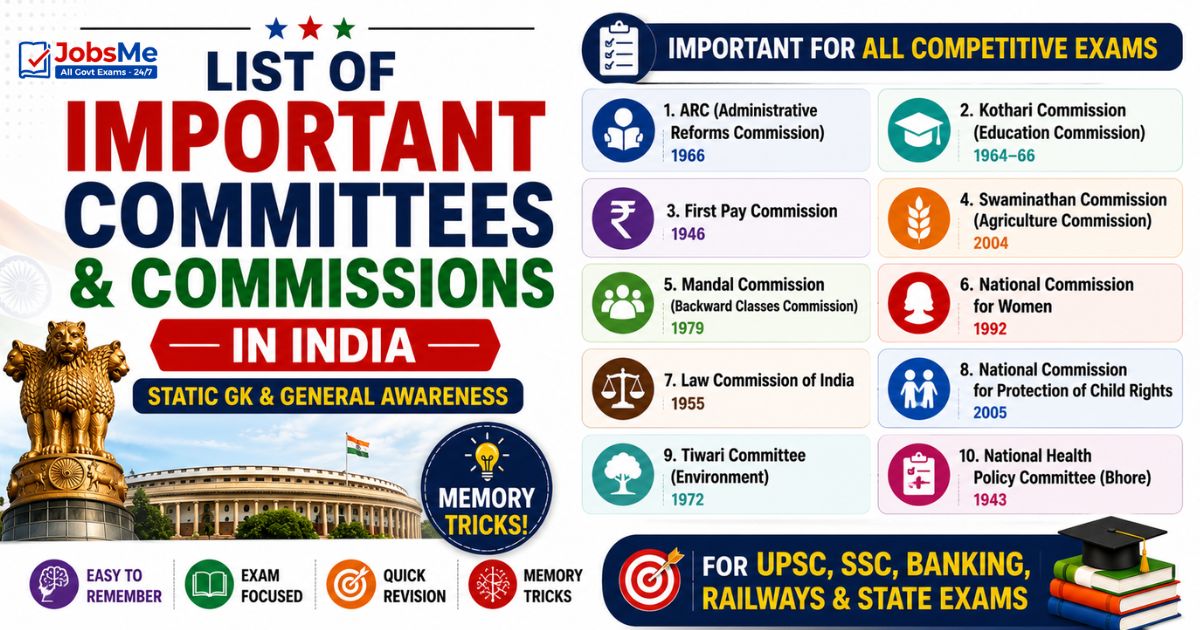
NewList of Important Committees and Commissions in India – Static GK & General Awareness for Competitive Exams with Memory Tricks
This article presents a complete list of important committees and commissions in India, covering Centre-State relations, Panchayati Raj, administrative reforms, education, banking, tax, police, social justice, and parliamentary committees, along with their chairpersons, year of establishment, and key recommendations. It includes iconic bodies like the Sarkaria Commission, Mandal Commission, Kothari Commission, Punchhi Commission, Narasimham Committee, Balwant Rai Mehta Committee, ARC I and II, Shah Commission, Liberhan Commission, and all major permanent commissions like UPSC, ECI, UGC, NHRC, CVC, and CCI, with memory tricks and one-liners for quick revision. All facts are arranged in exam-ready format to help UPSC, SSC, IBPS, RRB, PSU, Insurance, and State PCS aspirants score better in General Awareness, Polity, and Governance sections.
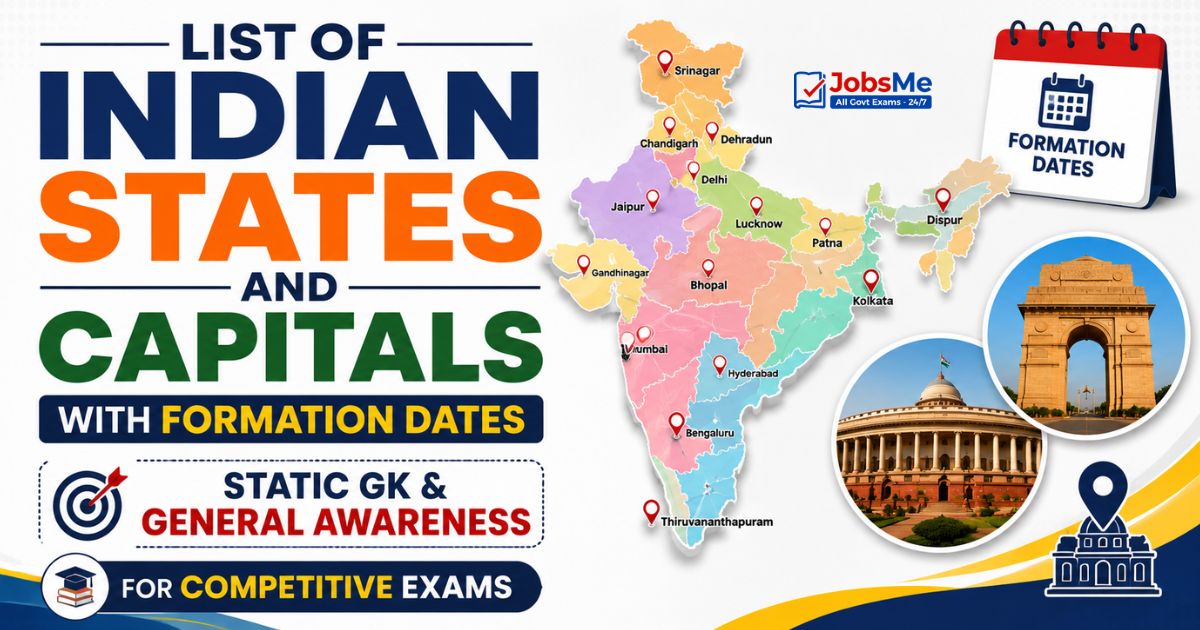
NewList of Indian States and Capitals with Formation Dates – Static GK & General Awareness for Competitive Exams with Memory Tricks
This article presents a complete list of all 28 Indian States and 8 Union Territories with their capitals, formation dates, governing acts, official languages, and state specialities. It includes every major fact tested in competitive exams – from the States Reorganisation Act of 1956 to the latest 2026 amendment making Amaravati the sole capital of Andhra Pradesh – along with memory tricks, mnemonics, and one-liners for quick revision. All facts are arranged in exam-ready format to help UPSC, SSC, IBPS, RRB, PSU, Defence, and State PCS aspirants score better in General Awareness, Indian Polity, and Geography sections.
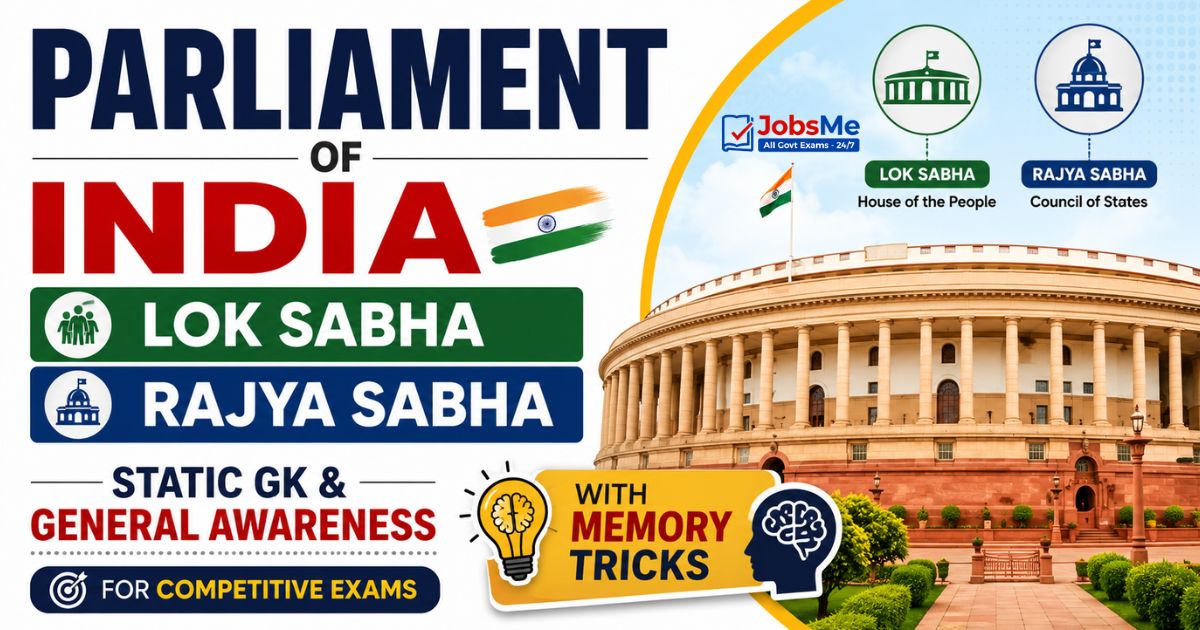
NewParliament of India – Lok Sabha and Rajya Sabha Static GK & General Awareness for Competitive Exams with Memory Tricks
This article presents a complete and exam-ready guide to the Indian Parliament, covering the composition, powers, and functions of the Lok Sabha (House of the People) and Rajya Sabha (Council of States) along with key Articles (79 to 122) of the Constitution, sessions, bills, majorities, parliamentary devices, and important constitutional amendments. It also lists every important Speaker, Chairman, Leader of Opposition, qualification, quorum, and joint sitting fact in one place with memory tricks, one-liners, and PYQ patterns. All facts are arranged to help UPSC, SSC, IBPS, RRB, PSU, Defence, Insurance, and State PCS aspirants score better in Polity and General Awareness.
NewFundamental Rights, Duties, and DPSP Static GK Notes for UPSC, SSC, Banking and Railways Exams
This article gives a complete one-stop revision of Fundamental Rights (Articles 12-35), Fundamental Duties (Article 51A), and the Directive Principles of State Policy (Articles 36-51) of the Indian Constitution. It includes all articles, landmark Supreme Court cases, key amendments, memory tricks, and one-liners specially curated for UPSC, SSC, IBPS, RRB, Insurance, Defence, and State PCS aspirants.
Parts of the Indian Constitution – Static GK & General Awareness for Competitive Exams with Memory Tricks
This article presents a complete list of all 25 Parts of the Indian Constitution along with their subject matter, article ranges, and key features — covering Fundamental Rights, Directive Principles, Fundamental Duties, Panchayats, Municipalities, Emergency Provisions, and every other constitutional segment. It includes the four parts added later (Part IVA, IXA, IXB and XIVA), the repealed Part VII, and detailed memory tricks for instant recall. All facts are arranged in exam-ready format to help UPSC, SSC, IBPS, RRB, PSU, Insurance and State PCS aspirants score better in Indian Polity and General Awareness sections.
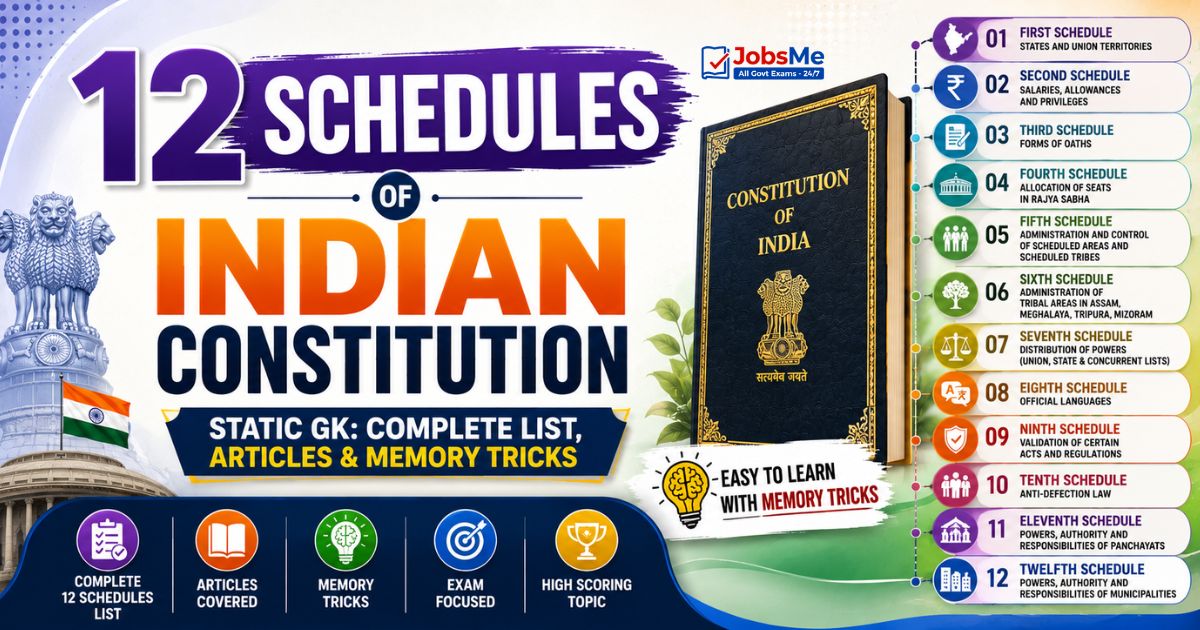
12 Schedules of Indian Constitution Static GK: Complete List, Articles and Memory Tricks
This article gives a complete, exam-ready overview of all 12 Schedules of the Indian Constitution, the Articles linked to each Schedule, and the Constitutional Amendments that added the 9th, 10th, 11th and 12th Schedules. It is built for UPSC, SSC, IBPS, RRB, State PCS and Defence aspirants who need quick revision notes, mnemonics and a one-shot reference for Static GK and Polity.
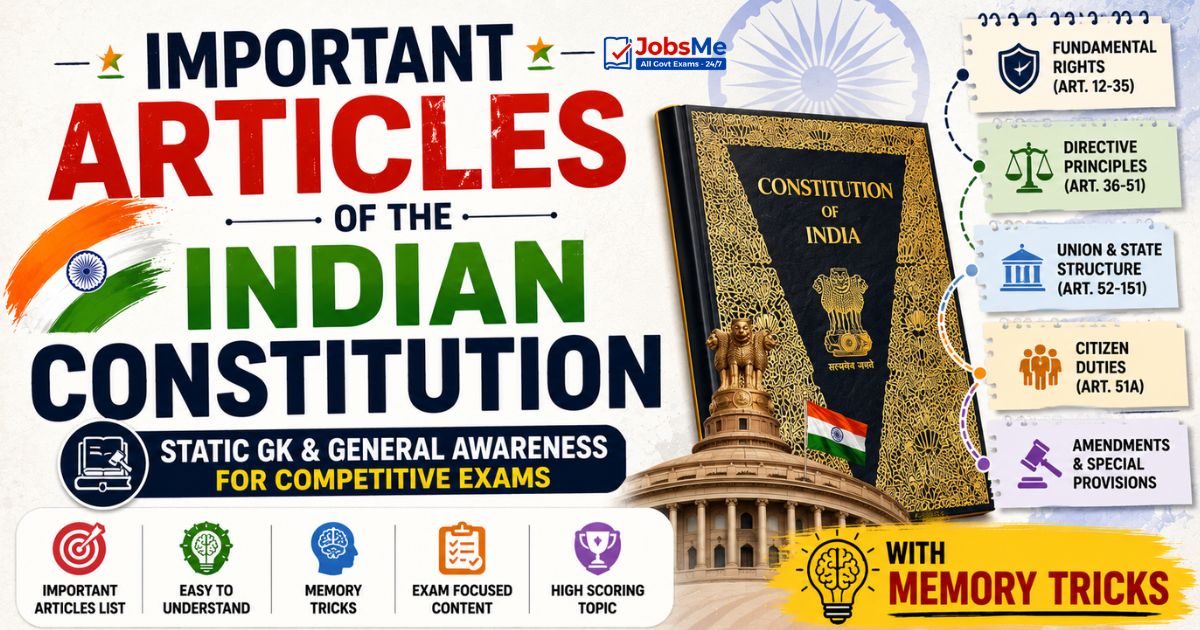
Important Articles of the Indian Constitution – Static GK & General Awareness for Competitive Exams with Memory Tricks
This article presents a complete, exam-ready list of the most important Articles of the Indian Constitution, arranged Part-wise from Article 1 to Article 395, covering Fundamental Rights, Directive Principles, Fundamental Duties, Union and State Government, Judiciary, Finance Commission, Elections, Emergency Provisions, and the Amendment procedure. It includes key articles like Article 14 (Equality), Article 19 (Six Freedoms), Article 21 (Right to Life), Article 32 (Constitutional Remedies), Article 356 (President's Rule), Article 368 (Amendment), and Article 370 (J&K), along with memory tricks, mnemonics, and one-liners for quick revision. All facts are arranged in a structured format to help UPSC, SSC, IBPS, RRB, PSU, Insurance, and State PCS aspirants score better in General Awareness, Indian Polity, and Static GK sections.
List of Freedom Fighters and Their Slogans – Static GK & General Awareness for Competitive Exams with Memory Tricks
This article presents a complete list of Indian freedom fighters and their famous slogans, covering the leaders of the Swadeshi, Home Rule, Non-Cooperation, Civil Disobedience, and Quit India Movements, along with the meaning, origin, and historical context behind each slogan. It includes iconic battle cries like "Do or Die" (Gandhi), "Inquilab Zindabad" (Bhagat Singh), "Give Me Blood and I Shall Give You Freedom" (Subhash Chandra Bose), "Swaraj is My Birthright" (Tilak), "Simon Go Back" (Lala Lajpat Rai), and "Vande Mataram" (Bankim Chandra Chattopadhyay), with memory tricks and exam-ready one-liners. All facts are arranged in a structured format to help UPSC, SSC, IBPS, RRB, PSU, and State PCS aspirants score better in General Awareness and Modern History sections.
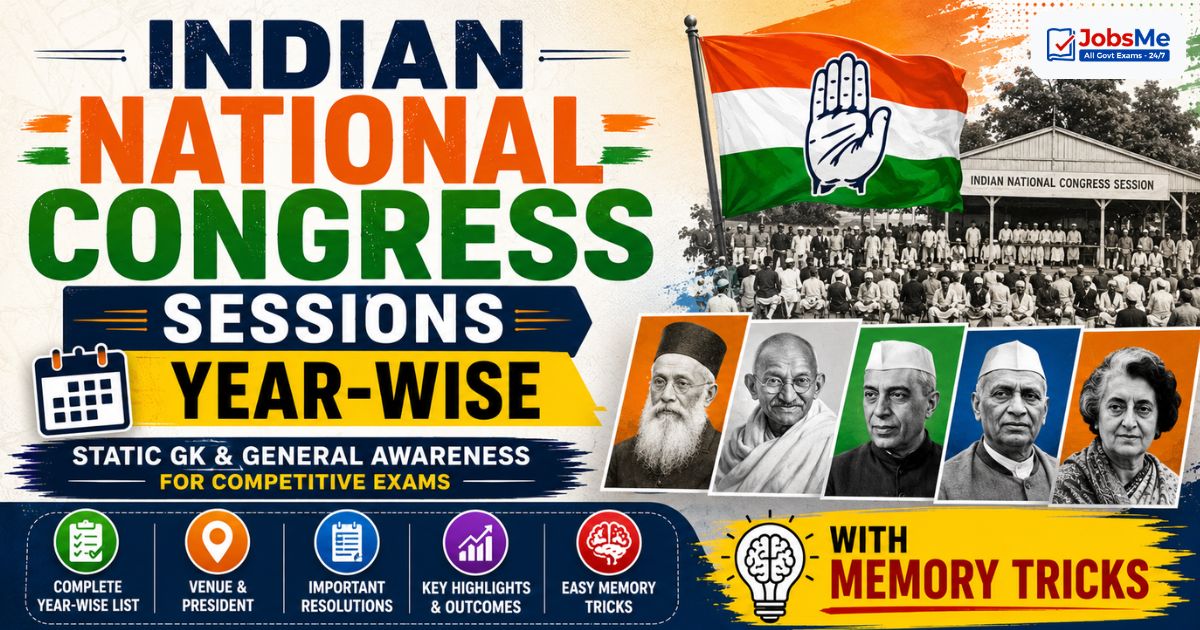
List of Indian National Congress (INC) Sessions Year-Wise – Static GK & General Awareness for Competitive Exams with Memory Tricks
This article presents the complete year-wise list of Indian National Congress (INC) Sessions from the inaugural Bombay session of 1885 to the post-Independence sessions of the 1980s, covering presidents, venues, and key outcomes of each session. It includes historic landmarks such as the first session at Gokuldas Tejpal Sanskrit College, the Surat Split of 1907, the Lucknow Pact of 1916, the Purna Swaraj resolution at Lahore in 1929, and the Karachi Session of 1931 on Fundamental Rights — along with memory tricks, mnemonics, and exam one-liners for quick revision. All facts are arranged in exam-ready format to help UPSC, SSC, IBPS, RRB, PSU, and State PCS aspirants score better in Modern History and General Awareness sections.
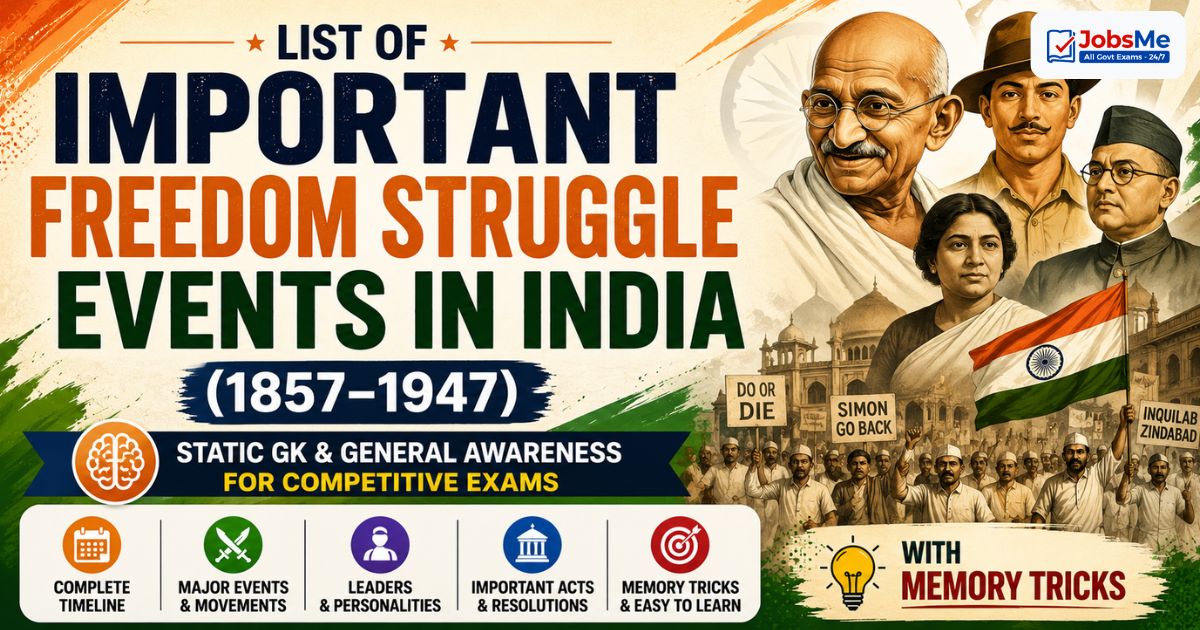
List of Important Freedom Struggle Events in India (1857–1947) – Static GK & General Awareness for Competitive Exams with Memory Tricks
This article presents a complete list of important Freedom Struggle Events in India from 1857 to 1947, covering the Revolt of 1857, Partition of Bengal, Swadeshi Movement, Home Rule Movement, Non-Cooperation Movement, Civil Disobedience Movement, Quit India Movement, INA campaigns, tribal uprisings, and peasant movements, along with leaders, locations, and outcomes. It includes phase-wise classification (Moderate, Extremist, Gandhian Era), British repressive acts, and memory tricks for quick revision. All facts are arranged in exam-ready format to help UPSC, SSC, IBPS, RRB, PSU, and State PCS aspirants score better in Modern History and General Awareness sections.
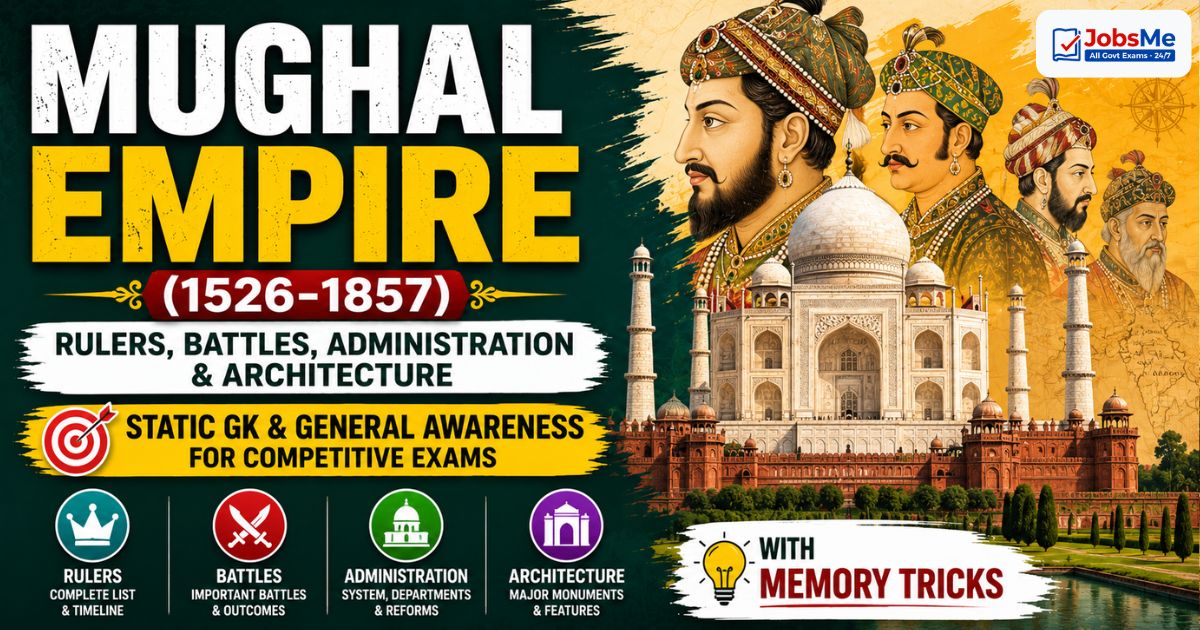
Mughal Empire (1526-1857) – Rulers, Battles, Administration & Architecture – Static GK & General Awareness for Competitive Exams with Memory Tricks
This article presents a complete, exam-ready summary of the Mughal Empire (1526-1857), covering its founder Babur, the great Mughals (Humayun, Akbar, Jahangir, Shah Jahan, Aurangzeb), the Later Mughals, key battles like the First and Second Battles of Panipat, the Mansabdari and Zabt revenue systems, and iconic monuments like the Taj Mahal, Red Fort, Fatehpur Sikri, and Humayun's Tomb. All facts are arranged with tables, memory tricks, and one-liners to help UPSC, SSC, IBPS, RRB, PSU, Defence, Insurance, and State PCS aspirants master Medieval History and Static GK.
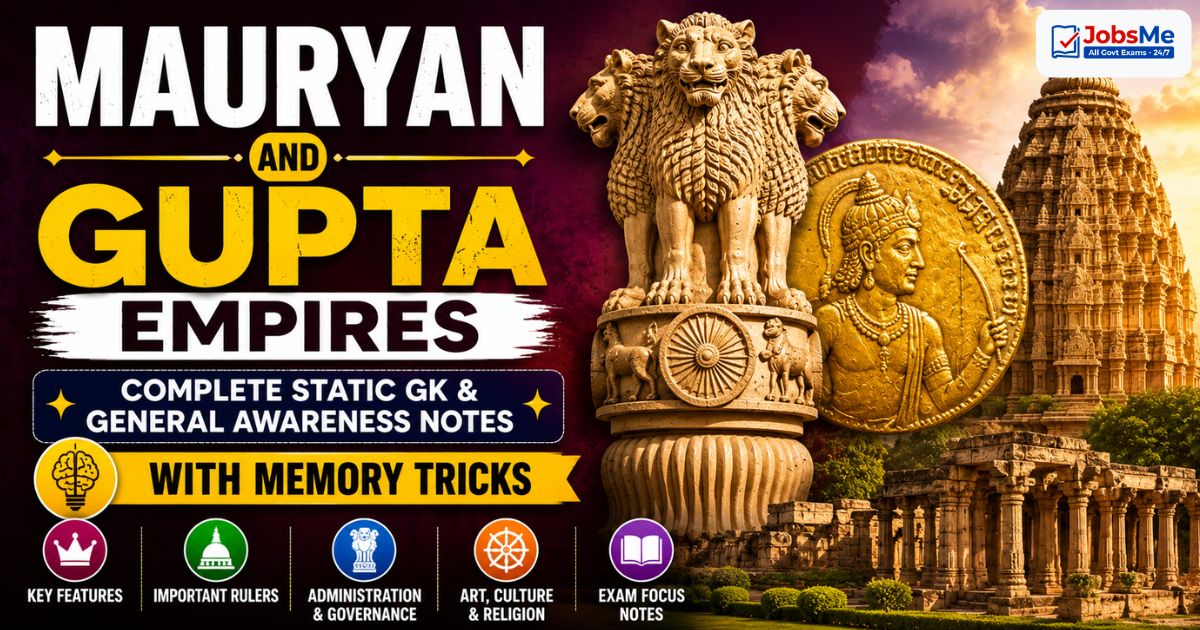
Mauryan and Gupta Empires – Complete Static GK & General Awareness Notes for Competitive Exams with Memory Tricks
This article provides a complete, exam-ready guide to the Mauryan Empire (321 BCE–185 BCE) and the Gupta Empire (319 CE–550 CE), covering all rulers, administration, art, literature, key inscriptions, foreign travellers, and major events. It includes ruler-wise tables, the Navaratnas of Chandragupta II, comparison charts, memory tricks, and one-liners designed for UPSC, SSC, IBPS, RRB, PSU, Defence, and State PCS aspirants preparing for Ancient History and General Awareness sections.
Indus Valley Civilization – Static GK & General Awareness Notes for UPSC, SSC, IBPS, RRB Exams with Memory Tricks
This article presents complete, exam-ready notes on the Indus Valley Civilization (IVC), also known as the Harappan Civilization, covering its chronology, major sites like Harappa, Mohenjo-Daro, Dholavira, Lothal, Kalibangan, Rakhigarhi and Chanhudaro, along with their excavators and key findings. It also covers town planning, agriculture, trade, religion, art, the Indus script, theories of decline, and the latest discoveries from 2021 to 2026. All facts are arranged in a structured format with memory tricks and one-liners to help UPSC, SSC, IBPS, RRB, PSU, Defence and State PCS aspirants score better in History and General Awareness sections.

National Park vs Wildlife Sanctuary vs Biosphere Reserve – Static GK & General Awareness for Competitive Exams with Memory Tricks
This article gives a complete, exam-ready comparison of National Parks, Wildlife Sanctuaries, and Biosphere Reserves in India — covering their legal basis under the Wildlife Protection Act 1972 and UNESCO's Man and Biosphere (MAB) Programme, IUCN categories, zoning, permitted human activities, ownership, and important examples like Jim Corbett, Hemis, Kaziranga, Gir, Nilgiri, and Gulf of Kachchh. It includes the latest numbers (107 National Parks, 573 Wildlife Sanctuaries, 18 Biosphere Reserves) along with memory tricks, one-liners, and frequently asked exam questions tailored for UPSC, SSC, IBPS, RRB, PSU, Defence, Insurance, and State PCS aspirants.
Indian River Systems and Drainage Static GK: Complete Notes with Maps, Tributaries, and Memory Tricks for All Exams
This article covers every major Indian river system and drainage pattern that government exam aspirants need to know — from the Himalayan rivers like Indus, Ganga, and Brahmaputra to peninsular rivers like Godavari, Krishna, Narmada, and Kaveri. It includes complete tables of origins, lengths, tributaries, dams, and exam-favourite one-liners, along with mnemonics and PYQ patterns for SSC, UPSC, IBPS, RRB, Defence, Insurance, and State PCS exams.
Indian Agriculture and Top Producer States: Complete Static GK Notes for Government Exams
This article gives a complete, exam-ready guide to Indian agriculture and the top producer states of every major crop, fruit, vegetable, spice, plantation crop, livestock product, and fisheries item. It also covers cropping seasons, India's global agricultural rank, agricultural revolutions, and quick memory tricks designed for UPSC, SSC, IBPS, RRB, State PCS, Defence, Insurance, and PSU exams.
Mineral Resources of India: Complete Static GK Notes with Mines, States and Memory Tricks
This article gives a complete, exam-ready overview of the Mineral Resources of India, covering types of minerals, their characteristics, major mineral belts, state-wise distribution, leading mines, and key public sector companies. It is designed for UPSC, SSC, IBPS, RRB, PSU, Defence, Insurance and State PCS aspirants who need accurate Static GK and General Awareness in one place.

List of Famous Books by Indian Authors – Static GK & General Awareness for Competitive Exams with Memory Tricks
This article presents a complete, exam-ready list of famous books by Indian authors, covering ancient Sanskrit classics, medieval Persian and Arabic chronicles, freedom-struggle writings, post-Independence literary masters, and the latest releases from 2018 right up to 2026. It includes iconic works like Arthashastra by Kautilya, Discovery of India by Jawaharlal Nehru, My Experiments with Truth by Mahatma Gandhi, Geetanjali by Rabindranath Tagore, Midnight's Children by Salman Rushdie, Tomb of Sand by Geetanjali Shree, and Tides of Time by Sudha Murty, along with memory tricks, mnemonics, and one-liners for quick revision. All facts are arranged in exam-ready format to help UPSC, SSC, IBPS, RRB, PSU, Insurance, and State PCS aspirants score better in General Awareness and Static GK sections.

Economic Terms & Concepts: Complete Static GK Notes for UPSC, SSC, Banking, RRB and PSU Exams 2026
This article is a complete, exam-focused guide to Economic Terms & Concepts Static GK covering fiscal deficit, monetary policy tools, GDP, inflation, taxation and external sector concepts. It includes clean definitions, comparison tables, easy memory tricks, frequently confused facts and 60+ one-liners that aspirants can use for quick revision before UPSC, SSC, IBPS, RRB, Insurance and State PCS exams.
History of Banking in India – Static GK & Banking Awareness Notes for SSC, IBPS, UPSC, RRB and PSU Exams with Memory Tricks
This article presents the complete history of banking in India from the Bank of Hindustan (1770) and the three Presidency Banks to the formation of the Imperial Bank of India, the birth of the State Bank of India in 1955, the nationalisation of banks in 1969 and 1980, and the liberalisation reforms after 1991 leading to the modern bank mergers of 2017 to 2020. It covers the structure of Indian banking, the role of RBI, types of banks (Scheduled, Public Sector, Private Sector, Foreign, RRBs, Cooperative), key committees, and important dates, with memory tricks, mnemonics, and exam-ready one-liners. All facts are arranged in exam-friendly format to help UPSC, SSC, IBPS, RRB, PSU, Insurance, and State PCS aspirants score better in Banking Awareness, General Awareness, and Economy sections.
Nobel Prize Indian Winners – Complete List, Years, Fields & Contributions (Static GK)
This article gives a complete, exam-ready list of all Indian and Indian-origin Nobel Prize winners from 1913 to date, covering the year, field, and key contribution of each laureate. It is designed for UPSC, SSC, Banking, Railways, Defence, and State PCS aspirants who need quick, accurate Static GK on Indian Nobel Laureates with mnemonics and one-liners.
Superlatives of India – Biggest, Largest, Highest, Longest, Smallest – Static GK & General Awareness for Competitive Exams with Memory Tricks
This article presents a complete list of Superlatives of India covering the biggest, largest, highest, longest, tallest, and smallest features across geography, monuments, infrastructure, water bodies, awards, and natural resources. It includes facts like Kangchenjunga (highest peak), Ganga (longest river), Thar (largest desert), Statue of Unity (tallest statue), Kunchikal Falls (highest waterfall), Rajasthan (largest state), Goa (smallest state), NH-44 (longest national highway), and Sundarbans (largest delta), with memory tricks and one-liners for quick revision. All facts are arranged in exam-ready format to help UPSC, SSC, IBPS, RRB, PSU, and State PCS aspirants score better in General Awareness and Static GK sections.
Nuclear Power Plants in India – Static GK & General Awareness for Competitive Exams with Memory Tricks
This article covers a complete state-wise list of operational, under-construction, and proposed nuclear power plants in India along with their reactor types, capacities, and key facts. It is designed for UPSC, SSC, IBPS, RRB, Insurance, Defence, and State PCS aspirants, with memory tricks, one-liners, and FAQs for quick revision. All facts are organised in an exam-ready format to help students master the General Awareness section.

Airports in India – Static GK & General Awareness for Competitive Exams with Memory Tricks
This article covers a comprehensive state-wise list of international and domestic airports in India, along with greenfield airports, classifications, managing authorities, and key aviation initiatives. It is designed for UPSC, SSC, IBPS, RRB, Insurance, Defence, and State PCS aspirants, with memory tricks, one-liners, and FAQs for quick revision. All facts are organised in an exam-ready format to help students score better in the General Awareness section.

Countries, Capitals and Currencies of the World – Static GK & General Awareness for Competitive Exams with Memory Tricks
This article covers a comprehensive continent-wise list of all countries of the world along with their capitals and official currencies, including special facts about shared currencies like the Euro, US Dollar, CFA Franc, and East Caribbean Dollar. It is designed for UPSC, SSC, IBPS, RRB, Insurance, Defence, and State PCS aspirants, with memory tricks, one-liners, and FAQs for quick revision. All facts are organised in an exam-ready format to help students score better in the General Awareness section.

Biosphere Reserves in India – Static GK & General Awareness for Competitive Exams with Memory Tricks
This article presents a complete list of all 18 biosphere reserves in India along with their year of establishment, states, UNESCO recognition status, key species, and biogeographical zones, making it an essential resource for UPSC, SSC, IBPS, RRB, and other government exam aspirants. It includes the first, largest, smallest, and latest UNESCO-recognised reserves, along with memory tricks and one-liners for quick revision. All facts are arranged in exam-ready format to help students score better in General Awareness sections.

National Parks and Wildlife Sanctuaries in India – Complete Static GK for Competitive Exams (State-Wise List, Memory Tricks & One-Liners)
This article covers the complete, updated list of National Parks and Wildlife Sanctuaries in India, organized state-wise for quick revision. It includes key facts, memory tricks, mnemonics, and one-liners essential for UPSC, SSC, Banking, Railways, Defence, and all other government competitive exams. With 107 National Parks and 550+ Wildlife Sanctuaries as of 2025, this is your one-stop reference for this high-priority Static GK topic.

UNESCO World Heritage Sites in India – Static GK & General Awareness for Competitive Exams with Memory Tricks
This article provides a complete and updated list of UNESCO World Heritage Sites in India along with their state, year of inscription, category, and key features, making it an essential resource for UPSC, SSC, IBPS, RRB, and other government exam aspirants. As of 2026, India has 44 UNESCO World Heritage Sites including 36 Cultural, 7 Natural, and 1 Mixed site, ranking India 6th globally. The article covers iconic sites like the Taj Mahal, Ajanta Caves, Kaziranga, Khangchendzonga, and the latest 2025 inscription — Maratha Military Landscapes — along with memory tricks and one-liners for quick revision.
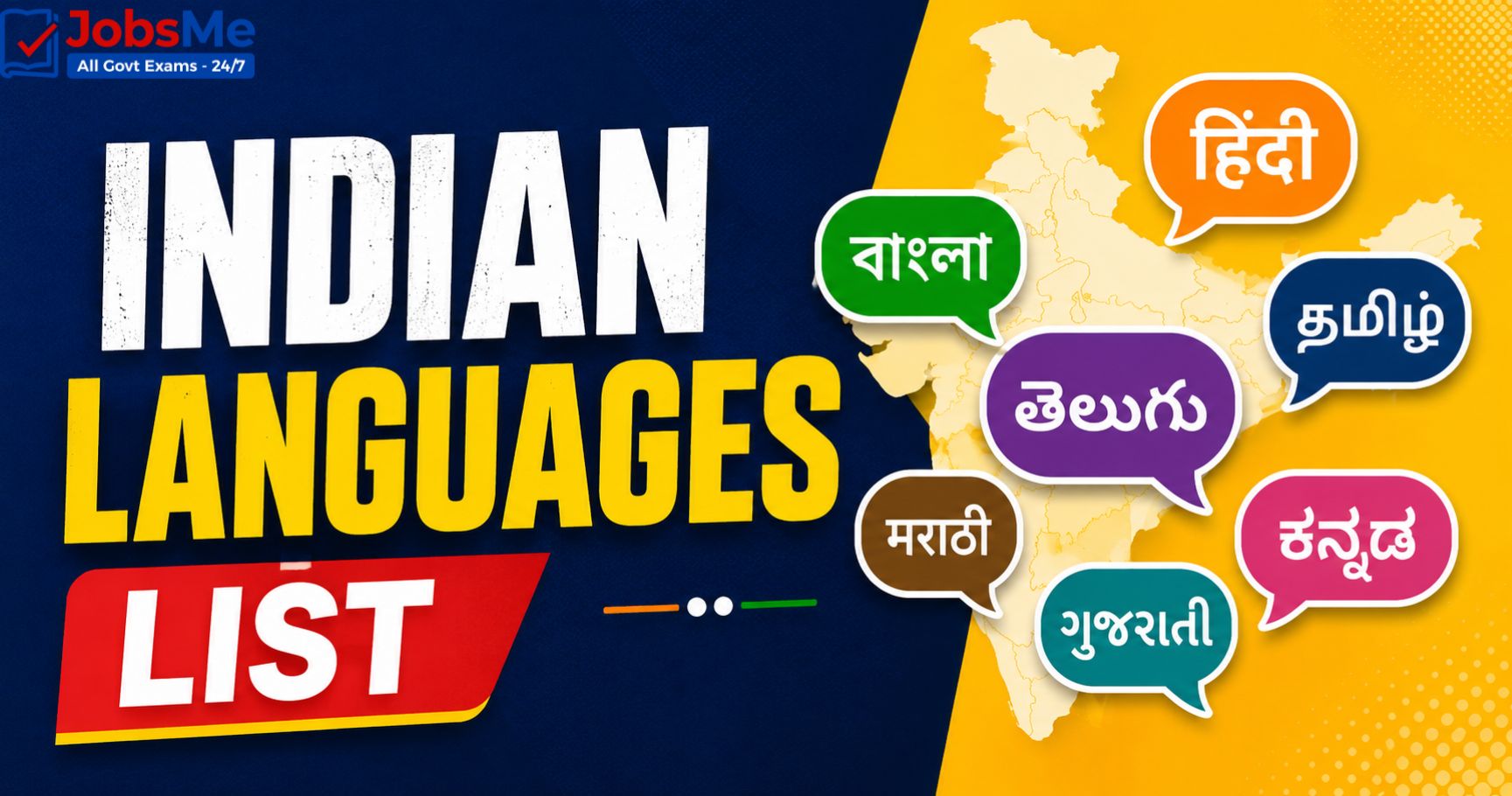
Indian Languages – Complete Static GK Notes for Government Exams
A complete guide to Indian languages for competitive exam aspirants. This article covers the 22 Scheduled Languages, state-wise official languages, language families, classical languages, writing systems, and memory tricks — everything you need to score well in the Static GK / General Awareness section of UPSC, SSC, IBPS, Railways, and other government exams.
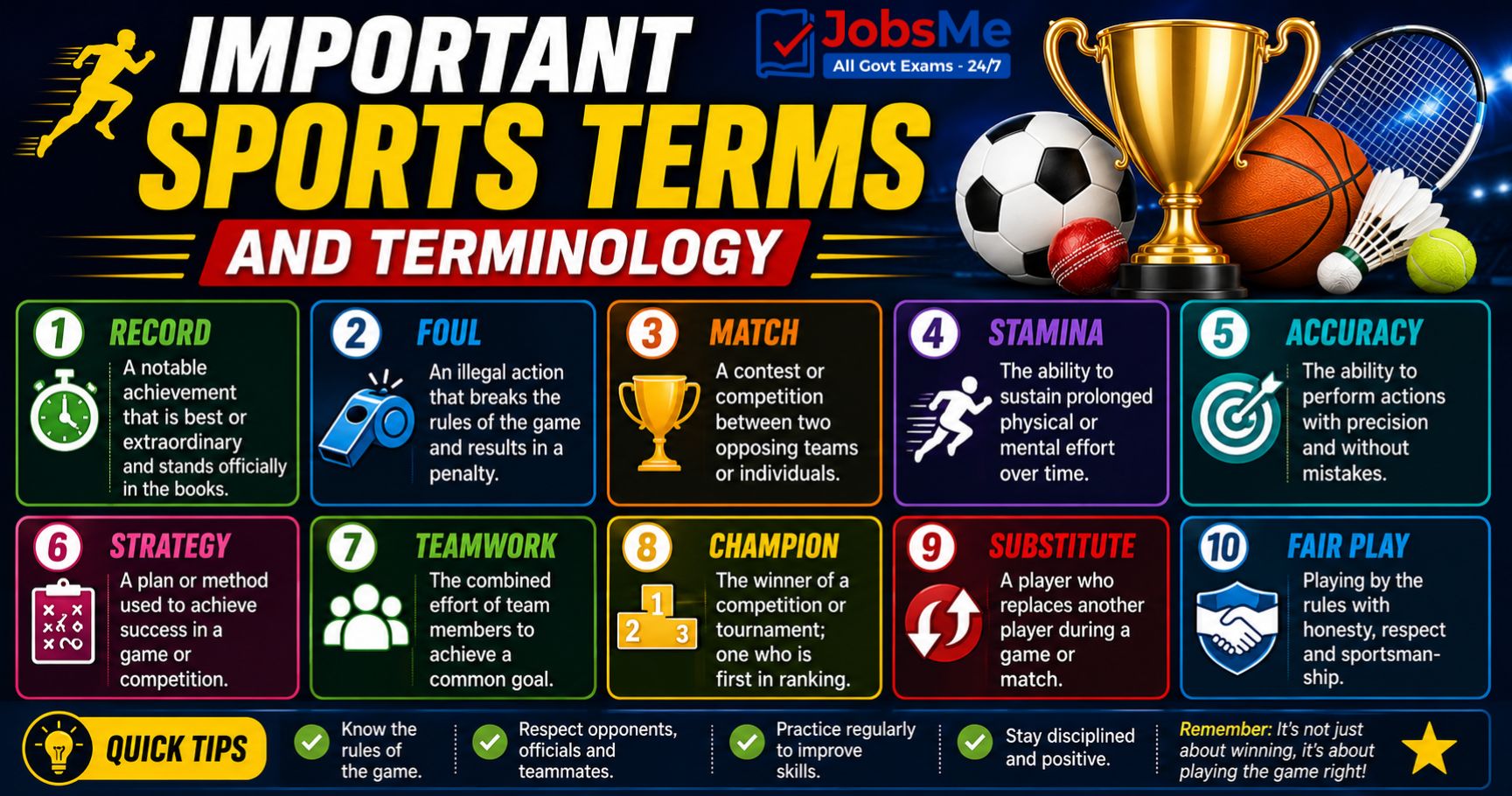
Sports Terminology – Important Sports Terms Static GK & General Awareness for Competitive Exams with Memory Tricks
This article presents a complete list of sports terminology covering cricket, football, hockey, tennis, badminton, basketball, boxing, swimming, athletics, chess, golf, and many other games, along with their meanings and exam-relevant facts, making it an essential resource for UPSC, SSC, IBPS, RRB, and other government exam aspirants. It includes commonly tested terms like Yorker, Hat-trick, Deuce, Bull's Eye, Slam Dunk, and Bunker, along with memory tricks and one-liners for quick revision. All facts are arranged in exam-ready format to help students score better in General Awareness sections.

Sports Cups and Trophies – Static GK & General Awareness for Competitive Exams with Memory Tricks
This article covers a comprehensive list of national and international sports cups and trophies associated with cricket, football, hockey, tennis, badminton, golf, and other major sports. It is designed for UPSC, SSC, IBPS, RRB, Insurance, Defence, and State PCS aspirants, with memory tricks, one-liners, and FAQs for quick revision. All facts are organised in an exam-ready format to help students score better in the General Awareness section.
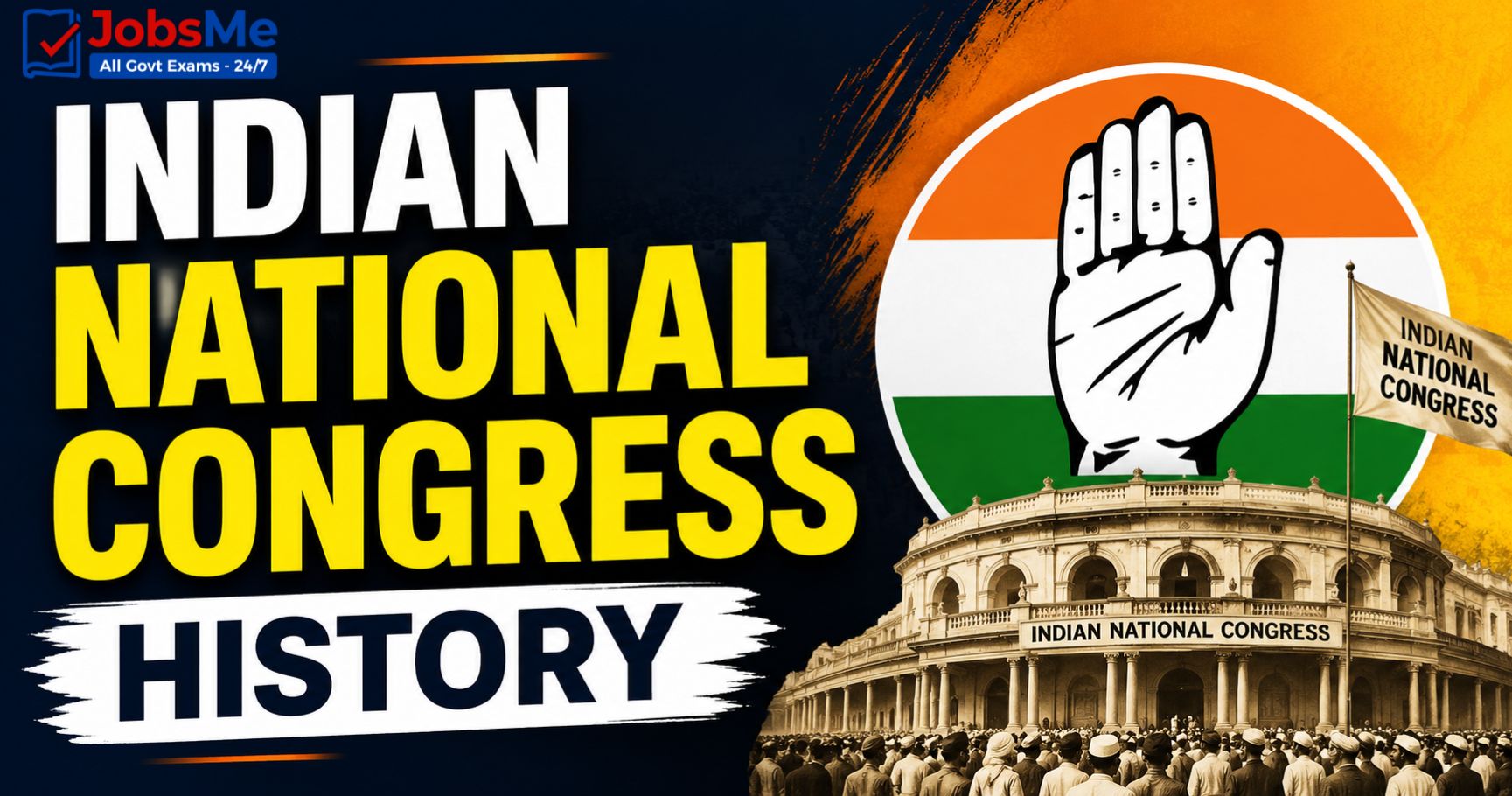
Indian National Congress – Important Sessions, Presidents, and History – Static GK & General Awareness for Competitive Exams with Memory Tricks
This article presents a complete list of important Indian National Congress (INC) sessions, presidents, venues, and outcomes from its foundation in 1885 to independence in 1947, making it an essential resource for UPSC, SSC, IBPS, RRB, and other government exam aspirants. It covers all landmark sessions like Bombay (1885), Calcutta (1906 – Swaraj), Surat Split (1907), Lucknow Pact (1916), Nagpur (1920), Lahore (1929 – Purna Swaraj), Karachi (1931), Tripuri (1939), and Meerut (1946), along with theories of INC formation, key leaders, memory tricks, and one-liners for quick revision. All facts are arranged in exam-ready format to help students score better in General Awareness and History sections.
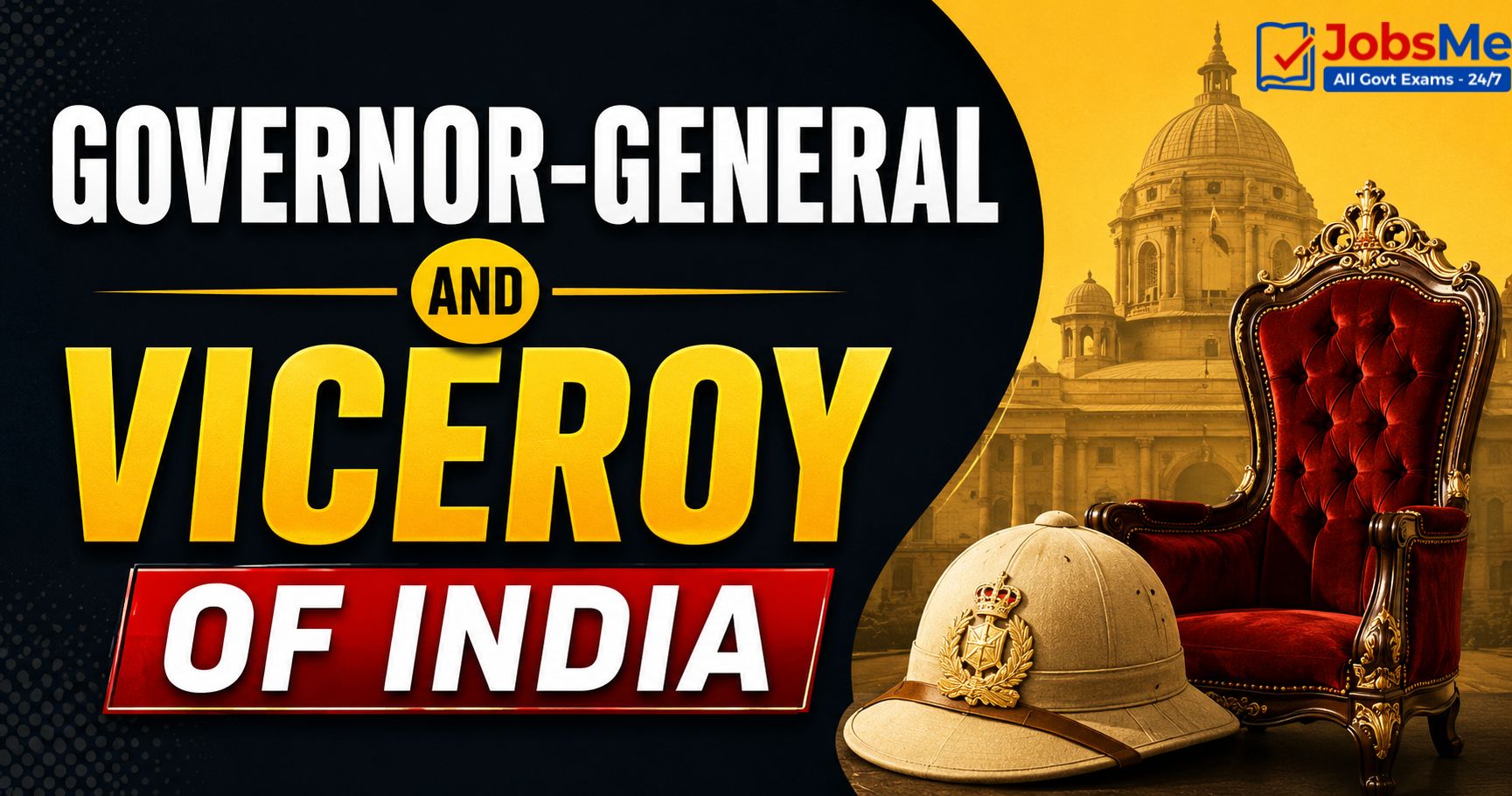
Governor-General and Viceroy of India – Complete List, Tenures, and Key Events – Static GK & General Awareness for Competitive Exams with Memory Tricks
This article presents the complete list of Governor-Generals of Bengal, Governor-Generals of India, and Viceroys of India from 1772 to 1950, along with their tenures, major reforms, wars, and exam-relevant events. It covers Warren Hastings, Lord Cornwallis, Lord William Bentinck, Lord Dalhousie, Lord Curzon, Lord Mountbatten, and C. Rajagopalachari, with memory tricks, mnemonics, and one-liners for quick revision. All facts are arranged in exam-ready format to help UPSC, SSC, IBPS, RRB, PSU, and State PCS aspirants score better in General Awareness and Modern History sections.
Founders and Rulers of Indian Dynasties – Static GK & General Awareness for Competitive Exams with Memory Tricks
This article covers a comprehensive list of all major dynasties of ancient and medieval India along with their founders, last rulers, capitals, and key kings — from the Haryanka and Mauryas to the Mughals, Cholas, and Vijayanagara empires. It is designed for UPSC, SSC, IBPS, RRB, Insurance, Defence, and State PCS aspirants, with memory tricks, one-liners, and FAQs for quick revision. All facts are organised in an exam-ready format to help students score better in the General Awareness section.
Important Battles in Indian History – Static GK & General Awareness for Competitive Exams with Memory Tricks
This article covers a complete chronological list of important battles in Indian history across the ancient, medieval, and modern periods, along with the year, opposing forces, location, and outcome of each. It is designed for UPSC, SSC, IBPS, RRB, Insurance, Defence, and State PCS aspirants, with memory tricks, one-liners, and FAQs for quick revision. All facts are organised in an exam-ready format to help students score better in History and General Awareness sections.
Five Year Plans of India – Static GK & General Awareness for Competitive Exams with Memory Tricks
This article presents a complete list of all Twelve Five Year Plans of India along with their durations, themes, models, target and achieved growth rates, key achievements, and exam-relevant facts, making it an essential resource for UPSC, SSC, IBPS, RRB, and other government exam aspirants. It covers the Planning Commission, NITI Aayog, the Harrod-Domar and Mahalanobis models, Plan Holidays, LPG reforms, and signature programmes like the Green Revolution, MNREGA, and Garibi Hatao, along with memory tricks and one-liners for quick revision. All facts are arranged in exam-ready format to help students score better in General Awareness sections.
Indian Cities and Their Nicknames – Static GK & General Awareness for Competitive Exams with Memory Tricksx
This article covers a comprehensive list of Indian cities and their popular nicknames, along with the reasons behind these names — covering metro cities, tier-2 towns, hill stations, industrial hubs, and cultural centres. It is designed for UPSC, SSC, IBPS, RRB, Insurance, Defence, and State PCS aspirants, with memory tricks, one-liners, and FAQs for quick revision. All facts are organised in an exam-ready format to help students score better in the General Awareness section.
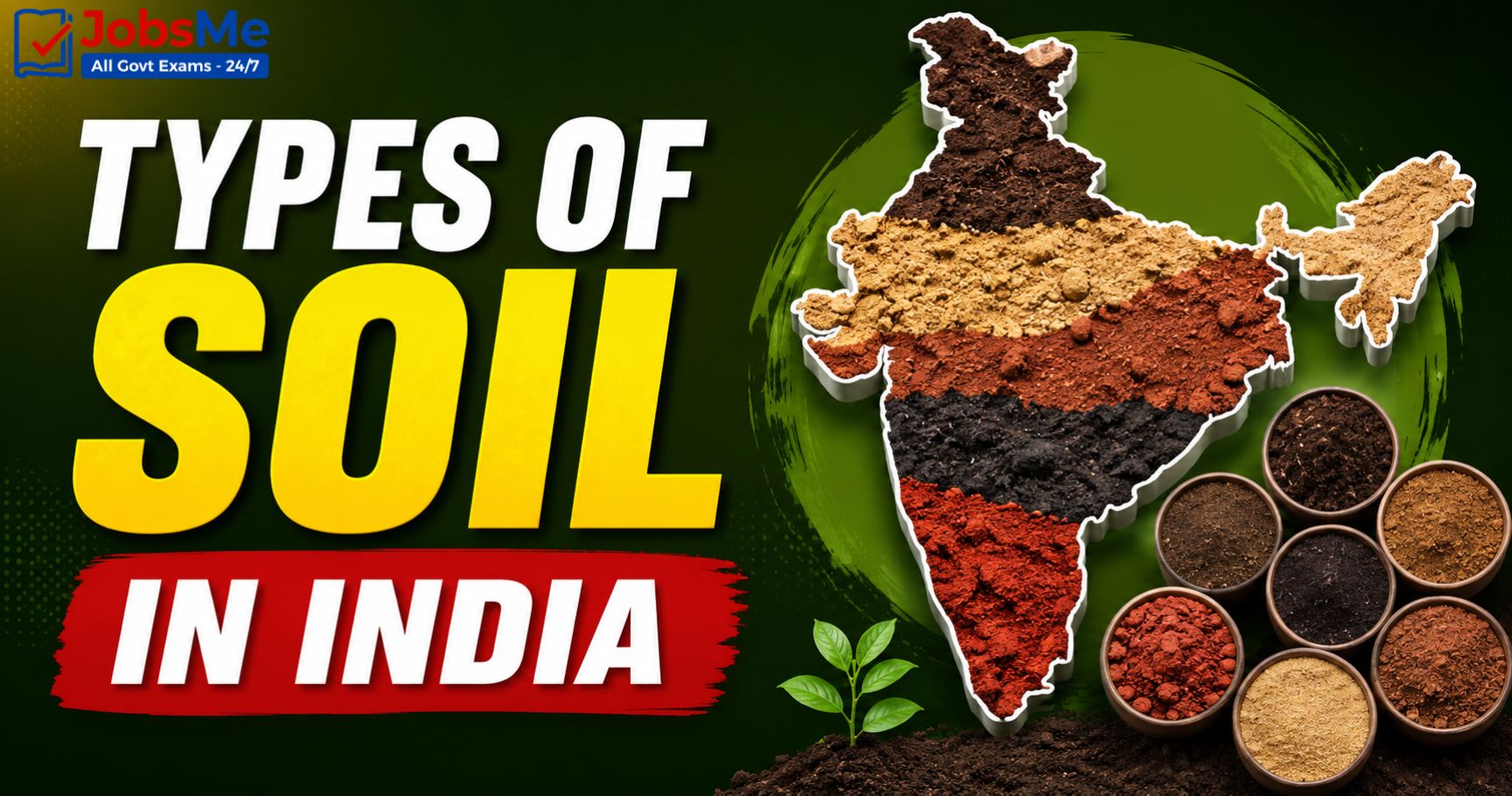
Types of Soil in India – Static GK & General Awareness for Competitive Exams with Memory Tricks
This article presents a complete classification of soils in India along with their formation, composition, distribution, characteristics, and crops grown, making it an essential resource for UPSC, SSC, IBPS, RRB, and other government exam aspirants. It includes all 8 ICAR soil categories — Alluvial, Black (Regur), Red, Laterite, Forest/Mountain, Arid/Desert, Saline/Alkaline, and Peaty/Marshy soils — along with memory tricks and one-liners for quick revision. All facts are arranged in exam-ready format to help students score better in General Awareness sections.

Major Seaports of India – Static GK & General Awareness for Competitive Exams with Memory Tricks
This article presents a complete list of major seaports in India along with their state, type (natural or artificial), key exports, and special features, making it an essential resource for UPSC, SSC, IBPS, RRB, and other government exam aspirants. It includes the largest, busiest, deepest, riverine, and corporatized ports of India, along with memory tricks and one-liners for quick revision. All facts are arranged in exam-ready format to help students score better in General Awareness sections.
Bird Sanctuaries in India – Static GK & General Awareness for Competitive Exams with Memory Tricks
This article presents a complete state-wise list of bird sanctuaries in India along with their establishment year, key bird species, and important features, making it an essential resource for UPSC, SSC, IBPS, RRB, and other government exam aspirants. It covers the first, largest, oldest, and most famous bird sanctuaries, along with memory tricks and one-liners for quick revision. All facts are arranged in exam-ready format to help students score better in General Awareness sections.
Introduction
JobsMe's Static GK section is your permanent, exam-ready knowledge base - a growing library of topic-wise Static General Knowledge posts and interactive quizzes covering every high-frequency subject tested in SSC, Banking, UPSC, Railways, Defence, Insurance, and State PSC examinations. Unlike current affairs, which change every day, Static GK is the fixed foundation of your General Awareness preparation - facts about Indian history, world geography, the Indian Constitution, important organisations, science fundamentals, national symbols, books and authors, and more. These facts do not expire. Master them once, and they score for you across every exam you sit.
Every Static GK topic on JobsMe comes with a free interactive quiz - attempt it, get your instant score, and if you are logged in, track how your performance improves across attempts over time. Your preparation history is stored, so you always know where you stand and what to work on next.
📖 Browse Static GK Posts → 🧩 Attempt Static GK Quizzes → 📅 Daily Current Affairs → 📆 Monthly Current Affairs →
What Is Static GK and Why Does It Matter
Static General Knowledge, often called Static GK or Static Awareness, refers to facts and information that do not change over time. The capital of France is Paris - that fact was true fifty years ago and will be true fifty years from now. The year of the Battle of Plassey, the name of the first Chairman of ISRO, the founding year of the United Nations - none of these facts change based on current events. This is what makes Static GK uniquely valuable: time invested in learning it is time that keeps paying dividends across every exam you appear for.
The difference between Static GK and Current Affairs is the difference between a permanent asset and a depreciating one. Both are essential, but they require different preparation strategies. Static GK rewards deep, structured learning and systematic revision. Current Affairs rewards consistent daily reading. Together, they form the complete General Awareness preparation that every competitive exam aspirant needs.
Static GK vs Current Affairs - How They Work Together
Many aspirants treat Static GK and Current Affairs as separate subjects. The most effective approach treats them as complementary layers of the same subject. When a new Ramsar site is declared - that is current affairs. But understanding what the Ramsar Convention is, when it was signed, and which body administers it - that is Static GK. When the RBI changes the repo rate - that is current affairs. But understanding what the repo rate is, how the monetary policy committee works, and the constitutional basis of the RBI - that is Static GK.
Aspirants who have built a strong Static GK foundation process current affairs far more efficiently, retain it more accurately, and answer exam questions with greater confidence. Visit daily current affairs and monthly current affairs alongside this section for complete GA preparation.
Topics Covered in JobsMe Static GK
JobsMe's Static GK library is organised by topic, with each topic getting a dedicated post and quiz. The following subjects are covered - spanning every category that appears in competitive exam General Awareness sections.
Indian History
Ancient Indian civilisations, important rulers and dynasties, medieval India, the Mughal Empire, colonial India, the freedom struggle, the Constituent Assembly, and post-independence milestones. Topics include Founders and Rulers of Indian Dynasties, Important Battles in Indian History, the Indian National Movement, and key personalities from Ancient and Medieval India.
World History and Geography
Major world civilisations, the World Wars, the Cold War, formation of the United Nations, decolonisation, and world geography - continents, oceans, mountain ranges, rivers, deserts, and climate zones. Topics include Countries, Capitals and Currencies of the World, World Organisations and their Headquarters, and Superlatives of the World.
Indian Geography
River systems, mountain ranges, plateaus, plains, states and capitals, national parks and wildlife sanctuaries, dams and reservoirs, important lakes, soil types, climate regions, and mineral resources of India. Topics include Superlatives of India, Indian Rivers and their Origins, and National Parks and Biosphere Reserves.
Indian Polity and Constitution
Fundamental Rights and Duties, Directive Principles of State Policy, important Constitutional Amendments, the structure of Parliament and State Legislatures, the President and Prime Minister's powers, constitutional bodies like the Election Commission and CAG, and landmark Supreme Court judgements.
Indian Economy
Five-Year Plans and NITI Aayog, important economic concepts, the banking system structure, types of banks and their functions, RBI's role and monetary policy tools, stock exchanges, and key economic institutions and their headquarters.
Science and Technology
Basic physics, chemistry, and biology concepts, important inventions and inventors, India's space programme milestones (ISRO), major scientific institutions, human body facts, disease and vaccines, and fundamental scientific principles tested in SSC and Railway exams.
Culture, Awards, and Symbols
India's national symbols (animal, bird, flower, song, emblem), important cultural institutions, classical dance forms, folk arts, major literary awards (Sahitya Akademi, Jnanpith, Booker, Nobel), Padma Awards history, and Bharat Ratna recipients.
Miscellaneous High-Frequency Topics
Books and authors, sports - stadiums, trophies and tournaments, Indian cities and their nicknames, First in India (first President, first PM, first IIT, first satellite), Largest/Longest/Highest superlatives, important committees and their purposes, and full forms of important abbreviations.
JobsMe's Interactive Static GK Quizzes - More Than Just a Test
What makes JobsMe's Static GK preparation different from every other platform is the interactive quiz experience. Each topic comes with a free quiz - but these are not static PDFs or basic self-graded exercises. They are fully interactive MCQ tests with instant scoring, detailed explanations, and - for logged-in users - a complete performance history that tracks every attempt.
Instant Score and Detailed Explanations
The moment you submit a quiz, your score appears immediately. Every question - whether you got it right or wrong - shows a full explanation of the correct answer. This means the quiz is not just a test: it is a teaching tool. You learn the material as you attempt it, particularly for questions you answered incorrectly or were uncertain about.
Performance History for Logged-In Users
When you are logged in, JobsMe stores your quiz history. Every attempt is recorded - your score, which questions you got right and wrong, and the date of the attempt. This lets you:
- Track improvement over time - see whether your scores on a particular topic are trending up
- Identify persistent weak spots - find questions you keep getting wrong across multiple attempts
- Plan revision smartly - focus your study time on the topics where your quiz history shows the biggest gaps
- Measure exam-readiness - when you are consistently scoring 80%+ on a topic across multiple attempts, you know it is mastered
No other free platform in India offers this level of personalised performance tracking built directly into topic-wise GK quizzes. Sign up for free to unlock your full quiz history.
Re-Attempt Any Quiz Any Time
Every quiz in the archive can be re-attempted as many times as you want. The recommended approach for each topic is: read the post → attempt the quiz → review explanations for wrong answers → re-attempt after 3–5 days (spaced repetition) → re-attempt again before the exam. Each re-attempt is tracked in your history, letting you see the score progression that confirms your mastery.
How to Use Static GK for Different Exams
Static GK for SSC CGL, CHSL, and MTS
SSC exams test Static GK extensively. Topics like Indian History, Geography, Polity, Science, Books and Authors, and Superlatives regularly appear in SSC General Awareness papers. Prioritise the History, Geography, and Science topics in JobsMe's Static GK section, as these are the highest-frequency categories in SSC papers.
Static GK for Banking Exams (IBPS, SBI, RBI)
Banking exams include a Financial/General Awareness section where Static GK questions focus on banking history, international financial organisations and headquarters, important economic concepts, and Indian Constitution fundamentals. Prioritise the Economy, International Organisations, and Polity topics.
Static GK for UPSC Prelims
UPSC requires the broadest Static GK coverage. History (Ancient, Medieval, Modern), Geography (Indian and World), Polity, Economy, Environment, and Science are all heavily tested. Use JobsMe's Static GK posts as a structured syllabus guide and pair them with monthly current affairs to connect static knowledge with contemporary developments.
Static GK for Railways (RRB NTPC, Group D, JE)
Railway exams test Science, History, Geography, Sports, and miscellaneous GK heavily. The Superlatives, Science basics, National Parks, and Countries-Capitals posts are particularly relevant for RRB aspirants.
Static GK for Defence Exams (NDA, CDS, AFCAT)
Defence exams test Indian History, Indian Geography, World Affairs, Science, and current events. The History of Battles, Constitutional Polity, and World Geography topics are especially important for NDA and CDS aspirants.
Static GK for State PSC Exams
State-level exams require both national static GK and state-specific knowledge. JobsMe's Static GK covers national topics comprehensively. Use the general posts for national coverage and supplement with state-specific sources for local geography, history, and governance.
Preparation Strategy - How to Master Static GK
Start with High-Frequency Topics
Not all Static GK topics are equally important for every exam. Identify the 8–10 topics that appear most frequently in your target exam's previous year papers. For SSC, this is typically Indian History, Geography, Polity, and Science. For Banking, it is Economy, International Organisations, and Polity. Start your preparation with these.
Read, Then Quiz, Then Revise
The most effective three-step approach for every Static GK topic: read the post fully → attempt the quiz immediately → review all explanations (especially for wrong answers). Wait 3–5 days without re-reading, then re-attempt the quiz. Your second-attempt score measures true retention.
Use Memory Tricks from JobsMe Posts
Every Static GK post on JobsMe includes memory tricks - mnemonics, acronyms, visual associations, and pattern-based recall techniques - specifically designed to help you remember exam-critical facts faster and longer. These are not generic tips; they are topic-specific techniques mapped to the exact facts most likely to be tested.
Connect Static GK to Current Affairs
As you read daily current affairs, constantly ask: "What Static GK concept does this connect to?" A new bilateral trade agreement connects to the WTO and international trade law. A new ISRO mission connects to India's space programme history. A new Supreme Court judgement connects to constitutional provisions. These connections deepen your understanding of both and make your exam answers richer.
Final Revision Strategy
In the last 2–3 weeks before your exam, use your quiz performance history to identify your weakest Static GK topics. Re-attempt those specific quizzes, review wrong answers, and redo the one-liners from the corresponding posts. Do not study new topics at this stage - consolidate and strengthen what you already know.
Exams Covered
UPSC Civil Services (IAS, IPS, IFS) | SSC CGL | SSC CHSL | SSC MTS | SSC CPO | IBPS PO | IBPS Clerk | SBI PO | SBI Clerk | RBI Grade B | RBI Assistant | NABARD Grade A | LIC AAO | NIACL AO | RRB NTPC | RRB Group D | RRB JE | NDA | CDS | AFCAT | CAPF | UPPSC | TNPSC | MPPSC | BPSC | KPSC | RPSC | WBCS | All State PSC Exams