Indian Agriculture and Top Producer States: Complete Static GK Notes for Government Exams
This article gives a complete, exam-ready guide to Indian agriculture and the top producer states of every major crop, fruit, vegetable, spice, plantation crop, livestock product, and fisheries item. It also covers cropping seasons, India's global agricultural rank, agricultural revolutions, and quick memory tricks designed for UPSC, SSC, IBPS, RRB, State PCS, Defence, Insurance, and PSU exams.
Jump to section
Introduction
India is one of the world's largest agricultural economies, with farming supporting nearly half of the country's workforce and contributing close to 17-18% to the Gross Value Added (GVA). Questions on Indian Agriculture and the top producer states for various crops are a high-yield static GK area in nearly every government exam, including UPSC Prelims, SSC CGL, SSC CHSL, IBPS PO/Clerk, RRB NTPC, RRB Group D, Insurance exams (LIC, NIACL, NICL), State PCS, and Defence exams like NDA and CDS.
This topic is repeatedly tested because it links three layers of knowledge at once: state-wise specialization (which state produces what), geographical reasoning (why a particular soil and climate suits a crop), and current affairs (Minimum Support Price, agricultural revolutions, exports). A single well-prepared chart can fetch you 2-4 marks across Prelims, Tier 1, and General Awareness sections.
For broader preparation across topics like history, geography, polity, and economy, you can also revise our consolidated notes on the Static GK section of Jobsme.in, which is updated regularly to match the latest exam pattern.
Core Concept Explanation
Before memorising the crop-state pairs, it is important to understand the structure of Indian agriculture, since many exam questions are concept-based rather than direct fact-based.
- India's Global Position: India is the largest producer of milk, pulses, jute, spices, mango, banana, papaya, and castor seed, and the second-largest producer of rice, wheat, sugarcane, cotton, groundnut, tea, fruits, vegetables, and fish.
- Share in Economy: Agriculture and allied activities contribute about 17-18% to India's GVA and employ roughly 45-50% of the workforce.
- Cropping Seasons: India has three main cropping seasons - Kharif (sown June-July, harvested October-November), Rabi (sown October-November, harvested March-April), and Zaid (a short summer season between March and June).
- Crop Classification: Crops are grouped as Food Grains (cereals and pulses), Cash or Commercial Crops, Plantation Crops, Horticulture (fruits and vegetables), Spices, Oilseeds, Fibre Crops, and Allied items like dairy, poultry, and fisheries.
- Soil Suitability: Alluvial soil suits rice and wheat, Black (Regur) soil suits cotton, Laterite soil suits cashew and tea, Red soil suits millets and pulses, and Arid soil suits bajra and barley.
Cropping Seasons of India
| Season | Sowing and Harvesting Period | Major Crops Grown | Key Features and Description |
|---|---|---|---|
| Kharif | Sown June-July, harvested October-November | Rice, Maize, Jowar, Bajra, Cotton, Tur (Arhar), Soybean, Groundnut, Jute, Sugarcane | Monsoon-dependent crops requiring high temperature and heavy rainfall. Dominant in eastern, southern, and central India. Failure of monsoon directly affects Kharif yield and rural demand. |
| Rabi | Sown October-November, harvested March-April | Wheat, Barley, Gram (Chana), Mustard, Peas, Masoor (Lentil), Oats | Winter crops grown in cool, dry conditions. Need irrigation since rainfall is limited. Punjab, Haryana, and Uttar Pradesh form the Rabi heartland thanks to canal irrigation. |
| Zaid | Sown March-April, harvested June | Watermelon, Muskmelon, Cucumber, Bitter Gourd, Fodder Crops, Vegetables | Short summer season between Rabi and Kharif. Requires irrigation and warm dry weather. Helps farmers earn an extra cycle of income through quick-maturing crops. |
Top Producer States of Major Crops in India
The following tables list the largest producer states (rank-wise) for every major crop, fruit, vegetable, spice, plantation product, livestock item, and fishery product asked in competitive exams. For daily updates on agricultural schemes, MSP changes, and budget announcements, you can follow Daily Current Affairs on Jobsme.in.
1. Cereals and Food Grains
| Crop | Largest Producer (1st) | 2nd Largest | 3rd Largest | Key Features and Exam Notes |
|---|---|---|---|---|
| Rice (Paddy) | West Bengal | Uttar Pradesh | Punjab | Kharif crop; needs temperature above 25 degree Celsius and rainfall over 100 cm. India is the second-largest producer in the world after China. Punjab has the highest yield per hectare. |
| Wheat | Uttar Pradesh | Punjab | Madhya Pradesh | Rabi crop; thrives in cool growing season and warm, dry harvest. India is the second-largest producer globally. Punjab and Haryana lead in productivity per hectare. |
| Maize (Corn) | Karnataka | Madhya Pradesh | Bihar | Both a food and a fodder crop. Used in poultry feed, starch, and ethanol. Karnataka leads due to extensive cultivation in southern dryland areas. |
| Bajra (Pearl Millet) | Rajasthan | Uttar Pradesh | Haryana | Drought-resistant Kharif millet grown in arid sandy soils. Forms staple diet in western India. India is the world's largest producer of bajra. |
| Jowar (Sorghum) | Maharashtra | Karnataka | Madhya Pradesh | Grown as both Kharif and Rabi crop. Major rainfed millet of the Deccan Plateau. Used as food, fodder, and raw material for ethanol. |
| Ragi (Finger Millet) | Karnataka | Tamil Nadu | Andhra Pradesh | Highly nutritious millet rich in calcium and iron. Major hill and dryland crop of South India. Promoted under the International Year of Millets initiative. |
| Barley | Rajasthan | Uttar Pradesh | Madhya Pradesh | Rabi cereal used for malting, beer, and animal feed. Tolerates salinity and drought. Important raw material for India's malt beverage industry. |
| Total Food Grains | Uttar Pradesh | Madhya Pradesh | Punjab | Uttar Pradesh leads in overall foodgrain output by combining wheat, rice, and pulses. Punjab is called the "Granary of India" for its high yield. |
2. Pulses
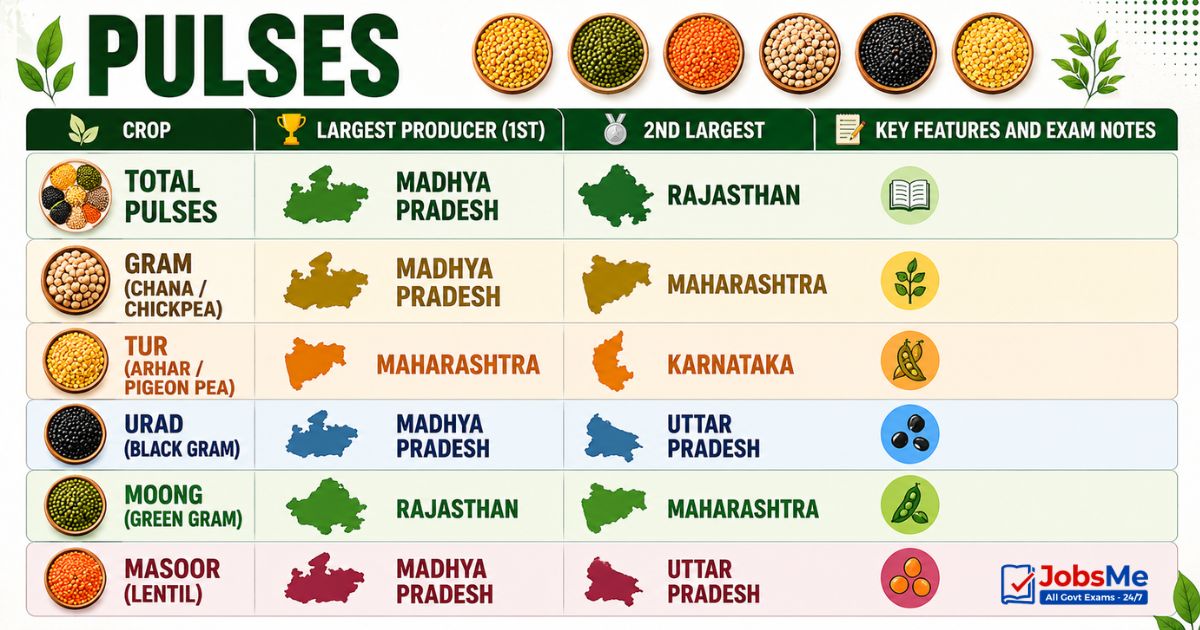
| Crop | Largest Producer (1st) | 2nd Largest | Key Features and Exam Notes |
|---|---|---|---|
| Total Pulses | Madhya Pradesh | Rajasthan | India is the largest producer, consumer, and importer of pulses in the world. Madhya Pradesh alone produces over 25% of India's total pulses. |
| Gram (Chana / Chickpea) | Madhya Pradesh | Maharashtra | Most important Rabi pulse of India. India accounts for about 70% of global chickpea production. Forms a vital source of protein for vegetarians. |
| Tur (Arhar / Pigeon Pea) | Maharashtra | Karnataka | Major Kharif pulse, second only to gram in importance. Cultivated mainly on the Deccan Plateau. Used widely for "toor dal" in Indian cuisine. |
| Urad (Black Gram) | Madhya Pradesh | Uttar Pradesh | Both Kharif and Rabi crop. Key ingredient of dosa, idli, and papad. Grown mainly in central and southern India. |
| Moong (Green Gram) | Rajasthan | Maharashtra | Short-duration pulse grown in all three seasons. Improves soil fertility through nitrogen fixation. Frequently used as a catch crop. |
| Masoor (Lentil) | Madhya Pradesh | Uttar Pradesh | Rabi pulse rich in protein and folate. Grown mainly in central India and the Indo-Gangetic plains. Major part of India's "dal" basket. |
3. Oilseeds
| Oilseed | Largest Producer (1st) | 2nd Largest | Key Features and Exam Notes |
|---|---|---|---|
| Total Oilseeds | Madhya Pradesh | Rajasthan | India is the fourth-largest producer of edible oilseeds globally. The Yellow Revolution boosted oilseed output from the 1980s onwards. |
| Groundnut (Peanut) | Gujarat | Rajasthan | Largest oilseed crop in India by output. Grown mainly in Kharif on sandy loam soils. India is the second-largest producer in the world. |
| Mustard / Rapeseed | Rajasthan | Madhya Pradesh | Important Rabi oilseed of north India. Used both as edible oil and as condiment. Rajasthan contributes nearly 45% of national mustard output. |
| Soybean | Madhya Pradesh | Maharashtra | Called the "Golden Bean"; rich in protein and oil. Madhya Pradesh produces nearly half of India's soybean. A major source of soymeal exports. |
| Sunflower | Karnataka | Andhra Pradesh | Grown in all three seasons; needs moderate temperature. Used for high-grade refined edible oil. Cultivation has been declining due to import competition. |
| Sesame (Til) | Madhya Pradesh | Rajasthan | India is the largest producer and exporter of sesame in the world. Important for confectionery, oil, and traditional foods. |
| Linseed (Flax) | Madhya Pradesh | Chhattisgarh | Rabi oilseed cultivated for industrial oil used in paints, varnishes, and printing inks. Also a source of fibre. |
| Castor | Gujarat | Rajasthan | India is the world's largest producer of castor seed, accounting for over 85% of global output. Used in lubricants, soaps, and pharmaceuticals. |
| Safflower | Karnataka | Maharashtra | Rabi oilseed grown in dryland conditions. Yields oil rich in unsaturated fats. Also used in dyes and bird feed. |
4. Cash and Commercial Crops
| Crop | Largest Producer (1st) | 2nd Largest | Key Features and Exam Notes |
|---|---|---|---|
| Sugarcane | Uttar Pradesh | Maharashtra | India is the second-largest producer in the world after Brazil. UP leads in production while Maharashtra leads in sugar recovery rate. Backbone of the sugar and ethanol industries. |
| Cotton | Gujarat | Maharashtra | India is the world's largest cotton producer and second-largest exporter. Cotton grows best on black (Regur) soil of the Deccan Plateau. Sometimes called the "White Gold" of India. |
| Jute | West Bengal | Bihar | India is the world's largest producer; Bangladesh is the largest exporter. Grown on alluvial soil under hot humid conditions. Known as the "Golden Fibre". |
| Tobacco | Gujarat | Andhra Pradesh | India is the second-largest tobacco producer after China. Andhra Pradesh leads in Virginia tobacco (FCV). Tobacco Board headquarters is in Guntur. |
| Mesta | Andhra Pradesh | Bihar | A jute-like bast fibre crop. Used as a substitute for jute. Grown on lighter and drier soils than jute. |
5. Plantation Crops
| Crop | Largest Producer (1st) | 2nd Largest | Key Features and Exam Notes |
|---|---|---|---|
| Tea | Assam | West Bengal | India is the second-largest tea producer in the world after China. Assam Valley and Darjeeling are world-famous regions. Tea Board is headquartered in Kolkata. |
| Coffee | Karnataka | Kerala | Karnataka alone contributes nearly 70% of India's coffee. Two main varieties are Arabica and Robusta. The Coffee Board is in Bengaluru. |
| Rubber | Kerala | Tamil Nadu | India is the sixth-largest natural rubber producer globally. Kerala accounts for about 75% of Indian rubber. Tripura is a fast-rising producer in the northeast. |
| Coconut | Kerala | Tamil Nadu | India is the largest producer of coconut by output and the third-largest by area. Kerala's name itself is derived from "Kera" (coconut tree). Coconut Board headquarters is in Kochi. |
| Areca Nut (Supari) | Karnataka | Kerala | India is the largest producer and consumer of areca nut. Grown mainly on the west coast and in the northeast. Used in paan and traditional preparations. |
| Cashew Nut | Maharashtra | Andhra Pradesh | India is the second-largest producer of raw cashew. Goa, Kerala, and Karnataka are also major producers. Vietnam is the world leader. |
6. Spices
| Spice | Largest Producer (1st) | 2nd Largest | Key Features and Exam Notes |
|---|---|---|---|
| Total Spices | Madhya Pradesh | Rajasthan | India is the world's largest producer, consumer, and exporter of spices. Kerala is called the "Spice Garden of India" for premium spices. |
| Black Pepper | Karnataka | Kerala | Known as the "King of Spices" and "Black Gold". Karnataka has overtaken Kerala in production. Used as a benchmark spice in global trade. |
| Cardamom (Small) | Kerala | Karnataka | Called the "Queen of Spices". Grown in the Western Ghats. India is the second-largest producer after Guatemala. |
| Cardamom (Large) | Sikkim | West Bengal | Sikkim is the largest producer of large cardamom in India. Grown in the eastern Himalayan belt. India is the world's leading producer of this variety. |
| Chilli | Andhra Pradesh | Madhya Pradesh | India is the largest producer and exporter of dried chillies. Guntur (Andhra Pradesh) is the chilli trading hub. Chilli contributes the largest share to India's spice output. |
| Turmeric | Telangana | Maharashtra | India produces about 75% of the world's turmeric. Erode (Tamil Nadu) is called "Turmeric City". Telangana, Andhra Pradesh, and Tamil Nadu together dominate output. |
| Ginger | Madhya Pradesh | Odisha | India is the largest producer of ginger in the world. Karnataka and Kerala are also significant producers. Used widely in fresh, dried, and oil forms. |
| Coriander | Madhya Pradesh | Rajasthan | India is the largest producer, exporter, and consumer of coriander. Both seed and leaf are used. Major Rabi spice crop. |
| Cumin (Jeera) | Gujarat | Rajasthan | Together Gujarat and Rajasthan produce nearly all of India's cumin. Unjha (Gujarat) hosts Asia's largest cumin market. Major export spice. |
| Fennel (Saunf) | Gujarat | Rajasthan | Gujarat dominates national output. Used as mouth freshener and digestive aid. India is the largest fennel producer globally. |
| Garlic | Madhya Pradesh | Uttar Pradesh | India is the second-largest producer of garlic after China. Grown mainly in Rabi season. Madhya Pradesh contributes over 60% of national output. |
| Saffron | Jammu and Kashmir (UT) | Only producer | Most expensive spice in the world. Pampore in Kashmir is famous for saffron cultivation. Kashmiri saffron has a GI tag. |
| Clove | Kerala | Tamil Nadu | Grown in the Western Ghats hill regions. India is a minor producer compared to Indonesia and Madagascar. |
| Tamarind | Tamil Nadu | Madhya Pradesh | Used as a souring agent in cuisines across India. Also exported in pulp form. Grown in the southern Deccan. |
7. Fruits (Horticulture)
| Fruit | Largest Producer (1st) | 2nd Largest | Key Features and Exam Notes |
|---|---|---|---|
| Total Fruits | Andhra Pradesh | Maharashtra | India is the second-largest fruit producer in the world after China. The Golden Revolution boosted horticulture output significantly. |
| Mango | Uttar Pradesh | Andhra Pradesh | India is the world's largest mango producer, contributing nearly 45% of global output. Mango is the national fruit of India. Alphonso, Dasheri, and Langra are popular varieties. |
| Banana | Andhra Pradesh | Maharashtra | India is the largest producer of banana in the world. Tamil Nadu and Gujarat are also major producers. Jalgaon is known as the "Banana City" of India. |
| Apple | Jammu and Kashmir (UT) | Himachal Pradesh | Temperate fruit grown in the Himalayan belt. Jammu and Kashmir alone produces over 75% of Indian apples. Uttarakhand and Arunachal Pradesh are emerging producers. |
| Orange | Madhya Pradesh | Maharashtra | Nagpur (Maharashtra) is famous as the "Orange City of India". Madhya Pradesh has overtaken Maharashtra in production volume in recent years. |
| Grape | Maharashtra | Karnataka | Maharashtra contributes nearly 70-80% of Indian grape output. Nashik is called the "Wine Capital of India". Major export fruit to Europe and Middle East. |
| Papaya | Andhra Pradesh | Gujarat | India is the largest producer of papaya in the world. Grown widely in tropical and subtropical zones. Used fresh and for papain enzyme extraction. |
| Pineapple | West Bengal | Assam | Grown mainly in the northeast and along the west coast. Tripura's "Queen" variety has a GI tag and is the state fruit. |
| Pomegranate | Maharashtra | Karnataka | India is the largest producer in the world. Solapur (Maharashtra) is famous for pomegranate. Major export fruit with high market value. |
| Guava | Uttar Pradesh | Madhya Pradesh | Allahabad (Prayagraj) is famous for its sweet guava. India is the largest producer of guava in the world. |
| Litchi | Bihar | West Bengal | Muzaffarpur in Bihar is called the "Litchi Capital of India". Shahi Litchi from Muzaffarpur has a GI tag. |
| Sapota (Chikoo) | Karnataka | Maharashtra | Tropical fruit grown along the western coast. India is a leading producer globally. Gujarat is also a major sapota state. |
| Walnut | Jammu and Kashmir (UT) | Himachal Pradesh | Jammu and Kashmir contributes over 90% of India's walnut production. Major export item from the Kashmir Valley. |
| Almond | Jammu and Kashmir (UT) | Himachal Pradesh | Grown in the cold dry zones of Ladakh and Kashmir. India is a minor producer compared to the US, which dominates globally. |
8. Vegetables
| Vegetable | Largest Producer (1st) | 2nd Largest | Key Features and Exam Notes |
|---|---|---|---|
| Total Vegetables | West Bengal | Uttar Pradesh | India is the second-largest vegetable producer in the world after China. Horticulture output exceeds total food grain output in volume. |
| Potato | Uttar Pradesh | West Bengal | India is the second-largest potato producer in the world. Agra is a major potato hub. Round Revolution refers to growth in potato production. |
| Onion | Maharashtra | Madhya Pradesh | India is the second-largest onion producer after China. Lasalgaon (Nashik) hosts Asia's largest onion market. Onion exports are a sensitive policy issue. |
| Tomato | Madhya Pradesh | Andhra Pradesh | India is the second-largest producer of tomato globally. Major suppliers include MP, AP, Karnataka, and Gujarat. Subject to wide seasonal price swings. |
| Brinjal | West Bengal | Odisha | India is the second-largest producer of brinjal. Grown year-round across most states. Native to the Indian subcontinent. |
| Cabbage | West Bengal | Odisha | Cool-season vegetable mainly grown in winter. West Bengal benefits from cool moist conditions in the Gangetic plain. |
| Cauliflower | West Bengal | Madhya Pradesh | Important Rabi vegetable crop. India is the second-largest producer of cauliflower in the world. |
| Okra (Bhindi) | West Bengal | Bihar | India is the largest producer of okra in the world. Grown in summer and rainy seasons across most states. |
| Peas (Green Peas) | Uttar Pradesh | Madhya Pradesh | Rabi crop grown widely in north India. India is the largest producer of green peas in the world. |
| Tapioca (Cassava) | Tamil Nadu | Kerala | Important tuber crop in south India. Used for sago and starch production. Grown in red and laterite soils. |
| Sweet Potato | Odisha | Uttar Pradesh | Tuber crop grown in eastern India and tribal belts. Promoted as nutrient-rich biofortified crop. |
9. Livestock, Dairy, and Allied Products
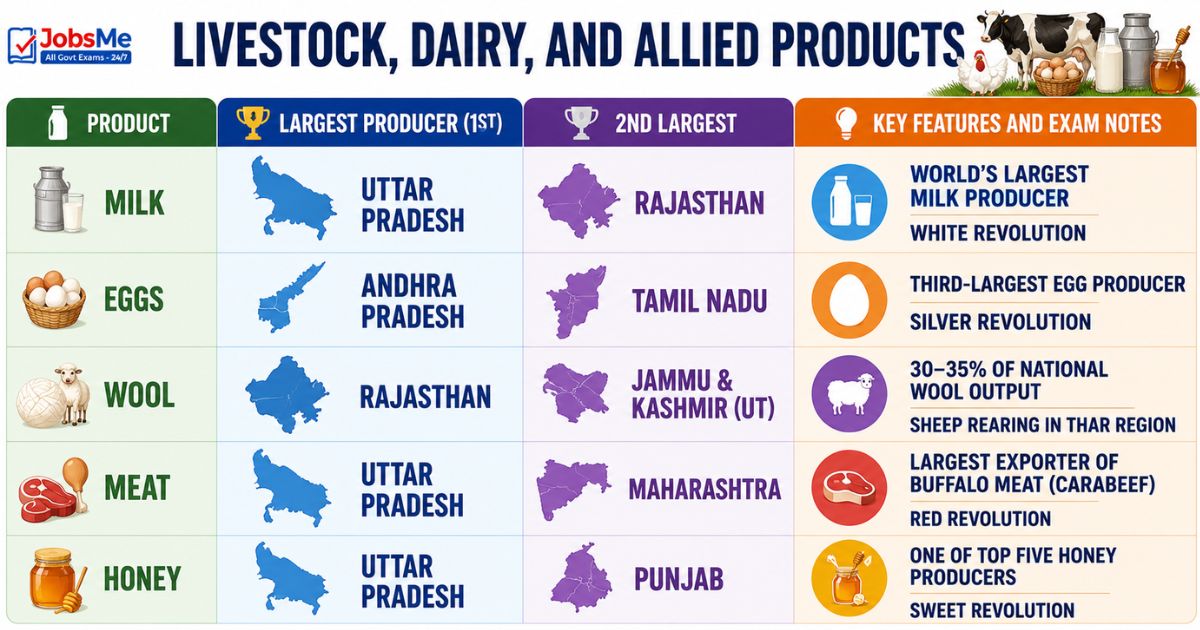
| Product | Largest Producer (1st) | 2nd Largest | Key Features and Exam Notes |
|---|---|---|---|
| Milk | Uttar Pradesh | Rajasthan | India is the world's largest milk producer, contributing over 24% of global output. Operation Flood (White Revolution) made India self-sufficient. Verghese Kurien is known as the "Father of the White Revolution". |
| Eggs | Andhra Pradesh | Tamil Nadu | India is the third-largest egg producer in the world. Namakkal in Tamil Nadu is the "Egg Capital of India". Silver Revolution refers to egg and poultry growth. |
| Wool | Rajasthan | Jammu and Kashmir (UT) | Rajasthan accounts for nearly 30-35% of national wool output. Sheep rearing is a major activity in the arid Thar region. |
| Meat | Uttar Pradesh | Maharashtra | India is the largest exporter of buffalo meat (carabeef) in the world. Red Revolution refers to growth in meat and tomato production. |
| Honey | Uttar Pradesh | Punjab | India is one of the top five honey producers in the world. Promoted under the Sweet Revolution. Honey exports are growing rapidly. |
10. Fisheries
| Type | Largest Producer (1st) | 2nd Largest | Key Features and Exam Notes |
|---|---|---|---|
| Total Fish | Andhra Pradesh | West Bengal | India is the third-largest fish producer and second-largest aquaculture producer globally. Blue Revolution refers to growth in fish production. |
| Marine Fish | Gujarat | Tamil Nadu | Gujarat has India's longest coastline (about 1,600 km) and leads in marine fish. Kerala and Karnataka are also major marine fishing states. |
| Inland Fish | Andhra Pradesh | West Bengal | Andhra Pradesh dominates with extensive aquaculture in Krishna and Godavari deltas. West Bengal and Odisha are traditional inland fishing zones. |
| Shrimp / Prawn (Aquaculture) | Andhra Pradesh | West Bengal | India is the largest exporter of frozen shrimp in the world. The US is the biggest buyer of Indian shrimp. |
11. Sericulture (Silk Production)
| Silk Type | Largest Producer State | Key Features and Exam Notes |
|---|---|---|
| Total Silk | Karnataka | India is the second-largest silk producer in the world after China and is the largest consumer of silk. Karnataka leads in overall silk output. |
| Mulberry Silk | Karnataka | The finest and most produced variety of silk in India. Grown mainly in southern and northeastern states. |
| Tasar Silk | Jharkhand | Produced from wild silkworms feeding on Arjun and Asan trees. Tribal communities are major producers. |
| Eri Silk | Assam | Also called "Peace Silk" since worms are not killed. Mainly produced in Assam, Meghalaya, and Nagaland. |
| Muga Silk | Assam | The famous "Golden Silk" of Assam; produced only in Assam. Has a GI tag and is highly valued. |
12. Agricultural Revolutions of India
| Revolution | Associated Sector / Product | Key Personality / Note |
|---|---|---|
| Green Revolution | Food grains, especially wheat and rice | Father in India: M.S. Swaminathan. Father in the world: Norman Borlaug. Launched in the 1960s with HYV seeds. |
| White Revolution (Operation Flood) | Milk and dairy | Father: Verghese Kurien. Made India the world's largest milk producer through the Amul model. |
| Yellow Revolution | Oilseeds (especially mustard and sunflower) | Father: Sam Pitroda. Launched in 1986-87 to reduce dependence on edible oil imports. |
| Blue Revolution | Fish and aquaculture | Father in India: Hiralal Chaudhuri / Arun Krishnan. Boosted fish output through inland and marine fisheries. |
| Pink Revolution | Onions, prawn, and pharmaceuticals | Linked to Durgesh Patel. Often used to describe poultry-meat and onion sectors. |
| Red Revolution | Meat and tomato | Linked to Vishal Tewari. Refers to growth in red-coloured produce. |
| Silver Revolution | Eggs and poultry | Father: Indira Gandhi (poultry). Aimed at boosting egg and poultry output. |
| Brown Revolution | Leather, cocoa, and non-conventional products | Linked to Hiralal Chaudhuri (broad meaning). Sometimes used for non-conventional energy. |
| Golden Revolution | Horticulture, fruits, and honey | Father: Nirpakh Tutej. Period: 1991-2003. Made India a leading horticulture producer. |
| Black Revolution | Petroleum / Crude oil | Refers to boosting domestic crude oil production and reducing dependence on imports. |
| Round Revolution | Potato | Refers to large-scale increase in potato production and storage. |
| Grey Revolution | Fertilizers and wool | Refers to growth in fertilizer use to support the Green Revolution. |
| Silver Fibre Revolution | Cotton | Refers to growth in cotton output, called the "White Gold" or silver fibre of India. |
| Golden Fibre Revolution | Jute | Jute is known as the "Golden Fibre". Aimed at boosting jute output in the eastern states. |
| Evergreen Revolution | Sustainable agriculture | Coined by M.S. Swaminathan. Aims at increasing productivity without ecological damage. |
| Sweet Revolution | Honey production | Aimed at making India one of the top honey producers and exporters. |
| Protein Revolution | Higher protein production (proposed) | Suggested second Green Revolution under Niti Aayog to raise pulses and animal protein output. |
Memory Tricks and Mnemonics
Use these tricks to quickly recall crop-state pairs in the exam hall. Each trick targets a frequently confused or repeated cluster of facts.
Trick 1: "WURP" for Rice Production Order
WURP = West Bengal, Uttar Pradesh, Rainy (Punjab) - in that order of production. Remember "WURP" sounds like "warp" - paddy fields warp under heavy monsoon.
Trick 2: "UP-PB-MP" for Wheat Production
U-P, P-B, M-P: Uttar Pradesh > Punjab > Madhya Pradesh. Tip: All three are land-locked, north Indian, and Rabi belt states. Wheat loves cool dry winters of the north.
Trick 3: "MP is the Pulse King and Oil King"
Madhya Pradesh leads in Total Pulses, Total Oilseeds, Soybean, Gram, Urad, Masoor, Garlic, Ginger, Coriander, and Linseed. Remember the line: "MP grows everything that goes into the kitchen tadka."
Trick 4: "GUJ-RAJ Twins" for Oilseeds and Cumin
Gujarat and Rajasthan together dominate Groundnut, Mustard, Castor, Cumin, and Fennel. Mnemonic: "GUJ-RAJ rules the spice and oil belt of west India." Easy way - Gujarat takes the coastal-oily crops (Groundnut, Castor); Rajasthan takes the dry-mustard crops.
Trick 5: "ABCD" for South Indian Crop Leaders
ABCD = Andhra Pradesh (Chilli, Banana, Papaya, Eggs, Inland Fish), Bengaluru/Karnataka (Coffee, Maize, Ragi, Silk, Areca), Coconut/Kerala (Coconut, Rubber, Cardamom), Dakshin Tamil Nadu (Tapioca, Coconut 2nd, Bananas).
Trick 6: "Maharashtra GOSP"
Maharashtra leads in: Grape, Onion, Sugarcane (2nd after UP), Pomegranate, plus Jowar, Tur, Cashew, and Cotton (2nd). Remember "Maharashtra is the GOSP-pel state of Deccan horticulture."
Trick 7: "Kashmir = Cold Crop Capital"
Jammu and Kashmir leads in Saffron, Apple, Walnut, Almond, and Pear. Remember: "Anything that grows on snow grows in Kashmir." Saffron is the only spice produced exclusively in J&K.
Trick 8: "Assam = AT (Assam Tea + Muga)"
Assam leads in Tea, Eri Silk, and Muga Silk (only state). Mnemonic: "In Assam, every leaf is a cash crop - tea leaves and silk leaves."
Trick 9: West Bengal "RJB" Combo
West Bengal leads in Rice, Jute, Pineapple, Brinjal, Cauliflower, Cabbage, Okra, and Total Vegetables. Hint: "In Bengal, water is everywhere - rice, jute, and watery veggies thrive."
Trick 10: "Revolutions Quick Colour Code"
- Green = Grain (food grains)
- White = Wahi-Doodh (milk)
- Yellow = Yummy Oil (oilseeds)
- Blue = Boat-Fish (fish)
- Pink = Pyaaz (onion / prawn)
- Silver = Shiny Egg shell (eggs and poultry)
- Golden = God's gift fruits (horticulture and honey)
- Round = Round Aloo (potato)
- Black = Black Crude (petroleum)
Additional Notes
Frequently Confused Facts
- Rice vs Wheat top producer: West Bengal leads in Rice; Uttar Pradesh leads in Wheat. Both have UP in 2nd/1st spots - do not swap.
- Cotton vs Jute: Gujarat leads in Cotton; West Bengal leads in Jute. Cotton needs black soil (west); Jute needs alluvial humid soil (east).
- Tea vs Coffee: Assam leads in Tea; Karnataka leads in Coffee. Tea = NE, Coffee = SW Western Ghats.
- Coconut vs Rubber: Both are led by Kerala, but Areca Nut is led by Karnataka. Do not assume Kerala leads in all plantation crops.
- Turmeric vs Chilli: Telangana leads in Turmeric; Andhra Pradesh leads in Chilli. Both were one state earlier, which is why confusion is common.
- Total Spices vs Spice Garden: Madhya Pradesh leads in total spice production by volume, but Kerala is called the "Spice Garden of India" for premium spices.
- Mango vs Banana: Uttar Pradesh leads in Mango; Andhra Pradesh leads in Banana and Total Fruits.
- Saffron: Produced only in Jammu and Kashmir. No second state - remember this for one-word answers.
- Muga Silk: Produced only in Assam. Eri Silk is also led by Assam but is produced in other NE states too.
- Marine vs Inland Fish: Gujarat leads Marine Fish (longest coastline); Andhra Pradesh leads Inland Fish and Total Fish.
Repeating PYQ Patterns
- SSC CGL and CHSL: Direct one-word questions on "largest producer of X". Most asked - Sugarcane (UP), Cotton (Gujarat), Jute (WB), Saffron (J&K), Mango (UP), Milk (UP).
- IBPS PO, Clerk, SBI PO: Mix of state-crop pairs in the General Awareness section, plus current affairs on MSP, PM-Kisan, and agricultural revolutions. Banking Awareness notes on Jobsme.in cover these scheme angles in depth.
- UPSC Prelims: Reasoning-style questions linking soil type, climate, and crop. Example: "Which of the following pairs of soil and crop are correctly matched?" Cotton-Black soil, Tea-Laterite, Rice-Alluvial.
- RRB NTPC, Group D: Heavy focus on plantation crops (Tea, Coffee, Rubber), revolutions, and state nicknames (Granary of India = Punjab).
- State PCS: Questions on the state's own dominant crop are very common. For example, MPPSC asks about Soybean and Pulses, RPSC about Mustard and Bajra, KPSC about Coffee and Ragi.
- Insurance and PSU Exams: Agriculture data is asked in static GK rounds; recent agri-insurance schemes like PMFBY (Pradhan Mantri Fasal Bima Yojana) are linked.
Quick Insight
Indian agriculture remains a high-priority area for the Union Budget, with regular announcements on MSP hikes, irrigation programs like PMKSY, crop insurance under PMFBY, and direct income transfer through PM-KISAN. India's recent push toward millets (recognised by the United Nations through the International Year of Millets) has revived interest in Bajra, Jowar, and Ragi, which were earlier seen as "coarse cereals". The agricultural sector is also at the heart of India's export economy - basmati rice, marine products, buffalo meat, and spices are top forex earners. Aspirants should track these themes in current affairs as they regularly appear in essay, descriptive, and interview rounds.
For ongoing updates and quizzes on these themes, see Daily Current Affairs Quizzes and the latest government job notifications on Jobsme.in.
One-Liners for Quick Revision
- India in global agriculture - 2nd largest agricultural producer - contributes about 17-18% to GVA and employs nearly half the workforce.
- Kharif season - June to October-November - includes Rice, Maize, Bajra, Jowar, Cotton, Tur, Soybean, Groundnut, Jute, and Sugarcane.
- Rabi season - October to March-April - includes Wheat, Barley, Gram, Mustard, Peas, and Masoor.
- Zaid season - March to June - includes Watermelon, Muskmelon, Cucumber, and summer vegetables.
- Rice - West Bengal is the largest producer - followed by Uttar Pradesh and Punjab; India is the 2nd largest globally.
- Wheat - Uttar Pradesh is the largest producer - followed by Punjab and Madhya Pradesh; India is the 2nd largest globally.
- Maize - Karnataka is the largest producer - followed by Madhya Pradesh and Bihar.
- Bajra (Pearl Millet) - Rajasthan is the largest producer - India is the world's largest bajra producer.
- Jowar (Sorghum) - Maharashtra is the largest producer - followed by Karnataka and Madhya Pradesh.
- Ragi (Finger Millet) - Karnataka is the largest producer - rich in calcium and iron.
- Barley - Rajasthan is the largest producer - used for malt, beer, and feed.
- Total Food Grains - Uttar Pradesh leads - Punjab is called the "Granary of India" for high yields.
- Total Pulses - Madhya Pradesh is the largest producer - India is the largest producer, consumer, and importer of pulses globally.
- Gram (Chana) - Madhya Pradesh leads - most important Rabi pulse.
- Tur (Arhar) - Maharashtra leads - main Kharif pulse of the Deccan.
- Urad (Black Gram) - Madhya Pradesh leads - key ingredient of dosa and idli.
- Moong (Green Gram) - Rajasthan leads - short-duration pulse.
- Masoor (Lentil) - Madhya Pradesh leads - rich in protein and folate.
- Total Oilseeds - Madhya Pradesh leads - followed by Rajasthan.
- Groundnut - Gujarat is the largest producer - grown on sandy loam in Kharif.
- Mustard / Rapeseed - Rajasthan is the largest producer - major Rabi oilseed.
- Soybean - Madhya Pradesh leads - called the "Golden Bean".
- Sunflower - Karnataka leads - grown across all three seasons.
- Sesame (Til) - Madhya Pradesh leads - India is the largest exporter globally.
- Linseed - Madhya Pradesh leads - used in paints and varnishes.
- Castor - Gujarat leads - India produces over 85% of world castor seed.
- Safflower - Karnataka leads - Rabi dryland oilseed.
- Sugarcane - Uttar Pradesh is the largest producer - India is the 2nd largest globally after Brazil.
- Cotton - Gujarat is the largest producer - called the "White Gold" of India; grown on black soil.
- Jute - West Bengal is the largest producer - India is the largest producer; Bangladesh is the largest exporter.
- Tobacco - Gujarat is the largest producer - India is the 2nd largest globally after China.
- Mesta - Andhra Pradesh leads - substitute for jute.
- Tea - Assam is the largest producer - India is the 2nd largest globally after China.
- Coffee - Karnataka is the largest producer - produces about 70% of national coffee output.
- Rubber - Kerala is the largest producer - contributes about 75% of national rubber.
- Coconut - Kerala is the largest producer - India is the largest globally by output.
- Areca Nut - Karnataka is the largest producer - India is the largest producer and consumer globally.
- Cashew Nut - Maharashtra is the largest producer - India is the 2nd largest producer after Vietnam.
- Total Spices - Madhya Pradesh is the largest producer - India is the largest producer and exporter globally.
- Black Pepper - Karnataka leads - called the "King of Spices" or "Black Gold".
- Small Cardamom - Kerala leads - called the "Queen of Spices".
- Large Cardamom - Sikkim leads - grown in eastern Himalayan belt.
- Chilli - Andhra Pradesh leads - Guntur is the chilli trading hub.
- Turmeric - Telangana leads - Erode is called "Turmeric City"; India produces about 75% of world turmeric.
- Ginger - Madhya Pradesh leads - India is the largest producer in the world.
- Coriander - Madhya Pradesh leads - India is the largest producer, consumer, and exporter.
- Cumin (Jeera) - Gujarat leads - Unjha hosts Asia's largest cumin market.
- Fennel (Saunf) - Gujarat leads - India is the largest producer globally.
- Garlic - Madhya Pradesh leads - India is the 2nd largest producer after China.
- Saffron - Jammu and Kashmir is the only producer - Pampore is famous; has a GI tag.
- Clove - Kerala leads - grown in the Western Ghats.
- Tamarind - Tamil Nadu leads - used as souring agent in cuisines.
- Total Fruits - Andhra Pradesh leads - India is the 2nd largest fruit producer in the world.
- Mango - Uttar Pradesh leads - national fruit of India; varieties include Alphonso, Dasheri, Langra.
- Banana - Andhra Pradesh leads - India is the largest producer globally; Jalgaon is the "Banana City".
- Apple - Jammu and Kashmir leads - over 75% of national apple production.
- Orange - Madhya Pradesh leads - Nagpur is the "Orange City of India".
- Grape - Maharashtra leads - Nashik is the "Wine Capital of India".
- Papaya - Andhra Pradesh leads - India is the largest producer in the world.
- Pineapple - West Bengal leads - Tripura's "Queen" variety has a GI tag.
- Pomegranate - Maharashtra leads - Solapur is famous for pomegranate.
- Guava - Uttar Pradesh leads - Allahabad/Prayagraj guavas are famous.
- Litchi - Bihar leads - Muzaffarpur is the "Litchi Capital"; Shahi Litchi has a GI tag.
- Sapota (Chikoo) - Karnataka leads - tropical west-coast fruit.
- Walnut - Jammu and Kashmir leads - over 90% of national output.
- Almond - Jammu and Kashmir leads - grown in Kashmir and Ladakh.
- Total Vegetables - West Bengal leads - India is the 2nd largest vegetable producer in the world.
- Potato - Uttar Pradesh leads - India is the 2nd largest producer globally; Round Revolution is linked.
- Onion - Maharashtra leads - Lasalgaon hosts Asia's largest onion market.
- Tomato - Madhya Pradesh leads - India is the 2nd largest producer of tomato.
- Brinjal - West Bengal leads - native to the Indian subcontinent.
- Cabbage - West Bengal leads - cool-season vegetable.
- Cauliflower - West Bengal leads - India is the 2nd largest producer globally.
- Okra (Bhindi) - West Bengal leads - India is the largest producer in the world.
- Peas - Uttar Pradesh leads - India is the largest producer of green peas globally.
- Tapioca - Tamil Nadu leads - used for sago and starch.
- Sweet Potato - Odisha leads - tuber crop of tribal belts.
- Milk - Uttar Pradesh leads - India is the largest milk producer globally; linked to Operation Flood and Verghese Kurien.
- Eggs - Andhra Pradesh leads - Namakkal (Tamil Nadu) is the "Egg Capital of India".
- Wool - Rajasthan leads - accounts for 30-35% of national wool output.
- Meat - Uttar Pradesh leads - India is the largest buffalo meat exporter globally.
- Honey - Uttar Pradesh leads - linked to the Sweet Revolution.
- Total Fish - Andhra Pradesh leads - India is the 3rd largest fish producer globally.
- Marine Fish - Gujarat leads - has India's longest coastline (about 1,600 km).
- Inland Fish - Andhra Pradesh leads - extensive aquaculture in Krishna-Godavari deltas.
- Shrimp / Prawn (Aquaculture) - Andhra Pradesh leads - India is the largest frozen shrimp exporter globally.
- Total Silk - Karnataka leads - India is the 2nd largest silk producer globally.
- Mulberry Silk - Karnataka leads - finest variety of Indian silk.
- Tasar Silk - Jharkhand leads - tribal communities are major producers.
- Eri Silk - Assam leads - called "Peace Silk".
- Muga Silk - Produced only in Assam - the "Golden Silk" with a GI tag.
- Green Revolution - Linked to food grains - M.S. Swaminathan is the father in India; Norman Borlaug globally.
- White Revolution (Operation Flood) - Linked to milk - Verghese Kurien is the father.
- Yellow Revolution - Linked to oilseeds - Sam Pitroda is associated; launched in 1986-87.
- Blue Revolution - Linked to fish - boosted aquaculture and marine fishing.
- Pink Revolution - Linked to onion / prawn / pharmaceuticals - sometimes meat sector.
- Red Revolution - Linked to meat and tomato - red-coloured produce.
- Silver Revolution - Linked to eggs and poultry - led by Indira Gandhi's initiatives.
- Golden Revolution - Linked to horticulture and honey - 1991-2003 period.
- Black Revolution - Linked to petroleum / crude oil.
- Round Revolution - Linked to potato production.
- Grey Revolution - Linked to fertilizers and wool.
- Silver Fibre Revolution - Linked to cotton.
- Golden Fibre Revolution - Linked to jute, called the "Golden Fibre".
- Evergreen Revolution - Coined by M.S. Swaminathan for sustainable agriculture.
- Sweet Revolution - Linked to honey production.
- Protein Revolution - Proposed second Green Revolution focusing on pulses and animal protein.
- India ranks 1st globally in - Milk, Pulses, Jute, Spices, Mango, Banana, Papaya, Castor seed, Sesame, Buffalo meat, Ginger, and Okra.
- India ranks 2nd globally in - Rice, Wheat, Sugarcane, Cotton, Groundnut, Tea, Fruits, Vegetables, Fish, Tomato, Potato, Cashew, and Wool.
- Soil-crop pairing - Alluvial (Rice, Wheat); Black/Regur (Cotton); Red (Millets, Pulses); Laterite (Cashew, Tea, Coffee); Arid (Bajra, Barley); Mountain (Tea, Spices).
For more rapid-revision tools, try the Static GK Quiz section on Jobsme.in. You can also strengthen related topics through the Banking Awareness notes (for schemes like NABARD and PMFBY) and the Computer Awareness notes for IT-enabled agricultural initiatives like e-NAM.
Free quiz • No signup required
Put this topic into practice with Indian Cultural Institutions – Static GK MCQ Quiz. It is the quickest way to reinforce what you just learned.
Frequently Asked Questions
Which state is the largest producer of rice in India?
Which state is the largest producer of wheat in India?
Which state is the largest producer of sugarcane in India?
Which state is the largest producer of cotton in India?
Which state is the largest producer of jute in India?
Which state is the largest producer of milk in India?
Which state is the only producer of saffron in India?
Which state is the largest producer of pulses in India?
Which state is the largest producer of coffee in India?
Who is known as the Father of the Green Revolution in India?

About the author