List of Famous Books by Indian Authors – Static GK & General Awareness for Competitive Exams with Memory Tricks
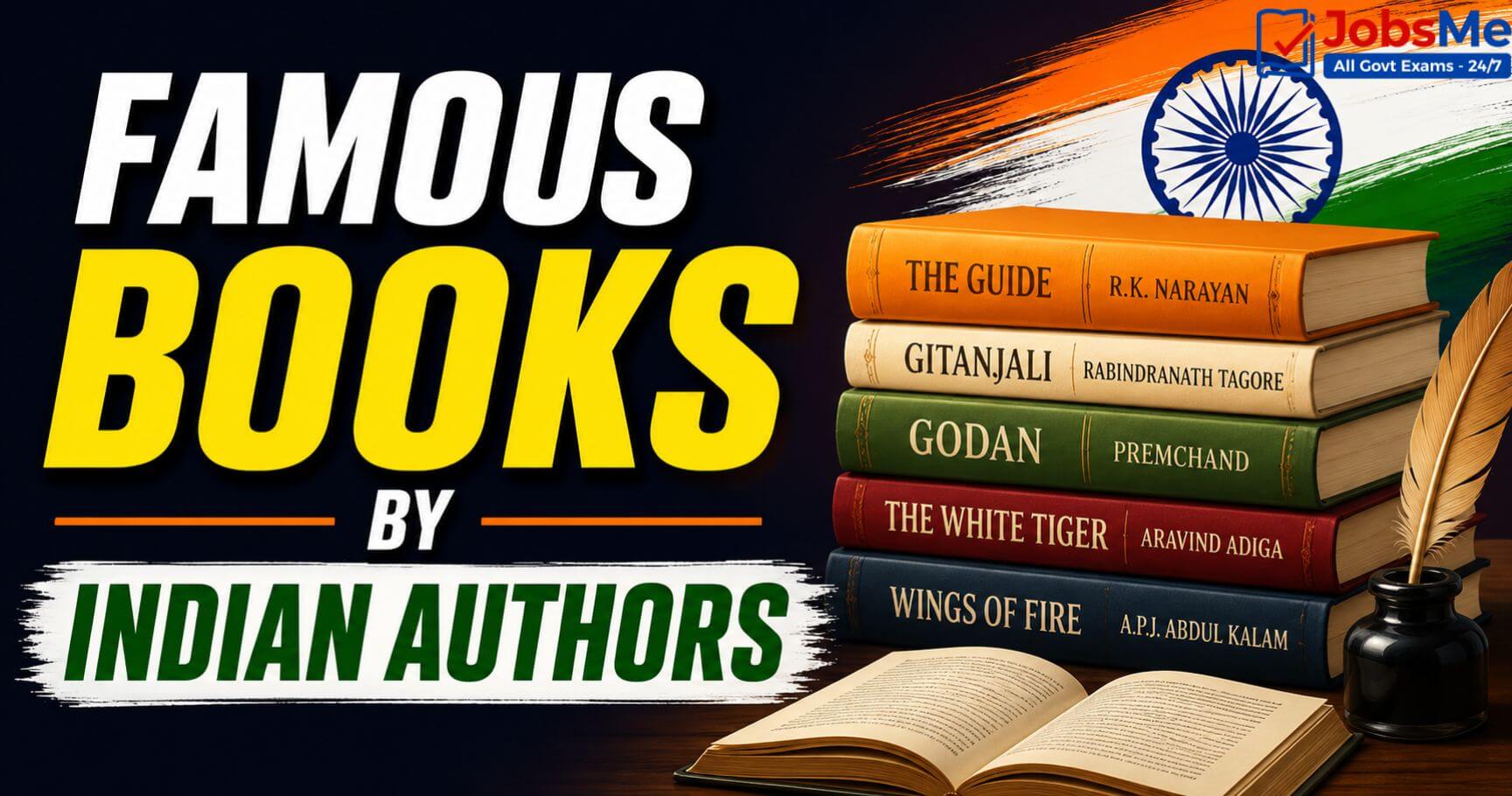
This article presents a complete, exam-ready list of famous books by Indian authors, covering ancient Sanskrit classics, medieval Persian and Arabic chronicles, freedom-struggle writings, post-Independence literary masters, and the latest releases from 2018 right up to 2026. It includes iconic works like Arthashastra by Kautilya, Discovery of India by Jawaharlal Nehru, My Experiments with Truth by Mahatma Gandhi, Geetanjali by Rabindranath Tagore, Midnight's Children by Salman Rushdie, Tomb of Sand by Geetanjali Shree, and Tides of Time by Sudha Murty, along with memory tricks, mnemonics, and one-liners for quick revision. All facts are arranged in exam-ready format to help UPSC, SSC, IBPS, RRB, PSU, Insurance, and State PCS aspirants score better in General Awareness and Static GK sections.
Jump to section
Introduction
Books and their authors form one of the most consistently tested segments of the General Awareness paper in Indian competitive exams. From the timeless wisdom of Kautilya's Arthashastra and Kalidasa's Abhigyan Shakuntalam, to the freedom-era classics like Jawaharlal Nehru's Discovery of India and Mahatma Gandhi's My Experiments with Truth, all the way to contemporary best-sellers like Salman Rushdie's Midnight's Children, Arundhati Roy's The God of Small Things, and Geetanjali Shree's Tomb of Sand, Indian authors have shaped global literature for more than two thousand years. Recent 2025-2026 releases such as Sudha Murty's Tides of Time, General Manoj Mukund Naravane's Four Stars of Destiny, Amish Tripathi's The Chola Tigers, and Arundhati Roy's Mother Mary Comes to Me continue to add fresh exam-relevant material every quarter.
Questions on famous books and their Indian authors appear regularly in UPSC Prelims, SSC CGL, SSC CHSL, IBPS PO, IBPS Clerk, SBI PO, SBI Clerk, RRB NTPC, RRB Group D, NDA, CDS, LIC AAO, NIACL, Insurance, and State PCS exams. Typical questions ask which book was written by a given author, who wrote a specific title, which book won the Booker Prize or Jnanpith Award, or which author published a particular work in the latest year. This article brings together every exam-relevant book by Indian authors in a structured, easy-to-revise format. For a year-wise tracker of the newest releases, you can also follow the Daily Current Affairs updates on Jobsme.in.
Beyond Prelims, books by Indian authors carry weight in UPSC Mains essay writing, SSC Descriptive paper, and Insurance and PSU Descriptive English sections, where aspirants are often expected to quote from or refer to works by Tagore, Gandhi, Nehru, A.P.J. Abdul Kalam, Amartya Sen, Raghuram Rajan, and Shashi Tharoor. Keeping a strong grip on this topic gives candidates an edge across both objective and descriptive evaluations.
Core Concepts: How Books and Authors Are Tested
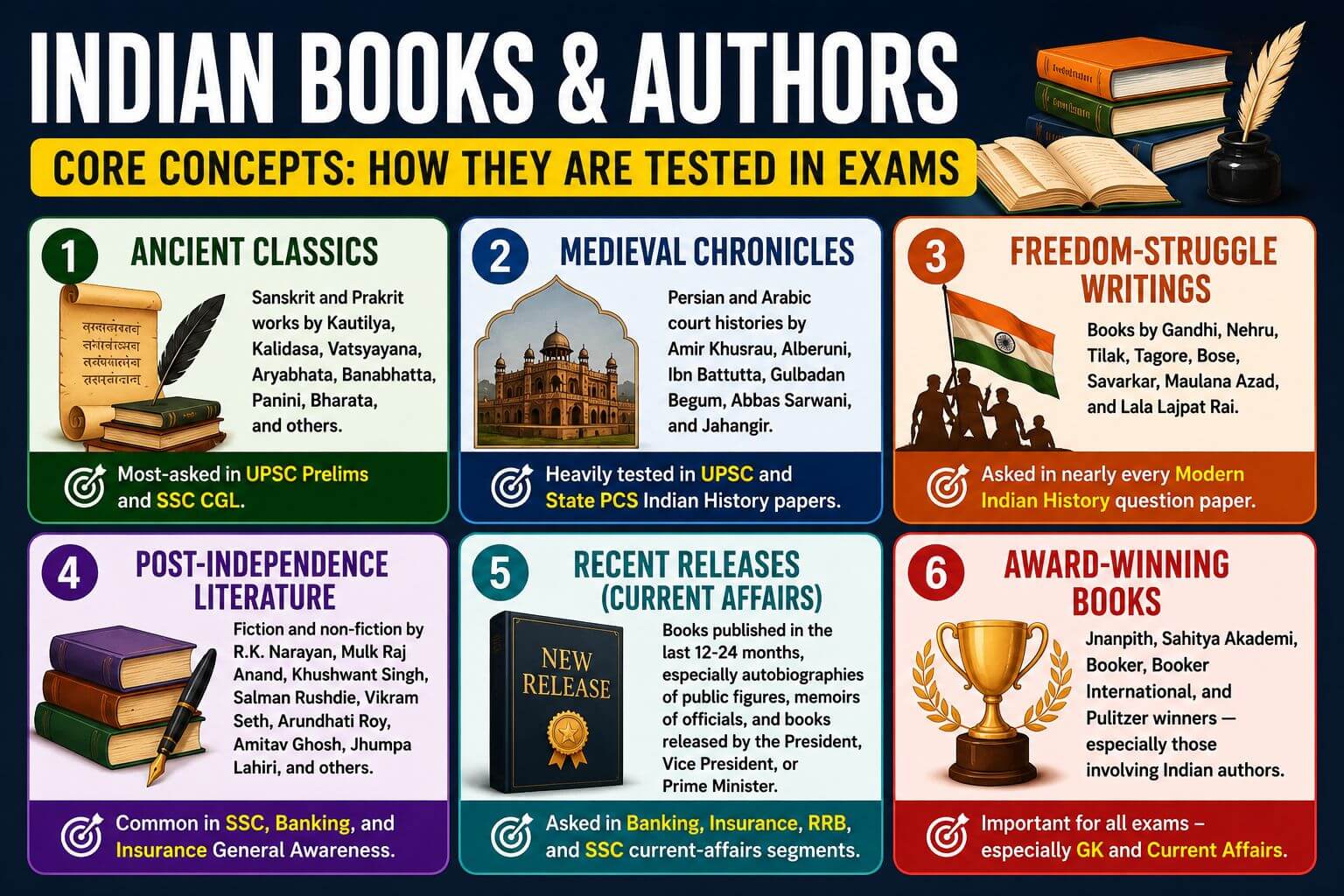
Indian book-and-author questions in competitive exams fall broadly into the following categories. Understanding these categories helps you prepare the right kind of data for each exam.
- Ancient classics: Sanskrit and Prakrit works by Kautilya, Kalidasa, Vatsyayana, Aryabhata, Banabhatta, Panini, Bharata, and others. Most-asked in UPSC Prelims and SSC CGL.
- Medieval chronicles: Persian and Arabic court histories by Amir Khusrau, Alberuni, Ibn Battuta, Gulbadan Begum, Abbas Sarwani, and Jahangir. Heavily tested in UPSC and State PCS Indian History papers.
- Freedom-struggle writings: Books by Gandhi, Nehru, Tilak, Tagore, Bose, Savarkar, Maulana Azad, and Lala Lajpat Rai. Asked in nearly every Modern Indian History question paper.
- Post-Independence literature: Fiction and non-fiction by R.K. Narayan, Mulk Raj Anand, Khushwant Singh, Salman Rushdie, Vikram Seth, Arundhati Roy, Amitav Ghosh, Jhumpa Lahiri, and others. Common in SSC, Banking, and Insurance General Awareness sections.
- Recent releases (current affairs): Books published in the last 12-24 months, especially autobiographies of public figures, memoirs of officials, and books released by the President, Vice President, or Prime Minister. Asked in Banking, Insurance, RRB, and SSC current-affairs segments.
- Award-winning books: Jnanpith, Sahitya Akademi, Booker, Booker International, and Pulitzer winners — especially those involving Indian authors.
Famous Books by Indian Authors - Complete List
The tables below cover the most exam-relevant books by Indian authors, organised period-wise. Every entry includes the book name, author, and the key features or exam-critical context students should remember.
Ancient and Classical Indian Books
These works span roughly 600 BCE to 1200 CE and form the bedrock of Indian Static GK. Sanskrit, Prakrit, and Pali texts dominate this period.
| Book Name | Author | Key Features / Exam Notes |
|---|---|---|
| Arthashastra | Kautilya (Chanakya / Vishnugupta) | 4th century BCE treatise on statecraft, economics, and military strategy; written for Chandragupta Maurya; Kautilya is called the "Indian Machiavelli." |
| Ashtadhyayi | Panini | Foundational Sanskrit grammar text with 3,959 sutras; the world's earliest scientific grammar. |
| Mahabhasya | Patanjali | Commentary on Panini's Ashtadhyayi; Patanjali is also credited with the Yoga Sutras. |
| Natyashastra | Bharata Muni | Ancient treatise on performing arts — drama, dance, and music; the source of classical Indian dance theory. |
| Buddha Charita | Ashvaghosha | Sanskrit biographical poem on the life of Gautama Buddha; written in 1st-2nd century CE. |
| Indica | Megasthenes | Greek ambassador's account of Mauryan India; describes Pataliputra and Chandragupta Maurya's court (though the author is Greek, the book is fundamental Indian history source material). |
| Abhigyan Shakuntalam | Kalidasa | Classical Sanskrit play; Kalidasa is called the "Shakespeare of India"; flourished in the Gupta court. |
| Vikramorvashiyam | Kalidasa | Sanskrit drama on the love of King Pururavas and the celestial nymph Urvashi. |
| Raghuvansham | Kalidasa | Mahakavya (epic poem) on the kings of the Raghu dynasty, including Rama. |
| Kumarasambhavam | Kalidasa | Sanskrit epic on the birth of Kartikeya (Kumara), son of Shiva and Parvati. |
| Meghaduta | Kalidasa | Lyric poem in which a Yaksha sends a message to his beloved via a cloud. |
| Mudrarakshasa | Vishakhadatta | Sanskrit play on the political intrigues of Chanakya leading to Chandragupta Maurya's coronation. |
| Mrichhakatika | Shudraka | "The Little Clay Cart"; Sanskrit play famous for its realistic portrayal of urban life. |
| Kamasutra | Vatsyayana | Ancient Sanskrit treatise on the art of living, love, and human relationships. |
| Panchatantra | Vishnu Sharma | Famous collection of animal fables teaching political wisdom; translated into more than 50 languages. |
| Nitisara | Kamandaka | Treatise on politics and ethics; modelled on Kautilya's Arthashastra. |
| Harshacharita | Banabhatta | Biography of Emperor Harshavardhana; one of the earliest historical biographies in Sanskrit. |
| Kadambari | Banabhatta | One of the earliest novels in world literature; written in Sanskrit prose. |
| Nagananda | Harshavardhana | Sanskrit play composed by the Pushyabhuti emperor Harsha himself. |
| Ratnavali | Harshavardhana | Sanskrit romantic comedy attributed to Emperor Harsha. |
| Priyadarshika | Harshavardhana | Third of Harsha's three Sanskrit plays. |
| Gathasaptashati | Hala | Anthology of 700 Prakrit verses; compiled by the Satavahana king Hala. |
| Aihole Prashasti | Ravikirti | Sanskrit inscription praising Chalukya king Pulakeshin II; composed by court poet Ravikirti. |
| Aryabhatiya | Aryabhata | 5th-century treatise on mathematics and astronomy; introduced the concept of zero and place value. |
| Surya Siddhanta | Aryabhata (attributed) | Sanskrit astronomical treatise dealing with the motions of celestial bodies. |
| Brihat Samhita | Varahamihira | Encyclopaedic Sanskrit work on astrology, astronomy, architecture, and natural phenomena. |
| Panchasiddhantika | Varahamihira | Treatise summarising five earlier astronomical schools. |
| Lilavati | Bhaskara II (Bhaskaracharya) | 12th-century treatise on arithmetic; named after Bhaskara's daughter. |
| Siddhanta Shiromani | Bhaskara II | Comprehensive Sanskrit work covering arithmetic, algebra, and astronomy. |
| Charaka Samhita | Charaka | Foundational Ayurveda text on internal medicine; Charaka is called the "Father of Indian Medicine." |
| Sushruta Samhita | Sushruta | Ancient surgical treatise; Sushruta is regarded as the "Father of Surgery." |
| Amarakosha | Amarasimha | Sanskrit thesaurus; one of the nine jewels of Chandragupta Vikramaditya's court. |
| Rajatarangini | Kalhana | 12th-century chronicle of the kings of Kashmir; the first true historical text in Indian literature. |
| Kathasaritsagara | Somadeva | 11th-century Sanskrit collection of legends and folktales of India. |
| Naishadhacharita | Sriharsha | Sanskrit Mahakavya based on the story of Nala and Damayanti. |
| Gita Govinda | Jayadeva | 12th-century lyric poem on the love of Radha and Krishna; written in Sanskrit. |
| Prashnottaramalika | Amoghavarsha I | Religious text by the Rashtrakuta king Amoghavarsha. |
| Swapnavasavadattam | Bhasa | Sanskrit drama on King Udayana and Queen Vasavadatta. |
Medieval Indian Books (Delhi Sultanate and Mughal Era)
The medieval period (c. 1200-1750 CE) saw a rich body of Persian, Arabic, and regional-language literature produced by court historians, Sufi poets, and emperor-authors.
| Book Name | Author | Key Features / Exam Notes |
|---|---|---|
| Kitab-ul-Hind / Tahqiq-i-Hind | Alberuni | 11th-century Arabic account of India by the Persian scholar who came with Mahmud of Ghazni. |
| Shah Namah | Firdausi | Persian epic on the kings of Persia; influenced Indo-Persian literature. |
| Khamsa | Amir Khusrau | Five Persian poems by the Sufi poet-musician; disciple of Nizamuddin Auliya; called "Tota-e-Hind" (Parrot of India). |
| Khazain-ul-Futuh | Amir Khusrau | Persian work on the conquests of Alauddin Khalji. |
| Nuh-Siphir | Amir Khusrau | Persian poem in nine cantos describing India. |
| Tughlaq-Nama | Amir Khusrau | Persian account of the rise of the Tughlaq dynasty. |
| Tabaqat-i-Nasiri | Minhaj-us-Siraj | 13th-century Persian history of the Muslim world up to the early Delhi Sultanate. |
| Tarikh-i-Firoz Shahi | Ziauddin Barani | 14th-century Persian chronicle of the Delhi Sultanate from Balban to Firoz Shah Tughlaq. |
| Fatuhat-i-Firoz Shahi | Firoz Shah Tughlaq | Autobiographical Persian work describing the achievements of his own reign. |
| Kitab-ul-Rihla / Safarnama | Ibn Battuta | 14th-century Moroccan traveller's Arabic account of his travels through India during Muhammad bin Tughlaq's reign. |
| Chandayan | Maulana Daud | 14th-century Awadhi Sufi romance poem. |
| Bhavartha Dipika (Dnyaneshwari) | Sant Dnyaneshwar (Gyaneshwara) | Marathi commentary on the Bhagavad Gita; foundational text of Marathi Bhakti literature. |
| Humayun-Nama | Gulbadan Begum | Mughal princess's Persian biography of her brother Emperor Humayun; written during Akbar's reign. |
| Akbarnama / Ain-i-Akbari | Abul Fazl | Official chronicle of Akbar's reign in Persian; Ain-i-Akbari forms the third volume. |
| Tuzuk-i-Jahangiri (Jahangirnama) | Emperor Jahangir | Persian autobiography of the Mughal emperor Jahangir. |
| Tarikh-i-Shershahi | Abbas Sarwani | Persian biographical history of Sher Shah Suri. |
| Padshahnama | Abdul Hamid Lahori | Official chronicle of the reign of Shah Jahan. |
| Ramcharitmanas | Goswami Tulsidas | 16th-century Awadhi retelling of the Ramayana; one of the greatest devotional works of Indian literature. |
| Sur Sagar | Surdas | Brajbhasha devotional poetry on Lord Krishna. |
| Padmavat | Malik Muhammad Jayasi | Awadhi Sufi epic on the legendary Rani Padmini of Chittor. |
Modern Era Books — Freedom Struggle Period
This section covers books written between the late 19th century and 1947 — the period of India's freedom struggle. These works shaped national consciousness and are heavily tested in Modern Indian History sections of UPSC, SSC, and State PCS exams. To strengthen your Modern History base, you can also revise the broader Static GK section on Jobsme.in.
| Book Name | Author | Key Features / Exam Notes |
|---|---|---|
| Poverty and Un-British Rule in India | Dadabhai Naoroji | 1901; propounded the famous "Drain of Wealth" theory; Naoroji is the "Grand Old Man of India." |
| Anandamath | Bankim Chandra Chattopadhyay | 1882 Bengali novel; source of the national song "Vande Mataram." |
| Devi Chaudharani | Bankim Chandra Chattopadhyay | Historical Bengali novel on woman-led rebellion against the British. |
| Bharat Durdasha | Bharatendu Harishchandra | 1876 Hindi play on the miserable plight of India under colonial rule. |
| Satya Harishchandra | Bharatendu Harishchandra | 1876 Hindi play; Bharatendu is the "Father of Modern Hindi Literature." |
| Gita Rahasya | Bal Gangadhar Tilak | Marathi commentary on the Bhagavad Gita; written in Mandalay Jail. |
| Kesari | Bal Gangadhar Tilak | Marathi newspaper founded by Tilak in 1881. |
| The Maratha | Bal Gangadhar Tilak | English-language newspaper founded by Tilak in 1881. |
| Geetanjali | Rabindranath Tagore | Bengali poetry collection; won the Nobel Prize in Literature in 1913 — first non-European Nobel laureate. |
| Gora | Rabindranath Tagore | Bengali novel exploring identity, religion, and nationalism. |
| The Home and the World (Ghare Baire) | Rabindranath Tagore | Bengali novel set during the Swadeshi Movement of 1905. |
| Chandalika / Visarjan / The Post Office / The Gardener / Hungry Stones / Chitra | Rabindranath Tagore | Other major works by Tagore; he is "Gurudev / Kaviguru / Biswa Kavi." |
| Anand Math | Bankim Chandra Chattopadhyay | Source of "Vande Mataram"; published 1882. |
| Hindu Swarajya (Hind Swaraj) | Mahatma Gandhi | 1909 Gujarati book outlining Gandhi's vision of self-rule and critique of modern civilisation. |
| My Experiments with Truth (Satya Na Prayogo) | Mahatma Gandhi | Autobiography published 1925-1929 in Gujarati; English translation by Mahadev Desai. |
| Young India | Mahatma Gandhi | English weekly journal edited by Gandhi from 1919 to 1931. |
| Harijan | Mahatma Gandhi | Weekly journal launched by Gandhi in 1933 focusing on social reform. |
| Navjivan | Mahatma Gandhi | Gujarati weekly journal edited by Gandhi. |
| Unhappy India | Lala Lajpat Rai | 1928 rebuttal to Katherine Mayo's "Mother India"; defended Indian culture against colonial caricature. |
| The Story of My Deportation | Lala Lajpat Rai | Memoir of his 1907 deportation to Mandalay. |
| A Nation in Making | Surendranath Banerjee | Autobiographical political memoir by the moderate Congress leader. |
| The Indian War of Independence 1857 | V.D. Savarkar | Reinterpreted the 1857 revolt as India's "First War of Independence." |
| Hindutva: Who is a Hindu? | V.D. Savarkar | 1923 ideological text foundational to the Hindutva movement. |
| India Wins Freedom | Maulana Abul Kalam Azad | Memoir of India's first Education Minister; published posthumously in 1957. |
| Al-Hilal | Maulana Abul Kalam Azad | Urdu weekly newspaper launched 1912; promoted Hindu-Muslim unity and nationalism. |
| Gubar-e-Khatir | Maulana Abul Kalam Azad | Urdu collection of letters written from Ahmednagar Fort prison. |
| The Discovery of India | Jawaharlal Nehru | Written in Ahmednagar Fort (1942-46); panoramic survey of Indian history and civilisation. |
| Glimpses of World History | Jawaharlal Nehru | 196 letters written from prison to his daughter Indira between 1930 and 1933. |
| An Autobiography (Toward Freedom) | Jawaharlal Nehru | 1936 autobiography written in Almora Jail. |
| Letters from a Father to His Daughter | Jawaharlal Nehru | 1929 collection of 30 letters to a young Indira on world history. |
| A Bunch of Old Letters | Jawaharlal Nehru | 1958 collection of letters exchanged with Gandhi, Patel, Jinnah, and others. |
| India Divided | Dr. Rajendra Prasad | 1946; analysed the Hindu-Muslim question and arguments against Partition. |
| The Indian Struggle (1920-42) | Subhash Chandra Bose | Historical account of India's freedom movement written during Bose's European exile. |
| An Indian Pilgrim | Subhash Chandra Bose | Unfinished autobiography of "Netaji." |
| Savitri | Sri Aurobindo | Epic English poem of 24,000 lines; spiritual masterpiece. |
| The Life Divine | Sri Aurobindo | Magnum opus on Integral Yoga and Indian metaphysics. |
| Essays on the Gita | Sri Aurobindo | Spiritual interpretation of the Bhagavad Gita. |
| Bandi Jeevan | Sachindra Nath Sanyal | Hindi memoir of life as a revolutionary; "Bible" of the HSRA movement. |
| Devdas | Sarat Chandra Chattopadhyay | 1917 Bengali novel; one of the most adapted stories in Indian cinema. |
| Parineeta / Charitraheen / Srikanta | Sarat Chandra Chattopadhyay | Famous Bengali novels by the "Kathasilpi" (Storyteller). |
| Agni Veena | Kazi Nazrul Islam | 1922 Bengali poetry collection; Nazrul is the "Rebel Poet" and the national poet of Bangladesh. |
| Bang-e-Dara / Tarana-e-Hind | Muhammad Iqbal | Urdu poetry; "Saare Jahan se Achha" is from Tarana-e-Hind. |
| Indian Philosophy | Dr. S. Radhakrishnan | 1923 monumental two-volume work; Radhakrishnan became India's second President. |
| Kamayani | Jaishankar Prasad | 1936 Hindi Chhayavadi epic poem; a masterpiece of modern Hindi literature. |
| Yama | Mahadevi Verma | 1936 Hindi poetry; won the Jnanpith Award; Mahadevi is called the "Modern Meera." |
| Bharat Bharati | Maithili Sharan Gupt | 1914 Hindi nationalist poem; Gupt is called the "Rashtra Kavi" (National Poet). |
| Chandrakanta Santati | Devkinandan Khatri | 1888; considered the first modern Hindi novel. |
| Karmayogi | Swami Vivekananda | Compilation of lectures on the path of selfless action. |
| The Coalition Years / The Dramatic Decade / The Turbulent Years | Pranab Mukherjee | Three-volume political memoir by India's 13th President. |
Post-Independence Classic Indian Authors
Indian literature in English flowered after 1947 with a generation of internationally celebrated authors. This section covers seminal classics from 1947 up to about 2015 — books regularly tested in Banking, SSC, and Insurance exam General Awareness. Banking aspirants can also strengthen their factual base via the Banking Awareness notes on Jobsme.in.
| Book Name | Author | Key Features / Exam Notes |
|---|---|---|
| The Guide | R.K. Narayan | 1958 novel set in the fictional town of Malgudi; won the Sahitya Akademi Award (1960). |
| Malgudi Days | R.K. Narayan | 1943 short story collection; later adapted into a famous Doordarshan series. |
| Swami and Friends | R.K. Narayan | 1935; the first Malgudi novel. |
| Coolie | Mulk Raj Anand | 1936 novel on the life of a child labourer; pioneer of Indian English fiction. |
| Untouchable | Mulk Raj Anand | 1935 novel on a day in the life of a Dalit sweeper; foreword by E.M. Forster. |
| Train to Pakistan | Khushwant Singh | 1956 novel on Partition; one of the most powerful accounts of the 1947 horrors. |
| We Indians | Khushwant Singh | 1982 social commentary. |
| Truth, Love and a Little Malice | Khushwant Singh | 2002 autobiography. |
| Aadhe Adhure | Mohan Rakesh | 1969 Hindi play; landmark of modern Indian theatre. |
| Midnight's Children | Salman Rushdie | 1981 Booker Prize winner; later won the "Booker of Bookers" (1993) and "Best of the Booker" (2008). |
| The Satanic Verses / Shame / Languages of Truth / Victory City | Salman Rushdie | Other major works by the Booker-winning author. |
| The God of Small Things | Arundhati Roy | 1997 Booker Prize winner; debut novel set in Kerala. |
| The Ministry of Utmost Happiness | Arundhati Roy | 2017 second novel — set across Delhi and Kashmir. |
| AZADI: Freedom. Fascism. Fiction | Arundhati Roy | 2020 essay collection on contemporary Indian politics. |
| A Suitable Boy | Vikram Seth | 1993; one of the longest novels in the English language at nearly 1,500 pages. |
| The Inheritance of Loss | Kiran Desai | 2006 Booker Prize winner; Kiran is the daughter of novelist Anita Desai. |
| The White Tiger | Aravind Adiga | 2008 Booker Prize winner; debut novel on class and corruption in India. |
| Selection Day | Aravind Adiga | 2016 novel on cricket and Mumbai. |
| The Shadow Lines / The Hungry Tide / Sea of Poppies / The Glass Palace / Gun Island / Jungle Nama / The Nutmeg's Curse / The Living Mountain / Wild Fictions | Amitav Ghosh | Acclaimed author of the Ibis Trilogy and climate-fiction works; won Sahitya Akademi (1989) and Jnanpith (2018). |
| Interpreter of Maladies | Jhumpa Lahiri | 1999 Pulitzer Prize-winning short story collection. |
| The Namesake | Jhumpa Lahiri | 2003 novel on Bengali immigrants in the US. |
| The Lowland / Whereabouts / Translating Myself and Others | Jhumpa Lahiri | Other notable works by the Indian-American author. |
| A Fine Balance | Rohinton Mistry | 1995 novel set during the Emergency. |
| Such a Long Journey | Rohinton Mistry | 1991 novel on Parsi life in Bombay. |
| Wings of Fire | A.P.J. Abdul Kalam (with Arun Tiwari) | 1999 autobiography of India's "Missile Man" and 11th President. |
| Ignited Minds / India 2020 / The Turning Point / My Journey / Indomitable Spirit | A.P.J. Abdul Kalam | Other widely-read Kalam books on India's future and his own life. |
| The Great Indian Novel | Shashi Tharoor | 1989 retelling of the Mahabharata as Indian political history. |
| An Era of Darkness (Inglorious Empire) | Shashi Tharoor | 2016 critique of British colonial rule; Sahitya Akademi Award (2019). |
| Why I Am a Hindu / The Paradoxical Prime Minister / Pride, Prejudice and Punditry / Ambedkar: A Life / The Battle of Belonging | Shashi Tharoor | Other notable Tharoor titles spanning politics, religion, and biography. |
| The Argumentative Indian | Amartya Sen | 2005 essays on Indian history and identity; Sen is the Nobel Laureate in Economics (1998). |
| An Uncertain Glory / Development as Freedom / The Idea of Justice / Home in the World | Amartya Sen | Other major Sen works; "Home in the World" (2021) is his memoir. |
| The Immortals of Meluha / Secret of the Nagas / Oath of the Vayuputras | Amish Tripathi | Shiva Trilogy; among India's biggest-selling English fiction series. |
| Ram: Scion of Ikshvaku / Sita / Raavan / Legend of Suheldev / Immortal India / Dharma / The Chola Tigers | Amish Tripathi | Ram Chandra Series and mythological non-fiction by India's bestselling mytho-fiction author. |
| Five Point Someone / 2 States / Half Girlfriend / Revolution 2020 / One Indian Girl / The Girl in Room 105 / 400 Days / One Arranged Murder / India Positive | Chetan Bhagat | Popular contemporary English fiction by India's mass-market novelist. |
| I Do What I Do | Raghuram Rajan | 2017 collection of speeches as RBI Governor. |
| The Third Pillar / Fault Lines / Saving Capitalism from the Capitalists | Raghuram Rajan | Major economics works by the former IMF chief economist and RBI Governor. |
| Indian Fiscal Federalism | Y.V. Reddy | Important reference on Indian Centre-State finances by former RBI Governor. |
| Overdraft: Saving the Indian Saver | Urjit Patel | 2020 book on India's banking crisis by former RBI Governor. |
| Hit Refresh | Satya Nadella | 2017 memoir by Microsoft CEO. |
| Stay Hungry Stay Foolish / Connect the Dots | Rashmi Bansal | Inspirational non-fiction on Indian entrepreneurs. |
| India Unbound / India Grows at Night | Gurcharan Das | 2000; survey of India's post-liberalisation economic journey. |
| The Idea of India | Sunil Khilnani | 1997 classic on India's nation-building project after Independence. |
| Breakout Nations / The Rise and Fall of Nations / Democracy on the Road | Ruchir Sharma | Widely read economics and politics works. |
| Curukshetra | Ramdhari Singh Dinkar | 1946 Hindi epic poem on the moral conflict in the Mahabharata. |
| Jhootha Sach | Yashpal | 1960 Hindi novel on Partition. |
| The Last Mughal / The Anarchy / White Mughals / City of Djinns | William Dalrymple (writes on India) | Acclaimed history of India; though Scottish, his works are central to Indian history sections. |
| How the Earth Got Its Beauty / Three Thousand Stitches / Wise and Otherwise / The Day I Stopped Drinking Milk / Common Yet Uncommon | Sudha Murty | Highly read by school and college aspirants; Murty was honoured with the Padma Bhushan in 2023. |
Recent Books by Indian Authors (2018-2026)
This is the most current-affairs-heavy section. Books from the last 8 years are frequently asked in Banking, SSC, RRB, and Insurance current-affairs segments. To keep up with newer releases between revisions, you can attempt the Daily Current Affairs Quiz on Jobsme.in regularly.
| Book Name | Author | Year / Key Features |
|---|---|---|
| Tides of Time | Sudha Murty | 2026; highlights India's history through the murals of Parliament House. |
| Atal Bihari Vajpayee: The Eternal Statesman | Released by VP C.P. Radhakrishnan | February 2026 release in New Delhi. |
| Four Stars of Destiny | General Manoj Mukund Naravane (Retd.) | Autobiography of the former Chief of Army Staff; re-released in 2026. |
| Karuna: The Power of Compassion | Kailash Satyarthi | 2026; by the Nobel Peace Prize laureate. |
| The One: Cricket, My Life and More | Shikhar Dhawan | 2025 autobiography of the Indian opener. |
| Mother Mary Comes to Me | Arundhati Roy | 2025 memoir dedicated to the author's mother Mary Roy. |
| The Chola Tigers: The Avengers of Somnath | Amish Tripathi | 2025 historical fiction on the Chola raid into Somnath. |
| The Great Sanctions Hack | Urjit Patel | 2025; on the new architecture of global financial sanctions. |
| Wings of Valour | Swapnil Pandey | 2025; on Indian Air Force fighter pilots. |
| Operation Sindoor: The Untold Story of India's Deep Strikes Inside Pakistan | Lt Gen K.J.S. Dhillon (Retd.) | 2025; insider account of cross-border operations. |
| Ready, Relevant and Resurgent II: Shaping a Future Ready Force | General Anil Chauhan | 2025; by the Chief of Defence Staff. |
| Why the Constitution Matters | Former CJI D.Y. Chandrachud | 2025; on the Indian Constitution's contemporary relevance. |
| Modi's Mission | Berjis Desai | 2025 political commentary. |
| Wings to Our Hopes - Volume II | President Droupadi Murmu | 2025 collection of speeches by India's 15th President. |
| The Undying Light: A Personal History of Independent India | Gopalkrishna Gandhi | 2025 memoir by Mahatma Gandhi's grandson and former Governor of West Bengal. |
| Indira Gandhi and the Years that Transformed India | Srinath Raghavan | 2025 political history. |
| Beyond the Courtroom | Fali S. Nariman | 2025; legal memoirs by the eminent jurist. |
| Life on Mars: Collected Stories | Amitabh Kant | 2025 short fiction by the former NITI Aayog CEO and G20 Sherpa. |
| Diyaslai | Kailash Satyarthi | 2025; Hindi work by the Nobel Peace Prize laureate. |
| BRING IT ON: The Incredible Story of My Life | Dr. Deepa Malik | 2025 autobiography of India's first Paralympic silver medallist. |
| How India Scaled Mt G20: The Inside Story of the G20 Presidency | Amitabh Kant | 2024; on India's G20 presidency. |
| The World After Gaza | Pankaj Mishra | 2025 essay on geopolitics post-Gaza war. |
| Wild Fictions | Amitav Ghosh | 2025 essay collection. |
| India: 5000 Years of History on the Subcontinent | Audrey Truschke | 2025; major work of Indian historiography. |
| Ek Samandar, Mere Andar | Sanjeev Joshi | 2024 Hindi poetry. |
| An Uncommon Love: The Early Life of Sudha and Narayana Murthy | Chitra Banerjee Divakaruni | 2024 biography of the Infosys co-founders. |
| Assam's Braveheart - Lachit Barphukan | Arup Kumar Dutta | 2024; on the 17th-century Ahom general. |
| Maha Kavithai | Vairamuthu | 2024 Tamil poetry by the Sahitya Akademi-winning lyricist. |
| Ambedkar: A Life | Shashi Tharoor | 2023 biography of Dr. B.R. Ambedkar. |
| Revolutionaries: The Other Story of How India Won Its Freedom | Sanjeev Sanyal | 2023; on lesser-known revolutionaries of the Indian freedom struggle. |
| Victory City | Salman Rushdie | 2023; on the Vijayanagara empire's founding. |
| Made in India | Amitabh Kant | 2023; on India's manufacturing journey. |
| Sachin @ 50 | Boria Majumdar | 2023; on Sachin Tendulkar's 50th birthday. |
| Pyre | Perumal Murugan | Tamil novel; shortlisted for the International Booker Prize 2023. |
| Partitioned Freedom | Ram Madhav | 2023; revisits the legacy of Partition. |
| The Golden Years | Ruskin Bond | 2023 memoir by India's beloved children's author. |
| Pranab, My Father: A Daughter Remembers | Sharmistha Mukherjee | 2023; on her father, former President Pranab Mukherjee. |
| Welcome to Paradise | Twinkle Khanna | 2023 short story collection. |
| Tomb of Sand (Ret Samadhi) | Geetanjali Shree (translated by Daisy Rockwell) | Won the International Booker Prize 2022 — first Hindi novel ever to win it. |
| Modi @20: Dreams Meeting Delivery | Edited by Bluekraft Digital Foundation | 2022; on 20 years of PM Narendra Modi in public office. |
| Indomitable: A Working Woman's Notes on Life, Work, and Leadership | Arundhati Bhattacharya | 2022; by the first woman Chairperson of SBI. |
| Lal Salam | Smriti Irani | 2022 debut fiction by the BJP minister. |
| Listen to Your Heart: The London Adventure | Ruskin Bond | 2022 memoir. |
| Fearless Governance | Dr. Kiran Bedi | 2022 memoir by India's first woman IPS officer. |
| Golden Boy Neeraj Chopra | Navdeep Singh Gill | 2022; on the Olympic gold medallist javelin thrower. |
| The Maverick Effect | Harish Mehta | 2022; on the founding of NASSCOM and India's IT industry. |
| India, That is Bharat: Coloniality, Civilisation, Constitution | J. Sai Deepak | 2021; first volume of his constitutional trilogy. |
| Asoca: A Sutra | Irwin Allan Sealy | 2021; on Emperor Ashoka. |
| The Commonwealth of Cricket | Ramachandra Guha | 2021 memoir on a cricketing life. |
| Home in the World | Amartya Sen | 2021 autobiography of the Nobel laureate. |
| Whereabouts | Jhumpa Lahiri | 2021; her first novel originally written in Italian and self-translated. |
| Believe - What Life and Cricket Taught Me | Suresh Raina | 2021 autobiography. |
| Unfinished | Priyanka Chopra Jonas | 2021 memoir by the actress. |
| Savarkar: A Contested Legacy | Vikram Sampath | 2021; second volume of the Savarkar biography. |
| The Nutmeg's Curse | Amitav Ghosh | 2021; on climate change and colonialism. |
| The Living Mountain: A Fable for Our Times | Amitav Ghosh | 2021 climate-fiction parable. |
| The Earthspinner | Anuradha Roy | 2021 novel. |
| Karmayoddha Granth | Amit Shah (Edited) | 2020; on PM Modi's life and work. |
| The Battle of Belonging | Shashi Tharoor | 2020; on nationalism, patriotism, and identity in India. |
| AZADI: Freedom. Fascism. Fiction | Arundhati Roy | 2020 essay collection. |
| Legend of Suheldev: The King Who Saved India | Amish Tripathi | 2020; on the 11th-century Bhar king. |
| Death - An Inside Story | Sadhguru Jaggi Vasudev | 2020; spiritual perspective on death. |
| Naoroji: Pioneer of Indian Nationalism | Dinyar Patel | 2020 biography of Dadabhai Naoroji. |
| One Arranged Murder | Chetan Bhagat | 2020 mystery novel. |
| Lessons Life Taught Me, Unknowingly | Anupam Kher | 2019 autobiography. |
| The Third Pillar | Raghuram Rajan | 2019; on community, state, and markets. |
| Every Vote Counts - The Story of India's Elections | Navin Chawla | 2019; by the former Chief Election Commissioner. |
| Mind-Master | Viswanathan Anand | 2019 autobiography of the chess Grandmaster. |
| Gun Island | Amitav Ghosh | 2019; on climate change, migration, and folklore. |
| Making of New India | Dr. Bibek Debroy | 2019; on India's development journey. |
| Indian Fiscal Federalism | Dr. Y.V. Reddy | 2019; by the former RBI Governor. |
| Exam Warriors | Narendra Modi | 2018; PM Modi's guide for students preparing for exams; a Braille edition was released later. |
| Changing India | Dr. Manmohan Singh | 2018; a five-volume compilation of speeches by the former PM. |
| The Paradoxical Prime Minister | Shashi Tharoor | 2018; critique of the Modi government. |
| Why I Am a Hindu | Shashi Tharoor | 2018; on Hinduism and contemporary politics. |
| Immortal India | Amish Tripathi | 2018 essay collection on Indian civilisation. |
| A Century Is Not Enough | Sourav Ganguly | 2018 autobiography. |
| 281 and Beyond | V.V.S. Laxman | 2018 cricketing autobiography. |
| Imperfect | Sanjay Manjrekar | 2018 cricketing autobiography. |
| Indira Gandhi: A Life in Nature | Jairam Ramesh | 2018; on the environmental side of Indira Gandhi. |
| Coalition Years (1996-2012) | Pranab Mukherjee | 2017 (third volume of his memoirs); released in 2018. |
| Citizen Delhi: My Times, My Life | Sheila Dikshit | 2018 autobiography of the late Delhi CM. |
Award-Winning Books by Indian Authors
This table covers the most exam-critical national and international literary awards won by Indian authors.
| Book Name | Author | Award / Recognition |
|---|---|---|
| Geetanjali | Rabindranath Tagore | Nobel Prize in Literature, 1913 — first non-European laureate. |
| Midnight's Children | Salman Rushdie | Booker Prize 1981; Booker of Bookers 1993; Best of the Booker 2008. |
| The God of Small Things | Arundhati Roy | Booker Prize 1997 — first Indian woman to win the Booker. |
| The Inheritance of Loss | Kiran Desai | Booker Prize 2006. |
| The White Tiger | Aravind Adiga | Booker Prize 2008. |
| Tomb of Sand (Ret Samadhi) | Geetanjali Shree (tr. Daisy Rockwell) | International Booker Prize 2022 — first Hindi novel to win. |
| Interpreter of Maladies | Jhumpa Lahiri | Pulitzer Prize for Fiction, 2000. |
| The Sea of Poppies (Ibis Trilogy) | Amitav Ghosh | Won Jnanpith Award 2018 — first English-language Indian author to receive it. |
| Mirage and Other Stories | Damodar Mauzo | 57th Jnanpith Award (2022) — Konkani writer. |
| Kabita | Nilmani Phookan Jr. | 56th Jnanpith Award (2021) — Assamese poet. |
| An Era of Darkness | Shashi Tharoor | Sahitya Akademi Award (English, 2019). |
| Things to Leave Behind | Namita Gokhale | Sahitya Akademi Award (English, 2021). |
| When God Is a Traveler | Arundhathi Subramaniam | Sahitya Akademi Award (English, 2020). |
| Tokri Mein Digant | Anamika | Sahitya Akademi Award (Hindi, 2020) — first Hindi woman poet to win the Akademi. |
| Samrat Ashok | Daya Prakash Sinha | Sahitya Akademi Award (Hindi, 2021). |
| Tell Her Everything | Mirza Waheed | The Hindu Literary Prize (Fiction, 2019). |
Memory Tricks and Mnemonics
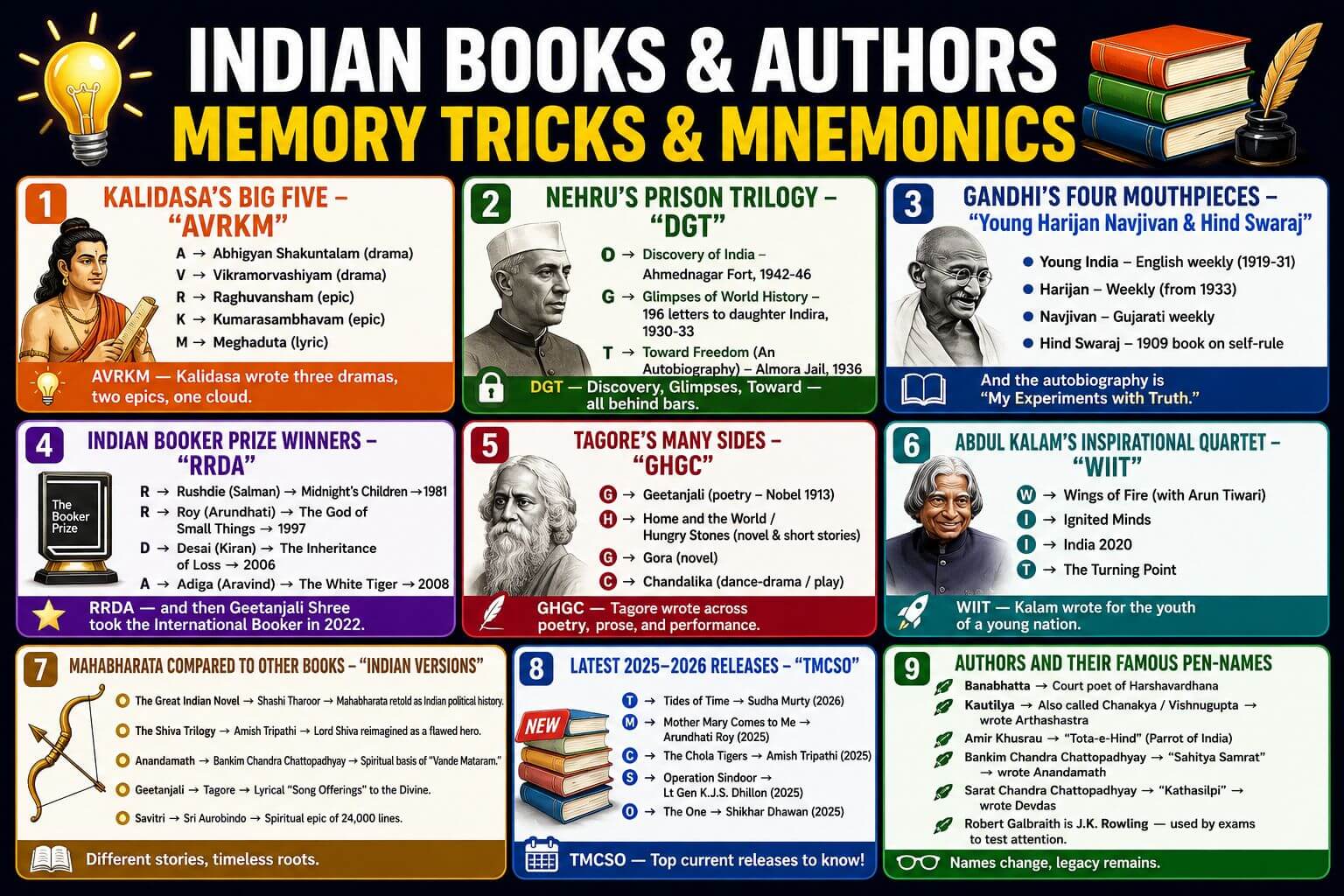
Trick 1: Kalidasa's Big Five — "AVRKM"
Use this acronym to remember Kalidasa's five major works:
- A → Abhigyan Shakuntalam (drama).
- V → Vikramorvashiyam (drama).
- R → Raghuvansham (epic).
- K → Kumarasambhavam (epic).
- M → Meghaduta (lyric).
"AVRKM — Kalidasa wrote three dramas, two epics, one cloud."
Trick 2: Nehru's Prison Trilogy — "DGT"
All three of Nehru's most famous books were written in prison. Remember them as "DGT":
- D → Discovery of India — Ahmednagar Fort, 1942-46.
- G → Glimpses of World History — 196 letters to daughter Indira, 1930-33.
- T → Toward Freedom (An Autobiography) — Almora Jail, 1936.
"DGT — Discovery, Glimpses, Toward — all behind bars."
Trick 3: Gandhi's Four Mouthpieces — "Young Harijan Navjivan & Hind Swaraj"
Gandhi's writings revolve around four key publications:
- Young India — English weekly (1919-31).
- Harijan — Weekly (from 1933).
- Navjivan — Gujarati weekly.
- Hind Swaraj — 1909 book on self-rule.
And the autobiography is "My Experiments with Truth."
Trick 4: Indian Booker Prize Winners — "RRDA"
Four Indians have won the Booker Prize for Fiction. Use "RRDA" in chronological order:
- R → Rushdie (Salman) → Midnight's Children → 1981.
- R → Roy (Arundhati) → The God of Small Things → 1997.
- D → Desai (Kiran) → The Inheritance of Loss → 2006.
- A → Adiga (Aravind) → The White Tiger → 2008.
"RRDA — and then Geetanjali Shree took the International Booker in 2022."
Trick 5: Tagore's Many Sides — "GHGC"
Tagore wrote across genres. Remember the four genres he conquered as "GHGC":
- G → Geetanjali (poetry — Nobel 1913).
- H → Home and the World / Hungry Stones (novel & short stories).
- G → Gora (novel).
- C → Chandalika (dance-drama / play).
Trick 6: Abdul Kalam's Inspirational Quartet — "WIIT"
Dr. APJ Abdul Kalam's four most-asked books form "WIIT":
- W → Wings of Fire (with Arun Tiwari).
- I → Ignited Minds.
- I → India 2020.
- T → The Turning Point.
"WIIT — Kalam wrote for the youth of a young nation."
Trick 7: Mahabharata Compared to Other Books — "Indian Versions"
Many Indian authors compare their work to global classics. Memorise these contrast pairs:
- The Great Indian Novel → Shashi Tharoor → Mahabharata retold as Indian political history.
- The Shiva Trilogy → Amish Tripathi → Lord Shiva reimagined as a flawed hero.
- Anandamath → Bankim Chandra Chattopadhyay → Spiritual basis of "Vande Mataram."
- Geetanjali → Tagore → Lyrical "Song Offerings" to the Divine.
- Savitri → Sri Aurobindo → Spiritual epic of 24,000 lines.
Trick 8: Latest 2025-2026 Releases — "TMCSO"
Five of the most-asked recent releases form "TMCSO":
- T → Tides of Time → Sudha Murty (2026).
- M → Mother Mary Comes to Me → Arundhati Roy (2025).
- C → The Chola Tigers → Amish Tripathi (2025).
- S → Operation Sindoor → Lt Gen K.J.S. Dhillon (2025).
- O → The One → Shikhar Dhawan (2025).
Trick 9: Authors and Their Famous Pen-Names
- Banabhatta → Court poet of Harshavardhana.
- Kautilya → Also called Chanakya / Vishnugupta → wrote Arthashastra.
- Amir Khusrau → "Tota-e-Hind" (Parrot of India).
- Bankim Chandra Chattopadhyay → "Sahitya Samrat" → wrote Anandamath.
- Sarat Chandra Chattopadhyay → "Kathasilpi" → wrote Devdas.
- Robert Galbraith is J.K. Rowling — used by exams to test attention.
Additional Notes
Frequently Confused Facts
- Discovery of India vs Glimpses of World History: Both by Nehru, but "Discovery" was written in Ahmednagar Fort (1942-46) as a survey of India; "Glimpses" was 196 letters to Indira from 1930-33.
- My Experiments with Truth vs Hind Swaraj: Both by Gandhi. "My Experiments with Truth" is the autobiography (1925-29); "Hind Swaraj" is the 1909 political treatise.
- Anandamath vs Devi Chaudharani: Both by Bankim Chandra Chattopadhyay. "Anandamath" contains "Vande Mataram"; "Devi Chaudharani" features a woman-led rebellion.
- Tomb of Sand vs The God of Small Things: Tomb of Sand (Geetanjali Shree) won the International Booker Prize 2022; The God of Small Things (Arundhati Roy) won the Booker Prize 1997.
- Geetanjali (Tagore) vs Geetanjali Shree: "Geetanjali" is Tagore's Nobel-winning 1913 poetry; "Geetanjali Shree" is the author of "Tomb of Sand."
- Wings of Fire vs Ignited Minds: Both by APJ Abdul Kalam. "Wings of Fire" is the autobiography (co-authored with Arun Tiwari); "Ignited Minds" is a motivational book on Indian youth.
- Arthashastra vs Indica: "Arthashastra" was written by Kautilya, an Indian; "Indica" was written by Megasthenes, the Greek ambassador.
- Akbarnama vs Ain-i-Akbari: Both by Abul Fazl. Akbarnama is the chronicle of Akbar's reign; Ain-i-Akbari is its administrative gazette and forms the third volume.
- Humayun-Nama vs Tuzuk-i-Jahangiri: Humayun-Nama was written by Gulbadan Begum (Humayun's sister); Tuzuk-i-Jahangiri is Jahangir's own autobiography.
- Train to Pakistan vs A Suitable Boy: Train to Pakistan (Khushwant Singh, 1956) is on Partition; A Suitable Boy (Vikram Seth, 1993) is post-Partition India.
- The Inheritance of Loss vs Fasting Feasting: The first is by Kiran Desai (Booker 2006); the second is by her mother Anita Desai.
- Lilavati vs Surya Siddhanta: Lilavati was by Bhaskara II (12th century); Surya Siddhanta is attributed to Aryabhata (5th century).
Repeating PYQ Patterns
Certain author-book pairs come up almost every year across exams. Mahatma Gandhi (My Experiments with Truth, Hind Swaraj), Jawaharlal Nehru (Discovery of India, Glimpses of World History), Rabindranath Tagore (Geetanjali, Gora), Bal Gangadhar Tilak (Gita Rahasya), Dadabhai Naoroji (Poverty and Un-British Rule in India), Kautilya (Arthashastra), Kalidasa (Abhigyan Shakuntalam), APJ Abdul Kalam (Wings of Fire, Ignited Minds), Salman Rushdie (Midnight's Children), Arundhati Roy (The God of Small Things), Aravind Adiga (The White Tiger), Geetanjali Shree (Tomb of Sand), Jhumpa Lahiri (Interpreter of Maladies), Vikram Seth (A Suitable Boy), Khushwant Singh (Train to Pakistan), Amitav Ghosh (The Hungry Tide / Sea of Poppies), Shashi Tharoor (An Era of Darkness, Why I Am a Hindu), Raghuram Rajan (The Third Pillar, I Do What I Do), and Amartya Sen (The Argumentative Indian) dominate UPSC Prelims, SSC CGL, RRB NTPC, IBPS PO, and SBI Clerk papers. Banking and Insurance exams pay special attention to books by RBI Governors, finance ministers, and CEOs. State PCS exams add regional language authors — Kannada (Kuvempu, U.R. Ananthamurthy), Malayalam (Perumal Murugan, M.T. Vasudevan Nair), Tamil (Vairamuthu, Perumal Murugan), Marathi (P.L. Deshpande, Vinda Karandikar), Bengali (Bankim Chandra, Tagore, Sarat Chandra), and Hindi (Premchand, Dinkar, Jaishankar Prasad, Mahadevi Verma).
Quick Insight
Books by Indian authors are more than literature — they are a continuous record of the nation's thought, struggle, and aspiration. Kautilya's Arthashastra still shapes how we read statecraft; Gandhi's Hind Swaraj still informs debates on development versus simplicity; Tagore's Geetanjali placed India on the Nobel stage in 1913; Geetanjali Shree's Tomb of Sand did the same for Hindi literature on the International Booker stage in 2022; and Sudha Murty's 2026 Tides of Time reminds us how living history is etched into the walls of Parliament itself. Understanding these works helps aspirants connect literature to current affairs — when a book is released by the President, Vice President, or PM, when a Jnanpith winner is announced, or when an Indian author wins the Booker. For wider Static GK preparation around such topics, students can refer to the Static GK notes and the Banking Awareness section on Jobsme.in.
One-Liners for Quick Revision
- Arthashastra → Kautilya (Chanakya) → 4th century BCE treatise on statecraft.
- Ashtadhyayi → Panini → World's earliest Sanskrit grammar.
- Mahabhasya → Patanjali → Commentary on Panini.
- Natyashastra → Bharata Muni → Ancient treatise on drama and dance.
- Buddha Charita → Ashvaghosha → Sanskrit biography of Buddha.
- Indica → Megasthenes → Greek envoy's account of Mauryan India.
- Abhigyan Shakuntalam / Vikramorvashiyam / Raghuvansham / Kumarasambhavam / Meghaduta → Kalidasa.
- Mudrarakshasa → Vishakhadatta → Sanskrit play on Chanakya-Chandragupta intrigue.
- Mrichhakatika → Shudraka → Sanskrit play "The Little Clay Cart."
- Kamasutra → Vatsyayana → Ancient treatise on love and human relationships.
- Panchatantra → Vishnu Sharma → Famous animal fables.
- Nitisara → Kamandaka → Treatise on politics modelled on Arthashastra.
- Harshacharita / Kadambari → Banabhatta → Court poet of Harshavardhana.
- Nagananda / Ratnavali / Priyadarshika → Harshavardhana himself.
- Gathasaptashati → Hala → Prakrit anthology by the Satavahana king.
- Aihole Prashasti → Ravikirti → Inscription praising Pulakeshin II.
- Aryabhatiya / Surya Siddhanta → Aryabhata → Astronomy and mathematics.
- Brihat Samhita / Panchasiddhantika → Varahamihira.
- Lilavati / Siddhanta Shiromani → Bhaskara II.
- Charaka Samhita → Charaka → Ayurveda; "Father of Indian Medicine."
- Sushruta Samhita → Sushruta → "Father of Surgery."
- Amarakosha → Amarasimha → Sanskrit thesaurus.
- Rajatarangini → Kalhana → First true historical text in Indian literature.
- Kathasaritsagara → Somadeva → Sanskrit folktales.
- Naishadhacharita → Sriharsha → Story of Nala and Damayanti.
- Gita Govinda → Jayadeva → Sanskrit lyric on Radha-Krishna.
- Swapnavasavadattam → Bhasa → Sanskrit drama on Udayana.
- Kitab-ul-Hind → Alberuni → Arabic account of India.
- Khamsa / Khazain-ul-Futuh / Nuh-Siphir / Tughlaq-Nama → Amir Khusrau.
- Tabaqat-i-Nasiri → Minhaj-us-Siraj → Persian history of early Delhi Sultanate.
- Tarikh-i-Firoz Shahi → Ziauddin Barani → Chronicle of the Delhi Sultanate.
- Fatuhat-i-Firoz Shahi → Firoz Shah Tughlaq → Autobiographical work.
- Kitab-ul-Rihla / Safarnama → Ibn Battuta → Moroccan traveller's account of India.
- Humayun-Nama → Gulbadan Begum → Biography of Humayun.
- Akbarnama / Ain-i-Akbari → Abul Fazl.
- Tuzuk-i-Jahangiri → Emperor Jahangir → Persian autobiography.
- Tarikh-i-Shershahi → Abbas Sarwani → On Sher Shah Suri.
- Padshahnama → Abdul Hamid Lahori → Chronicle of Shah Jahan.
- Bhavartha Dipika (Dnyaneshwari) → Sant Dnyaneshwar.
- Ramcharitmanas → Tulsidas → Awadhi retelling of the Ramayana.
- Sur Sagar → Surdas → Brajbhasha Krishna devotion.
- Padmavat → Malik Muhammad Jayasi → Awadhi Sufi epic on Rani Padmini.
- Poverty and Un-British Rule in India → Dadabhai Naoroji → Drain of Wealth theory.
- Anandamath / Devi Chaudharani → Bankim Chandra Chattopadhyay.
- Bharat Durdasha / Satya Harishchandra → Bharatendu Harishchandra.
- Gita Rahasya / Kesari / The Maratha → Bal Gangadhar Tilak.
- Geetanjali / Gora / Home and the World / Chandalika / The Post Office → Rabindranath Tagore → Nobel Prize 1913.
- My Experiments with Truth / Hind Swaraj / Young India / Harijan / Navjivan → Mahatma Gandhi.
- Unhappy India → Lala Lajpat Rai → Rebuttal to Mayo's Mother India.
- A Nation in Making → Surendranath Banerjee.
- Indian War of Independence 1857 / Hindutva → V.D. Savarkar.
- India Wins Freedom / Al-Hilal / Gubar-e-Khatir → Maulana Abul Kalam Azad.
- Discovery of India / Glimpses of World History / An Autobiography / Letters from a Father to His Daughter / A Bunch of Old Letters → Jawaharlal Nehru.
- India Divided → Dr. Rajendra Prasad.
- The Indian Struggle / An Indian Pilgrim → Subhash Chandra Bose.
- Savitri / The Life Divine / Essays on the Gita → Sri Aurobindo.
- Bandi Jeevan → Sachindra Nath Sanyal.
- Devdas / Parineeta / Srikanta → Sarat Chandra Chattopadhyay.
- Agni Veena → Kazi Nazrul Islam.
- Bang-e-Dara / Tarana-e-Hind → Muhammad Iqbal.
- Indian Philosophy → Dr. S. Radhakrishnan.
- Kamayani → Jaishankar Prasad → Hindi Chhayavadi epic.
- Yama → Mahadevi Verma → Jnanpith Award winner.
- Bharat Bharati → Maithili Sharan Gupt → "Rashtra Kavi."
- Chandrakanta Santati → Devkinandan Khatri → First modern Hindi novel.
- The Guide / Malgudi Days / Swami and Friends → R.K. Narayan.
- Coolie / Untouchable → Mulk Raj Anand.
- Train to Pakistan / We Indians → Khushwant Singh.
- Aadhe Adhure → Mohan Rakesh.
- Midnight's Children / Satanic Verses / Victory City → Salman Rushdie.
- The God of Small Things / The Ministry of Utmost Happiness / AZADI / Mother Mary Comes to Me → Arundhati Roy.
- A Suitable Boy → Vikram Seth.
- The Inheritance of Loss → Kiran Desai → Booker 2006.
- The White Tiger / Selection Day → Aravind Adiga → Booker 2008.
- The Hungry Tide / Sea of Poppies / Gun Island / Jungle Nama / The Nutmeg's Curse / Wild Fictions → Amitav Ghosh → Jnanpith 2018.
- Interpreter of Maladies / The Namesake / Whereabouts → Jhumpa Lahiri → Pulitzer 2000.
- A Fine Balance / Such a Long Journey → Rohinton Mistry.
- Wings of Fire / Ignited Minds / India 2020 / The Turning Point → APJ Abdul Kalam.
- The Great Indian Novel / An Era of Darkness / Why I Am a Hindu / The Paradoxical Prime Minister / Ambedkar: A Life → Shashi Tharoor.
- The Argumentative Indian / Home in the World / Development as Freedom → Amartya Sen.
- The Shiva Trilogy / Ram Chandra Series / Legend of Suheldev / Immortal India / The Chola Tigers → Amish Tripathi.
- Five Point Someone / 2 States / Half Girlfriend / 400 Days / One Arranged Murder → Chetan Bhagat.
- I Do What I Do / The Third Pillar / Fault Lines → Raghuram Rajan.
- Indian Fiscal Federalism → Y.V. Reddy.
- Overdraft: Saving the Indian Saver / The Great Sanctions Hack → Urjit Patel.
- Hit Refresh → Satya Nadella.
- India Unbound → Gurcharan Das.
- The Idea of India → Sunil Khilnani.
- Breakout Nations / The Rise and Fall of Nations → Ruchir Sharma.
- Kurukshetra → Ramdhari Singh Dinkar.
- Jhootha Sach → Yashpal.
- Three Thousand Stitches / How the Earth Got Its Beauty / Tides of Time → Sudha Murty.
- Tomb of Sand → Geetanjali Shree → International Booker Prize 2022.
- The One: Cricket, My Life and More → Shikhar Dhawan (2025).
- Four Stars of Destiny → General Manoj Mukund Naravane.
- Operation Sindoor → Lt Gen K.J.S. Dhillon (2025).
- Karuna: The Power of Compassion / Diyaslai → Kailash Satyarthi.
- Why the Constitution Matters → Former CJI D.Y. Chandrachud.
- Wings to Our Hopes - Volume II → President Droupadi Murmu (2025).
- The Undying Light → Gopalkrishna Gandhi (2025).
- Indira Gandhi and the Years that Transformed India → Srinath Raghavan.
- Beyond the Courtroom → Fali S. Nariman.
- How India Scaled Mt G20 / Made in India / Life on Mars → Amitabh Kant.
- The World After Gaza → Pankaj Mishra.
- BRING IT ON: The Incredible Story of My Life → Dr. Deepa Malik.
- Ambedkar: A Life / Pride, Prejudice and Punditry → Shashi Tharoor.
- Revolutionaries: The Other Story of How India Won Its Freedom → Sanjeev Sanyal.
- Pyre → Perumal Murugan.
- Pranab, My Father → Sharmistha Mukherjee.
- Welcome to Paradise → Twinkle Khanna.
- Indomitable → Arundhati Bhattacharya.
- Lal Salam → Smriti Irani.
- Fearless Governance → Dr. Kiran Bedi.
- Golden Boy Neeraj Chopra → Navdeep Singh Gill.
- Karmayoddha Granth → Amit Shah.
- The Battle of Belonging → Shashi Tharoor.
- Death - An Inside Story → Sadhguru Jaggi Vasudev.
- Naoroji: Pioneer of Indian Nationalism → Dinyar Patel.
- Lessons Life Taught Me, Unknowingly → Anupam Kher.
- Mind-Master → Viswanathan Anand.
- Every Vote Counts → Navin Chawla.
- Making of New India → Bibek Debroy.
- Exam Warriors → PM Narendra Modi.
- Changing India → Dr. Manmohan Singh.
- A Century Is Not Enough → Sourav Ganguly.
- 281 and Beyond → V.V.S. Laxman.
- Imperfect → Sanjay Manjrekar.
- Citizen Delhi → Sheila Dikshit.
- Indira Gandhi: A Life in Nature → Jairam Ramesh.
- Coalition Years (1996-2012) → Pranab Mukherjee.
- Mirage and Other Stories → Damodar Mauzo → Jnanpith 2022.
- Kabita → Nilmani Phookan Jr. → Jnanpith 2021.
- Things to Leave Behind → Namita Gokhale → Sahitya Akademi 2021.
- When God Is a Traveler → Arundhathi Subramaniam → Sahitya Akademi 2020.
- Tokri Mein Digant → Anamika → Sahitya Akademi Hindi 2020.
- Samrat Ashok → Daya Prakash Sinha → Sahitya Akademi Hindi 2021.
For more such Static GK lists and exam-ready notes, explore the Static GK section on Jobsme.in. You can also test your knowledge with the Static GK Quiz, brush up on banking terms via the Banking Awareness Quiz, and check out the latest exam notifications at Latest Government Job Notifications.
Free quiz • No signup required
Put this topic into practice with Indian Cultural Institutions – Static GK MCQ Quiz. It is the quickest way to reinforce what you just learned.
Frequently Asked Questions
Who is the author of Arthashastra?
Who wrote The Discovery of India?
Which Indian novel won the International Booker Prize in 2022?
Who wrote Wings of Fire and in which year was it published?
Who is the first Indian to win the Booker Prize?
Who wrote the book Geetanjali and what prize did it win?
Who is the author of My Experiments with Truth?
Who wrote Tides of Time published in 2026?
Who is the author of The God of Small Things?
Who wrote Humayun-Nama and why is it important?

About the author