
Banking Awareness Notes – Topic-Wise Study Material for Bank Exams
Hand-picked updates, explainers, and notifications for Banking Awareness aspirants.
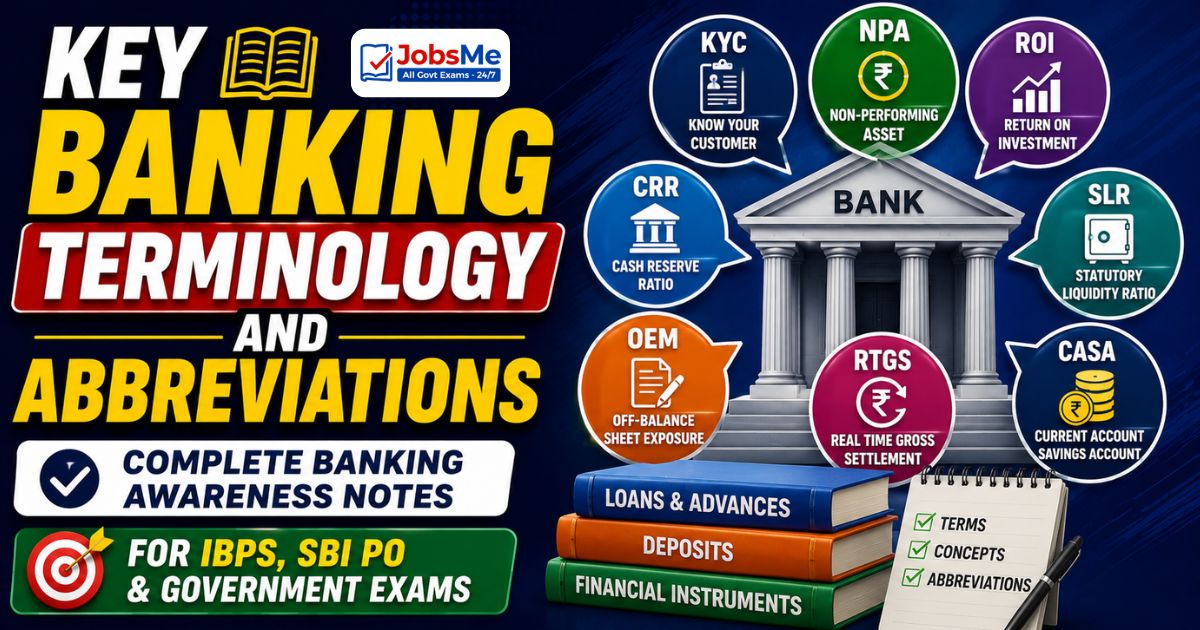
Key Banking Terminology and Abbreviations – Complete Banking Awareness Notes for IBPS, SBI PO and Government Exams 2026
Key Banking Terminology and Abbreviations is tested in IBPS PO, SBI Clerk, RBI Grade B, NABARD and all government banking examinations. Complete coverage with tables, memory tricks and one-liners for quick revision.
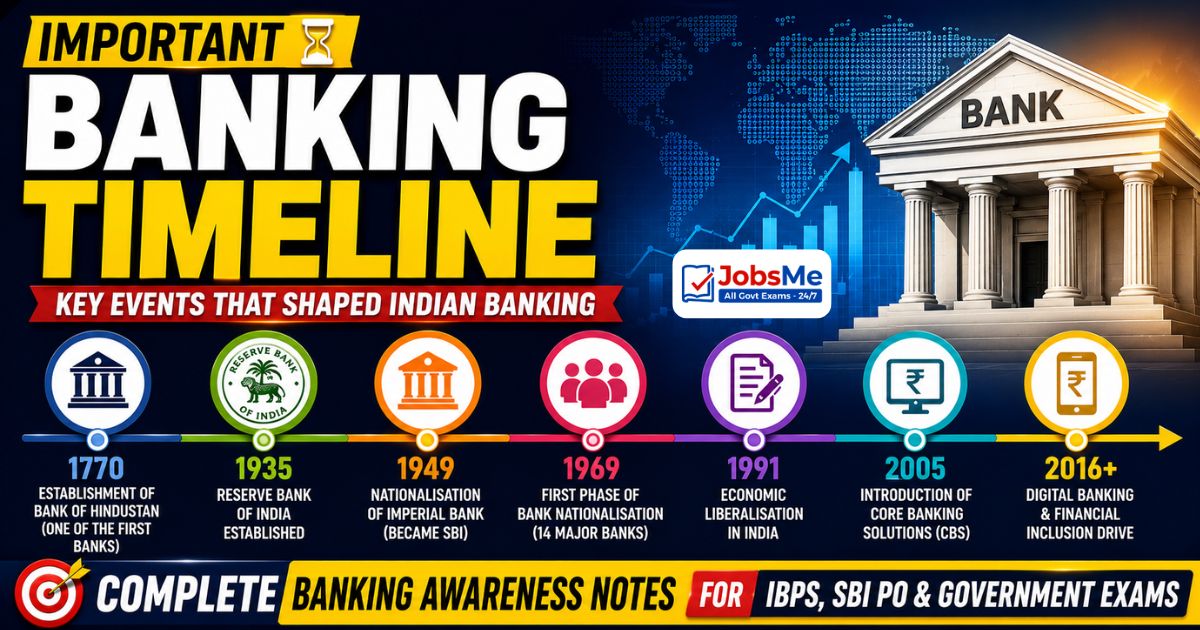
Important Banking Timeline – Complete Banking Awareness Notes for IBPS, SBI PO and Government Exams 2026
Important Banking Timeline is tested in IBPS PO, SBI Clerk, RBI Grade B, NABARD and all government banking examinations. Complete coverage with tables, memory tricks and one-liners for quick revision.
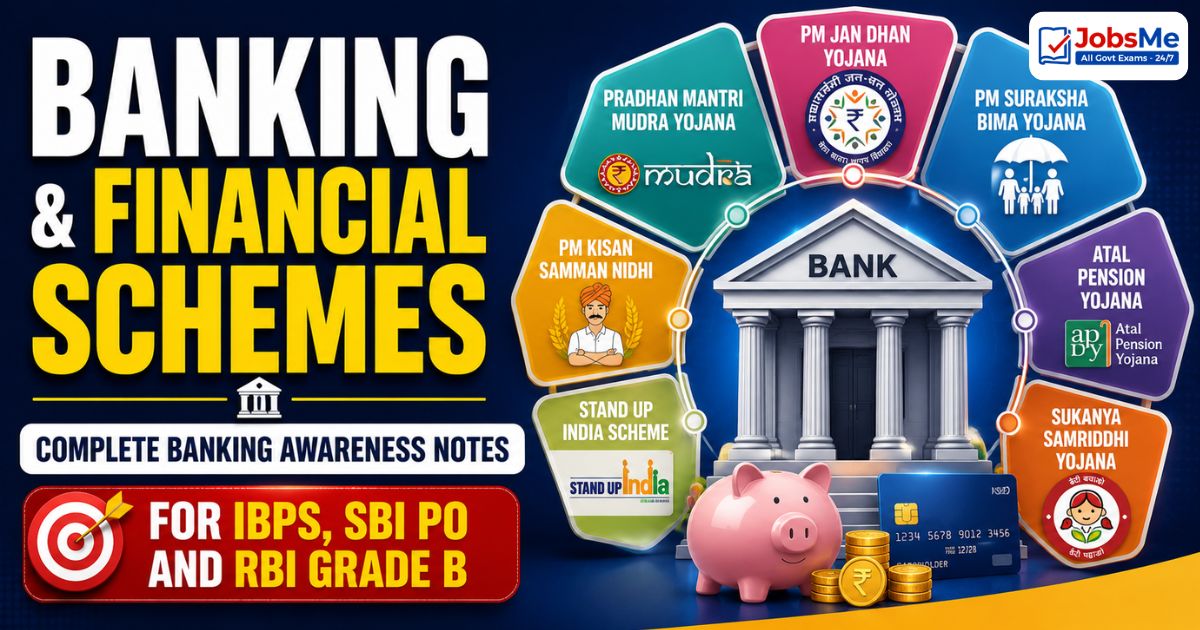
Banking and Financial Schemes – Complete Banking Awareness Notes 2026 for IBPS, SBI PO and RBI Grade B
Banking and Financial Schemes is one of the highest-frequency topics in banking awareness examinations. This chapter provides complete exam-ready coverage of every government and RBI-sponsored scheme including small savings schemes with current interest rates, financial inclusion schemes (PMJDY, MUDRA, Stand Up India, PM SVANidhi), agricultural credit schemes (KCC, PM-KISAN), pension schemes (APY, NPS), insurance schemes (PMJJBY, PMSBY) and the DBT/JAM infrastructure.
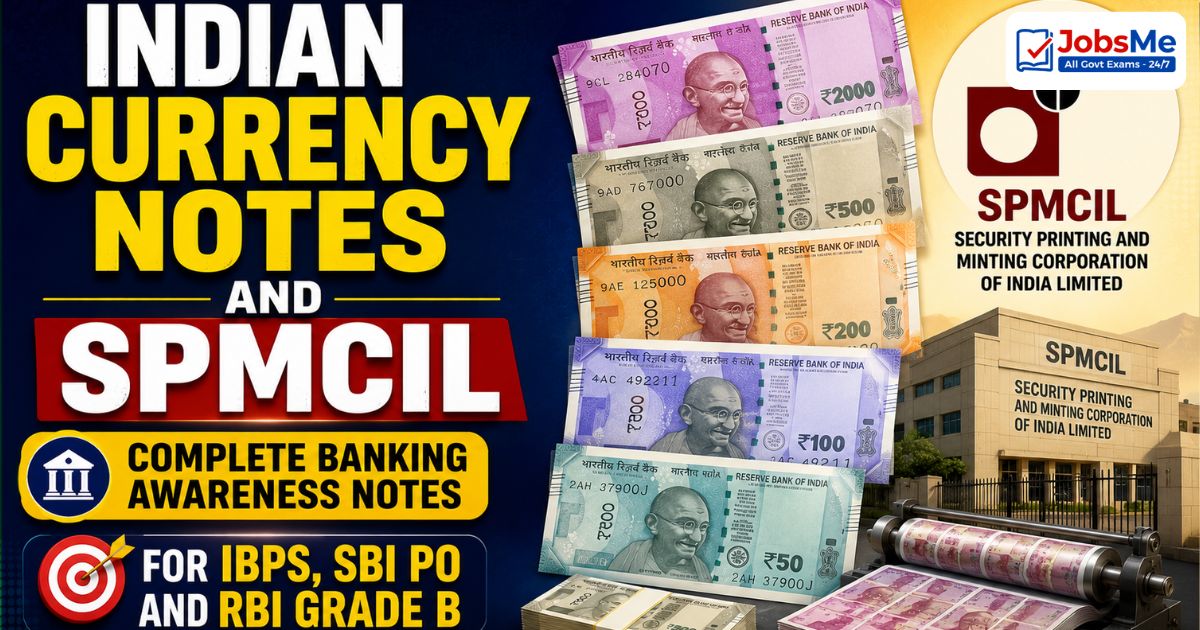
Indian Currency Notes and SPMCIL – Complete Banking Awareness Notes 2026 for IBPS, SBI PO and RBI Grade B
Indian Currency Notes and SPMCIL covers every aspect of India's currency that is tested in banking awareness exams. Topics include the complete specifications of all currency note denominations (₹10 to ₹2000) with dimensions, base colors, monuments depicted, security features including watermarks, security thread, MICR and intaglio printing, the history and features of the Indian Rupee symbol ₹, the Mahatma Gandhi Series and the Mahatma Gandhi (New) Series, the role of RBI in currency management, the SPMCIL structure with all four mints and four currency note presses, BRBNMPL and the Security Paper Mill at Hoshangabad. Coin denominations and special features are also covered.
Financial Markets, FDI and FPI – Complete Banking Awareness Notes 2026 for IBPS, SBI PO and RBI Grade B
Financial Markets, FDI and FPI covers all aspects of India's financial market ecosystem that are tested in banking awareness exams. Topics include money market instruments (T-Bills, Cash Management Bills, Commercial Paper, Certificate of Deposit, Call Money, Notice Money, TREPS), capital market instruments (equity, debentures, government securities, mutual funds), SEBI's role and structure, the FDI vs FPI comparison, types of foreign investment, Balance of Payments (BoP), Capital Account and Current Account, GIFT City International Financial Services Centre, FII vs FPI distinction and the Liberalised Remittance Scheme (LRS).
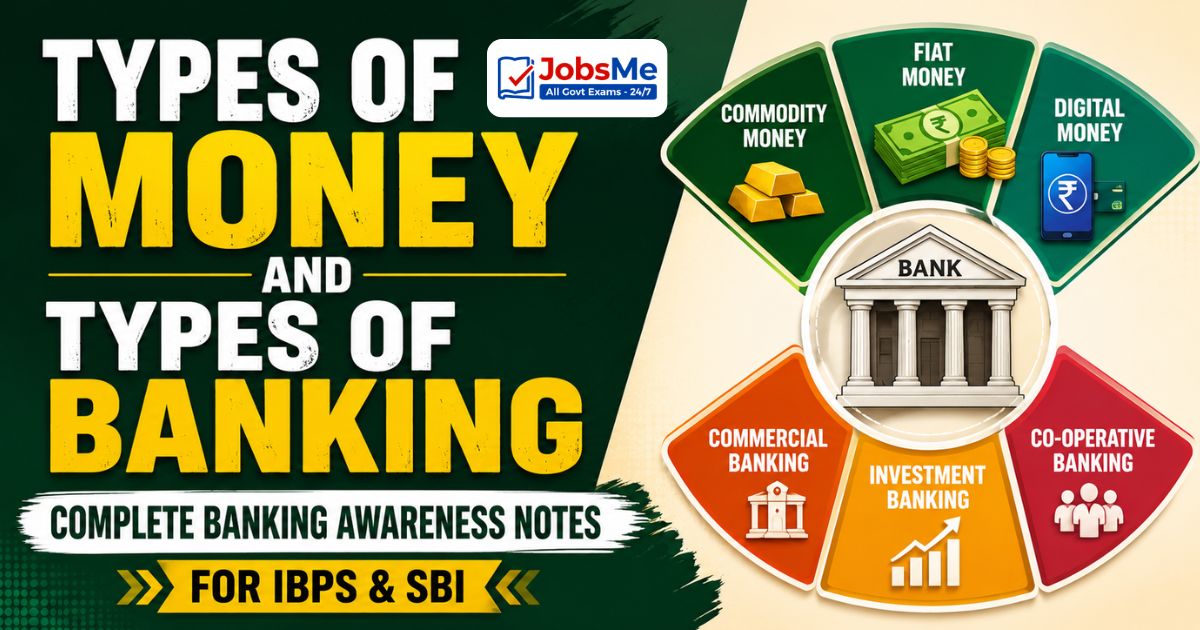
Types of Money and Types of Banking – Complete Banking Awareness Notes 2026 for IBPS and SBI
Types of Money and Types of Banking is a broad conceptual chapter that covers all monetary and banking models tested in banking awareness sections. Topics include fiat money, commodity money, representative money, credit money, hard currency, soft currency, hot money, dear and cheap money, barren money, cryptocurrency and stablecoin. Money supply measures (M0, M1, M2, M3, M4) are covered with their exact components. The chapter then covers all banking models from branch, unit, group, chain banking to universal, narrow, shadow, retail, wholesale, neo-banking, Islamic banking (Shariah), green banking, offshore, merchant and para banking.
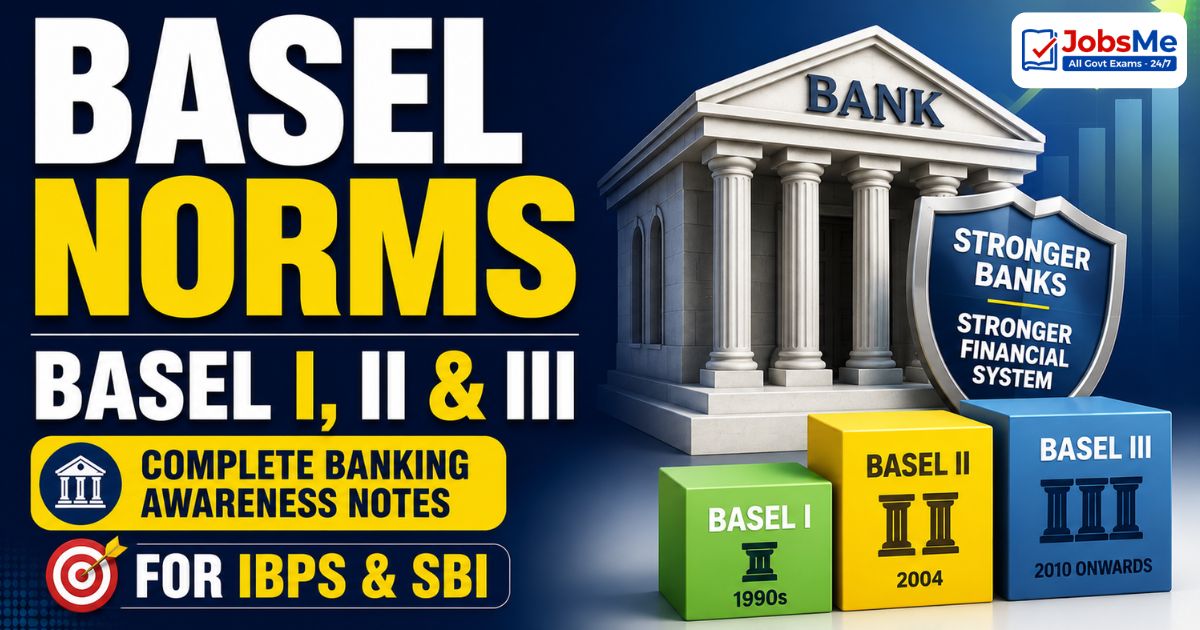
Basel Norms — Basel I, II and III — Complete Banking Awareness Notes 2026 for IBPS and SBI
Basel Norms covers the three international capital adequacy frameworks issued by the Basel Committee on Banking Supervision (BCBS) under the Bank for International Settlements (BIS). This chapter explains Basel I (1988, credit risk, 8% CAR), Basel II (2004, three pillars — minimum capital, supervisory review and market discipline, operational and market risk added), and Basel III (2010, post-financial crisis reform — LCR, NSFR, leverage ratio, capital conservation buffer, countercyclical buffer, CET1). India's specific requirements (9% CAR, 5.5% CET1) and the D-SIB surcharge are also covered with all exam-relevant detail.
CBDC and Digital Currencies – India's Digital Rupee and Global Landscape | Banking Awareness Notes 2026
CBDC and Digital Currencies covers India's Digital Rupee (e₹) — the world's first CBDC from a major emerging economy — in complete detail for banking awareness examinations. Topics include the definition and need for CBDC, differences between CBDC and physical currency and between CBDC and UPI, the RBI Concept Note (October 2022), Wholesale CBDC (e₹-W, launched November 1, 2022), Retail CBDC (e₹-R, launched December 1, 2022), the 2025 pilot status (17 banks, 6 million users, Rs. 1,016 crore in circulation), programmable CBDC use cases, the UMI platform, deposit tokenization, and the global CBDC landscape including Sand Dollar (Bahamas), eNaira (Nigeria) and e-CNY (China).
MCLR and Lending Rate Framework – Complete Banking Awareness Notes 2026 for IBPS and SBI
MCLR and Lending Rate Framework covers the complete evolution of bank lending rate benchmarks in India — from the opaque BPLR system to the transparent External Benchmark Rate linked to the RBI Repo Rate. This chapter explains BPLR, Base Rate, MCLR (components, calculation, disclosure rules, reset periods), the External Benchmark Rate system (mandatory from October 2019), differences between these systems, spread structure, international benchmark rates (LIBOR discontinuation, SOFR, SONIA, EURIBOR, ESTR), and all related concepts tested in IBPS PO, SBI Clerk, RBI Grade B and banking awareness examinations.
Monetary Policy and RBI Tools – Complete Banking Awareness Notes 2026 for IBPS and SBI
Monetary Policy and RBI Tools is one of the highest-frequency chapters in banking awareness examinations. This chapter covers the complete monetary policy framework of India including the Monetary Policy Committee (MPC), all quantitative tools (Repo Rate, Reverse Repo Rate, CRR, SLR, MSF, Bank Rate, OMO, LAF), qualitative credit controls, the inflation targeting framework, banking risks (credit risk, market risk, liquidity risk, operational risk, systemic risk), the transmission mechanism and all 2025 monetary policy developments including the 125-basis-point repo rate cut cycle.
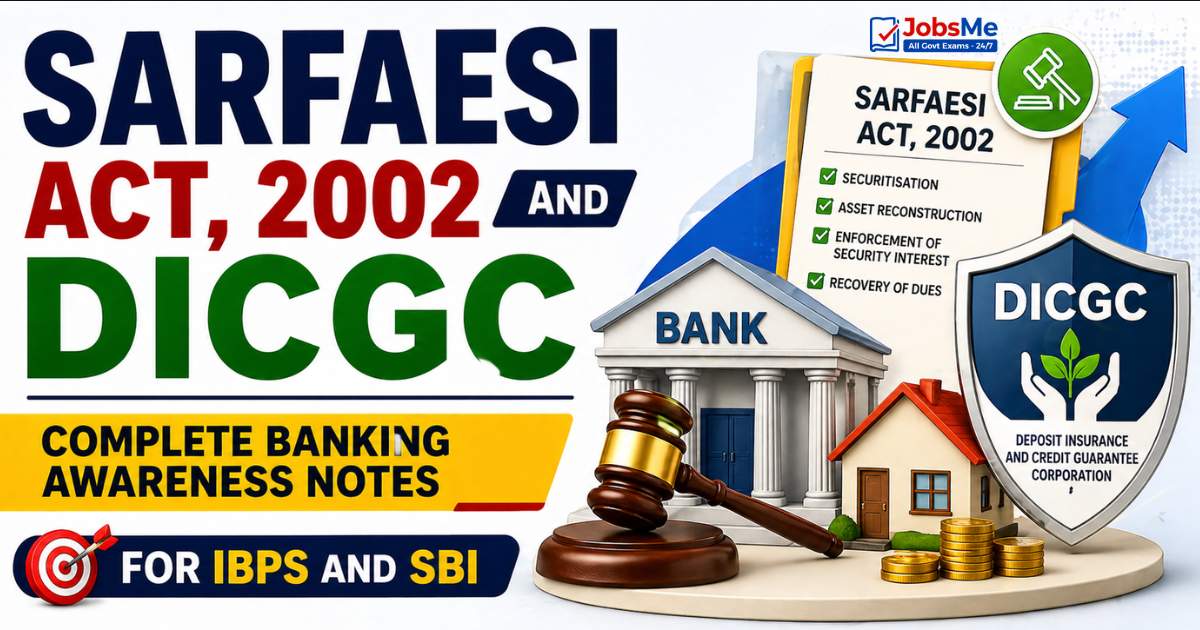
SARFAESI Act 2002 and DICGC – Complete Banking Awareness Notes 2026 for IBPS and SBI
SARFAESI Act and DICGC covers two critical banking laws. SARFAESI (Securitization and Reconstruction of Financial Assets and Enforcement of Security Interest Act, 2002) enables banks to recover NPAs by taking possession of secured assets without court intervention. DICGC (Deposit Insurance and Credit Guarantee Corporation) protects depositors by insuring their deposits up to Rs. 5 lakh per depositor per bank. Both topics are frequently tested in IBPS PO, SBI Clerk, RBI Grade B and NABARD examinations. The chapter covers complete SARFAESI provisions, the process of enforcement, ARC structure, Security Receipts, DICGC establishment, coverage, premium structure, institutions covered and not covered, the depositor protection timeline and international deposit insurance comparisons.
Non-Performing Assets (NPA) and Resolution – Complete Banking Awareness Notes 2026 for IBPS and SBI
Non-Performing Assets (NPA) and Resolution is a critical chapter in banking awareness for all competitive banking examinations. This chapter covers the complete definition of NPA and the 90-day rule, the three-stage asset classification (sub-standard, doubtful and loss assets), provisioning norms for each category, the causes of rising NPAs in India, all NPA resolution mechanisms including IBC 2016, SARFAESI Act, DRT, CDR, SDR, S4A and Asset Reconstruction Companies, the CAMELS rating framework used by RBI to assess bank health, and the GNPA and NNPA ratios that measure overall asset quality of the banking system.
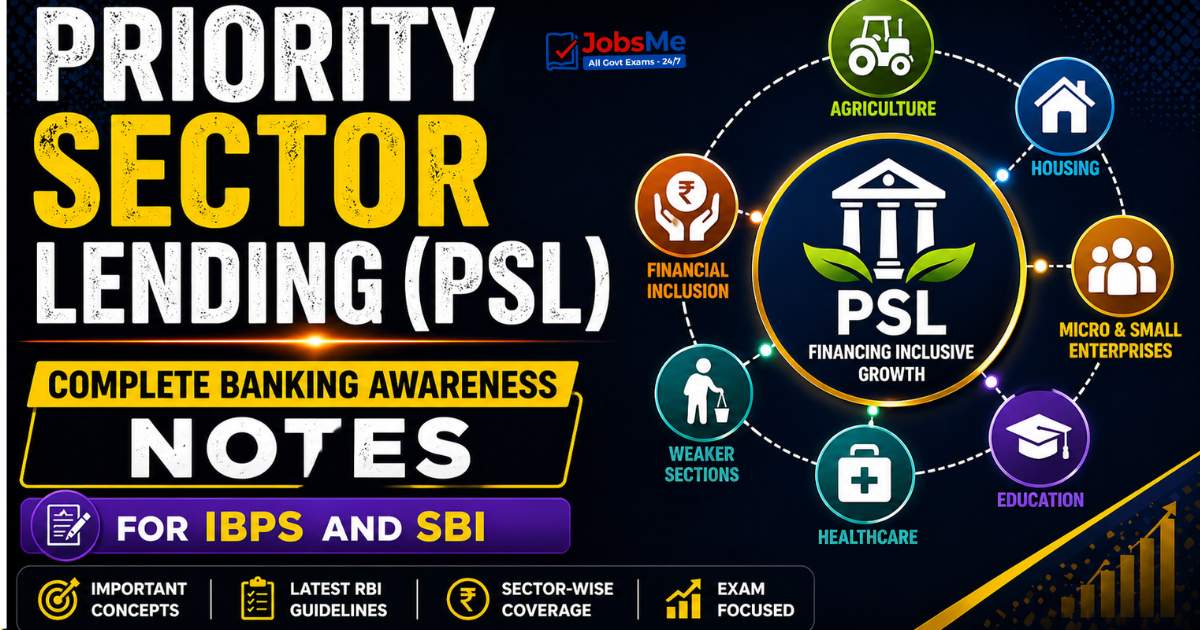
Priority Sector Lending (PSL) – Complete Banking Awareness Notes 2026 for IBPS and SBI
Priority Sector Lending (PSL) is a high-frequency topic in all banking awareness examinations. This chapter covers the complete PSL framework — the policy rationale, all PSL categories and sub-targets for domestic banks (agriculture 18%, MSME 7.5%, weaker sections 12%, total 40% of ANBC), PSL targets for foreign banks, the RIDF penalty mechanism, Priority Sector Lending Certificates (PLSCs), the Kisan Credit Card scheme in full detail (eligibility, issuing banks, credit limit structure, interest subvention), Self-Help Groups (SHG) and Joint Liability Groups (JLG), microfinance regulations, MUDRA loans and their relationship to PSL, and all related PSL concepts tested in IBPS PO, SBI PO, RBI Grade B and NABARD examinations.
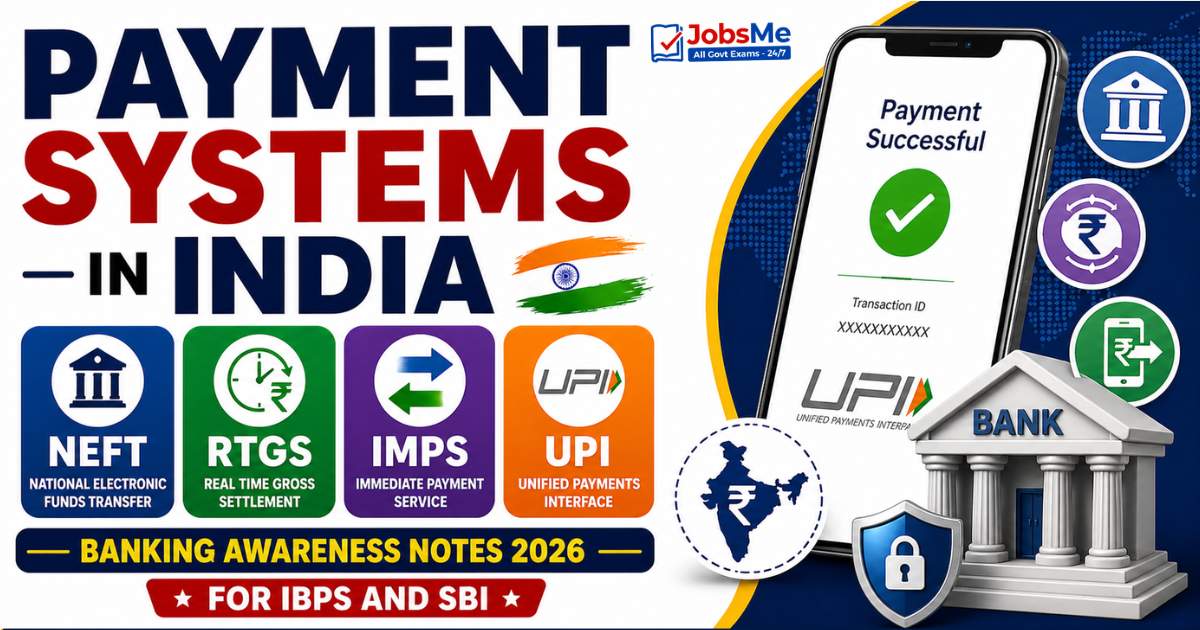
Payment Systems in India – NEFT RTGS IMPS UPI | Banking Awareness Notes 2026 for IBPS and SBI
Payment Systems National covers all domestic payment and settlement systems essential for banking awareness examinations in 2026. The chapter provides complete details of NEFT, RTGS, IMPS, UPI, BHIM app, NPCI and all its products, IFSC code, MICR code, e-RUPI, the ULI and UMI platforms, UPI-PayNow cross-border link and the Digital Payments Intelligence Platform (DPIP). All payment limits, charges, timings and 2025 updates are included.
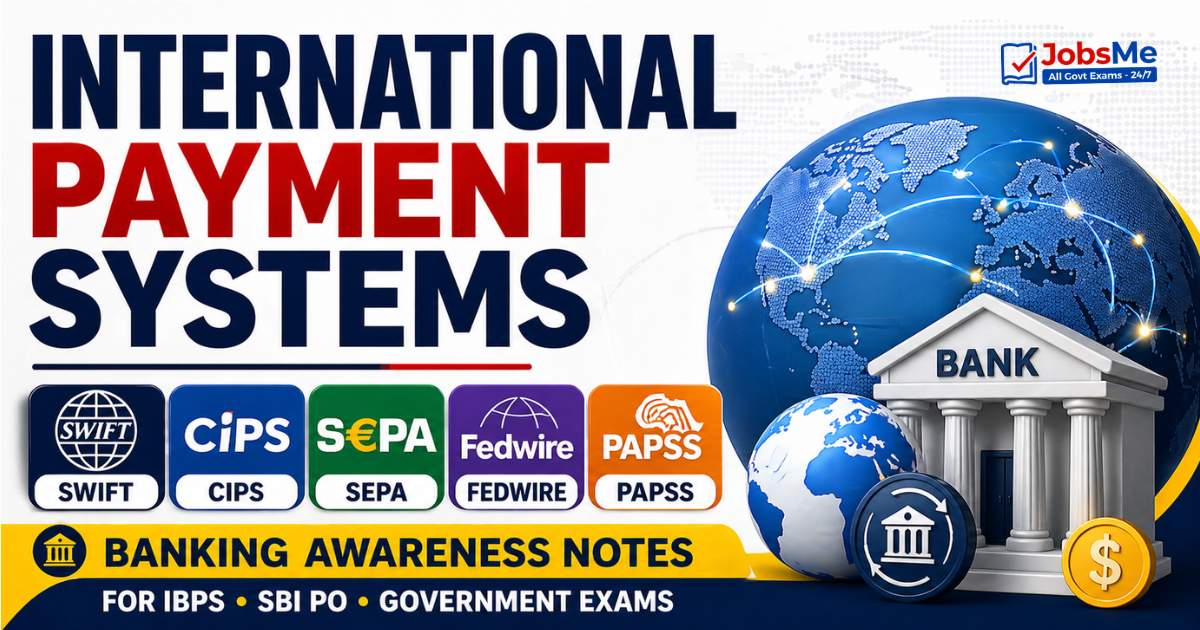
International Payment Systems – SWIFT CIPS SEPA Fedwire PAPSS | Banking Awareness Notes 2026
Payment Systems International covers all global payment and settlement systems tested in banking awareness exams. Topics include SWIFT (messaging network, 11,500+ institutions, ISO 20022 migration November 2025), CIPS (China's RMB system, 1,683 participants), SEPA (EU single payments area), TARGET2/TIPS (ECB systems), Fedwire, CHIPS, FedNow (USA), PIX (Brazil), PayNow (Singapore), PromptPay (Thailand), PAPSS (Africa, January 2022), Project Nexus (BIS) and all cross-border bilateral payment links including UPI-PayNow February 2023 and UPI-TIPS exploration 2025.
Negotiable Instruments – Complete Banking Awareness Notes for IBPS, SBI PO and Government Exams 2026
Negotiable Instruments covers the Negotiable Instruments Act 1881 and all instruments tested in banking awareness. Topics include bill of exchange, promissory note, all types of cheques — order, bearer, stale, post-dated, crossed — types of crossing, MICR code, difference between cheque and demand draft, CTS-2010 cheque truncation system, and international negotiable instruments like letter of credit and certificate of deposit.
Loans and Advances in India – Complete Banking Awareness Notes 2026 for IBPS and SBI
Loans and Advances is one of the most directly tested chapters in banking awareness. This chapter covers every type of credit facility offered by Indian banks — fund-based (overdraft, cash credit, term loans, demand loans, bill discounting, packing credit) and non-fund-based (letters of credit, bank guarantees, co-acceptance), the legal basis for creating security (hypothecation, pledge, mortgage, lien, assignment), all key lending concepts (EMI, moratorium, amortization, DRI scheme, reverse mortgage, ALCO), the complete evolution of India's lending rate benchmarks from BPLR to Base Rate to MCLR to External Benchmark Rate, and a detailed comparison of all four benchmarks.
NRI Accounts in India – NRE NRO FCNR and Special Accounts | Banking Awareness 2026
NRI Accounts and Special Accounts covers all bank account types relevant to Non-Resident Indians and special-purpose accounts tested in banking awareness sections. This chapter explains the full comparison between NRE (Non-Resident External), NRO (Non-Resident Ordinary) and FCNR(B) (Foreign Currency Non-Resident Bank) accounts including currency, tax treatment, repatriation limits and tenure. Special accounts covered include Nostro, Vostro, DEMAT, Escrow and GILT accounts. The chapter also covers DTAA, LRS and remittance statistics important for exam-level awareness.
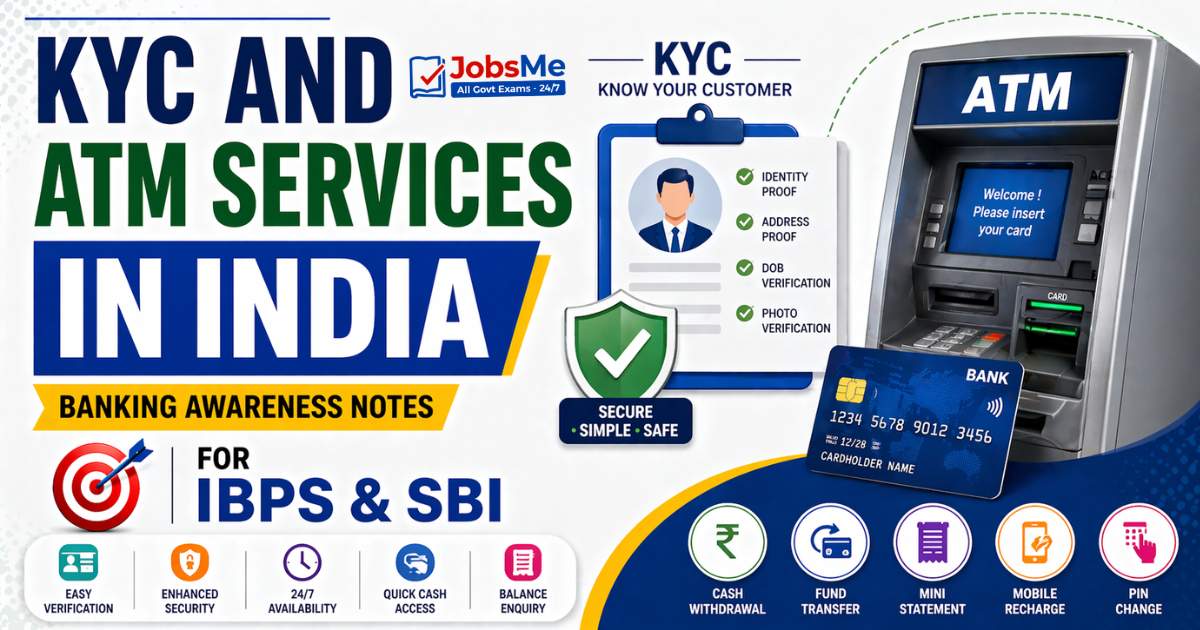
KYC and ATM Services in India – Banking Awareness Notes 2026 for IBPS and SBI
KYC and ATM Services covers two important sections of the banking awareness syllabus. KYC (Know Your Customer) explains the customer identification and verification process, officially valid documents, periodic verification timelines and the 2025 update allowing Aadhaar Face Authentication. ATM Services covers the full classification of ATMs in India including white label, brown label and biometric ATMs, RBI guidelines on failed transactions, the penalty for delayed reversal, card types including debit, credit, forex and prepaid cards, payment networks including RuPay, Visa and Mastercard, and EMV chip card technology.
Financial Inclusion and Banking Ombudsman – Banking Awareness Notes 2026 for IBPS and SBI
Financial Inclusion and Banking Ombudsman covers two critical topics tested in all banking awareness sections. Financial inclusion covers the No-Frills Account, BSBDA, PMJDY, Small Account, AePS, and the broader initiatives to bring unbanked populations into the formal banking system. The Banking Ombudsman section covers the RBI's integrated ombudsman scheme RB-IOS 2021, its coverage, complaint process, grounds for complaint, maximum award amounts, appellate authority and conditions for rejection. Both topics are high-frequency in IBPS PO, SBI Clerk, RBI Grade B and NABARD exams.
Types of Bank Accounts in India – Complete Banking Awareness Notes 2026 for IBPS and SBI
Types of Bank Accounts is a high-frequency chapter in banking awareness for all competitive banking exams. This chapter covers every type of bank account in India including savings account, current account, fixed deposit, recurring deposit, BSBDA, PMJDY account, small account, bulk deposits, inactive and dormant accounts, special accounts like DEMAT, Escrow and GILT accounts, NRI accounts and the nomination facility. Key features, interest rates, withdrawal limits, TDS rules and exam-relevant differences between account types are covered in detail.
National and International Banking Organizations – Banking Awareness Notes 2026 for IBPS and SBI
National and International Banking Organizations is an essential chapter in the banking awareness syllabus for IBPS PO, SBI Clerk, RBI Grade B, NABARD and all government banking exams. This chapter covers all the major national financial institutions in India including RBI, NABARD, SIDBI, NPCI, NHB, EXIM Bank, MUDRA and SEBI, as well as all the important international organizations including IMF, World Bank Group, BIS, ADB, AIIB, NDB, FATF and FSB. Headquarters, establishment years, purposes and key functions of each organization are covered with exam-focused detail.
Types of Banks in India – Complete Notes for IBPS, SBI PO and Government Exams 2026
Types of Banks in India covers all categories of banks that are tested in banking awareness sections of IBPS PO, SBI Clerk, RBI Grade B, NABARD and all government banking examinations in 2026. This chapter explains the classification of banks into scheduled and non-scheduled, the four types of commercial banks — public sector, private sector, foreign and regional rural banks — and the specialized differentiated banks like payment banks, small finance banks and cooperative banks. The chapter also covers NBFCs, their differences from banks, and the key features of each bank type with exam-relevant facts.
Reserve Bank of India (RBI) – Functions, Structure and Role | Banking Awareness Notes 2026
Reserve Bank of India (RBI) is the central bank and apex monetary authority of India. This chapter covers everything about RBI that is tested in IBPS PO, SBI Clerk, RBI Grade B, NABARD and all government banking exams. Topics include establishment and nationalization of RBI, composition of RBI board, all functions of RBI, list of RBI governors, subsidiary institutions, important acts governed by RBI, and new 2025 initiatives including ULI, UMI, Banking Connect, DPIP, PRAVAAH and UDGAM portal. This is one of the most high-weightage chapters in the entire banking awareness syllabus.
History of Banking in India – Complete Notes for IBPS, SBI PO and Government Exams 2026
History of Banking in India covers the complete evolution of the Indian banking system from the establishment of the Bank of Hindustan in 1770 to the digital banking era of 2025. This chapter is essential for IBPS PO, SBI Clerk, RBI Grade B, NABARD and all government banking exams. Topics include the pre-independence banking era, the three Presidency Banks, formation of Imperial Bank and later SBI, nationalization of 14 banks in 1969 and 6 more in 1980, the 1991 liberalization era, major bank mergers, and the digital payments revolution. Key firsts in Indian banking are frequently asked in all competitive exams.
Introduction to Banking – Complete Banking Awareness Notes for IBPS, SBI PO and Government Exams 2026
Introduction to Banking is the first and most important chapter of the Banking Awareness syllabus for all government banking exams in 2026. This chapter covers the legal definition of banking under the Banking Regulation Act 1949, the difference between assets and liabilities of a bank, how banks earn money through Net Interest Margin (NIM), the CASA Ratio and its importance, the JAM Trinity and the new JAM-UPI-ULI digital infrastructure introduced in 2025. This free study note from Jobsme.in is useful for IBPS PO, IBPS Clerk, SBI PO, SBI Clerk, RBI Grade B, NABARD Grade A, IBPS RRB, and all competitive banking examinations.
Recent posts
Latest quizzes



New job notifications
Introduction
JobsMe's Banking Awareness posts are topic-wise study notes written specifically for IBPS, SBI, RBI, NABARD, LIC, and all other banking and insurance examinations. Each post covers one Banking Awareness topic in full - with clear definitions, structured tables, exam-pattern framing, previous year question (PYQ) examples, and memory aids to help you retain and recall facts under exam conditions. After reading any post, head to the Banking Awareness quiz archive to test your retention with free interactive MCQs. Track your progress with every attempt when logged in.
Want to combine your Banking Awareness preparation with current developments? Pair these notes with daily current affairs and monthly current affairs for complete Financial Awareness preparation.
Why Banking Awareness Notes Matter More Than You Think
Banking Awareness is the most predictable scoring section in any bank exam. Unlike reasoning or quantitative aptitude - where question difficulty varies significantly - Banking Awareness questions are almost entirely factual. The RBI's repo rate, the founding year of NABARD, the full form of MCLR, the headquarters of ADB, the provisions of SARFAESI Act - these are fixed answers that do not change based on how the question is worded. Every mark you invest in Banking Awareness preparation has a predictable, high return on exam day.
The challenge is coverage. The Banking Awareness syllabus is extensive, spanning dozens of distinct topics. Without well-organised notes, aspirants either miss critical topics or spend more time than necessary. JobsMe's Banking Awareness posts solve both problems - each is a standalone, self-sufficient study resource for its topic, with nothing important left out and nothing irrelevant included.
Written for Exam Performance, Not General Reading
Each post opens with how questions from that topic are typically asked in competitive papers - whether as direct fact recall, match the following, or multi-statement correct/incorrect format. This sets the right exam mindset before you read a single fact. You will not just learn that the Repo Rate is the rate at which RBI lends to commercial banks - you will understand how a question on the Repo Rate is likely to be framed in IBPS PO Mains, and what common wrong-option traps to watch out for.
PYQ Pattern Analysis in Every Post
Each post includes examples of how that topic has been asked in previous year papers of IBPS PO, IBPS Clerk, SBI PO, and RBI Grade B. This shows you which sub-topics carry the most exam weight and where to focus your memorisation effort. Aspirants who study with PYQ awareness score significantly higher than those who prepare without knowing question patterns.
Memory Aids and Quick Revision Tables
Every Banking Awareness post includes structured tables for quick revision - RBI rate tables, bank headquarters lists, abbreviation full-form grids, act-provision summaries, and scheme-objective matrices. These tables are designed for screenshot and save - ideal for last-minute revision on the day before your exam.
Complete Topic Coverage
Foundation Topics (Start Here)
These are the core topics tested in every banking exam, regardless of level:
- History of Banking in India - Presidency banks, nationalisation (1969 and 1980), formation of SBI, cooperative banks, current banking structure
- Reserve Bank of India - Establishment, structure, functions, departments, Mint Street, RBI Governor
- Monetary Policy and MPC - Repo Rate, Reverse Repo Rate, CRR, SLR, MSF, Bank Rate, OMOs, LAF, current rates
- Types of Banks - Commercial banks (public and private), RRBs, cooperative banks, payment banks, small finance banks
- Banking Regulation Act 1949 - Key provisions, applicability, schedule banks vs non-schedule banks
Financial Institutions
- NABARD - Functions, establishment, refinancing role, RIDF, financial inclusion mandate
- SIDBI - Small industry financing, MUDRA loans, relationship with RBI
- NHB (National Housing Bank) - Housing finance regulation, refinancing
- EXIM Bank - Export-import financing, establishment, key schemes
- SEBI - Capital market regulation, functions, SEBI Act 1992, recent circulars
- IRDAI - Insurance regulation, types of insurance, composite licensing
- PFRDA - Pension regulation, NPS, APY
Banking Products and Services
- Types of Accounts - Savings, current, FD, RD, NRE, NRO, FCNR, demat accounts
- Negotiable Instruments - Cheques, demand drafts, promissory notes, bills of exchange - provisions of the Negotiable Instruments Act 1881
- Payment Systems - UPI, NEFT, RTGS, IMPS, NACH, BBPS, Fastag - mechanisms, timings, limits
- Loan Products - Home loans, personal loans, MUDRA, gold loans, crop loans, KCC - terms and conditions
Financial Inclusion
- PM Jan Dhan Yojana (PMJDY) - Objectives, account features, overdraft facility, RuPay card
- MUDRA Scheme - Shishu, Kishore, Tarun categories, eligible borrowers, disbursement data
- PM SVANidhi, Stand-Up India, Startup India - Banking linkages and financial support mechanisms
- Business Correspondents - Role, eligibility, services, importance for rural banking
- Financial Inclusion Index (FI Index) - Methodology, current value, RBI publication
Banking Regulation and Compliance
- SARFAESI Act 2002 - Secured creditors, enforcement of security interest, ARCs
- IBC 2016 (Insolvency and Bankruptcy Code) - Application to banks, NCLT, resolution timeline
- PMLA 2002 (Prevention of Money Laundering Act) - KYC norms, suspicious transaction reporting, FIU-IND
- Basel Norms (I, II, III) - Capital adequacy ratio, Tier 1/Tier 2 capital, LCR, NSFR
- NPA and Bad Loans - Definitions (substandard, doubtful, loss assets), NARCL, IBC resolution, provisioning norms
International Banking and Finance
- International Monetary Fund (IMF) - Functions, SDR, India's quota, recent developments
- World Bank Group - IBRD, IDA, IFC, MIGA - differences and India's borrowings
- Asian Development Bank (ADB) - Headquarters, membership, India and ADB
- New Development Bank (NDB) - BRICS bank, India's role, recent projects
- Bank for International Settlements (BIS) - Role in Basel norms, headquarters
Banking Abbreviations (High Frequency)
A dedicated post covering 200+ important banking abbreviations - NPA, MCLR, CRAR, PCFC, KYC, AML, RTGS, NEFT, IMPS, UPI, NACH, CIBIL, CERSAI, SARFAESI, IBC, NCLT, NBFC, MFI, SHG, and more. One of the highest-frequency direct question types in all banking exams.
How to Read Banking Awareness Posts Effectively
Prioritise by Exam
Before starting, check your target exam's previous year papers to identify which Banking Awareness sub-topics appear most. IBPS Clerk heavily tests payment systems and financial inclusion. RBI Grade B tests deeper monetary policy and capital markets. SBI PO Mains tests a broad mix with some current affairs overlay. Matching your reading priority to your exam saves time and sharpens focus.
Table-First Reading
In each post, go to the summary table or quick-revision chart first. This gives you the complete scope of the topic in 2–3 minutes. Then read the narrative content for context and understanding. This top-down approach is faster and sets up better retention than linear top-to-bottom reading.
Note the Current Rates
For monetary policy posts especially, the current RBI rates (Repo Rate, CRR, SLR) as of the most recent MPC meeting are always included. These change periodically - always use the most recent figures from JobsMe or current affairs updates.
Always Follow with the Quiz
After reading, attempt the corresponding Banking Awareness quiz immediately. Same-session testing converts short-term reading comprehension into long-term exam memory. The quiz explanations also teach you facts you may have skimmed past.