Reserve Bank of India (RBI) – Functions, Structure and Role | Banking Awareness Notes 2026
Reserve Bank of India (RBI) is the central bank and apex monetary authority of India. This chapter covers everything about RBI that is tested in IBPS PO, SBI Clerk, RBI Grade B, NABARD and all government banking exams. Topics include establishment and nationalization of RBI, composition of RBI board, all functions of RBI, list of RBI governors, subsidiary institutions, important acts governed by RBI, and new 2025 initiatives including ULI, UMI, Banking Connect, DPIP, PRAVAAH and UDGAM portal. This is one of the most high-weightage chapters in the entire banking awareness syllabus.
Jump to section
- Reserve Bank of India (RBI) - Overview and Importance for Bank Exams
- Establishment and History of RBI
- Composition and Structure of the RBI Board
- Functions of the Reserve Bank of India
- Subsidiary Institutions of the RBI
- Important Acts Governed and Regulated by RBI
- New RBI Initiatives and Platforms - 2024 and 2025 Updates
- Governors of the Reserve Bank of India - Key Names for Exams
- RBI's Monetary Policy Framework - Quick Summary
- Memory Tricks - Reserve Bank of India
- One-Liners for Quick Revision - Reserve Bank of India
Reserve Bank of India (RBI) - Overview and Importance for Bank Exams
The Reserve Bank of India (RBI) is the central bank and apex monetary authority of India. It occupies a unique and critically important position in India's financial system — regulating all banks, controlling the money supply, managing inflation, issuing currency, managing the country's foreign exchange reserves, and overseeing the payment systems that billions of transactions flow through every day.
For banking exam aspirants, the chapter on RBI is among the highest-weightage chapters in the entire banking awareness syllabus. Questions from this chapter appear in every section of IBPS PO, IBPS Clerk, SBI PO, SBI Clerk, RBI Grade B, RBI Assistant, NABARD Grade A, SEBI Grade A and all other government banking examinations. The RBI chapter covers establishment, structure, functions, governors, subsidiary institutions, important acts, monetary policy tools, and the many new digital initiatives RBI has launched in 2024 and 2025.
Establishment and History of RBI
| Parameter | Details |
|---|---|
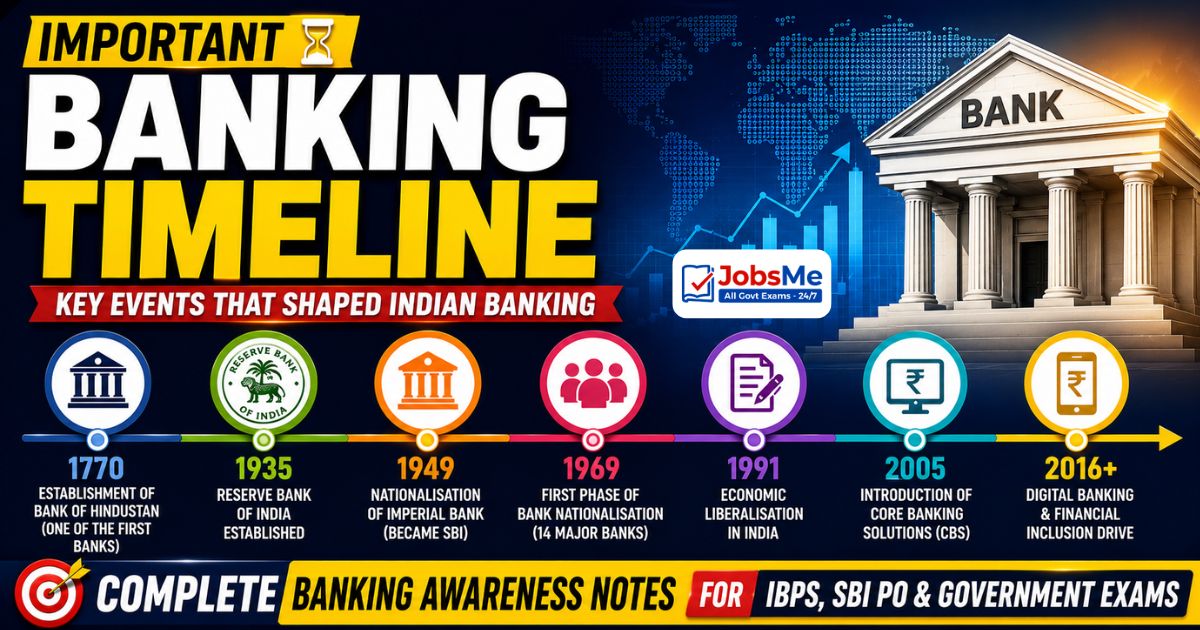
| Established | April 1, 1935 |
| Established Under | Reserve Bank of India Act, 1934 |
| Initial Headquarters | Calcutta (Kolkata) |
| Current Headquarters | Mumbai (shifted in 1937) |
| Nationalized On | January 1, 1949 |
| Initial Ownership | Private shareholders with paid-up capital of Rs. 5 crore |
| Current Ownership | Fully owned by Government of India (since nationalization) |
| Basis for Establishment | Recommendations of Hilton Young Commission (Royal Commission on Indian Currency and Finance, 1926) |
| First Governor | Sir Osborne Smith (April 1935 - June 1937) |
| First Indian Governor | C.D. Deshmukh (August 1943 - June 1949) |
| Current Governor | Sanjay Malhotra (appointed December 2024) |
| Regional Offices | 31 regional offices across India |
| Operates Under | Ministry of Finance, Government of India |
Important Exam Note: Before the RBI was established in 1935, the Imperial Bank of India performed certain central banking functions such as managing government accounts and acting as government banker. After RBI's establishment, these functions were transferred to the RBI.
Composition and Structure of the RBI Board
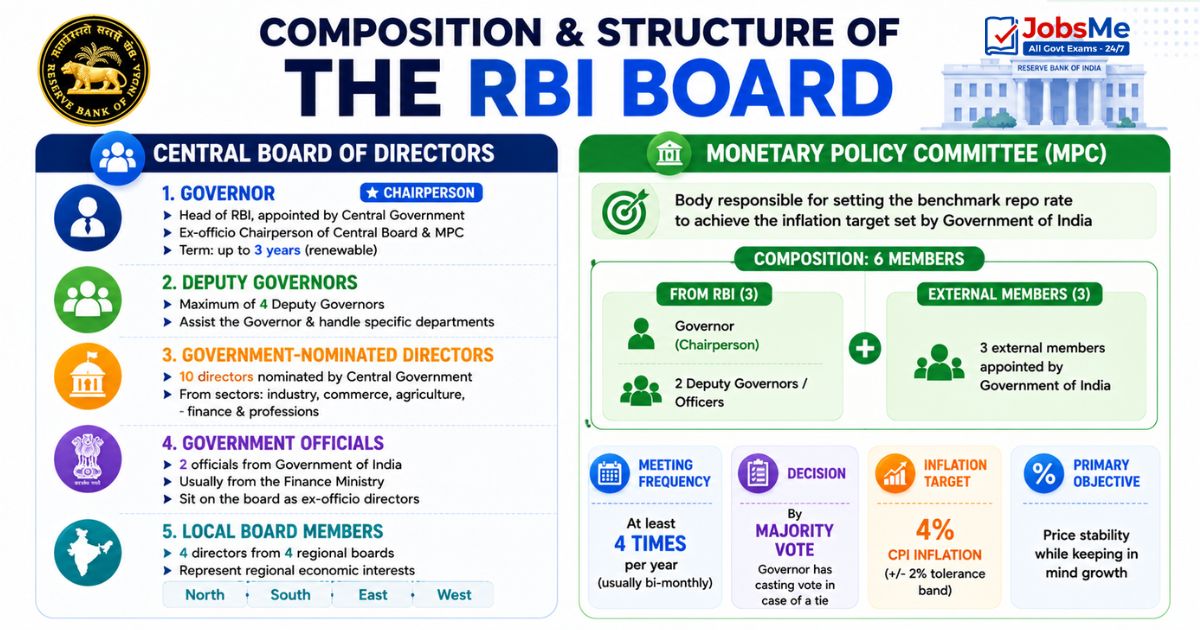
The RBI is managed and governed by a Central Board of Directors appointed in accordance with the RBI Act, 1934. Understanding the board composition is important for both objective and descriptive exam questions.
Central Board of Directors
- Governor — The head of RBI, appointed by the Central Government. The Governor is an ex-officio Chairperson of the Central Board and the Monetary Policy Committee. Term is up to 3 years and renewable.
- Deputy Governors — A maximum of four Deputy Governors assist the Governor. They handle specific departments and functions of the RBI.
- Government-Nominated Directors — 10 directors nominated by the Central Government from various sectors of the economy — industry, commerce, agriculture, finance and professions.
- Government Officials — Two Government of India officials, usually from the Finance Ministry, sit on the board as ex-officio directors.
- Local Board Members — Four directors from four regional boards (North, South, East and West) who represent regional economic interests.
Monetary Policy Committee (MPC)
The Monetary Policy Committee (MPC) was constituted under Section 45ZB of the RBI Act, 1934 following an amendment in 2016. The MPC is the body responsible for setting the benchmark repo rate to achieve the inflation target set by the Government of India (currently 4% CPI inflation with a tolerance band of +/- 2%).
- Composition: 6 members — 3 from RBI (Governor as Chairperson + 2 Deputy Governors/Officers) + 3 external members appointed by Government
- Meeting frequency: At least 4 times per year (usually bi-monthly)
- Decision: By majority vote; Governor has casting vote in case of a tie
- Inflation target: 4% CPI inflation (+/- 2% tolerance band)
Functions of the Reserve Bank of India
The functions of the RBI are the most tested topic in this chapter. Every function must be understood conceptually and remembered with its specific details.
1. Monetary Authority
The RBI formulates and implements monetary policy with the primary objective of maintaining price stability (controlling inflation) while also supporting economic growth. The key monetary policy tools used by RBI are the Repo Rate, Reverse Repo Rate, Cash Reserve Ratio (CRR), Statutory Liquidity Ratio (SLR), Marginal Standing Facility (MSF), Bank Rate and Open Market Operations (OMO). The Monetary Policy Committee (MPC) decides the repo rate at bi-monthly meetings. In 2025, the RBI reduced the repo rate by a cumulative 125 basis points, lowering inflation forecasts to 2% and raising GDP growth forecast to 7.3% for FY26.
2. Currency Issuer
The RBI has the sole authority to issue currency notes in India. It issues notes in denominations of Rs. 2, Rs. 5, Rs. 10, Rs. 20, Rs. 50, Rs. 100, Rs. 200, Rs. 500 and Rs. 2000. Coins are issued by the Government of India (Ministry of Finance) but distributed through the RBI. The RBI manages the currency chest network and ensures adequate supply of clean, good-quality currency. Currency notes are printed at four presses — Nashik (Maharashtra), Dewas (Madhya Pradesh), Mysuru (Karnataka) and Salboni (West Bengal) — managed by BRBNMPL and SPMCIL.
3. Regulator and Supervisor of the Financial System
The RBI regulates and supervises all scheduled commercial banks, regional rural banks, local area banks, small finance banks, payment banks, urban cooperative banks, non-banking financial companies (NBFCs) and other financial institutions. The regulatory tools include granting banking licences, setting capital adequacy norms, issuing guidelines on lending and deposits, conducting bank inspections and audits, and taking corrective action against weak banks. The RBI uses the CAMELS rating system (Capital, Assets, Management, Earnings, Liquidity, Sensitivity) to assess bank financial health.
4. Manager of Foreign Exchange
The RBI manages India's foreign exchange reserves and regulates all foreign exchange transactions under the Foreign Exchange Management Act (FEMA), 1999. India's forex reserves are one of the largest in the world. The RBI intervenes in the forex market to prevent excessive volatility of the Indian Rupee. In October 2025, the RBI sold USD 11.88 billion net in forex operations to curb excessive rupee depreciation. The RBI also regulates external commercial borrowings, foreign direct investment and remittances by NRIs.
5. Banker and Debt Manager to the Government
The RBI acts as banker to both the Central Government and State Governments. It manages government accounts, accepts receipts and makes payments on behalf of the government, and manages the public debt. The RBI conducts government securities auctions, manages the Consolidated Fund of India transactions, and advises the government on monetary and fiscal matters. The RBI's Retail Direct Scheme allows individual retail investors to directly buy government securities.
6. Banker's Bank and Lender of Last Resort
All scheduled commercial banks maintain accounts with the RBI and can borrow from it. The RBI acts as the lender of last resort — when a bank faces a severe liquidity crisis and cannot borrow from the market, the RBI provides emergency funds to prevent the bank's failure and protect depositors. This function ensures the stability of the entire banking system.
7. Developmental Role
The RBI has played a major role in building India's financial infrastructure including the payment systems, credit rating infrastructure, financial inclusion programs, and development of financial markets. The RBI promotes financial literacy and consumer awareness through campaigns and programs.
8. Payment System Regulator
The RBI oversees and regulates all payment and settlement systems in India under the Payment and Settlement Systems Act, 2007. This includes overseeing NPCI, which operates UPI, IMPS, RuPay and other systems. The RBI also introduced the Digital Rupee (CBDC) and is developing next-generation financial infrastructure like UMI (Unified Market Interface).
Subsidiary Institutions of the RBI
| Institution | Full Form | Function |
|---|---|---|
| BRBNMPL | Bharatiya Reserve Bank Note Mudran Private Limited | Prints currency notes at presses in Mysuru and Salboni |
| DICGC | Deposit Insurance and Credit Guarantee Corporation | Insures bank deposits up to Rs. 5 lakh per depositor per bank |
| NABARD | National Bank for Agriculture and Rural Development | Apex institution for agricultural and rural development finance; refinances rural credit |
| NHB | National Housing Bank | Apex regulator for housing finance companies; provides refinance to housing finance institutions |
Important Acts Governed and Regulated by RBI
| Act | Year | Purpose |
|---|---|---|
| Reserve Bank of India Act | 1934 | Constitution and powers of the RBI itself |
| Banking Regulation Act | 1949 | Governs all commercial banking companies; gives RBI supervisory powers over banks |
| Foreign Exchange Management Act (FEMA) | 1999 | Regulates all foreign exchange transactions and cross-border capital flows |
| SARFAESI Act | 2002 | Empowers banks to recover NPAs by auctioning secured assets without court intervention |
| Prevention of Money Laundering Act (PMLA) | 2002 | Combats money laundering; requires banks to implement KYC and report suspicious transactions |
| Credit Information Companies Act | 2005 | Governs credit bureaus like CIBIL; regulates collection and sharing of credit information |
| Payment and Settlement Systems Act | 2007 | Governs all payment systems in India; gives RBI authority over NPCI, payment aggregators |
| Factoring Regulation Act | 2011 | Regulates factoring businesses that provide short-term financing against receivables |
| Insolvency and Bankruptcy Code (IBC) | 2016 | Consolidated framework for resolving insolvencies; key tool for NPA resolution |
New RBI Initiatives and Platforms - 2024 and 2025 Updates
The RBI has launched several landmark digital platforms and initiatives in 2024 and 2025 that are high-priority topics for all upcoming banking exams. These are must-know for IBPS PO 2026, SBI PO 2026, RBI Grade B and NABARD aspirants.
| Initiative | Full Form / Description | Key Purpose |
|---|---|---|
| ULI | Unified Lending Interface | Consent-based digital platform for frictionless credit delivery to farmers and MSMEs; data from land records, banks, government databases; 3.2 million loans, Rs. 1.75 trillion by Oct 2025 |
| UMI | Unified Market Interface | Next-generation financial market infrastructure announced at GFF 2025; tokenizes financial assets using wholesale CBDC; revolutionizes market settlements |
| PRAVAAH | Platform for Regulatory Application, Validation and AutHorisation | Online portal for regulated entities to submit applications for regulatory approvals and licences; RBI won Digital Transformation Award 2025 for this |
| UDGAM | Unclaimed Deposits Gateway to Access inforMation | Centralized portal to search unclaimed deposits across multiple banks; 8.59 lakh users by July 2025 |
| Banking Connect | Unified net banking platform | Unveiled at GFF 2025; allows users to make payments directly from their bank apps without multiple logins across platforms |
| DPIP | Digital Payments Intelligence Platform | Platform to detect suspicious transactions, prevent digital payment frauds and strengthen security of India's digital payments ecosystem |
| Sarthi | Internal RBI management platform | Internal operational platform; RBI won Digital Transformation Award 2025 from Central Banking Publications for Sarthi and PRAVAAH |
| Digital Banking Channels Directions 2025 | Regulatory framework for digital banking | Issued November 28, 2025; effective January 1, 2026; governs internet banking and mobile banking authorization for commercial banks |
| Retail Direct Scheme | RBI Retail Direct | Allows individual retail investors to directly buy and sell government securities (G-Secs) through an online portal without intermediaries |
Governors of the Reserve Bank of India - Key Names for Exams
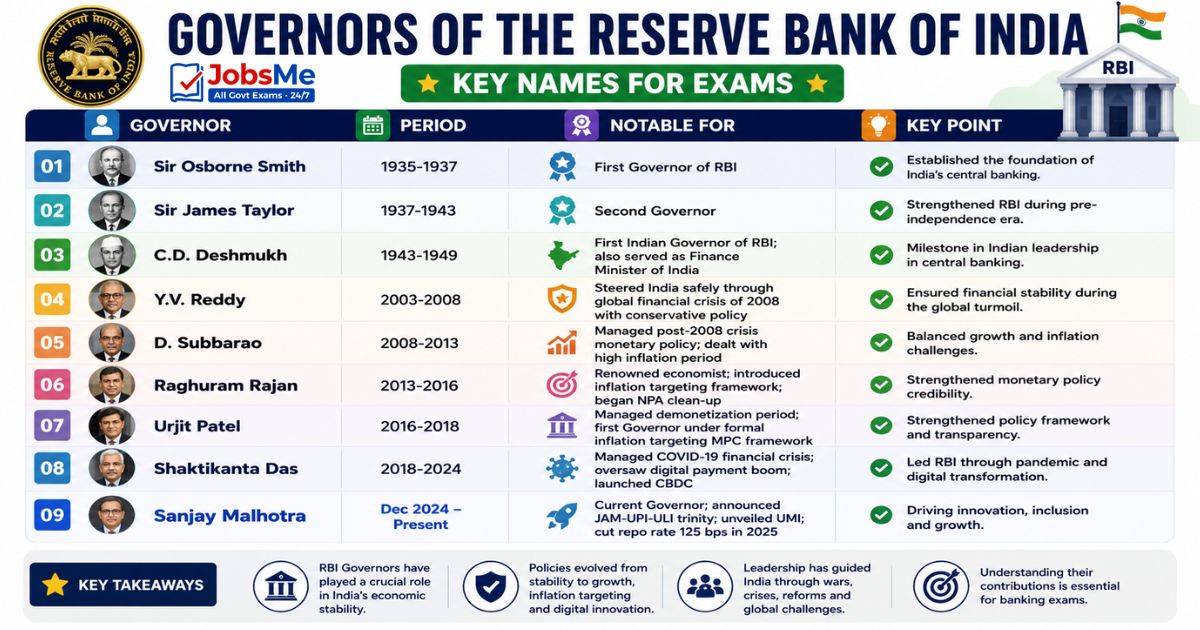
| Governor | Period | Notable For |
|---|---|---|
| Sir Osborne Smith | 1935-1937 | First Governor of RBI |
| Sir James Taylor | 1937-1943 | Second Governor |
| C.D. Deshmukh | 1943-1949 | First Indian Governor of RBI; also served as Finance Minister of India |
| Y.V. Reddy | 2003-2008 | Steered India safely through global financial crisis of 2008 with conservative monetary policy |
| D. Subbarao | 2008-2013 | Managed post-2008 crisis monetary policy; dealt with high inflation period |
| Raghuram Rajan | 2013-2016 | Renowned economist; introduced inflation targeting framework; began NPA clean-up |
| Urjit Patel | 2016-2018 | Managed demonetization period; first Governor under formal inflation targeting MPC framework |
| Shaktikanta Das | 2018-2024 | Managed COVID-19 financial crisis; oversaw digital payment boom; launched CBDC |
| Sanjay Malhotra | December 2024 - Present | Current Governor; announced JAM-UPI-ULI trinity; unveiled UMI; cut repo rate 125 bps in 2025 |
RBI's Monetary Policy Framework - Quick Summary
The full monetary policy chapter is covered in Chapter 17, but here is a quick summary of the key rates every aspirant must know about the RBI's monetary tools:
| Tool | Definition | Effect on Economy |
|---|---|---|
| Repo Rate | Rate at which RBI lends short-term to commercial banks against government securities | Higher = costlier borrowing = less credit = lower inflation. Lower = cheaper borrowing = more credit = growth stimulus |
| Reverse Repo Rate | Rate at which banks park surplus funds with RBI overnight | Higher = banks prefer to park with RBI = absorbs excess liquidity from the system |
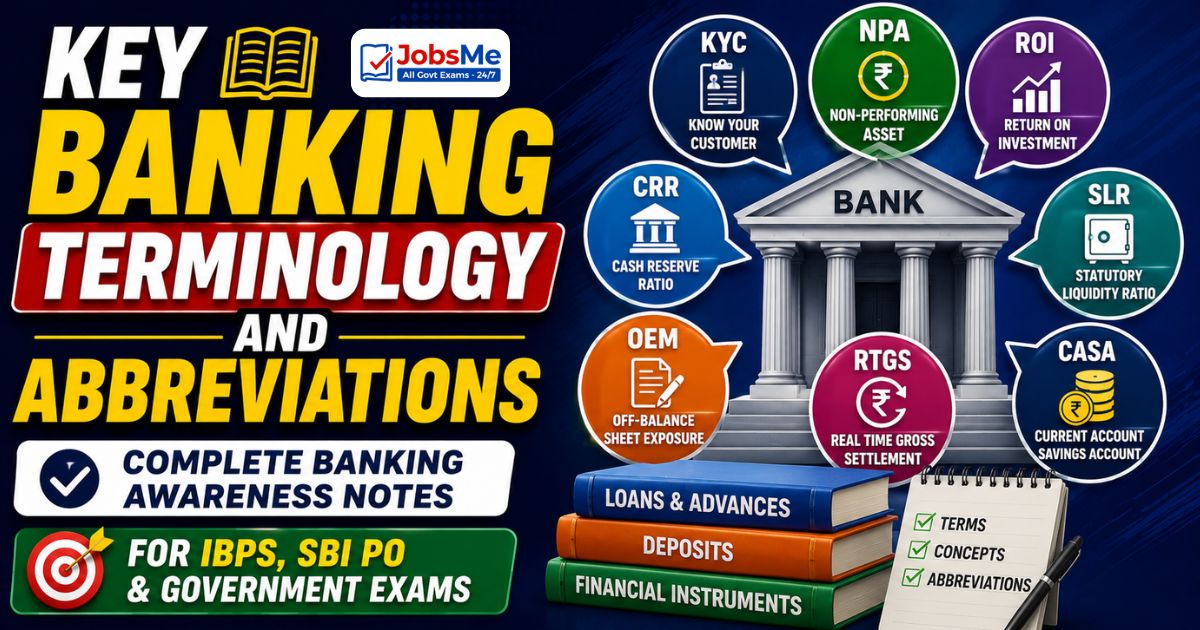
| CRR (Cash Reserve Ratio) | Percentage of bank deposits that must be maintained in cash with RBI | Higher = less money available to lend = tightens liquidity. Lower = more money to lend = eases liquidity |
| SLR (Statutory Liquidity Ratio) | Percentage of NDTL that banks must invest in approved liquid assets (G-Secs, gold) | Higher = more funds locked in G-Secs = less credit to public. Also ensures banks hold safe assets |
| MSF (Marginal Standing Facility) | Overnight emergency borrowing by banks from RBI at a rate above Repo Rate | Safety valve for banks facing acute short-term liquidity shortage |
| Bank Rate | Rate at which RBI lends to banks for long-term loans; also used as penal rate | Usually set at MSF rate; used for penalties on banks that breach CRR/SLR |
Memory Tricks - Reserve Bank of India
Remember RBI Establishment
Trick: "RBI was born on April Fool's Day 1935, but it's no joke." RBI established April 1, 1935 — the April Fool's Day date makes it unforgettable. Nationalized January 1, 1949 — same year as Banking Regulation Act. Two historic events, one year: 1949.
Remember First Governors
Trick: "Osborne Smith Started, CD Deshmukh Delivered." First Governor = Sir Osborne Smith (foreign). First Indian Governor = C.D. Deshmukh. CD = C.D. Deshmukh.
Remember MPC Composition
Trick: "3 + 3 = 6 members in MPC." Three from RBI (Governor chairs) + three external members appointed by Government = six total. Decision by majority; Governor has casting vote in a tie.
Remember New RBI Platforms
Trick: "UP DBS" = ULI + PRAVAAH + DPIP + Banking Connect + Sarthi. Or think of it as "ULI revolutionized credit the way UPI revolutionized payments" — one sentence captures the most important 2025 RBI update.
One-Liners for Quick Revision - Reserve Bank of India
- RBI established: April 1, 1935 under RBI Act, 1934.
- RBI initially headquartered in Calcutta; shifted to Mumbai in 1937.
- RBI nationalized on January 1, 1949.
- First Governor: Sir Osborne Smith; First Indian Governor: C.D. Deshmukh.
- Current Governor: Sanjay Malhotra (appointed December 2024).
- RBI was established based on recommendations of Hilton Young Commission (1926).
- RBI has 31 regional offices across India.
- MPC consists of 6 members — 3 from RBI + 3 external government-appointed members.
- Inflation target set by MPC: 4% CPI with +/- 2% tolerance band.
- RBI is the sole authority to issue currency notes; coins are issued by Ministry of Finance.
- CAMELS rating: 1 = best, 5 = worst for assessing bank health.
- NABARD, NHB, DICGC, BRBNMPL are key subsidiaries of RBI.
- ULI (Unified Lending Interface) is described as doing for credit what UPI did for payments.
- UDGAM portal helps locate unclaimed deposits across multiple banks.
- PRAVAAH = Platform for Regulatory Application, Validation and AutHorisation.
- Digital Rupee launched in November 2022 (wholesale) and December 2022 (retail).
- RBI repo rate cut by cumulative 125 basis points in 2025.
Preparing for competitive exams requires consistent revision. Platforms like JobsMe simplify preparation through:
- Daily Current Affairs
- Weekly Current Affairs
- Monthly Current Affairs
- Static GK for Competitive Exams
- Latest Government Jobs Notifications
- Computer Awareness
Stay updated, revise regularly, and attempt quizzes for better accuracy in UPSC, SSC CGL, IBPS PO/Clerk, SBI, RBI Grade B, RRB NTPC, Defence, and State PSC exams.
Free quiz • No signup required
Put this topic into practice with Current Affairs Quiz 13–15 June 2026 MCQs for UPSC, SSC, Banking, Railways, Defence & State PSC Exams. It is the quickest way to reinforce what you just learned.
Frequently Asked Questions
When was the Reserve Bank of India established?
Who was the first Governor of the Reserve Bank of India?
Who is the current Governor of the Reserve Bank of India?
What are the main functions of the Reserve Bank of India?
What is the difference between RBI Act 1934 and Banking Regulation Act 1949?
What are the subsidiary institutions of the RBI?
What is the Monetary Policy Committee (MPC) of RBI?
What is the PRAVAAH portal of RBI?
What is the UDGAM portal launched by RBI?
What is the ULI introduced by RBI?

About the author