History of Banking in India – Complete Notes for IBPS, SBI PO and Government Exams 2026
History of Banking in India covers the complete evolution of the Indian banking system from the establishment of the Bank of Hindustan in 1770 to the digital banking era of 2025. This chapter is essential for IBPS PO, SBI Clerk, RBI Grade B, NABARD and all government banking exams. Topics include the pre-independence banking era, the three Presidency Banks, formation of Imperial Bank and later SBI, nationalization of 14 banks in 1969 and 6 more in 1980, the 1991 liberalization era, major bank mergers, and the digital payments revolution. Key firsts in Indian banking are frequently asked in all competitive exams.
Jump to section
- History of Banking in India - Introduction
- Phase 1 - Pre-Independence Banking in India (Before 1947)
- Phase 2 - Post-Independence Banking Era (1947 to 1991)
- Phase 3 - Liberalization Era (1991 to 2014)
- Phase 4 - Digital Era (2014 Onwards)
- Firsts in Indian Banking - Most Tested in Exams
- Benefits of Bank Nationalization - Why It Was Done
- Memory Tricks - History of Banking in India
- One-Liners for Quick Revision - History of Banking in India
History of Banking in India - Introduction
The history of banking in India is a fascinating journey spanning over 250 years — from a single private bank in colonial Calcutta to one of the world's most advanced digital payment ecosystems. Understanding this history is not just academically interesting — it is directly and repeatedly tested in IBPS PO, SBI PO, SBI Clerk, RBI Grade B, NABARD Grade A, IBPS RRB and all government banking examinations.
Questions on the history of Indian banking cover the establishment of the first banks, the three Presidency Banks, the formation of SBI, the nationalization of banks in 1969 and 1980, the 1991 liberalization, major mergers, and the firsts in Indian banking. Examiners frequently test specific years, names and sequences, so every date and institution in this chapter must be memorized precisely.
The history of Indian banking is divided into four distinct phases that every aspirant must study systematically:
- Phase 1 — Pre-Independence Era (Before 1947) — Establishment of first banks, Presidency Banks, Imperial Bank
- Phase 2 — Post-Independence Era (1947 to 1991) — Nationalization, RRBs, cooperative banks expansion
- Phase 3 — Liberalization Era (1991 to 2014) — Private banks, technology, ATMs, internet banking
- Phase 4 — Digital Era (2014 Onwards) — UPI, PMJDY, payment banks, CBDC, mergers
Phase 1 - Pre-Independence Banking in India (Before 1947)
The pre-independence era of Indian banking was characterized by the establishment of banks under colonial influence, the formation of the three Presidency Banks, their merger into the Imperial Bank, and the rise of some purely Indian-owned and managed banks.
The First Banks in India
The first bank established in India was the Bank of Hindustan, set up in 1770 in Calcutta under the agency house of Alexander and Company. It was the first institution to conduct banking business in India. However, it closed down in 1832. The next significant institution was the General Bank of India established in 1786, which also failed after a few years.
The Three Presidency Banks
The three most important banks of the pre-independence era were the Presidency Banks, established by the British East India Company and later the British Crown in the three presidency towns of India:
| Bank | Year Established | Location | Note |
|---|---|---|---|
| Bank of Bengal | 1806 | Calcutta (Kolkata) | First of the three Presidency Banks; evolved from Bank of Calcutta (1806) |
| Bank of Bombay | 1840 | Bombay (Mumbai) | Second Presidency Bank; established under Royal Charter |
| Bank of Madras | 1843 | Madras (Chennai) | Third Presidency Bank; served South India |
These three Presidency Banks were merged on January 27, 1921 to form the Imperial Bank of India. The Imperial Bank was the largest banking institution in India at that time and performed some central banking functions alongside its commercial banking role.
Other Important Banks Established Before Independence
| Bank | Year Established | Significance |
|---|---|---|
| Allahabad Bank | 1865 | Oldest joint stock bank of Indian origin still in existence at time of merger |
| Punjab National Bank (PNB) | 1894 | First bank with Indian capital and Indian management; founded in Lahore |
| Bank of India | 1906 | Founded by a group of eminent businessmen from Mumbai |
| Bank of Baroda | 1908 | Founded by Maharaja Sayajirao Gaekwad III of Baroda |
| Central Bank of India | 1911 | First truly Indian-owned commercial bank; founded by Sir Sorabji Pochkhanawala |
| Canara Bank | 1906 | Founded by Ammembal Subba Rao Pai in Mangalore |
| Indian Bank | 1907 | Founded in Madras by V. Krishnaswamy Iyer |
Reserve Bank of India - Establishment
The most important development of the pre-independence era was the establishment of the Reserve Bank of India on April 1, 1935 under the Reserve Bank of India Act, 1934. The RBI was set up based on the recommendations of the Hilton Young Commission (Royal Commission on Indian Currency and Finance) of 1926. Initially a privately-owned institution with a paid-up capital of Rs. 5 crore, the RBI was headquartered in Calcutta and moved to Bombay (Mumbai) in 1937. Before the RBI was established, the Imperial Bank of India performed certain central banking functions.
Phase 2 - Post-Independence Banking Era (1947 to 1991)
The post-independence era was the most transformative period in Indian banking history. The government took decisive steps to use the banking system as a tool for socio-economic development, financial inclusion and poverty alleviation.
Nationalization of RBI - 1949
The first major post-independence banking event was the nationalization of the Reserve Bank of India on January 1, 1949. The RBI Act was amended and the government acquired all shares of the RBI, making it a fully state-owned central bank. On the same date, the Banking Regulation Act, 1949 was enacted, giving the RBI comprehensive powers to regulate, supervise and control all banking companies in India.
Nationalization of Imperial Bank - Formation of SBI (1955)
On July 1, 1955, the Imperial Bank of India was nationalized and converted into the State Bank of India (SBI) under the State Bank of India Act, 1955. This was done on the recommendation of the All India Rural Credit Survey Committee which advocated for a strong state-partnered banking institution to expand rural credit. SBI became the government's principal bank and the largest public sector bank in India — a position it holds to this day. The eight associate banks of the Imperial Bank also came under SBI over the following years and were eventually merged with SBI in 2017.
First Nationalization - 14 Banks in 1969
The most dramatic event in Indian banking history was the nationalization of 14 major private banks on July 19, 1969, under Prime Minister Indira Gandhi through the Banking Companies (Acquisition and Transfer of Undertakings) Ordinance, 1969. Banks with deposits of Rs. 50 crore or more were nationalized. The stated objectives were to control private monopolies, expand banking to rural areas, provide credit to priority sectors and channelize resources for development.
The 14 Banks Nationalized in 1969
| S.No. | Bank Nationalized |
|---|---|
| 1 | Allahabad Bank |
| 2 | Bank of Baroda |
| 3 | Bank of India |
| 4 | Bank of Maharashtra |
| 5 | Canara Bank |
| 6 | Central Bank of India |
| 7 | Dena Bank |
| 8 | Indian Bank |
| 9 | Indian Overseas Bank |
| 10 | Punjab National Bank |
| 11 | Syndicate Bank |
| 12 | UCO Bank |
| 13 | Union Bank of India |
| 14 | United Bank of India |
Second Nationalization - 6 Banks in 1980
On April 15, 1980, six more private sector banks with deposits of Rs. 200 crore or more were nationalized under the second phase of bank nationalization:
- Andhra Bank
- Corporation Bank
- New Bank of India (later merged with PNB in 1993)
- Oriental Bank of Commerce
- Punjab and Sind Bank
- Vijaya Bank
Establishment of Regional Rural Banks (RRBs) - 1975
Regional Rural Banks were established on October 2, 1975 under the Regional Rural Banks Act, 1976, based on the recommendations of the Narasimham Committee (1975). RRBs were created to provide credit and banking services specifically to rural areas, small farmers, agricultural labourers and artisans. The first RRB established in India was Prathama Bank, sponsored by Syndicate Bank in Moradabad, Uttar Pradesh. RRBs are jointly owned by the Central Government (50%), State Government (15%) and sponsoring commercial bank (35%).
DICGC Establishment - 1978
The Deposit Insurance and Credit Guarantee Corporation (DICGC) was established on July 15, 1978 under the DICGC Act, 1961, as a wholly-owned subsidiary of the RBI. DICGC protects depositors by insuring their deposits up to a specified limit in case a bank fails.
Phase 3 - Liberalization Era (1991 to 2014)
The economic crisis of 1991 forced India to fundamentally reform its financial sector. The liberalization era brought competition, technology and efficiency into Indian banking.
Narasimham Committee Recommendations - 1991
The Committee on the Financial System chaired by M. Narasimham submitted its report in 1991, recommending deregulation of interest rates, reduction in CRR and SLR, entry of new private sector banks, and strengthening of bank supervision. A second Narasimham Committee in 1998 further recommended banking sector consolidation and capital adequacy improvements.
Entry of New Private Banks - 1993 Onwards
Following the Narasimham Committee recommendations, the RBI issued guidelines for licensing new private sector banks in 1993. The first batch of new private banks received licences:
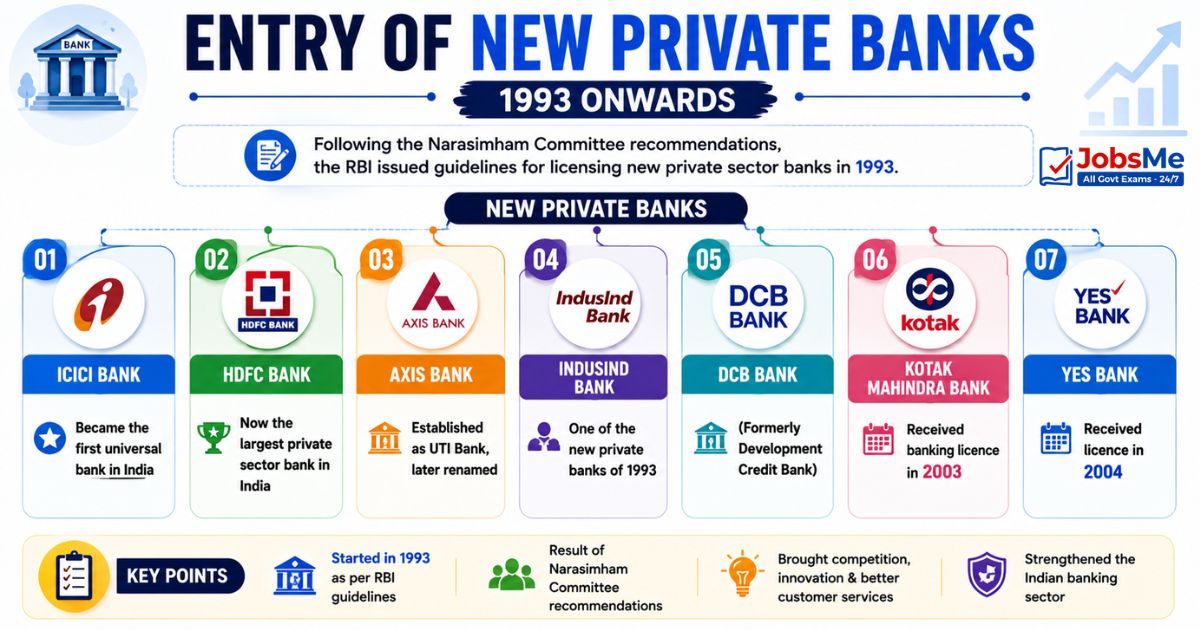
- ICICI Bank — became the first universal bank in India
- HDFC Bank — now the largest private sector bank in India
- Axis Bank — established as UTI Bank, later renamed
- IndusInd Bank
- DCB Bank (formerly Development Credit Bank)
- Kotak Mahindra Bank — received banking licence in 2003
- Yes Bank — received licence in 2004
Technology and ATMs in Indian Banking
The 1990s and 2000s saw rapid technology adoption in Indian banking. Core Banking Solutions (CBS) were implemented, connecting all branches of a bank in real time. ATMs expanded rapidly after the first ATM was introduced by HSBC in Mumbai in 1987. Internet banking was introduced by ICICI Bank, which also pioneered many digital banking innovations.
Phase 4 - Digital Era (2014 Onwards)
The digital era of Indian banking began with the launch of the Pradhan Mantri Jan Dhan Yojana in 2014 and accelerated dramatically with demonetization in 2016 and the launch of UPI.
Key Milestones of the Digital Era
| Year | Event | Significance |
|---|---|---|
| 2014 | PMJDY launched (August 28, 2014) | Financial inclusion of unbanked households; zero-balance accounts with RuPay cards |
| 2015 | RBI granted in-principle approval for Payment Banks and Small Finance Banks | New category of differentiated banks to serve specific segments |
| 2016 | UPI launched by NPCI (April 2016) | Revolutionized digital payments; instant bank-to-bank transfers via mobile |
| 2016 | Demonetization (November 8, 2016) | Massively accelerated digital payments and cashless transactions |
| 2016 | BHIM app launched (December 30, 2016) | Government UPI app by NPCI for simple mobile payments |
| 2019-2020 | Major bank mergers | Number of public sector banks reduced from 27 to 12 for efficiency |
| 2022 | Digital Rupee (e₹) launched | India's CBDC; wholesale (November 2022) and retail (December 2022) |
| 2023 | UPI-PayNow India-Singapore link | First bilateral cross-border real-time payment link |
| 2025 | ULI (Unified Lending Interface) pilot expanded | 3.2 million loans, Rs. 1.75 trillion in lending; credit delivery transformation |
Major Bank Mergers 2019-2020
| Banks Merged (Acquired) | Into (Anchor Bank) | Effective Date |
|---|---|---|
| Vijaya Bank + Dena Bank | Bank of Baroda | April 1, 2019 |
| Oriental Bank of Commerce + United Bank of India | Punjab National Bank | April 1, 2020 |
| Syndicate Bank | Canara Bank | April 1, 2020 |
| Allahabad Bank | Indian Bank | April 1, 2020 |
| Andhra Bank + Corporation Bank | Union Bank of India | April 1, 2020 |
Firsts in Indian Banking - Most Tested in Exams
Questions on the firsts in Indian banking are among the most frequently asked in all banking awareness sections. Every aspirant must memorize this list completely.
| First | Institution / Year |
|---|---|
| First bank in India | Bank of Hindustan (1770) |
| First bank managed entirely by Indians | Oudh Commercial Bank |
| First bank with Indian capital | Punjab National Bank (1894) |
| First Presidency Bank | Bank of Bengal (1806) |
| First foreign bank in India | HSBC (Hongkong and Shanghai Banking Corporation) |
| First bank to introduce ATM in India | HSBC (1987, Mumbai) |
| First bank to introduce savings account | Presidency Bank (1833) |
| First bank to introduce cheque system | Bengal Bank (1833) |
| First bank to introduce internet banking | ICICI Bank |
| First universal bank in India | ICICI Bank |
| First digital bank in India | Digibank (by DBS) |
| First Regional Rural Bank in India | Prathama Bank (October 2, 1975, Moradabad) |
| First bank with ISO certification | Canara Bank |
| First Indian Governor of RBI | C.D. Deshmukh (1943) |
| First Governor of RBI | Sir Osborne Smith (1935-1937) |
Benefits of Bank Nationalization - Why It Was Done
The nationalization of banks in 1969 and 1980 was one of the most significant economic policy decisions in independent India. Understanding why it was done helps you answer descriptive and interview questions:
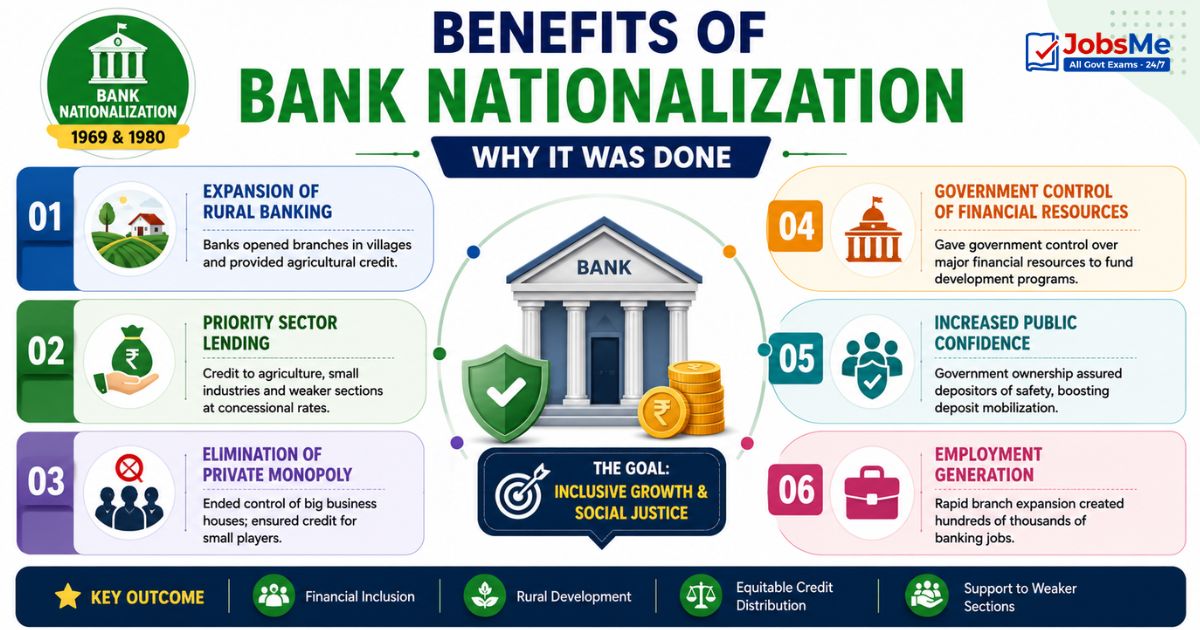
- Expansion of rural banking — Private banks concentrated in urban areas and neglected rural credit. Nationalization forced banks to open branches in villages and provide agricultural credit.
- Priority sector lending — Nationalized banks were directed to provide credit to agriculture, small industries and weaker sections at concessional rates.
- Elimination of private monopoly — Before nationalization, a handful of large business houses controlled the major banks and used them to finance their own businesses, denying credit to small players.
- Government control of financial resources — Nationalization gave the government control over a major pool of financial resources to fund development programs.
- Increased public confidence — Government ownership gave depositors confidence that their money was safe, increasing deposit mobilization.
- Employment generation — Rapid branch expansion after nationalization created hundreds of thousands of banking jobs.
Memory Tricks - History of Banking in India
Remember the Three Presidency Banks in Order
Trick: BBM - Bengal, Bombay, Madras (1806, 1840, 1843)
The gap between Bengal and Bombay is 34 years (1806 to 1840). The gap between Bombay and Madras is 3 years (1840 to 1843). Remember: BBM — three letters, three banks, three cities.
Remember the 14 Banks Nationalized in 1969
Trick: "All UCO Banks In United Canara Baroda Indian Bank Maharashtra Punjab Syndicate Indian Overseas"
Use the first letters: A U B I U C B I B M P S I O = 14 banks. Alternatively, remember that all major public sector banks you see today (except SBI and its associates) were nationalized in 1969.
Remember the Year of SBI Formation
Trick: SBI = 1955 = One year before India's constitution came into force for banking. SBI was born in 1955, six years after Indian independence (1947 + 6 = 1953... not exact but) — the simpler way is: RBI nationalized in 1949, SBI formed in 1955 — gap of 6 years. 1949 + 6 = 1955.
Remember RBI Establishment
Trick: RBI = April Fool's Day 1935. RBI was established on April 1, 1935. This is easy to remember because April 1 is April Fool's Day. But RBI is certainly no joke — it controls the entire monetary system of India.
One-Liners for Quick Revision - History of Banking in India
- First bank in India: Bank of Hindustan (1770), established in Calcutta.
- The three Presidency Banks: Bank of Bengal (1806), Bank of Bombay (1840), Bank of Madras (1843).
- The three Presidency Banks merged in 1921 to form the Imperial Bank of India.
- Imperial Bank became State Bank of India (SBI) on July 1, 1955.
- RBI established on April 1, 1935 under RBI Act, 1934.
- RBI nationalized on January 1, 1949.
- Banking Regulation Act enacted in 1949.
- 14 banks were nationalized on July 19, 1969.
- 6 more banks nationalized on April 15, 1980.
- First RRB (Prathama Bank) established on October 2, 1975.
- DICGC established on July 15, 1978.
- First ATM in India introduced by HSBC in Mumbai in 1987.
- Economic liberalization and entry of private banks from 1991.
- PMJDY launched on August 28, 2014 for financial inclusion.
- UPI launched by NPCI in April 2016.
- BHIM app launched on December 30, 2016.
- Major bank mergers reduced public sector banks from 27 to 12 (2019-2020).
- Digital Rupee (e₹) launched in November-December 2022.
- First Indian Governor of RBI: C.D. Deshmukh (1943).
- First Governor of RBI: Sir Osborne Smith (1935-1937).
Preparing for competitive exams requires consistent revision. Platforms like JobsMe simplify preparation through:
- Daily Current Affairs
- Weekly Current Affairs
- Monthly Current Affairs
- Static GK for Competitive Exams
- Latest Government Jobs Notifications
- Computer Awareness
Stay updated, revise regularly, and attempt quizzes for better accuracy in UPSC, SSC CGL, IBPS PO/Clerk, SBI, RBI Grade B, RRB NTPC, Defence, and State PSC exams.
Free quiz • No signup required
Put this topic into practice with Daily Current Affairs MCQ Quiz – 1 June 2026 | UPSC, SSC, Banking, Railways, Defence & State PSC Exams. It is the quickest way to reinforce what you just learned.
Frequently Asked Questions
Which was the first bank established in India?
What are the three Presidency Banks of India?
When were banks nationalized in India?
Which 14 banks were nationalized in 1969?
When was the Reserve Bank of India established?
Which was the first bank managed entirely by Indians?
Which was the first foreign bank to operate in India?
What happened to Indian banking after the 1991 liberalization?
What were the major bank mergers in India in 2019 and 2020?
What is the significance of the year 1955 in Indian banking history?

About the author