
Computer Awareness – Notes & Quizzes for Bank, SSC & Government Exams
Latest posts and quizzes curated for the Computer Awareness track.
Latest Posts & Quizzes
Page 1
Computer Awareness Important Terms & Abbreviations – Complete Exam Booster for IBPS, SSC, RRB
This final post in the Computer Awareness series is your ultimate exam booster — a comprehensive quick reference of all important terms, key inventors and their achievements, historical firsts in computing, important number facts, and the complete A–Z list of computer abbreviations. Perfect for last-minute revision before IBPS, SSC CGL, RRB NTPC, LIC AAO, and all government job exams.
Artificial Intelligence & New Technologies – Complete Notes for IBPS, SSC, RRB & Govt Exams
Artificial Intelligence and New Technologies is the most dynamic and fastest-growing chapter in Computer Awareness for IBPS, SSC CGL, RRB NTPC, and all government job exams. This post covers everything — AI, ML, Deep Learning, Generative AI, major AI tools (ChatGPT, Gemini, Claude), AI in India, IoT, Blockchain, Cryptocurrency, AR/VR/Metaverse, Quantum Computing, 5G technology, and all Digital India initiatives — with memory tricks, one-liners, and 10 exam-focused FAQs.
MS Office – Complete Notes for IBPS, SSC, RRB & Govt Exams
Microsoft Office is one of the most directly practical and exam-relevant chapters in Computer Awareness for IBPS, SSC CGL, RRB NTPC, LIC AAO, and all government job exams. This post covers everything — MS Word (components, features, shortcuts), MS Excel (functions, formulas, charts, shortcuts), MS PowerPoint (views, features, shortcuts), MS Access (components, data types, keys), MS Outlook, and Google Workspace — with memory tricks, one-liners, and 10 exam-focused FAQs.
Cyber Security – Complete Notes for IBPS, SSC, RRB & Govt Exams
Cyber Security is one of the most important and consistently tested chapters in IBPS, SSC CGL, RRB NTPC, LIC AAO, and all government job exams — especially in banking where digital security is a daily operational concern. This post covers everything — components of security, cryptography, all types of malware (viruses, worms, trojans, ransomware, spyware), all types of cyber attacks, complete security solutions (firewall, antivirus, VPN, MFA, encryption, digital signature, biometrics), file access permissions, and Indian cyber laws (IT Act 2000, DPDP Act 2023) — with memory tricks, one-liners, and 10 exam-focused FAQs.
Big Data, Data Mining & Data Warehouse – Complete Notes for IBPS, SSC, RRB & Govt Exams
Big Data, Data Mining, and Data Warehouse is a rapidly growing topic in IBPS, SSC CGL, RRB NTPC, and all government job exams, especially for IT-related roles. This post covers everything — definition and 5Vs of Big Data, Big Data tools (Hadoop, Spark, Kafka), Data Warehouse concepts, Data Mining, all four types of data analytics, OLAP vs OLTP, ETL process, Business Intelligence, and key data concepts — with memory tricks, one-liners, and 10 exam-focused FAQs.
DBMS – Database Management System Complete Notes for IBPS, SSC, RRB & Govt Exams
Database Management System (DBMS) is a high-yield chapter in IBPS, SSC CGL, RRB, and all government job exams. This post covers everything — what is a database, types of databases, DBMS vs RDBMS, ANSI/SPARC three-level architecture, database components, all types of keys (Primary, Foreign, Candidate, Composite), SQL commands (DDL, DML, DCL, TCL), SQL constraints, the Entity-Relationship (ER) model, normalisation, and key database terms — with memory tricks, one-liners, and 10 exam-focused FAQs.
Cloud Computing – Complete Notes for IBPS, SSC, RRB & Govt Exams
Cloud Computing is a rapidly growing topic in IBPS, SSC CGL, RRB, and all government job exams. This post covers the complete cloud computing notes — definition, deployment models (Public, Private, Hybrid, Community), service models (IaaS, PaaS, SaaS, FaaS, DaaS), major cloud providers (AWS, Azure, Google Cloud), cloud storage services, and new cloud concepts (Edge Computing, Serverless, Containerisation, DevOps) — with memory tricks, one-liners, and 10 exam-focused FAQs.
Internet & Applications – Complete Notes for IBPS, SSC, RRB & Govt Exams
Internet and its Applications is a high-scoring chapter in every government job exam — especially IBPS, where digital banking knowledge is directly tested. This post covers everything: definition and history of the Internet, types of internet connections, World Wide Web vs Internet, URL structure, domain names, all major browsers, search engines, internet services (email, chatting, video conferencing, e-commerce, e-banking), and India's UPI/digital payment ecosystem — with memory tricks, one-liners, and 10 exam-focused FAQs.
Data Communication & Protocols – Complete Notes for IBPS, SSC, RRB & Govt Exams
Data Communication and Protocols is one of the highest-scoring topics in IBPS, SSC CGL, RRB NTPC, and Insurance exams. This post covers everything — types of signals, simplex/half-duplex/full-duplex channels, guided and unguided transmission media, the complete 7-layer OSI model with mnemonics, the 4-layer TCP/IP model, all key protocols (HTTP, HTTPS, FTP, SMTP, POP3, IMAP, DNS, DHCP, ARP, TCP, UDP, SSH, VoIP), and IP addressing — with memory tricks, one-liners, and 10 exam-focused FAQs.
Computer Networking – Complete Notes for IBPS, SSC, RRB & Govt Exams
Computer Networking is a consistently high-scoring topic in IBPS, SSC CGL, RRB NTPC, and all government exams. This post covers everything — types of networks (PAN, LAN, MAN, WAN, CAN, SAN), network models (P2P, Client-Server), all networking devices (Hub, Switch, Router, Gateway, Modem), network topologies with diagrams, Wi-Fi standards up to Wi-Fi 7, and Bluetooth — with memory tricks, one-liners, and 10 exam-focused FAQs.
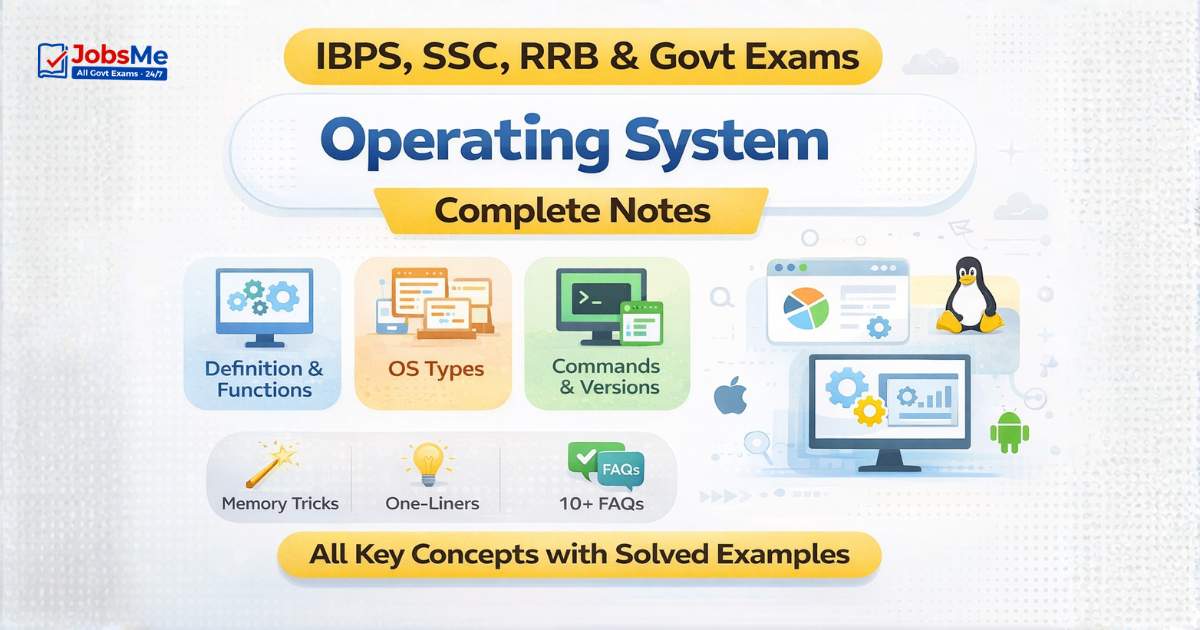
Operating System – Complete Notes for IBPS, SSC, RRB & Govt Exams
Operating System is one of the most heavily tested chapters in IBPS, SSC CGL, RRB NTPC, LIC AAO, and other government job exams. This post covers the complete OS notes — definition, functions, all types of operating systems, MS-DOS commands, all Windows versions with features, macOS versions, Linux, mobile operating systems (Android, iOS), booting types, and GUI vs CLI — with memory tricks, one-liners, and 10 exam-focused FAQs.
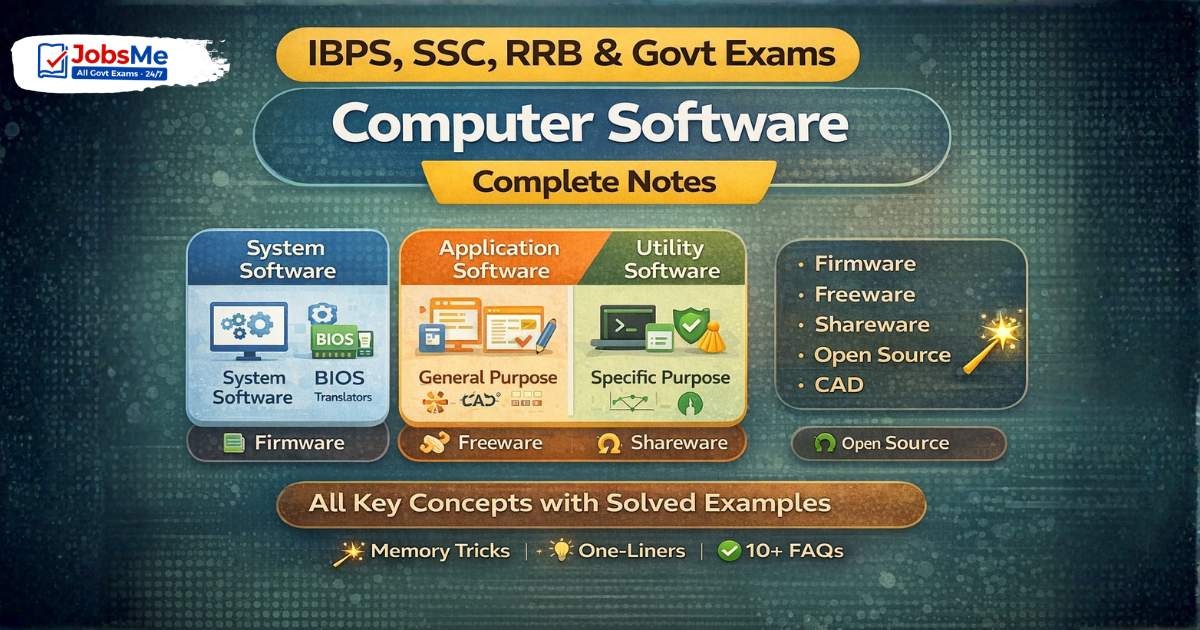
Computer Software – Complete Notes for IBPS, SSC, RRB & Govt Exams
Computer Software is one of the most consistently tested chapters in IBPS, SSC CGL, RRB, and other government exams. This post covers the complete classification of software — System Software (OS, BIOS, Device Drivers, Translators), Application Software (general and specific purpose), Utility Software — along with Firmware, Freeware, Shareware, Open Source, and CAD. Includes memory tricks, one-liners, and 10 exam-focused FAQs.
Computer Languages – Complete Notes for IBPS, SSC, RRB & Govt Exams
Computer Languages is a regularly tested chapter in IBPS, SSC CGL, RRB NTPC, and all state government exams. This post covers the complete classification of programming languages — Machine Language, Assembly Language, High-Level Languages with their inventors and years, all three translators (Assembler, Interpreter, Compiler), generations of languages, types of errors, and Object-Oriented Programming — with memory tricks, one-liners, and 10 exam-focused FAQs.
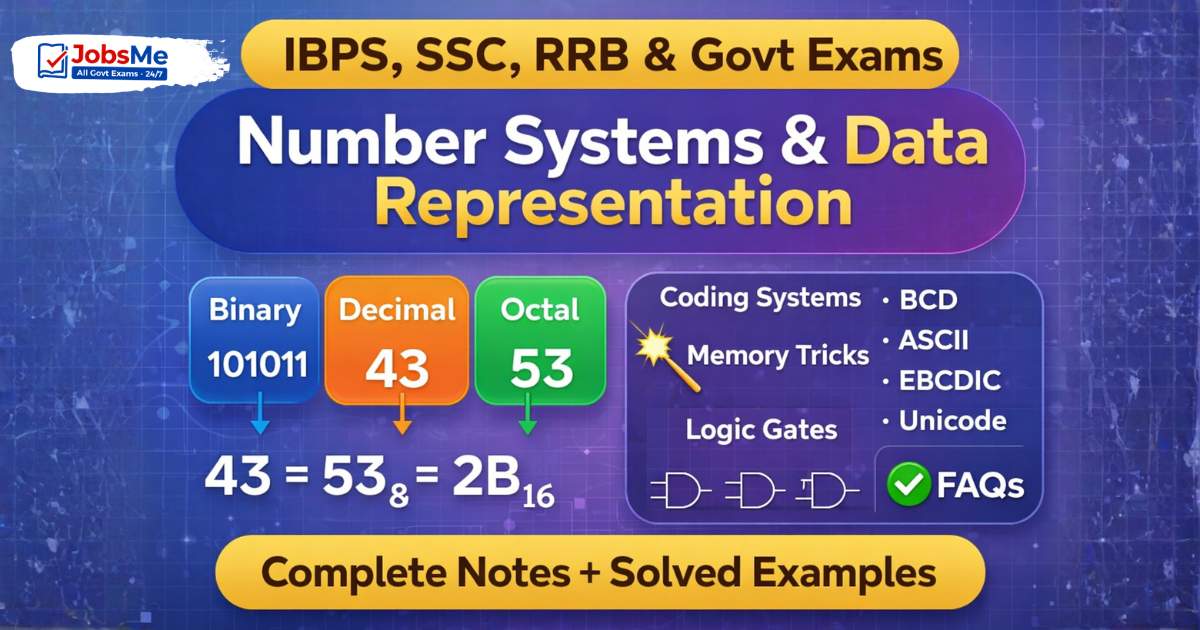
Data Representation & Number Systems – Complete Notes for IBPS, SSC, RRB & Govt Exams
Number Systems and Data Representation is a guaranteed scoring topic in IBPS, SSC CGL, RRB NTPC, and other government exams. This post covers all four number systems (Binary, Decimal, Octal, Hexadecimal), step-by-step conversion methods with solved examples, coding systems (BCD, ASCII, EBCDIC, Unicode), and Logic Gates — with memory tricks, one-liners, and 10 exam-focused FAQs.
Hardware & I/O Devices – Complete Notes for IBPS, SSC, RRB & Govt Exams
Hardware and I/O Devices is a high-yield chapter in every government job exam. This post covers all input devices (keyboard, mouse, scanner, OMR, MICR, OCR, biometrics), output devices (monitors, printers, plotters), dual I/O devices, and I/O ports — with detailed tables, device comparisons, memory tricks, one-liners, and 10 exam-focused FAQs.
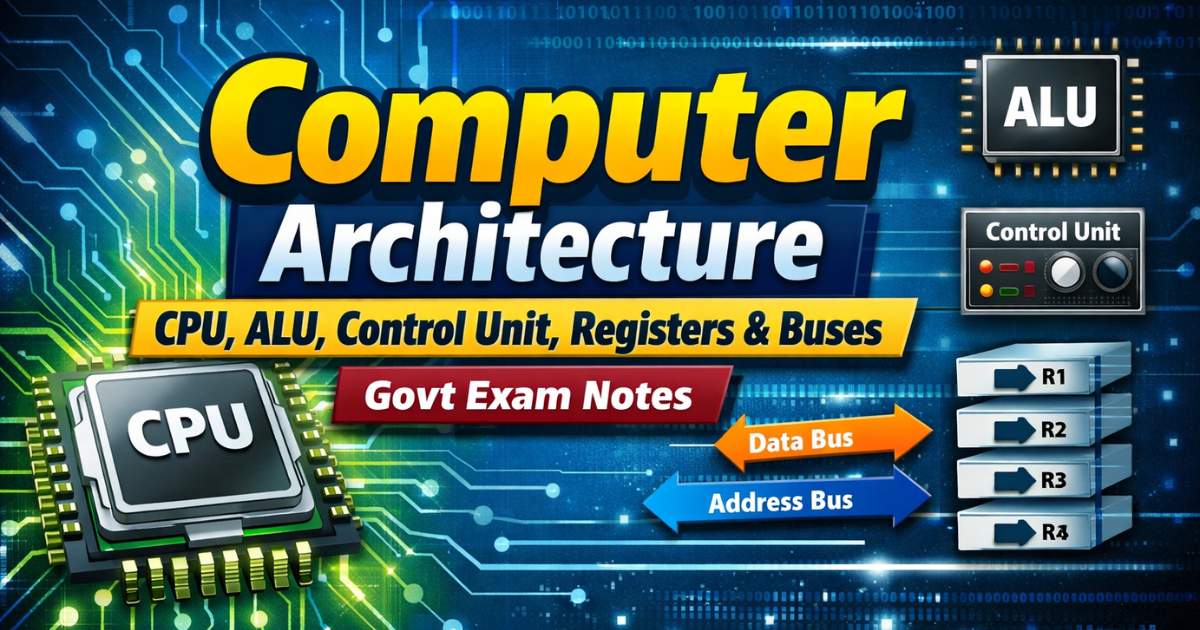
Computer Architecture – CPU, ALU, Control Unit, Registers & Buses | Govt Exam Notes
Computer Architecture is one of the most heavily tested topics in IBPS PO, IBPS Clerk, SBI, SSC CGL, and RRB exams. This post covers the full architecture of a computer — the three main components, CPU internals (ALU, Control Unit, Registers), how buses work, the motherboard layout, the instruction cycle, and microprocessor history — with exam-focused tables, memory tricks, one-liners, and 10 FAQs.

Memory Management in Computers – Complete Notes for IBPS, SSC, RRB & Govt Exams
Memory Management is one of the highest-scoring topics in Computer Awareness for IBPS, SSC, and RRB exams. This post covers the complete memory hierarchy — Registers, Cache, Primary Memory (RAM & ROM types), Secondary Memory (HDD, SSD, optical storage), Virtual Memory, Flash Memory — along with all memory units from Bit to GeopByte. Includes detailed tables, memory tricks, one-liners, and 10 exam-focused FAQs.
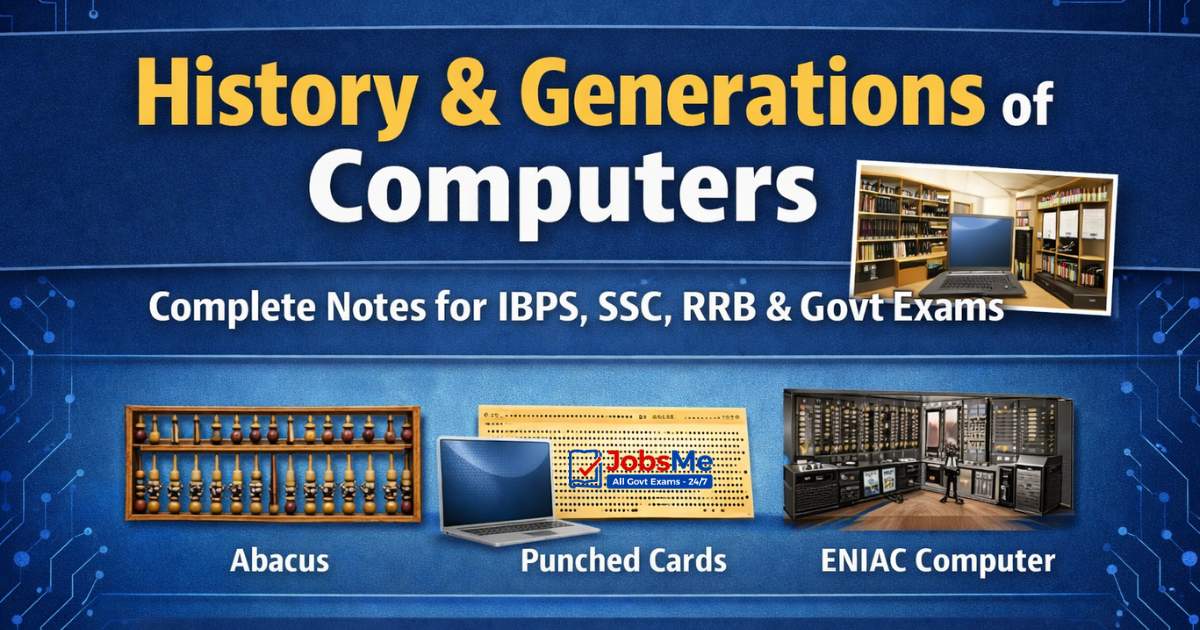
History & Generations of Computers – Complete Notes for IBPS, SSC, RRB & Govt Exams
Questions on the history of computers and their five generations appear in nearly every government job exam — from IBPS Clerk to SSC CGL and RRB NTPC. This post covers everything: early computing devices (Abacus to ENIAC), all five generations with their key features and technologies, landmark milestones, important inventors, and recent developments up to 2024 — with memory tricks, one-liners, and 10 exam-focused FAQs.
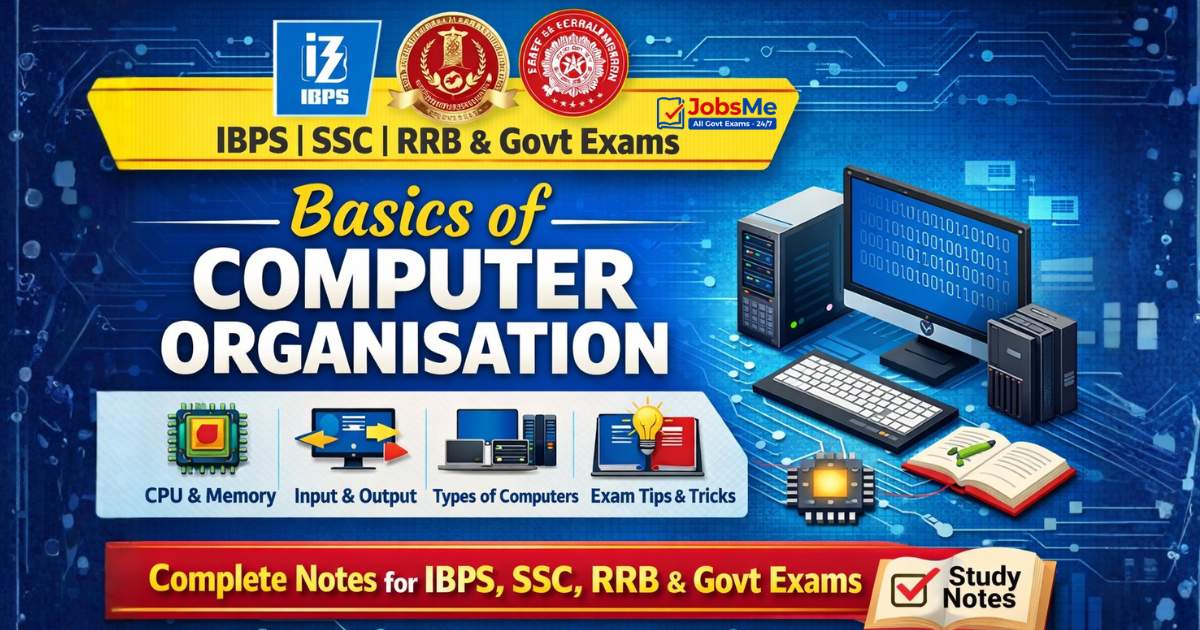
Basics of Computer Organisation – Complete Notes for IBPS, SSC, RRB & Govt Exams
Learn Basics of Computer Organisation for IBPS, SSC, RRB & all Govt Exams. Covers definition, functions, features, types & memory tricks. Free study notes at jobsme.in.
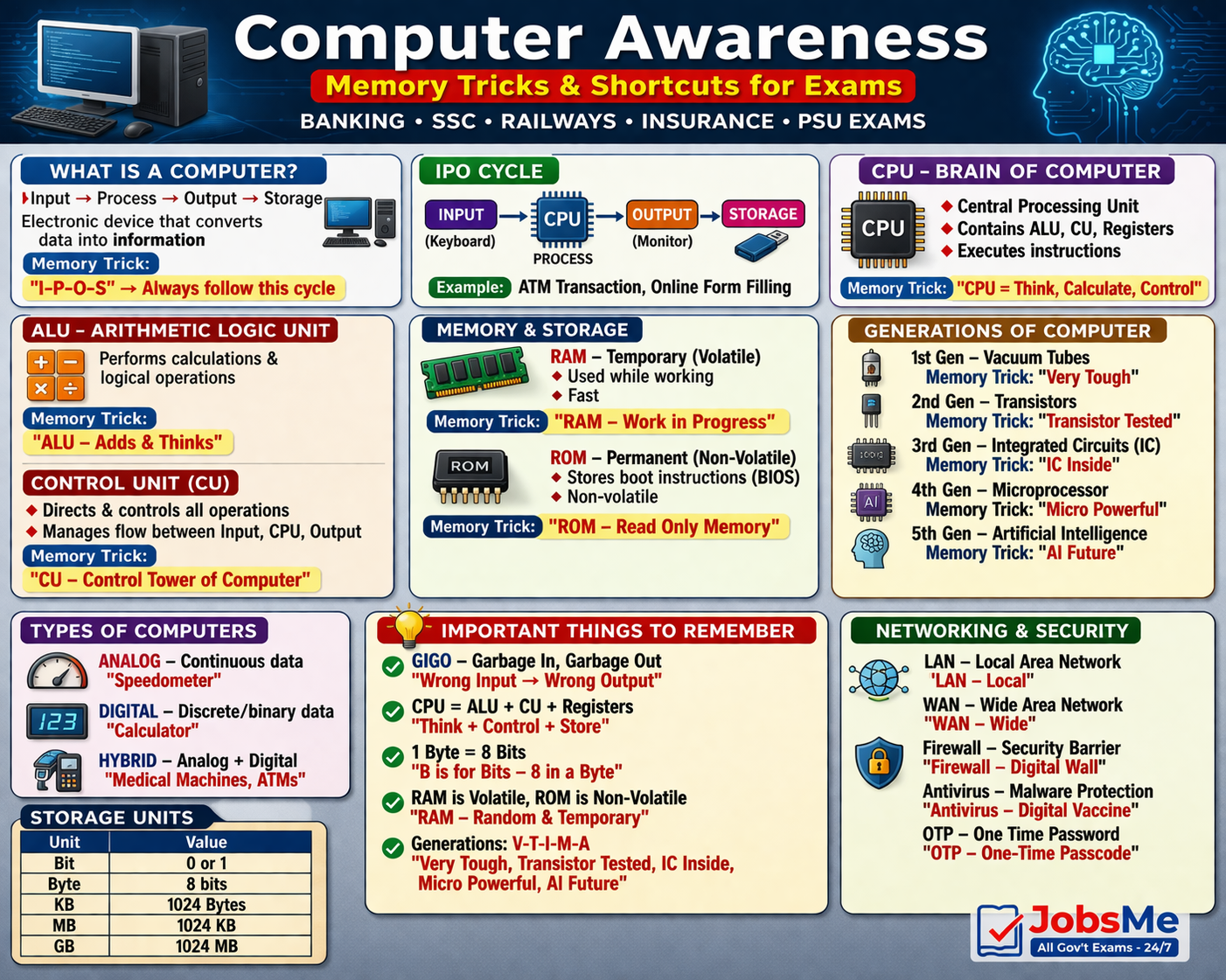
Computer Awareness – Fundamentals of Computer System | Important Concepts for Banking, SSC & Government Exams
This article covers core computer fundamentals including IPO cycle, hardware, software, memory, generations, and modern digital applications—essential for all government exam aspirants.
Introduction
JobsMe's Computer Awareness section is your complete, exam-focused preparation resource for the Computer Knowledge and Computer Aptitude sections of government competitive examinations. This combined archive brings together all Computer Awareness topic posts and interactive quizzes in one place - covering every subject from computer basics, hardware and software, operating systems and MS Office to networking, cybersecurity, programming languages, cloud computing, and computer abbreviations. Everything is written specifically for aspirants preparing for IBPS PO, IBPS Clerk, IBPS RRB PO/Clerk, SBI PO, SBI Clerk, RBI Assistant, SSC CGL, SSC CHSL, Delhi Police, and all other government examinations where Computer Awareness is a tested section.
Every topic comes with a free interactive quiz - attempt it, get your instant score, read the explanation behind every answer, and if you are logged in, track your performance history across all topics and all attempts over time.
📖 Browse Computer Awareness Posts → 🧩 Attempt Computer Awareness Quizzes → 🏦 Banking Awareness → 📚 Static GK →
What Is Computer Awareness and Why Is It Tested in Government Exams
Computer Awareness - also called Computer Knowledge or Computer Aptitude depending on the exam - tests your understanding of how computers work, how software applications function, and how digital systems communicate. As the banking, government, and public sector increasingly operate through digital platforms and computerised systems, recruiters want to ensure that every selected candidate has the foundational computer literacy to operate effectively in a modern workplace.
Unlike reasoning or quantitative aptitude, Computer Awareness is entirely factual. There are no multi-step problems to solve and no long reasoning chains to follow - just accurate recall of structured, well-defined concepts. This makes it one of the highest-scoring sections available to a well-prepared aspirant. Candidates who invest time in Computer Awareness preparation routinely clear sectional cutoffs in sections that less-prepared aspirants struggle with.
Computer Awareness Section Across Major Exams
IBPS RRB PO and Clerk (Mains): Computer Knowledge is a dedicated section in IBPS RRB Mains, carrying 40 marks with 40 questions. It is one of the five sections in the Mains paper and has officially fixed weightage. This makes Computer Awareness preparation non-negotiable for all IBPS RRB aspirants.
SBI Clerk (Mains): In SBI Clerk Mains, Computer Aptitude is combined with Reasoning Ability in a single 50-question, 60-mark section. Computer-specific questions typically account for 10-15 questions, and they are straightforward factual recalls that reward prepared candidates.
SBI PO (Mains): Computer Aptitude is embedded within the Reasoning and Computer Aptitude section. Questions focus on applied computer knowledge and logical computer-based problems rather than pure theory.
IBPS PO and Clerk (Mains): Computer Knowledge/Awareness is part of the Mains exam structure, testing basic concepts, software applications, networking, and cybersecurity.
RBI Assistant (Mains): A dedicated Computer Knowledge section tests fundamentals of hardware, software, operating systems, networking, and MS Office.
SSC CGL (Tier 2): The Computer Knowledge Test in SSC CGL Tier 2 consists of 20 questions for 60 marks completed in 15 minutes - making it a highly time-efficient section. Topics include CPU structure, memory types, OS basics, networking, keyboard shortcuts, and internet concepts. A well-prepared aspirant can score full marks here.
SSC CHSL: Computer Proficiency/Knowledge is part of the skill test and descriptive assessment. Practical computer literacy is tested alongside theoretical knowledge.
Delhi Police, DSSSB, and other Central Government Exams: Computer Knowledge sections appear across a range of Central and State government recruitment exams, testing basic computing concepts and digital literacy.
Topics Covered in JobsMe Computer Awareness
JobsMe's Computer Awareness library covers the complete exam syllabus across all major categories. Every topic has a dedicated post and quiz.
Computer Fundamentals
History and generations of computers (first through fifth generation), types of computers (supercomputer, mainframe, minicomputer, microcomputer), basic architecture of a computer system, and the fundamental input-process-output model. These are direct question types across all exams.
Hardware - Input, Output, and Storage
Input devices (keyboard, mouse, scanner, joystick, barcode reader, touchscreen), output devices (monitor, printer, plotter, speaker), internal components (CPU, motherboard, RAM, ROM, cache memory, hard disk, SSD), ports and connectors (USB, HDMI, VGA, PS/2), and backup devices. Questions on hardware are among the most common in SSC and banking Computer Awareness sections.
Memory and Storage
Types of memory - Primary memory (RAM and ROM), Secondary memory (hard disk, SSD, optical discs, pen drives), Cache memory, Virtual memory. Types of RAM (SRAM, DRAM, SDRAM). Types of ROM (PROM, EPROM, EEPROM). Memory units (bit, byte, KB, MB, GB, TB, PB). Storage capacity conversions. These are high-frequency direct question topics in all exams.
Number Systems
Binary, Octal, Decimal, and Hexadecimal number systems - conversions between them, basic binary arithmetic, and BCD (Binary Coded Decimal). Logic gates (AND, OR, NOT, NAND, NOR, XOR, XNOR). These are tested in SSC CGL Tier 2 and IBPS RRB.
Operating Systems
Definition and functions of an operating system, types of operating systems (batch, real-time, time-sharing, distributed, network), popular operating systems (Windows, Linux, macOS, Android, iOS), Windows Explorer navigation, file management concepts, and different versions of Windows. Task management, process scheduling, and memory management basics.
Microsoft Office Applications
This is one of the most heavily tested Computer Awareness categories across all banking and government exams:
- MS Word - toolbars, shortcut keys (Ctrl+C, Ctrl+X, Ctrl+Z, etc.), formatting, track changes, mail merge
- MS Excel - formulas, functions (SUM, AVERAGE, VLOOKUP, IF), cell references, charts, keyboard shortcuts
- MS PowerPoint - slide layouts, transitions, animations, presentation modes
- MS Access - database basics, tables, queries, forms, reports
- MS Outlook - email management basics
Keyboard Shortcuts and Function Keys
Function keys F1-F12 and their standard uses. Essential keyboard shortcuts (Ctrl+A, Ctrl+P, Ctrl+S, Ctrl+B, Alt+F4, Windows key shortcuts). Shortcut key questions are among the most frequently asked and easiest to score in bank exam Computer Awareness sections.
Computer Networks
Types of networks - LAN, MAN, WAN, PAN. Network topologies - Bus, Star, Ring, Mesh, Hybrid. Network devices - Router, Switch, Hub, Modem, Gateway, Repeater, Bridge. Network protocols - TCP/IP, HTTP, HTTPS, FTP, SMTP, POP3, DNS, DHCP. Transmission media - wired (coaxial, twisted pair, fibre optic) and wireless (Wi-Fi, Bluetooth, infrared). OSI model layers and functions.
Internet and Web Technologies
How the internet works, URL structure, IP addresses (IPv4 vs IPv6), domain name system (DNS), web browsers (Chrome, Firefox, Safari, Edge), HTML basics, web servers, FTP, email protocols (SMTP, IMAP, POP3), cookies, and cloud computing fundamentals (SaaS, PaaS, IaaS).
Cybersecurity and Computer Viruses
Types of malware (virus, worm, Trojan, ransomware, spyware, adware), antivirus software, firewall functions, phishing and social engineering, data encryption basics, digital signatures, SSL/TLS certificates, and basic cybersecurity best practices. Increasingly tested in banking exams given the sector's focus on digital security.
Software and Programming Languages
Difference between system software and application software, types of programming languages (machine language, assembly language, high-level language), generations of programming languages (1GL-5GL), compilers vs interpreters, common languages and their applications (C, Java, Python, SQL). These are tested in SSC and advanced banking papers.
Database Management Systems (DBMS)
Basic concepts of database systems, difference between file-based and database systems, DBMS vs RDBMS, key terms (table, record, field, primary key, foreign key), SQL basics, and common DBMS software (MySQL, Oracle, MS Access). Tested in SSC CGL Tier 2 and IT Officer papers.
Computer Abbreviations
A comprehensive list of 200+ important computer abbreviations - CPU, RAM, ROM, HTTP, HTML, URL, IP, USB, PDF, GUI, OS, BIOS, POST, LAN, WAN, SQL, DBMS, AI, ML, IoT, SaaS, PaaS, IaaS, and many more. One of the highest-frequency direct question types in every exam.
Emerging Technologies
Basic awareness of Artificial Intelligence (AI), Machine Learning (ML), Internet of Things (IoT), Blockchain, Cloud Computing, Big Data, and Cybersecurity frameworks. These are increasingly appearing in modern bank exam Computer Awareness sections.
Computer Awareness vs Computer Aptitude - Know the Difference
Some bank exams use the term "Computer Awareness" and others use "Computer Aptitude." While closely related, they have a subtle distinction that matters for preparation.
Computer Awareness tests theoretical knowledge of computing concepts - what different hardware components do, how operating systems function, what networking protocols are, and what abbreviations stand for. Questions are largely factual and direct.
Computer Aptitude tests the ability to apply computer knowledge to solve logical or analytical problems - such as understanding how a database query works, interpreting a flowchart, solving a logic gate problem, or identifying what a specific algorithm does. SBI PO and IBPS PO Mains tend to favour Computer Aptitude-style questions. Both types are covered in JobsMe's notes and quizzes.
Interactive Quizzes with Personal Performance Tracking
Every Computer Awareness topic on JobsMe has a corresponding free interactive quiz with instant scoring and detailed explanations for every answer. Logged-in users additionally get a full performance history - tracking every topic, every attempt, and every score over time. This lets you build an evidence-based preparation map: knowing exactly which Computer Awareness topics are mastered and which still need work before your exam.
Exams Covered
IBPS RRB PO | IBPS RRB Clerk | IBPS PO | IBPS Clerk | IBPS SO (IT Officer) | SBI PO | SBI Clerk | RBI Assistant | NABARD | SSC CGL | SSC CHSL | SSC MTS | SSC CPO | Delhi Police Constable | DSSSB | RRB NTPC | RRB Group D | LIC AAO | NIACL AO | All Banking & Insurance Exams | All Central Government Recruitment Exams