Computer Awareness Important Terms & Abbreviations – Complete Exam Booster for IBPS, SSC, RRB
This final post in the Computer Awareness series is your ultimate exam booster — a comprehensive quick reference of all important terms, key inventors and their achievements, historical firsts in computing, important number facts, and the complete A–Z list of computer abbreviations. Perfect for last-minute revision before IBPS, SSC CGL, RRB NTPC, LIC AAO, and all government job exams.
Jump to section
Introduction: How to Use This Exam Booster
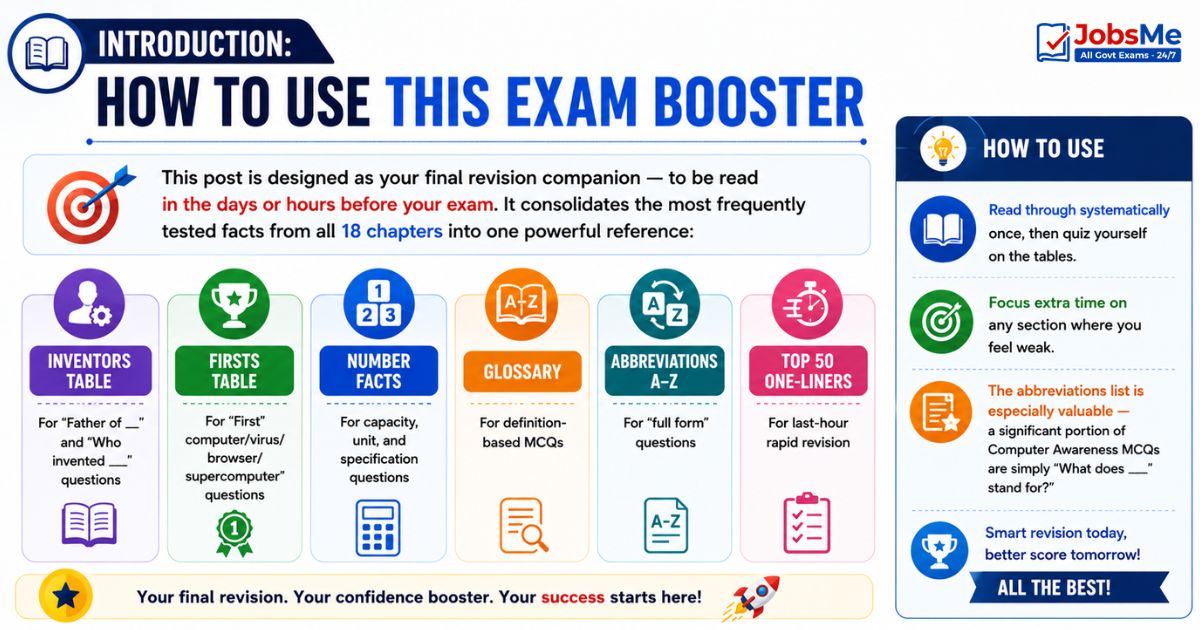
This post is designed as your final revision companion — to be read in the days or hours before your exam. It consolidates the most frequently tested facts from all 18 chapters into one powerful reference:
- Inventors table — for "Father of ___" and "Who invented ___" questions
- Firsts table — for "First computer/virus/browser/supercomputer" questions
- Number facts — for capacity, unit, and specification questions
- Glossary — for definition-based MCQs
- Abbreviations A-Z — for "full form" questions
- Top 50 one-liners — for last-hour rapid revision
How to use: Read through systematically once, then quiz yourself on the tables. Focus extra time on any section where you feel weak. The abbreviations list is especially valuable — a significant portion of Computer Awareness MCQs are simply "What does ___ stand for?"
Key Inventors and Fathers - Must Know for Every Exam
| Title / Role | Name | Achievement / Year |
|---|---|---|
| Father of Computer | Charles Babbage | Designed Analytical Engine (1837) — first concept of general-purpose computer |
| Father of Modern Computer | Alan Turing | Turing Machine concept; breaking Enigma code in WWII; theoretical basis of computing |
| Father of Internet | Vint Cerf | Co-developed TCP/IP protocol; designed ARPANET (1969) |
| Father of the Web (WWW) | Tim Berners-Lee | Invented World Wide Web (March 13, 1989) at CERN; created HTML, URL, first browser |
| Father of Relational Database | Dr. E.F. Codd | Presented 12 rules for RDBMS (1970) |
| Father of Data Warehousing | Bill Inmon | Coined the term and concept of Data Warehousing |
| First Computer Programmer | Ada Lovelace | Wrote first algorithm for Babbage's Analytical Engine |
| First Mouse | Douglas Engelbart | Invented at Stanford Research Center (1963) |
| First Microprocessor | Ted Hoff & Federico Faggin | Intel 4004 (1971) — first microprocessor |
| First IC (Integrated Circuit) | Jack St. Clair Kilby & Robert Noyce | Independently invented IC in 1958 (Texas Instruments & Fairchild) |
| Transistor | Bell Laboratory | William Shockley, John Bardeen, Walter Brattain (1947) |
| Linux | Linus Torvalds | First Linux kernel released September 1991 |
| Java language | James Gosling | Developed at Sun Microsystems (1995) |
| Python language | Guido van Rossum | Developed in 1991 |
| C language | Dennis Ritchie | Bell Labs (1972) |
| C++ language | Bjarne Stroustrup | Bell Labs (1985) |
| COBOL | Grace Hopper | 1959; also invented first compiler |
| FORTRAN | IBM team | 1957 — first high-level language |
| LISP | John McCarthy | 1958 at MIT; coined "Artificial Intelligence" |
| First Supercomputer | Seymour R. Cray | CRAY-1 (1976) |
| First Indian Supercomputer | C-DAC team | PARAM (1990) |
| ChatGPT | OpenAI | Launched November 2022 |
| Bitcoin | Satoshi Nakamoto | Whitepaper 2008; launched January 2009 |
| Mark Zuckerberg | 2004 | |
| M-Commerce | Kevin Duffey | Coined in 1997 (Global Mobile Commerce Forum) |
| ARPANET | US Department of Defense / Vint Cerf | 1969 |
| First Laptop | Adam Osborne | 1981; manufactured by EPSON |
| First Computer in India | — | Named Siddhartha |
| Abacus | Unknown (Chinese) | ~3000 BC — first calculating device |
| Pascaline | Blaise Pascal | 1642 — first mechanical adding machine |
| Analytical Engine | Charles Babbage | 1837 — first general-purpose computer concept |
| ENIAC | J. Presper Eckert & John W. Mauchly | 1946 — first electronic digital computer |
| Ethernet | Robert Metcalfe & David Boggs | Invented at Xerox PARC (1973) |
| Quantum Computing Concept | Richard Feynman | Proposed in 1982 |
| Quantum Supremacy | Google (Sycamore processor) | 2019 — 200 seconds vs 10,000 classical years |
Important Firsts in Computer History
| First | Name/Year | Details |
|---|---|---|
| First calculating device | Abacus (~3000 BC) | Used in China |
| First mechanical calculator | Pascaline (1642) | By Blaise Pascal |
| First punched card use | Jacquard's Loom (1801) | For weaving patterns |
| First general-purpose computer concept | Analytical Engine (1837) | Charles Babbage; never completed |
| First electromechanical computer | Tabulating Machine (1890) | Herman Hollerith; used for US Census |
| First electronic digital computer | ENIAC (1946) | Eckert & Mauchly |
| First stored-program computer | EDSAC (1949) | Von Neumann architecture |
| First commercial computer | UNIVAC (1951) | Eckert & Mauchly; used by US Census Bureau |
| First microprocessor | Intel 4004 (1971) | Ted Hoff & Faggin at Intel; 4-bit |
| First supercomputer | CRAY-1 (1976) | Seymour R. Cray |
| First computer virus | Creeper (1971) | Spread on ARPANET |
| First PC boot sector virus | Brain (1986) | Created in Pakistan |
| First minicomputer | DEC PDP-1 (1960) | Digital Equipment Corporation |
| First laptop | Osborne 1 (1981) | Adam Osborne; manufactured by EPSON |
| First Indian supercomputer | PARAM (1990) | C-DAC |
| First Indian AI supercomputer | PARAM Siddhi-AI (2020) | 5.27 PetaFLOPS; C-DAC |
| First graphical web browser | NCSA Mosaic (1993) | Marc Andreessen |
| First web browser (ever) | WorldWideWeb (1990) | Tim Berners-Lee; renamed Nexus |
| First GUI | Xerox Alto/PARC (1970s) | Xerox Corporation |
| First GUI for mass market | Apple Macintosh (1984) | Apple Computer |
| First computer network | ARPANET (1969) | US DoD |
| First modem | AT&T Dataphone (1960s) | AT&T Corporation |
| World's fastest supercomputer (2024) | Frontier (USA) | 1.2 ExaFLOPS; Oak Ridge National Laboratory |
| Fastest AI chatbot to 100M users | ChatGPT (2 months) | OpenAI; November 2022 launch |
Important Number Facts for Exams
| Fact | Value |
|---|---|
| 1 Bit | Binary digit (0 or 1) — smallest unit |
| 1 Nibble | 4 bits |
| 1 Byte | 8 bits = 256 possible values (2⁸) |
| 1 KB | 1024 Bytes |
| 1 MB | 1024 KB |
| 1 GB | 1024 MB |
| 1 TB | 1024 GB |
| 1 PB (PetaByte) | 1024 TB |
| 1 EB (ExaByte) | 1024 PB |
| 1 ZB (ZettaByte) | 1024 EB |
| 1 YB (YottaByte) | 1024 ZB |
| ASCII-7 | 7 bits → 128 characters (2⁷) |
| ASCII-8 (Extended) | 8 bits → 256 characters (2⁸) |
| EBCDIC | 8 bits → 256 characters |
| Unicode | 16+ bits → 65,536+ characters |
| BCD | 4 bits per decimal digit |
| IPv4 | 32-bit address |
| IPv6 | 128-bit address |
| Ethernet speed | 10 Mbps (original); 48-bit MAC address |
| Fast Ethernet | 100 Mbps |
| CD capacity | 640-680 MB |
| DVD capacity | 4.7 GB (single layer) to 17 GB (dual layer, double sided) |
| Blu-ray capacity | 25 GB per layer |
| Floppy disk (3½ inch) | 1.44 MB |
| Standard keyboard keys | 104 keys (QWERTY) |
| PowerPoint max zoom | 400% |
| MS Access default text field | 255 characters |
| 5G speed | Up to 20 Gbps theoretical |
| 5G latency | ~1 millisecond |
| Wi-Fi 6 (802.11ax) | 9.6 Gbps |
| Wi-Fi 7 (802.11be) | 46 Gbps |
| PARAM Siddhi-AI speed | 5.27 PetaFLOPS |
| Frontier speed (2024) | 1.2 ExaFLOPS |
| WannaCry (2017) | 200,000+ computers in 150 countries |
| ChatGPT to 100M users | 2 months |
| Google Drive free | 15 GB |
| OneDrive / iCloud / Amazon Drive free | 5 GB each |
| Dropbox free | 2 GB |
| Google Quantum Supremacy (2019) | 200 seconds (vs 10,000 classical years) |
| RTGS minimum | ₹2 lakh |
| India AI Mission budget | ₹10,371 crore |
Quick Reference Glossary - Key Terms A to Z
| Term | Definition |
|---|---|
| Abacus | World's first mechanical calculating device (~3000 BC, China) |
| Algorithm | Step-by-step procedure for solving a problem — the logic before programming |
| ALU | Arithmetic Logic Unit — performs all arithmetic (+−×÷) and logical (AND/OR/NOT) operations in the CPU |
| Analog Computer | Processes continuous physical variables (speedometer, ECG) |
| API | Application Programming Interface — allows software applications to communicate with each other |
| ARPANET | World's first packet-switching network (1969) — foundation of the Internet |
| ASCII | American Standard Code for Information Interchange — 7-bit (128 chars) or 8-bit (256 chars) text encoding |
| Assembler | Translates assembly language → machine language |
| Bandwidth | Maximum data transfer rate of a network; measured in bps or Hz |
| BIOS | Basic Input/Output System — firmware that initialises hardware at startup; first software to run |
| Bit | Binary digit (0 or 1) — smallest unit of digital information |
| Blog | Web Log — online journal or discussion website |
| Bluetooth | Short-range wireless technology for PAN (~10 metres) |
| Boot | Process of starting up a computer and loading the OS |
| Bug | Error in a computer program |
| Bus | Set of wires for transferring data between computer components |
| Byte | 8 bits — basic unit of storage; represents 256 possible values |
| Cache | Small, fast memory between CPU and RAM — stores frequently accessed data |
| CAPTCHA | Completely Automated Public Turing test to tell Computers and Humans Apart |
| ChatGPT | AI chatbot by OpenAI (November 2022) — fastest to reach 100M users (2 months) |
| Cloud Computing | Delivery of computing services over the internet on pay-as-you-go basis |
| Compiler | Translates entire HLL program → machine language at once; reports all errors |
| Cookie | Small file from web server stored in browser; tracks user activity and preferences |
| CPU | Central Processing Unit — "brain" of the computer; executes all instructions |
| DBMS | Database Management System — software for creating, managing, and retrieving database data |
| Debugging | Process of finding and fixing errors in a program |
| Deep Learning | ML subset using multi-layer neural networks to learn from large data |
| DNS | Domain Name System — translates domain names to IP addresses |
| E-Commerce | Buying and selling goods/services over the Internet |
| EBCDIC | Extended Binary Coded Decimal Interchange Code — IBM's 8-bit character encoding for mainframes |
| Encryption | Converting plain text → cipher text for security |
| Ethernet | Most widely used LAN technology; 10 Mbps; 48-bit MAC address; invented by Metcalfe & Boggs |
| Firewall | Filters network traffic based on security rules — hardware or software |
| Flash Memory | Non-volatile, electrically rewritable semiconductor storage (USB drives, SSDs) |
| FLOPS | Floating Point Operations Per Second — supercomputer speed measurement |
| Firmware | Software stored permanently in hardware ROM — BIOS is a key example |
| Freeware | Copyrighted software distributed free; source code NOT available (VLC, Notepad++) |
| GUI | Graphical User Interface — uses icons, windows, mouse; first designed by Xerox (1970s) |
| Hacker | Person who gains unauthorised access to computer systems |
| Hard Disk (HDD) | Primary non-volatile storage; magnetic platters; all programs installed here |
| Hardware | Physical, tangible components of a computer |
| HTML | HyperText Markup Language — language for designing web pages |
| HTTP | HyperText Transfer Protocol — transfers web pages; port 80 |
| HTTPS | HTTP Secure — HTTP + TLS encryption; padlock in browser; port 443 |
| Hub | Network device that broadcasts data to ALL connected ports; Physical Layer |
| Hyperlink | Clickable link connecting to another web resource |
| IC | Integrated Circuit — multiple electronic components on a single silicon chip |
| Internet | Global network of networks — worldwide "network of networks" |
| Interpreter | Translates HLL line by line; stops at first error; no object code saved |
| IoT | Internet of Things — network of physical objects connected to the Internet |
| IP Address | Unique numeric address identifying each device on a network |
| ISP | Internet Service Provider — company providing Internet access |
| Java | Platform-independent HLL; "Write Once Run Anywhere"; James Gosling, 1995 |
| Kernel | Core of OS; always in RAM; manages hardware directly |
| Keylogger | Records every keystroke; used to steal passwords |
| LAN | Local Area Network — within a building; Ethernet/Wi-Fi |
| Linux | Free, open-source OS; Linus Torvalds (1991) |
| LLM | Large Language Model — AI trained on massive text; generates human-like text |
| Machine Language | Binary (0s and 1s) — only language directly understood by CPU |
| Malware | Any malicious software (virus, worm, trojan, ransomware) |
| MICR | Magnetic Ink Character Recognition — reads magnetic-ink characters on bank cheques |
| Modem | MOdulator-DEModulator — converts digital↔analog signals |
| Monitor (VDU) | Visual Display Unit — primary output device; displays results |
| Motherboard | Main circuit board — all components connect here |
| Mouse | Pointing device; invented by Douglas Engelbart (1963) |
| NFT | Non-Fungible Token — unique digital asset on blockchain |
| NLP | Natural Language Processing — AI understanding and generating human language |
| NPU | Neural Processing Unit — dedicated AI chip in modern processors |
| OCR | Optical Character Recognition — scans and converts printed text to editable digital text |
| OMR | Optical Mark Reader — detects marks on paper (exam answer sheets) |
| OOP | Object-Oriented Programming — Java, C++, Python, C# |
| OS | Operating System — manages all hardware and software resources |
| OSI Model | 7-layer network framework by ISO (1983) |
| Phishing | Fraudulently acquiring sensitive data by impersonating trusted entities |
| Pixel | Smallest element of a digital image |
| Primary Key | Uniquely identifies each record; NOT NULL; one per table |
| Prompt | Input given to AI to generate a response |
| Protocol | Set of rules governing data communication |
| Quantum Computer | Uses qubits; superposition; potentially fastest for certain problems |
| RAM | Random Access Memory — volatile, read/write; temporary working memory |
| Ransomware | Encrypts files and demands ransom (WannaCry, LockBit) |
| ROM | Read Only Memory — non-volatile; permanent; stores BIOS firmware |
| Router | Routes data between networks using IP addresses; most intelligent network device; Layer 3 |
| SaaS | Software as a Service — cloud-based apps (Gmail, Office 365, Zoom) |
| Scanner | Converts paper/images to digital form |
| Search Engine | Indexes and retrieves web pages by keyword (Google, Bing) |
| Server | Most powerful computer in a network; provides resources to clients |
| Shell | OS command interpreter (Linux: Bash; Windows: CMD/PowerShell) |
| Software | Programs and instructions — interface between user and hardware |
| Spam | Unsolicited bulk email |
| Spoofing | Impersonating another user, system, or IP address |
| Spyware | Secretly monitors user activity; collects data without consent |
| SQL | Structured Query Language — standard for relational database management |
| SSD | Solid State Drive — no moving parts; faster than HDD |
| Switch | Forwards data to specific destination port by MAC address; Layer 2 |
| TCP | Transmission Control Protocol — reliable, connection-oriented; guarantees delivery |
| Trojan | Malware disguised as legitimate software; does NOT replicate |
| UDP | User Datagram Protocol — fast, connectionless, no delivery guarantee |
| UPI | Unified Payments Interface — India's real-time payment system (NPCI) |
| UPS | Uninterruptible Power Supply — emergency backup power |
| URL | Uniform Resource Locator — web address of a specific page |
| USB | Universal Serial Bus — standard interface port; plug and play |
| Virtual Memory | Hard disk space used as extended RAM |
| Virus | Self-replicating malware; attaches to files; requires human action to spread |
| VPN | Virtual Private Network — encrypted tunnel for secure internet traffic |
| WAN | Wide Area Network — spans large geographic areas; Internet is largest WAN |
| Wi-Fi | Wireless LAN technology (IEEE 802.11); latest = Wi-Fi 7 (46 Gbps) |
| Worm | Self-replicating; spreads via network without human action; no host file |
| WWW | World Wide Web — introduced March 13, 1989 by Tim Berners-Lee |
Complete Abbreviations List A-Z
A
| Abbreviation | Full Form |
|---|---|
| AI | Artificial Intelligence |
| ALU | Arithmetic Logic Unit |
| API | Application Programming Interface |
| ARP | Address Resolution Protocol |
| ARPANET | Advanced Research Projects Agency Network |
| ASCII | American Standard Code for Information Interchange |
| ATM | Automated Teller Machine |
| AR | Augmented Reality |
B
| Abbreviation | Full Form |
|---|---|
| BASIC | Beginner's All-purpose Symbolic Instruction Code |
| BCD | Binary Coded Decimal |
| BCR | Bar Code Reader |
| BD | Blu-ray Disc |
| BHIM | Bharat Interface for Money |
| BI | Business Intelligence |
| BIOS | Basic Input Output System |
| BPL | Broadband over Power Line |
| BTC | Bitcoin |
C
| Abbreviation | Full Form |
|---|---|
| CAD | Computer Aided Design |
| CAPTCHA | Completely Automated Public Turing test to tell Computers and Humans Apart |
| CDMA | Code Division Multiple Access |
| CERT-In | Computer Emergency Response Team India |
| CI/CD | Continuous Integration / Continuous Deployment |
| CLI | Command Line Interface |
| CNN | Convolutional Neural Network |
| COBOL | Common Business Oriented Language |
| CPU | Central Processing Unit |
| CRT | Cathode Ray Tube |
| CSS | Cascading Style Sheets |
| CU | Control Unit |
D
| Abbreviation | Full Form |
|---|---|
| DaaS | Desktop as a Service |
| DBMS | Database Management System |
| DCL | Data Control Language |
| DDL | Data Definition Language |
| DDoS | Distributed Denial of Service |
| DeFi | Decentralised Finance |
| DevOps | Development + Operations |
| DHCP | Dynamic Host Configuration Protocol |
| DL | Deep Learning |
| DMA | Direct Memory Access |
| DML | Data Manipulation Language |
| DNS | Domain Name System |
| DPI | Dots Per Inch |
| DPDP | Digital Personal Data Protection |
| DRAM | Dynamic Random Access Memory |
| DSL | Digital Subscriber Line |
| DTP | Desktop Publishing |
| DVD | Digital Video Disc / Digital Versatile Disc |
E
| Abbreviation | Full Form |
|---|---|
| E2EE | End-to-End Encryption |
| EBCDIC | Extended Binary Coded Decimal Interchange Code |
| EDI | Electronic Data Interchange |
| EDSAC | Electronic Delay Storage Automatic Calculator |
| EEPROM | Electrically Erasable Programmable Read Only Memory |
| eMMC | Embedded MultiMediaCard |
| ENIAC | Electronic Numerical Integrator And Computer |
| EPROM | Erasable Programmable Read Only Memory |
| ETL | Extract Transform Load |
| ETH | Ethereum |
F
| Abbreviation | Full Form |
|---|---|
| FaaS | Function as a Service |
| FAT | File Allocation Table |
| FLOPS | Floating Point Operations Per Second |
| FORTRAN | Formula Translation |
| FTP | File Transfer Protocol |
| FTTH | Fibre to the Home |
G
| Abbreviation | Full Form |
|---|---|
| GAN | Generative Adversarial Network |
| GCP | Google Cloud Platform |
| GDPR | General Data Protection Regulation |
| GPT | Generative Pre-trained Transformer |
| GSM | Global System for Mobile Communication |
| GUI | Graphical User Interface |
H
| Abbreviation | Full Form |
|---|---|
| HDD | Hard Disk Drive |
| HDR | High Dynamic Range |
| HTML | HyperText Markup Language |
| HTTP | HyperText Transfer Protocol |
| HTTPS | HyperText Transfer Protocol Secure |
I
| Abbreviation | Full Form |
|---|---|
| IaaS | Infrastructure as a Service |
| ICMP | Internet Control Message Protocol |
| IC | Integrated Circuit |
| IMAP | Internet Message Access Protocol |
| IMPS | Immediate Payment Service |
| IP | Internet Protocol |
| IoT | Internet of Things |
| iOS | iPhone Operating System |
| ISDN | Integrated Services Digital Network |
| ISP | Internet Service Provider |
| IT | Information Technology |
J-K
| Abbreviation | Full Form |
|---|---|
| JPEG | Joint Photographic Experts Group |
| JSON | JavaScript Object Notation |
| KB | Kilobyte |
| KHz | Kilohertz |
L-M
| Abbreviation | Full Form |
|---|---|
| LAN | Local Area Network |
| LCD | Liquid Crystal Display |
| LED | Light Emitting Diode |
| LISP | List Processing |
| LLM | Large Language Model |
| LoRaWAN | Long Range Wide Area Network |
| LPM | Lines Per Minute |
| MAR | Memory Address Register |
| MAN | Metropolitan Area Network |
| MB | Megabyte |
| MeitY | Ministry of Electronics and Information Technology |
| MFA | Multi-Factor Authentication |
| MICR | Magnetic Ink Character Recognition |
| ML | Machine Learning |
| MQTT | Message Queuing Telemetry Transport |
| MR | Mixed Reality |
| MSB | Most Significant Bit |
N-O
| Abbreviation | Full Form |
|---|---|
| NASSCOM | National Association of Software and Service Companies |
| NEFT | National Electronic Funds Transfer |
| NFT | Non-Fungible Token |
| NIC | Network Interface Card / National Informatics Centre |
| NLP | Natural Language Processing |
| NPCI | National Payments Corporation of India |
| NPU | Neural Processing Unit |
| NVMe | Non-Volatile Memory Express |
| OCR | Optical Character Recognition |
| OLAP | Online Analytical Processing |
| OLE | Object Linking and Embedding |
| OLTP | Online Transaction Processing |
| OMR | Optical Mark Reader |
| ONDC | Open Network for Digital Commerce |
| OOP | Object Oriented Programming |
| OS | Operating System |
| OSI | Open System Interconnection |
P-Q
| Abbreviation | Full Form |
|---|---|
| PaaS | Platform as a Service |
| PAN | Personal Area Network |
| Portable Document Format | |
| POP3 | Post Office Protocol version 3 |
| POST | Power On Self Test |
| PPM | Pages Per Minute |
| PPP | Point-to-Point Protocol |
| PROM | Programmable Read Only Memory |
| PSTN | Public Switched Telephone Network |
| PWA | Progressive Web App |
| QR Code | Quick Response Code |
R-S
| Abbreviation | Full Form |
|---|---|
| RAG | Retrieval Augmented Generation |
| RAM | Random Access Memory |
| RDBMS | Relational Database Management System |
| RLHF | Reinforcement Learning from Human Feedback |
| RNN | Recurrent Neural Network |
| ROM | Read Only Memory |
| RTGS | Real Time Gross Settlement |
| RTOS | Real Time Operating System |
| RuPay | Rupee Payment (India's card network by NPCI) |
| SaaS | Software as a Service |
| SAN | Storage Area Network |
| SMTP | Simple Mail Transfer Protocol |
| SNMP | Simple Network Management Protocol |
| SoC | System on Chip |
| SQL | Structured Query Language |
| SRAM | Static Random Access Memory |
| SSH | Secure Shell |
| SSL | Secure Sockets Layer |
| SSD | Solid State Drive |
| STPI | Software Technology Parks of India |
T-U
| Abbreviation | Full Form |
|---|---|
| TB | Terabyte |
| TCP | Transmission Control Protocol |
| TCL | Transaction Control Language |
| TLS | Transport Layer Security |
| TOPS | Tera Operations Per Second |
| TPM | Trusted Platform Module |
| TRAI | Telecom Regulatory Authority of India |
| UFS | Universal Flash Storage |
| UIDAI | Unique Identification Authority of India |
| UMANG | Unified Mobile Application for New-age Governance |
| UNIVAC | Universal Automatic Computer |
| UPI | Unified Payments Interface |
| UPS | Uninterruptible Power Supply |
| URL | Uniform Resource Locator |
| USB | Universal Serial Bus |
V-W
| Abbreviation | Full Form |
|---|---|
| VDU | Visual Display Unit |
| VGA | Video Graphics Array |
| VLSI | Very Large Scale Integration |
| VoIP | Voice over Internet Protocol |
| VPN | Virtual Private Network |
| VR | Virtual Reality |
| WAN | Wide Area Network |
| WAP | Wireless Application Protocol |
| Wi-Fi | Wireless Fidelity |
| WiMAX | Worldwide Interoperability for Microwave Access |
| WLAN | Wireless Local Area Network |
| WPA3 | Wi-Fi Protected Access version 3 |
| WORM | Write Once Read Many |
| WWW | World Wide Web |
X-Z & Numbers
| Abbreviation | Full Form |
|---|---|
| XHTML | Extensible HyperText Markup Language |
| XML | Extensible Markup Language |
| XR | Extended Reality |
| YB | Yottabyte |
| ZB | Zettabyte |
| 2FA | Two-Factor Authentication |
| 5G | Fifth Generation (mobile network) |
Last-Minute Power Revision - Top 50 One-Liners
- A computer accepts input, processes it, produces output, and stores results — the IPOS cycle.
- Charles Babbage = Father of Computer; Alan Turing = Father of Modern Computer; Vint Cerf = Father of Internet; Tim Berners-Lee = Father of WWW.
- ENIAC (1946) = first electronic digital computer; EDSAC (1949) = first stored-program computer; UNIVAC (1951) = first commercial computer.
- Five generations of computers: Vacuum Tubes → Transistors → ICs → Microprocessors → AI/SLSI.
- CPU = Brain of computer; ALU performs arithmetic/logic; Control Unit fetches, decodes, directs; Registers are the fastest memory.
- Address Bus = Unidirectional; Data Bus and Control Bus = Bidirectional.
- Memory hierarchy (fastest to slowest): Registers → Cache → RAM → Hard Disk.
- RAM = volatile (lost on power off); ROM = non-volatile (permanent); EPROM = erased by UV light; EEPROM = erased electrically (used in BIOS).
- CD = 640-680 MB; DVD = 4.7 GB (single layer) to 17 GB; Blu-ray = 25 GB per layer.
- 1 byte = 8 bits; 1 KB = 1024 bytes; order: bit → nibble → byte → KB → MB → GB → TB → PB → EB → ZB → YB.
- ASCII-7 = 128 characters; ASCII-8 = 256; EBCDIC = 256 (IBM mainframes); Unicode = 65,536+.
- Binary to Octal = group in 3s; Binary to Hex = group in 4s; always convert Octal↔Hex through Binary.
- NAND and NOR are Universal Gates — can build any other logic gate from just NAND or just NOR.
- Machine Language (1GL) → Assembly (2GL) → HLL (3GL) → SQL/4GL → Visual/5GL.
- Compiler = whole program at once + reports all errors; Interpreter = line by line + stops at first error.
- Virus = attaches to files + human action to spread; Worm = spreads automatically through network; Trojan = disguised + does NOT replicate.
- First virus = Creeper (1971); First PC boot sector virus = Brain (1986); WannaCry (2017) = ransomware that hit 200,000+ computers in 150 countries.
- MICR = magnetic ink, used for bank cheques; OMR = marks, used for exam answer sheets; OCR = scans printed text.
- Phishing = fake email/website to steal credentials; DDoS = flood server with requests; Man-in-the-Middle = intercepts communication.
- OSI model 7 layers top-to-bottom: Application, Presentation, Session, Transport, Network, Data Link, Physical — "All People Seem To Need Data Processing."
- Router = Layer 3 (IP addresses); Switch = Layer 2 (MAC addresses); Hub = Layer 1 (broadcasts to all).
- TCP = reliable, connection-oriented; UDP = fast, connectionless, no delivery guarantee.
- SMTP = send email (port 25); POP3 = receive and download (port 110); IMAP = receive, stays on server (port 143).
- HTTP = port 80; HTTPS = port 443; FTP = port 21; SSH = port 22; DNS = port 53.
- IPv4 = 32-bit = ~4.3 billion addresses; IPv6 = 128-bit = ~340 undecillion addresses.
- LAN = building; MAN = city; WAN = country/world; PAN = 10 metres (Bluetooth); Internet = largest WAN.
- Star topology = most popular; Mesh = most reliable; Bus = simplest but single point of failure.
- Wi-Fi 4 (802.11n) = 600 Mbps; Wi-Fi 5 (802.11ac) = 3.5 Gbps; Wi-Fi 6 (802.11ax) = 9.6 Gbps; Wi-Fi 7 (802.11be) = 46 Gbps.
- Bluetooth creates PAN; NFC range < 4 cm (contactless payments); LoRaWAN for long-range IoT.
- Public Cloud = anyone (AWS, Azure); Private Cloud = one org; Hybrid = both; Community = specific group.
- IaaS = virtual hardware; PaaS = development platform; SaaS = software over internet (Gmail, Office 365).
- AWS = ~31% cloud market; Azure = ~24%; GCP = ~11%.
- Google Drive = 15 GB free; OneDrive/iCloud = 5 GB free; Dropbox = 2 GB free.
- Big Data 5Vs = Volume, Velocity, Variety, Veracity, Value.
- Hadoop = distributed batch processing (HDFS + MapReduce); Spark = in-memory, 100× faster than Hadoop.
- OLAP = analysis, complex queries, Data Warehouse; OLTP = transactions, real-time, operational database.
- ETL = Extract (from source) → Transform (clean) → Load (into warehouse).
- Analytics types: Descriptive (What happened?) → Diagnostic (Why?) → Predictive (What will?) → Prescriptive (What to do?).
- Primary Key = unique + not null + one per table; Foreign Key = references PK in another table.
- SQL languages: DDL (CREATE/ALTER/DROP) = structure; DML (SELECT/INSERT/UPDATE/DELETE) = data; DCL (GRANT/REVOKE) = access; TCL (COMMIT/ROLLBACK) = transactions.
- Digital Signature = authenticates sender + ensures integrity + non-repudiation; Digital Certificate = verifies identity + contains public key (issued by CA).
- Zero Trust = "Never trust, always verify"; MFA = something you know + have + are.
- IT Act 2000 = India's primary cyber law; DPDP Act 2023 = India's first data protection law.
- CERT-In = Computer Emergency Response Team India; handles national cybersecurity incidents.
- IoT protocols: MQTT (lightweight messaging), Zigbee (smart home), LoRaWAN (long range), BLE (wearables).
- Blockchain = distributed + decentralised + immutable; Bitcoin created by Satoshi Nakamoto (2008/2009).
- Qubit = quantum bit = 0+1 simultaneously (superposition); Google Quantum Supremacy (2019) = Sycamore in 200 seconds.
- 5G = 20 Gbps speed + ~1ms latency; India launched 5G October 2022; enables IoT at scale and autonomous vehicles.
- PARAM Siddhi-AI = India's first AI supercomputer (5.27 PetaFLOPS); Frontier (USA, 2024) = world's fastest (1.2 ExaFLOPS).
- ChatGPT launched November 2022 by OpenAI; reached 100 million users in 2 months; powered by GPT-4; India's AI Mission = ₹10,371 crore.
Preparing for competitive exams requires consistent revision. Platforms like JobsMe simplify preparation through:
- Daily Current Affairs
- Weekly Current Affairs
- Monthly Current Affairs
- Static GK for Competitive Exams
- Latest Government Jobs Notifications
- Banking Awareness
Stay updated, revise regularly, and attempt quizzes for better accuracy in UPSC, SSC CGL, IBPS PO/Clerk, SBI, RBI Grade B, RRB NTPC, Defence, and State PSC exams.
Free quiz • No signup required
Put this topic into practice with Current Affairs Quiz 13–15 June 2026 MCQs for UPSC, SSC, Banking, Railways, Defence & State PSC Exams. It is the quickest way to reinforce what you just learned.
Frequently Asked Questions
Who are the key "Fathers" in Computer Science that are asked in every government exam?
What are the most commonly tested abbreviations in Computer Awareness?
What are the most important "first" facts in computer history?
What storage capacities should I memorise for exams?
Which important "number facts" are asked in almost every exam?
What are the key differences between similar-sounding terms that trick exam candidates?
Which Indian digital initiatives are most tested in IBPS and banking exams?
What are the 5 Vs of Big Data and why do they matter?
What are the OSI model layers and their associated devices/protocols?
What are the most important AI-related facts for current government job exams?

About the author