Artificial Intelligence & New Technologies – Complete Notes for IBPS, SSC, RRB & Govt Exams
Artificial Intelligence and New Technologies is the most dynamic and fastest-growing chapter in Computer Awareness for IBPS, SSC CGL, RRB NTPC, and all government job exams. This post covers everything — AI, ML, Deep Learning, Generative AI, major AI tools (ChatGPT, Gemini, Claude), AI in India, IoT, Blockchain, Cryptocurrency, AR/VR/Metaverse, Quantum Computing, 5G technology, and all Digital India initiatives — with memory tricks, one-liners, and 10 exam-focused FAQs.
Jump to section
- Introduction: Why AI & New Tech is the Most Dynamic Exam Chapter
- Artificial Intelligence (AI) - Core Concepts
- Machine Learning (ML)
- Deep Learning
- Natural Language Processing (NLP)
- Generative AI
- Major AI Tools and Models (2022-2024)
- Major AI Companies
- AI in India
- Internet of Things (IoT)
- Blockchain Technology
- Augmented Reality (AR), Virtual Reality (VR) & Extended Reality (XR)
- Quantum Computing
- 5G Technology
- Digital India Initiatives
- Important Indian Tech Organisations
- Memory Tricks
- One-Liner Recap (Quick Revision)
Introduction: Why AI & New Tech is the Most Dynamic Exam Chapter
The 2020s have seen an unprecedented acceleration in technology — ChatGPT reached 100 million users in 2 months, Quantum computers are solving problems in minutes that classical computers would take 10,000 years to solve, and 5G is enabling entirely new categories of applications. These are not just technology developments — they are directly reshaping banking, governance, and daily life.
Government exam setters have responded by increasingly testing current AI and technology knowledge:
- "ChatGPT was launched by which company?" → OpenAI
- "Which AI model is developed by Anthropic?" → Claude
- "Bitcoin was created by ___?" → Satoshi Nakamoto
- "IoT stands for ___?" → Internet of Things
- "PARAM Siddhi-AI is India's first ___?" → AI Supercomputer
- "Which generation of mobile network enables IoT at scale?" → 5G
- "BharatGPT is associated with ___?" → Indian language AI
This chapter also overlaps heavily with current affairs — AI regulation (EU AI Act), India AI Mission, quantum supremacy announcements, and new AI tool launches are all fair game for exam questions. Staying current with this chapter significantly boosts your Computer Awareness + General Awareness scores simultaneously.
Artificial Intelligence (AI) - Core Concepts
Artificial Intelligence (AI) is the science of creating machines and computer systems that can perform tasks that would normally require human intelligence — understanding language, recognising patterns, making decisions, learning from experience, and solving complex problems.
Formal Definition:
AI is the simulation of human intelligence processes by machines, especially computer systems, encompassing learning, reasoning, self-correction, perception, and language understanding.
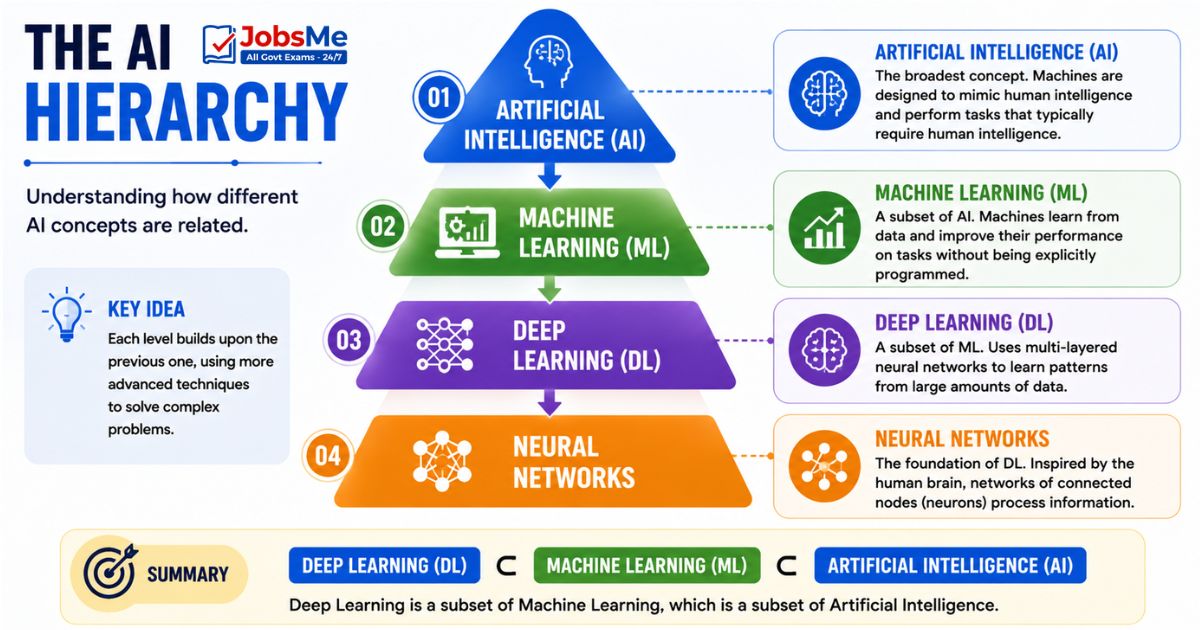
The AI Hierarchy:
Artificial Intelligence (AI)
↓
Machine Learning (ML)
↓
Deep Learning (DL)
↓
Neural Networks
Deep Learning ⊂ Machine Learning ⊂ Artificial Intelligence
Key AI Definitions and Terminology
| Term | Definition |
|---|---|
| Artificial Intelligence (AI) | The simulation of human intelligence in machines — making them think, learn, and solve problems |
| Machine Learning (ML) | A subset of AI where systems learn from data and improve their performance without being explicitly programmed for each task |
| Deep Learning (DL) | A subset of ML that uses multi-layer neural networks to learn complex patterns from large amounts of data |
| Neural Network | A computing model loosely inspired by the human brain — consists of interconnected layers of artificial neurons that process and learn from data |
| NLP (Natural Language Processing) | AI's ability to understand, interpret, and generate human language — enables chatbots, translation, sentiment analysis |
| Computer Vision | AI's ability to interpret and understand visual information (images and videos) — enables face recognition, object detection |
| Generative AI | AI that creates NEW content — text, images, audio, video, code — rather than just analysing existing content |
| LLM (Large Language Model) | AI model trained on massive amounts of text data that can understand and generate human-like text; examples: GPT-4, Gemini, Claude |
| Prompt | The input text or instruction given to an AI model to generate a response — the quality of the prompt affects the quality of the output |
| Hallucination | When an AI model generates false, incorrect, or fabricated information confidently as if it were true — a major limitation of LLMs |
| Fine-tuning | The process of further training a pre-trained AI model on a smaller, specific dataset to make it better at a particular task |
| RAG (Retrieval Augmented Generation) | A technique that combines LLMs with real-time information retrieval — the model retrieves relevant facts from a knowledge base before generating a response, reducing hallucinations |
| Token | The basic unit of text that LLMs process — roughly equivalent to a word or part of a word; models have context window limits in tokens |
| RLHF (Reinforcement Learning from Human Feedback) | A training technique where humans evaluate AI outputs and the model learns from this feedback to produce better, safer responses |
| GAN (Generative Adversarial Network) | Two neural networks competing against each other — a Generator creates fake data; a Discriminator tries to detect fakes; the Generator improves until it can fool the Discriminator |
| CNN (Convolutional Neural Network) | Neural network architecture specifically designed for image recognition and computer vision tasks |
| RNN (Recurrent Neural Network) | Neural network designed for sequential data (time series, text) — has memory of previous inputs |
| Transformer | Revolutionary neural network architecture (2017, Google) that uses "attention mechanisms"; forms the basis of all modern LLMs (GPT, Gemini, Claude) |
Types of AI (by Capability)
| Type | Description | Example |
|---|---|---|
| Narrow AI (ANI — Artificial Narrow Intelligence) | AI that excels at one specific task — cannot transfer knowledge to other domains | Chess-playing AI, image recognition, spam filters, Siri for specific commands |
| General AI (AGI — Artificial General Intelligence) | AI that can perform any intellectual task a human can — at human-level across all domains; does not yet exist | Theoretical human-level AI |
| Super AI (ASI — Artificial Super Intelligence) | AI that surpasses human intelligence in every domain — hypothetical future AI | Science fiction; does not exist |
All current AI (including ChatGPT, Gemini, Claude) is Narrow AI.
Machine Learning (ML)
Machine Learning is a subset of AI where algorithms learn patterns from data and make predictions or decisions without being explicitly programmed for each scenario.
Traditional programming: Input + Rules → Output Machine Learning: Input + Output (training data) → Rules (model) learned automatically
Types of Machine Learning
| Type | How It Learns | Description | Examples |
|---|---|---|---|
| Supervised Learning | From labelled data (input-output pairs) | The model learns by studying examples with known correct answers | Email spam classification, loan default prediction, image classification |
| Unsupervised Learning | From unlabelled data | The model discovers hidden patterns without being told what to look for | Customer segmentation, anomaly detection, topic modelling |
| Reinforcement Learning | Through trial and error (reward/punishment) | An agent learns by taking actions in an environment and receiving rewards for good actions, penalties for bad | Game-playing AI (AlphaGo), robot navigation, recommendation systems |
| Semi-Supervised Learning | Mix of labelled and unlabelled data | Combines a small amount of labelled data with large amounts of unlabelled data | Web content classification |
| Self-Supervised Learning | Self-generated labels from the data itself | Creates its own supervision signal from the structure of the data | LLMs learn by predicting the next word in text |
Deep Learning
Deep Learning is a subset of ML that uses artificial neural networks with many layers (deep neural networks) to learn complex, hierarchical representations from large amounts of data.
Why "Deep"? The "depth" refers to the many layers of the neural network — a deep neural network may have dozens or hundreds of layers. Each layer learns progressively more abstract features from the data.
How it works:
- Input layer receives raw data (pixels of an image)
- Hidden layers extract progressively complex features (edges → shapes → faces)
- Output layer produces the final result (this is a cat / not a cat)
Requirements for Deep Learning:
- Large amounts of data (millions of examples)
- Powerful computing hardware (GPUs — Graphics Processing Units)
- Advanced algorithms (backpropagation, optimisers)
Deep Learning Applications:
- Face recognition (iPhone Face ID, Aadhaar face authentication)
- Voice assistants (Siri, Alexa, Google Assistant)
- Autonomous vehicles
- Medical imaging diagnosis
- Language translation
- Generative AI (image and text generation)
Natural Language Processing (NLP)
Natural Language Processing (NLP) is the branch of AI that enables computers to understand, interpret, and generate human language — both text and speech.
NLP Tasks and Applications:
| Task | Description | Example |
|---|---|---|
| Machine Translation | Automatically translating between languages | Google Translate, DeepL |
| Sentiment Analysis | Determining the emotional tone of text (positive/negative/neutral) | Analysing customer reviews |
| Named Entity Recognition (NER) | Identifying proper nouns (people, places, organisations) in text | Extracting names from legal documents |
| Text Summarisation | Automatically creating concise summaries of longer texts | ChatGPT summarising a document |
| Question Answering | Answering questions posed in natural language | Virtual assistants, customer chatbots |
| Speech Recognition | Converting spoken language to text | Siri, Google Voice, Alexa |
| Chatbots | Conversational AI systems that understand and respond in natural language | Bank customer service chatbots |
Generative AI
Generative AI refers to AI systems that can create new, original content — text, images, audio, video, code — based on patterns learned from training data.
Key Generative AI Categories:
| Category | What It Creates | Examples |
|---|---|---|
| Text Generation | Articles, stories, code, emails, summaries | ChatGPT, Claude, Gemini, Llama |
| Image Generation | Photorealistic images, artwork, designs | DALL-E 3, Midjourney, Stable Diffusion, Adobe Firefly |
| Video Generation | Videos from text descriptions | Sora (OpenAI), Runway, Pika |
| Audio/Voice Generation | AI voices, music, sound effects | ElevenLabs, Suno, MusicLM |
| Code Generation | Complete code from natural language descriptions | GitHub Copilot, Cursor, Amazon CodeWhisperer |
Foundation Models: Large pre-trained models (LLMs) that serve as the foundation for many AI applications:
- GPT-4/GPT-4o (OpenAI) — powers ChatGPT
- Gemini (Google DeepMind) — powers Google's AI products
- Claude 3.5/4 (Anthropic) — safety-focused LLM
- LLaMA 3 (Meta) — open-source LLM
- Mistral (Mistral AI) — European open-source LLM
Major AI Tools and Models (2022-2024)
Conversational AI Tools
| Tool | Company | Launch | Key Feature |
|---|---|---|---|
| ChatGPT | OpenAI | November 2022 | Most popular AI chatbot; GPT-4o powered; fastest product to reach 100 million users (2 months) |
| Gemini (formerly Bard) | Google / DeepMind | February 2023 | Integrated with Google Search; multimodal (text, image, audio, video) |
| Copilot | Microsoft | February 2023 | Integrated into Windows 11, Office, Edge browser; GPT-4 based |
| Claude | Anthropic | March 2023 | Safety-focused; large context window (200K tokens); excellent for analysis and coding |
| Llama | Meta | February 2023 | Open-source LLM; can be run locally; widely used by researchers |
| Grok | xAI (Elon Musk) | November 2023 | Integrated with X (Twitter); real-time information access |
| Perplexity AI | Perplexity | December 2022 | AI-powered search engine; cites sources |
AI Image Generation Tools
| Tool | Company | Notes |
|---|---|---|
| DALL-E 3 | OpenAI | Integrated into ChatGPT; high accuracy to text prompts |
| Midjourney | Midjourney Inc. | Highest quality artistic images; runs in Discord |
| Stable Diffusion | Stability AI | Open-source; can run locally; highly customisable |
| Adobe Firefly | Adobe | Commercially safe; integrated into Photoshop |
| Imagen 3 | Google DeepMind | Google's text-to-image model |
| Canva AI | Canva | Integrated image generation in Canva design platform |
AI Video & Audio Tools
| Tool | Company | Use |
|---|---|---|
| Sora | OpenAI | Text-to-video generation; generates realistic 1-minute videos |
| ElevenLabs | ElevenLabs | AI voice cloning and synthesis; realistic text-to-speech |
| Whisper | OpenAI | Open-source speech recognition and transcription |
| Synthesia | Synthesia | AI avatar videos; creates videos with AI presenters |
AI Coding Tools
| Tool | Company | Notes |
|---|---|---|
| GitHub Copilot | Microsoft/GitHub | AI pair programmer; suggests code in real-time; most widely used |
| Cursor | Anysphere | AI-first code editor; Claude/GPT-4 powered |
| Amazon CodeWhisperer | Amazon | AWS-integrated; free for individuals |
| Replit AI | Replit | Browser-based coding with AI assistance |
Major AI Companies
| Company | Country | Key AI Products |
|---|---|---|
| OpenAI | USA | ChatGPT, GPT-4, GPT-4o, DALL-E 3, Sora, Whisper, Codex |
| Google DeepMind | USA/UK | Gemini, AlphaFold (protein folding), AlphaGo, Imagen 3 |
| Anthropic | USA | Claude AI (Claude 3.5 Sonnet, Claude 3 Opus) — safety-focused |
| Meta AI | USA | LLaMA 3 (open-source LLM), ImageBind, SAM (Segment Anything) |
| Microsoft | USA | Copilot (Office, Windows, Edge), Azure AI, GitHub Copilot |
| Apple | USA | Apple Intelligence, Siri, Core ML |
| Amazon | USA | Alexa, AWS AI/ML services, Bedrock, Titan models |
| Nvidia | USA | AI chips (H100, Blackwell GPU), CUDA platform — the infrastructure of AI |
| Hugging Face | USA/France | Open-source AI model hub; "GitHub of AI" |
| Mistral AI | France | Open-source European LLMs; Mixtral 8x7B |
| Samsung | South Korea | Gauss (Samsung's AI model), Galaxy AI features |
AI in India
India is rapidly building its AI ecosystem through government initiatives, domestic companies, and international partnerships:
| Initiative/Organisation | Description |
|---|---|
| India AI Mission | ₹10,371 crore government initiative to build AI infrastructure, datasets, and talent in India |
| AIRAWAT | India's AI supercomputing infrastructure project; led by C-DAC (Pune); 100+ PetaFLOPS capacity |
| BharatGPT | AI model project for Indian languages; jointly developed by IIT Bombay and Persistent Systems |
| Krutrim (Ola) | India's first AI unicorn company; founded by Bhavish Aggarwal (Ola CEO); multilingual AI with focus on Indian languages |
| Sarvam AI | Indian AI startup developing voice-first AI for regional Indian languages |
| Bhashini | Government of India's AI-powered translation platform for Indian languages; aims to break language barriers in digital access |
| C-DAC PARAM | India's supercomputing initiative; PARAM Siddhi-AI = India's first AI supercomputer (5.27 PetaFLOPS) |
| NASSCOM | National Association of Software and Service Companies; advocates AI adoption in India's IT industry |
India AI Key Facts:
- India has the world's largest AI talent pool by number of AI professionals
- India's AI market is projected to grow to $17 billion by 2027 and exceeding $130 billion by 2032
- NITI Aayog developed India's National AI Strategy: "AI for All"
Internet of Things (IoT)
The Internet of Things (IoT) is a network of physical devices, vehicles, appliances, and other objects embedded with sensors, software, and connectivity that enables them to collect and exchange data over the Internet.
Simple Definition: IoT = giving ordinary physical objects the ability to send and receive data over the internet.
IoT Examples:
- Smart Home: Smart speakers (Amazon Alexa, Google Home), smart thermostats (Nest), smart lighting (Philips Hue), smart locks, smart refrigerators
- Wearables: Apple Watch, Fitbit, Samsung Galaxy Watch — monitoring health metrics in real time
- Industrial IoT: Sensors monitoring factory equipment; predictive maintenance; supply chain tracking
- Smart City: Traffic sensors, air quality monitors, smart streetlights, waste management sensors
- Healthcare: Remote patient monitoring, connected pacemakers, smart insulin pumps
- Agriculture: Soil moisture sensors, drone-based crop monitoring, smart irrigation
- Connected Vehicles: Autonomous cars, fleet tracking, smart road infrastructure
IoT Architecture
A typical IoT system has four layers:
- Perception Layer — Physical devices and sensors that collect data (temperature sensors, cameras, GPS)
- Network Layer — Communication infrastructure that transmits data (Wi-Fi, Bluetooth, 5G, LoRaWAN)
- Processing Layer — Edge/cloud processing of collected data (often uses Edge Computing)
- Application Layer — User-facing applications and services (smart home app, industrial dashboard)
IoT Protocols
| Protocol | Use |
|---|---|
| MQTT (Message Queuing Telemetry Transport) | Lightweight publish-subscribe messaging; ideal for IoT devices with limited bandwidth |
| CoAP (Constrained Application Protocol) | Web-like protocol optimised for constrained devices |
| Zigbee | Short-range wireless; low power; used in smart home devices |
| Z-Wave | Smart home automation; focuses on reliability |
| LoRaWAN | Long Range Wide Area Network; low power; enables IoT over several kilometres; smart city, agriculture |
| Bluetooth LE (BLE) | Bluetooth Low Energy; wearables, beacons, health monitors |
| NB-IoT | Narrowband IoT; uses cellular (4G/5G) network; metering, asset tracking |
Blockchain Technology
Blockchain is a distributed, decentralised, immutable digital ledger that records transactions in chronological order in "blocks" that are cryptographically chained together.
Key Properties:
- Distributed — copies exist on many computers (nodes); no single point of control or failure
- Decentralised — no central authority; consensus mechanisms validate transactions
- Immutable — once a block is added, it cannot be altered or deleted without consensus
- Transparent — all participants can view the entire transaction history
- Secure — cryptographic hashing links blocks; tampering with one block invalidates all subsequent blocks
How it works: New transaction → Broadcast to network → Nodes validate transaction → Valid transaction bundled into a block → Block added to chain → Transaction permanently recorded
Key Blockchain Terms
| Term | Definition |
|---|---|
| Bitcoin (BTC) | The first and largest cryptocurrency; created by Satoshi Nakamoto (pseudonym) in 2008; launched January 2009 |
| Ethereum (ETH) | Second largest cryptocurrency; supports Smart Contracts and decentralised applications (dApps) |
| Cryptocurrency | Digital currency that uses cryptography for security; not issued by any central bank; examples: Bitcoin, Ethereum, Dogecoin, XRP |
| NFT (Non-Fungible Token) | A unique digital asset on a blockchain — represents ownership of digital art, music, collectibles; cannot be replicated or replaced |
| Smart Contract | Self-executing contracts with terms directly written into code; automatically execute when predefined conditions are met; no intermediary needed |
| Web3 | The vision of a decentralised internet built on blockchain — where users control their data and digital assets |
| DeFi (Decentralised Finance) | Financial services (lending, borrowing, trading) without traditional banks — built on blockchain smart contracts |
| Mining | The computational process of validating blockchain transactions; miners receive cryptocurrency rewards |
| Wallet | Software/hardware that stores cryptocurrency private keys and enables transactions |
| Hash | A fixed-length string generated from data using a hash function; used to link blockchain blocks |
| 51% Attack | When a single entity controls more than 51% of a blockchain network's computing power — can manipulate transactions |
Augmented Reality (AR), Virtual Reality (VR) & Extended Reality (XR)
| Technology | Definition | Real-World Examples |
|---|---|---|
| AR (Augmented Reality) | Overlays digital content (images, information, 3D objects) onto the real world — you still see the real world with digital additions | Pokémon Go (game), Snapchat filters, Google Lens, IKEA Place app (see furniture in your room), AR navigation in Google Maps |
| VR (Virtual Reality) | Creates a fully immersive, computer-generated virtual environment — replaces the real world entirely; requires a headset | Meta Quest VR gaming, VR training simulations, VR therapy |
| MR (Mixed Reality) | Blends real and virtual worlds — digital objects interact with real-world objects; the most advanced combination | Microsoft HoloLens — holographic manufacturing instructions; Meta Quest 3 |
| XR (Extended Reality) | Umbrella term covering AR, VR, and MR — all technologies that blend real and digital worlds | — |
| Metaverse | A persistent, interconnected network of virtual worlds — where users interact as avatars, work, socialise, and transact | Meta (formerly Facebook) Horizon Worlds; Roblox; Fortnite |
Key AR/VR Devices:
| Device | Company | Type |
|---|---|---|
| Meta Quest 3 | Meta | Mixed Reality headset |
| Apple Vision Pro | Apple | Spatial computing headset (launched 2024) |
| Microsoft HoloLens 2 | Microsoft | AR headset (enterprise use) |
| PlayStation VR2 | Sony | Gaming VR headset |
Quantum Computing
Quantum Computing is a type of computation that uses quantum mechanical phenomena — superposition, entanglement, and interference — to process information in fundamentally different (and potentially much faster) ways than classical computers.
Classical vs Quantum:
| Feature | Classical Computer | Quantum Computer |
|---|---|---|
| Basic unit | Bit (0 or 1) | Qubit (0, 1, or both simultaneously) |
| Processing | Sequential/parallel binary operations | Quantum parallelism — explores multiple solutions simultaneously |
| State | Definite (either 0 or 1) | Probabilistic — superposition of states |
| Speed advantage | — | Exponentially faster for certain problems |
Key Quantum Terms
| Term | Definition |
|---|---|
| Qubit (Quantum Bit) | The basic unit of quantum information; can represent 0, 1, or both simultaneously (superposition) — unlike classical bits which are only 0 or 1 |
| Superposition | A qubit exists as 0 and 1 at the same time until measured — allows quantum computers to explore many possibilities simultaneously |
| Entanglement | Two qubits are correlated in such a way that the state of one instantly affects the state of the other, regardless of the distance between them (Einstein called this "spooky action at a distance") |
| Quantum Supremacy | When a quantum computer performs a specific calculation faster than any classical computer — even the world's fastest supercomputer — in a reasonable time |
| Decoherence | The loss of quantum properties due to environmental interference — a major challenge in building practical quantum computers |
| Quantum Gate | The quantum equivalent of a logic gate — manipulates qubits |
Quantum Supremacy Milestone: In 2019, Google claimed Quantum Supremacy with its Sycamore processor — completed a specific calculation in 200 seconds that would take the world's fastest classical supercomputer 10,000 years.
Major Quantum Computing Players:
| Organisation | Notable Achievement |
|---|---|
| Sycamore processor (72 qubits); claimed Quantum Supremacy (2019) | |
| IBM Quantum | IBM Osprey (433 qubits); IBM Condor (1,121 qubits, 2023) |
| Microsoft | Azure Quantum; topological qubit research |
| D-Wave | Quantum annealing systems; real-world optimisation |
| IonQ | Trapped-ion quantum computers |
| Intel | Silicon-based qubit research |
Who introduced Quantum Computing concept? Richard Feynman proposed the concept of quantum computation in 1982.
5G Technology
5G is the fifth generation of mobile network technology — a massive leap in speed, capacity, and reliability over 4G LTE.
| Feature | Specification |
|---|---|
| Theoretical Speed | Up to 20 Gbps download |
| Practical Speed | ~1 Gbps in real-world conditions |
| Latency | As low as ~1 millisecond (1 ms) — vs ~50ms for 4G |
| Connected Devices | 1 million devices per square kilometre |
| Frequencies | Sub-6 GHz (wide coverage) and mmWave (very high speed, short range) |
What 5G Enables:
- IoT at scale — billions of connected devices simultaneously
- Autonomous vehicles — real-time communication between vehicles and infrastructure (V2X)
- Smart cities — connected traffic, energy, and public safety systems
- Telemedicine — real-time remote surgery with minimal latency
- Industrial automation — precise control of robots and machinery
- Enhanced mobile broadband — 4K/8K video streaming; cloud gaming
Key 5G Concepts:
- Network Slicing — Creating multiple virtual networks on the same physical 5G infrastructure, each optimised for different use cases (one for IoT, one for autonomous vehicles, one for mobile broadband)
- mmWave (Millimetre Wave) — Very high frequency (24-100 GHz); extremely fast but short range; used indoors and in dense urban areas
- Massive MIMO — Multiple-Input Multiple-Output; many antennas simultaneously serving many users
5G in India:
- Launched: October 2022 (India's first 5G launch by Airtel and Jio)
- Key operators: Jio, Airtel, BSNL (planned government 5G)
- India target: Nationwide 5G coverage by 2026. While 5G is already available in 99.9% of districts, full, high-density population coverage is projected to continue expanding through 2026 and 2031.
Digital India Initiatives
The Digital India programme, launched in 2015, is India's flagship initiative to transform India into a digitally empowered society and knowledge economy.
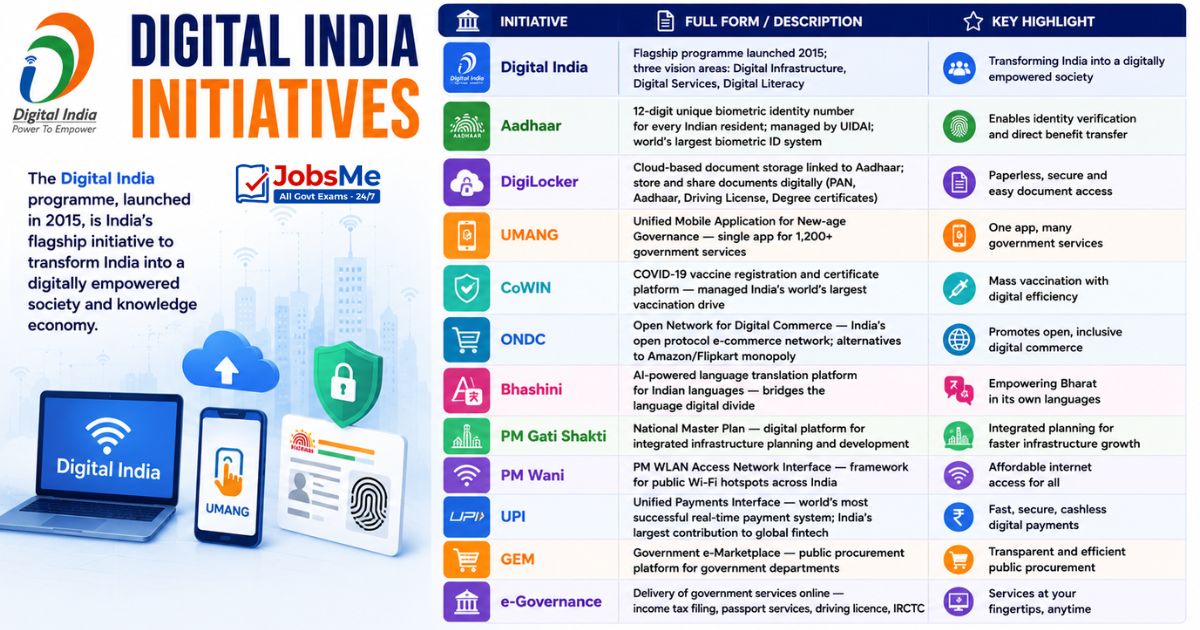
| Initiative | Full Form / Description |
|---|---|
| Digital India | Flagship programme launched 2015; three vision areas: Digital Infrastructure, Digital Services, Digital Literacy |
| Aadhaar | 12-digit unique biometric identity number for every Indian resident; managed by UIDAI; world's largest biometric ID system |
| DigiLocker | Cloud-based document storage linked to Aadhaar; store and share documents digitally (PAN, Aadhaar, Driving License, Degree certificates) |
| UMANG | Unified Mobile Application for New-age Governance — single app for 1,200+ government services |
| CoWIN | COVID-19 vaccine registration and certificate platform — managed India's world's largest vaccination drive |
| ONDC | Open Network for Digital Commerce — India's open protocol e-commerce network; alternatives to Amazon/Flipkart monopoly |
| Bhashini | AI-powered language translation platform for Indian languages — bridges the language digital divide |
| PM Gati Shakti | National Master Plan — digital platform for integrated infrastructure planning and development |
| PM Wani | PM WLAN Access Network Interface — framework for public Wi-Fi hotspots across India |
| UPI | Unified Payments Interface — world's most successful real-time payment system; India's largest contribution to global fintech |
| GEM | Government e-Marketplace — public procurement platform for government departments |
| e-Governance | Delivery of government services online — income tax filing, passport services, driving licence, IRCTC |
Important Indian Tech Organisations
| Organisation | Full Form | Primary Role |
|---|---|---|
| MeitY | Ministry of Electronics and Information Technology | IT policy, regulation, Digital India oversight |
| C-DAC | Centre for Development of Advanced Computing | Supercomputing (PARAM series), AI, software localisation |
| NIC | National Informatics Centre | IT infrastructure and services for central/state governments |
| NPCI | National Payments Corporation of India | UPI, RuPay, IMPS, BHIM, AePS — India's payment infrastructure |
| CERT-In | Computer Emergency Response Team India | National cybersecurity incident response |
| STPI | Software Technology Parks of India | Promotes IT exports; infrastructure for IT companies |
| NASSCOM | National Association of Software and Service Companies | Industry body for India's IT and BPM sector |
| TRAI | Telecom Regulatory Authority of India | Regulates telecom sector; sets tariffs and quality standards |
| UIDAI | Unique Identification Authority of India | Manages Aadhaar biometric ID system |
| BIS | Bureau of Indian Standards | Sets technical standards including cyber security standards |
Memory Tricks
🔑 AI Hierarchy:
AI → ML → DL → Neural Networks "A Man Digests Noodles" = AI → ML → DL → NN
🔑 Types of ML:
Supervised = Teacher gives answers (labelled data) Unsupervised = Find your own patterns (no labels) Reinforcement = Trial-and-error + rewards "SUper Rlearning" = Supervised, Unsupervised, Reinforcement
🔑 ChatGPT Launch Facts:
OpenAI | November 2022 | 100 million users in 2 months "ChatGPT from OpenAI = Greatest Product in Two months to 100M"
🔑 Bitcoin Creator:
Bitcoin = Satoshi Nakamoto (pseudonym) = 2008 (whitepaper) = 2009 (launched) "Satoshi made Bitcoin in 2008-2009"
🔑 Quantum Key Terms:
Qubit = Quantum bit = 0 + 1 simultaneously (superposition) Entanglement = Two qubits connected regardless of distance Supremacy = Google Sycamore (2019) = 200 seconds vs 10,000 years
🔑 5G Key Numbers:
Speed = 20 Gbps | Latency = ~1 ms | India launch = October 2022 "5G = 20 Gbps and 1 ms delay"
🔑 IoT = Internet of Things:
Smart Home + Wearables + Industrial + Smart City = IoT "IoT connects everything that was once dumb (offline)"
🔑 AR vs VR:
AR = Augmented = Adds to reality (you see real world + digital) VR = Virtual = Vanishes real world (you see only digital) "AR Adds; VR Vanishes"
One-Liner Recap (Quick Revision)
- Artificial Intelligence is the simulation of human intelligence in machines; Machine Learning is a subset where machines learn from data; Deep Learning is a subset of ML using multi-layer neural networks.
- An LLM (Large Language Model) is a neural network trained on massive text data that can understand and generate human-like text — ChatGPT, Gemini, and Claude are examples.
- Hallucination in AI refers to when an AI model generates false or fabricated information confidently as if it were true — a major limitation of current LLMs.
- ChatGPT was launched by OpenAI in November 2022 and reached 100 million users in just 2 months — the fastest product in history to achieve this milestone.
- Claude is the AI assistant developed by Anthropic, Gemini (formerly Bard) is developed by Google DeepMind, and Copilot is Microsoft's AI assistant — all three are major ChatGPT competitors.
- IoT (Internet of Things) connects physical objects — from smart speakers and wearables to industrial sensors and smart city infrastructure — to the internet for data exchange.
- MQTT is the lightweight messaging protocol primarily used for IoT devices; Zigbee and Z-Wave are used for smart home devices; LoRaWAN is used for long-range IoT in smart cities.
- Blockchain is a distributed, decentralised, immutable ledger — Bitcoin (created by Satoshi Nakamoto, 2008) was the first cryptocurrency; Ethereum supports smart contracts and DeFi.
- NFT (Non-Fungible Token) is a unique digital asset on a blockchain representing ownership of digital art or collectibles — each NFT is unique and cannot be replicated.
- AR (Augmented Reality) overlays digital content on the real world (Pokémon Go); VR (Virtual Reality) creates a fully immersive digital environment (Meta Quest); MR (Mixed Reality) blends both.
- A Qubit is the basic unit of quantum computing — unlike a classical bit (0 or 1), a qubit can represent 0, 1, or both simultaneously through superposition.
- Google claimed Quantum Supremacy in 2019 when its Sycamore processor completed a calculation in 200 seconds that would take a classical supercomputer 10,000 years.
- 5G offers theoretical speeds of up to 20 Gbps and latency of ~1 millisecond — enabling IoT at scale, autonomous vehicles, telemedicine, and smart cities; India launched 5G in October 2022.
- Digital India (2015) is India's flagship technology programme — key initiatives include Aadhaar (biometric ID), DigiLocker (digital documents), UMANG (government services app), and Bhashini (AI translation).
- PARAM Siddhi-AI is India's first AI supercomputer (5.27 PetaFLOPS); Krutrim (Ola) is India's first AI unicorn; BharatGPT and Sarvam AI are developing AI models for Indian languages.
Preparing for competitive exams requires consistent revision. Platforms like JobsMe simplify preparation through:
- Daily Current Affairs
- Weekly Current Affairs
- Monthly Current Affairs
- Static GK for Competitive Exams
- Latest Government Jobs Notifications
- Banking Awareness
Stay updated, revise regularly, and attempt quizzes for better accuracy in UPSC, SSC CGL, IBPS PO/Clerk, SBI, RBI Grade B, RRB NTPC, Defence, and State PSC exams.
Free quiz • No signup required
Put this topic into practice with Current Affairs Quiz 12 June 2026 MCQs for UPSC, SSC, Banking, Railways & State PSC Exams. It is the quickest way to reinforce what you just learned.
Frequently Asked Questions
What is the difference between AI, Machine Learning, and Deep Learning?
What is Generative AI and how is it different from traditional AI?
What is ChatGPT, when was it launched, and why is it significant?
What is IoT and what are its real-world applications?
What is Blockchain and how is it different from a traditional database?
What is the difference between AR, VR, and MR?
What is a Qubit and how is it different from a classical bit?
What are the Digital India key initiatives and their purpose?
What is 5G and how is it different from 4G?
What is Quantum Supremacy and has it been achieved?

About the author