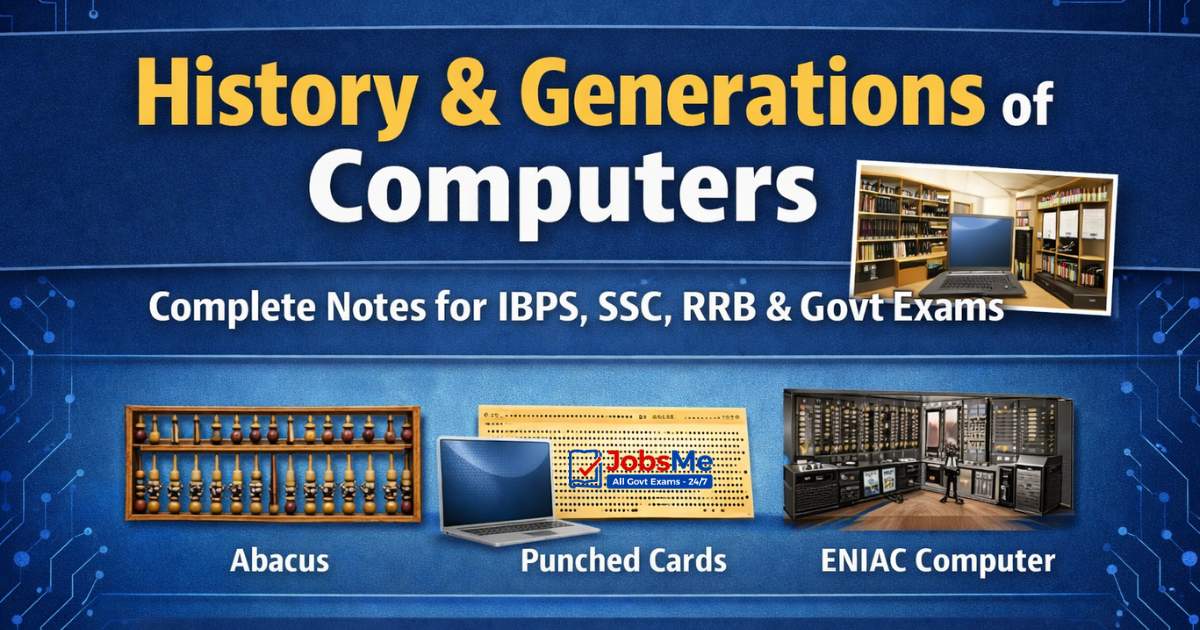
History & Generations of Computers – Complete Notes for IBPS, SSC, RRB & Govt Exams
Questions on the history of computers and their five generations appear in nearly every government job exam — from IBPS Clerk to SSC CGL and RRB NTPC. This post covers everything: early computing devices (Abacus to ENIAC), all five generations with their key features and technologies, landmark milestones, important inventors, and recent developments up to 2024 — with memory tricks, one-liners, and 10 exam-focused FAQs.
Jump to section
Introduction: Why History of Computers is Important for Govt Exams
The history of computers is one of the most directly tested topics in every government job exam. Questions from this chapter are simple, factual, and highly predictable — making it a guaranteed scoring area if you prepare it well.
In exams like IBPS PO, IBPS Clerk, SBI PO, RRB NTPC, SSC CGL, SSC CHSL, LIC AAO, and state PSC exams, the following question patterns appear regularly:
- "Who is called the Father of the Computer?"
- "Which was the first electronic digital computer?"
- "Which generation used transistors?"
- "The first computer with storage capacity was ___"
- "Which company developed the first commercial computer?"
This chapter also connects directly to the Generations of Computers — a topic that almost always appears in the form of a table-based or match-the-column MCQ. Understanding the progression of technology across generations also helps you remember the features of each era: vacuum tubes → transistors → ICs → microprocessors → AI.
This post covers the complete timeline of computer history — from the Abacus (3000 BC) to modern AI-powered computers in 2024 — with every inventor, every milestone, and every generation detail you need for your exam.
Early Computing Devices (Pre-Electronic Era)
The history of computing did not begin with electronic computers. For thousands of years, humans invented increasingly sophisticated mechanical tools to help perform calculations. Here is the complete timeline:
Abacus - The Very First Calculating Tool
- Year: Around 1602; originally invented in China around 3000 BC
- Inventor: Unknown (Chinese origin)
- What it did: Used beads on rods to perform addition and subtraction
- Significance: Considered the world's first calculating device; still used in some cultures today
- Type: Mechanical (no electrical components)
Napier's Bones (1617)
- Year: 1617
- Inventor: John Napier (Scotland)
- What it did: A 3-dimensional device made of bones/rods that helped perform multiplication through a method called Rabdologia
- Significance: Introduced the concept of logarithms; simplified complex multiplication
Pascaline (1642) - First Mechanical Adding Machine
- Year: 1642
- Inventor: Blaise Pascal (France)
- What it did: A mechanical calculator with gears and wheels that could perform addition and subtraction automatically
- Also called: The Adding Machine or Arithmetic Machine
- Significance: First true mechanical calculator built for practical use — Pascal built it to help his father with tax calculations
Jacquard's Loom (1801)
- Year: 1801
- Inventor: Joseph Marie Jacquard (France)
- What it did: An automated weaving machine that used punched cards to control patterns in cloth
- Significance: This was the first use of punched cards in a mechanical device — a concept that would later be adopted by computers for input
Difference Engine & Analytical Engine - Charles Babbage
Charles Babbage is called the "Father of the Computer" for two groundbreaking inventions:
| Device | Year | Description |
|---|---|---|
| Difference Engine | 1822 | Designed to compute mathematical tables using the method of differences; used steam power; never completed in his lifetime |
| Analytical Engine | 1837 | The first design for a general-purpose computer; had a Mill (ALU), Store (memory), Reader (input), and Printer (output); programs stored as "pegs"; was a decimal machine |
Ada Lovelace — worked with Babbage on the Analytical Engine and wrote the first program for it. She is considered the world's first computer programmer.
Tabulating Machine (1890) - Herman Hollerith
- Year: 1890
- Inventor: Herman Hollerith (America)
- What it did: First electromechanical computing machine; used punched cards with round holes to process data
- Used for: Processing the US Census of 1890 — reduced the census processing time from 8 years to 2.5 years
- Legacy: Hollerith's company eventually became part of IBM
MARK-1 (1944) - Howard Aiken
- Year: 1944
- Inventor: Howard Aiken (America), in collaboration with IBM
- What it did: A large-scale electromechanical computer used in World War II
- Storage: Used magnetic drums
- Significance: One of the first automatic sequence-controlled calculators; used for ballistic calculations and code-breaking during WWII
ENIAC (1946) - First Electronic Digital Computer
- Year: 1946
- Inventors: J. Presper Eckert and John W. Mauchly (America), University of Pennsylvania
- Full name: Electronic Numerical Integrator and Computer
- Key Features:
- The first fully electronic digital computer
- Used 18,000 vacuum tubes, weighed 30 tons, occupied 1,800 sq ft
- Had 20 accumulators for arithmetic
- Used for weather prediction and atomic energy calculations
- Input via punched cards
- Had no stored program — programs were set by rewiring
- Significance: The first generation of computing begins with ENIAC
EDSAC (1949) - First Computer with Storage
- Year: 1949
- Inventor: John Von Neumann (design concept), Maurice Wilkes (built it at Cambridge University)
- Full name: Electronic Delay Storage Automatic Calculator
- Key Features:
- The first computer with a stored program in memory
- The first program ever was run on this machine
- Used mercury delay lines for memory
- Implemented Von Neumann architecture
- Significance: Marked the transition from wired programs (ENIAC) to stored-program computing
UNIVAC (1951) - First Commercial Computer
- Year: 1951
- Inventors: J. Presper Eckert and John Mauchly (same team as ENIAC)
- Full name: Universal Automatic Computer
- Key Features:
- The first general-purpose commercial electronic computer
- Had large input/output capabilities
- Used magnetic tapes for storage
- First used by the US Census Bureau
- Famously predicted the outcome of the 1952 US Presidential Election
- Significance: Marked the beginning of the commercial computing industry
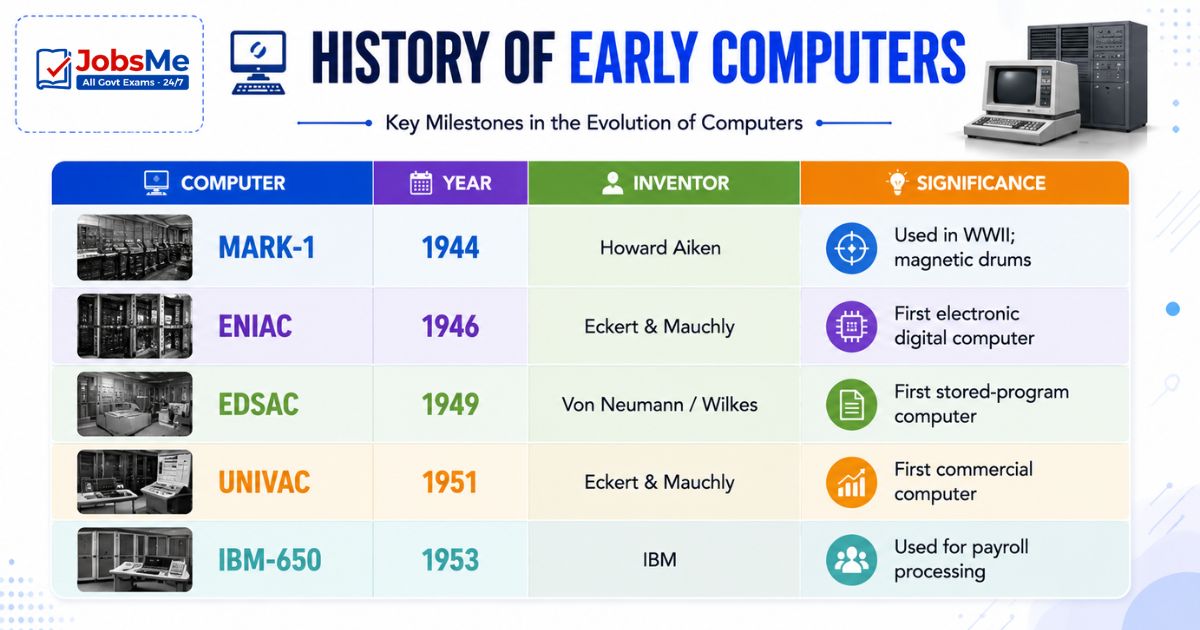
| Computer | Year | Inventor | Significance |
|---|---|---|---|
| MARK-1 | 1944 | Howard Aiken | Used in WWII; magnetic drums |
| ENIAC | 1946 | Eckert & Mauchly | First electronic digital computer |
| EDSAC | 1949 | Von Neumann / Wilkes | First stored-program computer |
| UNIVAC | 1951 | Eckert & Mauchly | First commercial computer |
| IBM-650 | 1953 | IBM | Used for payroll processing |
Five Generations of Computers
The development of computers is divided into five generations, each defined by the key electronic switching device used. Each generation brought dramatic improvements in speed, size, power consumption, and capability.
First Generation (1940-1956): Vacuum Tubes
| Feature | Details |
|---|---|
| Period | 1940 - 1956 |
| Technology | Vacuum Tubes (thermionic valves) |
| Memory | Magnetic Drums |
| Speed | 333 microseconds per operation |
| Programming Language | Machine Language (binary — 0s and 1s only) |
| OS Type | Batch Processing Operating System |
| Size | Enormous — filled entire rooms |
| Power Consumption | Very high — generated tremendous heat |
| Cost | Extremely expensive |
| Examples | ENIAC, UNIVAC, MARK-1, IBM-701 |
Key Characteristics:
- Programs were fed using punched cards or paper tape
- No operating system — programs were hardwired or hand-loaded
- Limited to solving one problem at a time
- Extremely unreliable — vacuum tubes burned out frequently
Second Generation (1956-1963): Transistors
| Feature | Details |
|---|---|
| Period | 1956 - 1963 |
| Technology | Transistors (semiconductor devices — invented at Bell Labs) |
| Memory | Magnetic Core Memory |
| Speed | 10 microseconds per operation (33× faster than 1st gen) |
| Programming Language | Assembly Language + early High Level Languages (FORTRAN, COBOL) |
| OS Type | Time-sharing, Multitasking OS |
| Size | Much smaller than 1st gen |
| Power Consumption | Significantly reduced |
| Examples | IBM-1401, PDP-8, IBM-7094, Honeywell 400 |
Key Characteristics:
- Transistors replaced vacuum tubes — smaller, faster, cheaper, more reliable
- Punched cards still used for input
- High-level languages began to emerge
- Batch processing improved efficiency
Third Generation (1964-1971): Integrated Circuits (ICs)
| Feature | Details |
|---|---|
| Period | 1964 - 1971 |
| Technology | ICs (Integrated Circuits) — multiple transistors on a single silicon chip |
| Memory | Magnetic Core Memory |
| Speed | 100 nanoseconds per operation |
| Programming Language | FORTRAN, COBOL, ALGOL, BASIC |
| OS Type | Real-Time OS; Time-sharing OS |
| Size | Further miniaturised |
| Examples | IBM-360 series, NCR-395, B6500, PDP-11 |
Key Characteristics:
- Jack St. Clair Kilby and Robert Noyce invented the IC in 1958
- Multiple transistors, resistors, and capacitors packed on a single chip
- Keyboards and monitors introduced for I/O (replacing punch cards)
- Multiprogramming became possible — multiple programs in memory simultaneously
Fourth Generation (1971-Present): Microprocessors
| Feature | Details |
|---|---|
| Period | 1971 - Present |
| Technology | LSI (Large Scale Integration) and VLSI (Very Large Scale Integration) microprocessors |
| Memory | Semiconductor memory (RAM/ROM); Winchester hard disk |
| Speed | 300 nanoseconds (and improving to nanoseconds/picoseconds) |
| Programming Language | PASCAL, C, C++, Java, Python |
| OS Type | GUI-based OS; Time-sharing; Multi-user |
| Examples | Intel 4004, IBM PC, Apple Macintosh, modern laptops/smartphones |
Key Characteristics:
- The entire CPU placed on one microprocessor chip (Intel 4004 in 1971)
- Personal computers (PCs) became affordable for individuals
- GUI (Graphical User Interface) introduced — first by Xerox in the 1970s
- Internet, networking, and multimedia computing emerged
- This is the generation we currently live in
Fifth Generation (Present & Beyond): AI & SLSI
| Feature | Details |
|---|---|
| Period | Present and future |
| Technology | SLSI (Super Large Scale Integration) + AI chips + Quantum chips |
| Memory | Optical discs, SSDs, Cloud storage |
| Processing | Artificial Intelligence, Machine Learning, Natural Language Processing |
| Languages | Python, R, Julia (AI/ML focused) |
| Key Feature | Knowledge Information Processing — computers that can reason, learn, and understand |
| Examples | AI systems (ChatGPT, Gemini), Quantum computers, Neuromorphic chips |
Key Characteristics:
- Computers can understand natural human language
- Parallel processing — multiple processors work simultaneously
- AI and Robotics integration
- Quantum computing and neuromorphic computing on the horizon
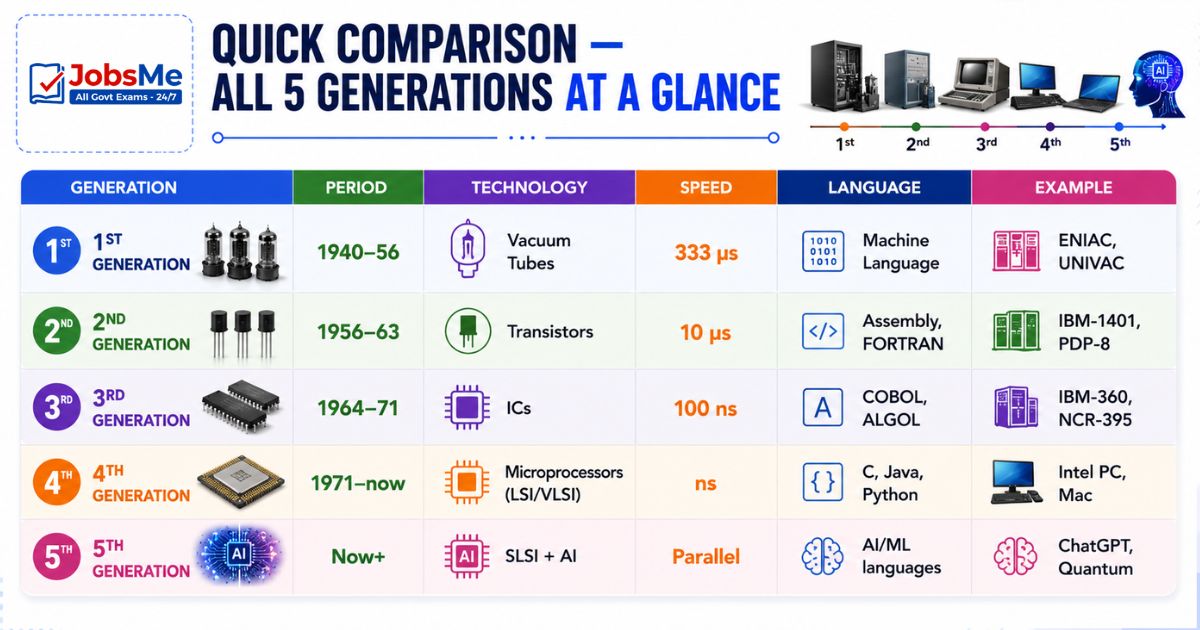
Quick Comparison — All 5 Generations at a Glance
| Generation | Period | Technology | Speed | Language | Example |
|---|---|---|---|---|---|
| 1st | 1940-56 | Vacuum Tubes | 333 µs | Machine Language | ENIAC, UNIVAC |
| 2nd | 1956-63 | Transistors | 10 µs | Assembly, FORTRAN | IBM-1401, PDP-8 |
| 3rd | 1964-71 | ICs | 100 ns | COBOL, ALGOL | IBM-360, NCR-395 |
| 4th | 1971-now | Microprocessors (LSI/VLSI) | ns | C, Java, Python | Intel PC, Mac |
| 5th | Now+ | SLSI + AI | Parallel | AI/ML languages | ChatGPT, Quantum |
Key Historical Inventors and Fathers
| Title / Role | Name | Achievement |
|---|---|---|
| Father of Computer | Charles Babbage | Designed Analytical Engine (1837) — first general-purpose computer concept |
| Father of Modern Computer | Alan Turing | Introduced concept of Turing Machine; theoretical basis of computing |
| Father of Internet | Vint Cerf | Co-developed TCP/IP; designed ARPANET (1969) |
| First Computer Programmer | Ada Lovelace | Wrote first program for Babbage's Analytical Engine |
| First Mouse | Douglas Engelbart | Invented the computer mouse at Stanford Research Center (1963) |
| WWW | Tim Berners-Lee | Invented the World Wide Web (March 13, 1989) |
| First Microprocessor | Ted Hoff & Federico Faggin | Intel 4004 (1971) |
| First IC | Jack St. Clair Kilby & Robert Noyce | Integrated Circuit (1958) |
| Transistor | Bell Laboratory scientists | Invented the transistor — foundation of 2nd generation computers |
| Linux OS | Linus Torvalds | Created Linux kernel (September 1991) |
| Java Language | James Gosling | Developed Java at Sun Microsystems (1995) |
| Mark Zuckerberg | Founded Facebook (2004) | |
| First Indian Supercomputer | C-DAC team | PARAM (1990) |
| First Supercomputer | Seymour R. Cray | CRAY-1 (1976) |
| First Laptop | Adam Osborne | 1981; manufactured by EPSON |
| First Computer in India | — | Named Siddhartha |
| First Minicomputer | DEC (Digital Equipment Corp.) | DEC PDP-1 (1960) |
Recent Milestones in Computer History (2016-2024)
| Year | Milestone |
|---|---|
| 2016 | Google's AlphaGo (DeepMind) defeats world champion Go player Lee Sedol — AI milestone |
| 2017 | IBM releases 50-qubit quantum computer prototype |
| 2019 | Google claims Quantum Supremacy — Sycamore processor completes a task in 200 seconds that would take classical computers 10,000 years |
| 2020 | Apple launches M1 chip — first Apple Silicon; ARM-based SoC; revolutionary performance per watt |
| 2021 | Windows 11 released (October); Apple M1 Pro/Max launched |
| 2022 | ChatGPT launched by OpenAI (November 30) — fastest product to reach 100 million users (in 2 months); Frontier supercomputer achieves 1.1 ExaFLOPS |
| 2023 | Apple M2 & M3 chips; Google Gemini AI released; Meta LLaMA open-source LLM |
| 2024 | Apple M4 chip; OpenAI GPT-4o; EU AI Act passed; Frontier confirmed at 1.2 ExaFLOPS |
Memory Tricks
🔑 Early Computing Devices — in Order:
"A Nice Parrot Jumps Across The Entire Universe" Abacus → Napier's Bones → Pascaline → Jacquard → Analytical Engine → Tabulating Machine → ENIAC → UNIVAC
🔑 5 Generations — Technology Device:
"Very Tired IC Men Sleep" Vacuum Tubes (1st) → Transistors (2nd) → ICs (3rd) → Microprocessors (4th) → SLSI/AI (5th)
🔑 ENIAC vs EDSAC vs UNIVAC:
ENIAC = First Electronic → EDSAC = First Stored-program → UNIVAC = First Commercial Trick: E-E-U = "Every Exam Uses this!"
🔑 Generation Speed Units:
"My Naughty Puppy Plays" Microseconds (1st & 2nd gen) → Nanoseconds (3rd & 4th gen) → Picoseconds / Parallel (5th gen)
🔑 Fathers to Remember:
"Baby Computers Teach Many Lessons" = Babbage (Computer), Cerf (Internet), Turing (Modern), Mosaic (First Browser), Lovelace (Programmer)
One-Liner Recap (Quick Revision)
- Charles Babbage is called the "Father of the Computer" for designing the Analytical Engine (1837), the first concept of a general-purpose programmable computer.
- Alan Turing is called the "Father of the Modern Computer" for his theoretical work on the Turing Machine, which forms the basis of all digital computing.
- The Abacus (China, ~3000 BC) is considered the world's first calculating device, using beads on rods for addition and subtraction.
- The Pascaline (1642), invented by Blaise Pascal, was the world's first mechanical adding machine, designed to help his father calculate taxes.
- Herman Hollerith's Tabulating Machine (1890) was the first electromechanical computer, used for the US Census using punched cards with round holes.
- ENIAC (1946), built by Eckert and Mauchly, was the world's first fully electronic digital computer, using 18,000 vacuum tubes.
- EDSAC (1949) was the first computer with a stored program in memory, implementing Von Neumann architecture using mercury delay lines.
- UNIVAC (1951), also by Eckert and Mauchly, was the first general-purpose commercial computer, famously used to predict the 1952 US Presidential Election.
- First generation computers (1940-1956) used vacuum tubes, magnetic drum memory, and machine language, with ENIAC and UNIVAC as key examples.
- Second generation computers (1956-1963) used transistors (invented at Bell Labs), magnetic core memory, and introduced high-level languages like FORTRAN and COBOL.
- Third generation computers (1964-1971) used Integrated Circuits (ICs) invented by Kilby and Noyce, enabling smaller, faster, and more affordable computers like the IBM-360.
- Fourth generation computers (1971-present) use VLSI microprocessors; the Intel 4004 (1971) was the first; this is the generation of PCs, laptops, and smartphones.
- Fifth generation computers (present and beyond) are based on AI, machine learning, and SLSI technology, featuring knowledge-processing and natural language capabilities.
- ChatGPT was launched by OpenAI in November 2022 and became the fastest product in history to reach 100 million users, achieving it in just 2 months.
- Frontier (USA, 2022-2024) is the world's first exascale supercomputer, operating at 1.2 ExaFLOPS, and is the fastest computer in the world as of 2024.
Preparing for competitive exams requires consistent revision. Platforms like JobsMe simplify preparation through:
- Daily Current Affairs
- Weekly Current Affairs
- Monthly Current Affairs
- Static GK for Competitive Exams
- Latest Government Jobs Notifications
- Banking Awareness
Stay updated, revise regularly, and attempt quizzes for better accuracy in UPSC, SSC CGL, IBPS PO/Clerk, SBI, RBI Grade B, RRB NTPC, Defence, and State PSC exams.
Free quiz • No signup required
Put this topic into practice with Current Affairs Quiz 20 June 2026 | UPSC, SSC, Banking, Railways & State PSC MCQs with Answers. It is the quickest way to reinforce what you just learned.
Frequently Asked Questions
Who is called the Father of the Computer and why?
What was ENIAC and why is it historically significant?
What is the key difference between ENIAC and EDSAC?
What technology distinguished each generation of computers?
Who invented the transistor and how did it change computers?

About the author