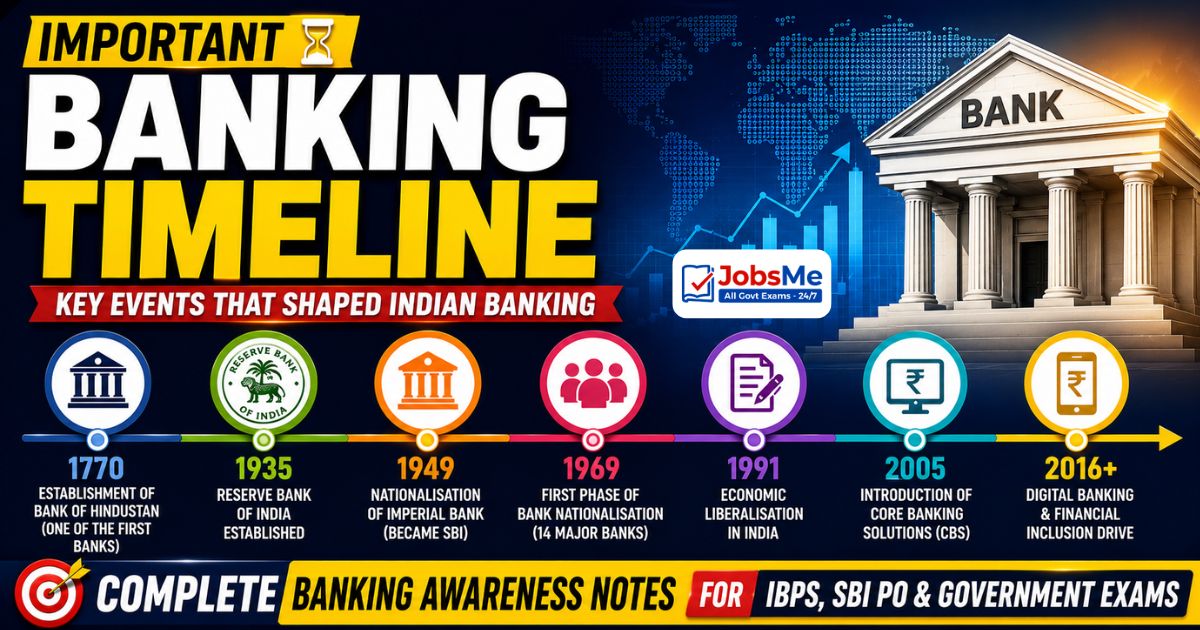
Important Banking Timeline – Complete Banking Awareness Notes for IBPS, SBI PO and Government Exams 2026
Important Banking Timeline is tested in IBPS PO, SBI Clerk, RBI Grade B, NABARD and all government banking examinations. Complete coverage with tables, memory tricks and one-liners for quick revision.
Jump to section
Indian Banking Timeline - Year by Year
| Year / Date | Event |
|---|---|
| 1770 | Bank of Hindustan established in Calcutta — first bank in India (closed 1832) |
| 1806 | Bank of Bengal established — first Presidency Bank |
| 1840 | Bank of Bombay established — second Presidency Bank |
| 1843 | Bank of Madras established — third Presidency Bank |
| 1865 | Allahabad Bank established — oldest joint-stock bank of Indian origin |
| 1894 | Punjab National Bank established in Lahore — first bank with Indian capital and management |
| 1906 | Bank of India and Canara Bank established |
| 1908 | Bank of Baroda established by Maharaja Sayajirao Gaekwad III |
| 1911 | Central Bank of India — first truly Indian-owned commercial bank (Sir Sorabji Pochkhanawala) |
| January 27, 1921 | Imperial Bank of India formed — merger of three Presidency Banks |
| April 1, 1935 | Reserve Bank of India established under RBI Act 1934 (Hilton Young Commission) |
| 1937 | RBI headquarters shifted from Calcutta to Bombay (Mumbai) |
| August 1943 | C.D. Deshmukh became first Indian Governor of RBI |
| January 1, 1949 | RBI nationalized; Banking Regulation Act 1949 enacted |
| July 1, 1955 | Imperial Bank nationalized → State Bank of India formed (SBI Act 1955) |
| July 15, 1978 | DICGC established (DICGC Act 1961) |
| July 19, 1969 | 14 major banks nationalized — PM Indira Gandhi; banks with deposits ≥ Rs. 50 crore |
| October 2, 1975 | First RRB (Prathama Bank) established in Moradabad — Gandhi Jayanti |
| April 15, 1980 | 6 more banks nationalized; total PSBs reached 20 |
| July 12, 1982 | NABARD established (National Bank for Agriculture and Rural Development) |
| January 1, 1982 | EXIM Bank of India established |
| 1987 | First ATM in India — HSBC, Mumbai |
| 1991 | Economic liberalization; Narasimham Committee reforms; new private banks licensed |
| 1993 | DRT (Debt Recovery Tribunal) established under RDDBFI Act 1993 |
| 1995 | Banking Ombudsman Scheme first introduced by RBI |
| 1998 | Kisan Credit Card (KCC) scheme launched — R.V. Gupta Committee |
| 1999 | FEMA enacted — replaced FERA; RBI implements |
| 2002 | SARFAESI Act enacted; ARCIL (first ARC) established |
| November 2005 | No-Frills Account introduced — first zero-balance account for financial inclusion |
| January 13, 2006 | SPMCIL established — Government-owned security printing and minting corporation |
| December 2008 | NPCI incorporated — promoted by RBI and IBA |
| July 1, 2010 | Base Rate system introduced — replaced BPLR |
| 2010 | Rupee symbol ₹ officially adopted — designed by Udaya Kumar Dharmalingam (IIT Bombay) |
| August 2012 | BSBDA introduced — replaced No-Frills Accounts |
| May 8, 2014 | RuPay card network officially launched by NPCI |
| August 28, 2014 | PMJDY launched by PM Narendra Modi — financial inclusion for every household |
| January 13, 2006 | SPMCIL established |
| April 1, 2016 | MCLR introduced by RBI — replaced Base Rate |
| April 2016 | UPI (Unified Payments Interface) launched by NPCI |
| May 2016 | IBC (Insolvency and Bankruptcy Code) enacted |
| August 2016 | MPC (Monetary Policy Committee) constituted under RBI Act |
| November 8, 2016 | Demonetization — Rs. 500 and Rs. 1,000 notes withdrawn; new notes introduced |
| December 30, 2016 | BHIM app launched by PM Modi — government UPI app by NPCI; 20 languages |
| October 1, 2019 | External Benchmark Rate (EBR) mandatory for new retail and MSME floating rate loans |
| April 1, 2019 | Vijaya Bank + Dena Bank merged into Bank of Baroda — first major PSB merger |
| April 1, 2020 | Mega bank mergers — 10 PSBs merged into 4 anchor banks; total PSBs reduced to 12 |
| Budget 2020 | DICGC coverage raised from Rs. 1 lakh to Rs. 5 lakh per depositor per bank |
| August 19, 2020 | NPCI International Payments Limited (NIPL) established |
| August 2021 | e-RUPI digital voucher launched |
| November 12, 2021 | RB-IOS 2021 (Integrated Banking Ombudsman Scheme) launched — One Nation One Ombudsman |
| November 1, 2022 | Wholesale Digital Rupee (e₹-W) pilot launched |
| December 1, 2022 | Retail Digital Rupee (e₹-R) pilot launched |
| February 2023 | UPI-PayNow India-Singapore bilateral link launched |
| September 1, 2024 | BSDA eligibility limit raised to Rs. 10 lakh by SEBI |
| December 2024 | Sanjay Malhotra appointed as RBI Governor (succeeded Shaktikanta Das) |
| 2025 | RBI cut repo rate by 125 bps; GDP 7.3%; CPI 2%; ULI expanded; JAM-UPI-ULI trinity announced |
| January 1, 2026 | RBI Digital Banking Channels Directions 2025 effective |
International Banking Timeline
| Year | Event |
|---|---|
| 1930 | BIS (Bank for International Settlements) established — Basel, Switzerland |
| 1944 | Bretton Woods Conference — IMF and World Bank Group established |
| 1966 | ADB (Asian Development Bank) established — Manila, Philippines |
| 1970 | CHIPS established — USA's private large-value USD clearing |
| 1973 | SWIFT founded — Brussels, Belgium; global financial messaging network |
| 1974 | BCBS (Basel Committee on Banking Supervision) established — after Herstatt Bank collapse |
| 1988 | Basel I — first global minimum capital standard; 8% CAR; credit risk focus |
| 1989 | FATF established — Paris; G7 initiative; global AML/CFT watchdog |
| 2004 | Basel II — three pillars; added operational and market risk |
| 2008 | Global Financial Crisis — exposed Basel II weaknesses; led to Basel III |
| 2009 | FSB (Financial Stability Board) established — Basel, Switzerland; G20 response to GFC |
| 2010 | Basel III announced — added LCR, NSFR, leverage ratio, capital buffers |
| 2014 | NDB (New Development Bank) established — Shanghai; BRICS bank |
| 2015 | CIPS launched by People's Bank of China — China's RMB payment system |
| 2016 | AIIB (Asian Infrastructure Investment Bank) established — Beijing; China-led |
| 2020 | Sand Dollar (Bahamas) — world's first live retail CBDC |
| October 2021 | eNaira (Nigeria) — Africa's first CBDC |
| April 2021 | PromptPay-PayNow (Thailand-Singapore) — world's first bilateral FPS link |
| January 2022 | PAPSS launched — Africa's Pan-African Payment and Settlement System |
| July 2023 | FedNow launched — US Federal Reserve's instant payment rail |
| July 14, 2025 | Fedwire migrated to ISO 20022 |
| March 2025 | SWIFT signed MoU with CIPS — agreed to work alongside each other |
| November 22, 2025 | SWIFT ISO 20022 mandatory — legacy MT messages retired globally |
Memory Tricks
Indian nationalization sequence: 1935-1949-1955-1969-1975-1980. RBI → RBI nationalized → SBI → 14 banks → RRBs → 6 more banks.
Digital India trinity: PMJDY (Aug 28, 2014) → UPI (April 2016) → BHIM (Dec 30, 2016) → CBDC (Nov/Dec 2022).
International: BIS 1930, Bretton Woods 1944, Basel I 1988, Basel II 2004, Basel III 2010. BIS and Basel Committee → Basel Norms.
One-Liners
- First bank in India: Bank of Hindustan (1770).
- Three Presidency Banks: Bengal 1806, Bombay 1840, Madras 1843.
- RBI established: April 1, 1935; nationalized January 1, 1949.
- SBI formed: July 1, 1955.
- 14 banks nationalized: July 19, 1969.
- First RRB: October 2, 1975 (Prathama Bank, Moradabad).
- NABARD: July 12, 1982.
- First ATM in India: HSBC, Mumbai, 1987.
- NPCI: December 2008.
- PMJDY: August 28, 2014.
- UPI launched: April 2016; BHIM: December 30, 2016.
- e₹-W: November 1, 2022; e₹-R: December 1, 2022.
- UPI-PayNow: February 2023.
- Sanjay Malhotra RBI Governor: December 2024.
- PAPSS launched: January 2022.
- SWIFT ISO 20022 mandatory: November 22, 2025.
Banking Timeline - Thematic Quick-Reference
RBI Governors - Key Names for Exams
| Governor | Tenure | Key Contribution |
|---|---|---|
| Sir Osborne Smith | April 1935 - June 1937 | First Governor of RBI |
| Sir James Taylor | July 1937 - February 1943 | Second Governor |
| C.D. Deshmukh | August 1943 - June 1949 | First Indian Governor of RBI; also served as Finance Minister of India |
| Sir Benegal Rama Rau | July 1949 - January 1957 | Oversaw RBI's early post-independence phase |
| Y.V. Reddy | September 2003 - September 2008 | Kept India insulated from 2008 global financial crisis through conservative banking regulations |
| D. Subbarao | September 2008 - September 2013 | Managed monetary policy during and after 2008 global financial crisis |
| Raghuram Rajan | September 2013 - September 2016 | Tamed inflation; inflation targeting framework introduced; banking sector clean-up |
| Urjit Patel | September 2016 - December 2018 | Governor during demonetization implementation and its aftermath; NBFC crisis |
| Shaktikanta Das | December 2018 - December 2024 | COVID-19 monetary response; repo rate cuts; digital payments push; UPI growth era |
| Sanjay Malhotra | December 2024 - Present | 125 bps repo rate cut in 2025; Goldilocks moment (strong growth + low inflation); ULI and UMI launch |
Landmark Banking Committees and Their Recommendations
| Committee | Year | Key Recommendation |
|---|---|---|
| Hilton Young Commission | 1926 | Recommended establishment of a Reserve Bank of India; led to RBI Act 1934 and RBI establishment 1935 |
| All India Rural Credit Survey Committee (Gorwala Committee) | 1954 | Recommended nationalization of Imperial Bank → led to formation of State Bank of India 1955 |
| Narasimham Committee I | 1991 | Economic liberalization reforms; recommended licensing of new private banks; reduced CRR and SLR; capital adequacy norms; phased NPA provisioning |
| Narasimham Committee II | 1998 | Merger of weak banks; reducing government ownership in PSBs to 33%; adoption of international best practices |
| R.V. Gupta Committee | 1998 | Recommended the Kisan Credit Card (KCC) scheme for agricultural credit |
| Rangarajan Committee | 2008 | Financial inclusion recommendations; Pradhan Mantri Jan Dhan Yojana was partly shaped by these recommendations |
| Urjit Patel Committee | 2014 | Inflation targeting framework; CPI as primary inflation measure; MPC constituted based on this report |
| Shivaraman Committee | 1979 | Recommended establishment of NABARD (National Bank for Agriculture and Rural Development) |
| P.J. Nayak Committee | 2014 | Recommended reducing government ownership in PSBs; bank board reforms; arms-length governance |
| Nachiket Mor Committee | 2014 | Comprehensive financial services for small businesses and low-income households; recommended Payment Banks and Small Finance Banks |
All Bank Nationalization Events - Key Exam Facts
| Event | Date | Banks / Details |
|---|---|---|
| SBI Formation | July 1, 1955 | Imperial Bank of India nationalized and renamed State Bank of India under SBI Act 1955 |
| SBI Associates | 1959-1960 | 7 State-associated banks (including State Bank of Bikaner, Travancore etc.) made SBI subsidiaries |
| First Major Nationalization | July 19, 1969 | 14 banks nationalized; PM Indira Gandhi; banks with deposits ≥ Rs. 50 crore: Allahabad Bank, Bank of India, Bank of Baroda, Bank of Maharashtra, Central Bank of India, Canara Bank, Dena Bank, Indian Bank, Indian Overseas Bank, Punjab National Bank, Syndicate Bank, UCO Bank, Union Bank of India, United Bank of India |
| Second Nationalization | April 15, 1980 | 6 more banks; deposits ≥ Rs. 200 crore: Andhra Bank, Corporation Bank, New Bank of India, Oriental Bank of Commerce, Punjab & Sind Bank, Vijaya Bank |
| New India-Guaranteed Bank Failure | 1960 | New India Co-operative Bank failure prompted Banking Regulation Act reforms |
| Post-2017 Mergers (PSBs) | 2017-2020 | SBI absorbed 5 associate banks + Bharatiya Mahila Bank (April 1, 2017); Bank of Baroda merged with Vijaya Bank + Dena Bank (April 1, 2019); 10 PSBs merged into 4 (April 1, 2020): OBC + United Bank → PNB; Syndicate Bank → Canara Bank; Andhra Bank + Corporation Bank → Union Bank; Allahabad Bank → Indian Bank |
| Current PSBs | 2020-present | 12 Public Sector Banks: SBI, Punjab National Bank, Bank of Baroda, Canara Bank, Union Bank, Indian Bank, UCO Bank, Bank of India, Central Bank, Indian Overseas Bank, Bank of Maharashtra, Punjab and Sind Bank |
Important Acts Governing Indian Banking
| Act | Year | Key Provisions |
|---|---|---|
| Negotiable Instruments Act | 1881 | Defines bills of exchange, promissory notes, cheques; Section 138 for cheque dishonour; amended 2018 (Sections 143A, 148) |
| RBI Act | 1934 | Establishes RBI; Section 22: RBI's monopoly on note issuance; Section 45ZB: MPC constitution |
| Banking Regulation Act | 1949 | Regulates banking companies; RBI gets supervisory powers; defines "banking"; enacted same day as RBI nationalization (January 1, 1949) |
| State Bank of India Act | 1955 | Established SBI from Imperial Bank |
| DICGC Act | 1961 | Foundation for deposit insurance; DICGC established July 15, 1978 |
| RDDBFI Act | 1993 | Recovery of Debts Due to Banks and Financial Institutions; established DRTs |
| SARFAESI Act | 2002 | NPA recovery without court; securitization; ARC framework; 60-day notice |
| PMLA (Prevention of Money Laundering Act) | 2002 | AML compliance; KYC mandatory; suspicious transaction reporting; FINTRAC |
| FEMA (Foreign Exchange Management Act) | 1999 | Replaced FERA; decriminalized most forex violations; RBI implements |
| Insolvency and Bankruptcy Code (IBC) | 2016 | Time-bound insolvency resolution at NCLT; 180 days (330 days extended); liquidation if no plan |
| Coinage Act | 2011 | Governs coin issuance by Government of India; replaced all previous coinage acts |
| IFSCA Act | 2019 | Established IFSCA as unified regulator for GIFT City International Financial Services Centre |
| Payment and Settlement Systems Act | 2007 | RBI regulates all payment systems; authorises NPCI, payment banks and prepaid instruments |
D-SIBs - Domestic Systemically Important Banks in India
RBI designates Domestic Systemically Important Banks (D-SIBs) — banks whose failure could have a significant impact on the Indian financial system. D-SIBs must hold additional capital surcharge above the standard CAR requirement.
| Bank | D-SIB Designation | Bucket |
|---|---|---|
| State Bank of India (SBI) | D-SIB since 2015 | Bucket 3 (highest additional capital surcharge among Indian D-SIBs) |
| HDFC Bank | D-SIB since 2017 | Bucket 1 |
| ICICI Bank | D-SIB since 2017 | Bucket 1 |
D-SIBs are the Indian counterpart of FSB's G-SIBs (Globally Systemically Important Banks). The concept comes from Basel III and the "too-big-to-fail" problem revealed in the 2008 global financial crisis.
Memory Tricks - Timeline and Committees
Remember First Indian RBI Governor: C.D. Deshmukh (1943). CD = Chintaman Dwarkanath. He served from August 1943 and later became Finance Minister — the only person to hold both positions.
Remember Narasimham Committees: Narasimham I (1991) = Liberalization. Narasimham II (1998) = Consolidation. 1991 was the year of economic crisis (liberalization began). 1998 was the year after the East Asian financial crisis — banks needed to be stronger.
Remember 14 + 6 = 20 banks nationalized: 14 in 1969 (Rs. 50 crore+), 6 in 1980 (Rs. 200 crore+). After 2020 mergers, 12 PSBs remain.
Remember D-SIBs: SBI (bucket 3, highest surcharge), HDFC Bank and ICICI Bank (both bucket 1). Three D-SIBs in India since 2017. D-SIB = Domestic SIFI (Systemically Important Financial Institution).
One-Liners (Timeline and Committees)
- First RBI Governor: Sir Osborne Smith (April 1935).
- First Indian RBI Governor: C.D. Deshmukh (August 1943).
- Current RBI Governor: Sanjay Malhotra (December 2024 - present).
- Hilton Young Commission (1926) → RBI Act 1934 → RBI established April 1, 1935.
- Gorwala Committee (1954) → Imperial Bank nationalized → SBI formed July 1, 1955.
- R.V. Gupta Committee (1998) → Kisan Credit Card (KCC) launched 1998.
- Shivaraman Committee (1979) → NABARD established July 12, 1982.
- Nachiket Mor Committee (2014) → Payment Banks and Small Finance Banks.
- Urjit Patel Committee (2014) → MPC constituted; CPI inflation targeting.
- 14 banks nationalized: July 19, 1969; 6 more: April 15, 1980.
- Total PSBs after 2020 mergers: 12.
- D-SIBs: SBI, HDFC Bank, ICICI Bank.
- NI Act 1881: cheque dishonour criminal under Section 138; interim compensation under Section 143A.
- Banking Regulation Act: 1949; RBI gets supervisory powers over banks.
- Payment and Settlement Systems Act: 2007; RBI regulates all payment systems.
Preparing for competitive exams requires consistent revision. Platforms like JobsMe simplify preparation through:
- Daily Current Affairs
- Weekly Current Affairs
- Monthly Current Affairs
- Static GK for Competitive Exams
- Latest Government Jobs Notifications
- Computer Awareness
Stay updated, revise regularly, and attempt quizzes for better accuracy in UPSC, SSC CGL, IBPS PO/Clerk, SBI, RBI Grade B, RRB NTPC, Defence, and State PSC exams.
Free quiz • No signup required
Put this topic into practice with Daily Current Affairs MCQ Quiz 22 May 2026 for SSC Banking UPSC. It is the quickest way to reinforce what you just learned.

About the author