National and International Banking Organizations – Banking Awareness Notes 2026 for IBPS and SBI
National and International Banking Organizations is an essential chapter in the banking awareness syllabus for IBPS PO, SBI Clerk, RBI Grade B, NABARD and all government banking exams. This chapter covers all the major national financial institutions in India including RBI, NABARD, SIDBI, NPCI, NHB, EXIM Bank, MUDRA and SEBI, as well as all the important international organizations including IMF, World Bank Group, BIS, ADB, AIIB, NDB, FATF and FSB. Headquarters, establishment years, purposes and key functions of each organization are covered with exam-focused detail.
Jump to section
National and International Banking Organizations - Why This Chapter Matters
Questions on national and international banking organizations appear in virtually every banking examination in India. IBPS PO, SBI Clerk, RBI Grade B, NABARD Grade A, SEBI Grade A and other government banking exams regularly test the headquarters, establishment year, purpose and key functions of major financial institutions at both the national and international level. This chapter provides complete coverage of all such organizations with exam-relevant facts.
National Banking and Financial Organizations in India
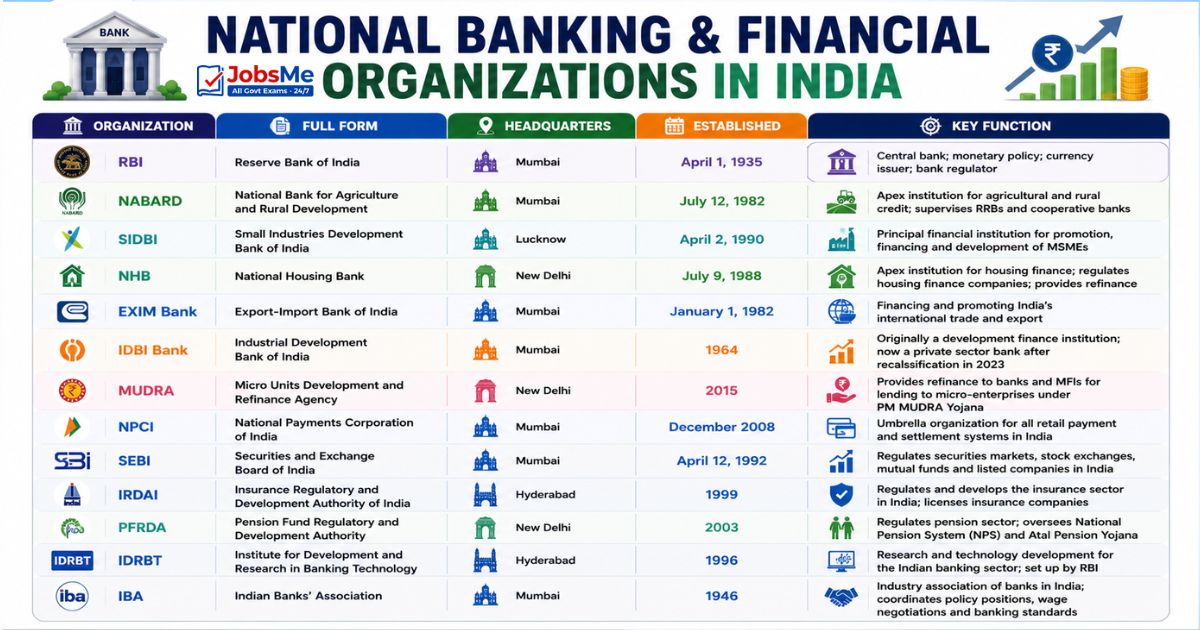
| Organization | Full Form | Headquarters | Established | Key Function |
|---|---|---|---|---|
| RBI | Reserve Bank of India | Mumbai | April 1, 1935 | Central bank; monetary policy; currency issuer; bank regulator |
| NABARD | National Bank for Agriculture and Rural Development | Mumbai | July 12, 1982 | Apex institution for agricultural and rural credit; supervises RRBs and cooperative banks |
| SIDBI | Small Industries Development Bank of India | Lucknow | April 2, 1990 | Principal financial institution for promotion, financing and development of MSMEs |
| NHB | National Housing Bank | New Delhi | July 9, 1988 | Apex institution for housing finance; regulates housing finance companies; provides refinance |
| EXIM Bank | Export-Import Bank of India | Mumbai | January 1, 1982 | Financing and promoting India's international trade and export |
| IDBI Bank | Industrial Development Bank of India | Mumbai | 1964 | Originally a development finance institution; now a private sector bank after reclassification in 2023 |
| MUDRA | Micro Units Development and Refinance Agency | New Delhi | 2015 | Provides refinance to banks and MFIs for lending to micro-enterprises under PM MUDRA Yojana |
| NPCI | National Payments Corporation of India | Mumbai | December 2008 | Umbrella organization for all retail payment and settlement systems in India |
| SEBI | Securities and Exchange Board of India | Mumbai | April 12, 1992 | Regulates securities markets, stock exchanges, mutual funds and listed companies in India |
| IRDAI | Insurance Regulatory and Development Authority of India | Hyderabad | 1999 | Regulates and develops the insurance sector in India; licenses insurance companies |
| PFRDA | Pension Fund Regulatory and Development Authority | New Delhi | 2003 | Regulates pension sector; oversees National Pension System (NPS) and Atal Pension Yojana |
| IDRBT | Institute for Development and Research in Banking Technology | Hyderabad | 1996 | Research and technology development for the Indian banking sector; set up by RBI |
| IBA | Indian Banks' Association | Mumbai | 1946 | Industry association of banks in India; coordinates policy positions, wage negotiations and banking standards |
NABARD - Detailed Notes
NABARD (National Bank for Agriculture and Rural Development) is one of the most important institutions for NABARD Grade A aspirants and also frequently tested in IBPS and SBI exams. Key facts:
- Established on July 12, 1982 under the National Bank for Agriculture and Rural Development Act, 1981
- Set up based on recommendations of the Shivaraman Committee (B. Sivaraman Committee)
- Took over the functions of ARDC (Agriculture Refinance and Development Corporation) and the agricultural finance wing of RBI
- Acts as the apex institution for agricultural and rural credit in India
- Provides refinance to banks, RRBs, cooperative banks and MFIs for rural lending
- Supervises and inspects RRBs and state cooperative banks
- Implements government schemes like Kisan Credit Card (KCC), Rural Infrastructure Development Fund (RIDF)
- Headquarters: Mumbai; Chairman is appointed by Government of India in consultation with RBI
NPCI - Products and Details
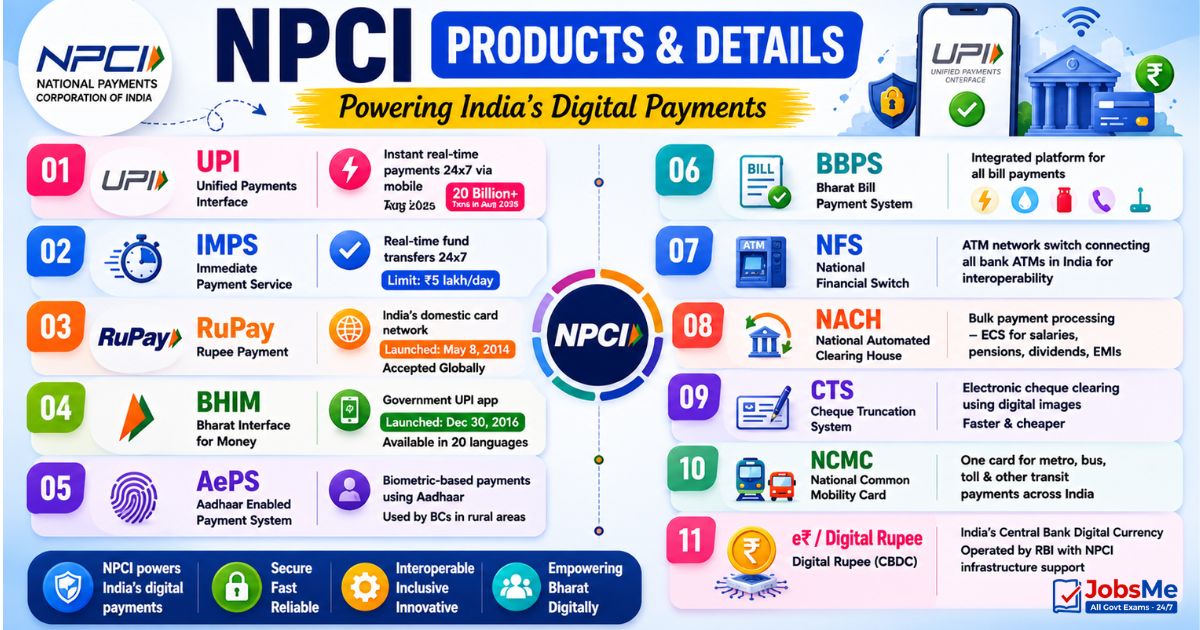
NPCI (National Payments Corporation of India) is the backbone of India's digital payments ecosystem. Incorporated in December 2008, NPCI operates the following key products:
| NPCI Product | Full Form | Purpose |
|---|---|---|
| UPI | Unified Payments Interface | Instant real-time payments 24x7 via mobile; 20 billion transactions in August 2025 |
| IMPS | Immediate Payment Service | Real-time fund transfers 24x7; transfer limit Rs. 5 lakh/day |
| RuPay | Rupee Payment | India's domestic card network; launched May 8, 2014; accepted globally through partnerships |
| BHIM | Bharat Interface for Money | Government UPI app; launched December 30, 2016; available in 20 languages |
| AePS | Aadhaar Enabled Payment System | Biometric-based payments using Aadhaar; used by banking correspondents in rural areas |
| BBPS | Bharat Bill Payment System | Integrated platform for all bill payments — electricity, gas, water, telecom, DTH |
| NFS | National Financial Switch | ATM network switch connecting all bank ATMs in India for interoperability |
| NACH | National Automated Clearing House | Bulk payment processing — ECS for salaries, pensions, dividends, EMIs |
| CTS | Cheque Truncation System | Electronic cheque clearing using digital images; faster and cheaper than physical movement |
| NCMC | National Common Mobility Card | One card for metro, bus, toll and other transit payments across India |
| e₹ / Digital Rupee | Digital Rupee (CBDC) | India's Central Bank Digital Currency; operated by RBI with NPCI infrastructure support |
International Banking and Financial Organizations
| Organization | Full Form | Headquarters | Established | Key Function |
|---|---|---|---|---|
| IMF | International Monetary Fund | Washington D.C., USA | 1944 (Bretton Woods) | Global monetary cooperation; exchange rate stability; financial assistance to countries with balance of payment crises |
| World Bank Group | — | Washington D.C., USA | 1944 (Bretton Woods) | Long-term development finance; poverty reduction; infrastructure loans and grants to developing countries |
| IBRD | International Bank for Reconstruction and Development | Washington D.C., USA | 1944 | Core lending arm of World Bank; loans to middle-income and creditworthy low-income countries |
| IDA | International Development Association | Washington D.C., USA | 1960 | Provides concessional loans and grants to the poorest countries; arm of World Bank |
| IFC | International Finance Corporation | Washington D.C., USA | 1956 | World Bank arm for private sector investment in developing countries |
| BIS | Bank for International Settlements | Basel, Switzerland | 1930 | Bank for central banks; fosters monetary and financial stability; home of Basel Committee which issues Basel Norms |
| ADB | Asian Development Bank | Manila, Philippines | 1966 | Socio-economic development including infrastructure, health, education and climate in Asia-Pacific |
| AIIB | Asian Infrastructure Investment Bank | Beijing, China | 2016 | Infrastructure financing in Asia; China-led multilateral development bank; 109 member countries |
| NDB | New Development Bank (BRICS Bank) | Shanghai, China | 2014 | Infrastructure and sustainable development financing in BRICS and other emerging economies |
| FATF | Financial Action Task Force | Paris, France | 1989 | Sets global standards for AML (Anti-Money Laundering) and CFT (Counter Financing of Terrorism); maintains grey list and black list of countries |
| FSB | Financial Stability Board | Basel, Switzerland | 2009 | Monitors global financial system; identifies systemic risks; oversees G-SIBs (Globally Systemically Important Banks) |
| SWIFT | Society for Worldwide Interbank Financial Telecommunication | Brussels, Belgium | 1973 | Global financial messaging network; 11,500+ institutions in 235+ countries; backbone of international payments |
| Afreximbank | African Export-Import Bank | Cairo, Egypt | 1993 | Promotes African trade and export financing; co-founded PAPSS (Pan-African Payment and Settlement System) in 2022 |
| WTO | World Trade Organization | Geneva, Switzerland | 1995 | Governs international trade rules; resolves trade disputes between member countries |
| OECD | Organisation for Economic Co-operation and Development | Paris, France | 1961 | Economic cooperation and policy coordination among developed nations; publishes economic data and guidelines |
World Bank Group - Complete Structure
The World Bank Group is not a single organization but a group of five international institutions that work together to reduce poverty and promote development. Understanding the five members is important for exams:
| Institution | Full Form | Focus |
|---|---|---|
| IBRD | International Bank for Reconstruction and Development | Loans to middle-income countries and creditworthy low-income countries |
| IDA | International Development Association | Concessional loans and grants to the poorest countries (IDA countries) |
| IFC | International Finance Corporation | Private sector investment and loans in developing countries |
| MIGA | Multilateral Investment Guarantee Agency | Political risk insurance to encourage foreign direct investment in developing countries |
| ICSID | International Centre for Settlement of Investment Disputes | Arbitration and conciliation for investment disputes between governments and foreign investors |
Memory Tricks - Banking Organizations
Remember IMF vs World Bank
Trick: IMF = Money stability. World Bank = Development projects. IMF lends when a country runs out of money and faces currency crisis. World Bank lends to build roads, schools, hospitals and infrastructure. IMF = financial emergency room. World Bank = development contractor.
Remember BIS Headquarters
Trick: BIS in Basel = Basel Committee in Basel = Basel Norms from Basel. Everything Basel-related comes from Basel, Switzerland. BIS headquarters is also the home of the Basel Committee on Banking Supervision that gave the world Basel I, II and III norms.
Remember FATF Lists
Trick: FATF Grey = Watch, FATF Black = Block. Countries on the grey list are being watched and must take corrective action. Countries on the black list face severe restrictions on international financial transactions. Being blacklisted is extremely serious for any country.
Remember NABARD Establishment
Trick: NABARD 1982 = Two years after 1980 second nationalization. RBI nationalized 1949. SBI formed 1955. RRBs 1975. NABARD 1982. The sequence helps you place each event in context.
Preparing for competitive exams requires consistent revision. Platforms like JobsMe simplify preparation through:
- Daily Current Affairs
- Weekly Current Affairs
- Monthly Current Affairs
- Static GK for Competitive Exams
- Latest Government Jobs Notifications
- Computer Awareness
Stay updated, revise regularly, and attempt quizzes for better accuracy in UPSC, SSC CGL, IBPS PO/Clerk, SBI, RBI Grade B, RRB NTPC, Defence, and State PSC exams.
Free quiz • No signup required
Put this topic into practice with Current Affairs Quiz 13–15 June 2026 MCQs for UPSC, SSC, Banking, Railways, Defence & State PSC Exams. It is the quickest way to reinforce what you just learned.
Frequently Asked Questions
What is the headquarters of NABARD?
What is the IMF and where is it headquartered?
What is the difference between the IMF and the World Bank?
What is BIS and why is it important for banking exams?
What is the AIIB and how is it different from ADB?
What is FATF and why is it important?
What is NPCI and what are its main products?

About the author