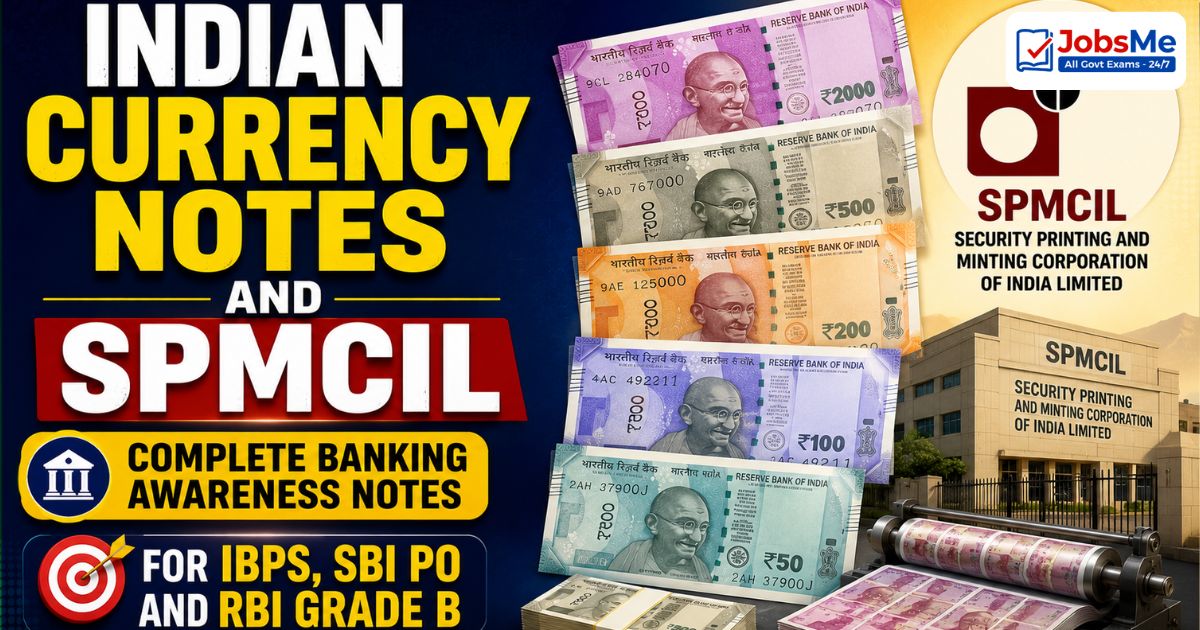
Indian Currency Notes and SPMCIL – Complete Banking Awareness Notes 2026 for IBPS, SBI PO and RBI Grade B
Indian Currency Notes and SPMCIL covers every aspect of India's currency that is tested in banking awareness exams. Topics include the complete specifications of all currency note denominations (₹10 to ₹2000) with dimensions, base colors, monuments depicted, security features including watermarks, security thread, MICR and intaglio printing, the history and features of the Indian Rupee symbol ₹, the Mahatma Gandhi Series and the Mahatma Gandhi (New) Series, the role of RBI in currency management, the SPMCIL structure with all four mints and four currency note presses, BRBNMPL and the Security Paper Mill at Hoshangabad. Coin denominations and special features are also covered.
Jump to section
- Indian Currency - Who Issues What
- Mahatma Gandhi New Series - Complete Note Specifications
- Common Features of All Notes - Mahatma Gandhi New Series
- Security Features of Indian Currency Notes
- Indian Rupee Symbol (₹) - Complete History
- Demonetization - Historical Overview
- SPMCIL - Security Printing and Minting Corporation of India Limited
- BRBNMPL - Bharatiya Reserve Bank Note Mudran Private Limited
- Indian Coin Denominations and Features
- Commemorative Coins and Currency
- Clean Note Policy - RBI's Role in Currency Management
- Memory Tricks - Currency Notes
- One-Liners for Quick Revision
Indian Currency - Who Issues What
Understanding who issues currency notes, who issues coins, and the difference between RBI-issued and government-issued currency is a frequently tested fact in banking awareness examinations.
| Currency | Issuing Authority | Signatory | Legal Authority |
|---|---|---|---|
| ₹1 Note | Government of India (Ministry of Finance) | Finance Secretary of India | Currency Act / RBI Act (special provision) |
| ₹2, ₹5, ₹10, ₹20, ₹50, ₹100, ₹200, ₹500, ₹2000 Notes | Reserve Bank of India | RBI Governor | Section 22 of RBI Act 1934 |
| All Coins (₹1, ₹2, ₹5, ₹10, ₹20) | Government of India (Ministry of Finance) | No signature; mint mark identifies mint | Coinage Act 2011 |
Key Exam Fact: RBI issues notes but puts coins into circulation on behalf of the Government. The Government mints coins through SPMCIL; RBI distributes them.
Mahatma Gandhi New Series - Complete Note Specifications
All currency notes in active circulation belong to the Mahatma Gandhi (New) Series, introduced with enhanced security features starting 2016. The series is distinguished from the older Mahatma Gandhi Series by upgraded security features and new denominations (₹200, new ₹500, ₹2000).
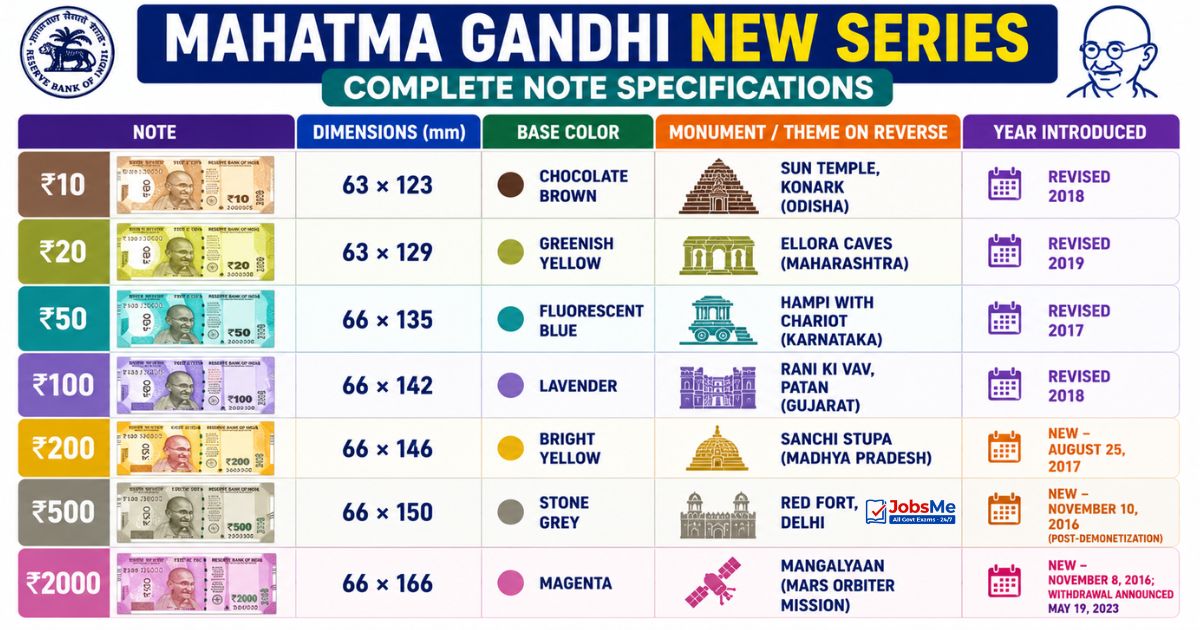
| Note | Dimensions (mm) | Base Color | Monument / Theme on Reverse | Year Introduced |
|---|---|---|---|---|
| ₹10 | 63 × 123 | Chocolate Brown | Sun Temple, Konark (Odisha) | Revised 2018 |
| ₹20 | 63 × 129 | Greenish Yellow | Ellora Caves (Maharashtra) | Revised 2019 |
| ₹50 | 66 × 135 | Fluorescent Blue | Hampi with Chariot (Karnataka) | Revised 2017 |
| ₹100 | 66 × 142 | Lavender | Rani Ki Vav, Patan (Gujarat) | Revised 2018 |
| ₹200 | 66 × 146 | Bright Yellow | Sanchi Stupa (Madhya Pradesh) | New — August 25, 2017 |
| ₹500 | 66 × 150 | Stone Grey | Red Fort, Delhi | New — November 10, 2016 (post-demonetization) |
| ₹2000 | 66 × 166 | Magenta | Mangalyaan (Mars Orbiter Mission) | New — November 8, 2016; withdrawal announced May 19, 2023 |
Dimension Pattern to Remember
- ₹10 and ₹20 are the only notes that are 63mm tall — all other denominations are 66mm tall
- The width increases with denomination value — ₹10 (123mm) to ₹2000 (166mm)
- The difference in width makes it easier for visually impaired persons to identify denominations by feel
Common Features of All Notes - Mahatma Gandhi New Series
Obverse (Front) Features
- Portrait of Mahatma Gandhi at the centre right
- Ashoka Pillar emblem to the right of Gandhi's portrait (State Emblem of India)
- RBI Governor's signature below the guarantee and promise clause
- RBI seal — "भारतीय रिज़र्व बैंक" (Hindi) and "Reserve Bank of India" (English)
- Guarantee and promise clause — "मैं धारक को _____ रुपये अदा करने का वचन देता हूँ / I promise to pay the bearer the sum of _____ rupees"
- Rupee numeral in Devanagari and denomination in English
- Year of printing on the reverse side
- Swachh Bharat logo on most denominations (printed on some notes)
Reverse (Back) Features
- Year of printing on the left
- Language panel showing the denomination in 15 Indian languages (in addition to Hindi and English on the front = total 17 languages; but the panel has 15 languages of the scheduled languages list)
- Monument or theme specific to each denomination
- Swachh Bharat Abhiyan logo and tagline (on most denominations)
Security Features of Indian Currency Notes
| Security Feature | Description | Notes Where Found |
|---|---|---|
| Security Thread | A windowed (Denatext) security thread embedded in the note paper; readable under UV light; for ₹500 and ₹2000, thread changes color from green to blue when tilted (color-shifting) | All denominations; color-shift on ₹500, ₹2000 |
| Watermark | Portrait of Mahatma Gandhi as watermark visible when note is held against light; also electrotype denomination numeral watermark | All denominations |
| Intaglio Printing | Raised ink printing that can be felt by touch; used for Gandhi portrait, RBI seal, guarantee clause, Ashoka Pillar; helps visually impaired identify genuine notes | All denominations |
| Optically Variable Ink (OVI) / Colour-Shifting Ink | The numeral changes color from green to blue when the note is tilted; used on high-denomination notes | ₹500 and ₹2000 |
| Fluorescent Features | Bank logo and security fiber fluoresce under ultraviolet (UV) light | All denominations |
| See-Through Register | A small floral design is printed on the front and back in exact alignment; the complete design visible only when held against light; called "see-through register" because both sides must be seen simultaneously | ₹50 and ₹100 |
| Micro-Lettering | Tiny letters "RBI" and the denomination numeral printed between the Gandhi portrait and the Ashoka Pillar; visible only under magnification | All denominations |
| Angular Bleed Lines | On the left and right side of the notes, angular bleed lines help visually impaired persons identify denomination by touch | All denominations; more prominent on ₹100, ₹200 |
| Identification Mark (Raised) | A specific raised identification symbol on the left side of the obverse — different shape for different denominations — helps visually impaired | All denominations with different shapes |
| Void Pantograph | A latent image print that reveals the word "VOID" when the note is photocopied on a colour photocopy machine | All denominations |
Indian Rupee Symbol (₹) - Complete History
| Parameter | Details |
|---|---|
| Symbol | ₹ |
| Official Adoption | July 15, 2010 — approved by the Union Cabinet; July 5, 2010 (Union Budget announcement) |
| Designer | Udaya Kumar Dharmalingam — a post-graduate student of Visual Communication Design at IIT Bombay at the time |
| Selection Process | National competition — thousands of designs submitted; Udaya Kumar's design was shortlisted and selected by a high-level committee |
| Design Inspiration | Stylized combination of the Devanagari letter Ra (र) and the Latin letter R; the two horizontal stripes represent the Indian Tricolour's white band and also recall the equality sign (=) |
| Global Context | India became the 5th country to have a unique currency symbol after the US Dollar ($), Euro (€), British Pound (£) and Japanese Yen (¥) |
| Keyboard | ₹ symbol is available as a standard key on Indian-language keyboards; Unicode: U+20B9 |
| Notes with Symbol | The ₹ symbol appears prominently on all notes of the Mahatma Gandhi New Series issued from 2016 onwards |
Demonetization - Historical Overview
| Event | Date | Notes Demonetized | Key Details |
|---|---|---|---|
| First Demonetization | January 12, 1946 | ₹1000 and ₹10,000 notes | Post-WWII; to curb black market money accumulated during wartime |
| Second Demonetization | January 16, 1978 | ₹1000, ₹5000 and ₹10,000 notes | Janata Party government; to combat black money |
| Third Demonetization | November 8, 2016 | ₹500 and ₹1000 notes | PM Narendra Modi announced at 8 PM; effective midnight; new ₹500 (stone grey) and ₹2000 (magenta) notes introduced |
| ₹2000 Withdrawal | May 19, 2023 | ₹2000 notes (not demonetized — still legal tender but being withdrawn from circulation) | RBI announced withdrawal; exchange at banks; deadline extended; notes remain legal tender |
SPMCIL - Security Printing and Minting Corporation of India Limited
| Parameter | Details |
|---|---|
| Full Name | Security Printing and Minting Corporation of India Limited |
| Established | January 13, 2006 |
| Headquarters | New Delhi |
| Ownership | Central Public Sector Enterprise (CPSE); 100% owned by Government of India (Ministry of Finance) |
| Classification | Schedule A — highest classification for CPSEs |
| Total Units | 9 units: 4 Mints + 4 Currency Note Presses + 1 Security Paper Mill |
| Products | Coins; currency notes (through presses); passports; postage stamps; court fee stamps; judicial stamps; military items; government stationery requiring security printing |
Four Mints Operated by SPMCIL
| Mint | Location | Year Established | Mint Mark on Coin |
|---|---|---|---|
| Mumbai Mint | Mumbai, Maharashtra | 1829 (oldest mint in India) | No mark or diamond (◆) |
| Alipore Mint (Kolkata Mint) | Kolkata, West Bengal | 1952 | No mark or "B" |
| Hyderabad Mint | Hyderabad, Telangana | 1903 | Star (★) or dot below the year |
| Noida Mint | Noida, Uttar Pradesh | 1988 | Dot (•) below the year |
Exam Tip: Mumbai Mint is the oldest (1829). Noida is the newest (1988). Mint marks help identify which mint struck a particular coin — asked in IBPS and SBI exams.
Four Currency Note Presses
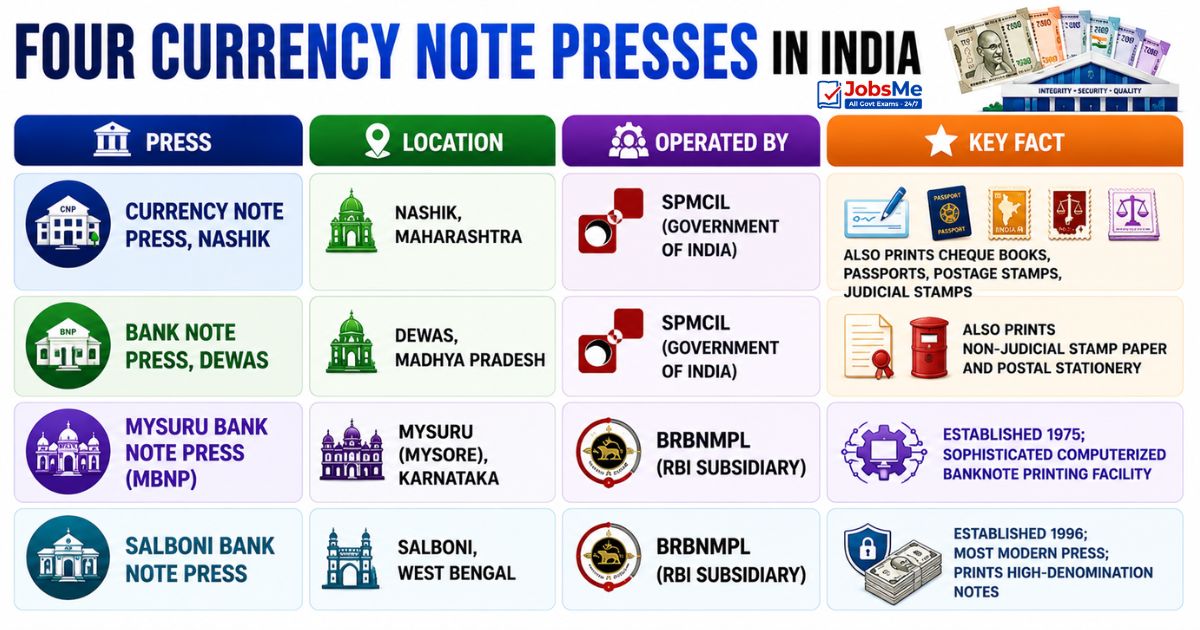
| Press | Location | Operated By | Key Fact |
|---|---|---|---|
| Currency Note Press, Nashik | Nashik, Maharashtra | SPMCIL (Government of India) | Also prints cheque books, passports, postage stamps, judicial stamps |
| Bank Note Press, Dewas | Dewas, Madhya Pradesh | SPMCIL (Government of India) | Also prints non-judicial stamp paper and postal stationery |
| Mysuru Bank Note Press (MBNP) | Mysuru (Mysore), Karnataka | BRBNMPL (RBI subsidiary) | Established 1975; sophisticated computerized banknote printing facility |
| Salboni Bank Note Press | Salboni, West Bengal | BRBNMPL (RBI subsidiary) | Established 1996; most modern press; prints high-denomination notes |
Security Paper Mill (SPM)
- Located at Hoshangabad, Madhya Pradesh (renamed Narmadapuram after 2021)
- Operated by SPMCIL
- Manufactures the special security paper used for printing currency notes — the paper itself is a security feature (cotton-linen blend, specific weight, UV-reactive properties)
- Also manufactures paper for non-judicial stamp paper and other security documents
BRBNMPL - Bharatiya Reserve Bank Note Mudran Private Limited
| Parameter | Details |
|---|---|
| Full Name | Bharatiya Reserve Bank Note Mudran Private Limited |
| Incorporated | February 3, 1995 |
| Ownership | 100% wholly-owned subsidiary of the Reserve Bank of India |
| Headquarters | Bengaluru, Karnataka |
| Presses | Mysuru Bank Note Press (Karnataka) and Salboni Bank Note Press (West Bengal) |
| Role | Prints currency notes for RBI; supplements printing capacity of SPMCIL's Nashik and Dewas presses |
Indian Coin Denominations and Features
| Coin | Metal | Shape | Current Status |
|---|---|---|---|
| ₹1 | Stainless Steel (ferritic) | Round | Active circulation |
| ₹2 | Stainless Steel (ferritic) | Round (interrupted milled edge) | Active circulation |
| ₹5 | Stainless Steel (ferritic) | Round (milled edge) | Active circulation |
| ₹10 | Bimetallic — Stainless Steel outer ring + Aluminium Bronze inner disc | Round (bimetallic) | Active — multiple design variants; some public confusion about authenticity |
| ₹20 | Bimetallic — Stainless Steel outer ring + Aluminium Bronze inner disc | 12-sided (dodecagonal) — distinctive shape | Active circulation since 2019 |
| 25 paise and smaller | Various | Various | Not legal tender from June 30, 2011 onwards |
| 50 paise | Stainless Steel | Round | Legal tender but rarely seen in circulation |
Key Exam Fact: Sub-25 paise coins (1 paise, 2 paise, 3 paise, 5 paise, 10 paise, 20 paise, 25 paise) ceased to be legal tender from June 30, 2011. The ₹20 coin has a distinctive 12-sided (dodecagonal) shape — only such coin in circulation.
Commemorative Coins and Currency
- The Government of India issues commemorative coins to mark important events, anniversaries and personalities — these are collector items and may not circulate widely
- Popular commemorative coins: Rs. 5 coin for RBI's Platinum Jubilee, coins for Gandhi's 150th birth anniversary, coins for Constitution's 70th anniversary
- High-denomination commemorative coins (₹100, ₹150, ₹1000) are issued for special occasions — not in regular circulation
Clean Note Policy - RBI's Role in Currency Management
- RBI actively manages the quality of currency in circulation under its Clean Note Policy
- Soiled, torn or mutilated notes can be exchanged at any bank branch — the exchange is free of charge
- RBI sets standards for the condition of notes that banks should keep in circulation
- Unfit notes are withdrawn and destroyed (shredded) at RBI Issue Offices and Currency Chests
- Currency Chests: Branches of banks where RBI maintains stocks of currency notes and coins for distribution to the public; currency chest balance is treated as part of RBI's balance sheet
- UDGAM portal: RBI's portal to help depositors trace unclaimed deposits (not directly related to currency but linked to unclaimed money in the financial system)
Memory Tricks - Currency Notes
Remember Note Colors (₹10 to ₹2000)
Trick: Brown (10), Yellow-Green (20), Blue (50), Lavender (100), Bright Yellow (200), Grey (500), Magenta (2000). Create a visual: imagine a 10-rupee note is the color of chocolate, a 50 is like the sea (blue), a 100 is like lavender flowers, and the 2000 is like the pink-purple color of space (Mangalyaan — Mars mission).
Remember Monuments on Notes
Trick: "Kings Sun, Elora's 20, Hampi's 50, Rani's 100, Sanchi's 200, Red Fort's 500, Mangal's 2000." Or: 10=Konark Sun (East India, Odisha), 20=Ellora (West, Maharashtra), 50=Hampi (South, Karnataka), 100=Rani Ki Vav (West, Gujarat), 200=Sanchi (Central, MP), 500=Red Fort (North, Delhi), 2000=Mangalyaan (Space — India's ultimate achievement).
Remember SPMCIL vs BRBNMPL
Trick: SPMCIL = Government of India owns it = Nashik (Maharashtra) + Dewas (MP) + 4 Mints + Paper Mill. BRBNMPL = RBI owns it = Mysuru (Karnataka) + Salboni (West Bengal). Both print notes; SPMCIL also mints coins.
Remember Four Mints
Trick: MHKN = Mumbai (oldest 1829), Hyderabad (1903), Kolkata (1952), Noida (newest 1988). MHKN — "Mint Here Keeps Notes." The age order: Mumbai → Hyderabad → Kolkata → Noida.
Remember ₹ Symbol
Trick: "Udaya Kumar (IIT Bombay) designed ₹ in 2010. India = 5th country with unique currency symbol (after $, €, £, ¥)." Udaya = U = Unique design for a Unique symbol.
One-Liners for Quick Revision
- All currency notes except ₹1 are issued by RBI; ₹1 note is issued by Government of India.
- All coins are issued by Government of India (Ministry of Finance); circulated by RBI.
- RBI issues notes under Section 22 of RBI Act 1934.
- ₹10 note: Chocolate Brown; Sun Temple, Konark; 63×123mm.
- ₹20 note: Greenish Yellow; Ellora Caves; 63×129mm.
- ₹50 note: Fluorescent Blue; Hampi with Chariot; 66×135mm.
- ₹100 note: Lavender; Rani Ki Vav, Patan; 66×142mm.
- ₹200 note: Bright Yellow; Sanchi Stupa; introduced August 25, 2017.
- ₹500 note: Stone Grey; Red Fort; introduced November 10, 2016.
- ₹2000 note: Magenta; Mangalyaan; withdrawal announced May 19, 2023.
- Rupee symbol ₹ adopted: 2010; designer: Udaya Kumar Dharmalingam; IIT Bombay.
- India is the 5th country with a unique currency symbol (after $, €, £, ¥).
- November 8, 2016: ₹500 and ₹1000 demonetized by PM Modi.
- Sub-25 paise coins: ceased legal tender from June 30, 2011.
- ₹20 coin: 12-sided (dodecagonal); bimetallic; active since 2019.
- SPMCIL established: January 13, 2006; HQ: New Delhi; owned by Govt of India.
- SPMCIL structure: 4 mints + 4 presses + 1 paper mill = 9 units.
- SPMCIL presses: Nashik (Maharashtra) and Dewas (Madhya Pradesh).
- BRBNMPL: RBI subsidiary; presses at Mysuru (Karnataka) and Salboni (West Bengal).
- Security Paper Mill: Hoshangabad (Narmadapuram), Madhya Pradesh; operated by SPMCIL.
- Mumbai Mint: oldest (1829); Noida Mint: newest (1988).
- OVI (colour-shifting ink): denomination numeral changes from green to blue when tilted; on ₹500 and ₹2000.
Preparing for competitive exams requires consistent revision. Platforms like JobsMe simplify preparation through:
- Daily Current Affairs
- Weekly Current Affairs
- Monthly Current Affairs
- Static GK for Competitive Exams
- Latest Government Jobs Notifications
- Computer Awareness
Stay updated, revise regularly, and attempt quizzes for better accuracy in UPSC, SSC CGL, IBPS PO/Clerk, SBI, RBI Grade B, RRB NTPC, Defence, and State PSC exams.
Free quiz • No signup required
Put this topic into practice with Current Affairs Quiz 20 June 2026 | UPSC, SSC, Banking, Railways & State PSC MCQs with Answers. It is the quickest way to reinforce what you just learned.
Frequently Asked Questions
Who issues currency notes in India?
Who issues coins in India?
What are the security features of Indian currency notes?
When was the Rupee symbol ₹ adopted and who designed it?
What is SPMCIL and what does it manage?
What is BRBNMPL?

About the author