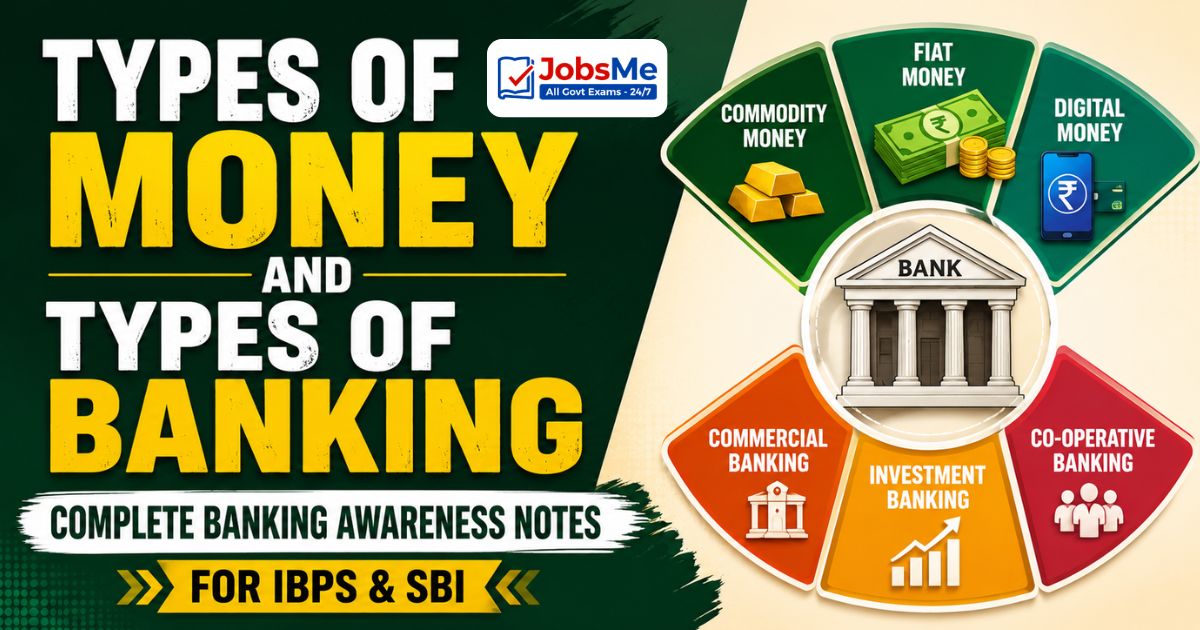
Types of Money and Types of Banking – Complete Banking Awareness Notes 2026 for IBPS and SBI
Types of Money and Types of Banking is a broad conceptual chapter that covers all monetary and banking models tested in banking awareness sections. Topics include fiat money, commodity money, representative money, credit money, hard currency, soft currency, hot money, dear and cheap money, barren money, cryptocurrency and stablecoin. Money supply measures (M0, M1, M2, M3, M4) are covered with their exact components. The chapter then covers all banking models from branch, unit, group, chain banking to universal, narrow, shadow, retail, wholesale, neo-banking, Islamic banking (Shariah), green banking, offshore, merchant and para banking.
Jump to section
Types of Money — Introduction
Money is one of the most important concepts in economics and banking. Understanding the different types of money — from commodity money to fiat currency to digital tokens — helps in grasping how modern financial systems work. For banking examinations, questions on types of money test conceptual clarity about how different forms of money function, their characteristics and their role in the economy. This chapter covers all types of money and money supply measures tested in IBPS PO, SBI Clerk, RBI Grade B and banking awareness examinations.
Types of Money — Complete Classification
1. Commodity Money
Commodity Money is money whose material is itself a valuable commodity. The intrinsic value of commodity money equals its face value. Gold and silver coins are the classic historical example — a gold coin was worth its weight in gold. Commodity money was the dominant form of money for most of human history and had the advantage that its value was self-sustaining — even if no government backed it, the metal could always be sold or used.
2. Representative Money
Representative Money is paper money that is backed by a specific physical commodity stored in a vault. The holder can redeem the paper for the underlying commodity on demand. The Gold Standard era (late 19th century to 1971) was the most famous example — currencies of major countries were pegged to gold and fully convertible into gold at fixed rates. The US Dollar was the last major currency backed by gold — President Nixon ended dollar-gold convertibility in 1971 (the "Nixon Shock"), ending the Bretton Woods system.
3. Fiat Money
Fiat Money is money declared to be legal tender by government decree, with no backing by any physical commodity. It has no intrinsic value — the physical paper note itself is worth almost nothing. Its entire value comes from legal mandate (the government requires it to be accepted in all transactions) and public trust (people accept it because they know others will accept it). All modern currencies — the Indian Rupee, US Dollar, Euro, Chinese Yuan — are fiat currencies. Fiat money gives governments and central banks significant flexibility to manage the money supply and respond to economic conditions.
4. Credit Money (Fiduciary Money)
Credit Money is money created through the commercial banking credit process rather than printed by the central bank. When a bank extends a loan, it does not take money from existing deposits and give it to the borrower — it simply creates a new deposit entry in the borrower's account. This newly created deposit is new money — it was not in existence before the loan was made. The vast majority of money in modern economies is credit money — not central bank notes. In India, approximately 90% of the broad money supply (M3) consists of commercial bank deposits created through lending, while only 10% is currency notes and coins issued by RBI and the Government.
5. Hard Currency
Hard Currency is the currency of a country with a strong, stable economy, low inflation, high liquidity and high international credibility. Hard currencies are widely accepted globally for international trade, investment and reserves — their value is stable over time and they can easily be exchanged for other currencies. The major hard currencies are:
- US Dollar (USD) — the world's dominant reserve currency; used in approximately 60% of all global foreign exchange reserves and the majority of commodity (oil, gold) pricing
- Euro (EUR) — the second most widely held reserve currency; used across the 20-country eurozone
- British Pound Sterling (GBP) — historically the world's reserve currency; London remains the world's largest foreign exchange trading center
- Japanese Yen (JPY) — widely used in Asia-Pacific financial markets; Japan is world's third largest economy
- Swiss Franc (CHF) — considered a safe-haven currency due to Switzerland's political neutrality and banking stability
6. Soft Currency
Soft Currency is the currency of a country with a weak, unstable or underdeveloped economy. Soft currencies are characterized by high inflation, frequent devaluation, political instability, foreign exchange controls or limited convertibility. Soft currencies are not widely accepted internationally — trading partners typically demand payment in hard currencies. Examples include currencies of countries facing hyperinflation, severe balance of payment crises or political upheaval. The Indian Rupee was historically considered a soft currency though it has strengthened considerably in convertibility and stability.
7. Hot Money
Hot Money refers to short-term capital flows that move rapidly between countries, financial markets and asset classes in search of the highest immediate returns. Hot money is highly sensitive to interest rate differentials, exchange rate expectations and risk sentiment — it enters a market quickly when returns are attractive and exits equally quickly when returns fall or risks emerge. Large hot money flows can cause significant disruption — rapid inflows inflate asset prices and currency values, while sudden outflows cause crashes. Foreign Portfolio Investment (FPI) flows in emerging market bond and equity markets are the classic example of hot money.
8. Dear Money and Cheap Money
Dear Money refers to a situation in the economy where borrowing is expensive — interest rates are high and credit is difficult and costly to obtain. This typically occurs during periods of high inflation when the central bank raises interest rates to cool the economy. During dear money periods, businesses delay investment decisions and consumers reduce borrowing, which reduces economic activity and helps bring inflation under control.
Cheap Money is the opposite — a situation where borrowing is inexpensive because interest rates are low. Central banks deliberately create cheap money conditions to stimulate economic activity during downturns or recessions. The post-COVID period of near-zero interest rates globally (2020-2021) was an extreme example of cheap money. While cheap money stimulates growth, it can also inflate asset bubbles if maintained for too long.
9. Near Money
Near Money refers to highly liquid non-cash assets that can be quickly converted into cash with minimal loss of value. Near money assets are not money themselves — they cannot be directly used for transactions — but can be rapidly liquidated if cash is needed. Examples include Treasury Bills, short-term government bonds, commercial paper, certificate of deposits and fixed deposits. Near money is included in broader money supply measures (M2, M3) but not in the narrowest (M1).
10. Barren Money
Barren Money is money that is sitting idle and earning no return. Money kept in a safe, under a mattress or in a current account that pays no interest is barren money — it is not being put to productive use. From an economic perspective, barren money is wasteful — idle resources that could support productive investment are being left unused.
11. Cryptocurrency
Cryptocurrency is a decentralized digital currency that uses cryptography for security and operates on a distributed ledger (blockchain) without any central authority — no government, no central bank. The most famous cryptocurrency is Bitcoin (BTC), created in 2009 by the pseudonymous Satoshi Nakamoto. Other major cryptocurrencies include Ethereum (ETH), Ripple (XRP), Litecoin, Cardano and thousands of others. Cryptocurrencies are generally not legal tender in most countries (El Salvador being a notable exception where Bitcoin is legal tender). The RBI and most central banks have raised concerns about the risks of private cryptocurrencies — including high volatility, use in money laundering and terrorism financing, and threats to monetary sovereignty.
12. Stablecoin
Stablecoins are a category of cryptocurrency designed to minimize price volatility by pegging their value to a stable external reference — typically a fiat currency (usually the US Dollar). Unlike Bitcoin which can fluctuate 10-20% in value in a single day, a USD stablecoin like USDC (USD Coin) maintains a 1:1 peg with the US Dollar. Stablecoins are increasingly used in decentralized finance (DeFi), cross-border payments and crypto trading. The EU's MiCA (Markets in Crypto-Assets Regulation) regulation, which came into effect in 2024, provides the first comprehensive regulatory framework for stablecoins globally.
Money Supply Measures — M0 to M4
The RBI measures and monitors the money supply in India using four progressively broader measures. Understanding the components of each measure is frequently tested in banking awareness examinations.
| Measure | Also Called | Components | Liquidity Level |
|---|---|---|---|
| M0 (Reserve Money) | High-powered money / Monetary base | Currency in circulation (notes and coins with the public) + Bankers' deposits with RBI (banks' CRR balances) + Other deposits with RBI | Most basic; the total stock of central bank money |
| M1 (Narrow Money) | Transaction money; most liquid money supply | Currency with the public + Demand deposits with banks (savings accounts + current accounts) + Other deposits with RBI (excluding interbank) | Highest liquidity; can be spent directly on transactions without delay |
| M2 | Intermediate money supply | M1 + Savings deposits of post office savings banks | Slightly less liquid than M1 (post office deposits take time to access) |
| M3 (Broad Money) | Broad money; aggregate monetary resources | M1 + Time deposits with banks (Fixed Deposits + Recurring Deposits of all tenures) | Less liquid than M1 (time deposits have withdrawal restrictions and penalties) |
| M4 | Widest money supply measure | M3 + All deposits with post offices (savings + time deposits) excluding National Savings Certificates | Widest measure; includes even less liquid post office term deposits |
Key Exam Point: The RBI primarily uses M3 (Broad Money) as its monetary aggregate for money supply targeting and policy analysis. M3 growth is one of the indicators the MPC considers when making monetary policy decisions. M0 (Reserve Money or high-powered money) is the monetary base that the RBI directly controls through its balance sheet operations — changes in M0 are magnified through the banking system's credit creation process into much larger changes in M3.
Types of Banking — Complete Coverage
1. Branch Banking
Branch Banking is the most common banking model globally and in India. A single bank operates through an extensive network of geographically distributed branches, all connected to a central headquarters through Core Banking Solutions (CBS). All branches share the same banking licence, the same capital base and the same management. Branch banking allows banks to achieve economies of scale, serve geographically dispersed customers and mobilize deposits from rural areas to fund urban lending. The major public sector banks in India — SBI, PNB, Bank of Baroda — operate through thousands of branches nationwide using the branch banking model.
2. Unit Banking
Unit Banking is a banking model where a single bank operates from one office with no branches. Unit banks serve only the local community in their immediate geographic area. This model was historically common in the United States before the nationwide Interstate Banking and Branching Efficiency Act of 1994 permitted bank expansion across state lines. Unit banking advocates argue it promotes local knowledge, community focus and specialized service. However, unit banks lack diversification — their loan portfolios are concentrated in local risks — and cannot achieve the economies of scale of branch banks.
3. Group Banking
Group Banking is a banking structure where multiple separately chartered and independently operated banks come under the ownership or control of a common holding company. Each bank in the group has its own board, management, capital and banking licence — they are not branches of the same bank — but they share ownership through the parent holding company. Group banking allows central coordination of strategy and capital allocation while maintaining individual bank autonomy. Bank holding companies in the US have historically used this structure.
4. Chain Banking
Chain Banking is an informal variant of group banking where a group of independently chartered banks are controlled through common ownership or management by the same individual investors or a small group of people — without the formal corporate holding company structure seen in group banking. Chain banking gives the controllers centralized decision-making authority across multiple banks without formal corporate integration.
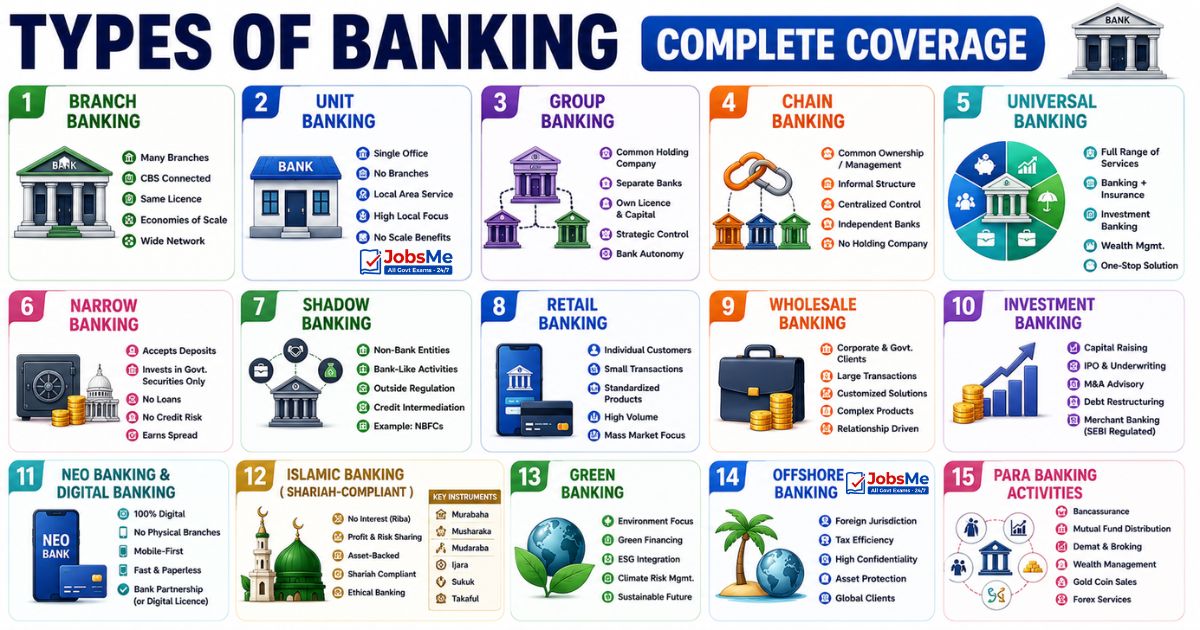
5. Universal Banking
Universal Banking refers to a single financial institution providing the full spectrum of financial services under one roof — commercial banking (deposits, loans, trade finance), investment banking (underwriting securities, managing IPOs, M&A advisory), insurance products, mutual funds, wealth management, brokerage and financial planning. The universal banking model was pioneered in continental Europe — particularly Germany (where Deutsche Bank is the classic universal bank) and Switzerland. The merits of universal banking include customer convenience (one-stop financial shopping), cross-selling opportunities and diversified revenue streams. The downside is potential conflicts of interest (a bank that lends to a company while also underwriting its shares may have conflicting incentives) and the risk that problems in one division spread to others.
6. Narrow Banking
Narrow Banking is a concept where a bank accepts deposits but invests them only in risk-free, liquid government securities — not in private sector loans. A narrow bank earns a spread between deposit rates it pays and the yield on government securities it holds. It creates no private sector credit and takes no credit risk. Narrow banking was proposed as a solution to the problem of bank failures causing economic disruption — a narrow bank can never fail due to bad loans because it makes no loans. The concept has been debated in India and globally but has never been formally implemented as a banking model, partly because it would drastically reduce the banking system's credit creation capacity.
7. Shadow Banking
Shadow Banking refers to the system of financial intermediaries, instruments and markets that collectively provide bank-like functions — primarily credit intermediation — but operate outside the regular banking regulatory perimeter. Shadow banking entities are not banks, do not hold banking licences and are not subject to the same capital, liquidity and supervisory standards as regulated banks. In India, NBFCs (Non-Banking Financial Companies) are the primary shadow banking entities. They accept public deposits (some types), extend loans, invest in securities and provide financial services — but are not covered by deposit insurance and are regulated differently from banks. Before the 2008 global financial crisis, shadow banking grew enormously in developed countries through securitization, structured investment vehicles (SIVs) and money market funds, contributing to systemic fragility.
8. Retail Banking
Retail Banking (also called Consumer Banking or Personal Banking) provides standardized financial services to individual consumers and small businesses. Retail banking products include savings and current accounts, personal loans, home loans, auto loans, education loans, credit cards, fixed deposits, insurance products, mutual fund distribution and ATM/digital banking services. Retail banking is characterized by high transaction volumes and relatively small individual transaction values. The focus is on standardized products that can be mass-marketed efficiently through branches, ATMs and digital channels.
9. Wholesale Banking
Wholesale Banking provides large-scale financial services to corporate clients, government entities, institutional investors and other financial institutions rather than individual consumers. Wholesale banking products include large corporate loans, working capital facilities, trade finance, cash management services, treasury and foreign exchange services, structured finance, bond issuance support, mergers and acquisitions (M&A) financing and investment advisory. Transactions are individually large, complex and often customized to specific client needs.
10. Investment Banking
Investment Banking is a specialized form of banking that helps corporations, governments and other entities raise capital from financial markets and provides advisory services for complex financial transactions. Investment banking activities include underwriting of Initial Public Offerings (IPOs) and bond issuances, mergers and acquisitions (M&A) advisory, debt restructuring advisory, private placement of securities and proprietary trading. In India, investment banking activities are regulated by SEBI. Merchant Banking (a closely related concept) specifically refers to firms that manage and advise on IPOs, rights issues and other capital market transactions — Category I Merchant Bankers must be registered with SEBI.
11. Neo Banking and Digital Banking
Neo Banks (also called challenger banks) are financial services providers that operate entirely through digital channels — no physical branches, no ATMs (typically). Neo banks are characterized by superior user experience through mobile apps, fast account opening with minimal documentation, lower fees, instant notifications and personal finance management tools. The critical distinction is that most neo banks do NOT have their own banking licence — they partner with a licensed bank that provides the actual banking infrastructure while the neo bank provides the customer-facing technology interface. Examples:
- India: Jupiter Money (partners with Federal Bank), Fi (partners with Federal Bank), Niyo (partners with multiple banks)
- Global: Revolut (UK, Europe), Monzo (UK), N26 (Germany), Chime (USA), Nubank (Brazil)
Some neo banks have obtained their own banking licences and operate as licensed digital banks — DBS Digibank in India is an example of a licensed digital bank with minimal physical presence.
12. Islamic Banking (Shariah-Compliant Banking)
Islamic Banking is a system of banking that complies with Islamic law (Shariah) by prohibiting the charging or payment of interest (Riba) in any form. Since conventional banking is fundamentally interest-based, Islamic banks use profit-sharing, risk-sharing and asset-backed structures instead. Key instruments in Islamic banking:
| Instrument | Description | Conventional Equivalent |
|---|---|---|
| Murabaha | Cost-plus sale — bank purchases the asset the customer wants and sells it to the customer at a markup; the markup is the bank's profit | Secured loan with fixed interest rate |
| Musharaka | Partnership — bank and customer co-invest in a project; profits and losses shared in agreed proportions | Equity financing or joint venture |
| Mudaraba | Trust financing — one party provides capital (Rab-ul-Maal) and the other provides expertise and management (Mudarib); profits shared; only capital provider bears financial loss | Silent partnership; venture capital |
| Ijara | Leasing — bank purchases an asset and leases it to the customer; lease payments are not interest but rent | Financial lease or operating lease |
| Sukuk | Islamic bonds — asset-backed securities representing ownership in tangible assets; not interest-bearing debt instruments | Conventional bond |
| Takaful | Islamic insurance — members contribute to a pool and help each other against losses; mutual cooperative model; no conventional insurance premium interest | Conventional insurance |
Islamic banking is practiced widely in the Middle East (UAE, Saudi Arabia, Qatar, Bahrain), Malaysia, Indonesia, Pakistan and Bangladesh. It is growing in the UK, France and Luxembourg. In India, there is currently no formal framework allowing full Islamic banking, though there have been policy discussions about introducing some Shariah-compliant products.
13. Green Banking
Green Banking refers to banking practices and financing activities that promote environmental sustainability. Green banks direct credit towards renewable energy projects (solar, wind), energy efficiency improvements, sustainable agriculture, electric vehicles and other environmentally beneficial activities. They also restrict or avoid financing coal mines, thermal power plants, deforestation projects and other environmentally harmful industries. ESG (Environmental, Social and Governance) criteria are increasingly central to green banking — banks assess not just the financial creditworthiness of borrowers but also their environmental and social impact. The RBI has issued guidelines on Climate Risk and Sustainable Finance, encouraging Indian banks to integrate climate risk into their risk management frameworks.
14. Offshore Banking
Offshore Banking refers to banking services provided by banks located in jurisdictions with favorable regulatory and tax treatment — typically low or zero taxes, high confidentiality, minimal financial regulation and convertibility. Customers (who are typically foreign to that jurisdiction) use offshore banking for asset protection, tax planning, privacy and holding wealth outside their home country. Famous offshore banking jurisdictions include the Cayman Islands, Isle of Man, Channel Islands, Luxembourg, Switzerland, Singapore and Hong Kong. Offshore banking has legitimate uses for international businesses and investors but has also historically been used for tax evasion, money laundering and hiding assets from legal proceedings.
15. Para Banking Activities
Para Banking refers to activities that banks undertake in addition to their core traditional banking functions — accepting deposits and extending credit. Para banking activities include:
- Bancassurance: Banks acting as distribution channels for insurance products — selling life and general insurance policies through their branch network
- Mutual Fund Distribution: Banks distributing and selling mutual fund schemes to their customers, earning distribution commissions
- Demat and Stock Broking: Banks offering demat account services and stock broking through subsidiary companies
- Wealth Management: Banks providing investment advisory, portfolio management and financial planning services to high-net-worth clients
- Gold Coin Sales: Banks retailing gold coins and gold bars to customers
- Forex Services: Selling foreign exchange, travel cards and drafts to customers
Memory Tricks — Types of Money and Banking
Remember Money Supply Measures
Trick: M0 = Monetary Base (notes + banker's CRR). M1 = Currency + Demand Deposits = Narrow Money. M3 = M1 + Time Deposits = Broad Money (RBI targets this). M4 = widest measure, includes post office deposits.
Remember Hard vs Hot Currency
Trick: Hard Currency = Hardrock stable (USD, EUR, GBP, JPY, CHF — the five pillars of global finance). Hot Money = Hot steam — volatile, moves quickly between markets, scalds economies when it exits suddenly.
Remember Universal vs Narrow Banking
Trick: Universal Bank = does EVERYTHING (full service). Narrow Bank = does ONE thing (only invests in G-Secs, no loans). Wide vs Narrow. Universal is wide open; Narrow is one-lane road.
Remember Islamic Banking Instruments
Trick: The Big Four of Islamic finance: MMIJ = Murabaha (cost-plus sale), Musharaka (partnership), Ijara (leasing), and... plus Mudaraba (trust financing). MMIJ = "My Money Is Just profit-based."
One-Liners for Quick Revision
- Fiat money: value by government decree; no intrinsic value; example — Indian Rupee, USD.
- Commodity money: intrinsic value equals face value; example — gold and silver coins.
- Representative money: paper backed by physical commodity; example — Gold Standard currencies.
- Credit money: created by commercial bank lending; majority of modern money supply.
- Hard currency: USD, EUR, GBP, JPY, CHF — stable, widely accepted globally.
- Hot money: moves rapidly between markets; destabilizing; example — FPI flows.
- Dear money: high interest rates; expensive credit; credit contraction.
- Cheap money: low interest rates; easy credit; economic stimulus.
- Bitcoin: first and most famous cryptocurrency; decentralized; not legal tender in most countries.
- Stablecoin: cryptocurrency pegged to fiat currency to minimize volatility; example — USDC.
- M0 = Reserve Money / Monetary Base (currency in circulation + banker's CRR deposits with RBI).
- M1 = Narrow Money = Currency with public + Demand deposits; most liquid.
- M3 = Broad Money = M1 + Time deposits with banks; RBI uses M3 for monetary targeting.
- M4 = widest measure = M3 + all post office deposits (excluding NSC).
- Universal banking: all financial services under one roof; common in Germany; ICICI and SBI closest in India.
- Narrow banking: deposits invested only in G-Secs; no private credit creation.
- Shadow banking: bank-like activities without banking licence; NBFCs in India.
- Neo banks: digital-only; no branches; most partner with licensed banks; Jupiter, Fi (India); Revolut (global).
- Islamic banking prohibits Riba (interest); uses Murabaha, Musharaka, Mudaraba, Ijara, Sukuk.
- Green banking: financing environmentally sustainable projects; ESG integration.
- Bancassurance: banks selling insurance products through their branch network = para banking.
Preparing for competitive exams requires consistent revision. Platforms like JobsMe simplify preparation through:
- Daily Current Affairs
- Weekly Current Affairs
- Monthly Current Affairs
- Static GK for Competitive Exams
- Latest Government Jobs Notifications
- Computer Awareness
Stay updated, revise regularly, and attempt quizzes for better accuracy in UPSC, SSC CGL, IBPS PO/Clerk, SBI, RBI Grade B, RRB NTPC, Defence, and State PSC exams.
Free quiz • No signup required
Put this topic into practice with Current Affairs Quiz 20 June 2026 | UPSC, SSC, Banking, Railways & State PSC MCQs with Answers. It is the quickest way to reinforce what you just learned.
Frequently Asked Questions
What is the difference between fiat money and commodity money?
What is hot money in banking?
What is the difference between M1 and M3 money supply?
What is shadow banking?
What is Islamic banking?
What is universal banking?

About the author