CBDC and Digital Currencies – India's Digital Rupee and Global Landscape | Banking Awareness Notes 2026
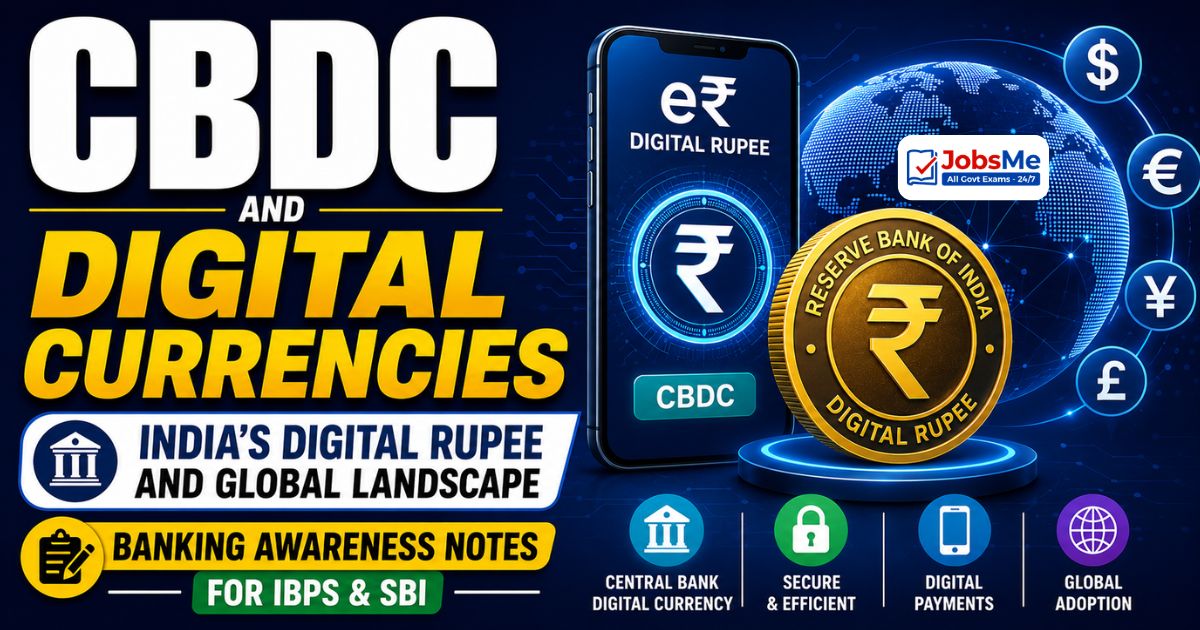
CBDC and Digital Currencies covers India's Digital Rupee (e₹) — the world's first CBDC from a major emerging economy — in complete detail for banking awareness examinations. Topics include the definition and need for CBDC, differences between CBDC and physical currency and between CBDC and UPI, the RBI Concept Note (October 2022), Wholesale CBDC (e₹-W, launched November 1, 2022), Retail CBDC (e₹-R, launched December 1, 2022), the 2025 pilot status (17 banks, 6 million users, Rs. 1,016 crore in circulation), programmable CBDC use cases, the UMI platform, deposit tokenization, and the global CBDC landscape including Sand Dollar (Bahamas), eNaira (Nigeria) and e-CNY (China).
Jump to section
- CBDC - Definition, Need and Types
- India's Digital Rupee (e₹) — Complete Timeline and Status
- India's Digital Rupee — Key Design Features
- Programmable CBDC — Real-World Use Cases in India
- Wholesale CBDC and UMI (Unified Market Interface)
- CBDC vs UPI vs Physical Cash — Three-Way Comparison
- Global CBDC Landscape — Key Countries and Status
- Risks and Concerns with CBDC
- Memory Tricks — CBDC
- One-Liners for Quick Revision — CBDC
CBDC - Definition, Need and Types
A Central Bank Digital Currency (CBDC) is a digital form of a country's fiat currency issued and regulated by its central bank. It carries the same legal tender status as physical banknotes and coins but exists in electronic form. CBDCs are distinct from private cryptocurrencies (like Bitcoin) which are decentralized and lack government backing, and from commercial bank digital money (like deposits in bank accounts) which is a commercial bank liability rather than a central bank liability.
Why CBDCs Are Being Developed Globally
- Financial inclusion: CBDC can reach unbanked populations who lack bank accounts but have basic mobile phones
- Payment efficiency: Programmable CBDC can eliminate intermediaries in government benefit transfers, reducing leakage and improving targeting
- Reduced transaction costs: Direct central bank money transfers potentially eliminate interbank settlement costs
- Modernizing payment infrastructure: CBDCs can settle financial market transactions instantly and atomically — simultaneously delivering both sides of a trade
- Countering private cryptocurrencies: Many central banks are developing CBDCs partly to maintain monetary sovereignty and counter the threat of private digital currencies replacing sovereign money
- Cross-border payments: Interoperable CBDCs across countries could dramatically reduce the cost and time of international remittances
Types of CBDC
| Type | Target Users | Purpose | India's Version |
|---|---|---|---|
| Wholesale CBDC | Financial institutions — banks, primary dealers, clearing corporations | Interbank settlements, government securities transactions, asset tokenization, replacing RTGS for institutional settlements | e₹-W (launched November 1, 2022) |
| Retail CBDC | General public — individuals and businesses | Person-to-person and person-to-merchant payments; replacing physical cash for everyday transactions; financial inclusion | e₹-R (launched December 1, 2022) |
India's Digital Rupee (e₹) — Complete Timeline and Status
| Date | Milestone |
|---|---|
| Budget 2022 (February 1, 2022) | Finance Minister Nirmala Sitharaman announced RBI would introduce CBDC in FY2022-23 |
| October 5, 2022 | RBI's Fintech Department published the CBDC Concept Note — outlined design choices, models, technology and legal framework |
| November 1, 2022 | Wholesale CBDC (e₹-W) pilot launched — 9 participating banks; used for settling government securities transactions on NDS-OM platform |
| December 1, 2022 | Retail CBDC (e₹-R) pilot launched — started in 4 cities (Mumbai, New Delhi, Bengaluru, Bhubaneswar) with 4 banks (SBI, ICICI Bank, Yes Bank, IDFC First Bank) |
| December 2022 - 2023 | Pilot expanded geographically and to more banks; UPI interoperability enabled — e₹ wallets can make UPI QR code payments |
| August 2024 | HDFC Bank introduced user-level programmability feature in e₹-R wallet on August 29, 2024 — users can set spending rules on their own Digital Rupees |
| March 2025 | 17 participating banks; over 6 million registered users; approximately Rs. 1,016 crore worth of e₹-R in circulation |
| October 8, 2025 | Wholesale CBDC deposit tokenization pilot launched — bank deposits tokenized using blockchain; settled using e₹-W; pilot towards UMI vision |
India's Digital Rupee — Key Design Features
| Feature | Details |
|---|---|
| Issuer and Liability | Issued by RBI; recorded as a liability on RBI's balance sheet — just like physical banknotes; not on commercial banks' balance sheets |
| Legal Tender Status | Legal tender with the same monetary value and acceptability as physical banknotes and coins |
| Account Model | Token-based model — e₹ tokens are equivalent to physical banknotes held in a digital wallet; the holder of the token is treated as its owner without requiring account verification |
| Technology | Can be based on blockchain or distributed ledger technology (DLT) or centralized technology — RBI has flexibility; uses intermediated model where banks distribute e₹ to end users |
| Intermediated Model | RBI does not directly interface with individual consumers; distributes e₹ to commercial banks (at par for physical cash) and banks distribute to their customers through e₹ wallets |
| Programmability | e₹ can be programmed with specific spending rules — time limitations, merchant restrictions, geographic restrictions, purpose restrictions |
| Offline Capability | RBI is developing offline payment functionality for e₹ using NFC (Near Field Communication) technology — allowing small value payments even without internet connectivity |
| UPI Interoperability | e₹-R wallets are interoperable with UPI — users can scan any UPI QR code and pay using their Digital Rupee wallet; expands acceptance significantly |
| Interest Bearing | Currently non-interest bearing — like physical cash, e₹ does not earn interest; this is to prevent disintermediation of banks (people moving all deposits to e₹ wallets) |
| KYC Requirements | Full KYC required to access e₹-R retail wallets through the bank's app; same KYC standards as regular bank accounts |
Programmable CBDC — Real-World Use Cases in India
Programmability is one of the most transformative features of CBDC. Unlike physical cash which can be spent on anything by anyone, programmable Digital Rupees can have rules built directly into the currency tokens. This has profound implications for government benefit transfers, targeted subsidies and corporate treasury management.
| Use Case | State/Institution | How Programmability Works |
|---|---|---|
| G-SAFAL Livelihood Assistance | Government of Gujarat | Agricultural livelihood assistance payments restricted to approved agricultural input suppliers within designated geographic areas; beneficiaries cannot spend on other items or at unauthorized merchants |
| DEEPAM 2.0 LPG Subsidy | Government of Andhra Pradesh | LPG subsidy distributed as programmable e₹; beneficiaries can redeem only upon receiving a gas cylinder from a registered LPG agency — ensures subsidy goes to actual purchase and not diverted |
| Carbon Credit Compensation | IndusInd Bank, Maharashtra | Farmers who sold carbon credits received compensation as programmable e₹ tokens — India's first programmable CBDC agriculture use case |
| Corporate Vouchers | Multiple private sector pilots | Companies issuing staff food allowances or travel allowances as programmable e₹ that can only be spent at designated merchants — reduces misuse and reconciliation costs |
| User-Level Programmability (HDFC Bank) | HDFC Bank | HDFC Bank introduced a feature on August 29, 2024 where users themselves can set rules on their e₹ — for example, restricting their own e₹ to only grocery purchases; helps with personal budgeting |
Wholesale CBDC and UMI (Unified Market Interface)
Wholesale CBDC (e₹-W) Use Cases
- Government Securities Settlement: e₹-W was first used for settling government securities (G-Sec) transactions on the NDS-OM (Negotiated Dealing System — Order Matching) platform; atomic delivery-versus-payment (DvP) settlement eliminates settlement risk
- Interbank Settlement: Banks settle interbank obligations using e₹-W — faster than traditional RTGS for some use cases
- Cross-Border CBDC Pilots: India is participating in the BIS Innovation Hub's Project mBridge (exploring multi-CBDC platform for cross-border payments) alongside central banks of China, UAE, Thailand and Hong Kong
- Deposit Tokenization Pilot (October 8, 2025): Bank deposits tokenized using blockchain technology; the tokenized deposit transferred using e₹-W as settlement currency — a step towards UMI
UMI — Unified Market Interface
UMI (Unified Market Interface) is a vision for next-generation financial market infrastructure unveiled by RBI Governor Sanjay Malhotra at the Global FinTech Festival (GFF) 2025 in Mumbai. UMI builds on the wholesale CBDC to create a programmable, tokenized financial market infrastructure where:
- Financial assets (government securities, bonds, commercial paper) are tokenized — converted into digital tokens on a distributed ledger
- These tokenized assets are traded and settled atomically using wholesale e₹ — both the asset delivery and cash payment occur simultaneously and instantaneously, eliminating settlement risk
- The settlement is programmable — complex financial transactions with multiple conditions can be automatically executed when conditions are met (smart contracts)
- UMI is described by RBI as representing the future of financial markets — the "UMI moment" paralleling the "UPI moment" in payments
CBDC vs UPI vs Physical Cash — Three-Way Comparison
| Parameter | Physical Cash | UPI | CBDC (e₹) |
|---|---|---|---|
| Nature | Physical notes and coins | Payment interface moving commercial bank money | Digital central bank money — same as cash but digital |
| Liability on | RBI balance sheet | Commercial bank balance sheet (sender and receiver's bank accounts) | RBI balance sheet — directly, like notes |
| Bank account needed | No — cash is anonymous and can be used without any account | Yes — both sender and receiver must have bank accounts | No — e₹ wallet can be set up with simplified KYC; token can transfer wallet-to-wallet |
| Settlement | Immediate and final on physical handover | Through banking system — NPCI, beneficiary bank settlement | Immediate and final on token transfer |
| Programmable | No — cash has no embedded conditions | No — the payment mechanism has no restrictions on use of funds | Yes — spending rules can be built into e₹ tokens |
| Offline possible | Yes — cash works without any technology | No — requires internet connectivity | Being developed using NFC technology for offline payments |
| Interest earning | No | Money sits in savings account and earns interest | No — currently non-interest bearing |
| Privacy | Complete anonymity in physical handover | Transaction data with NPCI and banks | Partial anonymity — RBI has transaction visibility; less than UPI for small transactions |
Global CBDC Landscape — Key Countries and Status
| Country | CBDC Name | Launch | Status and Key Facts |
|---|---|---|---|
| The Bahamas | Sand Dollar | October 2020 | World's first live retail CBDC; issued by Central Bank of the Bahamas; designed for financial inclusion in island archipelago |
| Nigeria | eNaira | October 25, 2021 | Africa's first and world's first major developing economy retail CBDC; issued by Central Bank of Nigeria (CBN); initially slow adoption but growing |
| Jamaica | JAM-DEX (Jamaican Digital Exchange) | January 2022 | One of the early live retail CBDCs; issued by Bank of Jamaica; offers incentives for adoption |
| China | e-CNY (Digital Yuan / Digital Renminbi) | Pilot 2020; large-scale rollout ongoing | World's largest CBDC pilot by population; used in multiple cities; integrated into Alipay and WeChat Pay; distributed at major events; expanding to cross-border use; promotes international use of RMB |
| India | Digital Rupee (e₹) | Wholesale: Nov 1, 2022; Retail: Dec 1, 2022 | Pilot stage; 17 banks; 6 million+ users; Rs. 1,016 crore in circulation (March 2025); programmable features being added |
| Eastern Caribbean Currency Union | DCash | March 2021 | Multi-country CBDC for ECCB member countries; faced technical outage in 2022 but restored |
| European Union | Digital Euro | Under design — not launched | ECB in preparation phase; legislation under EU Parliament review; expected to take several years before launch |
| USA | Digital Dollar (FedCoin) | Not launched; research only | Federal Reserve has been cautious; Congress divided; political and privacy concerns; no launch timeline announced |
| UK | Digital Pound (Britcoin) | Under design — not launched | Bank of England and HM Treasury conducting design consultation; decision on full launch pending |
| Sweden | e-Krona | Pilot completed; not live | Riksbank conducted pilots with Accenture; exploring full launch given declining cash usage in Sweden |
Global CBDC Status (2025): More than 130 countries, representing approximately 98% of global GDP, are at some stage of exploring, developing, piloting or launching CBDCs. This represents a dramatic acceleration from just 35 countries exploring CBDCs in 2020.
Risks and Concerns with CBDC
- Disintermediation of banks: If people move large deposits from commercial bank accounts to e₹ wallets (which are RBI liabilities), banks lose a key funding source for lending — potentially damaging the banking system's credit creation capacity. RBI addresses this by making e₹ non-interest bearing and limiting per-wallet balances
- Privacy concerns: Programmable and traceable CBDC gives the government and central bank unprecedented visibility into citizens' spending — raising serious civil liberties and financial privacy concerns
- Cybersecurity risk: A centralized digital currency system is a high-value target for cyberattacks; any breach could disrupt the entire payments system
- Financial stability during crises: If people rush to convert all commercial bank deposits to CBDC during a bank run, it could accelerate the collapse of weak banks by rapidly withdrawing their deposit base
- Technology and operational risk: Complex DLT and blockchain systems require significant investment and expertise; outages would be very damaging to public confidence
Memory Tricks — CBDC
Remember Launch Dates
Trick: Wholesale before Retail = W before R alphabetically = November before December chronologically. e₹-W: November 1, 2022 (W comes first in alphabet). e₹-R: December 1, 2022 (R comes after W). Always one month gap.
Remember World Firsts
Trick: First = Bahamas (Sand Dollar, 2020). First in Africa = Nigeria (eNaira, October 2021). Largest pilot = China (e-CNY). India = one of the first major emerging economies (2022).
Remember CBDC vs UPI Distinction
Trick: UPI = Pipe (payment system, moves bank money). e₹ = Water (the money itself, RBI liability). One is infrastructure; the other is the currency. e₹ IS the money. UPI MOVES the money.
Remember RBI Pilot Status (2025)
Trick: "17 banks, 6 million users, Rs. 1,016 crore." Three key numbers for March 2025 retail pilot: 17 (banks), 6 (million users), 1016 (crores in circulation).
One-Liners for Quick Revision — CBDC
- CBDC: digital legal tender issued by central bank; same value as physical currency.
- e₹ is a liability on RBI's balance sheet — not on commercial banks' balance sheets.
- RBI CBDC Concept Note: October 5, 2022.
- Wholesale e₹-W launched: November 1, 2022.
- Retail e₹-R launched: December 1, 2022.
- e₹ retail pilot (March 2025): 17 banks, 6 million+ users, Rs. 1,016 crore in circulation.
- e₹ is non-interest bearing — unlike bank deposits; prevents bank disintermediation.
- e₹ uses token-based model — like physical banknotes in digital form.
- e₹-R interoperable with UPI — can pay at any UPI QR code merchant.
- Programmable e₹: rules embedded in tokens — used in Gujarat G-SAFAL, AP DEEPAM 2.0.
- Deposit tokenization pilot: October 8, 2025 — blockchain-settled using e₹-W.
- UMI (Unified Market Interface): tokenized financial market infrastructure using wholesale e₹.
- World's first live retail CBDC: Sand Dollar (Bahamas, October 2020).
- Africa's first CBDC: eNaira (Nigeria, October 25, 2021).
- World's largest CBDC pilot: e-CNY (China, Digital Yuan).
- EU CBDC: Digital Euro — under preparation; not yet launched.
- USA CBDC: Digital Dollar — research only; no launch timeline.
- 130+ countries exploring CBDC — covering 98% of global GDP.
Preparing for competitive exams requires consistent revision. Platforms like JobsMe simplify preparation through:
- Daily Current Affairs
- Weekly Current Affairs
- Monthly Current Affairs
- Static GK for Competitive Exams
- Latest Government Jobs Notifications
- Computer Awareness
Stay updated, revise regularly, and attempt quizzes for better accuracy in UPSC, SSC CGL, IBPS PO/Clerk, SBI, RBI Grade B, RRB NTPC, Defence, and State PSC exams.
Free quiz • No signup required
Put this topic into practice with Daily Current Affairs MCQ Quiz – 9 May 2026 | SSC, Banking, UPSC, Railways & Defence Exams. It is the quickest way to reinforce what you just learned.
Frequently Asked Questions
What is a CBDC and how is it different from physical currency?
What is the difference between CBDC and UPI?
When did India launch its Digital Rupee?
What is programmable CBDC and how is it being used in India?
What is UMI and how does it relate to CBDC?
What was the world's first live retail CBDC?

About the author