Nuclear Power Plants in India – Static GK & General Awareness for Competitive Exams with Memory Tricks
This article covers a complete state-wise list of operational, under-construction, and proposed nuclear power plants in India along with their reactor types, capacities, and key facts. It is designed for UPSC, SSC, IBPS, RRB, Insurance, Defence, and State PCS aspirants, with memory tricks, one-liners, and FAQs for quick revision. All facts are organised in an exam-ready format to help students master the General Awareness section.
Jump to section
- Introduction
- Core Concepts: Nuclear Power and Reactor Types
- List of Operational Nuclear Power Plants in India
- Nuclear Power Plants Under Construction in India
- Proposed and Planned Nuclear Power Plants in India
- India's Nuclear Programme: Key Institutions and Milestones
- Memory Tricks and Mnemonics
- Additional Notes
- One-Liners for Quick Revision
Introduction
India is the fifth-largest source of electricity generated through nuclear power, ranking after thermal, hydroelectric, wind, and other renewable sources. As of 2025, India has 8 nuclear power stations with 23 operational reactors and an installed capacity of around 8.18 GW, with an ambitious target of reaching 100 GW by 2047. Of the operating reactors, 18 are Pressurised Heavy Water Reactors (PHWRs) and 4 are Light Water Reactors (LWRs). For students preparing for competitive exams, knowledge of nuclear power plants — their locations, reactor types, capacities, and the personalities behind India's atomic programme — is a recurring and high-scoring topic in Static GK and General Awareness sections.
Questions on nuclear power plants in India regularly appear in UPSC Prelims, SSC CGL, IBPS PO/Clerk, RRB NTPC, SBI, LIC, NIACL, EPFO, State PCS, and Defence exams. Aspirants are asked which state hosts a particular plant, which reactor type is used, or which plant was India's first. This article presents all the key facts in a structured, exam-ready format. To explore more energy and infrastructure-related Static GK, visit the Dams in India guide on Jobsme.in.
Beyond exams, India's nuclear sector is closely tied to current affairs — from the Nuclear Energy Mission launched in Union Budget 2025-26 targeting 5 indigenous Small Modular Reactors by 2033, to the SHANTI Act 2025 which permits private sector participation in nuclear energy. Mastering this topic builds the foundation for objective questions and supports descriptive answers in UPSC Mains and essay papers on energy security and climate change.
Core Concepts: Nuclear Power and Reactor Types
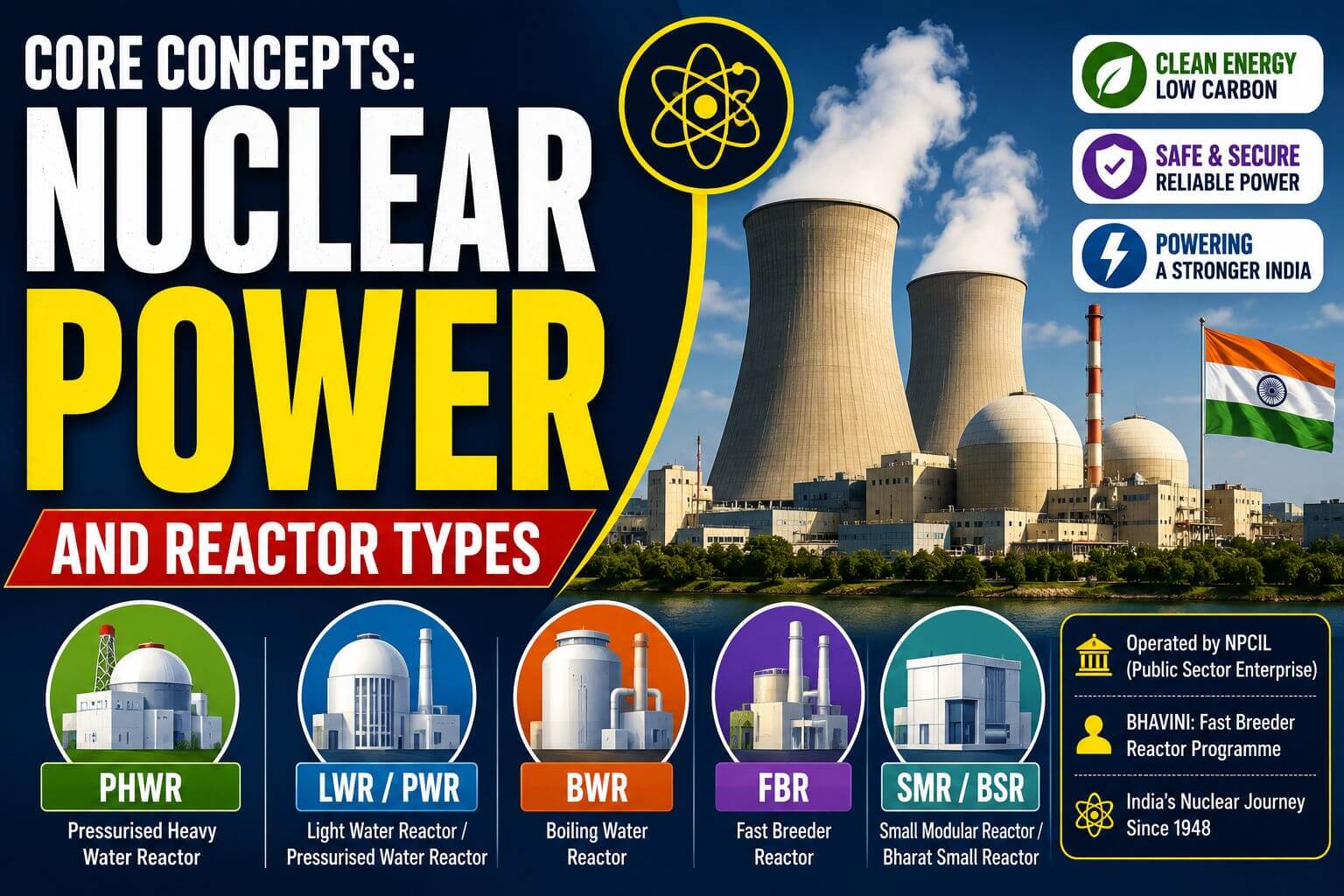
Nuclear power is generated through nuclear fission, a process in which the nucleus of a heavy element such as uranium is split, releasing a tremendous amount of heat. This heat converts water into steam, which drives turbines to produce electricity. Unlike fossil fuels, nuclear power produces no greenhouse gas emissions, making it a clean energy source, though it generates radioactive waste that requires careful long-term storage.
- Pressurised Heavy Water Reactor (PHWR): Uses natural uranium as fuel and heavy water (D2O) as both moderator and primary coolant. India operates the largest fleet of PHWRs in the world; most are based on the Canadian CANDU design.
- Light Water Reactor (LWR) / Pressurised Water Reactor (PWR): Uses enriched uranium as fuel and ordinary (light) water as moderator and coolant. Kudankulam units in Tamil Nadu use the Russian VVER-1000 design.
- Boiling Water Reactor (BWR): The first reactors at Tarapur (TAPS-1 and TAPS-2) were BWRs, the first of their kind in Asia.
- Fast Breeder Reactor (FBR): Produces more fissile material than it consumes. The Prototype Fast Breeder Reactor (PFBR) at Kalpakkam is being developed by BHAVINI.
- Small Modular Reactor (SMR) / Bharat Small Reactor (BSR): Compact, modular designs with lower costs and flexible deployment, central to India's 2047 nuclear roadmap.
All commercial nuclear power plants in India are operated by Nuclear Power Corporation of India Limited (NPCIL), a public sector enterprise headquartered in Mumbai under the Department of Atomic Energy (DAE). The Bharatiya Nabhikiya Vidyut Nigam Limited (BHAVINI) is responsible for the Fast Breeder Reactor programme. India's nuclear journey began with the formation of the Atomic Energy Commission (AEC) in 1948 under Homi J. Bhabha, and Asia's first nuclear research reactor, Apsara, was commissioned at Trombay, Mumbai.
List of Operational Nuclear Power Plants in India
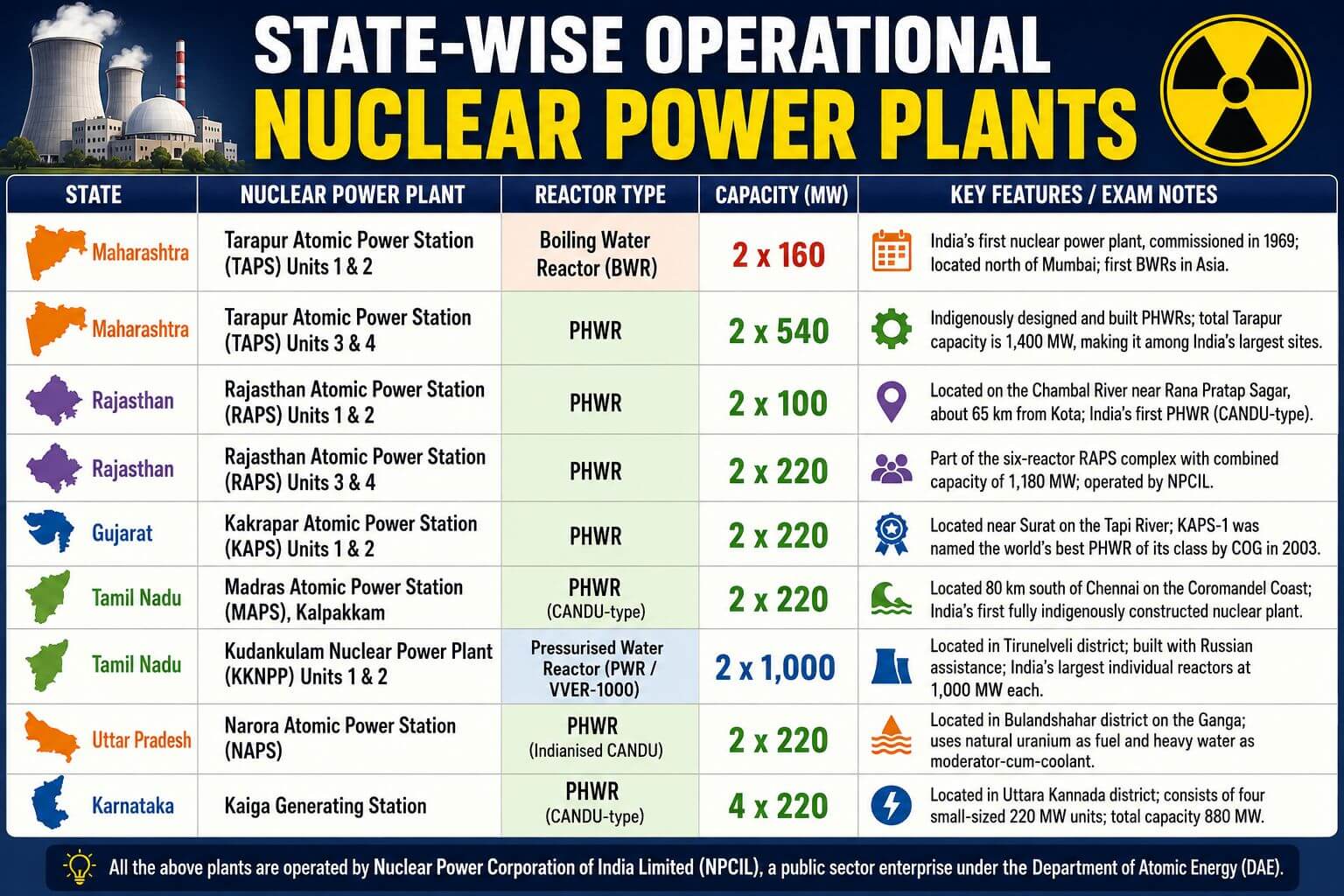
The following table presents a complete, state-wise list of all operational nuclear power plants in India along with their reactor types, capacities, and key features.
State-Wise Operational Nuclear Power Plants
| State | Nuclear Power Plant | Reactor Type | Capacity (MW) | Key Features / Exam Notes |
|---|---|---|---|---|
| Maharashtra | Tarapur Atomic Power Station (TAPS) Units 1 & 2 | Boiling Water Reactor (BWR) | 2 x 160 | India's first nuclear power plant, commissioned in 1969; located north of Mumbai; first BWRs in Asia. |
| Maharashtra | Tarapur Atomic Power Station (TAPS) Units 3 & 4 | PHWR | 2 x 540 | Indigenously designed and built PHWRs; total Tarapur capacity is 1,400 MW, making it among India's largest sites. |
| Rajasthan | Rajasthan Atomic Power Station (RAPS) Units 1 & 2 | PHWR | 2 x 100 | Located on the Chambal River near Rana Pratap Sagar, about 65 km from Kota; India's first PHWR (CANDU-type). |
| Rajasthan | Rajasthan Atomic Power Station (RAPS) Units 3 & 4 | PHWR | 2 x 220 | Part of the six-reactor RAPS complex with combined capacity of 1,180 MW; operated by NPCIL. |
| Gujarat | Kakrapar Atomic Power Station (KAPS) Units 1 & 2 | PHWR | 2 x 220 | Located near Surat on the Tapi River; KAPS-1 was named the world's best PHWR of its class by COG in 2003. |
| Tamil Nadu | Madras Atomic Power Station (MAPS), Kalpakkam | PHWR (CANDU-type) | 2 x 220 | Located 80 km south of Chennai on the Coromandel Coast; India's first fully indigenously constructed nuclear plant. |
| Tamil Nadu | Kudankulam Nuclear Power Plant (KKNPP) Units 1 & 2 | Pressurised Water Reactor (PWR / VVER-1000) | 2 x 1,000 | Located in Tirunelveli district; built with Russian assistance; India's largest individual reactors at 1,000 MW each. |
| Uttar Pradesh | Narora Atomic Power Station (NAPS) | PHWR (Indianised CANDU) | 2 x 220 | Located in Bulandshahar district on the Ganga; uses natural uranium as fuel and heavy water as moderator-cum-coolant. |
| Karnataka | Kaiga Generating Station | PHWR (CANDU-type) | 4 x 220 | Located in Uttara Kannada district; consists of four small-sized 220 MW units; total capacity 880 MW. |
Quick Summary of Operational Capacity
- Tarapur (Maharashtra): 1,400 MW - India's largest nuclear power station by total installed capacity.
- Kudankulam (Tamil Nadu): 2,000 MW - Largest reactor units; planned total capacity of 6,000 MW.
- Rajasthan (Rawatbhata): 1,180 MW from 6 reactors - India's longest-running PHWR site.
- Kaiga (Karnataka): 880 MW - All four units are 220 MW small CANDU plants.
- Kalpakkam (MAPS) and Kakrapar (KAPS): 440 MW each - Both indigenously built PHWR sites.
- Narora (UP): 440 MW - Only nuclear plant in the Hindi heartland.
Nuclear Power Plants Under Construction in India
Several nuclear projects are at various stages of construction across India, with a focus on indigenous PHWR-700 reactors and Russian VVER-1000 units. The table below lists all under-construction plants.
| State | Nuclear Power Plant | Reactor Type | Capacity (MW) | Expected Completion / Notes |
|---|---|---|---|---|
| Gujarat | Kakrapar Atomic Power Plant (KAPP) Units 3 & 4 | Indigenous PHWR-700 | 2 x 700 | India's first 700 MW indigenous reactor; KAPP-3 already achieved criticality; full commissioning by 2024. |
| Tamil Nadu | Kalpakkam Prototype Fast Breeder Reactor (PFBR) | Prototype Fast Breeder Reactor | 500 | Operated by BHAVINI; central to India's three-stage nuclear programme using thorium reserves. |
| Rajasthan | Rajasthan Atomic Power Plant (RAPP) Units 7 & 8 | Indigenous PHWR-700 | 2 x 700 | Will increase total RAPS capacity significantly; operated by NPCIL; expected commissioning 2023-24. |
| Tamil Nadu | Kudankulam Nuclear Power Plant (KKNPP) Units 3 & 4 | VVER-1000 (Russian PWR) | 2 x 1,000 | Built with Russian assistance; expected completion by 2026-27; will make Kudankulam India's largest nuclear complex. |
| Haryana | Gorakhpur Haryana Anu Vidyut Pariyojana (GHAVP) Units 1 & 2 | Indigenous PHWR-700 | 2 x 700 | First nuclear plant in Haryana; located in Fatehabad district; expected completion 2029-30. |
Proposed and Planned Nuclear Power Plants in India
India has several nuclear power projects in the proposed and planning stage, with site clearances and environmental approvals at various levels. These projects involve both indigenous PHWR-700 designs and large foreign-collaboration reactors from France, Russia, and the USA.
| State | Nuclear Power Plant | Capacity (MW) | Status / Key Features |
|---|---|---|---|
| Madhya Pradesh | Chutka Nuclear Power Plant | 2 x 700 | Indigenous PHWR-700; site clearance obtained; planned future capacity 1,400 MW. |
| Rajasthan | Mahi Banswara Nuclear Power Plant | 2 x 700 | Site clearance obtained; planned future expansion to 2,800 MW capacity. |
| Karnataka | Kaiga Nuclear Power Plant Units 5 & 6 | 2 x 700 | Environmental clearance obtained; will boost Kaiga's total capacity to 1,400 MW. |
| Madhya Pradesh | Bhimpur Nuclear Power Plant | 4 x 700 | Pre-project activities underway; planned capacity of 2,800 MW. |
| Andhra Pradesh | Kovvada Nuclear Power Plant | 6 x 1,000 | Located in Ranasthalam Mandal, Srikakulam district; planned with US assistance; total 6,600 MW; pre-project stage. |
| West Bengal | Haripur Nuclear Power Plant | 6 x 1,000 | Coastal village in East Medinipur district; planned with Russian assistance; faces local protests; capacity up to 10,000 MW. |
| Gujarat | Mithi Virdi (Chhaya Mithi Virdi) Nuclear Power Plant | 6,000 | Proposed near Alang Port; planned with US assistance; pre-project activities pending. |
| Maharashtra | Jaitapur Nuclear Power Plant | 6 x 1,650 | India's largest planned nuclear plant; 6 European Pressurised Reactors (EPR) by Areva, France; total 9,900 MW; in seismic Zone V. |
| Maharashtra | Tarapur (Future Expansion) | 300 | Planned future capacity addition at the existing Tarapur site. |
| Tamil Nadu | Madras (Future Expansion) | 1,200 | Planned capacity addition at Kalpakkam beyond MAPS and PFBR. |
India's Nuclear Programme: Key Institutions and Milestones
Understanding the institutions and historical milestones is essential for both objective and descriptive sections of competitive exams. To revise India's other premier institutions and PSUs, refer to the Static GK section on Jobsme.in.
| Year / Item | Event / Institution | Key Details |
|---|---|---|
| 1948 | Atomic Energy Commission (AEC) | Formed under the leadership of Homi J. Bhabha to promote peaceful uses of atomic energy. |
| 1954 | Atomic Energy Establishment, Trombay | Renamed Bhabha Atomic Research Centre (BARC) in 1967; India's premier nuclear research facility. |
| 1956 | Apsara Reactor | Asia's first nuclear research reactor; commissioned at Trombay, Mumbai. |
| 1969 | Tarapur Atomic Power Station | India's first commercial nuclear power station; the BWRs at TAPS were Asia's first of their kind. |
| 1974 | Smiling Buddha (Pokhran-I) | India's first nuclear test, conducted under PM Indira Gandhi; made India the sixth nuclear-capable nation. |
| 1998 | Pokhran-II | Series of nuclear tests; India declared itself a nuclear-weapon state. |
| NPCIL | Nuclear Power Corporation of India Limited | Public sector enterprise headquartered in Mumbai; operates all commercial nuclear plants under DAE. |
| BHAVINI | Bharatiya Nabhikiya Vidyut Nigam Limited | PSU responsible for the Prototype Fast Breeder Reactor at Kalpakkam. |
| IAEA & NSG | International Atomic Energy Agency & Nuclear Suppliers Group | India is a member of IAEA; engages with NSG for civilian nuclear cooperation. |
| 2025 | Nuclear Energy Mission | Launched in Union Budget 2025-26; targets 5 indigenous Small Modular Reactors (SMRs) by 2033. |
| 2025 | SHANTI Act | Sustainable Harnessing and Advancement of Nuclear Energy for Transforming India; passed in December 2025; allows private sector entry. |
Memory Tricks and Mnemonics
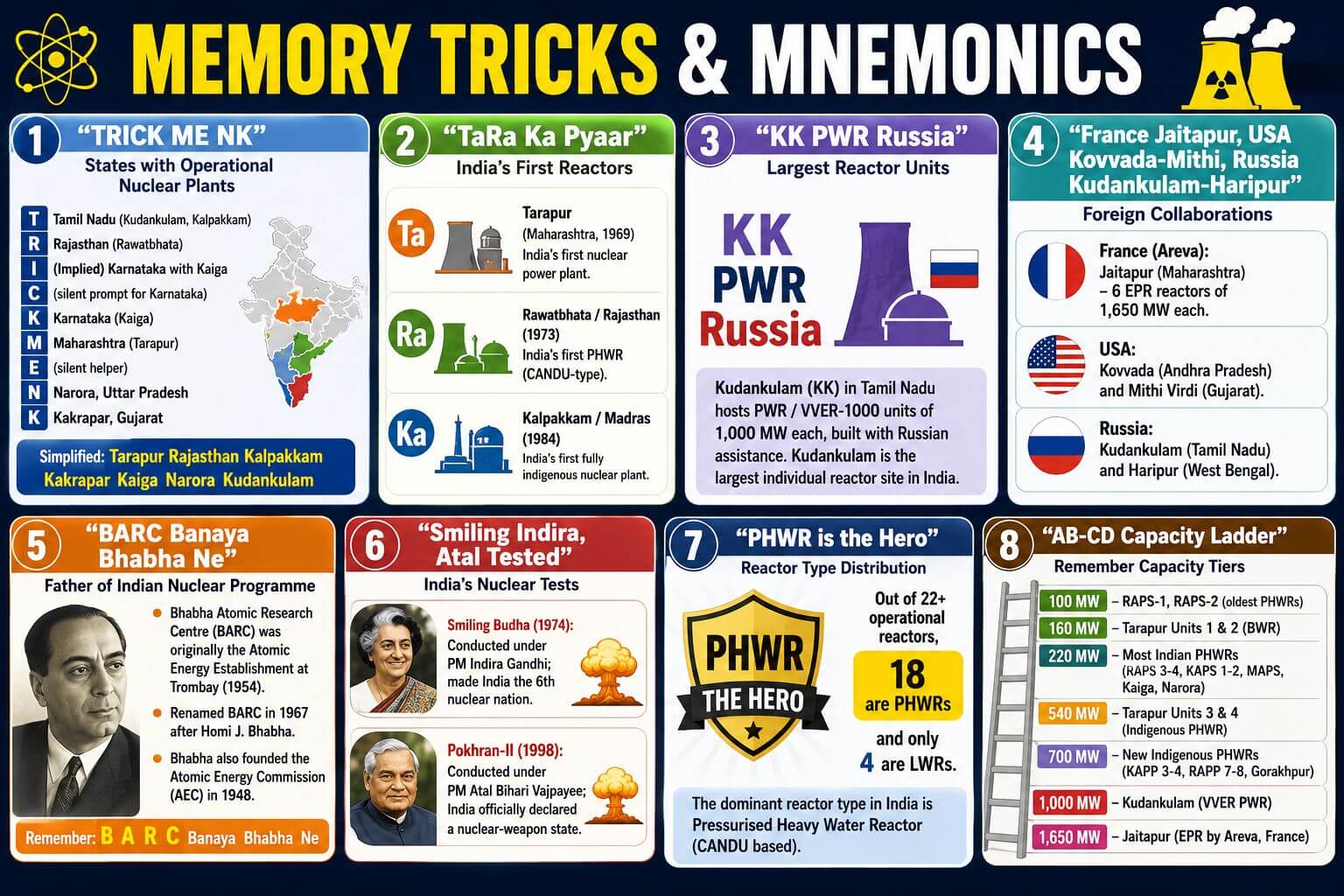
Trick 1: "TRICK ME NK" - States with Operational Nuclear Plants
Use the mnemonic "TRICK ME NK" to remember the seven states with operational nuclear power plants:
- T - Tamil Nadu (Kudankulam, Kalpakkam)
- R - Rajasthan (Rawatbhata)
- I - (Implied) Karnataka with Kaiga - think "K"
- C - (silent prompt for Karnataka)
- K - Karnataka (Kaiga)
- M - Maharashtra (Tarapur)
- E - (silent helper)
- N - Narora, Uttar Pradesh
- K - Kakrapar, Gujarat
Simplified version: "Tarapur Rajasthan Kalpakkam Kakrapar Kaiga Narora Kudankulam" - T-R-K-K-K-N-K covers all seven sites.
Trick 2: "TaRa Ka Pyaar" - India's First Reactors
Remember "TaRa Ka Pyaar" to recall the first three commercial nuclear power stations of India:
- Ta - Tarapur (Maharashtra, 1969) - India's first nuclear power plant.
- Ra - Rawatbhata / Rajasthan (1973) - India's first PHWR (CANDU-type).
- Ka - Kalpakkam / Madras (1984) - India's first fully indigenous nuclear plant.
Trick 3: "KK PWR Russia" - Largest Reactor Units
Use "KK PWR Russia" to remember that Kudankulam (KK) in Tamil Nadu hosts PWR/VVER-1000 units of 1,000 MW each, built with Russian assistance. Kudankulam is the largest individual reactor site in India.
Trick 4: "France Jaitapur, USA Kovvada-Mithi, Russia Kudankulam-Haripur"
Memorise foreign collaborations with this contrast trick:
- France (Areva): Jaitapur (Maharashtra) - 6 EPR reactors of 1,650 MW each.
- USA: Kovvada (Andhra Pradesh) and Mithi Virdi (Gujarat).
- Russia: Kudankulam (Tamil Nadu) and Haripur (West Bengal).
Trick 5: "BARC Banaya Bhabha Ne" - Father of Indian Nuclear Programme
The mnemonic "BARC Banaya Bhabha Ne" helps you recall that Bhabha Atomic Research Centre (BARC) was originally the Atomic Energy Establishment at Trombay (1954), renamed in 1967 after Homi J. Bhabha, the father of India's nuclear programme. Bhabha also founded the AEC in 1948.
Trick 6: "Smiling Indira, Atal Tested" - India's Nuclear Tests
Use this contrast trick to separate the two famous nuclear tests:
- Smiling Buddha (1974): Conducted under PM Indira Gandhi; made India the 6th nuclear nation.
- Pokhran-II (1998): Conducted under PM Atal Bihari Vajpayee; India officially declared a nuclear-weapon state.
Trick 7: "PHWR is the Hero" - Reactor Type Distribution
Out of 22+ operational reactors, 18 are PHWRs and only 4 are LWRs. Remember "PHWR is the Hero" - the dominant reactor type in India is Pressurised Heavy Water Reactor based on the Canadian CANDU design.
Trick 8: "AB-CD Capacity Ladder" - Remember Capacity Tiers
Use the ladder trick:
- 100 MW - RAPS-1, RAPS-2 (oldest PHWRs)
- 160 MW - Tarapur Units 1 & 2 (BWR)
- 220 MW - Most Indian PHWRs (RAPS 3-4, KAPS 1-2, MAPS, Kaiga, Narora)
- 540 MW - Tarapur Units 3 & 4 (Indigenous PHWR)
- 700 MW - New Indigenous PHWRs (KAPP 3-4, RAPP 7-8, Gorakhpur)
- 1,000 MW - Kudankulam (VVER PWR)
- 1,650 MW - Jaitapur (EPR by Areva, France)
Additional Notes
Frequently Confused Facts
- Apsara vs Tarapur: Apsara (1956, Mumbai) was Asia's first nuclear research reactor; Tarapur (1969) was India's first commercial nuclear power plant.
- BARC vs NPCIL: BARC is the research organisation; NPCIL is the corporate operator of commercial nuclear power plants.
- Kalpakkam (MAPS) vs Kalpakkam (PFBR): MAPS uses PHWR technology; the PFBR at the same site is a Prototype Fast Breeder Reactor operated by BHAVINI.
- Rawatbhata vs Rajasthan Atomic Power Station: Both names refer to the same plant on the Chambal River near Kota.
- Kakrapar vs Kaiga: Kakrapar is in Gujarat (on the Tapi River near Surat); Kaiga is in Karnataka (Uttara Kannada district).
- Smiling Buddha vs Operation Shakti: Smiling Buddha was the 1974 first test; Operation Shakti (Pokhran-II) was the 1998 test series.
- PHWR vs PWR: PHWR uses heavy water and natural uranium; PWR uses light water and enriched uranium.
Repeating PYQ Patterns
- SSC CGL & SSC CHSL: Frequently ask which state hosts a particular plant (e.g., Narora is in UP, Kaiga in Karnataka). The state-plant pairing is the most repeated question.
- IBPS PO & Clerk: Often ask about the operator (NPCIL), the largest nuclear plant (Tarapur by total capacity, Kudankulam by reactor size), and the Russian-aided plant (Kudankulam).
- UPSC Prelims: Tests conceptual depth - three-stage nuclear programme, thorium use, IAEA-NSG membership, and Bhabha's role in AEC formation.
- RRB NTPC & Group D: Ask basic facts like first nuclear plant (Tarapur), commissioning year (1969), and first nuclear test year (1974).
- State PCS & Defence: Focus on tests (Smiling Buddha, Pokhran-II), nuclear scientists (Homi J. Bhabha, Vikram Sarabhai), and current developments (SHANTI Act 2025, SMRs).
Quick Insight
India's nuclear sector has entered a transformative phase. The Union Budget 2025-26 launched the Nuclear Energy Mission with a target of 5 indigenous Small Modular Reactors (SMRs) by 2033, and the SHANTI Act 2025 - passed by Parliament in December 2025 - allows private companies to operate nuclear plants for the first time. The government has set a target to triple nuclear capacity by 2032 and reach 100 GW by 2047. Combined with international partnerships with France, Russia, and the USA, these reforms are tied to India's climate commitments and net-zero goals. Aspirants should also follow the Daily Current Affairs updates on Jobsme.in for the latest on Bharat Small Reactors (BSR) and uranium import deals, as such current affairs questions are increasingly common.
One-Liners for Quick Revision
- Tarapur Atomic Power Station (TAPS) → Maharashtra → India's first nuclear power plant, commissioned in 1969.
- TAPS-1 & TAPS-2 → BWR design → First Boiling Water Reactors in Asia; 2 x 160 MW.
- TAPS-3 & TAPS-4 → Indigenous PHWR → 2 x 540 MW; total Tarapur capacity 1,400 MW.
- Rajasthan Atomic Power Station (RAPS) → Rawatbhata, Rajasthan → On the Chambal River, 65 km from Kota.
- RAPS-1 & RAPS-2 → 2 x 100 MW PHWR → India's first pressurised heavy water reactor of CANDU type.
- RAPS Total Capacity → 1,180 MW from 6 reactors → India's longest-running PHWR site.
- Kakrapar Atomic Power Station (KAPS) → Gujarat → Located near Surat on the Tapi River; has a heavy water plant.
- KAPS-1 Recognition → 2003 → Distinguished as world's best PHWR of its class by CANDU Owners Group (COG).
- Madras Atomic Power Station (MAPS) → Kalpakkam, Tamil Nadu → 80 km south of Chennai on the Coromandel Coast.
- MAPS Significance → India's first fully indigenously constructed nuclear power station.
- Kudankulam Nuclear Power Plant (KKNPP) → Tirunelveli, Tamil Nadu → Built with Russian assistance.
- KKNPP Reactors → VVER-1000 PWR design → Water-cooled, water-moderated reactors of 1,000 MW each.
- KKNPP Future → Planned 6,000 MW total → Will become India's largest nuclear power complex.
- Narora Atomic Power Station (NAPS) → Bulandshahar, Uttar Pradesh → Located on the bank of the Ganga.
- NAPS Reactors → Indianised CANDU PHWRs → Use natural uranium fuel and heavy water as moderator-coolant.
- Kaiga Generating Station → Uttara Kannada, Karnataka → Four small CANDU-type PHWRs of 220 MW each.
- Kakrapar 3 & 4 (KAPP) → First indigenous 700 MW reactor → Achieved criticality recently.
- Kalpakkam PFBR → Prototype Fast Breeder Reactor → 500 MW; operated by BHAVINI.
- Rajasthan 7 & 8 (RAPP) → 2 x 700 MW PHWR → Expected commissioning 2023-24.
- Kudankulam 3 & 4 → 2 x 1,000 MW VVER → Expected completion 2026-27.
- Gorakhpur (GHAVP) → Fatehabad, Haryana → First nuclear plant in Haryana; 2 x 700 MW PHWR.
- Chutka Nuclear Power Plant → Madhya Pradesh → 2 x 700 MW; site clearance obtained.
- Mahi Banswara → Rajasthan → 2 x 700 MW PHWR; site clearance obtained.
- Kaiga 5 & 6 → Karnataka → 2 x 700 MW; environmental clearance obtained.
- Bhimpur → Madhya Pradesh → 4 x 700 MW; pre-project activities underway.
- Kovvada Nuclear Power Plant → Srikakulam, Andhra Pradesh → 6 x 1,000 MW; planned with US assistance.
- Haripur Nuclear Power Plant → East Medinipur, West Bengal → 6 x 1,000 MW; planned with Russian assistance.
- Mithi Virdi (Chhaya Mithi Virdi) → Near Alang Port, Gujarat → 6,000 MW planned with US assistance.
- Jaitapur Nuclear Power Plant → Maharashtra → 6 EPRs by Areva, France; 9,900 MW total.
- Jaitapur Concern → Falls in seismic Zone-V → Faces opposition due to earthquake risk.
- Apsara Reactor → 1956, Trombay, Mumbai → Asia's first nuclear research reactor.
- Atomic Energy Commission (AEC) → Founded 1948 → Under Homi J. Bhabha for peaceful atomic uses.
- BARC → Bhabha Atomic Research Centre → Renamed in 1967; located at Trombay, Mumbai.
- Smiling Buddha → 1974, Pokhran → India's first nuclear test under PM Indira Gandhi.
- Pokhran-II → 1998 → Series of tests; India declared a nuclear-weapon state.
- NPCIL → Public sector enterprise → Headquartered in Mumbai; operates all commercial plants.
- BHAVINI → Bharatiya Nabhikiya Vidyut Nigam → Operates the PFBR at Kalpakkam.
- Department of Atomic Energy (DAE) → Apex body → Reports directly to the Prime Minister.
- IAEA Membership → International Atomic Energy Agency → India is a long-standing member.
- NSG → Nuclear Suppliers Group → India engages with NSG for civilian nuclear cooperation.
- Russia's Role → Major supplier of nuclear fuel to India since the 1990s.
- India's Rank → 5th largest source of electricity from nuclear power.
- Operational Reactors (2025) → 23 reactors across 8 nuclear power stations.
- Reactor Type Split → 18 PHWRs and 4 LWRs in operation.
- Capacity Target → 100 GW by 2047 (from 8.18 GW currently).
- Nuclear Energy Mission → Launched in Union Budget 2025-26 → Targets 5 SMRs by 2033.
- Bharat Small Reactors (BSR) → Compact, modular reactors → Allow private sector participation.
- SHANTI Act 2025 → Sustainable Harnessing and Advancement of Nuclear Energy for Transforming India → Allows private operation in nuclear sector.
- Three-Stage Nuclear Programme → PHWR → Fast Breeder → Thorium-based reactors → India's roadmap.
- Nuclear Fission → Splitting of heavy atomic nuclei (uranium) → Releases energy as heat.
- Nuclear Fusion → Combining light nuclei → Process powering stars; future clean energy source.
- Henri Becquerel → 1896 → Discovered radioactivity.
- Marie & Pierre Curie → Isolated polonium and radium.
- Ernest Rutherford → 1911 → Proposed atomic model with positive nucleus.
- Otto Hahn & Fritz Strassmann → 1938 → Discovered nuclear fission.
- Mark Oliphant → 1930s → Proposed concept of nuclear fusion.
For more Static GK topics like dams, biosphere reserves, and major ports, explore the Biosphere Reserves in India guide on Jobsme.in. You can also test your preparation with the Static GK Quiz and check out the latest exam openings at Latest Government Job Notifications.
Free quiz • No signup required
Put this topic into practice with Indian Cultural Institutions – Static GK MCQ Quiz. It is the quickest way to reinforce what you just learned.
Frequently Asked Questions
Which is India's first nuclear power plant?
How many nuclear power plants are there in India in 2025?
Which is the largest nuclear power plant in India?
Who operates nuclear power plants in India?
Which Indian state has the most operational nuclear reactors?
What is the difference between PHWR and PWR reactors?
What was Operation Smiling Buddha?
What is the Nuclear Energy Mission launched in 2025?
Which is Asia's first nuclear research reactor?
What is the SHANTI Act 2025?

About the author