History of Banking in India – Static GK & Banking Awareness Notes for SSC, IBPS, UPSC, RRB and PSU Exams with Memory Tricks
This article presents the complete history of banking in India from the Bank of Hindustan (1770) and the three Presidency Banks to the formation of the Imperial Bank of India, the birth of the State Bank of India in 1955, the nationalisation of banks in 1969 and 1980, and the liberalisation reforms after 1991 leading to the modern bank mergers of 2017 to 2020. It covers the structure of Indian banking, the role of RBI, types of banks (Scheduled, Public Sector, Private Sector, Foreign, RRBs, Cooperative), key committees, and important dates, with memory tricks, mnemonics, and exam-ready one-liners. All facts are arranged in exam-friendly format to help UPSC, SSC, IBPS, RRB, PSU, Insurance, and State PCS aspirants score better in Banking Awareness, General Awareness, and Economy sections.
Jump to section
- Introduction
- Core Concepts: The Three Phases of Banking in India
- Phase 1: Pre-Independence Era (1770 to 1947)
- Phase 2: Post-Independence and Nationalisation Era (1947 to 1991)
- Phase 3: Liberalisation Era (1991 to Present)
- Structure and Components of the Indian Banking System
- Memory Tricks and Mnemonics
- Additional Notes
- One-Liners for Quick Revision
Introduction
The history of banking in India traces the journey of the country's financial system from the indigenous money-lenders of ancient India to the modern, technology-driven banking sector of today. The story begins with the Bank of Hindustan, founded in 1770 in Calcutta — the country's first joint-stock bank — and runs through the three Presidency Banks, the Imperial Bank of India (1921), the State Bank of India (1955), two waves of nationalisation in 1969 and 1980, the Narasimham Committee reforms of the 1990s, and the major public-sector bank mergers of 2017-2020 that reduced 27 public sector banks to just 12.
Questions on the history of banking in India are a staple of IBPS PO, IBPS Clerk, SBI PO, SBI Clerk, RBI Grade B, RRB NTPC, SSC CGL, UPSC Prelims, NABARD Grade A, Insurance (LIC AAO, NIACL AO), and State PCS exams. They typically appear in the Banking Awareness, General Awareness, and Economy sections. To explore a structured list of every banking topic that appears in exams, you can refer to the dedicated Banking Awareness notes section on Jobsme.in.
This article presents the full timeline, structure, components, and key reforms of Indian banking in one place — arranged in tables, mnemonics, and one-liners so that aspirants can revise the entire topic in a single sitting before the exam.
Core Concepts: The Three Phases of Banking in India
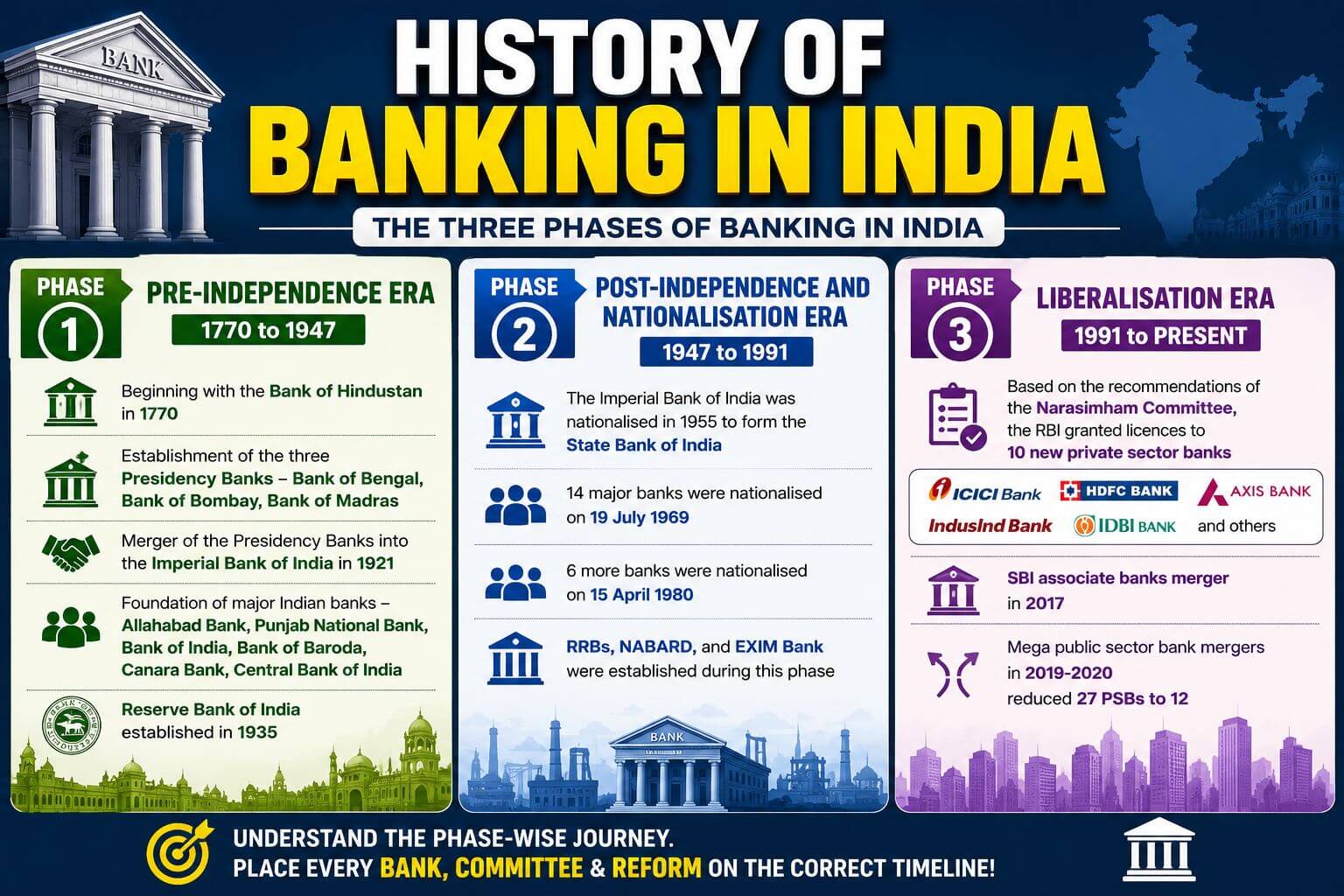
The history of banking in India is conventionally divided into three clear phases. Understanding the phase-wise framework helps students place every bank, committee, and reform on the correct timeline, which is exactly how exam questions are framed.
- Phase 1 - Pre-Independence Era (1770 to 1947): Beginning with the Bank of Hindustan in 1770, this phase saw the establishment of the three Presidency Banks (Bank of Bengal, Bank of Bombay, Bank of Madras), their merger into the Imperial Bank of India in 1921, and the founding of several major Indian banks such as Allahabad Bank, Punjab National Bank, Bank of India, Bank of Baroda, Canara Bank, and Central Bank of India. The Reserve Bank of India was also set up in 1935 during this phase.
- Phase 2 - Post-Independence and Nationalisation Era (1947 to 1991): The Imperial Bank of India was nationalised in 1955 to form the State Bank of India. Fourteen major banks were nationalised on 19 July 1969 and six more on 15 April 1980. RRBs, NABARD, and EXIM Bank were established during this phase.
- Phase 3 - Liberalisation Era (1991 to present): Based on the recommendations of the Narasimham Committee, the RBI granted licences to 10 new private sector banks (ICICI, HDFC, Axis, IndusInd, IDBI, etc.). This phase also saw the SBI associate banks merger in 2017 and the mega public sector bank mergers of 2019-2020 that reduced 27 PSBs to 12.
Phase 1: Pre-Independence Era (1770 to 1947)
The pre-independence era marks the foundation of the modern banking system in India. Over 600 banks were established during this period, but very few survived due to fraud, lack of technology, poor management, and limited facilities. The few that survived became the pillars of modern Indian banking.
Key Banks Established Before Independence
| Bank Name | Year of Establishment | Key Features and Exam Facts |
|---|---|---|
| Bank of Hindustan | 1770 | The first bank of India, headquartered in Calcutta (then capital of India); established by the agent of Alexander and Company; stopped operations by 1832 and is now non-existent. |
| Bank of Bengal | 1806 | First of the three Presidency Banks established by the East India Company; originally called the Bank of Calcutta. |
| Bank of Bombay | 1840 | Second Presidency Bank set up by the East India Company in Bombay. |
| Bank of Madras | 1843 | Third Presidency Bank set up by the East India Company in Madras. |
| Allahabad Bank | 1865 | Oldest joint-stock bank of India that continued operations until its merger with Indian Bank in 2020; founded in Allahabad. |
| Punjab National Bank (PNB) | 1894 | First Indian bank established purely with Indian capital and managed by Indians; founder Lala Lajpat Rai; headquartered in New Delhi. |
| Bank of India | 1906 | First commercial bank in India owned and managed by Indian shareholders; headquartered in Mumbai. |
| Canara Bank | 1906 | Founded by Ammembal Subba Rao Pai in Mangalore; headquartered in Bengaluru. |
| Bank of Baroda | 1908 | Founded by Maharaja Sayajirao Gaekwad III of Baroda; headquartered in Vadodara (Gujarat). |
| Central Bank of India | 1911 | First commercial bank fully owned and managed by Indians, founded by Sir Sorabji Pochkhanawala; headquartered in Mumbai. |
| Imperial Bank of India | 1921 | Formed by merging the three Presidency Banks (Bengal, Bombay, Madras); later nationalised in 1955 to form the State Bank of India. |
| Reserve Bank of India (RBI) | 1935 | Established under the RBI Act, 1934, on the recommendations of the Hilton-Young Commission; originally a private entity; first Governor Sir Osborne Smith; first Indian Governor C. D. Deshmukh. |
Reasons Why Most Pre-Independence Banks Failed
- Account holders were vulnerable to fraud and forgery.
- Absence of modern machines and banking technology.
- Heavy dependence on manual processes, leading to human errors and delays.
- Very limited customer facilities and product range.
- Lack of proper management and professional skills.
Phase 2: Post-Independence and Nationalisation Era (1947 to 1991)
After independence, the Indian government realised that most major banks were privately owned and rural Indians still depended on moneylenders. To direct credit toward agriculture, small industries, and weaker sections, the government undertook two major waves of nationalisation along with a string of institutional reforms. This phase also saw the conversion of the RBI itself into a fully government-owned institution.
Major Events of the Nationalisation Era
| Year | Event | Key Details |
|---|---|---|
| 1949 | Nationalisation of RBI | The Reserve Bank of India, originally set up as a private entity in 1935, was nationalised on 1 January 1949 and became a fully government-owned central bank. |
| 1949 | Banking Regulation Act | Enacted to give the RBI extensive powers to regulate, supervise, license, and inspect banking companies in India. |
| 1955 | Birth of State Bank of India | The Imperial Bank of India was nationalised under the SBI Act, 1955, and renamed the State Bank of India — the largest public sector bank of India. |
| 1959 | SBI Associate Banks Act | Seven state-associated banks (including State Bank of Patiala, State Bank of Hyderabad, State Bank of Bikaner & Jaipur, State Bank of Mysore, State Bank of Travancore, State Bank of Saurashtra, State Bank of Indore) became subsidiaries of SBI. |
| 19 July 1969 | First Nationalisation | 14 major commercial banks with deposits of Rs. 50 crore or more were nationalised by the government led by Prime Minister Indira Gandhi. |
| 1975 | Establishment of Regional Rural Banks (RRBs) | Set up under the RRB Act, 1976, on the recommendations of the Narasimham Working Group; first RRB was Prathama Bank, sponsored by Syndicate Bank, in Moradabad (UP) on 2 October 1975. |
| 1978 | DICGC formed | Deposit Insurance and Credit Guarantee Corporation, a subsidiary of RBI, was created to insure bank deposits. |
| 15 April 1980 | Second Nationalisation | 6 more commercial banks with deposits of Rs. 200 crore or more were nationalised, taking the total number of nationalised banks to 20. |
| 1982 | NABARD established | National Bank for Agriculture and Rural Development was set up on 12 July 1982 on the recommendations of the Sivaraman Committee; headquartered in Mumbai. |
| 1982 | EXIM Bank established | Export-Import Bank of India was set up to finance and promote foreign trade. |
| 1988 | NHB and SEBI set up | National Housing Bank for housing finance and the Securities and Exchange Board of India (granted statutory status in 1992). |
List of Banks Nationalised in 1969 and 1980
| Year of Nationalisation | Bank Name | Key Notes |
|---|---|---|
| 1969 (14 banks) | Allahabad Bank | Oldest joint-stock bank; later merged with Indian Bank in 2020. |
| 1969 | Bank of India | Headquartered in Mumbai; remains an independent public sector bank. |
| 1969 | Bank of Baroda | Headquartered in Vadodara; absorbed Vijaya Bank and Dena Bank in 2019. |
| 1969 | Central Bank of India | Headquartered in Mumbai; first fully Indian-owned bank. |
| 1969 | Bank of Maharashtra | Headquartered in Pune; remains independent. |
| 1969 | Canara Bank | Headquartered in Bengaluru; absorbed Syndicate Bank in 2020. |
| 1969 | Dena Bank | Merged with Bank of Baroda and Vijaya Bank in April 2019. |
| 1969 | Indian Overseas Bank (IOB) | Headquartered in Chennai; remains independent. |
| 1969 | Indian Bank | Headquartered in Chennai; absorbed Allahabad Bank in 2020. |
| 1969 | Punjab National Bank (PNB) | Absorbed Oriental Bank of Commerce and United Bank of India in 2020; second largest PSB. |
| 1969 | Syndicate Bank | Merged with Canara Bank in 2020. |
| 1969 | Union Bank of India | Headquartered in Mumbai; absorbed Andhra Bank and Corporation Bank in 2020. |
| 1969 | United Bank of India | Merged with PNB and OBC in 2020. |
| 1969 | UCO Bank | Headquartered in Kolkata; remains an independent PSB. |
| 1980 (6 banks) | Andhra Bank | Merged with Union Bank of India and Corporation Bank in 2020. |
| 1980 | Corporation Bank | Merged with Union Bank of India and Andhra Bank in 2020. |
| 1980 | New Bank of India | Merged with Punjab National Bank in 1993, the first ever PSB merger after nationalisation. |
| 1980 | Oriental Bank of Commerce (OBC) | Merged with Punjab National Bank and United Bank of India in 2020. |
| 1980 | Punjab and Sind Bank | Headquartered in New Delhi; remains an independent PSB. |
| 1980 | Vijaya Bank | Merged with Bank of Baroda and Dena Bank in 2019. |
Why Bank Nationalisation Was Carried Out
- To channel banking funds into priority sectors such as agriculture, small-scale industries, and exports.
- To strengthen the rural and agricultural economy and reduce dependence on moneylenders.
- To increase the geographical spread of banking, especially in unbanked rural areas.
- To use bank profits for public welfare and government development schemes.
- To reduce wasteful competition among private banks and improve operational efficiency.
- To create large-scale employment in the banking sector.
Phase 3: Liberalisation Era (1991 to Present)
To restore stability, profitability, and competitiveness to the public sector banks, the Government of India set up a committee under M. Narasimham in 1991. The Narasimham Committee I (1991) and Narasimham Committee II (1998) recommended sweeping financial-sector reforms — capital adequacy norms, prudential accounting standards, opening up the banking sector to private and foreign players, and reduction of statutory liquidity ratios.
Ten Private Sector Banks Licensed After 1991
Acting on the Narasimham Committee report, the RBI granted banking licences to ten new private sector banks. This marked the beginning of new-generation private banking in India.
- ICICI Bank - converted from financial institution to commercial bank; today the second-largest private bank.
- HDFC Bank - currently the largest private sector bank in India by market capitalisation.
- Axis Bank - originally launched as UTI Bank in 1993, renamed in 2007.
- IndusInd Bank - established in 1994; headquartered in Pune.
- IDBI Bank - originally a development financial institution.
- Global Trust Bank - later merged with Oriental Bank of Commerce in 2004.
- Bank of Punjab - later merged with Centurion Bank to form Centurion Bank of Punjab.
- Centurion Bank - eventually acquired by HDFC Bank in 2008.
- Times Bank - acquired by HDFC Bank in 2000.
- Development Credit Bank (DCB Bank) - still operating, headquartered in Mumbai.
Major Bank Mergers of 2017 to 2020
| Year | Anchor Bank | Merging Banks and Key Details |
|---|---|---|
| 2008 | State Bank of India | State Bank of Saurashtra was the first SBI associate bank to be merged with SBI. |
| 2010 | State Bank of India | State Bank of Indore was merged with SBI. |
| 1 April 2017 | State Bank of India | SBI absorbed its 5 remaining associate banks — State Bank of Bikaner & Jaipur, State Bank of Hyderabad, State Bank of Mysore, State Bank of Patiala, State Bank of Travancore — along with the Bharatiya Mahila Bank. |
| 1 April 2019 | Bank of Baroda | Vijaya Bank and Dena Bank were merged into Bank of Baroda, making it the third largest bank in India. |
| 1 April 2020 | Punjab National Bank | Oriental Bank of Commerce (OBC) and United Bank of India were merged into PNB, making it the second largest PSB. |
| 1 April 2020 | Canara Bank | Syndicate Bank was merged into Canara Bank. |
| 1 April 2020 | Union Bank of India | Andhra Bank and Corporation Bank were merged into Union Bank of India. |
| 1 April 2020 | Indian Bank | Allahabad Bank was merged into Indian Bank. After this round of mergers, the number of public sector banks fell from 27 to 12. |
Structure and Components of the Indian Banking System
The Indian banking system is led by the Reserve Bank of India and is organised into scheduled and non-scheduled banks. Scheduled banks are further divided into commercial banks (public, private, foreign, regional rural) and cooperative banks. Understanding this structure is essential for Banking Awareness questions in IBPS, SBI, and RRB exams. For a more detailed breakdown, students can refer to the Banking Awareness notes on Jobsme.in.
Components of the Indian Banking System
| Component | Number / Key Data | Description and Exam Facts |
|---|---|---|
| Reserve Bank of India (RBI) | Set up 1 April 1935; nationalised 1 January 1949 | The central bank of India; regulates monetary policy, issues currency, manages forex under FEMA 1999, and acts as banker to the government and to other banks. Headquartered in Mumbai. |
| Scheduled Banks | Listed under Schedule II of the RBI Act, 1934 | Banks with paid-up capital and reserves of at least Rs. 5 lakh; eligible for low-interest loans from RBI; have membership in clearing houses; must maintain CRR with the central bank. |
| Non-Scheduled Banks | Not listed under Schedule II | Smaller banks with reserve capital below Rs. 5 lakh; must maintain CRR with themselves, not with RBI; not eligible for RBI loans on the same terms; considered riskier for depositors. |
| Public Sector Banks (PSBs) | 12 (after 2020 mergers) | Banks where the government holds the majority stake; include SBI, PNB, BoB, Canara, Union Bank, BoI, Indian Bank, Central Bank, IOB, UCO, Bank of Maharashtra, Punjab & Sind Bank. |
| Private Sector Banks | 21 (as per RBI listing) | Banks owned mainly by private shareholders; include HDFC, ICICI, Axis, Kotak Mahindra, IndusInd, Yes Bank, Federal, Karur Vysya, RBL, Bandhan, IDFC First, City Union Bank, etc. |
| Foreign Banks | 45 banks operating in India | Mostly niche players focused on trade finance, wholesale lending, external commercial borrowings, treasury and investment banking. Hold about 7% share in Indian banking and contribute 11% of sector profit. Permitted as branch or wholly-owned subsidiary by RBI. |
| Regional Rural Banks (RRBs) | 43 (post consolidation; originally 196) | Government-owned scheduled commercial banks operating at regional level, owned jointly by the Government of India, the State Government and a sponsor commercial bank in the ratio 50:15:35. Established under RRB Act 1976. First RRB: Prathama Bank (1975). |
| Cooperative Banks | Includes 1531 Urban Cooperative Banks | Owned by their members (customers are also owners); regulated by RBI and governed by Banking Regulation Act 1949 and Banking Laws Act 1955; provide credit primarily to small borrowers and rural areas. |
| Urban Cooperative Banks (UCBs) | 1,531 in number | Primary cooperative banks located in urban and semi-urban areas; until 1996, were allowed to lend only for non-agricultural purposes. |
| State Cooperative Banks | One per state at the apex level | Federation of central cooperative banks and apex bank of the cooperative credit structure in a State; receives funds through share capital, deposits, loans and overdrafts from RBI. |
List of 12 Public Sector Banks (After 2020 Mergers)
| Public Sector Bank | Headquarters | Key Merger / Notes |
|---|---|---|
| State Bank of India (SBI) | Mumbai | Largest PSB; absorbed 5 associate banks + Bharatiya Mahila Bank in 2017. |
| Punjab National Bank (PNB) | New Delhi | Merged with Oriental Bank of Commerce and United Bank of India in 2020. |
| Bank of Baroda | Vadodara (Gujarat) | Absorbed Vijaya Bank and Dena Bank in 2019. |
| Canara Bank | Bengaluru | Absorbed Syndicate Bank in 2020. |
| Union Bank of India | Mumbai | Absorbed Andhra Bank and Corporation Bank in 2020. |
| Indian Bank | Chennai | Absorbed Allahabad Bank in 2020. |
| Bank of India | Mumbai | Did not participate in 2020 mergers; remains independent. |
| Central Bank of India | Mumbai | First commercial bank fully owned and managed by Indians (1911). |
| Indian Overseas Bank (IOB) | Chennai | Founded 1937; specialised in foreign exchange business. |
| UCO Bank | Kolkata | Founded 1943 by Ghanshyam Das Birla. |
| Bank of Maharashtra | Pune | Founded 1935; remains an independent PSB. |
| Punjab and Sind Bank | New Delhi | Founded 1908; smallest of the 12 PSBs. |
Top 10 Indian Banks by Market Capitalisation
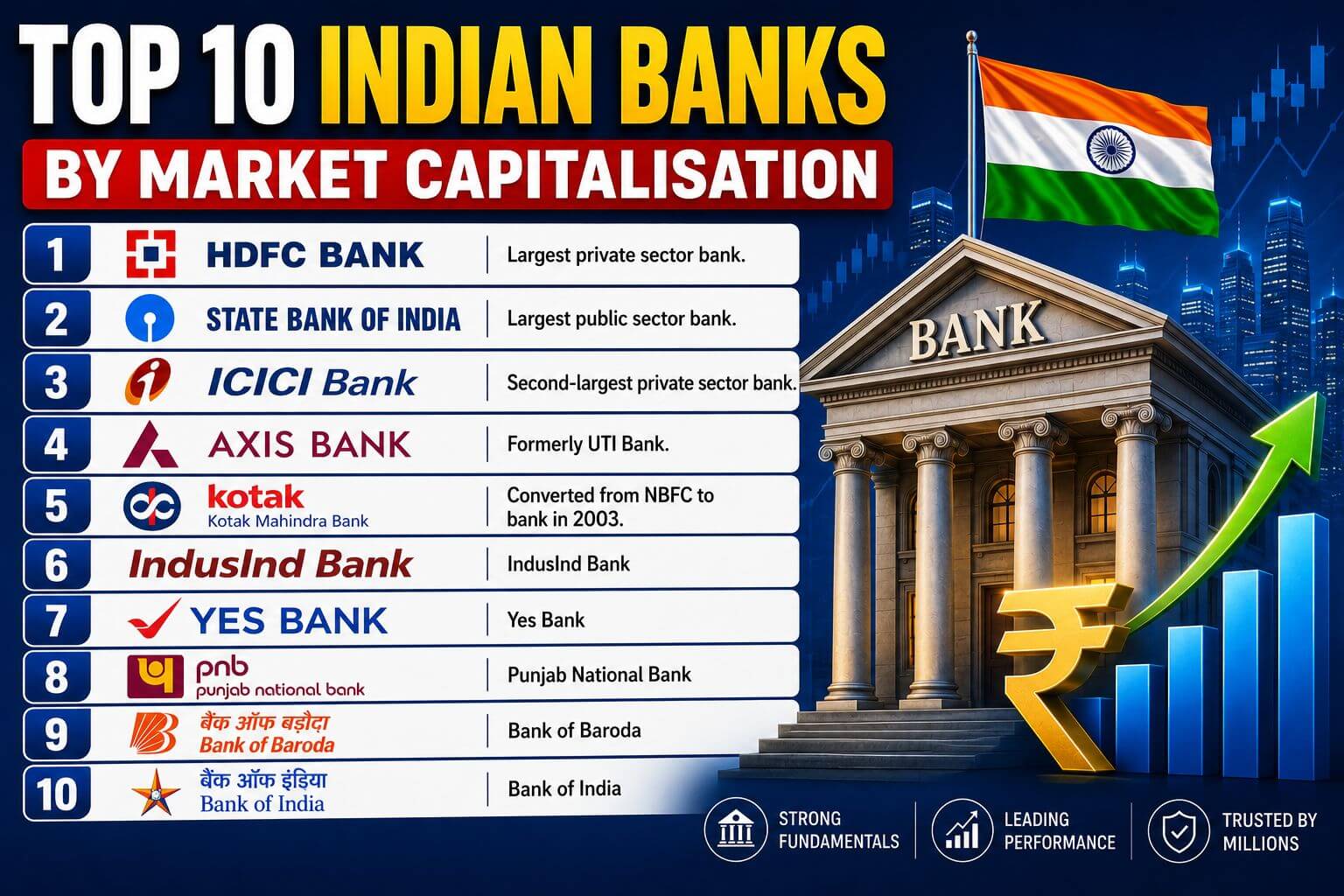
- HDFC Bank - largest private sector bank.
- State Bank of India - largest public sector bank.
- ICICI Bank - second-largest private sector bank.
- Axis Bank - formerly UTI Bank.
- Kotak Mahindra Bank - converted from NBFC to bank in 2003.
- IndusInd Bank
- Yes Bank
- Punjab National Bank
- Bank of Baroda
- Bank of India
Memory Tricks and Mnemonics
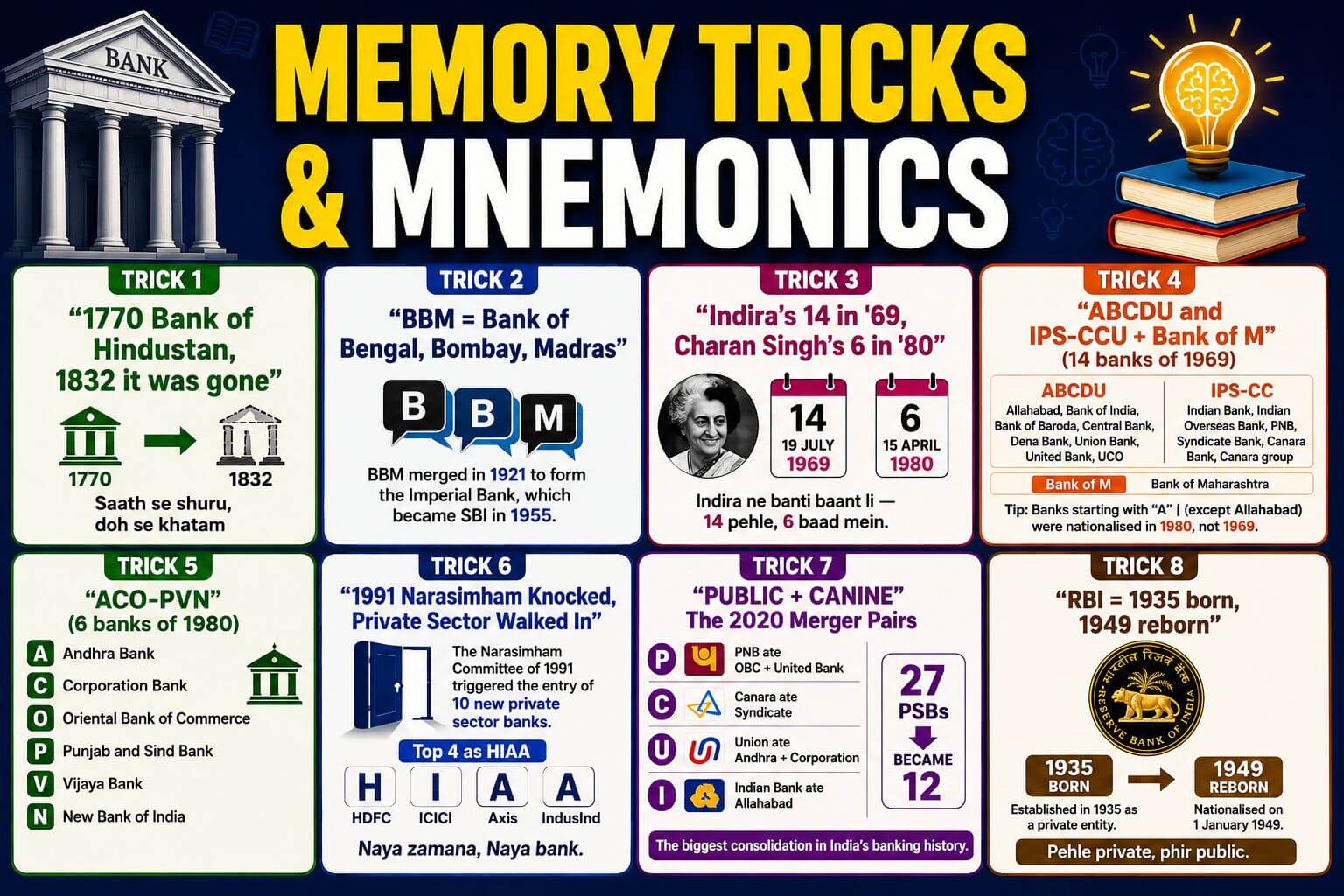
Memorising bank names, dates, and merger details can be tough. The following mnemonics and tricks make it far easier for exam aspirants.
Trick 1 - "1770 Bank of Hindustan, 1832 it was gone"
A simple rhyme to lock in the birth year of Indian banking (1770) and the year the Bank of Hindustan stopped operating (1832). "Saath se shuru, doh se khatam" — started in 70, ended in 32.
Trick 2 - "BBM = Bank of Bengal, Bombay, Madras"
The three Presidency Banks share the same initials as the chat app BBM. Remember: BBM merged in 1921 to form the Imperial Bank, which became SBI in 1955.
Trick 3 - "Indira's 14 in '69, Charan Singh's 6 in '80"
The first round of nationalisation (14 banks) happened on 19 July 1969 under Prime Minister Indira Gandhi. The second round (6 banks) happened on 15 April 1980 — again during the Indira Gandhi era after her return to power. Indira ne banti baant li — 14 pehle, 6 baad mein.
Trick 4 - "ABCDU and IPS-CCU + Bank of M" (14 banks of 1969)
Use this segment-based memory aid:
- ABCDU → Allahabad, Bank of India, Bank of Baroda, Central Bank, Dena Bank, Union Bank, United Bank, UCO.
- IPS-CC → Indian Bank, Indian Overseas Bank, PNB, Syndicate, Canara, Canara group.
- Bank of M → Bank of Maharashtra.
Tip: Whenever a bank starts with the letter "A" except Allahabad — it was nationalised in 1980, not 1969 (Andhra Bank). Same for Corporation Bank, OBC, Punjab & Sind, Vijaya, and New Bank of India.
Trick 5 - "ACO-PVN" (6 banks of 1980)
Six banks were nationalised in 1980. Remember them as ACO-PVN:
- Andhra Bank
- Corporation Bank
- Oriental Bank of Commerce
- Punjab and Sind Bank
- Vijaya Bank
- New Bank of India
Trick 6 - "1991 Narasimham Knocked, Private Sector Walked In"
The Narasimham Committee of 1991 triggered the entry of 10 new private sector banks. Remember the top 4 as HIAA — HDFC, ICICI, Axis, And IndusInd. "Naya zamana, Naya bank" — the moment liberalisation began, modern private banking was born.
Trick 7 - "PUBLIC + CANINE" — The 2020 Merger Pairs
Remember the 4 anchor banks of the 2020 mega-merger by the first letters: P-C-U-I.
- PNB ate OBC + United Bank.
- Canara ate Syndicate.
- Union ate Andhra + Corporation.
- Indian Bank ate Allahabad.
27 PSBs became 12 — the biggest consolidation in India's banking history.
Trick 8 - "RBI = 1935 born, 1949 reborn"
RBI was established in 1935 as a private entity (under RBI Act 1934, on Hilton-Young Commission recommendations). It was nationalised on 1 January 1949. "Pehle private, phir public".
Additional Notes
Frequently Confused Facts
- First bank of India vs First Indian bank: Bank of Hindustan (1770) was the first bank in India, but it was set up by British agents. The first bank set up purely with Indian capital and management was Punjab National Bank (1894).
- Oldest joint-stock bank still functioning: Allahabad Bank (1865) held this distinction until it was merged with Indian Bank in 2020. The oldest one still functioning today is the State Bank of India (traceable to Bank of Calcutta, 1806).
- RBI Act vs Banking Regulation Act: RBI Act was passed in 1934 (RBI started in 1935); Banking Regulation Act was passed in 1949.
- Imperial Bank vs State Bank of India: Imperial Bank was formed in 1921 by merging the three Presidency Banks. It was nationalised in 1955 and renamed State Bank of India.
- First Nationalisation cut-off vs Second: 1969 cut-off was deposits of Rs. 50 crore or more (14 banks). 1980 cut-off was Rs. 200 crore or more (6 banks).
- Number of associate banks merged with SBI in 2017: 5 associate banks + Bharatiya Mahila Bank. Saurashtra had merged earlier in 2008 and Indore in 2010.
- Bank of India vs Central Bank of India: Bank of India (1906) was the first commercial bank owned and managed by Indians. Central Bank of India (1911) is described as the first commercial bank entirely Indian-owned, managed and capitalised.
- NABARD vs RRB: RRBs were created in 1975 (RRB Act 1976). NABARD was set up in 1982 on the recommendations of the Sivaraman Committee.
Repeating PYQ Patterns
- IBPS PO / Clerk: Year of nationalisation of specific banks (1969 vs 1980), headquarters of public sector banks, and merger pairs of 2017-2020 — asked almost every year.
- SBI PO / Clerk: Heavy focus on SBI's evolution — from Bank of Calcutta to Imperial Bank to SBI — and on which associate banks merged when.
- RBI Grade B: Founders and first governors of RBI, recommendations of the Narasimham Committee, and structure of cooperative banks.
- SSC CGL / RRB NTPC: First bank of India (Bank of Hindustan), founder of PNB (Lala Lajpat Rai), and year of formation of Imperial Bank.
- UPSC Prelims: Conceptual questions on the role of RBI, priority sector lending, and reforms of the 1990s.
- State PCS / Insurance: Repeated questions on headquarters of major PSBs, RRBs, and full forms of banking acronyms (DICGC, NABARD, EXIM, NHB).
Quick Insight
The Indian banking sector is at the heart of every recent economic reform — from the Jan Dhan Yojana and Direct Benefit Transfers to UPI, Digital Rupee (e-Rupee), Account Aggregator framework, and the proposed Bad Bank (NARCL). Knowing the historical journey from 1770 to 2020 helps aspirants understand why these modern reforms were necessary and how they connect to past nationalisation and liberalisation phases. For the latest exam-relevant updates on banking topics, you can follow the Daily Current Affairs page on Jobsme.in.
One-Liners for Quick Revision
- Bank of Hindustan → First bank of India, established 1770, headquartered in Calcutta, closed by 1832.
- Three Presidency Banks → Bank of Bengal (1806), Bank of Bombay (1840), Bank of Madras (1843), all set up by the East India Company.
- Imperial Bank of India → Formed in 1921 by merging the three Presidency Banks; nationalised in 1955.
- State Bank of India (SBI) → Created on 1 July 1955 by nationalising the Imperial Bank; largest public sector bank; headquartered in Mumbai.
- Allahabad Bank → Established 1865; oldest joint-stock bank of India; merged with Indian Bank in 2020.
- Punjab National Bank → Established 1894; first bank purely with Indian capital and management; founder Lala Lajpat Rai; HQ New Delhi; merged with OBC and United Bank in 2020.
- Bank of India → Established 1906; first commercial bank owned and managed by Indians; HQ Mumbai.
- Canara Bank → Established 1906 by Ammembal Subba Rao Pai; HQ Bengaluru; absorbed Syndicate Bank in 2020.
- Bank of Baroda → Established 1908 by Maharaja Sayajirao Gaekwad III; HQ Vadodara; merged with Vijaya and Dena Bank in 2019.
- Central Bank of India → Established 1911 by Sir Sorabji Pochkhanawala; first fully Indian-owned commercial bank; HQ Mumbai.
- Reserve Bank of India (RBI) → Set up under RBI Act 1934 on Hilton-Young Commission recommendation; began operations 1 April 1935; nationalised 1 January 1949; first Governor Sir Osborne Smith; first Indian Governor C. D. Deshmukh.
- Banking Regulation Act → Passed in 1949; gives RBI powers to license, inspect, and supervise banks in India.
- First Nationalisation → 19 July 1969; 14 banks with deposits of Rs. 50 crore or more nationalised under PM Indira Gandhi.
- Second Nationalisation → 15 April 1980; 6 more banks with deposits of Rs. 200 crore or more nationalised.
- Regional Rural Banks (RRBs) → Established under RRB Act 1976; first RRB Prathama Bank (1975) in Moradabad, UP; sponsored by Syndicate Bank.
- NABARD → Established 12 July 1982 on Sivaraman Committee recommendation; HQ Mumbai; apex body for rural credit.
- EXIM Bank → Established 1982 to promote India's foreign trade.
- DICGC → Established 1978; subsidiary of RBI; insures bank deposits up to Rs. 5 lakh per depositor (revised 2020).
- SBI Associate Banks Act → Passed in 1959 to convert state-associated banks into SBI subsidiaries.
- New Bank of India → First PSB merger after nationalisation; merged with PNB in 1993.
- Narasimham Committee I → 1991; recommended capital adequacy, prudential norms, and entry of new private banks.
- Narasimham Committee II → 1998; recommended bank mergers, reduction of CRR/SLR, and stronger NPA recovery.
- 10 Private Sector Banks licensed → ICICI, HDFC, Axis (UTI Bank), IndusInd, IDBI, Global Trust Bank, Bank of Punjab, Centurion Bank, Times Bank, Development Credit Bank.
- State Bank of Saurashtra → First SBI associate bank to be merged with SBI; merged in 2008.
- State Bank of Indore → Second SBI associate bank merged; merged in 2010.
- SBI 2017 Merger → 1 April 2017; SBI absorbed 5 associate banks (Bikaner & Jaipur, Hyderabad, Mysore, Patiala, Travancore) plus Bharatiya Mahila Bank.
- 2019 Merger → Vijaya Bank and Dena Bank merged into Bank of Baroda, making BoB the third-largest bank.
- 2020 Mega Merger → 10 PSBs merged into 4 anchor banks (PNB, Canara, Union, Indian Bank); total PSBs reduced from 27 to 12.
- HDFC Bank → Largest private sector bank by market capitalisation; HQ Mumbai; founded 1994.
- ICICI Bank → Founded 1994; HQ Mumbai; converted from financial institution to commercial bank.
- Axis Bank → Founded 1993 as UTI Bank; renamed Axis Bank in 2007; HQ Mumbai.
- Kotak Mahindra Bank → Founded 2003 (converted from NBFC); HQ Mumbai.
- Yes Bank → Founded 2004; HQ Mumbai; bailed out by SBI-led consortium in 2020.
- IDBI Bank → Originally a development financial institution set up in 1964; converted to bank later.
- Bandhan Bank → Founded 2015; HQ Kolkata; started as a microfinance institution.
- IDFC First Bank → Founded 2015; HQ Mumbai.
- Federal Bank → Founded 1931; HQ Aluva, Kochi (Kerala).
- South Indian Bank → Founded 1929; HQ Thrissur, Kerala.
- City Union Bank → Founded 1904; HQ Kumbakonam, Tamil Nadu; one of the oldest private banks.
- Karur Vysya Bank → Founded 1916; HQ Karur, Tamil Nadu.
- Tamilnad Mercantile Bank → Founded 1921; HQ Tuticorin, Tamil Nadu.
- J&K Bank → Founded 1938; HQ Srinagar; only state-promoted bank with private status.
- Karnataka Bank → Founded 1924; HQ Mangaluru.
- Dhanlaxmi Bank → Founded 1927; HQ Thrissur, Kerala.
- CSB Bank → Founded 1920; HQ Thrissur, Kerala; formerly Catholic Syrian Bank.
- Nainital Bank → Founded 1922; HQ Nainital, Uttarakhand; subsidiary of Bank of Baroda.
- RBL Bank → Founded 1943; HQ Mumbai; formerly Ratnakar Bank.
- Foreign Banks in India → 45 in number; hold 7% market share; contribute 11% to sector profits; allowed by RBI as branch or wholly-owned subsidiary.
- Regional Rural Banks → Government-owned scheduled commercial banks; ownership shared 50:15:35 between Centre, State, and sponsor bank.
- Cooperative Banks → Owned by their members; regulated under Banking Regulation Act 1949 and Banking Laws Act 1955.
- Urban Cooperative Banks (UCBs) → 1,531 in number; could lend only for non-agricultural purposes until 1996.
- Scheduled Banks → Listed under Schedule II of RBI Act, 1934; must have paid-up capital and reserves of at least Rs. 5 lakh.
- Top 10 Indian Banks by Market Capitalisation → HDFC, SBI, ICICI, Axis, Kotak Mahindra, IndusInd, Yes Bank, PNB, Bank of Baroda, Bank of India.
- Current count of banks in India → 12 Public Sector Banks, 21 Private Sector Banks, 45 Foreign Banks.
To strengthen these facts further, attempt the Banking Awareness Quiz and the Static GK Quiz on Jobsme.in. Aspirants should also stay updated with the Latest Government Job Notifications to make the most of their Banking Awareness preparation.
Free quiz • No signup required
Put this topic into practice with Indian Cultural Institutions – Static GK MCQ Quiz. It is the quickest way to reinforce what you just learned.
Frequently Asked Questions
Which is considered the first bank of India and when was it established?
What were the three Presidency Banks of India?
When was the State Bank of India formed and how?
When was the Reserve Bank of India established and when was it nationalised?
How many banks were nationalised in 1969 and on what basis were they selected?
How many banks were nationalised in 1980?
What is the significance of the Narasimham Committee in Indian banking history?
How many public sector banks does India have after the 2020 mergers?
Which committee recommended the establishment of NABARD and when was NABARD set up?
Who founded Punjab National Bank and why is it historically important?

About the author