Countries, Capitals and Currencies of the World – Static GK & General Awareness for Competitive Exams with Memory Tricks
This article covers a comprehensive continent-wise list of all countries of the world along with their capitals and official currencies, including special facts about shared currencies like the Euro, US Dollar, CFA Franc, and East Caribbean Dollar. It is designed for UPSC, SSC, IBPS, RRB, Insurance, Defence, and State PCS aspirants, with memory tricks, one-liners, and FAQs for quick revision. All facts are organised in an exam-ready format to help students score better in the General Awareness section.
Jump to section
- Introduction
- Core Concepts: What Are Capitals and Currencies?
- Quick Statistics on World Countries, Capitals, and Currencies
- Countries, Capitals and Currencies of Asia
- Countries, Capitals and Currencies of Europe
- Countries, Capitals and Currencies of Africa
- Countries, Capitals and Currencies of North America
- Countries, Capitals and Currencies of South America
- Countries, Capitals and Currencies of Australia and Oceania
- Antarctica: A Continent Without Countries
- Special Currencies Shared by Multiple Countries
- Countries with Multiple Capitals
- Capitals That Have Recently Changed
- Memory Tricks and Mnemonics for Countries, Capitals, and Currencies
- Additional Notes
- One-Liners for Quick Revision
Introduction
The world today comprises 195 recognised countries — 193 UN member states plus 2 observer states (Vatican City and Palestine) — each with its own capital city and official currency. Understanding countries, capitals, and currencies is essential not just for travellers and economists but also for every aspirant of competitive exams in India. These three elements together reflect a nation's geographical identity, political administration, and economic system. For students preparing for government exams, this is one of the most predictable and high-scoring areas in the General Awareness section.
Questions on countries, capitals, and currencies regularly appear in UPSC Prelims, SSC CGL, IBPS PO/Clerk, RRB NTPC, SBI, LIC, NIACL, EPFO, State PCS, and Defence exams. Aspirants are typically asked the capital of a particular country, the currency used in a region, or which countries share a common currency like the Euro or the CFA Franc. This article presents all the key facts in a structured, exam-ready format. To explore more world geography-related Static GK, visit the Important Boundary Lines of the World and India guide on Jobsme.in.
Beyond exams, knowledge of capitals and currencies has gained importance with the rise of global trade, foreign exchange markets, and international diplomacy. Recent currency developments — such as Zimbabwe adopting the US Dollar, Croatia switching to the Euro in 2023, and the strong rise of the Kuwaiti Dinar as the world's most valuable currency — make this a frequently updated topic. Mastering it builds a strong foundation for objective questions and supports descriptive answers in UPSC Mains and essay papers on international relations and economics.
Core Concepts: What Are Capitals and Currencies?
Before diving into the country-wise lists, it is important to understand the basic definitions and roles of capitals and currencies in the modern world. Both are fundamental to a nation's identity and functioning.
- Capital City: The political and administrative hub of a country. It usually houses the government, parliament, supreme court, embassies, and central institutions. For example, New Delhi for India and Washington, D.C. for the United States.
- Currency: The official system of money — coins and paper notes — used in a country as legal tender. A currency acts as a medium of exchange, a store of value, and a unit of account. Some currencies are unique to one nation (like the Indian Rupee), while others are shared by many countries (like the Euro).
- Multiple Capitals: Some countries have more than one capital. For example, South Africa has three — Pretoria (administrative), Cape Town (legislative), and Bloemfontein (judicial). Sri Lanka has Colombo (commercial) and Sri Jayawardenepura Kotte (legislative).
- Shared Currencies: The Euro is used by 20 EU members; the US Dollar is the official currency of countries like Ecuador, El Salvador, East Timor, and several Pacific island nations; the East Caribbean Dollar is shared by 8 Caribbean nations; the CFA Franc is shared by 14 African countries (West and Central African groups).
- Strongest and Weakest Currencies: The Kuwaiti Dinar (KWD) is the world's strongest currency by exchange value against the US Dollar. The US Dollar remains the most traded currency globally, followed by the Euro.
The world is divided into seven continents for the study of countries — Africa, Asia, Europe, North America, South America, Oceania (Australia), and Antarctica. Antarctica has no permanent population or sovereign nations and is governed by the Antarctic Treaty (1959), hence it is excluded from country lists.
Quick Statistics on World Countries, Capitals, and Currencies
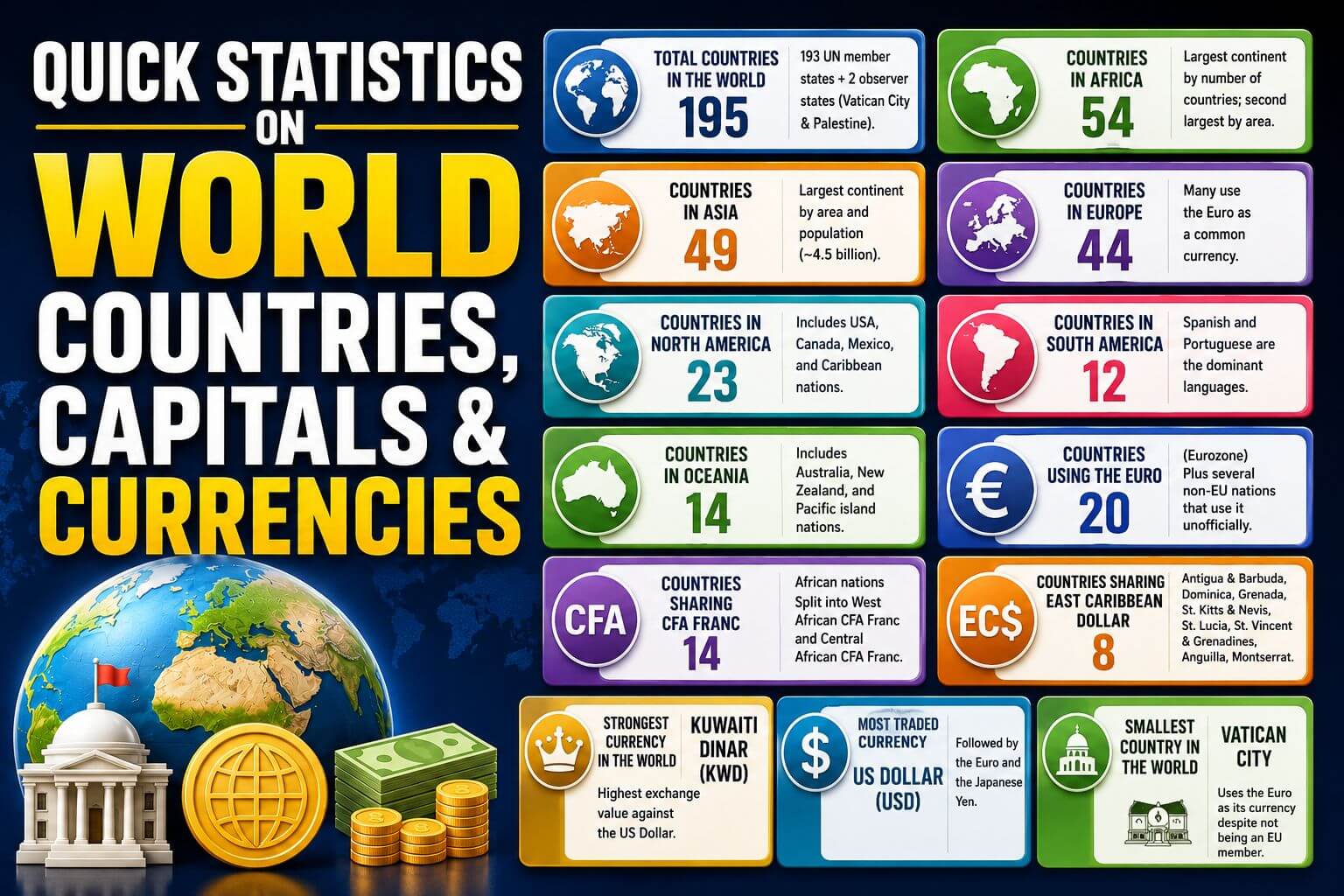
The following snapshot covers the key numerical facts most asked in exams.
| Parameter | Figure / Detail | Exam-Relevant Note |
|---|---|---|
| Total Countries in the World | 195 | 193 UN member states + 2 observer states (Vatican City & Palestine). |
| Countries in Africa | 54 | Largest continent by number of countries; second largest by area. |
| Countries in Asia | 49 | Largest continent by area and population (~4.5 billion). |
| Countries in Europe | 44 | Many use the Euro as a common currency. |
| Countries in North America | 23 | Includes USA, Canada, Mexico, and Caribbean nations. |
| Countries in South America | 12 | Spanish and Portuguese are the dominant languages. |
| Countries in Oceania | 14 | Includes Australia, New Zealand, and Pacific island nations. |
| Countries Using the Euro | 20 (Eurozone) | Plus several non-EU nations that use it unofficially. |
| Countries Sharing CFA Franc | 14 African nations | Split into West African CFA Franc and Central African CFA Franc. |
| Countries Sharing East Caribbean Dollar | 8 Caribbean nations | Antigua & Barbuda, Dominica, Grenada, St. Kitts & Nevis, St. Lucia, St. Vincent & Grenadines, Anguilla, Montserrat. |
| Strongest Currency in the World | Kuwaiti Dinar (KWD) | Highest exchange value against the US Dollar. |
| Most Traded Currency | US Dollar (USD) | Followed by the Euro and the Japanese Yen. |
| Smallest Country in the World | Vatican City | Uses the Euro as its currency despite not being an EU member. |
Countries, Capitals and Currencies of Asia
Asia is the largest continent by both area and population, home to over 4.5 billion people and 49 countries. It includes some of the world's oldest civilisations and fastest-growing economies. Asian countries dominate UPSC and SSC questions due to India's regional significance.
Country, Capital and Currency - Asia
| Country | Capital | Currency | Key Features / Exam Notes |
|---|---|---|---|
| Afghanistan | Kabul | Afghani | Landlocked South-Central Asian country sharing a border with Iran and Pakistan. |
| Armenia | Yerevan | Armenian Dram | First nation to adopt Christianity as a state religion. |
| Azerbaijan | Baku | Azerbaijani Manat | Located on the Caspian Sea; rich in oil reserves. |
| Bahrain | Manama | Bahraini Dinar | Island nation in the Persian Gulf; one of the world's strongest currencies. |
| Bangladesh | Dhaka | Bangladeshi Taka | Formed in 1971 after liberation; a key SAARC nation. |
| Bhutan | Thimphu | Bhutanese Ngultrum | Landlocked Himalayan kingdom; uses the Gross National Happiness index. |
| Brunei | Bandar Seri Begawan | Brunei Dollar | Small wealthy sultanate on Borneo island. |
| Cambodia | Phnom Penh | Cambodian Riel | Home to the Angkor Wat temple complex. |
| China | Beijing | Chinese Yuan (Renminbi) | Most populous and largest country in Asia by area. |
| Cyprus | Nicosia | Euro | Island in the eastern Mediterranean; EU member. |
| Georgia | Tbilisi | Georgian Lari | Located at the intersection of Europe and Asia. |
| India | New Delhi | Indian Rupee (INR) | Largest democracy in the world; founding SAARC member. |
| Indonesia | Jakarta (capital being shifted to Nusantara) | Indonesian Rupiah | World's largest archipelago; 4th most populous country. |
| Iran | Tehran | Iranian Rial | Persian heritage; member of OPEC. |
| Iraq | Baghdad | Iraqi Dinar | Cradle of Mesopotamian civilisation. |
| Israel | Jerusalem | Israeli Shekel (New Shekel) | Capital recognition is internationally disputed. |
| Japan | Tokyo | Japanese Yen | "Land of the Rising Sun"; 3rd largest economy. |
| Jordan | Amman | Jordanian Dinar | Home to the ancient city of Petra. |
| Kazakhstan | Astana (formerly Nur-Sultan) | Kazakhstani Tenge | Largest landlocked country in the world. |
| Kuwait | Kuwait City | Kuwaiti Dinar | World's strongest currency by exchange value. |
| Kyrgyzstan | Bishkek | Kyrgyzstani Som | Mountainous Central Asian nation. |
| Laos | Vientiane | Lao Kip | Only landlocked nation in Southeast Asia. |
| Lebanon | Beirut | Lebanese Pound | Mediterranean country; ancient Phoenician heritage. |
| Malaysia | Kuala Lumpur | Malaysian Ringgit | Famous for the Petronas Twin Towers. |
| Maldives | Malé | Maldivian Rufiyaa | Smallest Asian nation; SAARC founding member. |
| Mongolia | Ulaanbaatar | Mongolian Tögrög | Land of Genghis Khan; lowest population density in the world. |
| Myanmar | Naypyidaw | Burmese Kyat | Capital shifted from Yangon in 2005. |
| Nepal | Kathmandu | Nepalese Rupee | Home to Mt. Everest; SAARC member. |
| North Korea | Pyongyang | North Korean Won | Officially DPRK; isolated communist state. |
| Oman | Muscat | Omani Rial | Among the strongest currencies; Gulf nation. |
| Pakistan | Islamabad | Pakistani Rupee | SAARC member; capital shifted from Karachi. |
| Palestine | Ramallah (East Jerusalem claimed) | Israeli Shekel | UN observer state. |
| Philippines | Manila | Philippine Peso | Archipelago nation in Southeast Asia. |
| Qatar | Doha | Qatari Riyal | Hosted FIFA World Cup 2022; rich in natural gas. |
| Russia | Moscow | Russian Ruble | Largest country in the world by area; spans Europe and Asia. |
| Saudi Arabia | Riyadh | Saudi Riyal | Home to Mecca and Medina; OPEC's largest producer. |
| Singapore | Singapore (city-state) | Singapore Dollar | One of Asia's leading financial hubs. |
| South Korea | Seoul | South Korean Won | Officially Republic of Korea; tech and entertainment hub. |
| Sri Lanka | Sri Jayawardenepura Kotte (legislative); Colombo (commercial) | Sri Lankan Rupee | Island nation in the Indian Ocean. |
| Syria | Damascus | Syrian Pound | Damascus is one of the oldest continuously inhabited cities. |
| Taiwan | Taipei | New Taiwan Dollar | Officially Republic of China; major semiconductor producer. |
| Tajikistan | Dushanbe | Tajikistani Somoni | Central Asian republic; mountainous terrain. |
| Thailand | Bangkok | Thai Baht | "Land of Smiles"; only Southeast Asian nation never colonised. |
| Timor-Leste (East Timor) | Dili | United States Dollar | Asia's youngest country; gained independence in 2002. |
| Turkey | Ankara | Turkish Lira | Transcontinental nation across Europe and Asia. |
| Turkmenistan | Ashgabat | Turkmenistani Manat | Central Asian nation rich in natural gas. |
| United Arab Emirates | Abu Dhabi | UAE Dirham | Federation of 7 emirates; Dubai is a major commercial hub. |
| Uzbekistan | Tashkent | Uzbekistani Som | Central Asian republic on the Silk Road. |
| Vietnam | Hanoi | Vietnamese Dong | Socialist republic in Southeast Asia. |
| Yemen | Sana'a | Yemeni Rial | Located on the southern Arabian Peninsula. |
Countries, Capitals and Currencies of Europe
Europe consists of 44 sovereign countries, of which 20 use the Euro as their official currency. The continent is famous for its rich history, modern economies, and diverse cultures. Many capitals — Paris, Rome, Athens, London, Berlin — feature regularly in exam questions.
Country, Capital and Currency - Europe
| Country | Capital | Currency | Key Features / Exam Notes |
|---|---|---|---|
| Albania | Tirana | Albanian Lek | Balkan nation on the Adriatic Sea. |
| Andorra | Andorra la Vella | Euro | Microstate between France and Spain. |
| Austria | Vienna | Euro | Vienna is famous for classical music and waltzes. |
| Belarus | Minsk | Belarusian Ruble | Landlocked Eastern European nation. |
| Belgium | Brussels | Euro | Brussels is the headquarters of the European Union and NATO. |
| Bosnia & Herzegovina | Sarajevo | Convertible Mark | Balkan nation; historic Ottoman heritage. |
| Bulgaria | Sofia | Bulgarian Lev | EU member; oldest country in Europe (still using its original name). |
| Croatia | Zagreb | Euro | Adopted Euro in January 2023. |
| Czech Republic (Czechia) | Prague | Czech Koruna | Famous for Prague's medieval architecture. |
| Denmark | Copenhagen | Danish Krone | Scandinavian kingdom; oldest monarchy in Europe. |
| Estonia | Tallinn | Euro | Baltic state; one of the most digitally advanced nations. |
| Finland | Helsinki | Euro | "Land of a Thousand Lakes"; Nordic country. |
| France | Paris | Euro | Permanent UNSC member; Eiffel Tower landmark. |
| Germany | Berlin | Euro | Largest economy in Europe. |
| Greece | Athens | Euro | Birthplace of democracy and the Olympics. |
| Hungary | Budapest | Hungarian Forint | Crossed by the Danube River. |
| Iceland | Reykjavik | Icelandic Krona | Nordic island nation; rich in geothermal energy. |
| Ireland | Dublin | Euro | Officially Republic of Ireland. |
| Italy | Rome | Euro | Rome — Eternal City; centre of the Roman Empire. |
| Kosovo | Pristina | Euro | Declared independence in 2008. |
| Latvia | Riga | Euro | Baltic state; NATO and EU member. |
| Liechtenstein | Vaduz | Swiss Franc | Microstate between Switzerland and Austria. |
| Lithuania | Vilnius | Euro | Largest of the three Baltic states. |
| Luxembourg | Luxembourg City | Euro | Among the wealthiest nations per capita. |
| Malta | Valletta | Euro | Smallest EU member; Mediterranean island nation. |
| Moldova | Chișinău | Moldovan Leu | Landlocked Eastern European nation. |
| Monaco | Monaco | Euro | Second smallest country in the world; famous for the Monte Carlo casino. |
| Montenegro | Podgorica | Euro | Uses the Euro despite not being an EU member. |
| Netherlands | Amsterdam (capital); The Hague (seat of government) | Euro | The Hague hosts the International Court of Justice. |
| North Macedonia | Skopje | Macedonian Denar | Renamed from Macedonia in 2019. |
| Norway | Oslo | Norwegian Krone | Awards the Nobel Peace Prize annually. |
| Poland | Warsaw | Polish Złoty | Largest economy in Central Europe. |
| Portugal | Lisbon | Euro | Westernmost country of mainland Europe. |
| Romania | Bucharest | Romanian Leu | Crossed by the Carpathian Mountains. |
| Russia | Moscow | Russian Ruble | Spans Europe and Asia; largest country in the world. |
| San Marino | San Marino | Euro | One of the world's oldest republics (301 CE). |
| Serbia | Belgrade | Serbian Dinar | Balkan nation on the Danube River. |
| Slovakia | Bratislava | Euro | Central European country; former part of Czechoslovakia. |
| Slovenia | Ljubljana | Euro | Adopted Euro in 2007. |
| Spain | Madrid | Euro | Famous for flamenco, bullfighting, and Mediterranean culture. |
| Sweden | Stockholm | Swedish Krona | Awards Nobel prizes (except Peace Prize). |
| Switzerland | Bern | Swiss Franc | Famous for banking, watches, and chocolates; NOT an EU member. |
| Ukraine | Kyiv | Ukrainian Hryvnia | Largest country fully within Europe. |
| United Kingdom | London | Pound Sterling (GBP) | Permanent UNSC member; left the EU in 2020 (Brexit). |
| Vatican City | Vatican City | Euro | Smallest country in the world; seat of the Pope. |
Countries, Capitals and Currencies of Africa
Africa is the second-largest continent by area and population, with 54 recognised countries. The continent is unique for sharing two common currencies — the West African CFA Franc (8 countries) and the Central African CFA Franc (6 countries) — making it a high-frequency exam area.
Country, Capital and Currency - Africa
| Country | Capital | Currency | Key Features / Exam Notes |
|---|---|---|---|
| Algeria | Algiers | Algerian Dinar | Largest country in Africa by area. |
| Angola | Luanda | Angolan Kwanza | Major oil exporter; Portuguese-speaking. |
| Benin | Porto-Novo | West African CFA Franc | Official capital is Porto-Novo; Cotonou is the seat of government. |
| Botswana | Gaborone | Botswana Pula | Famous for the Okavango Delta and Kalahari Desert. |
| Burkina Faso | Ouagadougou | West African CFA Franc | Landlocked Sahel nation. |
| Burundi | Gitega | Burundian Franc | Capital shifted from Bujumbura to Gitega in 2019. |
| Cabo Verde (Cape Verde) | Praia | Cape Verdean Escudo | Atlantic island nation off West Africa. |
| Cameroon | Yaoundé | Central African CFA Franc | Bilingual (French and English); "Africa in miniature". |
| Central African Republic | Bangui | Central African CFA Franc | Landlocked country in Central Africa. |
| Chad | N'Djamena | Central African CFA Franc | Lake Chad nation; landlocked. |
| Comoros | Moroni | Comorian Franc | Indian Ocean archipelago nation. |
| Congo (Brazzaville) | Brazzaville | Central African CFA Franc | Republic of Congo; smaller of the two Congos. |
| Congo (Kinshasa) / DRC | Kinshasa | Congolese Franc | Democratic Republic of Congo; second largest African country. |
| Côte d'Ivoire (Ivory Coast) | Yamoussoukro (official); Abidjan (de facto) | West African CFA Franc | Largest cocoa producer in the world. |
| Djibouti | Djibouti | Djiboutian Franc | Strategic Horn of Africa nation. |
| Egypt | Cairo | Egyptian Pound | Cradle of civilisation; home to the Pyramids and the Suez Canal. |
| Equatorial Guinea | Malabo | Central African CFA Franc | Only Spanish-speaking nation in Sub-Saharan Africa. |
| Eritrea | Asmara | Eritrean Nakfa | Gained independence from Ethiopia in 1993. |
| Eswatini (Swaziland) | Mbabane | Swazi Lilangeni | Renamed from Swaziland in 2018; absolute monarchy. |
| Ethiopia | Addis Ababa | Ethiopian Birr | Headquarters of the African Union; never colonised. |
| Gabon | Libreville | Central African CFA Franc | Equatorial nation; rich in oil and rainforests. |
| Gambia | Banjul | Gambian Dalasi | Smallest mainland country in Africa. |
| Ghana | Accra | Ghanaian Cedi | First sub-Saharan African country to gain independence (1957). |
| Guinea | Conakry | Guinean Franc | West African nation; rich in bauxite. |
| Guinea-Bissau | Bissau | West African CFA Franc | Former Portuguese colony. |
| Kenya | Nairobi | Kenyan Shilling | Famous for the Maasai Mara safari and Mt. Kenya. |
| Lesotho | Maseru | Lesotho Loti | Enclave landlocked within South Africa. |
| Liberia | Monrovia | Liberian Dollar | Founded by freed American slaves; oldest African republic. |
| Libya | Tripoli | Libyan Dinar | North African nation on the Mediterranean. |
| Madagascar | Antananarivo | Malagasy Ariary | 4th largest island in the world. |
| Malawi | Lilongwe | Malawian Kwacha | "Warm Heart of Africa"; Lake Malawi. |
| Mali | Bamako | West African CFA Franc | Home to the historic city of Timbuktu. |
| Mauritania | Nouakchott | Mauritanian Ouguiya | Largely Saharan nation. |
| Mauritius | Port Louis | Mauritian Rupee | Indian Ocean island nation; popular Indian tourist destination. |
| Morocco | Rabat | Moroccan Dirham | Northwest African nation; gateway to Africa from Europe. |
| Mozambique | Maputo | Mozambican Metical | Lusophone nation on the Indian Ocean. |
| Namibia | Windhoek | Namibian Dollar | Famous for the Namib Desert; gained independence in 1990. |
| Niger | Niamey | West African CFA Franc | Sahel nation; major uranium producer. |
| Nigeria | Abuja | Nigerian Naira | Most populous African nation; capital shifted from Lagos. |
| Rwanda | Kigali | Rwandan Franc | "Land of a Thousand Hills". |
| São Tomé & Príncipe | São Tomé | São Toméan Dobra | Smallest Portuguese-speaking country. |
| Senegal | Dakar | West African CFA Franc | Westernmost country of mainland Africa. |
| Seychelles | Victoria | Seychellois Rupee | Indian Ocean archipelago. |
| Sierra Leone | Freetown | Sierra Leonean Leone | West African nation rich in diamonds. |
| Somalia | Mogadishu | Somali Shilling | Horn of Africa nation. |
| South Africa | Pretoria (administrative); Cape Town (legislative); Bloemfontein (judicial) | South African Rand | Only country in the world with three capital cities. |
| South Sudan | Juba | South Sudanese Pound | Newest country in the world; gained independence in 2011. |
| Sudan | Khartoum | Sudanese Pound | Confluence of the Blue Nile and White Nile. |
| Tanzania | Dodoma (official); Dar es Salaam (commercial) | Tanzanian Shilling | Home to Mt. Kilimanjaro and the Serengeti. |
| Togo | Lomé | West African CFA Franc | Narrow West African nation. |
| Tunisia | Tunis | Tunisian Dinar | Birthplace of the Arab Spring. |
| Uganda | Kampala | Ugandan Shilling | "Pearl of Africa"; home to Lake Victoria. |
| Zambia | Lusaka | Zambian Kwacha | Shares Victoria Falls with Zimbabwe. |
| Zimbabwe | Harare | Zimbabwean Dollar (US Dollar widely used) | Famous for hyperinflation; uses USD widely. |
Countries, Capitals and Currencies of North America
North America comprises 23 countries, including the United States, Canada, and Mexico, along with the smaller island nations of the Caribbean. Eight Caribbean countries share the East Caribbean Dollar, a frequent exam topic.
Country, Capital and Currency - North America
| Country | Capital | Currency | Key Features / Exam Notes |
|---|---|---|---|
| Antigua and Barbuda | St. John's | East Caribbean Dollar | Twin-island Caribbean nation. |
| Bahamas | Nassau | Bahamian Dollar | Archipelago in the Atlantic Ocean. |
| Barbados | Bridgetown | Barbadian Dollar | Became a republic in 2021. |
| Belize | Belmopan | Belize Dollar | Only Central American country with English as the official language. |
| Canada | Ottawa | Canadian Dollar | Second largest country in the world by area. |
| Costa Rica | San José | Costa Rican Colón | Famous for biodiversity and ecotourism. |
| Cuba | Havana | Cuban Peso | Largest island in the Caribbean. |
| Dominica | Roseau | East Caribbean Dollar | "Nature Island of the Caribbean". |
| Dominican Republic | Santo Domingo | Dominican Peso | Shares Hispaniola Island with Haiti. |
| El Salvador | San Salvador | United States Dollar | First country to adopt Bitcoin as legal tender (2021). |
| Grenada | St. George's | East Caribbean Dollar | "Spice Isle of the Caribbean". |
| Guatemala | Guatemala City | Guatemalan Quetzal | Largest economy in Central America. |
| Haiti | Port-au-Prince | Haitian Gourde | First independent Black republic in the world (1804). |
| Honduras | Tegucigalpa | Honduran Lempira | Currency named after a 16th-century chief. |
| Jamaica | Kingston | Jamaican Dollar | Birthplace of Bob Marley and reggae music. |
| Mexico | Mexico City | Mexican Peso | Most populous Spanish-speaking country. |
| Nicaragua | Managua | Nicaraguan Córdoba | Largest country in Central America. |
| Panama | Panama City | Panamanian Balboa / US Dollar | Famous for the Panama Canal. |
| Saint Kitts and Nevis | Basseterre | East Caribbean Dollar | Smallest sovereign state in the Americas. |
| Saint Lucia | Castries | East Caribbean Dollar | Volcanic island in the Caribbean. |
| Saint Vincent and the Grenadines | Kingstown | East Caribbean Dollar | Multi-island Caribbean nation. |
| Trinidad and Tobago | Port of Spain | Trinidad and Tobago Dollar | Twin-island nation; major oil and gas producer. |
| United States | Washington, D.C. | United States Dollar (USD) | World's largest economy; permanent UNSC member. |
Countries, Capitals and Currencies of South America
South America has 12 countries, mostly Spanish or Portuguese speaking. The continent is rich in natural resources, biodiversity, and cultural heritage. Brazil is the largest country, while Suriname is the smallest.
Country, Capital and Currency - South America
| Country | Capital | Currency | Key Features / Exam Notes |
|---|---|---|---|
| Argentina | Buenos Aires | Argentine Peso | Famous for tango, football, and Patagonia. |
| Bolivia | Sucre (constitutional); La Paz (administrative) | Boliviano | One of two landlocked countries in South America. |
| Brazil | Brasília | Brazilian Real | Largest country in South America; only Portuguese-speaking nation. |
| Chile | Santiago | Chilean Peso | Longest north-south country in the world. |
| Colombia | Bogotá | Colombian Peso | Only South American country with both Atlantic and Pacific coastlines. |
| Ecuador | Quito | United States Dollar | Capital named after the equator; uses USD. |
| Guyana | Georgetown | Guyanese Dollar | Only English-speaking country in South America. |
| Paraguay | Asunción | Paraguayan Guaraní | Other landlocked South American nation along with Bolivia. |
| Peru | Lima | Peruvian Sol | Home to Machu Picchu; cradle of the Inca civilisation. |
| Suriname | Paramaribo | Surinamese Dollar | Smallest country in South America; Dutch is the official language. |
| Uruguay | Montevideo | Uruguayan Peso | Most southern Spanish-speaking country. |
| Venezuela | Caracas | Venezuelan Bolívar | Has one of the world's largest oil reserves. |
Countries, Capitals and Currencies of Australia and Oceania
Oceania consists of 14 countries spread across thousands of islands in the Pacific Ocean. Several small island nations use the Australian Dollar or the US Dollar as their official currency.
Country, Capital and Currency - Australia & Oceania
| Country | Capital | Currency | Key Features / Exam Notes |
|---|---|---|---|
| Australia | Canberra | Australian Dollar | Largest country in Oceania; smallest continent. |
| Fiji | Suva | Fijian Dollar | Famous Pacific island tourist destination. |
| Kiribati | South Tarawa | Australian Dollar | Spans all four hemispheres. |
| Marshall Islands | Majuro | United States Dollar | Small Pacific island republic. |
| Micronesia (Federated States) | Palikir | United States Dollar | Cluster of Pacific islands; uses USD. |
| Nauru | Yaren (de facto) | Australian Dollar | Third smallest country in the world; no official capital. |
| New Zealand | Wellington | New Zealand Dollar | Maori cultural heritage; famous for Lord of the Rings landscapes. |
| Palau | Ngerulmud | United States Dollar | Pacific island nation with rich marine biodiversity. |
| Papua New Guinea | Port Moresby | Papua New Guinean Kina | Most populous Pacific nation after Australia. |
| Samoa | Apia | Samoan Tala | Polynesian island nation. |
| Solomon Islands | Honiara | Solomon Islands Dollar | Archipelago east of Papua New Guinea. |
| Tonga | Nuku'alofa | Tongan Pa'anga | Only constitutional monarchy in the Pacific. |
| Tuvalu | Funafuti | Australian Dollar / Tuvaluan Dollar | Fourth smallest country in the world. |
| Vanuatu | Port Vila | Vanuatu Vatu | South Pacific archipelago. |
Antarctica: A Continent Without Countries
Antarctica is a unique continent without any sovereign country, capital, or currency. It is governed by the Antarctic Treaty of 1959, signed by 12 nations and now ratified by 50+ nations. The continent is dedicated to peaceful scientific research and the protection of its fragile ecosystem. India operates research stations like Maitri, Bharati, and the new Maitri-II in Antarctica.
Special Currencies Shared by Multiple Countries
Several countries do not have their own unique currency but share one common currency with neighbouring nations. This is one of the most asked exam topics.
| Shared Currency | Number of Countries | Member Countries | Key Features / Exam Notes |
|---|---|---|---|
| Euro (EUR) | 20 (Eurozone) | Austria, Belgium, Croatia, Cyprus, Estonia, Finland, France, Germany, Greece, Ireland, Italy, Latvia, Lithuania, Luxembourg, Malta, Netherlands, Portugal, Slovakia, Slovenia, Spain | Also used by Andorra, Monaco, San Marino, Vatican City, Kosovo, Montenegro (non-EU); 2nd most traded currency. |
| US Dollar (USD) | ~10 countries (officially) | USA, Ecuador, El Salvador, Panama, Timor-Leste, Marshall Islands, Micronesia, Palau, Zimbabwe (de facto) | World's most traded currency; global reserve currency. |
| West African CFA Franc (XOF) | 8 countries | Benin, Burkina Faso, Côte d'Ivoire, Guinea-Bissau, Mali, Niger, Senegal, Togo | Issued by BCEAO (Central Bank of West African States); pegged to Euro. |
| Central African CFA Franc (XAF) | 6 countries | Cameroon, Central African Republic, Chad, Republic of Congo, Equatorial Guinea, Gabon | Issued by BEAC (Bank of Central African States); pegged to Euro. |
| East Caribbean Dollar (XCD) | 8 territories | Antigua & Barbuda, Dominica, Grenada, St. Kitts & Nevis, St. Lucia, St. Vincent & Grenadines, Anguilla, Montserrat | Issued by Eastern Caribbean Central Bank. |
| Australian Dollar (AUD) | 4 (officially) | Australia, Kiribati, Nauru, Tuvalu | Major Pacific currency; used by smaller island nations. |
| Swiss Franc (CHF) | 2 | Switzerland, Liechtenstein | One of the world's most stable currencies. |
| Russian Ruble (RUB) | 1 (officially) | Russia (also used in Belarus, Abkhazia, South Ossetia in some contexts) | Russia is the world's largest country. |
| South African Rand (ZAR) | 4 (Common Monetary Area) | South Africa, Lesotho, Eswatini, Namibia | Lesotho Loti, Swazi Lilangeni, and Namibian Dollar are pegged 1:1 to the Rand. |
| Indian Rupee (INR) | 2 | India; also accepted in Bhutan and Nepal alongside their own currencies | Bhutanese Ngultrum and Nepalese Rupee are pegged to INR. |
Countries with Multiple Capitals
While most countries have a single capital, a few have two or even three official capitals due to their administrative, judicial, or legislative arrangements. This is a frequently confused exam topic.
| Country | Capitals | Key Features / Exam Notes |
|---|---|---|
| South Africa | Pretoria (administrative); Cape Town (legislative); Bloemfontein (judicial) | Only country in the world with three official capitals. |
| Sri Lanka | Colombo (commercial); Sri Jayawardenepura Kotte (legislative) | Sri Jayawardenepura Kotte hosts the parliament. |
| Bolivia | Sucre (constitutional); La Paz (administrative) | La Paz is the highest administrative capital in the world. |
| Netherlands | Amsterdam (capital); The Hague (seat of government) | The Hague hosts the International Court of Justice. |
| Tanzania | Dodoma (official); Dar es Salaam (commercial) | Capital officially shifted from Dar es Salaam to Dodoma. |
| Côte d'Ivoire | Yamoussoukro (official); Abidjan (de facto) | Most government functions remain in Abidjan. |
| Benin | Porto-Novo (official); Cotonou (de facto) | Cotonou is the seat of government and largest city. |
| Eswatini | Mbabane (administrative); Lobamba (legislative/royal) | Lobamba is the spiritual and royal capital. |
| Malaysia | Kuala Lumpur (capital); Putrajaya (administrative) | Putrajaya hosts most federal government offices. |
Capitals That Have Recently Changed
Several countries have shifted their capitals in recent decades — a topic that frequently appears in current affairs and Static GK MCQs.
| Country | Old Capital | New Capital | Year of Change |
|---|---|---|---|
| Myanmar (Burma) | Yangon (Rangoon) | Naypyidaw | 2005 |
| Kazakhstan | Almaty | Astana (formerly Nur-Sultan) | 1997 |
| Burundi | Bujumbura | Gitega | 2019 |
| Nigeria | Lagos | Abuja | 1991 |
| Indonesia | Jakarta | Nusantara (under construction) | 2024 onwards |
| Pakistan | Karachi | Islamabad | 1967 |
| Egypt | Cairo | New Administrative Capital (NAC, partial shift) | 2021 onwards |
| Tanzania | Dar es Salaam | Dodoma | 1996 (official) |
Memory Tricks and Mnemonics for Countries, Capitals, and Currencies
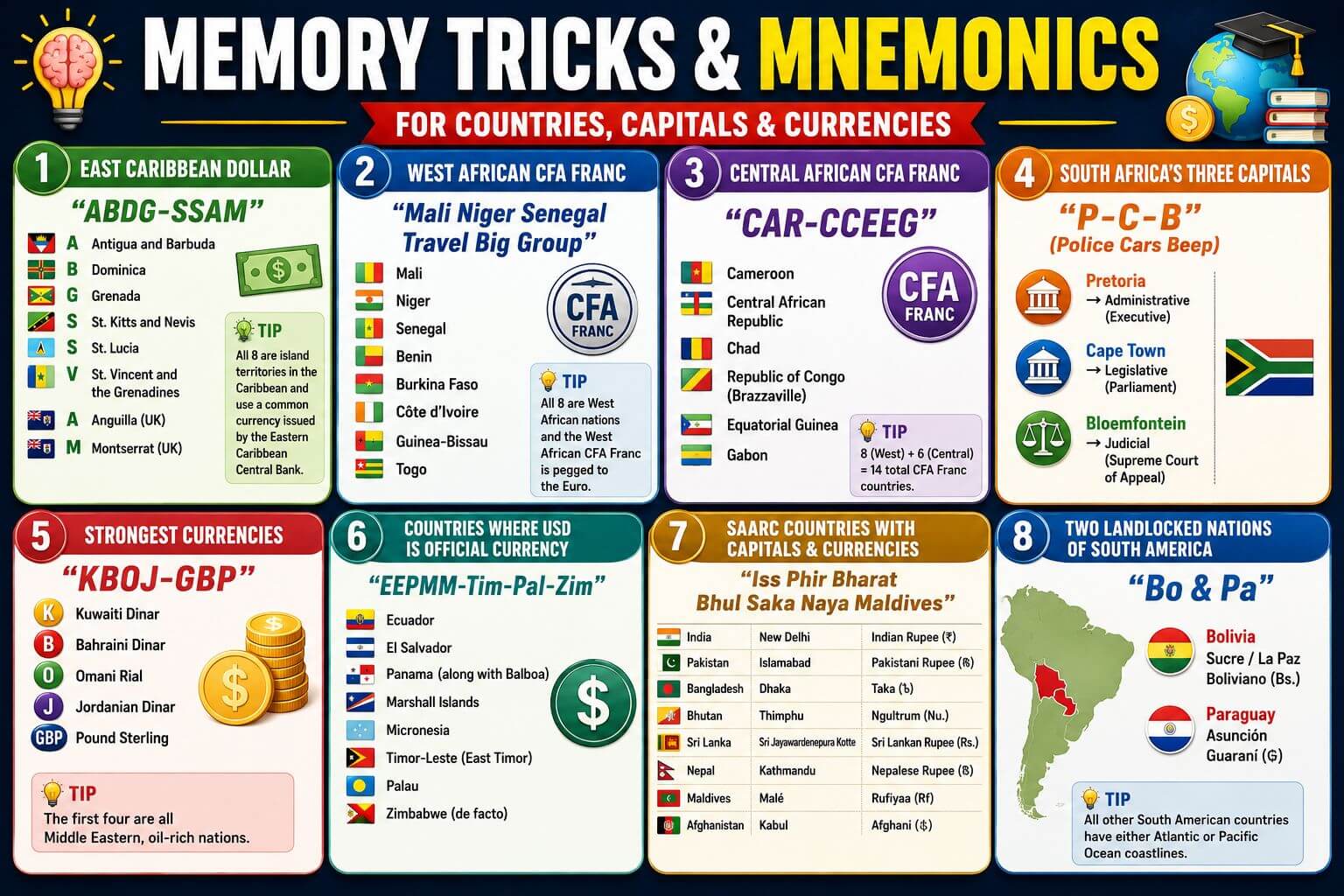
1. Eight Caribbean Nations Sharing the East Caribbean Dollar: "ABDGSSAM"
Eight Caribbean territories share the East Caribbean Dollar. Use the acronym:
"ABDG-SSAM" = Antigua, Barbuda, Dominica, Grenada, St. Kitts, St. Lucia, St. Vincent, Anguilla, Montserrat
- Antigua and Barbuda
- Dominica
- Grenada
- St. Kitts and Nevis
- St. Lucia
- St. Vincent and the Grenadines
- Anguilla (British territory)
- Montserrat (British territory)
Tip: All 8 are island territories in the Caribbean and use a common currency issued by the Eastern Caribbean Central Bank.
2. Eight West African CFA Franc Countries: "Mali Niger Senegal Travel Big Group"
Use this story-based mnemonic — Mali, Niger and Senegal travel with their big group:
"Mali Niger Senegal Travel Big Group of Cote d'Ivoire, Burkina Faso, Benin, Guinea-Bissau, Togo"
- Benin
- Burkina Faso
- Côte d'Ivoire
- Guinea-Bissau
- Mali
- Niger
- Senegal
- Togo
Tip: All 8 are West African nations and the West African CFA Franc is pegged to the Euro.
3. Six Central African CFA Franc Countries: "CAR-CCEEG"
Six Central African nations share the Central African CFA Franc. Remember:
"CAR-CCEEG" = Cameroon, CAR, Chad, Republic of Congo, Equatorial Guinea, Gabon
- Cameroon
- Central African Republic
- Chad
- Republic of Congo (Brazzaville)
- Equatorial Guinea
- Gabon
Tip: 8 (West) + 6 (Central) = 14 total CFA Franc countries.
4. South Africa's Three Capitals: "P-C-B" (Police Cars Beep)
South Africa is the only country with three capitals. Remember the order — administrative, legislative, judicial:
"PCB" — Pretoria, Cape Town, Bloemfontein
- Pretoria → Administrative (Executive)
- Cape Town → Legislative (Parliament)
- Bloemfontein → Judicial (Supreme Court of Appeal)
5. Currencies with the Strongest Value: "KBOJ-GBP"
The Gulf currencies dominate the strongest currency rankings against the US Dollar:
"KBOJ-GBP" = Kuwaiti Dinar, Bahraini Dinar, Omani Rial, Jordanian Dinar, Pound Sterling
- Kuwaiti Dinar — World's strongest currency
- Bahraini Dinar — 2nd strongest
- Omani Rial — 3rd strongest
- Jordanian Dinar — 4th strongest
- GBP (Pound Sterling) — UK's currency, strong globally
Tip: The first four are all Middle Eastern, oil-rich nations.
6. Countries Where USD Is Official Currency: "EEPMM-Tim-Pal-Zim"
Several countries have officially adopted the US Dollar as their currency:
"EEPMM-Tim-Pal-Zim"
- Ecuador
- El Salvador
- Panama (along with Balboa)
- Marshall Islands
- Micronesia
- Timor-Leste (East Timor)
- Palau
- Zimbabwe (de facto, after currency collapse)
7. SAARC Countries with Capitals and Currencies: "Iss Phir Bharat Bhul Saka Naya Maldives"
The 8 SAARC member countries (including Afghanistan) and their capitals:
- India → New Delhi → Indian Rupee
- Pakistan → Islamabad → Pakistani Rupee
- Bangladesh → Dhaka → Taka
- Bhutan → Thimphu → Ngultrum
- Sri Lanka → Sri Jayawardenepura Kotte → Sri Lankan Rupee
- Nepal → Kathmandu → Nepalese Rupee
- Maldives → Malé → Rufiyaa
- Afghanistan → Kabul → Afghani
8. Two Landlocked Nations of South America: "Bo & Pa"
Out of 12 South American countries, only two are landlocked:
"Bo & Pa" = Bolivia and Paraguay
- Bolivia → Sucre / La Paz → Boliviano
- Paraguay → Asunción → Guaraní
Tip: All other South American countries have either Atlantic or Pacific Ocean coastlines.
Additional Notes
Frequently Confused Facts
- North Korea vs South Korea: Both use a currency called "Won" — but they are different. North Korean Won (Pyongyang) and South Korean Won (Seoul) are not interchangeable.
- Republic of Congo vs Democratic Republic of Congo: Republic of Congo (Brazzaville) is smaller and uses Central African CFA Franc; DR Congo (Kinshasa) is larger and uses the Congolese Franc.
- West African CFA vs Central African CFA Franc: Both share the same name but are issued by different central banks (BCEAO vs BEAC); 8 vs 6 countries respectively.
- Australian Dollar vs New Zealand Dollar: Both Pacific currencies; Australia uses AUD (Canberra), New Zealand uses NZD (Wellington); they are not interchangeable.
- Yen vs Yuan vs Won: Yen → Japan; Yuan (Renminbi) → China; Won → Both Koreas.
- Krona vs Krone vs Kroner: Krona → Sweden, Iceland; Krone → Norway, Denmark. All trace to the same Latin root meaning "crown".
- Ruble vs Rouble: Both spellings refer to the same Russian/Belarusian currency.
- Switzerland vs Liechtenstein: Both use the Swiss Franc — Switzerland's capital is Bern (NOT Zurich or Geneva); Liechtenstein's is Vaduz.
- Eswatini vs Swaziland: Same country — renamed to Eswatini in 2018 by King Mswati III.
- Astana vs Nur-Sultan: Capital of Kazakhstan; renamed Nur-Sultan in 2019, then renamed back to Astana in 2022.
- Capitals on rivers: Cairo (Nile), Baghdad (Tigris), Vienna (Danube), Budapest (Danube), Belgrade (Danube), London (Thames), Paris (Seine).
Repeating PYQ (Previous Year Question) Patterns
- SSC CGL & CHSL: Most asked — capitals of African nations, capital changes (Myanmar, Kazakhstan), CFA Franc countries.
- IBPS PO & Clerk: Frequently appearing — strongest currency (Kuwaiti Dinar), Eurozone members, currencies of SAARC nations.
- RRB NTPC & Group D: Common questions on — capital-currency pairs (e.g., Argentina-Buenos Aires-Peso), East Caribbean Dollar countries.
- UPSC Prelims: Currencies of African nations, BRICS countries, observer states (Vatican, Palestine), recent capital shifts (Indonesia → Nusantara).
- Insurance Exams (LIC, NIACL, EPFO): Forex-related — most traded currencies, currency basket compositions.
- State PCS: Asian capitals and currencies, especially neighbouring countries of India.
Quick Insight
The world of currencies is rapidly evolving. Croatia joined the Eurozone on 1 January 2023, becoming the 20th member. El Salvador made history in 2021 by becoming the first nation to adopt Bitcoin as legal tender alongside the US Dollar. Indonesia is in the process of shifting its capital from Jakarta to Nusantara on Borneo Island, expected to be completed in stages. The Indian Rupee (INR) is gaining international relevance, with several countries now allowing trade settlements in INR. Such developments make this topic dynamic and frequently updated. For UPSC Mains, this links to international economic relations, geopolitics, and global trade. For daily updates, take the Daily Current Affairs Quiz on Jobsme.in. You can also strengthen your preparation through the International Organizations and their Headquarters and Banking Awareness sections.
One-Liners for Quick Revision
- Total Countries in the World → 195 → 193 UN members + 2 observer states (Vatican & Palestine).
- Largest Continent (countries) → Africa → 54 recognised nations.
- Largest Continent (area) → Asia → Also most populous (4.5+ billion).
- Smallest Continent → Australia/Oceania → 14 countries.
- Continent without countries → Antarctica → Governed by Antarctic Treaty 1959.
- Strongest Currency → Kuwaiti Dinar → Highest exchange value vs USD.
- Most Traded Currency → US Dollar → Followed by Euro.
- Smallest Country → Vatican City → Uses Euro despite not being EU member.
- Largest Country (area) → Russia → Spans Europe and Asia; Moscow is the capital.
- Newest Country → South Sudan (2011) → Capital Juba; currency South Sudanese Pound.
- Eurozone Members → 20 countries → Croatia joined in January 2023.
- West African CFA Franc → 8 countries → Benin, Burkina Faso, Côte d'Ivoire, Guinea-Bissau, Mali, Niger, Senegal, Togo.
- Central African CFA Franc → 6 countries → Cameroon, CAR, Chad, Republic of Congo, Equatorial Guinea, Gabon.
- East Caribbean Dollar → 8 territories → 6 nations + 2 British territories.
- India → New Delhi → Indian Rupee.
- Pakistan → Islamabad → Pakistani Rupee (capital shifted from Karachi in 1967).
- Bangladesh → Dhaka → Taka.
- Bhutan → Thimphu → Ngultrum (pegged to INR).
- Nepal → Kathmandu → Nepalese Rupee.
- Sri Lanka → Sri Jayawardenepura Kotte (legislative); Colombo (commercial) → Sri Lankan Rupee.
- Maldives → Malé → Rufiyaa.
- Afghanistan → Kabul → Afghani.
- China → Beijing → Yuan (Renminbi).
- Japan → Tokyo → Yen.
- South Korea → Seoul → Won.
- North Korea → Pyongyang → North Korean Won.
- Mongolia → Ulaanbaatar → Tögrög.
- Myanmar → Naypyidaw → Kyat (capital shifted from Yangon in 2005).
- Thailand → Bangkok → Baht.
- Vietnam → Hanoi → Dong.
- Indonesia → Jakarta (shifting to Nusantara) → Rupiah.
- Malaysia → Kuala Lumpur → Ringgit.
- Singapore → Singapore (city-state) → Singapore Dollar.
- Saudi Arabia → Riyadh → Saudi Riyal.
- UAE → Abu Dhabi → Dirham.
- Qatar → Doha → Qatari Riyal.
- Kuwait → Kuwait City → Kuwaiti Dinar (strongest currency).
- Iran → Tehran → Iranian Rial.
- Iraq → Baghdad → Iraqi Dinar.
- Turkey → Ankara → Turkish Lira.
- Israel → Jerusalem → Israeli Shekel.
- Russia → Moscow → Russian Ruble.
- Kazakhstan → Astana → Tenge (largest landlocked country).
- UK → London → Pound Sterling.
- France → Paris → Euro.
- Germany → Berlin → Euro (largest EU economy).
- Italy → Rome → Euro.
- Spain → Madrid → Euro.
- Netherlands → Amsterdam (capital); The Hague (govt seat) → Euro.
- Belgium → Brussels → Euro (HQ of EU and NATO).
- Switzerland → Bern → Swiss Franc (NOT Zurich or Geneva).
- Sweden → Stockholm → Swedish Krona.
- Norway → Oslo → Norwegian Krone.
- Denmark → Copenhagen → Danish Krone.
- Finland → Helsinki → Euro.
- Iceland → Reykjavik → Icelandic Krona.
- Vatican City → Vatican City → Euro (smallest country in the world).
- Monaco → Monaco → Euro (2nd smallest country).
- Liechtenstein → Vaduz → Swiss Franc.
- San Marino → San Marino → Euro (oldest republic, 301 CE).
- Croatia → Zagreb → Euro (joined Eurozone in 2023).
- Greece → Athens → Euro (birthplace of democracy).
- Portugal → Lisbon → Euro.
- Ireland → Dublin → Euro.
- Austria → Vienna → Euro.
- Poland → Warsaw → Złoty.
- Hungary → Budapest → Forint.
- Czech Republic → Prague → Koruna.
- Ukraine → Kyiv → Hryvnia (largest country fully in Europe).
- USA → Washington, D.C. → US Dollar (world's largest economy).
- Canada → Ottawa → Canadian Dollar (2nd largest country in the world).
- Mexico → Mexico City → Mexican Peso.
- Cuba → Havana → Cuban Peso (largest Caribbean island).
- Jamaica → Kingston → Jamaican Dollar (birthplace of reggae).
- Panama → Panama City → Balboa / USD (Panama Canal).
- El Salvador → San Salvador → US Dollar (first to adopt Bitcoin).
- Brazil → Brasília → Real (largest South American country).
- Argentina → Buenos Aires → Argentine Peso.
- Chile → Santiago → Chilean Peso (longest north-south country).
- Peru → Lima → Peruvian Sol (Machu Picchu, Inca civilisation).
- Colombia → Bogotá → Colombian Peso.
- Venezuela → Caracas → Venezuelan Bolívar.
- Ecuador → Quito → US Dollar (named after the equator).
- Bolivia → Sucre / La Paz → Boliviano (landlocked).
- Paraguay → Asunción → Guaraní (landlocked).
- Uruguay → Montevideo → Uruguayan Peso.
- Suriname → Paramaribo → Surinamese Dollar (smallest in South America).
- Guyana → Georgetown → Guyanese Dollar (only English-speaking SA nation).
- Egypt → Cairo → Egyptian Pound (Pyramids and Suez Canal).
- South Africa → Pretoria/Cape Town/Bloemfontein → Rand (3 capitals).
- Nigeria → Abuja → Naira (most populous African nation).
- Kenya → Nairobi → Kenyan Shilling.
- Ethiopia → Addis Ababa → Birr (HQ of African Union).
- Algeria → Algiers → Algerian Dinar (largest African country).
- Morocco → Rabat → Moroccan Dirham.
- Tunisia → Tunis → Tunisian Dinar (Arab Spring origin).
- Libya → Tripoli → Libyan Dinar.
- Sudan → Khartoum → Sudanese Pound.
- South Sudan → Juba → South Sudanese Pound (newest country, 2011).
- Ghana → Accra → Cedi (first sub-Saharan country to gain independence).
- Tanzania → Dodoma (official); Dar es Salaam (commercial) → Shilling.
- Uganda → Kampala → Ugandan Shilling.
- Rwanda → Kigali → Rwandan Franc.
- Zimbabwe → Harare → Zimbabwean Dollar / USD widely used.
- Madagascar → Antananarivo → Malagasy Ariary.
- Mauritius → Port Louis → Mauritian Rupee.
- Australia → Canberra → Australian Dollar (NOT Sydney or Melbourne).
- New Zealand → Wellington → NZ Dollar (NOT Auckland).
- Fiji → Suva → Fijian Dollar.
- Papua New Guinea → Port Moresby → Kina.
- Tonga → Nuku'alofa → Pa'anga (only constitutional monarchy in the Pacific).
- Samoa → Apia → Tala.
- Vanuatu → Port Vila → Vatu.
- Tuvalu → Funafuti → Australian Dollar / Tuvaluan Dollar.
- Kiribati → South Tarawa → Australian Dollar.
- Nauru → Yaren (de facto) → Australian Dollar (no official capital).
- Palau → Ngerulmud → US Dollar.
- Marshall Islands → Majuro → US Dollar.
- Micronesia → Palikir → US Dollar.
- Solomon Islands → Honiara → Solomon Islands Dollar.
For more Static GK topics like rivers, mountain peaks, and important boundary lines, explore the Static GK section on Jobsme.in. You can also test your preparation with the Static GK Quiz and check out the latest exam openings at Latest Government Job Notifications.
Free quiz • No signup required
Put this topic into practice with Indian Cultural Institutions – Static GK MCQ Quiz. It is the quickest way to reinforce what you just learned.
Frequently Asked Questions
How many countries are there in the world?
Which is the strongest currency in the world?
Which is the most traded currency in the world?
How many countries use the Euro as their official currency?
Which is the only country in the world with three capitals?
What is the CFA Franc and which countries use it?
Which is the newest country in the world?
What is the capital of Australia?
Why does Antarctica have no countries, capitals, or currencies?
Which countries share the East Caribbean Dollar?

About the author