Nobel Prize Indian Winners – Complete List, Years, Fields & Contributions (Static GK)
This article gives a complete, exam-ready list of all Indian and Indian-origin Nobel Prize winners from 1913 to date, covering the year, field, and key contribution of each laureate. It is designed for UPSC, SSC, Banking, Railways, Defence, and State PCS aspirants who need quick, accurate Static GK on Indian Nobel Laureates with mnemonics and one-liners.
Jump to section
Introduction
The Nobel Prize is the world's most prestigious award, instituted in 1895 under the will of Swedish chemist and inventor Alfred Nobel and first awarded in 1901. It is given every year in six fields: Physics, Chemistry, Physiology or Medicine, Literature, Peace, and Economic Sciences. The Economics Prize, added in 1968, is funded by Sweden's central bank, Sveriges Riksbank. Every laureate receives a gold medal, a diploma, and a cash award.
India's association with the Nobel Prize began in 1913, when Rabindranath Tagore became the first Indian and first Asian to win the award, in Literature. Since then, several Indians and people of Indian origin have been honoured for groundbreaking work in science, peace, literature, and economics. Their contributions form an evergreen Static GK topic for almost every government exam.
This article presents the complete, exam-focused list of Indian Nobel laureates with their year, field, and key work, along with memory tricks, one-liners, and frequently confused facts. For more such topic-wise notes, visit our Static GK notes hub.
Core Concept Explanation
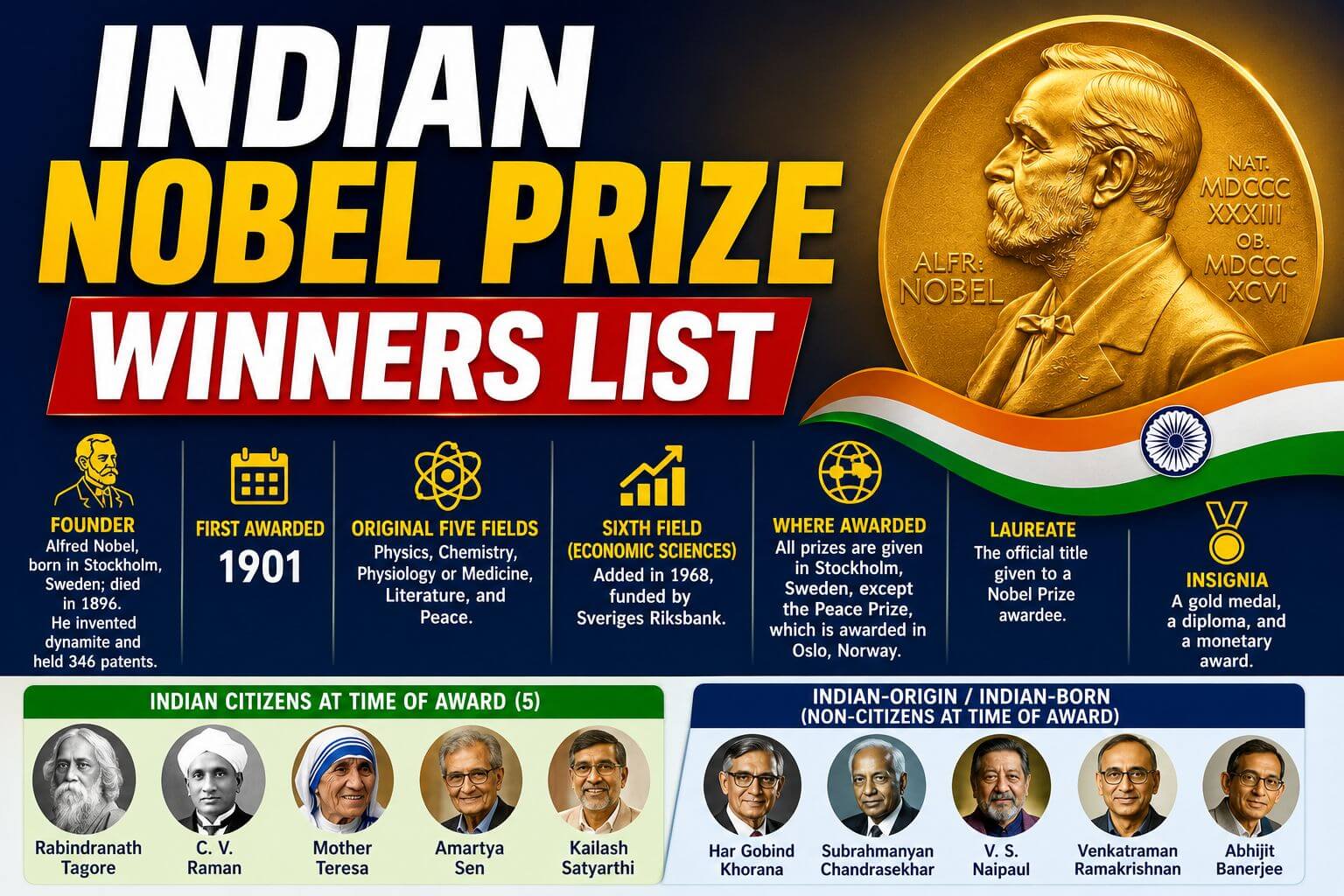
Before learning the list of Indian winners, candidates must understand a few basic facts that exam-setters love to twist in questions:
- Founder: Alfred Nobel, born in Stockholm, Sweden; died in 1896. He invented dynamite and held 346 patents.
- First awarded: 1901.
- Original five fields: Physics, Chemistry, Physiology or Medicine, Literature, and Peace.
- Sixth field (Economic Sciences): Added in 1968, funded by Sveriges Riksbank.
- Where awarded: All prizes are given in Stockholm, Sweden, except the Peace Prize, which is awarded in Oslo, Norway.
- Laureate: The official title given to a Nobel Prize awardee.
- Insignia: A gold medal, a diploma, and a monetary award.
- Indian citizens at time of award (5): Rabindranath Tagore, C. V. Raman, Mother Teresa, Amartya Sen, Kailash Satyarthi.
- Indian-origin / Indian-born (non-citizens at time of award): Har Gobind Khorana, Subrahmanyan Chandrasekhar, V. S. Naipaul, Venkatraman Ramakrishnan, Abhijit Banerjee.
Nobel Prize Indian Winners - Complete List
Indian Citizens Who Won the Nobel Prize
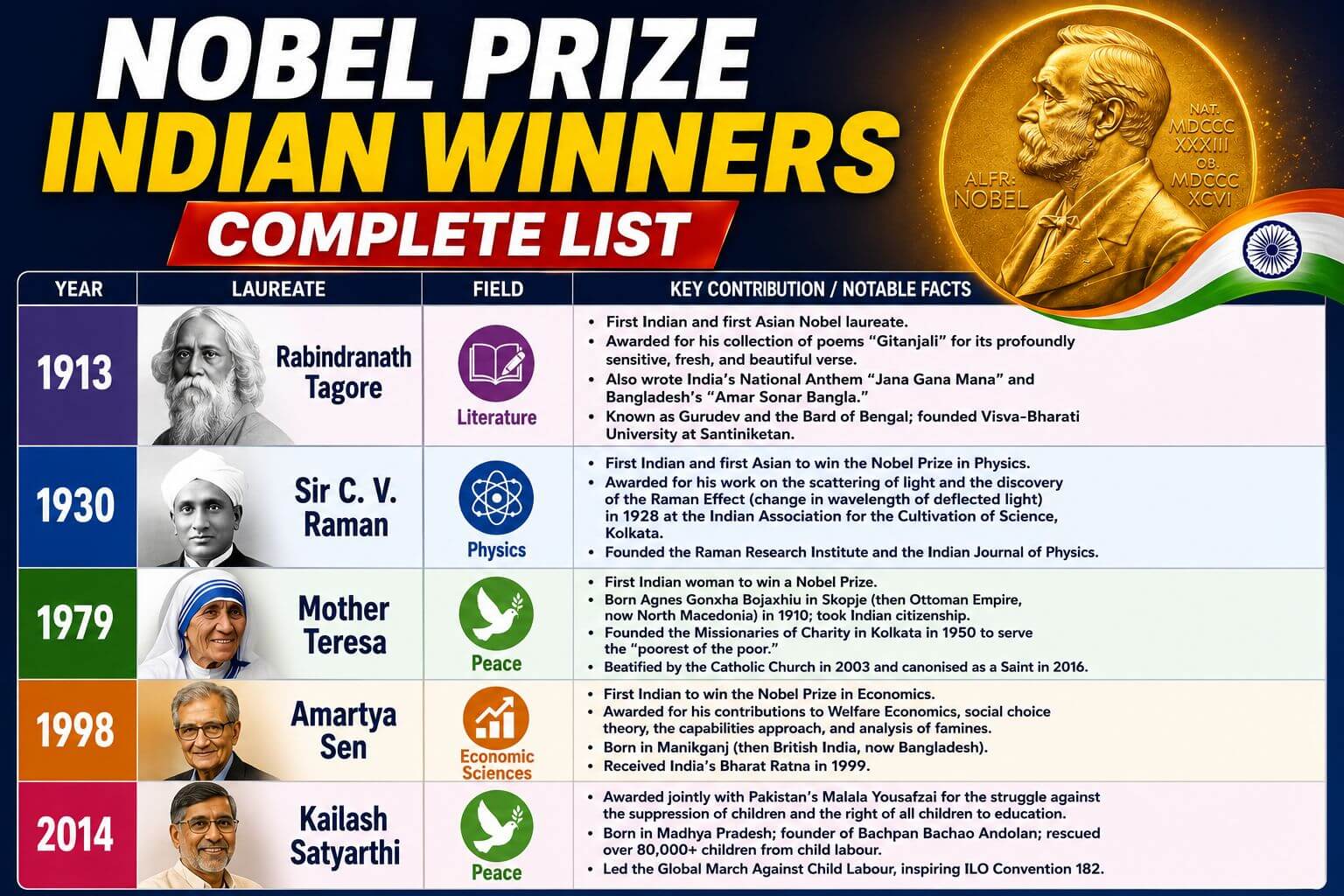
| Year | Laureate | Field | Key Contribution / Notable Facts |
|---|---|---|---|
| 1913 | Rabindranath Tagore | Literature | First Indian and first Asian Nobel laureate. Awarded for his collection of poems "Gitanjali" for its profoundly sensitive, fresh, and beautiful verse. Also wrote India's National Anthem "Jana Gana Mana" and Bangladesh's "Amar Sonar Bangla." Known as Gurudev and the Bard of Bengal; founded Visva-Bharati University at Santiniketan. |
| 1930 | Sir C. V. Raman | Physics | First Indian and first Asian to win the Nobel Prize in Physics. Awarded for his work on the scattering of light and the discovery of the Raman Effect (change in wavelength of deflected light) in 1928 at the Indian Association for the Cultivation of Science, Kolkata. Founded the Raman Research Institute and the Indian Journal of Physics. |
| 1979 | Mother Teresa | Peace | First Indian woman to win a Nobel Prize. Born Agnes Gonxha Bojaxhiu in Skopje (then Ottoman Empire, now North Macedonia) in 1910; took Indian citizenship. Founded the Missionaries of Charity in Kolkata in 1950 to serve the "poorest of the poor." Beatified by the Catholic Church in 2003 and canonised as a Saint in 2016. |
| 1998 | Amartya Sen | Economic Sciences | First Indian to win the Nobel Prize in Economics. Awarded for his contributions to Welfare Economics, social choice theory, the capabilities approach, and analysis of famines. Born in Manikganj (then British India, now Bangladesh). Received India's Bharat Ratna in 1999. |
| 2014 | Kailash Satyarthi | Peace | Awarded jointly with Pakistan's Malala Yousafzai for the struggle against the suppression of children and the right of all children to education. Born in Madhya Pradesh; founder of Bachpan Bachao Andolan; rescued over 80,000+ children from child labour. Led the Global March Against Child Labour, inspiring ILO Convention 182. |
Indian-Origin / Indian-Born Nobel Laureates
| Year | Laureate | Field | Key Contribution / Notable Facts |
|---|---|---|---|
| 1968 | Har Gobind Khorana | Physiology or Medicine | Indian-American biochemist born in Raipur (now in Pakistan). Awarded jointly with Marshall W. Nirenberg and Robert W. Holley for interpreting the genetic code and its function in protein synthesis. Synthesised the first artificial gene; revolutionised molecular biology and genetic engineering. |
| 1983 | Subrahmanyan Chandrasekhar | Physics | Indian-American astrophysicist born in Lahore (then British India). Awarded jointly with William A. Fowler for theoretical studies of the structure and evolution of stars. Famous for the Chandrasekhar Limit - the upper mass limit of a stable white dwarf star. Nephew of C. V. Raman. |
| 2001 | V. S. Naipaul | Literature | Trinidadian-British writer of Indian origin (born in Trinidad to Indian parents in 1932). Awarded for "perceptive narrative and incorruptible scrutiny in works that compel us to see the presence of suppressed histories." Notable works: A House for Mr. Biswas, A Bend in the River, The Enigma of Arrival. |
| 2009 | Venkatraman Ramakrishnan | Chemistry | Indian-American-British structural biologist born in Chidambaram, Tamil Nadu. Awarded jointly with Thomas A. Steitz and Ada E. Yonath for studies of the structure and function of the ribosome using X-ray crystallography. First Indian-origin scientist to win a Nobel Prize in Chemistry. |
| 2019 | Abhijit Banerjee | Economic Sciences | Indian-American economist born in Mumbai (and raised in Kolkata) on 21 February 1961. Awarded jointly with his wife Esther Duflo and Michael Kremer for an "experimental approach to alleviating global poverty." Co-founder of the Abdul Latif Jameel Poverty Action Lab (J-PAL). Currently the Ford Foundation International Professor of Economics at MIT. |
Other India-Connected Laureates (Born in India, Not Indian Citizens)
| Year | Laureate | Field | Key Contribution / Notable Facts |
|---|---|---|---|
| 1902 | Ronald Ross | Physiology or Medicine | British medical doctor born in Almora (in present-day Uttarakhand, India). Awarded for his work on malaria, showing how the parasite enters the human body through the mosquito. |
| 1907 | Rudyard Kipling | Literature | British author born in Bombay (Mumbai), India. Awarded for his power of observation, originality of imagination, and great talent for narration. Famous for The Jungle Book and Kim. |
| 1989 | 14th Dalai Lama (Tenzin Gyatso) | Peace | Tibetan spiritual leader living in exile in India since 1959. Awarded for his non-violent struggle for the liberation of Tibet and consistent advocacy for peaceful, mutually respectful solutions. |
Memory Tricks and Mnemonics
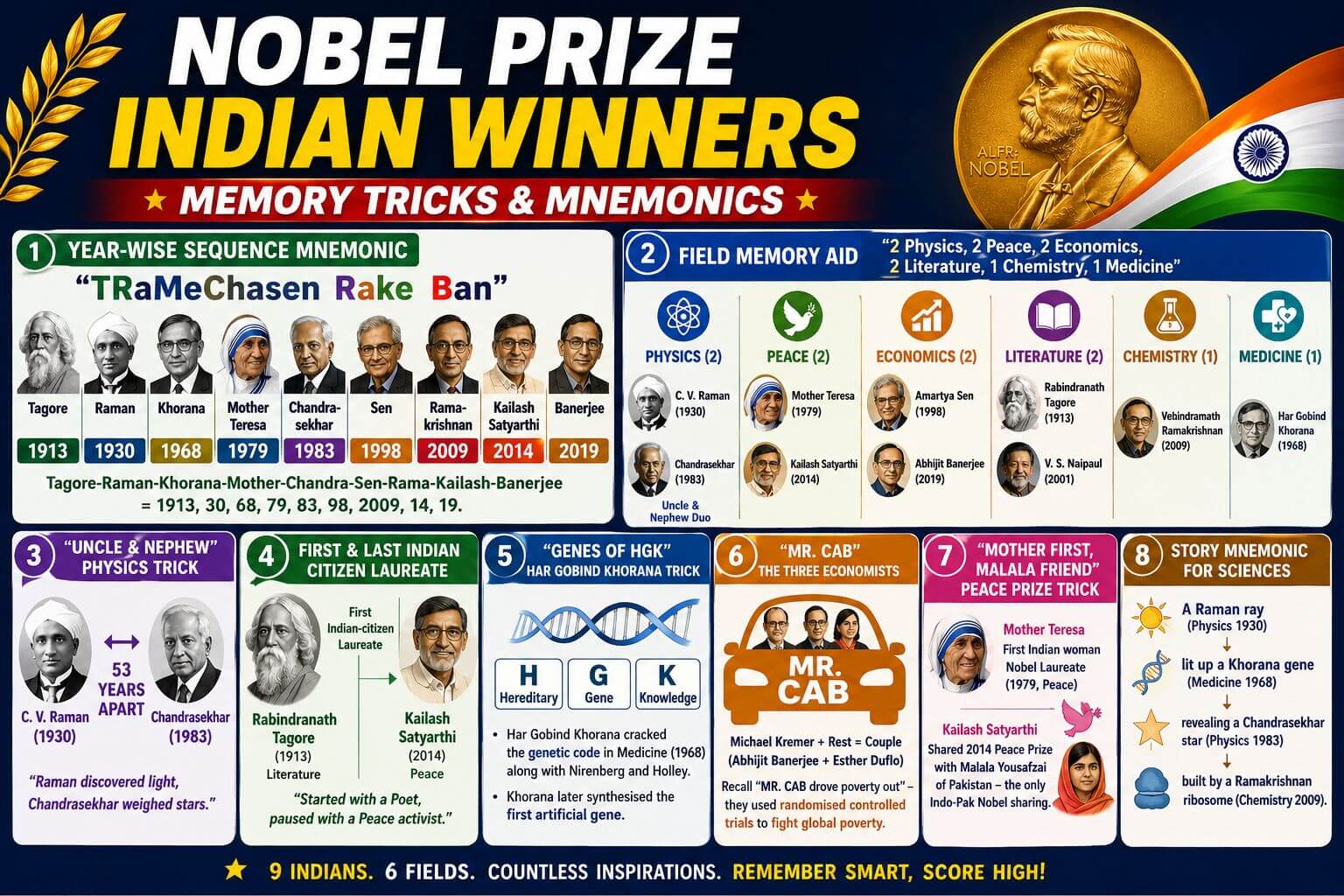
Trick 1 - Year-Wise Sequence Mnemonic: "TRaMeChasen Rake Ban"
Pick the first letters of the nine main Indian / Indian-origin laureates in order: Tagore, Raman, Khorana, Mother Teresa, Chandrasekhar, Sen, Ramakrishnan, Kailash Satyarthi, Banerjee.
"Tagore-Raman-Khorana-Mother-Chandra-Sen-Rama-Kailash-Banerjee = 1913, 30, 68, 79, 83, 98, 2009, 14, 19."
Trick 2 - Field Memory Aid: "2 Physics, 2 Peace, 2 Economics, 2 Literature, 1 Chemistry, 1 Medicine"
- Physics (2): C. V. Raman (1930), Chandrasekhar (1983) - uncle and nephew duo.
- Peace (2): Mother Teresa (1979), Kailash Satyarthi (2014).
- Economics (2): Amartya Sen (1998), Abhijit Banerjee (2019).
- Literature (2): Tagore (1913), V. S. Naipaul (2001).
- Chemistry (1): Venkatraman Ramakrishnan (2009).
- Medicine (1): Har Gobind Khorana (1968).
Trick 3 - "Uncle & Nephew" Physics Trick
"Raman discovered light, Chandrasekhar weighed stars." Remember that C. V. Raman (1930) and Subrahmanyan Chandrasekhar (1983) are uncle and nephew — both Nobel laureates in Physics, exactly 53 years apart.
Trick 4 - First & Last Indian Citizen Laureate
"Started with a Poet, paused with a Peace activist." Rabindranath Tagore (1913, Literature) was the first Indian-citizen laureate, and Kailash Satyarthi (2014, Peace) is the most recent Indian-citizen laureate.
Trick 5 - "GENES of HGK" - Har Gobind Khorana Trick
Remember HGK = Hereditary Gene Knowledge. Har Gobind Khorana cracked the genetic code in Medicine (1968) along with Nirenberg and Holley. Khorana later synthesised the first artificial gene.
Trick 6 - "MR. CAB" - The Three Economists
For the 2019 Economics Nobel: Michael Kremer + Rest = Couple (Abhijit Banerjee + Esther Duflo). Recall "MR. CAB drove poverty out" - they used randomised controlled trials to fight global poverty.
Trick 7 - "Mother First, Malala Friend" - Peace Prize Trick
Mother Teresa was the first Indian woman Nobel laureate (1979, Peace). Kailash Satyarthi shared his 2014 Peace Prize with Malala Yousafzai of Pakistan - the only Indo-Pak Nobel sharing.
Trick 8 - Story Mnemonic for Sciences
"A Raman ray (Physics 1930) lit up a Khorana gene (Medicine 1968), revealing a Chandrasekhar star (Physics 1983), built by a Ramakrishnan ribosome (Chemistry 2009)." This one line sequences all four science Nobels won by Indians / Indian-origin scientists.
Additional Notes
Frequently Confused Facts
- First Indian Nobel laureate vs First Indian-citizen woman Nobel laureate: The first Indian Nobel laureate was Rabindranath Tagore (1913); the first Indian woman Nobel laureate was Mother Teresa (1979).
- First Indian in Physics vs First Indian in Chemistry: C. V. Raman (1930, Physics) is often confused with Venkatraman Ramakrishnan (2009, Chemistry). Raman discovered the Raman Effect; Ramakrishnan worked on the ribosome.
- Amartya Sen vs Abhijit Banerjee: Both Bengali-origin economists. Sen (1998) - Welfare Economics, capabilities approach, famines. Banerjee (2019) - Randomised controlled trials, poverty alleviation, J-PAL.
- Khorana vs Ramakrishnan: Khorana won Medicine (1968) for the genetic code; Ramakrishnan won Chemistry (2009) for ribosome structure.
- Mother Teresa's birthplace: Born in Skopje (now North Macedonia), NOT in Albania (a common mistake). She took Indian citizenship later.
- Chandrasekhar Limit: Often confused with "Schwarzschild radius." The Chandrasekhar Limit is the maximum mass of a stable white dwarf star (~1.4 solar masses).
- Ronald Ross and Rudyard Kipling: Both were born in India but were British citizens; they are NOT counted as Indian Nobel laureates, only as "India-connected."
Repeating PYQ Patterns
- SSC CGL / CHSL: First Indian to win Nobel, year of C. V. Raman's Nobel, what is the Raman Effect, first Indian woman Nobel laureate.
- UPSC Prelims: Field of award for each laureate, joint awardees (Satyarthi-Malala, Banerjee-Duflo-Kremer), the Chandrasekhar Limit.
- IBPS PO / Clerk & SBI: Year and field of Amartya Sen and Abhijit Banerjee; capabilities approach; J-PAL.
- RRB NTPC & Group D: First Indian Nobel laureate, founder of Missionaries of Charity, Gitanjali author.
- Insurance (LIC AAO, NIACL): Names of all six Nobel categories, the 1968-added category, Sweden vs Norway awarding bodies.
- Defence (NDA, CDS, AFCAT): Indian-origin scientists in physics; uncle-nephew Raman-Chandrasekhar link; Khorana's contribution.
Quick Insight
India's Nobel record is uneven across categories - two each in Physics, Peace, Economics, and Literature, but only one each in Chemistry and Medicine, and zero Indian-citizen science Nobels since 1930. This is a frequent UPSC essay and interview discussion point on India's research ecosystem. The 2019 award to Abhijit Banerjee renewed national attention on evidence-based policymaking through Randomised Controlled Trials (RCTs). Stay current with the latest international awards through our Daily Current Affairs notes and practice them on the Current Affairs Quiz page.
One-Liners for Quick Revision
- Alfred Nobel → Swedish chemist, engineer and inventor of dynamite → instituted the Nobel Prize through his 1895 will; died in 1896.
- First Nobel Prize awarded → 1901 → in five fields (Physics, Chemistry, Medicine, Literature, Peace).
- Economic Sciences Nobel → Added in 1968 → funded by Sveriges Riksbank (central bank of Sweden).
- Place of award → Stockholm, Sweden for all categories → except Peace Prize, awarded in Oslo, Norway.
- Rabindranath Tagore (1913) → Nobel in Literature for "Gitanjali" → First Indian, first Asian, first non-European to win a Nobel; also called Gurudev / Bard of Bengal.
- C. V. Raman (1930) → Nobel in Physics for the Raman Effect (scattering of light) → First Asian to win Nobel in Physics; discovery made in 1928 at IACS, Kolkata.
- Har Gobind Khorana (1968) → Nobel in Physiology or Medicine for interpreting the genetic code → Shared with Marshall Nirenberg and Robert Holley; later synthesised the first artificial gene.
- Mother Teresa (1979) → Nobel Peace Prize → First Indian woman laureate; born in Skopje (now North Macedonia); founded Missionaries of Charity in Kolkata, 1950.
- Subrahmanyan Chandrasekhar (1983) → Nobel in Physics for the structure and evolution of stars → Famous for the Chandrasekhar Limit (~1.4 solar masses); nephew of C. V. Raman; shared prize with William A. Fowler.
- Amartya Sen (1998) → Nobel in Economic Sciences for Welfare Economics → Capabilities approach, social choice theory, famine analysis; Bharat Ratna (1999).
- V. S. Naipaul (2001) → Nobel in Literature → Indian-origin Trinidadian-British author; works include A House for Mr. Biswas, A Bend in the River.
- Venkatraman Ramakrishnan (2009) → Nobel in Chemistry for studies on the structure and function of the ribosome → Shared with Thomas A. Steitz and Ada E. Yonath; born in Chidambaram, Tamil Nadu.
- Kailash Satyarthi (2014) → Nobel Peace Prize for child rights → Shared with Malala Yousafzai (Pakistan); founder of Bachpan Bachao Andolan; rescued 80,000+ children.
- Abhijit Banerjee (2019) → Nobel in Economic Sciences for experimental approach to fighting poverty → Shared with Esther Duflo and Michael Kremer; co-founder of J-PAL; based at MIT.
- Ronald Ross (1902) → Nobel in Medicine for malaria research → Born in Almora, India; British citizen.
- Rudyard Kipling (1907) → Nobel in Literature → Born in Bombay (Mumbai); British citizen; famous for The Jungle Book.
- 14th Dalai Lama (1989) → Nobel Peace Prize → Tibetan spiritual leader living in exile in India since 1959.
- Indian citizens at award (5): Tagore, Raman, Mother Teresa, Amartya Sen, Kailash Satyarthi.
- Indian-origin / Indian-born (5): Khorana, Chandrasekhar, Naipaul, Ramakrishnan, Banerjee.
- Most recent Indian-citizen Nobel laureate → Kailash Satyarthi (2014, Peace).
- Most recent Indian-origin Nobel laureate → Abhijit Banerjee (2019, Economics).
- Only uncle-nephew Nobel pair from India → C. V. Raman and Subrahmanyan Chandrasekhar, both in Physics.
For more such quick-revision Static GK lists and topic-wise notes, explore the Static GK Quizzes, brush up on related awards in Banking Awareness, and stay updated on upcoming exam openings through the Latest Government Jobs Notifications page.
Free quiz • No signup required
Put this topic into practice with Indian Cultural Institutions – Static GK MCQ Quiz. It is the quickest way to reinforce what you just learned.
Frequently Asked Questions
Who was the first Indian to win a Nobel Prize?
Who was the first Indian woman to win a Nobel Prize?
Which Indian scientist won the Nobel Prize for the Raman Effect?
How many Indians and Indian-origin people have won the Nobel Prize?
Who was the first Indian to win the Nobel Prize in Economics?
Why did Har Gobind Khorana receive the Nobel Prize?
What is the Chandrasekhar Limit?
Who shared the 2014 Nobel Peace Prize with Kailash Satyarthi?
Who is the most recent Indian-origin Nobel laureate?
In which six fields is the Nobel Prize awarded?

About the author