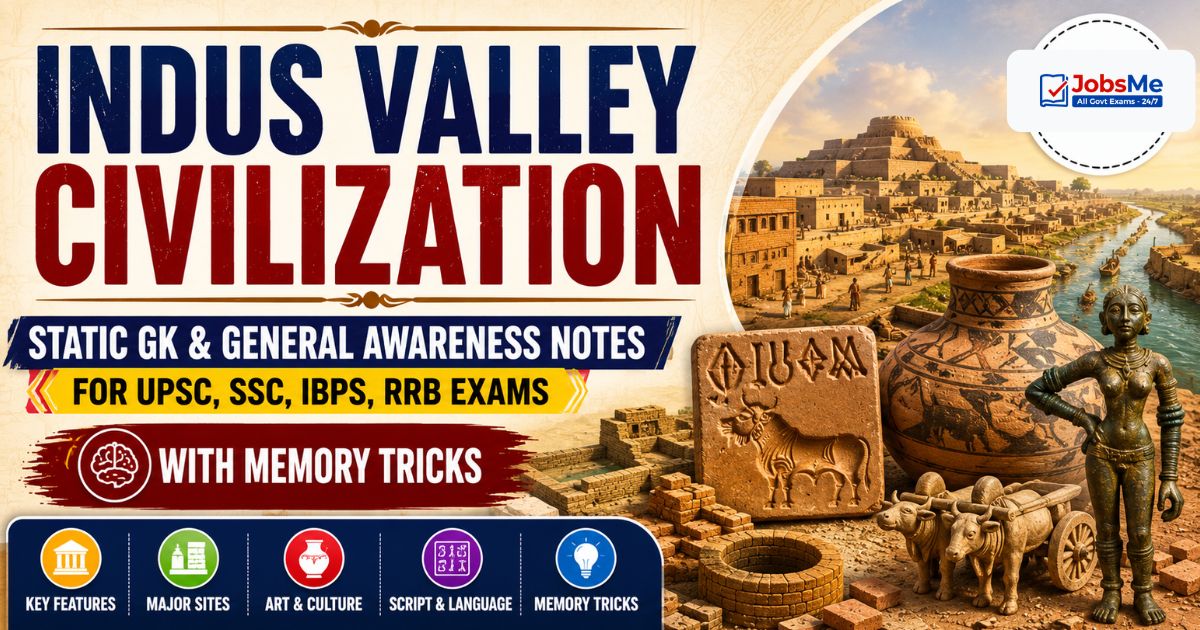
Indus Valley Civilization – Static GK & General Awareness Notes for UPSC, SSC, IBPS, RRB Exams with Memory Tricks
This article presents complete, exam-ready notes on the Indus Valley Civilization (IVC), also known as the Harappan Civilization, covering its chronology, major sites like Harappa, Mohenjo-Daro, Dholavira, Lothal, Kalibangan, Rakhigarhi and Chanhudaro, along with their excavators and key findings. It also covers town planning, agriculture, trade, religion, art, the Indus script, theories of decline, and the latest discoveries from 2021 to 2026. All facts are arranged in a structured format with memory tricks and one-liners to help UPSC, SSC, IBPS, RRB, PSU, Defence and State PCS aspirants score better in History and General Awareness sections.
Jump to section
Introduction
The Indus Valley Civilization (IVC), also known as the Harappan Civilization, is the earliest known urban culture of the Indian subcontinent and one of the world's three oldest civilizations along with Mesopotamia and Ancient Egypt. It flourished between 3300 BCE and 1300 BCE across the river basins of the Indus and the Ghaggar-Hakra, covering an enormous area of approximately 13,00,000 square kilometres — larger than either Egypt or Mesopotamia at their peak. Major cities such as Harappa, Mohenjo-Daro, Dholavira, Lothal, Kalibangan and Rakhigarhi reveal a remarkably advanced civilization marked by planned cities, baked brick architecture, an unparalleled drainage system, standardised weights, long-distance trade and an undeciphered pictographic script.
Questions on the Indus Valley Civilization appear in almost every major competitive examination — UPSC Prelims, SSC CGL, IBPS PO, SBI Clerk, RRB NTPC, State PCS, Defence and Insurance exams. Aspirants are typically asked about the dates of the civilization, names of sites and their excavators, location of sites along rivers, important findings (Great Bath, Dancing Girl, Pashupati seal, Dockyard), town planning features, and theories of decline. This article brings together every important fact in a structured, exam-ready format. For more such Ancient History resources, you can refer to the Static GK section on Jobsme.in.
The IVC is also a recurring theme in current affairs. Dholavira was inscribed as a UNESCO World Heritage Site in 2021 — India's 40th — and Rakhigarhi was confirmed as the largest Harappan site in the world. Recent excavations in Rajasthan's Thar Desert (2025) and gold-particle finds at Lothal (2026) have extended our understanding of Harappan geography. These developments make the topic doubly important for UPSC Mains, Essay papers and current affairs sections of Banking, SSC and Railway exams.
Core Concept: What is the Indus Valley Civilization
The Indus Valley Civilization was a Bronze Age civilization that developed in the north-western part of South Asia (present-day Pakistan and north-west India). Originally called the Indus Valley Civilization because most early sites lay along the Indus river, it is now also called the Indus-Sarasvati Civilization because many later sites were found along the dried-up Ghaggar-Hakra (believed to be the ancient Sarasvati). Since Harappa was the first site to be excavated, the civilization is also called the Harappan Civilization.
Key Identifiers of the IVC
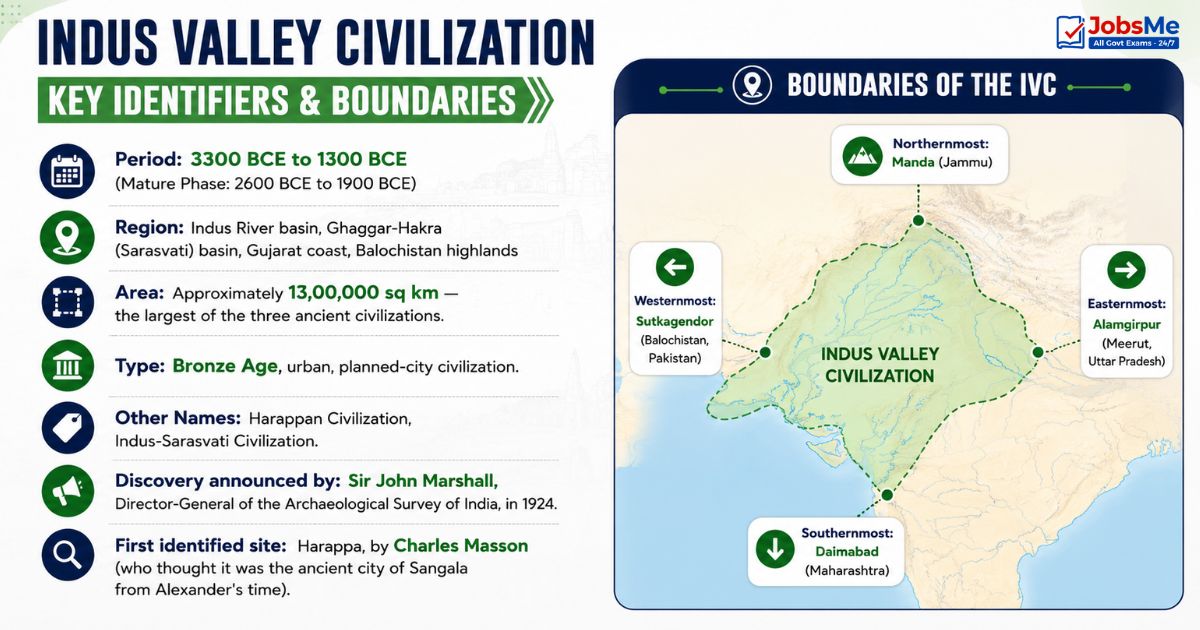
- Period: 3300 BCE to 1300 BCE (Mature Phase: 2600 BCE to 1900 BCE).
- Region: Indus River basin, Ghaggar-Hakra (Sarasvati) basin, Gujarat coast, Balochistan highlands.
- Area: Approximately 13,00,000 sq km — the largest of the three ancient civilizations.
- Type: Bronze Age, urban, planned-city civilization.
- Other Names: Harappan Civilization, Indus-Sarasvati Civilization.
- Discovery announced by: Sir John Marshall, Director-General of the Archaeological Survey of India, in 1924.
- First identified site: Harappa, by Charles Masson (who thought it was the ancient city of Sangala from Alexander's time).
Boundaries of the IVC
- Westernmost site: Sutkagendor (Balochistan, Pakistan).
- Easternmost site: Alamgirpur (Meerut, Uttar Pradesh).
- Northernmost site: Manda (Jammu).
- Southernmost site: Daimabad (Maharashtra).
Phases of the Indus Valley Civilization
The Harappan civilization is divided into three chronological phases based on radiocarbon dating. Each phase has distinct features and important sites.
| Phase | Dates | Important Sites | Key Features |
|---|---|---|---|
| Early Harappan / Regionalization Phase | 3300 - 2600 BCE | Harappa, Kot Diji, Amri | Beginning of fortification and grid-style planning, incipient trade networks, early craft specialisation, cultivation of peas, sesame, dates and cotton. Related to the Hakra phase of the Ghaggar-Hakra valley. |
| Mature Harappan / Integration Phase | 2600 - 1900 BCE | Mohenjo-Daro, Harappa, Kalibangan, Dholavira, Lothal, Banawali | Full-scale urbanisation, emergence of writing, uniformity of weights, bricks and artefacts, organised drainage, large public buildings, full-fledged internal and external trade. Earliest examples of the Indus script appear around 3000 BCE. |
| Late Harappan / Localization Phase | 1900 - 1300 BCE | Cemetery H at Harappa, Siswal, Rojdi, Rangpur | Decline and abandonment of major cities, rise of pastoral and agricultural settlements, decreasing standardisation, loss of script and seals. Most cities abandoned by 1700 BCE; archaeological traces persist till about 1000-900 BCE. |
Major Sites of the Indus Valley Civilization
The following table lists the most exam-relevant Indus Valley sites with their location, excavator, year of excavation and key findings. These are the most frequently asked sites in UPSC Prelims, SSC CGL, RRB NTPC and IBPS PO papers.
IVC Sites in Present-Day Pakistan
| Site | Location and River | Excavator (Year) | Important Findings and Features |
|---|---|---|---|
| Harappa | Montgomery (now Sahiwal) district, Punjab province, Pakistan; on the Ravi river. | Daya Ram Sahni (1920-1921) | First Harappan site to be excavated, which gave the civilization its name. Divided into citadel and lower town. Great Granary in the citadel, six granaries arranged in two rows. Elaborate drainage of baked bricks. Evidence of coffin burial and Cemetery H culture. Sandstone statues of human anatomy, red stone idols of a dancing girl and naked male torso. Direct trade evidence with Mesopotamia. Bullock carts. |
| Mohenjo-Daro (Mound of the Dead) | Larkana district, Sindh province, Pakistan; on the Indus river. | Rakhaldas Banerjee (1921-1922); later E. Makay, K. N. Dikshit, Sir John Marshall (1930) | UNESCO World Heritage Site. Divided into citadel and lower town. Famous discoveries include the Great Bath (12 x 7 x 3 m), Great Granary, multi-pillared assembly hall, bronze Dancing Girl statue (10.5 cm), steatite Bearded Man / Priest-King (17.5 cm), Pashupati Mahadeva seal, seal of mother goddess, piece of woven cotton cloth, human skeletons, superficial evidence of horse, evidence of large boats and bangles of clay. |
| Chanhudaro | Sindh province, Pakistan, near Mohenjo-Daro; on the Indus river. | N. G. Majumdar (1931); later E. Makay | Only Harappan site without a citadel and without a fortification wall. Major bead-making factory. Inkpot, bronze model of a roofed bullock cart and a four-wheeled clay cart, footprint of a dog chasing a cat preserved on a brick. Evidence of human sacrifice. |
| Sutkagendor | Southwestern Balochistan province, Pakistan; on the Dasht / Dashak river. | Aurel Stein (1929); later George Dales | Westernmost site of the IVC. Originally a port town, later cut off from the sea by coastal uplift. Acted as a trade point between Harappa and Babylon (Mesopotamia). |
| Kot Diji | Sindh province, Pakistan. | Ghurey (1835); Fazal Ahmed (1955) | Important pre-Harappan / Early Harappan site. Houses made of stone. City shows evidence of having been destroyed by force; represents the phase leading up to the Mature Harappan period. |
| Amri | Sindh province, Pakistan; on the banks of the Indus river. | N. G. Majumdar (1935) | Pre-Harappan site representing a transitional culture between pre-Harappan and Harappan stages. Actual remains of rhinoceros (antelope evidence too), trace of Jhangar culture and fire altars. |
IVC Sites in Present-Day India
| Site | Location and River | Excavator (Year) | Important Findings and Features |
|---|---|---|---|
| Rakhigarhi | Hisar district, Haryana; on the dry bed of the Drishadvati (Sarasvati) river. | Archaeological Survey of India (1960s); Dr. Suraj Bhan (1969); Amarendra Nath (1997 onwards) | Spread over 350 hectares, making it the largest Indus Valley site in the world (larger than Mohenjo-Daro and Harappa). Shows all three phases of Harappan culture. DNA analysis of skeletal remains revealed the Harappans had a distinct indigenous origin. Mud-brick and burnt-brick houses, efficient drainage, mud-brick granary with rammed-earth floor, seal with alligator symbol. A massive water reservoir was reported in 2025. |
| Dholavira | Khadir Bet Island, Great Rann of Kutch, Gujarat; lies on the Tropic of Cancer. | Jagat Pati Joshi (1967-1968); R. S. Bisht (1990-2005) | Inscribed as a UNESCO World Heritage Site in 2021 — India's 40th and the first IVC site in India to be listed. Unique three-part city plan: citadel, middle town and lower town. Cascading series of 16 water reservoirs and a sophisticated rainwater harvesting system, earning it the name "lake city" or "Jala Durga" (water fort). Extensive use of stone with mud-brick. The famous Dholavira signboard with ten large Harappan script signs — the world's earliest known sign-board. Multi-purpose grounds for festivities and marketplace. No human burials, unlike other sites. |
| Lothal (Mound of the Dead) | Ahmedabad district, Gujarat, at the head of the Gulf of Khambhat (Cambay); at the confluence of the Bhogava and Sabarmati rivers. | S. R. Rao (1953 / 1957) | Only port town of the IVC. World's earliest known tidal dockyard. Bead-making factory. Earliest evidence of rice cultivation in South Asia (rice husks). Fire altars indicate fire-god worship. City divided into six sectors (not the usual two). Houses had main entrances on the front (rare in IVC). Painting on a jar resembling the cunning fox story from the Panchatantra. Evidence of double burials (male and female together). Seal from Mesopotamia (Persian Gulf seal). Ivory scale and terracotta model of a ship. |
| Kalibangan ("Black Bangles") | Ganganagar / Hanumangarh district, Rajasthan; on the bank of the Ghaggar river. | Amlanand Ghosh (1953); Dr. B. B. Lal and B. K. Thapar (1961) | Made up of three mounds. World's earliest attested ploughed field. Earliest form of artificial irrigation practised here. Famous fire altars demonstrating a cult of fire / sacrifice. Bones of camel. Wooden plough. Mesopotamian pottery indicating trade contacts. Different types of burials (circular, rectangular) revealing social inequality. Burnt bricks were used only for drains, not houses. Decorative bricks used in flooring only at this site. Did not have a drainage system as planned as Mohenjo-Daro. |
| Banawali | Hisar district, Haryana; on the dry bed of the Rangoi river. | R. S. Bisht (1973-1974) | Evidence of both pre-Harappan and Mature Harappan culture. High-quality barley grains. Ceramics, a steatite seal, clay model of a plough and fire altars. Unlike most IVC cities, displayed a radial street pattern rather than a grid. Seals were found only in the lower town, not the citadel. |
| Surkotada | Bhuj district, Gujarat; on the Saraswati river. | J. P. Joshi (1964) | One of the very few IVC sites with bones of the horse (controversial evidence). Cylindrical stone-and-mud-brick fortification. Graveyard with pot-burials and beads. |
| Ropar (Rupar / Rupnagar) | Punjab, India; on the Sutlej river. | Y. D. Sharma (1955-1956) | First IVC site to be excavated in independent India. Unique evidence of a dog being buried below a human in a grave. |
| Alamgirpur | Meerut district, Uttar Pradesh; on the Hindon river (tributary of Yamuna). | Y. D. Sharma (1958) | Easternmost site of the IVC. Belongs to the Late Harappan culture. Findings include pottery, beads, terracotta and remains of cloth. |
| Rangpur | Gujarat, near Lothal; on the Madar river. | M. S. Vatsa (1931); S. R. Rao (1953-1954) | Contains both pre-Harappan and Mature Harappan layers. Yellow and grey pottery of pre-Harappan people. Stone flakes and rice husk evidence. |
| Daimabad | Ahmednagar district, Maharashtra; on the Pravara river. | B. P. Bopardikar (1958); later M. N. Deshpande and S. R. Rao | Southernmost known site of the IVC. Famous for outstanding bronze metal-cast sculptures including a chariot, bull, elephant and rhinoceros. |
Key Features of the Indus Valley Civilization
Town Planning
The most outstanding feature of the IVC was its highly advanced and uniform town planning. The same plan was followed across cities separated by hundreds of kilometres.
- Two-part City: Each city had a raised citadel (probably for rulers / public buildings) and a lower town for common people. Dholavira uniquely had three parts — citadel, middle town and lower town.
- Grid Pattern: Streets ran north-south and east-west, cutting one another at right angles. Main streets were 9-12 metres wide.
- Baked Bricks: Use of kiln-fired baked bricks was remarkable (Egypt used sun-dried bricks). The ratio of bricks was a uniform 1:2:4 (thickness:width:length); house bricks measured 7 x 14 x 28 cm and city-wall bricks 10 x 20 x 40 cm.
- Drainage System: The most advanced drainage system of the ancient world. Covered brick drains lined with lime, mortar and gypsum ran along every street. Each house had bathrooms and washbasins connected to soak pits.
- Great Bath: A large public waterproof tank at Mohenjo-Daro, 12 m long, 7 m wide and 3 m deep, used for ritual bathing.
- Granaries: Massive raised structures at Harappa and Mohenjo-Daro for grain storage.
- Houses: Each house had wells, courtyards and bathrooms. Kalibangan had wells in many houses; Dholavira and Lothal were entirely walled.
- No Palaces or Temples: No royal palaces or temples have been found — suggesting either a merchant-oligarchic or egalitarian society.
Agriculture and Food
- Main crops: wheat, barley, peas, sesame, mustard, lentils, chickpeas, dates and cotton. Indus people were the first in the world to cultivate cotton; the Greeks therefore called it "Sindon" (from Sindh).
- Millets are found in Gujarat; rice is rare, found mainly at Lothal and Rangpur.
- Wooden ploughs were used; the ploughed field at Kalibangan is the earliest in the world.
- Annual floods of the Indus provided alluvial soil and moisture; canals found only at Shortughai (Afghanistan), not Punjab or Sindh.
- Domesticated animals: cattle, sheep, goats, buffalo, dogs, camels and elephants. The horse was not known (evidence at Surkotada and Lothal remains doubtful).
Trade and Economy
- Internal trade between Harappan cities was carried out through the Indus river.
- External trade with Mesopotamia, Sumer, Bahrain, Oman and Persian Gulf regions. Harappan seals have been found in Mesopotamian cities.
- Trading colony at Shortughai (Afghanistan) facilitated trade with Central Asia.
- Exports: cotton, beads, jewellery, timber, pottery, grain.
- Money was not used — trade was carried on by the barter system.
- Standardised weights and measures using the binary system (1, 2, 4, 8, 16…) and decimal multiples.
- Lapis lazuli was a prestige trade item, possibly enhancing the status of the ruling class.
Harappan Imports and Their Source Regions
| Material | Source Region |
|---|---|
| Gold | Afghanistan, Iran, Kolar (South India) |
| Copper | Khetri mines (Rajasthan), Baluchistan, Oman |
| Tin | Afghanistan, Iran |
| Lapis Lazuli | Shortughai (Afghanistan) |
| Jade | Pamir (Central Asia) |
| Turquoise | Khorasan (Central Asia) |
| Steatite | Tepe Yahya (Iran), South Rajasthan |
| Bitumen | Baluchistan, Mesopotamia |
| Lead | South India |
| Silver | Jawar mines of Rajasthan, Mesopotamia |
Religion and Belief System
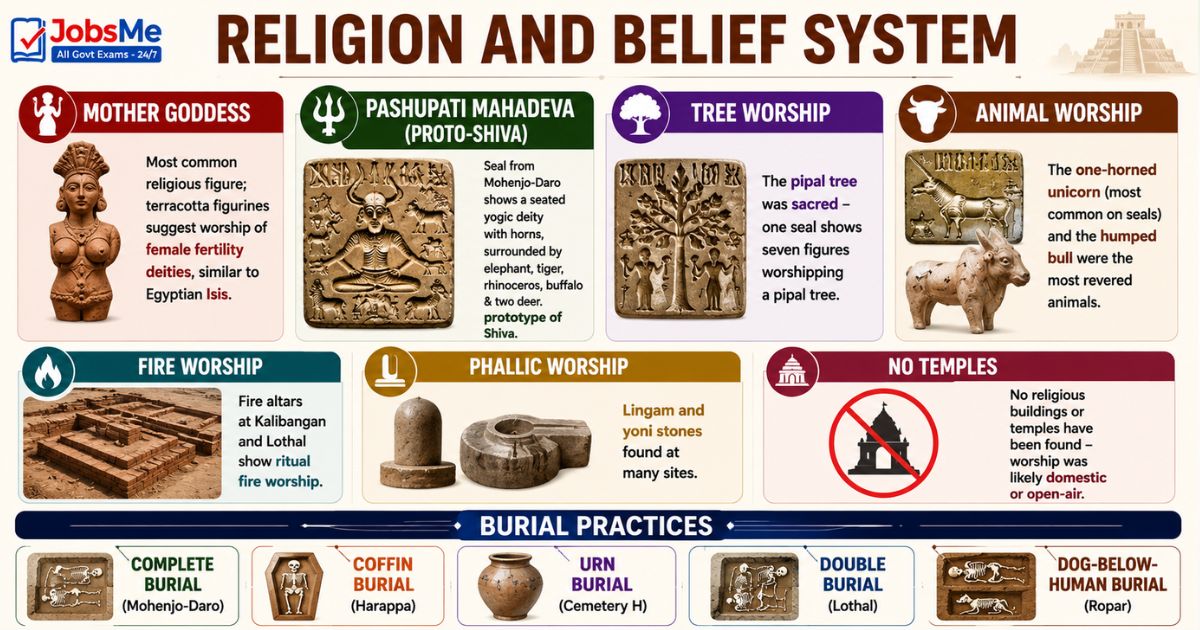
- Mother Goddess: The most common religious figure; terracotta figurines suggest worship of female fertility deities, similar to Egyptian Isis.
- Pashupati Mahadeva (Proto-Shiva): A seal from Mohenjo-Daro shows a seated yogic male deity with horns, surrounded by an elephant, tiger, rhinoceros and buffalo, with two deer at his feet — identified by John Marshall as the prototype of Shiva.
- Tree Worship: The pipal tree was sacred — one seal shows seven figures worshipping a pipal tree.
- Animal Worship: The one-horned unicorn (most common on seals) and the humped bull were the most revered animals.
- Fire Worship: Fire altars at Kalibangan and Lothal show ritual fire worship.
- Phallic Worship: Lingam and yoni stones found at many sites.
- No Temples: No religious buildings or temples have been found — worship was likely domestic or open-air.
- Burial Practices: Complete burial (Mohenjo-Daro), coffin burial (Harappa), urn burial (Cemetery H), double burial (Lothal), dog-below-human burial (Ropar).
Art, Crafts and Sculpture
- Bronze Dancing Girl: A 10.5-cm bronze statuette from Mohenjo-Daro, made by the lost-wax casting method — depicting a confident, ornament-clad young woman with her left hand on her hip.
- Bearded Priest-King: A 17.5-cm steatite bust from Mohenjo-Daro depicting a bearded man with closed eyes and a shawl over one shoulder, in a meditative pose.
- Red Sandstone Male Torso: A muscular torso from Harappa, notable for its naturalism.
- Steatite Seals: Over 2,000 seals discovered, most featuring animals (especially the unicorn), the undeciphered Indus script, and motifs like the swastika.
- Painted Pottery: Glossy black-on-red pottery with geometric, animal and plant designs.
- Terracotta Figurines: Mother goddesses, animals, bullock carts, toys and whistles.
- Bead Jewellery: Carnelian, agate, lapis lazuli, faience and shell beads — Lothal and Chanhudaro were major bead-making centres.
- Faience: An artificial material made from quartz; used for beads, bangles and figurines.
Indus Script
- The earliest examples of the Indus script date back to around 3000 BCE.
- It is pictographic, with about 400-500 distinct signs found on seals, pottery, copper tablets and bones.
- The script is boustrophedon — written from right to left in the first line, then left to right in the next, like an ox turning at the end of a furrow.
- The script has not been deciphered till date, which limits our understanding of Harappan language, religion and administration.
- The script disappeared around 1700 BCE and did not survive in later cultures.
Causes of Decline
The exact cause of the decline of the IVC around 1800 BCE is still debated. Several theories have been proposed:
- Aryan Invasion Theory: Earlier scholars (Mortimer Wheeler) believed an Aryan invasion destroyed the IVC; now largely discredited because IVC elements survived in later cultures.
- Climate Change: Gradual decrease in rainfall turned the region arid; this is the most widely accepted view today.
- Natural Disasters: Earthquakes, large-scale floods or droughts may have damaged cities.
- Course Change of Rivers: The drying up of the Ghaggar-Hakra (Sarasvati) and shifts in the Indus disrupted trade and agriculture.
- Epidemic Theory: Outbreaks of disease may have wiped out urban populations.
- Decline of Trade: Disruption of trade with Mesopotamia weakened the urban economy.
Memory Tricks and Mnemonics
Trick 1: Three Earliest Civilizations — "MIE"
The three earliest urban civilizations of the world are: "MIE — Mesopotamia, Indus, Egypt". Among these, the Indus was the largest in area.
Trick 2: Boundaries of IVC — "MASD"
Remember the four extreme sites with "MASD" in the cardinal order N-E-S-W:
- M → Manda (North, in Jammu).
- A → Alamgirpur (East, in UP).
- S → Sutkagendor (West, in Balochistan).
- D → Daimabad (South, in Maharashtra).
Or: "North-East-South-West, Manda-Alamgirpur-Daimabad-Sutkagendor."
Trick 3: Three Phases — "ELM" or "Early-Mature-Late"
The three phases of IVC can be remembered as "ELM", like a tree:
- E → Early Harappan (3300-2600 BCE).
- M → Mature Harappan (2600-1900 BCE).
- L → Late Harappan (1900-1300 BCE).
Trick 4: Excavators of Key Sites — "DRJS"
Remember the excavators of the four most-asked sites with "DRJS":
- D → Daya Ram Sahni → Harappa (1920-21).
- R → Rakhaldas Banerjee → Mohenjo-Daro (1921-22).
- J → Jagat Pati Joshi → Dholavira (1967-68).
- S → S. R. Rao → Lothal (1953/57).
Trick 5: Sites and Their Rivers — "HMD-RIK"
Match each big site to its river using "HMD-RIK":
- Harappa → Ravi.
- Mohenjo-Daro → Indus.
- Dholavira → Khadir Bet (Luni branch / no perennial river).
- Bonus: Kalibangan → Ghaggar; Lothal → Bhogava; Banawali → Rangoi; Ropar → Sutlej; Alamgirpur → Hindon.
Trick 6: Famous Findings at Mohenjo-Daro — "GDBP"
The four most-asked findings of Mohenjo-Daro can be remembered as "GDBP":
- G → Great Bath.
- D → Dancing Girl (bronze).
- B → Bearded Priest-King (steatite).
- P → Pashupati Seal.
Trick 7: Three Types of Bricks — "HEM"
Different civilizations used different bricks. Remember "HEM":
- H → Harappa used sun-dried + baked bricks (mostly baked).
- E → Egypt used dried bricks.
- M → Mesopotamia / Sumeria used baked bricks.
Trick 8: Only Port Town — Lothal "Loads The Ships"
The only port town of the IVC was Lothal in Gujarat. Remember: "Lothal Loads The Ships." It also gave the earliest evidence of rice and was famous for its dockyard.
Trick 9: Largest Site — "RR is the Biggest"
Rakhigarhi in Hisar, Haryana (~350 hectares) is the largest IVC site in the world. Mnemonic: "Rakhigarhi Rules" — larger than Mohenjo-Daro and Harappa combined.
Trick 10: UNESCO World Heritage IVC Site — "Only Dholavira (D-2021)"
Only Dholavira (Gujarat) is the IVC site listed by UNESCO (in 2021) — India's 40th World Heritage Site. Remember: "D for Dholavira, D for India's 40th."
Additional Notes
Frequently Confused Facts
- Mound of the Dead: The phrase "Mound of the Dead" usually refers to Mohenjo-Daro in Sindh, but Lothal in Gujarat also literally means the same in Gujarati.
- First Excavated vs First Discovered: Harappa was the first site to be excavated (Daya Ram Sahni, 1920); Mohenjo-Daro was excavated by Rakhaldas Banerjee in 1921; discovery was officially announced by Sir John Marshall in 1924.
- Largest Site vs Largest City: Rakhigarhi (350 hectares) is the largest IVC site overall; Mohenjo-Daro was the largest city in its peak.
- Pashupati Seal vs Mother Goddess Seal: The Pashupati seal depicts a horned male deity surrounded by animals; the Mother Goddess is shown in terracotta figurines, not seals.
- Dancing Girl vs Bearded Priest: The Dancing Girl is a bronze statue (10.5 cm); the Bearded Priest / Priest-King is a steatite bust (17.5 cm); both from Mohenjo-Daro.
- Citadel vs Lower Town: Most sites have two parts; Dholavira uniquely has three (citadel, middle town and lower town); Chanhudaro is the only site without a citadel.
- Fire Altars: Found at Kalibangan, Lothal, Banawali — not at Mohenjo-Daro or Harappa.
- Horse Evidence: Doubtful evidence at Surkotada (bones) and Lothal (a terracotta figurine); the IVC was not a horse-centred culture.
- Dockyard: Only at Lothal, on the Bhogava river near the Gulf of Cambay.
- Ploughed Field: World's earliest at Kalibangan, Rajasthan.
- Cotton First Cultivated: By the Harappans — the Greeks called cotton "Sindon" after Sindh.
- Iron: The IVC did not use iron — they were a Bronze Age civilization. They knew the wheel but not the spoked wheel.
- Indus Script Direction: Boustrophedon — alternating right-to-left and left-to-right, not just one direction.
Repeating PYQ Patterns
Certain IVC facts repeat across major exams. UPSC Prelims tends to ask about the dates of the civilization, location of sites along rivers, and findings like the Great Bath, Dancing Girl, Pashupati seal and Dholavira's water-management system. SSC CGL and RRB NTPC ask matching questions — site with excavator, site with river, or site with major finding (e.g., "Which IVC site is known for the dockyard?" → Lothal). IBPS PO and SBI Clerk exams frequently ask about the discovery year, John Marshall, the largest site (Rakhigarhi) and the UNESCO listing of Dholavira in 2021. State PCS exams add regional flavour — Haryana PCS frequently asks about Rakhigarhi and Banawali; Gujarat PCS focuses on Lothal, Dholavira, Surkotada and Rangpur; Rajasthan PCS on Kalibangan; UP PCS on Alamgirpur. For more such topics and daily updates, refer to the Daily Current Affairs section and the Static GK Quiz on Jobsme.in.
Quick Insight
The Indus Valley Civilization is more than a chapter in history textbooks — it is a touchstone of India's deep urban heritage. Dholavira's water reservoirs anticipated modern water-harvesting design by 4,500 years; Mohenjo-Daro's covered drains predate any other ancient sanitation network; and Lothal's tidal dockyard remains a milestone in maritime engineering. With Dholavira's UNESCO inscription in 2021, the 2025 Thar Desert discoveries near the Pakistan border, and the 2025 reservoir find at Rakhigarhi, the IVC is now a continuously evolving current-affairs topic. The discovery announced by IIT-Kharagpur and the Archaeological Survey of India that the IVC may be at least 8,000 years old has further pushed its relevance into Mains essays and interview questions on civilization, climate change and heritage. To keep track of the latest job notifications related to ASI, museums and heritage roles, check the Latest Government Job Notifications on Jobsme.in.
One-Liners for Quick Revision
- Indus Valley Civilization Period → 3300 BCE to 1300 BCE; Mature Phase 2600-1900 BCE.
- Also Called → Harappan Civilization (after first-excavated site); Indus-Sarasvati Civilization (after Ghaggar-Hakra sites).
- Type → Bronze Age, urban civilization.
- Area → Approximately 13,00,000 sq km — largest among the three ancient civilizations.
- Three Ancient Civilizations → Mesopotamia, Egypt, Indus.
- Discovery Announced → Sir John Marshall in 1924.
- First Identifier of Harappa → Charles Masson (thought it was Sangala of Alexander's time).
- Harappa Excavator → Daya Ram Sahni (1920-1921).
- Mohenjo-Daro Excavator → Rakhaldas Banerjee (1921-1922).
- Westernmost Site → Sutkagendor (Balochistan, Pakistan).
- Easternmost Site → Alamgirpur (Meerut, UP).
- Northernmost Site → Manda (Jammu).
- Southernmost Site → Daimabad (Maharashtra).
- Largest IVC Site → Rakhigarhi (Hisar, Haryana, ~350 hectares).
- UNESCO World Heritage Site → Mohenjo-Daro (Pakistan); Dholavira (India, 2021 - India's 40th).
- Harappa → Punjab (Pakistan), Ravi river; granaries, coffin burial, Cemetery H culture, dancing girl stone statue.
- Mohenjo-Daro → Sindh (Pakistan), Indus river; Great Bath, Great Granary, Bronze Dancing Girl, Pashupati seal, Bearded Priest, assembly hall.
- Dholavira → Khadir Bet, Gujarat; three-part city, cascading water reservoirs, signboard with 10 Harappan signs, UNESCO 2021.
- Lothal → Gujarat, Bhogava river; only port town, world's first tidal dockyard, rice husk, fire altars, six sectors, Persian Gulf seal.
- Kalibangan → Rajasthan, Ghaggar river; world's earliest ploughed field, fire altars, camel bones, artificial irrigation, wooden plough.
- Rakhigarhi → Haryana, Drishadvati river; largest IVC site, DNA evidence of indigenous origin, all three phases.
- Chanhudaro → Sindh, Indus river; only site without a citadel, bead factory, footprint of dog chasing cat, bronze toy carts.
- Banawali → Haryana, Rangoi river; both pre-Harappan and Harappan culture, radial street pattern, fire altars, clay model of plough.
- Surkotada → Gujarat; bones of horse (doubtful), graveyard, pot-burials.
- Sutkagendor → Balochistan, Dasht river; westernmost site, trade point between Harappa and Babylon.
- Ropar → Punjab (India), Sutlej river; dog buried below human; first IVC site excavated in independent India.
- Alamgirpur → Meerut (UP), Hindon river; easternmost site, Late Harappan.
- Amri → Sindh, Indus river; pre-Harappan, transitional culture, rhinoceros remains.
- Kot Diji → Sindh; pre-Harappan, stone houses, destroyed by force.
- Rangpur → Gujarat, Madar river; pre-Harappan and Mature Harappan layers, rice husk.
- Daimabad → Maharashtra, Pravara river; southernmost site, bronze metal-cast sculptures (chariot, bull, elephant, rhinoceros).
- Great Bath → Mohenjo-Daro; 12 x 7 x 3 m; ritual bathing site.
- Granaries → Found at Harappa, Mohenjo-Daro, Lothal, Rakhigarhi.
- Dockyard → Lothal (only IVC site with a dockyard).
- Bricks Ratio → 1:2:4 across all Harappan sites.
- Bricks Used → Baked bricks (Mesopotamia too); Egypt used sun-dried.
- Drainage → Most advanced at Mohenjo-Daro; weakest at Kalibangan.
- Main Crops → Wheat, barley, peas, sesame, mustard, cotton (first in the world).
- Cotton → First grown by Harappans; Greeks called it "Sindon."
- Rice → Earliest evidence at Lothal and Rangpur.
- Domesticated Animals → Cattle, sheep, goats, buffalo, dogs, camels, elephants.
- Horse → Not known with certainty; doubtful evidence at Surkotada and Lothal.
- Metals Known → Copper, bronze, gold, silver, lead — but NOT iron.
- Copper Source → Khetri mines (Rajasthan), Baluchistan, Oman.
- Tin Source → Afghanistan, Iran.
- Lapis Lazuli Source → Shortughai (Afghanistan).
- Trading Colony → Shortughai in Afghanistan.
- Foreign Trade → With Mesopotamia, Sumer, Bahrain, Oman.
- System of Trade → Barter system (no coins).
- Weight System → Binary (1, 2, 4, 8, 16…) and decimal.
- Main Religion → Mother Goddess worship and proto-Shiva (Pashupati) worship.
- Pashupati Seal → Mohenjo-Daro; horned male deity in yogic pose with animals.
- Sacred Tree → Pipal (peepal).
- Sacred Animals → Unicorn (most common on seals), humped bull.
- Fire Altars Sites → Kalibangan, Lothal, Banawali.
- Bronze Dancing Girl → Mohenjo-Daro; 10.5 cm; lost-wax method.
- Bearded Priest-King → Mohenjo-Daro; 17.5 cm; steatite.
- Red Sandstone Torso → Harappa.
- Indus Script → Pictographic; boustrophedon; undeciphered; disappeared by 1700 BCE.
- Number of Seals Found → Over 2,000.
- Most Common Animal on Seals → Unicorn.
- No Temples / No Palaces → No religious or royal buildings have been found at any IVC site.
- Burial Types → Complete (Mohenjo-Daro), coffin (Harappa), urn (Cemetery H), double (Lothal), dog-below-human (Ropar).
- Decline Period → Around 1800 BCE; cities mostly abandoned by 1700 BCE.
- Likely Causes of Decline → Climate change, river course shifts (Ghaggar-Hakra drying), floods, earthquakes, trade decline.
- Aryan Invasion Theory → Proposed by Mortimer Wheeler; now largely discredited.
- Wheel → Known to Harappans, but the spoked wheel was NOT.
- Female Figurines → Outnumber male figurines, especially at Harappa.
- Faience → Artificial material made from quartz; used in beads, bangles, figurines.
- Indus = Sindon → Cotton (first cultivated by Harappans, named "Sindon" by the Greeks after Sindh).
- 2021 Update → Dholavira inscribed as UNESCO World Heritage Site (India's 40th).
- 2025 Update → 4,500-year-old Harappan remains discovered in Rajasthan's Thar Desert; massive water reservoir found at Rakhigarhi.
- 2026 Update → Lothal excavations yielded gold particles, expanding our understanding of Harappan metallurgy.
- Latest Research → IIT-Kharagpur and ASI suggest IVC may be at least 8,000 years old (older than Egypt and Mesopotamia).
For more Static GK topics like Indian dynasties, monuments, important rivers and ancient battles, explore the Static GK section on Jobsme.in. Test your retention with the Static GK Quiz, brush up on banking and economy basics through the Banking Awareness notes, and check out the latest exam openings at Latest Government Job Notifications.
Free quiz • No signup required
Put this topic into practice with Indian Cultural Institutions – Static GK MCQ Quiz. It is the quickest way to reinforce what you just learned.
Frequently Asked Questions
What is the time period of the Indus Valley Civilization?
Why is the Indus Valley Civilization also called the Harappan Civilization?
Who announced the discovery of the Indus Valley Civilization to the world?
Which is the largest site of the Indus Valley Civilization?
Which Indus Valley site is famous for its dockyard?
Which IVC site has been inscribed as a UNESCO World Heritage Site?
What is the Great Bath and where was it found?
What is the Indus Script and has it been deciphered?
Why is the Pashupati seal important?
What are the main theories for the decline of the Indus Valley Civilization?

About the author