Mineral Resources of India: Complete Static GK Notes with Mines, States and Memory Tricks
This article gives a complete, exam-ready overview of the Mineral Resources of India, covering types of minerals, their characteristics, major mineral belts, state-wise distribution, leading mines, and key public sector companies. It is designed for UPSC, SSC, IBPS, RRB, PSU, Defence, Insurance and State PCS aspirants who need accurate Static GK and General Awareness in one place.
Jump to section
Introduction to Mineral Resources of India
India is geologically one of the richest countries in the world, blessed with a wide variety of metallic, non-metallic and energy minerals. These resources form the backbone of industries such as iron and steel, cement, aluminium, power generation, fertilizers and electronics. Understanding the Mineral Resources of India Static GK is therefore essential for almost every government exam, from UPSC Prelims to SSC, IBPS, RRB, PSU and State PCS papers.
Most of India's mineral wealth lies in the ancient crystalline rocks of the Peninsular Plateau, especially in the Chota Nagpur Plateau region. States like Odisha, Jharkhand, Chhattisgarh, Karnataka and Rajasthan together account for the bulk of India's reserves, while the alluvial Northern Plains are nearly devoid of economic minerals. For aspirants tracking the latest job openings linked to mining, energy and PSUs, the latest govt jobs notifications page is a useful place to follow vacancies.
This guide consolidates every key fact you need: types of minerals, characteristics, mineral belts, state-wise distribution, major mines, ports, public sector companies and government policies, along with mnemonic tricks for quick revision.
Core Concepts: What are Mineral Resources?
A mineral is a naturally occurring substance, of organic or inorganic origin, with a definite chemical composition and physical properties. Minerals are exhaustible resources, meaning they take millions of years to form and cannot be replenished within a human timescale. About 98 per cent of the earth's crust is made up of just eight elements: Oxygen, Silicon, Aluminium, Iron, Calcium, Sodium, Potassium and Magnesium.
Minerals are broadly classified as follows:
- Metallic Minerals: Contain metals that can be extracted by mining and processing.
- Ferrous (contain iron): iron ore, manganese, chromite.
- Non-Ferrous (no iron): copper, bauxite, lead, zinc, gold, silver, tin.
- Non-Metallic Minerals: Do not contain metals but are essential for industry.
- Industrial Minerals: limestone, mica, graphite.
- Building Materials: sand, clay, gypsum, marble.
- Gemstones: diamond, ruby, emerald.
- Energy / Fuel Minerals: coal, petroleum, natural gas, uranium, thorium.
Key physical properties used to identify minerals include: hardness (measured on the Mohs scale from 1 to 10), cleavage (tendency to break along smooth planes), fracture (irregular break), luster (way a mineral reflects light, metallic or non-metallic), streak (colour of powdered mineral), transparency (transparent, translucent or opaque), specific gravity, toughness, brittleness, magnetism, solubility and fluorescence.
Major Mineral Belts in India
India's mineral wealth is concentrated in five broad belts, each linked to a specific geological setting. Memorising these belts gives a strong base for both Prelims facts and Mains map-based questions.
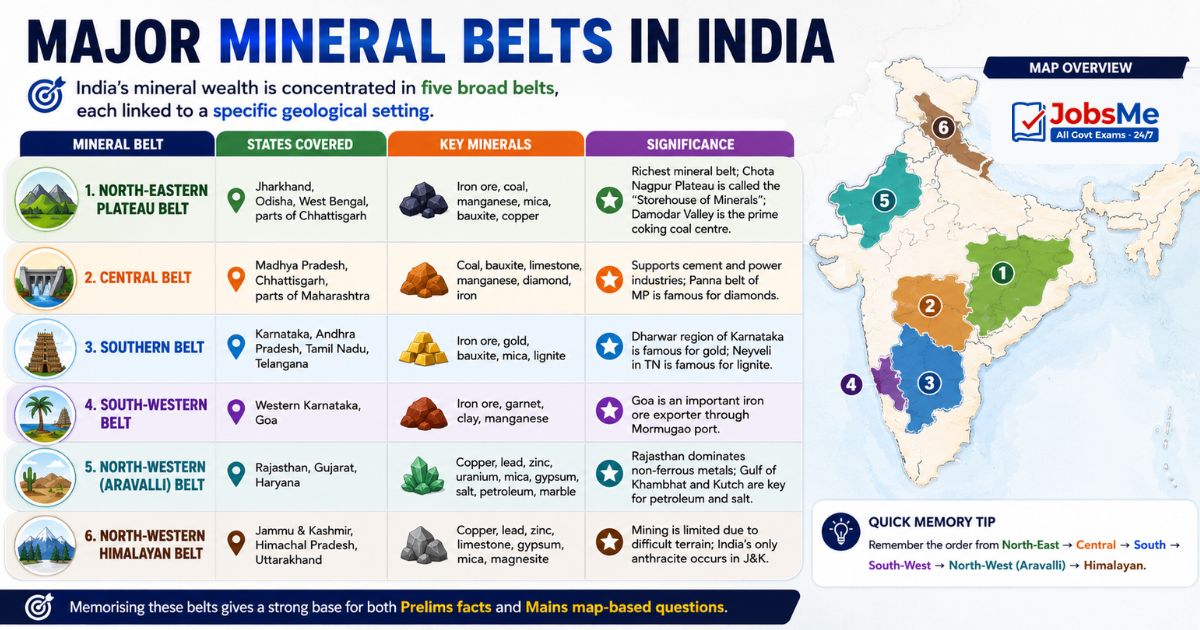
| Mineral Belt | States Covered | Key Minerals | Significance |
|---|---|---|---|
| North-Eastern Plateau Belt | Jharkhand, Odisha, West Bengal, parts of Chhattisgarh | Iron ore, coal, manganese, mica, bauxite, copper | Richest mineral belt; Chota Nagpur Plateau is called the "Storehouse of Minerals"; Damodar Valley is the prime coking coal centre. |
| Central Belt | Madhya Pradesh, Chhattisgarh, parts of Maharashtra | Coal, bauxite, limestone, manganese, diamond, iron | Supports cement and power industries; Panna belt of MP is famous for diamonds. |
| Southern Belt | Karnataka, Andhra Pradesh, Tamil Nadu, Telangana | Iron ore, gold, bauxite, mica, lignite | Dharwar region of Karnataka is famous for gold; Neyveli in TN is famous for lignite. |
| South-Western Belt | Western Karnataka, Goa | Iron ore, garnet, clay, manganese | Goa is an important iron ore exporter through Mormugao port. |
| North-Western (Aravalli) Belt | Rajasthan, Gujarat, Haryana | Copper, lead, zinc, uranium, mica, gypsum, salt, petroleum, marble | Rajasthan dominates non-ferrous metals; Gulf of Khambhat and Kutch are key for petroleum and salt. |
| North-Western Himalayan Belt | Jammu & Kashmir, Himachal Pradesh, Uttarakhand | Copper, lead, zinc, limestone, gypsum, mica, magnesite | Mining is limited due to difficult terrain; India's only anthracite occurs in J&K. |
State-wise Distribution of Major Minerals in India
The following table summarises which state leads in which mineral, the most important mines, and the industrial use. This is the single most asked area from this topic in UPSC Prelims, SSC GK and Banking Awareness sections, so it should be revised multiple times. For weekly current updates that often cite these mines, the daily current affairs page is a good companion read.
| Mineral | Top Producing States | Major Mines / Areas | Key Features and Uses |
|---|---|---|---|
| Iron Ore | Odisha (1), Jharkhand (2), Chhattisgarh (3), Karnataka (4), Goa (5) | Barbil-Joda, Noamundi, Gua, Bailadila, Dalli-Rajhara, Bellary-Hospet, Donimalai, Kudremukh, Codli | Backbone of steel industry. Main types: Hematite (60-70% Fe), Magnetite (30-60%), Limonite (35-50%), Siderite (20-40%). India mainly produces hematite. |
| Coal | Jharkhand (1 in reserves), Chhattisgarh (1 in production), Odisha, West Bengal, MP | Jharia (largest), Raniganj, Bokaro, Giridih, Karanpura, Talcher, Korba, Singrauli | About 98% from Gondwana coalfields in Damodar, Mahanadi, Son and Godavari valleys. Used in thermal power and steel making. India has the 5th largest coal reserves in the world. |
| Lignite (Brown Coal) | Tamil Nadu, Gujarat, Rajasthan, J&K, Puducherry | Neyveli (TN) | Lower grade coal with high moisture; used in thermal power generation. |
| Bauxite | Odisha (1), Andhra Pradesh, Gujarat, Maharashtra, MP, Chhattisgarh | Panchpatmali, Kodingamali, Gandhamardan, Amarkantak, Niyamgiri, Lohardaga | Primary ore of aluminium. Panchpatmali (Koraput, Odisha) is India's largest bauxite mine, operated by NALCO. India has the 5th largest bauxite reserves globally. |
| Aluminium | Odisha, Chhattisgarh, Jharkhand | Angul, Korba, Damanjodi, Muri | Used in aircraft, transport, packaging, electrical wires. Major players: NALCO, HINDALCO, BALCO. |
| Copper | Rajasthan (1), MP, Jharkhand, Andhra Pradesh | Khetri, Kolihan (Rajasthan), Malanjkhand (MP), Mosabani, Surda, Rakha (Jharkhand) | Used in electrical wires, electronics, alloys. Hindustan Copper Limited (HCL) operates India's main copper mines. Sterlite Copper (Tamil Nadu) was closed in 2018. |
| Zinc | Rajasthan (1, around 75-80%), Andhra Pradesh, Gujarat, Odisha | Rampura-Agucha, Zawar, Sindesar Khurd, Rajpura-Dariba, Kayad | Used in galvanisation and corrosion protection. Hindustan Zinc Limited (Vedanta) is the dominant producer with the Chanderiya smelter. |
| Lead | Rajasthan (over 85% of production) | Zawar, Sindesar Khurd, Rajpura-Dariba, Rampura-Agucha | Used in batteries, cable sheathing, radiation shielding. Occurs with galena (PbS), zinc and silver. |
| Gold | Karnataka (1), Rajasthan, Andhra Pradesh, Jharkhand | Hutti, Uti, Hirabuddini, Kolar Gold Fields (closed), Ramagiri, Jonnagiri, Jagpura | Hutti (Raichur, Karnataka) is India's only active large-scale gold mine. Kolar Gold Fields were once the largest but are now closed. |
| Silver | Rajasthan (over 90% as by-product of zinc-lead), Gujarat, Andhra Pradesh, Karnataka | Zawar, Sindesar Khurd, Rajpura-Dariba (Hindustan Zinc), Hutti Gold Fields | Mostly produced as a by-product of zinc-lead-copper-gold mining. Used in jewellery, electronics, solar panels. |
| Manganese | Odisha (44%, 1st), Karnataka (22%), Madhya Pradesh (13%), Maharashtra (8%), AP, Jharkhand, Goa | Joda-Barbil, Sundargarh, Balaghat, Ukwa, Tirodi, Kandri, Sandur, Garividi | Essential for steel making and ferro-alloys. MOIL Ltd contributes about 50% of India's manganese production. |
| Chromite | Odisha (about 93-99% of reserves and production), Karnataka, Manipur, Nagaland, Jharkhand | Sukinda Valley (Cuttack, Jajpur, Keonjhar) | The only economic ore of chromium. Used in stainless steel, chrome plating and refractories. |
| Nickel | Odisha | Sukinda Valley | Used in stainless steel, batteries, alloys; often associated with chromite. |
| Limestone | Madhya Pradesh (1, about 16%), Rajasthan, Andhra Pradesh, Gujarat, Chhattisgarh, Tamil Nadu | Jabalpur, Satna, Betul, Jaisalmer, Kadapa, Kota, Banaskantha | About 75% of limestone is used in cement, 16% in iron and steel as flux, and 4% in chemicals. Backbone of the cement industry. |
| Dolomite | Chhattisgarh, Odisha, Madhya Pradesh, Rajasthan, Maharashtra | Bilaspur, Durg, Raigarh, Narsinghpur, Banswara | Used as a flux in iron and steel, in refractories, glass and ceramics. |
| Gypsum | Rajasthan (about 99% of production), Tamil Nadu, J&K, Gujarat | Bikaner, Barmer, Jodhpur, Nagaur, Jaisalmer, Tiruchirapalli | Used in cement (4-5%), ammonium sulphate fertilizer, plaster of Paris, ceramics and soil conditioning. |
| Mica | Jharkhand (1), Andhra Pradesh, Rajasthan, Tamil Nadu, Bihar | Koderma, Domchanch, Gaya belt, Nellore (Gudur), Bhilwara, Sivaganga | Excellent electrical insulator. Koderma was once called the "Mica Capital of the World". Today Nellore (AP) is the largest producer of high-grade sheet mica. |
| Graphite | Jharkhand, Odisha, Tamil Nadu, Kerala, Rajasthan, Andhra Pradesh | Palamu, Sundargarh, Lohari, Kawal, Khundini | Used in lubricants, batteries, electrodes, pencils and refractories. |
| Diamond | Madhya Pradesh, Andhra Pradesh, Chhattisgarh, Karnataka | Panna (MP), Wajrakarur kimberlite pipe (Anantapur, AP), Krishna river gravels, Raichur-Gulbarga | Panna in MP is India's only working diamond mine. Surat is the global diamond cutting and polishing hub. |
| Tin | Chhattisgarh, Rajasthan, Jharkhand, Kerala | Bastar (Chhattisgarh), Hazaribagh, Wayanad, Sundergarh | Used in soldering, tin plating, alloys (bronze, solder), packaging. |
| Petroleum (Crude Oil) | Rajasthan, Gujarat, Assam, Maharashtra (offshore) | Digboi, Naharkatiya, Moran (Assam); Ankleshwar, Kalol, Mehsana (Gujarat); Mumbai High, Bassein (offshore); Barmer Mangala (Rajasthan); Rawa (KG offshore) | Digboi (Assam, 1901) is India's oldest oil field and refinery. Mumbai High was discovered in 1973 and started production in 1976. Jamnagar (Gujarat) hosts the world's largest oil refinery. |
| Natural Gas | Assam, Tripura, Gujarat, Maharashtra, Andhra Pradesh, Tamil Nadu, Rajasthan | Krishna-Godavari basin, Mumbai High, Cambay basin, Hazira, Cauvery basin | Used in power generation, fertilizers, CNG and PNG. Hajira-Bijapur-Jagdishpur (HBJ) is the world's largest underground pipeline. Jamnagar-Loni is the world's longest LPG pipeline. |
| Uranium | Jharkhand, Andhra Pradesh, Telangana, Meghalaya, Karnataka, Rajasthan | Jaduguda, Bhatin, Narwapahar, Turamdih (Jharkhand); Tummalapalle, Lambapur-Peddagattu (AP); Domiasiat, Wahkyn (Meghalaya); Gogi (Karnataka); Rohil (Rajasthan) | Used as fuel for nuclear power plants. Jaduguda in Jharkhand is India's first and one of the most important uranium mines. |
| Thorium | Kerala (largest), Tamil Nadu, Odisha, Andhra Pradesh | Monazite sands of Kerala beaches; coastal sands of TN, Odisha, AP | India has the largest thorium reserves in the world. Considered the fuel of India's three-stage nuclear programme. |
| Salt | Gujarat (largest), Rajasthan, Tamil Nadu | Rann of Kutch, Sambhar Lake, Didwana Lake | Used in food, chemicals and preservation. Gujarat alone produces over 70% of India's salt. |
Iron Ore Belts of India
| Iron Ore Belt | States Covered | Major Mines | Dominant Ore Type |
|---|---|---|---|
| Odisha-Jharkhand Belt | Odisha, Jharkhand | Noamundi, Gua, Joda, Barbil, Kiriburu, Bolani, Thakurani, Badampahar | Hematite |
| Durg-Bastar-Chandrapur Belt | Chhattisgarh, Maharashtra | Bailadila, Rajhara, Dalli-Rajhara | Hematite |
| Bellary-Hospet Belt | Karnataka | Donimalai, Kumaraswamy, Sandur, Ramandurg | Hematite and Magnetite |
| Western Belt (Goa-Maharashtra-Karnataka) | Goa, Maharashtra, Karnataka | Codli, Pissurlem, Sonshi, Ratnagiri | Hematite |
| Southern Belt | Karnataka, Tamil Nadu, Kerala | Kudremukh, Salem, Baba Budan Hills | Magnetite |
Coal Reserves: State-Wise Distribution
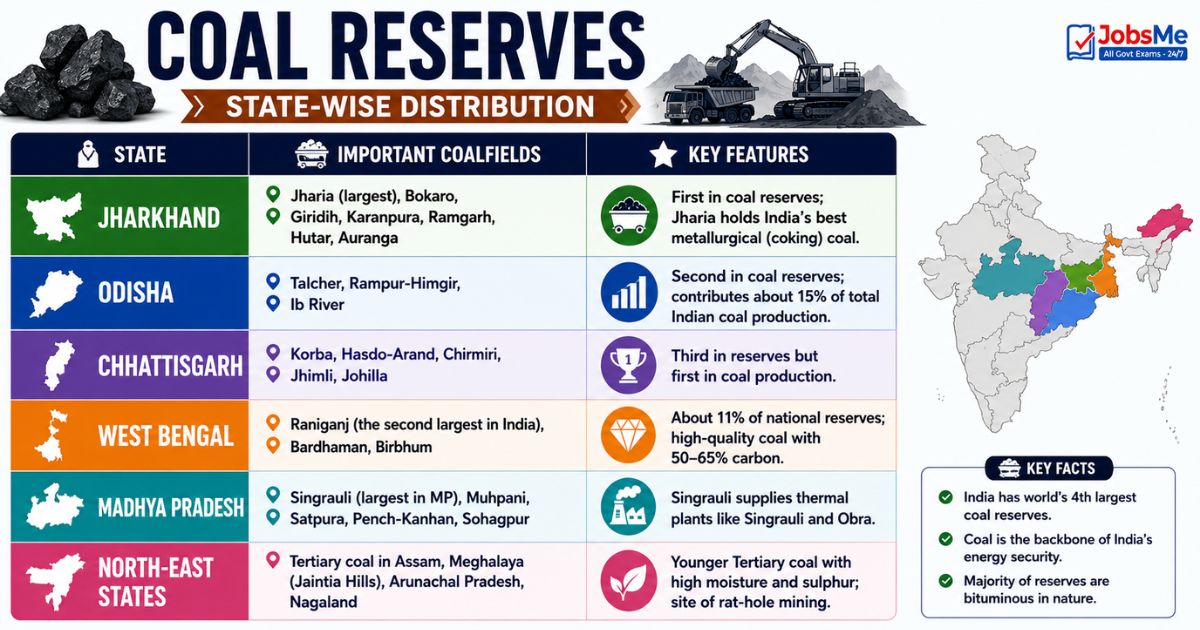
| State | Important Coalfields | Key Features |
|---|---|---|
| Jharkhand | Jharia (largest), Bokaro, Giridih, Karanpura, Ramgarh, Hutar, Auranga | First in coal reserves; Jharia holds India's best metallurgical (coking) coal. |
| Odisha | Talcher, Rampur-Himgir, Ib River | Second in coal reserves; contributes about 15% of total Indian coal production. |
| Chhattisgarh | Korba, Hasdo-Arand, Chirmiri, Jhimli, Johilla | Third in reserves but first in coal production. |
| West Bengal | Raniganj (the second largest in India), Bardhaman, Birbhum | About 11% of national reserves; high-quality coal with 50-65% carbon. |
| Madhya Pradesh | Singrauli (largest in MP), Muhpani, Satpura, Pench-Kanhan, Sohagpur | Singrauli supplies thermal plants like Singrauli and Obra. |
| North-East States | Tertiary coal in Assam, Meghalaya (Jaintia Hills), Arunachal Pradesh, Nagaland | Younger Tertiary coal with high moisture and sulphur; site of rat-hole mining. |
Distribution of Minerals in the World
| Mineral | Top Producing Countries | Key Regions / Mines | Uses |
|---|---|---|---|
| Iron Ore | Australia, Brazil, China, India, Russia | Pilbara (Australia), Carajas (Brazil), Kursk and Urals (Russia) | Steel production, infrastructure |
| Coal | China, India, USA, Australia, Indonesia | Shanxi (China), Appalachia (USA), Ruhr (Germany) | Thermal power, fuel, metallurgy |
| Bauxite | Australia, Guinea, China, Brazil, India | Weipa (Australia), Boke (Guinea) | Aluminium production |
| Copper | Chile, Peru, China, USA, DR Congo | Chuquicamata and Escondida (Chile) | Electrical industry, wiring |
| Gold | China, Australia, Russia, USA, Canada, South Africa | Witwatersrand (South Africa), Nevada (USA) | Jewellery, finance, electronics |
| Diamond | Russia, Botswana, Canada, DR Congo, Australia | Yakutia (Russia), Orapa and Jwaneng (Botswana), Kimberley (South Africa) | Jewellery, cutting tools |
| Uranium | Kazakhstan, Canada, Australia, Namibia, Niger | Athabasca Basin (Canada), Olympic Dam (Australia), Chu-Sarysu (Kazakhstan) | Nuclear energy |
| Petroleum | USA, Saudi Arabia, Russia, Canada, Iraq | Al-Ghawar (Saudi Arabia), Al-Burqan (Kuwait), Western Siberia (Russia) | Fuel, petrochemicals |
| Manganese | South Africa, Australia, Gabon, Brazil, India | Kalahari (South Africa) | Steel making, alloys |
| Phosphate | Morocco, China, USA, Russia, Jordan | Western Sahara (Morocco) | Fertilizers |
| Tin | China, Indonesia, Myanmar, Peru, Bolivia | Southeast Asia belt | Electronics, alloys |
Classification of Coal
| Type | Carbon Content | Features | Where Found in India |
|---|---|---|---|
| Peat | Less than 40-55% | First stage of coal formation; high moisture, more smoke, low heat. | Limited deposits in marshy areas. |
| Lignite (Brown Coal) | 40-55% | Lower grade; high moisture; risk of spontaneous combustion. | Neyveli (TN), Gujarat, Rajasthan, J&K, Puducherry. |
| Bituminous Coal | 40-80% | Soft coal; most widely used; used for coke and gas. | Jharia, Raniganj, Bokaro, most Gondwana fields. |
| Anthracite | 80-95% | Best quality; hard coal; burns slowly with very little smoke. | Found only in Jammu & Kashmir in small quantities. |
Major Public Sector Companies in Indian Mining
| Company | Main Mineral | Key Operations |
|---|---|---|
| NMDC (National Mineral Development Corporation) | Iron Ore | Bailadila (Chhattisgarh), Donimalai (Karnataka) |
| SAIL (Steel Authority of India Limited) | Iron and Steel | Kiriburu mines, Bhilai, Rourkela, Bokaro plants |
| Coal India Limited (CIL) | Coal | Largest coal producer; operates across Jharkhand, Odisha, Chhattisgarh, WB, MP |
| NALCO | Bauxite and Aluminium | Panchpatmali mine; Damanjodi refinery; Angul smelter |
| HINDALCO (Aditya Birla) | Aluminium and Copper | Muri, Belgaum, Utkal Alumina; Dahej copper refinery |
| BALCO | Aluminium | Korba (Chhattisgarh) refinery and smelter |
| HCL (Hindustan Copper Limited) | Copper | Khetri, Kolihan, Malanjkhand, Mosabani, Surda |
| Hindustan Zinc Limited (Vedanta) | Zinc, Lead, Silver | Rampura-Agucha, Zawar, Sindesar Khurd, Chanderiya smelter |
| MOIL (Manganese Ore India Limited) | Manganese | Balaghat, Ukwa, Tirodi, Kandri |
| Hutti Gold Mines Co. | Gold | Hutti, Uti, Hirabuddini (Karnataka) |
| KIOCL | Iron Ore (Magnetite) | Kudremukh (Karnataka), now closed |
| ONGC and Oil India | Crude Oil and Natural Gas | Mumbai High, KG basin, Assam, Cambay basin |
Memory Tricks and Mnemonics for Mineral Resources
Static GK on minerals is fact-heavy, so mnemonic tricks help retention. Use these alongside other static GK notes for fast revision before exam day.
Trick 1: Iron Ore States - "OJ-CKG"
Top five iron ore states in order of reserves: Odisha, Jharkhand, Chhattisgarh, Karnataka, Goa.
Remember: "Orange Juice Can Keep Going" - OJ-C-K-G.
Trick 2: Iron Ore Quality Ladder - "HMLS"
Four types of iron ore in decreasing iron content: Hematite (60-70%), Magnetite (30-60% but very pure), Limonite (35-50%), Siderite (less than 40%).
Remember: "How Much Less Steel" - HMLS.
Trick 3: Coal Quality Climb - "PLBA"
Coal types in increasing carbon and quality: Peat → Lignite → Bituminous → Anthracite.
Remember: "Poor Lazy Boys Achieve" - the higher you climb, the better the coal. Anthracite, the best, is found only in Jammu & Kashmir.
Trick 4: Royal Rajasthan - "ZLS-GMC"
Rajasthan is the top state for Zinc, Lead, Silver, Gypsum, Marble and Copper.
Remember: "Zara Lao Silver, Gypsum Marble Copper" - Rajasthan is the desert king of non-ferrous minerals.
Trick 5: Damodar Valley Coal Triplet - "Jharia-Raniganj-Bokaro"
India's three most famous coalfields all lie along the Damodar Valley belt: Jharia (largest, best coking coal), Raniganj (in West Bengal) and Bokaro (Hazaribagh).
Remember: "JRB - Jab Raniganj Bokaro" - say it as a chant for instant recall.
Trick 6: Uranium Mines - "JTM-KR"
Five uranium-bearing states: Jharkhand (Jaduguda), Telangana/AP (Tummalapalle), Meghalaya (Domiasiat), Karnataka (Gogi), Rajasthan (Rohil).
Remember: "Just Try Mining Karnataka Rajasthan" for India's nuclear fuel sources.
Trick 7: Diamond Sites - "PWK"
Three diamond-bearing regions of India: Panna (Madhya Pradesh - only active mine), Wajrakarur (Anantapur, Andhra Pradesh), Krishna river gravels (AP).
Remember: "Please Wear Karat" - the three Indian diamond clues.
Trick 8: Strategic Petroleum Reserves - "VMP + CB"
Phase 1 SPR: Visakhapatnam, Mangalore, Padur. Phase 2 additions: Chandikhole (Odisha) and Bikaner (Rajasthan).
Remember: "Very Many People Came Back" - VMPCB.
Additional Notes
Frequently Confused Facts
- Jharia vs Raniganj: Jharia is the largest coalfield and located in Jharkhand. Raniganj is the second largest and located in West Bengal.
- Kolar vs Hutti: Kolar Gold Fields (Karnataka) were once India's biggest, but are now closed. Hutti (Karnataka) is the only active large-scale gold mine.
- NMDC vs SAIL vs HCL: NMDC mines iron ore (Bailadila), SAIL is the steel maker (Bhilai, Rourkela), HCL is for copper (Khetri, Malanjkhand).
- NALCO vs HINDALCO vs BALCO: NALCO is government-owned (Panchpatmali, Damanjodi), HINDALCO is Aditya Birla group (Muri, Belgaum), BALCO is at Korba (now Vedanta).
- Mica capitals: Koderma (Jharkhand) is historically called the "Mica Capital of the World", but Nellore (AP) now produces the highest-quality sheet mica.
- Bauxite vs Aluminium: Bauxite is the ore; aluminium is the refined metal. Odisha leads in bauxite reserves; Panchpatmali (NALCO) is the biggest mine.
- Hematite vs Magnetite: Hematite is reddish, lower magnetism, around 60-70% iron - India's main type. Magnetite is black, strongly magnetic, up to 70% iron - found mainly in South India (Kudremukh, Salem).
- Sukinda Valley in Odisha is famous for two minerals: Chromite and Nickel.
- Damodar Valley is the prime coking coal belt; Krishna-Godavari basin is for oil and gas.
Repeating PYQ Patterns
- UPSC Prelims: regularly asks about mineral-rich regions, "match the mine with the state" questions, and the iron ore belt linked to specific steel plants (Bailadila to Vishakhapatnam Steel; Dalli-Rajhara to Bhilai).
- SSC CGL / CHSL: focuses on "largest producer" facts - Odisha for iron, chromite, bauxite; Rajasthan for zinc, lead, gypsum; Karnataka for gold.
- IBPS PO / Clerk and Insurance GK: tests basic awareness of PSUs like NMDC, NALCO, HCL, Coal India and their headquarters or operations.
- Railways NTPC, Group D: standard one-liners on Mumbai High (1973-76), Digboi (oldest oil field), Jharia (largest coalfield), Kolar (gold) and Panna (diamonds).
- State PCS: asks state-specific mineral linkages and policies like the Mines and Minerals (Development and Regulation) Act, 1957 and National Mineral Policy 2019.
Quick Insight: Real-World and Current Affairs Relevance
Minerals tie directly into India's economy, defence, energy security and climate transition. The push for critical minerals like lithium, cobalt and rare earth elements is reshaping policy, with the government promoting auctions, the District Mineral Foundation (DMF) under PMKKKY, the National Mineral Exploration Trust (NMET), and 100% FDI in mining via the automatic route. Strategic Petroleum Reserves at Visakhapatnam, Mangalore, Padur, Chandikhole and Bikaner are central to energy security. For learners who track exam-relevant updates and policies, the banking awareness and computer awareness notes complement this Static GK topic, since PSUs and financial inclusion frequently link back to mineral-rich states.
One-Liners for Quick Revision
- Mineral → Naturally occurring inorganic substance with definite chemical composition and physical properties.
- Major elements of Earth's crust (98%) → Oxygen, Silicon, Aluminium, Iron, Calcium, Sodium, Potassium, Magnesium.
- Ferrous minerals → Contain iron; examples are iron ore, manganese and chromite.
- Non-ferrous minerals → No iron; examples are copper, bauxite, lead, zinc, gold, silver, tin.
- Non-metallic minerals → Include limestone, mica, graphite, gypsum, diamond.
- Mohs scale → Used to measure mineral hardness; ranges from 1 (talc) to 10 (diamond).
- Streak → Colour of a mineral in powdered form; more reliable than surface colour for identification.
- Chota Nagpur Plateau → "Storehouse of Minerals" in India; spans Jharkhand, Odisha, parts of WB and Chhattisgarh.
- Iron ore types → Hematite, Magnetite, Limonite, Siderite (decreasing quality).
- Iron ore largest reserves → Odisha (rank 1), followed by Jharkhand, Chhattisgarh, Karnataka, Goa.
- Bailadila → Iron ore mine in Dantewada, Chhattisgarh; operated by NMDC; supplies Vishakhapatnam Steel Plant.
- Noamundi and Gua → Iron ore mines in Singhbhum, Jharkhand; operated by Tata Steel and SAIL.
- Donimalai and Kudremukh → Iron ore mines in Karnataka (Kudremukh is the magnetite belt and now closed).
- Manganese largest reserves → Odisha (44%), Karnataka (22%), MP (13%); MOIL is the largest producer.
- Joda-Barbil → Major manganese belt in Kendujhar, Odisha.
- Balaghat → Famous manganese mine in Madhya Pradesh.
- Chromite → Odisha holds about 93% of reserves; mined mainly in Sukinda Valley.
- Bauxite largest reserves → Odisha; Panchpatmali (Koraput) is the largest mine, operated by NALCO.
- Amarkantak plateau → Famous bauxite source in Madhya Pradesh and Chhattisgarh.
- Copper largest reserves → Rajasthan; key mines at Khetri and Kolihan (Hindustan Copper Limited).
- Malanjkhand → Largest copper mine in India, located in Balaghat, MP.
- Singhbhum (Jharkhand) → Famous for copper mines (Mosabani, Surda, Rakha) and iron ore.
- Zinc largest producer → Rajasthan; Rampura-Agucha is the largest mine (Hindustan Zinc Limited).
- Lead largest producer → Rajasthan, with mines at Zawar, Sindesar Khurd and Rajpura-Dariba.
- Silver → Mainly a by-product of zinc-lead mining in Rajasthan (Chanderiya smelter).
- Gold largest reserves → Karnataka; Kolar Gold Fields (closed) and Hutti (only active large mine).
- Ramagiri and Jonnagiri → Gold mines in Andhra Pradesh.
- Hutti Gold Mine → Located in Raichur district, Karnataka; only active large-scale gold mine in India.
- Mica → Used as an electrical insulator; Koderma (Jharkhand) is historically called the "Mica Capital of the World".
- Nellore (AP) → Today the leading producer of high-grade sheet mica.
- Limestone largest producer → Madhya Pradesh (about 16%); main districts are Jabalpur, Satna, Betul.
- Gypsum → Rajasthan produces about 99% of India's total; main areas are Bikaner, Barmer, Jodhpur.
- Dolomite → Mainly from Chhattisgarh and Odisha; used as a flux in steelmaking.
- Diamond → Panna belt (MP) is India's only active diamond mine; Surat is the diamond cutting hub.
- Wajrakarur → Kimberlite pipe in Anantapur (AP), associated with diamonds.
- Graphite → Used in lubricants, batteries and pencils; mined in Jharkhand, Odisha, TN and Kerala.
- Salt → Gujarat is the largest producer (Rann of Kutch); Sambhar Lake in Rajasthan is also famous.
- Coal types → Peat → Lignite → Bituminous → Anthracite (carbon content increases in this order).
- Anthracite → Found only in Jammu & Kashmir in India.
- Lignite → Major reserves at Neyveli, Tamil Nadu.
- Gondwana coalfields → Contain about 98% of India's coal reserves; lie along the Damodar, Mahanadi, Son and Godavari valleys.
- Jharia coalfield → Largest coalfield in India; best coking coal; located in Dhanbad, Jharkhand.
- Raniganj → Second largest coalfield in India; located in West Bengal.
- Korba → Major coalfield in Chhattisgarh.
- Singrauli → Largest coalfield of Madhya Pradesh.
- Petroleum → Mainly found in sedimentary rocks of Tertiary age.
- Digboi → India's oldest oil field and refinery (1901), located in Assam.
- Mumbai High → Major offshore oilfield discovered in 1973; production started in 1976.
- Ankleshwar and Kalol → Major oilfields in Gujarat.
- Mangala → Major onshore oilfield in Barmer, Rajasthan.
- Krishna-Godavari basin → Important for oil and natural gas on the east coast.
- Jamnagar (Gujarat) → World's largest oil refinery.
- HBJ Pipeline → Hajira-Bijapur-Jagdishpur; world's largest underground gas pipeline.
- Jamnagar-Loni → World's longest LPG pipeline.
- Strategic Petroleum Reserves (Phase 1) → Visakhapatnam, Mangalore, Padur.
- Strategic Petroleum Reserves (Phase 2) → Chandikhole (Odisha) and Bikaner (Rajasthan).
- Natural gas main sources → Mumbai High, KG basin, Cambay basin, Assam, Cauvery basin.
- Uranium main mines → Jaduguda (Jharkhand), Tummalapalle (AP), Domiasiat (Meghalaya), Gogi (Karnataka), Rohil (Rajasthan).
- Thorium → India has the world's largest reserves; mainly from monazite sands of Kerala beaches.
- Nuclear power plants → Tarapur (Maharashtra), Rawatbhata (Rajasthan), Kudankulam (TN), Kaiga (Karnataka), Kakrapar (Gujarat), Kalpakkam (TN), Narora (UP).
- MMDR Act, 1957 → Main law for regulating mining of major minerals in India; amended in 2015 to introduce auctions, DMF and NMET.
- National Mineral Policy 2019 → Encourages private exploration, mineral corridors and intergenerational equity.
- Hydrocarbon Vision 2025 and HELP (2016) → Frameworks promoting energy security and uniform licensing.
- Polymetallic Nodules → Found on the floor of the Central Indian Ocean Basin; India has rights to explore about 75,000 square km.
- India's renewable target → 175 GW from renewables by 2022 (100 GW solar + 60 GW wind + 10 GW biomass + 5 GW small hydro).
- International Solar Alliance (ISA) → India-led alliance, headquartered at Gurugram, with 120+ member countries.
For more such state-level mineral facts and full topic-wise notes, refer to the static GK hub and test yourself with the static GK quiz series. Aspirants who also want to stay updated with policy changes can use the daily current affairs quiz and explore relevant openings on the latest govt jobs notifications page.
Free quiz • No signup required
Put this topic into practice with Indian Cultural Institutions – Static GK MCQ Quiz. It is the quickest way to reinforce what you just learned.
Frequently Asked Questions
Which state is the largest producer of iron ore in India?
What are the four main types of iron ore found in India?
Why is Chota Nagpur Plateau called the storehouse of minerals?
Which is India's largest coalfield and where is it located?
Which state produces almost all of India's gypsum?
Where is the only active large-scale gold mine in India located?
Which is the only working diamond mine in India?
Where was India's first oil refinery set up?
Which public sector company is the largest producer of manganese in India?
Which Indian state has the largest reserves of thorium and from where is it obtained?

About the author