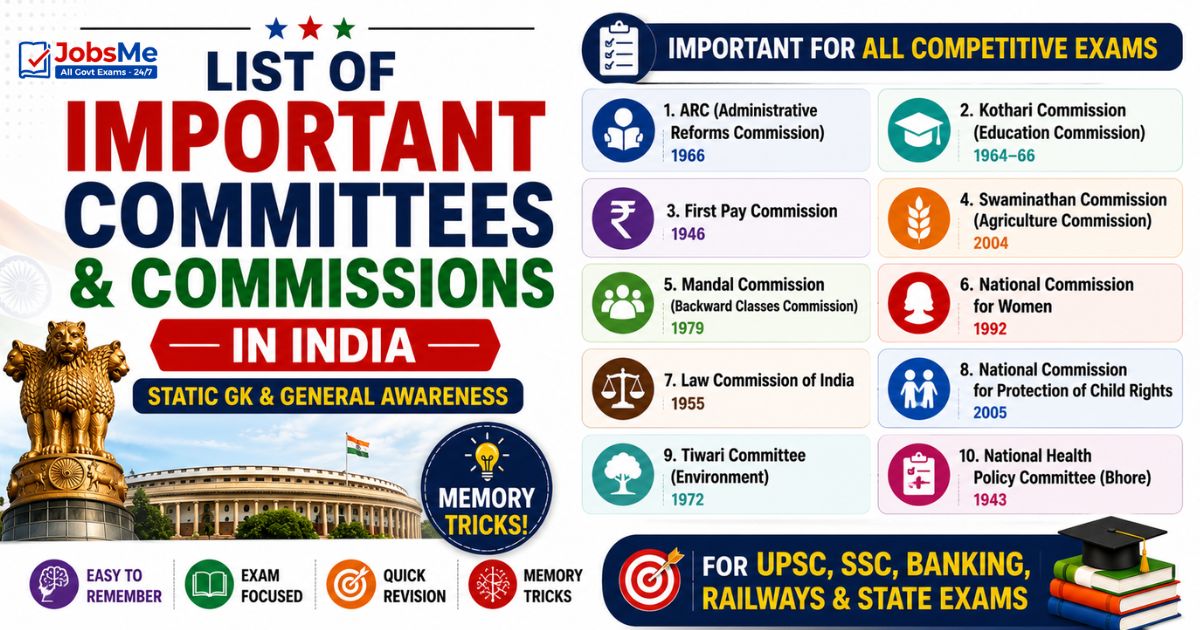
List of Important Committees and Commissions in India – Static GK & General Awareness for Competitive Exams with Memory Tricks
This article presents a complete list of important committees and commissions in India, covering Centre-State relations, Panchayati Raj, administrative reforms, education, banking, tax, police, social justice, and parliamentary committees, along with their chairpersons, year of establishment, and key recommendations. It includes iconic bodies like the Sarkaria Commission, Mandal Commission, Kothari Commission, Punchhi Commission, Narasimham Committee, Balwant Rai Mehta Committee, ARC I and II, Shah Commission, Liberhan Commission, and all major permanent commissions like UPSC, ECI, UGC, NHRC, CVC, and CCI, with memory tricks and one-liners for quick revision. All facts are arranged in exam-ready format to help UPSC, SSC, IBPS, RRB, PSU, Insurance, and State PCS aspirants score better in General Awareness, Polity, and Governance sections.
Jump to section
Introduction
Committees and commissions in India are the backbone of policy formulation and institutional reform. From the Sarkaria Commission on Centre-State relations to the Mandal Commission on reservation, from the Kothari Commission on education to the Narasimham Committee on banking, these bodies have shaped almost every major law, policy, and constitutional amendment since independence. They are essentially panels of experts tasked with studying specific national problems and proposing actionable solutions. Some commissions are permanent bodies like the Election Commission, UPSC, UGC, and NHRC, while others are ad hoc commissions that dissolve after submitting their reports.
Questions on important committees and commissions appear regularly in UPSC Prelims and Mains, SSC CGL, IBPS PO, RRB NTPC, SBI Clerk, State PCS, NDA, CDS, and Insurance exams. Questions typically ask about the chairperson of a commission, the year of establishment, the major recommendations, or the area of governance the commission examined. This article brings together every important committee and commission in a structured, exam-ready format. For more Polity and Governance notes, you can explore the Static GK section on Jobsme.in.
Knowledge of these bodies is also useful for current affairs questions, since commission reports often resurface in the news during constitutional debates, elections, reservation discussions, banking reforms, and federalism issues. This makes the topic doubly important for aspirants preparing for UPSC Mains essays, descriptive papers in Banking exams, and interviews. For daily updates on related current affairs, refer to the Daily Current Affairs page on Jobsme.in.
Core Concepts: Committees vs Commissions
Although the terms are often used interchangeably, committees and commissions differ in scope, duration, and authority. Understanding this distinction helps in answering conceptual questions in Polity and Governance papers.
Difference Between a Committee and a Commission
- Scope: A committee usually has a narrower, specific mandate while a commission has a broader, systemic mandate.
- Duration: Committees are often short-term while commissions usually run for multiple years.
- Authority: Both are advisory in nature, but some commissions are quasi-judicial (NHRC, ECI, CIC).
- Legal Basis: Committees are usually formed by a government resolution, while commissions can be formed by a resolution or by a statute or even the Constitution.
- Example: Ashok Mehta Committee (committee) versus Sarkaria Commission (commission).
Types of Commissions
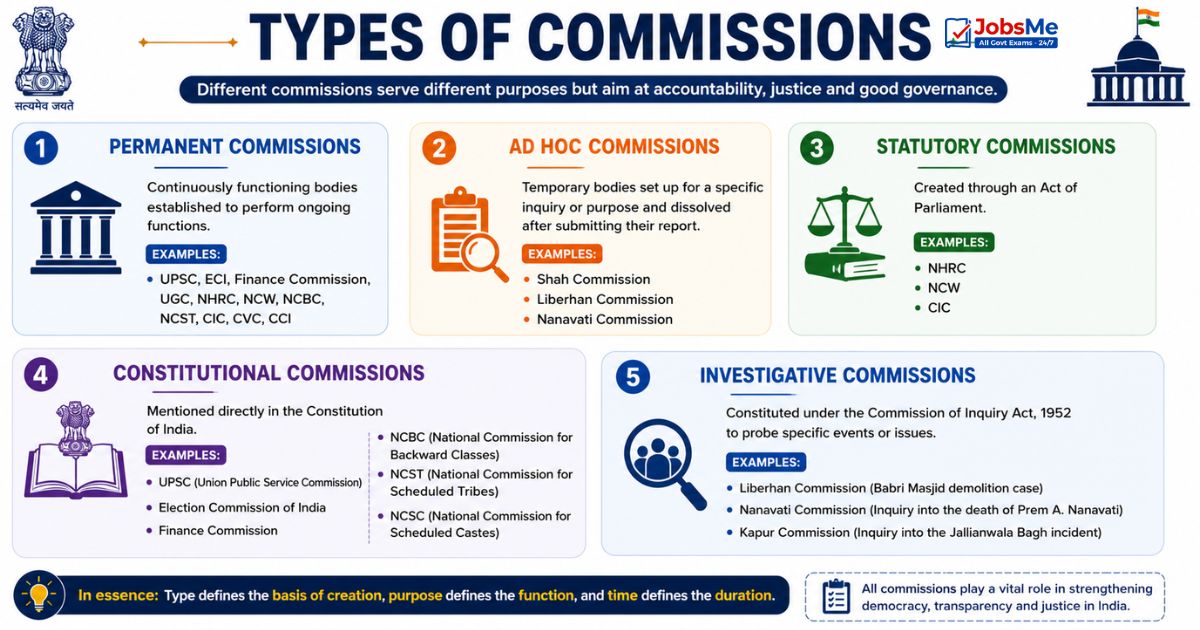
- Permanent Commissions: Continuously functioning bodies like UPSC, ECI, Finance Commission, UGC, NHRC, NCW, NCBC, NCST, CIC, CVC, CCI.
- Ad Hoc Commissions: Temporary bodies set up for a specific inquiry, dissolved after submitting their report. Example: Shah Commission, Liberhan Commission, Nanavati Commission.
- Statutory Commissions: Created through an Act of Parliament. Example: NHRC, NCW, CIC.
- Constitutional Commissions: Mentioned directly in the Constitution. Example: UPSC, Election Commission, Finance Commission, NCBC, NCST, NCSC.
- Investigative Commissions: Constituted under the Commission of Inquiry Act, 1952 to probe specific events. Example: Liberhan Commission, Nanavati Commission, Kapur Commission.
Major Permanent Commissions in India
The following table lists the most exam-relevant permanent commissions in India along with their year of establishment and primary purpose.
| Commission | Year | Purpose / Key Details |
|---|---|---|
| Union Public Service Commission (UPSC) | 1926 | Constitutional body under Article 315; conducts examinations for recruitment to higher categories of posts in the central government like IAS, IPS, IFS; advises President on promotion, deputation, and disciplinary matters. |
| Law Commission of India | 1834 (first); 1955 (post-independence) | Non-statutory advisory body; reviews existing laws and suggests reforms to promote justice; submits recommendations to the Ministry of Law and Justice. |
| Chief Labour Commissioner (Central) | 1945 | Enforces labour laws, settles industrial disputes, and ensures implementation of awards and settlements in central sphere industries. |
| Central Water Commission (CWC) | 1945 | Premier technical organisation under the Ministry of Jal Shakti for planning, conservation, and utilisation of water resources for flood control, irrigation, navigation, drinking water, and power generation. |
| Atomic Energy Commission of India | 1948 | Established under the chairmanship of Dr. Homi J. Bhabha; regulates and develops atomic energy in India; functions under the Department of Atomic Energy. |
| Election Commission of India (ECI) | 1950 | Constitutional body under Article 324; conducts free and fair elections to Parliament, State Legislatures, and the offices of the President and Vice-President of India. |
| Finance Commission of India | 1951 | Constitutional body under Article 280; constituted every five years; recommends distribution of net proceeds of taxes between Centre and states (vertical devolution) and among states (horizontal devolution). |
| University Grants Commission (UGC) | 1956 | Statutory body under the UGC Act 1956; provides recognition to universities, disburses funds, and maintains standards of university and higher education in India. |
| Khadi and Village Industries Commission (KVIC) | 1956 | Statutory body under the KVIC Act 1956; plans, promotes, and develops Khadi and Village Industries in rural areas; functions under the Ministry of MSME. |
| Central Vigilance Commission (CVC) | 1964 | Apex anti-corruption watchdog of India; constituted on the recommendation of the Santhanam Committee; given statutory status in 2003; investigates corruption charges against central government officials. |
| Commission for Agricultural Costs and Prices (CACP) | 1965 | Originally called Agricultural Prices Commission; recommends Minimum Support Prices (MSP) for major agricultural crops to ensure remunerative prices to farmers. |
| Administrative Reforms Commission (ARC) | 1966 (First); 2005 (Second) | First ARC headed by Morarji Desai, later by K. Hanumanthaiah, submitted 20 reports; Second ARC headed by Veerappa Moily submitted 15 reports including Right to Information, Ethics in Governance, and Local Governance. |
| National Flood Commission (Rashtriya Barh Ayog) | 1976 | Established to evolve a coordinated, integrated, and scientific approach to flood control problems in India. |
| Staff Selection Commission (SSC) | 1975 (as Subordinate Services Commission); 1977 (renamed SSC) | Conducts recruitment exams for Group B and Group C non-gazetted posts in various ministries, departments, and subordinate offices of the Government of India. |
| Commission for Additional Sources of Energy | 1981 | Formulates and implements policies for development of new and renewable energy; later evolved into the Ministry of New and Renewable Energy (MNRE). |
| Telecom Commission | 1989 | Apex body for formulating policies on telecommunications, telecom regulations, licensing, and approval of major telecom projects; renamed Digital Communications Commission in 2018. |
| National Commission for Women (NCW) | 1992 | Statutory body under the NCW Act 1990; reviews constitutional and legal safeguards for women; redresses grievances and advises the government on policy matters affecting women. |
| National Human Rights Commission (NHRC) | 1993 | Statutory body under the Protection of Human Rights Act 1993; investigates violations of human rights by public servants; chaired by a former Chief Justice of India. |
| National Commission for Backward Classes (NCBC) | 1993 (statutory); 2018 (constitutional) | Originally a statutory body, given constitutional status under Article 338B by the 102nd Amendment Act 2018; examines requests for inclusion/exclusion in OBC list. |
| Competition Commission of India (CCI) | 2003 | Statutory body under the Competition Act 2002; prevents anti-competitive practices, promotes fair competition, and protects consumer interests. |
| National Forest Commission | 2003 | Constituted under Justice B.N. Kirpal to review and assess the existing forest and environment policies and laws of India. |
| National Commission for Scheduled Tribes (NCST) | 2004 | Constitutional body under Article 338A; created by the 89th Constitutional Amendment Act 2003; came into effect on 19 February 2004 by bifurcating the earlier combined SC/ST Commission. |
| National Commission for Enterprises in the Unorganised Sector (NCEUS) | 2004 | Chaired by Arjun Sengupta; examined problems faced by enterprises in the unorganised and informal sector; recommended social security for unorganised workers. |
| National Statistical Commission (NSC) | 2005 | Constituted on the recommendation of the Rangarajan Commission; serves as the nodal advisory body on statistical matters; addresses problems of statistical agencies in data collection. |
| Central Information Commission (CIC) | 2005 | Statutory body under the Right to Information Act 2005; receives and inquires into complaints from aggrieved persons regarding access to information held by public authorities. |
Major Ad Hoc Commissions and Inquiry Commissions
The following table lists ad hoc commissions constituted for specific inquiries into riots, assassinations, and major political-administrative issues.
| Commission | Year | Purpose / Key Details |
|---|---|---|
| States Reorganisation Commission (SRC) | 1953 | Headed by Justice S. Fazal Ali; members Hriday Nath Kunzru and K. M. Panikkar; recommended reorganisation of states on linguistic basis; led to the States Reorganisation Act 1956 and Article 350A for linguistic minorities. |
| Kalelkar Commission (First Backward Classes Commission) | 1953 | Chaired by Kaka Kalelkar; first Backward Classes Commission of India; recommendations on upliftment of socially and educationally backward sections were not accepted by the government. |
| Kothari Commission (Education Commission) | 1964 | Chaired by Dr. D. S. Kothari; recommended the 10+2+3 pattern of schooling, Common School System, three-language formula, and spending 6% of GDP on education; led to the National Policy on Education 1968. |
| Kapur Commission | 1966 | Set up to inquire into the conspiracy behind the assassination of Mahatma Gandhi (1948); chaired by Justice Jeevan Lal Kapur. |
| Rajamannar Committee | 1969 | Constituted by the DMK Government of Tamil Nadu under Dr. P. V. Rajamannar; suggested permanent Inter-State Council, abolition of All-India Services, and giving residuary powers to states. |
| Khosla Commission | 1970 | Headed by Justice G. D. Khosla; second commission to re-investigate the death of Subhas Chandra Bose; confirmed that Bose died in the 1945 plane crash at Taihoku. |
| Anandpur Sahib Resolution | 1973 | Adopted by the Shiromani Akali Dal; demanded limited central jurisdiction and greater state autonomy on the lines of cooperative federalism. |
| Shah Commission | 1977 | Chaired by Justice J. C. Shah; investigated excesses committed during the Emergency (1975-77); documented illegal arrests, censorship of the press, and abuse of authority. |
| National Police Commission | 1977-1981 | First post-Independence commission on police reforms; chaired by Dharma Vira; submitted 8 reports; recommended insulating police from political interference and separating investigation from law and order; reiterated by the Supreme Court in the Prakash Singh case (2006). |
| Mandal Commission | 1979 | Chaired by B. P. Mandal; recommended 27% reservation in central government jobs and educational institutions for Other Backward Classes (OBC); identified 3,743 castes as backward; implemented by V. P. Singh government in 1990; upheld by the Supreme Court in the Indra Sawhney case (1992) with a 50% cap on total reservations. |
| Sarkaria Commission | 1983 | Chaired by Justice R. S. Sarkaria; submitted report in 1988; recommended Inter-State Council under Article 263, sparing use of Article 356 (President's Rule), and consultation with Chief Minister before Governor's appointment; the Inter-State Council was set up in 1990. |
| Thakkar Commission | 1984 | Probed the assassination of Prime Minister Indira Gandhi on 31 October 1984. |
| Liberhan Commission | 1992 | One-man commission headed by Justice Manmohan Singh Liberhan; appointed on 16 December 1992 to probe the demolition of the Babri Masjid (6 December 1992); submitted its report after 48 extensions in 2009, becoming the longest-serving commission of inquiry in India's history. |
| Mukherjee Commission | 1999 | Chaired by Justice Manoj Kumar Mukherjee; third commission to inquire into the disappearance of Subhas Chandra Bose; concluded in 2005 that Bose did not die in the 1945 plane crash; report rejected by the Government of India. |
| Nanavati Commission | 2000 | Chaired by Justice G. T. Nanavati; investigated the 1984 anti-Sikh riots; identified specific Congress leaders and police officials for inquiry. |
| National Commission to Review the Working of the Constitution (NCRWC) | 2000 | Also called the Venkatachaliah Commission after its chairman Justice M. N. Venkatachaliah; reviewed the working of the Constitution after 50 years of Independence; submitted report in 2002. |
| Narendran Commission | 2000 | Examined the representation of backward classes in the public services of the state of Kerala. |
| Nanavati-Shah Commission / U. C. Banerjee Commission | 2002 | Constituted to inquire into the Godhra train burning incident (27 February 2002) and the subsequent communal riots in Gujarat. |
| Phukan Commission | 2003 | Constituted to inquire into corruption allegations arising from the Tehelka tapes controversy involving defence deals. |
| Upendra Commission | 2004 | Probed the alleged rape and custodial killing of Thangjam Manorama Devi in Manipur by personnel of the Assam Rifles. |
| Ranganath Misra Commission | 2004 | Officially the National Commission for Religious and Linguistic Minorities; chaired by Justice Ranganath Misra; recommended 15% reservation for minorities (with focus on Muslims) and a sub-quota for religious minorities within the 27% OBC reservation. |
| M. M. Punchhi Commission | 2007 | Chaired by Justice Madan Mohan Punchhi; second major commission on Centre-State relations after Sarkaria; submitted 7-volume report in 2010; recommended fixed 5-year tenure for Governors, limited use of Articles 355 and 356, and Lokayukta in every state. |
| National Commission on Cattle (Rashtriya Govansh Aayog) | 2002 | Chaired by Justice Guman Mal Lodha; recommended ways to improve cattle population, prevent cattle slaughter, and promote dairy development. |
Important Committees and Their Recommendations
The following committees have shaped India's governance, financial system, and rural administration. They are heavily tested in UPSC, SSC, Banking, and State PCS exams.
Panchayati Raj and Local Governance Committees
| Committee | Year | Chairman and Key Recommendations |
|---|---|---|
| Balwant Rai Mehta Committee | 1957 | Chaired by Balwant Rai Mehta; recommended a three-tier Panchayati Raj system — Gram Panchayat (village), Panchayat Samiti (block), and Zila Parishad (district); Rajasthan became the first state to implement it in 1959, followed by Andhra Pradesh. |
| Ashok Mehta Committee | 1977 | Chaired by Ashok Mehta; recommended a two-tier system — Zila Parishad and Mandal Panchayat; suggested participation of political parties in panchayat elections, compulsory taxation powers, regular elections every 5 years, and SC/ST reservation; many recommendations were later incorporated in the 73rd Constitutional Amendment 1992. |
| GVK Rao Committee | 1985 | Recommended that the district should be the basic unit of planning; the District Development Commissioner should be the chief coordinator; emphasised regular panchayat elections and strengthening of the Zila Parishad. |
| L. M. Singhvi Committee | 1986 | Recommended constitutional recognition for Panchayati Raj institutions (achieved through the 73rd Amendment); Gram Sabha as the base of decentralised democracy; Nyaya Panchayats for village-level dispute resolution; judicial protection for panchayat autonomy. |
| P. K. Thungon Committee | 1988 | Recommended constitutional recognition for local bodies; clear definition of subjects to be devolved to Panchayats; State Finance Commission for resource sharing. |
Centre-State Relations Commissions
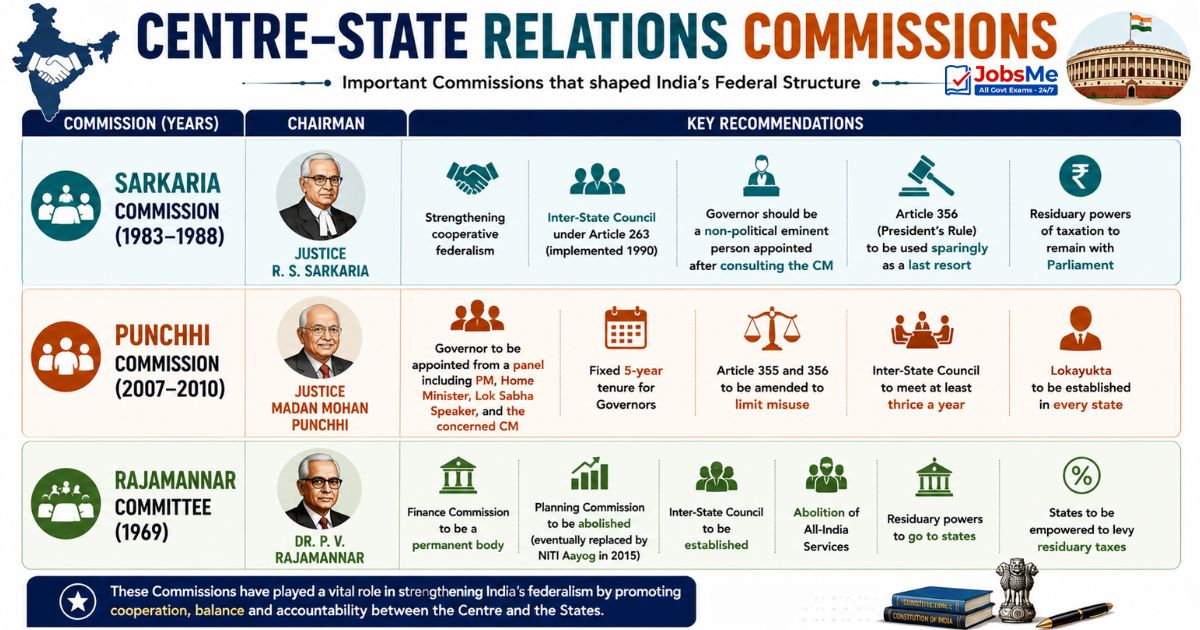
| Commission | Chairman | Key Recommendations |
|---|---|---|
| Sarkaria Commission (1983-1988) | Justice R. S. Sarkaria | Strengthening cooperative federalism; Inter-State Council under Article 263 (implemented 1990); Governor should be a non-political eminent person appointed after consulting the CM; Article 356 (President's Rule) to be used sparingly as a last resort; residuary powers of taxation to remain with Parliament. |
| Punchhi Commission (2007-2010) | Justice Madan Mohan Punchhi | Governor to be appointed from a panel including PM, Home Minister, Lok Sabha Speaker, and the concerned CM; fixed 5-year tenure for Governors; Article 355 and 356 to be amended to limit misuse; Inter-State Council to meet at least thrice a year; Lokayukta to be established in every state. |
| Rajamannar Committee (1969) | Dr. P. V. Rajamannar | Finance Commission to be a permanent body; Planning Commission to be abolished (eventually replaced by NITI Aayog in 2015); Inter-State Council to be established; abolition of All-India Services; residuary powers to go to states; states to be empowered to levy residuary taxes. |
Administrative Reforms Commissions (ARC)
| Commission | Period and Chairman | Key Recommendations |
|---|---|---|
| First ARC | 1966-1970; Morarji Desai (initially), K. Hanumanthaiah (later) | Submitted 20 reports; recommended establishment of Lokpal at the Centre and Lokayuktas in states; delegation of financial and administrative powers; reform of district administration; citizens' grievance redressal mechanism; personnel policy reforms. |
| Second ARC | 2005-2009; Veerappa Moily | Submitted 15 reports — Right to Information (1st), Unlocking Human Capital (2nd), Ethics in Governance (4th, very important for UPSC GS-IV), Public Order (5th), Local Governance (6th), Capacity Building (7th), Refurbishing Personnel Administration (10th), Organisational Structure (13th), State and District Administration (15th). |
Economic, Banking, and Tax Reform Committees
| Committee | Year and Chairman | Key Recommendations |
|---|---|---|
| Narasimham Committee I | 1991; M. Narasimham | First committee on banking sector reforms; recommended reduction of SLR (from 38.5% to 25%) and CRR (from 15% to 3-5%); deregulation of interest rates; phased reduction of directed credit; introduction of prudential norms — asset classification and income recognition. |
| Narasimham Committee II | 1998; M. Narasimham | Recommended capital adequacy standards (Basel norms); merger of weak banks; stronger regulation; technology upgradation; review of banking sector reforms. |
| Raja Chelliah Committee | 1991; Raja J. Chelliah | Tax reform committee; recommended reduction in tax rates, broader tax base, rationalisation of customs and excise duties; laid the foundation for India's modern tax system. |
| Kelkar Committee | 2002; Vijay Kelkar | Recommended simplified direct tax structure, broader tax base, and phased introduction of Goods and Services Tax (GST); later Kelkar Committee (2015) on PPP recommended modifying the Prevention of Corruption Act to protect honest officials. |
| Tarapore Committee | 1997 and 2006; S. S. Tarapore | Recommended roadmap for full Capital Account Convertibility (CAC) of the Indian rupee. |
| Nachiket Mor Committee | 2013; Nachiket Mor | RBI committee on financial inclusion; recommended Payments Banks and Small Finance Banks for last-mile banking access. |
| Bimal Jalan Committee | 2018; Bimal Jalan | Reviewed the economic capital framework of the RBI; recommended transfer of surplus reserves from RBI to the Government of India. |
Education Commissions
| Commission | Year and Chairman | Key Recommendations |
|---|---|---|
| Radhakrishnan Commission | 1948; Dr. S. Radhakrishnan | University Education Commission; first post-Independence commission on higher education; led to the establishment of the University Grants Commission (UGC) in 1956. |
| Mudaliar Commission | 1952; Dr. A. Lakshmanaswami Mudaliar | Secondary Education Commission; recommended diversified courses at the secondary level and a three-year degree course. |
| Kothari Commission | 1964-1966; Dr. D. S. Kothari | 10+2+3 pattern of schooling; Common School System; three-language formula; spending 6% of GDP on education; led to the National Policy on Education 1968. |
Police and Criminal Justice Reforms
| Commission/Committee | Year and Chairman | Key Recommendations |
|---|---|---|
| National Police Commission | 1977-1981; Dharma Vira | Insulate police from political interference; State Security Commission in every state; fixed tenure for police officers; separation of investigation from law and order functions; reiterated in the Prakash Singh judgement (2006). |
| Malimath Committee | 2003; Justice V. S. Malimath | Reform of criminal justice system; shift from purely adversarial to mix of adversarial and inquisitorial elements; victim compensation; witness protection; right to silence to be modified. |
| Justice Verma Committee | 2013; Justice J. S. Verma | Constituted after the Nirbhaya case (2012); recommended stricter laws against sexual offences; led to the Criminal Law (Amendment) Act 2013. |
Parliamentary Committees
Parliamentary committees are groups of MPs nominated or elected from amongst members of the House. They draw their authority from Articles 105 and 118 of the Constitution. They are broadly classified into Standing Committees (permanent) and Ad Hoc Committees (temporary).
Major Financial Standing Committees
| Committee | Number of Members | Tenure and Composition |
|---|---|---|
| Public Accounts Committee (PAC) | 22 (15 Lok Sabha + 7 Rajya Sabha) | 1-year tenure; members elected by the two Houses through the principle of proportional representation by single transferable vote; examines audit reports of the CAG; chaired by an Opposition MP since 1967. |
| Estimates Committee | 30 (all from Lok Sabha) | 1-year tenure; elected by Lok Sabha; examines the budget estimates and suggests economies in public expenditure; called the "Continuous Economy Committee." |
| Committee on Public Undertakings (COPU) | 22 (15 Lok Sabha + 7 Rajya Sabha) | 1-year tenure; examines reports and accounts of public sector undertakings; ensures their efficient functioning. |
Other Standing Committees
- Committees to Inquire: Committee on Petitions, Committee on Privileges, Ethics Committee.
- Committees to Scrutinise and Control: Committee on Government Assurances, Committee on Subordinate Legislation, Committee on Papers Laid on the Table, Committee on Welfare of SCs and STs, Committee on Empowerment of Women, Joint Committee on Offices of Profit.
- Committees Relating to Day-to-Day Business: Business Advisory Committee, Rules Committee, Committee on Private Members' Bills and Resolutions, Committee on Absence of Members from Sittings.
- House-Keeping or Service Committees: General Purposes Committee, House Committee, Library Committee, Joint Committee on Salaries and Allowances of Members.
- Departmentally Related Standing Committees (DRSCs): 24 committees covering ministries like Commerce, Home Affairs, Education, Industry, Finance, External Affairs, Defence; examine ministries' Demands for Grants and Bills referred to them.
Ad Hoc Parliamentary Committees
- Inquiry Committees: Set up to examine specific matters of public importance.
- Advisory Committees: Select Committees and Joint Parliamentary Committees (JPC) on Bills, Railway Convention Committee, Joint Committee on Food Management in Parliament House Complex.
Memory Tricks and Mnemonics
Trick 1: "SPRAY" - Centre-State Relations Commissions
Three major bodies on Centre-State relations can be remembered as:
- S → Sarkaria Commission (1983) - Justice R. S. Sarkaria.
- P → Punchhi Commission (2007) - Justice M. M. Punchhi.
- R → Rajamannar Committee (1969) - Dr. P. V. Rajamannar.
"SPR - three thinkers, one federal question."
Trick 2: "BAGLS" - Panchayati Raj Committees in Order
Remember the five major panchayati raj committees chronologically:
- B → Balwant Rai Mehta (1957) - 3-tier system.
- A → Ashok Mehta (1977) - 2-tier system.
- G → GVK Rao (1985) - District as planning unit.
- L → L. M. Singhvi (1986) - Constitutional status.
- S → Singhvi led to 73rd Amendment (1992).
"Balwant began it, Singhvi crowned it with the Constitution."
Trick 3: "Two N's of Banking" - Narasimham Committees
- N-I (1991): First wave of banking reforms - SLR/CRR cuts, deregulation, prudential norms.
- N-II (1998): Second wave - capital adequacy, mergers, Basel norms.
"One Narasimham, two cleanups of Indian banking."
Trick 4: "KaMaKaThaLi" - Famous Ad Hoc Commissions
Use this string to remember major investigative commissions:
- Ka → Kapur (Gandhi assassination).
- Ma → Mandal (OBC reservation, 27%).
- Ka → Kalelkar (First Backward Classes Commission).
- Tha → Thakkar (Indira Gandhi assassination).
- Li → Liberhan (Babri Masjid demolition, longest-serving commission).
Trick 5: "Bose - Three Inquiries"
Three commissions probed the disappearance of Subhas Chandra Bose:
- Shah Nawaz Committee (1956) - confirmed plane crash.
- Khosla Commission (1970) - also confirmed plane crash death.
- Mukherjee Commission (1999) - concluded Bose did not die in the crash; report rejected by government.
"Shah, Khosla, Mukherjee - three judges, one Netaji mystery."
Trick 6: "ARC = After Reform Comes" - ARC I and ARC II
- ARC I (1966) - Morarji Desai → K. Hanumanthaiah; 20 reports.
- ARC II (2005) - Veerappa Moily; 15 reports including Ethics in Governance and RTI.
"Desai-Hanumanthaiah laid the path; Moily polished it."
Trick 7: "Cold-Heat-Burn" Commissions - Memory by Event
- Shah Commission (1977) → "Heat of Emergency."
- Nanavati Commission (2000) → "Burn of 1984 riots."
- U. C. Banerjee / Nanavati-Shah (2002) → "Fire of Godhra."
- Liberhan Commission (1992) → "Demolition at Ayodhya."
Trick 8: "Permanent vs Ad Hoc" - Quick Rule
Use the simple acronym "PEN-FU-CHL-NHC" for major permanent commissions:
- P → UPSC, ECI, Finance Commission (Constitutional).
- E → UGC, KVIC, SSC (Education and Recruitment).
- N → NCW, NHRC, NCBC, NCST (Social Justice).
- C → CVC, CIC, CCI (Watchdogs).
"Constitutional → Education → Social → Watchdog - the four pillars of permanent commissions."
Additional Notes
Frequently Confused Facts
- Sarkaria vs Punchhi: Both deal with Centre-State relations. Sarkaria (1983) is the first comprehensive review. Punchhi (2007) updated Sarkaria for the post-liberalisation era; Punchhi went further on Governor reform.
- Balwant Rai Mehta vs Ashok Mehta: Balwant Rai Mehta (1957) recommended a 3-tier panchayat system; Ashok Mehta (1977) recommended a 2-tier system. The Constitution adopted the 3-tier model through the 73rd Amendment.
- Mandal vs Kalelkar: Both are Backward Classes Commissions. Kalelkar (1953) was the first BCC but its recommendations were not accepted. Mandal (1979) recommended 27% OBC reservation, implemented in 1990.
- Shah Commission vs Nanavati-Shah Commission: Shah Commission (1977) investigated Emergency excesses; Nanavati-Shah Commission (2002) probed the Godhra incident — chaired by Justice G. T. Nanavati and Justice Akshay Mehta.
- Khosla Commission vs Mukherjee Commission: Both probed Subhas Chandra Bose's death. Khosla (1970) confirmed his death in the plane crash; Mukherjee (1999) rejected the plane crash theory.
- Liberhan vs Nanavati Commission: Liberhan (1992) probed the Babri Masjid demolition; Nanavati (2000) probed the 1984 anti-Sikh riots.
- Narasimham I vs Narasimham II: Same chairman (M. Narasimham). Narasimham I (1991) focused on liberalising the banking sector; Narasimham II (1998) focused on capital adequacy and consolidation.
- Radhakrishnan vs Kothari Commissions: Radhakrishnan (1948) is on university education and led to UGC; Kothari (1964) is on schooling and gave the 10+2+3 structure.
- NCST vs NCSC: Both established in 2004 (19 February) by bifurcating the earlier National Commission for Scheduled Castes and Scheduled Tribes (89th Constitutional Amendment, 2003).
- Standing vs Ad Hoc Committees: Standing Committees are permanent and reconstituted each year; Ad Hoc Committees are temporary and dissolved after submitting their report.
Repeating PYQ Patterns
Certain commissions are asked repeatedly in competitive exams. Sarkaria Commission (Centre-State relations), Mandal Commission (27% OBC reservation), Kothari Commission (10+2+3 pattern), Punchhi Commission (Governor's role), Balwant Rai Mehta Committee (3-tier Panchayati Raj), Ashok Mehta Committee (2-tier panchayat), Shah Commission (Emergency excesses), Liberhan Commission (Babri Masjid demolition), Nanavati Commission (1984 riots), Narasimham Committee (banking reforms), Kelkar Committee (GST), and ARC II (15 reports including Ethics in Governance) appear most often in UPSC Prelims and Mains. SSC CGL and RRB NTPC favour matching year-with-commission and chairman-with-commission questions. Banking exams (IBPS PO, SBI Clerk, RBI Grade B) frequently focus on the Narasimham Committees, Kelkar Committee on GST, Nachiket Mor Committee on financial inclusion, and Tarapore Committee on capital account convertibility. State PCS exams often include state-level commissions and committees like the Rajamannar Committee (Tamil Nadu) and Narendran Commission (Kerala). For state-wise exam updates and pattern analysis, visit the Latest Government Job Notifications page on Jobsme.in.
Quick Insight
Commissions and committees are not mere academic exercises — they are the architects of India's policy framework. The 27% OBC reservation traces back to Mandal; the 73rd and 74th Constitutional Amendments owe their existence to Ashok Mehta and L. M. Singhvi; the Inter-State Council and the present rules on President's Rule rest on Sarkaria's recommendations; the entire 10+2+3 schooling pattern flows from Kothari; the modern Indian banking system rests on Narasimham; and GST itself was first formally proposed by Kelkar in 2002. Reading commission recommendations gives aspirants a ready-made framework for answering Mains questions on federalism, governance, education, banking, and social justice, and is equally useful for descriptive papers in Banking exams. For more deep-dive notes on related polity topics, see the Static GK section and for finance-related committees, refer to Banking Awareness notes on Jobsme.in.
One-Liners for Quick Revision
- UPSC → 1926 → Recruitment to higher central government posts; constitutional body under Article 315.
- Law Commission of India → 1834 (first); 1955 (post-Independence) → Law reforms; non-statutory advisory body.
- Chief Labour Commissioner → 1945 → Enforces central labour laws.
- Central Water Commission (CWC) → 1945 → Planning and conservation of water resources.
- Atomic Energy Commission → 1948 → Regulation of atomic energy; first chairman Homi J. Bhabha.
- Election Commission of India → 1950 → Free and fair elections; Article 324.
- Finance Commission → 1951 → Tax distribution between Centre and states; Article 280; constituted every 5 years.
- States Reorganisation Commission → 1953 → S. Fazal Ali; reorganised states on linguistic basis.
- Kalelkar Commission → 1953 → Kaka Kalelkar; first Backward Classes Commission.
- University Grants Commission (UGC) → 1956 → Standards of higher education.
- Khadi and Village Industries Commission (KVIC) → 1956 → Promotion of khadi and village industries.
- Balwant Rai Mehta Committee → 1957 → 3-tier Panchayati Raj; Rajasthan first state to implement (1959).
- Central Vigilance Commission (CVC) → 1964 → Anti-corruption watchdog; Santhanam Committee recommendation.
- Kothari Commission → 1964 → 10+2+3 pattern; 6% of GDP on education; Common School System.
- Commission for Agricultural Costs and Prices (CACP) → 1965 → Recommends MSP for crops.
- First ARC → 1966 → Morarji Desai / K. Hanumanthaiah; 20 reports including Lokpal-Lokayukta.
- Radhakrishnan Commission → 1948 → University education; led to UGC.
- Mudaliar Commission → 1952 → Secondary education reform.
- Kapur Commission → 1966 → Conspiracy in Gandhi's assassination.
- Rajamannar Committee → 1969 → Centre-state imbalance; permanent Finance Commission; abolition of Planning Commission and All-India Services.
- Khosla Commission → 1970 → Re-investigated Bose's death; confirmed plane crash.
- Anandpur Sahib Resolution → 1973 → State autonomy and limited central jurisdiction.
- National Flood Commission (Rashtriya Barh Ayog) → 1976 → Coordinated flood control.
- Indo-Bangladesh Joint Rivers Commission (JRC) → 1972 → Common river systems with Bangladesh.
- Shah Commission → 1977 → Justice J. C. Shah; Emergency excesses (1975-77).
- Staff Selection Commission (SSC) → 1977 (renamed) → Group B and C recruitment.
- Ashok Mehta Committee → 1977 → 2-tier panchayat system; party-based panchayat elections.
- National Police Commission → 1977-81 → Dharma Vira; police insulation from politics; 8 reports.
- Mandal Commission → 1979 → B. P. Mandal; 27% OBC reservation; implemented 1990; upheld in Indra Sawhney case (1992).
- Commission for Additional Sources of Energy → 1981 → Renewable energy; predecessor of MNRE.
- Sarkaria Commission → 1983 → Justice R. S. Sarkaria; Centre-State relations; Inter-State Council; sparing Article 356.
- Thakkar Commission → 1984 → Indira Gandhi assassination.
- GVK Rao Committee → 1985 → District as planning unit.
- L. M. Singhvi Committee → 1986 → Constitutional status to Panchayati Raj; Gram Sabha as base.
- P. K. Thungon Committee → 1988 → Constitutional recognition to local bodies.
- Telecom Commission → 1989 → Telecom policy; renamed Digital Communications Commission (2018).
- Narasimham Committee I → 1991 → Banking sector reforms; SLR/CRR cuts; prudential norms.
- Raja Chelliah Committee → 1991 → Tax reforms; reduction in tax rates.
- National Commission for Women (NCW) → 1992 → Statutory body for women's rights.
- Liberhan Commission → 1992 → Justice M. S. Liberhan; Babri Masjid demolition; longest-running commission, submitted report in 2009 after 48 extensions.
- National Human Rights Commission (NHRC) → 1993 → Protection of Human Rights Act 1993; chaired by former CJI.
- National Commission for Backward Classes (NCBC) → 1993 (statutory); 2018 (constitutional, Article 338B).
- Tarapore Committee → 1997 and 2006 → Capital Account Convertibility roadmap.
- Narasimham Committee II → 1998 → Banking reforms; capital adequacy; merger of weak banks.
- Mukherjee Commission → 1999 → Justice M. K. Mukherjee; re-investigated Bose's death; report rejected (2005).
- Nanavati Commission → 2000 → Justice G. T. Nanavati; 1984 anti-Sikh riots.
- NCRWC (Venkatachaliah Commission) → 2000 → Reviewed working of the Constitution; report submitted 2002.
- Narendran Commission → 2000 → Representation of backward classes in Kerala state services.
- Kelkar Committee → 2002 → Vijay Kelkar; simplified direct tax; phased GST introduction.
- National Commission on Cattle → 2002 → Justice Guman Mal Lodha; cattle protection and development.
- U. C. Banerjee / Nanavati-Shah Commission → 2002 → Godhra train burning and Gujarat riots.
- National Forest Commission → 2003 → Justice B. N. Kirpal; review of forest policy.
- Competition Commission of India (CCI) → 2003 → Competition Act 2002; prevents anti-competitive practices.
- Malimath Committee → 2003 → Justice V. S. Malimath; criminal justice reform; victim compensation.
- Phukan Commission → 2003 → Tehelka tapes corruption inquiry.
- National Commission for Scheduled Tribes (NCST) → 2004 → Article 338A; 89th Amendment Act 2003.
- NCEUS → 2004 → Arjun Sengupta; problems of enterprises in unorganised sector.
- Upendra Commission → 2004 → Thangjam Manorama Devi case in Manipur.
- Ranganath Misra Commission → 2004 → Religious and linguistic minorities; 15% minority reservation.
- National Statistical Commission → 2005 → Nodal body for statistical matters.
- Central Information Commission (CIC) → 2005 → Right to Information Act 2005.
- Second ARC → 2005-2009 → Veerappa Moily; 15 reports; Ethics in Governance (4th).
- M. M. Punchhi Commission → 2007 → Centre-State relations; fixed 5-year Governor tenure; report 2010 in 7 volumes.
- Justice Verma Committee → 2013 → Sexual offences law reform; led to Criminal Law (Amendment) Act 2013.
- Nachiket Mor Committee → 2013 → Payments Banks and Small Finance Banks.
- Bimal Jalan Committee → 2018 → RBI economic capital framework.
- Public Accounts Committee (PAC) → 22 members (15 LS + 7 RS) → Examines CAG reports; chaired by Opposition MP since 1967.
- Estimates Committee → 30 members (all LS) → Examines budget estimates; "Continuous Economy Committee."
- Committee on Public Undertakings (COPU) → 22 members (15 LS + 7 RS) → Examines PSU accounts.
- Departmentally Related Standing Committees (DRSCs) → 24 committees → Examine ministry-wise Demands for Grants and Bills.
For more Static GK topics like Indian Constitution articles, schedules, and parliamentary procedures, explore the Static GK section on Jobsme.in. You can also test your preparation with the Static GK Quiz, sharpen your finance knowledge with the Banking Awareness Quiz, and stay updated with the latest exam notifications at Latest Government Job Notifications.
Free quiz • No signup required
Put this topic into practice with Indian Cultural Institutions – Static GK MCQ Quiz. It is the quickest way to reinforce what you just learned.
Frequently Asked Questions
What is the difference between a committee and a commission in India?
Which commission recommended the 27% reservation for OBCs in India?
Who was the chairman of the Sarkaria Commission and what did it deal with?
Which committee recommended the three-tier Panchayati Raj system?
What did the Kothari Commission recommend for the Indian education system?
Which commission was set up to investigate excesses during the Emergency of 1975 to 1977?
Which is the longest-serving commission of inquiry in independent India?
Who chaired the First and Second Administrative Reforms Commissions?
What were the major recommendations of the Narasimham Committees on banking?
What is the role of the Punchhi Commission in Centre-State relations?

About the author