Parliament of India – Lok Sabha and Rajya Sabha Static GK & General Awareness for Competitive Exams with Memory Tricks
This article presents a complete and exam-ready guide to the Indian Parliament, covering the composition, powers, and functions of the Lok Sabha (House of the People) and Rajya Sabha (Council of States) along with key Articles (79 to 122) of the Constitution, sessions, bills, majorities, parliamentary devices, and important constitutional amendments. It also lists every important Speaker, Chairman, Leader of Opposition, qualification, quorum, and joint sitting fact in one place with memory tricks, one-liners, and PYQ patterns. All facts are arranged to help UPSC, SSC, IBPS, RRB, PSU, Defence, Insurance, and State PCS aspirants score better in Polity and General Awareness.
Jump to section
- Introduction
- Core Concepts: What is the Indian Parliament
- Lok Sabha and Rajya Sabha - Composition and Key Facts
- Important Articles Related to Parliament (Part V of the Constitution)
- Sessions, Bills, and Important Procedures of Parliament
- Presiding Officers and Important Office-Holders
- Memory Tricks and Mnemonics
- Additional Notes
- One-Liners for Quick Revision
Introduction
The Parliament of India is the supreme legislative body of the country and the cornerstone of India's parliamentary democracy. Under Article 79 of the Constitution, the Parliament consists of three components — the President of India, the Rajya Sabha (Council of States), and the Lok Sabha (House of the People). All law-making powers of the Union, the control over the executive, the scrutiny of finances, and the amendment of the Constitution flow through these two Houses. Understanding their structure, composition, and powers is therefore the very first building block of Indian Polity for every aspirant.
Questions on the Indian Parliament appear in almost every government recruitment examination — UPSC Prelims and Mains, SSC CGL, CHSL, IBPS PO and Clerk, SBI PO and Clerk, RRB NTPC, Group D, Insurance (LIC, NICL, IRDAI), Defence (CDS, NDA, AFCAT), and all State PCS papers. Typical questions include the minimum age to become a member, the maximum strength of each House, the article that defines a Money Bill, who presides over a joint sitting, how many joint sittings have been held so far, and which constitutional amendment removed Anglo-Indian reservation. This article brings together every important fact in one structured, exam-oriented format. For a wider overview of related Polity topics, you can also refer to the Static GK section on Jobsme.in.
The topic is also closely linked to current affairs themes — the inauguration of the New Parliament Building on 28 May 2023, the passing of the 106th Constitutional Amendment Act (Nari Shakti Vandan Adhiniyam, 2023) reserving 33 percent seats for women in Lok Sabha and State Legislative Assemblies, the constitution of the 18th Lok Sabha in June 2024, and the election of C. P. Radhakrishnan as the 15th Vice President of India and ex-officio Chairman of the Rajya Sabha in September 2025 — making it doubly important for both Prelims and Mains aspirants.
Core Concepts: What is the Indian Parliament
The Indian Parliament is a bicameral legislature, meaning it has two Houses. The model is borrowed primarily from the British Westminster system, but the federal character of the Rajya Sabha is borrowed from the United States Senate. The President, although not a sitting member of either House, is an integral part of the Parliament because no Bill can become law without his or her assent.
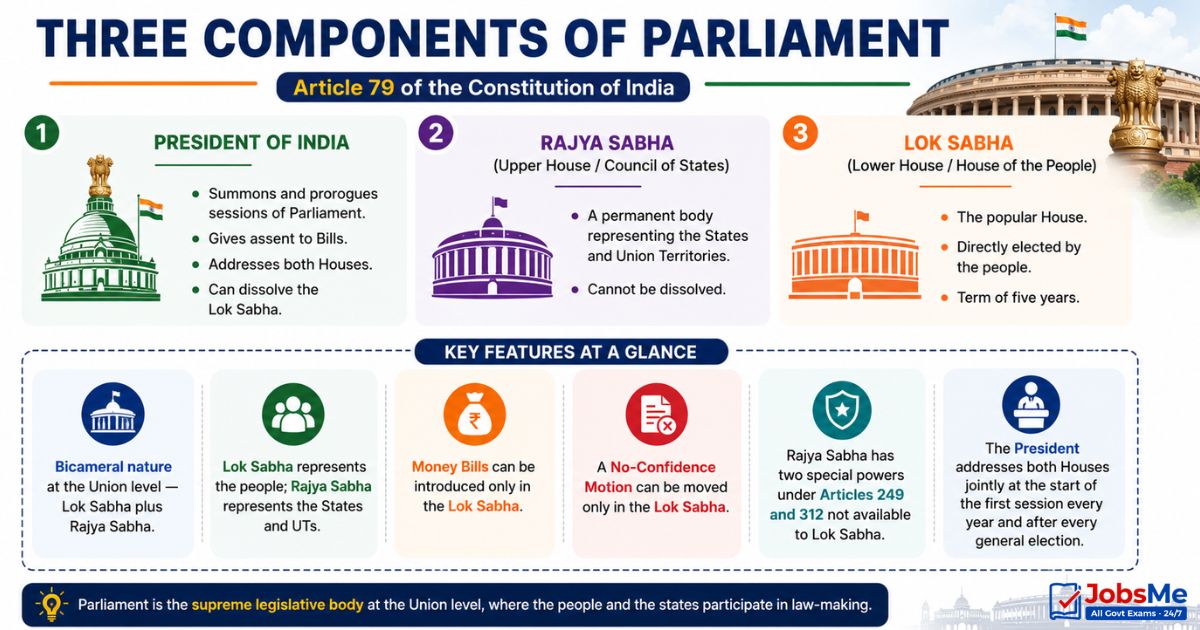
Three Components of Parliament (Article 79)
- President of India: Summons and prorogues sessions, gives assent to Bills, addresses both Houses, and can dissolve the Lok Sabha.
- Rajya Sabha (Upper House / Council of States): A permanent body representing the States and Union Territories; cannot be dissolved.
- Lok Sabha (Lower House / House of the People): The popular House, directly elected by the people for a term of five years.
Key Features at a Glance
- Bicameral nature at the Union level — Lok Sabha plus Rajya Sabha.
- Lok Sabha represents the people; Rajya Sabha represents the States and UTs.
- Money Bills can be introduced only in the Lok Sabha.
- A No-Confidence Motion can be moved only in the Lok Sabha.
- Rajya Sabha has two special powers under Articles 249 and 312 not available to Lok Sabha.
- The President addresses both Houses jointly at the start of the first session every year and after every general election.
Lok Sabha and Rajya Sabha - Composition and Key Facts
The following table compares the two Houses of Parliament on every exam-relevant parameter. All Article numbers, strengths, qualifications, and tenure details have been verified against the latest constitutional position.
| Parameter | Lok Sabha (House of the People) | Rajya Sabha (Council of States) |
|---|---|---|
| Constitutional Article | Article 81 | Article 80 |
| Nature of House | Lower House, Popular House, First Chamber. | Upper House, Permanent House, Second Chamber. Not subject to dissolution. |
| Maximum Strength | 550 members (530 from States plus 20 from UTs). Earlier 552 with 2 Anglo-Indian nominees; this provision was removed by the 104th CAA 2019. | 250 members (238 elected representatives of States and UTs plus 12 nominated by the President). |
| Current Strength | 543 members (after Anglo-Indian seats removed). | 245 members (233 elected plus 12 nominated). |
| Mode of Election | Direct election by adult universal franchise from territorial constituencies. | Indirect election by elected members of State Legislative Assemblies through Single Transferable Vote system of Proportional Representation. |
| Nominated Members | None (after 104th CAA). | 12 members nominated by the President for distinction in Literature, Science, Art, and Social Service. |
| Term of House | 5 years from the date of first sitting; can be dissolved earlier by the President. | Permanent body, never dissolves. One-third members retire every 2 years. |
| Term of a Member | 5 years. | 6 years. |
| Minimum Age (Article 84) | 25 years. | 30 years. |
| Presiding Officer | Speaker (Article 93); Deputy Speaker in Speaker's absence. | Vice-President of India as ex-officio Chairman (Article 89); Deputy Chairman in his absence. |
| Quorum (Article 100) | One-tenth of total membership (i.e., 55). | One-tenth of total membership (i.e., 25). |
| Money Bill Powers | Money Bills can originate only here; Speaker certifies a Bill as Money Bill. | Cannot introduce, reject, or amend a Money Bill; can only make recommendations within 14 days. |
| No-Confidence Motion | Can be moved only in Lok Sabha; the Council of Ministers is collectively responsible to it (Article 75). | Cannot move a No-Confidence Motion against the government. |
| Special Powers | Sole authority on Money Bills; final say in Budget; can dismiss government. | Article 249 (legislate on State List in national interest) and Article 312 (create All India Services). |
| First Sitting | 13 May 1952. | 13 May 1952; first constituted on 3 April 1952. |
| Current Term | 18th Lok Sabha (constituted June 2024). | Continuous; 264th Session began in June 2024. |
Important Articles Related to Parliament (Part V of the Constitution)
Part V (Articles 52 to 151) of the Constitution deals with the Union. Articles 79 to 122 specifically deal with the Parliament. The table below covers every exam-relevant Article in this range.
| Article | Subject | Key Details |
|---|---|---|
| Article 79 | Constitution of Parliament | Parliament consists of the President, Council of States (Rajya Sabha), and House of the People (Lok Sabha). |
| Article 80 | Composition of Rajya Sabha | Maximum strength 250 — 238 representatives of States and UTs plus 12 nominated by President. |
| Article 81 | Composition of Lok Sabha | Maximum strength 550 — 530 from States plus 20 from UTs (after 104th CAA removed Anglo-Indian seats). |
| Article 82 | Readjustment after each census | Delimitation of constituencies based on census; frozen till the first census after 2026 by the 84th CAA. |
| Article 83 | Duration of Houses | Lok Sabha 5 years; Rajya Sabha permanent, one-third members retire every 2 years. |
| Article 84 | Qualification for membership | Citizen of India; minimum age 25 (Lok Sabha) and 30 (Rajya Sabha); other qualifications by Parliament. |
| Article 85 | Sessions, Prorogation, Dissolution | Maximum gap between two sessions: 6 months. President summons, prorogues, and dissolves Lok Sabha. |
| Article 86 | President's right to address | President may address either House or both Houses jointly and send messages. |
| Article 87 | Special address by President | President addresses both Houses jointly at the commencement of the first session after each general election and at the beginning of the first session of each year. |
| Article 88 | Rights of Ministers and Attorney-General | Ministers and the Attorney-General may speak in either House but vote only in the House they belong to. |
| Article 89 | Chairman and Deputy Chairman of Rajya Sabha | Vice-President is ex-officio Chairman; Deputy Chairman elected by Rajya Sabha members. |
| Article 93 | Speaker and Deputy Speaker of Lok Sabha | Lok Sabha shall, as soon as may be, choose two members to be Speaker and Deputy Speaker. |
| Article 99 | Oath or affirmation by members | Every MP must take an oath before the President or a person appointed by him before taking seat. |
| Article 100 | Quorum and voting | Quorum is one-tenth of total members of the House; decisions by majority of members present and voting. |
| Article 105 | Powers and privileges of Houses | Freedom of speech in Parliament; no MP liable to any court proceedings for anything said or vote given in House. |
| Article 107 | Introduction and passing of Bills | An Ordinary Bill may originate in either House and must be passed by both before going to President. |
| Article 108 | Joint sitting of both Houses | President can summon a joint sitting in case of deadlock; Speaker of Lok Sabha presides over it. |
| Article 109 | Special procedure for Money Bills | Money Bill introduced only in Lok Sabha; Rajya Sabha to return within 14 days, can only recommend. |
| Article 110 | Definition of Money Bill | Defines Money Bill; Speaker of Lok Sabha's decision is final and cannot be questioned in any court. |
| Article 111 | Assent to Bills | President may give assent, withhold assent, or return a Bill (except Money Bill) for reconsideration. |
| Article 112 | Annual Financial Statement (Budget) | Statement of estimated receipts and expenditure of the Union for each financial year laid before Parliament. |
| Article 117 | Special provisions for Financial Bills | Financial Bills (Category I and II) involving expenditure from Consolidated Fund need President's recommendation. |
| Article 118 | Rules of Procedure | Each House may make its own rules for procedure and conduct of business. |
| Article 120 | Language of Parliament | Business in Parliament transacted in Hindi or English; Presiding Officer may allow members to address in their mother tongue. |
| Article 121 | Restriction on discussion | No discussion shall take place in Parliament on the conduct of any judge of the Supreme Court or High Court except on a motion for his removal. |
| Article 122 | Courts not to inquire into proceedings | Validity of any proceedings in Parliament cannot be questioned in any court. |
Sessions, Bills, and Important Procedures of Parliament
To do well in Polity and General Awareness, aspirants must master the operational side of Parliament — the sessions, the kinds of Bills, the types of majorities, and the various parliamentary devices that MPs use every day. For daily updates on parliamentary proceedings and other news, you can refer to the Daily Current Affairs section on Jobsme.in.
Sessions of Parliament
- Budget Session: Longest session, usually February to May.
- Monsoon Session: Usually July to September.
- Winter Session: Usually November to December.
- Maximum gap between two sessions: 6 months (Article 85).
- Summoning: Done by the President.
- Adjournment: Suspension of sitting for a specified time, done by Presiding Officer.
- Adjournment Sine Die: Termination of sitting without fixing a date, done by Presiding Officer.
- Prorogation: Ends a session of the House, done by the President.
- Dissolution: Ends the very life of the Lok Sabha; only applicable to Lok Sabha.
Types of Bills in Parliament
- Ordinary Bill (Article 107): Can originate in either House; must be passed by both; deadlock resolved by joint sitting.
- Money Bill (Article 110): Originates only in Lok Sabha; Rajya Sabha can only recommend; Speaker certifies it.
- Financial Bill (Article 117): Includes Money Bill matters plus other financial matters; needs President's recommendation.
- Constitutional Amendment Bill (Article 368): Can be introduced in either House; needs special majority; no joint sitting allowed.
Types of Majorities
- Simple (Functional) Majority: Majority of members present and voting. Used for ordinary Bills, no-confidence motions, etc.
- Absolute Majority: More than 50 percent of the total strength of the House.
- Effective Majority: More than 50 percent of the effective strength (total minus vacancies). Used for removal of Vice-President, Speaker, and Deputy Chairman.
- Special Majority (Article 368): Two-thirds of members present and voting plus more than 50 percent of total membership. Used for Constitutional Amendments, removal of judges, removal of Election Commissioners, and impeachment of the President.
Joint Sitting (Article 108)
- Summoned by the President to resolve deadlock between the two Houses on an Ordinary Bill.
- Presided over by the Speaker of Lok Sabha; in his absence, the Deputy Speaker; further, the Deputy Chairman of Rajya Sabha. (The Chairman of Rajya Sabha never presides.)
- Decision is by simple majority of members present and voting.
- Not allowed for Money Bills or Constitutional Amendment Bills.
- Only three joint sittings have been held in independent India:
- 1961: Dowry Prohibition Bill.
- 1978: Banking Service Commission (Repeal) Bill.
- 2002: Prevention of Terrorism Bill (POTA).
Important Parliamentary Devices
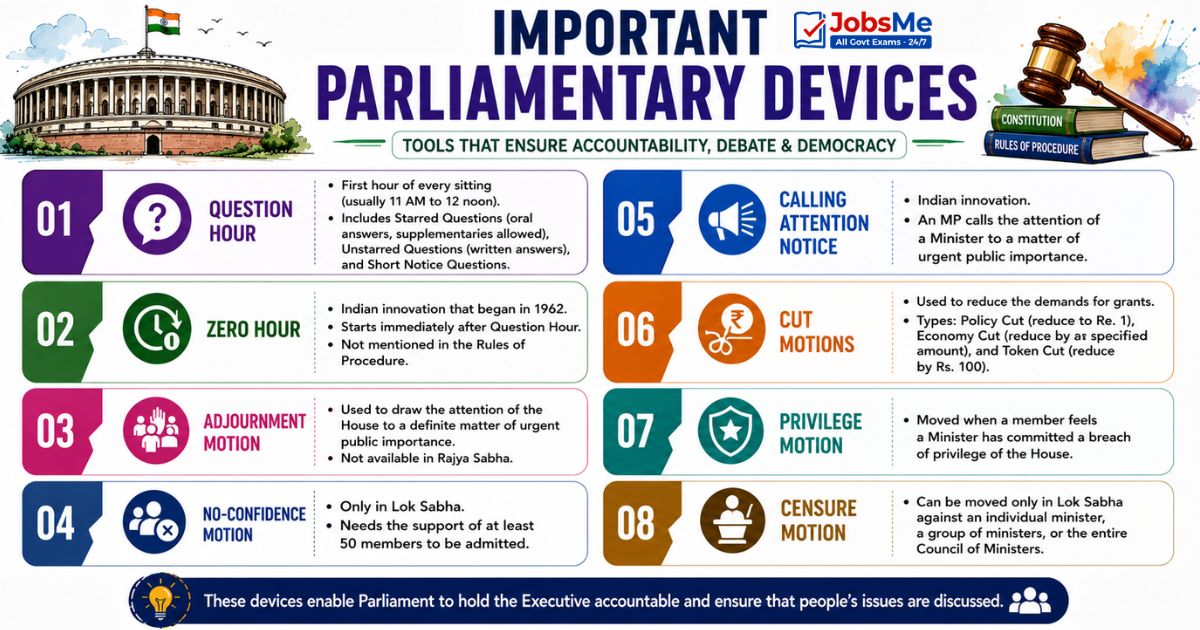
- Question Hour: First hour of every sitting (usually 11 AM to 12 noon). Includes Starred Questions (oral answers, supplementaries allowed), Unstarred Questions (written answers), and Short Notice Questions.
- Zero Hour: Indian innovation that began in 1962; starts immediately after Question Hour; not mentioned in the Rules of Procedure.
- Adjournment Motion: Used to draw the attention of the House to a definite matter of urgent public importance; not available in Rajya Sabha.
- No-Confidence Motion: Only in Lok Sabha; needs the support of at least 50 members to be admitted.
- Censure Motion: Can be moved only in Lok Sabha against an individual minister, a group of ministers, or the entire Council of Ministers.
- Calling Attention Notice: Indian innovation; an MP calls the attention of a Minister to a matter of urgent public importance.
- Cut Motions: Used to reduce the demands for grants — Policy Cut (reduce to Re. 1), Economy Cut (reduce by a specified amount), and Token Cut (reduce by Rs. 100).
- Privilege Motion: Moved when a member feels a Minister has committed a breach of privilege of the House.
Presiding Officers and Important Office-Holders
The Speaker, Deputy Speaker, Chairman, Deputy Chairman, and the Leaders of the House and Opposition are the most frequently asked office-holders in Banking, SSC, and Defence current affairs sections. To brush up on related Banking Awareness facts, you can also visit the Banking Awareness section on Jobsme.in.
Speaker of Lok Sabha
- Elected by the members of Lok Sabha from amongst themselves.
- First Speaker: G. V. Mavalankar (1952-1956) — called the "Father of the Lok Sabha".
- First woman Speaker: Meira Kumar (15th Lok Sabha, 2009-2014).
- Current Speaker (18th Lok Sabha): Om Birla (elected 26 June 2024; serving his second consecutive term).
- Can be removed by a resolution passed by an effective majority of Lok Sabha after a 14-day notice.
- Has a casting vote in case of a tie; certifies Money Bills; presides over joint sittings.
- Salary and allowances charged on the Consolidated Fund of India.
Deputy Speaker of Lok Sabha
- First Deputy Speaker: M. Ananthasayanam Ayyangar.
- Article 93 makes the election of Deputy Speaker mandatory; however, the post remained vacant throughout the 17th Lok Sabha (2019-2024) and continues to be vacant in the 18th Lok Sabha.
- Performs all duties of the Speaker when the post is vacant or the Speaker is absent.
Chairman of Rajya Sabha
- The Vice-President of India is the ex-officio Chairman of the Rajya Sabha (Article 89).
- He is not a member of the Rajya Sabha and has no regular vote — only a casting vote in case of a tie.
- First Chairman: Dr. Sarvepalli Radhakrishnan (1952-1962).
- Current Chairman: C. P. Radhakrishnan (15th Vice-President; assumed office September 2025).
Deputy Chairman of Rajya Sabha
- Elected by the members of Rajya Sabha from amongst themselves.
- First Deputy Chairman: S. V. Krishnamoorthy Rao.
- Most recent Deputy Chairman: Harivansh Narayan Singh (JDU); served 2018 to April 2026.
Leader of the House and Leader of the Opposition
- Leader of the House (Lok Sabha): Usually the Prime Minister if he is a member of Lok Sabha; otherwise, a senior Cabinet Minister.
- Leader of the House (Rajya Sabha): J. P. Nadda (current).
- Leader of the Opposition (LoP): Statutory post under the Salary and Allowances of Leaders of Opposition in Parliament Act, 1977.
- To be recognised as LoP, a party must have at least 10 percent of the total strength of the House.
- Current LoP, Lok Sabha: Rahul Gandhi (Indian National Congress) — the post was vacant during the entire 16th and 17th Lok Sabhas.
- Current LoP, Rajya Sabha: Mallikarjun Kharge.
Memory Tricks and Mnemonics
Trick 1: "25-30 Rule" for Minimum Age
The simplest memory trick to never confuse the minimum age of an MP:
- Lok Sabha → "Loud and Young" → 25 years.
- Rajya Sabha → "Royal and Older" → 30 years.
"Young people speak loudly (Lok 25); older people speak royally (Rajya 30)."
Trick 2: "5-6 Term Trick"
The term of the House versus the term of a member:
- Lok Sabha House → 5 years (one term).
- Rajya Sabha Member → 6 years (one-third retire every 2 years).
"Five fingers for Lok, six packs for Rajya."
Trick 3: "79-80-81 Family Trick"
Three consecutive articles, three components of Parliament:
- Article 79 → Constitution of Parliament.
- Article 80 → Composition of Rajya Sabha (alphabetically R comes first in this pair).
- Article 81 → Composition of Lok Sabha.
"Parliament first (79), then Rajya (80), then Lok (81) — top to bottom."
Trick 4: "Money Mile" — Money Bill Only Travels One Way
Use this story to remember Money Bill rules:
- A Money Bill starts in Lok Sabha (popular pocket).
- It visits Rajya Sabha only for 14 days as a guest (cannot reject or amend).
- The Speaker is the certifier; his decision is final.
- No joint sitting on Money Bills — Lok Sabha will always win.
"Money walks the Lok-mile, but Rajya is just a road sign."
Trick 5: "Three JS" — Three Joint Sittings in History
Only three joint sittings have ever been held. Remember them with "DBP — Dowry, Banking, POTA":
- D — 1961 → Dowry Prohibition Bill.
- B — 1978 → Banking Service Commission (Repeal) Bill.
- P — 2002 → Prevention of Terrorism Bill (POTA).
"DBP — three joint sittings, three decades apart."
Trick 6: "PASS the Bill" — Types of Bills
Four kinds of Bills move through Parliament; remember "OMFC":
- O → Ordinary Bill (Article 107).
- M → Money Bill (Article 110).
- F → Financial Bill (Article 117).
- C → Constitutional Amendment Bill (Article 368).
"OMFC — Order of Money, Finance, Constitution."
Trick 7: "12-2-238" Rajya Sabha Story
Break the Rajya Sabha numbers into a story:
- 12 nominated members (by President for LASS — Literature, Art, Science, Social Service).
- 2 years — gap between one-third retirements.
- 238 elected members from States and UTs.
- Add them: 12 + 238 = 250, the maximum strength.
"12 nominated, 2-year wave, 238 voted — 250 in total."
Trick 8: "LASS" — President's Nominee Categories
The President nominates 12 Rajya Sabha members for distinction in "LASS":
- L → Literature.
- A → Art.
- S → Science.
- S → Social Service.
Additional Notes
Frequently Confused Facts
- Article 80 vs Article 81: Article 80 is Rajya Sabha; Article 81 is Lok Sabha. Remember R-80 alphabetically before L-81 in this pair.
- Quorum is 1/10th, not 1/3rd: Quorum of either House is 1/10th of the total membership. 1/3rd is the figure for Rajya Sabha retirements every 2 years.
- Maximum strength of Lok Sabha is 550 (not 552): The earlier limit of 552 included 2 Anglo-Indian nominees, removed by the 104th CAA 2019.
- Chairman of Rajya Sabha is not a member of Rajya Sabha: The Vice-President is an outsider to the House; only the Deputy Chairman is a member of the House.
- Speaker presides over joint sitting, not Chairman: The Chairman of Rajya Sabha never presides over a joint sitting under any circumstances.
- Money Bill vs Financial Bill: All Money Bills are Financial Bills, but not all Financial Bills are Money Bills. Only Money Bills enjoy the special procedure of Article 109.
- Adjournment vs Prorogation vs Dissolution: Adjournment is by Presiding Officer; Prorogation is by President (ends the session); Dissolution is by President (ends the Lok Sabha itself).
- Zero Hour is not a constitutional device: Question Hour is mentioned in Rules of Procedure; Zero Hour is an informal Indian innovation since 1962.
- No-Confidence Motion vs Censure Motion: No-Confidence is against the entire Council of Ministers; Censure can be against an individual minister also.
- President is part of Parliament: Under Article 79, the President is the first component of Parliament, even though he is not a sitting member of either House.
Repeating PYQ Patterns
Certain Parliament-related facts are asked repeatedly across exams. Article 79 (composition of Parliament), Article 80 (Rajya Sabha), Article 81 (Lok Sabha), Article 108 (joint sitting), Article 110 (Money Bill definition), minimum age of MPs, term of Rajya Sabha members, quorum of Houses, and the three historical joint sittings appear repeatedly in UPSC Prelims, SSC CGL, and RRB NTPC papers. Banking exams (IBPS PO, SBI Clerk, RBI Grade B) frequently focus on Money Bill procedure, the Budget cycle, and the role of the Speaker. State PCS exams add State-specific Legislative Assembly comparisons. Defence exams (CDS, NDA) emphasise the constitutional structure under Part V, while Insurance exams (LIC, NICL) often ask about the current Speaker, Vice-President, and Leader of Opposition. To practise these patterns, take a quick test on the Static GK Quiz on Jobsme.in.
Quick Insight
The Parliament of India is not just a building or a chamber — it is the living centre of Indian democracy. The shift from the colonial-era Old Parliament House (designed by Sir Edwin Lutyens and Sir Herbert Baker, foundation laid in 1921 and opened in 1927) to the New Parliament Building (inaugurated by Prime Minister Narendra Modi on 28 May 2023, designed by HCP Design Bimal Patel, built by Tata Projects) marks a generational milestone. The new Lok Sabha chamber can seat 888 members and the new Rajya Sabha chamber 384 members, allowing future expansion after delimitation. The same Parliament passed the 106th Constitutional Amendment Act (Nari Shakti Vandan Adhiniyam) in September 2023 reserving 33 percent seats for women in Lok Sabha and State Legislative Assemblies — a landmark step that will come into effect after the next delimitation. For more such Polity-meets-current-affairs topics, you can also explore the Static GK notes and the Latest Government Job Notifications on Jobsme.in.
One-Liners for Quick Revision
- Parliament of India → President + Rajya Sabha + Lok Sabha (Article 79).
- Part V of Constitution → Deals with the Union (Articles 52 to 151).
- Articles 79 to 122 → Specifically deal with Parliament.
- Lok Sabha → Lower House, Popular House, House of the People.
- Rajya Sabha → Upper House, Council of States, Permanent House.
- Article 80 → Composition of Rajya Sabha — maximum 250 members.
- Article 81 → Composition of Lok Sabha — maximum 550 members.
- Current Lok Sabha Strength → 543 (after removal of 2 Anglo-Indian seats by 104th CAA 2019).
- Current Rajya Sabha Strength → 245 (233 elected + 12 nominated).
- 12 Nominated Rajya Sabha Members → Nominated by President for Literature, Science, Art, Social Service (LASS).
- Lok Sabha Term → 5 years; can be dissolved earlier.
- Rajya Sabha Term → Permanent; one-third retire every 2 years; member term 6 years.
- Minimum Age — Lok Sabha → 25 years.
- Minimum Age — Rajya Sabha → 30 years.
- Quorum → 1/10th of total members of the House (Article 100).
- Article 85 → Maximum gap between two sessions of Parliament is 6 months.
- Article 100 → Voting in Houses and Quorum.
- Article 105 → Powers and privileges of Parliament and its members.
- Article 108 → Joint sitting of both Houses; presided by Speaker of Lok Sabha.
- Article 110 → Defines a Money Bill; Speaker's decision is final.
- Article 112 → Annual Financial Statement (Union Budget).
- Article 117 → Financial Bills (Category I and II).
- Article 120 → Hindi and English are the official languages of Parliament.
- Money Bills → Can be introduced only in Lok Sabha and only on the recommendation of the President.
- Rajya Sabha and Money Bill → Cannot reject or amend; must return within 14 days; can only recommend.
- Rajya Sabha's Special Powers → Article 249 (legislate on State List) and Article 312 (create All India Services).
- Council of Ministers Responsibility → Collectively responsible to the Lok Sabha (Article 75).
- No-Confidence Motion → Can be moved only in Lok Sabha; needs 50 members' support to be admitted.
- Three Joint Sittings → 1961 (Dowry), 1978 (Banking), 2002 (POTA).
- Joint Sitting Presiding Officer → Speaker of Lok Sabha; never the Chairman of Rajya Sabha.
- Joint Sitting Not Allowed For → Money Bills and Constitutional Amendment Bills.
- Speaker of Lok Sabha → Elected by members of Lok Sabha; can be removed by effective majority.
- First Speaker of Lok Sabha → G. V. Mavalankar — Father of the Lok Sabha.
- First Woman Speaker → Meira Kumar (15th Lok Sabha, 2009-2014).
- Current Speaker (18th Lok Sabha) → Om Birla (second consecutive term, re-elected 26 June 2024).
- Deputy Speaker Article → Article 93; first Deputy Speaker was M. A. Ayyangar.
- Chairman of Rajya Sabha → Vice-President of India (ex-officio) under Article 89.
- First Chairman of Rajya Sabha → Dr. S. Radhakrishnan.
- Current Chairman of Rajya Sabha → C. P. Radhakrishnan (15th Vice-President, since September 2025).
- Deputy Chairman of Rajya Sabha → Elected by Rajya Sabha members; first was S. V. Krishnamoorthy Rao.
- Leader of Opposition (LoP) → Statutory post under 1977 Act; needs 10% strength of House.
- Current LoP, Lok Sabha → Rahul Gandhi (Indian National Congress).
- Current LoP, Rajya Sabha → Mallikarjun Kharge.
- Question Hour → First hour of every sitting; three kinds — Starred, Unstarred, Short Notice.
- Zero Hour → Indian innovation since 1962; starts after Question Hour; not in Rules of Procedure.
- Adjournment Motion → Available only in Lok Sabha; not in Rajya Sabha.
- Cut Motions → Policy Cut (Re. 1), Economy Cut (specified amount), Token Cut (Rs. 100).
- Special Majority (Article 368) → 2/3rd of members present and voting plus more than 50% of total membership.
- 52nd CAA (1985) → Anti-defection law; added the 10th Schedule.
- 91st CAA (2003) → Limited Council of Ministers to 15% of Lok Sabha strength; raised anti-defection split to 2/3rd merger.
- 104th CAA (2019) → Removed Anglo-Indian reservation; extended SC/ST reservation by 10 years.
- 106th CAA (2023) → Nari Shakti Vandan Adhiniyam; 33% women reservation in Lok Sabha and State Assemblies.
- Old Parliament House → Designed by Edwin Lutyens and Herbert Baker; foundation laid 1921; opened 1927.
- New Parliament Building → Inaugurated 28 May 2023 by PM Narendra Modi; designed by HCP Design (Bimal Patel); built by Tata Projects.
- New Lok Sabha Chamber Capacity → 888 seats.
- New Rajya Sabha Chamber Capacity → 384 seats.
- First Sitting of Lok Sabha and Rajya Sabha → 13 May 1952.
- Rajya Sabha Constituted → 3 April 1952.
- Current Lok Sabha → 18th Lok Sabha (constituted June 2024).
- Pro-tem Speaker of 18th Lok Sabha → Bhartruhari Mahtab (June 2024).
- President's Address → At the start of the first session of every year and after every general election (Article 87).
- Vote on Account (Article 116) → Permits withdrawal from Consolidated Fund for part of the year, pending Budget passage.
For more Static GK topics like Parts of the Constitution, Fundamental Rights, and Important Amendments, explore the Static GK section on Jobsme.in. You can also test your preparation with the Daily Current Affairs Quiz and stay updated with the Latest Government Job Notifications.
Free quiz • No signup required
Put this topic into practice with Indian Cultural Institutions – Static GK MCQ Quiz. It is the quickest way to reinforce what you just learned.
Frequently Asked Questions
What is the maximum strength of the Lok Sabha as per the Constitution?
What is the maximum strength of the Rajya Sabha and how are its members chosen?
What is the minimum age required to become a member of the Lok Sabha and the Rajya Sabha?
Who is the ex-officio Chairman of the Rajya Sabha?
Under which article can a joint sitting of both Houses of Parliament be summoned?
How many joint sittings of Parliament have been held in independent India?
What is the difference between a Money Bill and an Ordinary Bill?
Who is the current Speaker of the Lok Sabha?
What is Zero Hour in the Indian Parliament?
When was the new Parliament Building of India inaugurated?

About the author