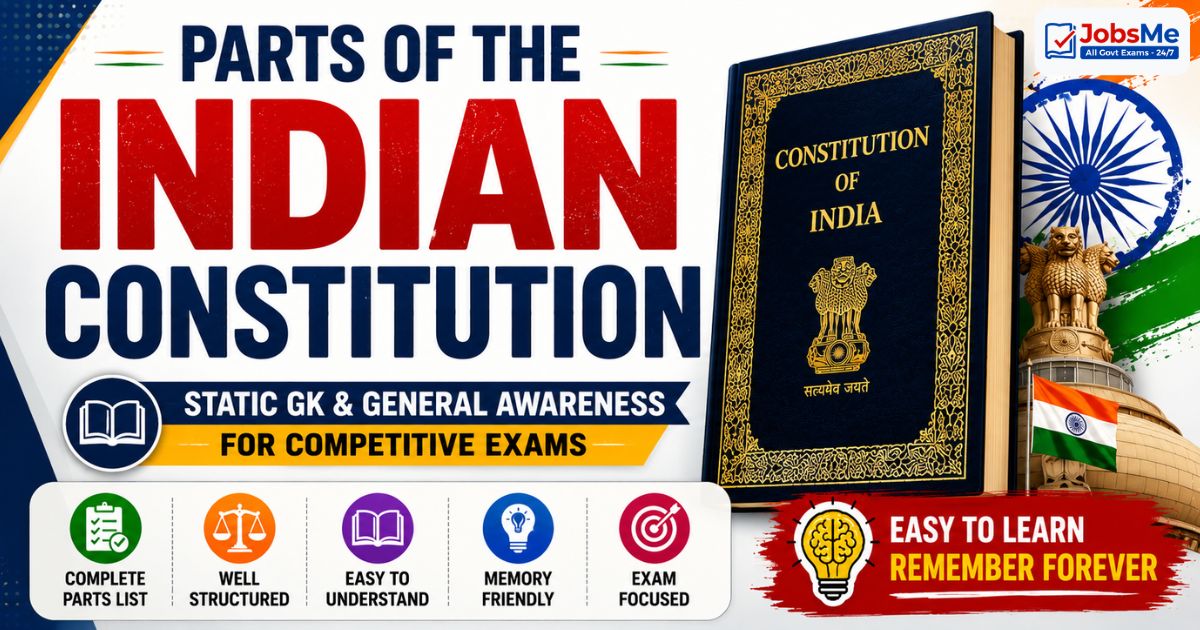
Parts of the Indian Constitution – Static GK & General Awareness for Competitive Exams with Memory Tricks
This article presents a complete list of all 25 Parts of the Indian Constitution along with their subject matter, article ranges, and key features — covering Fundamental Rights, Directive Principles, Fundamental Duties, Panchayats, Municipalities, Emergency Provisions, and every other constitutional segment. It includes the four parts added later (Part IVA, IXA, IXB and XIVA), the repealed Part VII, and detailed memory tricks for instant recall. All facts are arranged in exam-ready format to help UPSC, SSC, IBPS, RRB, PSU, Insurance and State PCS aspirants score better in Indian Polity and General Awareness sections.
Jump to section
Introduction
The Constitution of India is the supreme law of the land, adopted on 26 November 1949 and brought into force on 26 January 1950. At the time of its commencement, the Constitution had 395 Articles, 22 Parts, and 8 Schedules, making it the longest written constitution in the world. Over time, through various amendments, four new Parts have been added and one Part (Part VII) has been repealed, taking the current count to 25 Parts, 12 Schedules, and around 448 Articles. Each Part of the Constitution groups together a specific theme — Citizenship, Fundamental Rights, the Union, the States, Panchayats, Emergency Provisions, and so on.
Questions on the Parts of the Indian Constitution are a permanent fixture in UPSC Prelims, SSC CGL, IBPS PO, RRB NTPC, SBI Clerk, State PCS, Insurance and Defence exams. Typical questions ask which Part deals with which subject, which articles fall under a given Part, which Part was added by the 42nd, 73rd, 74th or 97th Amendment, and which Part was repealed. For aspirants who want to track such polity-based questions in daily exam updates, a useful resource is the Daily Current Affairs section on Jobsme.in.
Understanding Parts is also the gateway to mastering broader topics like Fundamental Rights vs Directive Principles, Centre-State relations, Local Self-Government, Emergency Provisions and the Amendment procedure. Since the structure of the Constitution rarely changes drastically, this remains a high-scoring Static GK area and frequently overlaps with current affairs themes such as Constitution Day (26 November), Republic Day (26 January) and major amendment anniversaries.
Core Concepts: Structure of the Indian Constitution
Before memorising individual Parts, it is important to understand how the Constitution is organised and how new Parts have been added over time without disturbing the original numbering.
Key Numerical Facts
- Adopted on: 26 November 1949 (celebrated as Constitution Day / Samvidhan Divas since 2015).
- Came into force on: 26 January 1950 (Republic Day).
- Original size: 395 Articles, 22 Parts, 8 Schedules.
- Current size: 448 Articles (approx.), 25 active Parts, 12 Schedules.
- Parts added later: Part IVA, Part IXA, Part IXB, Part XIVA (total 4).
- Part repealed: Part VII (by 7th Constitutional Amendment Act, 1956).
- Longest written constitution in the world.
How New Parts Are Numbered
- When a new Part is inserted, it is given the previous Part's number with a suffix letter (A, B, etc.) to preserve the original sequence.
- Example: Part IVA (Fundamental Duties) was inserted after Part IV (DPSP) by the 42nd Amendment, 1976.
- Example: Part IXA (Municipalities) was inserted after Part IX (Panchayats) by the 74th Amendment, 1992.
- This is why there is no "Part XXIII" or "Part XXV" — the numbering still ends at Part XXII, but additional Parts have been added in between.
Foreign Sources of Different Parts
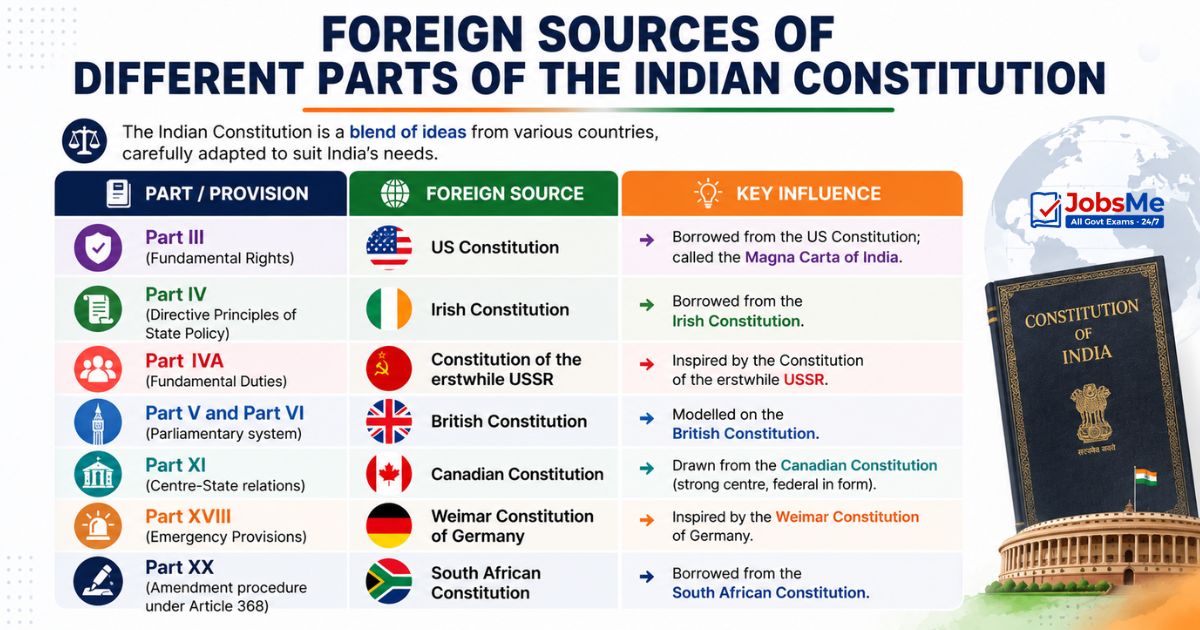
- Part III (Fundamental Rights): Borrowed from the US Constitution; called the Magna Carta of India.
- Part IV (Directive Principles of State Policy): Borrowed from the Irish Constitution.
- Part IVA (Fundamental Duties): Inspired by the Constitution of the erstwhile USSR.
- Part V and Part VI (Parliamentary system): Modelled on the British Constitution.
- Part XI (Centre-State relations): Drawn from the Canadian Constitution (strong centre, federal in form).
- Part XVIII (Emergency Provisions): Inspired by the Weimar Constitution of Germany.
- Part XX (Amendment procedure under Article 368): Borrowed from the South African Constitution.
List of All 25 Parts of the Indian Constitution
The following table lists every Part of the Indian Constitution along with the articles it covers, its subject matter, and the key features that examiners frequently test. Parts added by later amendments and the repealed Part VII are marked clearly.
| Part | Articles | Subject | Key Features / Details |
|---|---|---|---|
| Part I | Articles 1 - 4 | The Union and its Territory | Defines India as a "Union of States"; deals with admission, establishment, formation of new States and alteration of boundaries; Article 1 calls India "Bharat". |
| Part II | Articles 5 - 11 | Citizenship | Provides citizenship at the commencement of the Constitution and empowers Parliament to make laws on acquisition and termination of citizenship (Citizenship Act, 1955). |
| Part III | Articles 12 - 35 | Fundamental Rights | Called the Magna Carta of India; covers six Fundamental Rights — Equality, Freedom, Against Exploitation, Religion, Cultural & Educational, and Constitutional Remedies (Article 32, called the "heart and soul" of the Constitution by Dr. B. R. Ambedkar). |
| Part IV | Articles 36 - 51 | Directive Principles of State Policy (DPSP) | Borrowed from the Irish Constitution; non-justiciable guidelines for the State; includes Article 40 (Panchayats), Article 44 (Uniform Civil Code) and Article 51 (international peace). |
| Part IVA (Added) | Article 51A | Fundamental Duties | Added by the 42nd Amendment Act, 1976 on the recommendation of the Swaran Singh Committee; originally 10 duties; the 11th duty (education of children aged 6-14) was added by the 86th Amendment, 2002. |
| Part V | Articles 52 - 151 | The Union | Deals with the President, Vice-President, Prime Minister, Council of Ministers, Parliament (Lok Sabha and Rajya Sabha), Attorney General, Supreme Court, CAG and Union Judiciary. |
| Part VI | Articles 152 - 237 | The States | Deals with the Governor, Chief Minister, State Council of Ministers, State Legislature (Vidhan Sabha and Vidhan Parishad), Advocate General, and State High Courts; does not apply to Jammu & Kashmir originally. |
| Part VII (Repealed) | Article 238 | States in Part B of the First Schedule | Repealed by the 7th Constitutional Amendment Act, 1956 after the abolition of the four-fold State classification (Parts A, B, C, D) following the States Reorganisation Act, 1956. |
| Part VIII | Articles 239 - 242 | The Union Territories | Provides for administration of UTs by the President through an Administrator; Article 239AA gives a special status to Delhi (added by the 69th Amendment, 1991). |
| Part IX (Added) | Articles 243 - 243O | The Panchayats | Added by the 73rd Amendment Act, 1992, effective from 24 April 1993 (National Panchayati Raj Day); gives constitutional status to a three-tier Panchayati Raj; linked to the 11th Schedule (29 subjects). |
| Part IXA (Added) | Articles 243P - 243ZG | The Municipalities | Added by the 74th Amendment Act, 1992, also called the Nagarpalika Act; effective from 1 June 1993; provides for Nagar Panchayats, Municipal Councils and Municipal Corporations; linked to the 12th Schedule (18 subjects). |
| Part IXB (Added) | Articles 243ZH - 243ZT | The Co-operative Societies | Added by the 97th Amendment Act, 2011; gives constitutional status to co-operative societies; recognises the right to form co-operative societies as a Fundamental Right under Article 19(1)(c). |
| Part X | Articles 244 - 244A | The Scheduled and Tribal Areas | Provides for administration of Scheduled Areas and Tribal Areas; linked to the 5th Schedule (other than Assam, Meghalaya, Tripura, Mizoram) and the 6th Schedule (Assam, Meghalaya, Tripura, Mizoram tribal areas). |
| Part XI | Articles 245 - 263 | Relations between the Union and the States | Deals with legislative and administrative relations between the Centre and the States; linked to the 7th Schedule (Union, State and Concurrent Lists); provides for Inter-State Council under Article 263. |
| Part XII | Articles 264 - 300A | Finance, Property, Contracts and Suits | Covers taxation powers, distribution of revenues, Consolidated Fund, Contingency Fund, Public Account, Finance Commission (Article 280) and GST Council (Article 279A); Article 300A protects the Right to Property as a constitutional (legal) right. |
| Part XIII | Articles 301 - 307 | Trade, Commerce and Intercourse within the Territory of India | Guarantees freedom of trade, commerce and intercourse throughout India; Parliament can impose reasonable restrictions in public interest. |
| Part XIV | Articles 308 - 323 | Services under the Union and the States | Deals with All India Services, Central and State Public Service Commissions (UPSC and SPSC); regulates recruitment and conditions of service of civil servants. |
| Part XIVA (Added) | Articles 323A - 323B | Tribunals | Added by the 42nd Amendment Act, 1976 on the recommendation of the Swaran Singh Committee; provides for Administrative Tribunals (323A) and tribunals for other matters (323B); led to the creation of CAT, ITAT, etc. |
| Part XV | Articles 324 - 329A | Elections | Provides for the Election Commission of India (Article 324) — a three-member body (1 CEC + 2 ECs); covers electoral rolls, voting rights and bars on court interference in election matters. |
| Part XVI | Articles 330 - 342 | Special Provisions Relating to Certain Classes | Provides reservations for SCs, STs and Anglo-Indians in Lok Sabha and State Assemblies; National Commissions for SCs, STs and Backward Classes; the 104th Amendment (2019) discontinued Anglo-Indian reservation. |
| Part XVII | Articles 343 - 351 | Official Language | Declares Hindi in Devanagari script as the official language of the Union; English to continue alongside Hindi; the 8th Schedule currently lists 22 scheduled languages. |
| Part XVIII | Articles 352 - 360 | Emergency Provisions | Inspired by the Weimar Constitution of Germany; provides for three types of emergencies — National (352), President's Rule / State (356) and Financial (360); the 44th Amendment (1978) made the "armed rebellion" ground specific. |
| Part XIX | Articles 361 - 367 | Miscellaneous | Provides immunity to the President and Governors from court proceedings during their term; restricts publication of parliamentary proceedings; contains general interpretation clauses. |
| Part XX | Article 368 | Amendment of the Constitution | Contains the procedure for amending the Constitution; provides for simple majority, special majority, and special majority with ratification by half the States; the Kesavananda Bharati case (1973) introduced the "Basic Structure" doctrine as a limit on this power. |
| Part XXI | Articles 369 - 392 | Temporary, Transitional and Special Provisions | Contained Article 370 (special status to J&K, abrogated in August 2019) and Article 371 (special provisions for several states like Maharashtra, Gujarat, Nagaland, Sikkim, Mizoram, Arunachal Pradesh, Goa, Karnataka, Andhra Pradesh and Telangana). |
| Part XXII | Articles 393 - 395 | Short Title, Commencement, Authoritative Text in Hindi and Repeals | Article 393 gives the short title "The Constitution of India"; Article 394 deals with the date of commencement; Article 394A (added by 58th Amendment, 1987) provides for an authoritative text in Hindi; Article 395 repeals the Indian Independence Act, 1947 and the Government of India Act, 1935. |
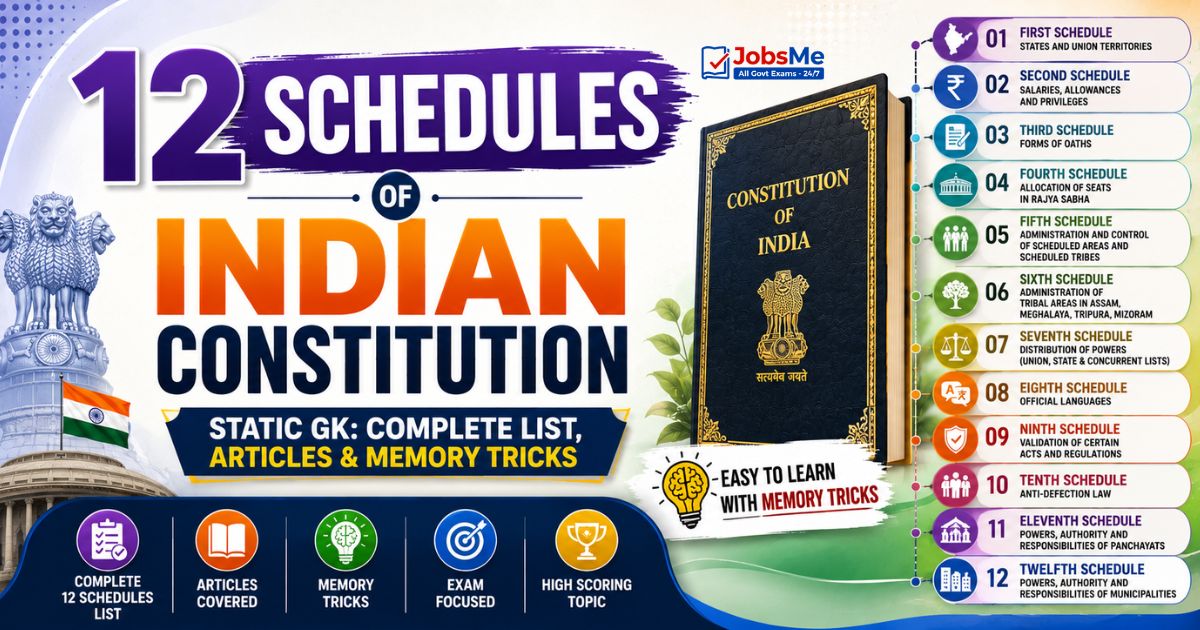
Important Schedules Linked to These Parts
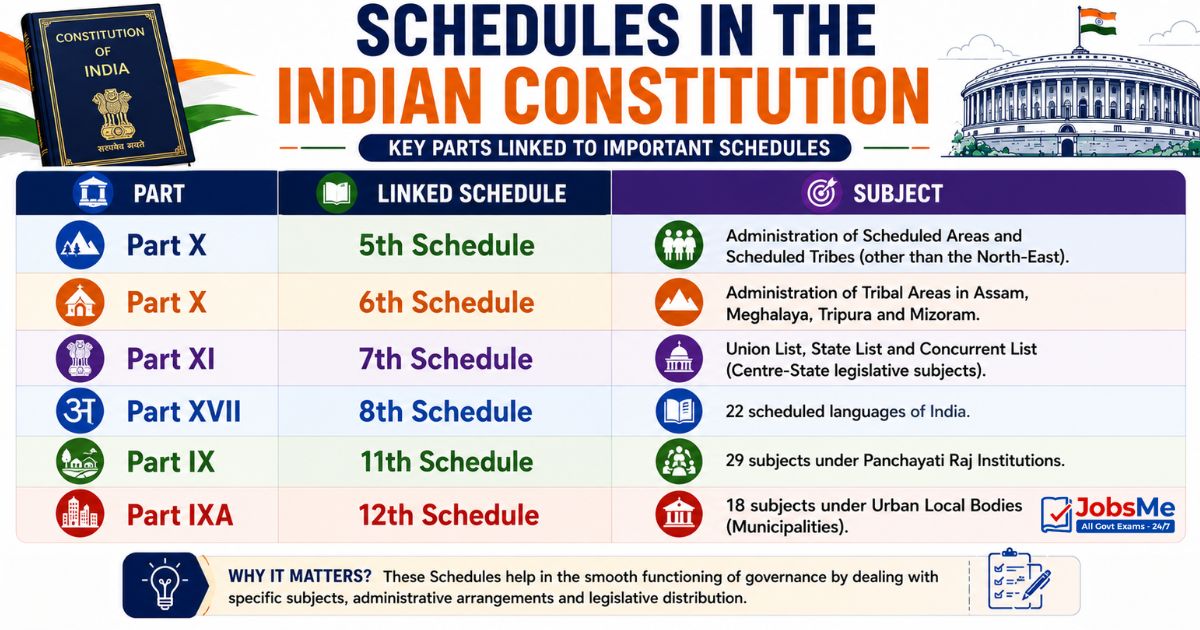
Several Parts of the Constitution are closely linked to specific Schedules. Knowing the Part-Schedule combinations is a frequent direct question in IBPS, SSC and RRB exams. To strengthen this overlap area, candidates can also follow the Banking Awareness section on Jobsme.in.
| Part | Linked Schedule | Subject |
|---|---|---|
| Part X | 5th Schedule | Administration of Scheduled Areas and Scheduled Tribes (other than the North-East). |
| Part X | 6th Schedule | Administration of Tribal Areas in Assam, Meghalaya, Tripura and Mizoram. |
| Part XI | 7th Schedule | Union List, State List and Concurrent List (Centre-State legislative subjects). |
| Part XVII | 8th Schedule | 22 scheduled languages of India. |
| Part IX | 11th Schedule | 29 subjects under Panchayati Raj Institutions. |
| Part IXA | 12th Schedule | 18 subjects under Urban Local Bodies (Municipalities). |
Memory Tricks and Mnemonics for Parts of the Constitution
Trick 1: Original 22 Parts vs Current 25 Parts — "22 - 1 + 4 = 25"
The Constitution still has Part numbers up to XXII, but four sub-Parts have been added and one has been repealed:
- Original Parts: 22 (Parts I to XXII).
- Minus 1: Part VII repealed by the 7th Amendment, 1956.
- Plus 4: Part IVA, Part IXA, Part IXB and Part XIVA.
- Net total: 22 − 1 + 4 = 25 active Parts.
"Twenty-two original, drop the seven, add four with 'A', and you get twenty-five."
Trick 2: The Four Added Parts — "FuMu-Co-Tri"
Remember the four Parts added later using the mnemonic "FuMu-Co-Tri":
- Fu → Part IVA → Fundamental Duties (42nd Amendment, 1976).
- Mu → Part IXA → Municipalities (74th Amendment, 1992).
- Co → Part IXB → Co-operative Societies (97th Amendment, 2011).
- Tri → Part XIVA → Tribunals (42nd Amendment, 1976).
"Two were added by the 42nd Amendment (FuTri) and two by the 73rd/74th/97th wave (MuCo)."
Trick 3: 42nd Amendment as the "Mini Constitution"
The 42nd Amendment Act, 1976 is called the "Mini Constitution" because it added two new Parts and changed dozens of articles. Remember its two additions as "DuTy = Duties + Tribunals":
- Du → Duties (Part IVA / Article 51A).
- Ty → Tribunals (Part XIVA / Articles 323A and 323B).
Trick 4: Local Government Twins — "73 = 9, 74 = 9A"
Local self-government was constitutionalised through two adjacent amendments. Pair the amendment number with the Part number:
- 73rd Amendment (1992) → Part IX (Panchayats) → 11th Schedule.
- 74th Amendment (1992) → Part IXA (Municipalities) → 12th Schedule.
- 97th Amendment (2011) → Part IXB (Co-operative Societies).
"All three 'IX-family' Parts deal with grassroots-level bodies — village, town and society."
Trick 5: First Five Parts — "U-C-F-D-D" (You-See-FuDDu)
The first five active Parts cover the foundational structure. Use the mnemonic "U-C-F-D-D":
- U → Part I → Union and its Territory.
- C → Part II → Citizenship.
- F → Part III → Fundamental Rights.
- D → Part IV → Directive Principles of State Policy.
- D → Part IVA → Duties (Fundamental Duties).
"Union → Citizens → Rights → Principles → Duties."
Trick 6: Last Five Parts — "EMA-T-S" (Emergency, Misc, Amendment, Transitional, Short title)
The final five Parts close the Constitution. Use "EMA-T-S":
- E → Part XVIII → Emergency Provisions (Articles 352-360).
- M → Part XIX → Miscellaneous (Articles 361-367).
- A → Part XX → Amendment of the Constitution (Article 368).
- T → Part XXI → Temporary, Transitional and Special Provisions.
- S → Part XXII → Short title, commencement and repeals.
Trick 7: Foreign Sources — "USA-Ireland-USSR-UK-Canada-Germany-SA"
Borrowing pattern for important Parts:
- Part III (FR) → USA.
- Part IV (DPSP) → Ireland.
- Part IVA (FD) → USSR (erstwhile).
- Parts V & VI (Parliamentary system) → UK.
- Part XI (Centre-State relations) → Canada.
- Part XVIII (Emergency) → Germany (Weimar).
- Part XX (Article 368 amendment) → South Africa.
"Rights from USA, Principles from Ireland, Duties from USSR, Parliament from UK, Federalism from Canada, Emergency from Germany, Amendment from South Africa."
Additional Notes
Frequently Confused Facts
- Part VII vs Part VIII: Part VII (States in Part B of First Schedule) was repealed in 1956; Part VIII deals with Union Territories and is still active.
- Part IX vs Part IXA vs Part IXB: Part IX is Panchayats (rural), Part IXA is Municipalities (urban), and Part IXB is Co-operative Societies — three different local-level bodies.
- Part IV vs Part IVA: Part IV is the Directive Principles of State Policy (duties of the State); Part IVA is the Fundamental Duties of citizens.
- Part XIV vs Part XIVA: Part XIV deals with Services under Union and States; Part XIVA deals with Tribunals (Articles 323A & 323B).
- Article 368 vs Article 32: Article 368 (Part XX) is the amendment procedure; Article 32 (Part III) is the Right to Constitutional Remedies — the "heart and soul" of the Constitution.
- Part XXI confusion: Part XXI contained Article 370 (J&K), which was abrogated in August 2019 but the Part itself still exists.
- 42nd Amendment vs 44th Amendment: The 42nd added Parts IVA and XIVA (Fundamental Duties and Tribunals); the 44th modified the emergency provisions of Part XVIII and removed Right to Property from Part III.
- 11th Schedule vs 12th Schedule: 11th Schedule (29 subjects) is linked to Part IX (Panchayats); 12th Schedule (18 subjects) is linked to Part IXA (Municipalities).
Repeating PYQ Patterns
Certain Parts dominate the exam landscape. Part III (Fundamental Rights), Part IV (DPSP), Part IVA (Fundamental Duties), Part V (Union), Part VI (States), Part IX (Panchayats), Part IXA (Municipalities), Part XVIII (Emergency Provisions) and Part XX (Amendment of the Constitution) are asked most frequently in UPSC Prelims, SSC CGL, RRB NTPC and State PCS exams. Banking exams (IBPS PO, SBI Clerk) commonly ask matching questions like "Part IXA deals with — Municipalities" or "Part XVIII covers — Emergency Provisions". Defence and Insurance exams favour the foundational five Parts (I-IV and IVA). State PCS often combines Parts with their corresponding Schedules — for example, Part XI with the 7th Schedule (Union, State and Concurrent Lists) and Part XVII with the 8th Schedule (languages). Aspirants can practise such polity-based MCQs through the Static GK Quiz on Jobsme.in.
Quick Insight
The Parts of the Constitution are not just a numbering system — they are the structural backbone of Indian democracy. Each Part corresponds to a real institution: Part III protects every citizen's freedoms in courtrooms, Part IX runs every Gram Panchayat election, Part XV runs every Lok Sabha and Vidhan Sabha election through the Election Commission, and Part XVIII has been invoked during the 1962, 1971 and 1975 National Emergencies. Tracking the evolution of these Parts — especially the addition of Parts IVA, IXA, IXB and XIVA — helps aspirants understand how a 1950 document keeps adapting to a 21st-century democracy. For more conceptual coverage, candidates can also explore the Static GK section on Jobsme.in.
One-Liners for Quick Revision
- Original Constitution → 22 Parts, 395 Articles, 8 Schedules → adopted 26 November 1949, enforced 26 January 1950.
- Current Constitution → 25 active Parts, around 448 Articles, 12 Schedules.
- Part I → Articles 1-4 → The Union and its Territory → India is a "Union of States".
- Part II → Articles 5-11 → Citizenship → linked to Citizenship Act, 1955.
- Part III → Articles 12-35 → Fundamental Rights → known as the Magna Carta of India.
- Part IV → Articles 36-51 → Directive Principles of State Policy → borrowed from Ireland.
- Part IVA → Article 51A → Fundamental Duties → added by 42nd Amendment, 1976; now 11 duties.
- Part V → Articles 52-151 → The Union → President, Parliament, Supreme Court, CAG.
- Part VI → Articles 152-237 → The States → Governor, State Legislature, High Court.
- Part VII → Article 238 → States in Part B of First Schedule → Repealed by 7th Amendment, 1956.
- Part VIII → Articles 239-242 → The Union Territories → Article 239AA gives special status to Delhi.
- Part IX → Articles 243-243O → The Panchayats → added by 73rd Amendment, 1992 → 11th Schedule.
- Part IXA → Articles 243P-243ZG → The Municipalities → added by 74th Amendment, 1992 → 12th Schedule.
- Part IXB → Articles 243ZH-243ZT → The Co-operative Societies → added by 97th Amendment, 2011.
- Part X → Articles 244-244A → Scheduled and Tribal Areas → linked to 5th and 6th Schedules.
- Part XI → Articles 245-263 → Union-State Relations → linked to 7th Schedule (three Lists).
- Part XII → Articles 264-300A → Finance, Property, Contracts and Suits → Finance Commission (280), GST Council (279A).
- Part XIII → Articles 301-307 → Trade, Commerce and Intercourse within India.
- Part XIV → Articles 308-323 → Services under Union and States → UPSC and SPSCs.
- Part XIVA → Articles 323A-323B → Tribunals → added by 42nd Amendment, 1976.
- Part XV → Articles 324-329A → Elections → Election Commission of India (Article 324).
- Part XVI → Articles 330-342 → Special Provisions for SCs, STs and Anglo-Indians.
- Part XVII → Articles 343-351 → Official Language → 8th Schedule lists 22 scheduled languages.
- Part XVIII → Articles 352-360 → Emergency Provisions → borrowed from Weimar Germany; three types of emergencies.
- Part XIX → Articles 361-367 → Miscellaneous → immunity of President and Governors.
- Part XX → Article 368 → Amendment of the Constitution → Basic Structure doctrine (Kesavananda Bharati, 1973).
- Part XXI → Articles 369-392 → Temporary, Transitional and Special Provisions → Article 370 (J&K) and Article 371 (special states).
- Part XXII → Articles 393-395 → Short title, Commencement, Authoritative Hindi Text and Repeals.
- 42nd Amendment, 1976 → Added Part IVA (Fundamental Duties) and Part XIVA (Tribunals) → called the "Mini Constitution".
- 73rd Amendment, 1992 → Added Part IX (Panchayats) → effective 24 April 1993.
- 74th Amendment, 1992 → Added Part IXA (Municipalities) → effective 1 June 1993.
- 97th Amendment, 2011 → Added Part IXB (Co-operative Societies).
- 7th Amendment, 1956 → Repealed Part VII after States Reorganisation Act, 1956.
- 86th Amendment, 2002 → Added the 11th Fundamental Duty under Article 51A.
- 104th Amendment, 2019 → Discontinued Anglo-Indian reservation under Part XVI.
For more Static GK topics like Indian Polity, Schedules, Amendments and important Articles, explore the Static GK section on Jobsme.in. You can also test your knowledge with the Daily Current Affairs Quiz and check out the latest exam updates at Latest Government Job Notifications.
Free quiz • No signup required
Put this topic into practice with Indian Cultural Institutions – Static GK MCQ Quiz. It is the quickest way to reinforce what you just learned.
Frequently Asked Questions
How many Parts are there in the Indian Constitution currently?
Which Part of the Indian Constitution deals with Fundamental Rights?
Which Part of the Constitution was added by the 42nd Amendment Act, 1976?
Which Part of the Indian Constitution has been repealed?
Which Part of the Constitution deals with the Panchayats and Municipalities?
Which Part of the Indian Constitution covers Emergency Provisions?
Which Part of the Constitution deals with the procedure for amending the Constitution?
How many Parts and Schedules did the original Constitution have at the time of commencement?
Which Part of the Constitution deals with Co-operative Societies?
Which Part of the Constitution deals with Elections in India?

About the author