Important Articles of the Indian Constitution – Static GK & General Awareness for Competitive Exams with Memory Tricks
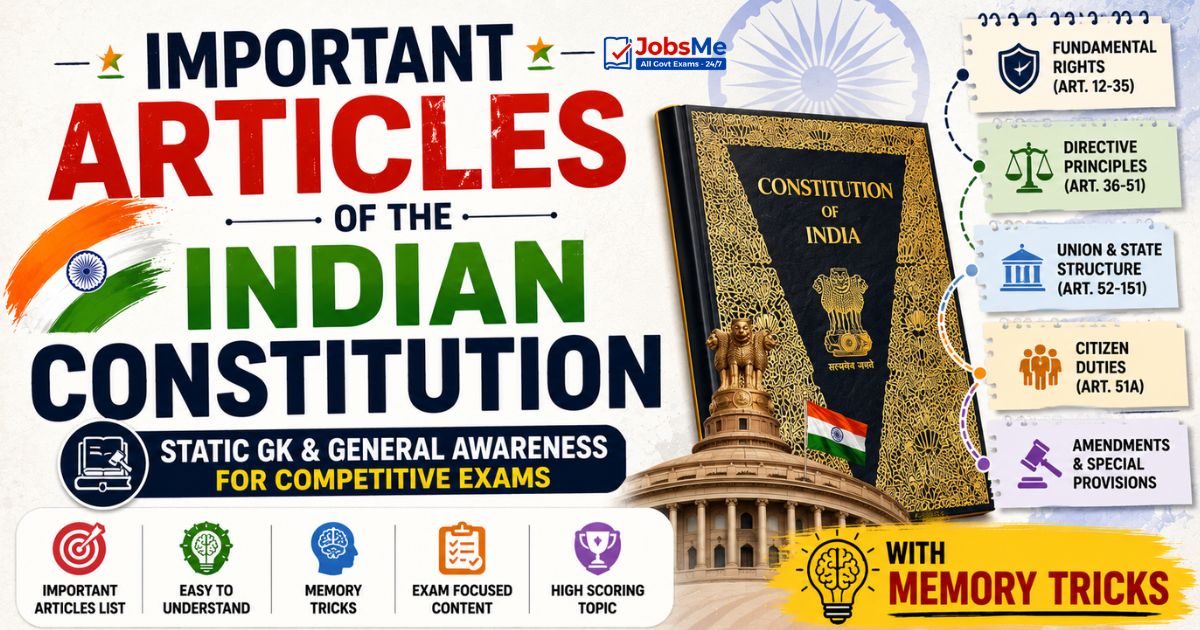
This article presents a complete, exam-ready list of the most important Articles of the Indian Constitution, arranged Part-wise from Article 1 to Article 395, covering Fundamental Rights, Directive Principles, Fundamental Duties, Union and State Government, Judiciary, Finance Commission, Elections, Emergency Provisions, and the Amendment procedure. It includes key articles like Article 14 (Equality), Article 19 (Six Freedoms), Article 21 (Right to Life), Article 32 (Constitutional Remedies), Article 356 (President's Rule), Article 368 (Amendment), and Article 370 (J&K), along with memory tricks, mnemonics, and one-liners for quick revision. All facts are arranged in a structured format to help UPSC, SSC, IBPS, RRB, PSU, Insurance, and State PCS aspirants score better in General Awareness, Indian Polity, and Static GK sections.
Jump to section
Introduction
The Indian Constitution is the longest written constitution in the world and the supreme legal document of the country. It was adopted on 26 November 1949 and came into force on 26 January 1950. Originally, the Constitution had 395 Articles divided into 22 Parts and 8 Schedules. After more than 100 constitutional amendments, it now contains approximately 448 Articles, 25 Parts, and 12 Schedules. Despite numerous insertions and repeals, the original numbering of Articles 1 to 395 has been retained, with new Articles added as sub-articles such as Article 21A, Article 51A, Article 239AA, and Article 338B.
Questions on the Important Articles of the Indian Constitution are asked in almost every major competitive exam — UPSC Prelims, SSC CGL, SSC CHSL, IBPS PO, IBPS Clerk, SBI PO, RRB NTPC, State PCS, LIC AAO, and Defence exams. Aspirants are usually asked to match an Article with its provision, identify the Article under which a particular right or institution is established, or recognise which Part of the Constitution deals with a specific subject. For a structured revision of Indian Polity and related Static GK topics, refer to the Static GK section on Jobsme.in.
This topic is also linked to current affairs themes such as Constitution Day (26 November), the abrogation of Article 370, debates on the Uniform Civil Code (Article 44), Finance Commission recommendations (Article 280), GST Council (Article 279A), Anti-Defection Law (Tenth Schedule), and reservation policies (Articles 330-342A) — making it doubly important for UPSC Mains, Essay papers, and Interview rounds as well.
Core Concepts: Structure of the Indian Constitution
Before learning individual Articles, it is essential to understand the basic structure of the Constitution. The Constitution is divided into Parts, each Part contains a set of Articles, and the document also includes Schedules that contain detailed lists, forms, and procedures referred to by various Articles.
Key Facts About the Constitution
- Adoption Date: 26 November 1949 (celebrated as Constitution Day / Samvidhan Divas).
- Commencement Date: 26 January 1950 (celebrated as Republic Day).
- Drafting Committee Chairman: Dr. B. R. Ambedkar, known as the Father of the Indian Constitution.
- Constituent Assembly Chairman: Dr. Rajendra Prasad.
- Original Composition: 395 Articles, 22 Parts, 8 Schedules.
- Present Composition: Approximately 448 Articles, 25 Parts, 12 Schedules.
- Time Taken to Draft: 2 years, 11 months, and 18 days.
- Total Sittings of the Constituent Assembly: 11 sessions over 165 days.
Categories of Articles
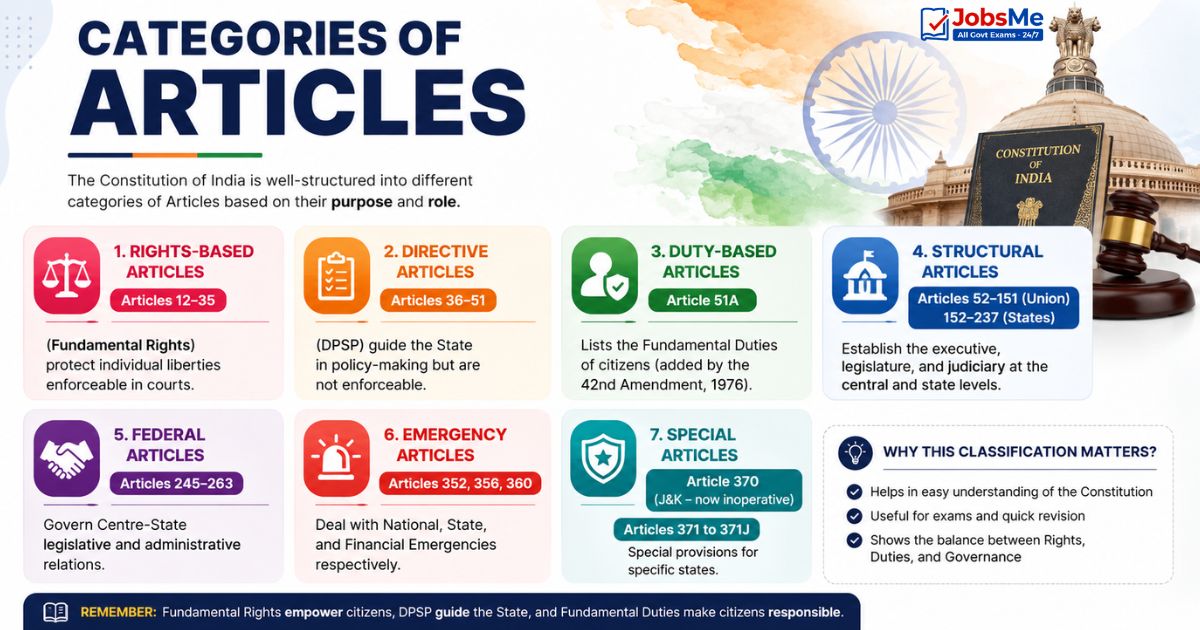
- Rights-Based Articles: Articles 12-35 (Fundamental Rights) protect individual liberties enforceable in courts.
- Directive Articles: Articles 36-51 (DPSP) guide the State in policy-making but are not enforceable.
- Duty-Based Articles: Article 51A lists the Fundamental Duties of citizens (added by the 42nd Amendment, 1976).
- Structural Articles: Articles 52-151 (Union) and 152-237 (States) establish the executive, legislature, and judiciary at the central and state levels.
- Federal Articles: Articles 245-263 govern Centre-State legislative and administrative relations.
- Emergency Articles: Articles 352, 356, and 360 deal with National, State, and Financial Emergencies respectively.
- Special Articles: Article 370 (J&K - now inoperative) and Article 371 to 371J (special provisions for specific states).
Parts of the Indian Constitution and Their Articles
The 25 Parts of the Indian Constitution and the Articles covered under each Part are presented below. This is one of the most frequently asked tables in competitive exams.
| Part | Subject | Articles |
|---|---|---|
| Part I | The Union and Its Territory | Articles 1 to 4 |
| Part II | Citizenship | Articles 5 to 11 |
| Part III | Fundamental Rights | Articles 12 to 35 |
| Part IV | Directive Principles of State Policy (DPSP) | Articles 36 to 51 |
| Part IVA | Fundamental Duties (added by 42nd Amendment, 1976) | Article 51A |
| Part V | The Union Government (President, Parliament, Supreme Court, CAG) | Articles 52 to 151 |
| Part VI | The State Government (Governor, State Legislature, High Courts) | Articles 152 to 237 |
| Part VII | States in Part B of the First Schedule (Repealed by 7th Amendment, 1956) | Article 238 |
| Part VIII | The Union Territories | Articles 239 to 242 |
| Part IX | The Panchayats (added by 73rd Amendment, 1992) | Articles 243 to 243O |
| Part IXA | The Municipalities (added by 74th Amendment, 1992) | Articles 243P to 243ZG |
| Part IXB | The Cooperative Societies (added by 97th Amendment, 2011) | Articles 243ZH to 243ZT |
| Part X | The Scheduled and Tribal Areas | Articles 244 to 244A |
| Part XI | Relations between the Union and the States | Articles 245 to 263 |
| Part XII | Finance, Property, Contracts, and Suits | Articles 264 to 300A |
| Part XIII | Trade, Commerce, and Intercourse within the Territory of India | Articles 301 to 307 |
| Part XIV | Services under the Union and the States | Articles 308 to 323 |
| Part XIVA | Tribunals (added by 42nd Amendment, 1976) | Articles 323A and 323B |
| Part XV | Elections | Articles 324 to 329A |
| Part XVI | Special Provisions Relating to Certain Classes | Articles 330 to 342A |
| Part XVII | Official Language | Articles 343 to 351 |
| Part XVIII | Emergency Provisions | Articles 352 to 360 |
| Part XIX | Miscellaneous | Articles 361 to 367 |
| Part XX | Amendment of the Constitution | Article 368 |
| Part XXI | Temporary, Transitional, and Special Provisions | Articles 369 to 392 |
| Part XXII | Short Title, Commencement, Authoritative Text in Hindi, and Repeals | Articles 393 to 395 |
Important Articles Part-Wise - Key Provisions
The following section lists the most important Articles of the Indian Constitution along with their key provisions, exam-relevant details, and historical context. All facts have been arranged Part-wise for systematic revision.
Part I - The Union and Its Territory (Articles 1-4)
| Article | Provision | Key Details |
|---|---|---|
| Article 1 | Name and territory of the Union | Declares "India, that is Bharat, shall be a Union of States"; defines the territory of India as states, union territories, and other acquired territories. |
| Article 2 | Admission or establishment of new States | Empowers Parliament to admit or establish new States into the Union on terms and conditions it thinks fit. |
| Article 3 | Formation of new States and alteration of areas, boundaries, or names | Allows Parliament to form a new State by separation, merging, or altering the boundaries or names of existing States. |
| Article 4 | Laws under Articles 2 and 3 | States that laws under Articles 2 and 3 may amend the First and Fourth Schedules and are not deemed to be Constitutional Amendments under Article 368. |
Part II - Citizenship (Articles 5-11)
| Article | Provision | Key Details |
|---|---|---|
| Article 5 | Citizenship at the commencement of the Constitution | Defines who was considered a citizen of India on 26 January 1950 based on domicile and place of birth. |
| Article 6 | Citizenship of persons migrated from Pakistan | Grants citizenship to persons who migrated to India from Pakistan before the commencement of the Constitution. |
| Article 7 | Citizenship of migrants to Pakistan returning to India | Deals with persons who migrated to Pakistan after 1 March 1947 but later returned to India. |
| Article 8 | Citizenship of persons of Indian origin residing abroad | Allows persons of Indian origin living outside India to be registered as Indian citizens. |
| Article 9 | Voluntary acquisition of foreign citizenship terminates Indian citizenship | India does not allow dual citizenship; voluntarily acquiring citizenship of another country ends Indian citizenship. |
| Article 10 | Continuance of rights of citizenship | Every person deemed to be a citizen of India shall continue to be such, subject to any law made by Parliament. |
| Article 11 | Parliament to regulate citizenship by law | Empowers Parliament to make laws on acquisition, termination, and other matters of citizenship; led to the Citizenship Act, 1955. |
Part III - Fundamental Rights (Articles 12-35)
Articles 12 to 35 form the heart of the Constitution, guaranteeing six categories of Fundamental Rights — Right to Equality, Right to Freedom, Right against Exploitation, Right to Freedom of Religion, Cultural and Educational Rights, and the Right to Constitutional Remedies. For deeper revision of these rights, you can also explore the Banking Awareness section, which connects polity topics with banking-related GA questions.
| Article | Provision | Key Details |
|---|---|---|
| Article 12 | Definition of "State" | Includes Government and Parliament of India, Government and Legislature of States, and all local or other authorities. |
| Article 13 | Laws inconsistent with Fundamental Rights are void | Provides the basis for the doctrine of judicial review. |
| Article 14 | Equality before law and equal protection of laws | Borrowed from the British concept of "Rule of Law" and the US concept of "Equal Protection". |
| Article 15 | Prohibition of discrimination | Prohibits discrimination on grounds of religion, race, caste, sex, or place of birth. |
| Article 16 | Equality of opportunity in public employment | Provides equal opportunity in matters of public employment for all citizens. |
| Article 17 | Abolition of Untouchability | Untouchability is abolished and its practice in any form is forbidden; enforcement governed by the Protection of Civil Rights Act, 1955. |
| Article 18 | Abolition of titles | No title (other than military or academic) shall be conferred by the State; does not bar civilian honours like Bharat Ratna and Padma Awards. |
| Article 19 | Six Fundamental Freedoms | Speech and expression; assembly; association; movement; residence; profession. (Right to property removed by 44th Amendment, 1978.) |
| Article 20 | Protection in respect of conviction for offences | No ex-post-facto law, no double jeopardy, no self-incrimination. |
| Article 21 | Protection of life and personal liberty | The widest interpreted Article; covers right to privacy, education, clean environment, dignified life, and right to die with dignity. |
| Article 21A | Right to Education | Inserted by the 86th Amendment, 2002; provides free and compulsory education to children aged 6-14 years. |
| Article 22 | Protection against arrest and detention | Covers safeguards against arbitrary arrest and preventive detention. |
| Article 23 | Prohibition of traffic in human beings and forced labour | Prohibits human trafficking, begar, and other forms of forced labour. |
| Article 24 | Prohibition of employment of children in hazardous work | No child below the age of 14 years shall be employed in any factory, mine, or hazardous occupation. |
| Article 25 | Freedom of conscience and free profession of religion | Allows all persons to freely profess, practise, and propagate religion subject to public order, morality, and health. |
| Article 26 | Freedom to manage religious affairs | Religious denominations can establish and maintain institutions for religious and charitable purposes. |
| Article 27 | Freedom from taxation for promotion of religion | No person can be compelled to pay taxes for the promotion of any particular religion. |
| Article 28 | Freedom from religious instruction in State-aided institutions | No religious instruction in fully State-funded educational institutions. |
| Article 29 | Protection of interests of minorities | Protects the language, script, and culture of any section of citizens. |
| Article 30 | Right of minorities to establish educational institutions | All religious and linguistic minorities have the right to establish and administer educational institutions. |
| Article 31 | Right to Property (Repealed) | Repealed by the 44th Amendment, 1978; Right to Property is now a legal right under Article 300A. |
| Article 32 | Right to Constitutional Remedies | Called the "Heart and Soul of the Constitution" by Dr. B. R. Ambedkar; allows direct approach to the Supreme Court for enforcement of FRs. Five writs: Habeas Corpus, Mandamus, Prohibition, Certiorari, Quo Warranto. |
| Article 33 | Power of Parliament to modify FRs for armed forces | Restricts FRs in their application to armed forces, paramilitary, and intelligence services. |
| Article 34 | Restriction of FRs during martial law | Allows Parliament to indemnify any person for acts done during martial law. |
| Article 35 | Legislation to give effect to certain FRs | Empowers only Parliament (not state legislatures) to make laws for enforcement of certain FRs. |
Part IV - Directive Principles of State Policy (Articles 36-51)
| Article | Provision | Key Details |
|---|---|---|
| Article 36 | Definition of State | Same as Article 12 — defines "State" for Part IV. |
| Article 37 | DPSPs not enforceable but fundamental in governance | The State shall apply these principles in making laws, though they are not justiciable. |
| Article 38 | Promote welfare of the people | Directs the State to secure a social order for the promotion of welfare. |
| Article 39 | Certain principles of policy | Covers livelihood, ownership of material resources, equal pay for equal work, protection of children and youth. |
| Article 39A | Equal justice and free legal aid | Inserted by 42nd Amendment; directs State to provide free legal aid to ensure justice. |
| Article 40 | Organisation of village panchayats | Directs the State to organise village panchayats as units of self-government. |
| Article 41 | Right to work, education, and public assistance | State to make effective provision for securing right to work, education, and public assistance. |
| Article 42 | Just and humane conditions of work and maternity relief | Provides for just working conditions and maternity benefits. |
| Article 43 | Living wage for workers | State to secure a living wage and decent standard of life for workers. |
| Article 43A | Workers' participation in management of industries | Inserted by 42nd Amendment, 1976. |
| Article 43B | Promotion of cooperative societies | Inserted by 97th Amendment, 2011. |
| Article 44 | Uniform Civil Code (UCC) | Directs the State to secure a Uniform Civil Code for all citizens throughout the territory of India. |
| Article 45 | Early childhood care and education | State to provide early childhood care and education for children below the age of 6 years. |
| Article 46 | Promotion of SC/ST and weaker sections | Promotion of educational and economic interests of SCs, STs, and other weaker sections. |
| Article 47 | Duty of State to raise nutrition and public health | Includes prohibition of intoxicating drinks and harmful drugs except for medicinal purposes. |
| Article 48 | Organisation of agriculture and animal husbandry | Includes prohibition of slaughter of cows, calves, and other milch and draught cattle. |
| Article 48A | Protection of environment, forests, and wildlife | Inserted by 42nd Amendment, 1976. |
| Article 49 | Protection of monuments and objects of national importance | State to protect every monument, place, or object of artistic or historic importance. |
| Article 50 | Separation of judiciary from executive | State to take steps to separate the judiciary from the executive in public services. |
| Article 51 | Promotion of international peace and security | Foster respect for international law, treaty obligations, and just and honourable relations among nations. |
Part IVA - Fundamental Duties (Article 51A)
| Article | Provision | Key Details |
|---|---|---|
| Article 51A | Eleven Fundamental Duties of citizens | Inserted by the 42nd Amendment, 1976, on the recommendation of the Swaran Singh Committee; 11th duty (parents/guardians to ensure education of children aged 6-14) added by 86th Amendment, 2002. |
Part V - The Union: President, Vice-President, and Council of Ministers (Articles 52-78)
| Article | Provision | Key Details |
|---|---|---|
| Article 52 | The President of India | "There shall be a President of India" — first citizen and constitutional head of the country. |
| Article 53 | Executive power of the Union | Vested in the President and exercised directly or through subordinate officers. |
| Article 54 | Election of President | Elected by an Electoral College consisting of elected MPs and elected MLAs of States and UTs of Delhi and Puducherry. |
| Article 55 | Manner of election of President | Single transferable vote system of proportional representation. |
| Article 56 | Term of office of President | Five years from the date of entering office. |
| Article 58 | Qualifications for President | Citizen of India, age 35+, qualified to be a Lok Sabha member, not holding any office of profit. |
| Article 61 | Procedure for impeachment of President | Impeachment can be initiated in either House on the ground of violation of the Constitution. |
| Article 63 | The Vice-President of India | Establishes the office of the Vice-President. |
| Article 64 | Vice-President as ex-officio Chairman of Rajya Sabha | Vice-President is the ex-officio Chairman of the Council of States. |
| Article 66 | Election of Vice-President | Elected by an Electoral College of both Houses of Parliament (not by State legislatures). |
| Article 72 | Pardoning power of the President | Power to grant pardons, reprieves, respites, remissions, and commute sentences, including death sentence. |
| Article 74 | Council of Ministers to aid and advise the President | President is bound to act on the advice of the Council of Ministers (made binding by 42nd Amendment). |
| Article 75 | Appointment of PM and other Ministers | PM appointed by President; other ministers appointed by President on advice of PM; collective responsibility to Lok Sabha. |
| Article 76 | Attorney-General for India | Highest law officer of the country; appointed by the President. |
| Article 77 | Conduct of business of Government of India | All executive action taken in the name of the President. |
| Article 78 | Duties of Prime Minister to furnish information | PM is the link between the President and the Council of Ministers. |
Part V - Parliament (Articles 79-122)
| Article | Provision | Key Details |
|---|---|---|
| Article 79 | Constitution of Parliament | Parliament consists of the President, the Council of States (Rajya Sabha), and the House of the People (Lok Sabha). |
| Article 80 | Composition of Rajya Sabha | Maximum 250 members — 238 representing States and UTs (elected indirectly) + 12 nominated by the President. |
| Article 81 | Composition of Lok Sabha | Maximum strength 552 (530 from States + 20 from UTs + 2 nominated Anglo-Indians; Anglo-Indian nomination ended after 104th Amendment). |
| Article 82 | Readjustment of seats after each census | Delimitation Commission redistributes seats after every census. |
| Article 83 | Duration of Houses of Parliament | Lok Sabha — 5 years; Rajya Sabha — permanent, with one-third members retiring every two years. |
| Article 84 | Qualification for membership of Parliament | Citizen of India; age 25+ for Lok Sabha and 30+ for Rajya Sabha. |
| Article 85 | Sessions of Parliament | President to summon each House so that not more than six months elapse between two sessions. |
| Article 93 | Speaker and Deputy Speaker of Lok Sabha | Lok Sabha shall, as soon as may be, choose two of its members to be Speaker and Deputy Speaker. |
| Article 100 | Voting, quorum, and validity of proceedings | Quorum is one-tenth of the total membership of either House. |
| Article 105 | Powers, privileges, and immunities of Parliament | Provides freedom of speech in Parliament and protection from legal action for parliamentary statements. |
| Article 108 | Joint sitting of both Houses | President can summon a joint session in case of deadlock on a Bill (not Money Bill or Constitutional Amendment Bill). |
| Article 110 | Definition of Money Bill | Decided by the Speaker of Lok Sabha; deals exclusively with taxation, borrowing, Consolidated Fund, etc. |
| Article 111 | Assent to Bills by the President | President can give assent, withhold, or return non-Money Bills for reconsideration. |
| Article 112 | Annual Financial Statement (Union Budget) | Presented in Parliament every financial year. |
| Article 114 | Appropriation Bills | Authorises withdrawal of money from the Consolidated Fund of India. |
| Article 123 | Ordinance-making power of the President | President can promulgate ordinances when Parliament is not in session; must be laid before Parliament within six weeks of reassembly. |
Part V - Supreme Court (Articles 124-147)
| Article | Provision | Key Details |
|---|---|---|
| Article 124 | Establishment and Constitution of the Supreme Court | Consists of the Chief Justice of India (CJI) and up to 33 other judges (total 34, as per current law). |
| Article 125 | Salaries, allowances, and rights of judges | Determined by Parliament; cannot be reduced after appointment. |
| Article 129 | Supreme Court as a Court of Record | Records of its proceedings and decisions are recognised as legal precedents and evidence. |
| Article 131 | Original jurisdiction of Supreme Court | Disputes between Centre and States, or between two or more States. |
| Article 132 | Appellate jurisdiction in constitutional matters | Appeals from High Courts in cases involving constitutional interpretation. |
| Article 136 | Special Leave to Appeal (SLP) | Supreme Court can grant special leave to appeal from any judgment of any court or tribunal in India (except military tribunals). |
| Article 137 | Review of judgments by the Supreme Court | SC has the power to review its own judgments. |
| Article 141 | Law declared by Supreme Court binding on all courts | Doctrine of precedent — SC rulings are binding on all subordinate courts. |
| Article 142 | Enforcement of decrees and complete justice power | SC can pass any decree necessary to do "complete justice" in a case. |
| Article 143 | Advisory jurisdiction | President may seek the opinion of the Supreme Court on any question of law or fact. |
| Article 144 | Civil and judicial authorities to act in aid of Supreme Court | All authorities in India shall act in aid of the Supreme Court. |
Part V - Comptroller and Auditor-General (Articles 148-151)
| Article | Provision | Key Details |
|---|---|---|
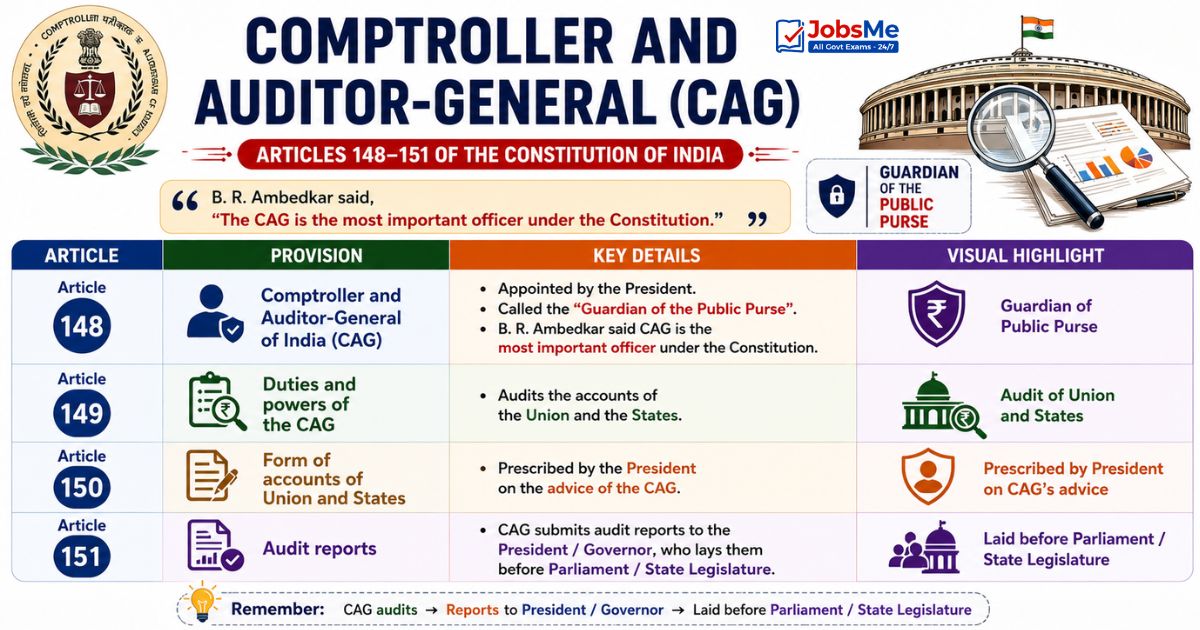
| Article 148 | Comptroller and Auditor-General of India (CAG) | Appointed by the President; called the "Guardian of the Public Purse"; B. R. Ambedkar said CAG is the most important officer under the Constitution. |
| Article 149 | Duties and powers of the CAG | Audits the accounts of the Union and the States. |
| Article 150 | Form of accounts of Union and States | Prescribed by the President on the advice of the CAG. |
| Article 151 | Audit reports | CAG submits audit reports to the President / Governor, who lays them before Parliament / State Legislature. |
Part VI - The States: Governor, Council of Ministers, and Legislature (Articles 152-213)
| Article | Provision | Key Details |
|---|---|---|
| Article 152 | Definition of State | "State" does not include Jammu and Kashmir (originally); now applies to all States. |
| Article 153 | Governors of States | Each State shall have a Governor; one person may be appointed Governor of two or more States. |
| Article 154 | Executive power of the State | Vested in the Governor. |
| Article 155 | Appointment of Governor | Appointed by the President of India. |
| Article 156 | Term of office of Governor | Five years; holds office during the pleasure of the President. |
| Article 161 | Pardoning power of the Governor | Power to grant pardons in cases relating to State laws; cannot pardon a death sentence. |
| Article 163 | Council of Ministers to aid and advise the Governor | Headed by the Chief Minister. |
| Article 164 | Appointment of Chief Minister and other Ministers | CM appointed by Governor; other ministers appointed on CM's advice; collective responsibility to State Legislative Assembly. |
| Article 165 | Advocate General for the State | Highest law officer of the State; counterpart of the Attorney-General. |
| Article 168 | Constitution of Legislatures in States | State Legislature consists of the Governor and one or two Houses. |
| Article 169 | Abolition or creation of Legislative Councils | Parliament can abolish or create a Legislative Council on the resolution of the State Legislative Assembly. |
| Article 170 | Composition of Legislative Assemblies | Minimum 60 and maximum 500 members; directly elected. |
| Article 171 | Composition of Legislative Councils | Maximum strength one-third of Legislative Assembly; minimum 40. |
| Article 200 | Assent to Bills (State level) | Governor can give assent, withhold, return (except Money Bill), or reserve the Bill for the President. |
| Article 202 | Annual Financial Statement (State Budget) | State counterpart of Article 112. |
| Article 213 | Governor's Ordinance-making power | Governor can promulgate ordinances when State Legislature is not in session (state counterpart of Article 123). |
Part VI - High Courts and Subordinate Courts (Articles 214-237)
| Article | Provision | Key Details |
|---|---|---|
| Article 214 | High Courts for States | Every State shall have a High Court; one HC for two or more States is allowed under Article 231. |
| Article 215 | High Courts as Courts of Record | Like the Supreme Court, HCs are also courts of record. |
| Article 217 | Appointment of judges of High Court | Appointed by the President after consultation with the CJI and Governor of the State. |
| Article 226 | Power of High Courts to issue writs | Wider than Article 32 — HC can issue writs for both fundamental rights and other legal rights. |
| Article 227 | Power of superintendence over subordinate courts | HC has administrative and judicial superintendence over all courts within its jurisdiction. |
| Article 233 | Appointment of District Judges | Appointed by the Governor in consultation with the High Court. |
Part VIII - The Union Territories (Articles 239-242)
| Article | Provision | Key Details |
|---|---|---|
| Article 239 | Administration of Union Territories | Administered by the President through an Administrator/Lieutenant Governor. |
| Article 239A | Local legislatures or Council of Ministers for UTs | Provides for creation of legislatures in certain UTs (e.g. Puducherry). |
| Article 239AA | Special provisions for Delhi | Delhi has a Legislative Assembly and Council of Ministers; certain matters reserved for the Centre. |
| Article 239AB | Failure of constitutional machinery in Delhi | President can suspend the Delhi Assembly if there is a constitutional breakdown. |
| Article 240 | Power of President to make regulations for UTs | Applies to Andaman & Nicobar Islands, Lakshadweep, Dadra & Nagar Haveli, Daman & Diu, and Ladakh. |
Part IX, IXA, IXB - Local Self-Government (Articles 243-243ZT)
| Article | Provision | Key Details |
|---|---|---|
| Article 243 | Definitions (Panchayats) | Part IX inserted by the 73rd Constitutional Amendment Act, 1992. |
| Article 243A | Gram Sabha | Body consisting of persons registered in the electoral roll of the village. |
| Article 243B | Constitution of Panchayats | Three-tier system: Village, Intermediate, and District levels. |
| Article 243D | Reservation of seats in Panchayats | Reservation for SCs, STs, and women (not less than one-third). |
| Article 243G | Powers, authority and responsibilities of Panchayats | Refers to the Eleventh Schedule (29 subjects). |
| Article 243-I | State Finance Commission | Constituted every 5 years to review the financial position of Panchayats. |
| Article 243K | Elections to Panchayats | State Election Commission to superintend Panchayat elections. |
| Article 243P | Definitions (Municipalities) | Part IXA inserted by the 74th Constitutional Amendment Act, 1992. |
| Article 243Q | Constitution of Municipalities | Three types — Nagar Panchayat, Municipal Council, Municipal Corporation. |
| Article 243W | Powers, authority and responsibilities of Municipalities | Refers to the Twelfth Schedule (18 subjects). |
| Article 243ZD | District Planning Committee | Consolidates plans prepared by Panchayats and Municipalities. |
| Article 243ZE | Metropolitan Planning Committee | Required for every metropolitan area. |
| Article 243ZH | Cooperative Societies | Part IXB inserted by the 97th Constitutional Amendment Act, 2011. |
Part XI - Centre-State Relations (Articles 245-263)
| Article | Provision | Key Details |
|---|---|---|
| Article 245 | Extent of laws made by Parliament and State Legislatures | Parliament can make laws for the whole or any part of India; State Legislature for that State. |
| Article 246 | Subject matter of laws | Refers to the Seventh Schedule — Union List (97 items), State List (66 items), Concurrent List (47 items). |
| Article 246A | Special provision for GST | Inserted by the 101st Constitutional Amendment, 2016. |
| Article 248 | Residuary powers of legislation | Vested in Parliament — exclusive power to make laws on matters not enumerated in any List. |
| Article 249 | Parliament's power in national interest | Parliament can legislate on State List subjects if Rajya Sabha passes a resolution by two-thirds majority. |
| Article 252 | Legislation for two or more States by consent | Parliament can legislate on State subjects if two or more States request it. |
| Article 262 | Inter-state river water disputes | Parliament can provide by law for adjudication of inter-state water disputes. |
| Article 263 | Inter-State Council | President can establish an Inter-State Council to coordinate Centre-State relations. |
Part XII - Finance (Articles 268-293)
| Article | Provision | Key Details |
|---|---|---|
| Article 269A | GST on inter-State trade or commerce | Inserted by 101st Amendment; levied and collected by the Centre. |
| Article 279A | Goods and Services Tax Council (GST Council) | Inserted by 101st Amendment, 2016; chaired by the Union Finance Minister. |
| Article 280 | Finance Commission | Constituted by the President every 5 years; recommends distribution of taxes between Centre and States. |
| Article 281 | Recommendations of the Finance Commission | President to lay the recommendations before Parliament along with an action taken report. |
| Article 292 | Borrowing by Government of India | Empowers the Centre to borrow on the security of the Consolidated Fund of India. |
| Article 293 | Borrowing by States | States can borrow within India only; foreign borrowing requires Centre's consent. |
| Article 300A | Right to Property | Inserted by 44th Amendment, 1978; now a constitutional/legal right, not a Fundamental Right. |
Part XIV - Services and Public Service Commissions (Articles 308-323)
| Article | Provision | Key Details |
|---|---|---|
| Article 309 | Recruitment and conditions of service | Empowers Parliament and State Legislatures to make laws regulating recruitment to public services. |
| Article 310 | Doctrine of Pleasure | Civil servants hold office during the pleasure of the President / Governor. |
| Article 311 | Safeguards against dismissal | No civil servant shall be dismissed or removed by an authority subordinate to the one that appointed them. |
| Article 312 | All-India Services | Parliament can create new All-India Services if Rajya Sabha passes a resolution by two-thirds majority. Existing AIS: IAS, IPS, IFoS. |
| Article 315 | Public Service Commissions | Provides for UPSC at the Centre and SPSC for each State. |
| Article 320 | Functions of Public Service Commissions | Conduct examinations for appointment to services and advise on disciplinary matters. |
| Article 323A | Administrative Tribunals | Inserted by 42nd Amendment; led to creation of Central Administrative Tribunal (CAT). |
| Article 323B | Tribunals for other matters | Covers taxation, foreign exchange, land reforms, etc. |
Part XV - Elections (Articles 324-329)
| Article | Provision | Key Details |
|---|---|---|
| Article 324 | Election Commission of India (ECI) | Superintendence, direction, and control of elections to Parliament, State Legislatures, and the offices of President and Vice-President. |
| Article 325 | No exclusion from electoral rolls | No person can be excluded from electoral rolls on grounds of religion, race, caste, or sex. |
| Article 326 | Universal Adult Suffrage | Every citizen aged 18 or above (reduced from 21 by 61st Amendment, 1988) has the right to vote. |
| Article 327 | Parliament's power to make election laws | For Parliament and State Legislatures. |
| Article 329 | Bar to interference by courts in electoral matters | Election disputes can only be raised through election petitions before High Courts. |
Part XVI - Special Provisions for Certain Classes (Articles 330-342A)
| Article | Provision | Key Details |
|---|---|---|
| Article 330 | Reservation of seats for SCs and STs in Lok Sabha | Anglo-Indian nomination discontinued after the 104th Amendment, 2020. |
| Article 332 | Reservation in State Legislative Assemblies | For SCs and STs. |
| Article 334 | Duration of reservation | Reservation extended periodically — currently extended till 2030 by the 104th Amendment. |
| Article 335 | Claims of SCs and STs to services and posts | Government to consider reservation in posts and services for SCs/STs. |
| Article 338 | National Commission for Scheduled Castes (NCSC) | Constitutional body to safeguard the interests of SCs. |
| Article 338A | National Commission for Scheduled Tribes (NCST) | Inserted by 89th Amendment, 2003. |
| Article 338B | National Commission for Backward Classes (NCBC) | Granted constitutional status by 102nd Amendment, 2018. |
| Article 340 | Commission to investigate conditions of Backward Classes | Led to the Mandal Commission (1979). |
| Article 341 | Scheduled Castes | President to notify the list of SCs in consultation with the Governor. |
| Article 342 | Scheduled Tribes | Similar provision for STs. |
| Article 342A | Socially and Educationally Backward Classes (SEBCs) | Inserted by 102nd Amendment; further refined by the 105th Amendment, 2021, restoring State power to identify SEBCs. |
Part XVII - Official Language (Articles 343-351)
| Article | Provision | Key Details |
|---|---|---|
| Article 343 | Official language of the Union | Hindi in Devanagari script; English to continue as associate official language. |
| Article 344 | Commission and Committee on Official Language | President to constitute an Official Language Commission. |
| Article 345 | Official language of a State | State Legislature can adopt one or more languages. |
| Article 348 | Language of Supreme Court and High Courts | English unless Parliament provides otherwise. |
| Article 350A | Instruction in mother tongue at primary stage | For linguistic minorities. |
| Article 350B | Special Officer for linguistic minorities | Appointed by the President. |
| Article 351 | Directive for development of Hindi | Union to promote spread of Hindi. |
Part XVIII - Emergency Provisions (Articles 352-360)
| Article | Provision | Key Details |
|---|---|---|
| Article 352 | Proclamation of National Emergency | Grounds: war, external aggression, armed rebellion. Declared three times — 1962, 1971, 1975. |
| Article 353 | Effect of Proclamation of Emergency | Centre's executive power extends to giving directions to States. |
| Article 355 | Duty of Union to protect States | Against external aggression and internal disturbance. |
| Article 356 | President's Rule (State Emergency) | Imposed when constitutional machinery in a State fails; most frequently invoked emergency provision. |
| Article 358 | Suspension of Article 19 | Automatically suspended when National Emergency is declared on grounds of war or external aggression. |
| Article 359 | Suspension of enforcement of Fundamental Rights | President can suspend the right to move courts for enforcement of certain FRs; Articles 20 and 21 cannot be suspended (44th Amendment). |
| Article 360 | Financial Emergency | Has never been declared in India. |
Part XX - Amendment of the Constitution (Article 368)
| Article | Provision | Key Details |
|---|---|---|
| Article 368 | Power of Parliament to amend the Constitution | Three modes — Simple majority, Special majority, and Special majority plus ratification by at least half the States. Basic Structure doctrine laid down in Kesavananda Bharati case (1973). |
Part XXI - Temporary, Transitional, and Special Provisions (Articles 369-392)
| Article | Provision | Key Details |
|---|---|---|
| Article 370 | Temporary provisions for Jammu and Kashmir | Made inoperative on 5 August 2019; J&K reorganised into UTs of J&K and Ladakh. |
| Article 371 | Special provision for Maharashtra and Gujarat | Concerning establishment of separate development boards. |
| Article 371A | Special provision for Nagaland | Protects Naga customary law and land rights. |
| Article 371B | Special provision for Assam | Committee of the Legislative Assembly for tribal areas. |
| Article 371C | Special provision for Manipur | Hill Areas Committee. |
| Article 371D | Special provision for Andhra Pradesh and Telangana | Equitable opportunities in public employment and education. |
| Article 371F | Special provision for Sikkim | Added by 36th Amendment, 1975, when Sikkim became a State. |
| Article 371G | Special provision for Mizoram | Protects Mizo customary law and religion. |
| Article 371H | Special provision for Arunachal Pradesh | Special responsibility of Governor regarding law and order. |
| Article 371-I | Special provision for Goa | Minimum strength of the Legislative Assembly to be 30 members. |
| Article 371J | Special provision for Karnataka (Hyderabad-Karnataka region) | Inserted by 98th Amendment, 2012. |
Part XXII - Short Title, Commencement, Repeals (Articles 393-395)
| Article | Provision | Key Details |
|---|---|---|
| Article 393 | Short title | "This Constitution may be called the Constitution of India." |
| Article 394 | Commencement | 26 January 1950; certain provisions came into force on 26 November 1949. |
| Article 394A | Authoritative text in Hindi | Inserted by the 58th Amendment, 1987. |
| Article 395 | Repeals | Repealed the Indian Independence Act, 1947, and the Government of India Act, 1935. |
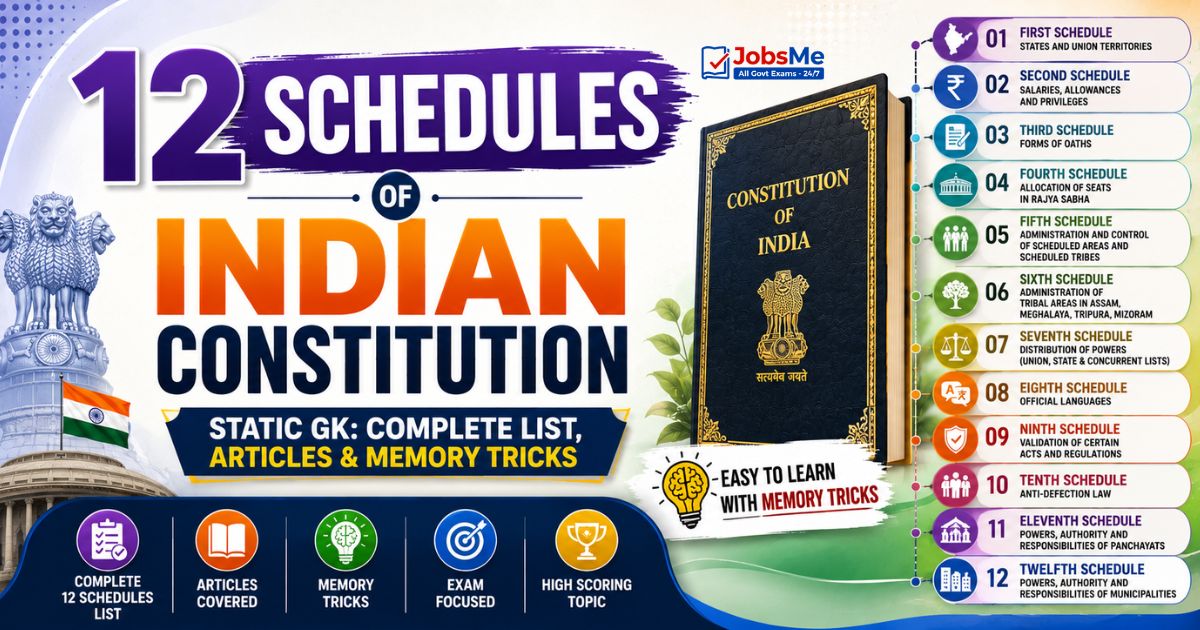
Schedules of the Indian Constitution
The 12 Schedules of the Constitution are attached to specific Articles and contain detailed lists, forms, and procedures referred to by those Articles. They are equally important for competitive exams.
| Schedule | Subject | Related Articles |
|---|---|---|
| First Schedule | Names of States and Union Territories and their territorial extent. | Articles 1 and 4 |
| Second Schedule | Salaries, allowances, and emoluments of the President, Governors, Speakers, Judges, CAG, etc. | Articles 59, 65, 75, 97, 125, 148, 158, 164, 186, 221 |
| Third Schedule | Forms of oaths and affirmations for Union/State Ministers, MPs, MLAs, Judges, and CAG. | Articles 75, 84, 99, 124, 146, 173, 188, 219 |
| Fourth Schedule | Allocation of seats in the Rajya Sabha to States and UTs. | Article 80 |
| Fifth Schedule | Administration and control of Scheduled Areas and Scheduled Tribes (except in Assam, Meghalaya, Tripura, Mizoram). | Article 244 |
| Sixth Schedule | Administration of tribal areas in Assam, Meghalaya, Tripura, and Mizoram. | Article 244(2) and 275 |
| Seventh Schedule | Division of powers between Union and States via Union List, State List, and Concurrent List. | Article 246 |
| Eighth Schedule | 22 official languages recognised by the Constitution. | Articles 343 and 344 |
| Ninth Schedule | Validation of certain Acts and Regulations (mostly land reforms); added by 1st Amendment, 1951. | Article 31B |
| Tenth Schedule | Anti-defection law; added by 52nd Amendment, 1985. | Articles 102 and 191 |
| Eleventh Schedule | Powers, authority, and responsibilities of Panchayats (29 subjects); added by 73rd Amendment, 1992. | Article 243G |
| Twelfth Schedule | Powers, authority, and responsibilities of Municipalities (18 subjects); added by 74th Amendment, 1992. | Article 243W |
Memory Tricks and Mnemonics
Trick 1: Emergency Provisions — "352, 356, 360"
The three Emergency Articles are spaced by 4 numbers each. Use the pattern:
- Article 352 → National Emergency (War, External Aggression, Armed Rebellion).
- Article 356 → State Emergency / President's Rule (failure of constitutional machinery).
- Article 360 → Financial Emergency (financial instability).
"NSF — National, State, Financial; just add 4 each time."
Trick 2: Union vs State — "Add 90"
For many Union-level Articles, the corresponding State-level Article is found by adding 90:
- Article 112 (Union Budget) → Article 202 (State Budget).
- Article 114 (Union Appropriation Bill) → Article 204 (State Appropriation Bill).
- Article 123 (President's Ordinance) → Article 213 (Governor's Ordinance).
- Article 110 (Money Bill — Lok Sabha) → Article 199 (Money Bill — State Assembly; close pattern).
"Union plus 90 = State."
Trick 3: President vs Governor — "Add 89"
Powers of the President and Governor are mirrored. For most provisions, add 89 to a President-related Article to get the Governor-related one:
- Article 72 (President's Pardoning Power) → Article 161 (Governor's Pardoning Power).
- Article 74 (Union Council of Ministers) → Article 163 (State Council of Ministers).
- Article 75 (Appointment of PM and Ministers) → Article 164 (Appointment of CM and Ministers).
Trick 4: Right to Equality — "14 to 18"
The five Articles under Right to Equality are sequential. Remember "EDEDA":
- Article 14 → Equality before law.
- Article 15 → Discrimination prohibited.
- Article 16 → Equal opportunity in public employment.
- Article 17 → Abolition of Untouchability (Dignity).
- Article 18 → Abolition of titles.
Trick 5: Six Freedoms of Article 19 — "SAAMRP"
The six fundamental freedoms under Article 19 can be remembered as "SAAMRP":
- S → Speech and expression.
- A → Assembly (peaceful and without arms).
- A → Association or union.
- M → Movement throughout India.
- R → Reside and settle anywhere in India.
- P → Profession, trade, business.
Trick 6: Ambedkar's "Heart and Soul" — Article 32
Dr. B. R. Ambedkar called Article 32 (Right to Constitutional Remedies) the "Heart and Soul of the Constitution." The five writs under Article 32 / 226 can be remembered as "HaMaPCQ":
- Ha → Habeas Corpus ("you may have the body").
- Ma → Mandamus ("we command").
- P → Prohibition.
- C → Certiorari.
- Q → Quo Warranto ("by what authority").
Trick 7: Three Critical Amendments — "42, 44, 73/74"
Some constitutional amendments are repeatedly asked. Remember:
- 42nd Amendment, 1976 → "Mini Constitution"; added Fundamental Duties (Article 51A), DPSPs 39A, 43A, 48A, and made Council of Ministers' advice binding on the President.
- 44th Amendment, 1978 → Removed Right to Property from FRs; placed it under Article 300A; protected Articles 20 and 21 from suspension during Emergency.
- 73rd and 74th Amendments, 1992 → Gave constitutional status to Panchayats (Part IX) and Municipalities (Part IXA).
- 86th Amendment, 2002 → Right to Education (Article 21A); also added 11th Fundamental Duty.
- 101st Amendment, 2016 → Introduced GST and the GST Council (Article 279A).
- 103rd Amendment, 2019 → 10% reservation for Economically Weaker Sections (EWS).
- 104th Amendment, 2020 → Ended Anglo-Indian nomination; extended SC/ST reservation in legislatures till 2030.
Trick 8: The Five Important "300s" — Finance and Property
The 280s and 300s are loaded with finance and property Articles:
- Article 280 → Finance Commission.
- Article 279A → GST Council.
- Article 300A → Right to Property (legal right).
- Article 312 → All-India Services.
- Article 324 → Election Commission of India.
"280 Finance, 300A Property, 324 Elections — three pillars of governance."
Additional Notes
Frequently Confused Facts
- Article 32 vs Article 226: Article 32 (Supreme Court) is a Fundamental Right itself and can be invoked only for FRs. Article 226 (High Court) is wider and can be invoked for FRs and other legal rights.
- Article 352 vs 356 vs 360: 352 — National Emergency (war/rebellion); 356 — President's Rule (State machinery failure); 360 — Financial Emergency (never declared).
- Article 368 vs Article 368 with Ratification: Simple amendments need special majority of Parliament; federal amendments additionally need approval of at least half the State Legislatures.
- Article 21 vs Article 21A: Article 21 protects life and personal liberty for all (citizens and foreigners). Article 21A is the Right to Education for children aged 6-14 — applies only to citizens.
- Article 31 vs Article 300A: Article 31 (Right to Property) was a Fundamental Right; repealed by the 44th Amendment. Article 300A made the Right to Property a legal right.
- Article 74 vs Article 75: Article 74 deals with the Council of Ministers' role as an advisory body; Article 75 deals with the appointment, tenure, and salaries of Ministers.
- Article 112 vs Article 110: Article 110 defines a Money Bill; Article 112 deals with the Annual Financial Statement (Union Budget).
- Article 280 vs Article 279A: Article 280 is the Finance Commission (constituted every 5 years). Article 279A is the GST Council (a permanent body, inserted by the 101st Amendment).
- Article 370 vs Article 371: Article 370 dealt with the special status of J&K (now inoperative). Article 371 to 371J provide special provisions for 12 other States.
- NCSC vs NCST vs NCBC: Article 338 — NCSC; Article 338A — NCST; Article 338B — NCBC (got constitutional status in 2018 by 102nd Amendment).
- Schedules 11 and 12: 11th Schedule (29 subjects for Panchayats — Article 243G); 12th Schedule (18 subjects for Municipalities — Article 243W).
- Voting Age: Originally 21 years; reduced to 18 by the 61st Amendment, 1988 (Article 326).
Repeating PYQ Patterns
Certain Articles are repeatedly asked in competitive exams. Article 1 (Union of States), Article 14 (Equality), Article 19 (Six Freedoms), Article 21 (Right to Life), Article 21A (RTE), Article 32 (Constitutional Remedies), Article 44 (UCC), Article 51A (Fundamental Duties), Article 72 (Pardoning Powers of President), Article 74 (Council of Ministers), Article 110 (Money Bill), Article 112 (Union Budget), Article 123 (Ordinance), Article 124 (Supreme Court), Article 148 (CAG), Article 226 (HC Writs), Article 280 (Finance Commission), Article 312 (All-India Services), Article 324 (Election Commission), Article 326 (Adult Suffrage), Article 352 / 356 / 360 (Emergencies), Article 368 (Amendment), and Article 370 (J&K) appear most often in UPSC Prelims, SSC CGL, RRB NTPC, and IBPS PO papers. Banking exams (IBPS PO, SBI Clerk, RBI Grade B) frequently focus on financial Articles like 112, 280, 279A, and 360. State PCS exams add State-specific Articles — Andhra/Telangana PCS asks about Article 371D, Nagaland PCS about Article 371A, and Karnataka PCS about Article 371J. For deeper revision on financial Articles and economic provisions, see the Banking Awareness notes on Jobsme.in.
Quick Insight
The Articles of the Indian Constitution are not just exam topics — they are the operating system of Indian democracy. Article 14 protects every citizen from arbitrary state action; Article 21 has been expanded by the Supreme Court to include the right to privacy (K. S. Puttaswamy case, 2017), right to clean environment, and right to die with dignity; Article 32 is the most powerful weapon available to any citizen against State excess; and Article 368, balanced by the Basic Structure Doctrine (Kesavananda Bharati case, 1973), ensures that the Constitution can evolve without losing its core identity. The abrogation of Article 370 in 2019, the implementation of GST under Articles 246A and 279A in 2017, and the 103rd Amendment introducing the 10% EWS reservation in 2019 show that the Constitution remains a living document. For practising Polity MCQs on these topics, you can also try the Static GK Quiz on Jobsme.in.
One-Liners for Quick Revision
- Article 1 → India, that is Bharat, shall be a Union of States.
- Article 2 → Admission or establishment of new States.
- Article 3 → Formation of new States; alteration of areas, boundaries, names.
- Article 4 → Laws under Articles 2 and 3 not deemed constitutional amendments.
- Articles 5-11 → Citizenship at the commencement of the Constitution; Citizenship Act, 1955.
- Article 12 → Definition of "State" for the purpose of Fundamental Rights.
- Article 13 → Laws inconsistent with FRs are void; basis of judicial review.
- Article 14 → Equality before law and equal protection of laws.
- Article 15 → Prohibition of discrimination on grounds of religion, race, caste, sex, place of birth.
- Article 16 → Equality of opportunity in public employment.
- Article 17 → Abolition of Untouchability.
- Article 18 → Abolition of titles (excludes military and academic).
- Article 19 → Six freedoms — speech, assembly, association, movement, residence, profession.
- Article 20 → Protection against ex-post-facto laws, double jeopardy, self-incrimination.
- Article 21 → Right to Life and Personal Liberty.
- Article 21A → Right to Education for children 6-14 years (86th Amendment, 2002).
- Article 22 → Protection against arrest and detention.
- Articles 23-24 → Right against Exploitation; prohibition of human trafficking, forced labour, and child labour.
- Articles 25-28 → Right to Freedom of Religion.
- Articles 29-30 → Cultural and Educational Rights of minorities.
- Article 31 → Right to Property (Repealed by 44th Amendment).
- Article 32 → Right to Constitutional Remedies — "Heart and Soul" of the Constitution.
- Article 36-51 → Directive Principles of State Policy (Part IV).
- Article 39A → Equal justice and free legal aid (42nd Amendment).
- Article 40 → Organisation of village panchayats.
- Article 44 → Uniform Civil Code.
- Article 45 → Early childhood care and education for children below 6 years.
- Article 48A → Protection of environment and wildlife (42nd Amendment).
- Article 50 → Separation of judiciary from executive.
- Article 51 → Promotion of international peace and security.
- Article 51A → Fundamental Duties (added by 42nd Amendment, 1976; 11th duty added by 86th Amendment).
- Article 52 → There shall be a President of India.
- Article 54 → Election of President by an Electoral College.
- Article 56 → President's term — 5 years.
- Article 61 → Impeachment of the President.
- Article 63 → Vice-President of India.
- Article 64 → Vice-President is ex-officio Chairman of Rajya Sabha.
- Article 72 → Pardoning powers of the President.
- Article 74 → Council of Ministers to aid and advise the President.
- Article 75 → Appointment of PM and other Ministers.
- Article 76 → Attorney-General of India.
- Article 78 → Duties of the Prime Minister.
- Article 79 → Constitution of Parliament — President, Rajya Sabha, Lok Sabha.
- Article 80 → Composition of Rajya Sabha (max 250).
- Article 81 → Composition of Lok Sabha (max 552).
- Article 83 → Duration of Houses of Parliament.
- Article 84 → Qualifications for membership of Parliament.
- Article 93 → Speaker and Deputy Speaker of Lok Sabha.
- Article 105 → Powers, privileges, and immunities of Parliament.
- Article 108 → Joint sitting of both Houses.
- Article 110 → Definition of Money Bill.
- Article 111 → Assent to Bills by President.
- Article 112 → Annual Financial Statement (Union Budget).
- Article 114 → Appropriation Bills.
- Article 123 → Ordinance-making power of the President.
- Article 124 → Establishment and Constitution of the Supreme Court.
- Article 129 → Supreme Court as a Court of Record.
- Article 131 → Original jurisdiction of Supreme Court.
- Article 136 → Special Leave Petition (SLP).
- Article 141 → Law declared by SC binding on all courts.
- Article 142 → "Complete justice" power of the Supreme Court.
- Article 143 → Advisory jurisdiction of the Supreme Court.
- Article 148 → Comptroller and Auditor-General of India (CAG).
- Article 153 → Governors of States.
- Article 155 → Appointment of Governor by the President.
- Article 161 → Pardoning power of the Governor.
- Article 163 → State Council of Ministers (counterpart of Article 74).
- Article 164 → Appointment of Chief Minister and Ministers (counterpart of Article 75).
- Article 165 → Advocate General for the State.
- Article 168 → Constitution of State Legislatures.
- Article 170 → Composition of State Legislative Assemblies.
- Article 200 → Assent to Bills (State level).
- Article 202 → State Budget.
- Article 213 → Governor's Ordinance-making power.
- Article 214 → High Courts for States.
- Article 226 → Power of High Courts to issue writs.
- Article 233 → Appointment of District Judges.
- Article 239AA → Special provisions for Delhi.
- Article 243 → Panchayats (73rd Amendment, 1992).
- Article 243G → Powers, authority of Panchayats (11th Schedule, 29 subjects).
- Article 243P → Municipalities (74th Amendment, 1992).
- Article 243W → Powers, authority of Municipalities (12th Schedule, 18 subjects).
- Article 244 → Administration of Scheduled and Tribal Areas (5th and 6th Schedules).
- Article 245 → Extent of laws by Parliament and State Legislatures.
- Article 246 → Subject matter of laws (7th Schedule — Union, State, Concurrent Lists).
- Article 246A → Special provision for GST (101st Amendment).
- Article 248 → Residuary powers of legislation (with Parliament).
- Article 249 → Parliament's power to legislate on State List in national interest.
- Article 262 → Inter-state river water disputes.
- Article 263 → Inter-State Council.
- Article 269A → GST on inter-State trade or commerce.
- Article 279A → Goods and Services Tax (GST) Council.
- Article 280 → Finance Commission (every 5 years).
- Article 292 → Borrowing by Government of India.
- Article 293 → Borrowing by States.
- Article 300A → Right to Property (legal right, not Fundamental Right).
- Article 309 → Recruitment and conditions of service.
- Article 310 → Doctrine of Pleasure.
- Article 311 → Safeguards against dismissal of civil servants.
- Article 312 → All-India Services (IAS, IPS, IFoS).
- Article 315 → Public Service Commissions (UPSC and SPSCs).
- Article 320 → Functions of Public Service Commissions.
- Articles 323A and 323B → Administrative Tribunals and tribunals for other matters (42nd Amendment).
- Article 324 → Election Commission of India.
- Article 325 → No exclusion from electoral rolls on discriminatory grounds.
- Article 326 → Universal Adult Suffrage (18 years; reduced by 61st Amendment, 1988).
- Article 330 → Reservation for SCs and STs in Lok Sabha.
- Article 332 → Reservation for SCs and STs in State Legislative Assemblies.
- Article 334 → Duration of reservation (extended till 2030 by 104th Amendment).
- Article 338 → National Commission for Scheduled Castes (NCSC).
- Article 338A → National Commission for Scheduled Tribes (NCST).
- Article 338B → National Commission for Backward Classes (NCBC; 102nd Amendment).
- Article 340 → Commission to investigate Backward Classes (Mandal Commission).
- Article 341 → Scheduled Castes.
- Article 342 → Scheduled Tribes.
- Article 342A → Socially and Educationally Backward Classes (102nd and 105th Amendments).
- Article 343 → Official language of the Union (Hindi in Devanagari).
- Article 344 → Official Language Commission.
- Article 348 → Language of Supreme Court and High Courts (English).
- Article 350A → Mother tongue at primary stage.
- Article 350B → Special Officer for linguistic minorities.
- Article 351 → Directive for development of Hindi.
- Article 352 → National Emergency.
- Article 356 → President's Rule (State Emergency).
- Article 358 → Suspension of Article 19 during National Emergency.
- Article 359 → Suspension of enforcement of FRs (Articles 20 and 21 cannot be suspended).
- Article 360 → Financial Emergency (never declared).
- Article 368 → Power of Parliament to amend the Constitution (subject to Basic Structure Doctrine).
- Article 370 → Temporary provisions for J&K (made inoperative on 5 August 2019).
- Article 371 → Special provision for Maharashtra and Gujarat.
- Article 371A → Special provision for Nagaland.
- Article 371B → Special provision for Assam.
- Article 371C → Special provision for Manipur.
- Article 371D → Special provision for Andhra Pradesh and Telangana.
- Article 371F → Special provision for Sikkim (36th Amendment, 1975).
- Article 371G → Special provision for Mizoram.
- Article 371H → Special provision for Arunachal Pradesh.
- Article 371-I → Special provision for Goa.
- Article 371J → Special provision for Karnataka (Hyderabad-Karnataka region; 98th Amendment, 2012).
- Article 393 → Short title — Constitution of India.
- Article 394 → Commencement of the Constitution (26 January 1950).
- Article 394A → Authoritative text in Hindi (58th Amendment, 1987).
- Article 395 → Repealed the Indian Independence Act, 1947, and Government of India Act, 1935.
For more Static GK and Polity topics like Constitutional Amendments, Schedules, and Important Articles, explore the Static GK section on Jobsme.in. You can also test your knowledge with the Static GK Quiz, brush up on Daily Current Affairs, and check out the Latest Government Job Notifications.
Free quiz • No signup required
Put this topic into practice with Indian Cultural Institutions – Static GK MCQ Quiz. It is the quickest way to reinforce what you just learned.
Frequently Asked Questions
How many Articles are there in the Indian Constitution?
Which Article of the Indian Constitution is called the Heart and Soul of the Constitution?
What does Article 21 of the Indian Constitution provide?
What is Article 370 and what is its current status?
Which Articles deal with Emergency Provisions in the Indian Constitution?
What is the difference between Article 32 and Article 226?
Which Article provides for the procedure to amend the Indian Constitution?
What are Fundamental Duties and under which Article are they listed?
Which Article establishes the Election Commission of India?
What is the importance of Article 280 of the Indian Constitution?

About the author