List of Important Freedom Struggle Events in India (1857–1947) – Static GK & General Awareness for Competitive Exams with Memory Tricks
This article presents a complete list of important Freedom Struggle Events in India from 1857 to 1947, covering the Revolt of 1857, Partition of Bengal, Swadeshi Movement, Home Rule Movement, Non-Cooperation Movement, Civil Disobedience Movement, Quit India Movement, INA campaigns, tribal uprisings, and peasant movements, along with leaders, locations, and outcomes. It includes phase-wise classification (Moderate, Extremist, Gandhian Era), British repressive acts, and memory tricks for quick revision. All facts are arranged in exam-ready format to help UPSC, SSC, IBPS, RRB, PSU, and State PCS aspirants score better in Modern History and General Awareness sections.
Jump to section
- Introduction
- Core Concepts: Phases of the Indian National Movement
- Complete Timeline of Indian Freedom Struggle Events (1857-1947)
- Major Gandhian Mass Movements - Detailed Comparison
- Tribal Uprisings During British Rule
- Major Peasant Movements
- Revolutionary Movements and Key Actions
- Contribution of Women to the Freedom Struggle
- Press and Newspapers in the Freedom Struggle
- Major British Acts and Reforms Linked to the Freedom Movement
- Memory Tricks and Mnemonics
- Additional Notes
- One-Liners for Quick Revision
Introduction
India's struggle for freedom from British rule is one of the longest and most inspiring chapters in world history, stretching from the Revolt of 1857 to Independence on 15 August 1947. Across nine decades, the freedom movement evolved through multiple phases — early tribal and peasant uprisings, the moderate constitutional phase, the extremist Swadeshi era, and the mass Gandhian phase of Satyagraha. Iconic events like the Partition of Bengal (1905), Jallianwala Bagh Massacre (1919), Non-Cooperation Movement (1920-22), Dandi Salt March (1930), and the Quit India Movement (1942) remain the most asked topics in competitive exams.
Questions on freedom struggle events appear regularly in UPSC Prelims, SSC CGL, IBPS PO, RRB NTPC, SBI Clerk, State PCS, and various Insurance and Defence exams. Questions typically test the year of a movement, its leader, location of launch, the specific cause, or the immediate outcome. This article brings together every major event of the Indian freedom struggle in a single structured, exam-ready format. To explore other related Modern History topics, you can refer to the Static GK section on Jobsme.in.
Freedom struggle events are also closely linked to current affairs themes such as Independence Day, Republic Day, anniversaries of Mahatma Gandhi, Bhagat Singh, and Netaji Subhas Chandra Bose, the Azadi Ka Amrit Mahotsav celebrations, and government commemorations like Veer Bal Diwas, Rashtriya Ekta Diwas, and August Kranti Diwas — making this topic doubly important for aspirants preparing for UPSC Mains and Essay papers as well.
Core Concepts: Phases of the Indian National Movement
Historians divide the Indian National Movement into three broad phases based on the dominant ideology, leadership, and method of struggle. Understanding each phase is essential for connecting events to their context.
The Three Phases
- Moderate Phase (1885-1905): Led by leaders like Dadabhai Naoroji, Gopal Krishna Gokhale, Pherozeshah Mehta, Surendranath Banerjee, and W. C. Bonnerjee. They believed in constitutional methods, petitions, prayers, and dialogue with the British. Dadabhai Naoroji's "Drain of Wealth" theory was the most powerful economic critique of this era. Their goal was "Dominion Status" within the British Empire.
- Extremist Phase (1905-1919): Led by the Lal-Bal-Pal trio (Lala Lajpat Rai, Bal Gangadhar Tilak, Bipin Chandra Pal) and Aurobindo Ghosh. They believed in direct action, boycott of British goods, and assertive nationalism. The slogan was "Swaraj is my birthright and I shall have it." This phase began with the Partition of Bengal in 1905.
- Gandhian Era / Mass Movement Phase (1919-1947): Led by Mahatma Gandhi after his return from South Africa in 1915. Marked by non-violent resistance, Satyagraha, civil disobedience, and mass mobilization. Other key leaders included Jawaharlal Nehru, Sardar Patel, Subhas Chandra Bose, Sarojini Naidu, Aruna Asaf Ali, and Maulana Azad. Goal: Sampoorna Swaraj (Complete Independence).
Factors that Triggered the National Uprising
- Political: Exclusion of Indians from governance and British monopoly over administration.
- Economic: Heavy taxation, drain of wealth, deindustrialisation of handicrafts, and forced commercialisation of agriculture.
- Social: Recurring famines, caste discrimination, and low levels of education.
- Major Events: Partition of Bengal (1905), World War I, and World War II.
- Repressive Policies: Rowlatt Act (1919), Jallianwala Bagh Massacre (1919), and the all-white Simon Commission (1927).
Complete Timeline of Indian Freedom Struggle Events (1857-1947)
The following table lists the most exam-relevant freedom struggle events in chronological order along with leaders, locations, and outcomes.
| Year | Event / Movement | Leader(s) / Organisation | Location / Centre | Key Details & Outcome |
|---|---|---|---|---|
| 1817 | Paika Rebellion | Bakshi Jagabandhu | Odisha | Armed resistance of the Paika warriors against British land revenue policies; one of the earliest organised revolts against the East India Company. |
| 1831-32 | Kol Rebellion | Tribal Chiefs of Chotanagpur | Chotanagpur (Jharkhand) | Early tribal revolt against British revenue and administrative interference; protested encroachment on tribal lands. |
| 1855-56 | Santhal Rebellion (Hul) | Sidhu Murmu and Kanhu Murmu | Bihar and Bengal (present-day Jharkhand) | Tribal revolt against zamindari exploitation, moneylenders, and revenue demands; led to creation of the Santhal Parganas as a separate administrative unit. |
| 1857 | Revolt of 1857 (First War of Indian Independence / Sepoy Mutiny) | Mangal Pandey, Rani Lakshmibai, Nana Sahib, Tantia Tope, Bahadur Shah Zafar, Kunwar Singh | Meerut (started 10 May 1857), Delhi, Kanpur, Lucknow, Jhansi | Triggered by greased cartridge issue, economic exploitation, and religious fears; Bahadur Shah Zafar was declared symbolic emperor; revolt suppressed but inspired future nationalism; led to end of Company Rule and start of Crown Rule (1858). |
| 1859-60 | Indigo Rebellion (Nil Bidroha) | Bengal peasants (Bishnu Charan Biswas, Digambar Biswas) | Bengal | Peasant revolt against forced indigo cultivation by European planters; led to formation of the Indigo Commission (1860) and temporary concessions. |
| 1875 | Deccan Riots | Maratha peasants | Maharashtra (Pune and Ahmednagar districts) | Peasant uprising against oppressive moneylenders (sahukars) and heavy debt; led to passage of the Deccan Agriculturists' Relief Act, 1879. |
| 1885 | Formation of Indian National Congress (INC) | Allan Octavian Hume, Dadabhai Naoroji, W. C. Bonnerjee | Bombay (Gokuldas Tejpal Sanskrit College) | First session held on 28 December 1885; W. C. Bonnerjee was the first President; provided a national platform for political dialogue and reform. |
| 1885-1905 | Moderate Phase of INC | Dadabhai Naoroji, Gopal Krishna Gokhale, Pherozeshah Mehta, Surendranath Banerjee | Bombay, Calcutta, Madras, Allahabad | Constitutional petitions, economic critique through the Drain of Wealth Theory, demand for legislative representation. |
| 1892 | Indian Councils Act | British Parliament | India-wide | Expanded legislative council participation but with limited powers; introduced the principle of indirect election. |
| 1899-1900 | Munda Rebellion (Ulgulan) | Birsa Munda | Chotanagpur (Jharkhand) | Tribal revolt against British land revenue policies; demanded "Munda Raj"; led to the Chotanagpur Tenancy Act of 1908. |
| 1905 | Partition of Bengal | Lord Curzon (Viceroy) | Bengal | Announced on 16 October 1905 as "divide and rule" strategy on communal lines; sparked the Swadeshi and Boycott movements; partition was reversed in 1911. |
| 1905-1911 | Swadeshi Movement | Bal Gangadhar Tilak, Lala Lajpat Rai, Bipin Chandra Pal, Aurobindo Ghosh, Rabindranath Tagore | Bengal (originated), Maharashtra, Punjab, United Provinces | Boycott of British goods, promotion of indigenous industry and education; led to establishment of Bengal National College and indigenous banks. |
| 1906 | Formation of All India Muslim League | Aga Khan, Nawab Salimullah of Dhaka | Dhaka | Formed to safeguard Muslim political interests; later spearheaded the demand for Pakistan. |
| 1907 | Surat Split of INC | Moderates vs Extremists | Surat | Congress split between Moderates (Gokhale) and Extremists (Tilak); weakened the national movement temporarily. |
| 1909 | Morley-Minto Reforms (Indian Councils Act) | Lord Morley, Lord Minto | India-wide | Introduced separate electorates for Muslims, sowing seeds of communal politics. |
| 1913 | Formation of Ghadar Party | Lala Hardayal, Sohan Singh Bhakna | San Francisco, USA | Revolutionary party of Indian expatriates abroad; aimed at armed overthrow of British rule, especially during World War I. |
| 1915 | Return of Mahatma Gandhi to India | Mahatma Gandhi | Bombay (9 January 1915) | Returned from South Africa; introduced Satyagraha as a tool of mass mobilisation; 9 January is celebrated as Pravasi Bharatiya Divas. |
| 1916 | Lucknow Pact | INC and Muslim League | Lucknow | Agreement between Congress and Muslim League on joint constitutional reforms; reunion of Moderates and Extremists in Congress. |
| 1916-1918 | Home Rule Movement | Bal Gangadhar Tilak (April 1916, Pune) and Annie Besant (September 1916, Madras) | Maharashtra and South India | Demanded self-government within the British Empire; mobilised people politically through propaganda and education. |
| 1917 | Champaran Satyagraha | Mahatma Gandhi | Champaran, Bihar | Gandhi's first Satyagraha in India; supported indigo farmers against the oppressive tinkathia system; led to abolition of the system. |
| 1918 | Kheda Satyagraha | Mahatma Gandhi, Sardar Vallabhbhai Patel | Kheda, Gujarat | Non-payment of land revenue by farmers after crop failure; successful in obtaining concessions from British administration. |
| 1918 | Ahmedabad Mill Strike | Mahatma Gandhi | Ahmedabad, Gujarat | Gandhi's first hunger strike; sought higher wages for textile mill workers; ended with arbitration in favour of workers. |
| 1919 | Rowlatt Act | British Government (Rowlatt Committee) | India-wide | Allowed detention without trial; protested as "No Dalil, No Vakil, No Appeal"; triggered the Rowlatt Satyagraha by Gandhi. |
| 1919 | Jallianwala Bagh Massacre | Brigadier General Reginald Dyer | Amritsar, Punjab (13 April 1919, Baisakhi day) | Hundreds of unarmed civilians shot dead at a peaceful gathering; Rabindranath Tagore returned his knighthood in protest; led to the Non-Cooperation Movement. |
| 1919 | Montagu-Chelmsford Reforms (Government of India Act 1919) | Edwin Montagu, Lord Chelmsford | India-wide | Introduced Dyarchy in provinces; bicameral legislature at the Centre; very limited self-government. |
| 1920 | Khilafat Movement | Ali Brothers (Maulana Mohammad Ali and Shaukat Ali), Maulana Azad | Nationwide | Pan-Islamic protest to restore the Ottoman Caliphate; merged with Non-Cooperation; showcased Hindu-Muslim unity. |
| 1920 | Formation of All India Trade Union Congress (AITUC) | Lala Lajpat Rai (first President) | Bombay | First major trade union federation in India; linked labour rights with the freedom struggle. |
| 1920-1922 | Non-Cooperation Movement | Mahatma Gandhi, C. R. Das, Motilal Nehru | Nationwide | Boycott of British institutions, courts, schools, and titles; surrender of honours; suspended in February 1922 after the Chauri Chaura incident (5 February 1922) in Gorakhpur, UP, where a mob set fire to a police station, killing 22 policemen. |
| 1922-1928 | Swaraj Party | Motilal Nehru, C. R. Das | Allahabad | Formed within INC; advocated entry into legislative councils to obstruct British rule from within. |
| 1925 | Kakori Conspiracy | Ram Prasad Bismil, Ashfaqulla Khan, Roshan Singh, Rajendra Lahiri (HRA members) | Kakori, near Lucknow (9 August 1925) | Train robbery to fund revolutionary activities; resulted in execution of key revolutionaries in 1927. |
| 1927 | Simon Commission Arrival | Sir John Simon (Chairman) | Arrived in India 1928 | All-white commission with no Indian member; greeted with "Simon Go Back" protests; Lala Lajpat Rai was fatally injured in a lathi charge during a Lahore protest in October 1928. |
| 1928 | Bardoli Satyagraha | Sardar Vallabhbhai Patel | Bardoli, Gujarat | No-tax movement against 22% hike in land revenue; complete success forced British to roll back the hike; earned Patel the title "Sardar." |
| 1928 | Formation of Hindustan Socialist Republican Association (HSRA) | Chandrashekhar Azad, Bhagat Singh, Sukhdev, Rajguru, Bhagwati Charan Vohra | Ferozeshah Kotla, Delhi (8-9 September 1928) | Reorganisation of the Hindustan Republican Association with a socialist orientation; aimed at armed overthrow of British rule. |
| 1928 | Nehru Report | Motilal Nehru (Chairman) | All-Parties Conference | First Indian-drafted constitution proposal; recommended Dominion Status; rejected by Muslim League under Jinnah. |
| 1929 | Lahore Session of INC (Purna Swaraj Declaration) | Jawaharlal Nehru (President) | Lahore (December 1929) | Declared "Purna Swaraj" (complete independence) as the goal; tricolour hoisted on banks of the Ravi; 26 January 1930 observed as first Independence Day. |
| 1929 | Central Assembly Bombing | Bhagat Singh, Batukeshwar Dutt | Central Legislative Assembly, Delhi (8 April 1929) | Threw bombs and leaflets shouting "Inquilab Zindabad" to protest the Public Safety Bill and Trade Disputes Bill; courted arrest to publicise their cause. |
| 1930 | Dandi March / Salt Satyagraha (Civil Disobedience Movement) | Mahatma Gandhi | Sabarmati Ashram to Dandi, Gujarat (12 March - 6 April 1930) | 240-mile march with 78 followers to break the British salt law; launched the Civil Disobedience Movement; brought international attention to India's cause. |
| 1930 | Chittagong Armoury Raid | Surya Sen (Master Da) | Chittagong (Bengal) | Daring revolutionary raid on the British armoury; Surya Sen led a group of about 65 revolutionaries. |
| 1930 | First Round Table Conference | British Government, princely states, B. R. Ambedkar, Muslim League | London (November 1930) | Boycotted by INC; discussed constitutional reforms for India. |
| 1931 | Gandhi-Irwin Pact | Mahatma Gandhi, Lord Irwin | Delhi (5 March 1931) | Suspension of Civil Disobedience Movement; release of political prisoners; Gandhi's participation in Second Round Table Conference. |
| 1931 | Execution of Bhagat Singh, Rajguru, Sukhdev | British Government | Lahore Central Jail (23 March 1931) | Hanged for the killing of British officer J. P. Saunders; 23 March observed as Shaheed Diwas. |
| 1931 | Second Round Table Conference | Mahatma Gandhi (sole INC representative) | London (September-December 1931) | Ended without agreement on minority representation; Civil Disobedience resumed in 1932. |
| 1932 | Poona Pact | Mahatma Gandhi and B. R. Ambedkar | Yerwada Jail, Pune (24 September 1932) | Agreement on reserved seats for Depressed Classes (Dalits) within the joint Hindu electorate, replacing separate electorates announced under Communal Award. |
| 1935 | Government of India Act 1935 | British Parliament | India-wide | Largest pre-independence constitutional document; provided for provincial autonomy and an All-India Federation (federation never materialised); basis of provincial elections of 1937. |
| 1937 | Provincial Elections | INC and other parties | Eleven British provinces | INC won majority in 8 of 11 provinces and formed ministries; resigned in 1939 over India's involvement in WWII without consultation. |
| 1939 | Formation of Forward Bloc | Subhas Chandra Bose | Calcutta (3 May 1939) | Founded after Bose resigned as INC President due to differences with Gandhi; aimed at armed national struggle. |
| 1940 | Individual Satyagraha | Mahatma Gandhi; first satyagrahi Vinoba Bhave; second Jawaharlal Nehru | Nationwide | Symbolic protest against India's forced involvement in WWII; carefully selected individuals offered satyagraha one by one. |
| 1942 | Cripps Mission | Sir Stafford Cripps | India | Offered Dominion Status after WWII with right to secede; rejected by INC; Gandhi called it a "post-dated cheque on a crashing bank." |
| 1942 | Quit India Movement (August Kranti) | Mahatma Gandhi; underground leaders Aruna Asaf Ali, Jayaprakash Narayan, Ram Manohar Lohia, Usha Mehta | Bombay (Gowalia Tank Maidan, 8 August 1942); nationwide | "Do or Die" call; Aruna Asaf Ali hoisted the national flag at Gowalia Tank Maidan on 9 August 1942; brutally suppressed but politically decisive; 9 August observed as August Kranti Diwas. |
| 1942 | Formation of Indian National Army (Azad Hind Fauj) | Captain Mohan Singh (initial); reorganised by Subhas Chandra Bose in 1943 | Singapore (initially); operated from Burma | Armed force of Indian POWs and expatriates; aimed at armed liberation of India with Japanese assistance during WWII. |
| 1943 | Azad Hind Government (Provisional Government of Free India) | Subhas Chandra Bose (Head of State) | Singapore (21 October 1943) | Parallel government in exile; recognised by nine Axis-aligned countries; coined slogans "Jai Hind" and "Tum Mujhe Khoon Do, Main Tumhe Azadi Doonga." |
| 1944 | INA Imphal-Kohima Campaign | Subhas Chandra Bose, INA + Japanese forces | Assam-Nagaland border | INA hoisted the Indian flag on Indian soil at Moirang (Manipur); eventually pushed back; inspired massive nationalist sentiment back home. |
| 1944 | Arakan Campaign | INA + Japanese forces | Burma | Joint INA-Japanese offensive on the Arakan front; strengthened INA's strategic role. |
| 1945 | INA Trials (Red Fort Trials) | Defence by Bhulabhai Desai, Jawaharlal Nehru, Tej Bahadur Sapru, K. N. Katju, Asaf Ali | Red Fort, Delhi | Court martial of INA officers Shah Nawaz Khan, Prem Sahgal, and Gurbaksh Singh Dhillon; sparked massive public sympathy and protests; British forced to commute sentences. |
| 1946 | Royal Indian Navy (RIN) Mutiny | RIN sailors | Bombay, Karachi, Madras (February 1946) | Mutiny by 20,000+ sailors over racial discrimination and food; signalled that the British could no longer rely on Indian armed forces. |
| 1946 | Cabinet Mission Plan | Lord Pethick-Lawrence, Stafford Cripps, A. V. Alexander | Delhi | Rejected the demand for a separate Pakistan; proposed a three-tier federal structure and a Constituent Assembly. |
| 1946-51 | Telangana Peasant Revolt | Communist Party leaders | Hyderabad State | Armed peasant uprising against zamindari exploitation and forced labour under the Nizam; led to integration of Hyderabad into India (1948) and post-independence land reforms. |
| 1946 | Direct Action Day | Muslim League (Jinnah) | Calcutta (16 August 1946) | Triggered the Great Calcutta Killings; intensified the demand for a separate Pakistan. |
| 1947 | Mountbatten Plan / Indian Independence Act | Lord Mountbatten (Viceroy), British Parliament | India-wide | Announced partition of British India into India and Pakistan; Indian Independence Act passed on 18 July 1947. |
| 1947 | Indian Independence | Indian National Congress; Jawaharlal Nehru (first PM) | India-wide (15 August 1947) | End of British rule; Pakistan formed on 14 August 1947, India on 15 August 1947; Nehru delivered the "Tryst with Destiny" speech. |
To revise these events in a quiz format, you can attempt the Static GK Quiz and stay updated with the latest exam-relevant developments via the Daily Current Affairs section.
Major Gandhian Mass Movements - Detailed Comparison
The three big Gandhian movements form the backbone of the Modern History section. Memorising their dates, slogans, causes, and outcomes is essential for both Prelims and Mains.
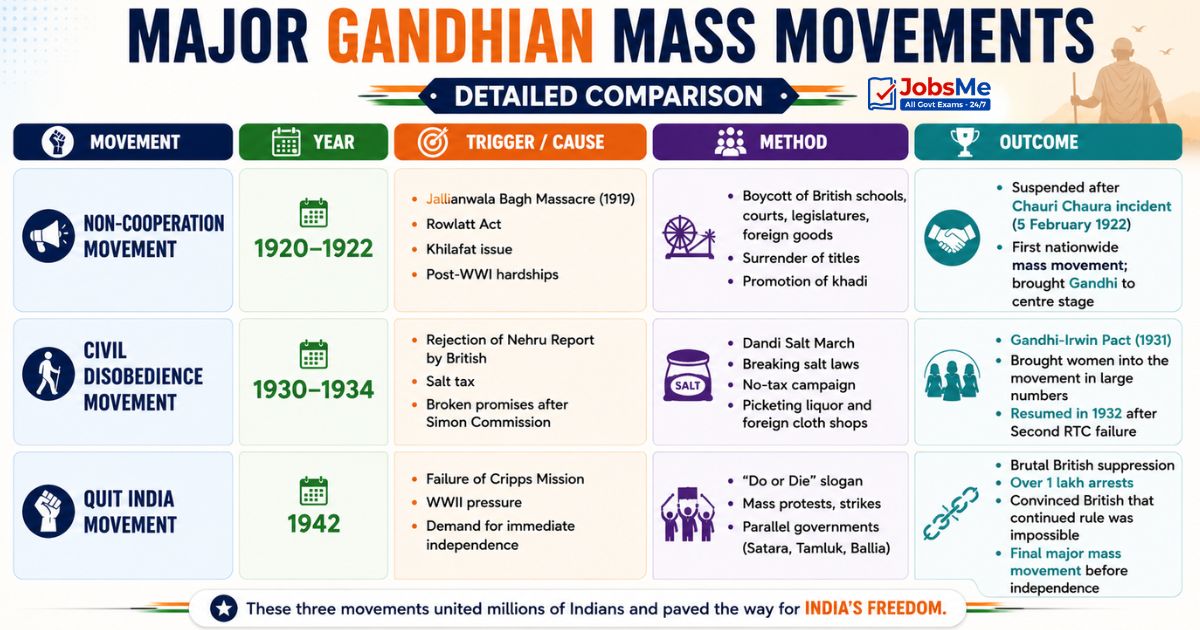
| Movement | Year | Trigger / Cause | Method | Outcome |
|---|---|---|---|---|
| Non-Cooperation Movement | 1920-1922 | Jallianwala Bagh Massacre (1919), Rowlatt Act, Khilafat issue, post-WWI hardships | Boycott of British schools, courts, legislatures, foreign goods; surrender of titles; promotion of khadi | Suspended after Chauri Chaura incident (5 February 1922); first nationwide mass movement; brought Gandhi to centre stage |
| Civil Disobedience Movement | 1930-1934 | Rejection of Nehru Report by British; salt tax; broken promises after Simon Commission | Dandi Salt March, breaking salt laws, no-tax campaign, picketing liquor and foreign cloth shops | Gandhi-Irwin Pact (1931); brought women into the movement in large numbers; resumed in 1932 after Second RTC failure |
| Quit India Movement | 1942 | Failure of Cripps Mission; WWII pressure; demand for immediate independence | "Do or Die" slogan; mass protests, strikes, parallel governments (Satara, Tamluk, Ballia) | Brutal British suppression; over 1 lakh arrests; convinced British that continued rule was impossible; final major mass movement before independence |
Tribal Uprisings During British Rule
Tribal communities resisted British encroachment on their forests, lands, and customary rights long before mainstream nationalism took shape. These uprisings are frequently asked in UPSC Prelims and State PCS.
| Tribal Uprising | Year | Leader(s) | Region | Significance |
|---|---|---|---|---|
| Paika Rebellion | 1817 | Bakshi Jagabandhu | Odisha | Armed resistance of Paika warriors against British land policies; recently recognised as one of the earliest organised revolts. |
| Kol Rebellion | 1831-32 | Tribal chiefs (Buddho Bhagat) | Chotanagpur (Jharkhand) | Protest against transfer of tribal land to non-tribal moneylenders and revenue contractors. |
| Santhal Rebellion (Hul) | 1855-56 | Sidhu Murmu and Kanhu Murmu | Bihar / Bengal (Jharkhand) | Largest pre-1857 tribal revolt; led to creation of Santhal Parganas district. |
| Munda Rebellion (Ulgulan) | 1899-1900 | Birsa Munda ("Dharti Aba") | Chotanagpur (Jharkhand) | Demanded "Munda Raj"; led to the Chotanagpur Tenancy Act, 1908; Birsa Munda's birth anniversary (15 November) is now observed as Janjatiya Gaurav Divas. |
| Rampa Rebellion | 1922-24 | Alluri Sitarama Raju | Andhra Pradesh (East Godavari) | Tribal revolt against the Madras Forest Act of 1882; combined armed struggle with Gandhian ideals. |
| Bhil and Gond Revolts | 18th-19th centuries | Local chiefs | Central India / Madhya Pradesh | Sustained tribal resistance against forest exploitation and revenue collection. |
Major Peasant Movements
| Movement | Year | Region | Leader(s) | Cause & Outcome |
|---|---|---|---|---|
| Indigo Rebellion (Nil Bidroha) | 1859-60 | Bengal | Local peasants; supported by Harish Chandra Mukherjee and Dinabandhu Mitra (author of "Nil Darpan") | Forced indigo cultivation by European planters; led to the Indigo Commission Report, 1860. |
| Deccan Riots | 1875 | Maharashtra (Pune, Ahmednagar) | Peasants | Against high debt and oppressive moneylenders; led to the Deccan Agriculturists' Relief Act, 1879. |
| Champaran Satyagraha | 1917 | Bihar | Mahatma Gandhi | Against the tinkathia indigo system; first Satyagraha on Indian soil; resulted in Champaran Agrarian Act 1918. |
| Kheda Satyagraha | 1918 | Gujarat | Mahatma Gandhi, Sardar Patel | Crop failure and high taxes; British government granted concessions to poor farmers. |
| Bardoli Satyagraha | 1928 | Gujarat | Sardar Vallabhbhai Patel | Against 22% hike in land revenue; complete success; Patel earned the title "Sardar." |
| Telangana Peasant Revolt | 1946-51 | Hyderabad State | Communist Party leaders | Against zamindari exploitation and Nizam's autocracy; integrated into post-independence land reforms. |
| Punjab Peasant Agitation | Early 20th century | Punjab | Local leaders (Ajit Singh, etc.) | Against high water rates and the Colonisation Act of 1906; "Pagri Sambhal Jatta" movement. |
Revolutionary Movements and Key Actions
| Organisation / Action | Year | Key Figures | Significance |
|---|---|---|---|
| Anushilan Samiti | 1902 (Calcutta), 1906 (Dhaka) | Aurobindo Ghosh, Barindra Kumar Ghosh, P. Mitra | Early Bengali revolutionary organisation; trained youth for armed struggle. |
| Alipore Bomb Case | 1908 | Aurobindo Ghosh, Khudiram Bose, Prafulla Chaki | Bombing aimed at Magistrate Kingsford; Khudiram became one of the youngest martyrs (executed at 18). |
| Ghadar Conspiracy | 1915 | Rash Behari Bose, Sachindra Nath Sanyal, Kartar Singh Sarabha | Plan for armed uprising in Punjab during WWI; betrayed and suppressed; Kartar Singh hanged at age 19. |
| Kakori Conspiracy | 1925 | Ram Prasad Bismil, Ashfaqulla Khan, Roshan Singh, Rajendra Lahiri (HRA) | Train robbery to fund revolutionary activities; four hanged in 1927. |
| Hindustan Socialist Republican Association (HSRA) | 1928 | Chandrashekhar Azad, Bhagat Singh, Sukhdev, Rajguru, Bhagwati Charan Vohra | Aimed at armed socialist revolution; behind several high-profile actions. |
| Killing of J. P. Saunders | 1928 | Bhagat Singh, Rajguru, Sukhdev, Chandrashekhar Azad | Avenged the death of Lala Lajpat Rai (Lahore, 17 December 1928). |
| Central Assembly Bombing | 1929 | Bhagat Singh and Batukeshwar Dutt | Threw bombs and leaflets in the Central Legislative Assembly, Delhi (8 April 1929) shouting "Inquilab Zindabad." |
| Chittagong Armoury Raid | 1930 | Surya Sen ("Master Da"), Pritilata Waddedar, Kalpana Datta | Daring armoury raid in Bengal; symbol of revolutionary spirit; women played a key role. |
| Indian National Army (Azad Hind Fauj) | 1942-45 | Captain Mohan Singh, Subhas Chandra Bose, Shah Nawaz Khan, P. K. Sahgal, G. S. Dhillon | Armed struggle from outside India; Bose coined "Give me blood, I shall give you freedom"; INA trials at Red Fort created huge public sympathy. |
Contribution of Women to the Freedom Struggle
| Leader | Region / Field | Contribution |
|---|---|---|
| Rani Lakshmibai | Jhansi | Led Jhansi forces in the Revolt of 1857; died fighting the British in Gwalior. |
| Begum Hazrat Mahal | Awadh | Led the Awadh forces during the 1857 Revolt; declared her son Birjis Qadr as Nawab. |
| Sarojini Naidu | Pan-India | First Indian woman President of INC (1925); led Civil Disobedience and Dharasana Salt Satyagraha; first woman Governor (UP). |
| Annie Besant | Madras / All India | Founded the Home Rule League (1916); first woman President of INC (1917). |
| Kasturba Gandhi | Gujarat | Participated in Champaran, Kheda, and Quit India movements; jailed several times alongside Gandhi. |
| Aruna Asaf Ali | Delhi | "Grand Old Lady of Indian Independence"; hoisted the Tricolour at Gowalia Tank Maidan on 9 August 1942 during Quit India. |
| Usha Mehta | Bombay | Ran the secret Congress Radio during the Quit India Movement in 1942. |
| Sucheta Kriplani | Uttar Pradesh | Freedom fighter and India's first woman Chief Minister (UP). |
| Captain Lakshmi Sahgal | Singapore / Burma | Headed the Rani Jhansi Regiment of the INA; medical officer in Bose's army. |
| Pritilata Waddedar and Kalpana Datta | Bengal | Revolutionaries; part of Surya Sen's Chittagong group. |
| Bhikaji Cama | Abroad (Stuttgart) | First Indian to unfurl the flag of Indian Independence at the International Socialist Congress in Stuttgart, Germany, in 1907. |
Press and Newspapers in the Freedom Struggle
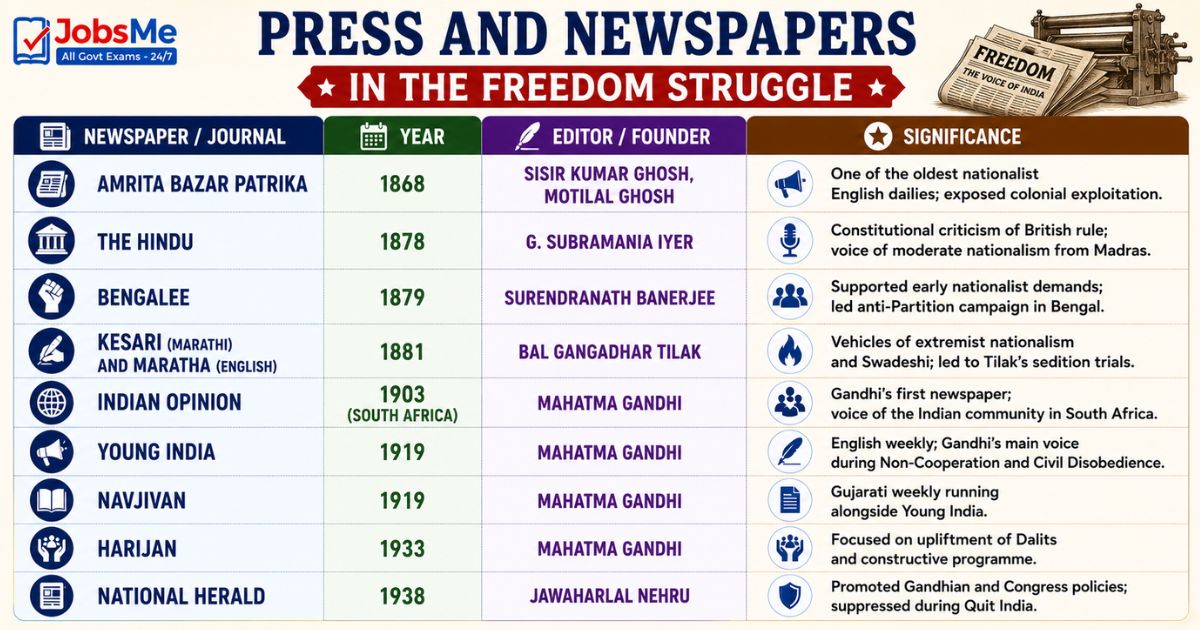
| Newspaper / Journal | Year | Editor / Founder | Significance |
|---|---|---|---|
| Amrita Bazar Patrika | 1868 | Sisir Kumar Ghosh, Motilal Ghosh | One of the oldest nationalist English dailies; exposed colonial exploitation. |
| The Hindu | 1878 | G. Subramania Iyer | Constitutional criticism of British rule; voice of moderate nationalism from Madras. |
| Bengalee | 1879 | Surendranath Banerjee | Supported early nationalist demands; led anti-Partition campaign in Bengal. |
| Kesari (Marathi) and Maratha (English) | 1881 | Bal Gangadhar Tilak | Vehicles of extremist nationalism and Swadeshi; led to Tilak's sedition trials. |
| Indian Opinion | 1903 (South Africa) | Mahatma Gandhi | Gandhi's first newspaper; voice of the Indian community in South Africa. |
| Young India | 1919 | Mahatma Gandhi | English weekly; Gandhi's main voice during Non-Cooperation and Civil Disobedience. |
| Navjivan | 1919 | Mahatma Gandhi | Gujarati weekly running alongside Young India. |
| Harijan | 1933 | Mahatma Gandhi | Focused on upliftment of Dalits and constructive programme. |
| National Herald | 1938 | Jawaharlal Nehru | Promoted Gandhian and Congress policies; suppressed during Quit India. |
Major British Acts and Reforms Linked to the Freedom Movement
| Act / Reform | Year | Significance |
|---|---|---|
| Indian Councils Act | 1892 | Expanded legislative council participation but with limited powers. |
| Morley-Minto Reforms (Indian Councils Act) | 1909 | Introduced separate electorates for Muslims; sowed communal seeds. |
| Rowlatt Act | 1919 | Allowed detention without trial; triggered Jallianwala Bagh protest. |
| Montagu-Chelmsford Reforms (Government of India Act 1919) | 1919 | Introduced Dyarchy in provinces; partial self-government. |
| Government of India Act | 1935 | Provincial autonomy and proposed All-India Federation; basis of 1937 elections. |
| Indian Independence Act | 1947 | Partitioned British India into India and Pakistan on 15 August 1947. |
Memory Tricks and Mnemonics
Trick 1: The Three Phases — "MEG"
Use "MEG" to remember the three phases of the Indian National Movement in chronological order:
- M → Moderate (1885-1905).
- E → Extremist (1905-1919).
- G → Gandhian Era (1919-1947).
"From MEGaphone petitions to MEGa mass movements."
Trick 2: Three Big Gandhian Movements — "N-C-Q" or the "20-30-42 Rule"
Just memorise the last two digits of the start year of each Gandhian mass movement:
- N → Non-Cooperation Movement → 1920.
- C → Civil Disobedience Movement → 1930.
- Q → Quit India Movement → 1942.
"NCQ — 20, 30, 42 — exactly a decade gap, then 12 years."
Trick 3: First Three Satyagrahas of Gandhi — "CKA"
Gandhi's first three Satyagrahas in India happened back-to-back in 1917-1918. Remember "CKA":
- C → Champaran (1917, Bihar) — indigo farmers.
- K → Kheda (1918, Gujarat) — peasants after crop failure.
- A → Ahmedabad (1918, Gujarat) — mill workers.
"CKA — Champaran first, then Kheda and Ahmedabad in the same year."
Trick 4: Five Stations of the 1857 Revolt — "MDLKJ"
The Revolt of 1857 spread to five major centres. Use "MDLKJ":
- M → Meerut (started 10 May 1857 — Mangal Pandey at Barrackpore was earlier in March).
- D → Delhi (Bahadur Shah Zafar).
- L → Lucknow (Begum Hazrat Mahal).
- K → Kanpur (Nana Sahib, Tantia Tope).
- J → Jhansi (Rani Lakshmibai).
Trick 5: Tribal Uprisings — "PKSM-R"
Use this acronym to recall the major tribal uprisings in chronological order:
- P → Paika Rebellion (1817, Odisha — Bakshi Jagabandhu).
- K → Kol Rebellion (1831-32, Chotanagpur).
- S → Santhal Hul (1855-56, Sidhu-Kanhu).
- M → Munda Ulgulan (1899-1900, Birsa Munda).
- R → Rampa Rebellion (1922-24, Alluri Sitarama Raju).
"PKSM-R — Paika to Rampa, the tribal arc of resistance."
Trick 6: The Lal-Bal-Pal Trio — "Punjab-Bengal via Maharashtra"
To remember the three Extremist leaders of the Swadeshi Movement:
- Lal → Lala Lajpat Rai (Punjab — Punjab Kesari).
- Bal → Bal Gangadhar Tilak (Maharashtra — Lokmanya).
- Pal → Bipin Chandra Pal (Bengal — Father of Revolutionary Thoughts).
Trick 7: Three Round Table Conferences — "1-2-3 / 30-31-32"
The three Round Table Conferences happened in three consecutive years:
- 1st RTC → 1930 → INC boycotted.
- 2nd RTC → 1931 → Gandhi attended (sole INC representative).
- 3rd RTC → 1932 → INC absent.
"Three RTCs, three years — only the middle one had Gandhi."
Trick 8: Slogans Connected to Freedom Events — "Slogan Map"
- "Swaraj is my birthright and I shall have it" → Bal Gangadhar Tilak (1916).
- "Inquilab Zindabad" → Bhagat Singh (1929, Central Assembly).
- "Do or Die" (Karo Ya Maro) → Mahatma Gandhi (Quit India, 1942).
- "Jai Hind" and "Tum Mujhe Khoon Do, Main Tumhe Azadi Doonga" → Subhas Chandra Bose.
- "Vande Mataram" → Bankim Chandra Chattopadhyay (Anandamath, 1882); became Swadeshi rallying cry.
- "Simon Go Back" → Lala Lajpat Rai-led protests (1928).
- "Jai Jawan Jai Kisan" → Lal Bahadur Shastri (post-independence, 1965).
Additional Notes
Frequently Confused Facts
- Champaran vs Kheda vs Bardoli: Champaran (1917) is in Bihar — against tinkathia indigo system. Kheda (1918) is in Gujarat — against tax during crop failure. Bardoli (1928) is in Gujarat — against 22% land revenue hike led by Sardar Patel.
- Home Rule League — Tilak vs Annie Besant: Tilak founded his Home Rule League in April 1916 at Pune; Annie Besant founded hers in September 1916 at Madras.
- 1857 Leaders by Place: Delhi → Bahadur Shah Zafar; Lucknow → Begum Hazrat Mahal; Kanpur → Nana Sahib and Tantia Tope; Jhansi → Rani Lakshmibai; Bihar → Kunwar Singh; Bareilly → Khan Bahadur Khan.
- Quit India Leaders Underground: Most senior leaders (Gandhi, Nehru, Patel) were arrested on 9 August 1942. Underground leadership was taken up by Aruna Asaf Ali, Jayaprakash Narayan, Ram Manohar Lohia, Usha Mehta, and Achyut Patwardhan.
- Salt March Distance and Duration: 240 miles (about 386 km) from Sabarmati Ashram to Dandi; took 24 days (12 March to 6 April 1930) with 78 followers.
- Chauri Chaura — Why Suspended: A mob set fire to a police station in Gorakhpur (UP) on 5 February 1922, killing 22 policemen. Gandhi called off the Non-Cooperation Movement on 12 February 1922.
- Partition of Bengal vs Reversal: Partitioned by Lord Curzon in 1905; reversed by Lord Hardinge in 1911 (annulment announced at the Delhi Durbar).
- Surat Split vs Lucknow Pact: Surat Split (1907) — Moderates and Extremists split. Lucknow Pact (1916) — INC and Muslim League came together; Moderates and Extremists also reunited.
- Cripps vs Cabinet Mission: Cripps Mission (1942) offered post-war Dominion Status, rejected by INC. Cabinet Mission (1946) rejected separate Pakistan and proposed Constituent Assembly.
- Founders of HRA vs HSRA: Hindustan Republican Association (HRA) was founded in 1924 by Sachindranath Sanyal and others. HSRA (Hindustan Socialist Republican Association) was the 1928 reorganisation under Chandrashekhar Azad and Bhagat Singh.
- Purna Swaraj Declaration Date: Resolution passed at Lahore Session of INC in December 1929; first observed as Independence Day on 26 January 1930 — later chosen as Republic Day date.
Repeating PYQ Patterns
Certain freedom struggle events are asked repeatedly in competitive exams. The Revolt of 1857, Partition of Bengal (1905), Lal-Bal-Pal, Champaran Satyagraha (1917), Jallianwala Bagh Massacre (1919), Rowlatt Act, Non-Cooperation Movement (1920-22), Chauri Chaura, Bardoli Satyagraha (1928), Dandi March (1930), Poona Pact (1932), Government of India Act 1935, Quit India Movement (1942), INA and Subhas Chandra Bose, and the Indian Independence Act 1947 appear most often in UPSC Prelims, SSC CGL, RRB NTPC, and CDS papers. Banking exams (IBPS PO, SBI Clerk, Insurance) frequently focus on direct year-leader-event matching. State PCS exams add regional movements — BPSC asks about Champaran and Kunwar Singh, MPSC about the Bardoli and Bombay Mill strikes, WBPSC about Bengal partition, the Chittagong raid, and the Swadeshi Movement, and TSPSC/APPSC about the Telangana and Rampa Rebellions.
Quick Insight
The Indian Freedom Struggle is not just a list of dates — it is a layered story of resistance from below (tribal, peasant, labour) and resistance from above (political, constitutional). Each event captures a small chapter of national awakening: 1857 recalls the death of Company Rule and the start of Crown Rule; 1905 recalls the awakening of mass nationalism through Swadeshi; 1919 recalls the brutality at Jallianwala Bagh that turned moderate India militant; 1930 recalls a fistful of salt becoming a weapon against the world's largest empire; and 1942 recalls the final push that made British rule politically untenable. Understanding the chain of these events helps aspirants quickly answer matching questions in Prelims and write strong analytical answers in Mains. For further reading on related Static GK topics, you can refer to the Static GK section and check the Banking Awareness notes for IBPS and SBI-related Indian history questions on Jobsme.in.
One-Liners for Quick Revision
- Paika Rebellion (1817) → Odisha; led by Bakshi Jagabandhu against British land policies.
- Kol Rebellion (1831-32) → Chotanagpur tribal revolt against transfer of land to outsiders.
- Santhal Hul (1855-56) → Led by Sidhu and Kanhu Murmu against zamindari and moneylender exploitation.
- Revolt of 1857 → Started 10 May 1857 at Meerut; First War of Indian Independence; led by Mangal Pandey, Rani Lakshmibai, Nana Sahib, Tantia Tope, Bahadur Shah Zafar, Kunwar Singh.
- Indigo Rebellion / Nil Bidroha (1859-60) → Bengal peasants against forced indigo cultivation; led to Indigo Commission.
- Deccan Riots (1875) → Maharashtra peasants against moneylenders; led to Deccan Agriculturists' Relief Act 1879.
- Formation of INC (1885) → Founded by A. O. Hume; first session in Bombay; W. C. Bonnerjee first President.
- Moderate Phase (1885-1905) → Dadabhai Naoroji, Gokhale, Mehta, Banerjee; petitions and Drain Theory.
- Indian Councils Act (1892) → Expanded legislative councils with limited powers.
- Munda Rebellion / Ulgulan (1899-1900) → Birsa Munda demanded "Munda Raj"; led to Chotanagpur Tenancy Act 1908.
- Partition of Bengal (1905) → By Lord Curzon; reversed by Lord Hardinge in 1911.
- Swadeshi Movement (1905-1911) → Boycott of British goods; led by Lal-Bal-Pal, Aurobindo, Tagore.
- Muslim League (1906) → Founded at Dhaka by Aga Khan and Nawab Salimullah.
- Surat Split (1907) → Moderates and Extremists parted ways in INC.
- Morley-Minto Reforms (1909) → Separate electorates for Muslims.
- Ghadar Party (1913) → Founded in San Francisco by Lala Hardayal and Sohan Singh Bhakna.
- Gandhi returns to India (9 January 1915) → From South Africa; introduces Satyagraha.
- Lucknow Pact (1916) → INC and Muslim League agree on joint reforms; Moderates and Extremists reunite.
- Home Rule Movement (1916-18) → Tilak (April 1916, Pune) and Annie Besant (September 1916, Madras).
- Champaran Satyagraha (1917) → Gandhi's first Satyagraha; against tinkathia indigo system in Bihar.
- Kheda Satyagraha (1918) → Gandhi and Patel; no-tax movement after crop failure in Gujarat.
- Ahmedabad Mill Strike (1918) → Gandhi's first hunger strike; for higher wages for mill workers.
- Rowlatt Act (1919) → Detention without trial; "No Dalil, No Vakil, No Appeal."
- Jallianwala Bagh Massacre (13 April 1919) → General Dyer, Amritsar; Tagore returned his knighthood.
- Montagu-Chelmsford Reforms / GOI Act (1919) → Introduced Dyarchy in provinces.
- Khilafat Movement (1920) → Ali Brothers; merged with Non-Cooperation; Hindu-Muslim unity.
- AITUC (1920) → First trade union federation; Lala Lajpat Rai first President.
- Non-Cooperation Movement (1920-22) → Gandhi's first mass movement; suspended after Chauri Chaura (5 Feb 1922).
- Swaraj Party (1923) → Founded by Motilal Nehru and C. R. Das to enter legislatures.
- Kakori Conspiracy (1925) → HRA train robbery; Bismil, Ashfaqulla, Roshan Singh, Lahiri hanged.
- Simon Commission (1927/1928) → All-white commission; "Simon Go Back"; Lala Lajpat Rai injured in lathi charge.
- Bardoli Satyagraha (1928) → Sardar Patel against land revenue hike; earned him title "Sardar."
- HSRA formed (1928) → Azad, Bhagat Singh, Sukhdev, Rajguru, Vohra.
- Nehru Report (1928) → Motilal Nehru; first Indian-drafted constitutional proposal.
- Saunders Killing (Dec 1928) → Bhagat Singh and team avenged Lala Lajpat Rai's death.
- Purna Swaraj Resolution (Dec 1929) → Lahore Session under Nehru; first Independence Day on 26 January 1930.
- Central Assembly Bombing (8 April 1929) → Bhagat Singh and Batukeshwar Dutt; "Inquilab Zindabad."
- Dandi March / Salt Satyagraha (12 March - 6 April 1930) → 240-mile march; launched Civil Disobedience.
- Chittagong Armoury Raid (1930) → Surya Sen ("Master Da") with Pritilata Waddedar and Kalpana Datta.
- First Round Table Conference (1930) → London; INC boycotted.
- Gandhi-Irwin Pact (March 1931) → Suspension of Civil Disobedience; release of prisoners.
- Execution of Bhagat Singh, Rajguru, Sukhdev (23 March 1931) → Shaheed Diwas.
- Second Round Table Conference (1931) → Gandhi attended; ended in failure.
- Poona Pact (24 September 1932) → Gandhi-Ambedkar agreement on reserved seats for Depressed Classes.
- Government of India Act 1935 → Provincial autonomy; All-India Federation proposal.
- Provincial Elections (1937) → INC won 8 of 11 provinces.
- Forward Bloc (1939) → Founded by Subhas Chandra Bose at Calcutta.
- Individual Satyagraha (1940) → Vinoba Bhave first; Nehru second.
- Cripps Mission (1942) → Offered Dominion Status; Gandhi called it "post-dated cheque."
- Quit India Movement (8 August 1942) → Bombay; "Do or Die"; Aruna Asaf Ali hoisted flag at Gowalia Tank on 9 August.
- Formation of INA (1942) → Captain Mohan Singh initially; reorganised by Bose in 1943.
- Azad Hind Government (21 October 1943) → Bose; Singapore; "Jai Hind" coined.
- INA Imphal-Kohima Campaign (1944) → Flag hoisted on Indian soil at Moirang, Manipur.
- INA Trials (1945) → Red Fort; created huge public sympathy.
- RIN Mutiny (February 1946) → Bombay, Karachi, Madras; 20,000+ sailors.
- Cabinet Mission Plan (1946) → Rejected separate Pakistan; proposed Constituent Assembly.
- Direct Action Day (16 August 1946) → Jinnah's call; Great Calcutta Killings.
- Telangana Peasant Revolt (1946-51) → Communist-led against Nizam and zamindari.
- Mountbatten Plan / Indian Independence Act (1947) → Partition into India and Pakistan.
- Indian Independence (15 August 1947) → End of British rule; Nehru's "Tryst with Destiny" speech.
- First Indian flag abroad (1907) → Bhikaji Cama at Stuttgart, Germany.
- Rampa Rebellion (1922-24) → Alluri Sitarama Raju in Andhra Pradesh against Madras Forest Act.
- "Nil Darpan" → Dinabandhu Mitra's play on Indigo Rebellion.
- Anushilan Samiti (1902) → Calcutta-based revolutionary organisation.
- Alipore Bomb Case (1908) → Khudiram Bose, Prafulla Chaki, Aurobindo Ghosh.
- Brahmo Samaj (1828) → Raja Ram Mohan Roy; campaign against Sati.
- Arya Samaj (1875) → Dayanand Saraswati; "Back to the Vedas."
- Aligarh Movement → Sir Syed Ahmed Khan; modern Muslim education.
- Self-Respect Movement → Periyar E. V. Ramasamy in Tamil Nadu.
For more Static GK topics on Indian history, polity, and government schemes, explore the Static GK section on Jobsme.in. You can also test your knowledge with the Daily Current Affairs Quiz and check out the latest exam notifications at Latest Government Job Notifications.
Free quiz • No signup required
Put this topic into practice with Indian Cultural Institutions – Static GK MCQ Quiz. It is the quickest way to reinforce what you just learned.
Frequently Asked Questions
When did the Indian Freedom Struggle officially begin?
What are the three main phases of the Indian National Movement?
Why was the Non-Cooperation Movement suspended in 1922?
What was the significance of the Dandi March of 1930?
Who hoisted the Indian flag at Gowalia Tank Maidan during the Quit India Movement?
What was the Partition of Bengal and who reversed it?
Who founded the Indian National Army and what was its role?
What was the importance of the Jallianwala Bagh Massacre?
What was the Bardoli Satyagraha and why is it important?
Which event led to the declaration of Purna Swaraj as the goal of the Indian National Congress?

About the author