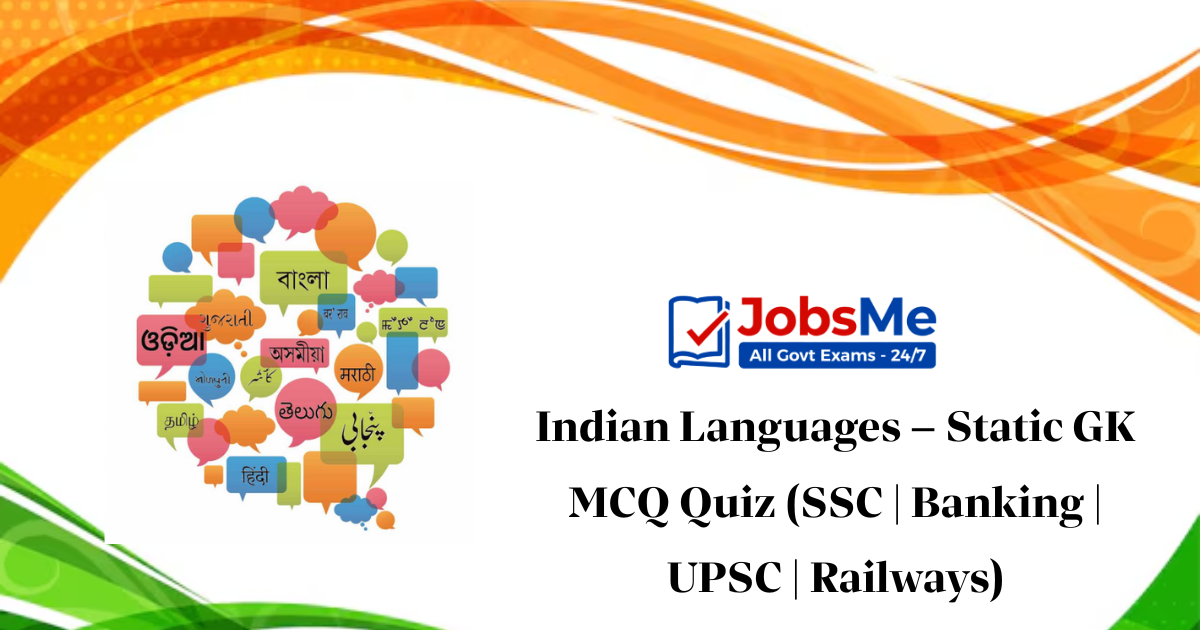
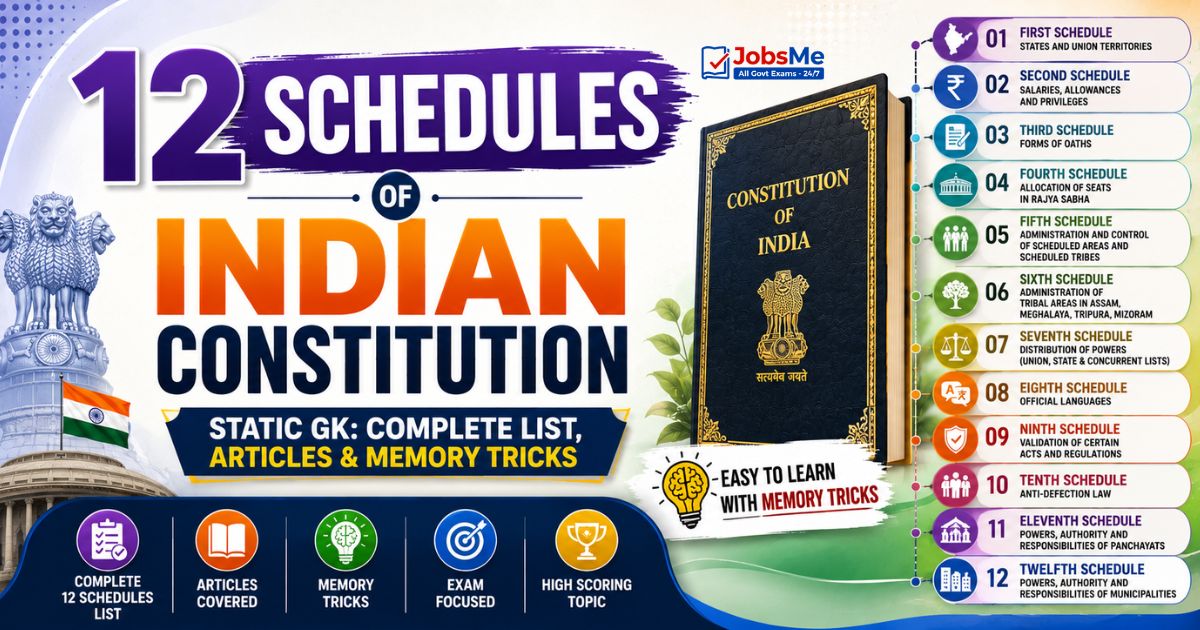
12 Schedules of Indian Constitution Static GK: Complete List, Articles and Memory Tricks
This article gives a complete, exam-ready overview of all 12 Schedules of the Indian Constitution, the Articles linked to each Schedule, and the Constitutional Amendments that added the 9th, 10th, 11th and 12th Schedules. It is built for UPSC, SSC, IBPS, RRB, State PCS and Defence aspirants who need quick revision notes, mnemonics and a one-shot reference for Static GK and Polity.
Jump to section
Introduction to the Schedules of the Indian Constitution
The Schedules of the Indian Constitution are supplementary lists attached at the end of the Constitution that organise detailed administrative, legislative and procedural information referred to in the Articles. They act as ready-reckoner annexures, separating long technical lists (like names of States, official languages or oath formats) from the main body of Articles. Today, the Indian Constitution has 12 Schedules, although it originally had only 8 Schedules when it was adopted on 26 January 1950.
For students of UPSC Prelims, SSC GK, IBPS, RRB NTPC, Insurance GK and State PCS exams, Schedules are a guaranteed scoring zone because the facts are fixed, finite and frequently repeated as one-line questions. Expect direct questions like "Which Schedule deals with anti-defection?" or "How many languages are listed in the 8th Schedule?" in almost every exam cycle.
If you are building your Static GK base from scratch, you can pair this article with the broader Polity revision notes available on our Static GK notes hub for a complete preparation cycle.
Core Concept: What Are Schedules and Why Do They Matter?
A Schedule is a structured list appended to the Constitution that gives detailed information referred to by one or more Articles. While Articles carry the legal provisions, Schedules carry the supporting data such as names, salaries, languages, lists of subjects and forms of oaths.
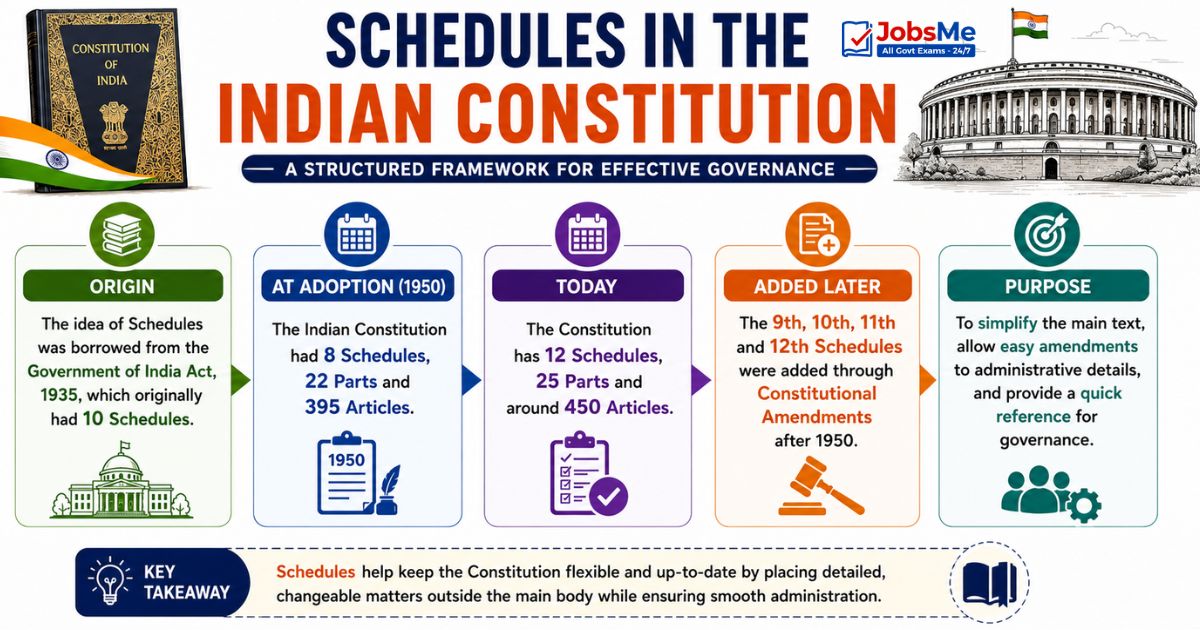
- Origin: The idea of Schedules was borrowed from the Government of India Act, 1935, which originally had 10 Schedules.
- At adoption (1950): The Indian Constitution had 8 Schedules, 22 Parts and 395 Articles.
- Today: The Constitution has 12 Schedules, 25 Parts and around 450 Articles.
- Added later: The 9th, 10th, 11th and 12th Schedules were added through Constitutional Amendments after 1950.
- Purpose: To simplify the main text, allow easy amendments to administrative details, and provide a quick reference for governance.
Complete List of the 12 Schedules of the Indian Constitution
The table below presents every Schedule along with its related Articles, subject matter and key features. This is the single most asked Static GK chart from Polity in UPSC, SSC CGL, IBPS PO/Clerk, RRB and Insurance exams.
Main Reference Table: All 12 Schedules at a Glance
| Schedule | Related Articles | Subject Matter | Key Features and Exam Points |
|---|---|---|---|
| First Schedule | Articles 1 and 4 | Names of States and Union Territories of India along with their territorial extent. | Lists all 28 States and 8 Union Territories of India. Updated through reorganisation Acts, e.g., bifurcation of Jammu and Kashmir into UTs in 2019. First Schedule was the first to be modified after the Constitution came into force. |
| Second Schedule | Articles 59, 65, 75, 97, 125, 148, 158, 164, 186, 221 | Provisions on salaries, allowances and emoluments of high constitutional functionaries. | Covers the President, Vice-President, Governors, Speaker and Deputy Speaker of Lok Sabha, Chairman and Deputy Chairman of Rajya Sabha, Speakers and Chairmen of State Legislatures, Judges of the Supreme Court and High Courts, and the Comptroller and Auditor General (CAG). |
| Third Schedule | Articles 75, 99, 124, 148, 164, 188, 219 | Forms of Oaths and Affirmations. | Prescribes the exact text of oaths for Union and State Ministers, MPs, MLAs, Judges of the Supreme Court and High Courts, and the CAG. It ensures uniformity and constitutional loyalty across all high offices. |
| Fourth Schedule | Articles 4(1) and 80(2) | Allocation of seats in the Rajya Sabha to the States and Union Territories. | Allocates the upper house seats on the basis of population strength. The current total strength of the Rajya Sabha is 245 members (233 elected + 12 nominated). |
| Fifth Schedule | Article 244(1) | Administration and control of Scheduled Areas and Scheduled Tribes. | Applies to Scheduled Areas in States other than Assam, Meghalaya, Tripura and Mizoram. The President can declare any area as a Scheduled Area. Governors play a key role and submit annual reports to the President. |
| Sixth Schedule | Articles 244(2) and 275(1) | Provisions for the administration of Tribal Areas in Assam, Meghalaya, Tripura and Mizoram. | Creates Autonomous District Councils (ADCs) and Regional Councils with legislative, judicial and executive powers over tribal regions. It protects tribal customs, land rights and self-governance. |
| Seventh Schedule | Article 246 | Division of legislative powers between the Union and the States through three Lists. | Contains three lists: Union List (currently 100 subjects, originally 97) like Defence, Foreign Affairs, Railways, Banking; State List (currently 61 subjects, originally 66) like Police, Public Health, Agriculture; and Concurrent List (currently 52 subjects, originally 47) like Education, Forests, Marriage and Bankruptcy. |
| Eighth Schedule | Articles 344(1) and 351 | List of official languages recognised by the Constitution. | Originally had 14 languages; presently contains 22 languages. Sindhi was added by the 21st Amendment, 1967; Konkani, Manipuri and Nepali by the 71st Amendment, 1992; and Bodo, Dogri, Maithili and Santhali by the 92nd Amendment, 2003 (effective 2004). English is NOT a part of the Eighth Schedule. |
| Ninth Schedule | Article 31B | Acts and Regulations dealing with land reforms and abolition of the zamindari system. | Added by the 1st Constitutional Amendment Act, 1951 by Pt. Jawaharlal Nehru. Laws placed here were originally immune from judicial review. The I. R. Coelho judgment (2007) ruled that laws added after 24 April 1973 can still be examined on the touchstone of the Basic Structure doctrine. |
| Tenth Schedule | Articles 102(2) and 191(2) | Anti-Defection Law — disqualification of MPs and MLAs on grounds of defection. | Added by the 52nd Constitutional Amendment Act, 1985 under PM Rajiv Gandhi. The 91st Amendment, 2003 deleted the one-third split provision and now requires a two-thirds merger for valid mergers. The presiding officer of the House decides disqualification cases. |
| Eleventh Schedule | Article 243G | Powers, authority and responsibilities of Panchayats (Panchayati Raj Institutions). | Added by the 73rd Constitutional Amendment Act, 1992. Contains 29 functional items such as agriculture, land improvement, minor irrigation, rural housing, drinking water, primary education, health and sanitation, women and child development. |
| Twelfth Schedule | Article 243W | Powers, authority and responsibilities of Municipalities (urban local bodies). | Added by the 74th Constitutional Amendment Act, 1992. Contains 18 functional items such as urban planning, regulation of land use, roads and bridges, water supply, public health, fire services, slum improvement and urban poverty alleviation. |
List of 22 Languages in the Eighth Schedule
The Eighth Schedule is one of the most frequently asked sub-topics. The current list of 22 languages, in alphabetical order, is given below. The complete list is a common one-line question in SSC CGL, IBPS, RRB, Insurance and State PCS exams.
| Sl. No. | Language | Year / Amendment of Inclusion |
|---|---|---|
| 1 | Assamese | Originally included (1950) |
| 2 | Bengali | Originally included (1950) |
| 3 | Bodo | 92nd Amendment, 2003 |
| 4 | Dogri | 92nd Amendment, 2003 |
| 5 | Gujarati | Originally included (1950) |
| 6 | Hindi | Originally included (1950) |
| 7 | Kannada | Originally included (1950) |
| 8 | Kashmiri | Originally included (1950) |
| 9 | Konkani | 71st Amendment, 1992 |
| 10 | Maithili | 92nd Amendment, 2003 |
| 11 | Malayalam | Originally included (1950) |
| 12 | Manipuri | 71st Amendment, 1992 |
| 13 | Marathi | Originally included (1950) |
| 14 | Nepali | 71st Amendment, 1992 |
| 15 | Odia | Originally included (1950) |
| 16 | Punjabi | Originally included (1950) |
| 17 | Sanskrit | Originally included (1950) |
| 18 | Santali | 92nd Amendment, 2003 |
| 19 | Sindhi | 21st Amendment, 1967 |
| 20 | Tamil | Originally included (1950) |
| 21 | Telugu | Originally included (1950) |
| 22 | Urdu | Originally included (1950) |
Amendments That Added New Schedules
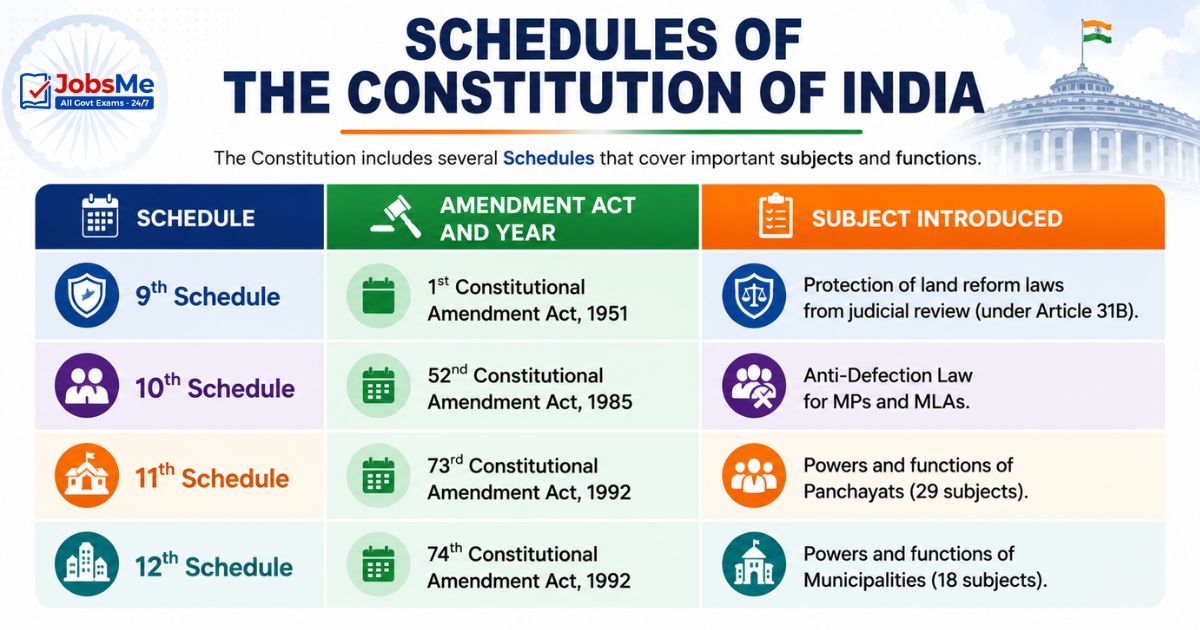
| Schedule | Amendment Act and Year | Subject Introduced |
|---|---|---|
| 9th Schedule | 1st Constitutional Amendment Act, 1951 | Protection of land reform laws from judicial review (under Article 31B). |
| 10th Schedule | 52nd Constitutional Amendment Act, 1985 | Anti-Defection Law for MPs and MLAs. |
| 11th Schedule | 73rd Constitutional Amendment Act, 1992 | Powers and functions of Panchayats (29 subjects). |
| 12th Schedule | 74th Constitutional Amendment Act, 1992 | Powers and functions of Municipalities (18 subjects). |
Memory Tricks and Mnemonics for Schedules of Constitution
Schedules are pure factual data, so a strong mnemonic can save valuable time in the exam. Use the tricks below to lock the order, the numbers and the amendments in your memory.
Trick 1: STOSSA SLAAPM — The Order of 12 Schedules
Remember each Schedule by the first letter of its subject in order:
- S — States and UTs (1st)
- T — EmolumenTs and Salaries (2nd)
- O — Oaths and Affirmations (3rd)
- S — Rajya Sabha Seat Allocation (4th)
- S — Scheduled Areas/Tribes (5th)
- A — Assam-Meghalaya-Tripura-Mizoram Tribal Areas (6th)
- S — Seven Union-State Lists (7th)
- L — Languages (8th)
- A — Anti-Land-grab (Land reforms - 9th)
- A — Anti-Defection (10th)
- P — Panchayats (11th)
- M — Municipalities (12th)
Phrase to remember: "STOSSA SLAAPM" — sounds like a quick chant for revision.
Trick 2: "1-52-73-74" — The Four Added Schedules
The four Schedules added after 1950 follow the amendment number sequence:
- 1st Amendment, 1951 added the 9th Schedule
- 52nd Amendment, 1985 added the 10th Schedule
- 73rd Amendment, 1992 added the 11th Schedule
- 74th Amendment, 1992 added the 12th Schedule
Memory hook: "1, 52, 73, 74" — the last two are twins because both came in 1992 for local self-government.
Trick 3: "14 + 1 + 3 + 4 = 22" — Eighth Schedule Languages
Break the 22 languages into easy chunks based on when they were added:
- 14 originally in 1950
- +1 in 1967 (Sindhi, by 21st Amendment)
- +3 in 1992 (Konkani, Manipuri, Nepali by 71st Amendment) — remember K-M-N
- +4 in 2003 (Bodo, Dogri, Maithili, Santhali by 92nd Amendment) — remember BDMS or "Bodo Doctor Maths Santa"
Trick 4: "PaM 29-18" — Panchayats and Municipalities Subjects
The 11th and 12th Schedules are commonly confused. Lock them this way:
- Panchayats — 11th Schedule — 29 subjects — Article 243G — 73rd Amendment.
- Municipalities — 12th Schedule — 18 subjects — Article 243W — 74th Amendment.
Hook: "Bigger village list (29) vs smaller city list (18)" — villages always come first.
Trick 5: "100-61-52" — The Seventh Schedule Lists
Current subjects in the three lists of the 7th Schedule:
- Union List — 100 subjects (originally 97).
- State List — 61 subjects (originally 66 — reduced over time).
- Concurrent List — 52 subjects (originally 47).
Pattern: Union and Concurrent grew, State shrank — reflects centralisation of Indian polity.
Trick 6: "5 vs 6" — The Two Tribal Schedules
Students mix up the 5th and 6th Schedules. Use this contrast:
- 5th Schedule — applies to Scheduled Areas in all other States (NOT Assam, Meghalaya, Tripura, Mizoram). Article 244(1).
- 6th Schedule — applies only to A-M-T-M (Assam, Meghalaya, Tripura, Mizoram). Article 244(2). Creates Autonomous District Councils.
Memory line: "Five for the rest, Six for the North-East four."
Trick 7: "9 = Saved, 10 = Sacked"
Two opposite-sounding Schedules to differentiate:
- 9th Schedule — laws are saved from judicial review (added 1951).
- 10th Schedule — defectors are sacked from the House (added 1985).
Additional Notes
Frequently Confused Facts
- 5th Schedule vs 6th Schedule: 5th covers tribal areas of all other States; 6th covers only Assam, Meghalaya, Tripura and Mizoram.
- 11th vs 12th Schedule: 11th — Panchayats — 29 subjects — 73rd Amendment; 12th — Municipalities — 18 subjects — 74th Amendment.
- 9th Schedule misconception: Many think laws under the 9th Schedule have absolute immunity. After the I. R. Coelho case (2007), laws added after 24 April 1973 can be reviewed on Basic Structure grounds.
- 8th Schedule and English: English is the associate official language of India under Article 343, but it is NOT listed in the Eighth Schedule.
- 2nd vs 3rd Schedule: 2nd lists salaries and emoluments; 3rd lists oath formats — both touch the same officers but cover different things.
- Original number: Constitution originally had 8 Schedules, not 10, and not 12.
Repeating PYQ Patterns
- UPSC Prelims: Conceptual questions on the 9th Schedule (judicial review), 10th Schedule (anti-defection process), and the difference between the 5th and 6th Schedules are repeat favourites.
- SSC CGL / CHSL: Direct one-line questions like "Which Schedule deals with Panchayats?" and "How many languages are in the 8th Schedule?" appear almost every year.
- IBPS PO / Clerk / RRB: Numbers stick — 29 subjects (11th), 18 subjects (12th), 22 languages (8th), and amendment numbers 73rd and 74th are heavily tested.
- State PCS: Often combine Schedule questions with State-specific provisions of the 6th Schedule.
- Insurance exams (LIC AAO, NIACL): Static GK questions on the original number of Schedules and which Amendment added which Schedule.
Quick Insight: Real-World Relevance
The Schedules of the Constitution are not frozen relics — they keep evolving with current events. Demands for the inclusion of languages like Bhojpuri, Rajasthani, Tulu and Kodava in the 8th Schedule appear regularly in news. The 9th Schedule continues to attract debate whenever new reservation or land laws are placed under it. The Anti-Defection Law (10th Schedule) makes headlines in every floor test in State Assemblies, while the 11th and 12th Schedules guide every Panchayat and Municipal election in India. Aspirants can stay updated by following the daily news capsules on our daily current affairs page.
For exam-focused revision combining Polity with current affairs, the Static GK quiz section on Jobsme.in is a smart tool to test retention of facts like Schedules, Articles, Parts and Amendments together.
One-Liners for Quick Revision
- Total Schedules → Currently 12 Schedules → Originally only 8 at the time of adoption in 1950.
- Source of Schedules → Borrowed from the Government of India Act, 1935 → Originally had 10 Schedules.
- 1st Schedule → Names of States and Union Territories → Linked to Articles 1 and 4.
- 2nd Schedule → Salaries and emoluments of President, VP, Governors, Speakers, Judges and CAG → Covers many Articles including 59, 65, 125 and 148.
- 3rd Schedule → Forms of Oaths and Affirmations → Applies to Ministers, MPs, MLAs, Judges and CAG.
- 4th Schedule → Allocation of seats in the Rajya Sabha to States and UTs → Linked to Articles 4(1) and 80(2).
- 5th Schedule → Administration of Scheduled Areas and Scheduled Tribes → Article 244(1) → Excludes Assam, Meghalaya, Tripura and Mizoram.
- 6th Schedule → Tribal areas of Assam, Meghalaya, Tripura and Mizoram → Articles 244(2) and 275(1) → Provides for Autonomous District Councils.
- 7th Schedule → Division of legislative powers → Article 246 → Contains Union, State and Concurrent Lists.
- Union List → Currently 100 subjects → Originally 97 → Defence, Foreign Affairs, Railways, Banking.
- State List → Currently 61 subjects → Originally 66 → Police, Public Health, Agriculture.
- Concurrent List → Currently 52 subjects → Originally 47 → Education, Forest, Marriage.
- 8th Schedule → Official languages → Articles 344(1) and 351 → Currently 22 languages, originally 14.
- 21st Amendment, 1967 → Added Sindhi to the 8th Schedule.
- 71st Amendment, 1992 → Added Konkani, Manipuri and Nepali to the 8th Schedule.
- 92nd Amendment, 2003 → Added Bodo, Dogri, Maithili and Santhali to the 8th Schedule.
- English in 8th Schedule → NOT included → Listed as associate official language under Article 343.
- 9th Schedule → Land reform Acts protected from judicial review → Added by 1st Amendment, 1951 → Linked to Article 31B.
- I. R. Coelho Case, 2007 → Laws added to the 9th Schedule after 24 April 1973 can be reviewed on Basic Structure grounds.
- 10th Schedule → Anti-Defection Law → Added by 52nd Amendment, 1985 → Linked to Articles 102(2) and 191(2).
- 91st Amendment, 2003 → Modified 10th Schedule → Removed one-third split, retained two-thirds merger.
- 11th Schedule → Powers of Panchayats → Added by 73rd Amendment, 1992 → Article 243G → Contains 29 subjects.
- 12th Schedule → Powers of Municipalities → Added by 74th Amendment, 1992 → Article 243W → Contains 18 subjects.
- Original Constitution → 8 Schedules + 22 Parts + 395 Articles → Adopted on 26 January 1950.
- Present Constitution → 12 Schedules + 25 Parts + around 450 Articles.
- Banking Awareness link → Banking is in the Union List (7th Schedule), making it a central subject — useful for IBPS and Insurance exams.
Once you have memorised the Schedules, test yourself with the topic-specific daily current affairs quiz and the banking awareness quiz. For aspirants tracking new openings, fresh updates are listed on our latest government jobs notifications page.
Free quiz • No signup required
Put this topic into practice with Indian Cultural Institutions – Static GK MCQ Quiz. It is the quickest way to reinforce what you just learned.
Frequently Asked Questions
How many Schedules are there in the Indian Constitution at present?
Which Schedule of the Indian Constitution deals with the Anti-Defection Law?
How many languages are listed in the Eighth Schedule of the Constitution?
Which Constitutional Amendments added the 11th and 12th Schedules?
What is the difference between the Fifth and Sixth Schedules of the Constitution?
Why is the Ninth Schedule important and is it completely immune from judicial review?
How many subjects are there in the Union, State and Concurrent Lists of the Seventh Schedule?
Is English included in the Eighth Schedule of the Indian Constitution?
Which Schedule contains the forms of oaths and affirmations for constitutional functionaries?
How are the 11th and 12th Schedules different from each other?

About the author