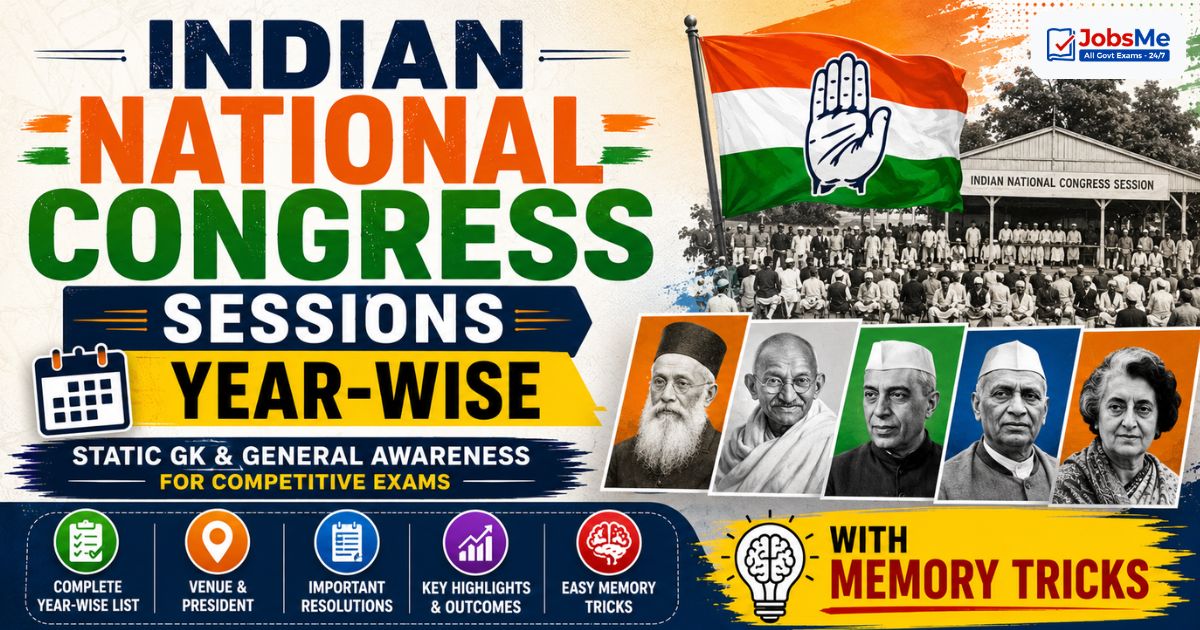
List of Indian National Congress (INC) Sessions Year-Wise – Static GK & General Awareness for Competitive Exams with Memory Tricks
This article presents the complete year-wise list of Indian National Congress (INC) Sessions from the inaugural Bombay session of 1885 to the post-Independence sessions of the 1980s, covering presidents, venues, and key outcomes of each session. It includes historic landmarks such as the first session at Gokuldas Tejpal Sanskrit College, the Surat Split of 1907, the Lucknow Pact of 1916, the Purna Swaraj resolution at Lahore in 1929, and the Karachi Session of 1931 on Fundamental Rights — along with memory tricks, mnemonics, and exam one-liners for quick revision. All facts are arranged in exam-ready format to help UPSC, SSC, IBPS, RRB, PSU, and State PCS aspirants score better in Modern History and General Awareness sections.
Jump to section
Introduction
The Indian National Congress (INC) was founded on 28 December 1885 at Gokuldas Tejpal Sanskrit College, Bombay, by retired British ICS officer Allan Octavian Hume (A.O. Hume), with Lord Dufferin as the Viceroy of India at the time. The first session was attended by 72 delegates — social reformers, journalists, and lawyers — and was presided over by Womesh Chandra Bonnerjee (W.C. Bonnerjee). From this modest beginning, the INC evolved into the principal political organisation that led India's freedom struggle, holding annual sessions almost every December across different parts of the country.
The sessions of the Indian National Congress are one of the most frequently asked topics in UPSC Prelims, SSC CGL, IBPS PO, RRB NTPC, SBI Clerk, State PCS, NDA, CDS, and various Insurance exams. Questions typically ask which president presided over a particular session, where a specific session was held, in which session "Vande Mataram" or "Jana Gana Mana" was sung for the first time, where the Surat Split or Lucknow Pact took place, and which session adopted the Purna Swaraj resolution. For a structured revision of similar Modern History topics, you can refer to the Static GK section on Jobsme.in.
The presidents of the INC initially served a one-year term from 1885 to 1933, after which no fixed term was followed. The sessions were rotated across regions so that the Congress could grow into a truly national platform, and as a convention, the president usually belonged to a region other than the host city. These sessions shaped the trajectory of the freedom struggle — from moderate petitions in the early years to Swaraj, Non-Cooperation, Civil Disobedience, and finally Quit India.
Core Concepts: Why the INC Sessions Matter
The annual sessions of the Indian National Congress were formal conferences where delegates from across British India met to discuss political, economic, and social issues, frame resolutions, and decide the direction of the national movement. Understanding the key phases of these sessions helps students remember presidents and outcomes more effectively.
Phases of INC Sessions
- Moderate Phase (1885-1905): Constitutional methods, petitions, and prayers; demands for greater Indian representation in legislatures and civil services. Key leaders: Dadabhai Naoroji, Pherozeshah Mehta, W.C. Bonnerjee, Gopal Krishna Gokhale.
- Extremist / Swadeshi Phase (1905-1916): Adoption of Swaraj, Boycott, Swadeshi, and National Education; rise of Lal-Bal-Pal; the Surat Split of 1907.
- Gandhian Phase (1917-1947): Mass movements — Non-Cooperation, Civil Disobedience, Quit India; Purna Swaraj resolution at Lahore; Karachi resolution on Fundamental Rights.
- Post-Independence Phase (1948 onwards): Congress as the ruling party; sessions held in Jaipur, Nasik, Delhi, Hyderabad, Bangalore, and other cities to consolidate organisational policy.
Important Conventions
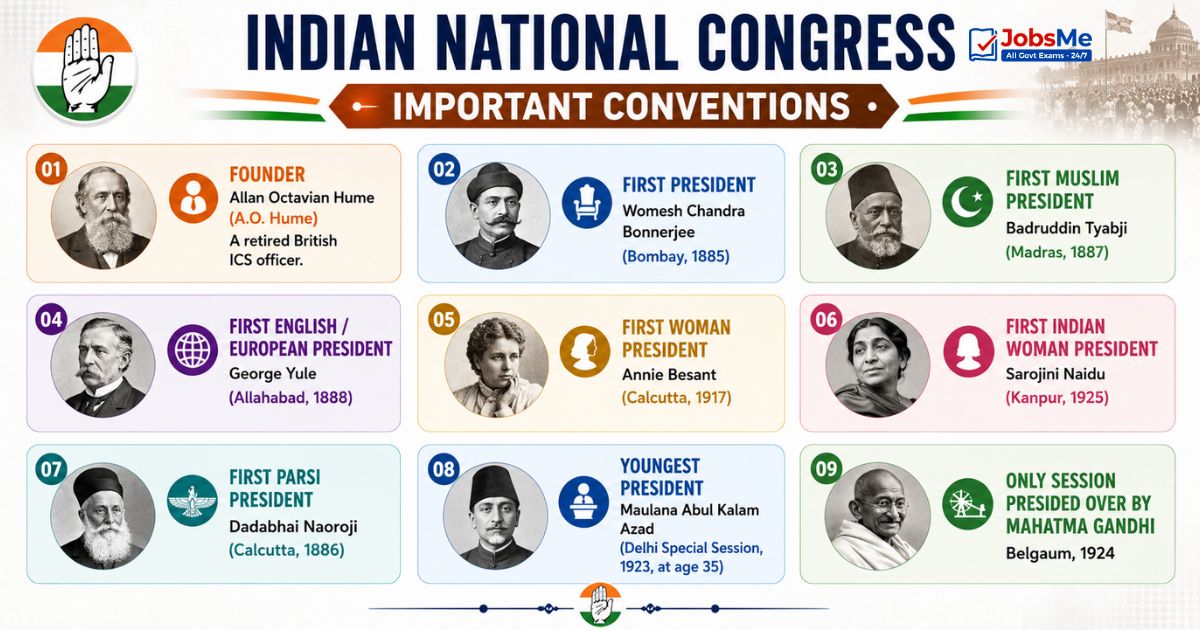
- Founder: Allan Octavian Hume (A.O. Hume), a retired British ICS officer.
- First President: Womesh Chandra Bonnerjee (Bombay, 1885).
- First Muslim President: Badruddin Tyabji (Madras, 1887).
- First English / European President: George Yule (Allahabad, 1888).
- First Woman President: Annie Besant (Calcutta, 1917).
- First Indian Woman President: Sarojini Naidu (Kanpur, 1925).
- First Parsi President: Dadabhai Naoroji (Calcutta, 1886).
- Youngest President: Maulana Abul Kalam Azad (Delhi Special Session, 1923, at age 35).
- Only Session presided over by Mahatma Gandhi: Belgaum, 1924.
Complete List of Indian National Congress Sessions (1885-1947)
The following table lists every major INC session from its foundation in 1885 to the last session before Independence in 1946, along with the venue, president, and key outcome of each session.
Moderate Phase Sessions (1885-1905)
| Year | Place | President | Key Significance / Outcomes |
|---|---|---|---|
| 1885 (1st Session) | Bombay | Womesh Chandra Bonnerjee (W.C. Bonnerjee) | Founding session of the Indian National Congress at Gokuldas Tejpal Sanskrit College; attended by 72 delegates; convened by A.O. Hume with Lord Dufferin as Viceroy. |
| 1886 (2nd Session) | Calcutta | Dadabhai Naoroji | Merger of the Indian National Congress with the Indian National Conference (founded by Surendranath Banerjee); decision to set up Provincial Congress Committees across India. |
| 1887 (3rd Session) | Madras | Badruddin Tyabji | First Muslim President of the INC; an appeal was made to Muslims to join the national mainstream and the freedom struggle. |
| 1888 (4th Session) | Allahabad | George Yule | First English (European) President of the INC. |
| 1889 (5th Session) | Bombay | Sir William Wedderburn | INC's British Committee was founded in London to influence British public opinion in favour of Indian demands. |
| 1890 (6th Session) | Calcutta | Pherozeshah Mehta | Kadambini Ganguly, the first woman graduate of Calcutta University, addressed the Congress — a milestone for women in Indian public life. |
| 1891 (7th Session) | Nagpur | P. Ananda Charlu | Regular annual session continuing the moderate constitutional approach. |
| 1892 (8th Session) | Allahabad | W.C. Bonnerjee | Congress criticised the Indian Councils Act of 1892 as inadequate; demanded the right of Indians to elect their own representatives. |
| 1893 (9th Session) | Lahore | Dadabhai Naoroji | Dadabhai Naoroji presided for the second time. |
| 1894 (10th Session) | Madras | Alfred Webb | Alfred Webb, an Irish nationalist, became the second European to preside over the Congress. |
| 1895 (11th Session) | Pune (Poona) | Surendranath Banerjee | Significant increase in the number of delegates attending; Surendranath Banerjee, the "Indian Burke," presided for the first time. |
| 1896 (12th Session) | Calcutta | Rahimtullah M. Sayani | National Song "Vande Mataram" was sung for the first time by Rabindranath Tagore; Congress passed a resolution blaming the British for the devastating famine. |
| 1897 (13th Session) | Amravati (Amraoti) | C. Sankaran Nair | Congress condemned the British for the arrest of Bal Gangadhar Tilak on charges of sedition; Sankaran Nair was the first and only Keralite President of the INC. |
| 1898 (14th Session) | Madras | Ananda Mohan Bose | Continued advocacy for representative government and civil rights. |
| 1899 (15th Session) | Lucknow | Romesh Chunder Dutt | Demand for permanent fixation of land revenue; Congress urged the British to stop the "Drain of Wealth" from India to England. |
| 1900 (16th Session) | Lahore | N.G. Chandavarkar | Continuation of moderate constitutional demands. |
| 1901 (17th Session) | Calcutta | Dinshaw Eduljee Wacha | Mahatma Gandhi appeared on the Congress platform for the first time and pleaded for support against racial injustice in South Africa. |
| 1902 (18th Session) | Ahmedabad | Surendranath Banerjee | Surendranath Banerjee presided for the second time. |
| 1903 (19th Session) | Madras | Lal Mohan Ghosh | Continuation of constitutional demands and political reform discussions. |
| 1904 (20th Session) | Bombay | Sir Henry Cotton | Congress protested against Lord Curzon's misuse of Indian revenue for his Tibet policy and his proposed partition of Bengal. |
| 1905 (21st Session) | Banaras (Varanasi) | Gopal Krishna Gokhale | Formal proclamation of the Swadeshi Movement against the Partition of Bengal; the rift between Moderates and Extremists came to the surface. |
Extremist Phase Sessions (1906-1916)
| Year | Place | President | Key Significance / Outcomes |
|---|---|---|---|
| 1906 (22nd Session) | Calcutta | Dadabhai Naoroji (third time) | The term "Swaraj" was formally declared as the goal of the INC for the first time; four resolutions adopted — Swaraj, Boycott, Swadeshi, and National Education. |
| 1907 (23rd Session - Suspended) | Surat | Rash Behari Ghosh | Surat Split — Congress split into Moderates (Surendranath Banerjea, Gopal Krishna Gokhale) and Extremists (Tilak, Lala Lajpat Rai, Bipin Chandra Pal); session adjourned. |
| 1908 (23rd Session reconvened) | Madras | Rash Behari Ghosh | The Constitution of the Congress was drawn up for the first time. |
| 1909 (24th Session) | Lahore | Madan Mohan Malaviya | Congress opposed the Indian Councils Act of 1909 and the provision of separate electorates on the basis of religion (Morley-Minto Reforms). |
| 1910 (25th Session) | Allahabad | Sir William Wedderburn | M.A. Jinnah decried the separate electorate system introduced by the Indian Councils Act of 1909. |
| 1911 (26th Session) | Calcutta | Bishan Narayan Dar | The National Anthem "Jana Gana Mana" was sung for the first time at a Congress session. |
| 1912 (27th Session) | Bankipore (Patna) | Raghunath Narasinha Mudholkar | Regular session focused on legislative and administrative demands. |
| 1913 (28th Session) | Karachi | Nawab Syed Mohammed Bahadur | Continued discussion on Indian representation and self-government. |
| 1914 (29th Session) | Madras | Bhupendra Nath Bose | Congress demanded that Indians be allowed to hold higher positions in the army. |
| 1915 (30th Session) | Bombay | Satyendra Prasanna Sinha (S.P. Sinha) | Constitution of the Congress was suitably amended to readmit the Extremist faction. |
| 1916 (31st Session) | Lucknow | Ambica Charan Mazumdar (A.C. Majumdar) | Historic reunion of Moderates and Extremists; the famous Lucknow Pact signed between the INC and the All-India Muslim League for joint constitutional demands. |
For more detailed coverage of these landmark events, you can explore the Daily Current Affairs section on Jobsme.in for related themes.
Gandhian Phase Sessions (1917-1947)
| Year | Place | President | Key Significance / Outcomes |
|---|---|---|---|
| 1917 (32nd Session) | Calcutta | Annie Besant | First woman President of the Indian National Congress; Annie Besant was also the founder of the Home Rule League. |
| 1918 (33rd Session) | Delhi | Madan Mohan Malaviya | Madan Mohan Malaviya presided for the second time. |
| 1918 (Special Session) | Bombay | Syed Hasan Imam | Convened to deliberate on the Montagu-Chelmsford Reforms; Congress termed the reforms "disappointing" and demanded a Declaration of Rights for Indians. |
| 1919 (34th Session) | Amritsar | Motilal Nehru | Congress condemned the Jallianwala Bagh Massacre (13 April 1919) and extended support to the Khilafat Movement. |
| 1920 (Special Session) | Calcutta | Lala Lajpat Rai | Mahatma Gandhi moved the resolution for the Non-Cooperation Movement, which was approved. |
| 1920 (35th Session) | Nagpur | C. Vijayaraghavachariar | Congress decided to intensify the Non-Cooperation Movement; reorganisation of Congress committees on a linguistic basis; M.A. Jinnah left the INC. |
| 1921 (36th Session) | Ahmedabad | Hakim Ajmal Khan (Acting for C.R. Das, who was in prison) | Gandhi was declared the sole executive authority of the Congress with full AICC powers; Hasrat Mohani demanded Complete Independence. |
| 1922 (37th Session) | Gaya | Deshbandhu Chittaranjan Das (C.R. Das) | Intense debate on Council Entry; C.R. Das and Motilal Nehru broke away and founded the Swaraj Party. |
| 1923 (Special Session) | Delhi | Maulana Abul Kalam Azad | At age 35, Azad became the youngest President of the INC; permitted members to contest the next elections; All India Khadi Board formed. |
| 1923 (38th Session) | Kakinada | Maulana Mohammad Ali Jouhar | Resolution to abolish untouchability passed, which sparked the Vaikom Satyagraha; Hindustan Seva Dal founded with Jawaharlal Nehru as first president. |
| 1924 (39th Session) | Belgaum (Belagavi) | M.K. Gandhi | The only INC session presided over by Mahatma Gandhi; focus on Hindu-Muslim unity, Khadi, village industries, and removal of untouchability. |
| 1925 (40th Session) | Kanpur (Cawnpore) | Sarojini Naidu | First Indian woman President of the INC; Sarojini Naidu is known as the Nightingale of India. |
| 1926 (41st Session) | Guwahati (Gauhati) | S. Srinivasa Iyengar | First INC session in North-East India; Khadi was made compulsory for Congress members. |
| 1927 (42nd Session) | Madras | M.A. Ansari (Dr. Mukhtar Ahmed Ansari) | Resolution passed to boycott the Simon Commission; complete national independence adopted as the goal; resolution against use of Indian troops in China, Iran, and Mesopotamia. |
| 1928 (43rd Session) | Calcutta | Motilal Nehru | The first All India Youth Congress was formed; resolution adopted to accept the Nehru Report's suggestion of Dominion Status if granted within two years. |
| 1929 (44th Session) | Lahore | Jawaharlal Nehru | Purna Swaraj (Complete Independence) declared as the goal; 26 January 1930 fixed as Independence Day; Working Committee authorised to launch the Civil Disobedience Movement. |
| 1931 (45th Session) | Karachi | Vallabhbhai Patel | Historic resolutions on Fundamental Rights and the National Economic Programme; endorsement of the Gandhi-Irwin Pact; Gandhi nominated to represent the INC at the Second Round Table Conference. |
| 1932 (46th Session) | Delhi | Amrit Ranchhoddas Seth | Congress was declared illegal by the British government during this period. |
| 1933 (47th Session) | Calcutta | Nellie Sengupta | Third woman President of the INC; British-born wife of Bengali leader J.M. Sengupta. |
| 1934 (48th Session) | Bombay | Dr. Rajendra Prasad | Wearing of Khadi made compulsory for elected members; the Congress Socialist Party was formed as a faction within the Congress. |
| 1936 (49th Session) | Lucknow | Jawaharlal Nehru | Nehru urged the Congress to adopt Socialism as its goal; emphasised mass-based political mobilisation. |
| 1937 (50th Session) | Faizpur (Bombay Presidency, near Jalgaon) | Jawaharlal Nehru | First INC session held in a rural area / village — a deliberate effort to take the Congress to the masses. |
| 1938 (51st Session) | Haripura (Gujarat) | Subhash Chandra Bose | The National Planning Committee was set up under the chairmanship of Jawaharlal Nehru; rejected the federal structure of the Government of India Act 1935; Haripura resolution demanded Poorna Swaraj. |
| 1939 (52nd Session) | Tripuri (Madhya Pradesh) | Subhash Chandra Bose (later Rajendra Prasad) | Bose was re-elected defeating Pattabhi Sitaramayya (Gandhi's candidate) but resigned due to differences; Rajendra Prasad took over; Bose subsequently formed the Forward Bloc. |
| 1940 (53rd Session) | Ramgarh (Bihar) | Maulana Abul Kalam Azad | Congress objected to India being declared a belligerent in World War II without consulting Indians; declared that nothing short of complete independence would be accepted; Civil Disobedience to be launched at an appropriate time. |
| 1941-1945 | No session | — | No regular session held due to the Quit India Movement (1942), RIN Mutiny, INA trials, and constitutional negotiations (Cripps Mission, Wavell Plan, Cabinet Mission). Azad continued as president throughout this period. |
| 1946 (54th Session) | Meerut | J.B. Kripalani (Acharya Kripalani) | Last INC session before Independence; Kripalani was the Congress President at the time of India's Independence on 15 August 1947. |
Important Post-Independence INC Sessions
| Year | Place | President | Key Significance / Outcomes |
|---|---|---|---|
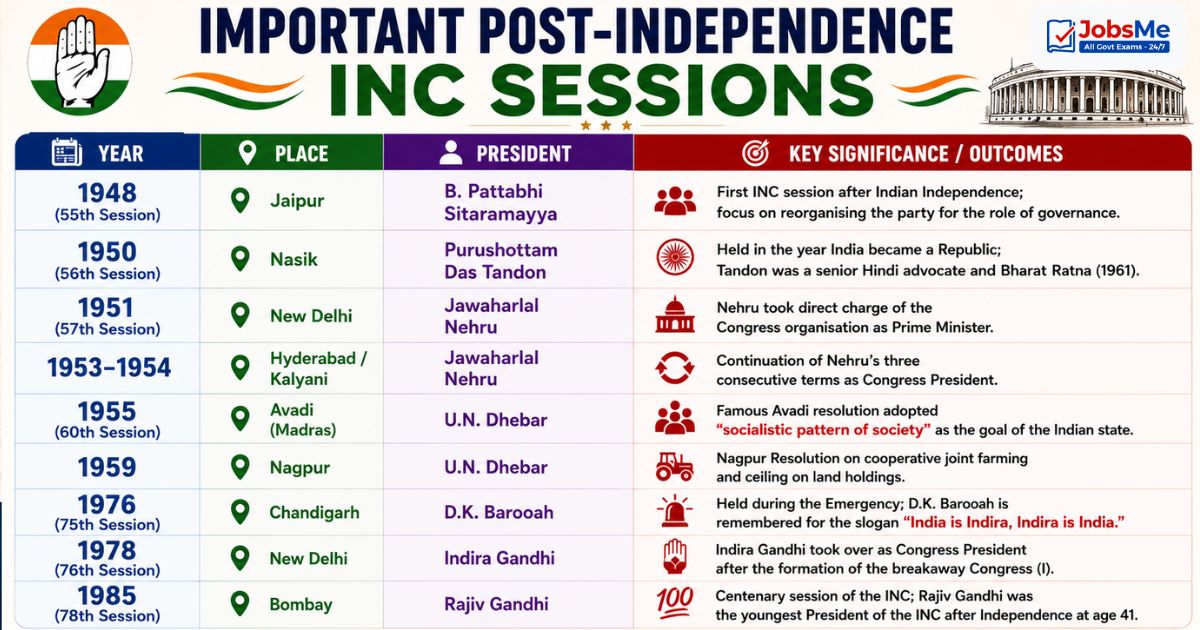
| 1948 (55th Session) | Jaipur | B. Pattabhi Sitaramayya | First INC session after Indian Independence; focus on reorganising the party for the role of governance. |
| 1950 (56th Session) | Nasik | Purushottam Das Tandon | Held in the year India became a Republic; Tandon was a senior Hindi advocate and Bharat Ratna (1961). |
| 1951 (57th Session) | New Delhi | Jawaharlal Nehru | Nehru took direct charge of the Congress organisation as Prime Minister. |
| 1953-1954 | Hyderabad / Kalyani | Jawaharlal Nehru | Continuation of Nehru's three consecutive terms as Congress President. |
| 1955 (60th Session) | Avadi (Madras) | U.N. Dhebar | Famous Avadi resolution adopted "socialistic pattern of society" as the goal of the Indian state. |
| 1959 | Nagpur | U.N. Dhebar | Nagpur Resolution on cooperative joint farming and ceiling on land holdings. |
| 1976 (75th Session) | Chandigarh | D.K. Barooah | Held during the Emergency; D.K. Barooah is remembered for the slogan "India is Indira, Indira is India." |
| 1978 (76th Session) | New Delhi | Indira Gandhi | Indira Gandhi took over as Congress President after the formation of the breakaway Congress (I). |
| 1985 (78th Session) | Bombay | Rajiv Gandhi | Centenary session of the INC; Rajiv Gandhi was the youngest President of the INC after Independence at age 41. |
Memory Tricks and Mnemonics
Trick 1: "BCMABCB" — The First Eight Sessions (1885-1892)
To remember the venues of the first eight INC sessions in order, use the acronym "BCMABCB Bombay-Calcutta-Madras-Allahabad-Bombay-Calcutta-Nagpur-Allahabad":
- B → 1885 Bombay (W.C. Bonnerjee).
- C → 1886 Calcutta (Dadabhai Naoroji).
- M → 1887 Madras (Badruddin Tyabji).
- A → 1888 Allahabad (George Yule).
- B → 1889 Bombay (W. Wedderburn).
- C → 1890 Calcutta (Pherozeshah Mehta).
- N → 1891 Nagpur (P. Ananda Charlu).
- A → 1892 Allahabad (W.C. Bonnerjee).
Trick 2: "Four Firsts" — The First-of-Their-Kind Presidents
Use this acronym "WBGA SDH" — Womesh, Badruddin, George, Annie, Sarojini, Dadabhai, Hakim:
- W → First President — Womesh Chandra Bonnerjee (1885 Bombay).
- B → First Muslim President — Badruddin Tyabji (1887 Madras).
- G → First English / European President — George Yule (1888 Allahabad).
- A → First Woman President — Annie Besant (1917 Calcutta).
- S → First Indian Woman President — Sarojini Naidu (1925 Kanpur).
- D → First Parsi President — Dadabhai Naoroji (1886 Calcutta).
- H → Only President of INC + Muslim League + Khilafat Committee — Hakim Ajmal Khan.
Trick 3: "Vande Jana" — Songs Sung for the First Time
To remember the sessions where the National Song and National Anthem were first sung:
- Vande Mataram → 1896 Calcutta Session (Rahimtullah Sayani) → sung by Rabindranath Tagore.
- Jana Gana Mana → 1911 Calcutta Session (Bishan Narayan Dar).
"Both anthems were born in Calcutta — 1896 sang Vande, 1911 sang Jana."
Trick 4: "Surat-Lucknow-Lahore-Karachi" — Four Landmark Sessions
Use the chain "S-L-L-K" to remember the four most-asked sessions in exams:
- S — Surat 1907 (Rash Behari Ghosh): Surat Split — Moderates vs Extremists.
- L — Lucknow 1916 (A.C. Mazumdar): Lucknow Pact and Moderate-Extremist reunion.
- L — Lahore 1929 (Jawaharlal Nehru): Purna Swaraj resolution; 26 January 1930 = Independence Day.
- K — Karachi 1931 (Vallabhbhai Patel): Fundamental Rights + Economic Programme + Gandhi-Irwin Pact.
Trick 5: "Naoroji Three Times" — The Hat-Trick President
Dadabhai Naoroji, the Grand Old Man of India, presided over the INC three times. Remember as "86-93-06: Calcutta-Lahore-Calcutta":
- 1886 → Calcutta (Second session, merger with National Conference).
- 1893 → Lahore.
- 1906 → Calcutta (Swaraj declared as goal).
Trick 6: "Gandhi One, Bose Two, Nehru Many" — Presidents Counted
A useful contrast trick for the Big Three of the freedom struggle:
- Mahatma Gandhi → Presided only once at Belgaum (1924).
- Subhash Chandra Bose → Presided twice — Haripura (1938) and Tripuri (1939, resigned).
- Jawaharlal Nehru → Presided multiple times — Lahore (1929), Lucknow (1936), Faizpur (1937), and again after Independence.
Trick 7: "Three Women" — Female Presidents of the INC
Only a handful of women have led the INC before Independence:
- 1st → Annie Besant (1917 Calcutta) — first woman, of Irish origin.
- 2nd → Sarojini Naidu (1925 Kanpur) — first Indian woman.
- 3rd → Nellie Sengupta (1933 Calcutta) — British-born; wife of J.M. Sengupta.
"Annie, Sarojini, Nellie — A-S-N."
Trick 8: "Village-Youth-Plan-Pact" — One-Word Cues for Famous Sessions
- Village → 1937 Faizpur (Nehru) — first rural session.
- Youth → 1928 Calcutta (Motilal Nehru) — first All India Youth Congress.
- Plan → 1938 Haripura (Bose) — National Planning Committee.
- Pact → 1916 Lucknow (Mazumdar) — Lucknow Pact with Muslim League.
Additional Notes
Frequently Confused Facts
- First Woman President vs First Indian Woman President: Annie Besant (1917 Calcutta) was the first woman President; Sarojini Naidu (1925 Kanpur) was the first Indian woman President. Annie Besant was Irish-born.
- Founding Year vs First Session: Both are the same — 28 December 1885, Bombay. There is no earlier session.
- Founder of INC vs First President: A.O. Hume founded the INC; W.C. Bonnerjee was the first president. They are often confused.
- 1923 Two Sessions: 1923 had two sessions — Special Session at Delhi (Maulana Abul Kalam Azad) and the regular Kakinada Session (Maulana Mohammad Ali). Do not confuse the two.
- Surat 1907 vs Lucknow 1916: Surat caused the Moderate-Extremist split; Lucknow brought the reunion. Surat = split; Lucknow = unity.
- Vande Mataram vs Jana Gana Mana: Vande Mataram first sung in 1896 (Calcutta); Jana Gana Mana first sung in 1911 (Calcutta). Both in Calcutta, fifteen years apart.
- Swaraj first mentioned vs Purna Swaraj declared: Swaraj first mentioned in 1906 (Calcutta, Naoroji); Purna Swaraj (Complete Independence) declared in 1929 (Lahore, Nehru).
- Only session by Gandhi: Belgaum 1924 — not any other session. Gandhi never presided over the Congress again.
- Faizpur 1937: First village session, not Wardha or Haripura. Faizpur is near Jalgaon in Maharashtra (then Bombay Presidency).
- Karachi 1931 vs Lahore 1929: Lahore declared Purna Swaraj; Karachi adopted Fundamental Rights and Economic Programme resolutions.
- Tripuri 1939: Bose was re-elected but resigned; Rajendra Prasad replaced him as president — both names are linked to this session.
- Youngest President: Maulana Abul Kalam Azad (age 35 at the 1923 Delhi Special Session). After Independence, Rajiv Gandhi (age 41) was the youngest INC President.
Repeating PYQ Patterns
Certain INC sessions appear almost every year in competitive exams. 1885 Bombay (W.C. Bonnerjee), 1906 Calcutta (Naoroji - Swaraj), 1907 Surat (Rash Behari Ghosh - Split), 1916 Lucknow (Mazumdar - Lucknow Pact), 1917 Calcutta (Annie Besant - first woman), 1920 Nagpur (Vijayaraghavachariar - Non-Cooperation), 1924 Belgaum (Gandhi), 1925 Kanpur (Sarojini Naidu), 1929 Lahore (Nehru - Purna Swaraj), 1931 Karachi (Patel - Fundamental Rights), 1937 Faizpur (Nehru - first village session), 1938 Haripura (Bose), and 1946 Meerut (Kripalani - last before Independence) appear most frequently in UPSC Prelims, SSC CGL, RRB NTPC, and IBPS PO. Banking and Insurance exams often ask matching-type questions linking presidents with venues. State PCS exams give extra weight to sessions held in their region — Maharashtra PCS focuses on Bombay, Nagpur, Faizpur; West Bengal PCS on Calcutta sessions; UP PCS on Lucknow, Allahabad, Kanpur, Meerut. Aspirants can practise more such questions through the Static GK Quiz on Jobsme.in.
Quick Insight
The journey of the INC sessions is essentially the journey of modern India — from a polite assembly of 72 delegates seeking minor reforms in 1885, to a mass movement declaring Purna Swaraj at Lahore in 1929, to the inheritor of state power in 1947. Each session marks a turning point: Calcutta 1906 (Swaraj as goal), Surat 1907 (the split that radicalised the movement), Lucknow 1916 (Hindu-Muslim joint demand), Nagpur 1920 (Non-Cooperation), Lahore 1929 (Complete Independence), Karachi 1931 (Fundamental Rights — the blueprint of Part III of our Constitution), and Faizpur 1937 (taking politics to the village). Understanding these sessions is essential not only for Prelims but also for UPSC Mains essays on the freedom struggle, federalism, and minority rights. To stay updated on related topics, check the Banking Awareness notes and the latest Government Job Notifications on Jobsme.in.
One-Liners for Quick Revision
- INC Founded → 28 December 1885 by A.O. Hume at Gokuldas Tejpal Sanskrit College, Bombay.
- Viceroy at INC's founding → Lord Dufferin.
- 1885 Bombay → 1st Session; President: W.C. Bonnerjee; 72 delegates.
- 1886 Calcutta → Dadabhai Naoroji; merger with Indian National Conference.
- 1887 Madras → Badruddin Tyabji, first Muslim President.
- 1888 Allahabad → George Yule, first English President.
- 1889 Bombay → Sir William Wedderburn; British Committee of INC founded.
- 1890 Calcutta → Pherozeshah Mehta; Kadambini Ganguly addressed Congress.
- 1891 Nagpur → P. Ananda Charlu.
- 1892 Allahabad → W.C. Bonnerjee (2nd time); Congress criticised Indian Councils Act 1892.
- 1893 Lahore → Dadabhai Naoroji (2nd time).
- 1894 Madras → Alfred Webb (Irish nationalist).
- 1895 Pune → Surendranath Banerjee.
- 1896 Calcutta → Rahimtullah Sayani; Vande Mataram sung for the first time.
- 1897 Amravati → C. Sankaran Nair (first and only Keralite President).
- 1898 Madras → Ananda Mohan Bose.
- 1899 Lucknow → R.C. Dutt; demand for permanent fixation of land revenue; "Drain of Wealth" protest.
- 1900 Lahore → N.G. Chandavarkar.
- 1901 Calcutta → Dinshaw Wacha; Gandhi appeared on Congress platform for the first time.
- 1902 Ahmedabad → Surendranath Banerjee (2nd time).
- 1903 Madras → Lal Mohan Ghosh.
- 1904 Bombay → Sir Henry Cotton; protest against Lord Curzon.
- 1905 Banaras → Gopal Krishna Gokhale; Swadeshi resolution against Partition of Bengal.
- 1906 Calcutta → Dadabhai Naoroji (3rd time); Swaraj declared as INC's goal for the first time; four resolutions — Swaraj, Boycott, Swadeshi, National Education.
- 1907 Surat → Rash Behari Ghosh; Surat Split — Moderates vs Extremists; session adjourned.
- 1908 Madras → Rash Behari Ghosh; Constitution of Congress drawn.
- 1909 Lahore → Madan Mohan Malaviya; Congress opposed separate electorates of Indian Councils Act 1909.
- 1910 Allahabad → William Wedderburn (2nd time); Jinnah opposed separate electorates.
- 1911 Calcutta → Bishan Narayan Dar; Jana Gana Mana sung for the first time.
- 1912 Bankipore → Raghunath Mudholkar.
- 1913 Karachi → Nawab Syed Mohammed Bahadur.
- 1914 Madras → Bhupendra Nath Bose; demand for higher army positions for Indians.
- 1915 Bombay → S.P. Sinha; Constitution amended to readmit Extremists.
- 1916 Lucknow → A.C. Mazumdar; Lucknow Pact with Muslim League; Moderate-Extremist reunion.
- 1917 Calcutta → Annie Besant, first woman President of INC.
- 1918 Delhi → Madan Mohan Malaviya (2nd time).
- 1918 Special Bombay → Syed Hasan Imam; opposition to Montagu-Chelmsford Reforms.
- 1919 Amritsar → Motilal Nehru; condemned Jallianwala Bagh massacre; supported Khilafat Movement.
- 1920 Special Calcutta → Lala Lajpat Rai; Non-Cooperation Movement approved.
- 1920 Nagpur → C. Vijayaraghavachariar; linguistic reorganisation of Congress committees; Jinnah left INC.
- 1921 Ahmedabad → Hakim Ajmal Khan (acting for C.R. Das); Gandhi given full AICC authority; Hasrat Mohani demanded Complete Independence.
- 1922 Gaya → C.R. Das; Swaraj Party formed by C.R. Das and Motilal Nehru.
- 1923 Special Delhi → Maulana Abul Kalam Azad, youngest President at age 35; All India Khadi Board formed.
- 1923 Kakinada → Maulana Mohammad Ali Jouhar; resolution against untouchability; Hindustan Seva Dal founded.
- 1924 Belgaum → M.K. Gandhi; only session presided over by Mahatma Gandhi.
- 1925 Kanpur → Sarojini Naidu, first Indian woman President.
- 1926 Guwahati → S. Srinivasa Iyengar; first session in North-East India; Khadi made compulsory.
- 1927 Madras → M.A. Ansari; boycott of Simon Commission; complete independence adopted as goal.
- 1928 Calcutta → Motilal Nehru; first All India Youth Congress formed; Nehru Report's Dominion Status accepted.
- 1929 Lahore → Jawaharlal Nehru; Purna Swaraj declared; 26 January 1930 = Independence Day; Civil Disobedience authorised.
- 1931 Karachi → Vallabhbhai Patel; Fundamental Rights and National Economic Programme resolutions; Gandhi-Irwin Pact endorsed.
- 1932 Delhi → Amrit Ranchhoddas Seth; Congress declared illegal.
- 1933 Calcutta → Nellie Sengupta, third woman President.
- 1934 Bombay → Dr. Rajendra Prasad; Khadi compulsory for elected members; Congress Socialist Party formed.
- 1936 Lucknow → Jawaharlal Nehru; urged Congress to adopt Socialism.
- 1937 Faizpur → Jawaharlal Nehru; first INC session in a village / rural area.
- 1938 Haripura → Subhash Chandra Bose; National Planning Committee set up under Nehru.
- 1939 Tripuri → Bose re-elected but resigned; Rajendra Prasad took over; Bose formed Forward Bloc.
- 1940 Ramgarh → Maulana Abul Kalam Azad; protest against India being declared belligerent in WWII.
- 1941-1945 → No session; period of Quit India Movement, RIN Mutiny, INA trials, Cripps Mission, Wavell Plan, Cabinet Mission.
- 1946 Meerut → J.B. Kripalani; last session before Independence; Kripalani was president at the time of 15 August 1947.
- 1948 Jaipur → B. Pattabhi Sitaramayya; first session after Independence.
- 1950 Nasik → Purushottam Das Tandon.
- 1955 Avadi → U.N. Dhebar; "Socialistic Pattern of Society" adopted.
- 1985 Bombay → Rajiv Gandhi; INC Centenary Session.
- Hakim Ajmal Khan → Only person to have been President of INC, All India Muslim League, and All India Khilafat Committee.
- C. Sankaran Nair → First and only Keralite President of the INC (1897 Amravati).
- Sessions not held in 1930, 1935, and 1941-1945 → due to Civil Disobedience, Government of India Act 1935 transition, and WWII / Quit India period respectively.
For more Static GK topics like Modern History, Indian polity, and freedom fighters, explore the Static GK section on Jobsme.in. You can also test your knowledge with the Daily Current Affairs Quiz and stay updated through the Daily Current Affairs notes. Aspirants preparing for banking exams can also brush up on the Computer Awareness section before attempting their next mock test.
Free quiz • No signup required
Put this topic into practice with Indian Cultural Institutions – Static GK MCQ Quiz. It is the quickest way to reinforce what you just learned.
Frequently Asked Questions
When and where was the first session of the Indian National Congress held?
Who was the first woman President of the Indian National Congress?
Who was the first Indian woman to preside over an INC session?
Where and in which year did the Surat Split of the Indian National Congress take place?
In which session was the Purna Swaraj resolution adopted by the INC?
Which was the only INC session presided over by Mahatma Gandhi?
Who was the first Muslim President of the Indian National Congress?
How many times did Dadabhai Naoroji preside over the INC?
Which was the first INC session held in a rural area or village?
Who was the President of the INC at the time of India's Independence in 1947?

About the author