List of Freedom Fighters and Their Slogans – Static GK & General Awareness for Competitive Exams with Memory Tricks
This article presents a complete list of Indian freedom fighters and their famous slogans, covering the leaders of the Swadeshi, Home Rule, Non-Cooperation, Civil Disobedience, and Quit India Movements, along with the meaning, origin, and historical context behind each slogan. It includes iconic battle cries like "Do or Die" (Gandhi), "Inquilab Zindabad" (Bhagat Singh), "Give Me Blood and I Shall Give You Freedom" (Subhash Chandra Bose), "Swaraj is My Birthright" (Tilak), "Simon Go Back" (Lala Lajpat Rai), and "Vande Mataram" (Bankim Chandra Chattopadhyay), with memory tricks and exam-ready one-liners. All facts are arranged in a structured format to help UPSC, SSC, IBPS, RRB, PSU, and State PCS aspirants score better in General Awareness and Modern History sections.
Jump to section
- Introduction
- Core Concepts: Why Slogans Mattered in India's Freedom Struggle
- Slogans and Their Movement Phases
- Major Slogans of India's Freedom Struggle - Origin and Meaning
- Freedom Fighters and Their Slogans - Personality-Wise List
- Memory Tricks and Mnemonics
- Additional Notes
- One-Liners for Quick Revision
Introduction
India's freedom struggle was shaped not only by movements, protests, and sacrifices but also by powerful slogans that inspired millions. "Do or Die" from Mahatma Gandhi, "Inquilab Zindabad" popularised by Bhagat Singh, "Give Me Blood and I Shall Give You Freedom" from Subhash Chandra Bose, "Swaraj is My Birthright" from Bal Gangadhar Tilak, and "Simon Go Back" from Lala Lajpat Rai created emotional unity, political awareness, and a shared national identity during the long battle against British colonial rule. These short, fiery phrases mobilised the masses, strengthened resistance, and communicated complex political ideas in simple words that even an illiterate villager could understand and repeat.
Questions on freedom fighters and their slogans appear regularly in UPSC Prelims, SSC CGL, IBPS PO, RRB NTPC, SBI Clerk, State PCS, and various Insurance and Defence exams. Examiners typically ask which slogan was given by which leader, in which year a particular slogan was first raised, which movement it is linked to, or which leader is associated with a specific phrase like "Dilli Chalo" or "Sarfaroshi ki Tamanna." This article brings together every important slogan in a structured, exam-ready format. To explore more such topics, you can refer to the Static GK section on Jobsme.in for related modern history notes.
Slogans of freedom fighters are also closely linked to current affairs themes such as birth and death anniversaries of national leaders, Republic Day and Independence Day speeches, references in Parliament debates, and national salutations like "Jai Hind" still used in official communication, making this topic doubly important for aspirants preparing for UPSC Mains, Essay papers, and Interview rounds. For latest updates on exam notifications, check the Latest Government Job Notifications page on Jobsme.in.
Core Concepts: Why Slogans Mattered in India's Freedom Struggle
Slogans were short, impactful statements used to motivate people, communicate political messages, and unify diverse masses across language and regional barriers. During the independence movement, leaders used slogans to demand freedom, oppose injustice, and awaken national consciousness in a way that long speeches and pamphlets could not. Their brevity made them memorable; their emotional charge made them effective.
Why Slogans Worked
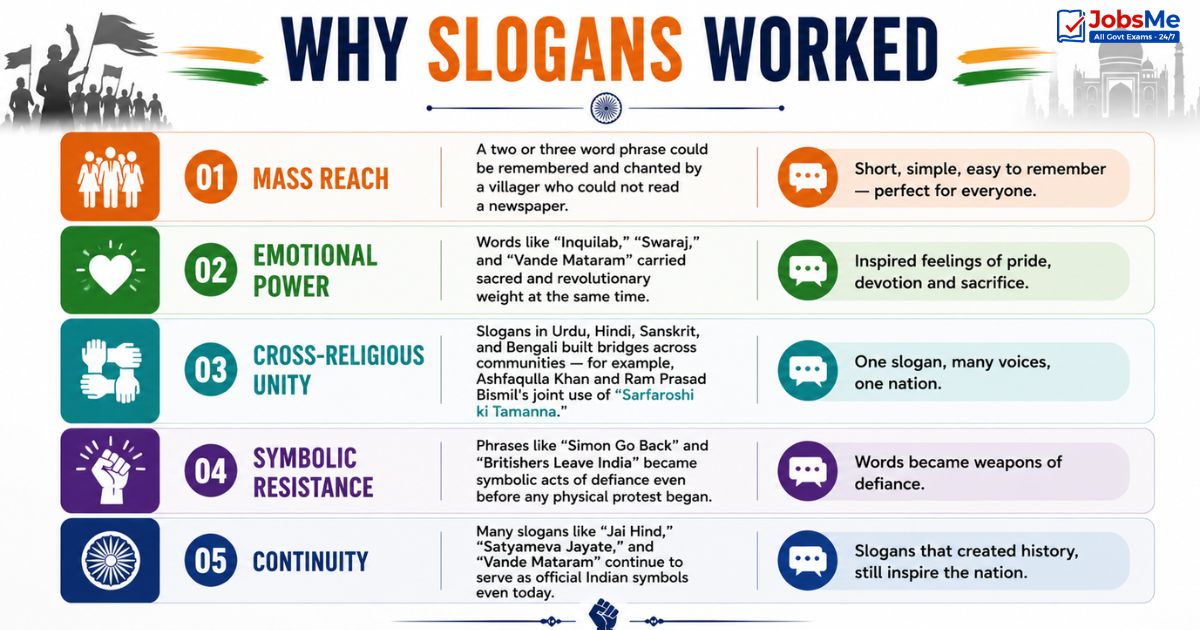
- Mass Reach: A two or three word phrase could be remembered and chanted by a villager who could not read a newspaper.
- Emotional Power: Words like "Inquilab," "Swaraj," and "Vande Mataram" carried sacred and revolutionary weight at the same time.
- Cross-Religious Unity: Slogans in Urdu, Hindi, Sanskrit, and Bengali built bridges across communities — for example, Ashfaqulla Khan and Ram Prasad Bismil's joint use of "Sarfaroshi ki Tamanna."
- Symbolic Resistance: Phrases like "Simon Go Back" and "Britishers Leave India" became symbolic acts of defiance even before any physical protest began.
- Continuity: Many slogans like "Jai Hind," "Satyameva Jayate," and "Vande Mataram" continue to serve as official Indian symbols even today.
Categories of Slogans
- Revolutionary Nationalist Slogans: Sparked aggressive resistance and called for sacrifice — examples include "Inquilab Zindabad" and "Vande Mataram."
- Non-Violent Mass Mobilization Slogans: Central to Gandhian movements — examples include "Do or Die" and "Satyameva Jayate."
- Social Reform and Unity Slogans: Broke caste and communal barriers — examples include "Sarfaroshi ki Tamanna" and "Jai Hind."
- Self-Rule Slogans: Demanded political independence — examples include "Swaraj is My Birthright" and "Quit India."
- Anti-Imperialist Slogans: Targeted specific colonial actions — examples include "Simon Go Back" and "Down with Imperialism."
Slogans and Their Movement Phases
The use of slogans intensified during each major phase of India's freedom movement. Each movement produced its own distinct rallying cries that reflected the mood and method of that period.
| Movement / Phase | Year | Associated Slogans | Key Features |
|---|---|---|---|
| Revolt of 1857 | 1857 | "Maaro Firangi Ko" (Mangal Pandey); "Main Apni Jhansi Nahi Doongi" (Rani Lakshmibai) | India's First War of Independence; slogans were short war cries used in battle against the British East India Company forces. |
| Swadeshi Movement | 1905 | "Vande Mataram"; "Swadeshi" | Launched after the Partition of Bengal by Lord Curzon; slogans promoted indigenous goods and boycott of British products. Bhikaji Cama unfurled the flag with "Vande Mataram" at Stuttgart in 1907. |
| Home Rule Movement | 1916 | "Swaraj is My Birthright and I Shall Have It" | Led by Bal Gangadhar Tilak (Belgaum, April 1916) and Annie Besant; demanded self-rule within the British Empire on the lines of the Irish Home Rule movement. |
| Non-Cooperation Movement | 1920-1922 | "Boycott"; "Satyameva Jayate"; "Asahyog" | Launched by Mahatma Gandhi; mass use of slogans for boycotts of British goods, courts, schools, and titles. Withdrawn after the Chauri Chaura incident (February 1922). |
| Simon Commission Protests | 1928 | "Simon Go Back" | Lala Lajpat Rai led the Lahore protest where he was lathi-charged; he died of injuries on 17 November 1928, an event later avenged by Bhagat Singh, Rajguru, and Sukhdev. |
| Civil Disobedience Movement | 1930-1934 | "Salt Satyagraha"; "Purna Swaraj" | Began with the Dandi March (12 March - 6 April 1930); slogans promoted breaking unjust laws, salt-making, and complete independence after the Lahore Session (December 1929). |
| Quit India Movement | 1942 | "Do or Die"; "Quit India"; "Britishers Leave India" | The most powerful and unified slogans demanding immediate freedom; given by Gandhi on 8 August 1942 at the Bombay (Gowalia Tank) session of AICC. |
| INA / Azad Hind Movement | 1943-1945 | "Give Me Blood and I Shall Give You Freedom"; "Jai Hind"; "Dilli Chalo" | Led by Subhash Chandra Bose; slogans inspired Indians abroad and the Indian National Army (Azad Hind Fauj) to march towards India through Burma. |
Major Slogans of India's Freedom Struggle - Origin and Meaning
The following table presents the most exam-relevant slogans along with their author, year, original source, meaning, and historical context. Examiners often ask the year, occasion, and exact phrasing, so the details column matters as much as the slogan itself.
| Slogan | Given By | Year / Occasion | Meaning and Key Details |
|---|---|---|---|
| Do or Die | Mahatma Gandhi | 8 August 1942, Bombay (Quit India speech) | "Karenge ya Marenge" — called for complete commitment to independence. Aimed to push British rule out of India immediately during the Quit India Movement. |
| Quit India / Britishers Leave India | Yusuf Meherally (coined); popularised by Gandhi | August 1942 | Used widely by masses during the 1942 uprising; demonstrated urgency for independence. Yusuf Meherally is credited with coining the phrase "Quit India." |
| Satyameva Jayate | Promoted by Mahatma Gandhi | Ancient — adopted as national motto on 26 January 1950 | Meaning: "Truth Alone Triumphs." Originally from the Mundaka Upanishad (3.1.6). Inscribed below the Lion Capital of Ashoka in the National Emblem of India. |
| Ahimsa Parmo Dharma | Mahatma Gandhi | Gandhian principle | Meaning: "Non-violence is the highest duty." Originally a Mahabharata verse; became the philosophical core of Gandhian satyagraha. |
| Give Me Blood and I Shall Give You Freedom | Netaji Subhash Chandra Bose | 4 July 1944, rally in Burma (Rangoon) | Original: "Tum Mujhe Khoon Do, Main Tumhe Azadi Doonga." Delivered to motivate Indians to join the Indian National Army (INA / Azad Hind Fauj). |
| Jai Hind | Adopted by INA under Bose | 1940s; first coined by Chempakaraman Pillai | Earlier used by Chempakaraman Pillai (Berlin, 1907); popularised by Bose and INA. Later became India's national salutation, used at the end of Independence Day and Republic Day speeches. |
| Dilli Chalo | Netaji Subhash Chandra Bose | 1943, INA campaign | Meaning: "March to Delhi." A military call for the INA to march from Burma through Imphal-Kohima towards Delhi to liberate India. |
| Inquilab Zindabad | Coined by Maulana Hasrat Mohani; popularised by Bhagat Singh | Used in Central Legislative Assembly bombing, 8 April 1929 | Meaning: "Long Live the Revolution." Became the rallying cry of revolutionary nationalism. Bhagat Singh and Batukeshwar Dutt shouted it after throwing bombs in the Assembly. |
| Down with Imperialism | Bhagat Singh | Used in trials, writings, and HSRA leaflets | "Samrajyavad ka Naash Ho" — represented direct resistance to colonial oppression. Used by the Hindustan Socialist Republican Association (HSRA). |
| Simon Go Back | Lala Lajpat Rai | 30 October 1928, Lahore | Raised in protest against the all-white Simon Commission. Became a symbol of rejecting imperial policies framed without Indian participation. Lala Lajpat Rai died from lathi-charge injuries. |
| Swaraj is My Birthright and I Shall Have It | Bal Gangadhar Tilak | 1916, Belgaum (during Home Rule Movement) | Tilak's defining political assertion; he founded the Indian Home Rule League at Belgaum in April 1916. The word "Swarajya" itself was first used in Congress by Dadabhai Naoroji (Calcutta Session, 1906). |
| Aaram Haram Hai | Jawaharlal Nehru | Post-independence, used during nation-building drive | Meaning: "Rest is forbidden." Used by India's first Prime Minister to motivate youth and workers for national service and development work. |
| Jana Gana Mana | Rabindranath Tagore | First sung 27 December 1911, Calcutta Session of INC; adopted as National Anthem on 24 January 1950 | A patriotic composition expressing India's unity. Originally written in Bengali (Tatsama Sanskrit form). Tagore is the only person to have written national anthems of two countries — India and Bangladesh. |
| Vande Mataram | Bankim Chandra Chattopadhyay | Written 1875; included in novel Anandamath (1882) | Meaning: "I bow to thee, O Mother." Adopted as the National Song on 24 January 1950. Inspired the Swadeshi Movement and was the title cry of Madame Bhikaji Cama's flag at Stuttgart (1907). |
| Amar Sonar Bangla | Rabindranath Tagore | Written 1905 in response to Partition of Bengal | Meaning: "My Golden Bengal." Later adopted as the National Anthem of Bangladesh (1971). |
| Sarfaroshi ki Tamanna | Coined by Bismil Azimabadi; popularised by Ram Prasad Bismil | Used widely after the Kakori Conspiracy, 1925 | Meaning: "The desire for sacrifice is in our hearts." Became the anthem of revolutionary nationalists associated with the Hindustan Republican Association (HRA). |
| We Will Face Bullets but Will Not Bow Before the British | Chandrashekhar Azad | 1920s-1931 | Reflected his vow to never be captured alive. He shot himself with his last bullet at Alfred Park, Allahabad (now Chandrashekhar Azad Park), on 27 February 1931. |
| I Am Proud to Die for My Motherland | Ashfaqulla Khan | Before his execution, 19 December 1927, Faizabad Jail | Symbolised supreme sacrifice and Hindu-Muslim unity beyond religion. Convicted in the Kakori Train Robbery (9 August 1925) along with Ram Prasad Bismil and Rajendra Lahiri. |
| What Bengal Thinks Today, India Thinks Tomorrow | Gopal Krishna Gokhale | Early 20th century | Recognised Bengal's intellectual leadership in social and political reform. Gokhale was a moderate Congress leader and political mentor to Mahatma Gandhi. |
| The Light Has Gone Out of Our Lives | Jawaharlal Nehru | 30 January 1948, on the assassination of Mahatma Gandhi | Delivered as a national broadcast on All India Radio after Gandhi's death; one of the most moving public speeches in Indian history. |
| Main Apni Jhansi Nahi Doongi | Rani Lakshmibai | 1857-58, Revolt of 1857 | Meaning: "I will not give up my Jhansi." Reflected her refusal to surrender Jhansi to the British under the Doctrine of Lapse. She died fighting at Kotah-ki-Serai on 18 June 1858. |
| Maaro Firangi Ko | Mangal Pandey | 29 March 1857, Barrackpore | War cry that triggered the Revolt of 1857. Mangal Pandey, a sepoy of the 34th Bengal Native Infantry, was hanged on 8 April 1857. |
| Abua Dishum, Abua Raj | Birsa Munda | Munda Ulgulan (Great Tumult), 1899-1900 | Meaning: "Our Land, Our Rule." Tribal rallying cry of the Munda rebellion in Chotanagpur. Birsa Munda is celebrated as "Bhagwan Birsa Munda"; his birthday (15 November) is observed as Janjatiya Gaurav Divas. |
| Educate, Agitate, Organise | Dr. B. R. Ambedkar | Used in social reform campaigns from the 1920s | A three-word call to action for the upliftment of Dalits and oppressed communities. Ambedkar drafted the Indian Constitution as Chairman of the Drafting Committee. |
Freedom Fighters and Their Slogans - Personality-Wise List
The list below maps every major freedom fighter to all the slogans associated with them. Several leaders have multiple slogans, and a few slogans (like "Vande Mataram") were used by multiple personalities — these distinctions are crucial for objective questions in SSC GK, IBPS, Insurance GK, and Railways GK papers.
National Leaders and Mainstream Congress Leaders
| Freedom Fighter | Slogans | Key Details |
|---|---|---|
| Mahatma Gandhi | Do or Die; Satyameva Jayate; Ahimsa Parmo Dharma; Sarvodaya; My Life is My Message | "Do or Die" given during the Quit India speech (8 August 1942). "Sarvodaya" means welfare of all. "My Life is My Message" was his reply when asked for a message for the people. |
| Subhash Chandra Bose | Give Me Blood and I Shall Give You Freedom; Jai Hind; Dilli Chalo; It is Blood Alone That Can Avenge the Blood; We Shall Not Rest Until Delhi is Ours | Founded the Forward Bloc (1939) and led the INA / Azad Hind Fauj. Set up the Azad Hind Government in Singapore (21 October 1943). |
| Bal Gangadhar Tilak | Swaraj is My Birthright and I Shall Have It; Freedom is Life | Founded the Indian Home Rule League (1916). Known as Lokmanya (Accepted by the people). Founded Kesari and Mahratta newspapers. |
| Lala Lajpat Rai | Simon Go Back; Every Blow on My Body Will Break the Chains of Slavery | "Punjab Kesari" (Lion of Punjab); founded the Punjab National Bank (1894). Died on 17 November 1928 from lathi-charge injuries. |
| Bipin Chandra Pal | We shall be free not because we claim freedom, but because we practice it; The meaning of Nationalism is not that one nation is against another, but that every nation is for itself | One-third of the Lal-Bal-Pal trio; called the "Father of Revolutionary Thoughts" and "Bengal Tiger." Pioneer of the Extremist faction. |
| Gopal Krishna Gokhale | What Bengal Thinks Today, India Thinks Tomorrow | Moderate Congress leader; political mentor to Mahatma Gandhi. Founded the Servants of India Society (1905). |
| Jawaharlal Nehru | Aaram Haram Hai; Unity is the Greatest Strength; The Light Has Gone Out of Our Lives | India's first Prime Minister. Delivered the famous "Tryst with Destiny" speech on the eve of independence (14 August 1947). Birthday (14 November) is Children's Day. |
| Sardar Vallabhbhai Patel | Work is Worship; Forget Self for the Nation | "Iron Man of India" — integrated 562 princely states. Birth anniversary (31 October) is Rashtriya Ekta Diwas. |
| Maulana Abul Kalam Azad | Unity is the Strength of India; Hindustan is One Nation | India's first Education Minister. His birthday (11 November) is observed as National Education Day. |
| C. Rajagopalachari | Peace Leads to Freedom | "Rajaji"; last Governor-General of India (1948-50); first Indian Governor-General. First recipient of the Bharat Ratna (1954). |
| Sri Aurobindo | India Will Rise, India Will Be Great; Swaraj We Must Have | Revolutionary, philosopher, and poet; later founded the Sri Aurobindo Ashram at Pondicherry. |
| Annie Besant | Better remain silent, better not even think, if you are not prepared to act | First woman President of the Indian National Congress (Calcutta, 1917). Co-founded the Home Rule League with Tilak. |
| Sarojini Naidu | Rise for Freedom | "Nightingale of India"; first Indian woman President of INC (Kanpur, 1925); first woman Governor of an Indian state (United Provinces, 1947). |
| Pandit Madan Mohan Malaviya | India is for Indians; Let Education Build the Nation | Founded Banaras Hindu University (BHU) in 1916. Awarded Bharat Ratna (posthumously) in 2015. Coined the slogan "Satyameva Jayate" for popular use. |
| Khan Abdul Ghaffar Khan | There is Nothing Greater than Peace | "Frontier Gandhi" / "Badshah Khan"; founded the Khudai Khidmatgar movement. First non-Indian to receive the Bharat Ratna (1987). |
| Vinayak Damodar Savarkar | Independence is never given, it is always taken; Better to die fighting for freedom than be a prisoner all the days of your life; An educated mind is the greatest weapon in the struggle for freedom | "Veer Savarkar"; author of "The First War of Indian Independence - 1857." Sentenced to life imprisonment in the Cellular Jail, Andaman. |
| Syama Prasad Mukherjee | Whatever work you undertake, do it seriously, thoroughly and well; never leave it half-done or undone; Political and social justice requires equality of opportunity for all | Founder of the Bharatiya Jana Sangh (1951). India's first Minister for Industry and Supply. |
Revolutionary Nationalists and Martyrs
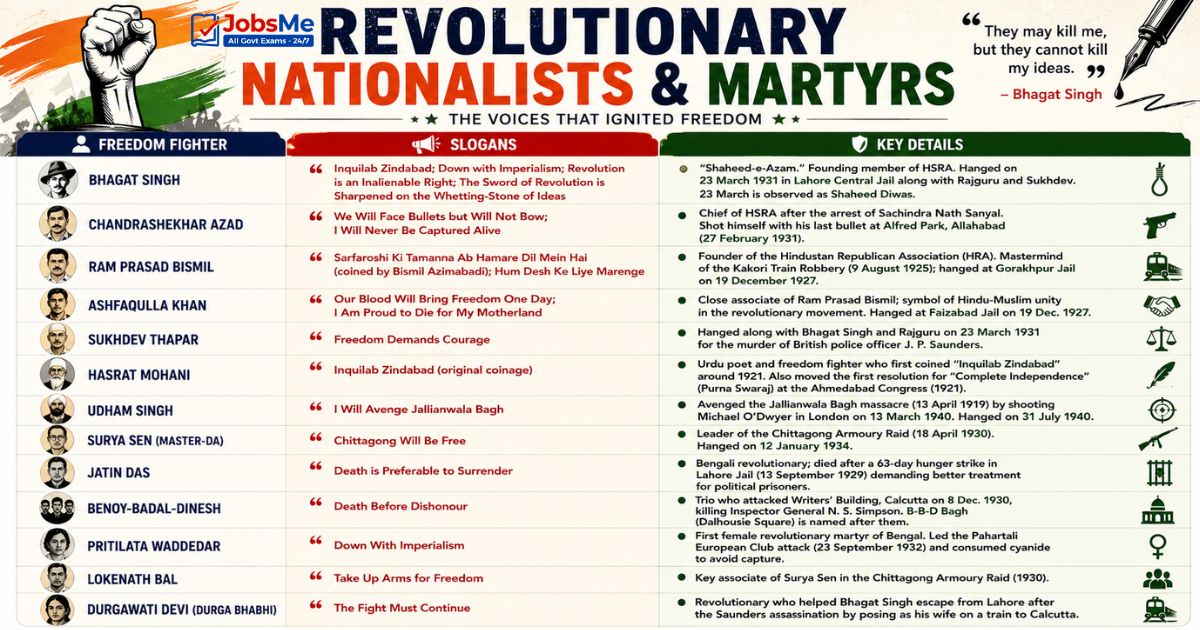
| Freedom Fighter | Slogans | Key Details |
|---|---|---|
| Bhagat Singh | Inquilab Zindabad; Down with Imperialism; Revolution is an Inalienable Right; The Sword of Revolution is Sharpened on the Whetting-Stone of Ideas | "Shaheed-e-Azam." Founding member of HSRA. Hanged on 23 March 1931 in Lahore Central Jail along with Rajguru and Sukhdev. 23 March is observed as Shaheed Diwas. |
| Chandrashekhar Azad | We Will Face Bullets but Will Not Bow; I Will Never Be Captured Alive | Chief of HSRA after the arrest of Sachindra Nath Sanyal. Shot himself with his last bullet at Alfred Park, Allahabad (27 February 1931). |
| Ram Prasad Bismil | Sarfaroshi Ki Tamanna Ab Hamare Dil Mein Hai (coined by Bismil Azimabadi); Hum Desh Ke Liye Marenge | Founder of the Hindustan Republican Association (HRA). Mastermind of the Kakori Train Robbery (9 August 1925); hanged at Gorakhpur Jail on 19 December 1927. |
| Ashfaqulla Khan | Our Blood Will Bring Freedom One Day; I Am Proud to Die for My Motherland | Close associate of Ram Prasad Bismil; symbol of Hindu-Muslim unity in the revolutionary movement. Hanged at Faizabad Jail on 19 December 1927. |
| Sukhdev Thapar | Freedom Demands Courage | Hanged along with Bhagat Singh and Rajguru on 23 March 1931 for the murder of British police officer J. P. Saunders. |
| Hasrat Mohani | Inquilab Zindabad (original coinage) | Urdu poet and freedom fighter who first coined "Inquilab Zindabad" around 1921. Also moved the first resolution for "Complete Independence" (Purna Swaraj) at the Ahmedabad Congress (1921). |
| Udham Singh | I Will Avenge Jallianwala Bagh | Avenged the Jallianwala Bagh massacre (13 April 1919) by shooting Michael O'Dwyer in London on 13 March 1940. Hanged on 31 July 1940. |
| Surya Sen (Master-da) | Chittagong Will Be Free | Leader of the Chittagong Armoury Raid (18 April 1930). Hanged on 12 January 1934. |
| Jatin Das | Death is Preferable to Surrender | Bengali revolutionary; died after a 63-day hunger strike in Lahore Jail (13 September 1929) demanding better treatment for political prisoners. |
| Benoy-Badal-Dinesh | Death Before Dishonour | Trio who attacked Writers' Building, Calcutta on 8 December 1930, killing Inspector General N. S. Simpson. B-B-D Bagh (Dalhousie Square) is named after them. |
| Pritilata Waddedar | Down With Imperialism | First female revolutionary martyr of Bengal. Led the Pahartali European Club attack (23 September 1932) and consumed cyanide to avoid capture. |
| Lokenath Bal | Take Up Arms for Freedom | Key associate of Surya Sen in the Chittagong Armoury Raid (1930). |
| Durgawati Devi (Durga Bhabhi) | The Fight Must Continue | Revolutionary who helped Bhagat Singh escape from Lahore after the Saunders assassination by posing as his wife on a train to Calcutta. |
1857 Revolt and Pre-Gandhian Era Heroes
| Freedom Fighter | Slogans | Key Details |
|---|---|---|
| Mangal Pandey | Maaro Firangi Ko | War cry of the Revolt of 1857; sepoy of the 34th Bengal Native Infantry at Barrackpore. Hanged on 8 April 1857. |
| Rani Lakshmibai | Main Apni Jhansi Nahi Doongi | Queen of Jhansi; one of the leading figures of the Revolt of 1857. Died fighting at Kotah-ki-Serai near Gwalior on 18 June 1858. |
| Tatya Tope | Desh Ke Liye Ladna Hai | Military strategist of the Revolt of 1857; aide to Nana Sahib. Captured and hanged on 18 April 1859. |
| Kunwar Singh | Chalo Dilli; Angrezi Hatao | Veteran zamindar of Jagdishpur, Bihar; led the 1857 revolt in Bihar at the age of 80. Died on 26 April 1858. |
| Jhalkari Bai | Jhansi Will Never Fall | Soldier and close advisor of Rani Lakshmibai; impersonated the queen to help her escape during the British siege of Jhansi (1858). |
| Peer Ali Khan | We Shall Not Live as Slaves | Bookseller and revolutionary of the 1857 Revolt in Patna. Hanged in July 1857. |
| Veerapandiya Kattabomman | We Shall Never Bow to the British | 18th-century chieftain of Panchalankurichi (Tamil Nadu); refused to pay taxes to the East India Company. Hanged at Kayathar on 16 October 1799. |
| Velu Nachiyar | Victory to My Land | Queen of Sivaganga (Tamil Nadu); first Indian queen to wage war against the British (1780s) — predating even the 1857 Revolt. |
| Tantia Bhil | We Shall Not Submit | Tribal Robin Hood of the Bhil community; led raids against the British in central India during the 1870s. Hanged in 1889. |
Women Freedom Fighters and INA Heroines
| Freedom Fighter | Slogans | Key Details |
|---|---|---|
| Bhikaji Cama | Vande Mataram (raised with the Indian flag at Stuttgart, 1907) | First Indian to unfurl the national flag on foreign soil at the International Socialist Conference, Stuttgart (Germany) on 22 August 1907. |
| Matangini Hazra | Vande Mataram (her last words) | "Gandhi Buri" of Bengal; shot dead during the Quit India Movement procession at Tamluk on 29 September 1942 at the age of 73. |
| Aruna Asaf Ali | March Forward With Courage | "Grand Old Lady of the Independence Movement"; hoisted the Congress flag at Gowalia Tank Maidan on 9 August 1942 to launch Quit India. |
| Kanaklata Barua | Do Not Move, I Will Carry the Flag | Assamese teenage martyr; shot dead while leading a Quit India procession at Gohpur on 20 September 1942 at the age of 17. |
| Lakshmi Sahgal | March to Freedom | Officer of the INA's Rani Jhansi Regiment; later Minister of Women's Affairs in the Azad Hind Government. |
| Captain Lakshmi (Azad Hind Fauj) | Women Will Fight for Freedom | Captain Lakshmi Sahgal commanded the all-women Rani of Jhansi Regiment of the INA. |
| Chakali Ilamma | We Will Resist Oppression | Telangana folk hero; resisted Razakar attacks during the Telangana Armed Struggle (1946-51). |
Tribal, Regional, and Social Reform Leaders
| Freedom Fighter | Slogans | Key Details |
|---|---|---|
| Birsa Munda | Abua Dishum, Abua Raj (Our Land, Our Rule) | Tribal leader of the Munda Ulgulan (1899-1900); died in Ranchi Jail on 9 June 1900 at age 25. Birthday (15 November) is Janjatiya Gaurav Divas. |
| Alluri Sitarama Raju | Fight Till Your Last Breath | Led the Rampa Rebellion (1922-24) against British forest laws in the Eastern Ghats of Andhra. Shot dead by British forces in May 1924. |
| Tiruppur Kumaran | Do Not Drop the National Flag | "Kodi Kaththa Kumaran" (the one who saved the flag); died on 11 January 1932 during a protest in Tiruppur (Tamil Nadu) while still holding the national tricolour. |
| V. O. Chidambaram Pillai | Freedom Through Swadeshi | "Kappalottiya Tamizhan" (The Tamil who sailed ships); founded the Swadeshi Steam Navigation Company (1906) to break British shipping monopoly. |
| Mahatma Jyotiba Phule | Education is the greatest weapon to eradicate social evils; There cannot be a nation worth the name until and unless all the people of the land become truly educated | Founded the Satyashodhak Samaj (1873); pioneer of women's education and Dalit upliftment in 19th-century Maharashtra. |
| Dr. B. R. Ambedkar | Educate, Agitate, Organise; Freedom of Mind is Real Freedom | Chairman of the Drafting Committee of the Indian Constitution. India's first Law Minister. Awarded Bharat Ratna in 1990. |
| Thakkar Bapa | Serve the Poor, Serve the Nation | Social worker who founded the Bhil Seva Mandal (1922) and worked extensively for tribal welfare under the guidance of Gandhi. |
Memory Tricks and Mnemonics
Trick 1: Gandhi's Five Slogans — "DSASM"
Mahatma Gandhi has five major slogans. Remember them as "DSASM":
- D → Do or Die (Quit India, 1942).
- S → Satyameva Jayate (from Mundaka Upanishad).
- A → Ahimsa Parmo Dharma.
- S → Sarvodaya (welfare of all).
- M → My Life is My Message.
"DSASM — Do Satyameva Ahimsa Sarvodaya Message."
Trick 2: Bose's INA Battle Cries — "Give-Jai-Dilli"
The three iconic INA slogans of Subhash Chandra Bose can be remembered in the order he used them:
- Give → Give Me Blood and I Shall Give You Freedom (rally in Burma, 1944).
- Jai → Jai Hind (INA salutation, later India's national salutation).
- Dilli → Dilli Chalo (march to Delhi).
"Give blood, say Jai Hind, march on Dilli — that's Netaji in three lines."
Trick 3: Three Hanged Together — "BRS on 23 March 1931"
Bhagat Singh, Rajguru, and Sukhdev were hanged together at Lahore Central Jail. Remember the date and the trio with this:
- B → Bhagat Singh (Inquilab Zindabad, Down with Imperialism).
- R → Rajguru.
- S → Sukhdev Thapar (Freedom Demands Courage).
"BRS — Hanged on the Twenty-Third (March 1931). 23 March is Shaheed Diwas."
Trick 4: Three "Vande Mataram" Moments — "Bankim, Bhikaji, Matangini"
Three different personalities are associated with "Vande Mataram." Remember the chronological 3-Bs (one starts with M):
- Bankim → Bankim Chandra Chattopadhyay wrote it in Anandamath (1882).
- Bhikaji → Bhikaji Cama raised it with the Indian flag at Stuttgart (1907).
- Matangini → Matangini Hazra cried "Vande Mataram" as her last words at Tamluk (1942).
"Bankim wrote it, Bhikaji flew it, Matangini died with it."
Trick 5: Slogans by Movement Phase — "1857-1916-1928-1942"
Link each major slogan to its movement year:
- 1857 → "Maaro Firangi Ko" (Mangal Pandey) and "Main Apni Jhansi Nahi Doongi" (Rani Lakshmibai).
- 1916 → "Swaraj is My Birthright" (Tilak, Home Rule).
- 1928 → "Simon Go Back" (Lala Lajpat Rai).
- 1929 → "Inquilab Zindabad" (Bhagat Singh in Assembly).
- 1942 → "Do or Die" / "Quit India" (Gandhi).
- 1944 → "Give Me Blood and I Shall Give You Freedom" (Bose, Burma).
Trick 6: "Inquilab Zindabad" — Two-Person Rule
Two leaders are linked to "Inquilab Zindabad" — never confuse them:
- Original Coiner → Maulana Hasrat Mohani (around 1921).
- Popular Face → Bhagat Singh (shouted in Central Assembly, 8 April 1929).
"Hasrat said it first; Bhagat made it famous."
Trick 7: The Kakori Trio — "BAR" (Bismil, Ashfaq, Rajendra)
Three revolutionaries were hanged for the Kakori Train Robbery (9 August 1925):
- B → Bismil (Ram Prasad Bismil) — "Sarfaroshi ki Tamanna."
- A → Ashfaqulla Khan — "I Am Proud to Die for My Motherland."
- R → Rajendra Lahiri.
"BAR — The bar of patriotism beyond religion. All hanged in December 1927."
Trick 8: Five National Symbols and Their Authors — "JV-MSA"
India's most recognised slogans turned into national symbols:
- J → Jana Gana Mana → Rabindranath Tagore (National Anthem, 1950).
- V → Vande Mataram → Bankim Chandra Chattopadhyay (National Song).
- M → Satyameva Jayate → Mundaka Upanishad / promoted by Madan Mohan Malaviya (National Motto).
- S → Sarvodaya → Mahatma Gandhi.
- A → "Aaram Haram Hai" → Jawaharlal Nehru.
Additional Notes
Frequently Confused Facts
- Inquilab Zindabad — Bhagat Singh vs Hasrat Mohani: Maulana Hasrat Mohani coined the slogan; Bhagat Singh popularised it by shouting it in the Central Legislative Assembly on 8 April 1929.
- Sarfaroshi ki Tamanna — Bismil vs Bismil Azimabadi: The poem was written by Bismil Azimabadi; it was made famous by Ram Prasad Bismil (a different person) and his Kakori associates.
- Jai Hind — Pillai vs Bose: Chempakaraman Pillai used "Jai Hind" first in Berlin (1907); Subhash Chandra Bose and the INA made it a mass salutation.
- Swaraj is My Birthright — Tilak, not Gokhale: The slogan was given by Bal Gangadhar Tilak in 1916 at Belgaum during the Home Rule Movement. Some sources confuse this because Gokhale spoke about Swaraj earlier in moderate terms, but the famous slogan is Tilak's.
- Quit India — Gandhi vs Yusuf Meherally: The phrase "Quit India" was coined by Yusuf Meherally; Gandhi gave the rallying call "Do or Die" in the same Quit India speech (8 August 1942).
- Vande Mataram vs Jana Gana Mana: "Vande Mataram" by Bankim Chandra is the National Song; "Jana Gana Mana" by Tagore is the National Anthem. Both were adopted on 24 January 1950.
- Father of the Nation Title: Subhash Chandra Bose first called Gandhi "Father of the Nation" in a radio address from Singapore (4 June 1944), not Nehru.
- Frontier Gandhi vs Mahatma Gandhi: "Frontier Gandhi" is Khan Abdul Ghaffar Khan, not Mahatma Gandhi.
- Tagore's Two Anthems: Rabindranath Tagore wrote both India's "Jana Gana Mana" and Bangladesh's "Amar Sonar Bangla" — he is the only person to author two national anthems.
- Maaro Firangi Ko vs Chalo Dilli: "Maaro Firangi Ko" was the war cry of Mangal Pandey in 1857; "Chalo Dilli" is associated with both Kunwar Singh (1857) and Subhash Chandra Bose (1943) — context determines which is asked.
Repeating PYQ Patterns
Certain slogan-personality pairs are asked repeatedly in competitive exams. "Do or Die" (Gandhi), "Inquilab Zindabad" (Bhagat Singh / Hasrat Mohani), "Give Me Blood and I Shall Give You Freedom" (Bose), "Swaraj is My Birthright" (Tilak), "Simon Go Back" (Lala Lajpat Rai), "Vande Mataram" (Bankim Chandra), "Jana Gana Mana" (Tagore), "Sarfaroshi ki Tamanna" (Bismil), "Abua Dishum, Abua Raj" (Birsa Munda), and "Educate, Agitate, Organise" (Ambedkar) appear most often in UPSC Prelims, SSC CGL, RRB NTPC, and IBPS PO papers. State PCS exams add regional heroes — Tamil Nadu PCS focuses on Veerapandiya Kattabomman, Velu Nachiyar, and V. O. Chidambaram Pillai; Andhra PCS asks about Alluri Sitarama Raju; West Bengal PCS focuses on Surya Sen, Matangini Hazra, and Benoy-Badal-Dinesh; Bihar PCS covers Kunwar Singh and Peer Ali Khan. To practice these recurring topics, attempt the Static GK Quiz on Jobsme.in.
Quick Insight
Slogans are condensed history — two or three words that can summarise an entire decade of struggle. "Inquilab Zindabad" captures the entire revolutionary movement from Hasrat Mohani's pen to Bhagat Singh's gallows; "Do or Die" captures the desperate, all-or-nothing mood of August 1942; "Jai Hind" captures the leap from Chempakaraman Pillai's Berlin to Bose's INA to today's official salutation. Even now, slogans of the freedom struggle live on in Parliament speeches, Independence Day addresses, school assemblies, and the National Emblem itself ("Satyameva Jayate"). Understanding these slogans helps aspirants connect any historical reference to its central figure — a skill that pays dividends in both Prelims (direct matching questions) and Mains (Essay and Modern History papers). For more on the men and women behind these slogans, refer to the Daily Current Affairs updates on Jobsme.in, where birth and death anniversaries of these leaders are covered every month.
One-Liners for Quick Revision
- Do or Die → Mahatma Gandhi → Quit India speech, 8 August 1942, Bombay.
- Quit India → Yusuf Meherally (coined); popularised by Gandhi → 1942.
- Satyameva Jayate → Mundaka Upanishad; promoted by Madan Mohan Malaviya; National Motto from 26 January 1950.
- Ahimsa Parmo Dharma → Mahatma Gandhi → core principle of non-violence.
- Sarvodaya → Mahatma Gandhi → "welfare of all."
- My Life is My Message → Mahatma Gandhi → reply when asked for a message for the people.
- Give Me Blood and I Shall Give You Freedom → Subhash Chandra Bose → Burma rally, 4 July 1944.
- Jai Hind → Chempakaraman Pillai (first use, Berlin 1907); popularised by Bose and INA; India's national salutation.
- Dilli Chalo → Subhash Chandra Bose → INA campaign, 1943.
- It is Blood Alone That Can Avenge the Blood → Subhash Chandra Bose.
- We Shall Not Rest Until Delhi is Ours → Subhash Chandra Bose.
- Inquilab Zindabad → Coined by Maulana Hasrat Mohani; popularised by Bhagat Singh on 8 April 1929 in the Central Assembly.
- Down with Imperialism → Bhagat Singh → HSRA leaflets and trial.
- Revolution is an Inalienable Right → Bhagat Singh.
- The Sword of Revolution is Sharpened on the Whetting-Stone of Ideas → Bhagat Singh.
- We Will Face Bullets but Will Not Bow → Chandrashekhar Azad.
- I Will Never Be Captured Alive → Chandrashekhar Azad → fulfilled at Alfred Park, Allahabad, 27 February 1931.
- Sarfaroshi Ki Tamanna Ab Hamare Dil Mein Hai → coined by Bismil Azimabadi; popularised by Ram Prasad Bismil.
- Hum Desh Ke Liye Marenge → Ram Prasad Bismil.
- Our Blood Will Bring Freedom One Day → Ashfaqulla Khan.
- I Am Proud to Die for My Motherland → Ashfaqulla Khan → before execution at Faizabad Jail, 19 December 1927.
- Freedom Demands Courage → Sukhdev Thapar.
- Simon Go Back → Lala Lajpat Rai → Lahore, 30 October 1928, against the Simon Commission.
- Every Blow on My Body Will Break the Chains of Slavery → Lala Lajpat Rai.
- Swaraj is My Birthright and I Shall Have It → Bal Gangadhar Tilak → Belgaum, 1916, Home Rule Movement.
- Freedom is Life → Bal Gangadhar Tilak.
- What Bengal Thinks Today, India Thinks Tomorrow → Gopal Krishna Gokhale.
- We shall be free not because we claim freedom, but because we practice it → Bipin Chandra Pal.
- The meaning of Nationalism is not that one nation is against another → Bipin Chandra Pal.
- Aaram Haram Hai → Jawaharlal Nehru → meaning "Rest is forbidden."
- Unity is the Greatest Strength → Jawaharlal Nehru.
- The Light Has Gone Out of Our Lives → Jawaharlal Nehru → on Gandhi's assassination, 30 January 1948.
- Work is Worship → Sardar Vallabhbhai Patel.
- Forget Self for the Nation → Sardar Vallabhbhai Patel.
- Jana Gana Mana → Rabindranath Tagore → National Anthem from 24 January 1950.
- Amar Sonar Bangla → Rabindranath Tagore → National Anthem of Bangladesh.
- Vande Mataram → Bankim Chandra Chattopadhyay → from Anandamath (1882); National Song.
- India Will Rise, India Will Be Great → Sri Aurobindo.
- Swaraj We Must Have → Sri Aurobindo.
- Better remain silent, better not even think, if you are not prepared to act → Annie Besant.
- Unity is the Strength of India → Maulana Abul Kalam Azad.
- Hindustan is One Nation → Maulana Abul Kalam Azad.
- Maaro Firangi Ko → Mangal Pandey → war cry of 1857 at Barrackpore.
- Main Apni Jhansi Nahi Doongi → Rani Lakshmibai → 1857-58.
- Desh Ke Liye Ladna Hai → Tatya Tope.
- Chalo Dilli; Angrezi Hatao → Kunwar Singh → 1857 revolt in Bihar.
- Vande Mataram (Stuttgart, 1907) → Bhikaji Cama → first to unfurl the Indian flag abroad.
- I Will Avenge Jallianwala Bagh → Udham Singh → killed Michael O'Dwyer in London, 13 March 1940.
- Vande Mataram (last words) → Matangini Hazra → Tamluk, 29 September 1942.
- Rise for Freedom → Sarojini Naidu.
- Abua Dishum, Abua Raj → Birsa Munda → Munda Ulgulan, 1899-1900.
- Peace Leads to Freedom → C. Rajagopalachari.
- There is Nothing Greater than Peace → Khan Abdul Ghaffar Khan (Frontier Gandhi).
- Independence is never given, it is always taken → V. D. Savarkar.
- Better to die fighting for freedom than be a prisoner all the days of your life → V. D. Savarkar.
- An educated mind is the greatest weapon in the struggle for freedom → V. D. Savarkar.
- India is for Indians → Pandit Madan Mohan Malaviya.
- Let Education Build the Nation → Pandit Madan Mohan Malaviya.
- Education is the greatest weapon to eradicate social evils → Mahatma Jyotiba Phule.
- There cannot be a nation worth the name until and unless all the people of the land become truly educated → Mahatma Jyotiba Phule.
- Educate, Agitate, Organise → Dr. B. R. Ambedkar.
- Freedom of Mind is Real Freedom → Dr. B. R. Ambedkar.
- Fight Till Your Last Breath → Alluri Sitarama Raju → Rampa Rebellion, 1922-24.
- Victory to My Land → Velu Nachiyar → 18th-century Queen of Sivaganga.
- Do Not Drop the National Flag → Tiruppur Kumaran → 11 January 1932.
- Chittagong Will Be Free → Surya Sen (Master-da) → Chittagong Armoury Raid, 18 April 1930.
- Death is Preferable to Surrender → Jatin Das → died after 63-day hunger strike, 13 September 1929, Lahore Jail.
- March Forward With Courage → Aruna Asaf Ali → hoisted Congress flag at Gowalia Tank, 9 August 1942.
- The Fight Must Continue → Durgawati Devi (Durga Bhabhi).
- We Shall Not Submit → Tantia Bhil.
- March to Freedom → Lakshmi Sahgal (INA).
- Women Will Fight for Freedom → Captain Lakshmi (Rani of Jhansi Regiment, INA).
- Jhansi Will Never Fall → Jhalkari Bai.
- We Will Resist Oppression → Chakali Ilamma → Telangana Armed Struggle.
- We Shall Not Live as Slaves → Peer Ali Khan → 1857 Revolt, Patna.
- Do Not Move, I Will Carry the Flag → Kanaklata Barua → Gohpur, 20 September 1942.
- Serve the Poor, Serve the Nation → Thakkar Bapa.
- Whatever work you undertake, do it seriously, thoroughly and well → Syama Prasad Mukherjee.
- Freedom Through Swadeshi → V. O. Chidambaram Pillai (Kappalottiya Tamizhan).
- Take Up Arms for Freedom → Lokenath Bal → Chittagong Armoury Raid.
- Death Before Dishonour → Benoy-Badal-Dinesh → Writers' Building attack, 8 December 1930.
- Down With Imperialism → Pritilata Waddedar → first female revolutionary martyr of Bengal.
- We Shall Never Bow to the British → Veerapandiya Kattabomman → hanged at Kayathar, 16 October 1799.
For more Static GK topics like Important Dates, Folk Dances, and First in India, explore the Static GK section on Jobsme.in. You can also test your knowledge with the Daily Current Affairs Quiz and check out the latest exam updates at Latest Government Job Notifications.
Free quiz • No signup required
Put this topic into practice with Indian Cultural Institutions – Static GK MCQ Quiz. It is the quickest way to reinforce what you just learned.
Frequently Asked Questions
Who gave the slogan Do or Die and when?
Who first coined the slogan Inquilab Zindabad?
Which slogan is associated with Subhash Chandra Bose?
Who actually gave the slogan Swaraj is My Birthright?
Who gave the slogan Simon Go Back?
Who wrote Vande Mataram and when was it adopted as the National Song?
Who gave the slogan Jai Hind and how did it become the national salutation?
Which slogan is associated with Bhagat Singh apart from Inquilab Zindabad?
What is Satyameva Jayate and where is it taken from?
What role did slogans play in India's freedom movement?

About the author