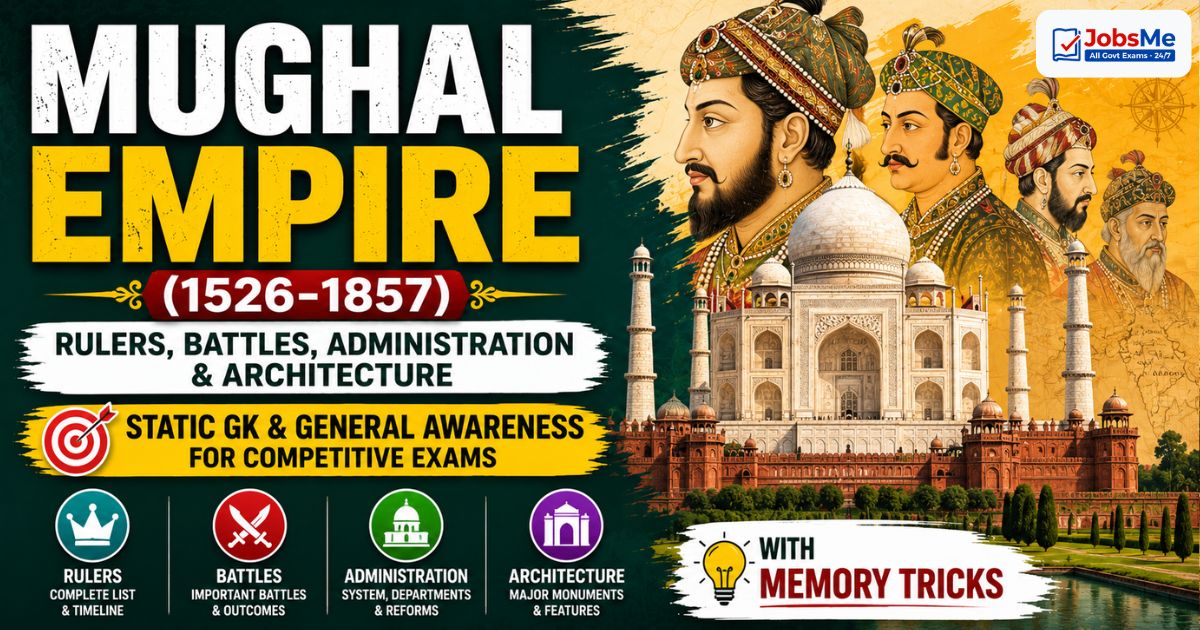
Mughal Empire (1526-1857) – Rulers, Battles, Administration & Architecture – Static GK & General Awareness for Competitive Exams with Memory Tricks
This article presents a complete, exam-ready summary of the Mughal Empire (1526-1857), covering its founder Babur, the great Mughals (Humayun, Akbar, Jahangir, Shah Jahan, Aurangzeb), the Later Mughals, key battles like the First and Second Battles of Panipat, the Mansabdari and Zabt revenue systems, and iconic monuments like the Taj Mahal, Red Fort, Fatehpur Sikri, and Humayun's Tomb. All facts are arranged with tables, memory tricks, and one-liners to help UPSC, SSC, IBPS, RRB, PSU, Defence, Insurance, and State PCS aspirants master Medieval History and Static GK.
Jump to section
- Introduction
- Core Concepts: Origin and Phases of the Mughal Empire
- Mughal Emperors - Rulers, Reigns and Key Facts
- Key Battles of the Mughal Empire
- Mughal Administration - Systems and Officials
- Mughal Architecture - Monuments by Ruler
- Important Books and Literature of the Mughal Era
- Akbar's Navratnas - The Nine Gems
- Mughal Religious Developments and Society
- Memory Tricks and Mnemonics for the Mughal Empire
- Additional Notes
- One-Liners for Quick Revision
Introduction
The Mughal Empire (1526-1857) is one of the most extensively tested topics in Medieval Indian History for competitive examinations. Founded by Babur after his victory over Ibrahim Lodi in the First Battle of Panipat (1526), the dynasty ruled large parts of the Indian subcontinent for over three centuries. The Mughals were descendants of Timur (paternal side) and Genghis Khan (maternal side), and their reign is remembered for political unity, military innovations like gunpowder warfare, administrative reforms, and an unmatched cultural synthesis of Persian, Central Asian, and Indian traditions.
Questions on the Mughal Empire appear in almost every major exam — UPSC Prelims and Mains, SSC CGL, SSC CHSL, IBPS PO and Clerk, SBI PO, RRB NTPC, State PCS, Defence (NDA, CDS), and Insurance exams (LIC AAO, NIACL AO). Aspirants must remember the order of rulers, key battles (Panipat I and II, Khanwa, Chausa, Kanauj), administrative systems (Mansabdari, Zabt, Dahsala), revenue reforms by Raja Todar Mal, religious policies like Din-i-Ilahi and Sulh-i-Kul, and architectural marvels like the Taj Mahal and Fatehpur Sikri. For more on Medieval Indian history and related topics, refer to the Static GK section on Jobsme.in.
The Mughal Empire is also relevant for current affairs themes — UNESCO World Heritage Site listings (Humayun's Tomb, Taj Mahal, Red Fort, Fatehpur Sikri), restoration of monuments under the Archaeological Survey of India, and discussions on Mughal history in school curricula make this topic doubly important for aspirants preparing for both Prelims (factual matching) and Mains (analytical questions on administration, religious policy, and decline).
Core Concepts: Origin and Phases of the Mughal Empire
The Mughal Empire was an Islamic empire of Turco-Mongol origin that ruled the Indian subcontinent from 1526 to 1857. The name "Mughal" is the Persian word for "Mongol," reflecting the dynasty's ancestry. Understanding the phases of the empire helps in remembering rulers and events in sequence.
Key Phases of the Mughal Empire
- Foundation Phase (1526-1556): Babur establishes the dynasty; Humayun loses and regains the throne with Persian support.
- Consolidation and Golden Age (1556-1707): The "Great Mughals" — Akbar, Jahangir, Shah Jahan, and Aurangzeb — expand and stabilise the empire; period of cultural and architectural peak.
- Decline Phase (1707-1857): The "Later Mughals" — Bahadur Shah I, Jahandar Shah, Farrukhsiyar, and others — preside over disintegration; foreign invasions by Nadir Shah (1739) and Ahmad Shah Abdali weaken the empire.
- End of the Empire (1857): Bahadur Shah II (Zafar), the last Mughal emperor, is deposed by the British after the Revolt of 1857 and exiled to Rangoon.
Important Titles and Terms
- Badshah: The Mughal emperor; held supreme authority.
- Mansab: Rank assigned to civil and military officials; carried two grades — zat (personal rank) and sawar (cavalry rank).
- Jagir: Land assignment given to a noble in lieu of cash salary; non-hereditary and transferable.
- Jizya: Religious tax on non-Muslims; abolished by Akbar in 1564, reimposed by Aurangzeb in 1679.
- Din-i-Ilahi: Syncretic faith launched by Akbar in 1582 blending Hinduism, Islam, Zoroastrianism, and Christianity.
- Sulh-i-Kul: Akbar's policy of "universal peace and tolerance" across religions.
Mughal Emperors - Rulers, Reigns and Key Facts
The following table lists all the major Mughal emperors in chronological order along with their reigns, original names, and most important achievements.
| Emperor | Reign | Key Details and Achievements |
|---|---|---|
| Babur | 1526-1530 | Founder of the Mughal Empire; original name Zahir-ud-din Muhammad; born in 1483 in Fergana (Uzbekistan); descended from Timur (father) and Genghis Khan (mother); defeated Ibrahim Lodi at First Battle of Panipat (1526); introduced gunpowder, artillery, and the Tulughma flanking strategy in India; wrote the autobiography Baburnama (Tuzuk-i-Baburi) in Turkish. |
| Humayun | 1530-1540, 1555-1556 | Son of Babur; lost the empire to Sher Shah Suri at the Battles of Chausa (1539) and Kanauj/Bilgram (1540); exiled to Persia for 15 years; regained Delhi in 1555 with Persian help; died in 1556 after falling down the stairs of his library at Dinpanah (Purana Qila); biography written by his sister Gulbadan Begum (Humayun Nama). |
| Akbar | 1556-1605 | Original name Jalaluddin Muhammad Akbar; ascended the throne at age 13 under regent Bairam Khan; defeated Hemu at the Second Battle of Panipat (1556); annexed Gujarat, Bengal, Kashmir, Kabul; introduced Mansabdari and Zabt (Bandobast) revenue systems; abolished jizya (1564); founded Din-i-Ilahi (1582) and Sulh-i-Kul; built Fatehpur Sikri, Buland Darwaza, and Agra Fort. |
| Jahangir | 1605-1627 | Original name Nuruddin Salim Jahangir; ascended the throne after rebelling against Akbar; deeply influenced by his wife Nur Jahan; annexed Kandahar, Mewar, and Ahmednagar; granted trade privileges to the British East India Company through Sir Thomas Roe (1615-1618); built Shalimar Gardens (Lahore) and the Tomb of Itmad-ud-Daulah (Baby Taj); wrote the autobiography Tuzuk-i-Jahangiri. |
| Shah Jahan | 1628-1658 | Original name Shihab-ud-din Muhammad Khurram; revolted against Jahangir; reign marked the golden age of Mughal architecture; built the Taj Mahal (mausoleum for wife Mumtaz Mahal), Red Fort (Delhi), Jama Masjid (Delhi), Moti Masjid, and Shalimar Gardens (Delhi); imprisoned by his son Aurangzeb in 1658; died in 1666 in Agra Fort under house arrest. |
| Aurangzeb | 1658-1707 | Title Alamgir ("Conqueror of the World"); reign saw the greatest territorial extent of the empire; orthodox Sunni ruler; reimposed jizya in 1679; banned music and court paintings; fought long Deccan campaigns against the Marathas (Shivaji and successors); conducted the siege of Golconda; compiled Fatawa-i-Alamgiri as legal code; his policies sparked Rajput, Maratha, Sikh, and Jat rebellions. |
| Bahadur Shah I | 1707-1712 | First of the Later Mughals; original name Muazzam; succeeded after a war of succession with his brothers; conciliatory policies towards Rajputs and Marathas. |
| Jahandar Shah | 1712-1713 | Came to power with the help of Zulfiqar Khan; first puppet emperor; deposed and killed within a year. |
| Farrukhsiyar | 1713-1719 | Came to throne with help of the Sayyid Brothers (Hassan Ali Khan and Hussain Ali Khan), known as the "King Makers of Indian History"; granted the famous Farman of 1717 giving trade privileges to the British East India Company in Bengal. |
| Muhammad Shah Rangila | 1719-1748 | Pleasure-loving ruler; reign saw the invasion of Nadir Shah (1739), who looted Delhi and took the Peacock Throne and the Kohinoor diamond to Persia. |
| Bahadur Shah II (Zafar) | 1837-1857 | Last Mughal emperor; declared symbolic leader of the Revolt of 1857 (First War of Independence); deposed by the British; exiled to Rangoon (Burma), where he died in 1862; also a noted Urdu poet. |
Key Battles of the Mughal Empire
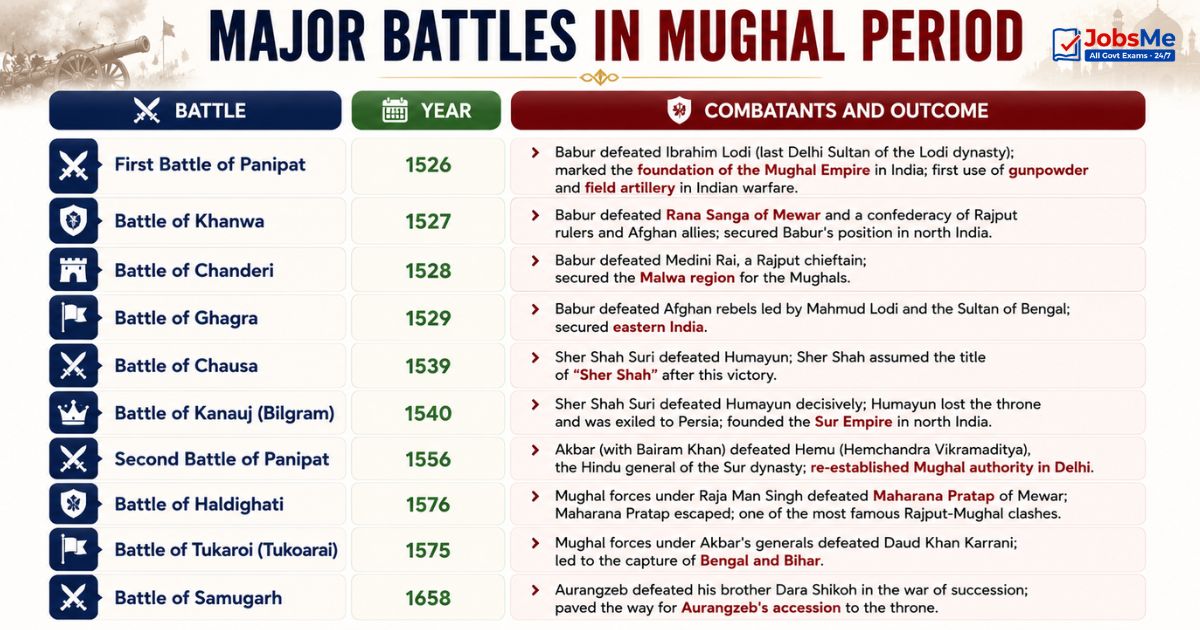
Battles are among the most frequently asked topics in SSC, RRB, and Banking exams. The table below covers all the major battles in chronological order with key details.
| Battle | Year | Combatants and Outcome |
|---|---|---|
| First Battle of Panipat | 1526 | Babur defeated Ibrahim Lodi (last Delhi Sultan of the Lodi dynasty); marked the foundation of the Mughal Empire in India; first use of gunpowder and field artillery in Indian warfare. |
| Battle of Khanwa | 1527 | Babur defeated Rana Sanga of Mewar and a confederacy of Rajput rulers and Afghan allies; secured Babur's position in north India. |
| Battle of Chanderi | 1528 | Babur defeated Medini Rai, a Rajput chieftain; secured the Malwa region for the Mughals. |
| Battle of Ghagra | 1529 | Babur defeated Afghan rebels led by Mahmud Lodi and the Sultan of Bengal; secured eastern India. |
| Battle of Chausa | 1539 | Sher Shah Suri defeated Humayun; Sher Shah assumed the title of "Sher Shah" after this victory. |
| Battle of Kanauj (Bilgram) | 1540 | Sher Shah Suri defeated Humayun decisively; Humayun lost the throne and was exiled to Persia; founded the Sur Empire in north India. |
| Second Battle of Panipat | 1556 | Akbar (with Bairam Khan) defeated Hemu (Hemchandra Vikramaditya), the Hindu general of the Sur dynasty; re-established Mughal authority in Delhi. |
| Battle of Haldighati | 1576 | Mughal forces under Raja Man Singh defeated Maharana Pratap of Mewar; Maharana Pratap escaped; one of the most famous Rajput-Mughal clashes. |
| Battle of Tukaroi (Tukoarai) | 1575 | Mughal forces under Akbar's generals defeated Daud Khan Karrani; led to the capture of Bengal and Bihar. |
| Battle of Samugarh | 1658 | Aurangzeb defeated his brother Dara Shikoh in the war of succession; paved the way for Aurangzeb's accession to the throne. |
Mughal Administration - Systems and Officials
The Mughal administrative framework is a critical topic for UPSC and State PCS. The table below summarises the central, provincial, and revenue systems.
| Administrative Unit / System | Key Features and Details |
|---|---|
| Central Administration | The Emperor (Badshah) held supreme authority, aided by a council of ministers (Diwan-i-Kul). Key positions: Wazir (Prime Minister), Diwan (Head of Finance), Mir Bakshi (Head of Military), Sadr-us-Sadur (Head of Religious Affairs), and Mir Saman (Head of Royal Karkhanas). |
| Provincial Divisions (Subas) | The empire was divided into provinces (Subas) headed by Subahdars. Subas were further divided into Sarkars (districts) and Parganas (groups of villages). Faujdars maintained law and order in the districts. |
| Provincial Officers | Sipahsalar: civil and military head representing the emperor. Diwan: managed revenue. Bakshi: organised the provincial army. Sadr: oversaw judicial and religious affairs. |
| District and Village Officers | Faujdar: administrative head ensuring law and order. Amalguzar: collected land revenue. At village level — Muqaddam (headman) and Patwari (accountant maintaining village records). |
| Mansabdari System | Introduced by Akbar; civilian and military officials were assigned mansabs (ranks) with dual grades — zat (personal/civil rank) and sawar (cavalry rank). Mansabs were not hereditary; mansabdars were paid by jagir assignments instead of cash salaries. |
| Jagirdari System | Land was distributed as jagirs to nobles and high-ranking officers in place of cash salaries. Jagirdari rights were non-hereditary and transferable at the emperor's will. |
| Dahsala System (1580) | Standardised land measurement and revenue collection using a ten-year average of produce and prices; enhanced state income and protected cultivators. |
| Zabt / Bandobast System | Developed by Raja Todar Mal under Akbar; land was measured and classified by soil fertility (Polaj, Parauti, Chachar, Banjar). Revenue was usually fixed at one-third of estimated produce. |
| Land Classification (under Akbar) | Polaj: most fertile land cultivated every year. Parauti: land left fallow for 1-2 years to regain fertility. Chachar: land fallow for 3-4 years. Banjar: barren land left uncultivated for five or more years. Standard unit of measurement was the Gaz, subdivided into Tasuaj. |
| Zamindari System | Emerged during the decline of the Mughal Empire; granted hereditary rights over landed estates to zamindars who paid a fixed annual revenue to the Mughal court after collecting taxes from peasants. |
| Legal System | Based on a combination of Islamic Sharia and local customs. Qazi (judge) administered justice with assistance from muftis (legal experts). |
Mughal Architecture - Monuments by Ruler
Mughal architecture combined Persian, Indian, and Islamic styles, featuring symmetrical layouts, bulbous domes, minarets, arched gateways, intricate calligraphy, and extensive use of red sandstone and white marble. The Charbagh (four-part garden) was a distinctive Mughal layout.
| Ruler | Architectural Contributions |
|---|---|
| Babur (1526-1530) | Kabuli Bagh Mosque at Panipat (to commemorate the 1526 victory); Jama Masjid at Sambhal. |
| Humayun (1530-1540, 1555-1556) | Humayun's Tomb, Delhi (built by his widow Hamida Banu Begum; a UNESCO World Heritage Site and precursor of the Taj Mahal); Purana Qila / Dinpanah, Delhi. |
| Akbar (1556-1605) | Agra Fort; Fatehpur Sikri (first planned city of the Mughals); Buland Darwaza (built in 1571 to commemorate the Gujarat victory); Panch Mahal; Jami Masjid, Fatehpur Sikri; Sheikh Salim Chishti's Dargah. |
| Jahangir (1605-1627) | Tomb of Akbar at Sikandra, Agra; Shalimar Gardens, Lahore; Tomb of Itmad-ud-Daulah (Baby Taj), Agra — built by Nur Jahan for her father. |
| Shah Jahan (1628-1658) | Taj Mahal, Agra (mausoleum for Mumtaz Mahal; UNESCO World Heritage Site); Red Fort, Delhi; Jama Masjid, Delhi (one of the largest mosques in India); Shalimar Gardens, Delhi; Moti Masjid, Agra Fort; Peacock Throne. |
| Aurangzeb (1658-1707) | Badshahi Mosque, Lahore; Bibi Ka Maqbara, Aurangabad (called the "Mini Taj" or "Dakkhani Taj"); Musammam Burj, Agra Fort; Moti Masjid, Red Fort, Delhi. |
Important Books and Literature of the Mughal Era
Mughal literature flourished in Persian, Urdu, and Turkish, with the emperors patronising historians, poets, and translators. The following books are exam-critical.
| Book | Author | Details |
|---|---|---|
| Tuzuk-i-Baburi (Baburnama) | Babur | Babur's autobiography in Turkish; describes his military tactics and administrative organisation. |
| Humayun Nama | Gulbadan Begum | Biography of Humayun written by his half-sister; a rare female-authored Mughal chronicle. |
| Akbarnama | Abul Fazl | Three-volume history of Akbar's reign; covers events up to the forty-sixth regnal year. |
| Ain-i-Akbari | Abul Fazl | Third volume of the Akbarnama; detailed account of Akbar's administration, revenue, military, justice, and the social and economic conditions of the empire (does not cover Akbar's ancestors). |
| Muntakhab-ul-Tawarikh | Abdul Qadir Badauni | Critical account of Akbar's reign from an orthodox Sunni perspective. |
| Tuzuk-i-Jahangiri | Jahangir | Jahangir's autobiography in Persian; provides insight into court life and administration. |
| Iqbalnamah-i-Jahangiri | Mutamid Khan | Biography of Jahangir. |
| Padshahnama | Abdul Hamid Lahori | Official history of Shah Jahan's reign. |
| Alamgirnama | Munshi Mirza Muhammad Kazim | History of the first ten years of Aurangzeb's rule. |
| Fatawa-i-Alamgiri | Compiled under Aurangzeb | Comprehensive compilation of Islamic Sharia law for governance of the empire. |
| Majma-ul-Bahrain (The Confluence of the Two Seas) | Dara Shikoh | Philosophical work exploring the diversity and harmony of Hinduism and Islam. |
| Sirr-i-Akbar (Persian translation of the Upanishads) | Dara Shikoh | Translated the Bhagavad Gita and the Upanishads into Persian. |
| Shahnameh | Firdausi | Persian epic on the history of Persian kings; widely read at the Mughal court. |
| Nuskha-i-Dilkusha | Bhimsen Saxena | Analytical account of Aurangzeb's rule, especially his Deccan campaigns. |
| Ramcharitmanas | Tulsidas | Ramayana in Awadhi dialect; composed during Akbar's reign. |
| Sursagar | Surdas | Poetry collection in Brij Bhasha celebrating Krishna's life. |
| Rag Darpan | Faqirullah (Sarang Dev's tradition) | Treatise on Indian classical music; written during Aurangzeb's reign. |
| Padmavat | Malik Muhammad Jayasi | Sufi epic poem on the story of Padmavati and Alauddin Khilji; composed during Humayun's reign. |
Akbar's Navratnas - The Nine Gems
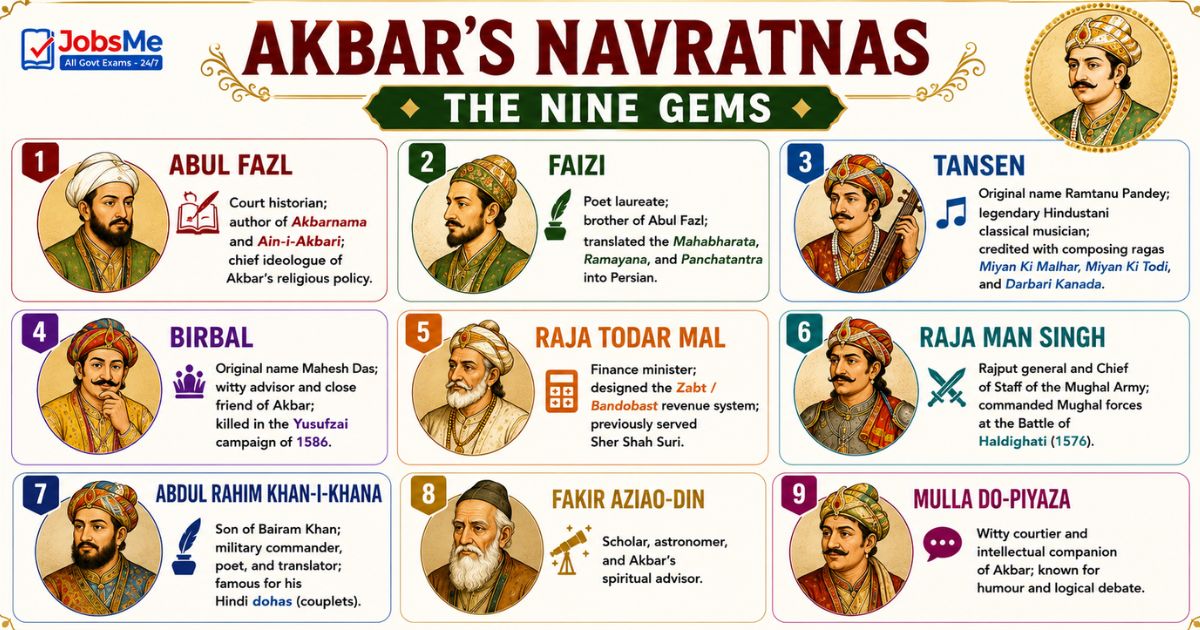
Akbar's court was adorned by nine distinguished personalities known as the Navratnas (Nine Gems). They excelled in administration, literature, music, religion, and military affairs. For more on important personalities, see the Static GK guides on Jobsme.in.
| Navratna | Role and Contribution |
|---|---|
| Abul Fazl | Court historian; author of Akbarnama and Ain-i-Akbari; chief ideologue of Akbar's religious policy. |
| Faizi | Poet laureate; brother of Abul Fazl; translated the Mahabharata, Ramayana, and Panchatantra into Persian. |
| Tansen | Original name Ramtanu Pandey; legendary Hindustani classical musician; credited with composing ragas Miyan Ki Malhar, Miyan Ki Todi, and Darbari Kanada. |
| Birbal | Original name Mahesh Das; witty advisor and close friend of Akbar; killed in the Yusufzai campaign of 1586. |
| Raja Todar Mal | Finance minister; designed the Zabt / Bandobast revenue system; previously served Sher Shah Suri. |
| Raja Man Singh | Rajput general and Chief of Staff of the Mughal Army; commanded Mughal forces at the Battle of Haldighati (1576). |
| Abdul Rahim Khan-i-Khana | Son of Bairam Khan; military commander, poet, and translator; famous for his Hindi dohas (couplets). |
| Fakir Aziao-Din | Scholar, astronomer, and Akbar's spiritual advisor. |
| Mulla Do-Piyaza | Witty courtier and intellectual companion of Akbar; known for humour and logical debate. |
Mughal Religious Developments and Society
The Mughal era witnessed both syncretism under Akbar and orthodoxy under Aurangzeb, with parallel growth of Sikhism, the Bhakti movement, and Sufism.
- Akbar's religious policy: Abolished jizya (1564), abolished the pilgrim tax, established the Ibadat Khana (House of Worship) at Fatehpur Sikri (1575) for inter-faith discussions, founded Din-i-Ilahi (1582), and issued the Mahzarnama (1579) giving him supreme religious authority.
- Aurangzeb's religious policy: Reimposed jizya in 1679, demolished several Hindu temples, executed the Sikh Guru Guru Tegh Bahadur (1675), and compiled the Fatawa-i-Alamgiri.
- Sikhism: Emerged and grew during the Mughal period from Guru Nanak (born 1469) through the ten Gurus; Guru Arjan Dev executed under Jahangir; Guru Tegh Bahadur executed under Aurangzeb; Guru Gobind Singh founded the Khalsa in 1699.
- Bhakti Movement: Flourished with saints like Mirabai, Tulsidas, Surdas, Kabir, and Ravidas promoting devotional Hindu traditions in regional languages.
- Sufism: Mystical Islamic order influenced literature, music, and the masses; key Sufi orders included Chishti, Naqshbandi, and Qadiri.
Memory Tricks and Mnemonics for the Mughal Empire
The following mnemonics make it easy to remember Mughal rulers, battles, and policies in the right sequence.
Trick 1: Order of the Six Great Mughals — "BHAJSA"
Remember the six great Mughals in chronological order with the acronym "BHAJSA":
- B → Babur (1526-1530).
- H → Humayun (1530-1540, 1555-1556).
- A → Akbar (1556-1605).
- J → Jahangir (1605-1627).
- S → Shah Jahan (1628-1658).
- A → Aurangzeb (1658-1707).
"BHAJSA — Babur to Aurangzeb, the six great Mughals."
Trick 2: Babur's Four Battles — "PKCG"
Babur fought four famous battles in just four years. Remember them with "PKCG":
- P → Panipat I (1526) — defeated Ibrahim Lodi.
- K → Khanwa (1527) — defeated Rana Sanga.
- C → Chanderi (1528) — defeated Medini Rai.
- G → Ghagra (1529) — defeated Afghan rebels.
Trick 3: Humayun's Two Defeats — "Cha-Ka"
Humayun was defeated by Sher Shah Suri in two battles — "Cha-Ka":
- Cha → Chausa (1539).
- Ka → Kanauj / Bilgram (1540).
"Chausa first, Kanauj next — and Humayun lost the empire."
Trick 4: Akbar's Navratnas — "Abt Faltu Be-Roj Rahe Faqir Mulla"
An easy mnemonic to recall Akbar's Nine Gems:
- A → Abul Fazl.
- B → Birbal.
- T → Tansen.
- F → Faizi.
- R → Raja Todar Mal.
- M → (Raja) Man Singh.
- K → (Abdul Rahim) Khan-i-Khana.
- Fa → Fakir Aziao-Din.
- Mu → Mulla Do-Piyaza.
Trick 5: Autobiographies / Memoirs — "BJ" Pattern
Only two Mughal emperors wrote their own autobiographies — "BJ":
- B → Babur → Baburnama (Tuzuk-i-Baburi) in Turkish.
- J → Jahangir → Tuzuk-i-Jahangiri in Persian.
"BJ wrote their own life — Akbar got it written by Abul Fazl."
Trick 6: Who Built the Taj Cluster — "Shah Jahan = Stone"
To remember Shah Jahan's main constructions, link him with stone (white marble):
- Taj Mahal → Agra (white marble).
- Red Fort → Delhi (red sandstone).
- Jama Masjid → Delhi (largest mosque in India).
- Moti Masjid → Agra Fort.
- Peacock Throne → Delhi.
"Shah Jahan = Stone Mason of the Mughals."
Trick 7: Jizya Tax — "Akbar Off, Aurangzeb On"
The jizya tax flip-flopped between two emperors:
- Akbar abolished jizya in 1564 (off).
- Aurangzeb reimposed jizya in 1679 (on).
"Two rulers, two opposite signatures on jizya."
Trick 8: Foreign Invasions during Decline — "Na-Ab"
During the Later Mughals, two foreign invaders looted Delhi — "Na-Ab":
- Na → Nadir Shah (1739) — took the Peacock Throne and Kohinoor.
- Ab → Ahmad Shah Abdali — fought the Third Battle of Panipat (1761) against the Marathas.
Additional Notes
Frequently Confused Facts
- First vs Second Battle of Panipat: First Battle of Panipat (1526) — Babur vs Ibrahim Lodi; Second Battle of Panipat (1556) — Akbar vs Hemu. (Third Battle of Panipat (1761) — Ahmad Shah Abdali vs Marathas, falls outside the Mughal-vs-Mughal series.)
- Akbarnama vs Ain-i-Akbari: Both written by Abul Fazl. Akbarnama is the history of Akbar's reign; Ain-i-Akbari (third volume) covers administration, statistics, geography, and economy.
- Baburnama vs Humayun Nama: Baburnama is Babur's autobiography (Turkish); Humayun Nama is Humayun's biography written by his half-sister Gulbadan Begum.
- Din-i-Ilahi vs Sulh-i-Kul: Din-i-Ilahi was a small syncretic faith (1582); Sulh-i-Kul ("universal peace") was Akbar's broader religious policy of tolerance.
- Mansabdari vs Jagirdari: Mansabdari was the ranking system; Jagirdari was the land-assignment method of payment to mansabdars.
- Mumtaz Mahal vs Nur Jahan: Mumtaz Mahal was Shah Jahan's wife (Taj Mahal built for her); Nur Jahan was Jahangir's powerful wife who ran the administration.
- Humayun's Tomb vs Akbar's Tomb: Humayun's Tomb is in Delhi (built by Hamida Banu Begum); Akbar's Tomb is at Sikandra, Agra (built by Jahangir).
- Bibi Ka Maqbara vs Taj Mahal: Bibi Ka Maqbara in Aurangabad was built by Aurangzeb's son Azam Shah for his mother Dilras Banu Begum, and is called the "Mini Taj" — not to be confused with the Taj Mahal in Agra.
- Bahadur Shah I vs Bahadur Shah II: Bahadur Shah I (1707-1712) was the first Later Mughal; Bahadur Shah II Zafar (1837-1857) was the last Mughal emperor, deposed after the Revolt of 1857.
Repeating PYQ Patterns
Certain Mughal Empire facts appear repeatedly in competitive exams. Babur (founder, First Battle of Panipat 1526, Baburnama), Akbar (Mansabdari, Din-i-Ilahi, Fatehpur Sikri, Navratnas, abolition of jizya), Shah Jahan (Taj Mahal, Red Fort, Jama Masjid), Aurangzeb (Alamgir, reimposed jizya, Fatawa-i-Alamgiri, Deccan campaigns), Nadir Shah's invasion (1739), and Bahadur Shah II (last emperor, Revolt of 1857) are the highest-frequency topics in UPSC Prelims, SSC CGL, SSC CHSL, RRB NTPC, and Banking exams. State PCS papers add regional angles — Rajput-Mughal relations (Battle of Haldighati 1576), Maratha-Mughal conflict (Shivaji vs Aurangzeb), and Mughal-Sikh relations (executions of Guru Arjan Dev and Guru Tegh Bahadur). For consistent practice, attempt the Static GK Quiz and review Daily Current Affairs on Jobsme.in.
Quick Insight
The Mughal Empire is more than a chapter in textbooks — it shaped India's modern landscape. The Taj Mahal continues to be one of the Seven Wonders of the World and India's most visited monument; the Red Fort hosts the annual Independence Day address by the Prime Minister; Humayun's Tomb, Fatehpur Sikri, and Agra Fort are UNESCO World Heritage Sites; and the administrative legacy of subas, sarkars, and parganas still echoes in modern district administration. Even Mughal-era revenue concepts inspired the colonial Permanent Settlement and continue to influence land laws. For aspirants, this topic links Static GK, Medieval History, Art and Culture, and Indian Polity in one continuous thread. To explore other related topics, check out the Static GK notes and Banking Awareness resources on Jobsme.in.
One-Liners for Quick Revision
- Mughal Empire → Founded 1526 by Babur after the First Battle of Panipat; ended in 1857 after the Revolt of 1857.
- Babur (1526-1530) → Founder; original name Zahir-ud-din Muhammad; descended from Timur and Genghis Khan; wrote Baburnama in Turkish.
- First Battle of Panipat (1526) → Babur vs Ibrahim Lodi; introduced gunpowder and Tulughma tactics in India.
- Battle of Khanwa (1527) → Babur defeated Rana Sanga of Mewar.
- Battle of Chanderi (1528) → Babur defeated Medini Rai; secured Malwa.
- Battle of Ghagra (1529) → Babur defeated Afghan rebels under Mahmud Lodi.
- Humayun (1530-1540, 1555-1556) → Son of Babur; lost throne to Sher Shah Suri; regained it in 1555; died falling from Dinpanah stairs.
- Battle of Chausa (1539) → Sher Shah Suri defeated Humayun.
- Battle of Kanauj / Bilgram (1540) → Sher Shah Suri decisively defeated Humayun; Sur Empire founded.
- Akbar (1556-1605) → Greatest Mughal; ascended at age 13 under regent Bairam Khan; founded Din-i-Ilahi and Sulh-i-Kul.
- Second Battle of Panipat (1556) → Akbar (via Bairam Khan) defeated Hemu.
- Battle of Haldighati (1576) → Mughal forces under Raja Man Singh vs Maharana Pratap; Mughal victory but Pratap escaped.
- Battle of Tukaroi (1575) → Mughal victory over Daud Khan Karrani; capture of Bengal and Bihar.
- Mansabdari System → Introduced by Akbar; ranks of zat and sawar; non-hereditary; paid through jagirs.
- Zabt / Bandobast System → Designed by Raja Todar Mal under Akbar; revenue fixed at one-third of produce.
- Dahsala System → Introduced in 1580; ten-year average for revenue assessment.
- Jagirdari System → Non-hereditary land assignment for nobles in place of cash salary.
- Zamindari System → Hereditary land rights; emerged during the decline phase.
- Land Classification under Akbar → Polaj (fertile, cultivated every year), Parauti (fallow 1-2 years), Chachar (fallow 3-4 years), Banjar (fallow 5+ years).
- Jizya tax → Religious tax on non-Muslims; abolished by Akbar (1564); reimposed by Aurangzeb (1679).
- Din-i-Ilahi → Syncretic faith launched by Akbar in 1582; blended Hinduism, Islam, Zoroastrianism, Christianity.
- Sulh-i-Kul → Akbar's policy of universal religious tolerance.
- Ibadat Khana → House of Worship built by Akbar at Fatehpur Sikri (1575) for interfaith debates.
- Mahzarnama (1579) → Document making Akbar the supreme arbiter of religious affairs.
- Akbar's Navratnas → Abul Fazl, Faizi, Tansen, Birbal, Raja Todar Mal, Raja Man Singh, Abdul Rahim Khan-i-Khana, Fakir Aziao-Din, Mulla Do-Piyaza.
- Tansen → Original name Ramtanu Pandey; composed Miyan Ki Malhar, Miyan Ki Todi, Darbari Kanada.
- Birbal → Original name Mahesh Das; close advisor to Akbar; died in Yusufzai campaign (1586).
- Raja Todar Mal → Akbar's finance minister; architect of the Zabt revenue system.
- Jahangir (1605-1627) → Original name Nuruddin Salim; wife Nur Jahan; granted trade rights to East India Company through Sir Thomas Roe (1615); wrote Tuzuk-i-Jahangiri.
- Nur Jahan → Powerful queen of Jahangir; minted coins in her name; effectively ran the empire.
- Sir Thomas Roe → British envoy to Jahangir's court; secured trade privileges for the East India Company.
- Shah Jahan (1628-1658) → Original name Khurram; golden age of Mughal architecture; imprisoned by Aurangzeb in 1658; died 1666.
- Mumtaz Mahal → Shah Jahan's wife; Taj Mahal built as her mausoleum.
- Taj Mahal → Built by Shah Jahan in Agra (1632-1653); UNESCO World Heritage Site; Seven Wonders of the World.
- Red Fort, Delhi → Built by Shah Jahan; location of the PM's annual Independence Day address.
- Jama Masjid, Delhi → Built by Shah Jahan; one of the largest mosques in India.
- Peacock Throne → Built by Shah Jahan; later taken by Nadir Shah to Persia in 1739.
- Aurangzeb (1658-1707) → Title Alamgir; orthodox Sunni; reign saw the largest territorial extent and the start of decline.
- Battle of Samugarh (1658) → Aurangzeb defeated Dara Shikoh in war of succession.
- Dara Shikoh → Aurangzeb's elder brother; wrote Majma-ul-Bahrain; translated Upanishads into Persian (Sirr-i-Akbar).
- Fatawa-i-Alamgiri → Sharia law code compiled under Aurangzeb.
- Bibi Ka Maqbara → Located in Aurangabad; called the "Mini Taj"; built by Aurangzeb's son for Dilras Banu Begum.
- Shivaji → Maratha leader; fought Aurangzeb in the Deccan.
- Sayyid Brothers → Hassan Ali Khan and Hussain Ali Khan; called "King Makers of Indian History"; deposed and installed several Later Mughals.
- Farrukhsiyar's Farman (1717) → Granted duty-free trade privileges to British East India Company in Bengal.
- Nadir Shah (1739) → Persian invader; sacked Delhi; took Peacock Throne and Kohinoor to Persia.
- Ahmad Shah Abdali → Afghan invader; fought Third Battle of Panipat (1761) against the Marathas.
- Bahadur Shah II (Zafar) → Last Mughal emperor; symbolic leader of the Revolt of 1857; exiled to Rangoon (Burma); died 1862; also a noted Urdu poet.
- Baburnama → Babur's autobiography in Turkish.
- Humayun Nama → Biography of Humayun by Gulbadan Begum.
- Akbarnama → History of Akbar by Abul Fazl.
- Ain-i-Akbari → Administrative gazette by Abul Fazl; third volume of Akbarnama.
- Tuzuk-i-Jahangiri → Jahangir's autobiography in Persian.
- Padshahnama → Shah Jahan's official history by Abdul Hamid Lahori.
- Alamgirnama → History of Aurangzeb's rule by Muhammad Kazim.
- Majma-ul-Bahrain → Dara Shikoh's work on Hindu-Muslim harmony.
- Padmavat → Sufi epic by Malik Muhammad Jayasi on Padmavati and Alauddin Khilji.
- Ramcharitmanas → Tulsidas's Ramayana in Awadhi; composed during Akbar's reign.
- Sursagar → Surdas's poetry in Brij Bhasha.
- Kabuli Bagh Mosque → Built by Babur at Panipat to commemorate the 1526 victory.
- Humayun's Tomb → Built in Delhi by Hamida Banu Begum; precursor to the Taj Mahal; UNESCO World Heritage Site.
- Fatehpur Sikri → First planned city of the Mughals; built by Akbar; UNESCO World Heritage Site.
- Buland Darwaza → Built by Akbar in 1571 to commemorate his Gujarat victory.
- Tomb of Itmad-ud-Daulah → "Baby Taj"; built in Agra by Nur Jahan for her father Mirza Ghiyas Beg.
- Shalimar Gardens, Lahore → Built by Jahangir.
- Badshahi Mosque, Lahore → Built by Aurangzeb.
- Mughal Painting Founders → Mir Sayyid Ali and Abdal Samad, brought from Persia by Humayun.
- Akbar's Painters → Baswan, Miskina, Daswant — illustrated Mahabharata and Akbarnama.
- Jahangir's Painters → Abul Hasan and Bishan Das — known for portraits and naturalism.
- Sikh Gurus and Mughals → Guru Arjan Dev executed under Jahangir; Guru Tegh Bahadur executed under Aurangzeb; Khalsa founded by Guru Gobind Singh in 1699.
- Hundi → Letter of credit used by Mughal-era traders.
- Sarais → Network of inns built to facilitate trade and travel.
- Trading communities → Banjaras, Bohra Muslims, Marwaris, Chettiars, and Europeans.
- Persian → Official language of Mughal administration.
- Urdu → Common language of communication that emerged during Mughal rule.
- Kathak → Classical dance form that evolved with Persian and Central Asian influences under Mughal patronage.
For more Static GK topics like Indian dynasties, battles, and important personalities, explore the Static GK section on Jobsme.in. You can also sharpen your preparation with the Static GK Quiz, stay updated through Daily Current Affairs Quiz, and check the latest exam alerts at Latest Government Job Notifications.
Free quiz • No signup required
Put this topic into practice with Indian Cultural Institutions – Static GK MCQ Quiz. It is the quickest way to reinforce what you just learned.
Frequently Asked Questions
Who founded the Mughal Empire in India and in which year?
Who was the last Mughal emperor of India?
What was the Mansabdari system introduced by Akbar?
Who designed the Zabt or Bandobast revenue system under Akbar?
What was Din-i-Ilahi and who founded it?
Who built the Taj Mahal and why?
Who were the Navratnas of Akbar?
Why was the Second Battle of Panipat important?
What happened during Nadir Shah's invasion of 1739?
What were the main reasons for the decline of the Mughal Empire?

About the author