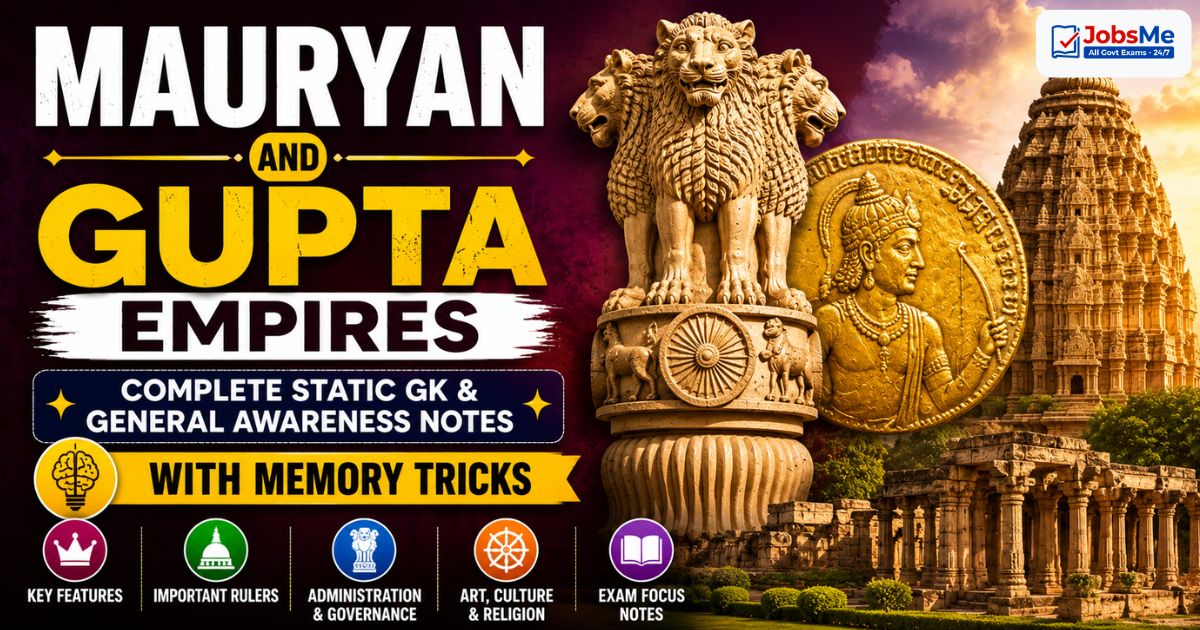
Mauryan and Gupta Empires – Complete Static GK & General Awareness Notes for Competitive Exams with Memory Tricks
This article provides a complete, exam-ready guide to the Mauryan Empire (321 BCE–185 BCE) and the Gupta Empire (319 CE–550 CE), covering all rulers, administration, art, literature, key inscriptions, foreign travellers, and major events. It includes ruler-wise tables, the Navaratnas of Chandragupta II, comparison charts, memory tricks, and one-liners designed for UPSC, SSC, IBPS, RRB, PSU, Defence, and State PCS aspirants preparing for Ancient History and General Awareness sections.
Jump to section
Introduction
The Mauryan Empire (321 BCE-185 BCE) and the Gupta Empire (319 CE-550 CE) are the two most important dynasties of ancient India and the most heavily tested topics in Ancient History across competitive exams. The Mauryan Empire, founded by Chandragupta Maurya with the guidance of Chanakya (Kautilya), was India's first pan-Indian centralised empire. The Gupta Empire, often called the Golden Age of India, witnessed unmatched progress in science, mathematics, astronomy, literature, art, and architecture under rulers like Samudragupta and Chandragupta II Vikramaditya.
Questions on these two empires appear consistently in UPSC Prelims, SSC CGL, IBPS PO, RRB NTPC, SBI Clerk, State PCS, NDA, CDS, and Insurance exams. Typical questions revolve around the order of Mauryan and Gupta rulers, Ashokan edicts, Kalinga War, Megasthenes' Indica, Fa-Hien's visit, the Iron Pillar of Mehrauli, Allahabad Prashasti, Nalanda University, and the Navaratnas. This article presents every important fact in a structured, exam-ready format. For additional Ancient History coverage, you can refer to the Static GK section on Jobsme.in.
The Mauryan and Gupta periods also link directly to current affairs themes such as the National Emblem (Lion Capital of Sarnath), Constitution Day references to Ashoka's Dhamma, Nalanda University's revival, the rediscovery of Ashokan rock edicts, and the cultural diplomacy connected to Buddhism — making this a doubly important topic for both Prelims and Mains essay preparation.
Core Concepts: Understanding the Mauryan and Gupta Empires
Both empires arose at critical turning points of Indian history. The Mauryans unified north and central India for the first time after the fall of the Nandas, while the Guptas re-established a strong central authority after centuries of foreign rule by the Indo-Greeks, Shakas, and Kushans. The two empires differ sharply in style of governance, religion, currency, art, and the nature of foreign contact.
Key Differences Between Mauryan and Gupta Empires
- Type of Administration: Mauryan = highly centralised; Gupta = decentralised, feudal with vassals (samantas).
- Religion Patronised: Mauryans patronised Buddhism (especially under Ashoka) and Jainism (Chandragupta Maurya); Guptas revived and patronised Brahmanical Hinduism (especially Vaishnavism).
- Currency: Mauryans used silver punch-marked coins called Panas/Karshapanas; Guptas issued the finest gold coins (Dinaras) in ancient India.
- Foreign Visitors: Mauryan period — Megasthenes (Greek ambassador); Gupta period — Fa-Hien (Chinese Buddhist pilgrim).
- Capital: Both used Pataliputra (modern Patna); Chandragupta II also developed Ujjain as a second capital.
- Art Style: Mauryan art is known for highly polished stone pillars and stupas; Gupta art produced the classical Nagara temple style and the Ajanta cave paintings.
The Mauryan Empire (321 BCE - 185 BCE)
The Mauryan Empire was founded in 321 BCE by Chandragupta Maurya, who overthrew the last Nanda ruler, Dhana Nanda, with the help of his mentor and Prime Minister, Chanakya. At its peak under Ashoka, the empire stretched from Afghanistan in the west to Bengal in the east, and from the Himalayas to Karnataka in the south, making it the largest empire in ancient Indian history.
Mauryan Rulers and Their Key Achievements
| Ruler | Reign | Key Facts and Achievements |
|---|---|---|
| Chandragupta Maurya | 321-297 BCE | Founder of the Mauryan dynasty; overthrew the Nanda king Dhana Nanda with Chanakya's help; defeated Seleucus Nicator (305 BCE) and received Arachosia, Gedrosia, Aria, and Paropamisadae; received Megasthenes as Greek ambassador at his court; abdicated and embraced Jainism under Acharya Bhadrabahu; died by Sallekhana (ritual fasting) at Shravanabelagola in Karnataka. |
| Bindusara | 297-273 BCE | Son of Chandragupta Maurya; known as Amitraghata ("Slayer of Foes"), referred to as Amitrochates in Greek sources; maintained diplomatic ties with the Seleucid king Antiochus I and the Egyptian king Ptolemy II Philadelphus; received Deimachus as Greek ambassador; follower of the Ajivika sect. |
| Ashoka the Great | 268-232 BCE | Greatest Mauryan emperor; titles include Devanampiya Piyadasi ("Beloved of the Gods, of Pleasing Appearance"); fought the Kalinga War in 261 BCE, after which he embraced Buddhism; propagated Dhamma; sent his children Mahendra and Sanghamitra to Sri Lanka to spread Buddhism; convened the Third Buddhist Council at Pataliputra (250 BCE) under Moggaliputta Tissa; built the Lion Capital of Sarnath, now India's National Emblem. |
| Dasharatha | 232-224 BCE | Grandson and successor of Ashoka; continued Ashoka's religious policy; issued cave inscriptions in the Nagarjuni Hills donating caves to the Ajivika sect. |
| Samprati | 224-215 BCE | Another grandson of Ashoka; patronised Jainism and is credited in Jain tradition for spreading Jainism in South India and abroad. |
| Shalishuka, Devavarman, Shatadhanvan | 215-187 BCE | Successive weak rulers; the empire began disintegrating during their reigns due to financial strain and provincial revolts. |
| Brihadratha | 187-185 BCE | Last Mauryan ruler; assassinated in 185 BCE by his Brahmin commander-in-chief Pushyamitra Shunga, who founded the Shunga dynasty, ending Mauryan rule. |
Important Mauryan Officials, Texts, and Foreign Visitors
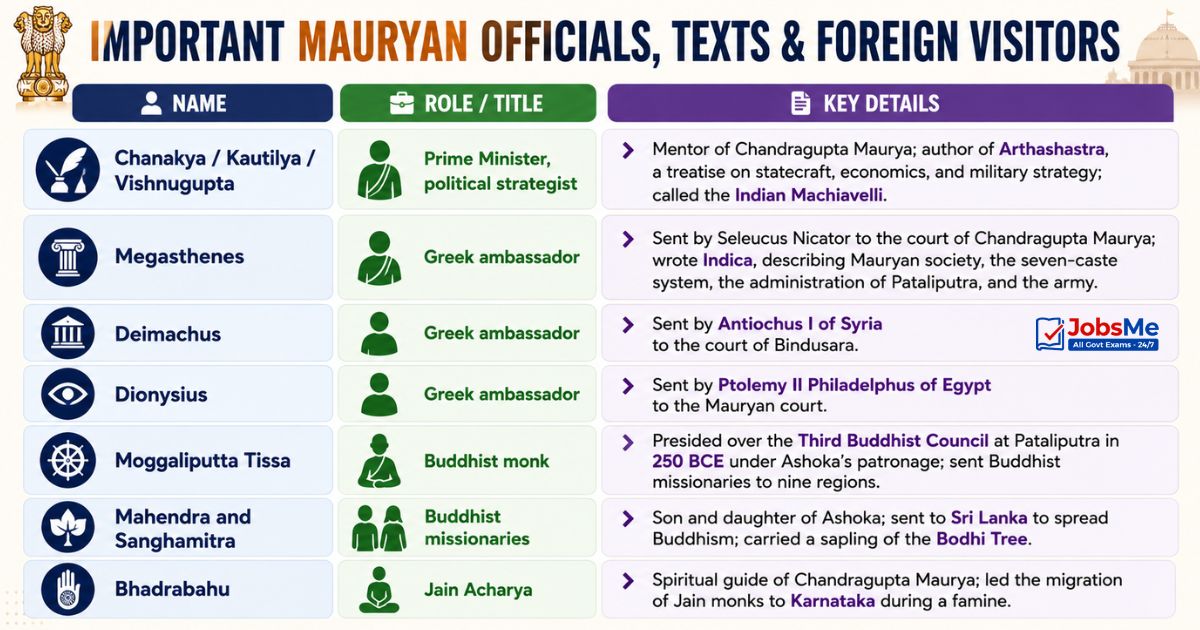
| Name | Role / Title | Key Details |
|---|---|---|
| Chanakya / Kautilya / Vishnugupta | Prime Minister, political strategist | Mentor of Chandragupta Maurya; author of Arthashastra, a treatise on statecraft, economics, and military strategy; called the Indian Machiavelli. |
| Megasthenes | Greek ambassador | Sent by Seleucus Nicator to the court of Chandragupta Maurya; wrote Indica, describing Mauryan society, the seven-caste system, the administration of Pataliputra, and the army. |
| Deimachus | Greek ambassador | Sent by Antiochus I of Syria to the court of Bindusara. |
| Dionysius | Greek ambassador | Sent by Ptolemy II Philadelphus of Egypt to the Mauryan court. |
| Moggaliputta Tissa | Buddhist monk | Presided over the Third Buddhist Council at Pataliputra in 250 BCE under Ashoka's patronage; sent Buddhist missionaries to nine regions. |
| Mahendra and Sanghamitra | Buddhist missionaries | Son and daughter of Ashoka; sent to Sri Lanka to spread Buddhism; carried a sapling of the Bodhi Tree. |
| Bhadrabahu | Jain Acharya | Spiritual guide of Chandragupta Maurya; led the migration of Jain monks to Karnataka during a famine. |
Ashokan Edicts and Inscriptions
Ashoka's edicts are the earliest deciphered written records of Indian history. They were inscribed mostly in Brahmi script (deciphered by James Prinsep in 1837), with some in Kharosthi (in the north-west), and Greek and Aramaic in Afghanistan.
| Edict / Inscription | Location | Key Content |
|---|---|---|
| Major Rock Edict XIII | Shahbazgarhi, Kalsi, Girnar, Yerragudi, Erragudi | Describes the Kalinga War and Ashoka's remorse; the most important edict historically. |
| Minor Rock Edict — Maski | Maski, Karnataka | First edict to mention Ashoka by name as Devanampiya Asoka; discovered in 1915. |
| Minor Rock Edicts — Gujarra, Nittur, Udegolam, Brahmagiri | Madhya Pradesh, Karnataka | Also explicitly mention Ashoka's personal name. |
| Kandahar Bilingual Rock Inscription | Kandahar, Afghanistan | Written in Greek and Aramaic; reflects Ashoka's outreach to non-Indian subjects. |
| Sarnath Pillar Edict | Sarnath, Uttar Pradesh | Bears the famous Lion Capital, adopted as the National Emblem of India; the Dharma Chakra on it is on the National Flag. |
| Rummindei Pillar Inscription | Lumbini, Nepal | Records Ashoka's visit to the Buddha's birthplace and his exemption of Lumbini from taxes. |
| Allahabad Pillar (Mauryan portion) | Allahabad / Prayagraj | Originally erected by Ashoka; later also contains the Gupta-era Prayag Prashasti of Samudragupta. |
| Sannati Inscription | Sannati, Karnataka | Discovered in 1989; the only Ashokan site with both Major Rock Edicts and a portrait sculpture believed to be of Ashoka. |
| Bhabru / Bairat Edict | Rajasthan | Ashoka declares his faith in Buddha, Dhamma, and Sangha — confirming his Buddhist allegiance. |
The Gupta Empire (319 CE - 550 CE)
The Gupta Empire is celebrated as the Golden Age of India because of remarkable advances in art, science, mathematics, astronomy, literature, and architecture. Founded by Sri Gupta around 240 CE, the dynasty rose to imperial heights under Chandragupta I, Samudragupta, and Chandragupta II Vikramaditya.
Gupta Rulers and Their Key Achievements
| Ruler | Reign | Key Facts and Achievements |
|---|---|---|
| Sri Gupta | c. 240-280 CE | Founder of the Gupta dynasty; held the title Maharaja; ruled a small kingdom in Magadha. |
| Ghatotkacha | c. 280-319 CE | Son of Sri Gupta; also held the title Maharaja; consolidated the early Gupta kingdom. |
| Chandragupta I | 319-335 CE | First major Gupta ruler; took the imperial title Maharajadhiraja; started the Gupta Era in 319-320 CE; married Kumaradevi, a Lichchhavi princess, strengthening Gupta power; issued gold coins jointly with his queen. |
| Samudragupta | 335-380 CE | Called the Napoleon of India by historian V. A. Smith for his vast conquests; his achievements are recorded in the Allahabad Pillar Inscription (Prayag Prashasti) composed by his court poet Harisena; performed the Ashvamedha Yajna; titled Kaviraja for his poetic skills; depicted on coins playing the veena; called Lichchhavi-dauhitra (grandson of the Lichchhavis). |
| Ramagupta | c. 380 CE | Successor of Samudragupta as per the play "Devichandraguptam"; known for surrendering his queen Dhruvadevi to a Saka chief, after which Chandragupta II killed him. |
| Chandragupta II Vikramaditya | 380-415 CE | Greatest Gupta ruler; defeated the Saka satrap Rudrasimha III and added Gujarat, Saurashtra, and Malwa; titled Vikramaditya, Sakari, and Devagupta; established Ujjain as second capital; patron of the Navaratnas (Nine Gems); Chinese pilgrim Fa-Hien visited his court (399-414 CE); credited with the Iron Pillar of Mehrauli (Delhi). |
| Kumaragupta I | 415-455 CE | Titled Mahendraditya; performed the Ashvamedha Yajna; founder of the world-famous Nalanda University in Bihar; faced early Huna invasions; worshipper of Kartikeya. |
| Skandagupta | 455-467 CE | Last great Gupta emperor; titled Vikramaditya; successfully defeated the Hunas (White Huns) led by Toramana; Junagadh / Girnar Inscription records his repair of the Sudarshana Lake originally built under Chandragupta Maurya; his death marked the start of Gupta decline. |
| Purugupta, Kumaragupta II, Budhagupta, Narasimhagupta, Kumaragupta III | 467-540 CE | Later weak Gupta rulers; faced repeated Huna invasions under Toramana and his son Mihirakula; empire fragmented. |
| Vishnugupta | c. 540-550 CE | Last Gupta ruler; with his death, the Gupta Empire collapsed; India entered the period of regional kingdoms. |
Navaratnas of Chandragupta II — The Nine Gems
The court of Chandragupta II Vikramaditya at Ujjain was adorned by nine extraordinary scholars known as the Navaratnas. They represent the peak of intellectual achievement of the Golden Age.
| Navaratna | Field | Key Contribution |
|---|---|---|
| Kalidasa | Poet and dramatist | Called the Shakespeare of India; works include the plays Abhijnanasakuntalam, Vikramorvashiyam, and Malavikagnimitram, and the poems Meghaduta, Raghuvamsa, Kumarasambhava, and Ritusamhara. |
| Aryabhata | Mathematician and astronomer | Wrote Aryabhatiya (499 CE); introduced the concept of zero in calculations; gave an approximate value of pi (π); stated that the Earth rotates on its axis; explained eclipses scientifically. |
| Varahamihira | Astronomer and astrologer | Authored Brihat Samhita (an encyclopaedic work on astronomy, geography, and architecture) and Panchasiddhantika. |
| Dhanvantari | Physician | Eminent Ayurvedic physician; considered the father of Indian medicine; National Ayurveda Day is celebrated on his birth anniversary (Dhanteras). |
| Vetala Bhatta | Magician / scholar | Believed to be the author of Niti Pradipa, a treatise on ethics and statecraft in sixteen stanzas. |
| Vararuchi (Katyayana) | Grammarian and linguist | Author of Prakrit Prakasha, the earliest grammar of the Prakrit language. |
| Shanku | Geographer / architect | Authored works on geography and territorial planning. |
| Ghatakarpara | Poet | Sanskrit poet credited with the short poem Ghatakarpara Kavya known for its elaborate use of rhyme. |
| Amarasimha | Lexicographer | Author of the famous Sanskrit thesaurus Amarakosha, still studied today. |
Other Important Gupta-Era Personalities and Foreign Visitors
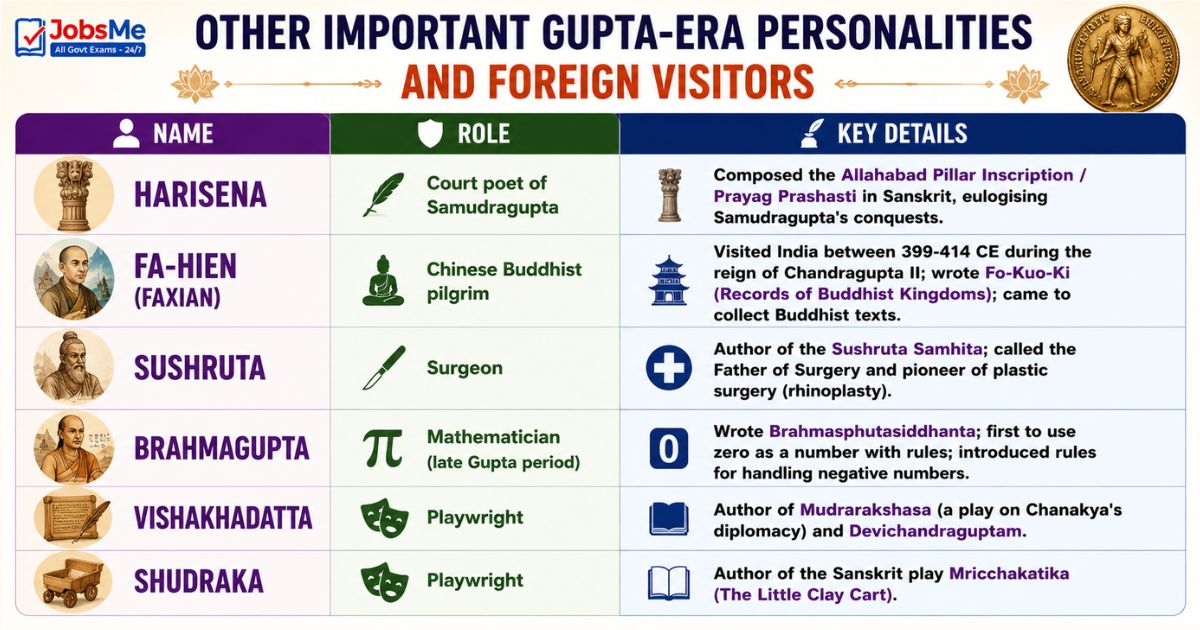
| Name | Role | Key Details |
|---|---|---|
| Harisena | Court poet of Samudragupta | Composed the Allahabad Pillar Inscription / Prayag Prashasti in Sanskrit, eulogising Samudragupta's conquests. |
| Fa-Hien (Faxian) | Chinese Buddhist pilgrim | Visited India between 399-414 CE during the reign of Chandragupta II; wrote Fo-Kuo-Ki (Records of Buddhist Kingdoms); came to collect Buddhist texts. |
| Sushruta | Surgeon | Author of the Sushruta Samhita; called the Father of Surgery and pioneer of plastic surgery (rhinoplasty). |
| Brahmagupta | Mathematician (late Gupta period) | Wrote Brahmasphutasiddhanta; first to use zero as a number with rules; introduced rules for handling negative numbers. |
| Vishakhadatta | Playwright | Author of Mudrarakshasa (a play on Chanakya's diplomacy) and Devichandraguptam. |
| Shudraka | Playwright | Author of the Sanskrit play Mricchakatika (The Little Clay Cart). |
Important Inscriptions, Art, and Architecture of the Gupta Era
| Monument / Inscription | Location | Significance |
|---|---|---|
| Allahabad Pillar Inscription (Prayag Prashasti) | Allahabad / Prayagraj | Composed by Harisena; details Samudragupta's military campaigns including the Aryavarta and Dakshinapatha campaigns; inscribed on a pillar originally erected by Ashoka. |
| Mehrauli Iron Pillar | Delhi (Qutub Complex) | Believed to have been erected by Chandragupta II; remarkable for not rusting in over 1,600 years; bears a Sanskrit inscription mentioning King "Chandra." |
| Junagadh / Girnar Rock Inscription of Skandagupta | Junagadh, Gujarat | Records Skandagupta's repair of the Sudarshana Lake (originally built under Chandragupta Maurya by Pushyagupta and repaired under Rudradaman I). |
| Bhitari Pillar Inscription | Ghazipur, Uttar Pradesh | Records Skandagupta's victory over the Hunas. |
| Dashavatara Temple | Deogarh, Uttar Pradesh | One of the earliest stone temples in the Nagara style; dedicated to Lord Vishnu. |
| Ajanta Cave Paintings | Maharashtra | Many of the most famous murals depicting Jataka tales were painted during the Gupta period (Caves 1, 2, 16, 17). |
| Bagh Caves | Madhya Pradesh | Buddhist rock-cut caves famous for Gupta-era murals. |
| Udayagiri Caves | Vidisha, Madhya Pradesh | Famous for the Varaha (boar incarnation of Vishnu) sculpture from the time of Chandragupta II. |
| Nalanda University | Bihar | Founded by Kumaragupta I; one of the world's first residential universities; later visited by Hiuen Tsang. |
| Sanchi Stupa | Madhya Pradesh | Originally commissioned by Ashoka (Mauryan); enlarged and decorated with gateways in the Shunga and Gupta periods. |
Comparison Chart: Mauryan vs Gupta Empire
This comparative table summarises the most exam-relevant differences between the two empires.
| Feature | Mauryan Empire | Gupta Empire |
|---|---|---|
| Founder | Chandragupta Maurya (with Chanakya) | Sri Gupta (dynasty); Chandragupta I (imperial) |
| Period | 321 BCE - 185 BCE | 319 CE - 550 CE |
| Capital | Pataliputra | Pataliputra (primary), Ujjain (secondary under Chandragupta II) |
| Administration | Highly centralised; espionage network; provinces under princes | Decentralised feudal; vassal kings (samantas) |
| Greatest Ruler | Ashoka the Great | Chandragupta II Vikramaditya |
| Religion Patronised | Buddhism (Ashoka), Jainism (Chandragupta Maurya), Ajivika (Bindusara) | Brahmanical Hinduism, especially Vaishnavism |
| Currency | Silver Punch-Marked Coins (Karshapana / Pana) | Gold Coins (Dinaras), Silver (Rupakas) |
| Foreign Visitor | Megasthenes (Greek), Deimachus, Dionysius | Fa-Hien (Chinese) |
| Key Text | Arthashastra (Chanakya), Indica (Megasthenes) | Aryabhatiya, Mudrarakshasa, Sushruta Samhita, Kalidasa's works |
| Key Architecture | Lion Capital of Sarnath, Ashokan Pillars, Sanchi Stupa | Iron Pillar of Mehrauli, Dashavatara Temple, Ajanta Paintings, Nalanda University |
| Last Ruler | Brihadratha (killed by Pushyamitra Shunga) | Vishnugupta |
| Cause of Decline | Weak successors, financial strain, Brahmanical revolt | Huna invasions, feudal fragmentation |
Memory Tricks and Mnemonics
Trick 1: Order of Mauryan Rulers — "Chandragupta Bindu Ashoka Da Sa Sa Sa Brihad"
Remember the seven main Mauryan rulers in order with the phrase: "Chandragupta Bindu Ashoka Da Sa Sa Sa Brihad."
- Chandragupta → Chandragupta Maurya.
- Bindu → Bindusara.
- Ashoka → Ashoka the Great.
- Da → Dasharatha.
- Sa → Samprati.
- Sa Sa → Shalishuka, Shatadhanvan.
- Brihad → Brihadratha (last).
Trick 2: Order of Major Gupta Rulers — "Sri Ghata Chandra Samudra Chandra Kuma Skanda"
Remember the line of imperial Gupta rulers:
- Sri → Sri Gupta.
- Ghata → Ghatotkacha.
- Chandra → Chandragupta I.
- Samudra → Samudragupta.
- Chandra → Chandragupta II (Vikramaditya).
- Kuma → Kumaragupta I.
- Skanda → Skandagupta (last great Gupta).
"Sri Ghata builds the throne; two Chandras, one Samudra, one Kumar, one Skanda — Gupta's seven famous sons."
Trick 3: Navaratnas of Chandragupta II — "KAV DhV V Sh Gh A"
Use this acronym to remember all nine gems:
- K → Kalidasa.
- A → Aryabhata.
- V → Varahamihira.
- Dh → Dhanvantari.
- V → Vetala Bhatta.
- V → Vararuchi.
- Sh → Shanku.
- Gh → Ghatakarpara.
- A → Amarasimha.
"Kalidasa is the king of the gems; the rest are jewels around him."
Trick 4: Foreign Visitors — "M-D-D for Mauryans, F for Guptas"
To remember which foreign ambassadors / pilgrims came in which period:
- M → Megasthenes (Chandragupta Maurya's court).
- D → Deimachus (Bindusara's court).
- D → Dionysius (Mauryan court from Egypt).
- F → Fa-Hien (Chandragupta II's court — Gupta era).
"Three Greeks for Mauryans, one Chinese for Guptas."
Trick 5: Titles of Chandragupta II — "VSD"
Chandragupta II Vikramaditya held three iconic titles:
- V → Vikramaditya (Sun of Valour).
- S → Sakari (Destroyer of the Sakas).
- D → Devagupta / Devaraja.
Trick 6: Ashokan Edicts that Mention His Name — "MaG-N-U-B"
Only a few Ashokan edicts actually mention Ashoka by name (Devanampiya Asoka). Remember them with "MaG-N-U-B":
- Ma → Maski (Karnataka).
- G → Gujarra (Madhya Pradesh).
- N → Nittur (Karnataka).
- U → Udegolam (Karnataka).
- B → Brahmagiri (Karnataka — by reference).
"Most of the name-bearing edicts are in Karnataka — Maski is the most famous."
Trick 7: Mauryan vs Gupta — "Silver vs Gold, Greek vs Chinese, Centralised vs Feudal"
Contrast the two empires using these three quick pairs:
- Currency: Mauryans = Silver punch-marked coins; Guptas = Gold dinaras.
- Foreign Visitor: Mauryans = Greek (Megasthenes); Guptas = Chinese (Fa-Hien).
- Administration: Mauryans = Centralised; Guptas = Feudal / Decentralised.
"Silver-Greek-Centre vs Gold-China-Feudal."
Additional Notes
Frequently Confused Facts
- Chandragupta Maurya vs Chandragupta I vs Chandragupta II: Chandragupta Maurya founded the Mauryan Empire in 321 BCE; Chandragupta I founded the imperial Gupta line in 319 CE; Chandragupta II (Vikramaditya) was the greatest Gupta ruler (380-415 CE).
- Napoleon of India vs Indian Machiavelli: Samudragupta is called the Napoleon of India; Chanakya (Kautilya) is the Indian Machiavelli.
- Megasthenes vs Fa-Hien: Megasthenes was a Greek ambassador during Chandragupta Maurya's reign; Fa-Hien was a Chinese Buddhist pilgrim during Chandragupta II's reign.
- Arthashastra vs Indica: Arthashastra was written by Chanakya (Mauryan PM); Indica was written by Megasthenes (Greek envoy).
- Allahabad Pillar — Ashoka and Samudragupta: The same pillar bears both an Ashokan edict and the later Gupta-era Prayag Prashasti of Samudragupta composed by Harisena.
- Lion Capital vs Iron Pillar: The Lion Capital of Sarnath is Mauryan (Ashoka, c. 250 BCE); the Iron Pillar of Mehrauli is Gupta (Chandragupta II, c. 400 CE).
- Third Buddhist Council vs Fourth Buddhist Council: The Third Council was held at Pataliputra under Ashoka; the Fourth Council was held in Kashmir under Kanishka (Kushan dynasty).
- Kumaragupta I vs Kumaragupta II: Kumaragupta I founded Nalanda University; Kumaragupta II was a later weak Gupta ruler.
- Skandagupta defeated Hunas vs Bindusara fought Greeks: Skandagupta repelled the Hunas (Toramana); Bindusara dealt with Seleucid Greeks diplomatically, not militarily.
Repeating PYQ Patterns
Across past papers of UPSC, SSC CGL, IBPS PO, RRB NTPC, SBI Clerk, and State PCS, the most repeated themes are: (1) order of Mauryan rulers and the founder of the Mauryan dynasty; (2) the Kalinga War and its impact on Ashoka; (3) the Allahabad Pillar Inscription and its author Harisena; (4) Megasthenes and his work Indica; (5) the Navaratnas, especially Aryabhata's contributions; (6) the Iron Pillar of Mehrauli; (7) Fa-Hien's visit and his account; (8) the founder of Nalanda University; and (9) the last Mauryan ruler and the dynasty that succeeded the Mauryans. Aspirants should also revise the Daily Current Affairs to track Nalanda University updates and references to Ashokan diplomacy.
Quick Insight
The Mauryan and Gupta empires together represent two distinct golden moments in Indian civilisation — one of political unification and ethical statecraft under the Mauryans, and one of cultural and scientific brilliance under the Guptas. Modern India still carries the legacy of both: the National Emblem (Lion Capital), the National Flag's Dharma Chakra, the revival of Nalanda University, and the decimal system used worldwide all trace back to these dynasties. For further reading on related Ancient History topics, you may refer to the Static GK notes and test your understanding with the Static GK Quiz on Jobsme.in.
One-Liners for Quick Revision
- Mauryan Empire → Founded in 321 BCE by Chandragupta Maurya with the guidance of Chanakya; capital Pataliputra.
- Chandragupta Maurya → Overthrew Dhana Nanda; defeated Seleucus Nicator in 305 BCE; embraced Jainism; died at Shravanabelagola.
- Chanakya (Kautilya / Vishnugupta) → Author of Arthashastra; called the Indian Machiavelli; PM of Chandragupta Maurya.
- Bindusara → Known as Amitraghata (Slayer of Foes); son of Chandragupta Maurya; followed the Ajivika sect.
- Ashoka the Great → Titled Devanampiya Piyadasi; fought Kalinga War in 261 BCE; embraced Buddhism; built Lion Capital of Sarnath.
- Kalinga War → Fought in 261 BCE; described in Major Rock Edict XIII; led to Ashoka's adoption of Buddhism.
- Third Buddhist Council → Held at Pataliputra in 250 BCE under Ashoka; presided over by Moggaliputta Tissa.
- Mahendra and Sanghamitra → Children of Ashoka; sent to Sri Lanka to spread Buddhism with a sapling of the Bodhi tree.
- Maski Edict → First edict to mention Ashoka by name; discovered in Karnataka in 1915.
- Sannati Edict → Discovered in Karnataka in 1989; only Ashokan site with a portrait sculpture believed to be of Ashoka.
- Brahmi Script → Most Ashokan edicts written in it; deciphered by James Prinsep in 1837.
- Kandahar Bilingual Inscription → Written in Greek and Aramaic; located in Afghanistan.
- Brihadratha → Last Mauryan ruler; killed by his commander Pushyamitra Shunga in 185 BCE.
- Pushyamitra Shunga → Founder of the Shunga dynasty; ended Mauryan rule.
- Megasthenes → Greek ambassador of Seleucus Nicator; wrote Indica.
- Arthashastra → Authored by Chanakya; treatise on statecraft, economics, and military strategy.
- Mauryan Coins → Silver punch-marked coins called Karshapanas or Panas.
- Lion Capital of Sarnath → Built by Ashoka; adopted as India's National Emblem on 26 January 1950.
- Gupta Empire → Founded by Sri Gupta around 240 CE; rose to imperial heights under Chandragupta I.
- Gupta Era → Started in 319-320 CE by Chandragupta I.
- Chandragupta I → First Gupta to use the title Maharajadhiraja; married Lichchhavi princess Kumaradevi.
- Samudragupta → Called Napoleon of India by V. A. Smith; performed Ashvamedha Yajna; called Lichchhavi-dauhitra; titled Kaviraja.
- Allahabad Pillar Inscription / Prayag Prashasti → Composed by Harisena; eulogy of Samudragupta's conquests.
- Harisena → Court poet of Samudragupta; author of Prayag Prashasti.
- Chandragupta II → Titled Vikramaditya, Sakari, and Devagupta; defeated Saka satrap Rudrasimha III.
- Fa-Hien (Faxian) → Chinese Buddhist pilgrim; visited India 399-414 CE; wrote Fo-Kuo-Ki.
- Iron Pillar of Mehrauli → Erected by Chandragupta II; in Delhi's Qutub Complex; has not rusted for over 1,600 years.
- Ujjain → Second capital of the Guptas under Chandragupta II.
- Navaratnas → Nine Gems in Chandragupta II's court — Kalidasa, Aryabhata, Varahamihira, Dhanvantari, Vetala Bhatta, Vararuchi, Shanku, Ghatakarpara, and Amarasimha.
- Kalidasa → Shakespeare of India; wrote Abhijnanasakuntalam, Meghaduta, Raghuvamsa, Kumarasambhava.
- Aryabhata → Wrote Aryabhatiya in 499 CE; gave the concept of zero, value of pi, and Earth's rotation theory.
- Varahamihira → Author of Brihat Samhita and Panchasiddhantika.
- Dhanvantari → Father of Ayurveda; National Ayurveda Day on his birth anniversary.
- Amarasimha → Lexicographer; author of Amarakosha.
- Sushruta → Father of Surgery; author of Sushruta Samhita; pioneer of plastic surgery.
- Brahmagupta → Mathematician; wrote Brahmasphutasiddhanta; first to use zero as a number with rules.
- Vishakhadatta → Author of Mudrarakshasa and Devichandraguptam.
- Shudraka → Author of Mricchakatika (The Little Clay Cart).
- Kumaragupta I → Titled Mahendraditya; founded Nalanda University; worshipper of Kartikeya.
- Nalanda University → Founded by Kumaragupta I; one of the world's first residential universities.
- Skandagupta → Last great Gupta ruler; defeated Hunas led by Toramana; repaired Sudarshana Lake.
- Junagadh / Girnar Inscription → Records Skandagupta's repair of the Sudarshana Lake.
- Bhitari Pillar Inscription → Records Skandagupta's victory over the Hunas.
- Dashavatara Temple → Located at Deogarh, UP; early Nagara-style temple of Vishnu.
- Ajanta Caves → Many famous Gupta-era murals depicting Jataka tales.
- Udayagiri Caves → Famous for the Varaha sculpture from Chandragupta II's time.
- Gupta Coins → Gold coins called Dinaras and silver coins called Rupakas.
- Vishnugupta → Last Gupta ruler; with him the empire ended around 550 CE.
- Hunas (White Huns) → Central Asian invaders who weakened the Guptas; led by Toramana and Mihirakula.
- Sudarshana Lake → Built under Chandragupta Maurya by Pushyagupta; repaired under Rudradaman I (Saka) and Skandagupta (Gupta).
- Mauryan Capital → Pataliputra (modern Patna); described in detail by Megasthenes.
- Gupta Golden Age → Marked by progress in mathematics, astronomy, medicine, literature, and Nagara-style temple architecture.
For more Ancient History and Static GK topics like Ashokan inscriptions, Indian dynasties, and important battles, explore the Static GK section on Jobsme.in. You can also test your knowledge with the Static GK Quiz and check out the latest exam updates at Latest Government Job Notifications.
Free quiz • No signup required
Put this topic into practice with Indian Cultural Institutions – Static GK MCQ Quiz. It is the quickest way to reinforce what you just learned.
Frequently Asked Questions
Who founded the Mauryan Empire and in which year?
Why is the Kalinga War considered a turning point in Indian history?
Who wrote the Allahabad Pillar Inscription and whose achievements does it describe?
Why is Samudragupta called the Napoleon of India?
Who were the Navaratnas in the court of Chandragupta II?
Who founded Nalanda University and during which dynasty?
What is the Iron Pillar of Mehrauli and why is it famous?
Who was Megasthenes and what did he write?
Who was the last ruler of the Mauryan Empire and who killed him?
Why is the Gupta period called the Golden Age of India?

About the author