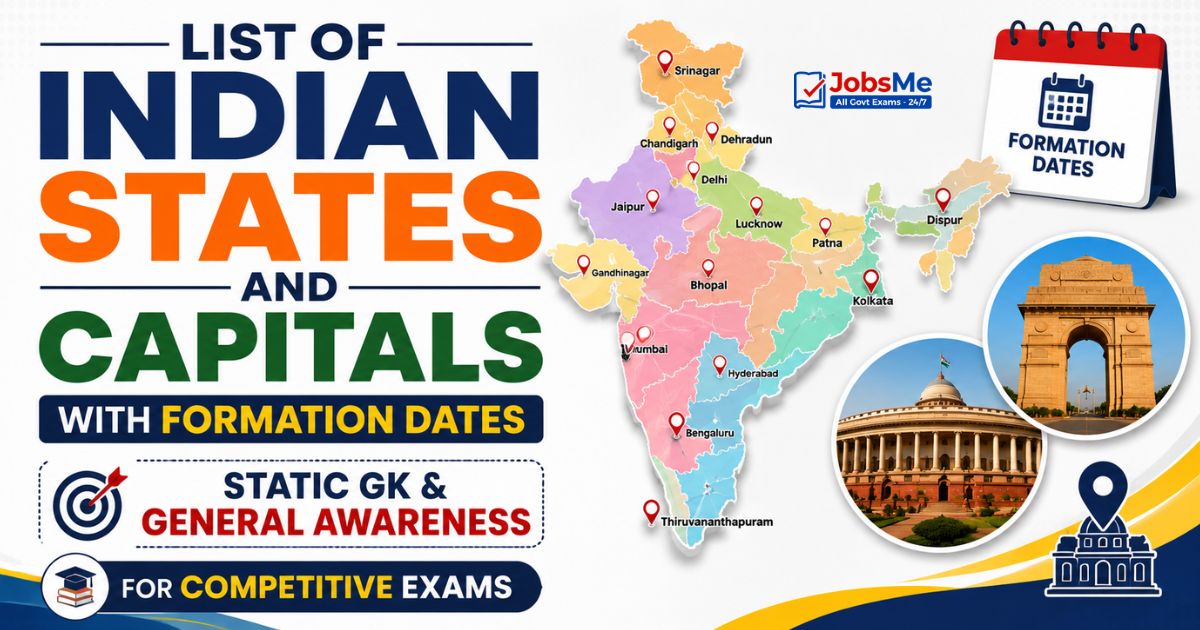
List of Indian States and Capitals with Formation Dates – Static GK & General Awareness for Competitive Exams with Memory Tricks
This article presents a complete list of all 28 Indian States and 8 Union Territories with their capitals, formation dates, governing acts, official languages, and state specialities. It includes every major fact tested in competitive exams – from the States Reorganisation Act of 1956 to the latest 2026 amendment making Amaravati the sole capital of Andhra Pradesh – along with memory tricks, mnemonics, and one-liners for quick revision. All facts are arranged in exam-ready format to help UPSC, SSC, IBPS, RRB, PSU, Defence, and State PCS aspirants score better in General Awareness, Indian Polity, and Geography sections.
Jump to section
- Core Concepts: States, Union Territories, and Constitutional Framework
- List of 28 Indian States with Capitals and Formation Dates
- List of 8 Union Territories with Capitals and Formation Dates
- Official Languages of Indian States
- Specialities of Indian States
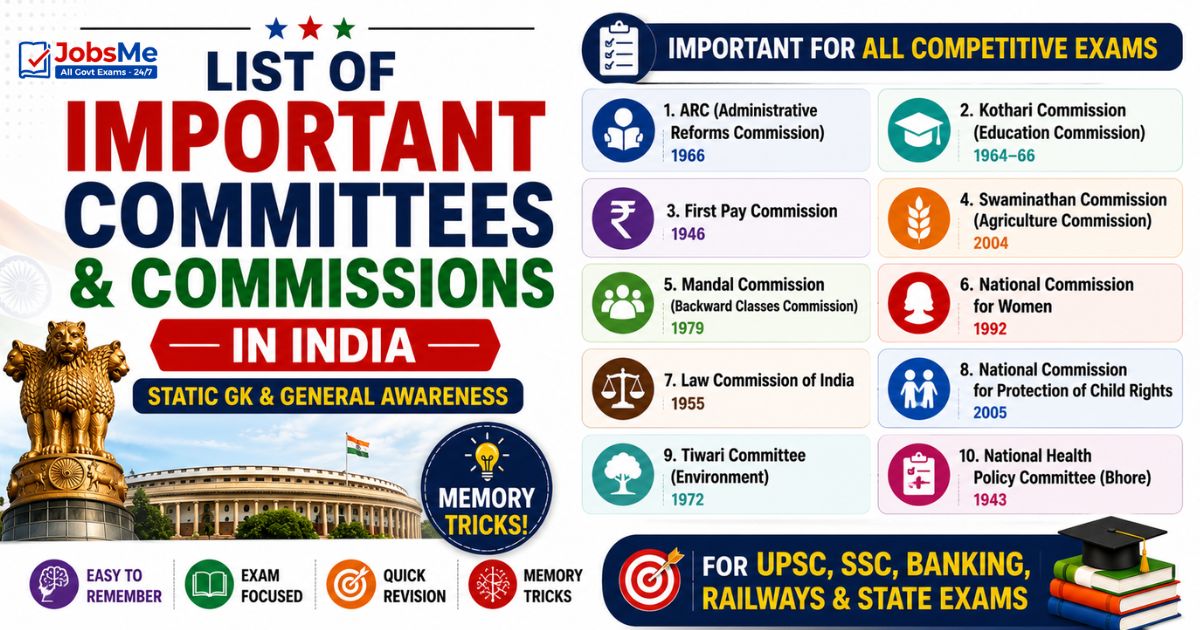
- Major Commissions on Reorganisation of States
- Memory Tricks and Mnemonics
- Additional Notes
- One-Liners for Quick Revision
India is a federal Union of 28 States and 8 Union Territories, each with its own capital, formation date, official language, and unique cultural identity. The political map of India did not look the way it does today on 15 August 1947 - it has been redrawn repeatedly through linguistic reorganisation, princely state integration, and successive Acts of Parliament. From Andhra Pradesh becoming the first linguistic state on 1 November 1956 to Telangana becoming the youngest state on 2 June 2014, and the 2019 bifurcation of Jammu and Kashmir into two Union Territories, every milestone is exam-critical.
Questions on Indian states, capitals, and their formation dates appear regularly in UPSC Prelims, SSC CGL, SSC CHSL, IBPS PO, IBPS Clerk, SBI PO, RRB NTPC, RRB Group D, State PCS, NDA, CDS, and Insurance exams. Typical question patterns include matching a state with its capital, identifying the formation date or the Act that created a state, recognising the first/newest state, and naming the commission that recommended a particular reorganisation. To explore other Static GK topics for competitive exams, you can refer to the Static GK section on Jobsme.in.
The topic is also closely linked to current affairs themes such as the renaming of Port Blair to Sri Vijaya Puram in September 2024, the Andhra Pradesh Reorganisation (Amendment) Act, 2026 declaring Amaravati as the sole permanent capital, statehood day celebrations, and ongoing demands for new states - making this topic doubly important for aspirants preparing for both objective papers and current affairs sections.
Core Concepts: States, Union Territories, and Constitutional Framework
Understanding the constitutional basis of state formation helps students answer not only direct matching questions but also polity-based application questions in Prelims and Mains.
- Article 1: Declares India (Bharat) as a "Union of States". It is the foundational article describing India's federal character.
- Article 2: Empowers Parliament to admit or establish new states into the Union.
- Article 3: Gives Parliament the power to form new states, alter boundaries, or change the name of an existing state. Often quoted as: "India is an indestructible Union of destructible States."
- Articles 239-241: Part VIII of the Constitution deals specifically with the administration of Union Territories.
- State Government Structure: Each state has an elected Chief Minister, Council of Ministers, and a Legislative Assembly. The Governor is the nominal head, representing the President.
- Union Territory Administration: UTs are administered directly by the Central Government through a Lieutenant Governor or Administrator. Delhi, Puducherry, and Jammu & Kashmir have their own legislative assemblies; others do not.
Original Classification under the Constitution (1950)
When the Constitution came into force on 26 January 1950, Indian states were classified into four groups, which was later abolished by the States Reorganisation Act of 1956.
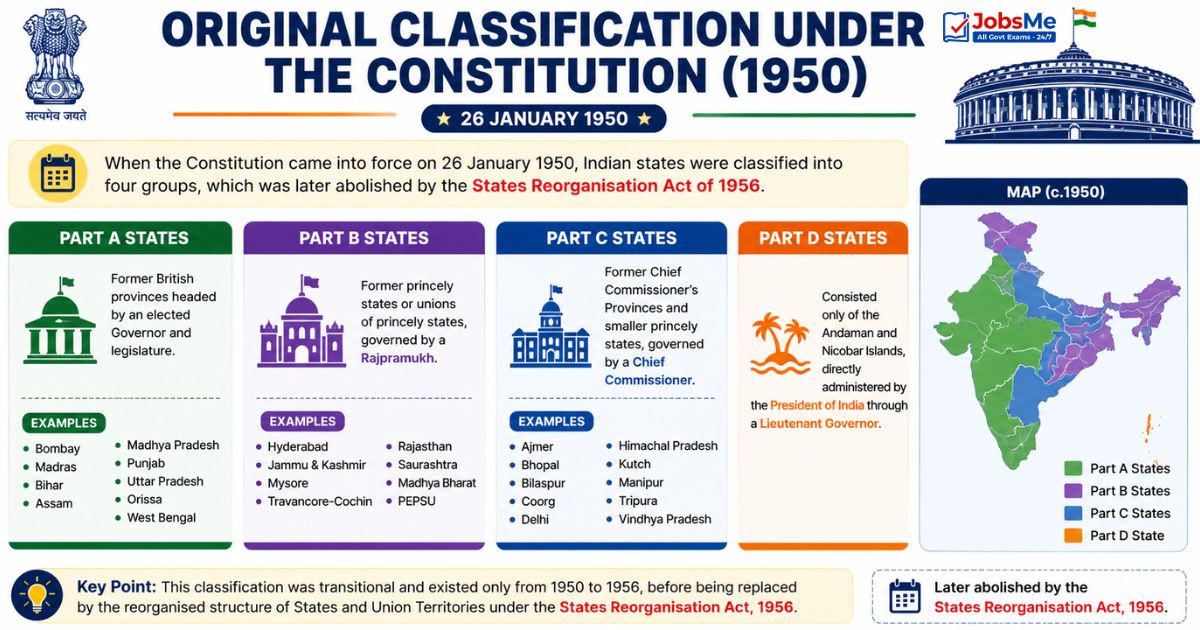
- Part A States: Former British provinces headed by an elected Governor and legislature. Examples: Bombay, Madras, Bihar, Assam, Madhya Pradesh, Punjab, Uttar Pradesh, Orissa, West Bengal.
- Part B States: Former princely states or unions of princely states, governed by a Rajpramukh. Examples: Hyderabad, Jammu & Kashmir, Mysore, Travancore-Cochin, Rajasthan, Saurashtra, Madhya Bharat, PEPSU.
- Part C States: Former Chief Commissioner's Provinces and smaller princely states, governed by a Chief Commissioner. Examples: Ajmer, Bhopal, Bilaspur, Coorg, Delhi, Himachal Pradesh, Kutch, Manipur, Tripura, Vindhya Pradesh.
- Part D States: Consisted only of the Andaman and Nicobar Islands, directly administered by the President of India through a Lieutenant Governor.
List of 28 Indian States with Capitals and Formation Dates
The following table lists every Indian state, its capital, the date on which it attained its current statehood, the Act or notification under which it was formed, and its previous administrative status. This is the single most exam-critical table on the topic.
| State | Capital | Formation Date | Formed By / Key Features |
|---|---|---|---|
| Andhra Pradesh | Amaravati | 1 November 1956 | Founded by the States Reorganisation Act, 1956; first linguistic state in India formed for Telugu-speaking people; Hyderabad was joint capital with Telangana till 2 June 2024; Amaravati declared sole and permanent capital by the Andhra Pradesh Reorganisation (Amendment) Act, 2026. |
| Arunachal Pradesh | Itanagar | 20 February 1987 | Founded by the State of Arunachal Pradesh Act, 1986; previously a Union Territory (1972) and earlier known as the North-East Frontier Agency (NEFA); the 24th state of India. |
| Assam | Dispur | 26 January 1950 | One of the oldest states of India, present in the Constitution at commencement; capital shifted from Shillong to Dispur in 1972 after Meghalaya was carved out; famous for Kaziranga, tea, and Bihu. |
| Bihar | Patna | 22 March 1912 (Province); 26 January 1950 (State) | Bihar Province was carved out of the Bengal Presidency on 22 March 1912; became a full state on 26 January 1950; Jharkhand was bifurcated from Bihar in 2000. |
| Chhattisgarh | Raipur | 1 November 2000 | Founded by the Madhya Pradesh Reorganisation Act, 2000; the 26th state of India; carved out of Madhya Pradesh to address tribal aspirations. |
| Goa | Panaji | 30 May 1987 | Founded by the Goa, Daman and Diu Reorganisation Act, 1987; liberated from Portuguese rule on 19 December 1961; became the 25th state of India; smallest state by area. |
| Gujarat | Gandhinagar | 1 May 1960 | Founded by the Bombay Reorganisation Act, 1960; created for Gujarati-speaking population by bifurcating the bilingual Bombay State; 1 May celebrated as Gujarat Day. |
| Haryana | Chandigarh (shared with Punjab) | 1 November 1966 | Founded by the Punjab Reorganisation Act, 1966 on the recommendation of the Shah Commission; carved out of Punjab to create a Hindi-speaking state; Chandigarh is a UT serving as joint capital. |
| Himachal Pradesh | Shimla | 25 January 1971 | Founded by the State of Himachal Pradesh Act, 1970; previously a Part C state (1950) and later a Union Territory (1956); achieved full statehood as the 18th state. |
| Jharkhand | Ranchi | 15 November 2000 | Founded by the Bihar Reorganisation Act, 2000; the 28th state of India; created on the birth anniversary of tribal icon Birsa Munda; rich in mineral resources. |
| Karnataka | Bengaluru | 1 November 1956 | Founded by the States Reorganisation Act, 1956 as Mysore State; renamed Karnataka on 1 November 1973; unified Kannada-speaking regions from Bombay, Hyderabad, Madras, and Coorg. |
| Kerala | Thiruvananthapuram | 1 November 1956 | Founded by the States Reorganisation Act, 1956 by merging Travancore-Cochin with the Malabar district of Madras State; consolidated Malayalam-speaking regions. |
| Madhya Pradesh | Bhopal | 1 November 1956 | Founded by the States Reorganisation Act, 1956 by merging Madhya Bharat, Vindhya Pradesh, Bhopal, and parts of CP & Berar; lost Chhattisgarh region in 2000. |
| Maharashtra | Mumbai | 1 May 1960 | Founded by the Bombay Reorganisation Act, 1960; created for Marathi-speaking population alongside Gujarat; 1 May celebrated as Maharashtra Day; Mumbai is India's financial capital. |
| Manipur | Imphal | 21 January 1972 | Founded by the North-Eastern Areas (Reorganisation) Act, 1971; previously a Union Territory; attained statehood along with Meghalaya and Tripura. |
| Meghalaya | Shillong | 21 January 1972 | Founded by the North-Eastern Areas (Reorganisation) Act, 1971; became an Autonomous State within Assam on 2 April 1970 and a full-fledged state on 21 January 1972; carved from United Khasi-Jaintia Hills and Garo Hills districts of Assam. |
| Mizoram | Aizawl | 20 February 1987 | Founded by the State of Mizoram Act, 1986; previously a Union Territory; achieved statehood after the Mizo Peace Accord of 1986; the 23rd state of India. |
| Nagaland | Kohima | 1 December 1963 | Founded by the State of Nagaland Act, 1962; the 16th state of India; first state in independent India formed exclusively for one community (Nagas); Article 371A gives special provisions. |
| Odisha | Bhubaneswar | 1 April 1936 (Province); 26 January 1950 (State) | Carved out as a separate province from Bihar and Orissa Province on 1 April 1936 under the Government of India Act, 1935 - the first state formed on a linguistic basis in British India; renamed from "Orissa" to "Odisha" by the Orissa (Alteration of Name) Act, 2011. |
| Punjab | Chandigarh (shared with Haryana) | 1 November 1966 | Founded by the Punjab Reorganisation Act, 1966; reorganised on linguistic basis (Punjabi-speaking); Haryana and parts of Himachal Pradesh were carved out simultaneously. |
| Rajasthan | Jaipur | 30 March 1949 (Union); 26 January 1950 (State) | Formed by merger of princely states of the Rajputana Agency in stages between 1948 and 1949; the largest state by area; 30 March celebrated as Rajasthan Day. |
| Sikkim | Gangtok | 16 May 1975 | Became the 22nd state of India through the 36th Constitutional Amendment, 1975; previously the Kingdom of Sikkim under a Chogyal; the only state to be added by a Constitutional Amendment. |
| Tamil Nadu | Chennai | 1 November 1956 | Founded by the States Reorganisation Act, 1956 as Madras State; renamed Tamil Nadu by the Madras State (Alteration of Name) Act, 1968 with effect from 14 January 1969. |
| Telangana | Hyderabad | 2 June 2014 | Founded by the Andhra Pradesh Reorganisation Act, 2014; the 29th state of India (now counted as 28th after J&K's reorganisation); the youngest state of India; carved out of Andhra Pradesh. |
| Tripura | Agartala | 21 January 1972 | Founded by the North-Eastern Areas (Reorganisation) Act, 1971; previously a Union Territory; merged with the Indian Union through the Tripura Merger Agreement, 1949. |
| Uttar Pradesh | Lucknow | 24 January 1950 | Reorganised as the State of Uttar Pradesh from the United Provinces of Agra and Oudh; the most populous state in India; Uttarakhand was bifurcated from UP in 2000. |
| Uttarakhand | Dehradun (Gairsain is summer capital) | 9 November 2000 | Founded by the Uttar Pradesh Reorganisation Act, 2000 as Uttaranchal; renamed Uttarakhand on 1 January 2007; the 27th state of India; carved out from the hill regions of Uttar Pradesh. |
| West Bengal | Kolkata | 15 August 1947 (Province); 26 January 1950 (State) | Formed from the partition of Bengal Province during Independence; gained statehood as the State of West Bengal on 26 January 1950; capital Kolkata was the former capital of British India until 1911. |
Quick Note on Andhra Pradesh's Capital Status
Following the bifurcation of Andhra Pradesh in 2014, Hyderabad served as the joint capital of Andhra Pradesh and Telangana for 10 years (until 2 June 2024). After years of political flux around the proposed three-capital plan (Amaravati as legislative, Visakhapatnam as executive, and Kurnool as judicial), Parliament passed the Andhra Pradesh Reorganisation (Amendment) Act, 2026, giving statutory status to Amaravati as the sole and permanent capital of Andhra Pradesh. President Droupadi Murmu's assent and the gazette notification were issued in April 2026.
List of 8 Union Territories with Capitals and Formation Dates
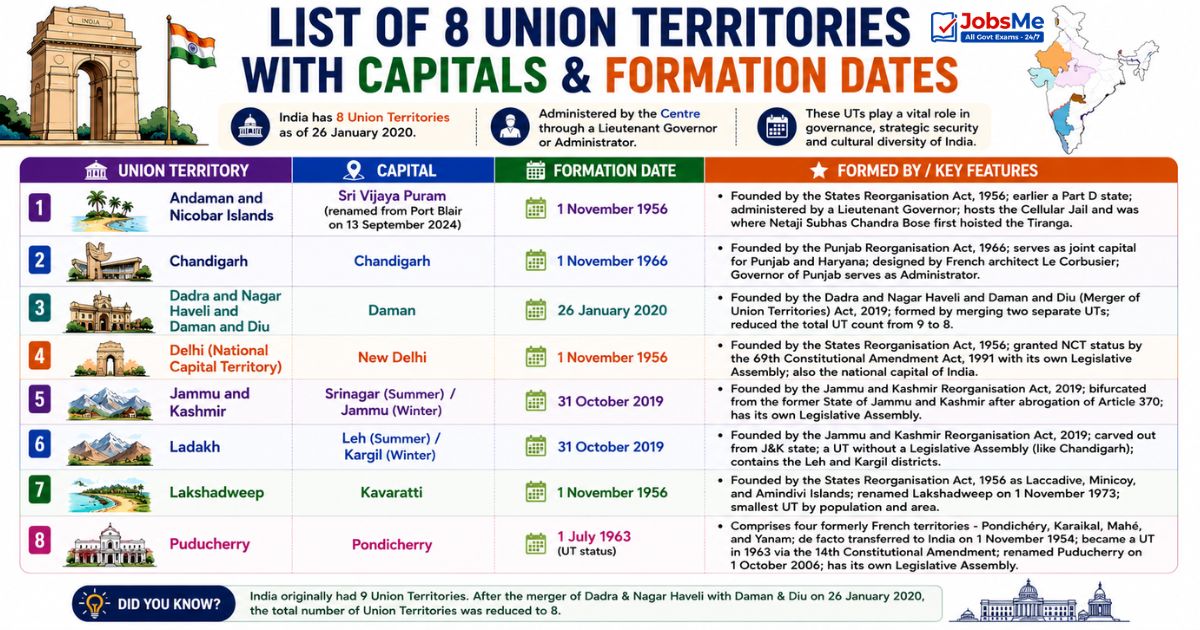
India has 8 Union Territories as of 26 January 2020. They are administered by the Centre through a Lieutenant Governor or Administrator. The table below lists each UT along with formation date and key details.
| Union Territory | Capital | Formation Date | Formed By / Key Features |
|---|---|---|---|
| Andaman and Nicobar Islands | Sri Vijaya Puram (renamed from Port Blair on 13 September 2024) | 1 November 1956 | Founded by the States Reorganisation Act, 1956; earlier a Part D state; administered by a Lieutenant Governor; hosts the Cellular Jail and was where Netaji Subhas Chandra Bose first hoisted the Tiranga. |
| Chandigarh | Chandigarh | 1 November 1966 | Founded by the Punjab Reorganisation Act, 1966; serves as joint capital for Punjab and Haryana; designed by French architect Le Corbusier; Governor of Punjab serves as Administrator. |
| Dadra and Nagar Haveli and Daman and Diu | Daman | 26 January 2020 | Founded by the Dadra and Nagar Haveli and Daman and Diu (Merger of Union Territories) Act, 2019; formed by merging two separate UTs; reduced the total UT count from 9 to 8. |
| Delhi (National Capital Territory) | New Delhi | 1 November 1956 | Founded by the States Reorganisation Act, 1956; granted NCT status by the 69th Constitutional Amendment Act, 1991 with its own Legislative Assembly; also the national capital of India. |
| Jammu and Kashmir | Srinagar (Summer) / Jammu (Winter) | 31 October 2019 | Founded by the Jammu and Kashmir Reorganisation Act, 2019; bifurcated from the former State of Jammu and Kashmir after abrogation of Article 370; has its own Legislative Assembly. |
| Ladakh | Leh (Summer) / Kargil (Winter) | 31 October 2019 | Founded by the Jammu and Kashmir Reorganisation Act, 2019; carved out from J&K state; a UT without a Legislative Assembly (like Chandigarh); contains the Leh and Kargil districts. |
| Lakshadweep | Kavaratti | 1 November 1956 | Founded by the States Reorganisation Act, 1956 as Laccadive, Minicoy, and Amindivi Islands; renamed Lakshadweep on 1 November 1973; smallest UT by population and area. |
| Puducherry | Pondicherry | 1 July 1963 (UT status) | Comprises four formerly French territories - Pondichéry, Karaikal, Mahé, and Yanam; de facto transferred to India on 1 November 1954; became a UT in 1963 via the 14th Constitutional Amendment; renamed Puducherry on 1 October 2006; has its own Legislative Assembly. |
Official Languages of Indian States
India has tremendous linguistic diversity, and 22 languages are recognised in the Eighth Schedule of the Constitution. The following table lists the principal language(s) spoken in each state.
| State | Official / Principal Language(s) |
|---|---|
| Andhra Pradesh | Telugu, Urdu |
| Arunachal Pradesh | English (official); tribal languages - Adi, Apatani, Nyishi, Tagin, Mishmi, Monpa |
| Assam | Assamese |
| Bihar | Hindi, Urdu |
| Chhattisgarh | Hindi, Chhattisgarhi |
| Goa | Konkani (Marathi also widely used) |
| Gujarat | Gujarati |
| Haryana | Hindi |
| Himachal Pradesh | Hindi, Pahari |
| Jharkhand | Hindi |
| Karnataka | Kannada |
| Kerala | Malayalam |
| Madhya Pradesh | Hindi |
| Maharashtra | Marathi |
| Manipur | Manipuri (Meitei) |
| Meghalaya | English (official); Khasi, Garo, Jaintia widely spoken |
| Mizoram | Mizo, English |
| Nagaland | English (official); Ao, Konyak, Angami, Sema, Lotha |
| Odisha | Odia |
| Punjab | Punjabi |
| Rajasthan | Hindi, Rajasthani |
| Sikkim | Nepali, Bhutia, Lepcha, Limbu, Hindi |
| Tamil Nadu | Tamil |
| Telangana | Telugu, Urdu |
| Tripura | Bengali, Kokborak (Tripuri) |
| Uttar Pradesh | Hindi, Urdu |
| Uttarakhand | Hindi, Sanskrit |
| West Bengal | Bengali |
Specialities of Indian States
Each Indian state has distinct geographical, cultural, and economic identifiers that are frequently tested in objective papers. Understanding "what a state is known for" helps in answering matching and one-liner questions.
| State | Known For |
|---|---|
| Andhra Pradesh | Tirupati Temple, spicy cuisine, Amaravati Capital Project, Krishna and Godavari deltas |
| Arunachal Pradesh | Tawang Monastery, "Land of the Rising Sun", tribal heritage, scenic valleys |
| Assam | Tea gardens, Kaziranga National Park (one-horned rhino), Bihu dance, Brahmaputra river |
| Bihar | Bodh Gaya, Nalanda University, Madhubani Art, Buddhism's birthplace of enlightenment |
| Chhattisgarh | Chitrakote Waterfalls, tribal culture, Bhilai Steel Plant, dense forests |
| Goa | Beaches, Portuguese architecture, seafood, smallest state by area |
| Gujarat | Rann of Kutch, Gir National Park (Asiatic Lion), Garba festival, Statue of Unity |
| Haryana | Agriculture (wheat bowl), industrial growth, Kurukshetra, dairy farming |
| Himachal Pradesh | Hill stations (Shimla, Manali), Tibetan culture, Dalai Lama's residence at Dharamshala |
| Jharkhand | Waterfalls, Betla National Park, mineral resources (coal, iron, copper), tribal heritage |
| Karnataka | IT Hub (Bengaluru), Hampi ruins (UNESCO), Mysore Palace, Coorg coffee |
| Kerala | Backwaters, Ayurveda, highest literacy rate, Sabarimala temple, spices |
| Madhya Pradesh | Khajuraho temples, Kanha and Bandhavgarh tiger reserves, "Heart of India" |
| Maharashtra | Mumbai (financial capital), Bollywood, Gateway of India, Ajanta-Ellora caves |
| Manipur | Loktak Lake (only floating lake), Manipuri dance, polo origin |
| Meghalaya | Living root bridges, Cherrapunji (highest rainfall), caves, "Abode of the Clouds" |
| Mizoram | Handloom, bamboo culture, music, one of the highest literacy rates |
| Nagaland | Hornbill Festival, tribal festivals, "Land of Festivals" |
| Odisha | Jagannath Temple Puri, Konark Sun Temple (UNESCO), Chilika Lake, Odissi dance |
| Punjab | Golden Temple Amritsar, Bhangra, agriculture (wheat & rice), Wagah border |
| Rajasthan | Forts and palaces, Thar Desert, largest state by area, Pushkar Mela |
| Sikkim | Organic farming (first fully organic state), Kanchenjunga, monasteries |
| Tamil Nadu | Temples (Brihadeeshwara, Meenakshi), Bharatanatyam, Chennai tech hub, classical Tamil |
| Telangana | Charminar, Golconda Fort, HITEC City, Hyderabadi biryani, IT industries |
| Tripura | Ujjayanta Palace, tribal art, Neermahal water palace |
| Uttar Pradesh | Taj Mahal, Kashi (Varanasi), Ayodhya, Lucknow's Nawabi heritage, most populous state |
| Uttarakhand | Kedarnath, Char Dham yatra, Nainital, Jim Corbett National Park, adventure tourism |
| West Bengal | Kolkata, Durga Puja, Sundarbans (Royal Bengal Tiger), Rabindra literature, sweets |
Major Commissions on Reorganisation of States
Several commissions and committees shaped the modern political map of India. Knowing their year, chairperson, and key recommendation is critical for both Prelims and Mains.
| Commission / Committee | Year | Purpose & Key Recommendation |
|---|---|---|
| Dhar Commission (Linguistic Provinces Commission) | 1948 | Headed by S. K. Dhar; examined feasibility of linguistic states; opposed linguistic basis and recommended administrative convenience as the criterion. |
| JVP Committee | 1948-49 | Comprised Jawaharlal Nehru, Vallabhbhai Patel, and Pattabhi Sitaramayya; rejected linguistic reorganisation for the time being to prioritise national unity. |
| Fazl Ali Commission (States Reorganisation Commission - SRC) | 1953-55 | Chaired by Fazl Ali, with K. M. Panikkar and H. N. Kunzru as members; recommended creation of 14 states and 6 UTs on linguistic lines; led to the States Reorganisation Act, 1956. |
| Shah Commission | 1966 | Headed by J. C. Shah; recommended bifurcation of Punjab into Punjab and Haryana with Chandigarh as joint capital and a UT. |
| North-Eastern Reorganisation | 1960s-70s | Led to the formation of Nagaland (1963), Meghalaya, Manipur, Tripura (1972), Mizoram, and Arunachal Pradesh (1987). |
| Sarkaria Commission | 1983 | On Centre-State relations; recommended strengthening federalism and reforming the Governor's role. |
| Punchhi Commission | 2007 | On Centre-State relations; suggested reforms on Governor's powers and emergency provisions. |
| Srikrishna Committee | 2010 | Headed by Justice B. N. Srikrishna; examined the demand for a separate Telangana; provided six options; eventually led to Telangana's creation in 2014. |
Memory Tricks and Mnemonics
Trick 1: The Four 1956 States - "TAK MK" (Five States Formed Together Under SRA 1956)
Five major states were created on the same day - 1 November 1956 - under the States Reorganisation Act, 1956. Use the acronym "TAK MK":
- T → Tamil Nadu (then Madras State).
- A → Andhra Pradesh.
- K → Karnataka (then Mysore State).
- M → Madhya Pradesh.
- K → Kerala.
"TAK-MK - five Southern and Central states born on 1 November 1956."
Trick 2: The Three Northeast Sisters of 1972 - "MMT"
Three Northeast states were formed on the same date - 21 January 1972 - through the North-Eastern Areas (Reorganisation) Act, 1971. Remember as "MMT":
- M → Manipur.
- M → Meghalaya.
- T → Tripura.
"MMT - Manipur, Meghalaya, Tripura, all on Republic-eve, 21 January 1972."
Trick 3: The Two Year-2000 Babies - "CJU" (Three States Born in 2000)
The year 2000 was historic - three states were carved out from larger ones. Use "CJU" in order of formation:
- C → Chhattisgarh - 1 November 2000 (from Madhya Pradesh).
- U → Uttarakhand - 9 November 2000 (from Uttar Pradesh).
- J → Jharkhand - 15 November 2000 (from Bihar).
"In November 2000, three children left their parent states: Chhattisgarh on the 1st, Uttarakhand on the 9th, Jharkhand on the 15th."
Trick 4: The Two 1987 States and One UT - "GAM" (Goa, Arunachal, Mizoram)
Three Northeast regions transitioned in 1987. Use "GAM":
- G → Goa - 30 May 1987 (25th state).
- A → Arunachal Pradesh - 20 February 1987 (24th state).
- M → Mizoram - 20 February 1987 (23rd state).
"In 1987, Mizoram and Arunachal Pradesh became states together on 20 February, and Goa followed on 30 May."
Trick 5: The Two Bombays of 1960 - "MG on 1 May"
The bilingual Bombay State was bifurcated in 1960 into two linguistic states - both formed on 1 May 1960:
- M → Maharashtra (Marathi-speaking).
- G → Gujarat (Gujarati-speaking).
"On 1 May 1960, Bombay State split - Maharashtra Day and Gujarat Day are celebrated together."
Trick 6: Punjab's Twin - "HP" (Haryana and Punjab on 1 November 1966)
Under the Punjab Reorganisation Act, 1966 (on Shah Commission's recommendation), three changes happened simultaneously on 1 November 1966:
- Haryana - carved out as a new Hindi-speaking state.
- Punjab - reorganised on linguistic basis as a Punjabi-speaking state.
- Chandigarh - created as a Union Territory and joint capital.
- Hilly areas were transferred to Himachal Pradesh (then a UT).
"1-11-1966 - the Punjab Trinity: Haryana, Punjab, Chandigarh."
Trick 7: Newest State Story - "Telangana, the Last Born"
Telangana became the 29th state of India on 2 June 2014 - which is celebrated as Telangana Formation Day. After the J&K reorganisation in 2019, the total state count came back to 28. Remember:
- Newest state → Telangana (2014).
- Youngest UTs → Jammu & Kashmir and Ladakh (31 October 2019).
- Most recent UT change → Dadra and Nagar Haveli and Daman and Diu merged on 26 January 2020.
Trick 8: Capitals Sharing the Same Name as the State - "SAGAR"
Some state capitals carry names connected to the state itself. Note these helpful patterns:
- Capital that is also a UT: Chandigarh (capital of both Punjab and Haryana).
- Two-capital states: Jammu & Kashmir (Srinagar summer / Jammu winter); Ladakh (Leh summer / Kargil winter); Uttarakhand (Dehradun all-year / Gairsain summer).
- Renamed capital (2024): Sri Vijaya Puram (formerly Port Blair) for the Andaman and Nicobar Islands.
- Newest capital: Amaravati for Andhra Pradesh (statutory status given in April 2026).
Additional Notes
Frequently Confused Facts
- First linguistic state vs first state in independent India formed on linguistic basis: Andhra Pradesh (then Andhra State, 1953) was the first state formed on linguistic lines in independent India; Andhra Pradesh in its present form was created on 1 November 1956 under the SRA.
- 16th state vs 22nd state: Nagaland (1963) was the 16th state of India; Sikkim (1975) was the 22nd state and the only state added via a Constitutional Amendment (36th).
- Karnataka vs Mysore: The state was created on 1 November 1956 as Mysore State; renamed Karnataka in 1973.
- Tamil Nadu vs Madras: Created on 1 November 1956 as Madras State; renamed Tamil Nadu in 1969.
- Odisha vs Orissa: The state was officially renamed from Orissa to Odisha by the Orissa (Alteration of Name) Act, 2011.
- Sri Vijaya Puram vs Port Blair: Port Blair was renamed Sri Vijaya Puram on 13 September 2024 to remove colonial legacy.
- Maharashtra Day vs Gujarat Day: Both are celebrated on 1 May 1960, when Bombay State was bifurcated.
- Telangana - 29th or 28th state? Telangana was formed as the 29th state on 2 June 2014. After J&K's reorganisation into two UTs on 31 October 2019, India now has 28 states.
- Chandigarh's dual role: Chandigarh is a Union Territory but also serves as the capital of two states - Punjab and Haryana.
- Amaravati's status: Until 2024, Hyderabad was the joint capital of Andhra Pradesh and Telangana. Amaravati was declared the sole capital of AP only by the Andhra Pradesh Reorganisation (Amendment) Act, 2026.
- Bihar's two dates: 22 March 1912 (Bihar Province carved out of Bengal Presidency) vs 26 January 1950 (Bihar State under the Constitution). Bihar Day is observed on 22 March.
- Odisha's two dates: 1 April 1936 (Odisha Province under Government of India Act, 1935 - the first linguistic province in British India) vs 26 January 1950 (State under Constitution). Utkala Divas is celebrated on 1 April.
Repeating PYQ Patterns
Certain facts repeat consistently across exams. Andhra Pradesh (first linguistic state, 1 Nov 1956), Telangana (newest state, 2 June 2014), Sikkim (added through 36th Amendment), Nagaland (16th state, 1 Dec 1963), and the three states formed on 21 January 1972 (Manipur, Meghalaya, Tripura) appear most frequently in UPSC Prelims, SSC CGL, RRB NTPC, and IBPS PO/Clerk papers. Banking exams (SBI PO, IBPS) focus heavily on capital-state matching; for daily updates and quizzes on banking, refer to the Banking Awareness section on Jobsme.in. State PCS exams add region-specific depth - Bihar PCS asks about Bihar Day (22 March 1912), Odisha PCS about Utkala Divas (1 April 1936), Maharashtra PCS about the Samyukta Maharashtra Movement, and Uttarakhand PCS about the 2000 reorganisation.
Quick Insight
The political map of India is not static - it has evolved continuously since 1947. Sardar Vallabhbhai Patel and V. P. Menon's integration of 565 princely states in 1947-48 was the first step; the Fazl Ali Commission's linguistic reorganisation in 1956 was the second; the carving out of north-eastern states between 1963 and 1987 was the third; the creation of three new states in 2000 (Chhattisgarh, Uttarakhand, Jharkhand) was the fourth; the formation of Telangana in 2014 was the fifth; and the bifurcation of Jammu and Kashmir in 2019 was the sixth. The 2024 renaming of Port Blair to Sri Vijaya Puram and the 2026 statutory recognition of Amaravati as the sole capital of Andhra Pradesh prove that the topic continues to evolve, making it crucial to combine static facts with current affairs. For ongoing updates on such administrative changes, you can check Daily Current Affairs on Jobsme.in.
One-Liners for Quick Revision
- Andhra Pradesh → Capital Amaravati → 1 November 1956 → First linguistic state.
- Arunachal Pradesh → Capital Itanagar → 20 February 1987 → 24th state; earlier NEFA.
- Assam → Capital Dispur → 26 January 1950 → Tea, Kaziranga, Bihu.
- Bihar → Capital Patna → 22 March 1912 (Province) / 26 January 1950 (State) → Bodh Gaya, Nalanda.
- Chhattisgarh → Capital Raipur → 1 November 2000 → 26th state; bifurcated from MP.
- Goa → Capital Panaji → 30 May 1987 → 25th state; liberated from Portugal in 1961.
- Gujarat → Capital Gandhinagar → 1 May 1960 → Carved out of Bombay State for Gujarati-speakers.
- Haryana → Capital Chandigarh (shared) → 1 November 1966 → Created by Punjab Reorganisation Act on Shah Commission's recommendation.
- Himachal Pradesh → Capital Shimla → 25 January 1971 → 18th state; earlier a UT.
- Jharkhand → Capital Ranchi → 15 November 2000 → 28th state; Birsa Munda's birth anniversary; carved from Bihar.
- Karnataka → Capital Bengaluru → 1 November 1956 (renamed from Mysore in 1973) → IT hub.
- Kerala → Capital Thiruvananthapuram → 1 November 1956 → Highest literacy rate; backwaters.
- Madhya Pradesh → Capital Bhopal → 1 November 1956 → "Heart of India"; Khajuraho.
- Maharashtra → Capital Mumbai → 1 May 1960 → Financial capital, Bollywood.
- Manipur → Capital Imphal → 21 January 1972 → Loktak Lake; only floating lake.
- Meghalaya → Capital Shillong → 21 January 1972 (Autonomous State on 2 April 1970) → "Abode of Clouds".
- Mizoram → Capital Aizawl → 20 February 1987 → 23rd state; Mizo Peace Accord.
- Nagaland → Capital Kohima → 1 December 1963 → 16th state; Hornbill Festival; Article 371A.
- Odisha → Capital Bhubaneswar → 1 April 1936 (Province) / 26 January 1950 (State) → Jagannath Temple, Konark.
- Punjab → Capital Chandigarh (shared) → 1 November 1966 → Golden Temple, Bhangra.
- Rajasthan → Capital Jaipur → 30 March 1949 → Largest state by area; Pink City.
- Sikkim → Capital Gangtok → 16 May 1975 → 22nd state; 36th Constitutional Amendment; first organic state.
- Tamil Nadu → Capital Chennai → 1 November 1956 (renamed from Madras in 1969) → Temples, Bharatanatyam.
- Telangana → Capital Hyderabad → 2 June 2014 → Newest state; 29th state at formation; Charminar.
- Tripura → Capital Agartala → 21 January 1972 → Ujjayanta Palace; Neermahal.
- Uttar Pradesh → Capital Lucknow → 24 January 1950 → Most populous state; Taj Mahal, Kashi, Ayodhya.
- Uttarakhand → Capital Dehradun (Gairsain - summer) → 9 November 2000 → 27th state; Kedarnath, Char Dham; renamed from Uttaranchal in 2007.
- West Bengal → Capital Kolkata → 26 January 1950 → Durga Puja, Sundarbans.
- Andaman and Nicobar Islands → Capital Sri Vijaya Puram (renamed from Port Blair on 13 September 2024) → 1 November 1956 → Cellular Jail.
- Chandigarh → Capital Chandigarh → 1 November 1966 → Joint capital of Punjab and Haryana; Le Corbusier designed.
- Dadra and Nagar Haveli and Daman and Diu → Capital Daman → 26 January 2020 → Merger of two UTs reduced count to 8.
- Delhi (NCT) → Capital New Delhi → 1 November 1956 → 69th Constitutional Amendment (1991) gave NCT status.
- Jammu and Kashmir → Capital Srinagar (summer) / Jammu (winter) → 31 October 2019 → Formed after abrogation of Article 370.
- Ladakh → Capital Leh (summer) / Kargil (winter) → 31 October 2019 → UT without legislature; carved from J&K.
- Lakshadweep → Capital Kavaratti → 1 November 1956 (renamed from Laccadive in 1973) → Smallest UT.
- Puducherry → Capital Pondicherry → 1 July 1963 → Former French territory; 14th Constitutional Amendment.
- Dhar Commission → 1948 → Opposed linguistic states.
- JVP Committee → 1948-49 → Nehru, Patel, Pattabhi Sitaramayya.
- Fazl Ali / SRC → 1953-55 → Recommended linguistic reorganisation; led to SRA 1956.
- Shah Commission → 1966 → Punjab-Haryana bifurcation.
- Srikrishna Committee → 2010 → Telangana statehood.
- Largest state by area → Rajasthan.
- Smallest state by area → Goa.
- Most populous state → Uttar Pradesh.
- Least populous state → Sikkim.
- Newest state → Telangana (2 June 2014).
- Newest UTs → Jammu & Kashmir and Ladakh (31 October 2019).
- Capital of India → New Delhi.
For more Static GK topics like Indian dynasties, boundary lines, and important battles, explore the Static GK Quiz section on Jobsme.in. You can also test your awareness with the Daily Current Affairs Quiz and check out the latest exam notifications at Latest Government Job Notifications. Aspirants preparing for IBPS, SBI, and RBI exams can also visit Banking Awareness Quizzes for related topics, and SSC/RRB candidates can benefit from the Computer Awareness notes.
Free quiz • No signup required
Put this topic into practice with Indian Cultural Institutions – Static GK MCQ Quiz. It is the quickest way to reinforce what you just learned.
Frequently Asked Questions
How many states and union territories are there in India in 2026?
Which is the newest state of India?
Which was the first state in India formed on a linguistic basis?
What is the current capital of Andhra Pradesh?
Which states were formed on 1 November 1956 under the States Reorganisation Act?
How was Sikkim added to the Indian Union?
What is the new name of Port Blair?
Which three states were formed on 21 January 1972?
Why was the State Reorganisation Commission of 1953 important?
How did Jammu and Kashmir become two Union Territories?

About the author