Fundamental Rights, Duties, and DPSP Static GK Notes for UPSC, SSC, Banking and Railways Exams
This article gives a complete one-stop revision of Fundamental Rights (Articles 12-35), Fundamental Duties (Article 51A), and the Directive Principles of State Policy (Articles 36-51) of the Indian Constitution. It includes all articles, landmark Supreme Court cases, key amendments, memory tricks, and one-liners specially curated for UPSC, SSC, IBPS, RRB, Insurance, Defence, and State PCS aspirants.
Jump to section
Introduction to Fundamental Rights, Duties and DPSP
The Constitution of India is the supreme law of the land, and three of its most frequently tested chapters in government exams are Fundamental Rights (Part III, Articles 12-35), Directive Principles of State Policy or DPSP (Part IV, Articles 36-51), and Fundamental Duties (Part IV-A, Article 51A). Together, they form the philosophical core of the Constitution, balancing individual liberty with collective welfare and citizen responsibility.
Fundamental Rights are often called the Magna Carta of Indian Constitution and the Conscience of the Constitution. They are justiciable, meaning citizens can directly approach the Supreme Court for their enforcement. DPSPs, on the other hand, are non-justiciable but fundamental in the governance of the country. Fundamental Duties remind every Indian citizen of their moral and civic obligations toward the nation.
This topic is a permanent favourite in UPSC Prelims, SSC CGL, IBPS PO/Clerk, RRB NTPC, State PCS, Insurance, and Defence exams. To stay updated on every Static GK area tested in competitive exams, bookmark our Static GK notes hub and keep revising.
Core Concept Explanation
Before diving into the data, learn these foundational terms that examiners repeatedly twist in MCQs:
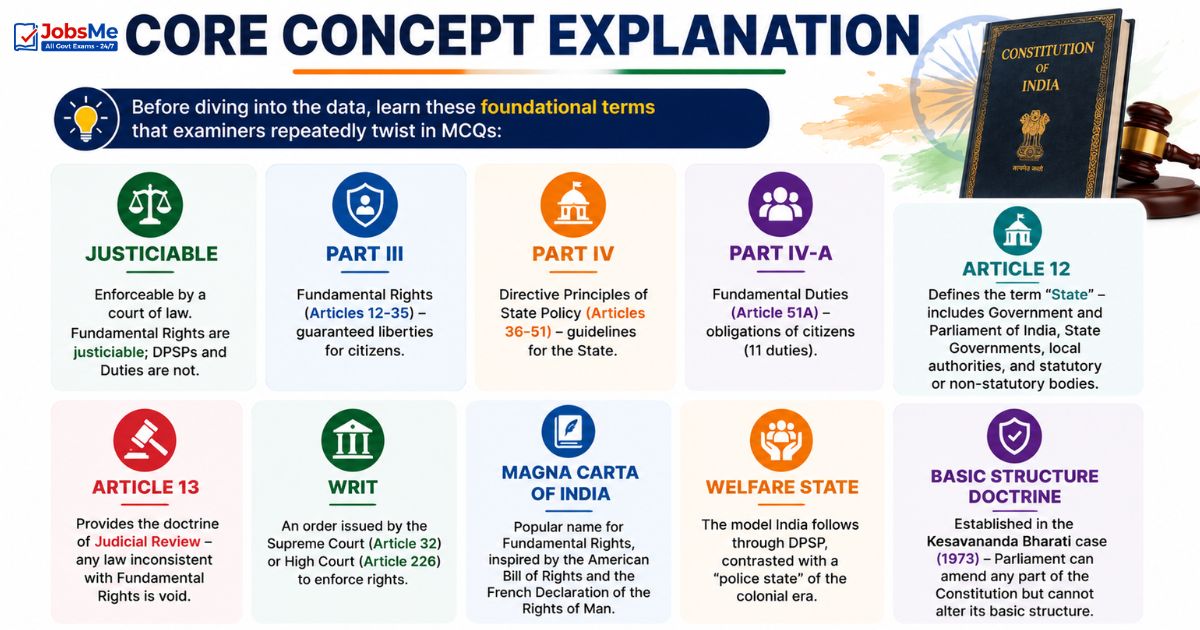
- Justiciable: Enforceable by a court of law. Fundamental Rights are justiciable; DPSPs and Duties are not.
- Part III: Fundamental Rights (Articles 12-35) - guaranteed liberties for citizens.
- Part IV: Directive Principles of State Policy (Articles 36-51) - guidelines for the State.
- Part IV-A: Fundamental Duties (Article 51A) - obligations of citizens (11 duties).
- Article 12: Defines the term "State" - includes Government and Parliament of India, State Governments, local authorities, and statutory or non-statutory bodies.
- Article 13: Provides the doctrine of Judicial Review - any law inconsistent with Fundamental Rights is void.
- Writ: An order issued by the Supreme Court (Article 32) or High Court (Article 226) to enforce rights.
- Magna Carta of India: Popular name for Fundamental Rights, inspired by the American Bill of Rights and the French Declaration of the Rights of Man.
- Welfare State: The model India follows through DPSP, contrasted with a "police state" of the colonial era.
- Basic Structure Doctrine: Established in the Kesavananda Bharati case (1973) - Parliament can amend any part of the Constitution but cannot alter its basic structure.
Main Data: Fundamental Rights, DPSP, and Fundamental Duties
Table 1: The Six Fundamental Rights (Part III, Articles 12-35)
| Right | Articles | Key Features and Details |
|---|---|---|
| Right to Equality | 14 to 18 | Article 14 guarantees equality before law and equal protection of laws. Article 15 prohibits discrimination on grounds of religion, race, caste, sex, or place of birth. Article 16 ensures equality of opportunity in public employment. Article 17 abolishes untouchability. Article 18 abolishes titles except military and academic distinctions. |
| Right to Freedom | 19 to 22 | Article 19 guarantees six freedoms - speech and expression, peaceful assembly, forming associations, free movement, residing anywhere in India, and practising any profession. Article 20 protects against ex-post-facto law, double jeopardy, and self-incrimination. Article 21 protects life and personal liberty. Article 21A guarantees free and compulsory education for ages 6-14 (added by 86th Amendment, 2002). Article 22 provides protection against arrest and detention. |
| Right against Exploitation | 23 to 24 | Article 23 prohibits human trafficking, begar, and forced labour. Article 24 bans employment of children below 14 years in factories, mines, or hazardous occupations. The Child Labour (Prohibition and Regulation) Amendment Act, 2016, completely prohibits employment of children below 14 years in all occupations. |
| Right to Freedom of Religion | 25 to 28 | Article 25 grants freedom of conscience and free profession, practice, and propagation of religion (no right to forceful conversion). Article 26 allows religious denominations to manage their own affairs. Article 27 prohibits taxation for the promotion of any religion. Article 28 forbids religious instruction in state-funded educational institutions. |
| Cultural and Educational Rights | 29 to 30 | Article 29 protects the interests of any section of citizens with a distinct language, script, or culture, and bars denial of admission to state-aided institutions on grounds of religion, race, caste, or language. Article 30 grants all religious and linguistic minorities the right to establish and administer educational institutions of their choice. |
| Right to Constitutional Remedies | 32 | Called the "Heart and Soul of the Constitution" by Dr. B.R. Ambedkar. Empowers citizens to directly approach the Supreme Court for the enforcement of Fundamental Rights through five writs - Habeas Corpus, Mandamus, Prohibition, Certiorari, and Quo Warranto. High Courts have similar power under Article 226. |
Table 2: The Five Writs under Article 32
| Writ | Literal Meaning | Purpose and Scope |
|---|---|---|
| Habeas Corpus | "To have the body of" | Issued to a person who has detained another, ordering production of the detained person before the court. The court examines the legality of the detention and releases the person if it is unlawful. Issued against both public authorities and private individuals. A bulwark of individual liberty against arbitrary detention. |
| Mandamus | "We Command" | A command issued by the court to a public official, public body, corporation, lower court, tribunal, or government to perform an official duty it has failed or refused to perform. Cannot be issued against a private individual, the President, State Governors, or the Chief Justice of a High Court acting in judicial capacity. |
| Prohibition | "To forbid" | Issued by a higher court to a lower court or tribunal to prevent it from exceeding its jurisdiction. Directs inactivity, unlike mandamus. Can only be issued against judicial and quasi-judicial authorities, not against administrative authorities, legislative bodies, or private individuals. |
| Certiorari | "To be certified" | Issued by a higher court to a lower court or tribunal either to transfer a pending case to itself or to quash an order. Issued on grounds of excess or lack of jurisdiction or error of law. Both preventive and curative. Since 1991, it can also be issued against administrative authorities affecting individual rights. |
| Quo Warranto | "By what authority" | Issued to enquire into the legality of a person's claim to a public office. Prevents illegal usurpation of public office. Issued only for substantive public offices of permanent character created by statute or Constitution. Unique among writs - can be sought by any interested person, not just the aggrieved party. |
Table 3: Important Articles 31A, 31B, 31C and Other Provisions
| Article | Inserted By | Provision |
|---|---|---|
| Article 31 | Original Constitution; repealed by 44th Amendment, 1978 | Originally provided Right to Property as a Fundamental Right. Now made a constitutional/legal right under Article 300A in Part XII. |
| Article 31A | 1st Constitutional Amendment Act, 1951 | Protects five categories of laws related to land reforms (state's power to acquire estates, manage properties, amalgamate corporations, etc.) from being challenged on grounds of violating Article 14 or Article 19. |
| Article 31B | 1st Constitutional Amendment Act, 1951 | Created the Ninth Schedule. Any law placed in the Ninth Schedule is immunised from Fundamental Rights challenges. Scope wider than Article 31A. |
| Article 31C | 25th Constitutional Amendment Act, 1971 | No law implementing socialistic directives under Article 39(b) and (c) shall be void for violating Article 14 or 19. In I.R. Coelho case (2007), the Supreme Court ruled that Ninth Schedule laws made after April 24, 1973 (Kesavananda Bharati case) can be reviewed if they violate Fundamental Rights or basic structure. |
| Article 33 | Original | Empowers Parliament to restrict or abrogate Fundamental Rights of armed forces, paramilitary, police, intelligence agencies, and analogous forces. |
| Article 34 | Original | Allows exceptions to Fundamental Rights during martial law - Parliament can pass laws to indemnify individuals and validate actions taken to restore order. |
| Article 35 | Original | Gives Parliament the power to make laws regarding matters specified in Articles 16(3), 32(3), 33, and 34. Ensures uniformity throughout the country. |
Table 4: 11 Fundamental Duties (Article 51A, Part IV-A)
| Clause | Fundamental Duty | Key Notes |
|---|---|---|
| 51A (a) | To abide by the Constitution and respect its ideals and institutions, the National Flag and the National Anthem. | Civic duty - reinforced by Prevention of Insults to National Honour Act, 1971. |
| 51A (b) | To cherish and follow the noble ideals which inspired our national struggle for freedom. | Moral duty linked to nationalism and the freedom struggle. |
| 51A (c) | To uphold and protect the sovereignty, unity and integrity of India. | Anti-secessionist; reinforced by Representation of the People Act, 1951. |
| 51A (d) | To defend the country and render national service when called upon to do so. | Civic obligation regarding national defence and conscription. |
| 51A (e) | To promote harmony and the spirit of common brotherhood; to renounce practices derogatory to the dignity of women. | Transcends religious, linguistic, regional, or sectional diversities. Reinforced by Protection of Civil Rights Act, 1955. |
| 51A (f) | To value and preserve the rich heritage of our composite culture. | Frequently tested in UPSC Prelims (2025). |
| 51A (g) | To protect and improve the natural environment, including forests, lakes, rivers, and wildlife; to have compassion for living creatures. | Backed by Wildlife (Protection) Act, 1972, and Forest (Conservation) Act, 1980. |
| 51A (h) | To develop the scientific temper, humanism, and the spirit of inquiry and reform. | Encourages rationalism and progressive outlook. |
| 51A (i) | To safeguard public property and to abjure violence. | Civic duty to protect public assets and resist violence. |
| 51A (j) | To strive towards excellence in all spheres of individual and collective activity. | Encourages pursuit of higher endeavour and achievement. |
| 51A (k) | Duty of every parent or guardian to provide opportunities for education to children between 6 and 14 years. | Added by the 86th Constitutional Amendment Act, 2002. Linked with Article 21A. |
Table 5: Directive Principles of State Policy - Classification (Articles 36-51)
| Category | Article | Subject Matter |
|---|---|---|
| Socialist Principles | Article 38 | To promote the welfare of people by securing a social order ensuring social, economic, and political justice and minimising inequalities of income, status, facilities, and opportunities. Article 38(2) was added by the 44th Amendment Act, 1978. |
| Socialist Principles | Article 39 | Adequate means of livelihood for all citizens; ownership and control of material resources to serve the common good; avoidance of concentration of wealth; equal pay for equal work for men and women; protection of strength and health of workers; childhood and youth shall not be exploited. |
| Socialist Principles | Article 39A | To promote equal justice and provide free legal aid to the poor. Added by 42nd Constitutional Amendment Act, 1976. |
| Socialist Principles | Article 41 | Right to work, to education, and to public assistance in cases of unemployment, old age, sickness, and disability. |
| Socialist Principles | Article 42 | Just and humane conditions of work and maternity relief. |
| Socialist Principles | Article 43 | Living wage and decent standard of life for all workers; promotion of cottage industries. |
| Socialist Principles | Article 43A | Participation of workers in the management of industries. Added by 42nd Constitutional Amendment Act, 1976. |
| Socialist Principles | Article 47 | To raise the level of nutrition and standard of living and improve public health (also classified under Gandhian for prohibition). |
| Gandhian Principles | Article 40 | To organise village panchayats as units of self-government. Fulfilled by 73rd Constitutional Amendment Act, 1992. |
| Gandhian Principles | Article 43 | Promotion of cottage industries on individual or cooperative basis in rural areas. |
| Gandhian Principles | Article 43B | To promote voluntary formation, autonomous functioning, democratic control, and professional management of cooperative societies. Added by 97th Constitutional Amendment Act, 2011. |
| Gandhian Principles | Article 46 | Promotion of educational and economic interests of Scheduled Castes, Scheduled Tribes, and other weaker sections. |
| Gandhian Principles | Article 47 | Prohibition of consumption of intoxicating drinks and drugs injurious to health. |
| Gandhian Principles | Article 48 | Prohibition of the slaughter of cows, calves, and other milch and draught cattle; to improve their breeds. |
| Liberal-Intellectual Principles | Article 44 | To secure a Uniform Civil Code throughout the territory of India. |
| Liberal-Intellectual Principles | Article 45 | Originally for free and compulsory education for children up to 14 years; subject changed by 86th Amendment (2002) to provide early childhood care and education to children up to age six. |
| Liberal-Intellectual Principles | Article 48 | To organise agriculture and animal husbandry on modern and scientific lines. |
| Liberal-Intellectual Principles | Article 48A | To protect and improve the environment and safeguard forests and wildlife. Added by 42nd Constitutional Amendment Act, 1976. |
| Liberal-Intellectual Principles | Article 49 | To protect every monument or place of artistic or historic interest. |
| Liberal-Intellectual Principles | Article 50 | To separate the judiciary from the executive in the public services of the State. |
| Liberal-Intellectual Principles | Article 51 | To establish international peace and security - maintain just relations with nations, foster respect for international law, encourage settlement of disputes by arbitration. |
Table 6: Landmark Supreme Court Cases on Fundamental Rights vs DPSP
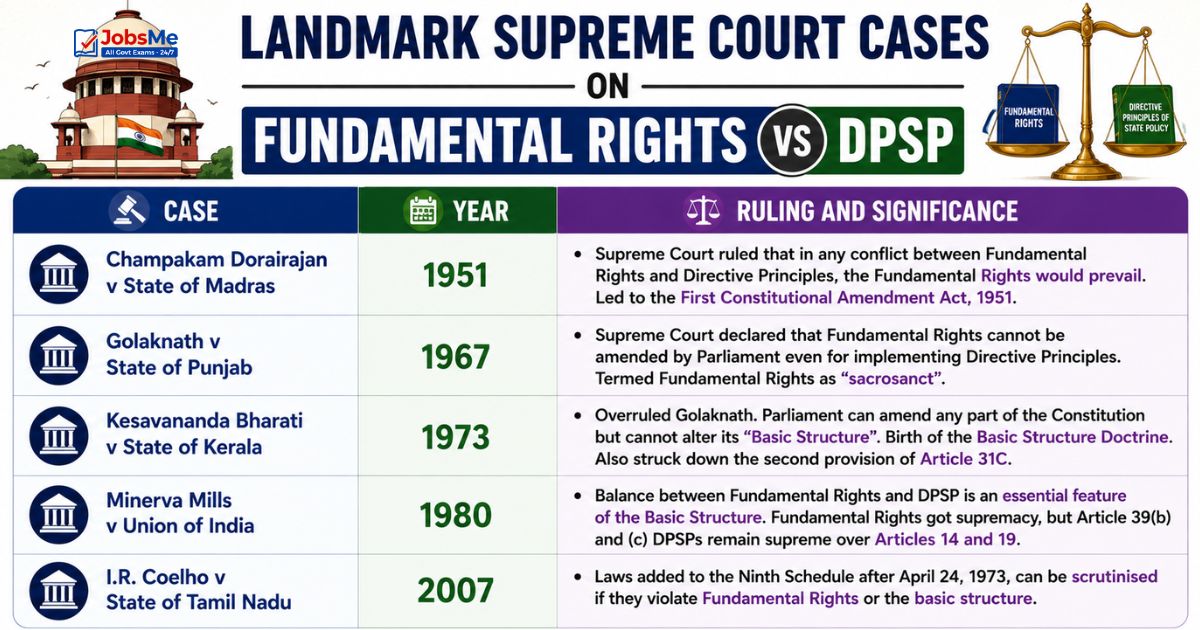
| Case | Year | Ruling and Significance |
|---|---|---|
| Champakam Dorairajan v State of Madras | 1951 | Supreme Court ruled that in any conflict between Fundamental Rights and Directive Principles, the Fundamental Rights would prevail. Led to the First Constitutional Amendment Act, 1951. |
| Golaknath v State of Punjab | 1967 | Supreme Court declared that Fundamental Rights cannot be amended by Parliament even for implementing Directive Principles. Termed Fundamental Rights as "sacrosanct". |
| Kesavananda Bharati v State of Kerala | 1973 | Overruled Golaknath. Parliament can amend any part of the Constitution but cannot alter its "Basic Structure". Birth of the Basic Structure Doctrine. Also struck down the second provision of Article 31C. |
| Minerva Mills v Union of India | 1980 | Balance between Fundamental Rights and DPSP is an essential feature of the Basic Structure. Fundamental Rights got supremacy, but Article 39(b) and (c) DPSPs remain supreme over Articles 14 and 19. |
| I.R. Coelho v State of Tamil Nadu | 2007 | Laws added to the Ninth Schedule after April 24, 1973, can be scrutinised if they violate Fundamental Rights or the basic structure. |
Table 7: Important Constitutional Amendments Related to FR, DPSP and FD
| Amendment | Year | Key Changes Introduced |
|---|---|---|
| 1st Amendment | 1951 | Inserted Article 31A and 31B; created the Ninth Schedule to protect land reform laws. |
| 25th Amendment | 1971 | Inserted Article 31C - protected laws implementing Article 39(b) and (c) from Article 14, 19, and 31 challenges. |
| 42nd Amendment | 1976 | Added Part IV-A with Article 51A containing 10 Fundamental Duties. Added Article 39A (free legal aid), Article 43A (workers' participation), and Article 48A (environment) to DPSP. Extended Article 31C to all DPSPs (later struck down). |
| 44th Amendment | 1978 | Removed Right to Property (Article 31) from Fundamental Rights; made it a legal right under Article 300A. Added Article 38(2). Reduced Fundamental Rights from seven to six. |
| 73rd Amendment | 1992 | Implemented Article 40 by introducing Panchayati Raj system at village, block, and district levels. |
| 86th Amendment | 2002 | Added Article 21A (Right to Education as Fundamental Right). Changed Article 45 to early childhood care for under-six children. Added 11th Fundamental Duty - 51A(k) on parental duty for education. |
| 97th Amendment | 2011 | Added Article 43B - promoting cooperative societies. |
Memory Tricks and Mnemonics
Trick 1: Remember the Six Fundamental Rights - "ERFREC"
"Every Fine Rabbit Reads Each Comic"
- E - Equality (Articles 14-18)
- F - Freedom (Articles 19-22)
- R - Right against Exploitation (Articles 23-24)
- R - Religion - Freedom of (Articles 25-28)
- E - Educational and Cultural Rights (Articles 29-30)
- C - Constitutional Remedies (Article 32)
Trick 2: Five Writs - "He May Properly Choose Queen"
"He May Properly Choose Queen" = Habeas Corpus, Mandamus, Prohibition, Certiorari, Quo Warranto.
- He = Habeas Corpus (produce the body)
- May = Mandamus (we command)
- Properly = Prohibition (forbid)
- Choose = Certiorari (to certify)
- Queen = Quo Warranto (by what authority)
Trick 3: Three Categories of DPSP - "SGL"
SGL = Sachin's Great Legacy
- S - Socialist Principles (Articles 38, 39, 39A, 41, 42, 43, 43A, 47)
- G - Gandhian Principles (Articles 40, 43, 43B, 46, 47, 48)
- L - Liberal-Intellectual Principles (Articles 44, 45, 48, 48A, 49, 50, 51)
Trick 4: Source of Inspiration - "FAIRS"
Where India borrowed key features from:
- Fundamental Rights → American Bill of Rights and French Declaration
- Amendment Procedure → South Africa
- Instrument of Instructions → DPSP from Irish Constitution (Article 45)
- Responsibilities (Fundamental Duties) → USSR Constitution
- Supreme Court structure → American Constitution
Trick 5: Key Amendments - "42-44-86-97"
The four golden amendments that shape Parts III, IV, and IV-A:
- 42nd (1976): Mini Constitution - added Fundamental Duties, Article 39A, 43A, 48A
- 44th (1978): Removed Right to Property as Fundamental Right
- 86th (2002): Right to Education (Article 21A), 11th Fundamental Duty 51A(k)
- 97th (2011): Article 43B - cooperative societies
Trick 6: Six Freedoms under Article 19 - "SAMPAS"
SAMPAS - The six freedoms guaranteed:
- S - Speech and expression
- A - Assembly (peaceful)
- M - Movement (free throughout India)
- P - Profession, occupation, trade, business
- A - Associations or unions formation
- S - Settle or reside in any part of India
Trick 7: Rights Available Only to Citizens (Not Foreigners)
Remember the numbers: 15-16-19-29-30
- Article 15 - No discrimination on grounds of religion, race, caste, sex, place of birth
- Article 16 - Equal opportunity in public employment
- Article 19 - Six freedoms
- Article 29 - Protection of culture, language, script
- Article 30 - Minority right to establish educational institutions
Additional Notes
Frequently Confused Facts
- Fundamental Rights vs DPSP: Fundamental Rights are justiciable and enforceable; DPSPs are non-justiciable but fundamental in governance. Both are "Conscience of the Constitution".
- Fundamental Rights vs Fundamental Duties: Rights are in Part III (Articles 12-35); Duties are in Part IV-A (Article 51A only). Rights are mostly justiciable; Duties are non-justiciable.
- Article 21 vs Article 21A: Article 21 is Right to Life and Personal Liberty (original); Article 21A is Right to Education for ages 6-14 (added by 86th Amendment, 2002).
- Article 32 vs Article 226: Article 32 is itself a Fundamental Right; Supreme Court must enforce it. Article 226 (High Court writ power) is discretionary and wider in scope, since High Courts can issue writs for any purpose, not just Fundamental Rights.
- Article 31A vs 31B vs 31C: 31A protects land reform laws; 31B protects Ninth Schedule laws (widest scope); 31C protects laws implementing Article 39(b) and (c).
- Article 45 (original) vs Article 21A: Article 45 originally provided free and compulsory education for under-14 children. After the 86th Amendment, Article 21A took over that role, and Article 45 now covers early childhood care for under-six children.
- Habeas Corpus vs Quo Warranto: Habeas Corpus is about wrongful detention of a person; Quo Warranto is about wrongful occupation of a public office.
- 10 vs 11 Fundamental Duties: Originally 10 (42nd Amendment, 1976); the 11th duty 51A(k) on parental duty for education was added by the 86th Amendment, 2002.
Repeating PYQ Patterns
- UPSC Prelims: Direct matching between provisions (FR vs DPSP vs FD) is asked almost every year (e.g., Prelims 2025 question matching three provisions across Part III, IV, and IV-A).
- SSC CGL and CHSL: Article numbers, specifically Article 14, 19, 21, 32, 44, 48, 51A - asked repeatedly in Tier 1 General Awareness.
- IBPS PO/Clerk: Right to Education (Article 21A), Right to Property (now Article 300A), and DPSP article numbers come up often.
- RRB NTPC and Group D: List of Fundamental Duties, the writ types, and the inspiration sources are favourites.
- UPSC Mains: Conceptual questions on the conflict between FR and DPSP, Right to Privacy under Article 21, scope of Article 19, hate speech doctrine.
- State PCS: Constitutional amendments (42nd, 44th, 86th) and landmark Supreme Court cases (Kesavananda Bharati, Minerva Mills) are repeatedly tested.
Quick Insight
The harmony between Fundamental Rights and DPSP is increasingly tested through current affairs. The expanded reading of Article 21 has produced many "derivative" rights - Right to Privacy (Puttaswamy case), Right to a Clean Environment, Right to Internet Access, Right to Health, and Right to Live with Dignity. Examiners often ask which of these are derived from Article 21 rather than from an explicit article. Likewise, debates around the Uniform Civil Code (Article 44), Cow Slaughter (Article 48), Prohibition (Article 47), and the Common Civil Code remind us that DPSPs are not dead letters - they continue to drive legislative action and judicial interpretation.
For daily exam updates and live commentary on constitutional issues, follow our daily current affairs notes, and keep an eye on the latest government job notifications where constitutional GK is a recurring section.
One-Liners for Quick Revision
- Part III of the Constitution → Contains Fundamental Rights → Articles 12 to 35.
- Part IV of the Constitution → Contains Directive Principles of State Policy → Articles 36 to 51.
- Part IV-A of the Constitution → Contains Fundamental Duties → Single Article 51A.
- Magna Carta of Indian Constitution → Fundamental Rights → Inspired by American Bill of Rights and French Declaration.
- Conscience of the Constitution → Fundamental Rights and DPSP together (Part III + Part IV).
- Heart and Soul of the Constitution → Article 32 (Right to Constitutional Remedies) → Dr. B.R. Ambedkar's words.
- Article 12 → Defines the term "State" → Includes Government and Parliament of India, State Governments, and local/other authorities.
- Article 13 → Doctrine of Judicial Review → Laws inconsistent with Fundamental Rights are void.
- Article 14 → Equality before law and equal protection of laws → Rule of law principle.
- Article 15 → No discrimination on religion, race, caste, sex, place of birth → Available only to citizens.
- Article 16 → Equal opportunity in public employment → Reservation possible for weaker sections.
- Article 17 → Abolition of untouchability → A social reform provision.
- Article 18 → Abolition of titles → Military and academic distinctions exempted.
- Article 19 → Six freedoms → SAMPAS (Speech, Assembly, Movement, Profession, Associations, Settlement).
- Article 20 → Protection in respect of conviction → No ex-post-facto law, no double jeopardy, no self-incrimination.
- Article 21 → Protection of life and personal liberty → Cannot be suspended even during national emergency.
- Article 21A → Right to Education for ages 6-14 → Added by 86th Amendment, 2002.
- Article 22 → Protection against arrest and detention → Right to be informed, consult lawyer, appear before magistrate within 24 hours.
- Article 23 → Prohibits trafficking, begar, forced labour → Right against exploitation.
- Article 24 → No child below 14 in factories, mines, or hazardous occupations → Strengthened by 2016 Amendment Act.
- Article 25 → Freedom of conscience, profession, practice, propagation of religion → No right to forced conversion.
- Article 26 → Freedom to manage religious affairs → For religious denominations.
- Article 27 → No tax for promotion of religion → Secular nature.
- Article 28 → No religious instruction in state-funded institutions → With certain exceptions.
- Article 29 → Protection of language, script, culture → Available only to citizens.
- Article 30 → Right of minorities to establish educational institutions → Religious and linguistic minorities only.
- Article 32 → Right to Constitutional Remedies → Supreme Court's writ jurisdiction.
- Article 33 → Restriction of Fundamental Rights for armed forces → By Parliament only.
- Article 34 → Restriction during martial law → Parliament's indemnification power.
- Article 35 → Parliament's power to make laws on certain Fundamental Rights matters → For national uniformity.
- Habeas Corpus → "To have the body" → Against wrongful detention.
- Mandamus → "We command" → Against public officials' failure to act.
- Prohibition → "To forbid" → Stops lower court from exceeding jurisdiction.
- Certiorari → "To be certified" → Quashes lower court's order; both preventive and curative.
- Quo Warranto → "By what authority" → Questions legality of public office holder.
- Article 31 → Right to Property (original) → Repealed by 44th Amendment, 1978 → Now Article 300A.
- Article 31A → Land reform protection → Inserted by 1st Amendment, 1951.
- Article 31B → Ninth Schedule protection → Inserted by 1st Amendment, 1951.
- Article 31C → Article 39(b)/(c) protection → Inserted by 25th Amendment, 1971.
- Article 38 → Welfare of people → Socialist principle.
- Article 39 → Adequate livelihood, equal pay, no concentration of wealth → Socialist principles.
- Article 39A → Free legal aid → Added by 42nd Amendment, 1976.
- Article 40 → Village Panchayats → Gandhian; fulfilled by 73rd Amendment, 1992.
- Article 41 → Right to work, education, public assistance → Socialist.
- Article 42 → Just and humane work conditions, maternity relief → Socialist.
- Article 43 → Living wage, cottage industries → Socialist and Gandhian overlap.
- Article 43A → Workers' participation in management → Added by 42nd Amendment, 1976.
- Article 43B → Cooperative societies → Added by 97th Amendment, 2011.
- Article 44 → Uniform Civil Code → Liberal-Intellectual; long-debated.
- Article 45 → Early childhood care for under-six → Originally for under-14; changed by 86th Amendment, 2002.
- Article 46 → Promotion of educational and economic interests of SCs, STs, and weaker sections → Gandhian.
- Article 47 → Nutrition, standard of living, prohibition of intoxicants → Socialist and Gandhian.
- Article 48 → Modern agriculture, animal husbandry, prohibition of cow slaughter → Gandhian and Liberal-Intellectual.
- Article 48A → Protection of environment, forests, wildlife → Added by 42nd Amendment, 1976.
- Article 49 → Protection of monuments and places of historic interest → Liberal-Intellectual.
- Article 50 → Separation of judiciary from executive → Liberal-Intellectual; Prelims 2025 favourite.
- Article 51 → International peace and security → Promotion of arbitration and respect for international law.
- Article 51A → 11 Fundamental Duties → Inserted by 42nd Amendment, 1976; 11th clause added by 86th Amendment, 2002.
- Fundamental Duties source → USSR Constitution → Inspired by Sardar Swaran Singh Committee, 1976.
- DPSP source → Irish Constitution (Article 45) → Originally from the Spanish Constitution.
- Champakam Dorairajan case (1951) → FR prevails over DPSP → Led to 1st Amendment.
- Golaknath case (1967) → Parliament cannot amend FR → Termed FR as sacrosanct.
- Kesavananda Bharati case (1973) → Basic Structure Doctrine → Parliament can amend, but not destroy basic structure.
- Minerva Mills case (1980) → Balance between FR and DPSP is basic structure → Article 39(b) and (c) get supremacy over Articles 14 and 19.
- I.R. Coelho case (2007) → Ninth Schedule laws (post 24 April 1973) subject to FR review → Judicial review reinforced.
- Justice Verma Committee (1998) → Recommended enforcement strategies for Fundamental Duties → Focused on civic consciousness.
- Prevention of Insults to National Honour Act, 1971 → Backs Article 51A(a) → Protection of national symbols.
- Wildlife (Protection) Act, 1972 → Backs Article 51A(g) → Conservation of biodiversity.
- Forest (Conservation) Act, 1980 → Backs Article 51A(g) → Forest conservation.
- 11th Fundamental Duty - 51A(k) → Parental duty for child education → Added by 86th Amendment, 2002.
- Rights cannot be suspended even in National Emergency → Article 20 and Article 21 → All other Fundamental Rights can be suspended.
For self-assessment after revision, take our Static GK quiz and the daily current affairs quiz. If you are preparing for banking and insurance exams, sharpen your basics through our banking awareness notes as well.
Free quiz • No signup required
Put this topic into practice with Indian Cultural Institutions – Static GK MCQ Quiz. It is the quickest way to reinforce what you just learned.
Frequently Asked Questions
How many Fundamental Rights are there in the Indian Constitution at present?
Which part of the Constitution deals with Fundamental Rights, DPSP, and Fundamental Duties?
How many Fundamental Duties are listed in the Indian Constitution?
From which country has India borrowed the concept of Directive Principles of State Policy?
Which committee recommended the inclusion of Fundamental Duties in the Constitution?
What are the five writs that the Supreme Court can issue under Article 32?
Which Fundamental Rights cannot be suspended even during a National Emergency?
Are Directive Principles of State Policy enforceable in a court of law?
What is the significance of the Kesavananda Bharati case (1973) in the FR vs DPSP debate?
Which Constitutional Amendment introduced the Right to Education as a Fundamental Right?

About the author