UNESCO World Heritage Sites in India – Static GK & General Awareness for Competitive Exams with Memory Tricks
This article provides a complete and updated list of UNESCO World Heritage Sites in India along with their state, year of inscription, category, and key features, making it an essential resource for UPSC, SSC, IBPS, RRB, and other government exam aspirants. As of 2026, India has 44 UNESCO World Heritage Sites including 36 Cultural, 7 Natural, and 1 Mixed site, ranking India 6th globally. The article covers iconic sites like the Taj Mahal, Ajanta Caves, Kaziranga, Khangchendzonga, and the latest 2025 inscription — Maratha Military Landscapes — along with memory tricks and one-liners for quick revision.

Jump to section
- Introduction
- Core Concepts: UNESCO World Heritage System
- UNESCO Cultural World Heritage Sites in India
- UNESCO Natural World Heritage Sites in India
- UNESCO Mixed World Heritage Site in India
- State-Wise UNESCO World Heritage Sites in India - Quick Reference
- Year-Wise Inscription of UNESCO Sites in India - Quick Reference
- UNESCO Tentative List of India - Recent Additions (2025)
- Memory Tricks and Mnemonics
- Additional Notes
- One-Liners for Quick Revision
Introduction
India is a land of extraordinary cultural and natural heritage, recognised globally through its UNESCO World Heritage Sites. From the ivory-white marble of the Taj Mahal to the rock-cut caves of Ajanta and Ellora, from the one-horned rhinos of Kaziranga to the snow-capped grandeur of Khangchendzonga, these sites reflect India's civilisational depth and ecological diversity. As of 2026, India has 44 UNESCO World Heritage Sites, comprising 36 Cultural, 7 Natural, and 1 Mixed site, placing India 6th globally in the total number of World Heritage Sites.
Questions on UNESCO World Heritage Sites in India appear regularly in UPSC Prelims, SSC CGL, IBPS PO, RRB NTPC, SBI Clerk, State PCS, Defence and Insurance exams. Examiners frequently ask about the year of inscription, location, category, the latest addition, and which site is the only mixed property. This article brings together all 44 sites in a structured, exam-ready format. For related Static GK preparation, you can explore the UNESCO World Heritage Sites in India - Static GK guide on Jobsme.in.
UNESCO World Heritage Sites are also closely tied to current affairs — the recent inscription of the Maratha Military Landscapes (2025), Moidams of the Ahom Dynasty (2024), and the addition of 6 new sites to India's Tentative List in 2025 make this topic doubly important for aspirants targeting UPSC Mains GS-1 (Art and Culture) and Essay papers.
Core Concepts: UNESCO World Heritage System
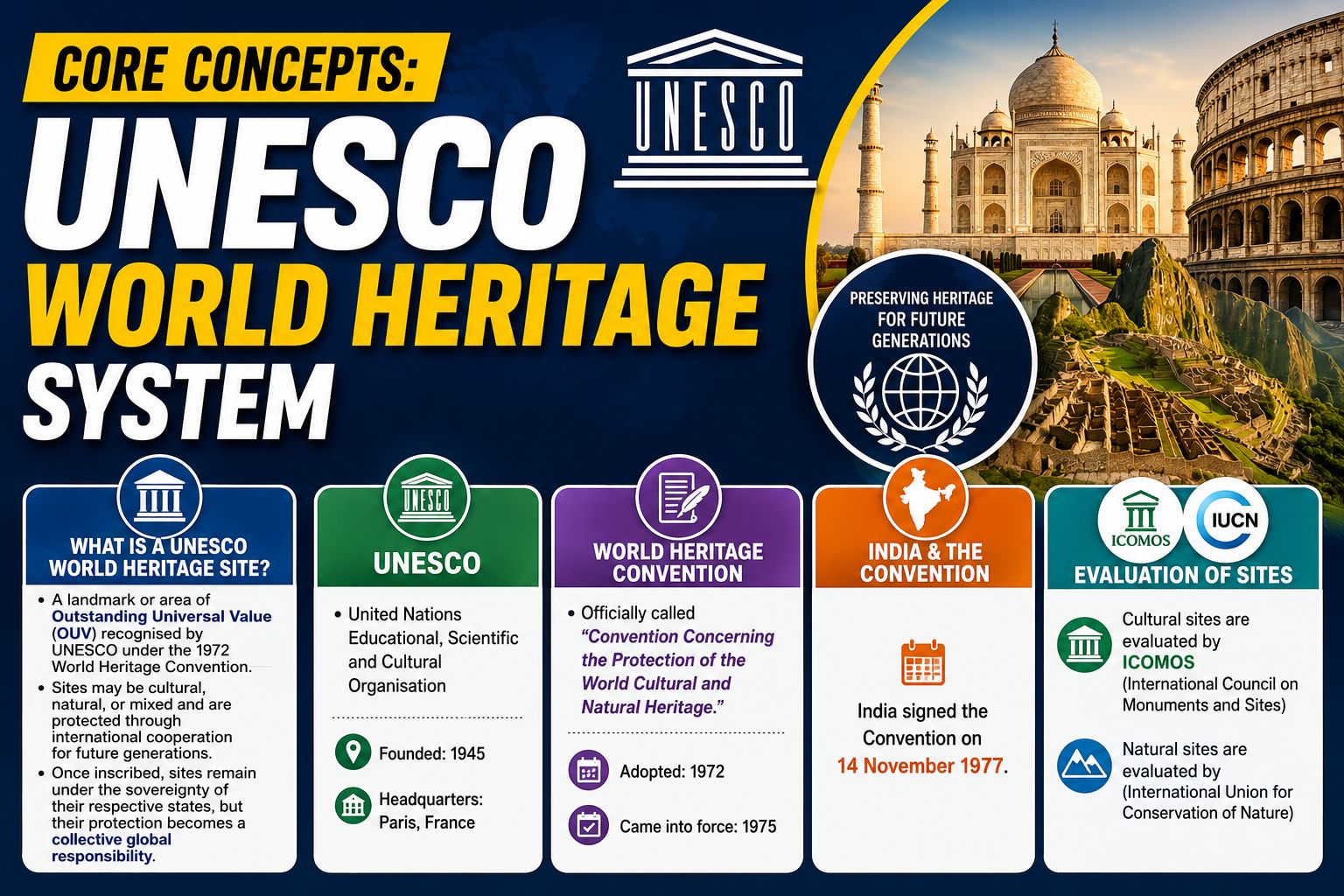
Understanding the framework behind UNESCO World Heritage Sites is essential before memorising the list, as exam questions often test conceptual knowledge.
What is a UNESCO World Heritage Site?
- A UNESCO World Heritage Site is a landmark or area of Outstanding Universal Value (OUV) recognised by UNESCO under the 1972 World Heritage Convention.
- Sites may be cultural, natural, or mixed and are protected through international cooperation for future generations.
- Once inscribed, sites remain under the sovereignty of their respective states, but their protection becomes a collective global responsibility.
UNESCO and the World Heritage Convention
- UNESCO - United Nations Educational, Scientific and Cultural Organisation, founded in 1945, headquartered in Paris, France.
- World Heritage Convention - Officially called "Convention Concerning the Protection of the World Cultural and Natural Heritage," adopted in 1972, came into force in 1975.
- India signed the Convention on 14 November 1977.
- Cultural sites are evaluated by ICOMOS (International Council on Monuments and Sites); natural sites by IUCN (International Union for Conservation of Nature).
Selection Criteria
A site must meet at least one of the ten criteria to qualify as a UNESCO World Heritage Site:
- Cultural Criteria (i-vi): Masterpiece of human creativity, cultural interchange, testimony to a tradition, architectural example, traditional human settlement, or association with events of universal significance.
- Natural Criteria (vii-x): Superlative natural phenomena, Earth's evolutionary history, ecological and biological processes, or critical habitats for biodiversity.
UNESCO Cultural World Heritage Sites in India
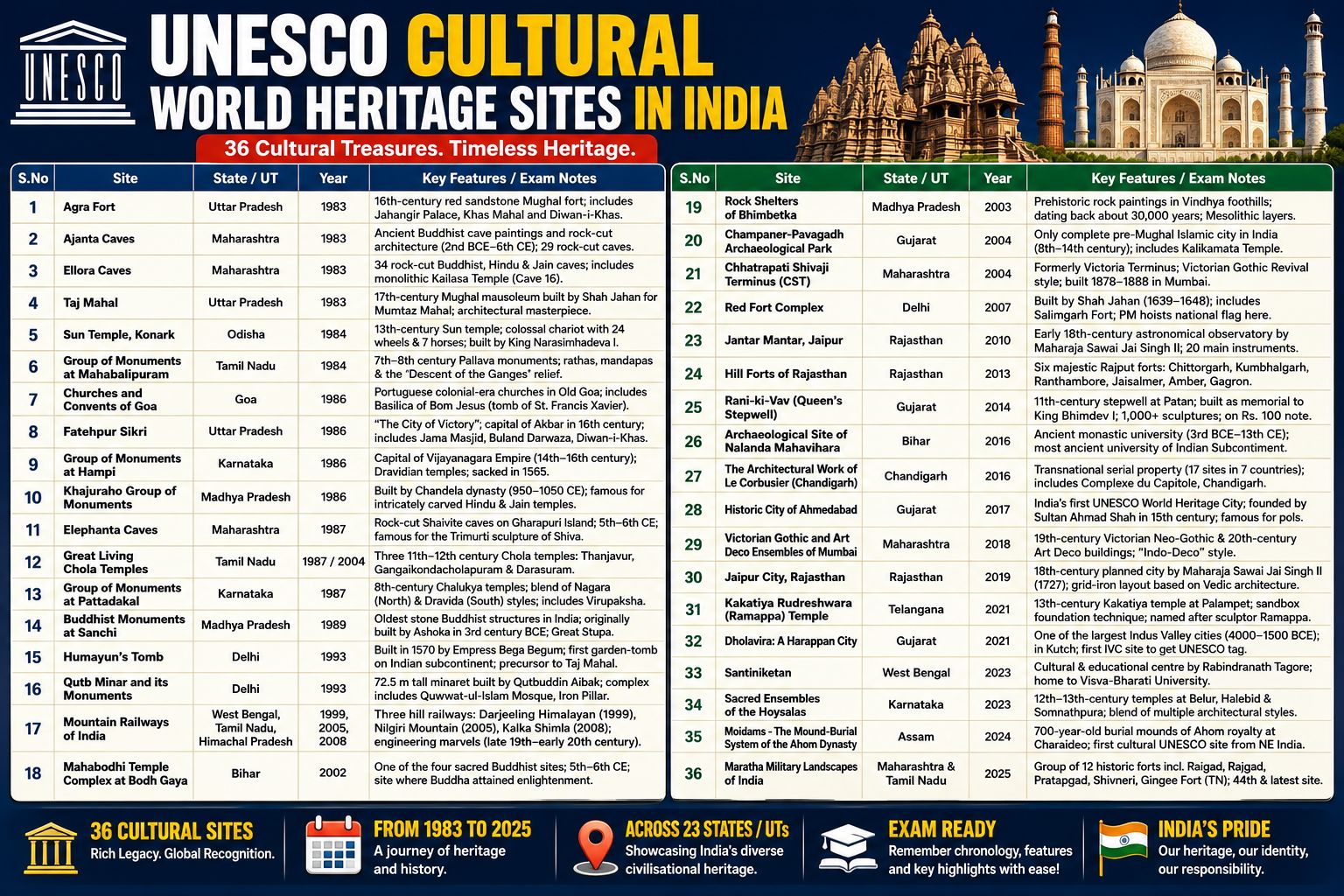
India has 36 Cultural UNESCO World Heritage Sites reflecting its rich legacy of art, architecture, urban planning, and religious traditions. The table below presents all cultural sites in chronological order of inscription.
| S.No | Site | State / UT | Year | Key Features / Exam Notes |
|---|---|---|---|---|
| 1 | Agra Fort | Uttar Pradesh | 1983 | 16th-century red sandstone Mughal fort; includes Jahangir Palace, Khas Mahal and Diwan-i-Khas; one of the first Indian sites inscribed. |
| 2 | Ajanta Caves | Maharashtra | 1983 | Finest surviving examples of ancient Buddhist cave paintings and rock-cut architecture (2nd century BCE to 6th century CE); 29 rock-cut caves. |
| 3 | Ellora Caves | Maharashtra | 1983 | 34 rock-cut Buddhist, Hindu, and Jain caves; includes the monolithic Kailasa Temple (Cave 16); 6th to 11th century CE. |
| 4 | Taj Mahal | Uttar Pradesh | 1983 | 17th-century Mughal mausoleum built by Shah Jahan for Mumtaz Mahal; architectural masterpiece of the Mughal era; one of the New Seven Wonders. |
| 5 | Sun Temple, Konark | Odisha | 1984 | 13th-century temple dedicated to Sun God Surya; designed as a colossal chariot with 24 wheels and 7 horses; built by King Narasimhadeva I. |
| 6 | Group of Monuments at Mahabalipuram | Tamil Nadu | 1984 | 7th-8th century Pallava dynasty monuments; rathas (chariot temples), mandapas (cave sanctuaries), and the "Descent of the Ganges" relief. |
| 7 | Churches and Convents of Goa | Goa | 1986 | Portuguese colonial-era churches in Old Goa; includes Basilica of Bom Jesus with tomb of St. Francis Xavier; spread Manueline, Mannerist, Baroque art in Asia. |
| 8 | Fatehpur Sikri | Uttar Pradesh | 1986 | "The City of Victory"; capital of Mughal Emperor Akbar in 16th century; includes Jama Masjid, Buland Darwaza, Diwan-i-Khas. |
| 9 | Group of Monuments at Hampi | Karnataka | 1986 | Capital of Vijayanagara Empire (14th-16th century); Dravidian temples; sacked in 1565 by the Deccan Sultanates. |
| 10 | Khajuraho Group of Monuments | Madhya Pradesh | 1986 | Built by Chandela dynasty (950-1050 CE); 20 surviving Hindu and Jain temples famous for intricately carved sculptures including erotic ones. |
| 11 | Elephanta Caves | Maharashtra | 1987 | Rock-cut Shaivite cave shrines on Gharapuri Island, near Mumbai; 5th-6th century CE; famous for the Trimurti sculpture of Shiva. |
| 12 | Great Living Chola Temples | Tamil Nadu | 1987 / 2004 | Three 11th-12th century Chola temples: Brihadisvara (Thanjavur), Brihadisvara (Gangaikondacholapuram), and Airavatesvara (Darasuram). |
| 13 | Group of Monuments at Pattadakal | Karnataka | 1987 | 8th-century Chalukya dynasty temple complex; blend of Northern (Nagara) and Southern (Dravida) styles; includes the Virupaksha Temple. |
| 14 | Buddhist Monuments at Sanchi | Madhya Pradesh | 1989 | Oldest stone Buddhist structures in India; built originally by Emperor Ashoka in 3rd century BCE; Great Stupa is the most famous. |
| 15 | Humayun's Tomb | Delhi | 1993 | Built in 1570 by Empress Bega Begum; first garden-tomb on the Indian subcontinent; precursor to the Taj Mahal. |
| 16 | Qutb Minar and its Monuments | Delhi | 1993 | 72.5 m tall minaret built by Qutbuddin Aibak in early 13th century; complex includes Quwwat-ul-Islam Mosque, Iron Pillar, Alai Darwaza. |
| 17 | Mountain Railways of India | West Bengal, Tamil Nadu, Himachal Pradesh | 1999, 2005, 2008 | Three hill railways: Darjeeling Himalayan Railway (1999), Nilgiri Mountain Railway (2005), Kalka Shimla Railway (2008); engineering marvels of late 19th-early 20th century. |
| 18 | Mahabodhi Temple Complex at Bodh Gaya | Bihar | 2002 | One of the four sacred Buddhist sites; present temple dates back to 5th-6th century CE; site where Buddha attained enlightenment under the Bodhi tree. |
| 19 | Rock Shelters of Bhimbetka | Madhya Pradesh | 2003 | Located in Vindhya foothills; prehistoric rock paintings dating back about 30,000 years; Mesolithic and later cultural layers. |
| 20 | Champaner-Pavagadh Archaeological Park | Gujarat | 2004 | Only complete pre-Mughal Islamic city in India; 8th-14th century; includes Kalikamata Temple atop Pavagadh Hill. |
| 21 | Chhatrapati Shivaji Terminus (CST) | Maharashtra | 2004 | Formerly Victoria Terminus; designed by F. W. Stevens in Victorian Gothic Revival style; built 1878-1888 in Mumbai. |
| 22 | Red Fort Complex | Delhi | 2007 | Built by Shah Jahan as the palace fort of Shahjahanabad (1639-1648); includes Salimgarh Fort; PM hoists the national flag here on Independence Day. |
| 23 | Jantar Mantar, Jaipur | Rajasthan | 2010 | Early 18th-century astronomical observatory built by Maharaja Sawai Jai Singh II; contains 20 main instruments including the world's largest sundial (Samrat Yantra). |
| 24 | Hill Forts of Rajasthan | Rajasthan | 2013 | Six majestic Rajput forts: Chittorgarh, Kumbhalgarh, Ranthambore, Jaisalmer, Amber, and Gagron; 8th-18th century; demonstrate Rajput military architecture. |
| 25 | Rani-ki-Vav (Queen's Stepwell) | Gujarat | 2014 | 11th-century stepwell on the banks of Saraswati River at Patan; built as memorial to King Bhimdev I; Maru-Gurjara style with 1,000+ sculptures; on Rs. 100 note. |
| 26 | Archaeological Site of Nalanda Mahavihara | Bihar | 2016 | Ruins of ancient monastic university (3rd century BCE to 13th century CE); considered the most ancient university of the Indian Subcontinent; Mahayana Buddhism centre. |
| 27 | The Architectural Work of Le Corbusier (Chandigarh) | Chandigarh | 2016 | Transnational serial property of 17 sites across 7 countries; includes Complexe du Capitole at Chandigarh; represents the Modern Movement in architecture. |
| 28 | Historic City of Ahmedabad | Gujarat | 2017 | India's first UNESCO World Heritage City; founded by Sultan Ahmad Shah in 15th century; famous for pols (gated residential streets) along Sabarmati River. |
| 29 | Victorian Gothic and Art Deco Ensembles of Mumbai | Maharashtra | 2018 | 19th-century Victorian Neo-Gothic and 20th-century Art Deco buildings; "Indo-Deco" style blending Indian and Art Deco elements; located around Oval Maidan. |
| 30 | Jaipur City, Rajasthan | Rajasthan | 2019 | 18th-century planned city founded by Maharaja Sawai Jai Singh II in 1727; capital of Amber kingdom; grid-iron urban layout based on Vedic architecture. |
| 31 | Kakatiya Rudreshwara (Ramappa) Temple | Telangana | 2021 | 13th-century engineering masterpiece of Kakatiya dynasty; located in Palampet; uses sandbox foundation technique; named after sculptor Ramappa. |
| 32 | Dholavira: A Harappan City | Gujarat | 2021 | One of the largest Indus Valley Civilisation cities (4000-1500 BCE); located in Kutch district; first IVC site to get UNESCO tag. |
| 33 | Santiniketan | West Bengal | 2023 | Cultural and educational centre established by Nobel laureate Rabindranath Tagore in early 20th century; home to Visva-Bharati University. |
| 34 | Sacred Ensembles of the Hoysalas | Karnataka | 2023 | 12th-13th-century Hoysala temples at Belur, Halebid, and Somnathpura; blend of Dravidian, Bhumija, Nagara, and Karnataka-Dravida styles. |
| 35 | Moidams - The Mound-Burial System of the Ahom Dynasty | Assam | 2024 | 700-year-old burial mounds of Ahom royalty at Charaideo; first cultural UNESCO site from Northeast India. |
| 36 | Maratha Military Landscapes of India | Maharashtra & Tamil Nadu | 2025 | India's 44th and latest UNESCO site; group of 12 historic forts including Raigad, Rajgad, Pratapgad, Shivneri, Gingee Fort (TN); inscribed at 47th session in Paris. |
UNESCO Natural World Heritage Sites in India
India has 7 Natural UNESCO World Heritage Sites recognised for their exceptional biodiversity, ecosystems, and natural beauty. The table below lists all natural sites with their state and key features.
| S.No | Site | State / UT | Year | Key Features / Exam Notes |
|---|---|---|---|---|
| 1 | Kaziranga National Park | Assam | 1985 | Home to the world's largest population of the one-horned rhinoceros; also has tigers, elephants, wild water buffalo; located on Brahmaputra floodplains. |
| 2 | Keoladeo National Park | Rajasthan | 1985 | Man-made wetland in Bharatpur; over 375 bird species; wintering ground for migratory waterfowl including the (formerly) Siberian Crane; declared NP in 1982. |
| 3 | Manas Wildlife Sanctuary | Assam | 1985 | Biodiversity hotspot on Manas River; tiger reserve; habitat for endangered species — tiger, one-horned rhino, swamp deer, pygmy hog, Bengal florican. |
| 4 | Sundarbans National Park | West Bengal | 1987 | World's largest estuarine mangrove forest; home to Royal Bengal Tiger; lies in delta of Ganga, Brahmaputra, and Meghna rivers; threatened by rising sea levels. |
| 5 | Nanda Devi and Valley of Flowers National Parks | Uttarakhand | 1988 / 2005 | Nanda Devi NP — rugged glacial wilderness around India's second-highest peak; Valley of Flowers — alpine meadow of wildflowers; home to snow leopard and Himalayan musk deer. |
| 6 | Western Ghats | Karnataka, Kerala, Tamil Nadu, Maharashtra | 2012 | 1,600 km mountain range parallel to west coast; one of the world's 8 "hottest hotspots" of biodiversity; 39 component sites; influences Indian monsoon. |
| 7 | Great Himalayan National Park Conservation Area | Himachal Pradesh | 2014 | Located in Kullu region; alpine peaks, meadows, riverine forests; 25 forest types; habitat for snow leopard, Himalayan tahr, blue sheep. |
UNESCO Mixed World Heritage Site in India
India has only one Mixed UNESCO World Heritage Site that holds both cultural and natural significance.
| Site | State / UT | Year | Cultural Significance | Natural Significance |
|---|---|---|---|---|
| Khangchendzonga National Park | Sikkim | 2016 | Sacred to indigenous Sikkimese (Lepcha) communities; Mount Khangchendzonga is worshipped as a guardian deity. | Dominated by world's third-highest peak (Mount Khangchendzonga, 8,586 m); 26-km Zemu Glacier; covers about 25% of Sikkim; rich Eastern Himalayan biodiversity from subtropical to alpine zones. |
State-Wise UNESCO World Heritage Sites in India - Quick Reference
The table below groups UNESCO sites by state — a high-yield list for SSC, RRB, and State PCS exams.
| State / UT | UNESCO Sites |
|---|---|
| Maharashtra | Ajanta Caves, Ellora Caves, Elephanta Caves, Chhatrapati Shivaji Terminus, Victorian Gothic & Art Deco Ensembles, Western Ghats, Maratha Military Landscapes |
| Uttar Pradesh | Taj Mahal, Agra Fort, Fatehpur Sikri |
| Madhya Pradesh | Khajuraho Group of Monuments, Buddhist Monuments at Sanchi, Rock Shelters of Bhimbetka |
| Gujarat | Champaner-Pavagadh, Rani-ki-Vav, Historic City of Ahmedabad, Dholavira |
| Karnataka | Group of Monuments at Hampi, Group of Monuments at Pattadakal, Sacred Ensembles of the Hoysalas, Western Ghats |
| Tamil Nadu | Mahabalipuram, Great Living Chola Temples, Nilgiri Mountain Railway, Western Ghats, Maratha Military Landscapes (Gingee Fort) |
| Rajasthan | Keoladeo NP, Jantar Mantar (Jaipur), Hill Forts of Rajasthan, Jaipur City |
| Delhi | Humayun's Tomb, Qutb Minar Complex, Red Fort Complex |
| Assam | Kaziranga NP, Manas Wildlife Sanctuary, Moidams of the Ahom Dynasty |
| West Bengal | Sundarbans NP, Darjeeling Himalayan Railway, Santiniketan |
| Bihar | Mahabodhi Temple Complex (Bodh Gaya), Nalanda Mahavihara |
| Odisha | Sun Temple, Konark |
| Goa | Churches and Convents of Goa |
| Uttarakhand | Nanda Devi & Valley of Flowers NPs |
| Sikkim | Khangchendzonga National Park (Mixed) |
| Himachal Pradesh | Great Himalayan NP, Kalka Shimla Railway |
| Telangana | Kakatiya Rudreshwara (Ramappa) Temple |
| Chandigarh (UT) | Architectural Work of Le Corbusier |
| Kerala | Western Ghats |
Year-Wise Inscription of UNESCO Sites in India - Quick Reference
First Batch and Early Years (1983-1989)
| Year | Site(s) Inscribed |
|---|---|
| 1983 | Taj Mahal, Agra Fort, Ajanta Caves, Ellora Caves |
| 1984 | Sun Temple Konark, Mahabalipuram |
| 1985 | Kaziranga NP, Keoladeo NP, Manas Wildlife Sanctuary |
| 1986 | Churches of Goa, Fatehpur Sikri, Hampi, Khajuraho |
| 1987 | Elephanta Caves, Great Living Chola Temples, Pattadakal, Sundarbans NP |
| 1988 | Nanda Devi NP |
| 1989 | Buddhist Monuments at Sanchi |
Middle Period (1993-2010)
| Year | Site(s) Inscribed |
|---|---|
| 1993 | Humayun's Tomb, Qutb Minar Complex |
| 1999 | Darjeeling Himalayan Railway |
| 2002 | Mahabodhi Temple, Bodh Gaya |
| 2003 | Rock Shelters of Bhimbetka |
| 2004 | Champaner-Pavagadh, Chhatrapati Shivaji Terminus, Great Living Chola Temples (extension) |
| 2005 | Nilgiri Mountain Railway (extension), Valley of Flowers NP (extension of Nanda Devi) |
| 2007 | Red Fort Complex |
| 2008 | Kalka Shimla Railway (extension) |
| 2010 | Jantar Mantar, Jaipur |
Recent Inscriptions (2012-2025)
| Year | Site(s) Inscribed |
|---|---|
| 2012 | Western Ghats |
| 2013 | Hill Forts of Rajasthan |
| 2014 | Rani-ki-Vav (Patan), Great Himalayan National Park |
| 2016 | Nalanda Mahavihara, Architectural Work of Le Corbusier (Chandigarh), Khangchendzonga NP (Mixed) |
| 2017 | Historic City of Ahmedabad |
| 2018 | Victorian Gothic & Art Deco Ensembles of Mumbai |
| 2019 | Jaipur City |
| 2021 | Kakatiya Rudreshwara (Ramappa) Temple, Dholavira |
| 2023 | Santiniketan, Sacred Ensembles of the Hoysalas |
| 2024 | Moidams - Mound-Burial System of the Ahom Dynasty |
| 2025 | Maratha Military Landscapes of India (44th site) |
UNESCO Tentative List of India - Recent Additions (2025)
The Tentative List is an inventory of sites that a country intends to nominate for inscription. India has 62 sites on the Tentative List as of 2025. The 6 newly added sites in 2025 are:
| Site | State / Location | Significance |
|---|---|---|
| Kanger Valley National Park | Chhattisgarh | Biodiversity hotspot with dense forests and limestone caves; home to the Bastar Hill Myna. |
| Mudumal Megalithic Menhirs | Telangana | Iron Age standing stones; believed to be burial markers with astronomical alignment. |
| Ashokan Edict Sites along Mauryan Routes | Multiple States | Inscriptions of Emperor Ashoka on pillars and rocks propagating Dhamma. |
| Chausath Yogini Temples | Multiple States | 64 circular temples dedicated to Yogini goddesses; unique tantric architecture. |
| Gupta Temples in North India | Multiple States | Temples from the Gupta period reflecting the golden age of Indian architecture. |
| Palace-Fortresses of the Bundelas | Madhya Pradesh & Uttar Pradesh | Bundela dynasty palace-forts blending Rajput and Mughal architectural styles. |
Memory Tricks and Mnemonics
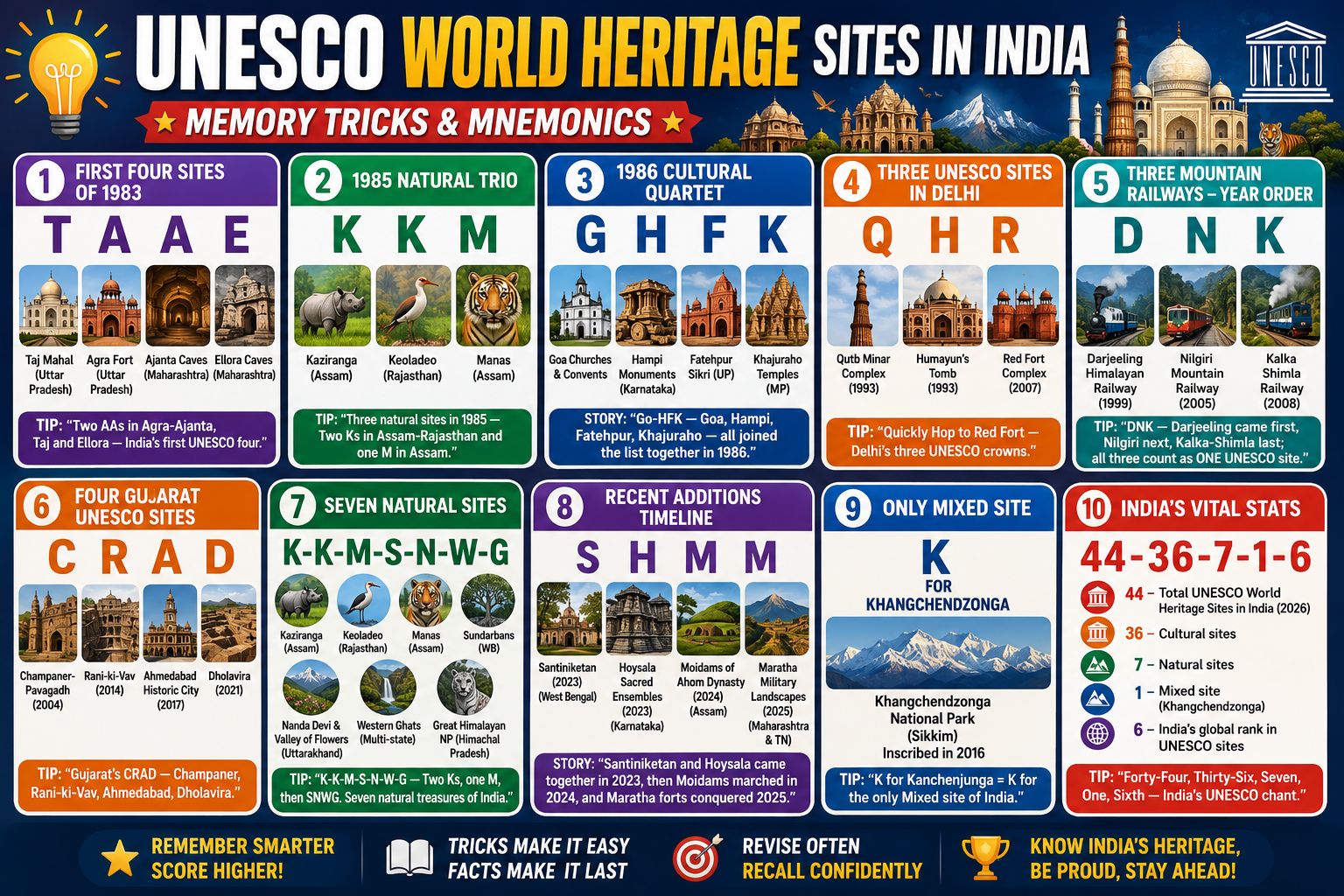
Trick 1: First Four Sites of 1983 - "TAAE"
- T - Taj Mahal (Uttar Pradesh).
- A - Agra Fort (Uttar Pradesh).
- A - Ajanta Caves (Maharashtra).
- E - Ellora Caves (Maharashtra).
Tip: "Two AAs in Agra-Ajanta, Taj and Ellora — India's first UNESCO four."
Trick 2: 1985 Natural Trio - "KKM"
- K - Kaziranga (Assam — one-horned rhino).
- K - Keoladeo (Rajasthan — bird sanctuary).
- M - Manas (Assam — tiger reserve).
Tip: "Three natural sites in 1985 — Two Ks in Assam-Rajasthan and one M in Assam."
Trick 3: 1986 Cultural Quartet - "GHFK"
- G - Goa Churches and Convents.
- H - Hampi Monuments (Karnataka).
- F - Fatehpur Sikri (UP).
- K - Khajuraho Temples (MP).
Story: "Go-HFK — Goa, Hampi, Fatehpur, Khajuraho — all joined the list together in 1986."
Trick 4: Three UNESCO Sites in Delhi - "QHR"
- Q - Qutb Minar Complex (1993).
- H - Humayun's Tomb (1993).
- R - Red Fort Complex (2007).
Tip: "Quickly Hop to Red Fort — Delhi's three UNESCO crowns."
Trick 5: Three Mountain Railways - "DNK" (year order)
- D - Darjeeling Himalayan Railway (1999, West Bengal).
- N - Nilgiri Mountain Railway (2005, Tamil Nadu).
- K - Kalka Shimla Railway (2008, Himachal Pradesh).
Tip: "DNK — Darjeeling came first, Nilgiri next, Kalka-Shimla last; all three count as ONE UNESCO site."
Trick 6: Four Gujarat UNESCO Sites - "CRAD"
- C - Champaner-Pavagadh (2004).
- R - Rani-ki-Vav (2014).
- A - Ahmedabad Historic City (2017).
- D - Dholavira (2021).
Tip: "Gujarat's CRAD — Champaner, Rani-ki-Vav, Ahmedabad, Dholavira."
Trick 7: Seven Natural Sites - "K-K-M-S-N-W-G"
- K - Kaziranga (Assam).
- K - Keoladeo (Rajasthan).
- M - Manas (Assam).
- S - Sundarbans (West Bengal).
- N - Nanda Devi & Valley of Flowers (Uttarakhand).
- W - Western Ghats (Multi-state).
- G - Great Himalayan NP (Himachal Pradesh).
Tip: "K-K-M-S-N-W-G — Two Ks, one M, then SNWG. Seven natural treasures of India."
Trick 8: Recent Additions Timeline - "SHMM"
- S - Santiniketan (2023, West Bengal).
- H - Hoysala Sacred Ensembles (2023, Karnataka).
- M - Moidams of Ahom Dynasty (2024, Assam).
- M - Maratha Military Landscapes (2025, Maharashtra & TN — 44th site).
Story: "Santiniketan and Hoysala came together in 2023, then Moidams marched in 2024, and Maratha forts conquered 2025."
Trick 9: Only Mixed Site - "K for Khangchendzonga"
India has exactly ONE mixed UNESCO site — Khangchendzonga National Park in Sikkim, inscribed in 2016. Tip: "K for Kanchenjunga = K for the only Mixed site of India."
Trick 10: India's Vital Stats - "44-36-7-1-6"
- 44 - Total UNESCO World Heritage Sites in India (2026).
- 36 - Cultural sites.
- 7 - Natural sites.
- 1 - Mixed site (Khangchendzonga).
- 6 - India's global rank in UNESCO sites.
Tip: "Forty-Four, Thirty-Six, Seven, One, Sixth — India's UNESCO chant."
Additional Notes
Frequently Confused Facts
- First UNESCO site of India: Agra Fort, Ajanta Caves, Ellora Caves, and Taj Mahal — all four were inscribed together in 1983. There is no single "first" site.
- Total sites (2026): 44 — comprising 36 Cultural, 7 Natural, and 1 Mixed.
- India's UNESCO global rank: 6th (Italy holds the top rank).
- Only Mixed site: Khangchendzonga National Park, Sikkim (2016).
- Latest UNESCO site (2025): Maratha Military Landscapes of India — India's 44th site.
- First Indian site from Northeast (cultural): Moidams of the Ahom Dynasty (Assam, 2024).
- First UNESCO World Heritage City of India: Ahmedabad (2017).
- First IVC site to get UNESCO status: Dholavira (2021).
- Mountain Railways: Counted as ONE UNESCO property even though inscription took place in three different years (1999, 2005, 2008).
- Nanda Devi & Valley of Flowers: Two separate inscription years (1988 and 2005) but counted as ONE UNESCO site.
- UNESCO HQ: Paris, France; UNESCO founded: 1945.
- World Heritage Convention adopted: 1972; India signed: 14 November 1977.
- Cultural sites evaluator: ICOMOS; Natural sites evaluator: IUCN.
- Maratha Military Landscapes: 12 forts — 11 in Maharashtra and 1 (Gingee Fort) in Tamil Nadu.
- Sacred Ensembles of Hoysalas: 3 temples — Belur, Halebid, Somnathpura (all in Karnataka).
Repeating PYQ Patterns
- UPSC Prelims: Frequently asks about the latest inscription, Khangchendzonga as the only mixed site, Le Corbusier transnational property, and Dholavira as IVC site.
- SSC CGL and CHSL: Match-the-column questions linking site to state; Konark, Mahabalipuram, Hampi, Pattadakal, and Khajuraho are most common.
- IBPS PO and Clerk: One-liner questions on year of inscription and total number of sites — current affairs angle.
- RRB NTPC and Group D: Direct questions on which state hosts a particular site (e.g., Rani-ki-Vav in Gujarat, Ramappa Temple in Telangana).
- State PCS: State-specific UNESCO sites are heavily favoured (e.g., Bihar PCS — Mahabodhi and Nalanda; MPPSC — Sanchi, Khajuraho, Bhimbetka).
Quick Insight
UNESCO World Heritage Sites are central to current affairs themes such as the inscription of Maratha Military Landscapes in 2025, the addition of 6 new sites to India's Tentative List in 2025, the upcoming nominations from the Tentative List, India hosting the 46th World Heritage Committee meeting in 2024, and ongoing conservation issues at sites like the Taj Mahal (Mathura refinery pollution) and Sundarbans (climate change). Aspirants should regularly track UNESCO inscriptions, ASI conservation reports, and World Heritage Day (18 April). For the latest updates, follow the daily current affairs section on Jobsme.in.
This topic also pairs well with related Static GK areas such as Temples in India, National Parks and Wildlife Sanctuaries, and Biosphere Reserves of India, since most natural UNESCO sites are also national parks or biosphere reserves.
One-Liners for Quick Revision
- Total UNESCO sites in India → 44 (as of 2026) → 36 Cultural + 7 Natural + 1 Mixed.
- India's global rank in UNESCO sites → 6th in the world.
- First sites inscribed (1983) → Taj Mahal, Agra Fort, Ajanta Caves, Ellora Caves.
- Latest UNESCO site → Maratha Military Landscapes (2025); India's 44th site.
- Only Mixed Site → Khangchendzonga National Park, Sikkim (2016).
- Taj Mahal → Uttar Pradesh (Agra), 1983 → Mughal mausoleum by Shah Jahan; one of New Seven Wonders.
- Agra Fort → Uttar Pradesh, 1983 → Red sandstone Mughal fort; Jahangir Palace and Khas Mahal.
- Ajanta Caves → Maharashtra, 1983 → 29 Buddhist rock-cut caves; ancient paintings.
- Ellora Caves → Maharashtra, 1983 → 34 Buddhist, Hindu, Jain caves; Kailasa Temple (Cave 16).
- Sun Temple, Konark → Odisha, 1984 → 13th-century chariot temple of Surya; built by Narasimhadeva I.
- Mahabalipuram → Tamil Nadu, 1984 → Pallava dynasty rathas, mandapas, Descent of the Ganges.
- Kaziranga National Park → Assam, 1985 → One-horned rhinoceros.
- Keoladeo National Park → Rajasthan (Bharatpur), 1985 → Bird sanctuary; Siberian crane wintering ground.
- Manas Wildlife Sanctuary → Assam, 1985 → Tiger reserve; pygmy hog, Bengal florican.
- Churches and Convents of Goa → Goa, 1986 → Basilica of Bom Jesus; tomb of St. Francis Xavier.
- Fatehpur Sikri → Uttar Pradesh, 1986 → Akbar's "City of Victory"; Jama Masjid, Buland Darwaza.
- Hampi → Karnataka, 1986 → Capital of Vijayanagara Empire; sacked in 1565.
- Khajuraho → Madhya Pradesh, 1986 → Chandela dynasty temples; 20 surviving structures.
- Elephanta Caves → Maharashtra, 1987 → Gharapuri Island; Shiva Trimurti sculpture.
- Great Living Chola Temples → Tamil Nadu, 1987/2004 → Brihadisvara (Thanjavur and Gangaikondacholapuram), Airavatesvara (Darasuram).
- Pattadakal → Karnataka, 1987 → Chalukya temples blending Nagara and Dravida styles.
- Sundarbans National Park → West Bengal, 1987 → Largest mangrove forest; Royal Bengal Tiger.
- Nanda Devi & Valley of Flowers NPs → Uttarakhand, 1988/2005 → Alpine wildflower meadow; snow leopard habitat.
- Buddhist Monuments at Sanchi → Madhya Pradesh, 1989 → Built by Ashoka in 3rd century BCE; Great Stupa.
- Humayun's Tomb → Delhi, 1993 → First garden-tomb in India; precursor to Taj Mahal.
- Qutb Minar Complex → Delhi, 1993 → 72.5 m minaret by Qutbuddin Aibak; Iron Pillar; Quwwat-ul-Islam Mosque.
- Mountain Railways of India → 1999, 2005, 2008 → Darjeeling (WB), Nilgiri (TN), Kalka-Shimla (HP); one UNESCO site.
- Mahabodhi Temple, Bodh Gaya → Bihar, 2002 → Site of Buddha's enlightenment; Bodhi tree.
- Rock Shelters of Bhimbetka → Madhya Pradesh, 2003 → Vindhya foothills; 30,000-year-old rock paintings.
- Champaner-Pavagadh Archaeological Park → Gujarat, 2004 → Only complete pre-Mughal Islamic city; Kalikamata Temple.
- Chhatrapati Shivaji Terminus → Maharashtra, 2004 → Victorian Gothic Revival; designed by F. W. Stevens.
- Red Fort Complex → Delhi, 2007 → Built by Shah Jahan; PM's Independence Day address venue.
- Jantar Mantar → Jaipur, Rajasthan, 2010 → Sawai Jai Singh II; world's largest sundial (Samrat Yantra).
- Western Ghats → Multi-state, 2012 → 1,600 km; biodiversity hotspot; influences monsoon.
- Hill Forts of Rajasthan → Rajasthan, 2013 → Chittorgarh, Kumbhalgarh, Ranthambore, Jaisalmer, Amber, Gagron.
- Rani-ki-Vav → Patan, Gujarat, 2014 → 11th-century stepwell by Bhimdev I's queen; on Rs. 100 note.
- Great Himalayan National Park → Himachal Pradesh, 2014 → Snow leopard, Himalayan tahr.
- Nalanda Mahavihara → Bihar, 2016 → Ancient monastic university; Mahayana Buddhism centre.
- Architectural Work of Le Corbusier (Chandigarh) → 2016 → Transnational property across 7 countries; Complexe du Capitole.
- Khangchendzonga National Park → Sikkim, 2016 → Only Mixed site; world's third-highest peak.
- Historic City of Ahmedabad → Gujarat, 2017 → India's first UNESCO World Heritage City; pols.
- Victorian Gothic & Art Deco Ensembles → Mumbai, Maharashtra, 2018 → Around Oval Maidan; Indo-Deco style.
- Jaipur City → Rajasthan, 2019 → Founded 1727 by Sawai Jai Singh II; grid-iron planning.
- Ramappa Temple (Kakatiya Rudreshwara) → Palampet, Telangana, 2021 → Kakatiya dynasty; sandbox foundation.
- Dholavira → Kutch, Gujarat, 2021 → First IVC site to get UNESCO tag; 4000-1500 BCE.
- Santiniketan → West Bengal, 2023 → Founded by Rabindranath Tagore; Visva-Bharati University.
- Sacred Ensembles of the Hoysalas → Karnataka, 2023 → Belur, Halebid, Somnathpura temples.
- Moidams of the Ahom Dynasty → Charaideo, Assam, 2024 → Royal burial mounds; first cultural UNESCO site from NE India.
- Maratha Military Landscapes → Maharashtra & Tamil Nadu, 2025 → 12 forts including Raigad, Rajgad, Shivneri, Pratapgad, Gingee; India's 44th site.
- UNESCO founded → 1945 → Paris, France.
- World Heritage Convention → Adopted 1972 → Came into force 1975.
- India signed Convention → 14 November 1977.
- Cultural site evaluator → ICOMOS.
- Natural site evaluator → IUCN.
- Highest UNESCO peak in India → Mount Khangchendzonga (8,586 m, Sikkim).
- First Indian World Heritage City → Ahmedabad (2017).
- State with most UNESCO sites → Maharashtra (7 sites including shared Western Ghats and Maratha Landscapes).
- UNESCO HQ → Paris, France.
- World Heritage Day → 18 April.
- India's Tentative List → 62 sites (after 2025 additions).
- 6 New Tentative List sites (2025) → Kanger Valley NP, Mudumal Menhirs, Ashokan Edicts, Chausath Yogini Temples, Gupta Temples, Bundela Palace-Fortresses.
For more Static GK topics like temples, national parks, and biosphere reserves of India, explore the Static GK section on Jobsme.in. You can also test your knowledge with the Static GK Quiz and check out the latest exam notifications at Latest Government Job Notifications.
Free quiz • No signup required
Put this topic into practice with Indian Cultural Institutions – Static GK MCQ Quiz. It is the quickest way to reinforce what you just learned.
Frequently Asked Questions
How many UNESCO World Heritage Sites are there in India in 2026?
Which is the latest UNESCO World Heritage Site in India?
Which is the only Mixed UNESCO World Heritage Site in India?
Which were the first UNESCO World Heritage Sites of India?
How many Natural UNESCO World Heritage Sites are in India?
Which Indian state has the highest number of UNESCO World Heritage Sites?
When was the UNESCO World Heritage Convention adopted and when did India sign it?
Which was the first UNESCO World Heritage City of India?
What is the difference between the Tentative List and the World Heritage List?
Which is the only Indus Valley Civilisation site to be inscribed as a UNESCO World Heritage Site?

About the author