Governor-General and Viceroy of India – Complete List, Tenures, and Key Events – Static GK & General Awareness for Competitive Exams with Memory Tricks
This article presents the complete list of Governor-Generals of Bengal, Governor-Generals of India, and Viceroys of India from 1772 to 1950, along with their tenures, major reforms, wars, and exam-relevant events. It covers Warren Hastings, Lord Cornwallis, Lord William Bentinck, Lord Dalhousie, Lord Curzon, Lord Mountbatten, and C. Rajagopalachari, with memory tricks, mnemonics, and one-liners for quick revision. All facts are arranged in exam-ready format to help UPSC, SSC, IBPS, RRB, PSU, and State PCS aspirants score better in General Awareness and Modern History sections.
Jump to section
- Introduction
- Core Concepts: Evolution of the Office
- Governor-Generals of Bengal (1773-1833)
- Governor-Generals of India (1833-1858)
- Viceroys of India (1858-1947)
- Governor-Generals of Independent India (1947-1950)
- Important Firsts and Lasts - Quick Reference
- Memory Tricks and MnemonicsTrick 1: Order of Governor-Generals of Bengal — "Warren Cornered Shore, Well Barlow Minto Hastings Amherst Bentinck"
- Additional Notes
- One-Liners for Quick Revision
Introduction
The administrative history of British India is closely tied to the office of the Governor-General and later the Viceroy. From Warren Hastings, who became the first Governor-General of Bengal in 1773, to C. Rajagopalachari, the first and only Indian Governor-General of independent India, this office shaped the political, social, and economic destiny of the subcontinent for nearly 180 years. The decisions taken by these officials laid the foundations of modern Indian administration, judiciary, education, railways, and civil services, even as they served the colonial interests of the British Crown.
Questions on Governor-Generals and Viceroys appear regularly in UPSC Prelims, SSC CGL, IBPS PO, RRB NTPC, SBI Clerk, State PCS, and various Insurance and Defence exams. Questions typically ask about who introduced a particular act, who was associated with a specific war or reform, the tenure of a Viceroy, or who served as the first or last in a specific role. This article brings together every key fact in a structured, exam-ready format. To explore other related Static GK topics, you can refer to the Governor General and Viceroy of India - Static GK guide on Jobsme.in.
The list of Governor-Generals and Viceroys is also closely linked to important themes such as the Revolt of 1857, the Partition of Bengal, the rise of the Indian National Congress, the Non-Cooperation and Quit India movements, and India's eventual independence in 1947 — making this topic doubly important for aspirants preparing for UPSC Mains, Essay papers, and Modern Indian History sections of other competitive exams.
Core Concepts: Evolution of the Office
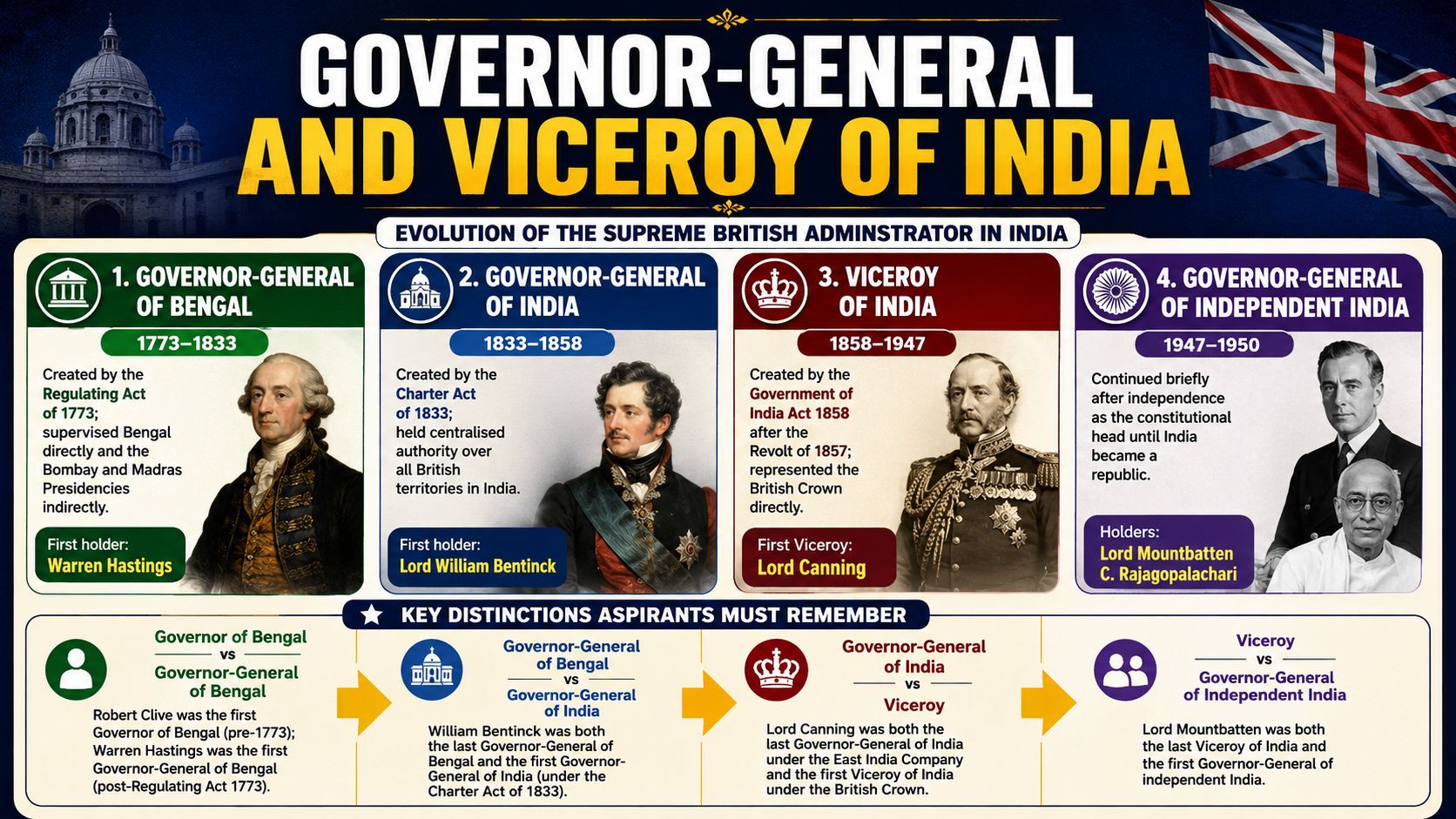
The office of the supreme British administrator in India went through three distinct phases, each created by a specific Act of the British Parliament.
Three Phases of British Administration in India
- Governor-General of Bengal (1773-1833): Created by the Regulating Act of 1773; supervised Bengal directly and the Bombay and Madras Presidencies indirectly. First holder was Warren Hastings.
- Governor-General of India (1833-1858): Created by the Charter Act of 1833; held centralised authority over all British territories in India. First holder was Lord William Bentinck.
- Viceroy of India (1858-1947): Created by the Government of India Act 1858 after the Revolt of 1857; represented the British Crown directly. First Viceroy was Lord Canning.
- Governor-General of Independent India (1947-1950): Continued briefly after independence as the constitutional head until India became a republic. Holders were Lord Mountbatten and C. Rajagopalachari.
Key Distinctions Aspirants Must Remember
- Governor of Bengal vs Governor-General of Bengal: Robert Clive was the first Governor of Bengal (pre-1773); Warren Hastings was the first Governor-General of Bengal (post-Regulating Act 1773).
- Governor-General of Bengal vs Governor-General of India: William Bentinck was both the last Governor-General of Bengal and the first Governor-General of India (under the Charter Act of 1833).
- Governor-General of India vs Viceroy: Lord Canning was both the last Governor-General of India under the East India Company and the first Viceroy of India under the British Crown.
- Viceroy vs Governor-General of Independent India: Lord Mountbatten was both the last Viceroy of India and the first Governor-General of independent India.
Governor-Generals of Bengal (1773-1833)
The Governor-Generals of Bengal laid the foundations of British administration in India. They implemented crucial reforms in governance, judiciary, and revenue, while expanding territorial control through wars and treaties.
| Governor-General of Bengal | Tenure | Key Events and Contributions |
|---|---|---|
| Warren Hastings | 1772-1785 | First Governor-General of Bengal; ended dual system of administration in Bengal; implemented Regulating Act of 1773; Pitt's India Act of 1784; Rohilla War (1774); First Anglo-Maratha War (1775-82) and Treaty of Salbai (1782); Second Anglo-Mysore War (1780-84); established the Asiatic Society of Bengal (1784) and Supreme Court at Calcutta. |
| Lord Cornwallis | 1786-1793 | Introduced the Permanent Settlement of Bengal (1793); reformed the Civil Services and is known as the "Father of Civil Services in India"; Cornwallis Code (1793); fought the Third Anglo-Mysore War (1790-92); signed the Treaty of Seringapatam (1792). |
| Sir John Shore | 1793-1798 | Implemented the Charter Act of 1793; followed a strict non-intervention policy; oversaw the Battle of Kharda (1795) between the Nizam and the Marathas. |
| Lord Wellesley | 1798-1805 | Introduced the Subsidiary Alliance system (1798); led the Fourth Anglo-Mysore War (1799) in which Tipu Sultan was killed; Second Anglo-Maratha War (1803-05); established Fort William College in Calcutta. |
| Sir George Barlow | 1805-1807 | Acting Governor-General; reduced British territory for economic reasons; faced the Mutiny of Vellore (1806). |
| Lord Minto I | 1807-1813 | Concluded the Treaty of Amritsar with Maharaja Ranjit Singh (1809); introduced the Charter Act of 1813; ended the policy of non-intervention. |
| Lord Hastings (Marquess of Hastings) | 1813-1823 | Anglo-Nepal War (1814-16) and Treaty of Sagauli (1816); Third Anglo-Maratha War (1817-19) and dissolution of the Maratha Confederacy; established the Ryotwari System in Madras (1820). |
| Lord Amherst | 1823-1828 | First Burmese War (1824-26) and Treaty of Yandabo (1826); annexation of Assam, Arakan, and Tenasserim. |
| Lord William Bentinck | 1828-1835 | Last Governor-General of Bengal (became first Governor-General of India in 1833); abolished Sati (1829); suppressed Thuggee; introduced English Education Act of 1835; established Medical College, Kolkata; passed the Charter Act of 1833. |
Governor-Generals of India (1833-1858)
With the Charter Act of 1833, the post was redesignated as Governor-General of India. The holders of this office oversaw transformative changes in education, infrastructure, and law before the office transitioned into the Viceroy after the Revolt of 1857.
| Governor-General of India | Tenure | Key Events and Contributions |
|---|---|---|
| Lord William Bentinck | 1833-1835 | First Governor-General of India; abolished Sati (1829); suppressed Thuggee; introduced English as the medium of higher education under the English Education Act of 1835 (based on Macaulay's Minute); established Medical College, Kolkata. |
| Lord Charles Metcalfe | 1835-1836 | Removed restrictions on the press by passing the Press Act of 1835; earned the title "Liberator of the Indian press." |
| Lord Auckland | 1836-1842 | Focused on education reforms; led the disastrous First Anglo-Afghan War (1838-42). |
| Lord Ellenborough | 1842-1844 | Annexed Sindh (1843) under General Charles Napier; abolished slavery through the Indian Slavery Act of 1843. |
| Lord Hardinge I | 1844-1848 | First Anglo-Sikh War (1845-46) and the Treaty of Lahore (1846); founded the engineering college at Roorkee (later IIT Roorkee); abolition of female infanticide. |
| Lord Dalhousie | 1848-1856 | Second Anglo-Sikh War (1848-49) and annexation of Punjab; introduced the Doctrine of Lapse; annexation of Lower Burma (1852); Wood's Despatch (1854); laid down the first railway line from Bombay to Thane (1853); first telegraph line and postal reforms; enacted the Widow Remarriage Act (passed under Canning but initiated under Dalhousie); established the Public Works Department (PWD). |
| Lord Canning | 1856-1862 | Last Governor-General of India under the East India Company; faced the Revolt of 1857; abolition of East India Company by the Government of India Act 1858; establishment of universities at Calcutta, Madras, and Bombay (1857); Indian Councils Act of 1861; became the first Viceroy of India in 1858. |
Viceroys of India (1858-1947)
The Government of India Act 1858 marked a turning point by ending Company rule and transferring governance directly to the British Crown. The Viceroy was appointed directly by the Crown and represented the monarch in India until independence in 1947.
| Viceroy | Tenure | Key Events and Contributions |
|---|---|---|
| Lord Canning | 1858-1862 | First Viceroy of India; abolished the Doctrine of Lapse; passed the Indian Councils Act of 1861; declared Queen Victoria's Proclamation of 1858; introduced the Indian High Courts Act of 1861. |
| Lord Elgin I | 1862-1863 | Suppressed the Wahabi Movement; died in office at Dharamshala. |
| Lord John Lawrence | 1864-1869 | Anglo-Bhutanese War (1865); established High Courts at Calcutta, Bombay, and Madras (1865); followed the policy of "Masterly Inactivity" towards Afghanistan; faced the Orissa famine of 1866. |
| Lord Mayo | 1869-1872 | Initiated financial decentralisation; conducted the first all-India Census (1872); established Mayo College at Ajmer; only Viceroy assassinated in office (in the Andamans, 1872). |
| Lord Northbrook | 1872-1876 | Faced the Kuka Movement; visit of Prince of Wales (1875); resigned over disagreements regarding Afghan policy. |
| Lord Lytton | 1876-1880 | Introduced the Vernacular Press Act (1878) and the Arms Act (1878); Second Anglo-Afghan War (1878-80); Queen Victoria proclaimed "Kaiser-i-Hind" (Empress of India) at the Delhi Durbar of 1877. |
| Lord Ripon | 1880-1884 | Repealed the Vernacular Press Act (1882); passed the first Factory Act (1881); Government Resolution on Local Self-Government (1882) — known as "Father of Local Self-Government in India"; Ilbert Bill controversy (1883-84); appointed the Hunter Commission on education (1882). |
| Lord Dufferin | 1884-1888 | Third Anglo-Burmese War (1885-86) and annexation of Upper Burma; foundation of the Indian National Congress (1885) by A. O. Hume. |
| Lord Lansdowne | 1888-1894 | Factory Act of 1891; Indian Councils Act of 1892; setting up of the Durand Commission (1893) and the Durand Line between India and Afghanistan. |
| Lord Elgin II | 1894-1899 | Faced the assassination of British officers by the Chapekar Brothers in Pune (1897); major famines and plague outbreaks. |
| Lord Curzon | 1899-1905 | Appointed the Police Commission (1902) and the Universities Commission (1902); Indian Universities Act (1904); Partition of Bengal (1905); Ancient Monuments Preservation Act (1904); restored the Taj Mahal; established the Imperial Cadet Corps. |
| Lord Minto II | 1905-1910 | Swadeshi Movement (1905-11); Surat Split of Congress (1907); founding of the Muslim League (1906); Morley-Minto Reforms / Indian Councils Act of 1909, which introduced separate electorates for Muslims. |
| Lord Hardinge II | 1910-1916 | Annulment of the Partition of Bengal (1911); transfer of capital from Calcutta to Delhi (1911); Delhi Durbar of 1911; establishment of the Hindu Mahasabha (1915); survived an assassination attempt during his entry into Delhi (1912). |
| Lord Chelmsford | 1916-1921 | Lucknow Pact (1916); Champaran Satyagraha (1917) — Gandhi's first satyagraha in India; Montagu's August Declaration (1917); Government of India Act of 1919 (Montagu-Chelmsford Reforms); Rowlatt Act (1919); Jallianwala Bagh massacre (13 April 1919); launch of the Non-Cooperation and Khilafat Movements (1920). |
| Lord Reading | 1921-1926 | Chauri Chaura incident (1922) and withdrawal of the Non-Cooperation Movement; formation of the Swaraj Party by C. R. Das and Motilal Nehru (1923); Kakori train robbery (1925); RSS founded (1925). |
| Lord Irwin | 1926-1931 | Simon Commission arrives in India (1928); Harcourt Butler Indian States Commission (1927); Nehru Report (1928); Deepavali Declaration (1929); Lahore Session of Congress and Purna Swaraj Resolution (1929); Dandi March and Civil Disobedience Movement (1930); First Round Table Conference (1930); Gandhi-Irwin Pact (1931). |
| Lord Willingdon | 1931-1936 | Second and Third Round Table Conferences (1931, 1932); Communal Award (1932) by Ramsay MacDonald; Poona Pact (1932) between Gandhi and Ambedkar; Government of India Act of 1935; separation of Burma from India (1937). |
| Lord Linlithgow | 1936-1944 | Longest-serving Viceroy; resignation of Congress ministries after the outbreak of the Second World War (1939); Tripuri Crisis and formation of Forward Bloc by Subhas Chandra Bose (1939); Lahore Resolution / Pakistan Resolution of the Muslim League (1940); "August Offer" (1940); formation of the Indian National Army (INA) by Mohan Singh (1941); Cripps Mission (1942); Quit India Movement (8 August 1942). |
| Lord Wavell | 1944-1947 | C. Rajagopalachari's CR Formula (1944); Wavell Plan and Simla Conference (1945); Royal Indian Navy Mutiny (1946); Cabinet Mission (1946); Direct Action Day (16 August 1946); Clement Attlee's announcement of the end of British rule in India (20 February 1947). |
| Lord Mountbatten | 1947-1948 | Last Viceroy of India and first Governor-General of independent India; June 3rd Plan / Mountbatten Plan (1947); Radcliffe Commission demarcated the India-Pakistan boundary (1947); India's independence on 15 August 1947 and partition; integration of princely states under Sardar Patel. |
Governor-Generals of Independent India (1947-1950)
After independence, the post of Governor-General continued as the constitutional head of the Dominion of India until the Constitution came into effect on 26 January 1950.
| Governor-General | Tenure | Key Events and Contributions |
|---|---|---|
| Lord Mountbatten | 1947-1948 | First Governor-General of independent India; oversaw the partition, accession of princely states, Indo-Pak War of 1947-48 over Kashmir, and integration of Junagadh and Hyderabad. |
| C. Rajagopalachari | 1948-1950 | First and only Indian Governor-General of India; oversaw India's transition to a republic; the post was permanently abolished on 26 January 1950 when Dr. Rajendra Prasad became the first President of India. |
Important Firsts and Lasts - Quick Reference
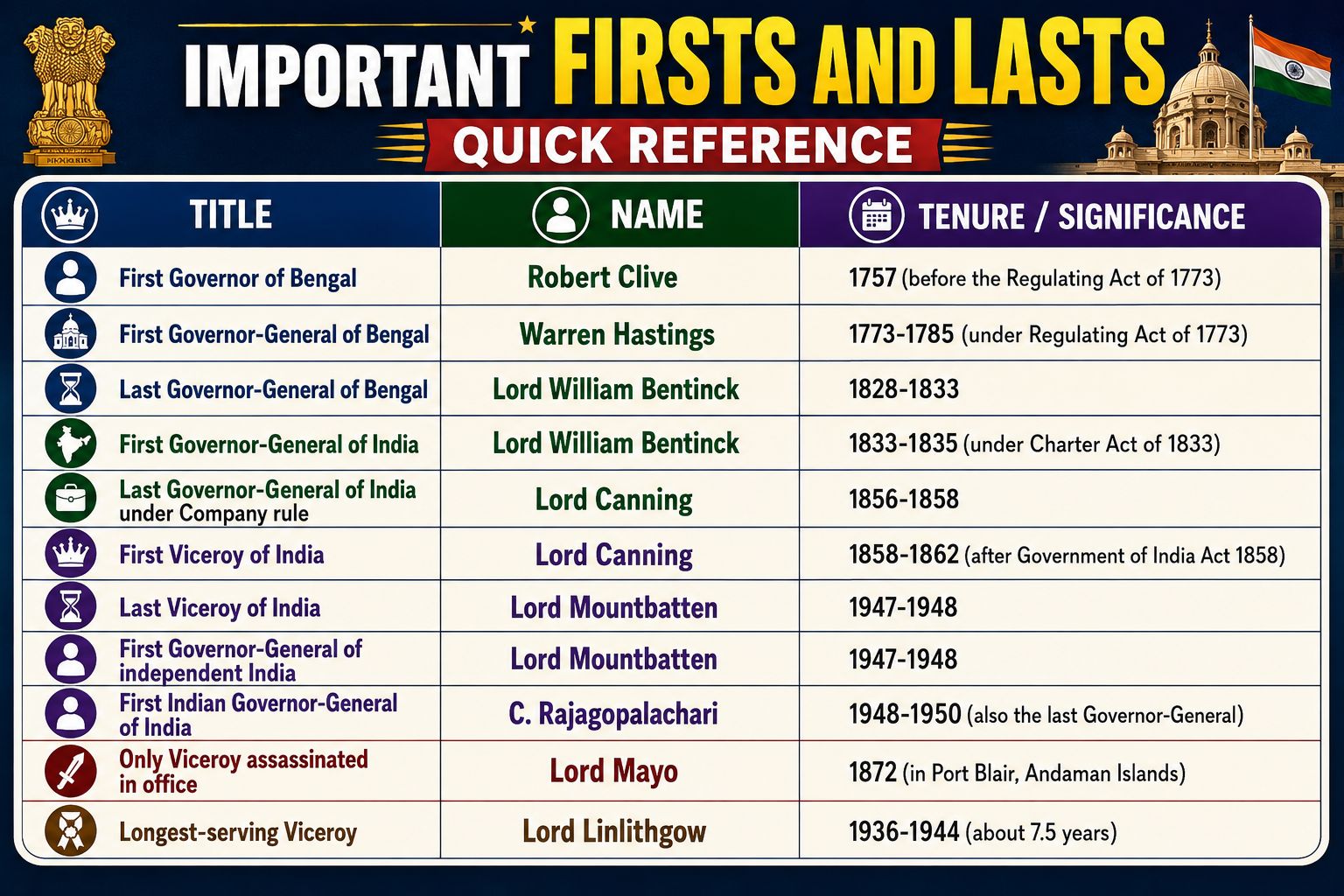
| Title | Name | Tenure / Significance |
|---|---|---|
| First Governor of Bengal | Robert Clive | 1757 (before the Regulating Act of 1773) |
| First Governor-General of Bengal | Warren Hastings | 1773-1785 (under Regulating Act of 1773) |
| Last Governor-General of Bengal | Lord William Bentinck | 1828-1833 |
| First Governor-General of India | Lord William Bentinck | 1833-1835 (under Charter Act of 1833) |
| Last Governor-General of India under Company rule | Lord Canning | 1856-1858 |
| First Viceroy of India | Lord Canning | 1858-1862 (after Government of India Act 1858) |
| Last Viceroy of India | Lord Mountbatten | 1947-1948 |
| First Governor-General of independent India | Lord Mountbatten | 1947-1948 |
| First Indian Governor-General of India | C. Rajagopalachari | 1948-1950 (also the last Governor-General) |
| Only Viceroy assassinated in office | Lord Mayo | 1872 (in Port Blair, Andaman Islands) |
| Longest-serving Viceroy | Lord Linlithgow | 1936-1944 (about 7.5 years) |
Memory Tricks and Mnemonics

Trick 1: Order of Governor-Generals of Bengal — "Warren Cornered Shore, Well Barlow Minto Hastings Amherst Bentinck"
Use this mnemonic to remember the order of Governor-Generals of Bengal (1773-1833):
"Warren Cornered Shore, Well Barlow Minto Hastings Amherst Bentinck"
- Warren → Warren Hastings
- Cornered → Lord Cornwallis
- Shore → Sir John Shore
- Well → Lord Wellesley
- Barlow → Sir George Barlow
- Minto → Lord Minto I
- Hastings → Lord Hastings (Marquess of Hastings)
- Amherst → Lord Amherst
- Bentinck → Lord William Bentinck
Trick 2: Reform-Linked Viceroys — "CELMNL" (Curzon Ended, Lytton Made News Laws)
To remember press-related Viceroys, use the contrast pair:
- Lord Lytton → Introduced the Vernacular Press Act (1878) — "Lytton was the Lion against the press."
- Lord Ripon → Repealed the Vernacular Press Act (1882) — "Ripon Repealed."
- Lord Charles Metcalfe → Liberator of the Indian Press (1835).
Memory hook: "Metcalfe liberated, Lytton chained, Ripon freed."
Trick 3: Three Acts, Three Phases — "Regulate, Charter, Crown"
The three legislative milestones that defined the office:
- Regulating Act of 1773 → Created the post of Governor-General of Bengal (Warren Hastings).
- Charter Act of 1833 → Created the post of Governor-General of India (William Bentinck).
- Government of India Act 1858 → Created the post of Viceroy of India (Lord Canning).
"73 begins, 33 expands, 58 transforms."
Trick 4: Social Reformer Viceroys — "Bentinck Banned Sati, Dalhousie Defended Widows"
- Lord William Bentinck → Abolished Sati (1829) and suppressed Thuggee.
- Lord Hardinge I → Abolition of female infanticide.
- Lord Dalhousie → Initiated the Widow Remarriage movement (Act passed under Canning, 1856).
- Lord Ellenborough → Abolished slavery (1843).
"Bentinck, Hardinge, Dalhousie, Ellenborough — Reformers Behind the Hand."
Trick 5: War-Linked Governor-Generals — "Hastings to Dalhousie Fought Everyone"
- Warren Hastings → First Anglo-Maratha War, Second Anglo-Mysore War, Rohilla War.
- Cornwallis → Third Anglo-Mysore War (Tipu signed Treaty of Seringapatam).
- Wellesley → Fourth Anglo-Mysore War (Tipu killed), Second Anglo-Maratha War.
- Hastings (Marquess) → Anglo-Nepal War, Third Anglo-Maratha War.
- Amherst → First Anglo-Burmese War.
- Auckland → First Anglo-Afghan War.
- Hardinge I → First Anglo-Sikh War.
- Dalhousie → Second Anglo-Sikh War; annexation of Punjab and Lower Burma.
Trick 6: Three "First/Last" Bridge Personalities — "Bentinck, Canning, Mountbatten"
- Lord William Bentinck → Last Governor-General of Bengal AND first Governor-General of India.
- Lord Canning → Last Governor-General of India (Company rule) AND first Viceroy of India (Crown rule).
- Lord Mountbatten → Last Viceroy of India AND first Governor-General of independent India.
"BCM — Bridge of Centuries and Movement: Bentinck, Canning, Mountbatten."
Trick 7: Movement-Linked Viceroys — "ICRWL" (Irwin, Chelmsford, Reading, Wavell, Linlithgow)
- Lord Chelmsford → Rowlatt Act, Jallianwala Bagh, Non-Cooperation Movement launch.
- Lord Reading → Chauri Chaura, withdrawal of Non-Cooperation, Swaraj Party.
- Lord Irwin → Simon Commission, Dandi March, Civil Disobedience, Gandhi-Irwin Pact.
- Lord Linlithgow → Quit India Movement, Cripps Mission, INA formation.
- Lord Wavell → Cabinet Mission, Direct Action Day, Simla Conference.
"From Rowlatt to Direct Action — ICRWL drove the freedom decade."
Trick 8: Lord Curzon — The "Partition Viceroy"
To remember Curzon's many actions, use the acronym "PUAT":
- P → Partition of Bengal (1905).
- U → Universities Act / Universities Commission (1904).
- A → Ancient Monuments Preservation Act (1904); restored Taj Mahal.
- T → Tibet Expedition (Younghusband Expedition, 1903-04).
Additional Notes
Frequently Confused Facts
- Robert Clive vs Warren Hastings: Clive was the first Governor of Bengal; Warren Hastings was the first Governor-General of Bengal.
- Lord Hastings vs Warren Hastings: Two different people — Warren Hastings (1773-1785) was the first Governor-General of Bengal, while Lord Hastings / Marquess of Hastings (1813-1823) fought the Anglo-Nepal War and Third Anglo-Maratha War.
- Lord Elgin I vs Lord Elgin II: Elgin I (1862-63) faced the Wahabi Movement and died in office; Elgin II (1894-99) faced the Chapekar Brothers' assassination of Rand.
- Lord Minto I vs Lord Minto II: Minto I (1807-13) signed the Treaty of Amritsar with Ranjit Singh; Minto II (1905-10) is associated with the Morley-Minto Reforms of 1909.
- Lord Hardinge I vs Lord Hardinge II: Hardinge I (1844-48) fought the First Anglo-Sikh War; Hardinge II (1910-16) shifted the capital from Calcutta to Delhi.
- Vernacular Press Act: Introduced by Lord Lytton (1878); repealed by Lord Ripon (1882).
- Partition of Bengal: Done by Lord Curzon (1905); annulled by Lord Hardinge II (1911).
- Doctrine of Lapse: Introduced by Lord Dalhousie; abolished by Lord Canning after the Revolt of 1857.
- Indian National Congress: Founded during the tenure of Lord Dufferin (1885) — not Lord Ripon, as is often confused.
- Charter Act of 1813 vs 1833: 1813 was under Lord Minto I (ended Company trade monopoly except for China and tea); 1833 was under Lord William Bentinck (made him Governor-General of India).
Repeating PYQ Patterns
Certain Governor-Generals and Viceroys are asked repeatedly in competitive exams. Warren Hastings, Lord Cornwallis, Lord William Bentinck, Lord Dalhousie, Lord Canning, Lord Lytton, Lord Ripon, Lord Curzon, Lord Minto II, Lord Chelmsford, Lord Irwin, Lord Linlithgow, and Lord Mountbatten appear most often in UPSC Prelims, SSC CGL, and RRB NTPC papers. Banking exams (IBPS PO, SBI Clerk) frequently focus on "first/last" personalities (first Governor-General, first Viceroy, first Indian Governor-General, last Viceroy). State PCS exams often link Viceroys to regional events — for example, Bengal-focused exams ask about Curzon and Canning, while Punjab PCS asks about Dalhousie and Hardinge I.
Quick Insight
The list of Governor-Generals and Viceroys is not just a static list of names — it is the backbone of Modern Indian History. Every major event from 1773 to 1947 — from the Regulating Act to the Indian Independence Act — is tied to the tenure of one of these officials. Understanding this list helps aspirants quickly connect any event in Modern History to its administrative context, which is invaluable for both Prelims (where direct questions are asked) and Mains (where contextual understanding adds depth). For further reading on related Modern History topics, you can refer to the Important Battles in Indian History guide and the Founders and Rulers of Indian Dynasties notes on Jobsme.in.
One-Liners for Quick Revision
- Robert Clive → First Governor of Bengal (pre-Regulating Act).
- Warren Hastings → 1772-1785 → First Governor-General of Bengal; Regulating Act of 1773; Pitt's India Act of 1784; Asiatic Society of Bengal; Rohilla War; First Anglo-Maratha War; Treaty of Salbai.
- Lord Cornwallis → 1786-1793 → Permanent Settlement of Bengal (1793); Cornwallis Code; "Father of Civil Services in India"; Third Anglo-Mysore War; Treaty of Seringapatam.
- Sir John Shore → 1793-1798 → Charter Act of 1793; non-intervention policy; Battle of Kharda.
- Lord Wellesley → 1798-1805 → Subsidiary Alliance (1798); Fourth Anglo-Mysore War (death of Tipu Sultan); Second Anglo-Maratha War; Fort William College.
- Sir George Barlow → 1805-1807 → Mutiny of Vellore (1806).
- Lord Minto I → 1807-1813 → Treaty of Amritsar with Ranjit Singh (1809); Charter Act of 1813.
- Lord Hastings (Marquess) → 1813-1823 → Anglo-Nepal War; Treaty of Sagauli (1816); Third Anglo-Maratha War; Ryotwari System.
- Lord Amherst → 1823-1828 → First Anglo-Burmese War; Treaty of Yandabo (1826).
- Lord William Bentinck → 1828-1835 → Abolished Sati (1829); suppressed Thuggee; English Education Act of 1835; Charter Act of 1833; first Governor-General of India.
- Lord Charles Metcalfe → 1835-1836 → Press Act of 1835; "Liberator of the Indian press."
- Lord Auckland → 1836-1842 → First Anglo-Afghan War.
- Lord Ellenborough → 1842-1844 → Annexation of Sindh (1843); abolition of slavery.
- Lord Hardinge I → 1844-1848 → First Anglo-Sikh War; Treaty of Lahore (1846); engineering college at Roorkee.
- Lord Dalhousie → 1848-1856 → Doctrine of Lapse; Second Anglo-Sikh War; annexation of Punjab and Lower Burma; first railway (Bombay-Thane, 1853); Wood's Despatch (1854); PWD; Widow Remarriage Act initiated.
- Lord Canning → 1856-1862 → Revolt of 1857; Government of India Act 1858; universities at Calcutta, Madras, Bombay (1857); Indian Councils Act 1861; first Viceroy of India.
- Lord Elgin I → 1862-1863 → Wahabi Movement; died in office.
- Lord John Lawrence → 1864-1869 → Bhutan War; High Courts at Calcutta, Bombay, Madras (1865); Orissa famine.
- Lord Mayo → 1869-1872 → Financial decentralisation; first Census (1872); Mayo College; only Viceroy assassinated in office.
- Lord Northbrook → 1872-1876 → Kuka Movement; visit of Prince of Wales (1875).
- Lord Lytton → 1876-1880 → Vernacular Press Act (1878); Arms Act (1878); Second Anglo-Afghan War; Queen Victoria proclaimed Empress (Kaiser-i-Hind) at Delhi Durbar 1877.
- Lord Ripon → 1880-1884 → Repealed Vernacular Press Act (1882); first Factory Act (1881); Local Self-Government Resolution (1882); Ilbert Bill controversy; Hunter Commission.
- Lord Dufferin → 1884-1888 → Third Anglo-Burmese War; founding of Indian National Congress (1885).
- Lord Lansdowne → 1888-1894 → Factory Act 1891; Indian Councils Act 1892; Durand Line (1893).
- Lord Elgin II → 1894-1899 → Chapekar Brothers' assassination of Rand (1897); famine and plague.
- Lord Curzon → 1899-1905 → Partition of Bengal (1905); Indian Universities Act (1904); Police Commission (1902); Ancient Monuments Preservation Act (1904).
- Lord Minto II → 1905-1910 → Swadeshi Movement; Surat Split (1907); Muslim League founded (1906); Morley-Minto Reforms (1909).
- Lord Hardinge II → 1910-1916 → Annulment of Partition of Bengal (1911); capital shifted from Calcutta to Delhi (1911); Delhi Durbar 1911; Hindu Mahasabha (1915).
- Lord Chelmsford → 1916-1921 → Lucknow Pact (1916); Champaran Satyagraha (1917); Government of India Act 1919; Rowlatt Act (1919); Jallianwala Bagh (1919); Non-Cooperation and Khilafat Movements.
- Lord Reading → 1921-1926 → Chauri Chaura (1922); withdrawal of Non-Cooperation; Swaraj Party (1923); Kakori train robbery (1925).
- Lord Irwin → 1926-1931 → Simon Commission (1928); Nehru Report (1928); Purna Swaraj Resolution (1929); Dandi March and Civil Disobedience (1930); First Round Table Conference (1930); Gandhi-Irwin Pact (1931).
- Lord Willingdon → 1931-1936 → Second and Third Round Table Conferences; Communal Award (1932); Poona Pact (1932); Government of India Act 1935.
- Lord Linlithgow → 1936-1944 → Longest-serving Viceroy; Congress ministries resigned (1939); Forward Bloc; Lahore Resolution (1940); August Offer (1940); INA (1941); Cripps Mission (1942); Quit India Movement (1942).
- Lord Wavell → 1944-1947 → CR Formula (1944); Wavell Plan and Simla Conference (1945); Cabinet Mission (1946); Direct Action Day (1946); Attlee's announcement of British withdrawal (1947).
- Lord Mountbatten → 1947-1948 → Last Viceroy and first Governor-General of independent India; June 3rd Plan; Radcliffe Commission; India's independence (15 August 1947); partition.
- C. Rajagopalachari → 1948-1950 → First and only Indian Governor-General; post abolished on 26 January 1950.
- First Governor of Bengal → Robert Clive.
- First Governor-General of Bengal → Warren Hastings.
- First Governor-General of India → Lord William Bentinck.
- First Viceroy of India → Lord Canning.
- Last Viceroy of India → Lord Mountbatten.
- First Governor-General of independent India → Lord Mountbatten.
- First Indian Governor-General of India → C. Rajagopalachari.
- Only Viceroy assassinated in office → Lord Mayo (1872, Port Blair).
- Longest-serving Viceroy → Lord Linlithgow (1936-1944).
- Act that created the post of Governor-General of Bengal → Regulating Act of 1773.
- Act that created the post of Governor-General of India → Charter Act of 1833.
- Act that created the post of Viceroy of India → Government of India Act 1858.
- Viceroy associated with Partition of Bengal → Lord Curzon (1905).
- Viceroy who annulled the Partition of Bengal → Lord Hardinge II (1911).
- Viceroy who shifted the capital from Calcutta to Delhi → Lord Hardinge II (1911).
- Viceroy during the Revolt of 1857 → Lord Canning.
- Viceroy during Jallianwala Bagh → Lord Chelmsford (1919).
- Viceroy during Quit India Movement → Lord Linlithgow (1942).
- Viceroy during the founding of Indian National Congress → Lord Dufferin (1885).
- Viceroy during the founding of the Muslim League → Lord Minto II (1906).
- Viceroy associated with the Dandi March → Lord Irwin (1930).
- Viceroy associated with the Poona Pact → Lord Willingdon (1932).
- Father of Local Self-Government in India → Lord Ripon.
- Father of Civil Services in India → Lord Cornwallis.
- Liberator of the Indian Press → Lord Charles Metcalfe.
For more Static GK topics like rivers, biosphere reserves, and national parks of India, explore the Static GK section on Jobsme.in. You can also test your knowledge with the Static GK Quiz and check out the latest exam notifications at Latest Government Job Notifications.
Free quiz • No signup required
Put this topic into practice with Indian Cultural Institutions – Static GK MCQ Quiz. It is the quickest way to reinforce what you just learned.
Frequently Asked Questions
Who was the first Governor-General of Bengal?
Who was the first Governor-General of India?
Who was the first Viceroy of India?
Who was the last Viceroy of India?
Who was the first and only Indian Governor-General of India?
Which Viceroy was assassinated while in office?
Which Viceroy ordered the Partition of Bengal and which one annulled it?
Who was the Viceroy during the Jallianwala Bagh massacre?
Who was the longest-serving Viceroy of India?
Which three Acts created the offices of Governor-General of Bengal, Governor-General of India, and Viceroy of India?

About the author