Five Year Plans of India – Static GK & General Awareness for Competitive Exams with Memory Tricks
This article presents a complete list of all Twelve Five Year Plans of India along with their durations, themes, models, target and achieved growth rates, key achievements, and exam-relevant facts, making it an essential resource for UPSC, SSC, IBPS, RRB, and other government exam aspirants. It covers the Planning Commission, NITI Aayog, the Harrod-Domar and Mahalanobis models, Plan Holidays, LPG reforms, and signature programmes like the Green Revolution, MNREGA, and Garibi Hatao, along with memory tricks and one-liners for quick revision. All facts are arranged in exam-ready format to help students score better in General Awareness sections.
Jump to section
Introduction
The Five Year Plans of India were centralised economic development programmes that guided the country's economic, social, and industrial growth from 1951 to 2017. Inspired by the Soviet model of planned development, these plans were designed to transform India from a poor, agrarian, colonial economy into a modern, industrialised, and self-reliant nation. India implemented a total of twelve Five Year Plans, each addressing the unique economic challenges and priorities of its time, ranging from agriculture and irrigation in the first plan to inclusive and sustainable growth in the twelfth.
Questions on Five Year Plans appear regularly in UPSC Prelims, SSC CGL, IBPS PO, RRB NTPC, SBI Clerk, State PCS, and various Insurance and Defence exams. Questions typically ask about the model on which a particular plan was based, the theme of a plan, target versus achieved growth rates, plan holidays, and the programmes launched during specific plans. This article brings together all the key facts in a structured, exam-ready format. To explore other related Static GK topics, you can refer to the Five Year Plans of India - Static GK guide on Jobsme.in.
Five Year Plans are also closely linked to current affairs themes such as the transition from the Planning Commission to NITI Aayog, the 15-Year Vision Document, the 7-Year Strategy Document, and the 3-Year Action Agenda — making this topic doubly important for aspirants targeting UPSC Mains and Essay papers as well as general economic awareness sections in banking and insurance exams.
Core Concepts: Understanding Five Year Plans in India
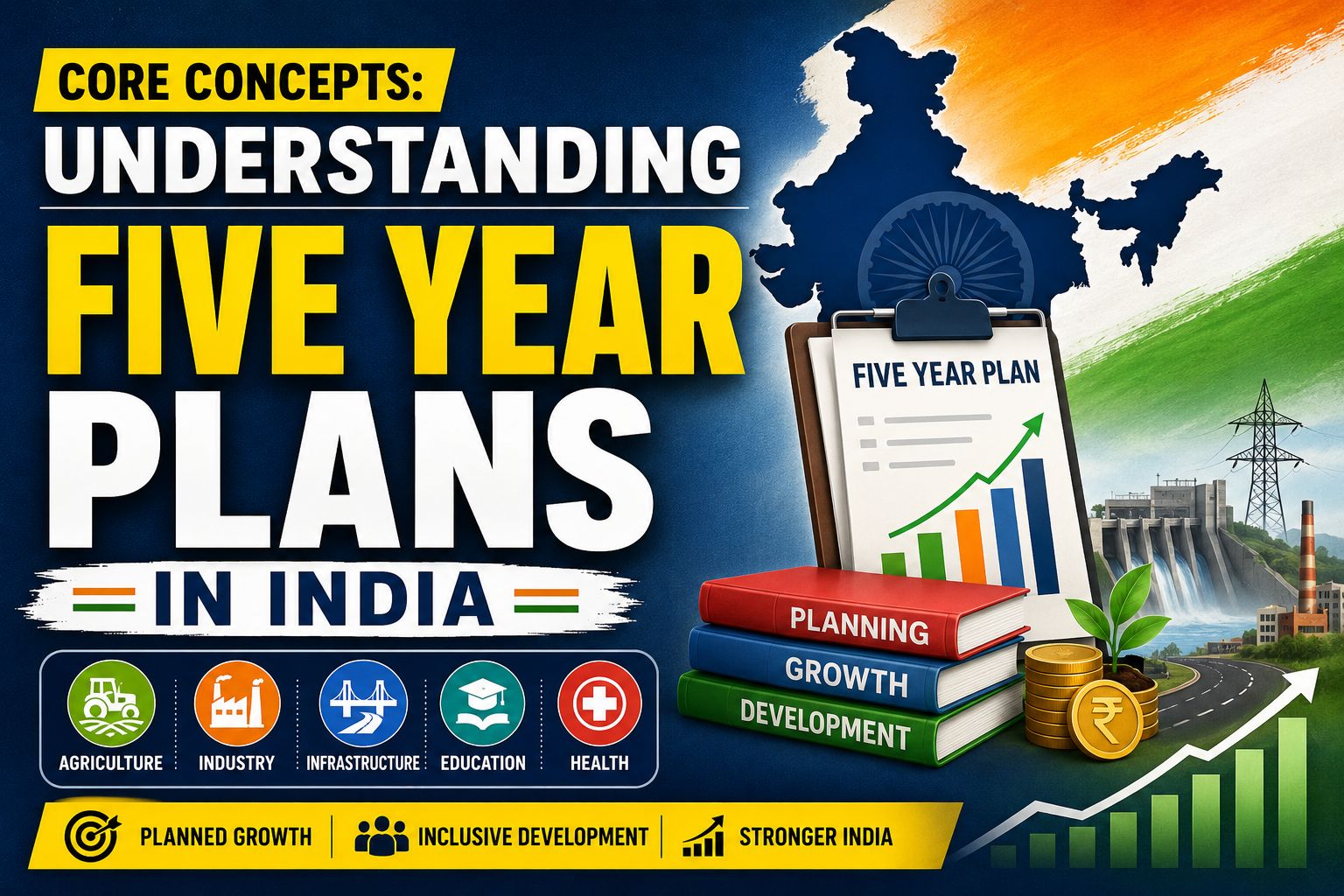
Five Year Plans were comprehensive economic blueprints that allocated national resources over a five-year period to achieve specific goals across sectors such as agriculture, industry, infrastructure, health, and education.
Key Features of Five Year Plans
- Centralised Planning: Plans were drafted, monitored, and reviewed by the Planning Commission of India until 2015.
- Sectoral Allocation: Funds were divided across agriculture, industry, infrastructure, education, health, and social welfare.
- Plan vs Non-Plan Budget: The central and state government budgets were split into a non-plan budget (routine yearly expenditure) and a plan budget (five-year priority spending).
- Target and Achieved Growth Rates: Each plan set a target GDP growth rate, which was later compared to the actual achieved rate.
- Hybrid Economy: Plans covered both the public sector and influenced the private sector under a mixed economic model.
Origin and Inspiration
- M. Visvesvaraya pioneered the idea of economic planning with his 1934 essay "Planned Economy for India", proposing a ten-year, Rs. 1,000 crore ambitious plan.
- The Bombay Plan was drafted in 1944 by leading Indian industrialists as a joint proposal for a planned economy.
- Joseph Stalin was the first leader to implement a Five-Year Plan in the Soviet Union in 1928, which inspired India's planning model.
- The Planning Commission was set up on 15 March 1950, with the Prime Minister as Chairman.
- In January 2015, the Planning Commission was replaced by NITI Aayog (National Institution for Transforming India).
Objectives of Five Year Plans
- Economic Growth: Achieving rapid and sustained increase in GDP.
- Self-Reliance: Reducing imports and boosting domestic production.
- Social Justice: Reducing inequalities in income and opportunity.
- Poverty Alleviation: Tackling unemployment and underdevelopment.
- Balanced Regional Development: Ensuring equitable growth across all states.
- Modernisation: Promoting technology, industry, and human capital development.
Complete List of Five Year Plans of India
The following table presents all twelve Five Year Plans of India along with their duration, model, theme, target and achieved growth rates, and key features.
| Plan | Duration | Prime Minister / Model | Target / Achieved Growth | Key Features / Exam Notes |
|---|---|---|---|---|
| First Five Year Plan | 1951-1956 | Jawaharlal Nehru; Harrod-Domar Model | Target: 2.1% / Achieved: 3.6% | Focused on agriculture and irrigation; presented by Nehru in Parliament; K.N. Raj advised "hasten slowly"; major dam projects like Bhakra Nangal, Hirakud, Damodar Valley; first five IITs established; University Grants Commission (UGC) set up; net domestic product rose by 15%. |
| Second Five Year Plan | 1956-1961 | Jawaharlal Nehru; Mahalanobis Model (P.C. Mahalanobis) | Target: 4.5% / Achieved: 4.27% | Emphasised rapid industrialisation and public sector; foundation of India's industrial base; steel plants at Bhilai, Durgapur, Rourkela; tariffs imposed on imports to protect domestic industries; quick structural transformation of the economy. |
| Third Five Year Plan | 1961-1966 | Jawaharlal Nehru / Lal Bahadur Shastri | Target: 5.6% / Achieved: 2.4% | Focused on agriculture, wheat production, and self-reliance; states given responsibility for secondary and higher education; Panchayat elections introduced for grassroots democracy; severely disrupted by Sino-Indian War (1962), Indo-Pak War (1965), and droughts; lowest achieved growth in planning history. |
| Plan Holiday (Annual Plans) | 1966-1969 | Indira Gandhi | Three Annual Plans | Caused by the failure of the Third Plan, wars, and droughts; three Annual Plans (1966-67, 1967-68, 1968-69) replaced the Fourth Plan temporarily; the Green Revolution was initiated during this period; focus on economic stabilisation. |
| Fourth Five Year Plan | 1969-1974 | Indira Gandhi; Gadgil Formula | Target: 5.6% / Achieved: 3.3% | Theme: "Growth with Stability and Progress towards Self-Reliance"; Gadgil Formula ensured fair distribution of central funds to states; 14 major Indian banks nationalised in 1969; Drought Prone Area Programme launched; Green Revolution boosted agriculture. |
| Fifth Five Year Plan | 1974-1979 | Indira Gandhi / Morarji Desai | Target: 4.4% / Achieved: 4.8% | Theme: Garibi Hatao (Remove Poverty); emphasised employment and poverty alleviation; Electricity Supply Act amended in 1975; Indian National Highway System introduced; Minimum Needs Programme (MNP) prepared by D.P. Dhar; plan ended one year early after Morarji Desai's Janata Party government rejected it in 1978. |
| Rolling Plan | 1978-1980 | Morarji Desai (Janata Party) | Annually evaluated | Period of political instability; Janata government rejected the Fifth Plan and introduced a new Sixth Plan, which was later rejected by Indira Gandhi in 1980; concept of Rolling Plan: targets and allocations evaluated and updated each year. |
| Sixth Five Year Plan | 1980-1985 | Indira Gandhi | Target: 5.2% / Achieved: 5.7% | Marked the beginning of economic liberalisation; eliminated price controls and closed ration shops; end of Nehruvian Socialism era; family planning introduced to control population; NABARD established on recommendation of Shivaraman Committee; India achieved its target growth rate for the first time since independence. |
| Seventh Five Year Plan | 1985-1990 | Rajiv Gandhi | Target: 5.0% / Achieved: 6.01% | Theme: "Food, Work, and Productivity"; emphasised industrial productivity via technology; anti-poverty programmes; modernisation of agriculture; aim of self-sustained growth by 2000; provided the base for India's later economic reforms. |
| Annual Plans | 1990-1992 | V.P. Singh / Chandra Shekhar / P.V. Narasimha Rao | Two Annual Plans | Economic and political instability; foreign exchange reserves crisis of 1991; Liberalisation, Privatisation, and Globalisation (LPG) reforms introduced under PM P.V. Narasimha Rao and Finance Minister Manmohan Singh; the Eighth Plan was delayed by two years. |
| Eighth Five Year Plan | 1992-1997 | P.V. Narasimha Rao | Target: 5.6% / Achieved: 6.8% | Promoted modernisation of industries and economic liberalisation; India became a member of the World Trade Organisation (WTO) on 1 January 1995; objectives included population control, poverty reduction, employment generation, infrastructure development, human resource development; decentralisation via Panchayats and Nagar Palikas. |
| Ninth Five Year Plan | 1997-2002 | Atal Bihari Vajpayee | Target: 6.5% (or 7.1%) / Achieved: 5.4% | Marked 50 years of independence; theme: "Growth with Social Justice and Equity"; focused on poverty elimination, primary education, empowerment of socially disadvantaged classes; joint efforts of public and private sectors; Asian financial crisis affected growth. |
| Tenth Five Year Plan | 2002-2007 | Atal Bihari Vajpayee / Manmohan Singh | Target: 8.0% / Achieved: 7.6% | Theme: "Inclusive Growth and Good Governance"; aimed at reducing poverty by half; creation of 80 million jobs; regional strategy replaced sectoral approach; aimed to reduce gender gaps in education and wages by 2007; monitorable development targets. |
| Eleventh Five Year Plan | 2007-2012 | Manmohan Singh; prepared by C. Rangarajan | Target: 9.0% / Achieved: 8.0% | Theme: "Towards Faster and More Inclusive Growth"; focused on environmental sustainability and reduced gender inequality; Right to Education Act introduced in 2009, effective 2010; MNREGA expanded; highest achieved growth rate among all plans; aim of clean drinking water for all by 2009. |
| Twelfth Five Year Plan | 2012-2017 | Manmohan Singh / Narendra Modi | Target: 8.0% (revised from 9.0%) / Achieved: ~7.0% | Theme: "Faster, More Inclusive, and Sustainable Growth"; final Five Year Plan of India; aimed at 50 million new non-farm jobs; reducing malnutrition in children aged 0-3 years; enhancing green cover by 1 million hectares annually; electricity supply in all villages; bridging gender and social gaps in education. |
Models Used in Five Year Plans
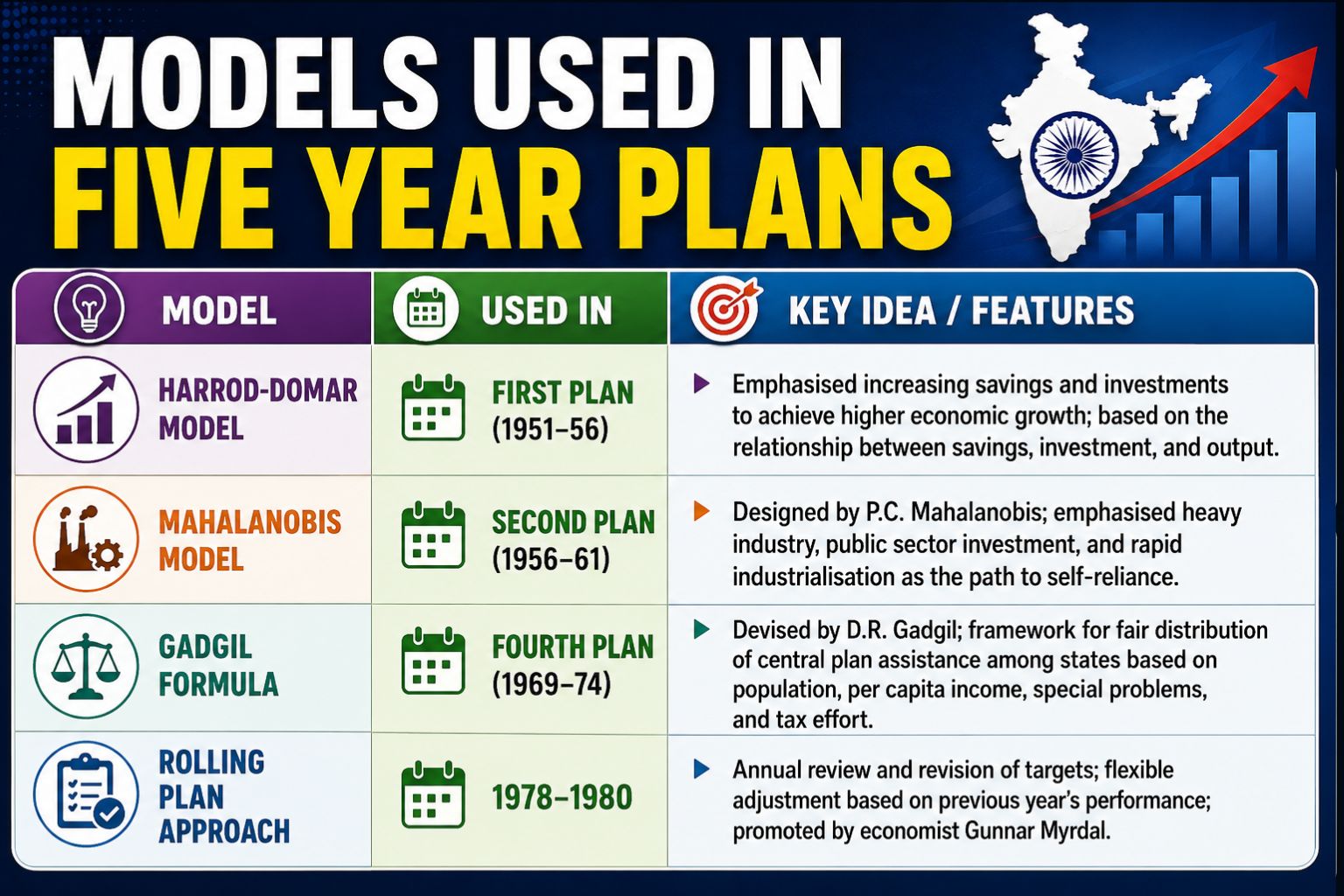
| Model | Used In | Key Idea / Features |
|---|---|---|
| Harrod-Domar Model | First Plan (1951-56) | Emphasised increasing savings and investments to achieve higher economic growth; based on the relationship between savings, investment, and output. |
| Mahalanobis Model | Second Plan (1956-61) | Designed by P.C. Mahalanobis; emphasised heavy industry, public sector investment, and rapid industrialisation as the path to self-reliance. |
| Gadgil Formula | Fourth Plan (1969-74) | Devised by D.R. Gadgil; framework for fair distribution of central plan assistance among states based on population, per capita income, special problems, and tax effort. |
| Rolling Plan Approach | 1978-1980 | Annual review and revision of targets; flexible adjustment based on previous year's performance; promoted by economist Gunnar Myrdal. |
Plans, Themes, and Signature Programmes
| Plan | Theme / Signature Slogan | Key Programme / Achievement |
|---|---|---|
| First Plan | Agriculture and Irrigation | Bhakra Nangal, Hirakud, Damodar Valley dams; IITs; UGC. |
| Second Plan | Rapid Industrialisation | Bhilai, Durgapur, Rourkela steel plants. |
| Third Plan | Self-Reliance and Democratic Socialism | Panchayat elections; wheat improvement; disrupted by wars. |
| Plan Holiday | Economic Stabilisation | Initiation of the Green Revolution. |
| Fourth Plan | Growth with Stability | Gadgil Formula; bank nationalisation (1969); DPAP. |
| Fifth Plan | Garibi Hatao (Remove Poverty) | Minimum Needs Programme; National Highway System. |
| Sixth Plan | Beginning of Liberalisation | NABARD (1982); end of price controls; family planning. |
| Seventh Plan | Food, Work, Productivity | Technology modernisation; anti-poverty programmes. |
| Annual Plans (1990-92) | LPG Reforms | Liberalisation, Privatisation, Globalisation under P.V. Narasimha Rao. |
| Eighth Plan | Liberalisation and Human Development | India joins WTO (1 January 1995); decentralisation. |
| Ninth Plan | Growth with Social Justice | Public-private partnership; poverty elimination focus. |
| Tenth Plan | Inclusive Growth and Good Governance | Monitorable targets; aim to halve poverty. |
| Eleventh Plan | Faster and More Inclusive Growth | Right to Education (2009); MNREGA; highest achieved growth. |
| Twelfth Plan | Faster, Inclusive, Sustainable Growth | Last Five Year Plan; non-farm jobs; child nutrition; green cover. |
Memory Tricks and Mnemonics for Five Year Plans
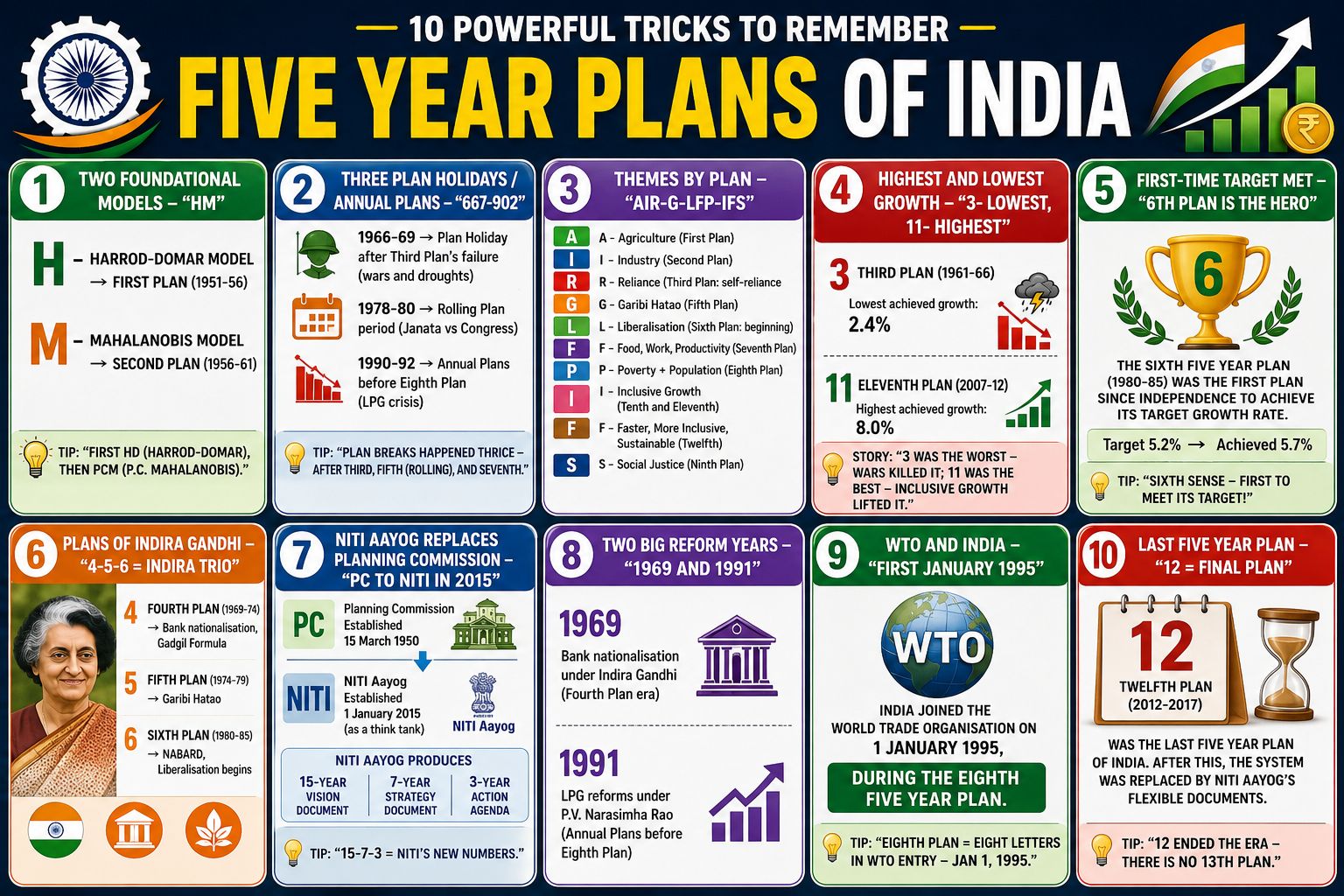
Trick 1: Two Foundational Models - "HM"
- H - Harrod-Domar Model → First Plan (1951-56).
- M - Mahalanobis Model → Second Plan (1956-61).
Tip: "First HD (Harrod-Domar), then PCM (P.C. Mahalanobis)."
Trick 2: Three Plan Holidays / Annual Plans - "667-902"
- 1966-69 → Plan Holiday after Third Plan's failure (wars and droughts).
- 1978-80 → Rolling Plan period (Janata vs Congress).
- 1990-92 → Annual Plans before Eighth Plan (LPG crisis).
Tip: "Plan breaks happened thrice — after Third, Fifth (rolling), and Seventh."
Trick 3: Themes by Plan - "AIR-G-LFP-IFS"
- A - Agriculture (First Plan).
- I - Industry (Second Plan).
- R - Reliance (Third Plan: self-reliance).
- G - Garibi Hatao (Fifth Plan).
- L - Liberalisation (Sixth Plan: beginning).
- F - Food, Work, Productivity (Seventh Plan).
- P - Poverty + Population (Eighth Plan).
- I - Inclusive Growth (Tenth and Eleventh).
- F - Faster, More Inclusive, Sustainable (Twelfth).
- S - Social Justice (Ninth Plan).
Trick 4: Highest and Lowest Growth - "3-Lowest, 11-Highest"
- Third Plan (1961-66) → Lowest achieved growth: 2.4% (wars and droughts).
- Eleventh Plan (2007-12) → Highest achieved growth: 8.0% (inclusive growth era).
Story: "3 was the worst — wars killed it; 11 was the best — inclusive growth lifted it."
Trick 5: First-Time Target Met - "6th Plan is the Hero"
The Sixth Five Year Plan (1980-85) was the first plan since independence to achieve its target growth rate (Target 5.2%, Achieved 5.7%). Tip: "Sixth Sense — first to meet its target!"
Trick 6: Plans of Indira Gandhi - "4-5-6 = Indira Trio"
- Fourth Plan (1969-74) → Indira Gandhi → Bank nationalisation, Gadgil Formula.
- Fifth Plan (1974-79) → Indira Gandhi → Garibi Hatao.
- Sixth Plan (1980-85) → Indira Gandhi → NABARD, Liberalisation begins.
Trick 7: NITI Aayog Replaces Planning Commission - "PC to NITI in 2015"
- Planning Commission → Established 15 March 1950.
- NITI Aayog → Established 1 January 2015 as a think tank.
- NITI Aayog produces a 15-Year Vision Document, 7-Year Strategy Document, 3-Year Action Agenda.
Tip: "15-7-3 = NITI's New Numbers."
Trick 8: Two Big Reform Years - "1969 and 1991"
- 1969 → Bank nationalisation under Indira Gandhi (Fourth Plan era).
- 1991 → LPG reforms under P.V. Narasimha Rao (Annual Plans before Eighth Plan).
Trick 9: WTO and India - "First January 1995"
India joined the World Trade Organisation on 1 January 1995, during the Eighth Five Year Plan. Tip: "Eighth Plan = Eight letters in WTO entry — Jan 1, 1995."
Trick 10: Last Five Year Plan - "12 = Final Plan"
The Twelfth Plan (2012-2017) was the last Five Year Plan of India. After this, the system was replaced by NITI Aayog's flexible documents. Tip: "12 ended the era — there is no 13th Plan."
Additional Notes
Frequently Confused Facts
- Harrod-Domar vs Mahalanobis Model: Harrod-Domar was used in the First Plan (focus on savings and investment for growth); Mahalanobis was used in the Second Plan (focus on heavy industry).
- Lowest vs Highest Growth Plan: Lowest achieved was the Third Plan (2.4%) due to wars and droughts; highest achieved was the Eleventh Plan (8.0%).
- Plan Holiday vs Rolling Plan: Plan Holiday (1966-69) was three Annual Plans after the Third Plan failure; Rolling Plan (1978-80) involved annual revisions of targets.
- First Plan to Meet Target: The Sixth Plan was the first since independence to achieve its target growth rate.
- Planning Commission vs NITI Aayog: Planning Commission was established on 15 March 1950 and dissolved in 2014; NITI Aayog was set up on 1 January 2015 as a think tank.
- Garibi Hatao Plan: Theme of the Fifth Plan under Indira Gandhi; the Janata Party government later rejected this plan in 1978.
- WTO Membership: India joined WTO on 1 January 1995 during the Eighth Plan, not the Ninth Plan.
- MNREGA Plan: Mahatma Gandhi National Rural Employment Guarantee Act was a flagship programme of the Eleventh Plan.
- Right to Education: RTE Act was passed in 2009 and came into effect in 2010, during the Eleventh Plan.
- NABARD Plan: Established in 1982 during the Sixth Plan on the recommendation of the Shivaraman Committee.
- Eleventh Plan Author: C. Rangarajan prepared the Eleventh Five Year Plan.
- Twelfth Plan Target: Originally set at 9% but later revised to 8% by the National Development Council in 2012.
- Bombay Plan vs First Plan: The Bombay Plan (1944) was a pre-independence industrialist proposal; the First Five Year Plan (1951) was the actual launched plan after independence.
Repeating PYQ Patterns
- UPSC Prelims: Frequently asks about models (Harrod-Domar, Mahalanobis), themes of plans, Planning Commission vs NITI Aayog, Gadgil Formula, and the lowest/highest growth plans.
- SSC CGL and CHSL: Match-the-column questions linking plans to their themes, models, and Prime Ministers; Fifth Plan's Garibi Hatao is most common.
- IBPS PO and Clerk: One-liner questions on bank nationalisation (1969), NABARD (1982), LPG reforms (1991), WTO membership (1995), and the last Five Year Plan.
- RRB NTPC and Group D: Direct questions on duration of specific plans, target growth rates, and programmes launched.
- State PCS: State-specific impacts of plans, Panchayat elections under Third Plan, and state allocation under the Gadgil Formula.
- Insurance and Banking Awareness: Focus on Sixth Plan's NABARD establishment, Eighth Plan's WTO entry, and reforms during the Annual Plans (1990-92).
Quick Insight
Five Year Plans are central to current affairs themes such as the transition from rigid central planning to flexible, federal, market-oriented governance under NITI Aayog, the focus on Sustainable Development Goals (SDGs), and the importance of cooperative federalism. Aspirants should track the 15-Year Vision Document, 7-Year Strategy Document, and 3-Year Action Agenda of NITI Aayog, as well as flagship schemes like Aspirational Districts Programme and Atal Innovation Mission. For the latest updates, follow the daily current affairs section on Jobsme.in.
This topic also pairs well with related Static GK areas such as Banking Awareness and Dams in India, since dam projects like Bhakra Nangal and Hirakud were major outcomes of the First Plan, while bank nationalisation in 1969 shaped India's modern banking system.
One-Liners for Quick Revision
- First Five Year Plan (1951-56) → Harrod-Domar Model; Jawaharlal Nehru → Agriculture and irrigation; Bhakra Nangal, Hirakud, Damodar Valley dams; IITs and UGC established.
- Second Five Year Plan (1956-61) → Mahalanobis Model; P.C. Mahalanobis → Rapid industrialisation; steel plants at Bhilai, Durgapur, Rourkela.
- Third Five Year Plan (1961-66) → Self-reliance and democratic socialism → Lowest achieved growth (2.4%); disrupted by 1962 Sino-Indian War, 1965 Indo-Pak War, droughts; Panchayat elections introduced.
- Plan Holiday (1966-69) → Three Annual Plans → Green Revolution initiated; economic stabilisation; under Indira Gandhi.
- Fourth Five Year Plan (1969-74) → Indira Gandhi; Gadgil Formula → "Growth with Stability"; bank nationalisation (1969); Drought Prone Area Programme launched.
- Fifth Five Year Plan (1974-79) → Indira Gandhi → Garibi Hatao theme; Minimum Needs Programme by D.P. Dhar; rejected by Janata government in 1978.
- Rolling Plan (1978-80) → Janata Party government → Annual evaluation and target revision; introduced by Gunnar Myrdal's concept.
- Sixth Five Year Plan (1980-85) → Indira Gandhi → Beginning of economic liberalisation; price controls eliminated; NABARD established (1982); first plan since independence to meet its target.
- Seventh Five Year Plan (1985-90) → Rajiv Gandhi → Theme: "Food, Work, Productivity"; achieved 6.01% growth; industrial productivity via technology.
- Annual Plans (1990-92) → P.V. Narasimha Rao → Foreign exchange crisis; LPG reforms (Liberalisation, Privatisation, Globalisation).
- Eighth Five Year Plan (1992-97) → P.V. Narasimha Rao → Modernisation of industries; India joined WTO on 1 January 1995; decentralisation through Panchayats and Nagar Palikas.
- Ninth Five Year Plan (1997-2002) → Atal Bihari Vajpayee → "Growth with Social Justice and Equity"; 50 years of independence; affected by Asian financial crisis.
- Tenth Five Year Plan (2002-07) → Vajpayee / Manmohan Singh → "Inclusive Growth and Good Governance"; aim to halve poverty; create 80 million jobs.
- Eleventh Five Year Plan (2007-12) → Manmohan Singh; prepared by C. Rangarajan → "Towards Faster and More Inclusive Growth"; Right to Education Act (2009/2010); MNREGA; highest achieved growth (8%).
- Twelfth Five Year Plan (2012-17) → Manmohan Singh / Narendra Modi → "Faster, More Inclusive, and Sustainable Growth"; last Five Year Plan; 50 million non-farm jobs.
- Planning Commission → Established 15 March 1950 → Chaired by the Prime Minister; replaced in 2015.
- NITI Aayog → Established 1 January 2015 → Replaces Planning Commission; produces 15-Year Vision, 7-Year Strategy, 3-Year Action documents.
- M. Visvesvaraya → Pioneer of Indian economic planning → 1934 essay "Planned Economy for India".
- Bombay Plan → 1944 → Joint proposal of Indian industrialists for a planned economy.
- Joseph Stalin → First leader to implement Five Year Plan → Soviet Union, 1928.
- Harrod-Domar Model → First Plan → Emphasised savings and investment for growth.
- Mahalanobis Model → Second Plan → Emphasised heavy industry and public sector.
- Gadgil Formula → Fourth Plan → Fair allocation of central plan funds to states; devised by D.R. Gadgil.
- K.N. Raj → First Plan advisor → Suggested India should "hasten slowly" for two decades.
- D.P. Dhar → Prepared the Minimum Needs Programme (MNP) → Fifth Plan.
- C. Rangarajan → Prepared the Eleventh Five Year Plan → Inclusive growth focus.
- Shivaraman Committee → Recommended NABARD establishment → Sixth Plan, 1982.
- Bank Nationalisation → 1969 → 14 major Indian banks nationalised during Fourth Plan; Indira Gandhi.
- LPG Reforms → 1991 → Liberalisation, Privatisation, Globalisation; P.V. Narasimha Rao and Manmohan Singh.
- WTO Membership → 1 January 1995 → During Eighth Plan; replaced GATT.
- NABARD → 1982 → National Bank for Agriculture and Rural Development; Sixth Plan.
- MNREGA → 2005-06 onwards → Flagship of Eleventh Plan; rural employment guarantee.
- Right to Education (RTE) Act → 2009 (effective 2010) → Free and compulsory education for ages 6-14; Eleventh Plan.
- Indian National Highway System → Introduced during Fifth Plan → Indira Gandhi era.
- Bhakra Nangal Dam → First Plan → Major irrigation project.
- Hirakud Dam → First Plan → Built on Mahanadi River.
- Damodar Valley Project → First Plan → Major multipurpose river valley project.
- IITs (first five) → Established by 1956 → Outcome of First Plan.
- UGC (University Grants Commission) → Established 1956 → Higher education regulation; First Plan.
- Steel plants of Second Plan → Bhilai (Soviet aid), Durgapur (British aid), Rourkela (German aid).
- Highest target growth rate → Eleventh Plan (9%).
- Highest achieved growth rate → Eleventh Plan (8%).
- Lowest achieved growth rate → Third Plan (2.4%).
- Plan with the Mahalanobis Model → Second Plan (1956-61).
- Plan with the Harrod-Domar Model → First Plan (1951-56).
- Plan with Garibi Hatao theme → Fifth Plan (1974-79).
- First Plan to meet its target → Sixth Plan (1980-85).
- Last Five Year Plan → Twelfth Plan (2012-17).
- Plan when India joined WTO → Eighth Plan (1992-97).
- Plan when MNREGA expanded → Eleventh Plan (2007-12).
- NITI Aayog founding date → 1 January 2015.
- NITI Aayog full form → National Institution for Transforming India.
- Planning Commission first chairman → Jawaharlal Nehru (as PM).
- Drought Prone Area Programme (DPAP) → Fourth Plan.
- Family Planning Programme → Sixth Plan focus.
- End of Nehruvian Socialism → Sixth Plan (1980-85).
- India's foreign exchange crisis → 1991 (Annual Plans period).
- Decentralisation through Panchayats → Eighth Plan emphasis.
- Clean drinking water aim by 2009 → Eleventh Plan.
- Green cover enhancement by 1 million hectares annually → Twelfth Plan.
- Electricity supply in all villages → Twelfth Plan goal.
- 15-Year Vision Document → NITI Aayog framework.
- 7-Year Strategy Document → NITI Aayog framework.
- 3-Year Action Agenda → NITI Aayog framework.
- Pre-independence economic planning pioneer → M. Visvesvaraya (1934).
- Bombay Plan year → 1944.
- First country to implement Five Year Plans → Soviet Union, 1928, under Joseph Stalin.
- Poverty reduction during planning era → From over 60% to about 22% by 2012.
For more Static GK topics like Indian dynasties, banking awareness, and economic history, explore the Static GK section on Jobsme.in. You can also test your knowledge with the Static GK Quiz and check out the latest exam notifications at Latest Government Job Notifications.
Free quiz • No signup required
Put this topic into practice with Indian Cultural Institutions – Static GK MCQ Quiz. It is the quickest way to reinforce what you just learned.
Frequently Asked Questions
How many Five Year Plans were implemented in India?
Which model was used in the First Five Year Plan of India?
Who designed the Second Five Year Plan?
Which Five Year Plan had the lowest achieved growth rate?
What was the theme of the Fifth Five Year Plan?
When did India join the World Trade Organisation?
When was NITI Aayog established and what did it replace?
Which Five Year Plan was the first to achieve its target growth rate?
Which was the last Five Year Plan of India?
What was the Gadgil Formula and when was it introduced?

About the author