Important Lakes in India – Static GK & General Awareness for Competitive Exams with Memory Tricks
This article covers a complete state-wise list of important lakes in India along with their types, key features, and exam-relevant facts, making it an essential resource for UPSC, SSC, IBPS, RRB, and other government exam aspirants. It includes the largest, longest, highest, and most famous lakes in India, Ramsar sites, artificial reservoirs, memory tricks, and one-liners for quick revision. All facts are arranged in exam-ready format to help students score better in General Awareness sections.
Jump to section
Introduction
India is home to over 100,000 lakes, ranging from high-altitude glacial pools in the Himalayas to brackish lagoons along the coast and massive man-made reservoirs in the plains. Lakes are vital geographical features that support biodiversity, provide freshwater, influence local climates, and sustain millions of livelihoods. From the tectonic origin of Wular Lake in Jammu and Kashmir to the meteorite-impact crater of Lonar Lake in Maharashtra, every important lake in India carries unique ecological, economic, and cultural significance.
Questions on important lakes in India appear regularly in UPSC Prelims, SSC CGL, IBPS PO, RRB NTPC, SBI Clerk, State PCS, and various Insurance and Defence exams. Questions typically ask about which state a lake is located in, which lake is the largest or longest, which is a Ramsar site, or which is famous for a particular feature like floating phumdis or color-changing waters. This article brings together all the key facts in a structured, exam-ready format. To explore more geography-related Static GK topics, visit the Rivers of India - Static GK guide on Jobsme.in.
Understanding India's lakes also connects directly to current affairs topics such as wetland conservation, Ramsar site additions, urban lake pollution, and strategic border lakes like Pangong Tso — making this topic doubly important for aspirants targeting UPSC Mains and Essay papers as well.
Core Concepts: What is a Lake and Why Does It Matter?
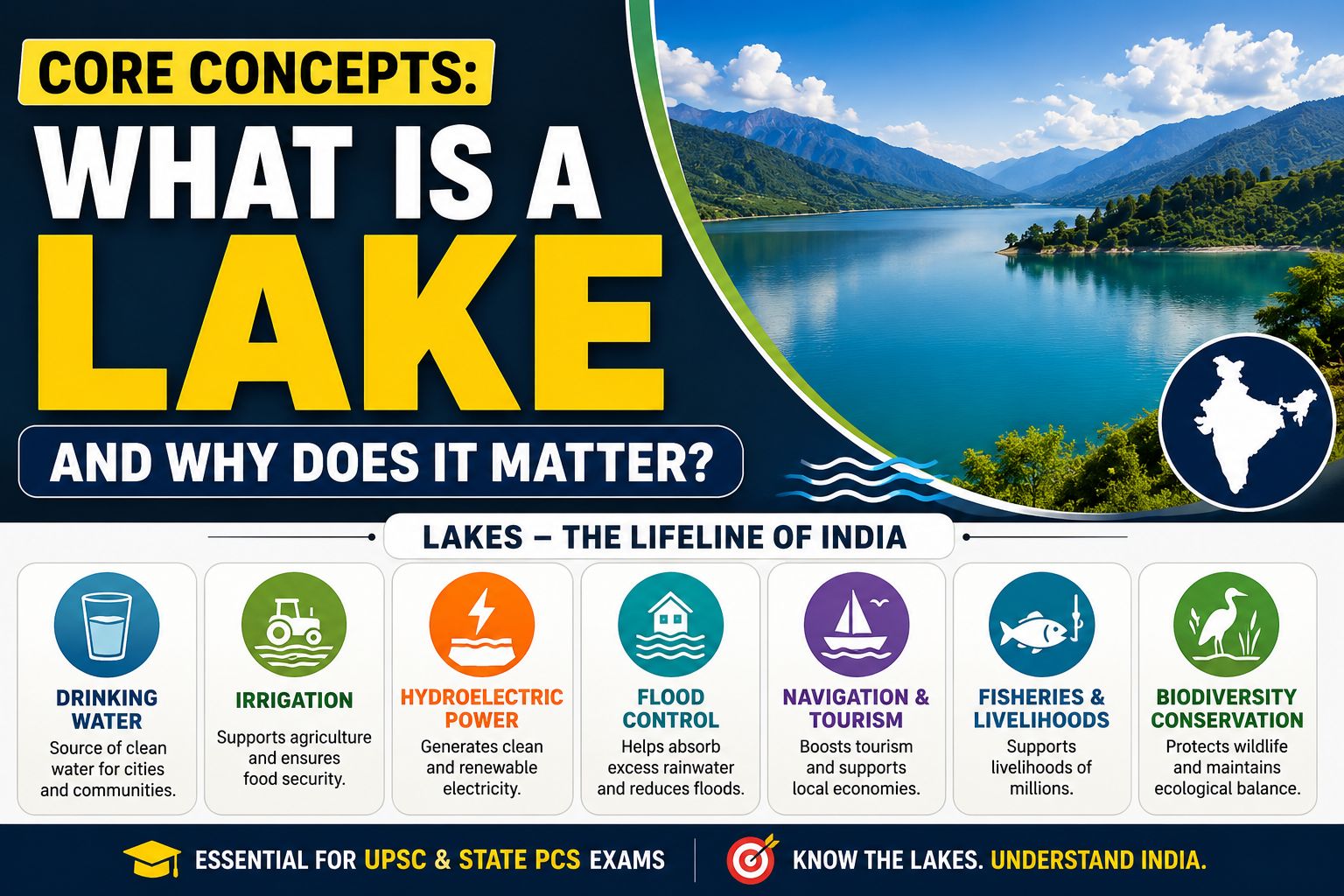
A lake is a large body of water surrounded by land and not directly connected to the ocean (except in the case of lagoons). Lakes serve multiple critical functions in India's development landscape:
- Drinking Water Supply: Many cities depend on lakes such as Bhojtal (Bhopal) and Chembarambakkam (Chennai) for clean drinking water.
- Irrigation: Lakes and reservoirs supply water to farmlands, especially in dry regions, enabling year-round cultivation.
- Hydroelectric Power Generation: Artificial lakes like Gobind Sagar and Govind Ballabh Pant Sagar are central to India's power supply.
- Flood Control: Lakes such as Kolleru act as natural flood-balancing reservoirs during the monsoon.
- Navigation and Tourism: Dal Lake, Vembanad, and Pichola are internationally famous tourist hubs.
- Fisheries and Livelihoods: Lakes like Loktak and Chilika support millions of fishermen and traditional communities.
- Biodiversity Conservation: Many lakes are Ramsar sites that protect endangered species like the Sangai deer, Irrawaddy dolphin, and black-necked crane.
Indian lakes are classified in two ways — based on water type (freshwater, saltwater, brackish) and based on origin (tectonic, glacial, volcanic/crater, lagoon, oxbow, and artificial). Understanding the multi-purpose nature of lakes helps aspirants answer application-based questions in UPSC and State PCS exams.
Classification Based on Water Type
- Freshwater Lakes: Fed by rivers and rainfall; used for drinking and irrigation. Example: Wular Lake.
- Saltwater Lakes: Located in arid regions; used for salt extraction. Example: Sambhar Lake.
- Brackish Water Lakes (Lagoons): Mixture of freshwater and seawater; located along coasts. Example: Chilika Lake.
Classification Based on Origin
- Tectonic Lakes: Formed by the movement of the Earth's crust. Example: Wular Lake.
- Glacial Lakes: Formed by melting glaciers. Example: Pangong Tso.
- Volcanic / Crater Lakes: Formed inside volcanic or meteorite-impact craters. Example: Lonar Lake.
- Lagoons: Coastal water bodies separated from the sea by sandbars. Example: Chilika Lake.
- Oxbow Lakes: Formed when a river meander is cut off. Example: Kanwar Lake, Bihar.
- Artificial Lakes: Man-made reservoirs built using dams. Example: Gobind Sagar, Nagarjuna Sagar.
State-Wise List of Important Lakes in India
The following tables present a complete, exam-oriented list of major lakes in India organized by state. Each entry includes the lake name, type, and key features relevant for exams.
Andhra Pradesh and Telangana
| Lake Name | Type | Key Features / Exam Notes |
|---|---|---|
| Kolleru Lake | Freshwater | One of Asia's largest shallow freshwater lakes; Ramsar site; located between the Krishna and Godavari deltas in Andhra Pradesh; home to Atapaka Bird Sanctuary; flood-balancing reservoir for migratory birds. |
| Pulicat Lake | Brackish water | Second-largest brackish water lagoon in India; lies between Andhra Pradesh and Tamil Nadu; separated from the Bay of Bengal by Sriharikota Island, where ISRO's Satish Dhawan Space Centre is located; hosts Pulicat Bird Sanctuary famous for flamingos. |
| Nagarjuna Sagar Lake | Artificial, Freshwater | Created by the Nagarjuna Sagar Dam on the Krishna River; one of the largest man-made lakes in the world; supports irrigation and hydropower; linked to the Nagarjunakonda archaeological site. |
| Hussain Sagar | Artificial, Freshwater | Built in 1562 during Qutb Shahi rule in Hyderabad, Telangana; connects Hyderabad and Secunderabad; features a large monolithic Buddha statue at its centre. |
Assam
| Lake Name | Type | Key Features / Exam Notes |
|---|---|---|
| Deepor Beel | Freshwater | Ramsar site located near Guwahati; major bird habitat; supports local livelihoods through fishing and farming; ecologically significant wetland. |
| Haflong Lake | Freshwater | Located in Dima Hasao district; the only natural lake in Assam; popular tourist destination surrounded by hills. |
| Chandubi Lake | Freshwater | Natural lake formed during the 1897 Assam earthquake; surrounded by tropical forests and tribal villages. |
Bihar
| Lake Name | Type | Key Features / Exam Notes |
|---|---|---|
| Kanwar Lake (Kabar Taal) | Oxbow, Freshwater | Asia's largest freshwater oxbow lake; located in Begusarai district; Ramsar site; major migratory bird sanctuary; threatened by encroachment and pollution. |
Gujarat
| Lake Name | Type | Key Features / Exam Notes |
|---|---|---|
| Nal Sarovar (Nal Lake) | Freshwater | Ramsar site and seasonal lake; the largest wetland bird sanctuary in India; major flamingo habitat; populated by migratory birds in winter and spring. |
| Sardar Sarovar Lake | Artificial, Freshwater | One of India's largest reservoirs; created by the Sardar Sarovar Dam on the Narmada River; supports irrigation, hydropower, and inter-state water supply across Gujarat, MP, Maharashtra, and Rajasthan. |
| Hamirsar Lake | Freshwater | Located in Bhuj; centuries-old artificial lake supplying drinking water to the city; cultural and historical significance. |
| Kankaria Lake | Artificial, Freshwater | Located in Ahmedabad; built by Sultan Qutbuddin in the 15th century; major recreational hub with a lakefront promenade. |
Haryana
| Lake Name | Type | Key Features / Exam Notes |
|---|---|---|
| Brahma Sarovar | Artificial, Freshwater | Sacred water body at Kurukshetra; linked to the Mahabharata; believed to be the site of Brahma's yagna; attracts pilgrims especially during solar eclipses. |
| Badkhal Lake | Freshwater | Located in Faridabad; once a popular tourist spot known for scenic surroundings in the Aravalli foothills. |
Himachal Pradesh
| Lake Name | Type | Key Features / Exam Notes |
|---|---|---|
| Renuka Lake | Freshwater | Largest lake in Himachal Pradesh; Ramsar site; dedicated to Goddess Renuka, mother of Parshuram; surrounded by forests and temples; site of the Renuka Fair. |
| Chandra Taal | Freshwater | High-altitude crescent-shaped lake in Spiti Valley; called the "Lake of the Moon"; sacred and popular among trekkers; freezes during winter. |
| Gobind Sagar | Artificial, Freshwater | Reservoir created by the Bhakra Dam on the Sutlej River; one of the largest reservoirs in India; supports hydropower, irrigation, fishing, and water sports. |
| Maharana Pratap Sagar (Pong Dam Lake) | Artificial, Freshwater | Ramsar site in Kangra district; formed by Pong Dam on the Beas River; supports migratory birds, irrigation, fishing, and power generation. |
Jammu and Kashmir
| Lake Name | Type | Key Features / Exam Notes |
|---|---|---|
| Wular Lake | Freshwater | Largest freshwater lake in India; formed by tectonic activity; fed by the Jhelum River; Ramsar site; supports rich aquatic biodiversity and an important fishing area. |
| Dal Lake | Freshwater | Called the "Jewel in the Crown of Kashmir"; famous for houseboats and Shikara rides; major water source for Srinagar; divided into Gagribal, Lokut Dal, Bod Dal, and Nigeen; Asia's largest Tulip Garden lies on its banks. |
Karnataka
| Lake Name | Type | Key Features / Exam Notes |
|---|---|---|
| Bellandur Lake | Freshwater | One of Bangalore's largest urban lakes; severely affected by pollution, frothing, and wastewater contamination; restoration efforts are ongoing. |
| Agara Lake | Freshwater | Located in southeast Bangalore; serves as a recreational and bird-watching site for the urban population. |
| Ulsoor Lake | Freshwater | One of the oldest lakes in Bangalore; built during the reign of Kempe Gowda II; popular for boating and recreation. |
Kerala
| Lake Name | Type | Key Features / Exam Notes |
|---|---|---|
| Vembanad Lake | Brackish water | Longest lake in India and the largest in Kerala; Ramsar site; hosts the Nehru Trophy Snake Boat Race; surrounds Kuttanad, the "Rice Bowl of Kerala," which lies below sea level. |
| Sasthamkotta Lake | Freshwater | Largest freshwater lake in Kerala; Ramsar site; major drinking water source; named after a nearby Sastha temple; clean water due to a larva population that consumes germs. |
| Ashtamudi Lake | Brackish water | Second-largest lake in Kerala; named for its eight branches; Ramsar site; major centre of the coir industry; connected to the Arabian Sea. |
| Kuttanad Lake | Freshwater | Region known as the "Rice Bowl of Kerala"; cultivation takes place below sea level; closely associated with the Vembanad ecosystem. |
| Periyar Lake | Artificial, Freshwater | Created in 1895 by a dam across the Mullaperiyar River; surrounded by Periyar Wildlife Sanctuary, famous for elephants and tigers. |
Ladakh
| Lake Name | Type | Key Features / Exam Notes |
|---|---|---|
| Pangong Tso | Saltwater | High-altitude trans-boundary lake at 4,350 m; about 60 percent lies in China; saline yet freezes completely in winter; famous for its color-changing waters. |
| Tso Moriri | Brackish water | High-altitude Ramsar site at 4,522 m; supports endangered black-necked crane; home to Changpa nomads. |
Madhya Pradesh
| Lake Name | Type | Key Features / Exam Notes |
|---|---|---|
| Bhojtal (Upper Lake) | Artificial, Freshwater | Built by Raja Bhoj in the 11th century in Bhopal; provides drinking water to about 40 percent of the city; part of the Bhoj Wetland Ramsar site. |
| Indira Sagar Lake | Artificial, Freshwater | Largest artificial reservoir in India by surface area and volume; built on the Narmada River; supports irrigation, hydropower, flood control, and fisheries. |
Maharashtra
| Lake Name | Type | Key Features / Exam Notes |
|---|---|---|
| Lonar Lake | Saltwater, Crater | The only hyper-velocity meteorite crater lake in basalt rock in India; alkaline and saline water; Ramsar site and notified National Geo-heritage Monument; located in Buldhana district. |
| Salim Ali Lake | Artificial, Freshwater | Located near Delhi Gate, Aurangabad; named after the renowned ornithologist Salim Ali; rich birdlife and a popular birdwatching destination. |
| Shivsagar Lake (Shivaji Sagar) | Artificial, Freshwater | Reservoir formed by the Koyna Dam; vital for hydroelectric power and irrigation in Maharashtra. |
Manipur
| Lake Name | Type | Key Features / Exam Notes |
|---|---|---|
| Loktak Lake | Freshwater | Largest freshwater lake in Northeast India; Ramsar site; famous for floating phumdis; hosts Keibul Lamjao National Park, the world's only floating national park; refuge of the endangered Sangai (brow-antlered) deer. |
Meghalaya and Mizoram
| Lake Name | Type | Key Features / Exam Notes |
|---|---|---|
| Umiam Lake (Barapani) | Artificial, Freshwater | Located near Shillong, Meghalaya; formed by the Umiam Umtru Hydroelectric Power Project in 1965; known for water sports and scenic beauty. |
| Tam Dil | Freshwater | Natural lake near Saitual in Mizoram; popular tourist and angling destination. |
Odisha
| Lake Name | Type | Key Features / Exam Notes |
|---|---|---|
| Chilika Lake | Brackish water | Largest coastal lagoon in India and the second-largest in the world; covers about 1,100 sq km; India's first Ramsar site (1981); home to Irrawaddy dolphin and migratory birds; hosts an annual bird festival. |
Punjab
| Lake Name | Type | Key Features / Exam Notes |
|---|---|---|
| Harike Lake | Freshwater | Formed by the Harike Barrage at the confluence of the Sutlej and Beas rivers; Ramsar site; major migratory bird habitat in northern India. |
| Kanjli Lake | Freshwater | Artificial lake near Kapurthala formed by a barrage on the Beas River; Ramsar site; supports irrigation and rich birdlife. |
Rajasthan
| Lake Name | Type | Key Features / Exam Notes |
|---|---|---|
| Sambhar Lake | Saltwater | Largest inland salt lake in India; produces about 196,000 tonnes of salt annually; surrounds the historic Sambhar Lake Town on NH-8; mentioned in the Mahabharata as part of king Brishparva's domain. |
| Pichola Lake | Artificial, Freshwater | Built in 1362 in Udaipur; famous for the Lake Palace and stunning scenic beauty; central to Udaipur's title of "City of Lakes." |
| Pushkar Lake | Artificial, Freshwater | Sacred lake associated with Lord Brahma; surrounded by 52 ghats; hosts the famous Pushkar Camel Fair every year. |
| Rajsamand Lake | Artificial, Freshwater | Built in 1660 by Maharana Raj Singh; known for its marble ghats and historical inscriptions on its banks. |
| Nakki Lake | Freshwater | Located in Mount Abu in the Aravalli range; the only lake station in Rajasthan; sacred lake with a legend that it was dug by gods with their nails; offers boating and tourism. |
| Jaisamand Lake (Dhebar) | Artificial, Freshwater | Built in 1685 AD; second-largest artificial lake in Asia; historic monument of Mewar. |
Sikkim
| Lake Name | Type | Key Features / Exam Notes |
|---|---|---|
| Cholamu Lake (Tso Lhamo) | Freshwater | Highest altitude lake in India at about 5,330 m; located near the Tibet border; access controlled; known for its clear waters. |
| Tsomgo Lake (Changu) | Freshwater | Glacial lake at 3,753 m in East Sikkim; sacred lake known for changing colours; freezes in winter; Guru Purnima festival is celebrated here by Jhakris. |
Tamil Nadu
| Lake Name | Type | Key Features / Exam Notes |
|---|---|---|
| Chembarambakkam Lake | Artificial, Freshwater | Major drinking water source for Chennai; used for irrigation and flood control; one of the principal reservoirs of Chennai metropolitan area. |
| Kaliveli Lake | Brackish water | Ramsar site rich in biodiversity; major migratory bird habitat in Tamil Nadu; supports irrigation and fisheries. |
Uttar Pradesh
| Lake Name | Type | Key Features / Exam Notes |
|---|---|---|
| Govind Ballabh Pant Sagar (Rihand Lake) | Artificial, Freshwater | Largest artificial lake in India by volume; created by the Rihand Dam on the Rihand River in Sonbhadra; supports hydropower, irrigation, and fisheries. |
| Belasagar Lake | Freshwater | Historical lake in Mahoba district; surrounded by ancient temples; cultural and tourist importance. |
Uttarakhand
| Lake Name | Type | Key Features / Exam Notes |
|---|---|---|
| Nainital Lake | Freshwater | Pear or kidney-shaped natural lake in Nainital; divided into Tallital and Mallital; linked to Goddess Naina Devi; major tourist hub of the Kumaon region. |
| Bhimtal | Freshwater | Largest lake in the Kumaon "lake district"; has a 'C' shape with a central island; masonry dam built in 1883; bigger than Nainital Lake. |
| Roopkund | Freshwater (Glacial) | High-altitude glacial lake at 5,029 m in Chamoli district; called the "Skeleton Lake" due to ancient human remains dating back to the 9th century; popular trekking destination. |
Andaman and Nicobar Islands and Other Lakes
While the Andaman and Nicobar Islands are better known for their dams and reservoirs, the Indian mainland also features several lakes that fall outside the major state-wise listings but remain important for biodiversity and water supply.
Largest Artificial Lakes (Reservoirs) in India
Artificial lakes formed by dams play a major role in irrigation, hydroelectricity, and water supply. Many of these are repeatedly tested in SSC GK and Banking Awareness exams.
| Artificial Lake / Reservoir | State | Dam and River | Key Features / Purpose |
|---|---|---|---|
| Govind Ballabh Pant Sagar (Rihand) | Uttar Pradesh | Rihand Dam, Rihand River | Largest artificial lake in India by volume; major source of hydropower for northern India. |
| Indira Sagar | Madhya Pradesh | Indira Sagar Dam, Narmada River | Largest artificial lake by surface area; supports irrigation, hydropower, flood control, and fisheries. |
| Gobind Sagar | Himachal Pradesh | Bhakra Dam, Sutlej River | One of India's largest reservoirs; supports irrigation, hydropower, fishing, and water sports. |
| Nagarjuna Sagar | Telangana and Andhra Pradesh | Nagarjuna Sagar Dam, Krishna River | One of the largest man-made lakes in the world; primarily for irrigation across two states. |
| Sardar Sarovar | Gujarat | Sardar Sarovar Dam, Narmada River | Major multipurpose project benefiting Gujarat, Rajasthan, MP, and Maharashtra. |
| Jaisamand (Dhebar) | Rajasthan | Built 1685 AD | Second-largest artificial lake in Asia; historic monument from Mewar dynasty. |
| Hussain Sagar | Telangana | Built 1562, Qutb Shahi era | Heart of Hyderabad; iconic Buddha statue at its centre. |
| Hirakud Reservoir | Odisha | Hirakud Dam, Mahanadi River | One of the longest dams in the world; supports flood control and irrigation. |
| Krishna Raja Sagara (KRS) | Karnataka | KRS Dam, Kaveri River | Created by KRS Dam; major reservoir for South Karnataka; Brindavan Gardens lie adjacent. |
| Mettur Reservoir | Tamil Nadu | Mettur Dam, Cauvery River | One of the largest dams in India; key irrigation source for the Cauvery delta. |
| Upper Kolab Reservoir | Odisha | Upper Kolab Dam | Important hydroelectric and irrigation reservoir of Odisha. |
| Neyveli Lakes | Tamil Nadu | Lignite mining area | Series of artificial lakes formed due to lignite mining operations under Neyveli Lignite Corporation. |
Ramsar Sites Among Important Lakes in India
India has the highest number of Ramsar Wetland Sites in South Asia. Many of these sites are well-known lakes that frequently appear in UPSC Prelims, SSC, and State PCS exams.
| Ramsar Lake | State / UT | Significance |
|---|---|---|
| Chilika Lake | Odisha | India's first Ramsar site (1981); largest coastal lagoon. |
| Wular Lake | Jammu and Kashmir | Largest freshwater lake in India. |
| Sambhar Lake | Rajasthan | Largest inland salt lake. |
| Vembanad Lake | Kerala | Longest lake in India. |
| Loktak Lake | Manipur | Floating phumdis and Sangai deer habitat. |
| Tso Moriri | Ladakh | High-altitude lake; black-necked crane habitat. |
| Lonar Lake | Maharashtra | Only meteorite crater lake; Geo-heritage Monument. |
| Pulicat Lake | Andhra Pradesh and Tamil Nadu | Second-largest brackish lagoon in India. |
| Kolleru Lake | Andhra Pradesh | Shallow freshwater lake; major bird habitat. |
| Bhoj Wetland | Madhya Pradesh | Includes Bhojtal (Upper Lake), Bhopal. |
| Nal Sarovar | Gujarat | Largest wetland bird sanctuary in India. |
| Ashtamudi Lake | Kerala | Eight-branched brackish lake; coir industry hub. |
| Sasthamkotta Lake | Kerala | Largest freshwater lake in Kerala. |
| Renuka Lake | Himachal Pradesh | Largest lake in Himachal Pradesh. |
| Maharana Pratap Sagar | Himachal Pradesh | Pong Dam Lake; migratory bird habitat. |
| Harike Lake | Punjab | Confluence of Sutlej and Beas rivers. |
| Kanjli Lake | Punjab | Artificial Beas barrage lake. |
| Deepor Beel | Assam | Important bird habitat near Guwahati. |
| Kanwar Lake (Kabar Taal) | Bihar | Asia's largest freshwater oxbow lake. |
| Kaliveli Lake | Tamil Nadu | Brackish lake with rich migratory birdlife. |
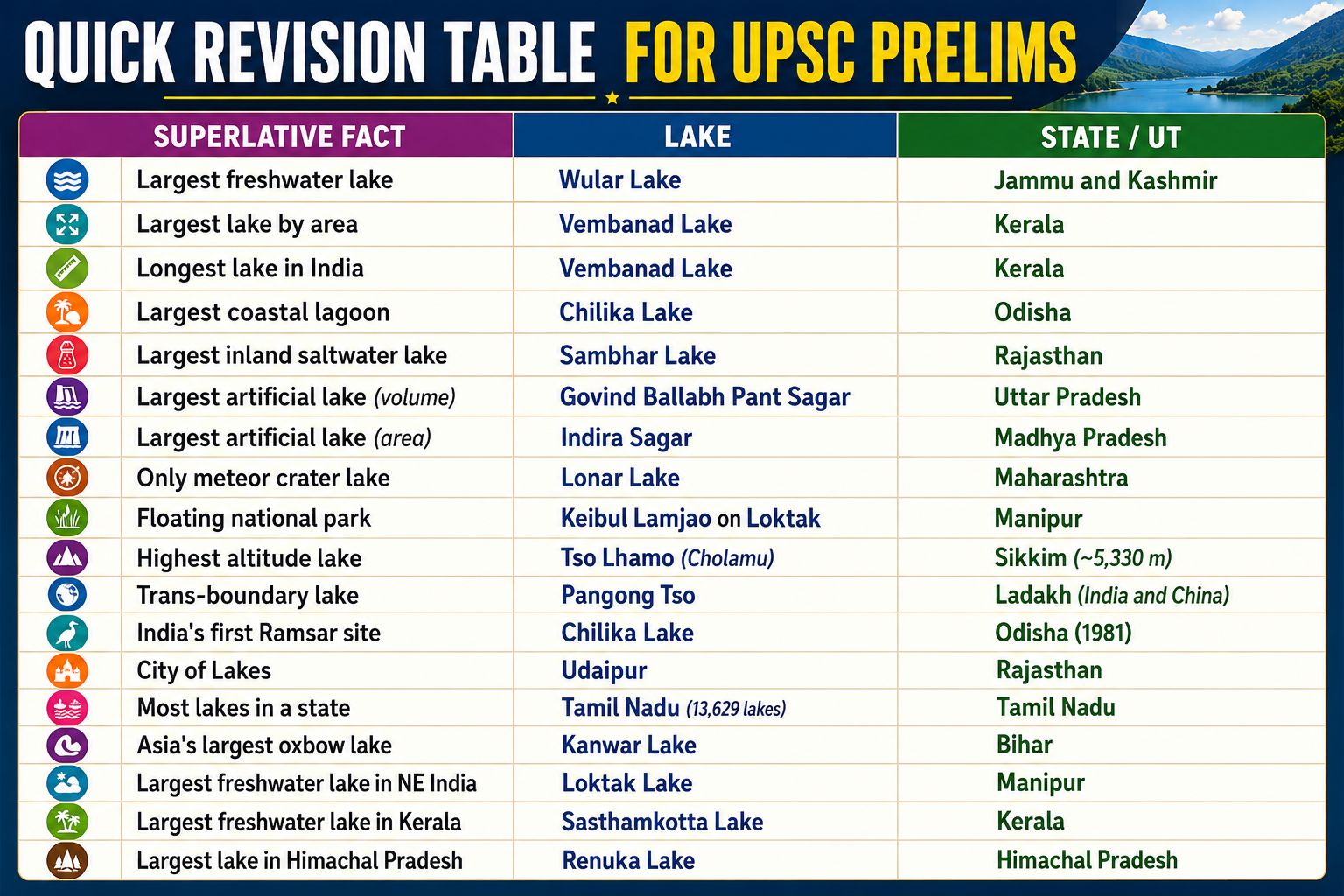
Quick Revision Table for UPSC Prelims
| Superlative Fact | Lake | State / UT |
|---|---|---|
| Largest freshwater lake | Wular Lake | Jammu and Kashmir |
| Largest lake by area | Vembanad Lake | Kerala |
| Longest lake in India | Vembanad Lake | Kerala |
| Largest coastal lagoon | Chilika Lake | Odisha |
| Largest inland saltwater lake | Sambhar Lake | Rajasthan |
| Largest artificial lake (volume) | Govind Ballabh Pant Sagar | Uttar Pradesh |
| Largest artificial lake (area) | Indira Sagar | Madhya Pradesh |
| Only meteor crater lake | Lonar Lake | Maharashtra |
| Floating national park | Keibul Lamjao on Loktak | Manipur |
| Highest altitude lake | Tso Lhamo (Cholamu) | Sikkim (~5,330 m) |
| Trans-boundary lake | Pangong Tso | Ladakh (India and China) |
| India's first Ramsar site | Chilika Lake | Odisha (1981) |
| City of Lakes | Udaipur | Rajasthan |
| Most lakes in a state | Tamil Nadu (13,629 lakes) | Tamil Nadu |
| Asia's largest oxbow lake | Kanwar Lake | Bihar |
| Largest freshwater lake in NE India | Loktak Lake | Manipur |
| Largest freshwater lake in Kerala | Sasthamkotta Lake | Kerala |
| Largest lake in Himachal Pradesh | Renuka Lake | Himachal Pradesh |
Memory Tricks and Mnemonics for Lakes in India
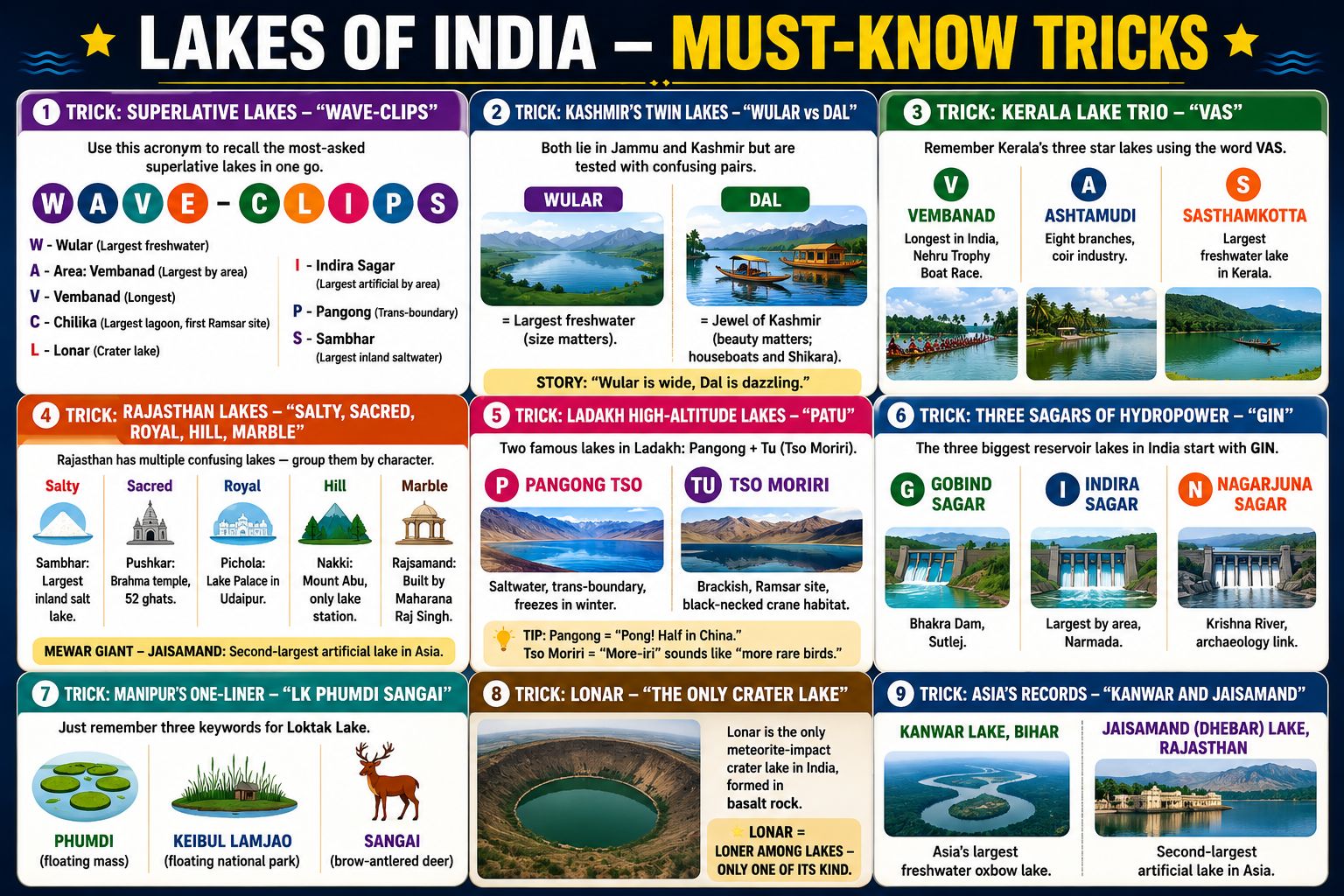
Trick 1: Superlative Lakes - "WAVE-CLIPS"
Use this acronym to recall the most-asked superlative lakes in one go.
WAVE-CLIPS = Wular, Area-Vembanad, Vembanad-longest, Empty, Chilika, Lonar, Indira Sagar, Pangong, Sambhar.
- W - Wular (Largest freshwater)
- A - Area: Vembanad (Largest by area)
- V - Vembanad (Longest)
- C - Chilika (Largest lagoon, first Ramsar site)
- L - Lonar (Crater lake)
- I - Indira Sagar (Largest artificial by area)
- P - Pangong (Trans-boundary)
- S - Sambhar (Largest inland saltwater)
Trick 2: Kashmir's Twin Lakes - "Wular vs Dal"
Both lie in Jammu and Kashmir but are tested with confusing pairs.
- Wular = Largest freshwater (size matters).
- Dal = Jewel of Kashmir (beauty matters; houseboats and Shikara).
Story: "Wular is wide, Dal is dazzling."
Trick 3: Kerala Lake Trio - "VAS"
Remember Kerala's three star lakes using the word VAS.
- V - Vembanad: Longest in India, Nehru Trophy Boat Race.
- A - Ashtamudi: Eight branches, coir industry.
- S - Sasthamkotta: Largest freshwater lake in Kerala.
Trick 4: Rajasthan Lakes - "Salty, Sacred, Royal, Hill, Marble"
Rajasthan has multiple confusing lakes — group them by character.
- Salty - Sambhar: Largest inland salt lake.
- Sacred - Pushkar: Brahma temple, 52 ghats.
- Royal - Pichola: Lake Palace in Udaipur.
- Hill - Nakki: Mount Abu, only lake station.
- Marble - Rajsamand: Built by Maharana Raj Singh.
- Mewar Giant - Jaisamand: Second-largest artificial lake in Asia.
Trick 5: Ladakh High-Altitude Lakes - "PaTu"
Two famous lakes in Ladakh: Pangong + Tu (Tso Moriri).
- Pangong Tso - Saltwater, trans-boundary, freezes in winter.
- Tso Moriri - Brackish, Ramsar site, black-necked crane habitat.
Tip: Pangong = "Pong! Half in China." Tso Moriri = "More-iri" sounds like "more rare birds."
Trick 6: Three Sagars of Hydropower - "GIN"
The three biggest reservoir lakes in India start with GIN.
- G - Gobind Sagar: Bhakra Dam, Sutlej.
- I - Indira Sagar: Largest by area, Narmada.
- N - Nagarjuna Sagar: Krishna River, archaeology link.
Trick 7: Manipur's One-Liner - "LK Phumdi Sangai"
Just remember three keywords for Loktak Lake: Phumdi (floating mass), Keibul Lamjao (floating national park), and Sangai (brow-antlered deer).
Trick 8: Lonar - "The Only Crater Lake"
Lonar is the only meteorite-impact crater lake in India, formed in basalt rock. "Lonar = Loner among lakes — only one of its kind."
Trick 9: Asia's Records - "Kanwar and Jaisamand"
- Kanwar Lake, Bihar - Asia's largest freshwater oxbow lake.
- Jaisamand (Dhebar) Lake, Rajasthan - Second-largest artificial lake in Asia.
Additional Notes
Frequently Confused Facts
- Wular vs Vembanad: Wular is the largest freshwater lake; Vembanad is the longest and largest by area.
- Chilika vs Sambhar: Chilika is the largest brackish coastal lagoon (Odisha); Sambhar is the largest inland saltwater lake (Rajasthan).
- Indira Sagar vs Govind Ballabh Pant Sagar: Indira Sagar is the largest artificial lake by surface area; Govind Ballabh Pant Sagar (Rihand) is the largest by volume.
- Loktak vs Wular: Loktak is the largest freshwater lake in Northeast India; Wular is the largest freshwater lake in India overall.
- Cholamu (Tso Lhamo) vs Pangong Tso: Cholamu is the highest altitude lake; Pangong is the most famous trans-boundary lake.
- Bhojtal vs Hussain Sagar: Bhojtal was built by Raja Bhoj in the 11th century; Hussain Sagar was built in 1562 during Qutb Shahi rule.
- Sasthamkotta vs Vembanad: Sasthamkotta is Kerala's largest freshwater lake; Vembanad is Kerala's largest brackish lake.
- Nainital vs Bhimtal: Bhimtal is bigger than Nainital and has a central island; Nainital is more famous as a tourist hub.
Repeating PYQ Patterns
- UPSC Prelims: Frequently asks about Ramsar sites, Loktak phumdis, Lonar Lake's geology, Pangong Tso boundary, and Chilika as the first Ramsar site.
- SSC CGL and CHSL: Match-the-column questions on lakes and states; Wular, Vembanad, and Sambhar are the most repeated.
- IBPS PO and Clerk: One-liner facts on largest, longest, and highest lakes; artificial reservoir-river pairs.
- RRB NTPC and Group D: Direct questions on which lake is in which state; capital city-lake associations.
- State PCS: Often asks state-specific lakes such as Bhojtal (MP), Renuka (HP), Loktak (Manipur), and Hussain Sagar (Telangana).
Quick Insight
Lakes are central to several current affairs themes such as wetland conservation, Ramsar site additions, urban lake pollution (Bellandur, Bengaluru), saltwater extraction issues at Sambhar, and the strategic importance of Pangong Tso along the LAC. Aspirants should regularly track wetland-related news, environmental ministry notifications, and supreme court rulings on lake encroachment. For the latest geography-related current affairs, visit the daily current affairs section on Jobsme.in to stay updated.
Static GK on lakes also pairs well with related Indian geography topics such as Dams in India and National Parks and Wildlife Sanctuaries, since many lakes lie within or adjacent to protected areas.
One-Liners for Quick Revision
- Wular Lake → Largest freshwater lake in India → Tectonic origin, fed by Jhelum, Ramsar site, Jammu and Kashmir.
- Dal Lake → Jewel in the Crown of Kashmir → Houseboats, Shikara rides, Tulip Garden, Srinagar.
- Pangong Tso → Trans-boundary saltwater lake → 4,350 m altitude, 60 percent in China, freezes in winter, Ladakh.
- Tso Moriri → High-altitude Ramsar lake in Ladakh → 4,522 m, black-necked crane habitat, Changpa nomads.
- Cholamu Lake (Tso Lhamo) → Highest altitude lake in India → ~5,330 m in Sikkim, near Tibet border.
- Tsomgo Lake (Changu) → Glacial lake in East Sikkim → 3,753 m, sacred, Guru Purnima festival.
- Chilika Lake → Largest coastal lagoon in India → First Ramsar site (1981), Irrawaddy dolphin habitat, Odisha.
- Sambhar Lake → Largest inland salt lake in India → 196,000 tonnes annual salt production, Rajasthan.
- Pulicat Lake → Second-largest brackish lagoon in India → Sriharikota Island, Satish Dhawan Space Centre, AP-TN.
- Kolleru Lake → Largest shallow freshwater lake of Asia → Between Krishna and Godavari deltas, Andhra Pradesh.
- Loktak Lake → Largest freshwater lake in Northeast India → Floating phumdis, Keibul Lamjao National Park, Sangai deer, Manipur.
- Vembanad Lake → Longest lake in India → Nehru Trophy Boat Race, Kuttanad below sea level, Kerala.
- Sasthamkotta Lake → Largest freshwater lake in Kerala → Drinking water source, Ramsar site.
- Ashtamudi Lake → Eight-branched brackish lake → Coir industry centre, Ramsar site, Kerala.
- Kuttanad → Rice Bowl of Kerala → Cultivation below sea level, surrounds Vembanad.
- Periyar Lake → Created in 1895 → Mullaperiyar Dam, Periyar Wildlife Sanctuary, Kerala.
- Bhojtal (Upper Lake) → Built by Raja Bhoj in 11th century → Drinking water for Bhopal, Bhoj Wetland Ramsar site.
- Indira Sagar → Largest artificial lake by surface area → Built on Narmada River, Madhya Pradesh.
- Lonar Lake → Only meteorite crater lake in India → Basalt rock, alkaline-saline, Geo-heritage Monument, Maharashtra.
- Salim Ali Lake → Named after ornithologist Salim Ali → Aurangabad, birdwatching destination.
- Shivsagar Lake (Shivaji Sagar) → Created by Koyna Dam → Hydropower and irrigation, Maharashtra.
- Pichola Lake → Built in 1362 in Udaipur → Lake Palace, scenic beauty, Rajasthan.
- Pushkar Lake → Sacred lake of Lord Brahma → 52 ghats, Pushkar Camel Fair, Rajasthan.
- Rajsamand Lake → Built in 1660 → Maharana Raj Singh, marble ghats and inscriptions, Rajasthan.
- Nakki Lake → Only lake station of Rajasthan → Mount Abu, Aravalli range, sacred legend.
- Jaisamand (Dhebar) Lake → Built in 1685 AD → Second-largest artificial lake in Asia, Rajasthan.
- Chandra Taal → Lake of the Moon → Crescent-shaped, Spiti Valley, Himachal Pradesh.
- Renuka Lake → Largest lake in Himachal Pradesh → Dedicated to Goddess Renuka, Renuka Fair, Ramsar site.
- Gobind Sagar → Bhakra Dam reservoir → Sutlej River, Himachal Pradesh.
- Maharana Pratap Sagar (Pong Dam Lake) → Ramsar site in Himachal Pradesh → Migratory birds, irrigation, Beas River.
- Roopkund → Skeleton Lake → 5,029 m, Chamoli district, Uttarakhand, ancient human remains.
- Bhimtal → Largest lake in Kumaon → Central island, dam built 1883, bigger than Nainital Lake.
- Nainital Lake → Pear or kidney-shaped → Tallital and Mallital, Goddess Naina Devi, Uttarakhand.
- Hussain Sagar → Built in 1562 (Qutb Shahi era) → Connects Hyderabad and Secunderabad, Buddha statue, Telangana.
- Nagarjuna Sagar Lake → Krishna River reservoir → Linked to Nagarjunakonda archaeological site, AP-Telangana.
- Sardar Sarovar Lake → Narmada River reservoir → Multipurpose project for Gujarat, MP, Maharashtra, Rajasthan.
- Nal Sarovar (Nal Lake) → Largest wetland bird sanctuary in India → Seasonal lake, Ramsar site, Gujarat.
- Hamirsar Lake → Located in Bhuj → Centuries-old artificial lake supplying drinking water, Gujarat.
- Kankaria Lake → Built by Sultan Qutbuddin in 15th century → Recreational hub, Ahmedabad, Gujarat.
- Brahma Sarovar → Sacred lake at Kurukshetra → Mahabharata link, attracts pilgrims during solar eclipse, Haryana.
- Badkhal Lake → Located in Faridabad → Once a popular tourist spot, Haryana.
- Kanwar Lake (Kabar Taal) → Asia's largest freshwater oxbow lake → Begusarai, Bihar, Ramsar site.
- Deepor Beel → Ramsar site near Guwahati → Major bird habitat, Assam.
- Haflong Lake → Only natural lake in Assam → Located in Dima Hasao district.
- Chandubi Lake → Formed during 1897 Assam earthquake → Tropical forest surroundings.
- Bellandur Lake → Largest urban lake in Bangalore → Severe pollution and froth issues, Karnataka.
- Agara Lake → Located in southeast Bangalore → Bird-watching site, Karnataka.
- Ulsoor Lake → One of the oldest lakes in Bangalore → Built by Kempe Gowda II.
- Umiam Lake (Barapani) → Reservoir near Shillong → Formed by Umiam Umtru Hydroelectric Project, 1965, Meghalaya.
- Tam Dil → Natural lake in Mizoram → Near Saitual, tourist and angling spot.
- Harike Lake → Confluence of Sutlej and Beas → Ramsar site, Punjab.
- Kanjli Lake → Artificial lake near Kapurthala → Beas barrage, Ramsar site, Punjab.
- Govind Ballabh Pant Sagar (Rihand Lake) → Largest artificial lake by volume → Rihand Dam, Sonbhadra, Uttar Pradesh.
- Belasagar → Historical lake in Mahoba → Surrounded by ancient temples, Uttar Pradesh.
- Chembarambakkam Lake → Major drinking water source for Chennai → Irrigation and flood control, Tamil Nadu.
- Kaliveli Lake → Brackish Ramsar site in Tamil Nadu → Migratory bird habitat.
- Hirakud Reservoir → Built on Mahanadi River → One of the longest dams in the world, Odisha.
- Krishna Raja Sagara (KRS) → Built on Kaveri River → Located in Mandya, Karnataka; Brindavan Gardens nearby.
- Mettur Reservoir → Built on Cauvery River → One of the largest dams in India, Tamil Nadu.
- Upper Kolab Reservoir → Hydroelectric reservoir → Located in Odisha.
- Neyveli Lakes → Series of artificial lakes from lignite mining → Tamil Nadu.
For more Static GK topics like nuclear power plants, biosphere reserves, and mountain peaks, explore the Static GK section on Jobsme.in. You can also test your knowledge with the Static GK Quiz and check out the latest exam notifications at Latest Government Job Notifications.
Free quiz • No signup required
Put this topic into practice with Indian Cultural Institutions – Static GK MCQ Quiz. It is the quickest way to reinforce what you just learned.
Frequently Asked Questions
Which is the largest freshwater lake in India?
Which is the longest lake in India?
Which is the largest saltwater lake in India?
Which is the largest inland salt lake in India?
Which lake is famous for its floating phumdis and the world's only floating national park?
Which is the only meteorite crater lake in India?
Which is the highest altitude lake in India?
Which trans-boundary lake is shared between India and China?
Which is the largest artificial lake in India?
Which lake is known as the Jewel in the Crown of Kashmir?

About the author