Indian Cities on the Banks of Rivers: Complete Static GK for Competitive Exams with Memory Tricks
This article covers the complete list of important Indian and world cities located on the banks of rivers — a high-frequency topic in SSC, UPSC, IBPS, Railways, and State PCS exams. Learn river-city pairs, key facts about major Indian river systems, government initiatives, and memory tricks to retain every fact quickly.
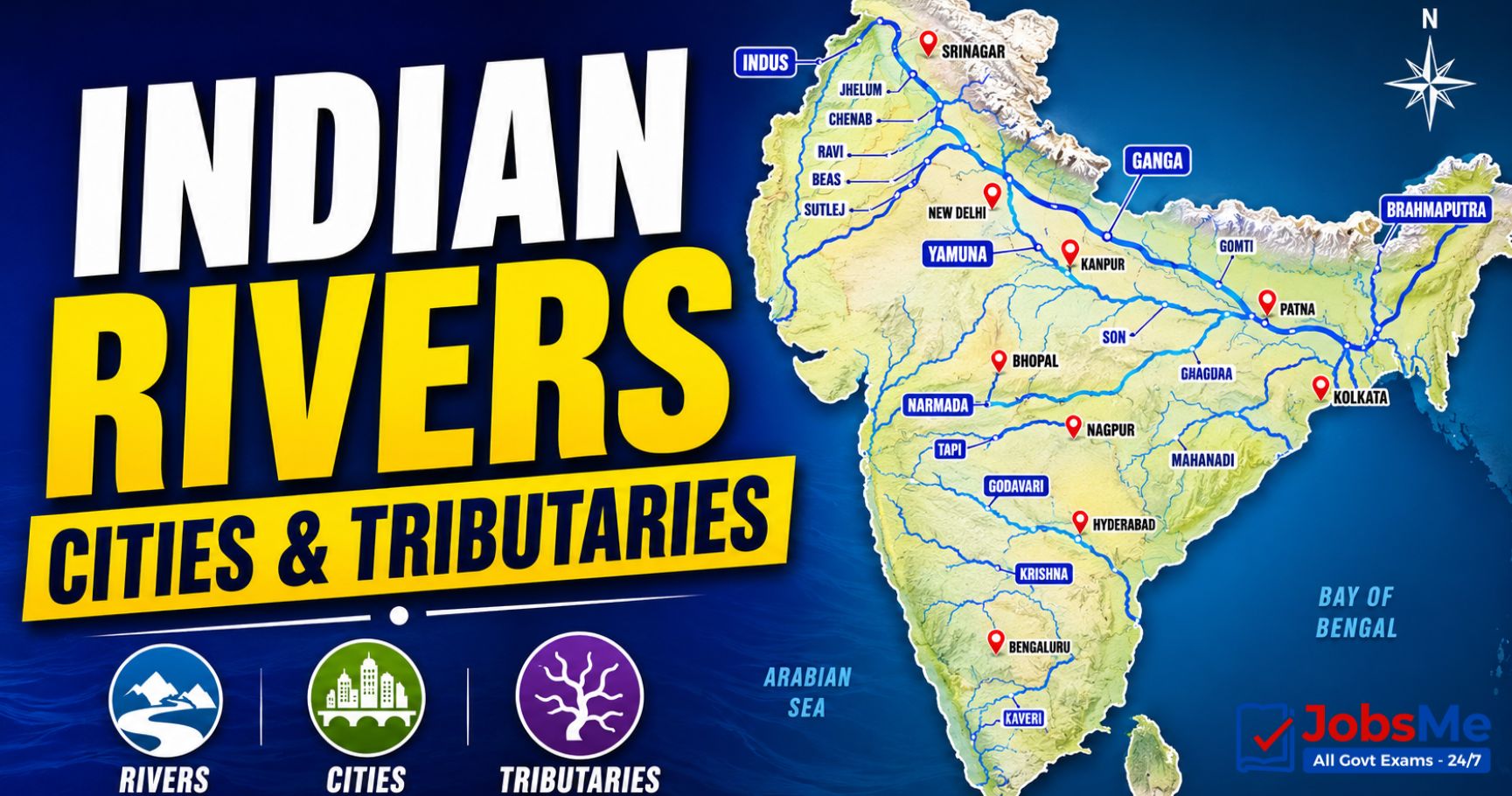
Jump to section
- Introduction: Why Rivers and Cities Matter in Competitive Exams
- Overview of Major Indian River Systems
- Detailed Notes on Major Indian River Systems
- Important Indian Cities on the Banks of Rivers
- Important World Cities on the Banks of Rivers
- Key Facts About Indian Rivers for Competitive Exams
- Government Initiatives for River Conservation
- Memory Tricks, Mnemonics, and Vivid Memory Aids
- Additional Notes: Tricky Facts, PYQ Patterns, and Common Confusions
- One-Liners: Quick Revision for Last-Minute Prep
Introduction: Why Rivers and Cities Matter in Competitive Exams
Rivers are the lifelines of civilisations. From the Indus Valley to the Gangetic plains, every major human settlement in India grew along a riverbank — and that geographical reality is reflected heavily in competitive exam question papers. Topics such as Indian cities on the banks of rivers, river origins, tributaries, and related government initiatives appear regularly in SSC CGL, SSC CHSL, IBPS PO, IBPS Clerk, SBI PO, RRB NTPC, UPSC Prelims, State PCS, Defence, and Insurance exams.
This article is your one-stop Static GK reference for all river-city pairs in India and the world, complete details of major Indian river systems, tributary information, and sharp memory tricks to help you retain every fact before exam day. Bookmark this page alongside our Static GK notes for a complete geography revision.
Overview of Major Indian River Systems
Most rivers of India originate from one of three major watersheds:
- The Himalaya and Karakoram Range (northern rivers)
- The Chota Nagpur Plateau and Vindhya-Satpura Range (central rivers)
- The Western Ghats (peninsular rivers)
The majority of Indian rivers drain into the Bay of Bengal. A few — notably the Narmada, Tapi, and Mahi — flow west and drain into the Arabian Sea. The Thar Desert, northern Aravalli region, and parts of Ladakh have inland drainage with no outlet to the sea.
Indian River Systems at a Glance
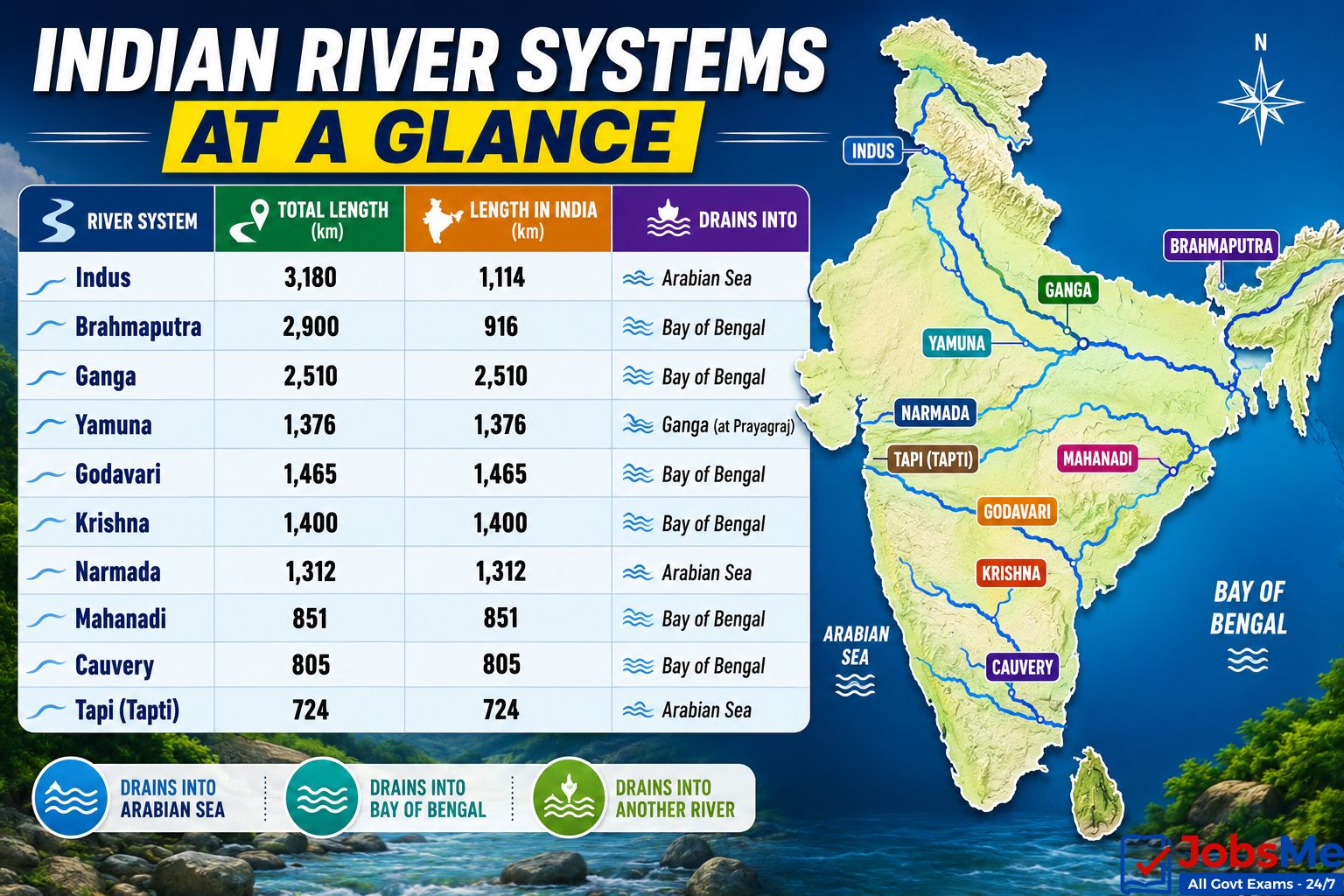
| River System | Total Length (km) | Length in India (km) | Drains Into |
|---|---|---|---|
| Indus | 3,180 | 1,114 | Arabian Sea |
| Brahmaputra | 2,900 | 916 | Bay of Bengal |
| Ganga | 2,510 | 2,510 | Bay of Bengal |
| Yamuna | 1,376 | 1,376 | Ganga (at Prayagraj) |
| Godavari | 1,465 | 1,465 | Bay of Bengal |
| Krishna | 1,400 | 1,400 | Bay of Bengal |
| Narmada | 1,312 | 1,312 | Arabian Sea |
| Mahanadi | 851 | 851 | Bay of Bengal |
| Cauvery | 805 | 805 | Bay of Bengal |
| Tapi (Tapti) | 724 | 724 | Arabian Sea |
Detailed Notes on Major Indian River Systems
1. Indus River System
- Originates from the northern slopes of the Kailash Range in Tibet, near Lake Mansarovar.
- Total length: ~3,180 km; length within India: ~1,114 km.
- Enters India through Jammu & Kashmir, forming a deep gorge near Attock.
- Flows between the Ladakh Range and Zaskar Range at Leh.
- Drains into the Arabian Sea near Karachi (Pakistan).
- Major tributaries in India: Jhelum, Chenab, Ravi, Beas, Sutlej (remember: Just Come Run Before Sunset).
- Minor tributaries in J&K: Zaskar, Shyok, Nubra, Hunza.
2. Brahmaputra River System
- Originates from Mansarovar Lake (same source region as Indus and Sutlej).
- Total length: ~3,848 km — one of the longest rivers in Asia.
- Known as Tsangpo in Tibet, Dihang in Arunachal Pradesh, and Brahmaputra in Assam.
- Flows east parallel to the Himalayas, takes a sharp U-turn near Namcha Barwa, and enters India via Arunachal Pradesh.
- Has a braided channel throughout most of its course in Assam.
- Carries the highest volume of water among all Indian rivers during monsoon.
- Regularly causes devastating floods in Assam and Bangladesh.
3. Ganga River System
- Originates as Bhagirathi from the Gangotri Glacier in Uttarakhand.
- Meets the Alaknanda at Devprayag to form the Ganga.
- Total length: ~2,510 km; drains into the Bay of Bengal.
- Principal tributaries: Yamuna, Ghaghara, Gomati, Ram Ganga, Damodar, Son, Sapta Kosi.
- The Ganga basin has the largest drainage area of any Indian river system.
The Panch Prayag (Five Sacred Confluences) — Frequently Asked in Exams
| Prayag | Rivers Merging |
|---|---|
| Vishnuprayag | Alaknanda + Dhauli Ganga |
| Nandprayag | Alaknanda + Nandakini |
| Karnaprayag | Alaknanda + Pinder (Pindar) |
| Rudraprayag | Alaknanda + Mandakini |
| Devprayag | Alaknanda + Bhagirathi = GANGA |
4. Yamuna River System
- Largest tributary of the Ganga.
- Originates from the Yamunotri Glacier at Bandarpoonch Peak, Uttarakhand.
- Meets the Ganga at Prayagraj (Triveni Sangam) along with the mythical Saraswati.
- Largest tributary of Yamuna: Tons River.
- Other tributaries: Chambal, Betwa, Ken, Hindon, Sin.
- Flows through: Delhi, Uttar Pradesh, Haryana, Himachal Pradesh, Rajasthan, Madhya Pradesh.
5. Narmada River System
- Originates from Amarkantak Hills, Madhya Pradesh.
- One of only three peninsular rivers flowing west to east to west (west-flowing): Narmada, Tapi, and Mahi.
- Forms the traditional boundary between North and South India.
- Drains into the Arabian Sea at Bharuch (Gulf of Khambhat), Gujarat.
- Flows through: Madhya Pradesh, Maharashtra, Gujarat.
6. Tapi (Tapti) River System
- Originates from the Eastern Satpura Range, southern Madhya Pradesh.
- Flows westward through Nimar (MP), Vidarbha, Khandesh (Maharashtra), and South Gujarat.
- Drains into the Gulf of Khambhat (Gulf of Cambay), Arabian Sea.
- Major city on Tapi: Surat (Gujarat).
- Key tributaries: Purna, Girna, Panzara, Waghur, Aner, Bori.
7. Godavari River System
- Second longest river in India (after the Ganga).
- Also called Dakshin Ganga (South Ganga) and Vriddh Ganga (Old Ganga).
- Originates from Trimbakeshwar, near Nashik, Maharashtra.
- Flows southeast through Maharashtra, Telangana, Andhra Pradesh, and Odisha.
- Drains into the Bay of Bengal; forms a fertile delta at Rajahmundry.
- Key tributaries: Pranahita (Penganga + Wardha), Indravati, Sabari, Manjira, Bindusara.
- Asia's longest rail-cum-road bridge connects Kovvur and Rajahmundry on the Godavari.
- Major pilgrimage sites: Nashik, Trimbak, Bhadrachalam.
8. Krishna River System
- Originates from Mahabaleshwar, Maharashtra.
- Flows through Maharashtra, Karnataka, Telangana, and Andhra Pradesh.
- Drains into the Bay of Bengal.
- Main tributary: Tungabhadra (formed by Tunga + Bhadra rivers from the Western Ghats).
- Other tributaries: Bhima, Koyna, Musi, Ghataprabha, Mallaprabha, Yerla, Warna.
- Major city: Vijayawada (Andhra Pradesh).
9. Cauvery (Kaveri) River System
- Originates from Talakaveri, Kodagu District, Karnataka (Western Ghats).
- Flows through Karnataka and Tamil Nadu before draining into the Bay of Bengal.
- A perennial river — sustained by both the Southwest and Northeast Monsoons.
- Key tributaries: Hemavati, Shimsha, Arkavathy, Kabini, Amaravati, Bhavani, Noyyal, Kapila.
- Four major dams in Karnataka: KRS (Krishna Raja Sagara), Kabini, Harangi, Hemavathi.
- Supports major cities: Mysuru, Tiruchirapalli (Trichy), Thanjavur, Erode.
10. Mahanadi River System
- Originates from the Satpura Range in central India (Chhattisgarh).
- Flows east through Chhattisgarh, Jharkhand, Maharashtra, and Odisha.
- Drains into the Bay of Bengal.
- The Hirakud Dam — one of the longest dams in India — is built on the Mahanadi in Odisha.
- Major cities: Cuttack and Sambalpur (both in Odisha).
Important Indian Cities on the Banks of Rivers
This is one of the most frequently asked Static GK topics in SSC, UPSC, IBPS, and Railways exams. Memorise the table below carefully, paying special attention to cities that are often confused.
| City | State | River |
|---|---|---|
| Agra | Uttar Pradesh | Yamuna |
| Ahmedabad | Gujarat | Sabarmati |
| Ayodhya | Uttar Pradesh | Saryu (Ghaghara) |
| Allahabad (Prayagraj) | Uttar Pradesh | Ganga + Yamuna (Triveni Sangam) |
| Badrinath | Uttarakhand | Alaknanda |
| Bareilly | Uttar Pradesh | Ramganga |
| Cuttack | Odisha | Mahanadi |
| Delhi | Delhi (NCT) | Yamuna |
| Dibrugarh | Assam | Brahmaputra |
| Firozpur | Punjab | Sutlej |
| Guwahati | Assam | Brahmaputra |
| Haridwar | Uttarakhand | Ganga |
| Hyderabad | Telangana | Musi |
| Jabalpur | Madhya Pradesh | Narmada |
| Jamshedpur | Jharkhand | Subarnarekha |
| Jaunpur | Uttar Pradesh | Gomti |
| Kanpur | Uttar Pradesh | Ganga |
| Kolkata | West Bengal | Hooghly |
| Kota | Rajasthan | Chambal |
| Kurnool | Andhra Pradesh | Tungabhadra |
| Lucknow | Uttar Pradesh | Gomti |
| Ludhiana | Punjab | Sutlej |
| Mathura | Uttar Pradesh | Yamuna |
| Nashik | Maharashtra | Godavari |
| Panaji | Goa | Mandovi |
| Patna | Bihar | Ganga |
| Sambalpur | Odisha | Mahanadi |
| Srinagar | Jammu & Kashmir | Jhelum |
| Surat | Gujarat | Tapi (Tapti) |
| Tiruchirapalli (Trichy) | Tamil Nadu | Cauvery |
| Ujjain | Madhya Pradesh | Kshipra (Shipra) |
| Varanasi | Uttar Pradesh | Ganga |
| Vijayawada | Andhra Pradesh | Krishna |
Important World Cities on the Banks of Rivers
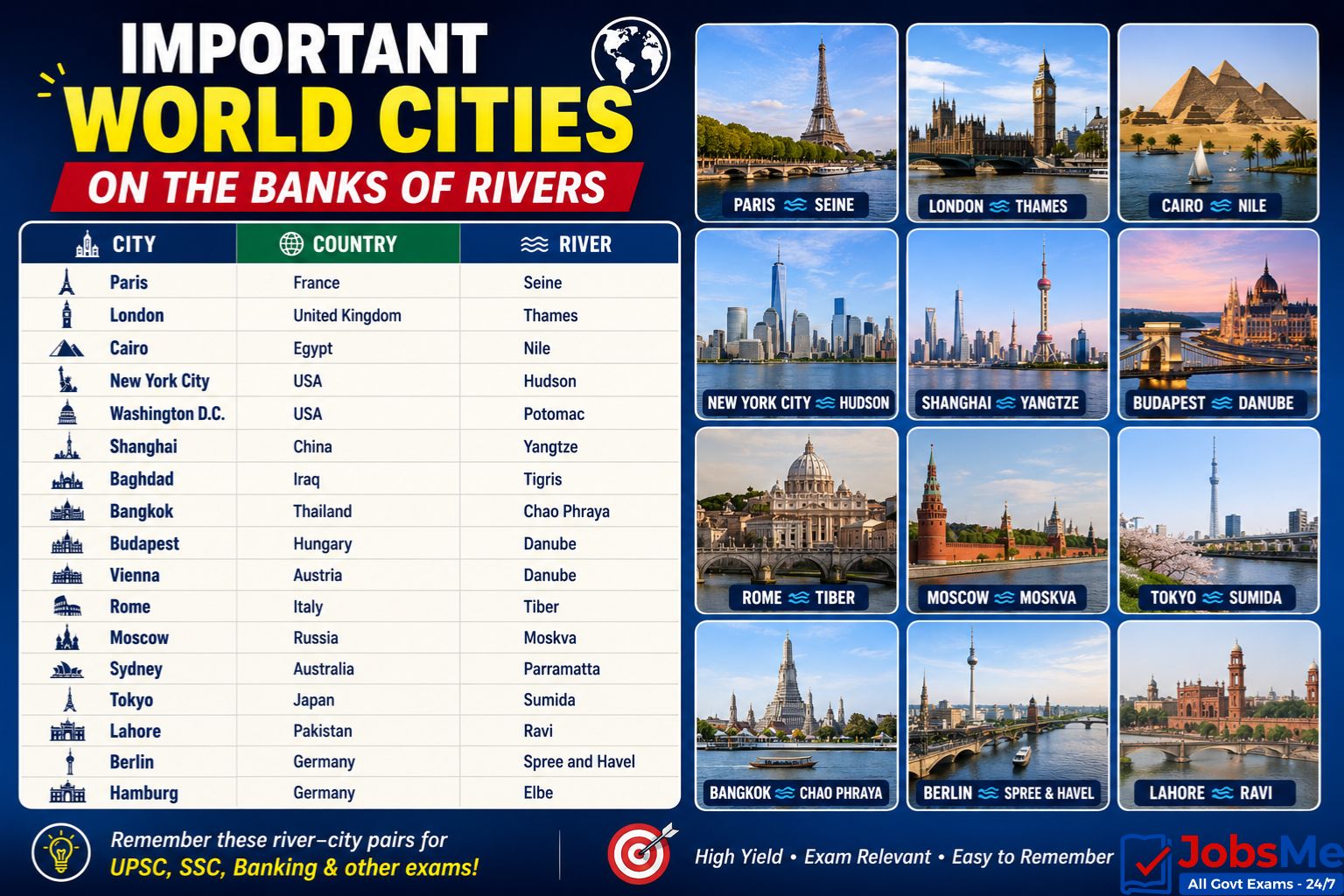
Questions on world cities and their rivers appear regularly in UPSC Prelims, SSC, and Banking exams. The table below covers all major international river-city pairs.
| City | Country | River |
|---|---|---|
| Paris | France | Seine |
| London | United Kingdom | Thames |
| Cairo | Egypt | Nile |
| New York City | USA | Hudson |
| Washington D.C. | USA | Potomac |
| Shanghai | China | Yangtze |
| Baghdad | Iraq | Tigris |
| Bangkok | Thailand | Chao Phraya |
| Budapest | Hungary | Danube |
| Vienna | Austria | Danube |
| Rome | Italy | Tiber |
| Moscow | Russia | Moskva |
| Sydney | Australia | Parramatta |
| Tokyo | Japan | Sumida |
| Lahore | Pakistan | Ravi |
| Berlin | Germany | Spree and Havel |
| Hamburg | Germany | Elbe |
Key Facts About Indian Rivers for Competitive Exams
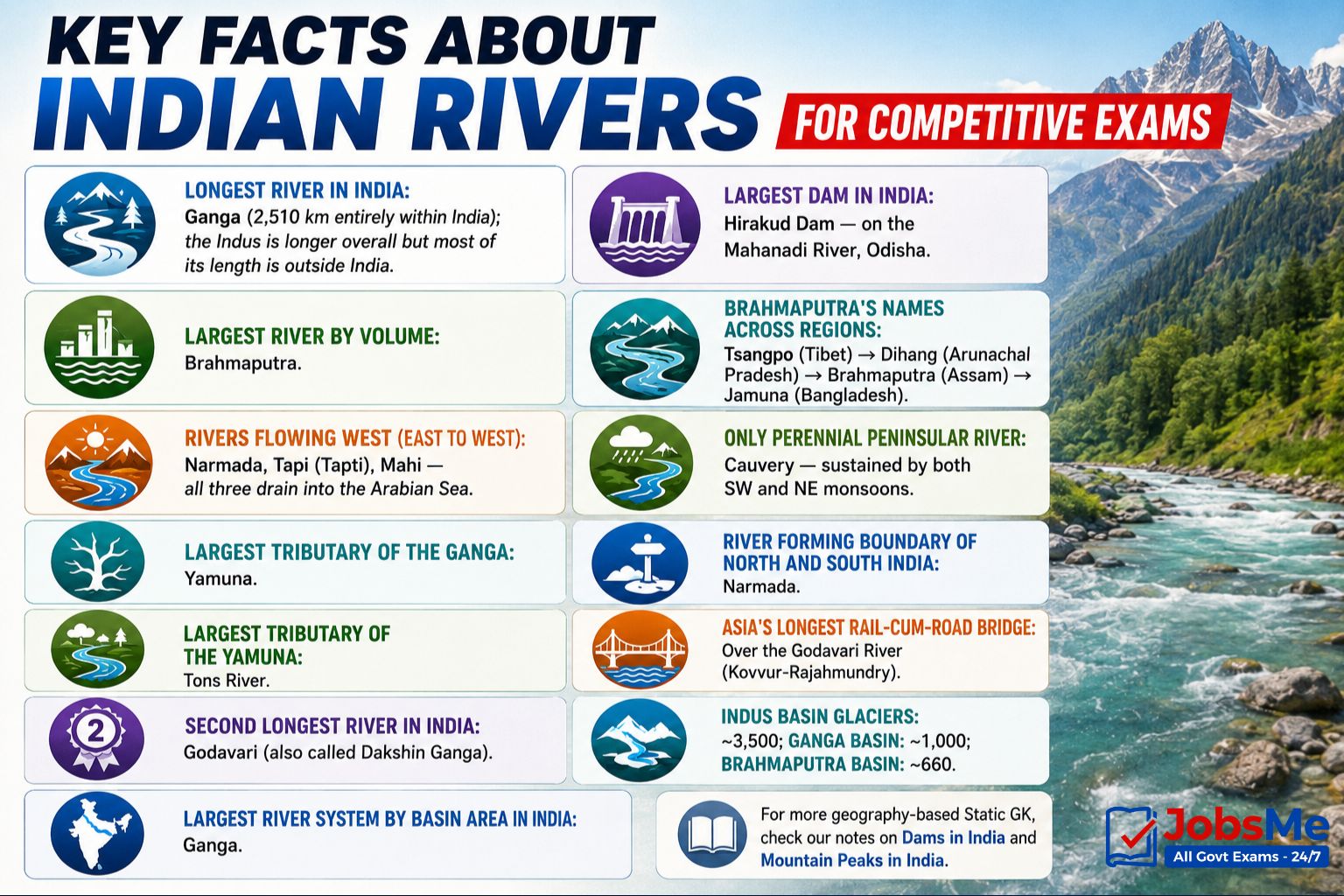
- Longest river in India: Ganga (2,510 km entirely within India); the Indus is longer overall but most of its length is outside India.
- Largest river by volume: Brahmaputra.
- Rivers flowing west (east to west): Narmada, Tapi (Tapti), Mahi — all three drain into the Arabian Sea.
- Largest tributary of the Ganga: Yamuna.
- Largest tributary of the Yamuna: Tons River.
- Second longest river in India: Godavari (also called Dakshin Ganga).
- Largest dam in India: Hirakud Dam — on the Mahanadi River, Odisha.
- Brahmaputra's names across regions: Tsangpo (Tibet) → Dihang (Arunachal Pradesh) → Brahmaputra (Assam) → Jamuna (Bangladesh).
- Only perennial peninsular river: Cauvery — sustained by both SW and NE monsoons.
- River forming boundary of North and South India: Narmada.
- Asia's longest rail-cum-road bridge: Over the Godavari River (Kovvur-Rajahmundry).
- Indus basin glaciers: ~3,500; Ganga basin: ~1,000; Brahmaputra basin: ~660.
- Largest river system by basin area in India: Ganga.
For more geography-based Static GK, check our notes on Dams in India and Mountain Peaks in India.
Government Initiatives for River Conservation
Questions on government schemes related to rivers appear in Current Affairs, Banking Awareness, and UPSC GS Paper 3. Keep the names, years, and key details sharp. For latest updates, follow our Daily Current Affairs section.
1. Namami Gange Programme
- Launched in June 2014 by the Union Government as a Flagship Programme.
- Twin objectives: Pollution abatement + Conservation and restoration of the Ganga.
- Implemented by the Ministry of Jal Shakti (Department of Water Resources, River Development & Ganga Rejuvenation).
- Executed through NMCG and State Programme Management Groups (SPMGs).
- Phase 2 (2021-26) focuses on fast-tracking projects in Ganga tributary towns and restoring small rivers and wetlands.
2. Ganga Action Plan (GAP)
- Announced on 14 January 1986 by PM Rajiv Gandhi.
- A fully centrally sponsored scheme.
- Aimed to reduce pollution by intercepting, diverting, and treating both domestic and industrial wastewater entering the Ganga.
3. National River Ganga Basin Authority (NGRBA), 2009
- Established in 2009 under the Environment Protection Act, 1986.
- Designated the Ganga as a "National River" of India.
- Chairperson: Prime Minister of India.
- Transferred from MoEF to Ministry of Jal Shakti in 2014.
- Renamed as National Ganga Council (NGC) in 2016.
4. National Mission for Clean Ganga (NMCG), 2016
- Established in 2016 under the River Ganga (Rejuvenation, Protection and Management) Authorities Order, 2016.
- Has a two-tier management system: Governing Council + Executive Committee (with approval powers up to Rs. 1,000 crore).
- Five-tier structure at national, state, and district levels: NGC → NMCG → Empowered Task Force → State Ganga Committees → District Ganga Committees.
- Operates in five Ganga states: Uttarakhand, Uttar Pradesh, Bihar, Jharkhand, and West Bengal.
5. Swachh Bharat Abhiyan
- Launched in October 2014.
- Aims to create a clean and healthy India by improving sanitation, promoting waste segregation, and encouraging cleaner civic habits.
6. Clean Ganga Fund (CGF)
- Authorised by the Union Cabinet in September 2014.
- Managed by a Trust headed by the Finance Minister of India.
- Funded by nationals, NRIs, and PIOs.
- Secretariat under the Mission Director, Clean Ganga (Ministry of Jal Shakti).
Memory Tricks, Mnemonics, and Vivid Memory Aids
Mnemonic 1: Tributaries of the Indus in India
"Just Come Run Before Sunset"
- J — Jhelum
- C — Chenab
- R — Ravi
- B — Beas
- S — Sutlej
Mnemonic 2: Panch Prayag Order (downstream to upstream)
"Dev Rud Karna Nand Vishnu" — imagine "Dev" (God) descends through the sacred prayags like a pilgrimage in reverse.
- Devprayag — Alaknanda + Bhagirathi = Ganga
- Rudraprayag — Alaknanda + Mandakini
- Karnaprayag — Alaknanda + Pinder
- Nandprayag — Alaknanda + Nandakini
- Vishnuprayag — Alaknanda + Dhauli Ganga
Mnemonic 3: West-Flowing Peninsular Rivers
"Narmada Taps (Tapti) Mahi" — these three rivers are rebels; they don't follow the general eastward flow and instead drain into the Arabian Sea.
Mnemonic 4: Cities on the Yamuna
"Agra-Delhi-Mathura Are Yamuna Devotees" — Agra, Delhi, and Mathura are all on the Yamuna.
Mnemonic 5: Brahmaputra's Name Journey
Think of a traveller changing clothes as they cross borders:
- Tibet → wears a Tibetan robe = Tsangpo
- Arunachal Pradesh → dresses in tribal attire = Dihang
- Assam → puts on a traditional gamosa = Brahmaputra
- Bangladesh → becomes Jamuna
Mnemonic 6: Cities on the Ganga
"Har Kanpur Patna Varanasi Bhakti Karta Hai" (Har = Haridwar)
- Haridwar, Kanpur, Patna, Varanasi — all on the Ganga. Add Allahabad (Prayagraj) where Yamuna meets Ganga.
Vivid Memory Aid: Godavari = South Ganga
Picture an elderly Ganga wearing a South Indian silk saree — that is the Godavari (Vriddh Ganga = Old Ganga, Dakshin Ganga = South Ganga). It originates near Nashik and creates a delta at Rajahmundry, just like the Ganga creates its delta in West Bengal.
Vivid Memory Aid: Cauvery is Perennial
Cauvery is like a loyal employee who comes to work in both shifts (SW Monsoon + NE Monsoon), unlike other peninsular rivers that work only in the SW monsoon shift. This makes it perennial and a lifeline for Tamil Nadu's agriculture.
Practice these city-river pairs with our Static GK Quizzes to reinforce memory before your exam.
Additional Notes: Tricky Facts, PYQ Patterns, and Common Confusions
- Kolkata vs Ganga: Kolkata is on the Hooghly River — which is a distributary of the Ganga, NOT the main Ganga channel. This is a classic trap question.
- Jaunpur and Lucknow — both on Gomti: These two UP cities both sit on the Gomti River. Do not confuse them.
- Srinagar is on the Jhelum, not the Indus. Jhelum is a tributary of the Indus.
- Ujjain is on the Kshipra (Shipra) — often called Shipra in exam context. Site of the Kumbh Mela (Simhastha).
- Panaji (Goa capital) is on the Mandovi — not the Zuari (another Goa river).
- Jamshedpur is on the Subarnarekha — a lesser-known river; very frequently asked in SSC and Railways.
- Sydney is on the Parramatta River, not the Harbour (Sydney Harbour is a bay/estuary, not a river).
- Brahmaputra has the highest sediment load of any river in India during monsoon — despite originating in the rain-shadow of Tibet.
- Narmada and Tapi flow through rift valleys (graben) formed by faulting — this is why they flow west instead of east.
- Tungabhadra is the principal tributary of the Krishna — it is itself formed by the Tunga and Bhadra rivers which originate in the Western Ghats.
- Allahabad (Prayagraj) Triveni Sangam: Ganga + Yamuna + (mythical) Saraswati. Only Ganga and Yamuna are visible.
- For related facts on India's geography, see our notes on Biosphere Reserves in India and National Parks and Wildlife Sanctuaries.
One-Liners: Quick Revision for Last-Minute Prep
- Ganga originates as Bhagirathi from Gangotri Glacier; meets Alaknanda at Devprayag to form Ganga.
- Brahmaputra = Tsangpo (Tibet) = Dihang (Arunachal) = Brahmaputra (Assam) = Jamuna (Bangladesh).
- Narmada, Tapi, and Mahi are the three west-flowing major peninsular rivers — all drain into the Arabian Sea.
- Godavari = Dakshin Ganga = Vriddh Ganga; second longest river in India; originates near Nashik.
- Cauvery is the only major perennial peninsular river.
- Hirakud Dam — longest in India — is on the Mahanadi in Odisha.
- Kolkata is on the Hooghly (distributary of Ganga), NOT the main Ganga.
- Srinagar — Jhelum; Guwahati and Dibrugarh — Brahmaputra; Ujjain — Kshipra; Panaji — Mandovi.
- Jamshedpur is on the Subarnarekha River.
- Hyderabad is on the Musi River (a tributary of Krishna).
- Kota (Rajasthan) is on the Chambal River.
- Vijayawada is on the Krishna River; Kurnool is on the Tungabhadra.
- London — Thames; Paris — Seine; Cairo — Nile; Rome — Tiber; Moscow — Moskva; Baghdad — Tigris.
- Budapest and Vienna are both on the Danube River.
- Namami Gange launched June 2014; Clean Ganga Fund September 2014; NMCG established 2016.
- Ganga Basin has India's largest drainage area; Indus Basin has the most glaciers (~3,500).
- Allahabad (Prayagraj) sits at the confluence of the Ganga and Yamuna — known as Triveni Sangam.
- Asia's longest rail-cum-road bridge spans the Godavari between Kovvur and Rajahmundry.
- Indus originates near Lake Mansarovar (Tibet); enters India via J&K; drains into Arabian Sea near Karachi.
- Yamuna's largest tributary: Tons River; Yamuna joins Ganga at Prayagraj.
Take the Daily Current Affairs Quiz or the Static GK Quiz on Jobsme.in to test your preparation on this topic and track your progress.
Free quiz • No signup required
Put this topic into practice with Indian Cultural Institutions – Static GK MCQ Quiz. It is the quickest way to reinforce what you just learned.
Frequently Asked Questions
Which Indian city is located at the confluence of the Ganga and Yamuna rivers?
On which river is Kolkata located?
What are the three major west-flowing rivers in peninsular India?
Why is the Cauvery called a perennial river while most other peninsular rivers are seasonal?
What is the other name of the Godavari river and why is it called so?
On which river is Srinagar located?
Which river does the Brahmaputra originate from, and what are its different names?
On which river is Jamshedpur located?
What are the five Panch Prayags and which rivers meet at each?
Which government programme was launched specifically to clean and conserve the Ganga river?

About the author