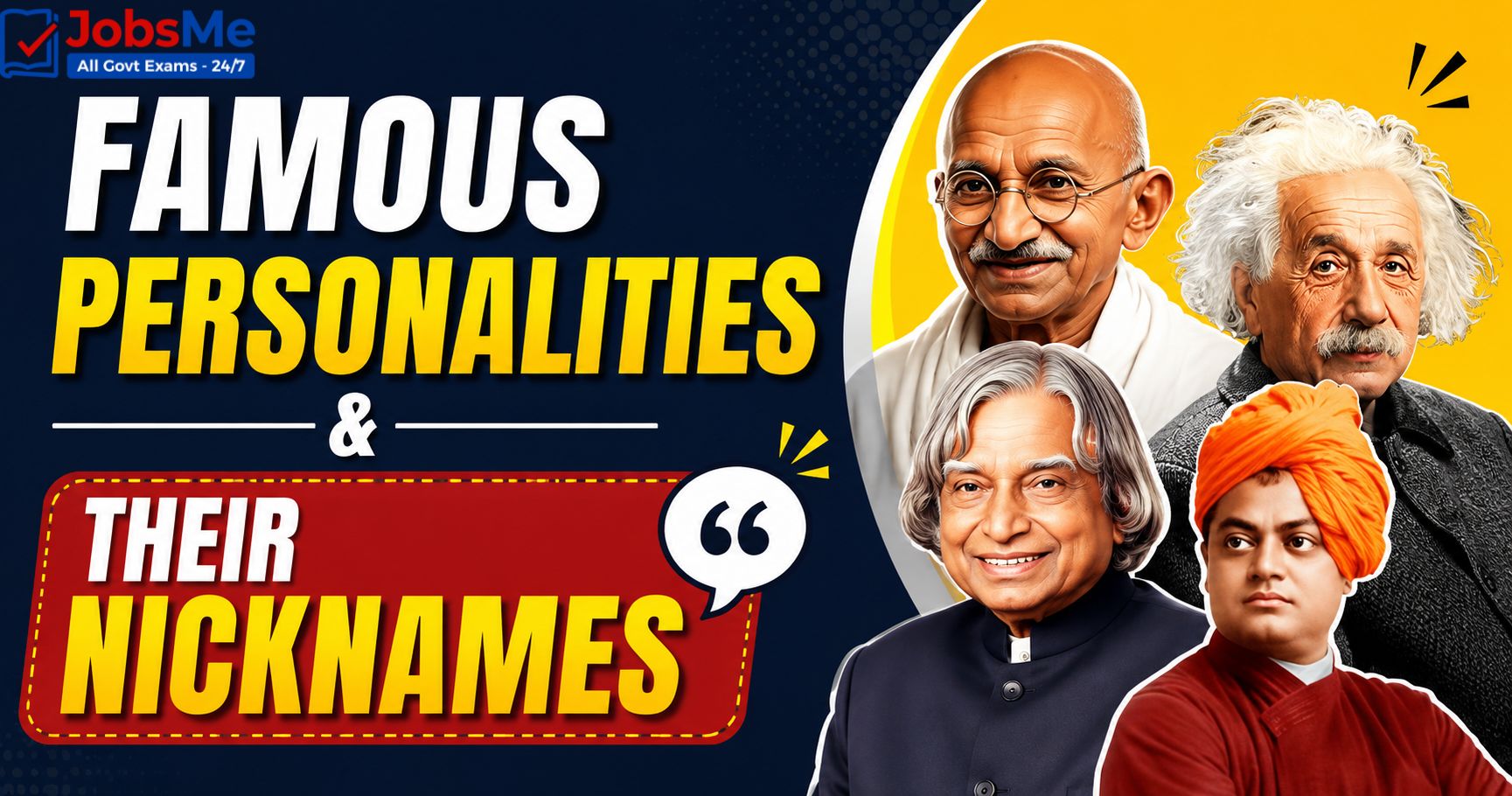
List of Famous Personalities and Their Nicknames – Static GK & General Awareness for Competitive Exams with Memory Tricks
This article presents a complete list of famous Indian personalities and their nicknames, covering freedom fighters, political leaders, social reformers, poets, saints, rulers, scientists, and sports personalities, along with the reasons behind each nickname. It includes iconic figures like Mahatma Gandhi (Bapu), Sardar Patel (Iron Man), Subhash Chandra Bose (Netaji), Lala Lajpat Rai (Punjab Kesari), Sachin Tendulkar (Little Master), Milkha Singh (Flying Sikh), and P. T. Usha (Payyoli Express), with memory tricks and one-liners for quick revision. All facts are arranged in exam-ready format to help UPSC, SSC, IBPS, RRB, PSU, and State PCS aspirants score better in General Awareness and Modern History sections.
Jump to section
- Introduction
- Core Concepts: Why Famous Personalities Have Nicknames
- Famous National Leaders and Freedom Fighters - Nicknames
- Saints, Poets, Rulers, and Literary Personalities - Nicknames
- Famous Indian Sports Personalities and Their Nicknames
- Memory Tricks and Mnemonics
- Additional Notes
- One-Liners for Quick Revision
Introduction
India's history, politics, literature, and sports are filled with iconic figures who are remembered not just by their official names but by the affectionate nicknames bestowed on them by the public, fellow leaders, or the press. Mahatma Gandhi is universally known as "Bapu" and the "Father of the Nation"; Sardar Vallabhbhai Patel is the "Iron Man of India"; Subhash Chandra Bose is "Netaji"; and on the sports field, Milkha Singh is the "Flying Sikh" while Sachin Tendulkar is the "Little Master". These nicknames are not random — each captures a defining trait, achievement, or contribution.
Questions on famous personalities and their nicknames appear regularly in UPSC Prelims, SSC CGL, IBPS PO, RRB NTPC, SBI Clerk, State PCS, and various Insurance and Defence exams. Questions typically ask which nickname is associated with which personality, who was called by a specific title (like "Grand Old Man of India" or "Punjab Kesari"), or which freedom fighter is known by a particular epithet. This article brings together every important nickname in a structured, exam-ready format. To explore other related Static GK topics, you can refer to the Famous Personalities and Their Nicknames - Static GK guide on Jobsme.in.
Nicknames of famous personalities are also closely linked to current affairs themes such as Bharat Ratna conferments, death anniversaries of national leaders, birth centenaries, sports honours like the Khel Ratna and Padma awards, and ongoing references in Parliament and public speeches — making this topic doubly important for aspirants preparing for UPSC Mains and Essay papers as well.
Core Concepts: Why Famous Personalities Have Nicknames
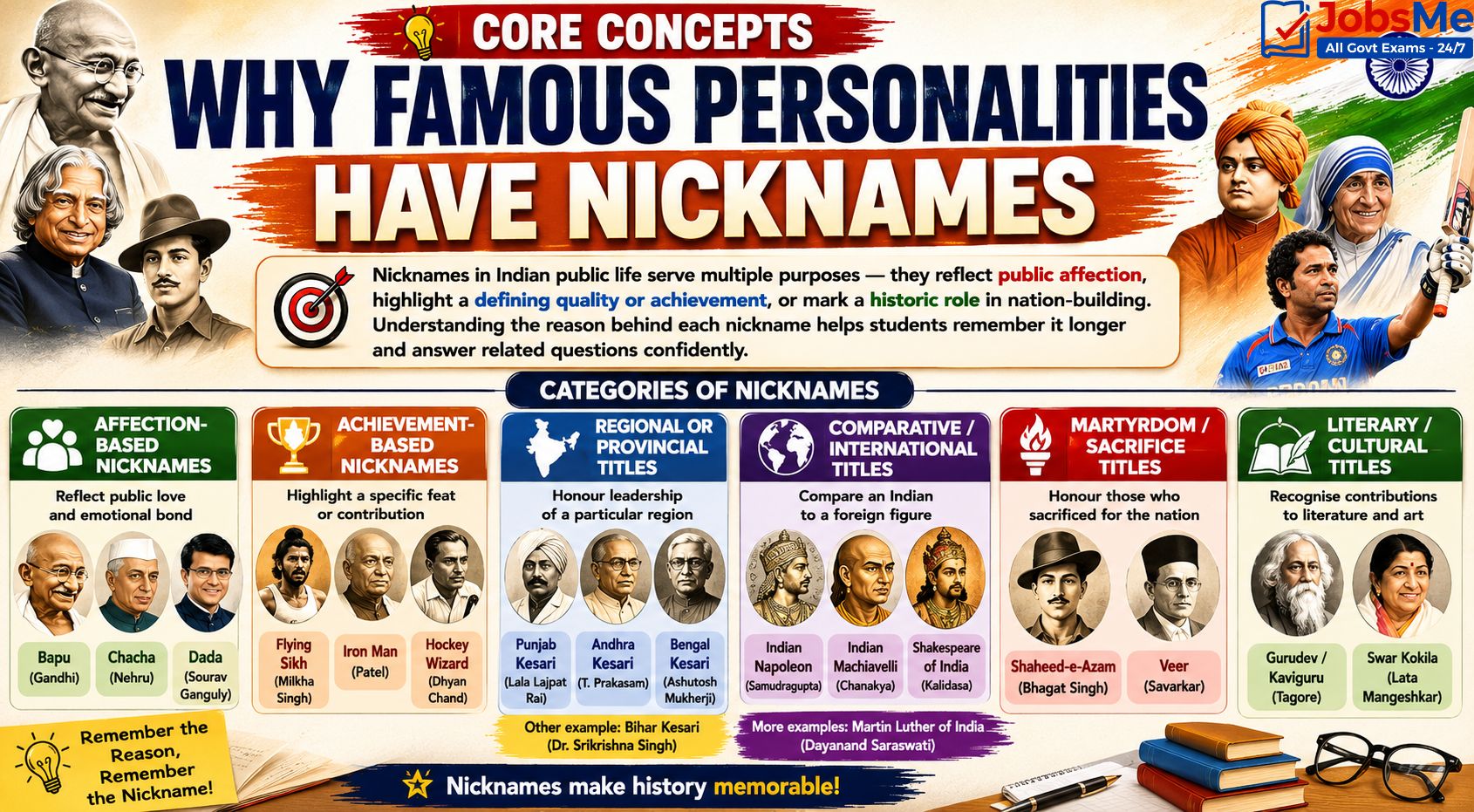
Nicknames in Indian public life serve multiple purposes — they reflect public affection, highlight a defining quality or achievement, or mark a historic role in nation-building. Understanding the reason behind each nickname helps students remember it longer and answer related questions confidently.
Categories of Nicknames
- Affection-Based Nicknames: Reflect public love and emotional bond. Example: Bapu (Gandhi), Chacha (Nehru), Dada (Sourav Ganguly).
- Achievement-Based Nicknames: Highlight a specific feat or contribution. Example: Flying Sikh (Milkha Singh), Iron Man (Patel), Hockey Wizard (Dhyan Chand).
- Regional or Provincial Titles: Honour leadership of a particular region. Example: Punjab Kesari (Lala Lajpat Rai), Andhra Kesari (T. Prakasam), Bengal Kesari (Ashutosh Mukherji), Bihar Kesari (Dr. Srikrishna Singh).
- Comparative / International Titles: Compare an Indian to a foreign figure. Example: Indian Napoleon (Samudragupta), Indian Machiavelli (Chanakya), Shakespeare of India (Kalidasa), Martin Luther of India (Dayanand Saraswati).
- Martyrdom / Sacrifice Titles: Honour those who sacrificed for the nation. Example: Shaheed-e-Azam (Bhagat Singh), Veer (Savarkar).
- Literary / Cultural Titles: Recognise contributions to literature and art. Example: Gurudev / Kaviguru (Tagore), Adi Kavi (Valmiki), Swar Kokila (Lata Mangeshkar).
Famous National Leaders and Freedom Fighters - Nicknames
The following table lists the most exam-relevant nicknames of national leaders, freedom fighters, and social reformers along with the reason behind each title.
| Personality | Nickname(s) | Reason / Key Details |
|---|---|---|
| Mohandas Karamchand Gandhi | Bapu, Father of the Nation, Mahatma, Gandhiji, Saint of Sabarmati | Title "Bapu" given out of public affection; "Father of the Nation" first used by Subhash Chandra Bose in 1944; "Saint of Sabarmati" for his life at Sabarmati Ashram. |
| Sardar Vallabhbhai Patel | Iron Man of India, Bismarck of India, Strong Man of India, Man of Iron | Integrated 562 princely states into the Indian Union; compared to Otto von Bismarck of Germany; his birth anniversary (31 October) is celebrated as Rashtriya Ekta Diwas. |
| Jawaharlal Nehru | Chacha, Chacha Nehru, Panditji | First Prime Minister of India; "Chacha" for his deep affection for children; his birthday (14 November) is celebrated as Children's Day. |
| Subhash Chandra Bose | Netaji, Patriot of Patriots | Founded the Forward Bloc and led the Indian National Army (Azad Hind Fauj); coined the slogan "Jai Hind" and "Tum Mujhe Khoon Do, Main Tumhe Azadi Doonga." |
| Bhagat Singh | Shaheed-e-Azam, Prince of Martyrs | "Martyr of the Great Order"; hanged on 23 March 1931 along with Rajguru and Sukhdev; founded the Hindustan Socialist Republican Association. |
| Bal Gangadhar Tilak | Lokmanya, Lion of Maratha | "Accepted by the people as their leader"; gave the slogan "Swaraj is my birthright and I shall have it"; founded Kesari and Maratha newspapers. |
| Lala Lajpat Rai | Punjab Kesari (Lion of Punjab) | Founder of Punjab National Bank; died in 1928 from injuries received during a lathi charge while protesting the Simon Commission. |
| Bipin Chandra Pal | Bengal Tiger, Father of Revolutionary Thoughts | One of the three "Lal-Bal-Pal" trio; pioneer of the Swadeshi Movement and Extremist faction of Congress. |
| Lal, Bal, Pal (trio) | Lal-Bal-Pal | Lala Lajpat Rai, Bal Gangadhar Tilak, and Bipin Chandra Pal — the three Extremist leaders who led the Swadeshi Movement (1905-11). |
| Dadabhai Naoroji | Grand Old Man of India | First Indian MP in the British House of Commons (1892); author of the "Drain of Wealth" theory and the book "Poverty and Un-British Rule in India." |
| Sarojini Naidu | Nightingale of India, Bharat Kokila | First woman President of the Indian National Congress (1925); first woman Governor of an Indian state (United Provinces). |
| Indira Gandhi | Iron Lady of India, Priyadarshini | First and only female Prime Minister of India; led India during the 1971 Bangladesh Liberation War; "Priyadarshini" was her birth name affix. |
| Lal Bahadur Shastri | Man of Peace, Shanti Purush | Second Prime Minister of India; gave the slogan "Jai Jawan Jai Kisan" during the 1965 Indo-Pak War; died in Tashkent in 1966. |
| Dr. Rajendra Prasad | Desh Ratna, Ajatshatru | First President of India; "Ajatshatru" means "one with no enemies"; served two terms as President (1950-1962). |
| Rabindranath Tagore | Gurudev, Kaviguru, Biswa Kavi | First non-European Nobel laureate in Literature (1913) for "Gitanjali"; composed the national anthems of India and Bangladesh. |
| Raja Ram Mohan Roy | Morning Star of the Indian Renaissance, Father of Modern India | Founder of Brahmo Samaj (1828); led the campaign for abolition of Sati; pioneer of the Indian Renaissance and English education. |
| Dayanand Saraswati | Martin Luther of India | Founder of Arya Samaj (1875); led the "Back to the Vedas" movement. |
| Abdul Ghaffar Khan | Frontier Gandhi, Badshah Khan, Sarhadi Gandhi | Pashtun freedom fighter; founder of the Khudai Khidmatgar movement; first non-Indian to receive the Bharat Ratna (1987). |
| Chitta Ranjan Das | Deshbandhu, Desabandhu | "Friend of the Country"; co-founder of the Swaraj Party with Motilal Nehru in 1923. |
| C. F. Andrews | Deenabandhu | "Friend of the Poor"; British missionary and close associate of Gandhi. |
| Madan Mohan Malaviya | Mahamana, Prince of Beggars | Founder of Banaras Hindu University (BHU); awarded Bharat Ratna posthumously in 2015. |
| Vinoba Bhave | Acharya | Founder of the Bhoodan Movement (1951); first recipient of the Ramon Magsaysay Award (1958); Bharat Ratna (1983). |
| Jayaprakash Narayan | JP, Loknayak | "Leader of the People"; led the Total Revolution (Sampoorna Kranti) against Indira Gandhi's government in 1974; Bharat Ratna (1999). |
| Karpuri Thakur | Jana Nayak | "People's Leader"; former Chief Minister of Bihar; Bharat Ratna awarded posthumously in 2024. |
| Mother Teresa | Saint of the Gutters, Mother | Founder of Missionaries of Charity; Nobel Peace Prize (1979); Bharat Ratna (1980); canonised as a saint by the Catholic Church (2016). |
| Sheikh Mohammad Abdullah | Sher-e-Kashmir, Lion of Kashmir | First Prime Minister (later Chief Minister) of Jammu and Kashmir; founder of the National Conference. |
| Jagjivan Ram | Babuji | Senior Dalit leader; longest-serving Cabinet Minister in India; former Deputy Prime Minister. |
| C. N. Annadurai | Anna | "Elder Brother"; founder of DMK and former Chief Minister of Madras State (later Tamil Nadu). |
| T. Prakasam | Andhra Kesari | "Lion of Andhra"; first Chief Minister of Andhra State. |
| Ashutosh Mukherji | Bengal Kesari | "Lion of Bengal"; educationist and Vice-Chancellor of Calcutta University. |
| Dr. Srikrishna Singh | Bihar Kesari | "Lion of Bihar"; first Chief Minister of Bihar after independence. |
| Dr. Anurag Narayan Singh | Bihar Vibhuti | "Jewel of Bihar"; veteran freedom fighter and politician of Bihar. |
| Yatindra Mohan Sengupta | Deshpriya | "Loved by the Nation"; Mayor of Calcutta and Congress leader. |
| Ravi Shankar Maharaj | Father of Gujarat | Gandhian social reformer of Gujarat; led tribal welfare programmes. |
| C. Rajagopalachari | Rajaji, CR | First and only Indian Governor-General of India (1948-50); founder of the Swatantra Party; Bharat Ratna (1954). |
| Chaudhary Devi Lal | Tau | "Paternal Uncle"; former Deputy Prime Minister and Chief Minister of Haryana. |
| Chandra Sekhar | Young Turk | Former Prime Minister of India; known for his rebellious socialist politics within the Congress. |
| Purushottam Das Tandon | Rajarshee | "Royal Sage"; freedom fighter and Hindi advocate; Bharat Ratna (1961). |
| M. S. Golwalkar | Guruji | Second Sarsanghchalak of the Rashtriya Swayamsevak Sangh (RSS) from 1940 to 1973. |
| Rani Lakshmi Bai | Jhansi Ki Rani, Manu | Queen of Jhansi who led the 1857 Revolt; symbol of women's resistance against British rule. |
| Chandrashekhar Azad | Azad | "The Free One"; revolutionary leader of HSRA; shot himself at Alfred Park, Allahabad (1931) to avoid arrest. |
| Vinayak Damodar Savarkar | Veer Savarkar | "Brave"; revolutionary, author of "The Indian War of Independence 1857"; popularised Hindutva ideology. |
| Sayyed Brothers (Sayyed Bandhu) | King Makers of Indian History | Hassan Ali Khan and Hussain Ali Khan; deposed and installed several Mughal emperors in the 18th century. |
| Salim Ali | Bird Man of India | Pioneering ornithologist; Padma Vibhushan; instrumental in saving the Bharatpur and Silent Valley sanctuaries. |
| Lord Ripon | Father of Local Self-Government in India | Viceroy of India (1880-84); passed the Local Self-Government Resolution of 1882. |
Saints, Poets, Rulers, and Literary Personalities - Nicknames
The following table lists nicknames associated with ancient and medieval personalities, poets, philosophers, and rulers frequently asked in competitive exams.
| Personality | Nickname(s) | Reason / Key Details |
|---|---|---|
| Valmiki | Adi Kavi | "First Poet"; author of the Ramayana, the world's first epic poem. |
| Kalidasa | Shakespeare of India | Classical Sanskrit poet and playwright; author of "Abhijnanasakuntalam" and "Meghaduta." |
| Chanakya (Kautilya) | Indian Machiavelli, Machiavelli of India | Author of Arthashastra; chief advisor of Chandragupta Maurya; master of political strategy. |
| Samudragupta | Napoleon of India | Gupta emperor known for his military conquests; title given by historian V. A. Smith. |
| Tipu Sultan | Tiger of Mysore, Mysore Tiger | Ruler of Mysore who fought four Anglo-Mysore Wars against the British; killed in 1799. |
| Amir Khusrau | Tota-e-Hind, Parrot of India | Sufi poet and musician; credited with inventing the sitar and tabla; disciple of Nizamuddin Auliya. |
| Siddhartha Gautama (Sri Buddha) | Buddha, Light of Asia | Founder of Buddhism; "Light of Asia" was popularised by Sir Edwin Arnold's poem of the same name. |
| Jainul Abdin | Akbar of Kashmir | Liberal Sultan of Kashmir (1420-1470); known for religious tolerance and patronage of arts. |
| Babur | Prince of Autobiography | Founder of the Mughal Empire; author of the famous Baburnama in Turkish. |
| Shah Jahan | Prince of Builders, Engineer King | Mughal emperor known for the Taj Mahal, Red Fort, and Jama Masjid. |
| Muhammad bin Tughlaq | Wise Fool King | Delhi Sultan known for unusual experiments — capital shift to Daulatabad, token currency, etc. |
| Mohammad Ali Jinnah | Quaid-e-Azam | "Great Leader"; founder of Pakistan and its first Governor-General. |
| Sheikh Mujibur Rahman | Bangabandhu | "Friend of Bengal"; founder and first President of Bangladesh. |
| Adi Shankaracharya | Sage of Kanchi | 8th-century philosopher; founder of Advaita Vedanta; established four mathas across India. |
| Bankim Chandra Chattopadhyay | Sahitya Samrat | "Emperor of Literature"; author of "Anandamath" and composer of "Vande Mataram." |
| Sarat Chandra Chattopadhyay | Kathasilpi | "Storyteller"; famous Bengali novelist; author of "Devdas" and "Parineeta." |
| Nagarjuna | Indian Einstein | 2nd-century Buddhist philosopher; founder of the Madhyamaka school of Mahayana Buddhism. |
| K. V. Puttappa | Kuvempu | Kannada poet; first Kannada writer to receive the Jnanpith Award (1967). |
| Lata Mangeshkar | Swar Kokila, Nightingale of India | Legendary playback singer; Bharat Ratna (2001); recorded songs in 36 languages. |
| Dhundiraj Govind Phalke (Dadasaheb Phalke) | Grandfather of Indian Films, Father of Indian Cinema | Director of India's first feature film "Raja Harishchandra" (1913). |
| Major General Rajinder Singh | Sparrow | Indian Army officer awarded the Maha Vir Chakra for his role in the 1947 Kashmir operations. |
| Maharaj Kumar of Vizianagaram | Vizzy | Indian cricketer and commentator; captained the Indian team during the 1936 England tour. |
Famous Indian Sports Personalities and Their Nicknames
Indian sports stars are widely known by colourful nicknames that capture their unique style, achievements, or home region. The following table covers the most exam-relevant entries.
| Sports Personality | Nickname(s) | Sport / Key Achievements |
|---|---|---|
| Milkha Singh | Flying Sikh | Athletics (sprinter); narrowly missed Olympic bronze in 1960 Rome 400m; won gold at the Commonwealth Games and Asian Games; Padma Shri (1959). |
| Kapil Dev | Haryana Hurricane | Cricket; captained India to its first Cricket World Cup victory in 1983; Wisden Indian Cricketer of the Century (2002). |
| Dhyan Chand | Hockey Wizard, Magician of Hockey | Hockey; led India to three consecutive Olympic gold medals (1928, 1932, 1936); his birthday (29 August) is National Sports Day. |
| P. T. Usha | Payyoli Express, Udanpari, Queen of Indian Track and Field | Athletics; missed Olympic bronze by 1/100th of a second at Los Angeles 1984; current President of the Indian Olympic Association. |
| Sourav Ganguly | Prince of Kolkata, Dada, Bengal Tiger, God of the Off Side | Cricket; one of India's most successful Test captains; former BCCI President. |
| Sachin Tendulkar | Master Blaster, Little Master, Bombay Bomber, God of Cricket | Cricket; only batsman with 100 international centuries; Bharat Ratna (2014) — youngest and first sportsperson recipient. |
| Sunil Gavaskar | Little Master, Sunny | Cricket; first batsman to score 10,000 Test runs; first to score 34 Test centuries. |
| Anil Kumble | Jumbo | Cricket; only Indian and second bowler in Test history to take all 10 wickets in an innings (vs Pakistan, 1999). |
| Virender Sehwag | Veeru, Nawab of Najafgarh, Sultan of Multan | Cricket; first Indian to score a Test triple century (309 vs Pakistan, 2004). |
| Rahul Dravid | The Wall, Jammy, Mr. Dependable | Cricket; current head coach of Indian cricket team (former); known for his impeccable defensive technique. |
| Harbhajan Singh | Turbanator, Bhajji | Cricket; first Indian bowler to take a Test hat-trick (vs Australia, 2001). |
| Zaheer Khan | Baroda Express | Cricket; ace left-arm fast bowler; key member of India's 2011 World Cup-winning team. |
| Mahendra Singh Dhoni | Mr. Cool, Captain Cool, Mahi | Cricket; only captain to win all three ICC trophies (T20 World Cup 2007, ODI World Cup 2011, Champions Trophy 2013). |
| Javagal Srinath | Mysore Express | Cricket; India's first genuine fast bowler to consistently bowl 145+ kmph. |
| Gautam Gambhir | Gauti | Cricket; played match-winning innings in 2007 T20 and 2011 ODI World Cup finals; current head coach of Team India. |
| Mary Kom | Magnificent Mary, Meethoileima | Boxing; six-time World Amateur Boxing Champion; Olympic bronze medallist (London 2012); Padma Vibhushan. |
| Virat Kohli | Cheeku, King Kohli, Run Machine | Cricket; former captain of all three formats; fastest to multiple ODI milestones; Khel Ratna and Padma Shri recipient. |
| Rohit Sharma | Hitman, Sharma Ji | Cricket; current Indian captain; only batsman with three ODI double centuries. |
Memory Tricks and Mnemonics
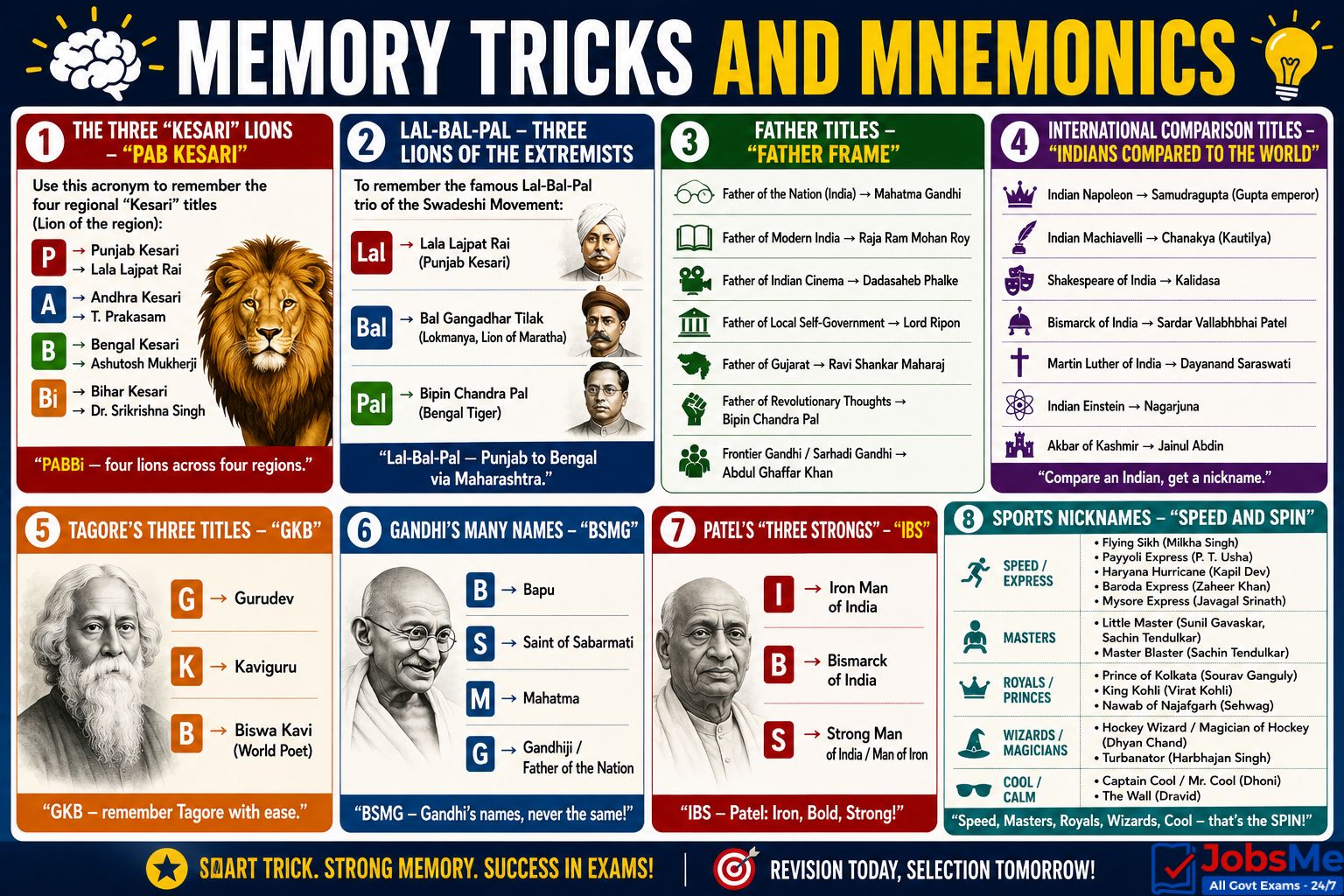
Trick 1: The Three "Kesari" Lions — "PAB Kesari"
Use this acronym to remember the four regional "Kesari" titles (Lion of the region):
- P → Punjab Kesari → Lala Lajpat Rai.
- A → Andhra Kesari → T. Prakasam.
- B → Bengal Kesari → Ashutosh Mukherji.
- Bi → Bihar Kesari → Dr. Srikrishna Singh.
"PABBi — four lions across four regions."
Trick 2: Lal-Bal-Pal — Three Lions of the Extremists
To remember the famous Lal-Bal-Pal trio of the Swadeshi Movement:
- Lal → Lala Lajpat Rai (Punjab Kesari).
- Bal → Bal Gangadhar Tilak (Lokmanya, Lion of Maratha).
- Pal → Bipin Chandra Pal (Bengal Tiger).
"Lal-Bal-Pal — Punjab to Bengal via Maharashtra."
Trick 3: Father Titles — "Father Frame"
Many personalities are known as the "Father of…" something. Use this list:
- Father of the Nation (India) → Mahatma Gandhi.
- Father of Modern India → Raja Ram Mohan Roy.
- Father of Indian Cinema → Dadasaheb Phalke.
- Father of Local Self-Government → Lord Ripon.
- Father of Gujarat → Ravi Shankar Maharaj.
- Father of Revolutionary Thoughts → Bipin Chandra Pal.
- Frontier Gandhi / Sarhadi Gandhi → Abdul Ghaffar Khan.
Trick 4: International Comparison Titles — "Indians Compared to the World"
- Indian Napoleon → Samudragupta (Gupta emperor).
- Indian Machiavelli → Chanakya (Kautilya).
- Shakespeare of India → Kalidasa.
- Bismarck of India → Sardar Vallabhbhai Patel.
- Martin Luther of India → Dayanand Saraswati.
- Indian Einstein → Nagarjuna.
- Akbar of Kashmir → Jainul Abdin.
"Compare an Indian, get a nickname."
Trick 5: Tagore's Three Titles — "GKB"
Rabindranath Tagore has three famous nicknames; remember them as "GKB":
- G → Gurudev.
- K → Kaviguru.
- B → Biswa Kavi (World Poet).
Trick 6: Gandhi's Many Names — "BSMG"
Mahatma Gandhi is known by multiple titles. Use "BSMG":
- B → Bapu.
- S → Saint of Sabarmati.
- M → Mahatma.
- G → Gandhiji / Father of the Nation.
Trick 7: Patel's "Three Strongs" — "IBS"
Sardar Patel has three iron-themed nicknames:
- I → Iron Man of India.
- B → Bismarck of India.
- S → Strong Man of India / Man of Iron.
Trick 8: Sports Nicknames — "Speed and Spin"
Group sports nicknames by their theme to remember faster:
- Speed / Express: Flying Sikh (Milkha Singh), Payyoli Express (P. T. Usha), Haryana Hurricane (Kapil Dev), Baroda Express (Zaheer Khan), Mysore Express (Javagal Srinath).
- Masters: Little Master (Sunil Gavaskar, Sachin Tendulkar), Master Blaster (Sachin Tendulkar).
- Royals / Princes: Prince of Kolkata (Sourav Ganguly), King Kohli (Virat Kohli), Nawab of Najafgarh (Sehwag).
- Wizards / Magicians: Hockey Wizard / Magician of Hockey (Dhyan Chand), Turbanator (Harbhajan Singh).
- Cool / Calm: Captain Cool / Mr. Cool (Dhoni), The Wall (Dravid).
Additional Notes
Frequently Confused Facts
- Nightingale of India: Sarojini Naidu is primarily called the Nightingale of India; Lata Mangeshkar is also referred to as the Nightingale of India / Swar Kokila — context determines which is meant.
- Little Master: Both Sunil Gavaskar and Sachin Tendulkar are called the Little Master. Gavaskar received the title first; Sachin is more popularly called "Master Blaster."
- Lion of Kashmir vs Lion of Punjab vs Lion of Maratha: Sheikh Mohammad Abdullah is Lion of Kashmir (Sher-e-Kashmir); Lala Lajpat Rai is Lion of Punjab (Punjab Kesari); Bal Gangadhar Tilak is Lion of Maratha.
- Bengal Tiger: Refers to both Bipin Chandra Pal (freedom fighter) and Sourav Ganguly (cricketer) — context decides.
- Frontier Gandhi: Abdul Ghaffar Khan, not Mahatma Gandhi himself. He was also called Badshah Khan and Sarhadi Gandhi.
- Iron Man vs Iron Lady: Iron Man of India is Sardar Patel; Iron Lady of India is Indira Gandhi.
- Father of the Nation vs Father of Modern India: Mahatma Gandhi is Father of the Nation; Raja Ram Mohan Roy is Father of Modern India / Father of the Indian Renaissance.
- Loknayak vs Lokmanya: Loknayak (Leader of the People) is Jayaprakash Narayan; Lokmanya (Revered by the People) is Bal Gangadhar Tilak.
- Desabandhu vs Deenabandhu: Desabandhu (Friend of the Country) is C. R. Das; Deenabandhu (Friend of the Poor) is C. F. Andrews.
- Hockey Wizard vs Wizard of Oz: "Hockey Wizard" and "Magician of Hockey" both refer to Major Dhyan Chand.
- Adi Kavi vs Mahakavi: Valmiki is the Adi Kavi (First Poet); Kalidasa is the Mahakavi / Shakespeare of India.
- Master Blaster vs Hitman: Master Blaster is Sachin Tendulkar; Hitman is Rohit Sharma.
Repeating PYQ Patterns
Certain personality-nickname pairs are asked repeatedly in competitive exams. Mahatma Gandhi (Bapu, Father of the Nation), Subhash Chandra Bose (Netaji), Sardar Patel (Iron Man, Bismarck of India), Bhagat Singh (Shaheed-e-Azam), Lala Lajpat Rai (Punjab Kesari), Sarojini Naidu (Nightingale of India), Dadabhai Naoroji (Grand Old Man of India), Milkha Singh (Flying Sikh), Dhyan Chand (Hockey Wizard), Kapil Dev (Haryana Hurricane), P. T. Usha (Payyoli Express), and Sachin Tendulkar (Master Blaster) appear most often in UPSC Prelims, SSC CGL, and RRB NTPC papers. Banking exams (IBPS PO, SBI Clerk) frequently focus on matching nicknames with personalities. State PCS exams add regional leaders — Andhra PCS asks about T. Prakasam (Andhra Kesari), Bihar PCS about Dr. Srikrishna Singh and Karpuri Thakur, Tamil Nadu PCS about Annadurai (Anna), and Haryana PCS about Chaudhary Devi Lal (Tau).
Quick Insight
Nicknames are more than mere labels — they are condensed history. Each title captures an entire chapter of India's past in two or three words: "Iron Man" recalls the integration of 562 princely states; "Flying Sikh" recalls a Partition refugee's rise to Olympic glory; "Frontier Gandhi" recalls a Pashtun's lifelong commitment to non-violence. Understanding these nicknames helps aspirants quickly connect any historical or sports reference to its central figure, which is invaluable for both Prelims (direct matching questions) and Mains (essays on freedom struggle, national integration, and sports heritage). For further reading on related Static GK topics, you can refer to the Governor-General and Viceroy of India guide and the Important Battles in Indian History notes on Jobsme.in.
One-Liners for Quick Revision
- Mahatma Gandhi → Bapu, Father of the Nation, Mahatma, Saint of Sabarmati, Gandhiji.
- Sardar Vallabhbhai Patel → Iron Man of India, Bismarck of India, Strong Man of India, Man of Iron.
- Jawaharlal Nehru → Chacha, Chacha Nehru, Panditji.
- Subhash Chandra Bose → Netaji, Patriot of Patriots.
- Bhagat Singh → Shaheed-e-Azam, Prince of Martyrs.
- Bal Gangadhar Tilak → Lokmanya, Lion of Maratha.
- Lala Lajpat Rai → Punjab Kesari / Panjab Kesari, Lion of Punjab.
- Bipin Chandra Pal → Bengal Tiger, Father of Revolutionary Thoughts.
- Lal-Bal-Pal → Lala Lajpat Rai, Bal Gangadhar Tilak, Bipin Chandra Pal.
- Dadabhai Naoroji → Grand Old Man of India.
- Sarojini Naidu → Nightingale of India, Bharat Kokila.
- Indira Gandhi → Iron Lady of India, Priyadarshini.
- Lal Bahadur Shastri → Man of Peace, Shanti Purush.
- Dr. Rajendra Prasad → Desh Ratna, Ajatshatru.
- Rabindranath Tagore → Gurudev, Kaviguru, Biswa Kavi.
- Raja Ram Mohan Roy → Morning Star of the Indian Renaissance, Father of Modern India.
- Dayanand Saraswati → Martin Luther of India.
- Abdul Ghaffar Khan → Frontier Gandhi, Badshah Khan, Sarhadi Gandhi.
- Chitta Ranjan Das (C. R. Das) → Deshbandhu / Desabandhu.
- C. F. Andrews → Deenabandhu.
- Madan Mohan Malaviya → Mahamana, Prince of Beggars.
- Vinoba Bhave → Acharya.
- Jayaprakash Narayan → JP, Loknayak.
- Karpuri Thakur → Jana Nayak.
- Mother Teresa → Saint of the Gutters, Mother.
- Sheikh Mohammad Abdullah → Sher-e-Kashmir, Lion of Kashmir.
- Jagjivan Ram → Babuji.
- C. N. Annadurai → Anna.
- T. Prakasam → Andhra Kesari.
- Ashutosh Mukherji → Bengal Kesari.
- Dr. Srikrishna Singh → Bihar Kesari.
- Dr. Anurag Narayan Singh → Bihar Vibhuti.
- Yatindra Mohan Sengupta → Deshpriya.
- Ravi Shankar Maharaj → Father of Gujarat.
- C. Rajagopalachari → Rajaji, CR.
- Chaudhary Devi Lal → Tau.
- Chandra Sekhar → Young Turk.
- Purushottam Das Tandon → Rajarshee.
- M. S. Golwalkar → Guruji.
- Rani Lakshmi Bai → Jhansi Ki Rani, Manu.
- Chandrashekhar Azad → Azad.
- Vinayak Damodar Savarkar → Veer Savarkar.
- Sayyed Brothers → King Makers of Indian History.
- Salim Ali → Bird Man of India.
- Lord Ripon → Father of Local Self-Government in India.
- Valmiki → Adi Kavi (First Poet).
- Kalidasa → Shakespeare of India.
- Chanakya → Indian Machiavelli, Machiavelli of India.
- Samudragupta → Napoleon of India.
- Tipu Sultan → Tiger of Mysore, Mysore Tiger.
- Amir Khusrau → Tota-e-Hind, Parrot of India.
- Siddhartha Gautama → Buddha, Light of Asia.
- Jainul Abdin → Akbar of Kashmir.
- Babur → Prince of Autobiography.
- Shah Jahan → Prince of Builders.
- Muhammad bin Tughlaq → Wise Fool King.
- Mohammad Ali Jinnah → Quaid-e-Azam.
- Sheikh Mujibur Rahman → Bangabandhu.
- Adi Shankaracharya → Sage of Kanchi.
- Bankim Chandra Chattopadhyay → Sahitya Samrat.
- Sarat Chandra Chattopadhyay → Kathasilpi.
- Nagarjuna → Indian Einstein.
- K. V. Puttappa → Kuvempu.
- Lata Mangeshkar → Swar Kokila.
- Dadasaheb Phalke → Grandfather of Indian Films, Father of Indian Cinema.
- Major General Rajinder Singh → Sparrow.
- Maharaj Kumar of Vizianagaram → Vizzy.
- Milkha Singh → Flying Sikh.
- Kapil Dev → Haryana Hurricane.
- Dhyan Chand → Hockey Wizard, Magician of Hockey.
- P. T. Usha → Payyoli Express, Udanpari.
- Sourav Ganguly → Prince of Kolkata, Dada, Bengal Tiger, God of the Off Side.
- Sachin Tendulkar → Master Blaster, Little Master, Bombay Bomber.
- Sunil Gavaskar → Little Master, Sunny.
- Anil Kumble → Jumbo.
- Virender Sehwag → Veeru, Nawab of Najafgarh.
- Rahul Dravid → The Wall, Jammy, Mr. Dependable.
- Harbhajan Singh → Turbanator, Bhajji.
- Zaheer Khan → Baroda Express.
- Mahendra Singh Dhoni → Mr. Cool, Captain Cool, Mahi.
- Javagal Srinath → Mysore Express.
- Gautam Gambhir → Gauti.
- Mary Kom → Magnificent Mary, Meethoileima.
- Virat Kohli → Cheeku, King Kohli, Run Machine.
- Rohit Sharma → Hitman.
For more Static GK topics like Indian dynasties, battles, and dances, explore the Static GK section on Jobsme.in. You can also test your knowledge with the Static GK Quiz and check out the latest exam notifications at Latest Government Job Notifications.
Free quiz • No signup required
Put this topic into practice with Indian Cultural Institutions – Static GK MCQ Quiz. It is the quickest way to reinforce what you just learned.
Frequently Asked Questions
Who is known as the Father of the Nation in India?
Why is Sardar Vallabhbhai Patel called the Iron Man of India?
Who are referred to as Lal-Bal-Pal in Indian history?
Who is known as the Nightingale of India?
Why is Milkha Singh called the Flying Sikh?
Who is called the Hockey Wizard of India?
Who is known as the Grand Old Man of India?
Why is Bhagat Singh called Shaheed-e-Azam?
Who is called the Frontier Gandhi and why?
Who is referred to as the Master Blaster of Indian cricket?

About the author