Major Tribes of India – Static GK & General Awareness for Competitive Exams with Memory Tricks
This article covers a comprehensive state-wise list of major tribes of India, including Scheduled Tribes (STs), Particularly Vulnerable Tribal Groups (PVTGs), constitutional provisions, regional classifications, and key facts about famous tribes like Bhils, Gonds, Santhals, and Mundas. It is designed for UPSC, SSC, IBPS, RRB, Insurance, Defence, and State PCS aspirants, with memory tricks, one-liners, and FAQs for quick revision. All facts are organised in an exam-ready format to help students score better in the General Awareness section.
Jump to section
- Introduction
- Core Concepts: Definition and Classification of Tribes in India
- Key Statistics on Indian Tribes
- State-Wise List of Major Tribes in India
- Famous Major Tribes of India: Detailed Profile
- Particularly Vulnerable Tribal Groups (PVTGs) State-Wise
- Geographical Distribution of Indian Tribes
- Constitutional Provisions for Scheduled Tribes
- Important Committees and Acts Related to Tribes
- Memory Tricks and Mnemonics for Tribes of India
- Additional Notes
- One-Liners for Quick Revision
Introduction
India is often described as a melting pot of tribes and races, with the second-largest concentration of tribal population in the world after Africa. According to the 2011 Census, the tribal population constitutes about 8.6% of India's total population, which is approximately 10.4 crore people. India officially recognises 705 Scheduled Tribes under Article 342 of the Constitution, spread across more than 30 states and Union Territories. For students preparing for competitive exams, knowledge of tribes — their states, languages, customs, and constitutional safeguards — is a recurring and high-scoring topic in Static GK and General Awareness sections.
Questions on Indian tribes regularly appear in UPSC Prelims, SSC CGL, IBPS PO/Clerk, RRB NTPC, SBI, LIC, NIACL, EPFO, State PCS, and Defence exams. Aspirants are asked which state a tribe belongs to, which tribes are classified as PVTGs, or which constitutional article defines Scheduled Tribes. This article presents all the key facts in a structured, exam-ready format. To explore more culture and society-related Static GK, visit the Indian Fairs and Festivals guide on Jobsme.in.
Beyond exams, India's tribal diversity is closely tied to current affairs — from the celebration of Janjatiya Gaurav Divas on 15 November honouring the tribal freedom fighter Birsa Munda, to the historic election of Smt. Droupadi Murmu as the first tribal President of India. Mastering this topic builds the foundation for objective questions and supports descriptive answers in UPSC Mains and essay papers on social justice, anthropology, and indigenous rights.
Core Concepts: Definition and Classification of Tribes in India
According to the Imperial Gazetteer of India, a tribe is defined as a collection of families bearing a common name, speaking a common dialect, and occupying or professing to occupy a common territory. Tribes share common ancestry, beliefs, customs, and a strong connection with their natural environment. The Indian Constitution, under Article 366(25), defines Scheduled Tribes as those tribes or tribal communities deemed under Article 342 to be Scheduled Tribes for the purposes of the Constitution.
- Adivasis: A general term meaning "indigenous population" or "original inhabitants" of India. Adivasis possess distinct cultures, languages, and customs, and have a deep understanding of the ecology and resources of their regions.
- Scheduled Tribes (STs): Communities recognised under Article 342 of the Constitution. Their essential characteristics include primitive traits, geographical isolation, distinct culture, shyness of contact with the larger community, and economic backwardness.
- Particularly Vulnerable Tribal Groups (PVTGs): The most disadvantaged sub-category among STs. Identified on the recommendation of the Dhebar Commission (1973) and created in 1975 as Primitive Tribal Groups (PTGs), later renamed PVTGs. Currently, there are 75 PVTGs spread across 17 states and 1 Union Territory.
- Forest Dwellers: People who live in and around forests and rely on them for livelihood — for hunting, gathering, agriculture, pastoralism, and non-timber forest products like honey, medicinal plants, and bamboo. Their rights are protected under the Forest Rights Act (FRA), 2006.
- Denotified Tribes (DNTs): Communities once labelled "criminal tribes" under the British Criminal Tribes Act, 1871. They were "denotified" or removed from the criminal tribes list after Independence in 1947, but continue to face discrimination and marginalisation.
- Nomadic and Semi-Nomadic Tribes: Communities like Banjara, Lambadi, Raika, Rabari, and Gaddi that move from place to place with their herds in search of food, water, and seasonal resources.
Tribes are also broadly classified on two bases — permanent traits (geography, language, physical or racial attributes, size) and acquired traits (economy, subsistence pattern, and degree of integration into Hindu society). Based on livelihood, tribes can be hunters and food gatherers, fishermen, shifting cultivators, plantation and industrial workers, or agricultural peasants.
Key Statistics on Indian Tribes
Before diving into state-wise lists, it is important to remember the key numerical facts about Indian tribes that are frequently asked in competitive exams.
| Parameter | Figure / Detail | Exam-Relevant Note |
|---|---|---|
| Total Recognised Scheduled Tribes | 705 | Notified under Article 342 of the Constitution. |
| Tribal Population (2011 Census) | About 10.4 crore (8.6% of total) | India has the second-largest tribal population in the world after Africa. |
| Rural vs Urban Tribal Population | 97% rural, 2.8% urban (approx.) | Most tribes live in remote, forested, and hilly areas. |
| Sex Ratio among STs | 990 females per 1,000 males | Higher than the general population sex ratio of 940. |
| Total PVTGs | 75 | Spread across 17 states and 1 Union Territory. |
| Lok Sabha Seats Reserved for STs | 47 | Reserved under Article 330 of the Constitution. |
| Janjatiya Gaurav Divas | 15 November | Celebrates the birth anniversary of Birsa Munda; declared in 2021. |
| State with Largest Tribal Population | Madhya Pradesh (15.3%) | Followed by Maharashtra (10.1%), Odisha (9.1%), Chhattisgarh (8.6%), Jharkhand (8.3%). |
| State with Highest Tribal Concentration | Mizoram, Nagaland, Meghalaya, Arunachal Pradesh | Northeastern states where tribes form over 90% of the population. |
| Largest Tribe in India | Bhil Tribe | Approx. 38% of total ST population; mainly in Rajasthan, MP, Gujarat, Maharashtra. |
State-Wise List of Major Tribes in India
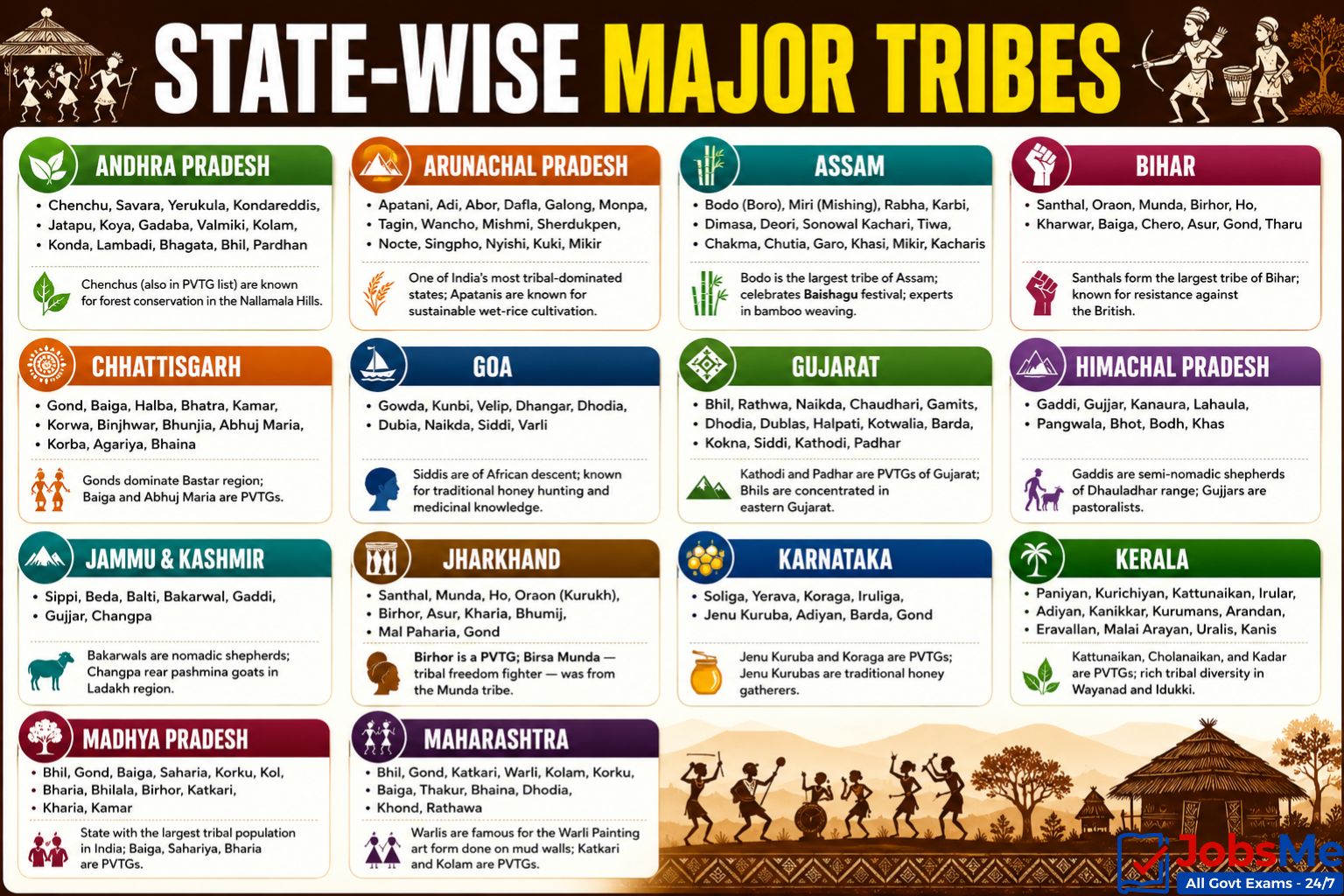
The following table presents a comprehensive state-wise and Union Territory-wise list of major tribes in India along with their key features, languages, and exam-relevant notes. All major tribes from across the country are included.
State-Wise Major Tribes
| State / Union Territory | Major Tribes | Key Features / Exam Notes |
|---|---|---|
| Andhra Pradesh | Chenchu, Savara, Yerukula, Kondareddis, Jatapu, Koya, Gadaba, Valmiki, Kolam, Konda, Lambadi, Bhagata, Bhil, Pardhan | Chenchus (also in PVTG list) are known for forest conservation in the Nallamala Hills. |
| Arunachal Pradesh | Apatani, Adi, Abor, Dafla, Galong, Monpa, Tagin, Wancho, Mishmi, Sherdukpen, Nocte, Singpho, Nyishi, Kuki, Mikir | One of India's most tribal-dominated states; Apatanis are known for sustainable wet-rice cultivation. |
| Assam | Bodo (Boro), Miri (Mishing), Rabha, Karbi, Dimasa, Deori, Sonowal Kachari, Tiwa, Chakma, Chutia, Garo, Khasi, Mikir, Kacharis | Bodo is the largest tribe of Assam; celebrates Baishagu festival; experts in bamboo weaving. |
| Bihar | Santhal, Oraon, Munda, Birhor, Ho, Kharwar, Baiga, Chero, Asur, Gond, Tharu | Santhals form the largest tribe of Bihar; known for resistance against the British. |
| Chhattisgarh | Gond, Baiga, Halba, Bhatra, Kamar, Korwa, Binjhwar, Bhunjia, Abhuj Maria, Korba, Agariya, Bhaina | Gonds dominate Bastar region; Baiga and Abhuj Maria are PVTGs. |
| Goa | Gowda, Kunbi, Velip, Dhangar, Dhodia, Dubia, Naikda, Siddi, Varli | Siddis are of African descent; known for traditional honey hunting and medicinal knowledge. |
| Gujarat | Bhil, Rathwa, Naikda, Chaudhari, Gamits, Dhodia, Dublas, Halpati, Kotwalia, Barda, Kokna, Siddi, Kathodi, Padhar | Kathodi and Padhar are PVTGs of Gujarat; Bhils are concentrated in eastern Gujarat. |
| Himachal Pradesh | Gaddi, Gujjar, Kanaura, Lahaula, Pangwala, Bhot, Bodh, Khas | Gaddis are semi-nomadic shepherds of Dhauladhar range; Gujjars are pastoralists. |
| Jammu & Kashmir | Sippi, Beda, Balti, Bakarwal, Gaddi, Gujjar, Changpa | Bakarwals are nomadic shepherds; Changpa rear pashmina goats in Ladakh region. |
| Jharkhand | Santhal, Munda, Ho, Oraon (Kurukh), Birhor, Asur, Kharia, Bhumij, Mal Paharia, Gond | Birhor is a PVTG; Birsa Munda — tribal freedom fighter — was from the Munda tribe. |
| Karnataka | Soliga, Yerava, Koraga, Iruliga, Jenu Kuruba, Adiyan, Barda, Gond | Jenu Kuruba and Koraga are PVTGs; Jenu Kurubas are traditional honey gatherers. |
| Kerala | Paniyan, Kurichiyan, Kattunaikan, Irular, Adiyan, Kanikkar, Kurumans, Arandan, Eravallan, Malai Arayan, Uralis, Kanis | Kattunaikan, Cholanaikan, and Kadar are PVTGs; rich tribal diversity in Wayanad and Idukki. |
| Madhya Pradesh | Bhil, Gond, Baiga, Saharia, Korku, Kol, Bharia, Bhilala, Birhor, Katkari, Kharia, Kamar | State with the largest tribal population in India; Baiga, Sahariya, Bharia are PVTGs. |
| Maharashtra | Bhil, Gond, Katkari, Warli, Kolam, Korku, Baiga, Thakur, Bhaina, Dhodia, Khond, Rathawa | Warlis are famous for the Warli Painting art form done on mud walls; Katkari and Kolam are PVTGs. |
| Manipur | Naga (Tangkhul, Mao, Maram), Kuki, Meitei (in hill areas only), Paite, Hmar, Angami | Major Naga sub-tribes include Tangkhul; Meiteis are STs only in hill areas. |
| Meghalaya | Khasi, Garo, Jaintia, Chakma, Hajong | Both Khasi and Garo follow matrilineal system; Khasis live in Khasi Hills, Garos in Garo Hills. |
| Mizoram | Lushai (Mizo), Chakma, Hmar, Lai, Mara, Paite, Dimasa, Kuki | Lushais form the dominant tribe; Mizoram has over 90% tribal population. |
| Nagaland | Angami, Ao, Lotha, Sema, Konyak, Chakhesang, Phom, Rengma, Zeliang, Garo | Angamis host the famous Hornbill Festival; known for woodcraft and bamboo art. |
| Odisha | Santhal, Munda, Gond, Bonda, Juang, Dongria Kondh, Saora, Kharia, Paroja, Khond, Chenchu, Gadaba, Birhor, Oraon | Bonda, Juang, Dongria Kondh, Birhor are PVTGs; Khonds practice traditional Gudi village governance. |
| Rajasthan | Bhil, Meena, Garasia, Damor, Saharia, Kathodi, Dhanka, Damaria, Patelia | Bhils believe their gods reside in forests, hills, and rivers; Saharias are a PVTG. |
| Sikkim | Bhutia, Lepcha, Limboo, Tamang, Khas | Lepchas are considered original inhabitants of Sikkim; Bhutias are of Tibetan origin. |
| Tamil Nadu | Todas, Kotas, Irular, Kurumbas, Paniyan, Kattunayakan, Kanikar, Adiyan, Aranadan, Eravallan, Badagas | Todas live in the Nilgiris and follow polyandry; Kotas and Badagas also inhabit the Nilgiris. |
| Telangana | Chenchu, Gond, Koya, Lambada, Kolam | Chenchus are PVTGs; Lambadas (Banjaras) are nomadic traders. |
| Tripura | Tripuri, Reang, Chakma, Jamatia, Halam, Uchoi, Bhutia, Khasia, Lushai | Reangs (Bru) are a PVTG of Tripura; Tripuris form the largest tribal community in the state. |
| Uttar Pradesh | Tharu, Gond, Baiga, Chero, Bhotia, Kol, Jaunsari, Khas | Tharus inhabit the Terai region; Khas live in the Jaunsar-Bawar area. |
| Uttarakhand | Tharu, Bhotia, Jaunsari, Raji, Buksa | Bhotias are semi-nomadic pastoralists of Garhwal and Kumaon; Raji are a PVTG. |
| West Bengal | Santhal, Oraon, Munda, Bhumij, Lodha, Rabha, Mahali, Kora, Asur, Khond, Ho, Bhutia, Birhor, Lodas, Totos | Santhals are the largest tribe; Birhor, Lodas, and Totos are PVTGs of West Bengal. |
| Andaman & Nicobar Islands | Great Andamanese, Jarawas, Onges, Sentinelese, Shompens | All five are PVTGs; Sentinelese remain the most isolated uncontacted tribe in the world. |
Famous Major Tribes of India: Detailed Profile
Among the 705 Scheduled Tribes, certain tribes are repeatedly asked in competitive exams due to their large population, cultural prominence, or historical significance. The table below profiles the most important tribes you must know.
| Tribe Name | Main States | Key Features / Exam Notes |
|---|---|---|
| Bhil | Rajasthan, Madhya Pradesh, Gujarat, Maharashtra, Chhattisgarh | Largest tribe in India (around 38% of ST population, ~1.7 crore); name comes from "vil/bil" meaning bow; famous for Bhil Pithora Painting; resisted Mughals, Marathas, and British. |
| Gond | Madhya Pradesh, Chhattisgarh, Maharashtra, Andhra Pradesh, Telangana | Second-largest tribe (~1.3 crore); concentrated in Chhindwara (MP); known for Gond Painting, metal craft, and Mahua liquor; main foods are Kutki and Kodo millets; villages led by a Patel or Mahji. |
| Santhal | Jharkhand, West Bengal, Odisha, Bihar, Assam | Third-largest tribe (~60+ lakh); largest tribe of Jharkhand; speak Santali (Austroasiatic family, in 8th Schedule); famous for Santhal dance and music; led the Santhal Rebellion (1855) against British. |
| Munda | Jharkhand, Odisha, West Bengal, Chhattisgarh, Bihar, MP | One of the oldest tribes (~50 lakh); speak Mundari language; village headman called "Munda"; tribal hero Birsa Munda led the Ulgulan revolt against the British in the late 19th century. |
| Oraon (Kurukh) | Jharkhand, Chhattisgarh, Odisha, West Bengal, Bihar | Fifth-largest tribe (~40 lakh); also called Kurukh; known for traditional dance, music, agriculture, and weaving. |
| Bodo (Boro) | Assam (mainly Udalguri, Kokrajhar) | Largest tribe in Assam; celebrate the Baishagu festival in spring; experts in bamboo weaving and handloom; mostly non-vegetarian (chicken, pork, fish). |
| Khasi | Meghalaya (Khasi Hills), Assam | One of the few matrilineal societies in India — lineage and inheritance pass through the mother; staple food is rice with meat curries; pork is especially popular. |
| Garo | Meghalaya (Garo Hills), Assam, West Bengal | Another matrilineal tribe; live in traditional bamboo homes (Nokmong, Nokpante, Jamadaal); celebrate the Wangala harvest festival; men wear feathered turbans. |
| Naga (Angami, Ao, Sema, Lotha, Konyak, Tangkhul) | Nagaland, Manipur, parts of Assam and Arunachal Pradesh | Group of related tribes; Angamis host the famous Hornbill Festival in Kohima; known for woodcraft, shawls, and machetes. |
| Bhutia | Sikkim, parts of West Bengal, Tripura | Of Tibetan origin; celebrate Losar (Tibetan New Year) and Loosong; famous for momos and thukpa cuisine. |
| Lepcha | Sikkim, Darjeeling (West Bengal) | Considered the original inhabitants of Sikkim; deeply connected to nature and Buddhism. |
| Toda | Nilgiri Hills, Tamil Nadu | Pastoral tribe famous for buffalo herding; live in barrel-shaped huts called Munds; practice polyandry historically; Todas are ethnographically unique. |
| Warli | Maharashtra, Gujarat, Dadra and Nagar Haveli | Famous for Warli Painting — distinctive geometric tribal art done on mud walls during festivals and ceremonies. |
| Toto | West Bengal (Totopur, Alipurduar district) | One of India's smallest and most endangered tribes (~1,500 members); often called "a vanishing tribe"; PVTG; livelihood from pig rearing and cattle herding. |
| Chenchu | Andhra Pradesh, Telangana, Odisha, Karnataka | PVTG; protect forests of the Nallamala Hills; traditional hunters and gatherers; practice forest conservation. |
| Bonda | Odisha (Malkangiri district) | PVTG; practice shifting cultivation; depend on forests for hunting and food; women known for distinctive bead jewellery. |
| Jarawa | Andaman Islands | PVTG; live in the western coast of Middle and South Andaman; remain semi-isolated; under special protection. |
| Sentinelese | North Sentinel Island, Andaman | PVTG; the most isolated uncontacted tribe in the world; entry to the island is legally banned. |
| Onge | Little Andaman | PVTG; hunter-gatherers and one of the smallest Negrito tribes. |
| Shompen | Great Nicobar Island | PVTG; semi-nomadic; depend on forest resources, hunting, and fishing. |
| Great Andamanese | Strait Island, Andaman | PVTG; population reduced to a few dozen; among the most endangered tribes in India. |
| Siddi | Karnataka, Gujarat, Goa, Andhra Pradesh | Of African descent; traditionally involved in beekeeping and honey hunting; possess vast knowledge of medicinal plants. |
| Tharu | Uttarakhand, Uttar Pradesh, Bihar | Inhabit the Terai region along the Indo-Nepal border; known for unique architecture and matriarchal household traditions. |
| Apatani | Arunachal Pradesh (Ziro Valley) | Famous for sustainable wet-rice cultivation integrated with fish farming; nominated for UNESCO World Heritage status; women historically wore facial tattoos and nose plugs. |
| Banjara / Lambadi | UP, MP, Gujarat, Rajasthan, Maharashtra, Telangana, AP, Delhi | Most important nomadic trader tribe; historically transported goods across India; known for colourful embroidery and mirror work. |
| Gaddi | Himachal Pradesh, J&K | Semi-nomadic pastoralists who migrate seasonally with herds of sheep and goats across the Dhauladhar range. |
| Bhotia | Uttarakhand (Garhwal & Kumaon), Himachal Pradesh, Sikkim | Semi-nomadic Indo-Tibetan pastoralists; subsist on milk and agricultural products; traditional traders along Indo-Tibet routes. |
| Irula | Tamil Nadu, Kerala | Famous as expert snake-catchers; also known for honey gathering and traditional medicinal knowledge. |
| Baiga | Madhya Pradesh, Chhattisgarh | PVTG; practice Bewar shifting cultivation; women famous for tattooing tradition called Godna. |
| Birhor | Jharkhand, Odisha, West Bengal, Chhattisgarh | PVTG; traditional hunter-gatherers; name "Birhor" means "people of the forest". |
| Saharia | Madhya Pradesh, Rajasthan | PVTG; one of the most disadvantaged tribes; depend on minor forest produce. |
| Dongria Kondh | Odisha (Niyamgiri Hills) | PVTG; sub-group of Khonds; gained global attention for protecting the Niyamgiri Hills against bauxite mining. |
| Reang (Bru) | Tripura, Mizoram | PVTG; second-largest tribal community of Tripura; famous for the Hojagiri folk dance. |
| Koraga | Karnataka, Kerala | PVTG; primitive tribe of the Western Ghats coastal belt. |
| Jenu Kuruba | Karnataka, Kerala | PVTG; "Jenu" means honey; traditional honey gatherers of Western Ghats forests. |
Particularly Vulnerable Tribal Groups (PVTGs) State-Wise
PVTGs were earlier known as Primitive Tribal Groups (PTGs), based on the Dhebar Commission's recommendation in 1973. The Government of India identifies PVTGs based on four criteria — pre-agricultural level of technology, low literacy, economic backwardness, and a declining or stagnant population. There are 75 PVTGs across 17 states and 1 UT.
Major PVTGs and Their States
| State / UT | PVTGs | Key Features / Exam Notes |
|---|---|---|
| Andhra Pradesh & Telangana | Chenchu, Konda Reddi, Bondo Porja, Khond Porja, Gadaba, Thoti | Chenchus are forest conservationists of Nallamala Hills. |
| Bihar & Jharkhand | Asur, Birhor, Birjia, Hill Kharia, Korwa, Mal Paharia, Parhaiya, Sauria Paharia, Savar | Jharkhand has 8 PVTGs — the highest in India along with Odisha. |
| Chhattisgarh | Abujh Maria, Baiga, Birhor, Hill Korwa, Kamar, Pahari Korwa, Birjia | Abujh Maria of Bastar live in the dense Abujhmarh forests. |
| Gujarat | Kathodi, Kotwalia, Kolgha, Padhar, Siddi | Siddis are of African descent. |
| Karnataka | Jenu Kuruba, Koraga | Jenu Kuruba means "honey gatherers". |
| Kerala | Cholanaikan, Kadar, Kattunayakan, Kurumbas, Koraga | Cholanaikans are sometimes called the "Cavemen of Kerala". |
| Madhya Pradesh | Baiga, Bharia, Sahariya | Baiga women are famous for Godna tattoo art. |
| Maharashtra | Katkari, Kolam, Maria Gond | Katkaris depend on bamboo work and forest produce. |
| Manipur | Marram Naga | Sub-group of Naga tribes. |
| Odisha | Birhor, Bondo, Didayi, Dongria Kondh, Juang, Kharia, Kutia Kondh, Lanjia Saora, Lodha, Mankidia, Paudi Bhuyan, Saora, Chuktia Bhunjia | Odisha has 13 PVTGs — the highest in India. |
| Rajasthan | Sahariya | Found in Baran district and adjoining MP areas. |
| Tamil Nadu | Kattunayakan, Kota, Kurumbas, Irular, Paniyan, Toda | Todas of Nilgiris are famous for buffalo herding. |
| Tripura | Reang (Bru) | Famous for the Hojagiri dance. |
| Uttar Pradesh & Uttarakhand | Buksa, Raji | Raji are forest-dwelling hunter-gatherers. |
| West Bengal | Birhor, Lodha, Toto | Totos of Totopur are nearly extinct (~1,500 members). |
| Andaman & Nicobar Islands | Great Andamanese, Jarawa, Onge, Sentinelese, Shompen | All five tribes of A&N are PVTGs; Sentinelese remain uncontacted. |
Geographical Distribution of Indian Tribes
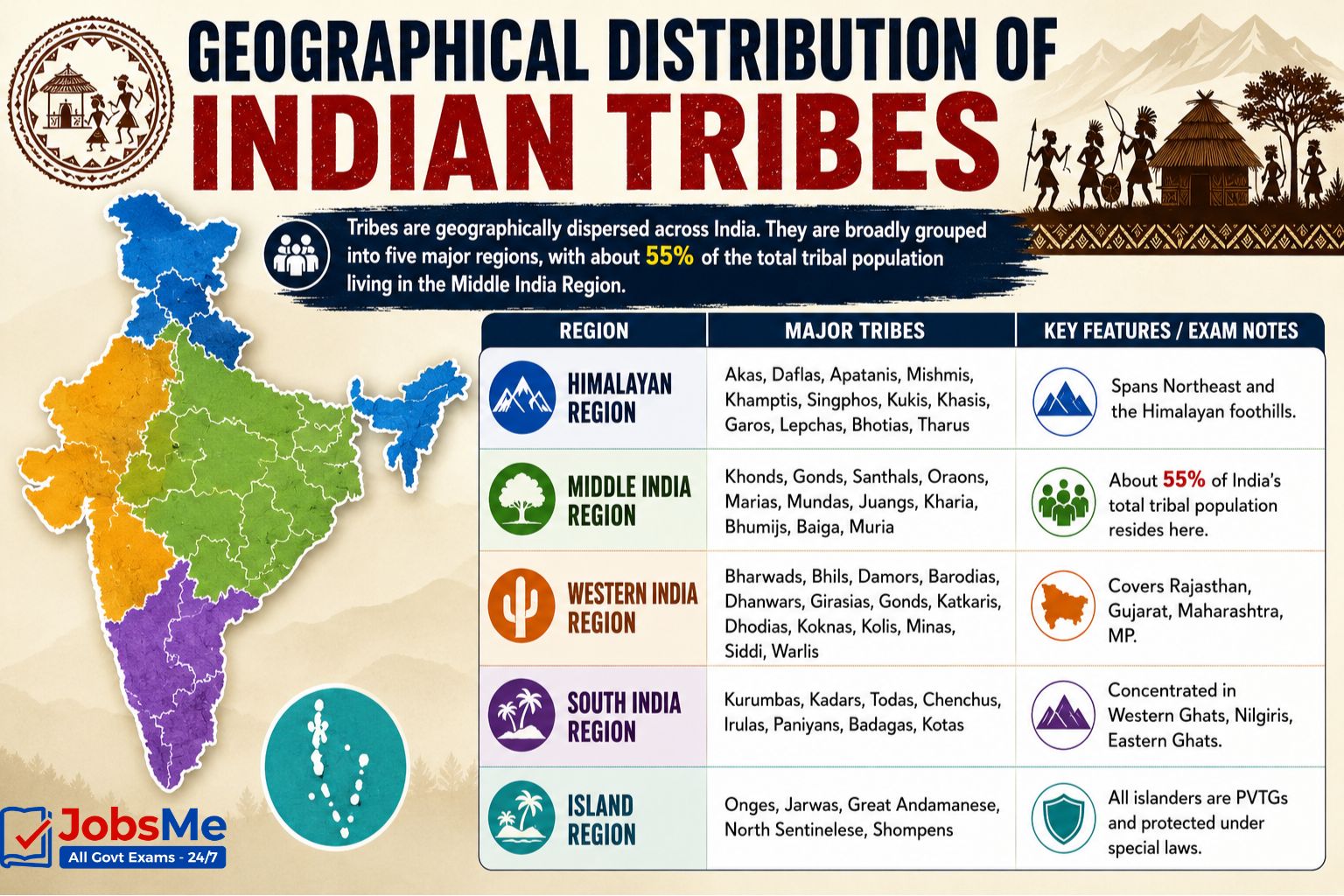
Tribes are geographically dispersed across India. They are broadly grouped into five major regions, with about 55% of the total tribal population living in the Middle India Region.
| Region | Major Tribes | Key Features / Exam Notes |
|---|---|---|
| Himalayan Region | Akas, Daflas, Apatanis, Mishmis, Khamptis, Singphos, Kukis, Khasis, Garos, Lepchas, Bhotias, Tharus | Spans Northeast and the Himalayan foothills. |
| Middle India Region | Khonds, Gonds, Santhals, Oraons, Marias, Mundas, Juangs, Kharia, Bhumijs, Baiga, Muria | About 55% of India's total tribal population resides here. |
| Western India Region | Bharwads, Bhils, Damors, Barodias, Dhanwars, Girasias, Gonds, Katkaris, Dhodias, Koknas, Kolis, Minas, Siddi, Warlis | Covers Rajasthan, Gujarat, Maharashtra, MP. |
| South India Region | Kurumbas, Kadars, Todas, Chenchus, Irulas, Paniyans, Badagas, Kotas | Concentrated in Western Ghats, Nilgiris, Eastern Ghats. |
| Island Region | Onges, Jarwas, Great Andamanese, North Sentinelese, Shompens | All islanders are PVTGs and protected under special laws. |
Constitutional Provisions for Scheduled Tribes
The Indian Constitution provides a robust framework for the protection and welfare of Scheduled Tribes. The following articles and schedules are frequently asked in UPSC, State PCS, and SSC exams.
| Article / Schedule | Constitutional Provision | Key Features / Exam Notes |
|---|---|---|
| Article 46 | Promotion of educational and economic interests of SCs, STs, and other weaker sections | Directive Principle of State Policy. |
| Article 244(1) | Provisions for administration of Scheduled Areas and Tribal Areas | Linked to Fifth Schedule. |
| Article 275(1) | Grants-in-aid to states having Scheduled Tribes | Special financial assistance. |
| Article 330 | Reservation of seats for SCs and STs in the Lok Sabha | 47 seats reserved for STs. |
| Article 332 | Reservation of seats for SCs and STs in State Legislative Assemblies | Numbers vary by state. |
| Article 334 | Special provision regarding reservation of seats | Time-bound reservation provisions. |
| Article 335 | Claims of SCs and STs to services and posts | Reservation in government jobs. |
| Article 338-A | National Commission for Scheduled Tribes (NCST) | Constitutional body established in 2004. |
| Article 342 | Specifies which communities are Scheduled Tribes | Notification by the President. |
| Article 366(25) | Defines "Scheduled Tribes" | Definition clause. |
| Fifth Schedule | Administration and control of Scheduled Areas and STs (other than NE states) | Tribal Advisory Council in scheduled-area states. |
| Sixth Schedule | Administration of tribal areas in Assam, Meghalaya, Tripura, Mizoram | Autonomous District Councils. |
Important Committees and Acts Related to Tribes
| Committee / Act | Year | Key Features / Exam Notes |
|---|---|---|
| U. N. Dhebar Commission | 1961 | Studied tribal welfare; recommended PTG/PVTG sub-category later in 1973. |
| B. N. Lokur Committee | 1965 | Reviewed criteria for inclusion in the ST list. |
| Dileep Singh Bhuria Committee | 2002 | Examined tribal land alienation and forest issues. |
| Virginius Xaxa Committee | 2013 | High-level committee on the socio-economic status of tribes. |
| Criminal Tribes Act | 1871 | Colonial law; labelled certain tribes as "criminal"; repealed in 1949. |
| PESA Act (Panchayat Extension to Scheduled Areas) | 1996 | Extended Panchayati Raj to Fifth Schedule areas; empowers gram sabhas. |
| Forest Rights Act (FRA) | 2006 | Recognises forest rights of tribal communities and other traditional forest dwellers. |
| National Commission for Scheduled Tribes (NCST) | Established 2004 | Set up under Article 338-A; safeguards rights and welfare of STs. |
| Janjatiya Gaurav Divas | Declared 2021 | Celebrated on 15 November (Birsa Munda's birth anniversary). |
Memory Tricks and Mnemonics for Tribes of India
1. Top 5 Largest Tribes: "BG-SMO"
The five largest tribes of India in order of population can be remembered as:
"BG-SMO" = Bhil, Gond, Santhal, Munda, Oraon
- Bhil — Largest tribe (Rajasthan, MP, Gujarat, Maharashtra)
- Gond — Second largest (MP, Chhattisgarh)
- Santhal — Third largest (Jharkhand, WB, Odisha)
- Munda — Fourth largest (Jharkhand, Odisha)
- Oraon — Fifth largest (Jharkhand, Chhattisgarh)
Tip: All five together form roughly half of India's tribal population.
2. Matrilineal Tribes of Meghalaya: "Khasi-Garo Mother First"
Meghalaya is famous for its matrilineal tribes where lineage and inheritance pass through the mother:
"Khasi-Garo Mother First"
- Khasi — Khasi Hills, Meghalaya
- Garo — Garo Hills, Meghalaya
- Jaintia — Jaintia Hills, Meghalaya (also matrilineal)
Tip: Wangala festival = Garo; Khasis live in matrilineal society but inherit through the youngest daughter (Khadduh).
3. Five Tribes of Andaman & Nicobar: "GJOSS"
Remember the five PVTG tribes of Andaman & Nicobar Islands:
"GJOSS" = Great Andamanese, Jarawa, Onge, Sentinelese, Shompen
- Great Andamanese — Strait Island
- Jarawa — Western coast of Middle & South Andaman
- Onge — Little Andaman
- Sentinelese — North Sentinel Island (uncontacted)
- Shompen — Great Nicobar Island
Tip: All five are PVTGs. Sentinelese remain the most isolated.
4. Top 5 Tribal-Population States: "Madhya Maha Odisha Chhatti Jhar"
States with the largest tribal populations in order:
"Madhya Maha Odisha Chhatti Jhar"
- Madhya Pradesh (15.3%) — highest
- Maharashtra (10.1%)
- Odisha (9.1%)
- Chhattisgarh (8.6%)
- Jharkhand (8.3%)
Tip: Mizoram, Nagaland, Meghalaya, Arunachal Pradesh have the highest concentration (over 90%) but not the largest absolute numbers.
5. Painting Tribes: "Warli paints, Gond colours, Bhil dots"
Each major tribe has a unique painting style frequently asked in exams:
- Warli Painting — Maharashtra; geometric figures on mud walls
- Gond Painting — Madhya Pradesh; line and dot patterns of nature
- Bhil (Pithora) Painting — Rajasthan/MP; dot-style folk art
- Saura Painting — Odisha; tribal art of the Saora tribe
Tip: "Warli is white on brown, Gond is colourful, Bhil is dotty."
6. Nomadic and Semi-Nomadic Tribes: "Banjara on the Move"
Use this image-based mnemonic for nomadic tribes:
"Banjaras travel; Gaddis graze; Bhotias trade; Rabaris herd; Raikas roam"
- Banjara / Lambadi — most important trader nomads
- Gaddi — semi-nomadic shepherds (HP)
- Bhotia — Indo-Tibetan trader pastoralists (Uttarakhand)
- Rabari / Raika — pastoralists of Gujarat/Rajasthan
7. Tribal Freedom Fighter: "Birsa Munda — 15 November"
Connect the date and tribe in one chain:
"Birsa Munda → Munda Tribe → Ulgulan Revolt → Janjatiya Gaurav Divas (15 November)"
- Birth Anniversary: 15 November 1875
- Tribe: Munda
- Movement: Ulgulan (Great Tumult) against the British
- Day declared: 2021 by the Union Cabinet
8. PVTG Numbers: "75 in 17 + 1"
Easy to remember PVTG-related figures:
"75 in 17 + 1" = 75 PVTGs in 17 states + 1 UT
- Total PVTGs: 75
- Spread across 17 states + 1 UT (Andaman & Nicobar)
- Odisha has the highest number of PVTGs (13)
- Sub-category created in 1975 based on the Dhebar Commission (1973)
Additional Notes
Frequently Confused Facts
- Adivasi vs Scheduled Tribe: "Adivasi" is a general/cultural term meaning original inhabitants; "Scheduled Tribe" is a constitutional category notified under Article 342.
- PTG vs PVTG: Both refer to the same group; "Primitive Tribal Group" (1975) was renamed "Particularly Vulnerable Tribal Group" (PVTG) in 2006 as the older term was considered derogatory.
- Khasi vs Garo: Both are matrilineal tribes of Meghalaya; Khasis live in Khasi Hills, Garos in Garo Hills; Khasis follow Khadduh inheritance (youngest daughter), Garos celebrate Wangala harvest festival.
- Bhil vs Gond: Bhils are the largest tribe (Rajasthan, MP, Gujarat); Gonds are the second largest (MP, Chhattisgarh) and famous for Gond Painting.
- Santhal vs Munda: Both are tribes of Jharkhand; Santhals led the Santhal Rebellion (1855); Mundas, led by Birsa Munda, led the Ulgulan Revolt (1899-1900).
- Toda vs Toto: Toda is in the Nilgiris (Tamil Nadu) and known for buffalo herding; Toto is in West Bengal and is one of India's smallest endangered tribes (~1,500 members).
- Apatani vs Adi: Both belong to Arunachal Pradesh; Apatanis are famous for wet-rice cultivation in the Ziro Valley; Adis are concentrated in the East Siang area.
- Article 342 vs Article 366(25): Article 342 specifies which communities are STs; Article 366(25) provides the definition of Scheduled Tribes.
- Fifth vs Sixth Schedule: Fifth Schedule covers Scheduled Areas in states other than the NE; Sixth Schedule covers tribal areas in Assam, Meghalaya, Tripura, and Mizoram with Autonomous District Councils.
- Lepcha vs Bhutia (Sikkim): Lepchas are the original inhabitants of Sikkim; Bhutias are of Tibetan origin and famous for momos and Losar festival.
Repeating PYQ (Previous Year Question) Patterns
- SSC CGL & CHSL: Most asked — Bhil (largest tribe), Gond (Gond Painting), Toda (Nilgiris/buffalo), Warli Painting (Maharashtra).
- IBPS PO & Clerk: Frequently appearing — Birsa Munda and Ulgulan, Janjatiya Gaurav Divas (15 November), Santhal Rebellion 1855.
- RRB NTPC & Group D: Common questions on — state-tribe matching pairs, especially Toda, Khasi, Garo, Bhutia, Apatani.
- UPSC Prelims: PVTGs criteria and numbers, Forest Rights Act 2006, PESA Act 1996, Article 342, Sixth Schedule areas, Dhebar Commission.
- Insurance Exams (LIC, NIACL, EPFO): Tribes of NE India, matrilineal tribes (Khasi/Garo), Sentinelese protection.
- State PCS: State-specific tribes — Chenchu (AP/Telangana), Gond (MP/CG), Bonda (Odisha), Tharu (UP/Uttarakhand), Toda (TN).
Quick Insight
India's tribal communities are among the most culturally rich and ecologically wise populations in the world, contributing significantly to environmental conservation, traditional medicine, and indigenous knowledge systems. The historic election of Smt. Droupadi Murmu from the Santhal tribe as the 15th President of India in 2022 marked a watershed moment for tribal representation. The Government's flagship PM-JANMAN scheme (2023) targeting PVTGs, the recognition of Janjatiya Gaurav Divas, and the protection of tribal land rights through the Forest Rights Act 2006 reflect the rising importance of tribal welfare in India's policy landscape. For UPSC Mains, this topic links to social justice, anthropology, and sustainable development. For daily updates on policy developments, take the Daily Current Affairs Quiz on Jobsme.in. You can also strengthen your preparation through the Dances of India and Indian Art & Culture sections.
One-Liners for Quick Revision
- Total Scheduled Tribes → 705 communities → Notified under Article 342 of the Constitution.
- Tribal Population (2011 Census) → 8.6% of India's total → ~10.4 crore people.
- Article 342 → Specifies which communities are STs → Notified by the President.
- Article 366(25) → Defines "Scheduled Tribes" → The constitutional definition clause.
- Article 338-A → National Commission for Scheduled Tribes (NCST) → Established in 2004.
- Article 330 & 332 → Reservation for STs in Lok Sabha and Legislative Assemblies → 47 ST seats in Lok Sabha.
- Fifth Schedule → Administration of Scheduled Areas → Outside the Northeast.
- Sixth Schedule → Tribal areas in Assam, Meghalaya, Tripura, Mizoram → Autonomous District Councils.
- PVTGs → 75 across 17 states + 1 UT → Earlier called Primitive Tribal Groups (PTGs).
- Dhebar Commission → 1973 → Recommended creation of PVTGs.
- State with Most PVTGs → Odisha (13 PVTGs) → Followed by Jharkhand.
- State with Largest Tribal Population → Madhya Pradesh (15.3%) → Highest in India.
- States with Highest Tribal Concentration → Mizoram, Nagaland, Meghalaya, Arunachal Pradesh → Over 90% population.
- Largest Tribe in India → Bhil → ~38% of total ST population (1.7 crore).
- Second Largest Tribe → Gond → ~1.3 crore; central India.
- Third Largest Tribe → Santhal → 60+ lakh; Jharkhand, WB, Odisha.
- Fourth Largest Tribe → Munda → ~50 lakh; Birsa Munda was their leader.
- Fifth Largest Tribe → Oraon (Kurukh) → ~40 lakh; Jharkhand & Chhattisgarh.
- Janjatiya Gaurav Divas → 15 November → Birth anniversary of Birsa Munda; declared in 2021.
- Forest Rights Act → 2006 → Recognises forest rights of tribal communities.
- PESA Act → 1996 → Extends Panchayati Raj to Scheduled Areas.
- Criminal Tribes Act → 1871 → Colonial law; repealed in 1949 (Denotified Tribes).
- Sex Ratio in STs → 990 females per 1,000 males → Higher than the general population (940).
- First Tribal President of India → Smt. Droupadi Murmu → From the Santhal tribe.
- Bhil Tribe → Rajasthan, MP, Gujarat, Maharashtra → Name from "vil/bil" meaning bow.
- Gond Tribe → MP (Chhindwara), Chhattisgarh → Famous for Gond Painting and Mahua liquor.
- Santhal Tribe → Jharkhand, WB, Odisha → Speak Santali (8th Schedule); led 1855 rebellion.
- Munda Tribe → Jharkhand → Speak Mundari; produced Birsa Munda (Ulgulan revolt).
- Oraon (Kurukh) Tribe → Jharkhand, Chhattisgarh → Famous for traditional dance and weaving.
- Bodo (Boro) Tribe → Assam (Udalguri, Kokrajhar) → Largest tribe of Assam; Baishagu festival.
- Khasi Tribe → Meghalaya (Khasi Hills) → Matrilineal society; inheritance through youngest daughter.
- Garo Tribe → Meghalaya (Garo Hills) → Matrilineal; celebrate Wangala harvest festival.
- Naga Tribes → Nagaland → Sub-tribes: Angami, Ao, Sema, Lotha, Konyak, Tangkhul, Rengma, Zeliang.
- Angami Tribe → Kohima, Nagaland → Hosts the famous Hornbill Festival.
- Bhutia Tribe → Sikkim → Tibetan origin; celebrate Losar (Tibetan New Year).
- Lepcha Tribe → Sikkim → Considered original inhabitants of Sikkim.
- Limboo & Tamang → Sikkim → Other major tribes of the state.
- Toda Tribe → Nilgiri Hills, Tamil Nadu → Pastoral tribe; buffalo herding; live in Munds.
- Kota Tribe → Nilgiri Hills, Tamil Nadu → Artisans and musicians.
- Badaga Tribe → Nilgiris (Tamil Nadu) → Agricultural community.
- Irula Tribe → Tamil Nadu, Kerala → Famous as expert snake catchers.
- Warli Tribe → Maharashtra → Famous for Warli Painting on mud walls.
- Toto Tribe → Totopur, West Bengal → Endangered PVTG; ~1,500 members; "vanishing tribe".
- Chenchu Tribe → Andhra Pradesh, Telangana → PVTG; conservationists of Nallamala Hills.
- Bonda Tribe → Odisha (Malkangiri) → PVTG; practice shifting cultivation.
- Dongria Kondh → Odisha (Niyamgiri Hills) → PVTG; protected Niyamgiri from mining.
- Juang Tribe → Odisha → PVTG; one of the oldest tribes of Odisha.
- Saora Tribe → Odisha → Famous for Saura Painting tradition.
- Apatani Tribe → Ziro Valley, Arunachal Pradesh → Sustainable wet-rice cultivation; UNESCO nominated.
- Adi Tribe → East Siang, Arunachal Pradesh → Major tribe of the state.
- Nyishi Tribe → Arunachal Pradesh → Largest tribe of Arunachal Pradesh.
- Mishmi Tribe → Arunachal Pradesh → Inhabit the Mishmi Hills.
- Monpa Tribe → Tawang, Arunachal Pradesh → Buddhist tribe.
- Mizo (Lushai) Tribe → Mizoram → Dominant tribe; over 90% tribal population.
- Tripuri Tribe → Tripura → Largest tribal community of Tripura.
- Reang (Bru) → Tripura, Mizoram → PVTG; famous for Hojagiri folk dance.
- Meitei Tribe → Manipur (hill areas only) → STs in hills; recently in news for ST status debate.
- Kuki Tribe → Manipur, Mizoram, Nagaland → Major tribe of Northeast.
- Tharu Tribe → Uttarakhand, UP, Bihar → Indo-Nepal Terai region.
- Bhotia Tribe → Uttarakhand, HP, Sikkim → Indo-Tibetan trader pastoralists.
- Jaunsari Tribe → Jaunsar-Bawar, Uttarakhand & UP → Practice polyandry.
- Gaddi Tribe → Himachal Pradesh, J&K → Semi-nomadic shepherds.
- Gujjar Tribe → HP, J&K, Rajasthan → Pastoralists; Bakarwals are nomadic Gujjars.
- Bakarwal Tribe → J&K → Nomadic shepherds of Pir Panjal range.
- Changpa Tribe → Ladakh → Rear pashmina goats at high altitudes.
- Balti Tribe → Ladakh, J&K → Of Tibetan origin.
- Meena Tribe → Rajasthan → One of the largest tribes of Rajasthan.
- Garasia Tribe → Rajasthan, Gujarat → Aravalli range tribe.
- Saharia Tribe → Rajasthan, MP → PVTG; Baran district of Rajasthan.
- Kathodi Tribe → Gujarat, Maharashtra → PVTG; bamboo and forest-based livelihood.
- Padhar Tribe → Gujarat → PVTG; traditional fishing community.
- Siddi Tribe → Karnataka, Gujarat, Goa, AP → African descent; honey hunters and herbalists.
- Baiga Tribe → MP, Chhattisgarh → PVTG; women famous for Godna tattoo art.
- Bharia Tribe → Madhya Pradesh → PVTG; Patalkot region.
- Korku Tribe → MP, Maharashtra → Inhabit the Satpura range.
- Abhuj Maria → Bastar, Chhattisgarh → PVTG; live in dense Abujhmarh forests.
- Kamar Tribe → Chhattisgarh → PVTG; traditional bamboo workers.
- Kanikkar Tribe → Kerala (Western Ghats) → Forest-based livelihood.
- Kattunaikan → Kerala (Wayanad) → PVTG; honey gatherers.
- Cholanaikan → Kerala → PVTG; called the "Cavemen of Kerala".
- Kadar Tribe → Kerala, Tamil Nadu → PVTG; hunter-gatherers.
- Paniyan Tribe → Kerala, TN, Karnataka → Largest tribe of Kerala.
- Jenu Kuruba → Karnataka → PVTG; "Jenu" means honey; honey gatherers.
- Koraga Tribe → Karnataka, Kerala → PVTG; coastal Western Ghats.
- Soliga Tribe → Karnataka (BR Hills) → Forest-dwelling tribe.
- Birhor Tribe → Jharkhand, Odisha, Chhattisgarh, WB → PVTG; "people of the forest".
- Asur Tribe → Jharkhand → PVTG; traditional iron smelters.
- Ho Tribe → Jharkhand → Major tribe; speak Ho language.
- Bhumij Tribe → Jharkhand, WB, Odisha → Cultivators and labourers.
- Lodha Tribe → West Bengal → PVTG; Denotified Tribe.
- Banjara / Lambadi → UP, MP, Gujarat, Rajasthan, MH, Telangana, AP, Delhi → Most important nomadic trader tribe.
- Sentinelese → North Sentinel Island → PVTG; most isolated uncontacted tribe in the world.
- Jarawa Tribe → Andaman → PVTG; legally protected from outside contact.
- Onge Tribe → Little Andaman → PVTG; small Negrito tribe.
- Great Andamanese → Strait Island, Andaman → PVTG; nearly extinct.
- Shompen Tribe → Great Nicobar → PVTG; semi-nomadic.
- Birsa Munda → Tribal freedom fighter (1875-1900) → Led the Ulgulan Revolt; Munda tribe.
- Droupadi Murmu → 15th President of India (2022) → First tribal President; Santhal tribe.
- Jual Oram → Former Union Minister of Tribal Affairs → From Odisha.
- Imperial Gazetteer Definition → Common name + dialect + territory → Defines a tribe.
- U. N. Dhebar Committee → 1961 → First major committee on tribal affairs.
- Lokur Committee → 1965 → Reviewed criteria for ST inclusion.
- Bhuria Committee → 2002 → Tribal land alienation.
- Xaxa Committee → 2013 → Socio-economic status of tribes.
- Warli Painting → Maharashtra → Geometric tribal art on mud walls.
- Gond Painting → Madhya Pradesh → Line and dot patterns of nature.
- Bhil (Pithora) Painting → Rajasthan, MP → Dot-style folk art.
- Saura Painting → Odisha → Tribal art of the Saora tribe.
- Hornbill Festival → Nagaland → Hosted by Angami Naga; major tourist event.
- Wangala Festival → Garo tribe, Meghalaya → Harvest celebration.
- Baishagu Festival → Bodo tribe, Assam → Spring/New Year celebration.
- Losar Festival → Bhutia tribe, Sikkim → Tibetan New Year.
- Hojagiri Dance → Reang (Bru) tribe, Tripura → Famous folk dance.
For more Static GK topics like national parks, biosphere reserves, and Indian art & culture, explore the Static GK section on Jobsme.in. You can also test your preparation with the Static GK Quiz and check out the latest exam openings at Latest Government Job Notifications.
Free quiz • No signup required
Put this topic into practice with Indian Cultural Institutions – Static GK MCQ Quiz. It is the quickest way to reinforce what you just learned.
Frequently Asked Questions
Which is the largest tribe in India?
How many Scheduled Tribes are officially recognised in India?
Which Indian state has the largest tribal population?
What are PVTGs and how many are there in India?
Which constitutional articles deal with Scheduled Tribes in India?
Why is Janjatiya Gaurav Divas celebrated on 15 November?
Which tribes of India follow a matrilineal system?
Which tribes live in the Andaman and Nicobar Islands?
Who was Birsa Munda and which tribe did he belong to?
What is the difference between Scheduled Tribes, PVTGs, and Denotified Tribes?

About the author