
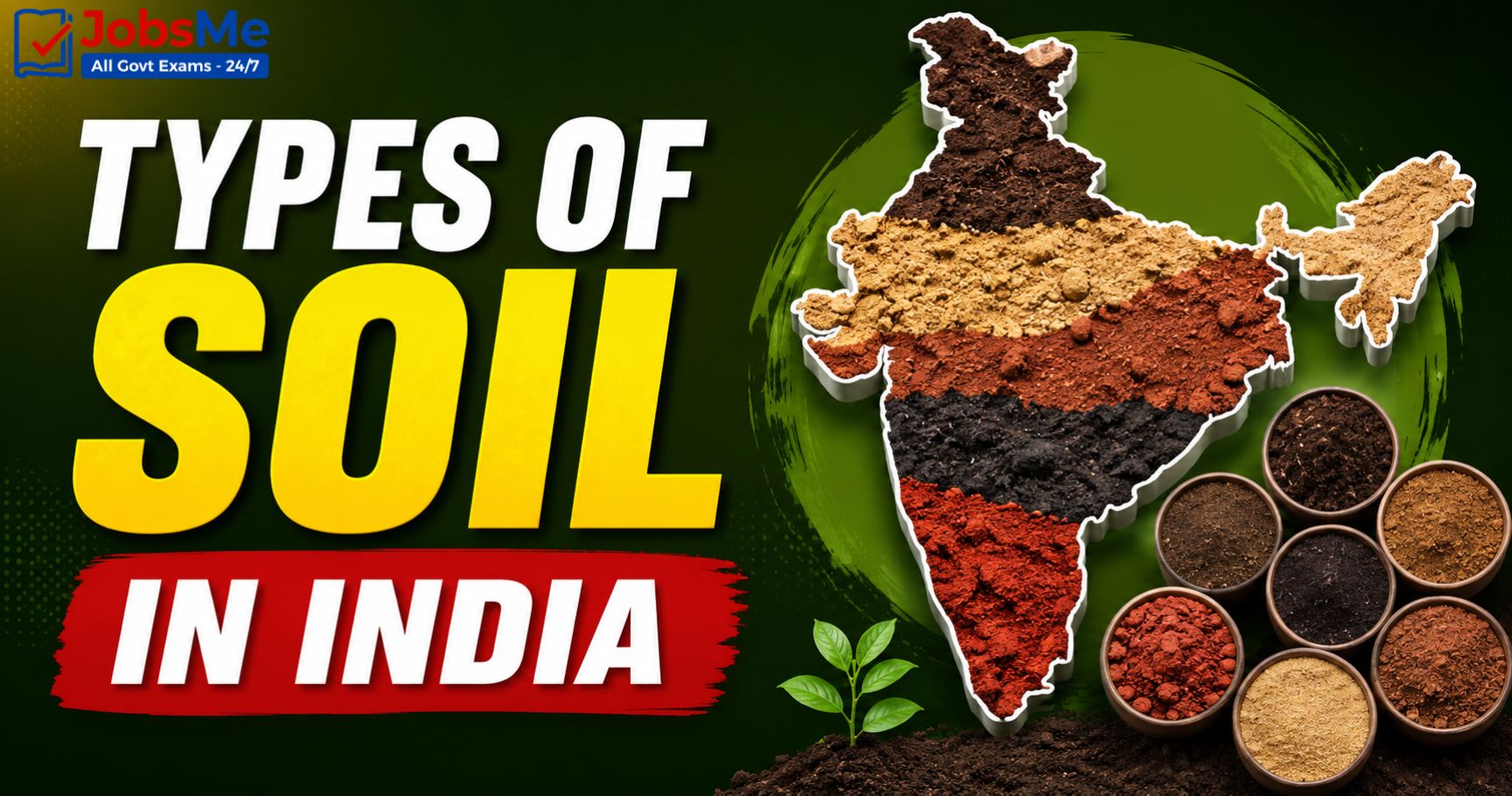
Types of Soil in India – Static GK & General Awareness for Competitive Exams with Memory Tricks
This article presents a complete classification of soils in India along with their formation, composition, distribution, characteristics, and crops grown, making it an essential resource for UPSC, SSC, IBPS, RRB, and other government exam aspirants. It includes all 8 ICAR soil categories — Alluvial, Black (Regur), Red, Laterite, Forest/Mountain, Arid/Desert, Saline/Alkaline, and Peaty/Marshy soils — along with memory tricks and one-liners for quick revision. All facts are arranged in exam-ready format to help students score better in General Awareness sections.
Jump to section
Introduction
India has an extremely diverse range of soils, shaped by the country's varied climate, parent rocks, topography, vegetation, and human activity. The Indian Council of Agricultural Research (ICAR) has classified Indian soils into 8 major categories — Alluvial, Black (Regur), Red, Laterite, Forest/Mountain, Arid/Desert, Saline/Alkaline, and Peaty/Marshy soils. Each soil type has unique characteristics, distribution, and crop suitability that directly influence India's agriculture and economy.
Questions on types of soil in India appear regularly in UPSC Prelims, SSC CGL, IBPS PO, RRB NTPC, SBI Clerk, State PCS, and various Insurance and Defence exams. Questions usually ask about which soil is best for a particular crop, which soil covers the largest area, which soil is called Regur, or which states have which soil type. This article brings together all the key facts in a structured, exam-ready format. To explore other related Static GK topics, you can refer to the Types of Soil in India - Static GK guide on Jobsme.in.
Soil knowledge is also closely linked to current affairs themes such as soil health cards, the Pradhan Mantri Krishi Sinchayee Yojana, soil degradation (which affects 30 percent of India's land), the National Soil Survey, and climate change impacts on agriculture — making this topic doubly important for aspirants targeting UPSC Mains and Essay papers as well.
Core Concepts: What is Soil and How is it Formed?
Soil is the topmost layer of the Earth's crust, formed from a mixture of weathered rock particles and decomposed organic matter (humus) that supports plant growth. The first scientific classification of soil was done by Vasily Dokuchaev, while Guy Donald Smith is regarded as the father of modern soil taxonomy.
Factors Influencing Soil Formation
- Parent Material: Igneous, sedimentary, or metamorphic rocks determine the mineral composition of the soil.
- Climate: Temperature and rainfall control weathering, leaching, and humus formation.
- Topography / Relief: Slopes, valleys, and plains influence soil moisture and erosion patterns.
- Biological Activity: Plants, animals, and microorganisms add humus and shape soil fertility.
- Time: Older soils develop distinct horizons and profiles.
Soil Texture and Loam
Based on texture, soils are classified into three primary types — sand, silt, and clay. Loam is a balanced mixture of roughly equal parts sand, silt, and clay, making it the most fertile and well-draining soil texture.
ICAR Classification (8 Major Soil Types)
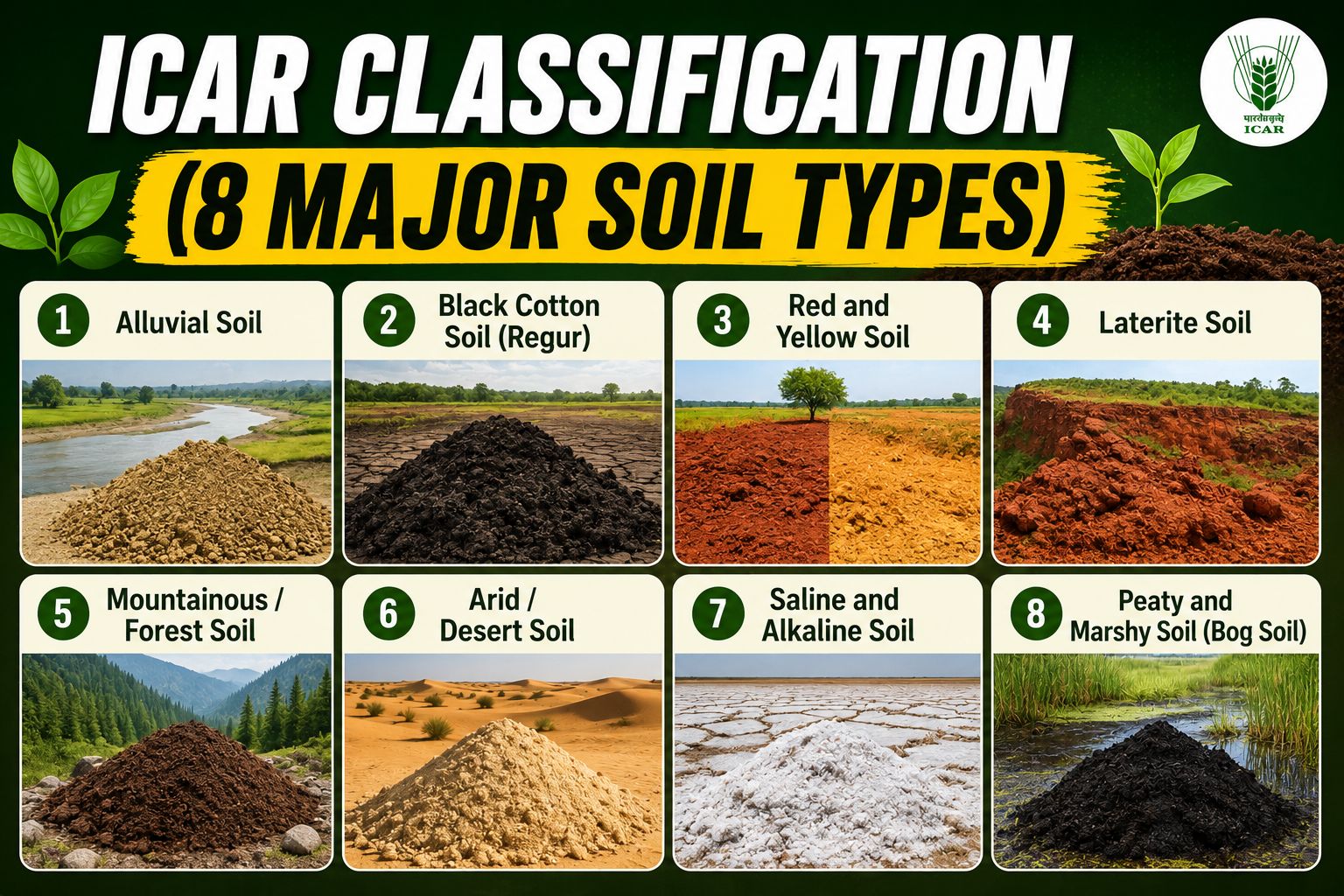
- Alluvial Soil
- Black Cotton Soil (Regur)
- Red and Yellow Soil
- Laterite Soil
- Mountainous / Forest Soil
- Arid / Desert Soil
- Saline and Alkaline Soil
- Peaty and Marshy Soil (Bog Soil)
USDA Soil Taxonomy Classification (Adopted by ICAR)
India's soils are also classified under the United States Department of Agriculture (USDA) system into orders such as Inceptisols (39.74 percent — largest), Entisols, Alfisols, Vertisols, Aridisols, Ultisols, Mollisols, and Others.
Master Table: 8 Types of Soils in India
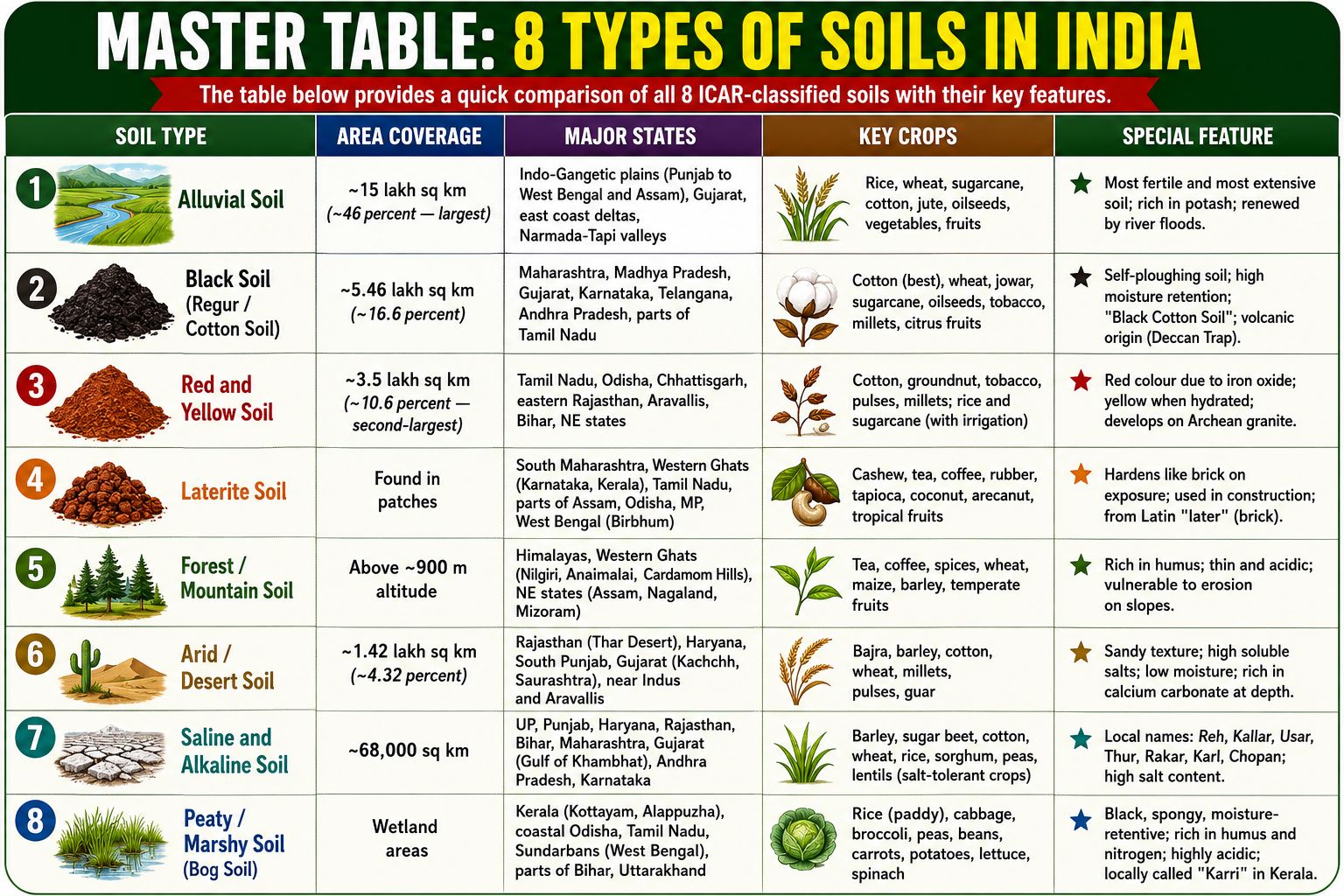
The table below provides a quick comparison of all 8 ICAR-classified soils with their key features.
| Soil Type | Area Coverage | Major States | Key Crops | Special Feature |
|---|---|---|---|---|
| Alluvial Soil | ~15 lakh sq km (~46 percent — largest) | Indo-Gangetic plains (Punjab to West Bengal and Assam), Gujarat, east coast deltas, Narmada-Tapi valleys | Rice, wheat, sugarcane, cotton, jute, oilseeds, vegetables, fruits | Most fertile and most extensive soil; rich in potash; renewed by river floods. |
| Black Soil (Regur / Cotton Soil) | ~5.46 lakh sq km (~16.6 percent) | Maharashtra, Madhya Pradesh, Gujarat, Karnataka, Telangana, Andhra Pradesh, parts of Tamil Nadu | Cotton (best), wheat, jowar, sugarcane, oilseeds, tobacco, millets, citrus fruits | Self-ploughing soil; high moisture retention; "Black Cotton Soil"; volcanic origin (Deccan Trap). |
| Red and Yellow Soil | ~3.5 lakh sq km (~10.6 percent — second-largest) | Tamil Nadu, Odisha, Chhattisgarh, eastern Rajasthan, Aravallis, Bihar, NE states | Cotton, groundnut, tobacco, pulses, millets; rice and sugarcane (with irrigation) | Red colour due to iron oxide; yellow when hydrated; develops on Archean granite. |
| Laterite Soil | Found in patches | South Maharashtra, Western Ghats (Karnataka, Kerala), Tamil Nadu, parts of Assam, Odisha, MP, West Bengal (Birbhum) | Cashew, tea, coffee, rubber, tapioca, coconut, arecanut, tropical fruits | Hardens like brick on exposure; used in construction; from Latin "later" (brick). |
| Forest / Mountain Soil | Above ~900 m altitude | Himalayas, Western Ghats (Nilgiri, Anaimalai, Cardamom Hills), NE states (Assam, Nagaland, Mizoram) | Tea, coffee, spices, wheat, maize, barley, temperate fruits | Rich in humus; thin and acidic; vulnerable to erosion on slopes. |
| Arid / Desert Soil | ~1.42 lakh sq km (~4.32 percent) | Rajasthan (Thar Desert), Haryana, South Punjab, Gujarat (Kachchh, Saurashtra), near Indus and Aravallis | Bajra, barley, cotton, wheat, millets, pulses, guar | Sandy texture; high soluble salts; low moisture; rich in calcium carbonate at depth. |
| Saline and Alkaline Soil | ~68,000 sq km | UP, Punjab, Haryana, Rajasthan, Bihar, Maharashtra, Gujarat (Gulf of Khambhat), Andhra Pradesh, Karnataka | Barley, sugar beet, cotton, wheat, rice, sorghum, peas, lentils (salt-tolerant crops) | Local names: Reh, Kallar, Usar, Thur, Rakar, Karl, Chopan; high salt content. |
| Peaty / Marshy Soil (Bog Soil) | Wetland areas | Kerala (Kottayam, Alappuzha), coastal Odisha, Tamil Nadu, Sundarbans (West Bengal), parts of Bihar, Uttarakhand | Rice (paddy), cabbage, broccoli, peas, beans, carrots, potatoes, lettuce, spinach | Black, spongy, moisture-retentive; rich in humus and nitrogen; highly acidic; locally called "Karri" in Kerala. |
Detailed Profile of Each Soil Type
1. Alluvial Soil - Most Extensive Soil of India
| Feature | Details |
|---|---|
| Coverage | ~15 lakh sq km, about 46 percent of India's total area — largest soil group. |
| Formation | Deposited by rivers, winds, glaciers, and sea waves; parent material is Himalayan rock; transported and depositional origin. |
| Composition | Rich in potash; poor in phosphorus and nitrogen; contains adequate alkalies and lime. |
| Texture | Ranges from sandy loam to clay; loamy and clayey in lower Ganga plains and Brahmaputra valley. |
| Colour | Light grey to ash grey, depending on depth and maturity. |
| Distribution | Great Northern Plain (Punjab to Assam), Narmada-Tapi valleys, east coast deltas (Mahanadi, Godavari, Krishna, Cauvery), northern Gujarat plains. |
| Crops | Rice, wheat, sugarcane, cotton, jute, maize, oilseeds, tobacco, vegetables, fruits. |
Geological Divisions of Alluvial Soil
- Bhabar: Porous, pebbly belt 8-16 km wide along Shivalik foothills; alluvial fans where streams disappear; not suitable for agriculture.
- Terai: Marshy, ill-drained, thickly forested belt 15-30 km wide south of Bhabar; rich in nitrogen and organic matter; suitable for wheat, rice, sugarcane, jute.
- Bhangar: Old alluvium along terraces above flood level; clayey, dark-coloured, contains lime nodules called "Kankar."
- Khadar: New alluvium in floodplains and deltas; lighter, sandy clay loam; replenished annually by floods; most fertile.
- Deltaic Alluvium / Coastal Alluvium: Found in deltas of Mahanadi, Godavari, Krishna, Cauvery.
Alluvial Regions Based on Rainfall
- Above 100 cm rainfall: Suitable for paddy.
- 50-100 cm rainfall: Wheat, sugarcane, tobacco, cotton.
- Below 50 cm rainfall: Coarse grains and millets.
2. Black Soil (Regur / Black Cotton Soil)
| Feature | Details |
|---|---|
| Coverage | ~5.46 lakh sq km, about 16.6 percent of India's area. |
| Formation | Formed from weathering of basaltic / volcanic rocks of the Deccan Trap during the Cretaceous period; in Tamil Nadu, formed from gneisses and schists. |
| Composition | 10 percent alumina, 9-10 percent iron oxide, 6-8 percent lime and magnesium carbonates; rich in iron and lime; deficient in nitrogen, phosphorus, organic matter. |
| Texture | Highly argillaceous; over 62 percent clay content. |
| Colour | Black colour due to titaniferous magnetite or iron; varies from deep black to grey. |
| Special Property | Self-ploughing — develops cracks during dry season as it shrinks; swells when wet; retains moisture for long periods. |
| Distribution | Maharashtra, Madhya Pradesh, parts of Karnataka, Telangana, Andhra Pradesh, Gujarat, Tamil Nadu; deepest in upper Godavari and Krishna basins. |
| Crops | Best for cotton (hence "Black Cotton Soil"); also wheat, jowar, linseed, tobacco, castor, sunflower, millets, rice, sugarcane (with irrigation), citrus fruits. |
3. Red and Yellow Soil - Second Largest Soil
| Feature | Details |
|---|---|
| Coverage | ~3.5 lakh sq km, about 10.6 percent — second largest soil after alluvial. |
| Formation | Develops on ancient crystalline igneous and metamorphic rocks like Archean granite, gneisses, and quartzites. |
| Composition | Rich in iron and potash; deficient in phosphate, lime, magnesia, humus, and nitrogen. |
| Colour | Red due to ferric oxide coatings; yellow when found in hydrated form. |
| Texture | Sandy to clayey and loamy; fine-grained varieties are fertile, coarse-grained are poor. |
| Sub-types | Red and Yellow Soil (NE India, Manipur, Mizoram, Malabar coast), Red Sandy Soil (Karnataka, Tamil Nadu, Telangana, Rayalaseema), Red Alluvial Soil (river valleys — Kaveri, Vaigai). |
| Distribution | Tamil Nadu (almost entire state), Odisha, Chhattisgarh, eastern Rajasthan (Aravallis), parts of Assam, Nagaland, Manipur, Mizoram, Tripura, Meghalaya, southern parts of middle Ganga plain, piedmont zones of Western Ghats. |
| Crops | Cotton, groundnut, tobacco, pulses, millets; with irrigation — rice, sugarcane; coffee and rubber on Karnataka and Kerala stretches. |
4. Laterite Soil
| Feature | Details |
|---|---|
| Origin of Name | From Latin "later," meaning brick — hardens like brick on exposure to air. |
| Formation | Formed under high temperature and high rainfall; intense leaching of silica and lime; alternating dry and wet conditions ideal. |
| Composition | Rich in iron oxide and aluminium; poor in nitrogen, phosphate, lime, magnesia, calcium; humus content low due to bacterial action in high temperatures; potash in excess. |
| Colour | Brown to reddish; iron oxides found as nodules. |
| Distribution | South Maharashtra, Western Ghats (Karnataka, Kerala), Tamil Nadu, Western West Bengal (Birbhum), parts of Assam, Odisha, MP (Amarkantak plateau), Gujarat (Panchmahal), Jharkhand (Santhal Parganas), Goa. |
| Crops | Cashew, tea, coffee, rubber, tapioca, coconut, arecanut, tropical fruits; with fertiliser inputs. |
| Other Uses | Used as bricks for house construction and roads. |
5. Forest / Mountain Soil
| Feature | Details |
|---|---|
| Coverage | Found above ~900 m altitude. |
| Formation | Formed in forested areas with sufficient rainfall; heterogeneous soils on hill slopes; vary with altitude and vegetation. |
| Composition | Rich in humus and organic matter; deficient in potash, phosphorus, and lime; acidic in snow-bound regions of Himalayas. |
| Texture | Loamy and silty in valleys; coarse-grained on upper slopes. |
| Distribution | Himalayas, Himalayan foothills, Western Ghats (Nilgiri, Anaimalai, Cardamom Hills), NE states (Assam, Nagaland, Mizoram). |
| Crops | Tea, coffee, spices, tropical fruits in peninsular forests; wheat, maize, barley, temperate fruits in Himalayan forests. |
| Special Note | Vulnerable to soil erosion due to fast drainage; supports shifting cultivation in NE India. |
6. Arid / Desert Soil
| Feature | Details |
|---|---|
| Coverage | ~1.42 lakh sq km, about 4.32 percent of India. |
| Formation | Formed by wind action in arid and semi-arid regions; high evaporation and low rainfall. |
| Composition | High soluble salts and calcium carbonate (increases with depth); rich in iron, low in humus, low in nitrogen but some nitrates available. |
| Texture | Sandy with low organic matter; poor moisture retention. |
| Distribution | Western Rajasthan (Thar Desert), Haryana, South Punjab, Gujarat (Kachchh, Saurashtra), near Indus River and Aravallis. |
| Crops | Drought-resistant crops — bajra, barley, cotton, wheat, millets, pulses, guar, fodder. |
| Special Note | Gives high agricultural return when irrigated; major area in Indira Gandhi Canal command. |
7. Saline and Alkaline Soil
| Feature | Details |
|---|---|
| Coverage | ~68,000 sq km. |
| Formation | Both natural (dried lakes of Rajasthan, Rann of Kutch, Palaya basins) and anthropogenic (faulty irrigation in western UP and Punjab); accumulation of sodium, magnesium, calcium salts. |
| Composition | High sodium chloride and sodium sulphate; nutrient-poor; low in humus and microorganisms. |
| Local Names | Reh, Kallar, Usar, Thur, Rakar, Karl, Chopan. |
| Texture | Compact, sandy or silty; poor drainage; pale or cracked surface. |
| Distribution | Andhra Pradesh, Karnataka, Bihar, Uttar Pradesh (1.25 million ha), Haryana, Punjab (1.21 million ha), Rajasthan, Maharashtra, Gujarat (Gulf of Khambhat). |
| Crops | Salt-tolerant crops — barley, sugar beet, cotton, wheat, rice, sorghum, sunflower, peas, lentils, cowpea, citrus fruits, pomegranate; suitable for leguminous crops. |
8. Peaty and Marshy Soil (Bog Soil)
| Feature | Details |
|---|---|
| Formation | Forms in humid, waterlogged regions where decomposition is slow due to stagnant water; accumulates dead plant material. |
| Composition | Rich in organic matter and nitrogen; deficient in phosphorus and potash; highly acidic. |
| Colour | Black due to decomposed plant material. |
| Texture | Heavy, spongy, and moisture-retentive; clayey and muddy. |
| Local Name | "Karri" along the backwaters (Kayals) of Kerala. |
| Distribution | Kottayam and Alappuzha (Kerala), coastal Odisha, Tamil Nadu, Sundarbans (West Bengal), parts of Bihar, Uttarakhand (Almora). |
| Crops | Rice (paddy is best); cabbage, broccoli, peas, beans, carrots, radishes, potatoes, lettuce, spinach; jute over Bengal delta; spices and rubber in Malabar. |
| Special Note | Supports mangrove forests; required water management for cultivation. |
Soil-Crop Quick Reference Table
This is the most asked area in SSC, IBPS, RRB, and State PCS exams — the matching of soils to crops. To revise related geography topics, you can also explore the Rivers of India - Static GK guide on Jobsme.in.
| Crop | Best Suited Soil |
|---|---|
| Rice (Paddy) | Alluvial, Peaty/Marshy |
| Wheat | Alluvial |
| Cotton | Black (Regur) |
| Sugarcane | Alluvial, Black (with irrigation) |
| Jute | Alluvial (especially Bengal delta) |
| Tea and Coffee | Laterite, Forest/Mountain |
| Rubber | Laterite, Forest/Mountain (Western Ghats) |
| Cashew | Laterite |
| Tobacco | Alluvial, Black, Red |
| Groundnut and Pulses | Red, Black |
| Millets (Bajra, Jowar) | Black, Red, Desert |
| Spices (Cardamom, Pepper) | Forest, Laterite |
| Coconut and Arecanut | Laterite |
| Barley | Saline, Desert |
| Oilseeds (Linseed, Castor) | Black |
| Mangrove vegetation | Peaty/Marshy |
Soil Degradation in India
Soil degradation affects nearly 30 percent of India's total land area. Major problems include:
- Soil Erosion: Most severe in the Himalayan region and Chambal ravines.
- Desertification: Around the Thar Desert, Karnataka, Telangana rain-shadow regions.
- Waterlogging: Punjab-Haryana plains due to canal irrigation.
- Salinity and Alkalinity: Excessively irrigated regions of Punjab, Haryana, Karnataka.
- Wasteland Formation: Due to overgrazing and deforestation.
- Urban Encroachment: Loss of agricultural land due to urban expansion.
- Loss of Fertility: Centuries of cultivation without replenishment.
Memory Tricks and Mnemonics for Soils of India
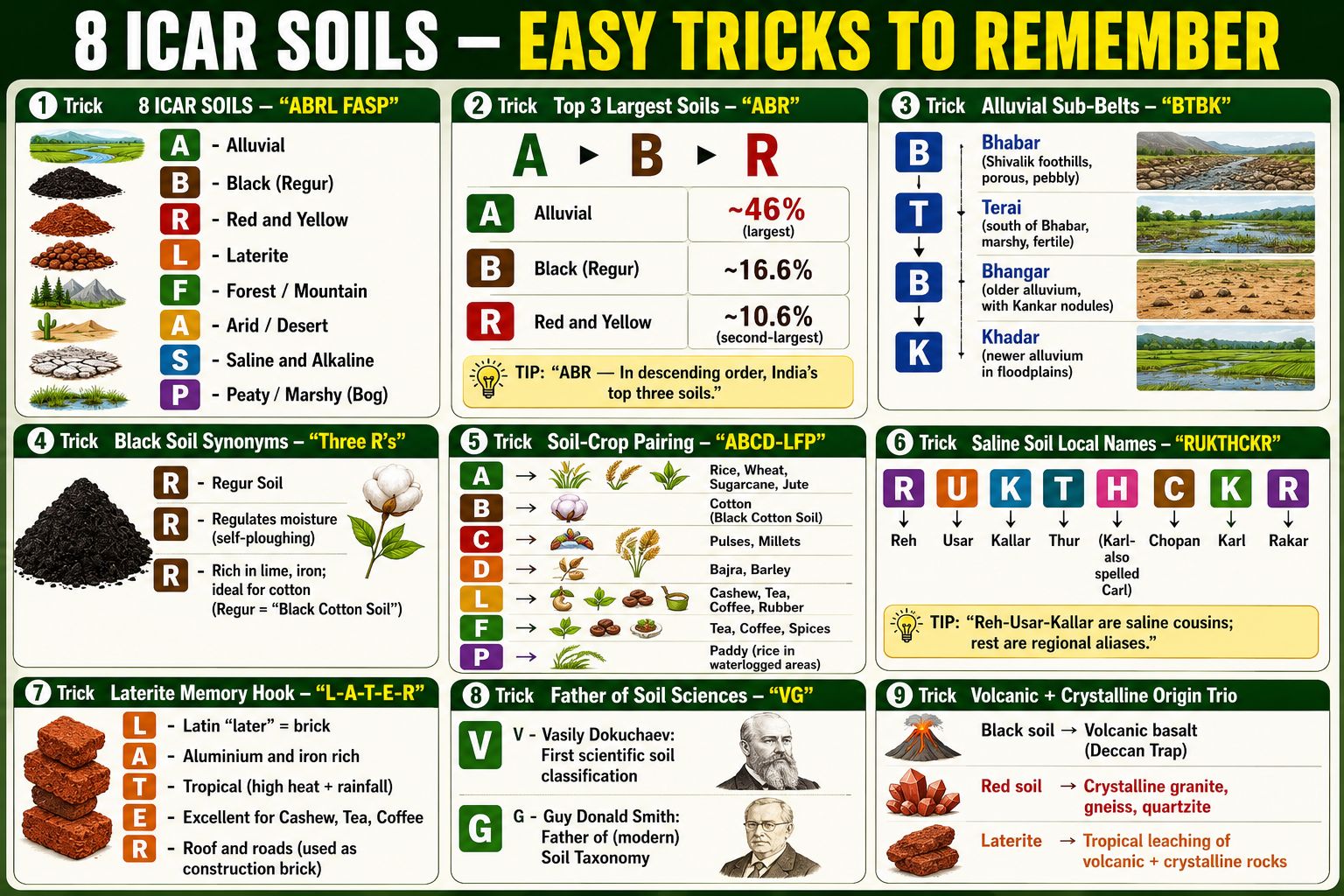
Trick 1: 8 ICAR Soils - "ABRL FASP"
Use this acronym to recall all 8 ICAR-classified soils.
- A - Alluvial.
- B - Black (Regur).
- R - Red and Yellow.
- L - Laterite.
- F - Forest / Mountain.
- A - Arid / Desert.
- S - Saline and Alkaline.
- P - Peaty / Marshy (Bog).
Trick 2: Top 3 Largest Soils - "ABR" (Alluvial-Black-Red)
- A - Alluvial: ~46 percent (largest).
- B - Black: ~16.6 percent.
- R - Red and Yellow: ~10.6 percent (second-largest).
Tip: "ABR — In descending order, India's top three soils."
Trick 3: Alluvial Sub-Belts - "BTBK" (North to South)
- B - Bhabar (Shivalik foothills, porous, pebbly).
- T - Terai (south of Bhabar, marshy, fertile).
- B - Bhangar (older alluvium, with Kankar nodules).
- K - Khadar (newer alluvium in floodplains).
Trick 4: Black Soil Synonyms - "Three R's"
- R - Regur Soil.
- R - Regulates moisture (self-ploughing).
- R - Rich in lime, iron; ideal for cotton (Regur = "Black Cotton Soil").
Trick 5: Soil-Crop Pairing - "ABCD-LFP"
- A - Alluvial → Rice, Wheat, Sugarcane, Jute.
- B - Black → Cotton (Black Cotton Soil).
- C - Coarser Red → Pulses, Millets.
- D - Desert → Bajra, Barley.
- L - Laterite → Cashew, Tea, Coffee, Rubber.
- F - Forest → Tea, Coffee, Spices.
- P - Peaty → Paddy (rice in waterlogged areas).
Trick 6: Saline Soil Local Names - "RUKTHCKR"
Eight local names for saline/alkaline soil.
- R - Reh.
- U - Usar.
- K - Kallar.
- T - Thur.
- H - (Karl-also spelled Carl).
- C - Chopan.
- K - Karl.
- R - Rakar.
Tip: "Reh-Usar-Kallar are saline cousins; rest are regional aliases."
Trick 7: Laterite Memory Hook - "L-A-T-E-R"
- L - Latin "later" = brick.
- A - Aluminium and iron rich.
- T - Tropical (high heat + rainfall).
- E - Excellent for Cashew, Tea, Coffee.
- R - Roof and roads (used as construction brick).
Trick 8: Father of Soil Sciences - "VG"
- V - Vasily Dokuchaev: First scientific soil classification.
- G - Guy Donald Smith: Father of (modern) Soil Taxonomy.
Trick 9: Volcanic + Crystalline Origin Trio
- Black soil → Volcanic basalt (Deccan Trap).
- Red soil → Crystalline granite, gneiss, quartzite.
- Laterite → Tropical leaching of volcanic + crystalline rocks.
Additional Notes
Frequently Confused Facts
- Regur soil = Black soil = Black Cotton Soil: All three names refer to the same soil ideal for cotton.
- Bhangar vs Khadar: Bhangar is older alluvium with Kankar nodules; Khadar is newer alluvium in floodplains, more fertile.
- Bhabar vs Terai: Bhabar is dry, porous, and pebbly with disappearing rivers; Terai is marshy and fertile, where streams re-emerge.
- Red soil vs Yellow soil: Same parent material; red when iron is anhydrous; yellow when hydrated.
- Laterite vs Red soil: Both have iron oxide; laterite forms by leaching in tropical climates; red soil forms on crystalline rocks.
- Saline vs Alkaline: Saline soil has high sodium chloride/sulphate; alkaline soil has high pH due to sodium carbonate; both clubbed together.
- Father of Soil Taxonomy: Guy Donald Smith (modern); Vasily Dokuchaev (first classification).
- Largest soil order under USDA system in India: Inceptisols (39.74 percent).
- Self-ploughing soil: Black soil (cracks during dry season).
- Brick soil: Laterite soil (hardens like brick).
- Karri soil of Kerala: Local name for peaty/marshy soil along Kayals.
Repeating PYQ Patterns
- UPSC Prelims: Frequently asks about Bhangar-Khadar distinction, Bhabar-Terai differences, Regur soil's crop suitability, and laterite formation.
- SSC CGL and CHSL: Match-the-column questions on soil-crop pairings; alluvial-rice, black-cotton, and laterite-cashew are most common.
- IBPS PO and Clerk: One-liner questions on which soil covers the largest area, which is most fertile, and which is best for cotton.
- RRB NTPC and Group D: Direct soil-state mapping; especially black soil in Maharashtra, alluvial in Northern Plains.
- State PCS: State-specific soil questions (e.g., Karri in Kerala, Kachchh desert soil for Gujarat).
Quick Insight
Soil topics are central to current affairs themes such as the Soil Health Card scheme, the National Mission for Sustainable Agriculture, soil organic carbon mapping, and the link between soil degradation and climate change. India's soil supports over 65-70 percent of the population engaged in agriculture, and soil conservation is critical for food security. For the latest updates on agriculture and rural development, follow the daily current affairs section on Jobsme.in.
This topic also pairs well with related Static GK areas such as Dams in India and Biosphere Reserves in India, since most cropping patterns and ecological zones depend directly on soil type.
One-Liners for Quick Revision
- Total ICAR soil categories → 8 → Alluvial, Black, Red, Laterite, Forest, Desert, Saline-Alkaline, Peaty.
- Largest soil group in India → Alluvial soil (~46 percent, ~15 lakh sq km).
- Second-largest soil → Red and Yellow soil (~10.6 percent, ~3.5 lakh sq km).
- Third-largest soil (by area) → Black soil (~16.6 percent, ~5.46 lakh sq km).
- Most fertile soil → Alluvial soil.
- Best for cotton → Black soil (Regur / Black Cotton Soil).
- Best for tea, coffee, rubber, cashew → Laterite soil.
- Best for paddy in waterlogged areas → Peaty/Marshy soil.
- Self-ploughing soil → Black soil.
- Brick soil → Laterite (from Latin "later" = brick).
- Soil with kankar nodules → Bhangar (old alluvium).
- Most fertile alluvial sub-type → Khadar (new alluvium).
- Porous and pebbly Shivalik foothill belt → Bhabar.
- Marshy belt south of Bhabar → Terai.
- Kerala's local peaty soil → Karri (along Kayals).
- Saline soil local names → Reh, Kallar, Usar, Thur, Rakar, Karl, Chopan.
- Alluvial Soil → Most extensive; ~46 percent of India → Indo-Gangetic plains, Gujarat, deltas; rich in potash, low in N and P; supports rice, wheat, sugarcane.
- Bhabar → 8-16 km wide along Shivalik foothills → Porous, pebbly; rivers disappear; not suitable for agriculture.
- Terai → 15-30 km wide south of Bhabar → Marshy, forested; rich in nitrogen; suits wheat, rice, sugarcane, jute.
- Bhangar → Older alluvium → Clayey, dark, contains kankar (lime nodules).
- Khadar → New alluvium → Sandy clay loam, replenished annually by floods, most fertile.
- Deltaic / Coastal Alluvium → Mahanadi, Godavari, Krishna, Cauvery deltas.
- Black Soil (Regur) → Volcanic basalt origin (Deccan Trap) → Maharashtra, MP, Gujarat, Karnataka, Telangana, AP, parts of TN; ideal for cotton.
- Black Soil colour → Due to titaniferous magnetite or iron.
- Black Soil clay content → Over 62 percent → highly argillaceous.
- Black Soil fertility → Rich in lime, iron, magnesia, alumina; deficient in N, P, organic matter.
- Red and Yellow Soil → On Archean granite and crystalline rocks → Tamil Nadu (almost entire), Odisha, Chhattisgarh, eastern Rajasthan, NE states.
- Red Soil colour → Due to ferric oxide; yellow when hydrated.
- Red Soil sub-types → Red & Yellow (NE India), Red Sandy (Karnataka, TN, Telangana), Red Alluvial (Kaveri, Vaigai basins).
- Laterite Soil → High temperature + high rainfall → Western Ghats, Kerala, Karnataka, TN, Assam, Odisha, MP, West Bengal, Goa, Jharkhand.
- Laterite Composition → Rich in iron and aluminium; poor in N, P, K, lime; potash in excess.
- Laterite Crops → Cashew, tea, coffee, rubber, tapioca, coconut, arecanut.
- Forest / Mountain Soil → Above ~900 m altitude → Himalayas, Western Ghats, NE states; rich in humus, deficient in potash and lime.
- Forest Soil Crops → Tea, coffee, spices, wheat, maize, barley, temperate fruits.
- Desert Soil → ~1.42 lakh sq km, ~4.32 percent → Rajasthan (Thar), Haryana, Punjab, Gujarat (Kachchh, Saurashtra).
- Desert Soil Composition → Sandy, high soluble salts, high calcium carbonate; low humus and moisture.
- Desert Soil Crops → Bajra, barley, cotton, wheat, millets, pulses, guar.
- Saline and Alkaline Soil → ~68,000 sq km → UP (1.25 mha), Punjab (1.21 mha), Haryana, Rajasthan, Bihar, Maharashtra, Gujarat.
- Saline Soil Crops → Salt-tolerant — barley, sugar beet, cotton, wheat, rice, sorghum, leguminous crops.
- Peaty / Marshy / Bog Soil → Waterlogged regions → Kerala (Kottayam, Alappuzha), coastal Odisha, TN, Sundarbans, Bihar, Uttarakhand (Almora).
- Peaty Soil composition → Black, rich in organic matter and nitrogen; deficient in P and K; highly acidic.
- Peaty Soil Crops → Paddy (best); cabbage, broccoli, peas, carrots, potatoes, lettuce, spinach.
- Soil degradation in India → Affects ~30 percent of total land area.
- USDA largest soil order in India → Inceptisols (39.74 percent).
- First scientific soil classification → Vasily Dokuchaev.
- Father of Soil Taxonomy → Guy Donald Smith.
- Loam → Equal parts sand, silt, clay; most fertile and well-draining texture.
- Three primary soil textures → Sand, Silt, Clay.
- Five factors of soil formation → Parent material, climate, topography, biological activity, time.
- Soil best for jute (Bengal delta) → Peaty/Marshy and Alluvial.
- Soil best for spices and rubber (Malabar) → Peaty/Marshy with Forest.
- Soil best for coffee (Karnataka) → Laterite + Forest.
- Soil best for tea (Assam, Darjeeling) → Forest soil + Laterite.
- Mangrove vegetation soil → Peaty/Marshy (Sundarbans).
- Population dependent on soil-based agriculture → 65-70 percent of India.
- Alluvial regions above 100 cm rainfall → Suit paddy.
- Alluvial regions 50-100 cm rainfall → Wheat, sugarcane, tobacco, cotton.
- Alluvial regions below 50 cm rainfall → Coarse grains and millets.
For more Static GK topics like rivers, dams, and biosphere reserves of India, explore the Static GK section on Jobsme.in. You can also test your knowledge with the Static GK Quiz and check out the latest exam notifications at Latest Government Job Notifications.
Free quiz • No signup required
Put this topic into practice with Indian Cultural Institutions – Static GK MCQ Quiz. It is the quickest way to reinforce what you just learned.
Frequently Asked Questions
How many types of soils are classified by ICAR in India?
Which is the largest soil group in India?
Which soil is known as Regur in India?
Why is laterite soil called brick soil?
What is the difference between Bhangar and Khadar soils?
Which soil is best for cotton cultivation?
Which soil is the second most extensive soil in India?
What are the local names of saline and alkaline soils in India?
Who is known as the father of soil taxonomy?
Which soil is best for tea, coffee, and rubber cultivation?

About the author