Founders and Rulers of Indian Dynasties – Static GK & General Awareness for Competitive Exams with Memory Tricks
This article covers a comprehensive list of all major dynasties of ancient and medieval India along with their founders, last rulers, capitals, and key kings — from the Haryanka and Mauryas to the Mughals, Cholas, and Vijayanagara empires. It is designed for UPSC, SSC, IBPS, RRB, Insurance, Defence, and State PCS aspirants, with memory tricks, one-liners, and FAQs for quick revision. All facts are organised in an exam-ready format to help students score better in the General Awareness section.
Jump to section
- Introduction
- Core Concepts: Classification of Indian Dynasties
- Quick Statistics on Indian Dynasties
- Ancient Indian Dynasties (6th Century BCE - 6th Century CE)
- Early Medieval North Indian Dynasties (8th - 12th Century CE)
- South Indian Dynasties (3rd Century BCE - 16th Century CE)
- Delhi Sultanate Dynasties (1206 - 1526 CE)
- Vijayanagara Empire Dynasties (1336 - 1646 CE)
- Bahmani and Deccan Sultanates
- Mughal Dynasty (1526 - 1857 CE)
- Other Notable Dynasties
- Memory Tricks and Mnemonics for Indian Dynasties
- Additional Notes
- One-Liners for Quick Revision
Introduction
Indian history spans thousands of years and is marked by the rise and fall of numerous dynasties — from the ancient Haryanka and Mauryan empires of Magadha to the medieval Mughals, Cholas, and Vijayanagara kingdoms. Each dynasty contributed uniquely to India's political, cultural, religious, and architectural heritage. For students preparing for competitive exams, knowing the founders, last rulers, and capitals of these dynasties is one of the most predictable and high-scoring topics in the General Awareness and Static GK section.
Questions on Indian dynasties regularly appear in UPSC Prelims, SSC CGL, IBPS PO/Clerk, RRB NTPC, SBI, LIC, NIACL, EPFO, State PCS, and Defence exams. Aspirants are commonly asked who founded a particular dynasty, who was its last ruler, where its capital was located, and which key historical events occurred under its rule. This article presents all the key facts in a structured, exam-ready format. To explore more history and culture-related Static GK, visit the Important Battles in Indian History guide on Jobsme.in.
Beyond exams, understanding India's dynasties helps appreciate the country's cultural roots — from the Buddhist councils patronised by Magadhan rulers, to the Dravidian temple architecture of the Pallavas and Cholas, the Indo-Islamic architectural fusion of the Delhi Sultanate, and the artistic glory of the Mughals. Mastering this topic supports both objective questions in prelims and descriptive answers in UPSC Mains essays on Indian heritage and civilisation.
Core Concepts: Classification of Indian Dynasties
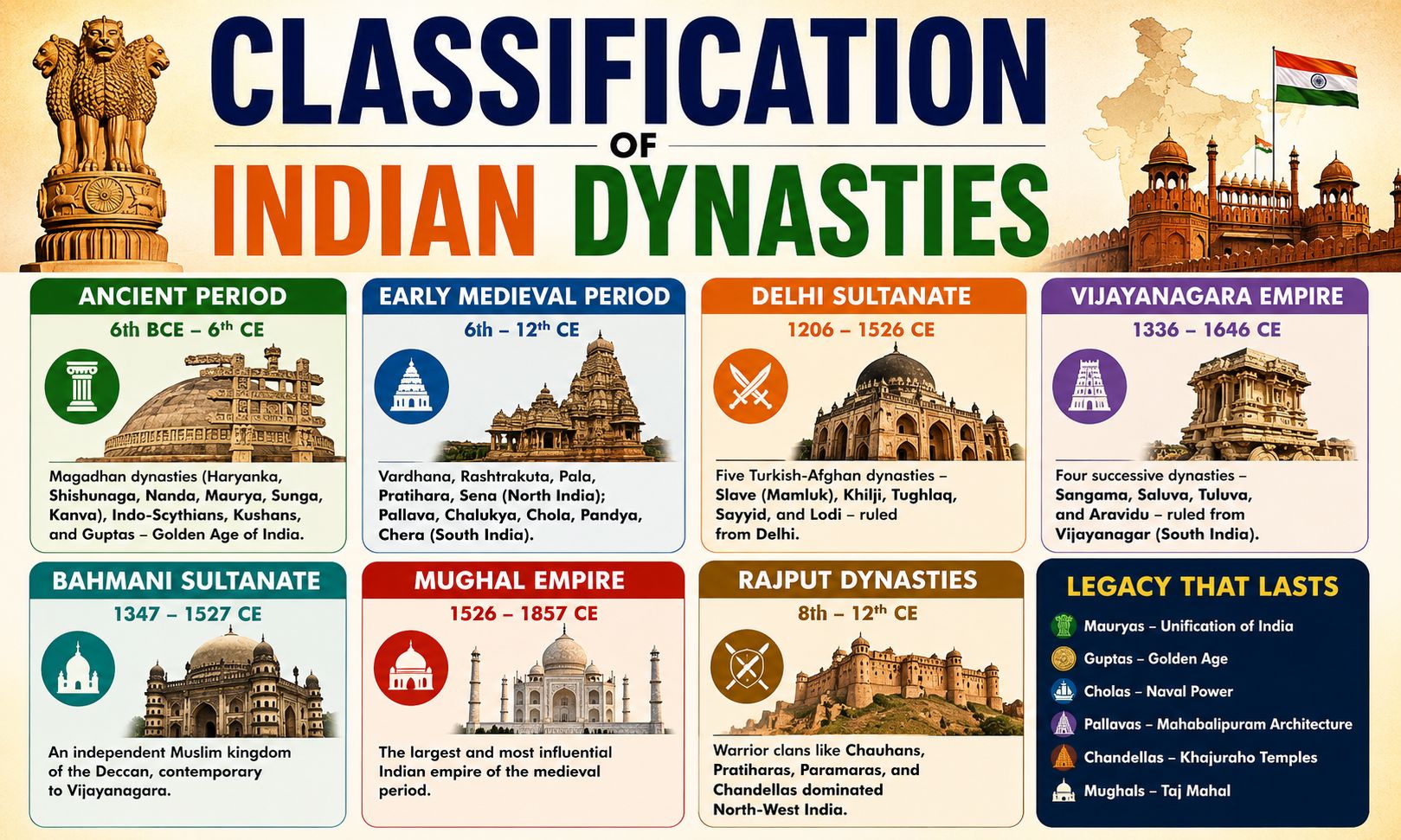
Indian dynasties are typically classified by historical period and geographical region. Understanding this framework makes it easier to remember founders, capitals, and key kings.
- Ancient Period (6th century BCE - 6th century CE): Includes the Magadhan dynasties (Haryanka, Shishunaga, Nanda, Maurya, Sunga, Kanva), foreign invader dynasties (Indo-Scythians, Kushans), and the Gupta Dynasty often called the "Golden Age" of India.
- Early Medieval Period (6th - 12th century CE): Includes the Vardhana, Rashtrakuta, Pala, Pratihara, Sena dynasties of North India, and the Pallava, Chalukya, Chola, Pandya, and Chera dynasties of South India.
- Delhi Sultanate (1206 - 1526 CE): Five successive Turkish-Afghan dynasties — Slave (Mamluk), Khilji, Tughlaq, Sayyid, and Lodi — ruled from Delhi.
- Vijayanagara Empire (1336 - 1646 CE): Four successive dynasties — Sangama, Saluva, Tuluva, and Aravidu — ruled from Vijayanagar in South India.
- Bahmani Sultanate (1347 - 1527 CE): An independent Muslim kingdom of the Deccan, contemporary to Vijayanagara.
- Mughal Empire (1526 - 1857 CE): The largest and most influential Indian empire of the medieval period, ending with the British takeover in 1857.
- Rajput Dynasties: Warrior clans like Chauhans, Pratiharas, Paramaras, and Chandellas dominated North-West India between the 8th and 12th centuries.
Many dynasties are remembered for specific contributions — the Mauryas for unification of India, the Guptas for the Golden Age, the Cholas for naval power, the Pallavas for Mahabalipuram architecture, the Chandellas for Khajuraho temples, and the Mughals for the Taj Mahal.
Quick Statistics on Indian Dynasties

Before diving into detailed tables, here are the most asked numerical and chronological facts.
| Parameter | Detail | Exam-Relevant Note |
|---|---|---|
| Earliest Major Dynasty of Magadha | Haryanka Dynasty (6th century BCE - 413 BCE) | Founded by Bimbisara; contemporary of Buddha and Mahavira. |
| First Empire to Unify India | Mauryan Empire (322-185 BCE) | Founded by Chandragupta Maurya with help of Chanakya. |
| Golden Age of India | Gupta Dynasty (4th-6th century CE) | Founded by Sri Gupta; capital Pataliputra. |
| Most Powerful Dynasty of South India | Chola Dynasty (300s BCE - 1279 CE) | Famous for naval power and Sri Lanka conquest. |
| Total Dynasties of Delhi Sultanate | 5 (Slave, Khilji, Tughlaq, Sayyid, Lodi) | Spanned from 1206 CE to 1526 CE. |
| Total Dynasties of Vijayanagara Empire | 4 (Sangama, Saluva, Tuluva, Aravidu) | Founded in 1336 CE; lasted till 1646 CE. |
| Largest Indian Empire (Medieval) | Mughal Empire (1526 - 1857 CE) | Founded by Babur after the First Battle of Panipat. |
| Common Capital of Magadhan Dynasties | Pataliputra (modern Patna) | Capital from Haryanka to Gupta period. |
| Common Capital of Delhi Sultanate | Delhi | All five sultanate dynasties ruled from Delhi. |
| Tripartite Struggle (8th-10th c.) | Pala vs Pratihara vs Rashtrakuta | For control over Kannauj. |
Ancient Indian Dynasties (6th Century BCE - 6th Century CE)
Ancient Indian history is dominated by the dynasties of Magadha, which gradually rose from a small kingdom in modern Bihar to become the most powerful empire in the subcontinent. The Mauryan period saw the first political unification of India, while the Gupta period is celebrated as the Golden Age.
Magadhan and Pan-Indian Dynasties
| Dynasty | Founder | Last Ruler | Capital | Key Features / Exam Notes |
|---|---|---|---|---|
| Haryanka Dynasty (6th c. BCE - 413 BCE) | Bimbisara | Nagadasaka | Rajgriha (Girivraja); later Pataliputra | Important kings: Bimbisara, Ajatashatru, Udayin. The 1st Buddhist Council was held during this period; capital shifted to Pataliputra under Udayin. |
| Shishunaga Dynasty (413 BCE - 345 BCE) | Shishunaga | Mahanandin | Vaishali (also Girivraja) | Destroyed the Avanti kingdom; the 2nd Buddhist Council was held under Kalashoka at Vaishali. |
| Nanda Dynasty (345 BCE - 322/321 BCE) | Mahapadma Nanda | Dhana Nanda | Pataliputra | First non-Kshatriya dynasty; Mahapadma was titled "Ekarat" and "Sarva-Kshatriyantaka"; Dhana Nanda (Greek: Agrammes) ruled when Alexander invaded India in 326 BCE; defeated by Chandragupta Maurya. |
| Mauryan Dynasty (322 BCE - 185 BCE) | Chandragupta Maurya | Brihadratha Maurya | Pataliputra | Founded with the help of Chanakya (Kautilya); defeated Seleucus Nikator; Ashoka the Great patronised Buddhism and held the 3rd Buddhist Council; Brihadratha was killed by Pushyamitra Sunga. |
| Sunga Dynasty (185 BCE - 75 BCE) | Pushyamitra Sunga | Devabhuti | Pataliputra | Founded after assassination of Brihadratha; revived Brahmanism; important kings: Agnimitra (hero of Kalidasa's Malavikagnimitra), Bhagabhadra. |
| Kanva Dynasty (75 BCE - 30 BCE) | Vasudeva | Susharman | Pataliputra | Short-lived Brahmin dynasty; rulers — Vasudeva, Bhumimitra, Narayana, Susharman; ended by Satavahanas. |
| Satavahana Dynasty (1st c. BCE - 2nd c. CE) | Simuka | Pulumavi IV | Pratishthana (Paithan); later Amaravati | Ruled the Deccan region; Gautamiputra Satakarni was the greatest king; issued lead, copper, and bronze coins; defeated the Shakas. |
| Indo-Scythians (Shakas) (150 BCE - 400 CE) | Maues (Moga) | Rudrasimha III | Sigal, Taxila, Mathura | Important kings: Rudradaman I (repaired Sudarshan Lake — Junagarh inscription), Vikramaditya. Started the Shaka era in 78 CE. |
| Kushan Dynasty (30 CE - 375 CE) | Kujula Kadphises | Vasudeva I | Purushapura (Peshawar); also Bamiyan, Taxila, Mathura | Greatest king: Kanishka, who started the Shaka era in 78 CE and held the 4th Buddhist Council; first Indian rulers to issue gold coins; patronised Mahayana Buddhism and Gandhara art. |
| Vakataka Dynasty (3rd - 6th c. CE) | Vindhyashakti | Prithivishena II | Vatsagulma (Washim) | Contemporary of the Guptas; matrimonial alliance with Chandragupta II; patronised Ajanta cave paintings. |
| Gupta Dynasty (319 CE - 550 CE) | Sri Gupta | Vishnugupta | Pataliputra | "Golden Age of India"; major rulers — Chandragupta I, Samudragupta (Indian Napoleon), Chandragupta II (Vikramaditya), Skandagupta. Hun invasions led to its decline. |
| Hun Dynasty (5th - 6th c. CE) | Toramana | Mihirakula | Sialkot | White Huns who invaded India weakening the Guptas; Mihirakula was defeated by Yashodharman. |
| Vardhana Dynasty (6th - 7th c. CE) | Pushyabhuti | Harshavardhana | Thaneswar; later Kannauj | Harshavardhana (606-647 CE) was the last great Hindu king of North India; patron of Hiuen Tsang; held religious assemblies at Kannauj and Prayag; also a Sanskrit playwright (Ratnavali, Priyadarshika, Nagananda). |
| Ikshvaku Dynasty (legendary; historic ~3rd c. CE) | Ikshvaku | Nala II / Rudrapurushadatta | Saketa, Ayodhya; later Vijayapuri (historic) | Mythical lineage of Lord Rama; historic Andhra Ikshvakus succeeded the Satavahanas in the lower Krishna region. |
Early Medieval North Indian Dynasties (8th - 12th Century CE)
The post-Harsha period saw North India fragmented into several powerful regional kingdoms. The Palas, Pratiharas, and Rashtrakutas competed for control of Kannauj — a struggle known as the Tripartite Struggle. Rajput clans dominated North-West India.
Palas, Pratiharas, Rashtrakutas, Senas, and Rajput Dynasties
| Dynasty | Founder | Last Ruler | Capital | Key Features / Exam Notes |
|---|---|---|---|---|
| Pala Dynasty (8th - 12th c. CE) | Gopala I | Ramapala | Munger / Pataliputra (also Vikrampura) | Greatest Buddhist patrons of medieval India; Dharmapala revived Nalanda; Devapala was the most powerful; founded Vikramshila University. Participants in the Tripartite Struggle. |
| Pratihara Dynasty (Gurjara-Pratiharas) (8th - 10th c. CE) | Nagabhata I | Yashpala | Avanti (Ujjain); later Kannauj | Resisted Arab invasions; greatest king Mihir Bhoja; held Kannauj, the prize of the Tripartite Struggle; patronised art and Khajuraho-related temple traditions. |
| Rashtrakuta Dynasty (753 - 982 CE) | Dantidurga | Karka II (Kakka II) | Manyakheta (Malkhed) | Founded after defeating Chalukyas of Badami; greatest king Krishna I built the Kailasa Temple at Ellora; Amoghavarsha I authored Kavirajamarga. |
| Sena Dynasty (11th - 12th c. CE) | Samanta Sena (founder); Hemanta Sena/Vijaya Sena rose to power | Lakshmana Sena | Nadia (Navadwipa); Vikrampura | Replaced the Palas in Bengal; Lakshmana Sena patronised Jayadeva (author of Gita Govinda); ended by Bakhtiyar Khilji's invasion. |
| Chauhan (Chahamana) Dynasty (8th - 12th c. CE) | Vasudeva | Prithviraj Chauhan III | Ajmer; later Delhi | Famous Rajput dynasty; Prithviraj Chauhan defeated Muhammad Ghori in the 1st Battle of Tarain (1191) but lost the 2nd Battle of Tarain (1192). |
| Paramara Dynasty (9th - 14th c. CE) | Upendra (Krishnaraja) | Mahalakadeva | Dhar Nagari (Dhara) | Famous for Raja Bhoja, scholar-king who wrote Samarangana Sutradhara; Bhojshala temple-cum-college at Dhar. |
| Chandela Dynasty (9th - 13th c. CE) | Nannuka | Vira-Varman II | Khajuraho; later Mahoba and Kalanjara | Built the famous Khajuraho temples (UNESCO World Heritage Site) known for erotic sculptures; major rulers — Yashovarman, Dhanga, Vidyadhara. |
| Solanki (Chalukya of Gujarat) Dynasty (940 - 1244 CE) | Mularaja I | Tribhuvanapala | Anhilwara (Patan) | Built the Sun Temple at Modhera and the Rani-ki-Vav stepwell (UNESCO site); Bhima I, Siddhraj Jaisinh, and Kumarapala were major kings. |
| Gahadavala Dynasty (11th - 12th c. CE) | Chandradeva | Jayachandra | Kannauj; Varanasi | Jayachandra was defeated by Muhammad Ghori at the Battle of Chandawar (1194). |
South Indian Dynasties (3rd Century BCE - 16th Century CE)
South India was home to some of the longest-ruling and most artistically rich dynasties — the Cholas, Pallavas, Pandyas, Cheras, and Chalukyas. Their temple architecture, naval strength, and literature left a lasting mark on Indian civilisation.
Major South Indian Dynasties
| Dynasty | Founder | Last Ruler | Capital | Key Features / Exam Notes |
|---|---|---|---|---|
| Chola Dynasty (300s BCE - 1279 CE) | Vijayalaya (founder of Imperial Cholas) | Rajendra Chola III | Poompuhar, Uraiyur, Thanjavur, Gangaikonda Cholapuram | Greatest naval power of medieval India; Rajaraja I built Brihadeeswara Temple (Thanjavur) — UNESCO site; Rajendra I annexed Sri Lanka and parts of Southeast Asia. |
| Pandya Dynasty (4th c. BCE - 1345 CE) | Kadungon (early); Maravarman Sundara (later) | Maravarman Rajasimha III | Korkai; later Madurai, Tenkasi, Tirunelveli | One of the three Tamil "muvendar" dynasties; traded with Roman Empire; sent embassies to Emperor Augustus; key rulers: Nedunjadaiyan, Maravarman Sundara Pandyan. |
| Chera Dynasty (3rd c. BCE - 12th c. CE) | Vanavaramban / Uthiyan Cheralathan | Rama Varma Kulashekhara | Mahodayapuram (Kodungallur); Karur, Quilon | Ruled present-day Kerala and Kongunadu; engaged in foreign trade (especially spices); king Cheraman Perumal is associated with the Sangam age. |
| Pallava Dynasty (275 CE - 897 CE) | Simhavishnu / Bappadeva (early); Singh Varman IV (later) | Aparajitavarman | Kanchipuram | Mahendravarman I built rock-cut cave temples; Narasimhavarman I (Mamalla) built Mahabalipuram (UNESCO site); Hiuen Tsang visited his court. |
| Chalukya Dynasty (Badami) (543 - 753 CE) | Pulakeshin I | Kirtivarman II | Vatapi (Badami) | Pulakeshin II defeated Harshavardhana on the Narmada (634 CE); built Aihole, Pattadakal (UNESCO site), and Badami cave temples. |
| Chalukya Dynasty (Kalyani / Western) (973 - 1189 CE) | Tailapa II | Someshvara IV | Manyakheta; later Kalyani | Restored Chalukya rule after Rashtrakutas; greatest king Vikramaditya VI patronised Bilhana (Vikramankadeva Charita) and Vijnaneswara (Mitakshara law commentary). |
| Chalukya Dynasty (Vengi / Eastern) (624 - 1189 CE) | Kubja Vishnuvardhana | Rajaraja Narendra (notable) | Vengi (Andhra Pradesh) | Founded by brother of Pulakeshin II; matrimonial alliance with Cholas; Rajaraja Narendra was patron of Telugu poet Nannaya (translator of Mahabharata). |
| Hoysala Dynasty (1026 - 1343 CE) | Nripa Kama II / Sala | Veera Ballala IV | Belur; later Halebidu (Dwarasamudra) | Famous Hoysala temple architecture — Belur, Halebidu, Somanathapura (UNESCO site, 2023); ended by Malik Kafur's invasions. |
| Yadava Dynasty (Seuna) (850 - 1334 CE) | Dridhaprahara | Harapaladeva | Devagiri (Daulatabad) | Major Marathi Deccan dynasty; Singhana II was greatest king; Hemadri (minister) developed the Hemadpanti style of architecture. |
| Kakatiya Dynasty (12th - 14th c. CE) | Beta Raja I | Prataparudra II | Warangal (Orugallu) | Built the Ramappa Temple (Kakatiya Rudreshwara Temple) — UNESCO site (2021); Rani Rudrama Devi was a famous female ruler. |
| Eastern Ganga Dynasty (1078 - 1434 CE) | Mittavarman / Anantavarman Chodaganga | Bhanudeva IV | Dantapura; later Kalinganagar; Cuttack | Built the Jagannath Temple at Puri and the Konark Sun Temple (UNESCO site) under Narasimhadeva I. |
Delhi Sultanate Dynasties (1206 - 1526 CE)
The Delhi Sultanate consisted of five successive Turkish-Afghan dynasties that ruled most of North India from Delhi for over three centuries. They introduced Indo-Islamic architecture, the Persian language, and several administrative reforms.
The Five Sultanate Dynasties
| Dynasty (Period) | Founder | Last Ruler | Capital | Key Features / Exam Notes |
|---|---|---|---|---|
| Slave / Mamluk Dynasty (1206 - 1290) | Qutb-ud-din Aibak | Muiz-ud-din Qaiqabad (or his infant son Kayumars) | Delhi (initially Lahore) | Qutb-ud-din Aibak built the Qutb Minar (started) and Quwwat-ul-Islam Mosque; Iltutmish completed the Qutb Minar; Razia Sultan was the first female Muslim ruler of Delhi; Balban introduced the strict policy of "Iron and Blood". |
| Khilji Dynasty (1290 - 1320) | Jalaluddin Khilji | Khusro Khan | Delhi | Alauddin Khilji was the greatest king — introduced market reforms, defeated Mongols multiple times, conquered Deccan via Malik Kafur; built Alai Darwaza and Siri Fort. |
| Tughlaq Dynasty (1320 - 1413) | Ghiyasuddin Tughlaq | Nasiruddin Mahmud Shah Tughlaq | Delhi | Muhammad bin Tughlaq — known for "Mad" reforms (capital shift to Daulatabad, token currency); Firoz Shah Tughlaq founded Firozabad and Hisar; ended by Timur's invasion (1398). |
| Sayyid Dynasty (1414 - 1451) | Khizr Khan | Alauddin Alam Shah | Delhi | Founded as a vassal of Timur; weakest of all sultanate dynasties; Khizr Khan claimed descent from Prophet Muhammad. |
| Lodi Dynasty (1451 - 1526) | Bahlul Lodi | Ibrahim Lodi | Delhi; later Agra (under Sikandar Lodi) | First Afghan dynasty of Delhi; Sikandar Lodi founded Agra (1504); Ibrahim Lodi defeated and killed by Babur in the 1st Battle of Panipat (1526), ending the Sultanate. |
Vijayanagara Empire Dynasties (1336 - 1646 CE)
The Vijayanagara Empire was the last great Hindu empire of South India, founded as a counter to the southward expansion of the Delhi Sultanate. It saw four successive ruling dynasties — Sangama, Saluva, Tuluva, and Aravidu — and reached its peak under Krishnadeva Raya.
Vijayanagara Dynasties
| Dynasty (Period) | Founder | Last Ruler | Capital | Key Features / Exam Notes |
|---|---|---|---|---|
| Sangama Dynasty (1336 - 1485) | Harihara I and Bukka I | Virupaksha Raya II | Vijayanagar (Hampi) | Founded with the blessings of saint Vidyaranya; greatest king Devaraya II; engaged in continuous wars with the Bahmani Sultanate. |
| Saluva Dynasty (1485 - 1505) | Saluva Narasimha | Narasimha II (Immadi Narasimha) | Vijayanagar (Hampi) | Briefest of the four dynasties; came to power after the decline of Sangama. |
| Tuluva Dynasty (1505 - 1570) | Veera Narasimha (Tuluva Narasa Nayaka) | Sadashiva Raya | Vijayanagar (Hampi) | Krishnadeva Raya (1509-1529) was the greatest king of Vijayanagara; patron of Telugu literature (Amuktamalyada); empire defeated at Battle of Talikota (1565). |
| Aravidu Dynasty (1570 - 1646) | Tirumala Deva Raya | Sriranga III | Penukonda; later Chandragiri and Vellore | Last dynasty of Vijayanagara; ruled after the empire's defeat at Talikota. |
Bahmani and Deccan Sultanates
The Bahmani Sultanate was an independent Muslim kingdom of the Deccan, contemporary to the Vijayanagara Empire. After its decline, it split into five Deccan Sultanates that played a crucial role in the politics of the region.
Bahmani and Deccan Sultanates
| Dynasty / Sultanate | Founder | Last Ruler | Capital | Key Features / Exam Notes |
|---|---|---|---|---|
| Bahmani Dynasty (1347 - 1527) | Hassan Gangu (Alauddin Bahman Shah) | Mahmood Shah Bahmani II | Gulbarga; later Bidar | Constant rivalry with Vijayanagara; Mahmud Gawan was a famous Persian minister; later split into 5 Deccan Sultanates. |
| Adil Shahi Dynasty (1490 - 1686) | Yusuf Adil Shah | Sikandar Adil Shah | Bijapur | Built the Gol Gumbaz (tomb of Mohammed Adil Shah) — second-largest dome in the world; merged into Mughal Empire under Aurangzeb. |
| Qutb Shahi Dynasty (1518 - 1687) | Quli Qutb-ul-Mulk | Abul Hasan Qutb Shah | Golconda; later Hyderabad | Founded Hyderabad city; built Charminar (1591) under Muhammad Quli Qutb Shah; annexed by Aurangzeb in 1687. |
| Nizam Shahi Dynasty (1490 - 1636) | Ahmad Nizam Shah I | Murtaza Nizam Shah III | Ahmadnagar | Famous for Malik Ambar, the Habshi (Ethiopian) general who resisted Mughal advances; Chand Bibi defended Ahmadnagar against Akbar. |
| Imad Shahi Dynasty (1490 - 1572) | Fathullah Imad-ul-Mulk | Burhan Imad Shah | Berar (Achalpur) | Smallest of the Deccan Sultanates; absorbed by Ahmadnagar. |
| Barid Shahi Dynasty (1489 - 1619) | Qasim Barid I | Amir Barid III | Bidar | Smallest in territory; Bidar was famous for Bidri art (metalcraft). |
Mughal Dynasty (1526 - 1857 CE)
The Mughal Empire was founded by Babur after his victory over Ibrahim Lodi at the First Battle of Panipat in 1526. Under Akbar, Jahangir, Shah Jahan, and Aurangzeb, it became the largest and most powerful Indian empire of the medieval era. The dynasty ended with the British exile of Bahadur Shah Zafar after the Revolt of 1857.
Mughal Emperors at a Glance
| Mughal Emperor | Reign | Capital | Key Features / Exam Notes |
|---|---|---|---|
| Babur (Founder) | 1526 - 1530 | Agra | Founded Mughal Empire after 1st Battle of Panipat (1526); won Battle of Khanwa (1527) against Rana Sanga; wrote Baburnama (Tuzuk-i-Baburi). |
| Humayun | 1530 - 1540; 1555 - 1556 | Agra; Delhi | Defeated by Sher Shah Suri (1540); regained throne in 1555; died falling from his library steps; Humayun's Tomb is a UNESCO site. |
| Akbar the Great | 1556 - 1605 | Agra; Fatehpur Sikri (1571-1585); Lahore | Won 2nd Battle of Panipat (1556); abolished Jizya; founded Din-i-Ilahi (1582); Nine Gems (Navaratnas) including Birbal, Tansen, Todar Mal, Abul Fazl; built Fatehpur Sikri (UNESCO). |
| Jahangir | 1605 - 1627 | Agra; Lahore | Married Nur Jahan (real power behind the throne); promoted Mughal painting; Sir Thomas Roe visited his court. |
| Shah Jahan | 1628 - 1658 | Agra; Shahjahanabad (Delhi) from 1648 | "Golden Age of Mughal architecture"; built Taj Mahal, Red Fort, Jama Masjid, Peacock Throne; deposed by Aurangzeb. |
| Aurangzeb | 1658 - 1707 | Delhi; Aurangabad | Largest territorial extent; reimposed Jizya (1679); built Bibi-ka-Maqbara and Moti Masjid; long Deccan campaigns drained the empire. |
| Bahadur Shah I | 1707 - 1712 | Delhi | Also called Shah Alam I; granted concessions to Marathas and Sikhs. |
| Muhammad Shah ("Rangeela") | 1719 - 1748 | Delhi | Nadir Shah's invasion (1739) and looting of the Peacock Throne and Kohinoor diamond. |
| Shah Alam II | 1759 - 1806 | Delhi | Lost the Battle of Buxar (1764); came under East India Company protection (1803). |
| Bahadur Shah II (Bahadur Shah Zafar) - Last Ruler | 1837 - 1857 | Delhi | Last Mughal emperor; led nominally during the Revolt of 1857; exiled by the British to Rangoon (Burma) where he died in 1862; ending of the dynasty. |
Other Notable Dynasties
Beyond the major imperial dynasties, several regional powers ruled important parts of India and produced significant cultural and political legacies.
| Dynasty (Period) | Founder | Last Ruler | Capital | Key Features / Exam Notes |
|---|---|---|---|---|
| Sur Dynasty (1540 - 1555) | Sher Shah Suri | Adil Shah Suri | Sasaram; Delhi | Briefly displaced the Mughals; built Grand Trunk Road; introduced rupiya (silver coin) and dak system; Humayun reclaimed throne in 1555. |
| Maratha Empire (1674 - 1818) | Chhatrapati Shivaji Maharaj | Pratap Singh / Bajirao II (Peshwa) | Raigad; later Pune (under Peshwas) | Shivaji crowned at Raigad (1674); Peshwas (Balaji Vishwanath, Bajirao I, Madhav Rao) became real rulers after Shivaji's successors; defeated at 3rd Battle of Panipat (1761). |
| Sikh Empire (1799 - 1849) | Maharaja Ranjit Singh | Maharaja Duleep Singh | Lahore | "Sher-e-Punjab"; held the Kohinoor diamond; annexed by British after the Anglo-Sikh Wars (1849). |
| Ahom Dynasty (1228 - 1826) | Sukaphaa | Purandar Singha | Charaideo; later Rangpur, Jorhat | Ruled Assam for nearly 600 years; defeated Mughals multiple times; Ahom moidams (burial mounds) inscribed as UNESCO site (2024). |
| Ganga Dynasty (Western) (4th - 11th c. CE) | Konkani Varma | Rachamalla IV | Talakad; later Manyapura | Ruled parts of Karnataka; commissioned the Gomateshwara statue at Shravanabelagola (Chamundaraya, minister to Rachamalla IV). |
| Kadamba Dynasty (4th - 6th c. CE) | Mayurasharma | Krishna Varma II | Banavasi (Karnataka) | One of the earliest indigenous dynasties of Karnataka; first to use Kannada in inscriptions. |
| Slave (Mamluk) Dynasty Trivia - Three Important Female Rulers Note | — | — | Delhi | Razia Sultana (1236-1240) was the only female ruler of the Delhi Sultanate; daughter of Iltutmish. |
Memory Tricks and Mnemonics for Indian Dynasties

1. Magadha Dynasty Sequence: "Hero Shines, Nailing Mauryan Sun-Kanva-Satvahan"
Remember the order of dynasties that ruled Magadha:
"Hero Shines, Nailing Mauryan Sun-Kanva-Satvahan"
- Haryanka → Bimbisara
- Shishunaga → Shishunaga
- Nanda → Mahapadma Nanda
- Mauryan → Chandragupta Maurya
- Sunga → Pushyamitra Sunga
- Kanva → Vasudeva
- Satvahan → Simuka
Tip: All the first six had their capital at Pataliputra (except Haryanka which initially had Rajgriha).
2. Five Delhi Sultanate Dynasties: "Slave Khilji Tughlaq Sayyid Lodi" (SKTSL)
The five dynasties of the Delhi Sultanate in chronological order:
"SKTSL" — Some Kings Take Sweet Lassi
- Slave / Mamluk (1206) → Qutb-ud-din Aibak
- Khilji (1290) → Jalaluddin Khilji
- Tughlaq (1320) → Ghiyasuddin Tughlaq
- Sayyid (1414) → Khizr Khan
- Lodi (1451) → Bahlul Lodi
Tip: All five had their capital at Delhi; Lodis later shifted to Agra.
3. Vijayanagara Dynasties: "STSA" (Sangama-Saluva-Tuluva-Aravidu)
The four dynasties of the Vijayanagara Empire:
"STSA" — Sangama Started, Saluva Stayed, Tuluva Triumphed, Aravidu Adieu
- Sangama (1336) → Harihara & Bukka
- Saluva (1485) → Saluva Narasimha
- Tuluva (1505) → Veera Narasimha; greatest king Krishnadeva Raya
- Aravidu (1570) → Tirumala Deva Raya
4. Mughal Emperors in Order: "BHA-JSA-BAA-MUS-Bahadur"
Use this chain to recall the major Mughal rulers:
"Babur, Humayun, Akbar, Jahangir, Shah Jahan, Aurangzeb"
- Babur (1526) — Founder; Battle of Panipat I
- Humayun (1530-40, 1555-56) — Lost throne to Sher Shah, regained later
- Akbar (1556-1605) — Greatest Mughal; Din-i-Ilahi
- Jahangir (1605-27) — Husband of Nur Jahan
- Shah Jahan (1628-58) — Built Taj Mahal
- Aurangzeb (1658-1707) — Largest extent
- Last: Bahadur Shah Zafar (1837-1857) — Exiled to Rangoon
5. Three Tamil Dynasties: "C-C-P" (Chera, Chola, Pandya)
The three "muvendar" Tamil dynasties of South India:
"C-C-P" — Chera (Kerala), Chola (Tamil Nadu coast), Pandya (Madurai)
- Chera → Capital Mahodayapuram → Foreign trade with Romans
- Chola → Capital Thanjavur → Naval power; Brihadeeswara Temple
- Pandya → Capital Madurai → Sangam literature
6. Tripartite Struggle Trio: "PPR" (Pala, Pratihara, Rashtrakuta)
Three dynasties fought for control over Kannauj from 8th to 10th centuries:
"PPR" — Three powers, one prize: Kannauj
- Pala → Founder Gopala → Bengal/Bihar → Buddhists
- Pratihara → Founder Nagabhata I → Western India → Avanti/Kannauj
- Rashtrakuta → Founder Dantidurga → Deccan → Manyakheta
Tip: Dantidurga overthrew the Badami Chalukyas to start the Rashtrakutas.
7. Founder Mnemonic for Major Ancient Dynasties: "Bimbi-Shi-Maha-Chandra-Pushya-Vasu-Simu"
Use this story chain:
- Bimbisara → Haryanka
- Shishunaga → Shishunaga
- Mahapadma Nanda → Nanda
- Chandragupta Maurya → Maurya
- Pushyamitra Sunga → Sunga
- Vasudeva → Kanva
- Simuka → Satavahana
8. Buddhist Councils & Dynasties Pairing
Four Buddhist Councils and the dynasties that hosted them:
- 1st Buddhist Council (483 BCE) → Rajgriha → Haryanka (Ajatashatru)
- 2nd Buddhist Council (383 BCE) → Vaishali → Shishunaga (Kalashoka)
- 3rd Buddhist Council (250 BCE) → Pataliputra → Mauryan (Ashoka)
- 4th Buddhist Council (~78 CE) → Kashmir → Kushan (Kanishka)
9. Founders of Major UNESCO-Linked Dynasties
Memorise dynasties through their famous UNESCO temple/site:
- Pallava (Narasimhavarman I) → Mahabalipuram
- Chola (Rajaraja I) → Brihadeeswara Temple, Thanjavur
- Chandela (Yashovarman, Dhanga) → Khajuraho
- Solanki → Rani-ki-Vav, Patan
- Hoysala → Belur, Halebidu, Somanathapura (2023)
- Kakatiya → Ramappa Temple (2021)
- Eastern Ganga (Narasimhadeva I) → Konark Sun Temple
- Mughal (Shah Jahan) → Taj Mahal, Red Fort
- Mughal (Akbar) → Fatehpur Sikri
- Ahom → Charaideo Moidams (2024)
Additional Notes
Frequently Confused Facts
- Chandragupta Maurya vs Chandragupta I (Gupta): Chandragupta Maurya founded the Mauryan Dynasty (322 BCE); Chandragupta I founded the Imperial Gupta Dynasty (319 CE) — over 600 years apart.
- Bimbisara vs Bindusara: Bimbisara was the founder of the Haryanka Dynasty (Magadha); Bindusara was the second Mauryan emperor (son of Chandragupta Maurya, father of Ashoka).
- Pulakeshin I vs Pulakeshin II: Pulakeshin I founded the Badami Chalukya Dynasty; Pulakeshin II was the greatest king who defeated Harshavardhana.
- Three Chalukya Branches: Badami Chalukyas (Vatapi, 543 CE) — founder Pulakeshin I; Western/Kalyani Chalukyas (973 CE) — founder Tailapa II; Eastern/Vengi Chalukyas (624 CE) — founder Kubja Vishnuvardhana.
- Babur vs Bahadur Shah: Babur founded the Mughal Dynasty in 1526; Bahadur Shah Zafar (Bahadur Shah II) was the last ruler exiled in 1857.
- Slave Dynasty vs Mamluk Dynasty: Same dynasty — also called Mamluk Dynasty; founder Qutb-ud-din Aibak; Razia Sultana belonged to this dynasty.
- Chola vs Chera vs Chalukya: Chola — east Tamil Nadu; Chera — Kerala; Chalukya — Karnataka/Deccan. They sound similar but are distinct.
- Harshavardhana vs Pulakeshin II: Both were 7th-century rulers; Harsha lost to Pulakeshin II at the Narmada (634 CE).
- Vijayalaya vs Vijayanagara: Vijayalaya founded the Imperial Chola Dynasty (~850 CE); Vijayanagara was a separate empire founded by Harihara & Bukka in 1336.
- Krishnadeva Raya (Tuluva) vs Krishna I (Rashtrakuta): Krishnadeva Raya was the greatest Tuluva ruler of Vijayanagara (1509-1529); Krishna I built the Kailasa Temple at Ellora (Rashtrakuta).
- Sher Shah Suri: Founded the Sur Dynasty (not part of the Mughal Dynasty); ruled 1540-1545; defeated Humayun.
Repeating PYQ (Previous Year Question) Patterns
- SSC CGL & CHSL: Most asked — founders of Magadhan dynasties (Bimbisara, Shishunaga, Mahapadma Nanda, Chandragupta Maurya), Mughal succession order, Delhi Sultanate dynasties.
- IBPS PO & Clerk: Frequently appearing — capital cities (Pataliputra, Vatapi, Kanchipuram, Vijayanagar), Krishnadeva Raya, Razia Sultana.
- RRB NTPC & Group D: Common questions on — last rulers (Brihadratha, Ibrahim Lodi, Bahadur Shah Zafar), founders of South Indian dynasties.
- UPSC Prelims: Tripartite Struggle, Buddhist Councils dynasty pairings, Pulakeshin II vs Harsha, Sangam dynasties, UNESCO site builder dynasties.
- Insurance Exams (LIC, NIACL, EPFO): Common questions — founders of Mughal Empire, Maratha Empire, Sikh Empire.
- State PCS: Region-specific — Cholas (TN), Chalukyas (Karnataka), Pala-Sena (Bengal), Ahoms (Assam), Kakatiyas (Telangana).
Quick Insight
India's dynastic history is not just an exam topic — it is the foundation of the country's cultural and architectural identity. Recent UNESCO inscriptions reflect this — the Sacred Ensembles of the Hoysala (Belur, Halebid, Somanathapura) was added in 2023, and the Charaideo Moidams of the Ahom Dynasty in Assam joined the World Heritage List in 2024, becoming the first cultural site from Northeast India. The Maratha Military Landscapes of India were inscribed in 2025, recognising 12 historic Maratha forts. Such current developments make this topic especially rewarding for UPSC and SSC aspirants. For UPSC Mains, the topic links to art & culture, ancient and medieval Indian history, and heritage conservation. For daily updates, take the Daily Current Affairs Quiz on Jobsme.in. You can also strengthen your preparation through the Governor Generals and Viceroys of India and Temples in India sections.
One-Liners for Quick Revision
- Haryanka Dynasty → Founder Bimbisara → Last ruler Nagadasaka → Capital Rajgriha (later Pataliputra).
- Shishunaga Dynasty → Founder Shishunaga → Last ruler Mahanandin → Capital Vaishali; 2nd Buddhist Council.
- Nanda Dynasty → Founder Mahapadma Nanda → Last ruler Dhana Nanda → Capital Pataliputra; first non-Kshatriya empire.
- Mauryan Dynasty → Founder Chandragupta Maurya → Last ruler Brihadratha → Capital Pataliputra; greatest king Ashoka; 3rd Buddhist Council.
- Sunga Dynasty → Founder Pushyamitra Sunga → Last ruler Devabhuti → Capital Pataliputra.
- Kanva Dynasty → Founder Vasudeva → Last ruler Susharman → Capital Pataliputra.
- Satavahana Dynasty → Founder Simuka → Last ruler Pulumavi IV → Capital Pratishthana / Amaravati; greatest king Gautamiputra Satakarni.
- Indo-Scythians (Shakas) → Founder Maues (Moga) → Capitals Sigal, Taxila, Mathura; greatest king Rudradaman I.
- Kushan Dynasty → Founder Kujula Kadphises → Last ruler Vasudeva I → Capital Purushapura (Peshawar); greatest king Kanishka; 4th Buddhist Council.
- Vakataka Dynasty → Founder Vindhyashakti → Last ruler Prithivishena II → Capital Vatsagulam.
- Gupta Dynasty → Founder Sri Gupta → Last ruler Vishnugupta → Capital Pataliputra; "Golden Age".
- Hun Dynasty → Founder Toramana → Capital Sialkot.
- Vardhana Dynasty → Founder Pushyabhuti → Last ruler Harshavardhana → Capital Thaneswar / Kannauj.
- Pala Dynasty → Founder Gopala I → Last ruler Ramapala → Capital Munger; revived Nalanda; Vikramshila University.
- Pratihara Dynasty → Founder Nagabhata I → Capital Avanti (Ujjain); greatest king Mihir Bhoja.
- Rashtrakuta Dynasty → Founder Dantidurga → Last ruler Karka II → Capital Manyakheta; built Kailasa Temple at Ellora.
- Sena Dynasty → Founder Samanta Sena (rose under Vijaya Sena) → Last ruler Lakshmana Sena → Capital Nadia.
- Chauhan Dynasty → Founder Vasudeva → Capital Ajmer; Prithviraj Chauhan III.
- Paramara Dynasty → Founder Upendra → Capital Dhar; greatest king Raja Bhoja.
- Chandela Dynasty → Founder Nannuka → Last ruler Vira-Varman II → Capital Khajuraho/Mahoba; built Khajuraho temples.
- Solanki Dynasty → Founder Mularaja I → Capital Anhilwara (Patan); built Modhera Sun Temple, Rani-ki-Vav.
- Chola Dynasty → Founder Vijayalaya → Last ruler Rajendra Chola III → Capital Thanjavur, Gangaikonda Cholapuram; annexed Sri Lanka.
- Pandya Dynasty → Capital Madurai; key king Nedunjadaiyan; traded with Romans.
- Chera Dynasty → Founder Vanavaramban → Capital Mahodayapuram; foreign trade.
- Pallava Dynasty → Founder Singh Varman IV (Bappadeva) → Last ruler Aparajitavarman → Capital Kanchipuram; built Mahabalipuram.
- Chalukya (Badami) → Founder Pulakeshin I → Last ruler Kirtivarman II → Capital Vatapi; Pulakeshin II defeated Harsha.
- Chalukya (Kalyani / Western) → Founder Tailapa II → Capital Manyakheta / Kalyani; greatest king Vikramaditya VI.
- Chalukya (Vengi / Eastern) → Founder Kubja Vishnuvardhana → Capital Vengi.
- Hoysala Dynasty → Founder Sala / Nripa Kama II → Capital Halebidu (Dwarasamudra); UNESCO site (2023).
- Yadava (Seuna) Dynasty → Founder Dridhaprahara → Capital Devagiri (Daulatabad).
- Kakatiya Dynasty → Founder Beta Raja I → Last ruler Prataparudra II → Capital Warangal; Ramappa Temple (UNESCO 2021).
- Eastern Ganga Dynasty → Founder Mittavarman → Last ruler Bhanudeva IV → Capital Kalinganagar / Cuttack; built Konark Sun Temple.
- Slave / Mamluk Dynasty → Founder Qutb-ud-din Aibak → Last ruler Muiz-ud-din Qaiqabad → Capital Delhi (1206-1290).
- Razia Sultana → First female Muslim ruler of Delhi; daughter of Iltutmish.
- Khilji Dynasty → Founder Jalaluddin Khilji → Last ruler Khusro Khan → Capital Delhi (1290-1320); greatest king Alauddin Khilji.
- Tughlaq Dynasty → Founder Ghiyasuddin Tughlaq → Last ruler Nasiruddin Mahmud Shah → Capital Delhi (1320-1413).
- Sayyid Dynasty → Founder Khizr Khan → Last ruler Alauddin Alam Shah → Capital Delhi (1414-1451).
- Lodi Dynasty → Founder Bahlul Lodi → Last ruler Ibrahim Lodi → Capital Delhi/Agra (1451-1526); first Afghan dynasty of Delhi.
- Sangama Dynasty → Founder Harihara & Bukka → Last ruler Virupaksha Raya II → Capital Vijayanagar.
- Saluva Dynasty → Founder Saluva Narasimha → Last ruler Narasimha II → Capital Vijayanagar.
- Tuluva Dynasty → Founder Veera Narasimha → Last ruler Sadashiva Raya → Capital Vijayanagar; greatest king Krishnadeva Raya.
- Aravidu Dynasty → Founder Tirumala → Last ruler Sriranga III → Capital Penukonda.
- Bahmani Dynasty → Founder Hassan Gangu (Alauddin Bahman Shah) → Last ruler Mahmood Shah Bahmani II → Capital Gulbarga / Bidar.
- Adil Shahi Dynasty → Founder Yusuf Adil Shah → Capital Bijapur; built Gol Gumbaz.
- Qutb Shahi Dynasty → Founder Quli Qutb-ul-Mulk → Capital Golconda / Hyderabad; built Charminar.
- Nizam Shahi Dynasty → Founder Ahmad Nizam Shah → Capital Ahmadnagar; defended by Chand Bibi.
- Mughal Dynasty → Founder Babur → Last ruler Bahadur Shah Zafar (II) → Capitals Agra/Delhi.
- Babur → 1526-1530 → 1st Battle of Panipat (1526); Battle of Khanwa (1527); wrote Baburnama.
- Humayun → 1530-40, 1555-56 → Defeated by Sher Shah Suri; Humayun's Tomb is a UNESCO site.
- Akbar the Great → 1556-1605 → 2nd Battle of Panipat; Din-i-Ilahi (1582); built Fatehpur Sikri.
- Jahangir → 1605-1627 → Husband of Nur Jahan; Sir Thomas Roe visited.
- Shah Jahan → 1628-1658 → Built Taj Mahal, Red Fort, Jama Masjid; Peacock Throne.
- Aurangzeb → 1658-1707 → Largest Mughal extent; reimposed Jizya in 1679.
- Bahadur Shah Zafar → 1837-1857 → Last Mughal; exiled to Rangoon (Burma) by British.
- Sur Dynasty → Founder Sher Shah Suri → Last ruler Adil Shah Suri → Capitals Sasaram/Delhi; introduced rupiya.
- Maratha Empire → Founder Chhatrapati Shivaji Maharaj → Capital Raigad; later Pune (Peshwas).
- Sikh Empire → Founder Maharaja Ranjit Singh → Last ruler Duleep Singh → Capital Lahore.
- Ahom Dynasty → Founder Sukaphaa → Capital Charaideo / Rangpur; ruled Assam ~600 years.
- Western Ganga Dynasty → Founder Konkani Varma → Capital Talakad; built Gomateshwara statue.
- Kadamba Dynasty → Founder Mayurasharma → Capital Banavasi; first Kannada inscriptions.
- 1st Buddhist Council → Rajgriha → Haryanka Dynasty (Ajatashatru).
- 2nd Buddhist Council → Vaishali → Shishunaga Dynasty (Kalashoka).
- 3rd Buddhist Council → Pataliputra → Mauryan Dynasty (Ashoka).
- 4th Buddhist Council → Kashmir → Kushan Dynasty (Kanishka).
- Tripartite Struggle → Pala vs Pratihara vs Rashtrakuta → For Kannauj.
- Brihadeeswara Temple, Thanjavur → Built by Rajaraja Chola I → UNESCO site.
- Mahabalipuram → Built by Narasimhavarman I (Pallava) → UNESCO site.
- Khajuraho Temples → Built by Chandelas → UNESCO site.
- Kailasa Temple, Ellora → Built by Krishna I (Rashtrakuta).
- Konark Sun Temple → Built by Narasimhadeva I (Eastern Ganga) → UNESCO site.
- Hampi (Vijayanagar) → Capital of Vijayanagara Empire → UNESCO site.
- Taj Mahal → Built by Shah Jahan in memory of Mumtaz Mahal → UNESCO site.
- Red Fort, Delhi → Built by Shah Jahan → UNESCO site.
- Fatehpur Sikri → Built by Akbar → UNESCO site.
- Humayun's Tomb → Mughal Garden-Tomb in Delhi → UNESCO site.
- Hoysala Temples (Belur, Halebid, Somanathapura) → UNESCO site (2023).
- Charaideo Moidams (Ahom) → UNESCO site (2024); first cultural site from NE India.
- Maratha Military Landscapes → 12 forts including Raigad, Shivneri → UNESCO site (2025).
- Ramappa Temple → Built by Kakatiyas → UNESCO site (2021).
- Battle of Talikota (1565) → Defeat of Vijayanagara by Deccan Sultanates.
- Battle of Panipat I (1526) → Babur defeated Ibrahim Lodi → Founded Mughal Empire.
- Battle of Panipat II (1556) → Akbar's army defeated Hemu.
- Battle of Panipat III (1761) → Marathas defeated by Ahmad Shah Abdali.
- Battles of Tarain (1191, 1192) → Prithviraj Chauhan vs Muhammad Ghori.
- Battle of Buxar (1764) → Shah Alam II lost; East India Company gained Diwani.
For more Static GK topics like temples, rivers, and famous personalities, explore the Static GK section on Jobsme.in. You can also test your preparation with the Static GK Quiz and check out the latest exam openings at Latest Government Job Notifications.
Free quiz • No signup required
Put this topic into practice with Indian Cultural Institutions – Static GK MCQ Quiz. It is the quickest way to reinforce what you just learned.
Frequently Asked Questions
Who founded the Mauryan Dynasty?
Who was the last ruler of the Mughal Dynasty?
Which dynasty built the Taj Mahal?
How many dynasties ruled the Delhi Sultanate?
Who was the founder of the Vijayanagara Empire?
What was the Tripartite Struggle?
Who was the first female Muslim ruler of Delhi?
Who is known as the greatest king of the Vijayanagara Empire?
Which Mauryan ruler is associated with Buddhism?
Which dynasty is known as the Golden Age of India?

About the author