Biosphere Reserves in India – Static GK & General Awareness for Competitive Exams with Memory Tricks
This article presents a complete list of all 18 biosphere reserves in India along with their year of establishment, states, UNESCO recognition status, key species, and biogeographical zones, making it an essential resource for UPSC, SSC, IBPS, RRB, and other government exam aspirants. It includes the first, largest, smallest, and latest UNESCO-recognised reserves, along with memory tricks and one-liners for quick revision. All facts are arranged in exam-ready format to help students score better in General Awareness sections.

Jump to section
- Introduction
- Core Concepts: What is a Biosphere Reserve?
- Complete List of 18 Biosphere Reserves in India
- UNESCO-Recognised Biosphere Reserves of India
- Biogeographical Zone-Wise Distribution
- Difference Between Biosphere Reserve, National Park, and Wildlife Sanctuary
- Key Facts at a Glance for UPSC and SSC
- Memory Tricks and Mnemonics for Biosphere Reserves
- Additional Notes
- One-Liners for Quick Revision
Introduction
India is one of the 17 mega-biodiverse nations in the world and is home to nearly 8 percent of all biodiversity on Earth. To protect this rich natural heritage, India has notified 18 biosphere reserves covering approximately 91,425 sq km, of which 13 reserves are recognised under UNESCO's World Network of Biosphere Reserves (WNBR) as of 2025. These reserves protect terrestrial, coastal, and marine ecosystems and support endangered species like the Snow Leopard, Royal Bengal Tiger, Lion-tailed Macaque, Dugong, and Indian Wild Ass.
Questions on biosphere reserves appear regularly in UPSC Prelims, SSC CGL, IBPS PO, RRB NTPC, SBI Clerk, State PCS, and various Insurance and Defence exams. Questions typically ask which state a particular reserve is located in, which is the first or largest, which species it protects, or whether it has UNESCO recognition. This article brings together all the key facts in a structured, exam-ready format. To explore other related geography topics, you can refer to the National Parks and Wildlife Sanctuaries in India - Static GK guide on Jobsme.in.
Biosphere reserves are also closely linked to current affairs themes such as new UNESCO designations, the Man and Biosphere (MAB) Programme, climate change adaptation, and protection of ecologically sensitive zones — making this topic doubly important for aspirants targeting UPSC Mains and Essay papers as well.
Core Concepts: What is a Biosphere Reserve?
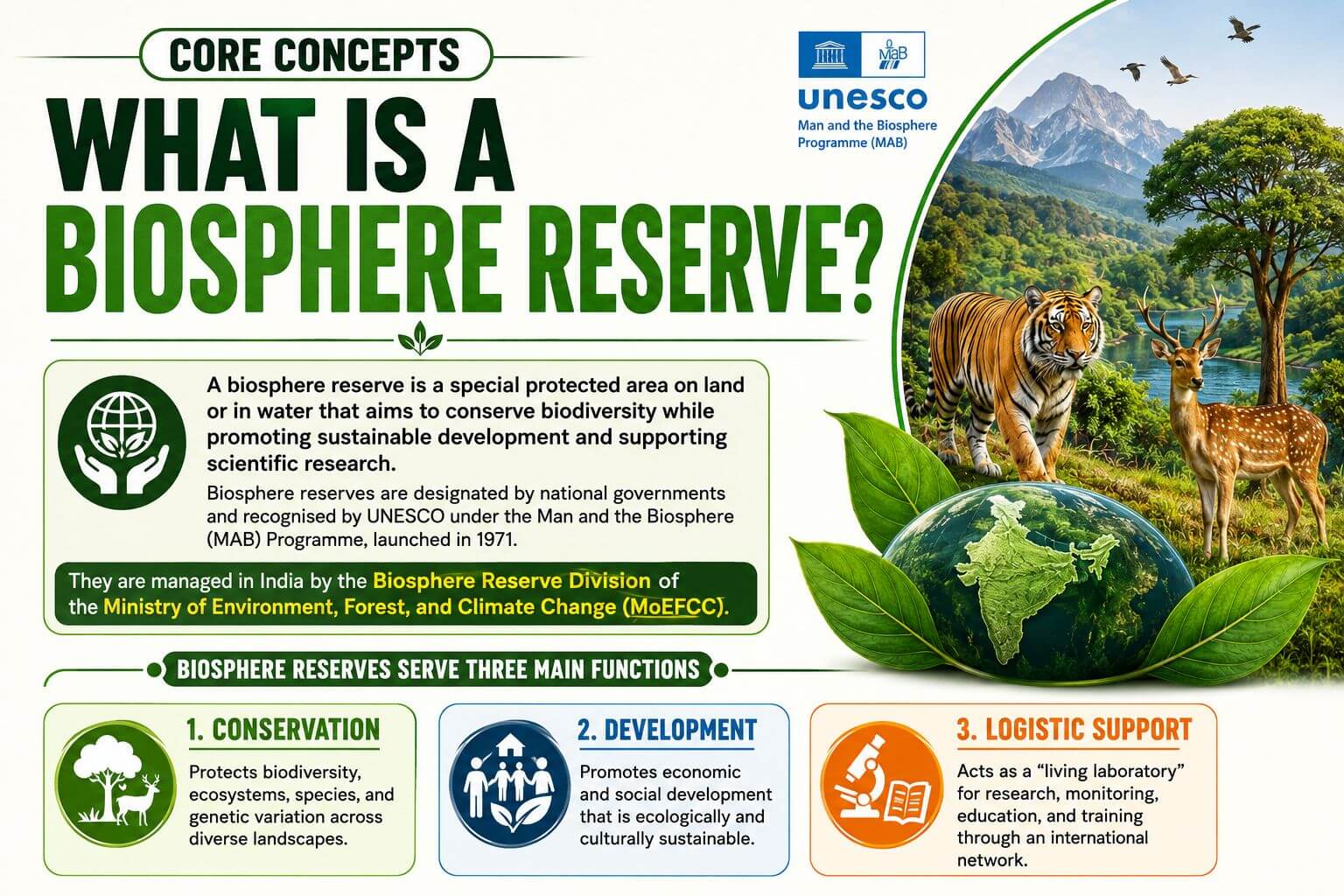
A biosphere reserve is a special protected area on land or in water that aims to conserve biodiversity while promoting sustainable development and supporting scientific research. Biosphere reserves are designated by national governments and recognised by UNESCO under the Man and the Biosphere (MAB) Programme, launched in 1971. They are managed in India by the Biosphere Reserve Division of the Ministry of Environment, Forest, and Climate Change (MoEFCC).
Biosphere reserves serve three main functions:
- Conservation: Protects biodiversity, ecosystems, species, and genetic variation across diverse landscapes.
- Development: Promotes economic and social development that is ecologically and culturally sustainable.
- Logistic Support: Acts as a "living laboratory" for research, monitoring, education, and training through an international network.
Three Zones of a Biosphere Reserve
Each biosphere reserve is divided into three interconnected zones, each balancing conservation with sustainable use.
| Zone | Description | Function |
|---|---|---|
| Core Area | Strictly protected ecosystem; minimally disturbed. | Conserves landscapes, ecosystems, species, and genetic variation; no human activity allowed. |
| Buffer Zone | Surrounds or adjoins the core area. | Supports scientific research, monitoring, education, training, and eco-friendly activities. |
| Transition Area | Outermost zone with human settlements and economic activities. | Promotes sustainable development; balances ecological and socio-cultural needs. |
Origin and Designation Criteria
- Concept introduced: UNESCO General Conference, 1968.
- MAB Programme launched: 1971.
- First biosphere reserves designated: Early 1970s (first reserve in 1979).
- India's National Biosphere Reserve Programme launched: 1986.
- India's first biosphere reserve notified: Nilgiri (1986).
- Total global biosphere reserves (2025): 785 sites in 142 countries.
UNESCO uses specific criteria to designate an area as a biosphere reserve. The core area must be minimally disturbed and contain significant biological diversity. It must support viable populations of species at all trophic levels. The site must offer opportunities for research and monitoring, must have a buffer zone surrounding the core, and a transition zone for sustainable human activities. A management plan involving local communities is mandatory.
Complete List of 18 Biosphere Reserves in India
The table below provides the complete list of all 18 notified biosphere reserves in India with year of establishment, area, states, UNESCO recognition year, and key species.
| Sl. No. | Biosphere Reserve (Area in sq km) | State(s) | Year Established | UNESCO Recognition Year | Key Species |
|---|---|---|---|---|---|
| 1 | Nilgiri (5,520) | Tamil Nadu, Kerala, Karnataka | 1986 | 2000 | Nilgiri Tahr, Lion-tailed Macaque, Malabar Giant Squirrel, Tiger. |
| 2 | Nanda Devi (6,407.03) | Uttarakhand | 1988 | 2004 | Snow Leopard, Himalayan Brown Bear, Musk Deer. |
| 3 | Nokrek (820) | Meghalaya | 1988 | 2009 | Red Panda, Wild Asian Elephant, Hoolock Gibbon. |
| 4 | Gulf of Mannar (10,500) | Tamil Nadu | 1989 | 2001 | Dugong, Sea Turtle, Olive Ridley Turtle, Coral Reefs; first marine biosphere reserve in India. |
| 5 | Sundarbans (9,630) | West Bengal | 1989 | 2001 | Royal Bengal Tiger, Irrawaddy Dolphin, Saltwater Crocodile. |
| 6 | Manas (2,837) | Assam | 1989 | 2001 | Golden Langur, Wild Buffalo, Asiatic Elephant; also a Tiger Reserve, UNESCO World Heritage Site, and Ramsar wetland link. |
| 7 | Great Nicobar (1,038.7) | Andaman and Nicobar Islands | 1989 | 2013 | Leatherback Sea Turtle, Nicobar Megapode, Saltwater Crocodile. |
| 8 | Simlipal (5,569) | Odisha | 1994 | 2009 | Tiger, Elephant, Giant Squirrel, Gaur; located in Mayurbhanj district. |
| 9 | Dibru-Saikhowa (765) | Assam | 1986/1997 | National designation only | Feral Horse, Gangetic River Dolphin, Bengal Tiger; located in Dibrugarh and Tinsukia. |
| 10 | Dehang-Debang / Dihang-Dibang (5,111.5) | Arunachal Pradesh | 1998 | National designation only | Snow Leopard, Takin, Red Panda; covers Siang and Dibang valleys. |
| 11 | Pachmarhi (4,981.72) | Madhya Pradesh | 1999 | 2009 | Flying Squirrel, Indian Wild Dog, Indian Giant Squirrel; located in Betul, Hoshangabad, and Chhindwara. |
| 12 | Khangchendzonga (2,931.12) | Sikkim | 2000 | 2018 | Snow Leopard, Red Panda; covers Kangchenjunga region in North and West Sikkim. |
| 13 | Agasthyamalai (3,500) | Kerala, Tamil Nadu | 2001 | 2016 | Elephant, Lion-tailed Macaque, Nilgiri Tahr; covers Neyyar, Peppara, Shenduruny. |
| 14 | Achanakmar-Amarkantak (3,835.46) | Madhya Pradesh, Chhattisgarh | 2005 | 2012 | Indian Wild Dog, Flying Squirrel, Sarus Crane; covers Anuppur, Dindori, Bilaspur. |
| 15 | Kachchh / Great Rann of Kutch (12,454) | Gujarat | 2008 | National designation only | Largest biosphere reserve in India; Indian Wild Ass, Flamingo (Flamingo City); covers Kutch, Morbi, Surendranagar, Patan. |
| 16 | Cold Desert (7,770) | Himachal Pradesh | 2009 | 2025 | Snow Leopard, Tibetan Wolf; India's first high-altitude cold desert biosphere reserve; covers Pin Valley NP, Chandratal Wetland, Kibber WLS, Sarchu. |
| 17 | Seshachalam Hills (4,755.58) | Andhra Pradesh | 2010 | National designation only | Red Sanders, Slender Loris; covers Chittoor and Kadapa districts in Eastern Ghats. |
| 18 | Panna (2,998.98) | Madhya Pradesh | 2011 | 2020 | Tiger, Vulture, Crocodile, Chinkara; located in Panna and Chhatarpur on the Ken River basin. |
| — | Total Area | 91,425.11 sq km | |||
UNESCO-Recognised Biosphere Reserves of India
Out of 18 biosphere reserves in India, 13 are part of UNESCO's World Network of Biosphere Reserves (WNBR). These are repeatedly tested in UPSC and SSC exams. To revise related Static GK on world heritage sites, you can also explore the UNESCO World Heritage Sites in India - Static GK guide on Jobsme.in.
| UNESCO Recognition Year | Biosphere Reserve | State(s) |
|---|---|---|
| 2000 | Nilgiri Biosphere Reserve | Tamil Nadu, Kerala, Karnataka |
| 2001 | Gulf of Mannar Biosphere Reserve | Tamil Nadu |
| 2001 | Sundarbans Biosphere Reserve | West Bengal |
| 2001 | Manas Biosphere Reserve | Assam |
| 2004 | Nanda Devi Biosphere Reserve | Uttarakhand |
| 2009 | Pachmarhi Biosphere Reserve | Madhya Pradesh |
| 2009 | Nokrek Biosphere Reserve | Meghalaya |
| 2009 | Simlipal Biosphere Reserve | Odisha |
| 2012 | Achanakmar-Amarkantak Biosphere Reserve | Madhya Pradesh, Chhattisgarh |
| 2013 | Great Nicobar Biosphere Reserve | Andaman and Nicobar Islands |
| 2016 | Agasthyamala Biosphere Reserve | Kerala, Tamil Nadu |
| 2018 | Khangchendzonga Biosphere Reserve | Sikkim |
| 2020 | Panna Biosphere Reserve | Madhya Pradesh |
| 2025 | Cold Desert Biosphere Reserve | Himachal Pradesh |
The 5 reserves with national designation only (not yet UNESCO-recognised) are Dibru-Saikhowa, Dihang-Dibang, Kachchh (Great Rann of Kutch), Seshachalam Hills, and earlier Cold Desert (now upgraded in 2025).
Biogeographical Zone-Wise Distribution
India's biosphere reserves cover all major ecological zones, from cold deserts to tropical evergreen forests and coastal-marine ecosystems.
| Sl. No. | Biosphere Reserve | Biogeographical Zone | State(s) | Specific Location |
|---|---|---|---|---|
| 1 | Nilgiri | Western Ghats | Tamil Nadu, Kerala, Karnataka | Wayanad, Nagarhole, Bandipur, Mudumalai, Nilambur, Silent Valley. |
| 2 | Nanda Devi | Western Himalayas | Uttarakhand | Chamoli, Pithoragarh, Bageshwar. |
| 3 | Nokrek | Eastern Himalayas | Meghalaya | West Garo Hills. |
| 4 | Gulf of Mannar | Coasts | Tamil Nadu | From Rameswaram to Kanyakumari. |
| 5 | Sundarbans | Gangetic Delta | West Bengal | Delta of Ganga-Brahmaputra rivers. |
| 6 | Manas | Eastern Himalayas | Assam | Kokrajhar, Bongaigaon, Barpeta, Nalbari, Kamrup, Darrang. |
| 7 | Great Nicobar | Islands | Andaman and Nicobar | Southernmost islands. |
| 8 | Simlipal | Deccan Peninsula | Odisha | Mayurbhanj district. |
| 9 | Dibru-Saikhowa | Eastern Himalayas | Assam | Dibrugarh and Tinsukia districts. |
| 10 | Dehang-Dibang | Eastern Himalayas | Arunachal Pradesh | Siang and Dibang Valley. |
| 11 | Pachmarhi | Semi-Arid | Madhya Pradesh | Betul, Hoshangabad, Chhindwara. |
| 12 | Khangchendzonga | Eastern Himalayas | Sikkim | Kangchenjunga region. |
| 13 | Agasthyamalai | Western Ghats | Kerala, Tamil Nadu | Neyyar, Peppara, Shenduruny. |
| 14 | Achanakmar-Amarkantak | Maikala Hills | Madhya Pradesh, Chhattisgarh | Anuppur, Dindori, Bilaspur. |
| 15 | Great Rann of Kutch | Desert | Gujarat | Kutch, Morbi, Surendranagar, Patan. |
| 16 | Cold Desert | Western Himalayas | Himachal Pradesh | Pin Valley, Chandratal, Sarchu, Kibber. |
| 17 | Seshachalam Hills | Eastern Ghats | Andhra Pradesh | Chittoor and Kadapa. |
| 18 | Panna | Ken River Basin | Madhya Pradesh | Panna and Chhatarpur. |
Difference Between Biosphere Reserve, National Park, and Wildlife Sanctuary
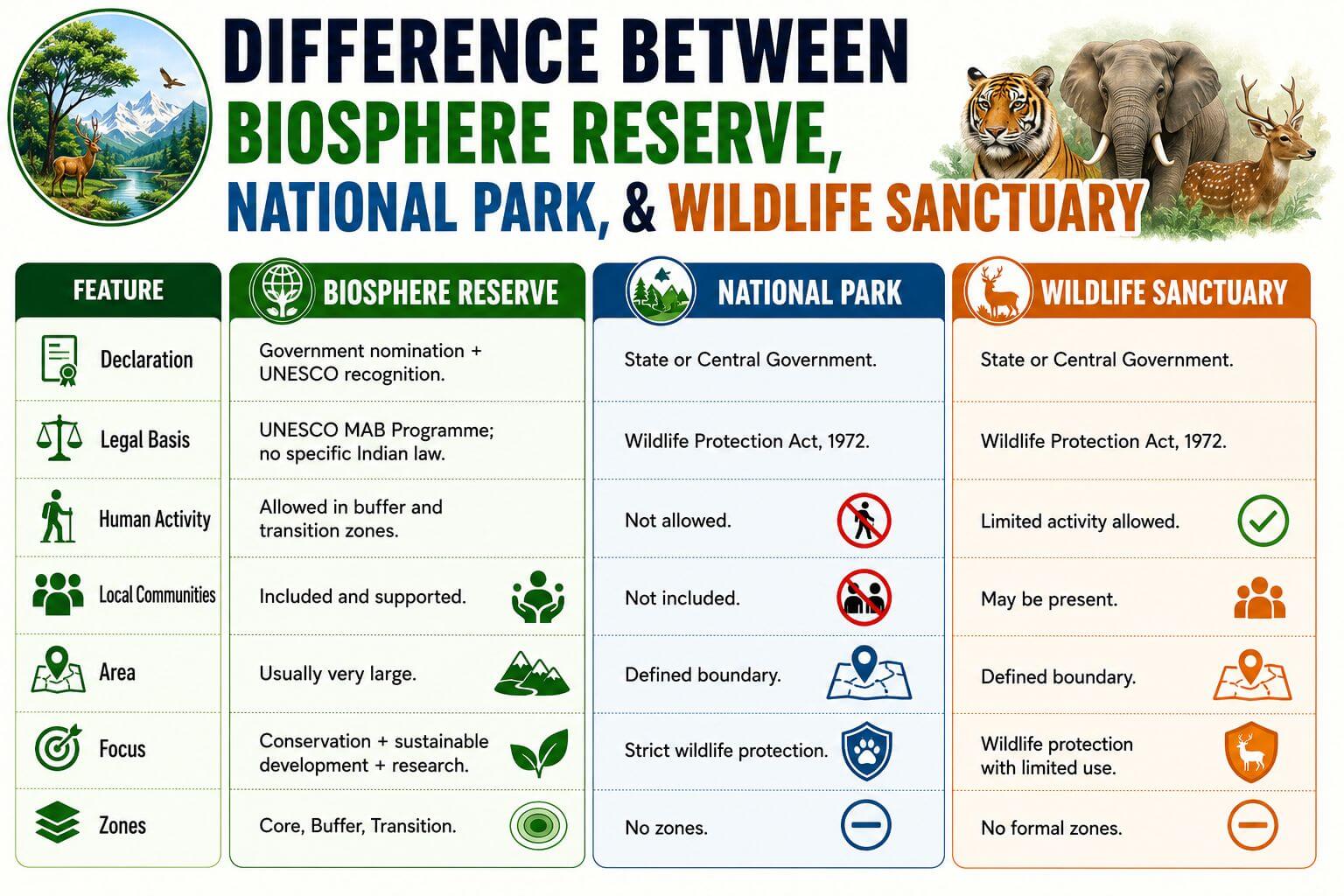
Biosphere reserves differ significantly from national parks and wildlife sanctuaries in their legal basis, human presence, and conservation purpose.
| Feature | Biosphere Reserve | National Park | Wildlife Sanctuary |
|---|---|---|---|
| Declaration | Government nomination + UNESCO recognition. | State or Central Government. | State or Central Government. |
| Legal Basis | UNESCO MAB Programme; no specific Indian law. | Wildlife Protection Act, 1972. | Wildlife Protection Act, 1972. |
| Human Activity | Allowed in buffer and transition zones. | Not allowed. | Limited activity allowed. |
| Local Communities | Included and supported. | Not included. | May be present. |
| Area | Usually very large. | Defined boundary. | Defined boundary. |
| Focus | Conservation + sustainable development + research. | Strict wildlife protection. | Wildlife protection with limited use. |
| Zones | Core, Buffer, Transition. | No zones. | No formal zones. |
Key Facts at a Glance for UPSC and SSC
| Question | Answer |
|---|---|
| How many biosphere reserves are there in India? | 18 (as of 2025). |
| UNESCO-recognised biosphere reserves in India | 13 (as of September 2025). |
| First biosphere reserve in India | Nilgiri (1986). |
| First UNESCO-recognised biosphere reserve in India | Nilgiri (2000). |
| Largest biosphere reserve in India | Kachchh / Great Rann of Kutch, Gujarat (~12,454 sq km). |
| Smallest biosphere reserve in India | Dibru-Saikhowa, Assam (~765 sq km); some sources also cite Nokrek (820 sq km). |
| First marine biosphere reserve in India | Gulf of Mannar (1989). |
| Latest UNESCO recognition | Cold Desert, Himachal Pradesh (September 2025). |
| India's first high-altitude cold desert biosphere reserve | Cold Desert (Pin Valley, Chandratal, Kibber). |
| MAB Programme launched | 1971 by UNESCO. |
| India's National Biosphere Reserve Programme launched | 1986. |
| Total global biosphere reserves (2025) | 785 sites in 142 countries. |
| Manas Biosphere Reserve also holds | Tiger Reserve + UNESCO World Heritage Site + Ramsar association. |
| Total area of biosphere reserves in India | ~91,425.11 sq km. |
Memory Tricks and Mnemonics for Biosphere Reserves
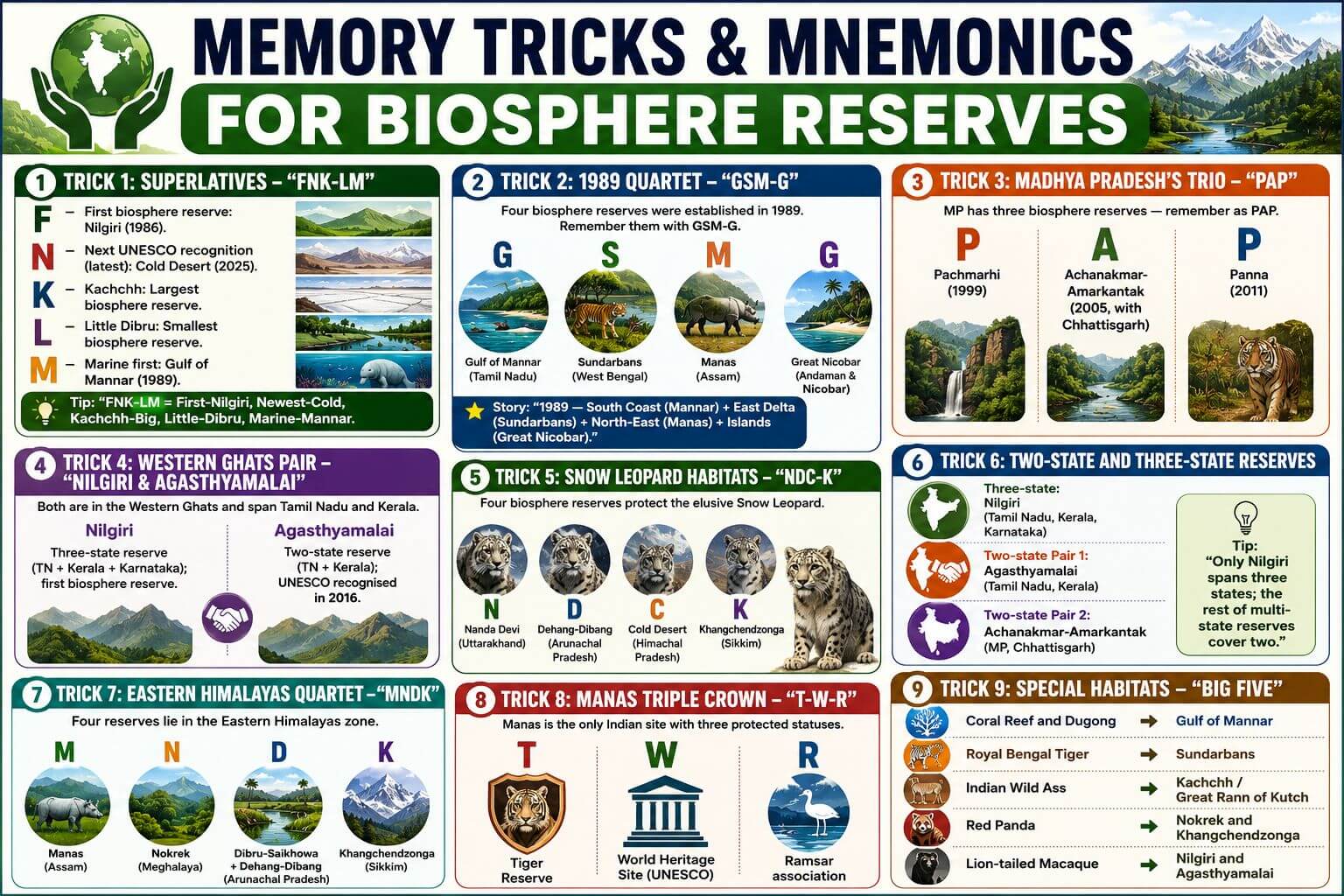
Trick 1: Superlatives - "FNK-LM"
Use this to remember the key superlative facts.
- F - First biosphere reserve: Nilgiri (1986).
- N - Next UNESCO recognition (latest): Cold Desert (2025).
- K - Kachchh: Largest biosphere reserve.
- L - Little Dibru: Smallest biosphere reserve.
- M - Marine first: Gulf of Mannar (1989).
Tip: "FNK-LM = First-Nilgiri, Newest-Cold, Kachchh-Big, Little-Dibru, Marine-Mannar."
Trick 2: 1989 Quartet - "GSM-G"
Four biosphere reserves were established in 1989. Remember them with GSM-G.
- G - Gulf of Mannar (Tamil Nadu).
- S - Sundarbans (West Bengal).
- M - Manas (Assam).
- G - Great Nicobar (Andaman and Nicobar).
Story: "1989 — South Coast (Mannar) + East Delta (Sundarbans) + North-East (Manas) + Islands (Great Nicobar)."
Trick 3: Madhya Pradesh's Trio - "PAP"
MP has three biosphere reserves — remember as PAP.
- P - Pachmarhi (1999).
- A - Achanakmar-Amarkantak (2005, with Chhattisgarh).
- P - Panna (2011).
Trick 4: Western Ghats Pair - "Nilgiri & Agasthyamalai"
Both are in the Western Ghats and span Tamil Nadu and Kerala.
- Nilgiri - Three-state reserve (TN + Kerala + Karnataka); first biosphere reserve.
- Agasthyamalai - Two-state reserve (TN + Kerala); UNESCO recognised in 2016.
Trick 5: Snow Leopard Habitats - "NDC-K"
Four biosphere reserves protect the elusive Snow Leopard.
- N - Nanda Devi (Uttarakhand).
- D - Dehang-Dibang (Arunachal Pradesh).
- C - Cold Desert (Himachal Pradesh).
- K - Khangchendzonga (Sikkim).
Trick 6: Two-State and Three-State Reserves
- Three-state: Nilgiri (Tamil Nadu, Kerala, Karnataka).
- Two-state Pair 1: Agasthyamalai (Tamil Nadu, Kerala).
- Two-state Pair 2: Achanakmar-Amarkantak (MP, Chhattisgarh).
Tip: "Only Nilgiri spans three states; the rest of multi-state reserves cover two."
Trick 7: Eastern Himalayas Quartet - "MNDK"
Four reserves lie in the Eastern Himalayas zone.
- M - Manas (Assam).
- N - Nokrek (Meghalaya).
- D - Dibru-Saikhowa + Dehang-Dibang.
- K - Khangchendzonga (Sikkim).
Trick 8: Manas Triple Crown - "T-W-R"
Manas is the only Indian site with three protected statuses.
- T - Tiger Reserve.
- W - World Heritage Site (UNESCO).
- R - Ramsar association.
Trick 9: Special Habitats - "Big Five"
- Coral Reef and Dugong → Gulf of Mannar.
- Royal Bengal Tiger → Sundarbans.
- Indian Wild Ass → Kachchh / Great Rann of Kutch.
- Red Panda → Nokrek and Khangchendzonga.
- Lion-tailed Macaque → Nilgiri and Agasthyamalai.
Additional Notes
Frequently Confused Facts
- First in India vs First UNESCO-recognised: Nilgiri is both — established in 1986 and UNESCO-recognised in 2000.
- Largest vs Smallest: Kachchh (Gujarat, ~12,454 sq km) is the largest; Dibru-Saikhowa (Assam, ~765 sq km) is the smallest.
- Marine vs Terrestrial: Gulf of Mannar (1989) is the first marine biosphere reserve; most others are terrestrial.
- Cold Desert (Himachal Pradesh): India's first high-altitude cold desert biosphere reserve; UNESCO-recognised in 2025 — the latest addition.
- Nilgiri vs Agasthyamalai: Both in Western Ghats; Nilgiri spans three states, Agasthyamalai spans two.
- Sundarbans vs Manas: Sundarbans protects the Royal Bengal Tiger and Irrawaddy Dolphin; Manas protects the Golden Langur and Wild Buffalo.
- Khangchendzonga (2000): Established as a biosphere reserve in 2000 but recognised by UNESCO only in 2018.
- Reserves not yet UNESCO-recognised: Dibru-Saikhowa, Dehang-Dibang, Kachchh, Seshachalam Hills.
Repeating PYQ Patterns
- UPSC Prelims: Frequently asks about Nilgiri being the first, Manas's triple status, Cold Desert's recent UNESCO recognition, and biosphere reserves protecting specific species.
- SSC CGL and CHSL: Match-the-column questions linking biosphere reserves to states; Nilgiri, Sundarbans, and Kachchh are most commonly asked.
- IBPS PO and Clerk: One-liner questions on first/largest/smallest reserves and UNESCO additions.
- RRB NTPC and Group D: Direct state-reserve mapping questions; Nokrek (Meghalaya), Pachmarhi (MP), Simlipal (Odisha) frequently appear.
- State PCS: Region-specific reserves are heavily favoured in respective state exams.
Quick Insight
Biosphere reserves are central to current affairs themes such as the addition of new UNESCO sites, the conservation of endangered species like the Snow Leopard and Great Indian Bustard, and the integration of climate change mitigation strategies into ecological zones. The recent inclusion of Cold Desert under UNESCO at the 5th World Congress of Biosphere Reserves in Hangzhou, China (September 2025), is a high-yield current affairs item. For the latest updates, follow the daily current affairs section on Jobsme.in.
This topic also pairs well with related Static GK areas such as Rivers of India and Mountain Peaks of India, since most biosphere reserves are linked to specific river basins, mountain ranges, or coastal regions.
One-Liners for Quick Revision
- Nilgiri Biosphere Reserve → First biosphere reserve in India (1986); first UNESCO-recognised (2000) → Tamil Nadu, Kerala, Karnataka; Western Ghats; Nilgiri Tahr, Lion-tailed Macaque.
- Nanda Devi Biosphere Reserve → Established 1988; UNESCO 2004 → Uttarakhand; Western Himalayas; Snow Leopard, Himalayan Brown Bear.
- Nokrek Biosphere Reserve → Established 1988; UNESCO 2009 → Meghalaya; West Garo Hills; Red Panda, Hoolock Gibbon, Wild Asian Elephant.
- Gulf of Mannar Biosphere Reserve → First marine biosphere reserve (1989); UNESCO 2001 → Tamil Nadu; Rameswaram to Kanyakumari; Dugong, Sea Turtle, coral reefs.
- Sundarbans Biosphere Reserve → Established 1989; UNESCO 2001 → West Bengal; Ganga-Brahmaputra delta; Royal Bengal Tiger, Irrawaddy Dolphin.
- Manas Biosphere Reserve → Established 1989; UNESCO 2001 → Assam; Eastern Himalayas; Golden Langur, Wild Buffalo; also Tiger Reserve and UNESCO World Heritage Site.
- Great Nicobar Biosphere Reserve → Established 1989; UNESCO 2013 → Andaman and Nicobar Islands; southernmost islands; Leatherback Sea Turtle, Nicobar Megapode.
- Simlipal Biosphere Reserve → Established 1994; UNESCO 2009 → Odisha; Mayurbhanj; Tiger, Elephant, Giant Squirrel.
- Dibru-Saikhowa Biosphere Reserve → Established 1986/1997; National designation only → Assam; Dibrugarh and Tinsukia; smallest in India; Feral Horse, Gangetic River Dolphin.
- Dehang-Dibang Biosphere Reserve → Established 1998; National designation only → Arunachal Pradesh; Siang and Dibang Valley; Snow Leopard, Takin.
- Pachmarhi Biosphere Reserve → Established 1999; UNESCO 2009 → Madhya Pradesh; Betul, Hoshangabad, Chhindwara; Flying Squirrel, Indian Wild Dog.
- Khangchendzonga Biosphere Reserve → Established 2000; UNESCO 2018 → Sikkim; Eastern Himalayas; Snow Leopard, Red Panda.
- Agasthyamalai Biosphere Reserve → Established 2001; UNESCO 2016 → Kerala, Tamil Nadu; Western Ghats; Elephant, Lion-tailed Macaque.
- Achanakmar-Amarkantak Biosphere Reserve → Established 2005; UNESCO 2012 → MP, Chhattisgarh; Maikala Hills; Indian Wild Dog, Flying Squirrel.
- Kachchh / Great Rann of Kutch Biosphere Reserve → Established 2008; National designation only → Gujarat; largest in India (~12,454 sq km); Indian Wild Ass, Flamingo City.
- Cold Desert Biosphere Reserve → Established 2009; UNESCO 2025 → Himachal Pradesh; Pin Valley, Chandratal, Kibber; India's first high-altitude cold desert biosphere reserve; Snow Leopard, Tibetan Wolf.
- Seshachalam Hills Biosphere Reserve → Established 2010; National designation only → Andhra Pradesh; Eastern Ghats; Red Sanders, Slender Loris.
- Panna Biosphere Reserve → Established 2011; UNESCO 2020 → Madhya Pradesh; Ken River basin; Tiger, Vulture, Crocodile, Chinkara.
- Total Biosphere Reserves in India → 18 → Cover ~91,425.11 sq km.
- UNESCO-recognised reserves in India → 13 (as of September 2025) → Out of 18 notified reserves.
- MAB Programme launched → 1971 by UNESCO → Aimed at conservation, sustainable development, and research.
- India's National Biosphere Reserve Programme → Launched 1986 → First reserve Nilgiri notified the same year.
- Three Zones → Core, Buffer, Transition → Core is strictly protected; transition allows human activity.
- Global biosphere reserves total → 785 sites in 142 countries → As of 2025.
- Latest UNESCO addition (5th World Congress) → Cold Desert, HP → September 2025, Hangzhou, China.
- Manas's triple status → Tiger Reserve + UNESCO World Heritage Site + Ramsar association → Unique among biosphere reserves.
- Snow Leopard habitats → Nanda Devi, Khangchendzonga, Cold Desert, Dehang-Dibang.
- Red Panda habitats → Nokrek and Khangchendzonga.
- Lion-tailed Macaque habitats → Nilgiri and Agasthyamalai.
- Indian Wild Ass habitat → Only in Kachchh / Great Rann of Kutch.
- Royal Bengal Tiger habitat → Sundarbans (mangrove tigers).
- Dugong habitat → Gulf of Mannar.
- Nicobar Megapode habitat → Great Nicobar.
- Golden Langur habitat → Manas Biosphere Reserve.
- Three-state biosphere reserve → Only Nilgiri (TN + Kerala + Karnataka).
- Two-state biosphere reserves → Agasthyamalai (TN + Kerala) and Achanakmar-Amarkantak (MP + Chhattisgarh).
- Western Ghats reserves → Nilgiri and Agasthyamalai.
- Western Himalayas reserves → Nanda Devi and Cold Desert.
- Eastern Himalayas reserves → Nokrek, Manas, Dibru-Saikhowa, Dehang-Dibang, Khangchendzonga.
- Coastal reserve → Gulf of Mannar.
- Island reserve → Great Nicobar.
- Desert reserves → Kachchh (hot desert) and Cold Desert (HP).
- Madhya Pradesh's three reserves → Pachmarhi, Achanakmar-Amarkantak (with Chhattisgarh), Panna.
- Reserves with national designation only (non-UNESCO) → Dibru-Saikhowa, Dehang-Dibang, Kachchh, Seshachalam Hills.
- UNESCO recognition years sequence → 2000-Nilgiri, 2001-Mannar/Sundarbans/Manas, 2004-Nanda Devi, 2009-Pachmarhi/Nokrek/Simlipal, 2012-Achanakmar, 2013-Great Nicobar, 2016-Agasthyamala, 2018-Khangchendzonga, 2020-Panna, 2025-Cold Desert.
For more Static GK topics like national parks, mountain peaks, and rivers of India, explore the Static GK section on Jobsme.in. You can also test your knowledge with the Static GK Quiz and check out the latest exam notifications at Latest Government Job Notifications.
Free quiz • No signup required
Put this topic into practice with Indian Cultural Institutions – Static GK MCQ Quiz. It is the quickest way to reinforce what you just learned.
Frequently Asked Questions
How many biosphere reserves are there in India?
Which is the first biosphere reserve in India?
Which is the largest biosphere reserve in India?
Which is the smallest biosphere reserve in India?
Which is the first marine biosphere reserve in India?
Which is the latest biosphere reserve added to UNESCO's World Network from India?
What are the three zones of a biosphere reserve?
What is the Man and Biosphere (MAB) Programme?
Which biosphere reserve protects the Royal Bengal Tiger?
What is the difference between a biosphere reserve and a national park?

About the author