
National Parks and Wildlife Sanctuaries in India – Complete Static GK for Competitive Exams (State-Wise List, Memory Tricks & One-Liners)
This article covers the complete, updated list of National Parks and Wildlife Sanctuaries in India, organized state-wise for quick revision. It includes key facts, memory tricks, mnemonics, and one-liners essential for UPSC, SSC, Banking, Railways, Defence, and all other government competitive exams. With 107 National Parks and 550+ Wildlife Sanctuaries as of 2025, this is your one-stop reference for this high-priority Static GK topic.
Jump to section
- Introduction: Why This Topic Matters for Government Exams
- National Park vs Wildlife Sanctuary - Key Differences
- Important Superlatives - Largest, Smallest, Oldest, Newest National Parks
- Special Category National Parks - Must Know for Exams
- State-Wise List of National Parks and Wildlife Sanctuaries in India
- Famous Animal-Park Pairs - High-Priority Exam Table
- Project Tiger and Tiger Reserves in India
- Biosphere Reserves in India - Quick Exam Reference
- Mnemonics, Memory Tricks, and Vivid Memory Aids
- Additional Notes - Tricky Facts, PYQ Patterns, and Common Confusions
- One-Liners - Key Facts for Last-Minute Revision
- Related Static GK Topics for Exam Preparation
Introduction: Why This Topic Matters for Government Exams
National Parks and Wildlife Sanctuaries are among the most frequently examined topics in government competitive exams. Questions on this topic appear in UPSC Civil Services Prelims, SSC CGL, IBPS PO/Clerk, RRB NTPC, NDA, State PSC, and Insurance exams every year. They are asked in the form of matching pairs (park-state), identifying the correct park for a given animal, locating parks by geography, or recalling the oldest/newest/largest/smallest parks.
India is one of the world's 17 megadiverse countries, hosting an extraordinary variety of wildlife — from the one-horned rhinoceros in Assam to the Asiatic lion in Gujarat and the snow leopard in Ladakh. As of 2025, India has 107 National Parks and over 550 Wildlife Sanctuaries, collectively covering more than 1.65 lakh sq km — roughly 5% of India's total land area.
This article gives you a thoroughly organized, exam-focused guide — state-wise lists, key superlatives, animal-park pairs, special category parks, memory tricks, and one-liners — everything you need to answer questions confidently. For more Static GK notes across all topics, explore our complete archive.
Legal Framework - Quick Overview
National Parks and Wildlife Sanctuaries in India are governed by the Wildlife Protection Act (WPA), 1972. The Ministry of Environment, Forest and Climate Change (MoEFCC) is the nodal ministry at the central level. The National Tiger Conservation Authority (NTCA) oversees Tiger Reserves, many of which overlap with national parks. Key amendments to the WPA were made in 2002 and 2006 to strengthen anti-poaching measures and habitat protection. India also fulfills commitments under the Convention on Biological Diversity (CBD) and the Ramsar Convention on Wetlands through its protected area network.
National Park vs Wildlife Sanctuary - Key Differences
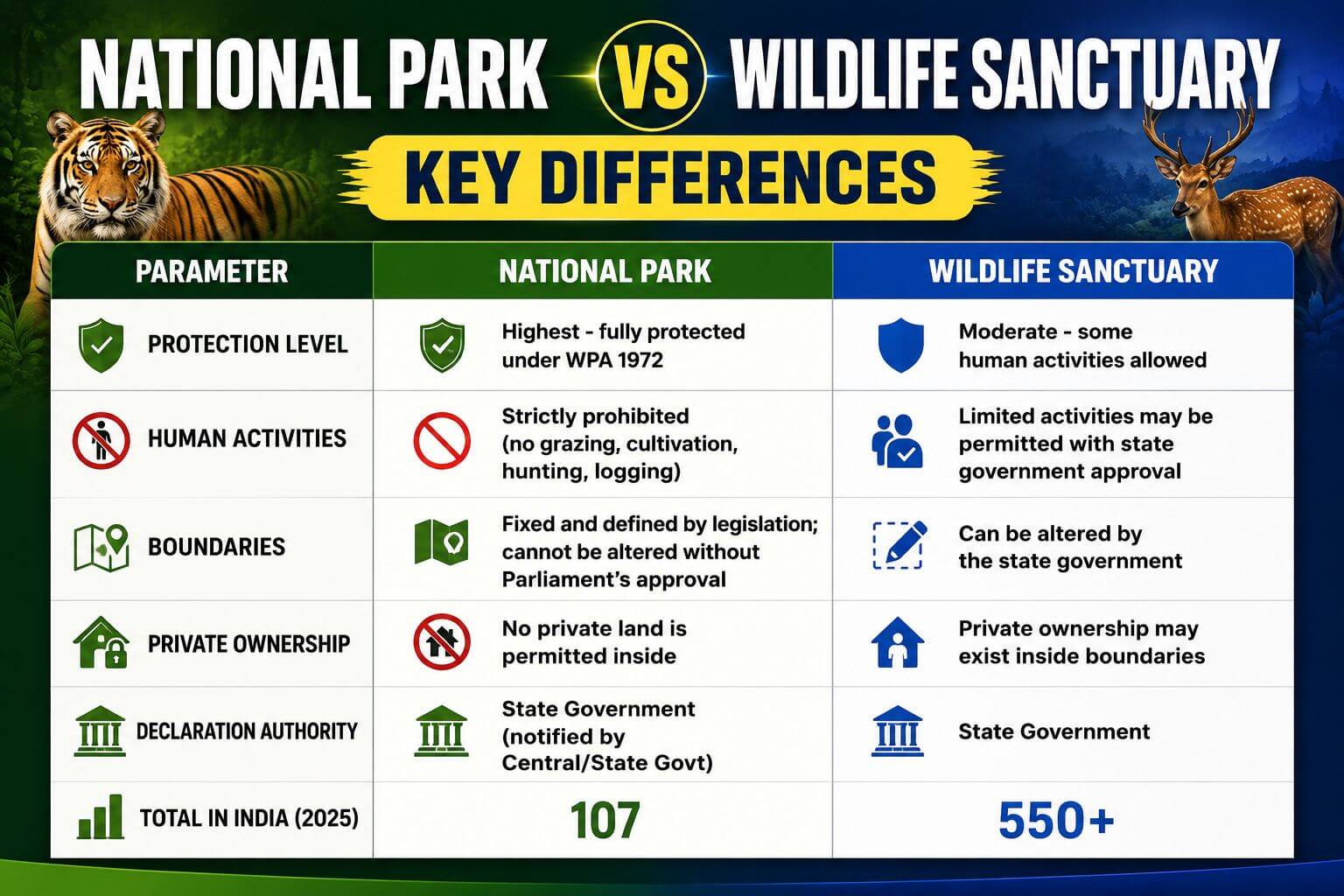
Exam questions frequently test the distinction between a National Park and a Wildlife Sanctuary. The critical differences are as follows:
| Parameter | National Park | Wildlife Sanctuary |
|---|---|---|
| Protection Level | Highest - fully protected under WPA 1972 | Moderate - some human activities allowed |
| Human Activities | Strictly prohibited (no grazing, cultivation, hunting, logging) | Limited activities may be permitted with state government approval |
| Boundaries | Fixed and defined by legislation; cannot be altered without Parliament's approval | Can be altered by the state government |
| Private Ownership | No private land is permitted inside | Private ownership may exist inside boundaries |
| Declaration Authority | State Government (notified by Central/State Govt) | State Government |
| Total in India (2025) | 107 | 550+ |
Important for Exams: A Wildlife Sanctuary can be upgraded to a National Park, but a National Park cannot be downgraded to a Sanctuary. Also, Biosphere Reserves are a separate UNESCO-recognized category that can overlap with both national parks and sanctuaries but follow a different management framework with core, buffer, and transition zones.
Important Superlatives - Largest, Smallest, Oldest, Newest National Parks
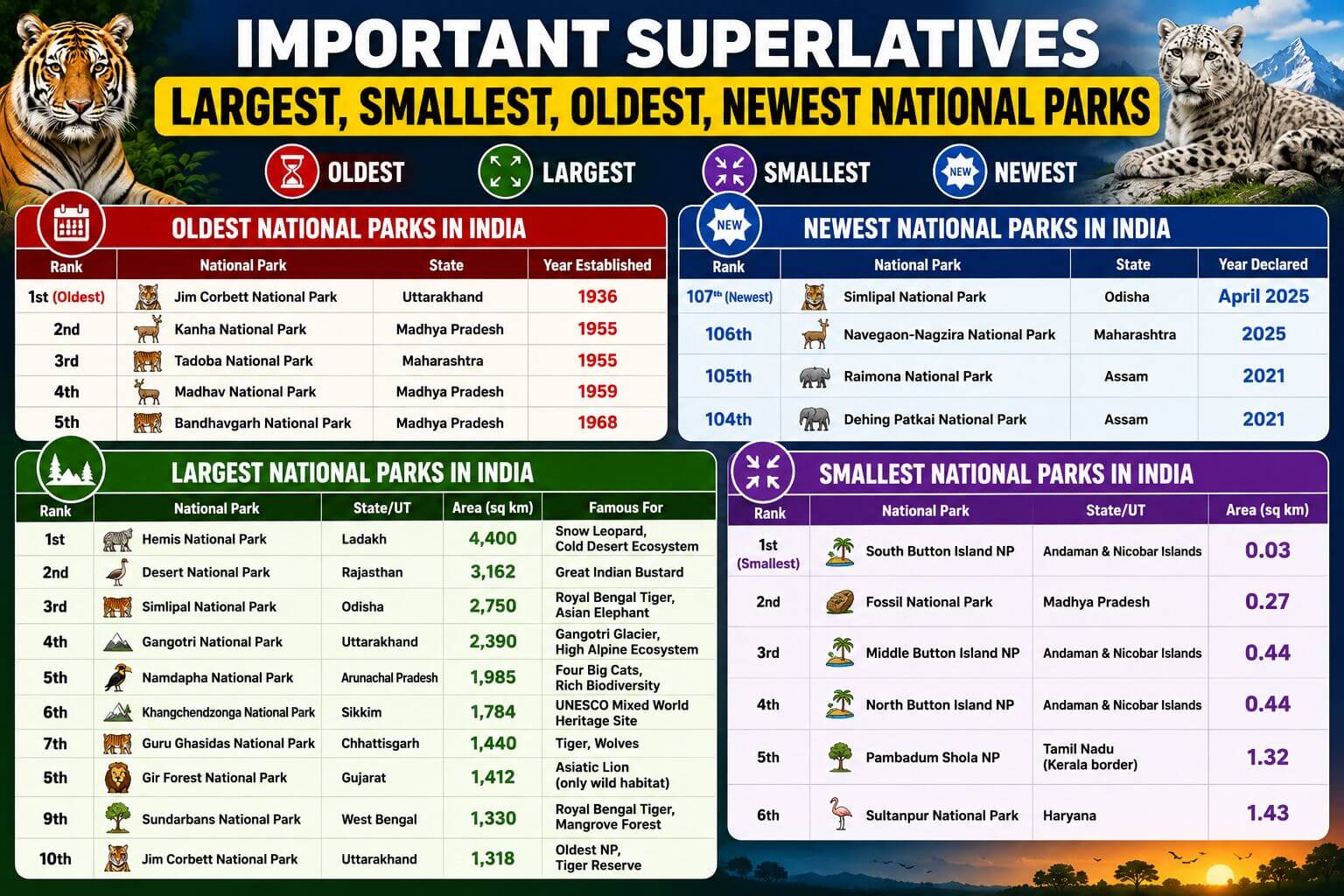
Superlatives are highly exam-favoured facts. They appear year after year in UPSC Prelims, SSC CGL, Banking GK, and Railway GK sections. Memorize the following carefully.
Oldest National Parks in India
| Rank | National Park | State | Year Established |
|---|---|---|---|
| 1st (Oldest) | Jim Corbett National Park | Uttarakhand | 1936 |
| 2nd | Kanha National Park | Madhya Pradesh | 1955 |
| 3rd | Tadoba National Park | Maharashtra | 1955 |
| 4th | Madhav National Park | Madhya Pradesh | 1959 |
| 5th | Bandhavgarh National Park | Madhya Pradesh | 1968 |
Newest National Parks in India
| Rank | National Park | State | Year Declared |
|---|---|---|---|
| 107th (Newest) | Simlipal National Park | Odisha | April 2025 |
| 106th | Navegaon-Nagzira National Park | Maharashtra | 2025 |
| 105th | Raimona National Park | Assam | 2021 |
| 104th | Dehing Patkai National Park | Assam | 2021 |
Largest National Parks in India
| Rank | National Park | State/UT | Area (sq km) | Famous For |
|---|---|---|---|---|
| 1st | Hemis National Park | Ladakh | 4,400 | Snow Leopard, Cold Desert Ecosystem |
| 2nd | Desert National Park | Rajasthan | 3,162 | Great Indian Bustard |
| 3rd | Simlipal National Park | Odisha | 2,750 | Royal Bengal Tiger, Asian Elephant |
| 4th | Gangotri National Park | Uttarakhand | 2,390 | Gangotri Glacier, High Alpine Ecosystem |
| 5th | Namdapha National Park | Arunachal Pradesh | 1,985 | Four Big Cats, Rich Biodiversity |
| 6th | Khangchendzonga National Park | Sikkim | 1,784 | UNESCO Mixed World Heritage Site |
| 7th | Guru Ghasidas National Park | Chhattisgarh | 1,440 | Tiger, Wolves |
| 8th | Gir Forest National Park | Gujarat | 1,412 | Asiatic Lion (only wild habitat) |
| 9th | Sundarbans National Park | West Bengal | 1,330 | Royal Bengal Tiger, Mangrove Forest |
| 10th | Jim Corbett National Park | Uttarakhand | 1,318 | Oldest NP, Tiger Reserve |
Smallest National Parks in India
| Rank | National Park | State/UT | Area (sq km) |
|---|---|---|---|
| 1st (Smallest) | South Button Island NP | Andaman & Nicobar Islands | 0.03 |
| 2nd | Fossil National Park | Madhya Pradesh | 0.27 |
| 3rd | Middle Button Island NP | Andaman & Nicobar Islands | 0.44 |
| 4th | North Button Island NP | Andaman & Nicobar Islands | 0.44 |
| 5th | Pambadum Shola NP | Tamil Nadu (Kerala border) | 1.32 |
| 6th | Sultanpur National Park | Haryana | 1.43 |
Special Category National Parks - Must Know for Exams
World's Only Floating National Park
Keibul Lamjao National Park in Manipur is the world's only floating national park. It is located on the floating biomass locally called phumdi on Loktak Lake. It is the last natural habitat of the critically endangered Sangai deer (Manipur Brow-antlered Deer), which is the state animal of Manipur. Loktak Lake is also a Ramsar Wetland site.
India's First Marine National Park
Gulf of Mannar Marine National Park in Tamil Nadu, established in 1980, was the first marine national park in India. It protects coral reefs, dugongs (sea cows), dolphins, sea turtles, and diverse marine ecosystems across 21 islands.
Urban National Parks
India has a few national parks located within or adjacent to major cities — a unique and exam-relevant category:
- Guindy National Park - Located within Chennai, Tamil Nadu. It is one of the few urban national parks in the world.
- Sanjay Gandhi (Borivali) National Park - Located within the Mumbai metropolitan area, Maharashtra.
- Van Vihar National Park - Located within Bhopal, Madhya Pradesh. It functions both as a national park and a zoo.
- Mahavir Harina Vanasthali NP - Located near Hyderabad, Telangana.
UNESCO World Heritage Sites Among Indian National Parks
The following National Parks have been recognized as UNESCO World Heritage Sites — a very frequently asked fact in UPSC and SSC exams:
- Kaziranga National Park - Assam - Inscribed 1985 - Famous for the Indian one-horned rhinoceros
- Keoladeo Ghana National Park - Rajasthan - Inscribed 1985 - Famous for migratory birds including the Siberian Crane
- Manas National Park - Assam - Inscribed 1985 - Habitat of tiger, elephant, and rhinoceros
- Sundarbans National Park - West Bengal - Inscribed 1987 - World's largest mangrove forest, Royal Bengal Tiger
- Nanda Devi and Valley of Flowers National Parks - Uttarakhand - Inscribed 1988 (extended 2005) - Alpine flora, Brahmakamal
- Great Himalayan National Park - Himachal Pradesh - Inscribed 2014
- Khangchendzonga National Park - Sikkim - Inscribed 2016 - India's first and only UNESCO Mixed World Heritage Site (both natural and cultural)
Only National Park in Certain States
- Goa - Mollem National Park (also known as Bhagwan Mahavir NP) - Only National Park in Goa
- Bihar - Valmiki National Park - Only National Park in Bihar
- Uttar Pradesh - Dudhwa National Park - Only National Park in UP
- Nagaland - Ntangki National Park - Only National Park in Nagaland
- Punjab - No National Park (Punjab has no national park — only wildlife sanctuaries)
State-Wise List of National Parks and Wildlife Sanctuaries in India
The following section covers all states and union territories with their National Parks and key Wildlife Sanctuaries. This is the most comprehensive exam-relevant data for UPSC Prelims, SSC GK, IBPS Banking Awareness, and Railway GK. For additional practice, take our Static GK quizzes on this topic.
Andaman and Nicobar Islands
| National Parks | Key Wildlife Sanctuaries |
|---|---|
| Campbell Bay NP, Galathea Bay NP, Mahatma Gandhi Marine (Wandoor) NP, Middle Button Island NP, Mount Harriet NP, North Button Island NP, South Button Island NP (Smallest NP in India), Rani Jhansi Marine NP, Saddle Peak NP | Spike Island WLS, Lohabarrack Saltwater Crocodile WLS, Defence Island WLS, Cinque Island WLS, Flat Island WLS, Barren Island WLS |
Andhra Pradesh
| National Parks | Key Wildlife Sanctuaries |
|---|---|
| Papikonda NP, Sri Venkateshwara NP, Rajiv Gandhi NP | Gundla Brahmeswaram WLS, Rollapadu WLS (Great Indian Bustard), Sri Lankamalleswara WLS, Koundinya WLS (Slender Loris), Coringa WLS (Mangroves), Krishna WLS, Kambalakonda WLS, Kolleru WLS (Ramsar Site), Nellapattu WLS (Pelicans), Pulicat Lake WLS (shared with Tamil Nadu), Sri Penusila Narasimha WLS |
Arunachal Pradesh
| National Parks | Key Wildlife Sanctuaries |
|---|---|
| Mouling NP, Namdapha NP (5th Largest NP; only park with 4 big cat species) | Pakhui Tiger Reserve, Dibang WLS, Kamlang WLS, Mehao WLS, Eaglenest WLS, Itanagar WLS, Sessa Orchid WLS, Kane WLS, Talley Valley WLS |
Assam
| National Parks | Key Wildlife Sanctuaries |
|---|---|
| Dibru-Saikhowa NP, Kaziranga NP (UNESCO WHS; largest population of Indian one-horned rhinos), Manas NP (UNESCO WHS; Tiger, Elephant, Rhino), Rajiv Gandhi Orang NP, Nameri NP, Raimona NP (2021), Dehing Patkai NP (2021) | Barnadi WLS, Garampani WLS, Sonai Rupai WLS, Lawkhowa WLS, Pobitora WLS (highest density of one-horned rhinos), Amchang WLS, Nambor WLS, East Karbi Anglong WLS, North Karbi Anglong WLS |
Bihar
| National Parks | Key Wildlife Sanctuaries |
|---|---|
| Valmiki NP (Only NP in Bihar) | Kaimur WLS, Bhimbandh WLS, Valmikinagar WLS, Gautam Buddha WLS (shared with Jharkhand), Pant Rajgir WLS, Udaipur WLS, Nagi Dam WLS |
Chhattisgarh
| National Parks | Key Wildlife Sanctuaries |
|---|---|
| Indravati (Kutru) NP, Kanger Valley (Kanger Ghati) NP, Guru Ghasi Das (Sanjay) NP | Bhoramdev WLS, Bhairamgarh WLS, Barnawapara WLS, Udanti WLS, Semarsot WLS, Sitanadi WLS, Tamor Pingla WLS, Pamed WLS, Badalkhol WLS |
Goa
| National Parks | Key Wildlife Sanctuaries |
|---|---|
| Mollem NP / Bhagwan Mahavir NP (Only NP in Goa) | Bondla WLS, Bhagwan Mahavir WLS, Mhadei WLS, Netravali WLS, Cotigao WLS |
Gujarat
| National Parks | Key Wildlife Sanctuaries |
|---|---|
| Blackbuck (Velavadar) NP, Gir Forest NP (Only habitat of Asiatic Lion), Marine NP Gulf of Kutch, Vansda NP | Balaram-Ambaji WLS, Kutch Desert WLS, Barda WLS, Gir WLS, Jessore WLS (Sloth Bear), Mitiyala WLS, Thol Lake WLS, Rampara WLS, Ratan Mahal WLS (Sloth Bear) |
Haryana
| National Parks | Key Wildlife Sanctuaries |
|---|---|
| Kalesar NP, Sultanpur NP (6th Smallest NP in India - famous for migratory birds) | Bhindawas WLS, Kalesar WLS, Khaparwas WLS, Nahar WLS |
Himachal Pradesh
| National Parks | Key Wildlife Sanctuaries |
|---|---|
| Great Himalayan NP (UNESCO WHS - 2014), Pin Valley NP (Cold Desert), Inderkilla NP, Khirganga NP, Simbalbara NP | Rupi Bhaba WLS, Tundah WLS, Kugti WLS, Nargu WLS, Bandli WLS, Daranghati WLS, Pong Dam Lake WLS, Dhauladhar WLS, Manali Sanctuary |
Jammu and Kashmir
| National Parks | Key Wildlife Sanctuaries |
|---|---|
| Dachigam NP (Hangul/Kashmir Stag), Kishtwar NP, Salim Ali (City Forest) NP (named after ornithologist Salim Ali) | Hirpora WLS, Changtang WLS, Limber WLS, Nandni WLS |
Ladakh (Union Territory)
| National Parks | Key Wildlife Sanctuaries |
|---|---|
| Hemis NP (Largest NP in India - 4,400 sq km; Snow Leopard habitat) | Karakoram WLS, Changtang WLS |
Note: After J&K reorganization in August 2019, Hemis NP was transferred from J&K to the newly created Ladakh UT. This is an important current affairs fact often asked in exams.
Jharkhand
| National Parks | Key Wildlife Sanctuaries |
|---|---|
| Betla NP (Palamau Tiger Reserve), Hazaribagh NP | Dalma WLS, Gautam Buddha WLS (shared with Bihar), Koderma WLS, Lawalong WLS, Hazaribagh WLS, Palkot WLS, Parasnath WLS |
Karnataka
| National Parks | Key Wildlife Sanctuaries |
|---|---|
| Bandipur NP, Bannerghatta NP, Kudremukh NP, Nagarhole (Rajiv Gandhi) NP, Anshi NP, Rajiv Gandhi (Rameswaram) NP | Mookambika WLS, Nugu WLS, Arabithittu WLS, Attiveri WLS, Adichunchanagiri WLS, Bhadra WLS, Bhimgad WLS, Brahmagiri WLS, Cauvery WLS, Dandeli WLS, Melkote Temple WLS, Pushpagiri WLS, Ranibennur Blackbuck WLS, Ghataprabha Bird Sanctuary WLS |
Note: Karnataka's Nagarhole NP is also called Rajiv Gandhi NP — this is different from the Rajiv Gandhi NP in Andhra Pradesh. Do not confuse the two in exams.
Kerala
| National Parks | Key Wildlife Sanctuaries |
|---|---|
| Eravikulam NP (Nilgiri Tahr habitat), Mathikettan Shola NP, Periyar NP, Silent Valley NP, Anamudi Shola NP, Pambadum Shola NP | Parambikulam WLS, Peechi-Vazhani WLS, Chimmony WLS, Malabar WLS, Aralam WLS, Idukki WLS, Neyyar WLS, Thattekkad WLS (Salim Ali Bird Sanctuary), Kumarakom WLS |
Madhya Pradesh
| National Parks | Key Wildlife Sanctuaries |
|---|---|
| Bandhavgarh NP, Kanha NP, Madhav NP, Mandla Plant Fossils NP (Fossil NP - 2nd Smallest NP in India), Van Vihar NP (Urban NP, Bhopal), Panna NP, Pench NP, Sanjay NP, Satpura NP, Omkareshwar NP, Kuno NP (Cheetah Reintroduction Site) | Bori WLS, Bagdara WLS, Phen WLS, Pench WLS, Ghatigaon WLS (Sarus Crane), Gandhi Sagar WLS, Karera WLS (Great Indian Bustard), Ken Ghariyal WLS, Kheoni WLS, Narsinghgarh WLS, Singhori WLS, Son Ghariyal WLS, Sardarpur WLS |
Madhya Pradesh has the highest number of National Parks in India - 11 parks. It is also sometimes called the "Tiger State of India" for its high tiger population and multiple tiger reserves.
Maharashtra
| National Parks | Key Wildlife Sanctuaries |
|---|---|
| Chandoli NP, Navegaon NP, Sanjay Gandhi (Borivali) NP (Urban NP, Mumbai), Tadoba NP, Gugamal NP, Pench (Jawaharlal Nehru) NP, Navegaon-Nagzira NP (106th NP - 2025) | Koyna WLS, Aner WLS, Jaikwadi WLS, Tungareshwar WLS, Tipeshwar WLS, Sagareshwar WLS, Radhanagari WLS, Painganga WLS, Nagzira WLS, Great Indian Bustard WLS, Bhamragarh WLS, Bhimashankar WLS |
Manipur
| National Parks | Key Wildlife Sanctuaries |
|---|---|
| Keibul Lamjao NP (World's only floating NP; last habitat of Sangai Deer), Sirohi NP | Yangoupokpi-Lokchao WLS, Khongjaingamba Ching WLS |
Meghalaya
| National Parks | Key Wildlife Sanctuaries |
|---|---|
| Balphakram NP, Nokrek NP (UNESCO Biosphere Reserve; Red Panda habitat) | Baghmara Pitcher Plant WLS (famous for carnivorous pitcher plants), Siju WLS, Nongkhyllem WLS |
Mizoram
| National Parks | Key Wildlife Sanctuaries |
|---|---|
| Murlen NP, Phawngpui Blue Mountain NP (highest peak of Mizoram) | Takalo WLS, Ngengpui WLS, Pualreng WLS, Dampa WLS (Tiger Reserve), Tawi WLS |
Nagaland
| National Parks | Key Wildlife Sanctuaries |
|---|---|
| Ntangki NP (Only NP in Nagaland) | Fakim WLS, Puliebadze WLS, Rangapahar WLS |
Odisha
| National Parks | Key Wildlife Sanctuaries |
|---|---|
| Bhitarkanika NP (Saltwater Crocodile, Olive Ridley Turtle nesting), Simlipal NP (107th NP - April 2025; Royal Bengal Tiger, Elephant) | Badrama WLS, Baisipalli WLS, Debrigarh WLS, Kuldiha WLS, Satkosia Gorge WLS, Sunabeda WLS, Chilika WLS (Ramsar Site; migratory birds) |
Punjab
| National Parks | Key Wildlife Sanctuaries |
|---|---|
| None - Punjab has no National Park | Abohar WLS (Indian Bishnoi community protects Blackbuck here), Harike Lake WLS (Ramsar Site), Jhajjar Bachauli WLS, Bassi WLS, Nangal WLS |
Rajasthan
| National Parks | Key Wildlife Sanctuaries |
|---|---|
| Mukundar Hills (Darrah) NP, Desert NP (2nd Largest NP; Great Indian Bustard), Keoladeo (Ghana) NP (UNESCO WHS; Ramsar Site; Siberian Crane), Ranthambore NP (Tiger Reserve), Sariska NP (Tiger Reserve) | Mount Abu WLS, Darrah WLS, Kailadevi WLS, Phulwari WLS, Jaswant Sagar WLS, Ramgarh Vishdhari WLS, Sitamata WLS, Tal Chhapar WLS (Blackbuck), Todgarh Raoli WLS, Sariska WLS |
Sikkim
| National Parks | Key Wildlife Sanctuaries |
|---|---|
| Khangchendzonga NP (India's first and only UNESCO Mixed World Heritage Site - 2016) | Barsey Rhododendron WLS, Pangolakha WLS, Kyongnosla Alpine WLS, Shingba Rhododendron WLS, Fambong Lho WLS, Kitam WLS (Bird Sanctuary), Maenam WLS |
Tamil Nadu
| National Parks | Key Wildlife Sanctuaries |
|---|---|
| Guindy NP (Urban NP within Chennai), Gulf of Mannar NP (India's First Marine NP - 1980), Indira Gandhi (Annamalai) NP, Mudumalai NP, Mukurthi NP, Palani Hills NP | Sathyamangalam WLS, Mudumalai WLS, Karikili WLS, Karaivetti WLS, Pulicat Lake WLS (shared with Andhra Pradesh), Vaduvoor WLS, Vedanthangal WLS (oldest bird sanctuary), Vettangudi WLS, Mundanthurai WLS |
Telangana
| National Parks | Key Wildlife Sanctuaries |
|---|---|
| Kasu Brahmananda Reddy NP (Urban NP, Hyderabad), Mahavir Harina Vanasthali NP (near Hyderabad), Mrugavani (Murugavani) NP | Eturnagaram WLS, Kawal WLS (Tiger Reserve), Kinnerasani WLS, Manjira Crocodile WLS, Pakhal WLS, Pocharam WLS, Pranahita WLS, Nagarjunasagar-Srisailam WLS (largest WLS in India by area), Shivaram WLS |
Tripura
| National Parks | Key Wildlife Sanctuaries |
|---|---|
| Bison (Rajbari) NP, Clouded Leopard NP (named after the state animal of Tripura) | Gumti WLS, Rowa WLS, Trishna WLS, Sipahijola WLS |
Uttar Pradesh
| National Parks | Key Wildlife Sanctuaries |
|---|---|
| Dudhwa NP (Only NP in UP; Tiger and one-horned rhino habitat) | Chandra Prabha WLS, Kaimur WLS, Katerniaghat WLS, Ranipur WLS, Sohagibarwa WLS, Kishanpur WLS, Hastinapur WLS, National Chambal WLS (Gharial, Gangetic Dolphin), Sur Sarovar WLS |
Uttarakhand
| National Parks | Key Wildlife Sanctuaries |
|---|---|
| Jim Corbett NP (Oldest NP in India - 1936; First Tiger Reserve - 1973), Gangotri NP (4th Largest NP), Nanda Devi NP (UNESCO WHS), Valley of Flowers NP (UNESCO WHS; endemic alpine flora), Rajaji NP (Elephant habitat), Govind Pashu Vihar NP | Askot Musk Deer WLS, Govind Pashu Vihar WLS, Kedarnath WLS, Sonanadi WLS, Mussoorie WLS, Binsar WLS |
West Bengal
| National Parks | Key Wildlife Sanctuaries |
|---|---|
| Sundarbans NP (UNESCO WHS; Ramsar Site; World's largest mangrove forest; Royal Bengal Tiger), Gorumara NP (One-horned Rhino), Jaldapara NP, Singalila NP (Red Panda, Himalayan Black Bear), Buxa NP, Neora Valley NP | Ballavpur WLS, Haliday Island WLS, Mahananda WLS, Senchal WLS, Buxa Tiger Reserve, Lothian Island WLS |
Famous Animal-Park Pairs - High-Priority Exam Table
This is one of the most asked question types across all competitive exams. The table below covers all the critical animal-park associations. For regular practice on this type of question, use our Static GK quiz section.
| Animal | National Park / Sanctuary | State/UT |
|---|---|---|
| Indian One-Horned Rhinoceros | Kaziranga National Park | Assam |
| Asiatic Lion | Gir Forest National Park | Gujarat |
| Snow Leopard | Hemis National Park | Ladakh |
| Royal Bengal Tiger | Sundarbans NP, Jim Corbett NP, Bandhavgarh NP, Ranthambore NP | Multiple states |
| Sangai Deer (Brow-antlered Deer) | Keibul Lamjao National Park | Manipur |
| Blackbuck | Velavadar (Blackbuck) National Park | Gujarat |
| Great Indian Bustard | Desert National Park | Rajasthan |
| Siberian Crane (migratory) | Keoladeo Ghana National Park | Rajasthan |
| Dugong (Sea Cow) | Gulf of Mannar Marine NP | Tamil Nadu |
| Clouded Leopard | Clouded Leopard National Park | Tripura |
| Hoolock Gibbon | Namdapha National Park | Arunachal Pradesh |
| Olive Ridley Turtle (mass nesting) | Bhitarkanika NP / Gahirmatha WLS | Odisha |
| Alpine Flowers / Brahmakamal | Valley of Flowers National Park | Uttarakhand |
| Nilgiri Tahr | Eravikulam National Park | Kerala |
| Gharial and Gangetic Dolphin | National Chambal Sanctuary | UP / MP / Rajasthan |
| Red Panda | Khangchendzonga NP, Singalila NP | Sikkim, West Bengal |
| Musk Deer | Askot Musk Deer WLS, Kedarnath WLS | Uttarakhand |
| Hangul (Kashmir Stag) | Dachigam National Park | Jammu and Kashmir |
| Saltwater Crocodile | Bhitarkanika NP, Lohabarrack WLS | Odisha, A&N Islands |
| African Cheetah (reintroduced) | Kuno National Park | Madhya Pradesh |
Project Tiger and Tiger Reserves in India
Project Tiger was launched in 1973 by the Government of India under Prime Minister Indira Gandhi, with the primary aim of protecting the Bengal tiger and its habitat. It is managed by the National Tiger Conservation Authority (NTCA), which was established under the WPA Amendment of 2006. India currently has 54 Tiger Reserves (as of 2024-25), covering around 75,000 sq km. The 2022 All-India Tiger Estimation census recorded 3,167 tigers, making India home to over 70% of the world's wild tiger population.
Key Tiger Reserves and Their States
| Tiger Reserve | State | Special Note |
|---|---|---|
| Jim Corbett Tiger Reserve | Uttarakhand | First Tiger Reserve under Project Tiger (1973) |
| Bandhavgarh Tiger Reserve | Madhya Pradesh | Highest tiger density in India |
| Kanha Tiger Reserve | Madhya Pradesh | Inspiration for Rudyard Kipling's The Jungle Book |
| Panna Tiger Reserve | Madhya Pradesh | Also a UNESCO Biosphere Reserve |
| Ranthambore Tiger Reserve | Rajasthan | Famous for daylight tiger sightings |
| Sariska Tiger Reserve | Rajasthan | First reserve to successfully relocate tigers |
| Sundarbans Tiger Reserve | West Bengal | Only mangrove tiger habitat in the world |
| Kaziranga Tiger Reserve | Assam | Overlaps with Kaziranga NP (UNESCO WHS) |
| Manas Tiger Reserve | Assam | UNESCO World Heritage Site |
| Nagarahole Tiger Reserve | Karnataka | Also known as Rajiv Gandhi NP |
| Periyar Tiger Reserve | Kerala | Overlaps with Periyar NP; also an elephant reserve |
| Pench Tiger Reserve | MP / Maharashtra | Straddles two states |
For comprehensive exam notes on related conservation topics, also read our article on Biosphere Reserves in India.
Biosphere Reserves in India - Quick Exam Reference
India has 18 Biosphere Reserves, of which 12 are recognized by UNESCO's Man and Biosphere (MAB) Programme. Biosphere Reserves are different from national parks — they allow human habitation in buffer and transition zones and follow a three-zone model (Core, Buffer, and Transition).
| Biosphere Reserve | State(s) | UNESCO Recognized (Year) |
|---|---|---|
| Nilgiri (First BR of India) | TN / Karnataka / Kerala | Yes (2000) |
| Gulf of Mannar | Tamil Nadu | Yes (2001) |
| Sundarbans | West Bengal | Yes (2001) |
| Nanda Devi | Uttarakhand | Yes (2004) |
| Nokrek | Meghalaya | Yes (2009) |
| Pachmarhi | Madhya Pradesh | Yes (2009) |
| Simlipal | Odisha | Yes (2009) |
| Achanakmar-Amarkantak | MP / Chhattisgarh | Yes (2012) |
| Great Nicobar | Andaman & Nicobar | Yes (2013) |
| Agasthyamala | Kerala / Tamil Nadu | Yes (2016) |
| Khangchendzonga | Sikkim | Yes (2018) |
| Panna | Madhya Pradesh | Yes (2020) |
| Cold Desert | Himachal Pradesh | No |
| Dibru-Saikhowa | Assam | No |
| Dehang-Dibang | Arunachal Pradesh | No |
| Manas | Assam | No |
| Seshachalam | Andhra Pradesh | No |
| Panna (2020 addition) | Madhya Pradesh | Yes (2020) |
Mnemonics, Memory Tricks, and Vivid Memory Aids
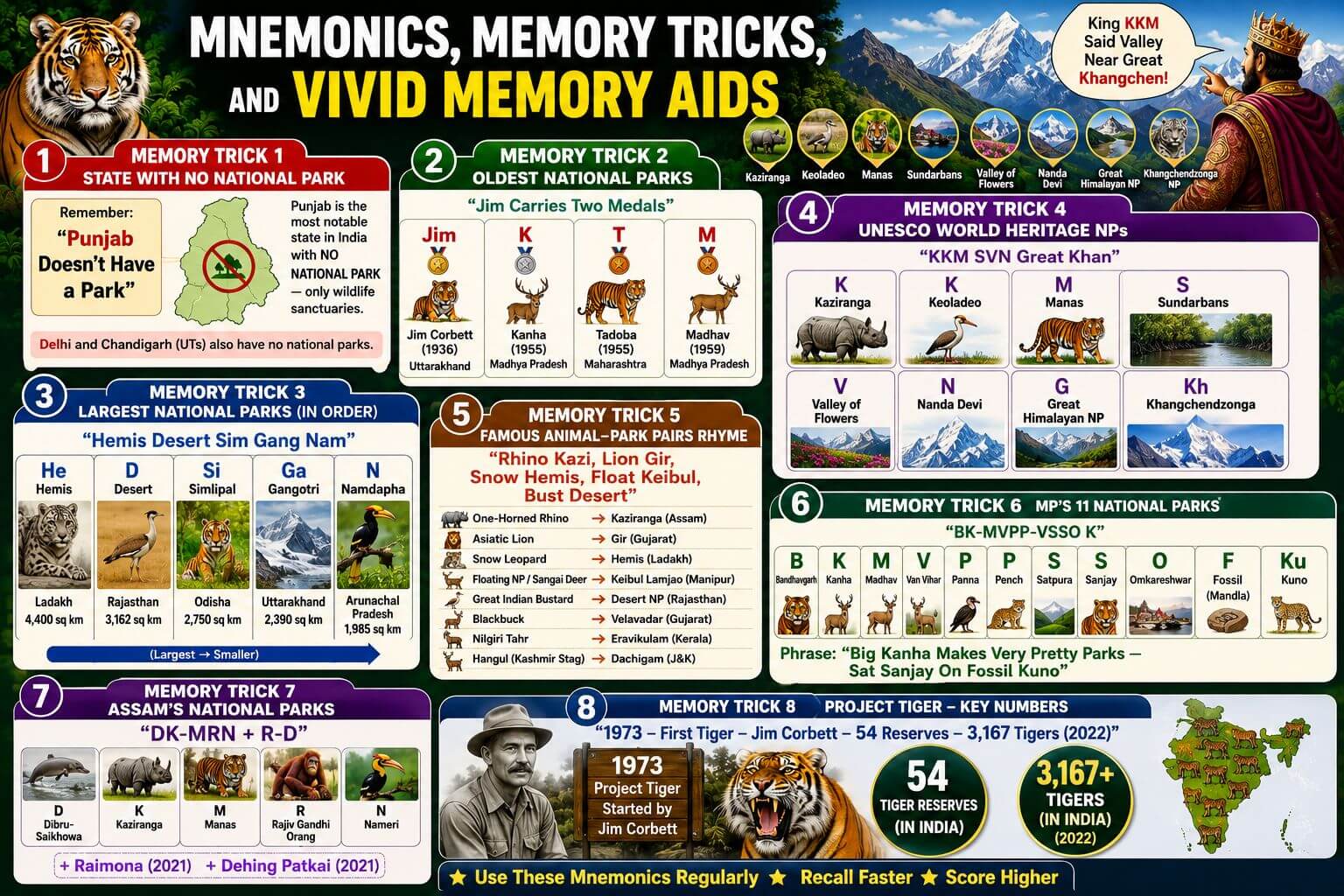
These mnemonics are designed specifically for competitive exam aspirants to retain high-volume data without rote learning. Use them actively while revising.
Memory Trick 1 - State with No National Park
Remember: "Punjab Doesn't Have a Park"
Punjab is the most notable state in India with no National Park — only wildlife sanctuaries. Delhi and Chandigarh (UTs) also have no national parks. This is a direct PYQ-type fact asked in SSC and UPSC exams.
Memory Trick 2 - Oldest National Parks: "Jim Kanha Tadoba Madhav"
Remember the phrase: "Jim Carries Two Medals"
- Jim - Jim Corbett (1936, Uttarakhand) - Oldest NP in India
- K - Kanha (1955, Madhya Pradesh)
- T - Tadoba (1955, Maharashtra)
- M - Madhav (1959, Madhya Pradesh)
Memory Trick 3 - Largest NPs in Order: "Hemis Desert Sim Gang Nam"
- He - Hemis (Ladakh, 4,400 sq km) - Largest
- D - Desert (Rajasthan, 3,162 sq km)
- Si - Simlipal (Odisha, 2,750 sq km)
- Ga - Gangotri (Uttarakhand, 2,390 sq km)
- N - Namdapha (Arunachal Pradesh, 1,985 sq km)
Memory Trick 4 - UNESCO World Heritage NPs: "KKM SVN Great Khan"
- K - Kaziranga
- K - Keoladeo
- M - Manas
- S - Sundarbans
- V - Valley of Flowers
- N - Nanda Devi
- G - Great Himalayan NP
- Kh - Khangchendzonga
Vivid image: "King KKM Said Valley Near Great Khangchen" - imagine a King on a mountain saying this while surveying all the famous UNESCO parks.
Memory Trick 5 - Famous Animal-Park Pairs Rhyme
Memorize this rhyme: "Rhino Kazi, Lion Gir, Snow Hemis, Float Keibul, Bust Desert"
- One-Horned Rhino → Kaziranga (Assam)
- Asiatic Lion → Gir (Gujarat)
- Snow Leopard → Hemis (Ladakh)
- Floating NP / Sangai Deer → Keibul Lamjao (Manipur)
- Great Indian Bustard → Desert NP (Rajasthan)
- Blackbuck → Velavadar (Gujarat)
- Nilgiri Tahr → Eravikulam (Kerala)
- Hangul (Kashmir Stag) → Dachigam (J&K)
Memory Trick 6 - MP's 11 National Parks: "BK-MVPP-VSSO K"
Madhya Pradesh has the most national parks (11). Remember using: B-K-M-V-P-P-S-S-O-F-Ku
- B - Bandhavgarh
- K - Kanha
- M - Madhav
- V - Van Vihar
- P - Panna
- P - Pench
- S - Satpura
- S - Sanjay
- O - Omkareshwar
- F - Fossil (Mandla Plant Fossils)
- Ku - Kuno
Phrase: "Big Kanha Makes Very Pretty Parks — Sat Sanjay On Fossil Kuno"
Memory Trick 7 - Assam's National Parks: "DK-MRN + R-D"
Phrase: "Desi King Makes Royal Names - Raimona Dehing added"
- D - Dibru-Saikhowa
- K - Kaziranga
- M - Manas
- R - Rajiv Gandhi Orang
- N - Nameri
- + Raimona (2021) + Dehing Patkai (2021)
Memory Trick 8 - Project Tiger Key Numbers
Remember: "1973 - First Tiger - Jim Corbett - 54 Reserves - 3,167 Tigers (2022)"
Vivid: Imagine Jim Corbett starting a Tiger project in '73, and today India has 54 reserves with over 3,000 tigers roaring across the country.
Additional Notes - Tricky Facts, PYQ Patterns, and Common Confusions
Commonly Confused Parks and Sanctuaries
- Gir Forest NP vs Gir WLS: Both exist in Gujarat. The National Park is the strictly protected core zone; the Gir WLS forms the surrounding buffer area. The Asiatic Lion roams through both areas.
- Nagarahole NP (Karnataka) vs Rajiv Gandhi NP (Andhra Pradesh): Nagarahole NP in Karnataka is also officially called Rajiv Gandhi NP. There is a separate Rajiv Gandhi NP in Andhra Pradesh. These are two different parks in two different states — do not confuse them in exam questions.
- Pulicat Lake WLS is a shared sanctuary spanning both Andhra Pradesh and Tamil Nadu. Similarly, the National Chambal Sanctuary spans UP, MP, and Rajasthan.
- Pench NP straddles two states: the MP portion is called Indira Priyadarshini Pench NP, and the Maharashtra portion is called Jawaharlal Nehru Pench NP.
- Sirohi NP is listed under Chhattisgarh in some sources and Manipur in others. The Sirohi NP in Manipur is a separate park from any Sirohi-related location in Rajasthan. Always check context carefully.
- Hemis NP was previously listed under Jammu & Kashmir but is now correctly listed under Ladakh UT (after the J&K Reorganization Act, 2019).
States / UTs with No National Park
The following states and UTs have no National Park — a direct PYQ fact in SSC CGL, UPSC, and Banking exams:
- Punjab
- Delhi (NCT)
- Chandigarh
- Lakshadweep
- Dadra and Nagar Haveli & Daman and Diu (merged UT)
Special and Unique Parks - Frequently Asked in Exams
- Namdapha NP (Arunachal Pradesh) is the only national park in the world where four species of big cats coexist — tiger, leopard, snow leopard, and clouded leopard.
- Kuno NP (Madhya Pradesh) made global headlines in September 2022 when 8 cheetahs from Namibia were introduced — the first intercontinental translocation of a large carnivore in history. More cheetahs from South Africa followed in 2023.
- Baghmara Pitcher Plant WLS (Meghalaya) is named after pitcher plants — carnivorous plants that trap and digest insects. It is the only sanctuary in India specifically named after and protecting a plant species.
- Valley of Flowers NP (Uttarakhand) is one of the smallest yet most botanically rich parks, home to over 500 species of wildflowers. It is accessible only during July-September due to heavy snowfall for the rest of the year.
- Sessa Orchid WLS (Arunachal Pradesh) is India's only wildlife sanctuary dedicated entirely to the protection of orchids.
Recently Declared / Modified Parks - Current Affairs Relevance
- Raimona NP - Assam - Declared June 2021 (India's 100th NP at the time)
- Dehing Patkai NP - Assam - Declared June 2021 (known as the "Amazon of the East" for its dense rainforests)
- Simlipal NP - Odisha - Declared as India's 107th National Park in April 2025; covers ~846 sq km; rich in Bengal tigers, elephants, and rare melanistic tigers
- Navegaon-Nagzira NP - Maharashtra - Declared as India's 106th NP in 2025
Stay updated on such developments with our Daily Current Affairs and Latest Govt Jobs Notifications.
Repeating PYQ Patterns on This Topic
- Match the National Park with the state - Very common in UPSC Prelims Set A/B/C/D format
- Which national park is the habitat of [specific animal]? - Common in SSC CGL Tier 1, IBPS PO
- Which is the oldest / newest / largest / smallest National Park in India? - Almost every year in Banking Awareness, RRB NTPC
- How many National Parks are there in India? - Asked frequently in current affairs MCQs
- Name the only floating national park / only urban national park / first marine national park - Direct static GK MCQs in all exams
- Which state has the most / no National Parks? - State-level PSC and SSC exams
- UNESCO World Heritage Sites among national parks - Common in UPSC, CDS, NDA
Practice all these question types with our Static GK Quiz and Daily Current Affairs Quiz.
One-Liners - Key Facts for Last-Minute Revision
- India has 107 National Parks (as of April 2025) and 550+ Wildlife Sanctuaries, governed under the Wildlife Protection Act, 1972.
- Jim Corbett National Park (1936), Uttarakhand, is India's oldest and first National Park. It was also the first Tiger Reserve under Project Tiger in 1973.
- Hemis National Park, Ladakh, is India's largest National Park (4,400 sq km) and is famous for the snow leopard and high-altitude cold desert ecosystem.
- South Button Island National Park, Andaman & Nicobar Islands, is India's smallest National Park with an area of just 0.03 sq km.
- Simlipal National Park, Odisha, declared in April 2025, is India's 107th and most recently declared National Park.
- Keibul Lamjao National Park, Manipur, is the world's only floating National Park, located on the phumdi biomass of Loktak Lake. It is the last habitat of the critically endangered Sangai (Brow-antlered) Deer.
- Kaziranga National Park, Assam, hosts the world's largest population of Indian one-horned rhinoceros and is a UNESCO World Heritage Site since 1985.
- Gir Forest National Park, Gujarat, is the only wild habitat of the Asiatic Lion anywhere in the world outside Africa.
- Keoladeo Ghana National Park, Rajasthan, is both a UNESCO World Heritage Site and a Ramsar Wetland, famous for hosting thousands of migratory birds including the Siberian Crane.
- Sundarbans National Park, West Bengal, is home to the world's largest mangrove forest, is a UNESCO World Heritage Site, Ramsar Wetland, and a critical habitat for the Royal Bengal Tiger.
- Desert National Park, Rajasthan (3,162 sq km), is India's second largest National Park, famous for the Great Indian Bustard — India's critically endangered state bird of Rajasthan.
- Punjab is the only major state in India without a National Park. It has Wildlife Sanctuaries but no declared National Park.
- Madhya Pradesh has the highest number of National Parks in India — 11 parks — and is often called the "Tiger State of India."
- Gulf of Mannar Marine National Park, Tamil Nadu (1980), was India's first Marine National Park. It is famous for dugongs, coral reefs, dolphins, and sea turtles.
- Kuno National Park, Madhya Pradesh, is the site of India's historic Cheetah Reintroduction Project (September 2022) — the first intercontinental translocation of a large wild carnivore in history.
- Namdapha National Park, Arunachal Pradesh, is the only park in the world with all four big cat species — tiger, leopard, snow leopard, and clouded leopard.
- Khangchendzonga National Park, Sikkim, was designated India's first and only UNESCO Mixed World Heritage Site in 2016 (recognized for both natural and cultural values).
- Valley of Flowers National Park, Uttarakhand, is a UNESCO World Heritage Site (part of the paired designation with Nanda Devi NP) and is famous for over 500 species of endemic Himalayan wildflowers.
- Great Himalayan National Park, Himachal Pradesh, became a UNESCO World Heritage Site in 2014 and protects biodiversity in the western Himalayas.
- Guindy National Park (Chennai, Tamil Nadu) and Sanjay Gandhi National Park (Mumbai, Maharashtra) are prominent examples of urban national parks in India.
- Project Tiger was launched in 1973. India now has 54 Tiger Reserves and recorded 3,167 wild tigers in the 2022 All-India Tiger Census — the highest in the world.
- Raimona NP and Dehing Patkai NP, both in Assam, were declared in June 2021. Dehing Patkai is sometimes called the "Amazon of the East" for its lowland tropical rainforests.
- India has 18 Biosphere Reserves, of which 12 are recognized by UNESCO under the Man and Biosphere (MAB) Programme. Nilgiri (2000) was the first Indian BR to receive UNESCO recognition.
- Sessa Orchid WLS in Arunachal Pradesh is the only Indian wildlife sanctuary dedicated entirely to the protection of orchids.
- The Wildlife Protection Act, 1972 is the primary legislation for conservation of wildlife in India. Key amendments in 2002 and 2006 strengthened anti-poaching, introduced NTCA, and enhanced habitat protection measures.
Related Static GK Topics for Exam Preparation
Build a complete General Awareness foundation with these closely related topics:
- Biosphere Reserves in India - Complete Static GK Notes
- UNESCO World Heritage Sites in India
- Superlatives of India and the World
- Rivers of India - Static GK Notes
- Types of Soil in India
- Mountain Peaks in India
- Dams in India
- Major Tribes of India
- First in India - Important Firsts for Static GK
- Browse All Static GK Articles
Free quiz • No signup required
Put this topic into practice with Indian Cultural Institutions – Static GK MCQ Quiz. It is the quickest way to reinforce what you just learned.
Frequently Asked Questions
How many National Parks are there in India as of 2025?
Which is the oldest National Park in India?
Which is the largest National Park in India?
Which is the smallest National Park in India?
What is the world's only floating National Park and where is it located?
What is the difference between a National Park and a Wildlife Sanctuary in India?
Which state has the highest number of National Parks in India?
Which was the first Marine National Park in India?
Which National Park is famous for the Cheetah Reintroduction Project?
Which National Park is India's first and only UNESCO Mixed World Heritage Site?

About the author