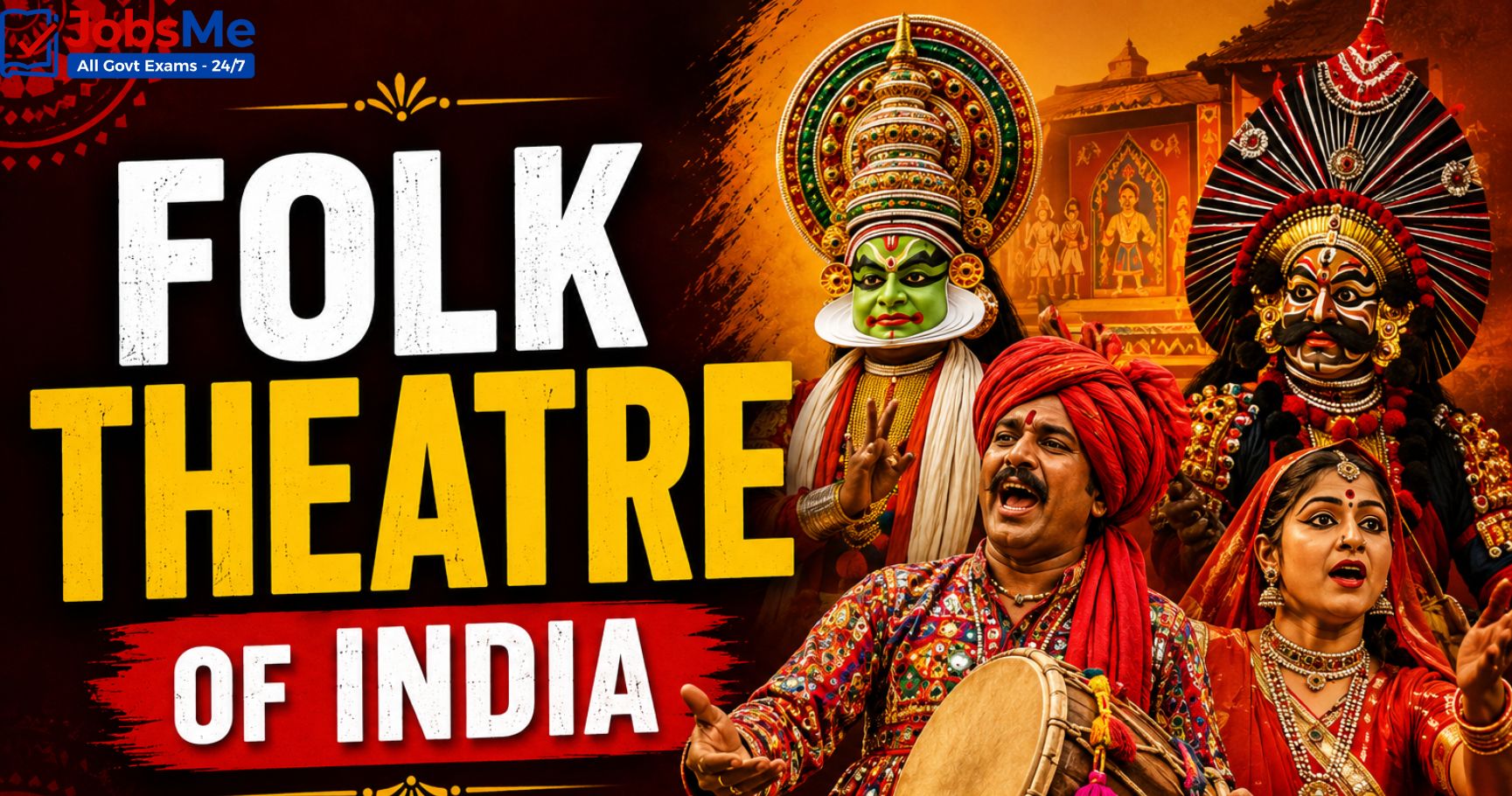
Folk Theatre of India – Complete Static GK Notes for Government Exams
A complete guide to Folk Theatre of India covering all regional forms, state-wise classification, cultural significance, and exam-relevant facts. Designed for UPSC, SSC, IBPS, Railways, Defence, and State PCS aspirants with memory tricks, one-liners, and PYQ-based notes.
Jump to section
- Introduction
- Historical Background of Indian Folk Theatre
- Key Defining Features of Folk Theatre in India
- Classification of Folk Theatre in India
- Regional Overview of Folk Theatre
- State-Wise Detailed List of Folk Theatre Forms in India
- Quick Reference - Complete State-Wise Table of Folk Theatre Forms
- UNESCO Recognised Folk Theatre Forms of India
- Purpose and Significance of Folk Theatre
- Puppet Theatre - A Related Folk Tradition
- Mnemonics, Memory Tricks, and Vivid Memory Aids
- Additional Notes - Tricky Facts, PYQ Patterns, and Frequently Confused Points
- One-Liners - Exam-Ready Quick Revision
Introduction
Folk Theatre of India is one of the most dynamic and culturally rich topics covered in competitive exams - especially in UPSC Prelims GS-1, SSC CGL General Awareness, IBPS PO Banking Awareness, Railways RRB, Defence CDS, and State PCS papers. Questions on this topic appear frequently as direct one-liners, match-the-following pairs, and statement-based sets.
India has over 5,000 years of theatrical tradition. Folk theatre emerged as a grassroots art form that combined storytelling, music, dance, satire, and mythology into a single performance. Unlike classical theatre forms, folk theatre is performed in open-air spaces, uses local dialects, and is deeply connected to the social and religious life of rural communities.
This article covers the complete Static GK on Folk Theatre of India - including the historical background, classification, state-wise major forms, features of each form, and UNESCO-recognised traditions. You will also find mnemonic tricks, exam-ready one-liners, and a detailed FAQ section at the end. For more such notes, visit our Static GK section.
Historical Background of Indian Folk Theatre
Understanding the historical evolution of folk theatre helps answer context-based questions in UPSC and State PCS exams.
- The roots of Indian theatre lie in Vedic rituals and sacrificial ceremonies, which gradually evolved into dramatic presentations.
- Natyashastra by Bharata Muni (approximately 200 BCE to 200 CE) is the world's first comprehensive treatise on dramaturgy. It laid down the grammar for all Indian theatrical traditions - both classical and folk.
- During the Medieval Period, the Bhakti and Sufi movements gave rise to new regional theatre forms centred on devotion. Saints like Srimanta Shankaradeva (Ankia Nat, Assam) and Chaitanya Mahaprabhu significantly influenced eastern India's theatrical forms.
- The Mughal Era brought Persian and Central Asian influences into Indian performing arts, resulting in new syncretic theatrical traditions.
- During the Colonial Period, traditional patronage systems were disrupted by British administration, but theatre adapted to become a vehicle for social reform - addressing caste, gender inequality, and colonial rule.
- After Independence, the Sangeet Natak Akademi (established in 1952) began systematic documentation and preservation of folk theatre traditions across India. The First Five Year Plan also recommended using traditional folk communication methods alongside electronic media to reach rural populations.
- Folk theatre largely emerged in the 15th and 16th centuries, beginning with religious themes before transitioning to secular subjects including local heroic tales, folklore, and stories of love and bravery.
Key Defining Features of Folk Theatre in India
These features are commonly asked in SSC CGL and IBPS PO exams as statement-based questions.
- Performed in open-air spaces - village grounds, temple courtyards, and market squares
- Themes drawn from mythology (Ramayana, Mahabharata), epics, local legends, and social issues
- Combines multiple art forms: music, dance, drama, mime, and acrobatics
- Uses local dialects and is deeply rooted in regional identity
- Participatory in nature - the audience actively engages with the performers
- Serves ritual, religious, and entertainment purposes simultaneously
- Relies heavily on oral tradition - texts and scripts are transmitted orally from generation to generation
- Uses elaborate costumes, symbolic props, and stylised makeup to convey character and emotion
- Many forms serve as a vehicle for social criticism and satire (e.g., Tamasha, Bhavai, Bhand Pather)
Classification of Folk Theatre in India
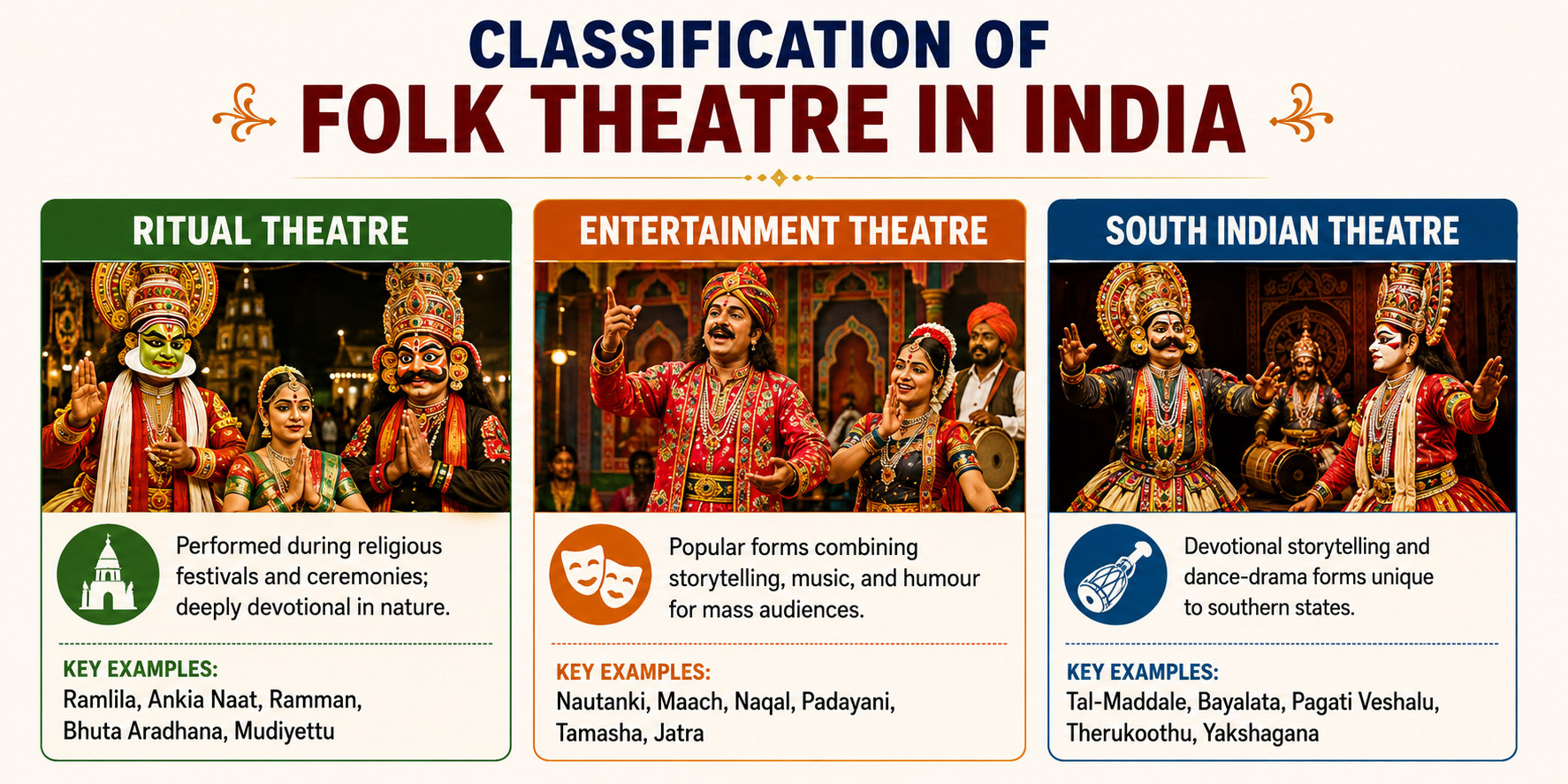
For exam purposes, it is important to remember the three broad classifications of Indian folk theatre:
| Category | Description | Key Examples |
|---|---|---|
| Ritual Theatre | Performed during religious festivals and ceremonies; deeply devotional in nature | Ramlila, Ankia Naat, Ramman, Bhuta Aradhana, Mudiyettu |
| Entertainment Theatre | Popular forms combining storytelling, music, and humour for mass audiences | Nautanki, Maach, Naqal, Padayani, Tamasha, Jatra |
| South Indian Theatre | Devotional storytelling and dance-drama forms unique to southern states | Tal-Maddale, Bayalata, Pagati Veshalu, Therukoothu, Yakshagana |
Regional Overview of Folk Theatre
The following is a quick regional overview that is useful for match-the-following questions in SSC, UPSC, and Railway exams.
| Region | Major Folk Theatre Forms |
|---|---|
| North India | Ramlila (Uttar Pradesh), Nautanki (UP, Haryana), Maach (Madhya Pradesh), Swang (Haryana, Punjab), Bhand Pather (Kashmir) |
| East India | Jatra (West Bengal, Odisha), Bhaona and Ojapali (Assam), Ankia Naat (Assam) |
| West India | Bhavai (Gujarat), Tamasha (Maharashtra), Powada (Maharashtra), Dashavatar (Goa and Konkan) |
| South India | Yakshagana (Karnataka), Therukoothu (Tamil Nadu), Koodiyattam (Kerala), Krishnattam (Kerala), Mudiyettu (Kerala), Pagati Veshalu (Telangana), Burra Katha (Andhra Pradesh), Veedhi Natakam (Andhra Pradesh) |
State-Wise Detailed List of Folk Theatre Forms in India
This section is the most exam-relevant part. Study each form carefully along with its distinguishing features, as questions often focus on unique characteristics, instruments used, themes, or specific facts.
Uttar Pradesh
Nautanki
- A branch of Swang, considered the most popular folk musical drama of northern India
- First mentioned by Abul Fazal in his book Ain-e-Akbari
- Major centres: Lucknow, Haathras, and Kanpur
- Based on heroic legends, romance, and social narratives
- Instruments used: Sarangi, Harmonium, Dholak
Raasleela
- Based on the love tales of Lord Krishna and Radha
- Famous in Mathura and Vrindavan
- Described in Gita Govinda and Hindu scriptures like the Bhagavata Purana
- Early plays attributed to the poet Nand Das
- Combines prose and music in Krishna-based narrative drama
Swang (Saang)
- Popular in Uttar Pradesh, Rajasthan, Malwa (Madhya Pradesh), and Haryana
- Two important styles: Rohtak style and Haathras style
- A performance typically involves 20 to 30 artists
- Includes songs, dialogues, impressions, and conversation
- Initially music-based; prose was later introduced
- Uses Haryanvi and Brajbhasha dialects
Kashmir
Bhand Pather
- A satirical folk theatre using wit, parody, and sharp social commentary
- Performed by members of the farming community
- Part of an oral tradition - scripts transmitted orally from generation to generation
- Instruments used: Surnai, Nagaara, Dhol
- Mentioned in Natya Shastra of Bharata Muni
- The word "Pather" refers to the plays performed by the Bhands; derived from the dramatic figure "Patra"
- Each performance is unique as it adapts to a new area and time, though the texts and topics remain the same
Madhya Pradesh
Maach
- Well-known folk theatre of Madhya Pradesh, with historical evidence dating back to the early 18th century
- The word "Maach" is derived from the Malwi word for "Manch" (stage) in Hindi - it refers both to the stage and the performance itself
- Essentially a musical performance in which actors sing and dance while enacting mythical, religious, and historical tales
- Combines prose, verse, and song with a strong poetic tradition
Maharashtra
Tamasha
- Developed from satirical verses, prolonged stories, and dialogue-based parody
- The foundation of Tamasha is a semi-erotic song called Lavni and the Wag
- The female lead (Murki) leads the dance
- One of the rare Indian folk theatre forms where female roles are played by women
- Incorporates classical music and gestures
- Many Tamasha plays were created during the Indian non-cooperation movement in the 1920s
- High-energy performances combining dance, music, humour, and satire
Powada
- Created to honour Chhatrapati Shivaji Maharaj's bravery, specifically composed when Shivaji defeated Afzal Khan
- Sung by Gondhalis and Shahirs - traditional folk musicians of Maharashtra
- Delivered in the style of Marathi ballads (operatic ballads)
- Depicts events from the life of the legendary Maratha king
Dashavatar
- A popular folk theatre with a history of approximately 800 years
- Belongs to Southern Maharashtra, Konkan region, and Goa
- Enacts the ten incarnations (Dashavatar) of Lord Vishnu
- Performers wear stylized masks and elaborate makeup
Gujarat
Bhavai
- Predominant in Kutch and Kathiawar regions of Gujarat; also found in Rajasthan
- A satirical folk theatre form that critiques social issues such as caste and inequality through humour, irony, and devotional storytelling
- Mixes devotional and romantic elements
- Often performed with balancing acts - female dancers balance 8 or 9 pitchers on their heads while dancing
- The first Bhavai dancer of India was Krishna Vyas Chhangani from Jodhpur, Rajasthan
West Bengal and Odisha
Jatra (Jaatra)
- One of the most structurally well-crystallized folk theatre forms in India
- An open-air theatrical form known for emotionally intense acting, loud music, and exaggerated expressions
- Blends mythology with social and political themes
- Serves as a means of political education and projects social and cultural requirements of local people
- Rabindranath Tagore promoted the use of Jatra for reaching rural populations in his renowned Swadeshi Samaj address in July 1904
- A distinct variety known as Swadeshi Jatra (Nationalist Jatra) emerged in the early 20th century, focusing on Mahatma Gandhi's non-cooperation movement
- Widely used as a form of political campaigning even during modern elections
Assam
Bhaona
- An Assamese folk theatre tradition created by the saint-reformer Srimanta Shankaradeva, born in Nagaon district in 1449
- Shankaradeva was the founder of the Neo-Vaishnavite movement
- Also practised in Vrindavan, Odisha, Bengal, and Mathura
- Begins in Sanskrit and transitions into Brajboli/Assamese
- Actors are referred to as Bhaoriya
- Derived from Ankia Naat
Ojapali (Oja-Pali)
- Associated with the Manasa (Serpent Goddess) festival
- The story is divided into three sections: Baniya Khanda, Bhatiyali Khanda, and Deva Khanda
- Oja serves as the primary narrator; Palis form the choir (chorus)
- Represents the rich cultural heritage of Assam
Ankia Naat
- A Vaishnavite theatre tradition developed by Srimanta Shankaradeva
- Performed in Namghars (prayer halls)
- Combines devotion, music, and dramatic storytelling
Kerala
Koodiyattam (Kutiyattam)
- Approximately 2,000 years old, making it one of the oldest surviving theatre traditions in the world
- Recognised by UNESCO as a Masterpiece of Oral and Intangible Heritage of Humanity
- The oldest surviving form of Sanskrit theatre
- The word "Kutiyattam" literally means "acting together"
- Traditionally performed only by members of the Chakyar and Nambyar castes in temple theatres called Koothambalam
- Highly codified in performance style
Krishnattam
- Created by King Manavedan of Kozhikode (also known as King Manavada) in the 17th century
- Also known as the "Dance of Krishna"
- Based on Krishnageethi - a Sanskrit text written by King Manavedan based on the poet Jayadeva's Gitagovinda
- Consists of 8 Krishna-themed plays performed over 8 days (from his birth to his ascent to heaven)
- Performed as a ritual offering at Guruvayur Temple
- Considered a precursor to Kathakali
- Sponsored by the king of Kozhikode
Mudiyettu
- A ritual theatre form of Kerala depicting the mythological battle between Goddess Bhadrakali (Kali) and the demon Darika
- Performed in temples during the month of Vrischikam (November-December)
- Recognised by UNESCO as Intangible Cultural Heritage
- A village-wide custom in which the entire community participates
- Before the performance, performers purify themselves through fasting and prayer, and create a massive image of Kali (called Kalam) on the temple floor using coloured powders
Chavittu Natakam (Cavittu Natakam)
- A Christian folk drama of Kerala, also called the "Stamping Dance"
- Originated in the 17th century under Portuguese influence
- Portrays biblical and European historical themes with music and dance elements
Karnataka
Yakshagana
- Popular in the districts of Uttara Kannada, Kasaragod, Shimoga, Udupi, and Dakshina Kannada
- A highly stylized open-air dance-drama tradition based on Puranic stories, especially Mahabharata and Ramayana
- Characterised by elaborate costumes, heavy makeup, expressive gestures, and live percussion-based music
- Usually performed overnight
- Has deep classical roots; was performed in the royal courts of the Vijayanagara period by a group known as Jakkula Varu
- Significantly influenced by the Vaishnava Bhakti Movement
Tamil Nadu
Therukoothu
- A street theatre form - the name "Therukoothu" literally means "street theatre"
- Performed during village and temple festivals, primarily depicting episodes from the Mahabharata (especially Draupadi-based stories)
- Performed to invoke agricultural prosperity
- Includes a cycle of eight plays
- Uses loud, expressive dialogue, music, and dance
- Has a small influence from Kathakali of Kerala
- Performed by amateur actors who pay a nominal fee to the troupe
Kuruvanji
- A dance ballet in Bharatanatyam style
- Love-themed; first composed by Thirukutarajappa Kaviyar
Andhra Pradesh and Telangana
Burra Katha
- A unique form of oral storytelling - one main narrator and two assistants
- Uses a traditional drum called "Burra" for rhythm
- Combines storytelling, chorus, and rhythm
Pagati Veshalu
- A folk theatre form of Telangana
- Characterised by devotional storytelling and dance-drama
Veedhi Natakam
- A street theatre form of Andhra Pradesh performed in rural public spaces
- Deals with both mythological stories and contemporary social issues
Odisha
Daskathia
- Features two narrators - Gayaka (lead) and Palia (assistant)
- Tales are centred around Shiva, accompanied by wooden instruments called Kathia
Himachal Pradesh
Kariyila
- Open-air night performances consisting of various skits and short plays
Gujarat (Community-specific form)
Garodas
- Art form of the Garoda community
- Storytelling using painted pictures about romance and bravery
Quick Reference - Complete State-Wise Table of Folk Theatre Forms
This table is essential for SSC CGL, IBPS PO, RRB, UPSC Prelims, and State PCS exams. Memorise the state-theatre pairs carefully.
| Folk Theatre Form | State / Region | Key Feature / Fact |
|---|---|---|
| Bhand Pather | Kashmir | Satirical; uses Surnai, Nagaara, Dhol; performed by farming community |
| Bhaona | Assam | Derived from Ankia Naat; created by Srimanta Shankaradeva (1449); actors = Bhaoriya |
| Ankia Naat | Assam | Vaishnavite theatre; performed in Namghars; developed by Srimanta Shankaradeva |
| Ojapali | Assam | Manasa festival; Oja = lead narrator, Pali = chorus |
| Bhavai | Gujarat (also Rajasthan) | Satirical; Kutch and Kathiawar; balancing acts; first dancer: Krishna Vyas Chhangani |
| Garodas | Gujarat | Garoda community; storytelling with painted pictures |
| Burra Katha | Andhra Pradesh | 1 narrator + 2 assistants; Burra drum; oral storytelling |
| Pagati Veshalu | Telangana | Devotional storytelling; dance-drama |
| Veedhi Natakam | Andhra Pradesh | Street theatre; mythological and social themes |
| Chavittu Natakam | Kerala | Christian folk drama; stamping dance; 17th century; Portuguese influence |
| Dashavatar | Goa and Konkan coast | Ten incarnations of Vishnu; 800-year history; stylised masks |
| Daskathia | Odisha | Gayaka and Palia; tales of Shiva; wooden Kathia instruments |
| Kariyila | Himachal Pradesh | Open-air night performances; skits |
| Koodiyattam / Kutiyattam | Kerala | 2,000 years old; UNESCO recognised; Sanskrit theatre; Chakyar and Nambyar castes; Koothambalam |
| Krishnattam | Kerala | King Manavedan; 17th century; 8 plays over 8 days; Guruvayur Temple; precursor to Kathakali |
| Kuruvanji | Tamil Nadu | Dance ballet; Bharatanatyam style; love-themed; first composed by Thirukutarajappa Kaviyar |
| Mudiyettu | Kerala | UNESCO recognised; ritual to Goddess Bhadrakali vs demon Darika; Vrischikam (Nov-Dec) |
| Jatra (Jaatra) | West Bengal and Odisha | Open-air; political education; Tagore promoted it; Swadeshi Jatra in early 20th century |
| Maach | Madhya Pradesh | 18th century; Maach = Manch (stage); musical performance; mythological and historical tales |
| Nautanki | Uttar Pradesh (also Rajasthan) | Branch of Swang; mentioned in Ain-e-Akbari; centres: Lucknow, Haathras, Kanpur |
| Powada | Maharashtra | Ballads praising Shivaji's bravery; sung by Gondhalis and Shahirs; composed after defeating Afzal Khan |
| Raasleela | Uttar Pradesh | Krishna-Radha love tales; famous in Mathura, Vrindavan; Bhagavata Purana; prose + music |
| Swang (Saang) | Punjab, Haryana, UP, Rajasthan | 20-30 artists; Rohtak and Haathras styles; Haryanvi and Brajbhasha dialects |
| Tamasha | Maharashtra | Lavni + Wag; female lead = Murki; women play female roles; anti-colonial plays in 1920s |
| Therukoothu | Tamil Nadu | Street theatre; Draupadi/Mahabharata stories; 8 plays; agricultural prosperity ritual |
| Yakshagana | Karnataka | Open-air overnight drama; Mahabharata and Ramayana; elaborate costumes; Vijayanagara period |
| Villu Pattu | Deccan region (Tamil Nadu) | Bow-song musical theatre; focuses on Ramayana stories |
UNESCO Recognised Folk Theatre Forms of India
UNESCO recognition questions are a recurring theme in UPSC Prelims and SSC exams. Remember these carefully.
| Folk Theatre Form | State | UNESCO Recognition |
|---|---|---|
| Koodiyattam (Kutiyattam) | Kerala | Recognised as Masterpiece of Oral and Intangible Heritage of Humanity |
| Mudiyettu | Kerala | Recognised as Intangible Cultural Heritage |
| Ramlila | Uttar Pradesh (and across India) | Recognised as Intangible Cultural Heritage in 2008 |
For a complete list of UNESCO World Heritage Sites and intangible cultural heritage items of India, visit our UNESCO World Heritage Sites in India notes.
Purpose and Significance of Folk Theatre
These points are tested in descriptive and statement-based questions in UPSC Mains, State PCS, and essay-type questions.
- Cultural Preservation: Folk theatre maintains oral traditions, local dialects, folk history, and regional identity at the grassroots level. Each performance carries forward generations of collective memory.
- Mass Education: It has historically been used to spread social, economic, and cultural messages - especially to rural and semi-literate audiences who cannot access formal education. The First Five Year Plan explicitly recommended folk theatre for rural communication.
- Community Bonding: The participatory nature of folk theatre brings communities together - both performers and audiences share a common cultural experience.
- Political Mobilisation: Forms like Jatra, Swang, and Tamasha were actively used during the Independence movement to spread nationalist messages. Jatra in Bengal was one of the most effective tools during the Swadeshi movement.
- Social Criticism: Forms like Bhand Pather (Kashmir) and Bhavai (Gujarat) use satire to critique authority, social inequality, and caste discrimination - giving voice to marginalised communities.
- Religious Devotion: Ritual theatre forms like Ramlila, Krishnattam, and Mudiyettu serve as acts of devotion and community worship, reinforcing religious identity.
Puppet Theatre - A Related Folk Tradition
Puppet theatre is closely related to folk theatre and is tested in combination with it in exams like SSC CGL and UPSC Prelims.
| Type of Puppet Theatre | Form | State / Region |
|---|---|---|
| Shadow Puppetry | Gombeyatta | Karnataka |
| Shadow Puppetry | Ravana Chhaya | Odisha |
| Glove Puppetry | Gopalila | Odisha |
| Glove Puppetry | Pavai Koothu | Tamil Nadu |
| Doll / Rod Puppetry | Bommalattam | Tamil Nadu and Karnataka (Mysore) |
| Doll Puppetry | Putul Naach | West Bengal |
| String Puppetry | Kathputli | Rajasthan |
You can revise more related topics in our Dances of India and Indian Music notes.
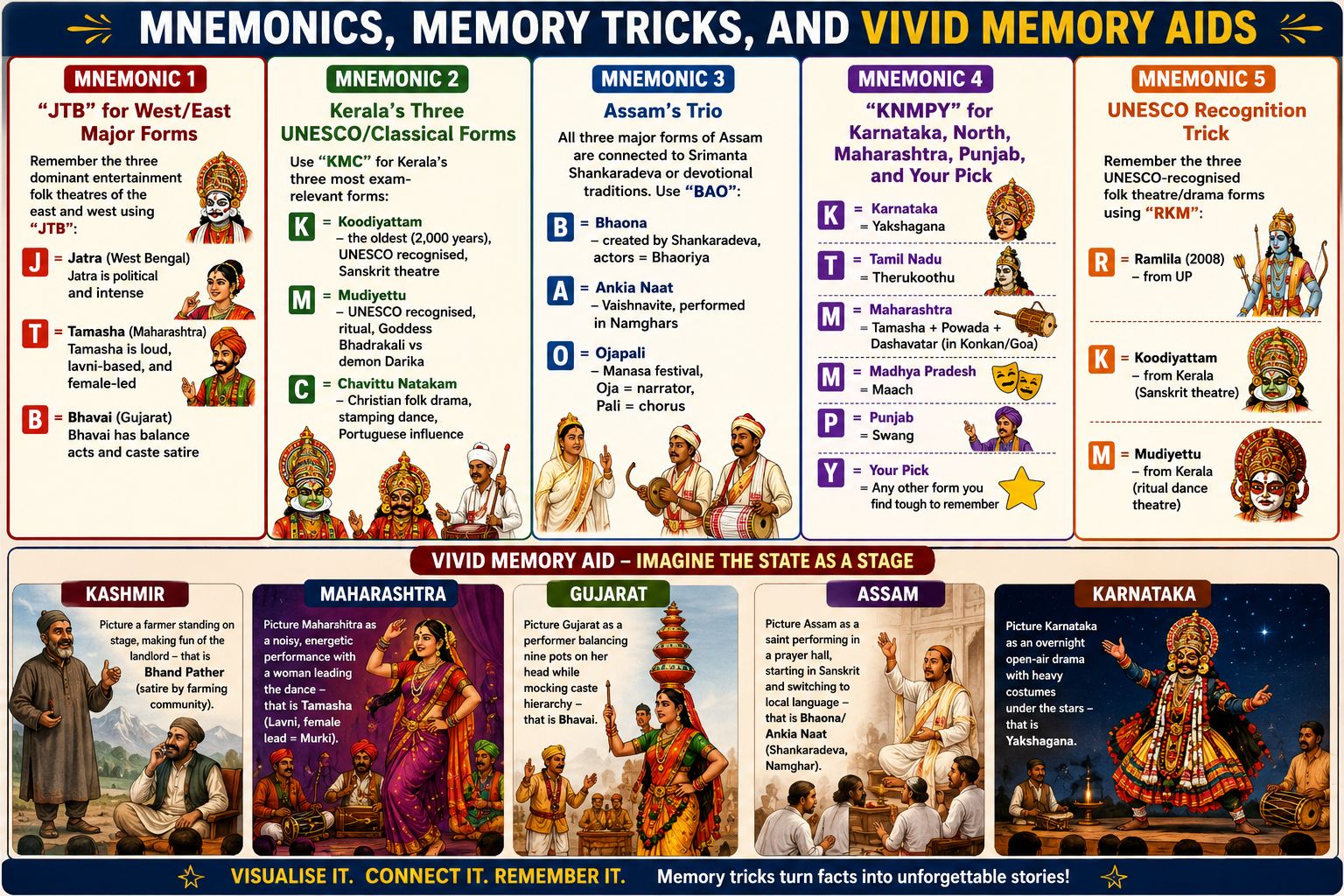
Mnemonics, Memory Tricks, and Vivid Memory Aids
These tricks are specifically designed to help you retain the state-theatre mapping for SSC, IBPS, UPSC, and Railway exams.
Mnemonic 1 - "JTB" for West/East Major Forms
Remember the three dominant entertainment folk theatres of the east and west using "JTB":
- J = Jatra (West Bengal) - Jatra is political and intense
- T = Tamasha (Maharashtra) - Tamasha is loud, lavni-based, and female-led
- B = Bhavai (Gujarat) - Bhavai has balance acts and caste satire
Mnemonic 2 - Kerala's Three UNESCO/Classical Forms
Use "KMC" for Kerala's three most exam-relevant forms:
- K = Koodiyattam - the oldest (2,000 years), UNESCO recognised, Sanskrit theatre
- M = Mudiyettu - UNESCO recognised, ritual, Goddess Bhadrakali vs demon Darika
- C = Chavittu Natakam - Christian folk drama, stamping dance, Portuguese influence
Mnemonic 3 - Assam's Trio
All three major forms of Assam are connected to Srimanta Shankaradeva or devotional traditions. Use "BAO":
- B = Bhaona - created by Shankaradeva, actors = Bhaoriya
- A = Ankia Naat - Vaishnavite, performed in Namghars
- O = Ojapali - Manasa festival, Oja = narrator, Pali = chorus
Mnemonic 4 - "KNMPY" for Karnataka, North, Maharashtra, Punjab, and Your Pick
- Karnataka = Yakshagana (Remember: YaKshagana - "YaK" sounds like "Yak" and yaks live in Karnataka's lush Western Ghats)
- Tamil Nadu = Therukoothu (Both start with T - Tamil + Therukoothu)
- Maharashtra = Tamasha + Powada + Dashavatar (in Konkan/Goa)
- Madhya Pradesh = Maach (Both start with M)
- Kashmir = Bhand Pather (Kashmir has Bhand = satirists, Pather = play)
Mnemonic 5 - UNESCO Recognition Trick
Remember the three UNESCO-recognised folk theatre/drama forms using "RKM":
- R = Ramlila (2008) - from UP
- K = Koodiyattam - from Kerala (Sanskrit theatre)
- M = Mudiyettu - from Kerala (ritual dance theatre)
Vivid Memory Aid - Imagine the State as a Stage
- Picture Kashmir as a farmer standing on stage, making fun of the landlord - that is Bhand Pather (satire by farming community).
- Picture Maharashtra as a noisy, energetic performance with a woman leading the dance - that is Tamasha (Lavni, female lead = Murki).
- Picture Gujarat as a performer balancing nine pots on her head while mocking caste hierarchy - that is Bhavai.
- Picture Assam as a saint performing in a prayer hall, starting in Sanskrit and switching to local language - that is Bhaona/Ankia Naat (Shankaradeva, Namghar).
- Picture Karnataka as an overnight open-air drama with heavy costumes under the stars - that is Yakshagana.
Additional Notes - Tricky Facts, PYQ Patterns, and Frequently Confused Points
These notes are based on recurring PYQ patterns and commonly confused facts in government exams.
Frequently Confused: Krishnattam vs Koodiyattam vs Kathakali
- Koodiyattam = Oldest surviving Sanskrit theatre (2,000 years old), UNESCO recognised, Kerala. Performed in Koothambalam by Chakyar and Nambyar castes.
- Krishnattam = 17th century, created by King Manavedan, depicts 8 stories of Krishna over 8 days, performed at Guruvayur Temple, considered a precursor to Kathakali.
- Kathakali = Classical dance-drama of Kerala (not folk theatre), derived influences from Krishnattam.
- Key differentiator: Krishnattam is temple-based and royal-patronised; Koodiyattam is caste-restricted and Sanskrit-based; Kathakali is a classical dance form.
Frequently Confused: Jatra vs Tamasha vs Bhavai
- All three are entertainment-oriented folk theatre forms with strong satirical or social commentary elements.
- Jatra = West Bengal - political education, intensity, Rabindranath Tagore connection
- Tamasha = Maharashtra - Lavni, female lead (Murki), semi-erotic song
- Bhavai = Gujarat - balancing acts, caste satire, Kutch and Kathiawar
Frequently Confused: Bhaona vs Ankia Naat
- Both are from Assam and both were created or influenced by Srimanta Shankaradeva.
- Ankia Naat is the original theatre tradition created by Shankaradeva, performed in Namghars.
- Bhaona is a performance derived from Ankia Naat - it is the act of staging an Ankia Naat play.
Tricky Fact - Swang vs Nautanki
- Nautanki is a branch of Swang - not the other way around.
- Swang is the parent form; Nautanki is a popular offshoot that developed into a major folk musical drama tradition.
Tricky Fact - Ramlila's UNESCO Recognition Year
- Ramlila was recognised by UNESCO as Intangible Cultural Heritage in 2008. This specific year is asked in exams.
Tricky Fact - Dashavatar's Location
- Dashavatar is associated with both Goa and the Konkan coast (Southern Maharashtra). Do not limit it only to Goa.
PYQ Pattern - Instruments in Folk Theatre
- Bhand Pather (Kashmir) - Surnai, Nagaara, Dhol
- Burra Katha (AP) - Burra drum
- Daskathia (Odisha) - Kathia (wooden instruments)
- Nautanki (UP) - Sarangi, Harmonium, Dholak
PYQ Pattern - Creator/Founder Connections
- Bhaona / Ankia Naat - Created by Srimanta Shankaradeva
- Krishnattam - Created by King Manavedan of Kozhikode
- Kuruvanji - First composed by Thirukutarajappa Kaviyar
- Powada - Composed to honour Shivaji's defeat of Afzal Khan
- Raasleela - Early plays attributed to Nand Das
To practise questions on this and related topics, check out the Static GK Quiz section on Jobsme.in. You can also explore our comprehensive notes on Indian Art and Culture for broader coverage.
One-Liners - Exam-Ready Quick Revision
These one-liners cover the most important facts across all major folk theatre forms and are designed for last-minute revision before exams.
- Natyashastra, the world's first comprehensive treatise on dramaturgy, was written by Bharata Muni.
- Koodiyattam is approximately 2,000 years old and is the oldest surviving form of Sanskrit theatre in India; it is UNESCO recognised.
- Ramlila was recognised as UNESCO Intangible Cultural Heritage in 2008.
- Mudiyettu is a ritual theatre of Kerala depicting the battle between Goddess Bhadrakali and demon Darika; also UNESCO recognised.
- Krishnattam was created by King Manavedan of Kozhikode in the 17th century and is considered a precursor to Kathakali.
- Yakshagana is performed overnight in open-air settings in Karnataka and is based on Mahabharata and Ramayana episodes.
- Therukoothu means "street theatre" and is performed in Tamil Nadu during temple festivals based on Draupadi stories.
- Tamasha of Maharashtra is built on the semi-erotic song Lavni; the female lead is called Murki.
- Jatra (West Bengal) was promoted by Rabindranath Tagore in his Swadeshi Samaj address of July 1904.
- Bhaona (Assam) was created by saint-reformer Srimanta Shankaradeva, born in Nagaon district in 1449; actors are called Bhaoriya.
- Bhand Pather (Kashmir) is a satirical folk theatre performed by the farming community, using Surnai, Nagaara, and Dhol.
- Bhavai (Gujarat) is characterised by balancing acts (9 pitchers on the head) and critiques caste and social inequality; first Bhavai dancer was Krishna Vyas Chhangani.
- Nautanki (UP) is a branch of Swang and was first mentioned by Abul Fazal in Ain-e-Akbari.
- Maach (Madhya Pradesh) is derived from the Malwi word for stage ("Manch"); it dates back to the early 18th century.
- Dashavatar (Goa and Konkan) enacts the ten incarnations of Lord Vishnu and has a history of approximately 800 years.
- Powada (Maharashtra) are operatic ballads praising Shivaji's heroism, sung by Gondhalis and Shahirs.
- Chavittu Natakam (Kerala) is a Christian folk drama also called the "Stamping Dance," originating in the 17th century under Portuguese influence.
- Burra Katha (Andhra Pradesh) involves one narrator and two assistants, using the Burra drum.
- Ojapali (Assam) is associated with the Manasa festival; Oja = lead narrator, Pali = chorus.
- Daskathia (Odisha) features two narrators - Gayaka and Palia - with tales about Shiva accompanied by wooden Kathia instruments.
- Swang involves 20-30 artists and has two major styles: Rohtak and Haathras.
- Raasleela is famous in Mathura and Vrindavan; early plays were attributed to Nand Das.
- The Sangeet Natak Akademi was established in 1952 to document and preserve folk theatre traditions.
- Folk theatre in India is broadly classified into Ritual Theatre, Entertainment Theatre, and South Indian Theatre.
- Kuruvanji (Tamil Nadu) is a dance ballet in Bharatanatyam style on love themes; first composed by Thirukutarajappa Kaviyar.
- The First Five Year Plan recommended using traditional folk means of communication to reach rural populations alongside electronic media.
Want to practice these facts? Take the Static GK Quiz or check our Daily Current Affairs for related updates. You can also explore our full guide on Indian Paintings, Indian Martial Arts, and Folk Theatre of India for complete art and culture preparation.
Free quiz • No signup required
Put this topic into practice with Indian Cultural Institutions – Static GK MCQ Quiz. It is the quickest way to reinforce what you just learned.
Frequently Asked Questions
Which is the oldest surviving form of Sanskrit theatre in India?
Which folk theatre forms of India are recognised by UNESCO?
Who created Bhaona and Ankia Naat of Assam?
What is the difference between Swang and Nautanki?
Which folk theatre of Maharashtra is based on the Lavni song?
What is the significance of Jatra in Indian history?
Which folk theatre depicts the ten incarnations of Lord Vishnu?
Who created Krishnattam and where is it performed?
What is Bhand Pather and which instruments are used in it?
What is the Sangeet Natak Akademi and when was it established?

About the author