Arts and Cultural Institutions in India – Static GK Notes for Government Exams
India is home to a rich network of arts and cultural institutions that preserve, promote, and propagate the country's vast heritage. This article covers all major cultural institutions – their founding year, parent ministry, objectives, and key facts – presented in an exam-ready format with memory tricks and one-liners for UPSC, SSC, IBPS, Railways, Defence, and State PCS aspirants.
Jump to section
- Introduction to Cultural Institutions in India
- What Are Cultural Institutions?
- List of Major Arts and Cultural Institutions in India
- Detailed Notes on Each Institution
- The Three National Academies — A Comparison
- Institutions and Their Founding Personalities
- Institutions Under Different Ministries
- Memory Tricks and Mnemonics
- Additional Notes — Tricky Facts and PYQ Insights
- One-Liners for Quick Revision
Introduction to Cultural Institutions in India
India's cultural heritage spans thousands of years — from Vedic manuscripts and classical music to medieval monuments and contemporary visual arts. To safeguard and promote this legacy, the Government of India, along with autonomous and non-governmental bodies, has established a wide network of arts and cultural institutions.
For government exam aspirants, this topic features regularly in UPSC Prelims, SSC CGL, IBPS PO, RRB NTPC, State PCS, and Defence exams — particularly under Art & Culture, Static GK, and General Awareness sections. Questions typically focus on founding years, parent ministries, headquarters, and key objectives of these institutions.
This article organises all major cultural institutions in India with detailed notes, tables, and exam-ready memory tricks. Bookmark it as your go-to Static GK reference for all upcoming government exams.
What Are Cultural Institutions?
A cultural institution (or cultural organisation) is a body dedicated to the preservation, promotion, interpretation, and dissemination of a society's cultural, artistic, scientific, or environmental knowledge. Their core functions include:
- Conserving tangible heritage (monuments, artefacts, manuscripts, and archaeological sites)
- Safeguarding intangible heritage (music, dance, drama, oral traditions, and folk arts)
- Educating and engaging the public through exhibitions, workshops, publications, and awards
- Promoting India's cultural identity on the global stage through diplomacy and exchange programs
Examples include museums, libraries, academies of arts and letters, historical societies, and research centres.
List of Major Arts and Cultural Institutions in India
The table below provides a quick-reference snapshot of all major cultural institutions — ideal for last-minute revision before exams.
| Institution | Year Established | Parent Ministry / Body | Headquarters | Primary Focus |
|---|---|---|---|---|
| Archaeological Survey of India (ASI) | 1861 | Ministry of Culture | New Delhi | Archaeological research & conservation of monuments |
| Sangeet Natak Akademi (SNA) | 1952 | Ministry of Culture | New Delhi | Music, dance, and drama |
| Sahitya Akademi | 1954 | Ministry of Culture (Autonomous) | New Delhi | Literature in 24 Indian languages |
| Lalit Kala Akademi | 1954 | Ministry of Culture (Autonomous) | New Delhi | Visual arts (painting, sculpture, graphics) |
| Indian Council for Cultural Relations (ICCR) | 1950 | Ministry of Culture | New Delhi | Cultural diplomacy & international exchange |
| Indian Council of Historical Research (ICHR) | 1972 | Ministry of Education (UGC Funded) | New Delhi | Historical research & scholarship |
| Centre for Cultural Resources and Training (CCRT) | 1979 | Ministry of Culture | New Delhi | Integrating culture into education |
| Indian National Trust for Art and Cultural Heritage (INTACH) | 1984 | Autonomous NGO | New Delhi | Preservation of tangible & intangible heritage |
| Indira Gandhi National Centre for the Arts (IGNCA) | 1985 | Ministry of Culture (Autonomous) | New Delhi | Arts research, restoration, and dissemination |
| National Mission for Manuscripts (NMM) | 2003 | Ministry of Culture | New Delhi | Locating, cataloguing, and preserving manuscripts |
| National Archives of India (NAI) | 1891 (as Imperial Records Dept.) | Ministry of Culture | New Delhi | Repository of Government of India's non-current records |
| Nehru Memorial Museum and Library (NMML) | 1964 (converted) | Ministry of Culture | New Delhi (Teen Murti House) | Research in modern Indian history & politics |
Detailed Notes on Each Institution
1. Archaeological Survey of India (ASI)
The Archaeological Survey of India (ASI) is India's premier body for archaeological research and the conservation of the country's built heritage. It functions as a subordinate office under the Ministry of Culture.
- Founded: 1861
- Governing Legislation:
- Ancient Monuments and Archaeological Sites and Remains Act, 1958
- Antiquities and Art Treasures Act, 1972
- Key Responsibilities:
- Conservation and maintenance of Centrally Protected Monuments (over 3,600 monuments)
- Archaeological excavations and research across India
- Regulation of export and trade of antiques and art treasures
- Chemical preservation and epigraphy (study of inscriptions)
Exam Tip: ASI is the implementing body for UNESCO World Heritage Site nominations in India. Questions on ASI frequently appear alongside questions on UNESCO World Heritage Sites in India.
2. Sangeet Natak Akademi (SNA)
The Sangeet Natak Akademi is India's national academy for music, dance, and drama — the first of the three national academies to be established after Independence.
- Founded: 1952 (by a resolution of the Ministry of Education)
- Reconstituted as a Society: 1961, registered under the Societies Registration Act, 1860
- Parent Ministry: Ministry of Culture
- Headquarters: New Delhi (Rabindra Bhavan)
Background and Historical Context
In 1945, the Asiatic Society of Bengal proposed the creation of a National Cultural Trust with three academies — one for dance, drama, and music; one for letters; and one for art and architecture. This proposal directly led to the formation of the three national academies (Sangeet Natak Akademi, Sahitya Akademi, and Lalit Kala Akademi) after India's Independence.
Key Functions
- Identifies, supports, and honours outstanding artists through the prestigious Sangeet Natak Akademi Awards (also called Akademi Ratna and Akademi Puraskar)
- Documents and archives India's performing arts traditions
- Promotes the transmission of classical and folk performing arts to new generations
- Maintains records of regional music, dance, and theatre forms across India
- Manages the National School of Drama (NSD) in New Delhi
3. Sahitya Akademi (National Academy of Letters)
The Sahitya Akademi is India's national academy for literature, established in 1954 to nurture literary culture across all Indian languages.
- Founded: 1954
- Parent Ministry: Ministry of Culture (Autonomous body)
- Headquarters: New Delhi
- Regional Offices: Kolkata, Mumbai, Bengaluru, and Chennai
Key Facts for Exams
- Promotes literature in 24 recognised Indian languages
- Has published over 7,000 books across 24 languages over six decades
- Publishes three major journals:
- Indian Literature — Bi-monthly, in English
- Samkaleena Bhartiya Sahitya — Bi-monthly, in Hindi
- Sanskrit Pratibha — Quarterly, in Sanskrit
- Actively promotes children's literature and translation projects
- The Sahitya Akademi Awards are considered among the most prestigious literary honours in India
- Covers fiction, poetry, drama, criticism, and classical to contemporary literature
Note: The Sahitya Akademi is distinct from the Jnanpith Award (given by the Bharatiya Jnanpith organisation) — a common point of confusion in exams.
4. Lalit Kala Akademi (National Academy of Art)
The Lalit Kala Akademi is India's apex body for the promotion and development of visual arts, including painting, sculpture, graphics, and applied arts.
- Founded: 1954
- Parent Ministry: Ministry of Culture (Fully funded autonomous body)
- Headquarters: New Delhi (Rabindra Bhavan)
Key Functions
- Maintains a permanent national collection showcasing the development of modern and contemporary Indian art
- Organises national and international exhibitions, art camps, and workshops
- Confers awards and fellowships on eminent visual artists
- Promotes Indian art both nationally and internationally
- Publishes Lalit Kala Contemporary (art journal) in English and Lalit Kala Ancient (journal on Indian archaeology and art history)
Exam Tip: All three academies — Sangeet Natak Akademi, Sahitya Akademi, and Lalit Kala Akademi — were established as per the proposal originating from the Asiatic Society of Bengal (1945). The Sangeet Natak Akademi was the first (1952), followed by both Sahitya and Lalit Kala Akademi in 1954.
5. Indian Council for Cultural Relations (ICCR)
The ICCR is India's nodal body for cultural diplomacy — fostering international understanding through cultural exchange programmes.
- Founded: 1950
- Founder: Maulana Abul Kalam Azad, India's first Education Minister
- Parent Ministry: Ministry of Culture
- Headquarters: New Delhi (Azad Bhavan)
Key Functions
- Designs and executes cultural exchange programs with countries worldwide
- Organises international visual and performing arts events
- Offers academic and cultural scholarships to foreign students (ICCR Scholarships)
- Manages India's cultural centres abroad (e.g., Jawaharlal Nehru Cultural Centres)
- Hosts foreign cultural delegations and promotes people-to-people ties
Exam Tip: ICCR was founded by Maulana Abul Kalam Azad — remember this as a frequently asked fact in UPSC Prelims and SSC exams. ICCR's building is called Azad Bhavan, named in his honour.
6. Indian Council of Historical Research (ICHR)
The ICHR is India's premier body for the promotion of rigorous, objective historical research and scholarship.
- Founded: 1972 (under the Societies Registration Act, 1860)
- Parent Ministry: Ministry of Education
- Funding: Primarily by the University Grants Commission (UGC)
- Nature: Autonomous body
- Headquarters: New Delhi
Key Functions
- Promotes objective, evidence-based historical research in India
- Provides research fellowships to historians and scholars
- Funds historical publications, journals, and monographs
- Organises national and international seminars and conferences on history
- Acts as a collaborative platform for historians to exchange ideas
Important Distinction: ICHR is under the Ministry of Education (not Ministry of Culture) and is funded by UGC — this distinction is a common exam trap.
7. Centre for Cultural Resources and Training (CCRT)
The CCRT is the government body responsible for integrating India's cultural heritage into the formal education system.
- Founded: 1979
- Founders: Dr. Kapila Vatsyayan and Smt. Kamala Devi Chattopadhyay
- Parent Ministry: Ministry of Culture
- Headquarters: New Delhi
- Regional Centres:
- Udaipur (West)
- Hyderabad (South)
- Guwahati (Northeast)
Key Functions
- Conducts training workshops for school teachers on integrating art and culture into teaching
- Organises cultural scholarship programs for students to learn classical art forms
- Promotes the broader dissemination of Indian art and culture across regions
- Bridges formal education with living cultural traditions
8. Indian National Trust for Art and Cultural Heritage (INTACH)
INTACH is India's largest membership-based heritage conservation organisation, functioning as a non-governmental body.
- Founded: 1984
- Nature: Autonomous NGO (Non-Governmental Organisation)
- Headquarters: New Delhi
- Motto: "Dedicated to Conservation"
Key Functions
- Works to preserve tangible heritage: monuments, historic buildings, artefacts, and objects
- Safeguards intangible heritage: traditions, crafts, skills, and cultural practices
- Operates through chapters (branches) across the country
- Raises public awareness about conservation and heritage importance
- Collaborates with government bodies, UNESCO, and international conservation agencies
Exam Tip: INTACH is the only NGO in this list — it is not a government body. It is autonomous and membership-based. This distinction is frequently tested.
9. Indira Gandhi National Centre for the Arts (IGNCA)
The IGNCA is a multidisciplinary research and resource institution dedicated to the study of all art forms, their interconnections, and their relationship to nature and society.
- Founded: 1985
- Named after: Late Prime Minister Smt. Indira Gandhi
- Nature: Autonomous body under the Ministry of Culture
- Headquarters: New Delhi
Key Functions
- Specialises in study, preservation, display, and dissemination of visual, oral, and performing arts
- Supports critical and creative writing beyond visual arts
- Aims to serve as a National Data Bank on Arts, Humanities, and Cultural Heritage
- Encourages cross-cultural understanding between diverse Indian regions and between India and other countries
- Promotes digital documentation of art forms and traditions
10. National Mission for Manuscripts (NMM)
India has one of the largest manuscript heritages in the world, estimated at over 10 million manuscripts. The National Mission for Manuscripts was set up specifically to address the urgent need to preserve this endangered heritage.
- Launched: February 2003
- Parent Ministry: Ministry of Culture, Government of India
- Headquarters: New Delhi
Key Objectives
- Locating and surveying manuscripts across India
- Creating detailed catalogues (bibliographic documentation)
- Conserving manuscripts through scientific methods
- Digitising manuscripts for long-term preservation and public access
- Spreading awareness about India's manuscript wealth
- Encouraging scholarly use of manuscripts in education and research
Note: The NMM was initially conceived as a five-year project but has continued due to the sheer scale of India's manuscript heritage.
11. National Archives of India (NAI)
The National Archives of India is the custodian of the Government of India's non-current (historically significant) official records.
- Original Establishment: 1891 as the Imperial Records Department in Calcutta (now Kolkata), during the British colonial period, by Prof. G. W. Forrest
- Shifted to New Delhi: After the transfer of the capital
- Parent Ministry: Ministry of Culture
- Headquarters: New Delhi
Key Objectives
- Preserving India's documentary heritage for future generations
- Providing public access to archival collections for research and education
- Systematic organisation and maintenance of historical government records
- Fostering collaboration with national and international archival institutions
Exam Tip: The NAI was originally called the "Imperial Records Department" and was set up in Calcutta (1891) — not New Delhi. It moved to New Delhi when the capital shifted.
12. Nehru Memorial Museum and Library (NMML)
The NMML is a nationally important institution dedicated to preserving the legacy of Pandit Jawaharlal Nehru and advancing research in modern Indian history.
- Original Building Designed: 1929-30 by Sir Edwin Lutyens
- Originally Known as: Teen Murti House (residence of the last British Commander-in-Chief)
- Converted into Museum and Library: 1964, after Nehru's death
- Parent Ministry: Ministry of Culture
- Location: Teen Murti Bhavan, New Delhi
Key Facts
- Jawaharlal Nehru lived at Teen Murti House for 16 years as India's first Prime Minister
- Today it functions as a centre for research in modern Indian history, politics, and society
- Maintains a library of rare documents, private papers, oral history recordings, and newspapers
- Houses a museum displaying Nehru's personal belongings, photographs, and documents
The Three National Academies — A Comparison
The three national academies — Sangeet Natak Akademi, Sahitya Akademi, and Lalit Kala Akademi — are closely related in origin. Here is a focused comparison for exam revision:
| Feature | Sangeet Natak Akademi | Sahitya Akademi | Lalit Kala Akademi |
|---|---|---|---|
| Founded | 1952 | 1954 | 1954 |
| Focus Area | Music, Dance, Drama | Literature (24 languages) | Visual Arts |
| Parent Ministry | Ministry of Culture | Ministry of Culture | Ministry of Culture |
| Award Name | Sangeet Natak Akademi Award | Sahitya Akademi Award | Lalit Kala Akademi Award |
| Headquarters | New Delhi (Rabindra Bhavan) | New Delhi (Rabindra Bhavan) | New Delhi (Rabindra Bhavan) |
| First to be established | Yes (1952) | No | No |
Note: All three academies share the same address — Rabindra Bhavan, New Delhi — a frequently tested fact.
Institutions and Their Founding Personalities
| Institution | Key Founding Personality / Association |
|---|---|
| Indian Council for Cultural Relations (ICCR) | Maulana Abul Kalam Azad (India's first Education Minister) |
| Centre for Cultural Resources and Training (CCRT) | Dr. Kapila Vatsyayan & Smt. Kamala Devi Chattopadhyay |
| National Archives of India | Prof. G. W. Forrest (founded the Imperial Records Department) |
| Indira Gandhi National Centre for the Arts | Named after PM Indira Gandhi; established in 1985 |
| Nehru Memorial Museum and Library | Named after PM Jawaharlal Nehru; designed by Sir Edwin Lutyens |
| Three National Academies (concept) | Proposed by the Asiatic Society of Bengal (1945) |
Institutions Under Different Ministries
A common exam trap is confusing which institution falls under which ministry. The table below clarifies this:
| Ministry | Institutions Under It |
|---|---|
| Ministry of Culture | ASI, Sangeet Natak Akademi, Sahitya Akademi, Lalit Kala Akademi, ICCR, CCRT, IGNCA, NMM, NAI, NMML |
| Ministry of Education (via UGC) | Indian Council of Historical Research (ICHR) |
| Autonomous NGO (No Ministry) | INTACH |
| Ministry of Information & Broadcasting | All India Radio (AIR), Doordarshan |
Memory Tricks and Mnemonics
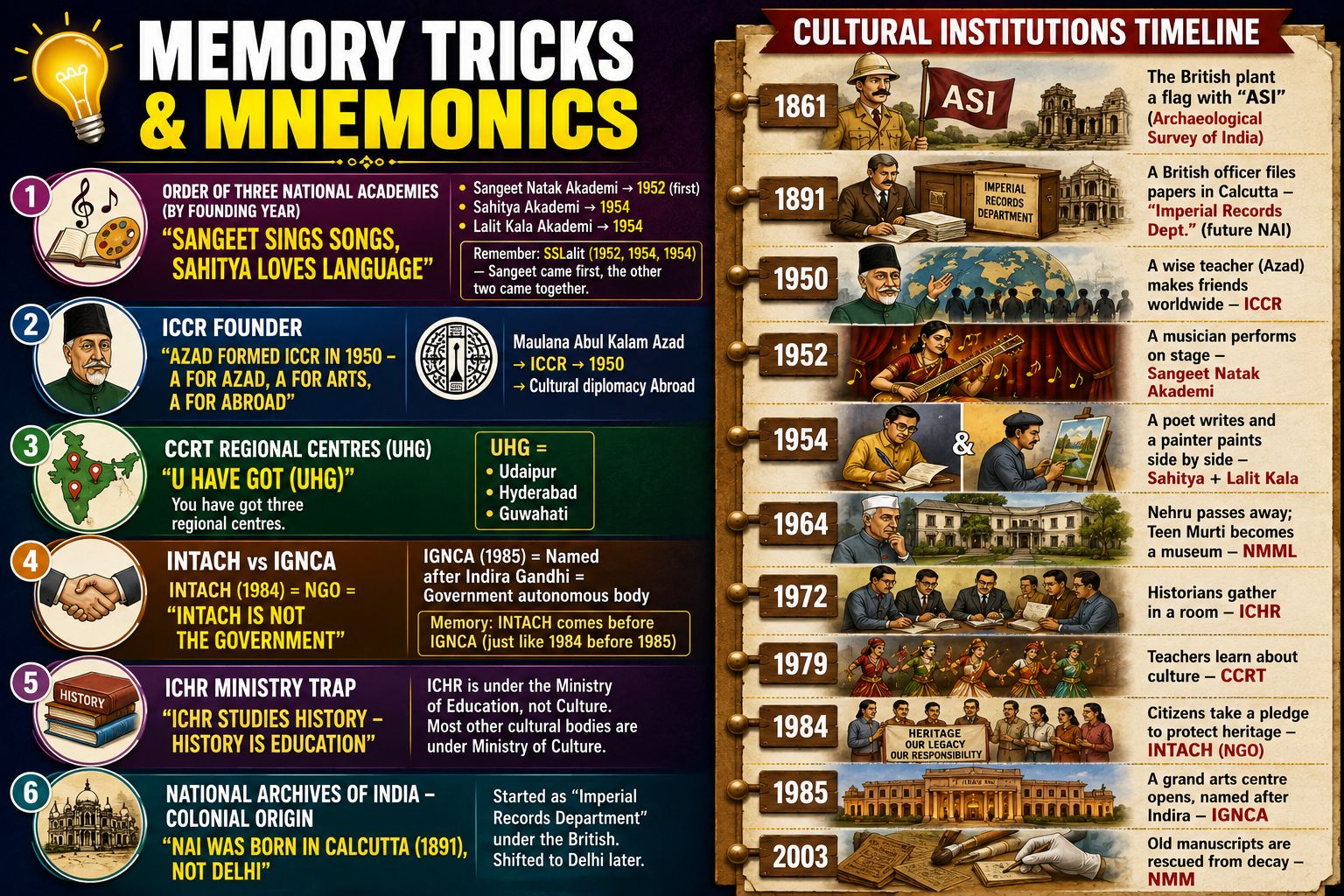
Mnemonic 1: Order of Three National Academies (by founding year)
"Sangeet Sings Songs, Sahitya Loves Language"
- Sangeet Natak Akademi → 1952 (first)
- Sahitya Akademi → 1954
- Lalit Kala Akademi → 1954
Remember: SSLalit (1952, 1954, 1954) — Sangeet came first, the other two came together.
Mnemonic 2: ICCR Founder
"AZAD formed ICCR in 1950 — A for Azad, A for Arts, A for Abroad"
Maulana Abul Kalam Azad → ICCR → 1950 → Cultural diplomacy Abroad
Mnemonic 3: CCRT Regional Centres (UHG)
Remember UHG = Udaipur, Hyderabad, Guwahati
Trick: "U Have Got (UHG)" — You have got three regional centres.
Mnemonic 4: INTACH vs IGNCA
- INTACH (1984) = NGO = "INTACH is NOT the government"
- IGNCA (1985) = Named after Indira Gandhi = Government autonomous body
- Memory: INTACH comes before IGNCA (just like 1984 comes before 1985)
Mnemonic 5: ICHR Ministry Trap
"ICHR studies History — History is Education" → ICHR is under the Ministry of Education, not Culture. Most other cultural bodies are under Ministry of Culture.
Mnemonic 6: National Archives of India — Colonial Origin
"NAI was born in Calcutta (1891), not Delhi" — Started as "Imperial Records Department" under the British. Shifted to Delhi later.
Vivid Memory Aid: Cultural Institutions Timeline
Picture a timeline wall with the following pegs:
- 1861 — The British plant a flag with "ASI" (Archaeological Survey of India)
- 1891 — A British officer files papers in Calcutta — "Imperial Records Dept." (future NAI)
- 1950 — A wise teacher (Azad) makes friends worldwide — ICCR
- 1952 — A musician performs on stage — Sangeet Natak Akademi
- 1954 — A poet writes and a painter paints side by side — Sahitya + Lalit Kala
- 1964 — Nehru passes away; Teen Murti becomes a museum — NMML
- 1972 — Historians gather in a room — ICHR
- 1979 — Teachers learn about culture — CCRT
- 1984 — Citizens take a pledge to protect heritage — INTACH (NGO)
- 1985 — A grand arts centre opens, named after Indira — IGNCA
- 2003 — Old manuscripts are rescued from decay — NMM
Additional Notes — Tricky Facts and PYQ Insights
Frequently Confused Facts
- ICHR vs Ministry: ICHR is under Ministry of Education (funded by UGC), while most other cultural bodies are under the Ministry of Culture. This is a repeated trap in SSC CGL and UPSC Prelims.
- INTACH is an NGO: Unlike all other bodies in this article, INTACH is not a government body — it is an autonomous Non-Governmental Organisation. It does not receive direct government funding as its primary source.
- Sangeet Natak Akademi (1952) was the FIRST national academy — not Sahitya Akademi. Both Sahitya and Lalit Kala Akademi were set up in 1954.
- All three national academies are at Rabindra Bhavan, New Delhi — same address, different sections.
- NAI was NOT established post-Independence — it dates back to 1891 under the British, originally as the "Imperial Records Department" in Calcutta.
- ICCR Headquarters is called Azad Bhavan — named after its founder Maulana Abul Kalam Azad.
- Sahitya Akademi Award vs Jnanpith Award: Sahitya Akademi Award is given by the government autonomous body; Jnanpith Award is given by the private Bharatiya Jnanpith organisation. Both are literary awards but very different in nature.
- NMML building was designed by Sir Edwin Lutyens in 1929-30 — the same architect who designed much of New Delhi's imperial capital layout.
Repeating PYQ Patterns
- Founding years of Sangeet Natak Akademi, Sahitya Akademi, and Lalit Kala Akademi (frequently tested in UPSC and SSC)
- ICCR founder (Maulana Abul Kalam Azad) — repeated in UPSC Prelims and Banking Awareness sections
- INTACH being an NGO — tested in SSC CGL and IBPS PO
- CCRT regional centres (Udaipur, Hyderabad, Guwahati) — asked in State PCS and SSC exams
- ASI's governing legislation (1958 Act and 1972 Act) — frequently tested in UPSC
- NAI's original name "Imperial Records Department" and its founding in Calcutta (1891) — asked in history-based GK questions
Quick Insights
- The concept of three national academies originated from a 1945 proposal by the Asiatic Society of Bengal, not from a post-Independence government initiative directly.
- IGNCA was established in 1985 — the year after INTACH (1984). Both deal with arts preservation but INTACH is an NGO while IGNCA is a government autonomous body.
- The National Mission for Manuscripts (2003) is a mission, not an academy or institution — it is a project-based initiative under the Ministry of Culture.
- ASI operates under the Ancient Monuments and Archaeological Sites and Remains Act, 1958 — not the 1972 Act. The 1972 Act (Antiquities and Art Treasures Act) deals with the regulation of antiques trade and export.
- For cultural institutions connected to Dances of India and Indian Music, the Sangeet Natak Akademi is the apex body that documents and promotes these traditions.
One-Liners for Quick Revision
- ASI was founded in 1861 and functions under the Ministry of Culture; it protects over 3,600 Centrally Protected Monuments.
- Sangeet Natak Akademi (1952) was the first national academy established in India.
- Sahitya Akademi (1954) promotes literature in 24 recognised languages and has published over 7,000 books.
- Lalit Kala Akademi (1954) is the apex body for visual arts in India, funded by the Ministry of Culture.
- All three academies — Sangeet Natak, Sahitya, and Lalit Kala — are headquartered at Rabindra Bhavan, New Delhi.
- ICCR was founded in 1950 by Maulana Abul Kalam Azad for cultural diplomacy; its office is called Azad Bhavan.
- ICHR (1972) is under the Ministry of Education and funded by UGC — not the Ministry of Culture.
- CCRT (1979) has regional centres in Udaipur, Hyderabad, and Guwahati.
- INTACH (1984) is India's largest heritage conservation NGO; its motto is "Dedicated to Conservation."
- IGNCA (1985) is named after Indira Gandhi and aims to be a National Data Bank on Arts, Humanities, and Cultural Heritage.
- National Mission for Manuscripts was launched in February 2003 by the Ministry of Culture to preserve India's manuscript wealth.
- National Archives of India was originally the Imperial Records Department, established in Calcutta in 1891.
- NMML is located at Teen Murti House, New Delhi — Nehru's official residence for 16 years; designed by Sir Edwin Lutyens (1929-30).
- The concept for three national academies was proposed by the Asiatic Society of Bengal in 1945.
- National Mission for Manuscripts covers locating, cataloguing, conserving, and digitising India's manuscripts.
- ICCR sponsors ICCR Scholarships for foreign students and manages India's cultural centres abroad.
- ASI's work is governed by the Ancient Monuments and Archaeological Sites and Remains Act, 1958, and the Antiquities and Art Treasures Act, 1972.
- Sahitya Akademi publishes three journals: Indian Literature (English), Samkaleena Bhartiya Sahitya (Hindi), and Sanskrit Pratibha (Sanskrit).
- For broader exam preparation on Indian culture, explore our notes on Indian Art and Culture, Indian Paintings, and Folk Theatre of India.
- Keep your preparation updated with Daily Current Affairs and test yourself with our Static GK Quiz.
Free quiz • No signup required
Put this topic into practice with Indian Cultural Institutions – Static GK MCQ Quiz. It is the quickest way to reinforce what you just learned.
Frequently Asked Questions
Which is the first national academy established in India?
Who founded the Indian Council for Cultural Relations (ICCR)?
Which institution is responsible for protecting India's monuments and archaeological sites?
What is the difference between INTACH and IGNCA?
Under which ministry does the Indian Council of Historical Research (ICHR) function?
Where is the National Archives of India originally located, and when was it established?
What are the three regional centres of CCRT?
In how many languages does the Sahitya Akademi promote literature?
Who designed the Teen Murti House (Nehru Memorial Museum and Library)?
When was the National Mission for Manuscripts launched, and what is its purpose?

About the author