Calendars in India – Saka, Vikram, Hijri and Gregorian | Static GK for Competitive Exams with Memory Tricks
This article covers all types of calendars used in India — Saka Samvat, Vikram Samvat, Hijri, and Gregorian — with complete details, month-wise comparison tables, date conversion formulas, memory tricks, and exam-ready one-liners. Ideal for UPSC, SSC, IBPS, Railways, Defence, Insurance, and all other government exam aspirants.
Jump to section
- Introduction
- Basis of Calendar Systems - Three Types of Synchronisation
- Four Types of Calendars Followed in India
- 1. Saka Samvat - The National Calendar of India
- 2. Vikram Samvat
- 3. Hijri Calendar (Islamic Calendar)
- 4. Gregorian Calendar
- Comparison of All Four Indian Calendar Systems
- Why Does India Follow Two Calendars?
- Previous Year Questions (PYQs) - Calendars in India
- Mnemonic, Memory Tricks and Vivid Memory Aids
- Additional Notes - Tricky Facts, Exceptions and Exam Insights
- One-Liners - Exam-Ready Quick Revision
Introduction
A calendar is a system of organising days for social, religious, commercial, or administrative purposes. It assigns names to specific periods of time — such as days, weeks, months, and years — and helps societies maintain a structured record of time.
The word "calendar" originates from the Latin word "Calends" or "Kalends", which referred to the first day of each month in the ancient Roman system.
India is a land of extraordinary cultural and religious diversity, and this is clearly reflected in the multiple calendar systems followed across the country. While the Gregorian calendar is used internationally for everyday civil purposes, India officially recognises the Saka Samvat as its National Calendar. Additionally, the Vikram Samvat (Hindu luni-solar calendar) and the Hijri calendar (Islamic lunar calendar) hold deep cultural, religious, and historical significance.
For government exam aspirants preparing for UPSC Prelims, SSC CGL, IBPS, RRB, Defence, Insurance, and State PCS, questions from this topic appear regularly in General Awareness and Static GK sections — especially those related to the National Calendar of India, month-to-month correspondences, date conversion formulas, and key factual details. You can stay updated with more such topics at Static GK on Jobsme.in.
Basis of Calendar Systems - Three Types of Synchronisation
Before understanding individual calendars, it is important to know the three astronomical systems on which all calendars are built:
1. Lunar Calendar
- Based on the movement and phases of the Moon.
- A lunar month varies from 29.26 to 29.80 days.
- A lunar year has approximately 354 days — about 11 days shorter than a solar year.
- To adjust this difference in luni-solar systems, an intercalary (extra) month called Adhik Masa is added every 2 years and 6 months.
- Under the pure Hijri calendar, this difference is not adjusted, so the Islamic year falls short by one full year every 33 years compared to the Gregorian calendar.
- Example: Hijri Calendar (Islamic Calendar)
2. Solar Calendar
- Based on the apparent motion of the Sun and perceived seasonal changes.
- A solar year consists of 365 days, 5 hours, 48 minutes, and 46 seconds.
- Maintains the closest correspondence between the calendar year and the seasons.
- Examples: Gregorian Calendar, Persian Calendar, Saka Calendar
3. Luni-Solar Calendar
- Based on a combination of both solar and lunar reckonings.
- Uses lunar months but aligns with solar sidereal years for annual reckoning.
- Examples: Vikram Samvat, traditional Hindu calendars, Hebrew calendar, Chinese traditional calendar
Four Types of Calendars Followed in India
India officially follows four major calendar systems:
| Calendar | Type | Zero / Origin Year | Named After / Origin |
|---|---|---|---|
| Vikram Samvat | Luni-Solar | 57 BC | King Vikramaditya of Ujjain |
| Saka Samvat | Solar (with lunar month names) | 78 AD | King Shalivahana of Shatavahana dynasty |
| Hijri Calendar | Lunar | 622 AD | Migration of Prophet Muhammad from Mecca to Medina |
| Gregorian Calendar | Solar | 1582 AD | Pope Gregory XIII |
1. Saka Samvat - The National Calendar of India
What is the Saka Calendar?
The Saka Samvat is the official National Calendar of India, adopted by the Government of India on 22 March 1957 alongside the Gregorian calendar. It is based on the Saka Era, which began in 78 AD, and is also referred to as the Shalivahana Saka Era or Mahasakkarat Era.
The Saka calendar was recommended by the Calendar Reform Committee, constituted in 1952 under the Council of Scientific and Industrial Research (CSIR) and led by the renowned scientist Meghnad Saha. The primary objective was to bring uniformity among the over 30 different regional calendars in use across India at that time.
The calendar officially came into use from 22 March 1957 (Gregorian), which corresponded to Chaitra 1, 1879 (Saka Samvat).
Key Features of the Saka Calendar
- Type: Solar calendar (month names are of Sanskrit/Hindu origin)
- Zero Year: 78 AD
- First Month: Chaitra
- New Year Begins: 22 March every year (21 March in a Gregorian leap year)
- Total Days: 365 days per year
- Total Months: 12
- Named after: King Shalivahana of the Shatavahana dynasty
- Adopted as National Calendar: 1957
- It is one of the National Symbols of India.
- Used in: Gazette of India, All India Radio news broadcasts, official government calendars, and communication documents issued by the Government of India.
- Also used by Indonesian Hindus in Bali and Java.
- Corresponds to Julian year 78.
- The first documented connection between King Shalivahana and the Saka era is found in the Kannada work "Udbhatakavya" by Somaraja.
Saka Calendar - 12 Months with Gregorian Equivalents
| No. | Saka Month | Days | Gregorian Equivalent |
|---|---|---|---|
| 1 | Chaitra | 30 / 31 (leap year) | 22 March - 20 April (21 March in leap year) |
| 2 | Vaishakha | 31 | 21 April - 21 May |
| 3 | Jyeshtha | 31 | 22 May - 21 June |
| 4 | Ashadha | 31 | 22 June - 22 July |
| 5 | Shravana | 31 | 23 July - 22 August |
| 6 | Bhadra | 31 | 23 August - 22 September |
| 7 | Ashwin | 30 | 23 September - 22 October |
| 8 | Kartika | 30 | 23 October - 21 November |
| 9 | Agrahayana | 30 | 22 November - 21 December |
| 10 | Pausha | 30 | 22 December - 20 January |
| 11 | Magha | 30 | 21 January - 19 February |
| 12 | Phalguna | 30 | 20 February - 20/21 March |
Important Pattern to Remember: The first 6 months (Vaishakha to Bhadra) have 31 days each. The last 6 months (Ashwin to Phalguna) have 30 days each. Chaitra has 30 days in normal years and 31 days in leap years.
Saka Calendar - Date Conversion Formula
- Gregorian Year − 78 = Saka Year
- Saka Year + 78 = Gregorian Year
Example: Gregorian year 2025 − 78 = Saka Year 1947
History and Background of the Saka Calendar
- The Saka Era is believed to have been founded by King Shalivahana of the Shatavahana dynasty.
- The era marks the remembrance of King Shalivahana's chief military triumphs.
- The Calendar Reform Committee was formed in 1952 under CSIR, chaired by Meghnad Saha, to standardise the Indian calendar system.
- The committee aimed to reconcile astronomical data and harmonise calendar usage after correcting local errors across regional systems.
- It was adopted to synchronise usage of the 30+ different calendars that existed in India at the time of adoption.
2. Vikram Samvat
What is Vikram Samvat?
The Vikram Samvat (also called the Vikrami Calendar) is a historical luni-solar calendar widely followed by Hindus and Sikhs across India. It is the official calendar of Nepal. The calendar was named after King Vikramaditya of Ujjain, believed to have established the era in 57 BC to commemorate his victory over the Saka rulers.
The Vikram Samvat is prominent across almost all of India except the Bengal region. Before the 9th century, this same calendar system was known by other names such as Krita and Malava. It gained its current name and wider recognition after the 9th century with the growth of epigraphical artwork.
Key Features of Vikram Samvat
- Type: Luni-Solar calendar
- Zero Year: 57 BC (starts 57 years before the Christian/Gregorian era)
- Named after: King Vikramaditya of Ujjain
- Total Days: 354 days per year (lunar-based)
- Total Months: 12 months
- Uses lunar months and solar sidereal years for annual reckoning.
- Followed by Hindus and Sikhs; also the official calendar of Nepal.
- In Gujarat and Maharashtra, the Vikram Samvat new year is celebrated the day after Diwali.
- Conversion formula: Vikram Samvat Year − 57 = Gregorian Year (approximately, for current era)
Division of a Month in Vikram Samvat
Each month in Vikram Samvat is divided into two phases (Pakshas) of 15 days each:
- Shukla Paksha (15 days): The bright fortnight — begins with the new moon (Amavasya) and ends with the full moon (Purnima).
- Krishna Paksha (15 days): The dark fortnight — begins with the full moon (Purnima) and ends with the new moon (Amavasya).
Vikram Samvat - 12 Months with Gregorian Equivalents
| No. | Vikram Samvat Month | Approximate Gregorian Equivalent |
|---|---|---|
| 1 | Chaitra | March - April |
| 2 | Baishakh (Vaishakha) | April - May |
| 3 | Jestha (Jyeshtha) | May - June |
| 4 | Ashadh (Ashadha) | June - July |
| 5 | Shrawan (Shravana) | July - August |
| 6 | Bhadra (Bhadrapada) | August - September |
| 7 | Ashwin | September - October |
| 8 | Kartik (Kartika) | October - November |
| 9 | Mangsir (Margashirsha) | November - December |
| 10 | Poush (Pausha) | December - January |
| 11 | Magh (Magha) | January - February |
| 12 | Falgun (Phalguna) | February - March |
Note: In Vikram Samvat, the year begins with Chaitra in most of India. However, in Gujarat and Maharashtra, the new year begins with Kartik (the day after Diwali). Because it is a lunar calendar, exact month start dates shift slightly each Gregorian year.
3. Hijri Calendar (Islamic Calendar)
What is the Hijri Calendar?
The Hijri calendar (also spelled Hijra or Hegira calendar) is a purely lunar calendar consisting of 12 lunar months and 354 or 355 days per year. It is the official Islamic calendar and is used to determine Islamic holidays, religious rituals, and significant events.
The calendar derives its name from the Hijra — the historic migration of Prophet Muhammad from Mecca to Medina in 622 AD, which marks the zero year of the Islamic calendar.
Key Features of the Hijri Calendar
- Type: Pure Lunar calendar
- Zero Year: 622 AD (year of the Hijra)
- Total Days: 354 days (sometimes 355 days)
- Total Months: 12 lunar months
- Originally started and followed in Saudi Arabia.
- The lunar months are not adjusted to match the solar year — making Islamic festivals shift approximately 11 days earlier each Gregorian year.
- As a result, the Hijri calendar falls short by one full year every 33 years compared to the Gregorian calendar.
- Used across Muslim countries alongside the Gregorian calendar to determine the dates of Ramadan, Hajj, Eid-ul-Fitr, and Eid-ul-Adha.
- Four months are considered sacred: the 1st (Muharram), 7th (Rajab), 11th (Dhu al-Qi'dah), and 12th (Dhu al-Hijjah).
Hijri Calendar - 12 Months with Key Significance
| No. | Month Name | Key Significance |
|---|---|---|
| 1 | Muharram | Sacred month; Islamic New Year on 1st Muharram; travel and business traditionally restricted |
| 2 | Safar | Good for travel, business, and fighting |
| 3 | Rabi al-Awwal (Rabi I) | Commencement of spring; birth month of Prophet Muhammad |
| 4 | Rabi al-Thani (Rabi II) | Indicates the end of spring |
| 5 | Jumada al-Awwal (Jumada I) | Commencement of the cold season |
| 6 | Jumada al-Thani (Jumada II) | Conclusion of the cold season |
| 7 | Rajab | Sacred month; preparation month |
| 8 | Sha'ban | Month of harvesting |
| 9 | Ramadan | Month of fasting (Roza/Sawm) for purification of the soul; Shehri (morning meal before dawn) and Iftar (evening meal after sunset) |
| 10 | Shawwal | 1st Shawwal - Eid-ul-Fitr (festival after Ramadan) |
| 11 | Dhu al-Qi'dah | Sacred month; preparation for pilgrimage; camels prepared for travel |
| 12 | Dhu al-Hijjah | Sacred month; 8-13 Dhu al-Hijjah - Hajj pilgrimage to Mecca; Eid-ul-Adha observed |
4. Gregorian Calendar
What is the Gregorian Calendar?
The Gregorian calendar is the most widely used civil calendar in the world. It was introduced in October 1582 by Pope Gregory XIII as a correction to the earlier Julian calendar. The Julian calendar had a miscalculation in its leap year system — it assumed a year of 365.25 days, causing a gradual drift from the actual solar year over centuries.
The Gregorian calendar corrects this by spacing leap years such that the average year is 365.2425 days long, closely matching the Earth's actual revolution around the Sun. Despite the correction, it retained the same month names as the Julian calendar.
Key Features of the Gregorian Calendar
- Type: Solar calendar
- Introduced: October 1582
- Named after: Pope Gregory XIII
- Replaced: The Julian calendar (which had 365.25 days per year)
- Total Days: 365 days in a normal year; 366 days in a leap year
- Leap Year Rule: A year is a leap year if it is divisible by 4, except century years — which must also be divisible by 400 to qualify as leap years.
- The solar year is 365 days, 5 hours, 48 minutes, and 46 seconds — the extra hours are accounted for by adding one day (29 February) to February every four years.
- Used as the standard civil calendar across the world, including India (alongside the Saka calendar).
Gregorian Calendar - 12 Months
| No. | Month | Days |
|---|---|---|
| 1 | January | 31 |
| 2 | February | 28 (29 in leap year) |
| 3 | March | 31 |
| 4 | April | 30 |
| 5 | May | 31 |
| 6 | June | 30 |
| 7 | July | 31 |
| 8 | August | 31 |
| 9 | September | 30 |
| 10 | October | 31 |
| 11 | November | 30 |
| 12 | December | 31 |
Comparison of All Four Indian Calendar Systems
| Feature | Saka Samvat | Vikram Samvat | Hijri Calendar | Gregorian Calendar |
|---|---|---|---|---|
| Type | Solar | Luni-Solar | Lunar | Solar |
| Zero Year | 78 AD | 57 BC | 622 AD | 1582 AD (reformed) |
| Days per Year | 365 | 354 | 354 / 355 | 365 / 366 |
| First Month | Chaitra | Chaitra (or Kartik in Gujarat/Maharashtra) | Muharram | January |
| New Year Date | 22 March (21 March in leap year) | Day after Diwali (Gujarat/Maharashtra); Chaitra Shukla Pratipada elsewhere | 1st Muharram (shifts annually) | 1st January |
| Named After | King Shalivahana | King Vikramaditya | Prophet Muhammad's Hijra | Pope Gregory XIII |
| Official Use in India | Yes (National Calendar) | No (cultural and religious use) | No (religious use) | Yes (civil use) |
| Used By | Indian Government, Gazette, AIR | Hindus, Sikhs; official in Nepal | Muslims worldwide | Most countries globally |
Why Does India Follow Two Calendars?
India follows both the National Calendar (Saka Samvat) and the Gregorian calendar to balance administrative needs with global coordination. The Gregorian calendar is used for international communication, trade, banking, and global events — ensuring seamless interaction with the rest of the world. The Saka calendar is used for official government purposes such as gazette notifications, All India Radio broadcasts, and formal administrative records. This dual system ensures global compatibility while preserving India's cultural and historical identity.
For a broader understanding of India's cultural heritage, you can also explore our notes on National Symbols of India and Indian Fairs and Festivals.
Previous Year Questions (PYQs) - Calendars in India
Q. Chaitra 1 of the national calendar based on the Saka Era corresponds to which one of the following dates of the Gregorian calendar in a normal year of 365 days?
(UPSC Prelims 2014)
- (a) 22 March (or 21 March)
- (b) 15 May (or 16 May)
- (c) 31 March (or 30 March)
- (d) 21 April (or 20 April)
Answer: (a) 22 March
Explanation: Chaitra is the first month of the Saka Samvat (National Calendar of India). It begins on 22 March in a normal year and on 21 March during a Gregorian leap year. This is a frequently tested concept in UPSC, SSC, and other government exams.
Practice more such questions on our Static GK Quiz section or check our Daily Current Affairs Quiz to stay exam-ready.
Mnemonic, Memory Tricks and Vivid Memory Aids
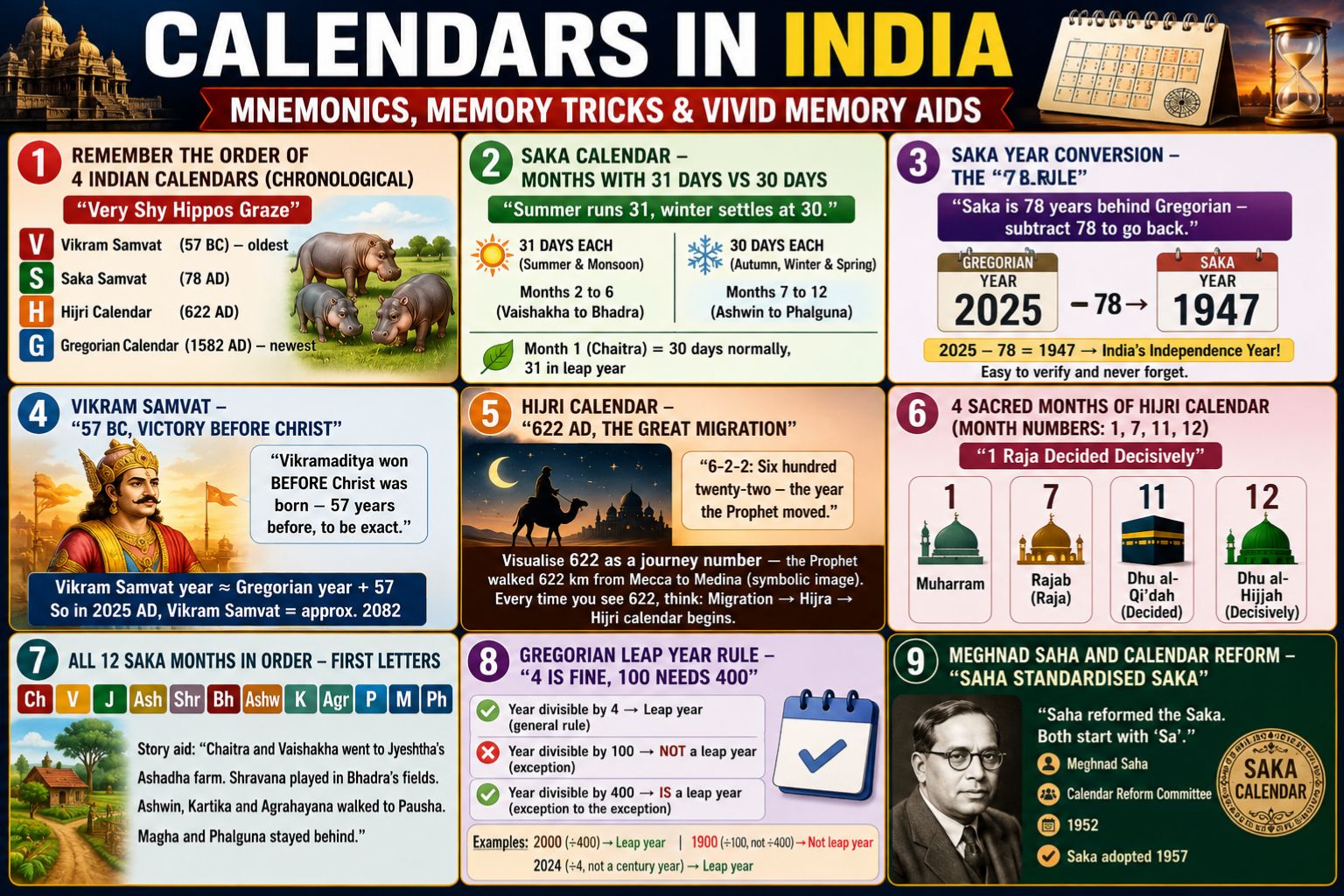
1. Remember the Order of 4 Indian Calendars (Chronological)
Mnemonic: "Very Shy Hippos Graze"
- V - Vikram Samvat (57 BC) — oldest
- S - Saka Samvat (78 AD)
- H - Hijri Calendar (622 AD)
- G - Gregorian Calendar (1582 AD) — newest
This also gives you the correct chronological order from oldest to newest zero year.
2. Saka Calendar - Months with 31 Days vs 30 Days
Trick: "Summer runs 31, winter settles at 30."
- Months 2 to 6 (Vaishakha to Bhadra) = 31 days each (summer and monsoon season)
- Months 7 to 12 (Ashwin to Phalguna) = 30 days each (autumn, winter, spring)
- Month 1 (Chaitra) = 30 days normally, 31 in leap year
3. Saka Year Conversion - The "78 Rule"
Memory hook: "Saka is 78 years behind Gregorian — subtract 78 to go back."
- Gregorian 2025 − 78 = Saka 1947 — the same number as India's independence year! Use this as your anchor.
- When Gregorian year = 2025, Saka year = 1947. Easy to verify and never forget.
4. Vikram Samvat - "57 BC, Victory Before Christ"
Memory hook: "Vikramaditya won BEFORE Christ was born — 57 years before, to be exact."
Vikram Samvat year ≈ Gregorian year + 57. So in 2025 AD, Vikram Samvat = approx. 2082.
5. Hijri Calendar - "622 AD, the Great Migration"
Memory hook: "6-2-2: Six hundred twenty-two — the year the Prophet moved."
Visualise 622 as a journey number — the Prophet walked 622 km from Mecca to Medina (symbolic image). Every time you see 622, think: Migration → Hijra → Hijri calendar begins.
6. Remember the 4 Sacred Months of Hijri Calendar (Month Numbers: 1, 7, 11, 12)
Mnemonic: "1 Raja Decided Decisively" → 1, 7, 11, 12
- 1 - Muharram
- 7 - Rajab (Raja)
- 11 - Dhu al-Qi'dah (Decided)
- 12 - Dhu al-Hijjah (Decisively)
7. All 12 Saka Months in Order - First Letters
"Ch - V - J - Ash - Shr - Bh - Ashw - K - Agr - P - M - Ph"
Story aid: "Chaitra and Vaishakha went to Jyeshtha's Ashadha farm. Shravana played in Bhadra's fields. Ashwin, Kartika and Agrahayana walked to Pausha. Magha and Phalguna stayed behind."
8. Gregorian Leap Year Rule - "4 is Fine, 100 Needs 400"
- Year divisible by 4 → Leap year (general rule)
- Year divisible by 100 → NOT a leap year (exception)
- Year divisible by 400 → IS a leap year (exception to the exception)
- Quick examples: 2000 (divisible by 400) → Leap year. 1900 (divisible by 100, not 400) → Not a leap year. 2024 (divisible by 4, not a century year) → Leap year.
9. Meghnad Saha and Calendar Reform - "Saha Standardised Saka"
Memory hook: "Saha reformed the Saka. Both start with 'Sa'."
Meghnad Saha → Calendar Reform Committee → 1952 → Saka adopted 1957.
Additional Notes - Tricky Facts, Exceptions and Exam Insights
Frequently Confused Facts
- Saka Samvat vs Vikram Samvat: Both are used in India, but only Saka Samvat is the National Calendar. Vikram Samvat is cultural and religious, and is the official calendar of Nepal — not India.
- Saka Calendar is NOT purely lunar: Despite having Sanskrit month names, the Saka calendar (as National Calendar) is a solar calendar with fixed Gregorian date correspondences.
- Meghnad Saha's role: He chaired the Calendar Reform Committee (1952) that recommended Saka as the National Calendar. Do not confuse him with other scientists in exam MCQs.
- Chaitra 1 = 22 March (not 21 March): The standard exam answer is 22 March for a normal 365-day year. 21 March applies only in a Gregorian leap year. This exact distinction was tested in UPSC Prelims 2014.
- Hijri Calendar does NOT add intercalary months: Unlike Vikram Samvat (luni-solar), the Hijri calendar makes no solar adjustment. This is why Islamic festivals cycle through all seasons over approximately 33 years.
- Gregorian replaced Julian — not Saka: A common exam distractor. The Gregorian calendar corrected the Julian calendar's leap year error. It has no direct relation to the Saka system.
- Saka calendar is also used in Bali and Java (Indonesia): This is a less-known fact frequently asked in exams to test deeper knowledge beyond the standard syllabus.
- The Gazette of India uses BOTH Saka and Gregorian calendars — both dates are printed side by side in official government notifications.
- Adhik Masa is the intercalary month added in Hindu luni-solar calendars (like Vikram Samvat) to reconcile the lunar year with the solar year. It is added roughly every 2.5 years.
- Vikram Samvat new year: In most of India it falls on Chaitra Shukla Pratipada (first day of the bright fortnight of Chaitra). But in Gujarat and Maharashtra, it falls on the day after Diwali (Kartik Shukla Pratipada) — a distinction commonly tested in state PCS exams.
Repeating PYQ Patterns to Watch
- "Which is the first month of the Saka calendar?" → Chaitra
- "When was the National Calendar of India adopted?" → 22 March 1957
- "Chaitra 1 of Saka corresponds to which Gregorian date (normal year)?" → 22 March
- "Who chaired the Calendar Reform Committee?" → Meghnad Saha
- "Zero year of Saka Samvat?" → 78 AD
- "Zero year of Vikram Samvat?" → 57 BC
- "Zero year of Hijri Calendar?" → 622 AD
- "Which calendar is the National Calendar of India?" → Saka Samvat
- "How many regional calendars were in use before the 1957 reform?" → More than 30
- "The Saka calendar is also used in which country other than India?" → Indonesia (Bali and Java)
For more such exam-focused notes on Indian history and governance, explore our Governor General and Viceroy of India article. Stay updated with the latest exam openings at Latest Govt Jobs Notifications.
One-Liners - Exam-Ready Quick Revision
- The National Calendar of India is based on Saka Samvat, adopted on 22 March 1957.
- The Saka Samvat begins from 78 AD; conversion formula: Gregorian Year − 78 = Saka Year.
- The first month of the Saka calendar is Chaitra, beginning on 22 March (21 March in a Gregorian leap year).
- The Calendar Reform Committee (1952) was chaired by scientist Meghnad Saha under CSIR.
- The Saka calendar is one of the National Symbols of India.
- The Gazette of India and All India Radio use the Saka calendar alongside the Gregorian calendar.
- The Saka calendar is also used by Indonesian Hindus in Bali and Java.
- The Saka era corresponds to Julian year 78 and is linked to King Shalivahana of the Shatavahana dynasty.
- The first documentary link between King Shalivahana and the Saka era is in the Kannada work "Udbhatakavya" by Somaraja.
- Vikram Samvat started in 57 BC, named after King Vikramaditya of Ujjain.
- Vikram Samvat is a luni-solar calendar with 354 days and is the official calendar of Nepal.
- Each Vikram Samvat month is divided into Shukla Paksha (bright fortnight) and Krishna Paksha (dark fortnight) of 15 days each.
- The first day of Vikram Samvat is celebrated after Diwali in Gujarat and Maharashtra.
- The Hijri (Islamic) calendar began in 622 AD to mark the Hijra (Prophet Muhammad's migration from Mecca to Medina).
- The Hijri calendar has 12 lunar months and 354/355 days with no intercalary adjustment to the solar year.
- The Hijri calendar falls short of the Gregorian calendar by one year every 33 years.
- The four sacred months in the Hijri calendar: Muharram (1st), Rajab (7th), Dhu al-Qi'dah (11th), Dhu al-Hijjah (12th).
- The 9th month of the Hijri calendar is Ramadan — the month of fasting; morning meal = Shehri, evening meal = Iftar.
- The Gregorian calendar was introduced in October 1582 by Pope Gregory XIII to correct the Julian calendar.
- The Gregorian calendar maintains the average year as 365.2425 days through its structured leap year system.
- The Julian calendar assumed a year of 365.25 days — the Gregorian calendar corrected this miscalculation.
- The intercalary month in Hindu luni-solar calendars added to align lunar and solar years is called Adhik Masa, added roughly every 2 years and 6 months.
- Before the 1957 reform, India had more than 30 different regional calendars in use simultaneously.
Free quiz • No signup required
Put this topic into practice with Indian Cultural Institutions – Static GK MCQ Quiz. It is the quickest way to reinforce what you just learned.
Frequently Asked Questions
What is the National Calendar of India?
When was the National Calendar of India adopted and who recommended it?
What is the first month of the Saka Calendar and when does it start?
How do you convert a Saka year to a Gregorian year?
What is the difference between Saka Samvat and Vikram Samvat?
What is the zero year of each major calendar used in India?
What is the Hijri Calendar and why does it shift each year?
Which are the four sacred months in the Hijri Calendar?
Why does India follow both the Saka Calendar and the Gregorian Calendar?
How many types of calendars are officially followed in India and what are they?

About the author