Musical Instruments and Their Famous Musicians (Exponents) – Static GK & General Awareness for Competitive Exams with Memory Tricks
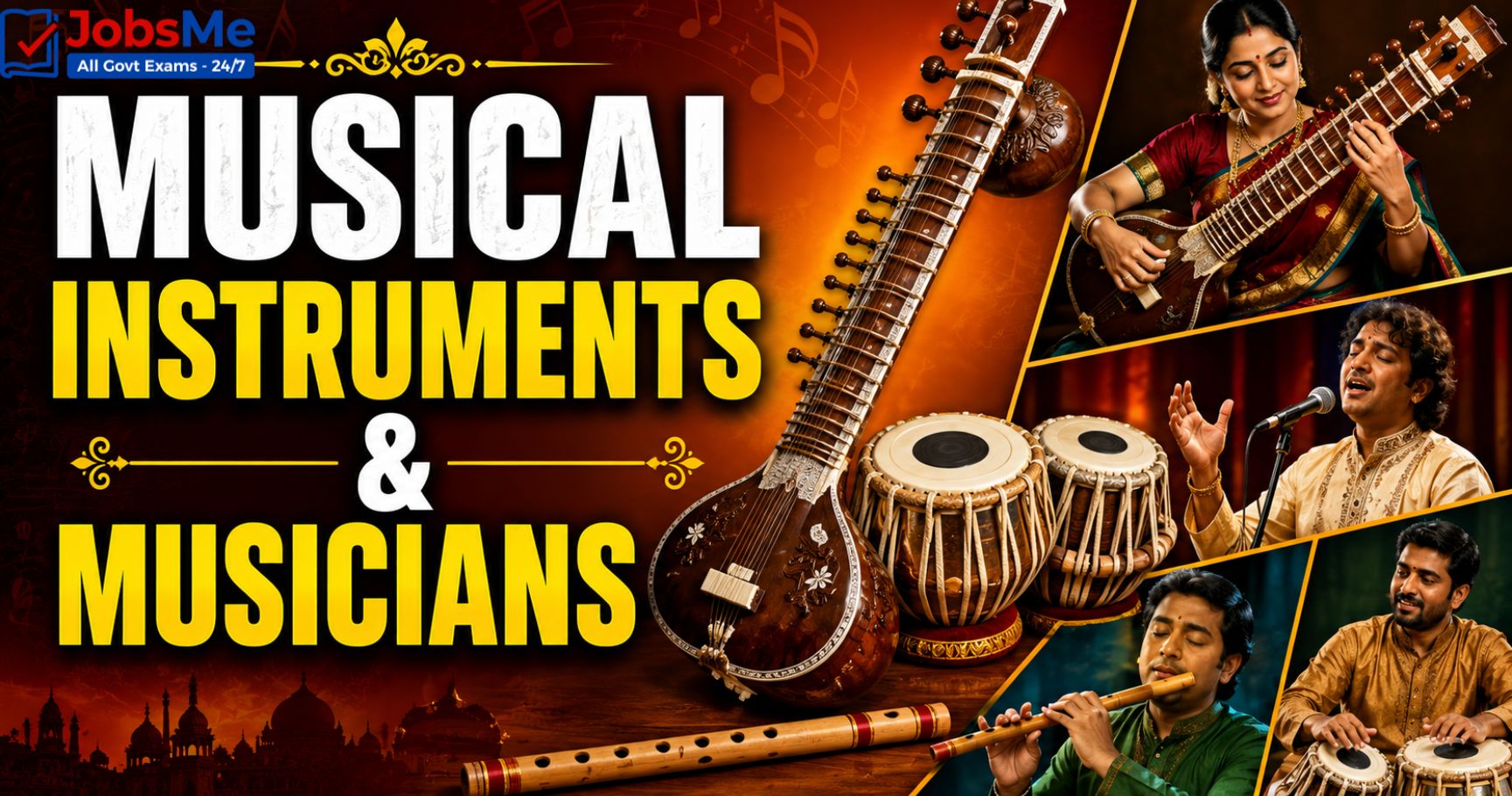
This article presents a complete list of famous Indian musical instruments and their renowned exponents, covering wind instruments, string instruments, percussion instruments, and keyboard instruments, along with their classical names (Sushir, Tat, Avanaddh, Ghan Vadya) and exam-relevant facts. It includes legends like Pandit Ravi Shankar (Sitar), Ustad Zakir Hussain (Tabla), Ustad Bismillah Khan (Shehnai), Pandit Hariprasad Chaurasia (Flute), Pandit Shiv Kumar Sharma (Santoor), and Ustad Amjad Ali Khan (Sarod), with memory tricks and one-liners for quick revision. All facts are arranged in exam-ready format to help UPSC, SSC, IBPS, RRB, PSU, and State PCS aspirants score better in General Awareness and Art & Culture sections.
Jump to section
- Introduction
- Core Concepts: Classification of Musical Instruments
- Famous String Instruments (Tat Vadya) and Their Exponents
- Famous Wind Instruments (Sushir Vadya) and Their Exponents
- Famous Percussion / Membrane Instruments (Avanaddh Vadya) and Their Exponents
- Famous Solid / Plate Instruments (Ghan Vadya) and Their Exponents
- Important Musical Instruments and Their Exponents - Quick Reference
- Memory Tricks and Mnemonics
- Additional Notes
- One-Liners for Quick Revision
Introduction
Indian music has a rich tradition of legendary maestros who have given their lives to mastering specific musical instruments. From Pandit Ravi Shankar, who took the sitar to the global stage, to Ustad Bismillah Khan, who turned the shehnai from a folk instrument into a classical art form, these exponents have shaped the identity of Indian classical music. Each instrument — whether it is the rhythmic tabla, the melodic flute, the soulful sarangi, or the divine santoor — is associated with one or more iconic names that every competitive exam aspirant must memorise.
Questions on musical instruments and their famous exponents appear regularly in UPSC Prelims, SSC CGL, IBPS PO, RRB NTPC, SBI Clerk, State PCS, and various Insurance and Defence exams. Questions typically ask which exponent is associated with which instrument, the classical Sanskrit name of an instrument category (Tat, Sushir, Avanaddh, Ghan Vadya), or which instrument is used in a specific genre of music. This article brings together every key fact in a structured, exam-ready format. To explore other related Static GK topics, you can refer to the Musical Instruments and Famous Musicians - Static GK guide on Jobsme.in.
Musical instruments and their exponents are also closely linked to current affairs themes such as Bharat Ratna awards (Bismillah Khan, Ravi Shankar, M. S. Subbulakshmi), Padma Vibhushan recipients, UNESCO recognition of Indian classical music traditions, and tribute concerts after the demise of legends — making this topic doubly important for aspirants preparing for UPSC Mains and Essay papers as well.
Core Concepts: Classification of Musical Instruments
Musical instruments are classified based on how they produce sound. In Indian classical tradition, this classification was systematised by the ancient sage Bharata in the Natyashastra, which grouped instruments into four categories. The same instruments are also classified in modern terms.
Classical Indian Classification (Natyashastra)
- Tat Vadya (String Instruments): Sound is produced by vibrating strings. Examples: Sitar, Sarod, Veena, Sarangi, Santoor, Violin, Guitar.
- Sushir Vadya (Wind Instruments): Sound is produced by blowing air through the instrument. Examples: Flute (Bansuri), Shehnai, Nadaswaram, Harmonium.
- Avanaddh Vadya (Membrane / Percussion Instruments): Sound is produced by striking a stretched membrane (animal skin). Examples: Tabla, Mridangam, Pakhawaj, Dholak.
- Ghan Vadya (Solid / Plate Instruments): Sound is produced by striking a solid plate or surface. Examples: Ghatam, Jal Tarang, Manjira, Bells.
Modern Classification
- String Instruments: Guitar, Violin, Cello, Harp, Sitar, Veena, Mandolin, Viola, Lute, Banjo, Ukulele.
- Wind / Brass Instruments: Flute, Mouth Organ, Piccolo, Trombone, Euphonium, Oboe, Bassoon, Trumpet, Saxophone, Tuba, French Horn, Cornet, Clarinet.
- Percussion Instruments: Mridangam, Drums, Xylophone, Snare Drum, Tabla, Triangle, Cymbal, Bass Drum, Maracas, Chimes, Tambourine, Timpani, Marimba.
- Keyboard Instruments: Harmonium, Celeste, Piano, Claviola, Pipe Organ, Accordion, Harpsichord, Organ, Harmonica, Synthesiser.
Famous String Instruments (Tat Vadya) and Their Exponents
String instruments form the backbone of Hindustani and Carnatic classical music. The following table lists every major string instrument and its renowned Indian exponents.
| String Instrument | Description | Famous Exponents |
|---|---|---|
| Sitar | A long-necked plucked string instrument central to Hindustani classical music; popularised globally as the face of Indian music. | Pandit Ravi Shankar, Ustad Vilayat Khan, Shujaat Hussain Khan, Shahid Parvez Khan, Anushka Shankar, Nikhil Banerjee, Mushtaq Ali Khan, Budhaditya Mukherjee, Bande Hasan. |
| Sarod | A fretless plucked string instrument made of teak wood with a goat-skin resonator; rich, deep tone used in Hindustani classical music. | Ustad Amjad Ali Khan, Ustad Allauddin Khan, Ustad Ali Akbar Khan, Bahadur Khan, Zarin Sharma, Sharan Rani, Buddhadev Das Gupta, Brij Narayan, Mukesh Sharma. |
| Santoor | A trapezoidal string instrument originally from Kashmir, played by striking the strings with two wooden mallets; produces a divine, water-like sound. | Pandit Shiv Kumar Sharma, Pandit Bhajan Sopori, Pandit Tarun Bhattacharya, Abhay Rustum Sopori, Varsha Agrawal. |
| Sarangi | A bowed, short-necked string instrument considered closest to the human voice; widely used as accompaniment in Hindustani classical vocal music. | Pandit Ram Narayan, Ustad Sultan Khan, Ustad Binda Khan, Abdul Latif Khan, Ramesh Mishra, Shakoor Khan. |
| Violin | A Western bowed string instrument that has been fully adopted in both Carnatic and Hindustani classical music traditions. | Dr. L. Subramaniam, Lalgudi Jayaraman, V. G. Jog, M. Chandrasekharan, N. R. Muralidharan, M. S. Gopalakrishnan, T. N. Krishnan. |
| Veena (Saraswati Veena) | An ancient plucked string instrument; one of the oldest Indian instruments, associated with Goddess Saraswati; central to Carnatic music. | S. Balachander, Doraiswamy Iyengar, Chitti Babu, Karaikudi Sisters, E. Gayathri. |
| Rudra Veena | An ancient large plucked string instrument with two large gourd resonators; used in Dhrupad style of Hindustani music. | Ustad Asad Ali Khan, Ustad Zia Mohiuddin Dagar, Bahauddin Dagar. |
| Vichitra Veena | A fretless plucked string instrument played with a slide; produces a continuous glide between notes. | Abdul Aziz Khan, Ahmed Raza Khan, Lalmani Misra, Gopal Krishan. |
| Mohan Veena | A modified hollow-necked Hawaiian guitar invented by Pandit Vishwa Mohan Bhatt, combining features of sitar, sarod, and veena. | Pandit Vishwa Mohan Bhatt (inventor and main exponent). |
| Been (Pungi) | Traditional wind-string hybrid instrument used by snake charmers; also a name used for Rudra Veena. | Ustad Asad Ali Khan. |
| Guitar | A six-stringed fretted instrument; widely popular internationally and adapted into Indian classical and fusion music. | Pandit Brij Bhushan Kabra (pioneer of Indian classical guitar), Pandit Vishwa Mohan Bhatt, Krishna Nalini. |
| Mandolin | A small plucked string instrument with paired strings; adapted into Carnatic music by U. Srinivas. | U. Srinivas, M. Balamuralikrishna, Nagen Dey, Khagen Dey. |
| Piano | A Western keyboard string instrument; sound produced by hammers striking strings. | V. Balsara, Anil Srinivasan. |
Famous Wind Instruments (Sushir Vadya) and Their Exponents
Wind instruments produce melody through the breath of the player. The following table lists every major Indian wind instrument and its famous exponents.
| Wind Instrument | Description | Famous Exponents |
|---|---|---|
| Flute (Bansuri) | A side-blown bamboo flute deeply associated with Lord Krishna; one of the oldest and simplest wind instruments of India. | Pandit Hariprasad Chaurasia, Pannalal Ghosh, T. R. Mahalingam, N. Ramani, Rajendra Prasanna, Ronu Majumdar. |
| Shehnai | A double-reed oboe-like wind instrument considered auspicious; played at weddings, temples, and ceremonial occasions. | Ustad Bismillah Khan (Bharat Ratna 2001), Ali Ahmad Hussain Khan, Daya Shankar, Anant Lal. |
| Nadaswaram | A long double-reed wind instrument from South India; considered the loudest non-brass acoustic instrument; central to Carnatic temple music. | Rajaratnam Pillai, Sheikh Chinna Maulana, Neeruswami Pillai, Karukurichi P. Arunachalam. |
| Harmonium | A keyboard wind instrument that blows air through reeds using bellows; widely used in Hindustani classical, devotional, and Sufi music. | Shri Purushottam Walawalkar, Appa Jalgaonkar, Pandit Jnan Prakash Ghosh, Tulsidas Borkar. |
| Mouth Organ (Harmonica) | A small free-reed wind instrument played by blowing and drawing air through holes. | Milon Gupta, Rajat Nandy. |
| Trumpet | A brass wind instrument with three valves; used in Western classical, jazz, and fusion music. | Used in orchestras; popular Indian fusion artists include Frank Dubier. |
Famous Percussion / Membrane Instruments (Avanaddh Vadya) and Their Exponents
Percussion instruments provide the rhythmic foundation of Indian classical music. The following table lists every major Indian percussion instrument and its renowned exponents.
| Percussion Instrument | Description | Famous Exponents |
|---|---|---|
| Tabla | A pair of hand drums (smaller "dayan" and larger "bayan"); the most prominent rhythm instrument in Hindustani classical music. | Ustad Zakir Hussain, Ustad Allah Rakha, Pandit Kishan Maharaj, Sabir Khan, Sandeep Das, Ustad Shafaat Ahmed Khan, Pandit Jnan Prakash Ghosh, Latif Khan, Faiyaz Khan, Sukwinder Singh, Pandit Anindo Chatterjee. |
| Mridangam | A double-headed barrel drum; the principal rhythm instrument in Carnatic classical music. | Palghat Mani Iyer, Palghat Raghu, Karaikudi R. Mani, S. V. Rajarao, K. V. Prasad, Umayalpuram K. Sivaraman. |
| Pakhawaj | An ancient double-headed barrel drum considered the predecessor of the tabla; used in Dhrupad style of Hindustani classical music. | Totaram Sharma, Gopaldas, Ramshankar Pagaldas, Pandit Ayodhya Prasad, Pandit Bhavani Shankar. |
| Ghatam | An earthen clay pot used as a percussion instrument; played by striking with hands and fingers; central to Carnatic music. | T. H. Vinayakram (Padma Shri, Padma Bhushan), E. M. Subramaniam, V. Suresh. |
| Kanjira | A South Indian frame drum similar to a tambourine; used as a secondary rhythm instrument in Carnatic music. | Pudukottai Dakshinamurthy Pillai, G. Harishankar, V. Selvaganesh. |
| Dholak | A two-headed hand drum widely used in folk, qawwali, and devotional music across North India. | Used widely in folk traditions; noted players include Zakir Hussain and Ustad Allah Rakha in fusion settings. |
| Dhapli | A single-headed frame drum (similar to tambourine) used in folk and devotional music. | Used in folk traditions across North India. |
Famous Solid / Plate Instruments (Ghan Vadya) and Their Exponents
Solid or plate instruments produce sound by striking a hard surface. The following table lists important Ghan Vadya instruments.
| Instrument | Description | Famous Exponents |
|---|---|---|
| Jal Tarang | A melodic percussion instrument made of china bowls filled with water; played by striking with wooden sticks. | Ranjana Pradhan, Milind Tulankar, Anayampatti S. Ganesan. |
| Manjira / Karatala | Small brass cymbals used in devotional and folk music. | Used widely in bhajan and kirtan traditions. |
| Ghatam (Solid Variant) | Already covered under percussion; classified as Ghan Vadya in some traditions due to its solid clay body. | T. H. Vinayakram, E. M. Subramaniam. |
Important Musical Instruments and Their Exponents - Quick Reference
| Instrument | Category | Most Famous Exponent |
|---|---|---|
| Sitar | String (Tat Vadya) | Pandit Ravi Shankar |
| Sarod | String (Tat Vadya) | Ustad Amjad Ali Khan |
| Santoor | String (Tat Vadya) | Pandit Shiv Kumar Sharma |
| Sarangi | String (Tat Vadya) | Pandit Ram Narayan |
| Violin | String (Tat Vadya) | Dr. L. Subramaniam |
| Veena | String (Tat Vadya) | S. Balachander |
| Rudra Veena | String (Tat Vadya) | Ustad Asad Ali Khan |
| Mohan Veena | String (Tat Vadya) | Pandit Vishwa Mohan Bhatt |
| Guitar (Indian Classical) | String | Pandit Brij Bhushan Kabra |
| Mandolin | String | U. Srinivas |
| Flute (Bansuri) | Wind (Sushir Vadya) | Pandit Hariprasad Chaurasia |
| Shehnai | Wind (Sushir Vadya) | Ustad Bismillah Khan |
| Nadaswaram | Wind (Sushir Vadya) | Rajaratnam Pillai |
| Harmonium | Wind / Keyboard | Pandit Jnan Prakash Ghosh |
| Tabla | Percussion (Avanaddh) | Ustad Zakir Hussain |
| Mridangam | Percussion (Avanaddh) | Palghat Mani Iyer |
| Pakhawaj | Percussion (Avanaddh) | Pandit Ayodhya Prasad |
| Ghatam | Percussion / Solid | T. H. Vinayakram |
| Kanjira | Percussion | Pudukottai Dakshinamurthy Pillai |
| Jal Tarang | Solid (Ghan Vadya) | Ranjana Pradhan |
Memory Tricks and Mnemonics
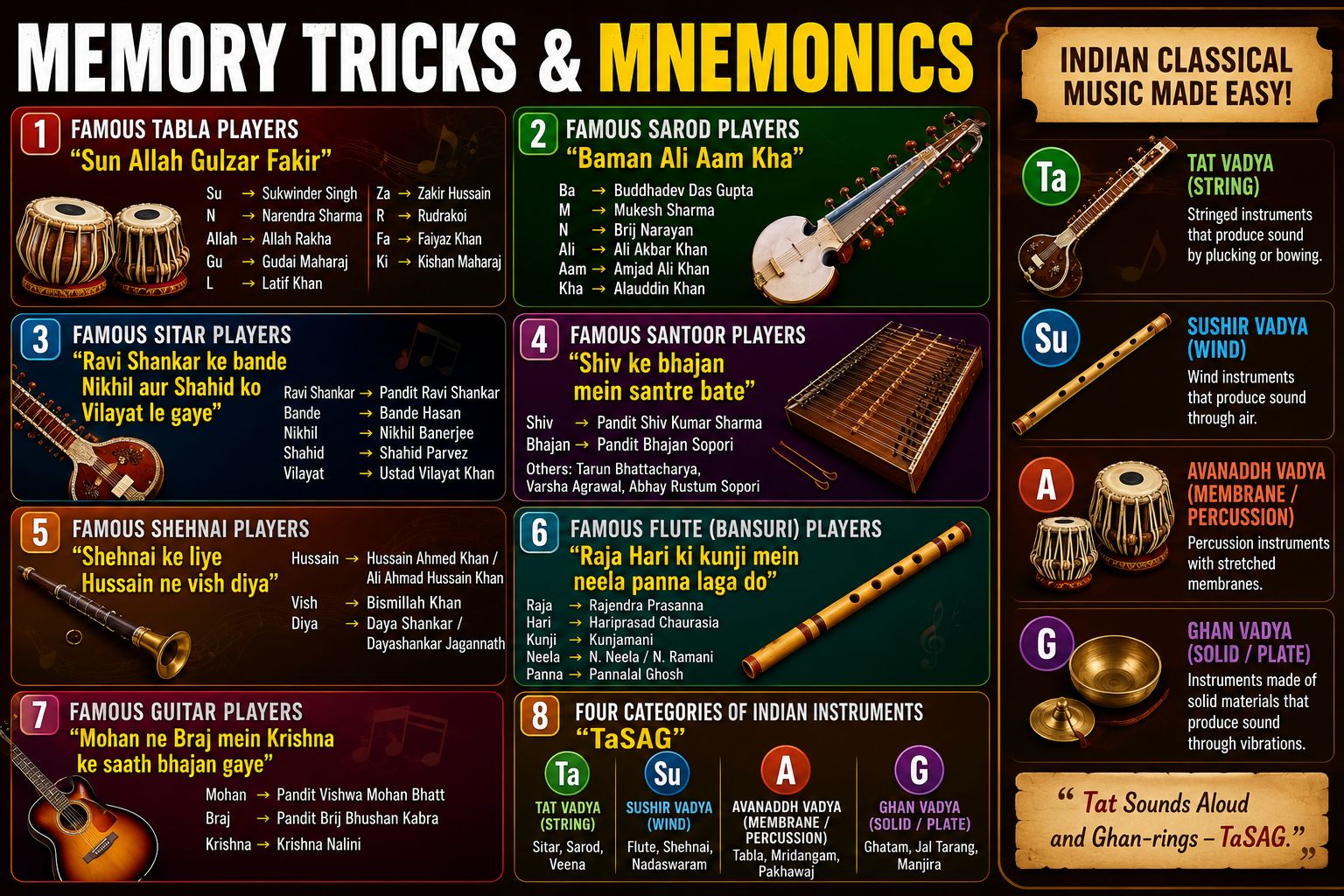
Trick 1: Famous Tabla Players — "Sun Allah Gulzar Fakir"
Use this Hindi-style mnemonic to remember the famous Tabla maestros:
"Sun Allah Gulzar Fakir"
- Su → Sukwinder Singh
- N → Narendra Sharma
- Allah → Allah Rakha
- Gu → Gudai Maharaj
- L → Latif Khan
- Za → Zakir Hussain
- R → Rudrakoi
- Fa → Faiyaz Khan
- Ki → Kishan Maharaj
Trick 2: Famous Sarod Players — "Baman Ali Aam Kha"
Translation: "Baman Ali, eat a mango." Use this to remember Sarod exponents:
- Ba → Buddhadev Das Gupta
- M → Mukesh Sharma
- N → Brij Narayan
- Ali → Ali Akbar Khan
- Aam → Amjad Ali Khan (most frequently asked)
- Kha → Alauddin Khan
Trick 3: Famous Sitar Players — "Ravi Shankar ke bande Nikhil aur Shahid ko Vilayat le gaye"
Translation: "Ravi Shankar's men, Nikhil and Shahid, were taken abroad (vilayat)." The word Sitar matches "Sitara" (star), and Vilayat means "foreign":
- Ravi Shankar → Pandit Ravi Shankar
- Bande → Bande Hasan
- Nikhil → Nikhil Banerjee
- Shahid → Shahid Parvez
- Vilayat → Ustad Vilayat Khan
Trick 4: Famous Santoor Players — "Shiv ke bhajan mein santre bate"
Translation: "Oranges (santre) were distributed during Shiva's bhajan." Santoor sounds like Santra (orange), distributed during religious gatherings:
- Shiv → Pandit Shiv Kumar Sharma
- Bhajan → Pandit Bhajan Sopori
- Other notable names: Tarun Bhattacharya, Varsha Agrawal, Abhay Rustum Sopori.
Trick 5: Famous Shehnai Players — "Shehnai ke liye Hussain ne vish diya"
Translation: "For the Shehnai, Hussain gave poison (vish)." Use this for Shehnai exponents:
- Hussain → Hussain Ahmed Khan / Ali Ahmad Hussain Khan
- Vish → Bismillah Khan (the legendary Bharat Ratna recipient)
- Diya → Daya Shankar / Dayashankar Jagannath
Trick 6: Famous Flute (Bansuri) Players — "Raja Hari ki kunji mein neela panna laga do"
Translation: "Put a blue emerald in Raja Hari's key." Flute is linked to Lord Krishna (Hari):
- Raja → Rajendra Prasanna
- Hari → Hariprasad Chaurasia (most famous)
- Kunji → Kunjamani
- Neela → N. Neela / N. Ramani
- Panna → Pannalal Ghosh
Trick 7: Famous Guitar Players — "Mohan ne Braj mein Krishna ke saath bhajan gaye"
Translation: "Mohan sang hymns with Krishna in Braj." Use this for Indian classical Guitar:
- Mohan → Pandit Vishwa Mohan Bhatt
- Braj → Pandit Brij Bhushan Kabra (pioneer)
- Krishna → Krishna Nalini
Trick 8: Four Categories of Indian Instruments — "TaSAG"
To remember the four classical Indian categories from Natyashastra, use the acronym "TaSAG":
- Ta → Tat Vadya (String) — Sitar, Sarod, Veena.
- Su → Sushir Vadya (Wind) — Flute, Shehnai, Nadaswaram.
- A → Avanaddh Vadya (Membrane / Percussion) — Tabla, Mridangam, Pakhawaj.
- G → Ghan Vadya (Solid / Plate) — Ghatam, Jal Tarang, Manjira.
"Tat Sounds Aloud and Ghan-rings — TaSAG."
Additional Notes
Frequently Confused Facts
- Allah Rakha vs Zakir Hussain: Ustad Allah Rakha was the father of Ustad Zakir Hussain; both belong to the Punjab gharana of tabla. Allah Rakha was Pandit Ravi Shankar's regular accompanist.
- Ravi Shankar vs Anushka Shankar: Pandit Ravi Shankar is the legendary sitar maestro; Anushka Shankar is his daughter and also a renowned sitar player. Norah Jones (Grammy-winning singer) is also his daughter.
- Amjad Ali Khan vs Ali Akbar Khan: Both are sarod maestros. Amjad Ali Khan is the most famous living name; Ali Akbar Khan was the son of Allauddin Khan and brother-in-law of Ravi Shankar.
- Vilayat Khan vs Ravi Shankar: Both were sitar maestros and contemporary rivals. Vilayat Khan belonged to the Imdadkhani gharana; Ravi Shankar belonged to the Maihar gharana.
- Bismillah Khan vs Ali Ahmad Hussain: Both played shehnai. Bismillah Khan was awarded the Bharat Ratna in 2001 — the only shehnai player to receive India's highest civilian honour.
- Hariprasad Chaurasia vs Pannalal Ghosh: Both were flute (bansuri) maestros. Pannalal Ghosh is credited with introducing the bansuri to Hindustani classical music; Hariprasad Chaurasia popularised it globally.
- Shiv Kumar Sharma vs Bhajan Sopori: Both were santoor maestros from Kashmir. Shiv Kumar Sharma is credited with bringing the santoor into mainstream Hindustani classical music.
- Veena vs Rudra Veena vs Vichitra Veena vs Mohan Veena: Saraswati Veena is the standard plucked veena of South India; Rudra Veena is the ancient large Dhrupad instrument; Vichitra Veena is fretless and played with a slide; Mohan Veena is a modern instrument invented by Vishwa Mohan Bhatt.
- Mridangam vs Pakhawaj vs Tabla: Mridangam is the Carnatic equivalent; Pakhawaj is the ancestor used in Dhrupad; Tabla is the modern Hindustani drum pair.
- Bansuri vs Shehnai vs Nadaswaram: Bansuri is a side-blown bamboo flute; Shehnai is a North Indian double-reed instrument; Nadaswaram is its longer, louder South Indian counterpart.
Repeating PYQ Patterns
Certain instrument-exponent pairs are asked repeatedly in competitive exams. Pandit Ravi Shankar (Sitar), Ustad Zakir Hussain (Tabla), Ustad Bismillah Khan (Shehnai), Pandit Hariprasad Chaurasia (Flute), Pandit Shiv Kumar Sharma (Santoor), Ustad Amjad Ali Khan (Sarod), Pandit Ram Narayan (Sarangi), and Dr. L. Subramaniam (Violin) appear most often in UPSC Prelims, SSC CGL, and RRB NTPC papers. Banking exams (IBPS PO, SBI Clerk) frequently focus on "who is associated with which instrument" matching questions. State PCS exams often add regional players — for example, Tamil Nadu PCS asks about Carnatic exponents (Mridangam, Nadaswaram, Veena), while West Bengal PCS focuses on Hindustani classical players like Ali Akbar Khan and Nikhil Banerjee.
Quick Insight
Indian musical instruments and their exponents are not just static facts — they are living traditions tied to gharanas (schools of music), Bharat Ratna and Padma awards, and India's cultural diplomacy. Ustad Bismillah Khan (Shehnai), Pandit Ravi Shankar (Sitar), and M. S. Subbulakshmi (Vocal) are among the few musicians to have received the Bharat Ratna. Understanding this list helps aspirants quickly connect any cultural news to its musical context, which is invaluable for both Prelims (direct questions) and Mains (Art & Culture sections). For further reading on related Static GK topics, you can refer to the Famous Personalities and Their Nicknames guide and the Indian Art and Culture notes on Jobsme.in.
One-Liners for Quick Revision
- Sitar → Plucked string instrument → Pandit Ravi Shankar, Ustad Vilayat Khan, Shujaat Hussain Khan, Shahid Parvez Khan, Anushka Shankar, Nikhil Banerjee, Mushtaq Ali Khan, Budhaditya Mukherjee, Bande Hasan.
- Sarod → Fretless plucked string instrument → Ustad Amjad Ali Khan, Allauddin Khan, Ali Akbar Khan, Bahadur Khan, Zarin Sharma, Sharan Rani, Buddhadev Das Gupta, Brij Narayan, Mukesh Sharma.
- Santoor → Trapezoidal Kashmiri string instrument struck with mallets → Pandit Shiv Kumar Sharma, Bhajan Sopori, Tarun Bhattacharya, Varsha Agrawal, Abhay Rustum Sopori.
- Sarangi → Bowed string instrument closest to human voice → Pandit Ram Narayan, Ustad Sultan Khan, Ustad Binda Khan, Abdul Latif Khan, Ramesh Mishra, Shakoor Khan.
- Violin (Indian) → Bowed string instrument adopted in Carnatic and Hindustani → Dr. L. Subramaniam, Lalgudi Jayaraman, V. G. Jog, M. Chandrasekharan, N. R. Muralidharan, M. S. Gopalakrishnan, T. N. Krishnan.
- Veena (Saraswati Veena) → Ancient plucked string instrument of South India → S. Balachander, Doraiswamy Iyengar, Chitti Babu, E. Gayathri.
- Rudra Veena → Large Dhrupad string instrument → Ustad Asad Ali Khan, Ustad Zia Mohiuddin Dagar, Bahauddin Dagar.
- Vichitra Veena → Fretless slide veena → Abdul Aziz Khan, Ahmed Raza Khan, Lalmani Misra, Gopal Krishan.
- Mohan Veena → Invented by Vishwa Mohan Bhatt → Pandit Vishwa Mohan Bhatt.
- Been (Pungi / Rudra Veena variant) → Ustad Asad Ali Khan.
- Guitar (Indian Classical) → Six-stringed fretted instrument → Pandit Brij Bhushan Kabra (pioneer), Pandit Vishwa Mohan Bhatt, Krishna Nalini.
- Mandolin → Small paired-string instrument → U. Srinivas, M. Balamuralikrishna, Nagen Dey, Khagen Dey.
- Piano → Western keyboard string instrument → V. Balsara, Anil Srinivasan.
- Flute (Bansuri) → Side-blown bamboo flute → Pandit Hariprasad Chaurasia, Pannalal Ghosh, T. R. Mahalingam, N. Ramani, Rajendra Prasanna, Ronu Majumdar.
- Shehnai → Double-reed auspicious wind instrument → Ustad Bismillah Khan (Bharat Ratna 2001), Ali Ahmad Hussain Khan, Daya Shankar, Anant Lal.
- Nadaswaram → Long double-reed South Indian wind instrument → Rajaratnam Pillai, Sheikh Chinna Maulana, Neeruswami Pillai, Karukurichi P. Arunachalam.
- Harmonium → Keyboard wind instrument with bellows → Pandit Jnan Prakash Ghosh, Shri Purushottam Walawalkar, Appa Jalgaonkar, Tulsidas Borkar.
- Mouth Organ (Harmonica) → Small free-reed wind instrument → Milon Gupta, Rajat Nandy.
- Tabla → Pair of hand drums (Dayan and Bayan) → Ustad Zakir Hussain, Ustad Allah Rakha, Pandit Kishan Maharaj, Sabir Khan, Sandeep Das, Ustad Shafaat Ahmed Khan, Pandit Jnan Prakash Ghosh, Latif Khan, Faiyaz Khan, Sukwinder Singh, Pandit Anindo Chatterjee.
- Mridangam → Double-headed Carnatic barrel drum → Palghat Mani Iyer, Palghat Raghu, Karaikudi R. Mani, S. V. Rajarao, K. V. Prasad, Umayalpuram K. Sivaraman.
- Pakhawaj → Ancient double-headed Dhrupad drum → Pandit Ayodhya Prasad, Totaram Sharma, Gopaldas, Ramshankar Pagaldas, Pandit Bhavani Shankar.
- Ghatam → Clay pot percussion instrument → T. H. Vinayakram (Padma Bhushan), E. M. Subramaniam, V. Suresh.
- Kanjira → South Indian frame drum → Pudukottai Dakshinamurthy Pillai, G. Harishankar, V. Selvaganesh.
- Jal Tarang → China bowls with water played with sticks → Ranjana Pradhan, Milind Tulankar, Anayampatti S. Ganesan.
- Tat Vadya → Classical Indian name for String instruments.
- Sushir Vadya → Classical Indian name for Wind instruments.
- Avanaddh Vadya → Classical Indian name for Membrane / Percussion instruments.
- Ghan Vadya → Classical Indian name for Solid / Plate instruments.
- Father of Indian Classical Guitar → Pandit Brij Bhushan Kabra.
- Inventor of Mohan Veena → Pandit Vishwa Mohan Bhatt.
- Only Shehnai player to receive Bharat Ratna → Ustad Bismillah Khan (2001).
- Sitar player who received Bharat Ratna → Pandit Ravi Shankar (1999).
- Vocalist who received Bharat Ratna → M. S. Subbulakshmi (1998), Pandit Bhimsen Joshi (2008), Lata Mangeshkar (2001).
- Bansuri legend linked to Lord Krishna imagery → Pandit Hariprasad Chaurasia.
- Santoor's classical mainstream popularizer → Pandit Shiv Kumar Sharma.
- Tabla maestro globally famous for fusion → Ustad Zakir Hussain.
- Father-son duo on tabla → Ustad Allah Rakha (father) and Ustad Zakir Hussain (son).
- Father-daughter duo on sitar → Pandit Ravi Shankar and Anushka Shankar.
- Carnatic violin legends → Lalgudi Jayaraman, Dr. L. Subramaniam, T. N. Krishnan, M. S. Gopalakrishnan.
- Loudest non-brass acoustic instrument → Nadaswaram.
- Instrument associated with snake charmers → Pungi / Been.
- Instrument considered closest to the human voice → Sarangi.
- Instrument associated with Goddess Saraswati → Veena.
- Instrument associated with Lord Krishna → Bansuri (Flute).
- Instrument associated with weddings and auspicious occasions → Shehnai.
- Carnatic music's primary rhythm instrument → Mridangam.
- Hindustani music's primary rhythm instrument → Tabla.
- Dhrupad style's primary rhythm instrument → Pakhawaj.
For more Static GK topics like Indian languages, dances, and festivals, explore the Static GK section on Jobsme.in. You can also test your knowledge with the Static GK Quiz and check out the latest exam notifications at Latest Government Job Notifications.
Free quiz • No signup required
Put this topic into practice with Indian Cultural Institutions – Static GK MCQ Quiz. It is the quickest way to reinforce what you just learned.
Frequently Asked Questions
Who is the most famous exponent of the Sitar in India?
Which musical instrument is Ustad Zakir Hussain known for?
Who is the legendary exponent of the Shehnai?
Which instrument is Pandit Hariprasad Chaurasia famous for?
Who is the most famous Santoor player in India?
Which instrument is Ustad Amjad Ali Khan associated with?
What are the four classical categories of Indian musical instruments?
Who invented the Mohan Veena?
Which instrument is considered the closest to the human voice?
Who is known as the father of Indian classical guitar?

About the author