Indian Paintings – Complete Static GK for Government Exams | UPSC, SSC, Banking, Railways
Indian Paintings is a high-frequency topic in UPSC Prelims, SSC CGL/CHSL, IBPS PO, Railways, and State PCS exams. This article covers all major painting traditions — from Bhimbetka rock art to Mughal miniatures and modern Indian art — with memory tricks, PYQ patterns, and crisp one-liners for last-minute revision.
Jump to section
- Introduction
- Principles of Indian Painting — Shadanga (Six Limbs)
- Classification of Indian Paintings
- Prehistoric Rock Paintings
- Mural Paintings in India (Bhittichitra)
- Miniature Paintings in India
- Folk Paintings of India
- Modern Indian Paintings
- Memory Tricks and Mnemonics
- Additional Notes — Tricky Facts, PYQ Patterns and Exceptions
- One-Liners for Quick Revision
Introduction
India has one of the world's oldest and most diverse painting traditions, stretching back over 30,000 years to the Upper Palaeolithic period. Indian paintings are broadly classified into murals (large works executed on walls and ceilings of caves and temples) and miniatures (small, detailed works on palm leaves, cloth, or paper). Over centuries, distinct regional schools emerged — Mughal, Rajasthani, Pahari, Deccani, and South Indian — each with its own style, subject matter, and patronage system. Folk and tribal painting traditions further enriched this diversity. For government exam aspirants, Indian Paintings is one of the most consistent high-yield topics in the Art and Culture section. It appears regularly in UPSC Prelims, SSC CGL/CHSL, IBPS PO, Railways (RRB), and State PCS examinations. Understanding the major schools, their characteristics, and associated previous year questions (PYQs) will help you score confidently in the Static GK section.
Principles of Indian Painting — Shadanga (Six Limbs)
The theoretical foundation of Indian painting is the Shadanga (six limbs), first mentioned by Vatsyayana in his Kamasutra (3rd century AD) and further elaborated in the Vishnudharmottara Purana and the play Mudrarakshasa by Vishakhadatta.
| Shadanga Principle | Meaning | Exam Tip |
|---|---|---|
| Rupabheda | Variety of form — depicts a subject's outer appearance and its distinguishing features | Rupa = form; Bheda = distinction |
| Pramanam (Pramana) | Correct proportion and measurement of the subject and its structural anatomy | Prama = accurate measurement |
| Bhava | Emotion and expression; gives the painting life and movement | Bhava = feeling / mood |
| Lavanya Yojanam | Gracefulness and aesthetic composition; enhances beauty of the artwork | Lavanya = grace / beauty |
| Sadrisyam | Similitude — the degree to which the painting resembles the artist's vision or the actual subject | Sadrisya = resemblance / likeness |
| Varnikabhanga | Use and mixing of colours to create aesthetic and three-dimensional effects | Varnika = colour; Bhanga = differentiation |
Two important painting-related terms from Brahmanical and Buddhist literature:
- Lepya Chitra — Representation of myths and lore on textiles
- Lekhya Chitra — Line drawings and sketches
Classification of Indian Paintings
Indian paintings are broadly classified into the following categories:
- Prehistoric / Rock Paintings — Executed on cave walls and rock shelters
- Mural Paintings (Bhittichitra) — Large-scale paintings on cave walls, temple ceilings, and palace interiors
- Miniature Paintings — Small, highly detailed paintings on palm leaves, paper, cloth, or ivory
- Folk and Tribal Paintings — Regional community-based art forms rooted in local customs and beliefs
- Modern Indian Paintings — From the colonial period onward, blending Western and Indian traditions
Prehistoric Rock Paintings
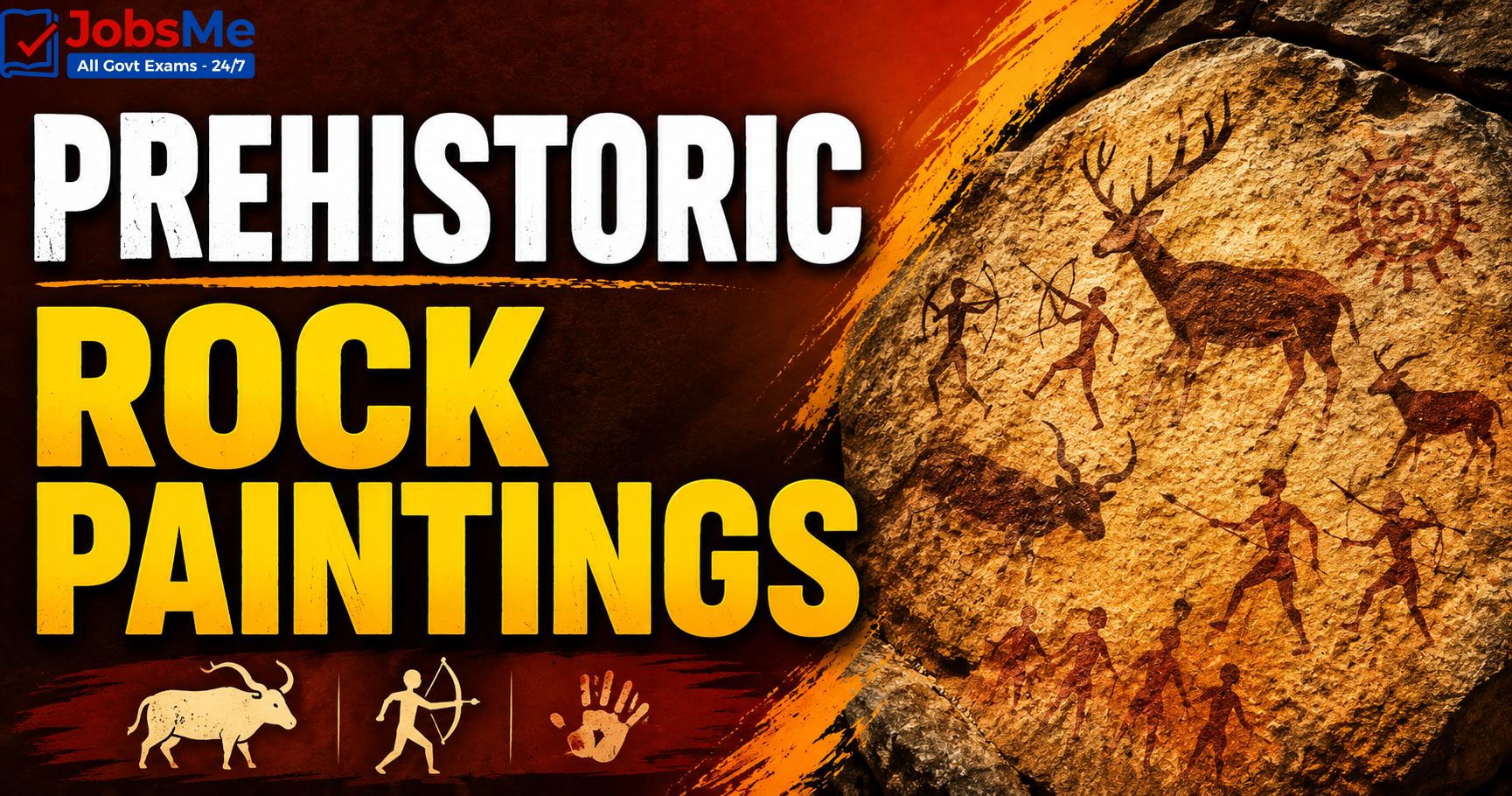
The earliest known paintings in India date to the Upper Palaeolithic period. Rock engravings of this period are called Petroglyphs. The most important prehistoric painting site is Bhimbetka caves (Madhya Pradesh), discovered in 1957-58 and declared a UNESCO World Heritage Site in 2003. These caves are nicknamed the "Zoo Rock Shelter" due to depictions of elephants, rhinoceroses, deer, tigers, snakes and other fauna. Other significant sites include the Lakhudiyar rock shelters on the banks of the River Suyal (Uttarakhand) and the Jogimara caves in Chhattisgarh. Key Bhimbetka facts:
- Located south of Bhopal in the Vindhya ranges of Madhya Pradesh
- Over 500 rock paintings; oldest estimated at 30,000 years
- Continuous occupation from 1,00,000 BC to 1000 AD — many paintings superimposed over older ones
- Wall material: quartzite rock; pigments: mineral-based ochre (geru), lime, and natural colours
- Most paintings belong to the Mesolithic period
Three Major Periods of Prehistoric Painting
| Period | Approximate Time | Colours Used | Themes and Characteristics |
|---|---|---|---|
| Upper Palaeolithic | 40,000 - 10,000 BC | White, dark red, green; ochre (geru) + lime + water | Large animals — bison, elephants, rhinos, tigers; stick-like human figures; hunters shown in red, dancers in green; linear representations |
| Mesolithic | 10,000 - 4,000 BC | Predominantly red | Paintings became smaller; themes expanded — group hunting, community dances, grazing, riding scenes; animals painted naturalistically, humans stylistically |
| Chalcolithic | 3,500 - 1,000 BC | Green and yellow increased; cross-hatched and spiral motifs | Battle scenes; humans riding horses and elephants; pottery and metal tools depicted; complex geometric shapes — spirals, rhomboids, circles |
Mural Paintings in India (Bhittichitra)
Mural paintings are large-scale works applied to walls or ceilings of rock-cut caves and structural temples. India's mural tradition spans from the 2nd century BCE to the 19th century CE. The word Bhittichitra is used for mural painting in Indian texts.
Ajanta Cave Paintings (Maharashtra)
- Period: 2nd century BCE to 5th-6th century CE (Maurya, Shunga, Satavahana, Vakataka, and Gupta periods)
- Number of caves: 29 caves, carved in a horse-shoe shape into volcanic rock
- Technique: Tempera style (pigments applied on a dry surface); both mural and fresco (wet plaster) methods used; outline colour is red ochre
- Themes: Jataka stories, life of Buddha, court scenes, elaborate flora and fauna
- Most famous paintings: Padmapani (Avalokitesvara) and Vajrapani bodhisattvas; Mahajanaka Jataka; Umaga Jataka; Dying Princess (Cave 16)
- Caves 9 and 10 belong to the Shunga period; remaining caves belong to the Gupta period
- Influence extended to South India, Sri Lanka, and Southeast Asia up to the 10th century CE
Ellora Cave Paintings (Maharashtra)
- Period: 5th to 10th centuries CE; 34 monasteries and temples dedicated to Buddhism, Hinduism, and Jainism
- Mural paintings best preserved in the Kailasa (Kailashnath) Temple
- Themes: Vishnu and Lakshmi with Garuda, flying Apsaras, Shaiva holy men, themes from Shiva Purana
- Paintings done in two phases; later paintings show Gujarati influence
- Stylistic features: angular arms, sharp head twists, concave curves, long open eyes
- The peculiar eye placement and angular nose of Ellora (Rashtrakuta period) influenced Jain manuscript painting from the 12th century CE
- This is the last surviving example of the Ajanta style of mural painting
Bagh Cave Paintings (Madhya Pradesh)
- Located 97 km from Dhar district; Buddhist murals from the Satavahana period
- Considered an extension of the Ajanta school, with similar design and execution but more tightly modelled figures and stronger outlines
- More secular themes compared to Ajanta; Cave 4 is called Rang Mahal
- This is the other surviving example of Gupta-period painting besides Ajanta (UPSC 2010 PYQ)
Sittanavasal Cave Paintings (Tamil Nadu)
- Period: 1st century BCE to 10th century CE; Jain themes and symbolism
- Painted on walls and ceilings; technique similar to Ajanta and Bagh
- Themes: lotus pool, birds, elephants, buffaloes, youth plucking flowers
- Represents the Pallava continuation of the Ajanta mural tradition
Other Important Mural Sites
| Site | State | Period / Dynasty | Key Highlights |
|---|---|---|---|
| Armamalai Caves | Tamil Nadu (Vellore) | 8th century CE; Jain | Depictions of Astathik Palakas (deities of 8 directions); mix of north and south Indian techniques |
| Jogimara Caves | Chhattisgarh (Surguja) | 1000-300 BCE | Brahmi script inscriptions; love story theme; dancing couples, animals; white base plaster with red outlines |
| Badami Caves | Karnataka | 6th-7th CE; Chalukyas | One of the earliest Hindu paintings; graceful figures; Cave 3 — Brahma on swan; UNESCO World Heritage Site |
| Lepakshi Temple (Veerabhadra) | Andhra Pradesh | 16th CE; Vijayanagara | Ramayana, Mahabharata, Vishnu themes; black outlines; no primary colours used |
| Brihadisvara Temple | Tamil Nadu (Tanjore) | Chola period | Two layers of Chola paintings on walls; South Indian tradition |
| Virupaksha Temple (Hampi) | Karnataka | Vijayanagara | Murals of sage Vidyaranya's procession; Tripurantaka; Narasimha; Girija Kalyana |
| Padmanabhaswamy Temple | Kerala (Trivandrum) | Chera / Kerala tradition | Colourful murals combining Vijayanagara influence with vibrant local expression |
| Ravan Chhaya Rock Shelter | Odisha | 7th century CE | Half-opened umbrella-shaped rock shelter; royal procession; tempera technique |
| Mysore Murals | Karnataka | Mysore Sultanate / British era | Last phase of mural painting in India; largest mural depicts the Mysore War between Tipu Sultan and the British |
Miniature Paintings in India
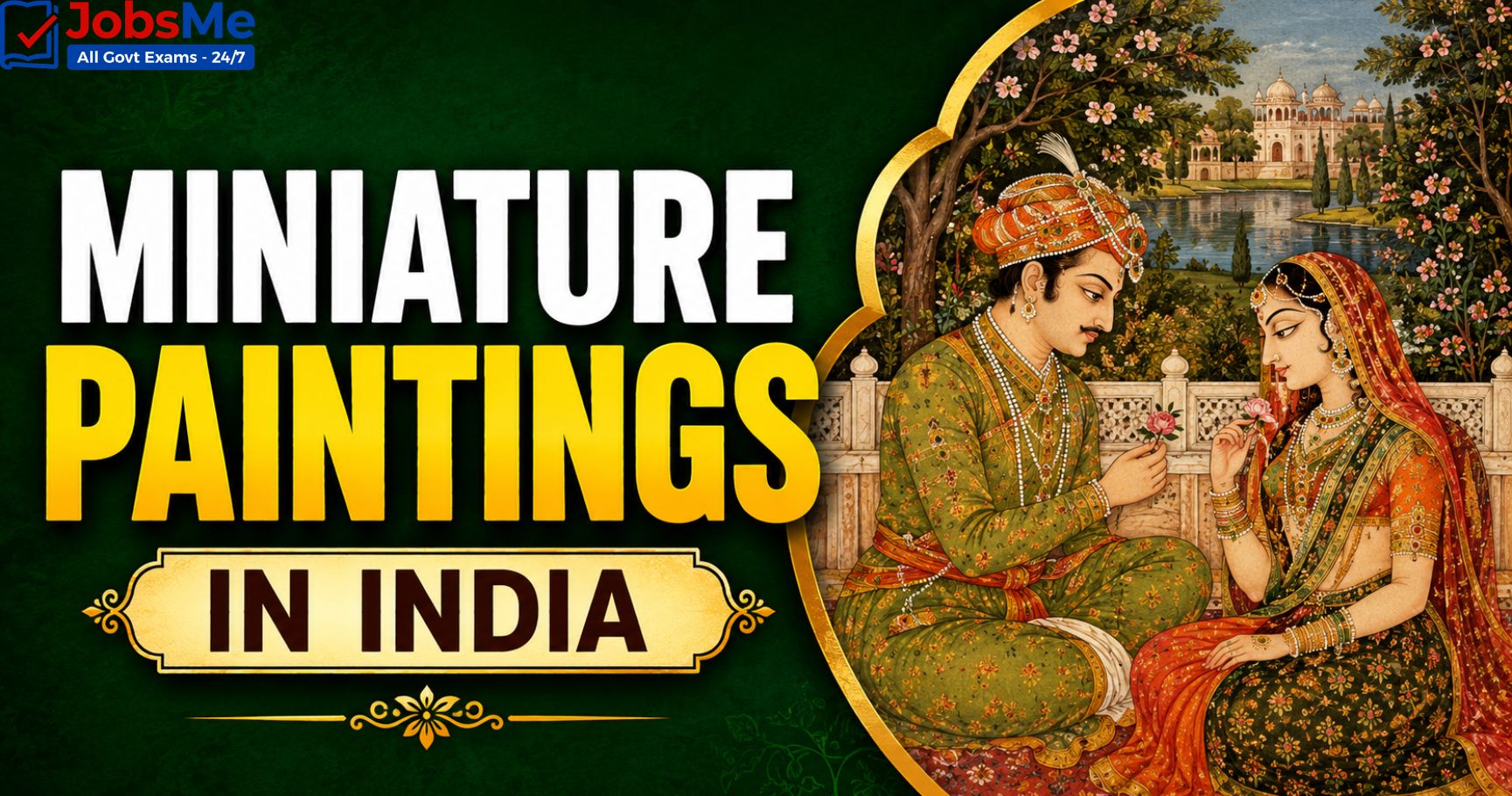
The word miniature is derived from the Latin word Minium (red lead paint). Miniature paintings are small and highly detailed works. Defining characteristics:
- Size: not larger than 25 square inches
- Subject painted at not more than 1/6th of its actual size
- Common physical features depicted: bulging eyes, pointed nose, slim waist
- Executed on palm leaves, vellum, cloth, paper, or ivory
The miniature tradition originated from illustrated Buddhist manuscripts of the Pala period (8th-12th century CE).
Early Miniature Schools
Pala School of Art (750 CE - 1150 CE)
- Eastern India — centres at Nalanda and Vikramshila (Bihar / Bengal)
- Patronized by the Vajrayana school of Buddhism
- Most famous manuscript: Astasahasrika Prajnaparamita
- Executed on palm leaves; later on vellum paper
- Style: sinuous lines, subdued tones, single or few isolated figures
Apabhramsa School of Art (11th-15th Century)
- Western India — Gujarat, Rajasthan (Mewar), and Malwa
- Patronized by the Chalukya dynasty; primarily Jain themes, later also Vaishnavite
- Texts illustrated: Kalpasutra and Kalakacharya Katha
- Transition from palm leaf to paper; style represents reduced-dimension murals
Transition Period — Delhi Sultanate Miniatures
- Blend of Indian and Persian artistic traditions; bright colours, dark outlines, sharp angular faces
- Most notable manuscript: Nimatnama (a book on cookery) — created during the reign of Nasir Shah of Mandu
- Other manuscript centres: Malwa, Bengal, Delhi, Jaunpur, Gujarat, Deccan
Mughal Miniature Paintings
The Mughal school is the most extensively tested miniature tradition in government exams. It developed from Persian-Timurid antecedents and progressively incorporated Indian themes and techniques. The focus shifted from depicting gods to glorifying the ruler and chronicling court life. Key technique introduced by the Mughals: Foreshortening — objects were drawn smaller to appear closer to the viewer, creating a three-dimensional perspective on a flat surface.
| Emperor | Key Contribution to Painting | Notable Works / Artists |
|---|---|---|
| Babur | Patronized Persian artist Bihzad; limited contribution due to short reign | Mughal family tree illustrations |
| Humayun | Introduced Persian influence; brought Persian artists to India; created illustrated albums | Artists: Mir Syed Ali and Khwaja Abdus Samad |
| Akbar | Established Tasvir Khana (formal art studio with salaried artists); introduced 3D effect and foreshortening; inscriptions included painters' names for the first time | Tutinama, Hamzanama, Anvar-i-Suhaili, Gulistan of Sadi; Artists: Basawan, Daswanth, Kesudasa |
| Jahangir | Golden period of Mughal painting; naturalistic approach to flora and fauna; introduced decorated margins; was a skilled artist himself | Paintings of zebra, turkey, cock; Ayar-i-Danish; Artist: Ustad Mansoor |
| Shah Jahan | Reduced liveliness; introduced European influence and pencil sketching; increased use of gold and silver; preferred brighter palettes | Opulent and still compositions |
| Aurangzeb | Did not patronize painting; artists migrated to provincial courts in Rajasthan and hills | Decline of Mughal painting; rise of Rajasthani and Pahari schools |
Rajasthani Schools of Painting
Rajasthani painting is largely synonymous with the Rajput school of painting. It is more colourful and symbolic than the naturalistic Mughal style, with strong devotional (Bhakti) themes. The migration of Mughal court artists due to Aurangzeb's lack of patronage helped these distinct schools develop.
| School | Region | Key Features | Notable Work / Artist / Patron |
|---|---|---|---|
| Mewar | Udaipur | Dominated by artist Sahibdin; literary texts illustrated — Rasikapriya, Ramayana, Bhagavata Purana; extraordinary 'tamasha' paintings show court ceremonies and city views in unprecedented detail | Artist: Sahibdin |
| Kishangarh | Kishangarh, Rajasthan | Most romantic school; women depicted resembling Radha; elongated necks and lotus-shaped eyes; associated with Sawant Singh and beloved Bani Thani | Artist: Nihal Chand; Famous work: Bani Thani |
| Amber-Jaipur (Dhundar) | Jaipur | Detailed palace paintings and court scenes | Patron: Sawai Pratap Singh |
| Marwar | Jodhpur / Bikaner | Bold colours; colourful costumes and ornaments | Patron: Man Singh |
| Bundi | Bundi (Hadoti) | Krishna Bhakti themes; naturalistic treatment of flora and fauna; lush vegetation | Hadoti school |
| Kota | Kota (Hadoti) | Famous for dynamic hunting scenes; bold and vigorous style | Extension of Bundi school |
Pahari Schools of Painting (17th-19th Century)
Pahari painting developed in the sub-Himalayan hill states of the western Himalayas, which were loosely under Mughal suzerainty. It is divided into two broad groups:
Basohli School (Jammu / Dogra — Northern Series)
- Early, bold phase of Pahari painting; uses primary colours — red, yellow, green
- Expressive faces with receding hairline and large lotus-petal-shaped eyes
- Most famous illustrated text: Rasamanjari
- Used Mughal painting techniques on clothing but developed distinct styles
Guler School
- Bridge between Basohli boldness and Kangra refinement; soft colours and naturalism
- Notable artist family: Nainsukh (portraits) and Manaku (illustrated Gita Govinda)
Kangra School (Southern Pahari Series)
- Most refined Pahari school; known for delicate lines, soft colours, and sensuous grace
- Famous series: Barahmasa (Twelve Months) — depicting the effect of each month on human emotions
- Strong Bhakti and Radha-Krishna themes
- Patronized by Raja Sansar Chand of Kangra
Ragamala Paintings
Ragamala (Garland of Ragas) is a series of illustrative paintings based on Indian classical music's ragas. It is a classic example of the fusion of art, poetry, and music in medieval India.
- Created across most Indian schools starting in the 16th-17th centuries
- Each raga is personified by colour and associated with a hero (nayaka), heroine (nayika), specific season, and time of day
- Hindu deities are linked to specific ragas — e.g., Bhairava/Bhairavi → Shiva; Sri → Devi
- Six principal ragas: Bhairava, Deepak, Sri, Malkaush, Megha, and Hindola
- Varieties: Pahari Ragamala, Rajasthani (Rajput) Ragamala, Deccan Ragamala, Mughal Ragamala
Deccani School of Painting
- Offshoot of the Mughal miniature school; influenced by Ellora murals, Mewar, and Malwa traditions
- Centres: Ahmadnagar, Bijapur, Golconda (Hyderabad), Bidar
- Bold colours, Persian and Iranian themes, stylized figures, rich textile patterns, and distinctive gold ornamentation
South Indian Miniatures
Tanjore (Thanjavur) Paintings
- Patronized by the Maratha rulers of Tanjore in the 18th century; reached zenith under Serfoji II (Sarfoji Maharaj)
- Base: glass or wooden board (not cloth or vellum as in north India)
- Unique features: brilliant colours, liberal use of gold leaf, embellishment with gemstones and cut glass
- Themes: predominantly frontal, jewel-adorned Hindu deities
- GI-tagged art form
Mysore Paintings
- Patronized by the rulers of the Mysore province; continued into the British period
- Themes: Hindu gods and goddesses; one dominant figure among multiple figures in each composition
- Distinctive technique: gesso paste (mixture of zinc oxide and Arabic gum) creates a raised, lustrous background
- Muted colours are used alongside the sheen of the gesso base
- GI-tagged art form
Folk Paintings of India
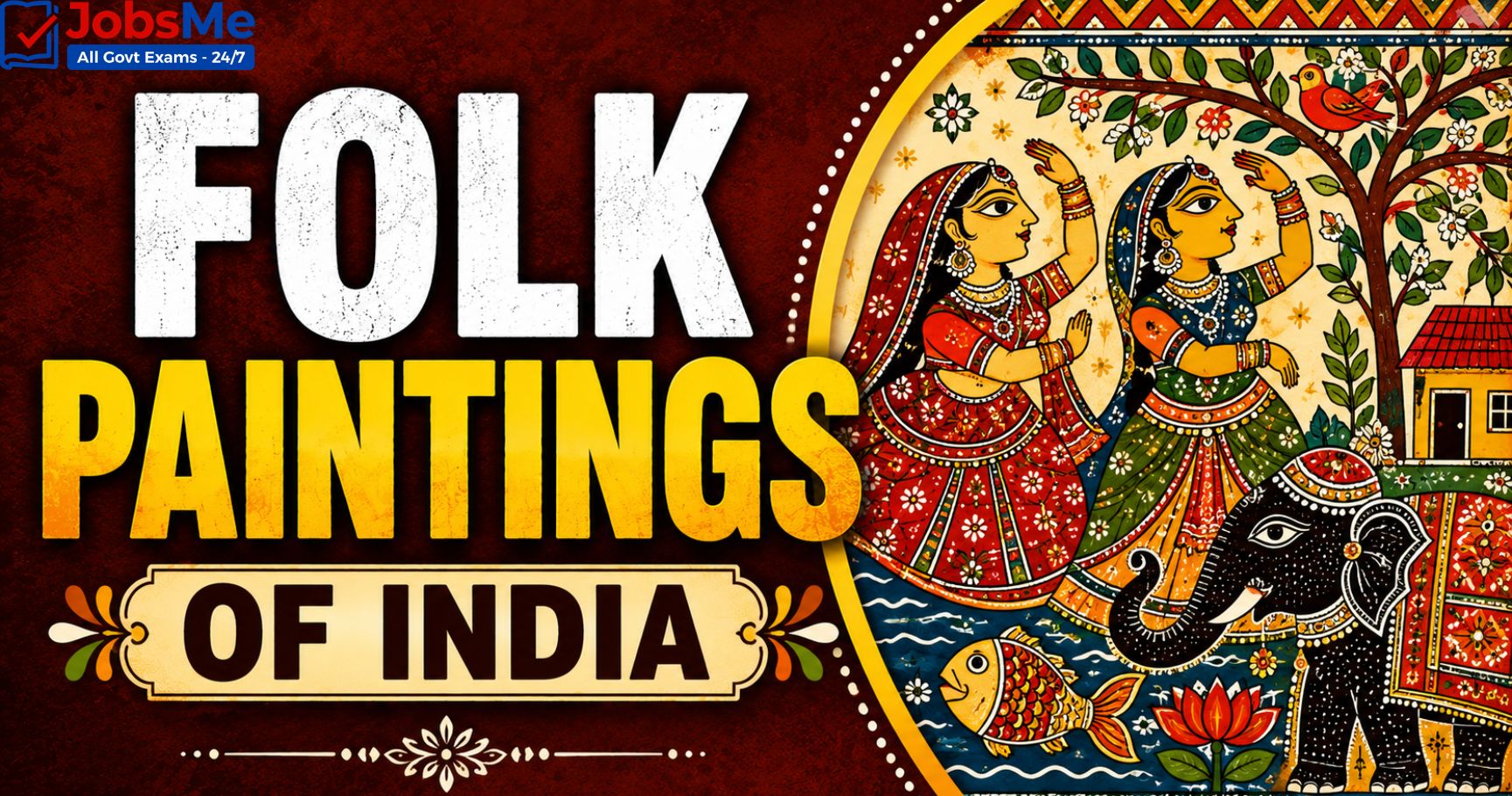
Folk painting traditions are rooted in specific regional cultures, shaped by geography, community beliefs, and local customs. They are generally created to invoke divine blessings, mark occasions, or narrate religious and social stories. For a broader coverage of Indian cultural traditions, see our guide on Indian Fairs and Festivals.
| Folk Painting | State / Region | Medium / Base | Key Features |
|---|---|---|---|
| Madhubani (Mithila) | Bihar (Mithila region) | Paper, cloth, walls | 2D geometric patterns; no empty space; Hindu epics; fish = fertility symbol; natural and earthen pigments; primarily created by village women; GI tagged |
| Kalamkari | Andhra Pradesh | Cotton cloth | Hand-painted using bamboo pen (kalam); vegetable dyes; Vijayanagara origin; also block-printed variant; GI tagged |
| Pattachitra | Odisha | Cloth (Patta = cloth; Chitra = painting) | Dedicated to Lord Jagannath of Puri; artists called Chitrakar; also done on palm leaf (Talapattachitra); GI tagged |
| Kalighat Painting | West Bengal (Kolkata) | Mill-made paper | Watercolour; done by scroll painters-cum-potters (Patua); satirical social and religious themes |
| Phad Painting | Rajasthan | Long cloth scroll | Practised by Joshi clan of Chhipa caste; narrates deeds of regional hero-gods (Pabuji, Devnarayan); scroll-based storytelling |
| Thangka | Sikkim, Himachal Pradesh, Ladakh, Arunachal Pradesh | Cotton or silk | Tibetan Buddhist painting; depicts Buddhist deities or stories; colour symbolism: Red = passion, White = serenity, Black = anger, Green = consciousness |
| Warli | Maharashtra (Gujarat border) | Mud-coated walls, paper | Estimated 2,500-3,000 BC; ritualistic; themes: farming, hunting, festivals; geometric shapes (triangles, circles); white pigment from rice paste |
| Patua / Pata Art | West Bengal | Scroll (Pata) | Storytelling scroll; Mangal Kavyas; political and social themes; also practised by Muslim Patua community |
| Paitkar | Jharkhand | Scroll | Tribal scroll art; associated with Maa Mansa; themes: life after death and journey of the soul |
| Manjusha | Bihar (Bhagalpur) | Jute or paper | Snake paintings; linked to Anga Mahajanapada; associated with the Behula-Bishahari legend |
| Cheriyal | Telangana | Cloth scroll | Also called Nakashi art; bold outlines and vivid colours; community storytelling tradition |
| Pithora | Gujarat / Madhya Pradesh | Mud walls | Tribal art by Rathwa and Bhilala tribes; horses as central motif (divine horses of deity Pithora); ritualistic |
| Saura (Ikons) | Odisha | Walls | Wall murals by Saura tribe; geometric patterns; figures with large heads and big eyes; offerings to nature spirits |
| Gond Painting | Madhya Pradesh | Paper, cloth, walls | Intricate dot and line patterns; themes of nature, trees, animals; practised mainly by Pardhan Gond community |
Modern Indian Paintings
Company Paintings (Late 18th-19th Century)
- A hybrid style combining Rajput, Mughal, and other Indian painting traditions with European techniques (watercolour, linear perspective, shading)
- Emerged when British Company officers employed Indian artists trained in Indian styles
- Centres: Kolkata, Chennai, Delhi, Patna, Varanasi, Thanjavur
- Patrons: Lord Impey, Marquess Wellesley; artists included Ghulam Ali Khan and Shaikh Zia-ud-Din
Bazaar Paintings (Bengal and Bihar)
- Influenced by European encounter; took Greco-Roman (not Indian) elements — copying Greek and Roman statues
- Painted everyday bazaar scenes with European-style backgrounds; also depicted Indian religious themes and courtesans
- Prevalent in the Bengal and Bihar region
Raja Ravi Varma (Kerala, 1848-1906)
- Considered the father of modern Indian painting
- Combined South Indian painting traditions with Western oil painting techniques
- Nicknamed the "Raphael of the East" for his lifelike brushwork
- Famous works: Lady in the Moonlight, Mother India / Shakuntala, Ravana Kidnapping Sita
- A film based on his life, Rang Rasiya, was released in 2014
Bengal School of Art (Early 20th Century)
- A nationalist / Swadeshi reaction against Western art styles prevalent in colonial India
- Artists revived Indian painting techniques inspired by Ajanta, using natural powder colours
- Abanindranath Tagore: Ideological founder; painted Bharat Mata; combined Swadeshi values with Mughal-style miniature techniques
- Nandalal Bose: Key figure; illuminated the original Constitution of India
- Rabindranath Tagore: Unique style with dominant black lines; small-sized paintings
- Amrita Sher-Gil: Associated with this era; used Impressionist and Cubist influences; famous work: Three Women
Calcutta Group — 1943
- Led by Paritosh Sen, Niroda Majumdar, and Pradosh Dasgupta
- Depicted conditions of the people of India through new visual language and novel techniques
Progressive Artists Group (PAG), Bombay — 1948
- Founded by Francis Newton Souza (F.N. Souza) in Bombay in 1948
- Broke away from the Bengal School tradition; symbolizes modern, bold, forceful art of independent India
- Inspired by European Modernism; had no stylistic uniformity among members
- Key members: F.N. Souza, S.H. Raza, M.F. Husain, K.H. Ara, H.A. Gade, S.K. Bakre
- M.F. Husain — famous Cubist painter; series called Personification of Romance
Madras School of Art (Post-Independence)
- Led by Debi Prasad Roy Chowdhury and K.C.S. Paniker
- Emerged as an important modern art centre in post-independence India; influenced a new generation of artists
Summary — Famous Paintings and Their Schools
| Famous Painting / Work | School / Artist | Exam Relevance |
|---|---|---|
| Padmapani Bodhisattva | Ajanta Caves | UPSC 2017 PYQ — Ajanta is correct |
| Bani Thani | Kishangarh School; Artist: Nihal Chand | UPSC 2018 PYQ |
| Bharat Mata | Bengal School; Artist: Abanindranath Tagore | Swadeshi icon; frequently asked |
| Three Women | Amrita Sher-Gil | Modernist; Indo-European fusion |
| Gita Govinda (illustrated) | Pahari School; Artist: Manaku (Guler) | Radha-Krishna devotional art |
| Tutinama (Tale of a Parrot) | Mughal — Akbar period | Tasvir Khana production |
| Hamzanama | Mughal — Akbar period | Large illustrated manuscript (1,400 folios) |
| Nimatnama | Delhi Sultanate (Mandu) | Cookery manuscript; Nasir Shah of Mandu |
| Ravana Kidnapping Sita | Raja Ravi Varma | Modern oil painting; Ramayana theme |
| Personification of Romance | M.F. Husain; Progressive Artists Group | Cubist style |
Memory Tricks and Mnemonics
1. Shadanga (Six Limbs) — "Really Pretty Bears Look So Vivid"
R = Rupabheda | P = Pramanam | B = Bhava | L = Lavanya Yojanam | S = Sadrisyam | V = Varnikabhanga
2. Ajanta Patrons — "SVG = Satavahana → Vakataka → Gupta"
Think of SVG as a high-quality image format — just like Ajanta produces high-quality art. These three dynasties were the key Ajanta patrons in sequence.
3. Mughal Emperor Sequence for Painting — "Big Hippos Always Jump, Staying Apart"
Babur (minimal) → Humayun (Persian start) → Akbar (Tasvir Khana) → Jahangir (Golden era) → Shah Jahan (Gold + still) → Aurangzeb (Decline)
4. Kishangarh = Bani Thani = "Indian Mona Lisa"
The elongated eyes, graceful pose, and romanticism = Kishangarh's trademark. Bani Thani was painted by Nihal Chand. UPSC 2018 asked this directly.
5. Progressive Artists Group — "FRESH Art from Bombay"
F = F.N. Souza (Founder) | R = S.H. Raza | E = evocative/M.F. Husain | S = S.K. Bakre | H = H.A. Gade | A = K.H. Ara
6. Tanjore vs Mysore — Quick Distinction
- Tanjore = BLING → Gold leaf + gems + glass/wood base + bright colours
- Mysore = MATTE GLOW → Gesso paste + muted colours + wooden base
7. Folk Paintings by State — Easy Grouping
- Bihar → Madhubani, Manjusha
- Jharkhand → Paitkar
- Andhra Pradesh → Kalamkari
- Odisha → Pattachitra, Saura
- Maharashtra → Warli
- West Bengal → Kalighat, Patua
- Rajasthan → Phad, Pithora (also Gujarat/MP)
- Telangana → Cheriyal
- Sikkim / Ladakh / HP → Thangka
8. Kalamkari — "Kalam = Pen → Hand + Pen = Kalamkari"
UPSC 2015 asked this: Answer = hand-painted cotton textile in South India (Andhra Pradesh). Kalam = pen; Kari = craft or work.
9. Bengal School vs PAG — A Timeline Relay Race
Bengal School (early 1900s → nationalist → Abanindranath) hands the baton to → Progressive Artists Group (1948 → post-independence → Souza). Bengal = tradition + Swadeshi. PAG = bold + modern + European modernism.
10. Bagh Caves = Gupta Period (Second Site)
UPSC 2010 asked for the "other surviving example of Gupta-period painting besides Ajanta." Answer = Bagh Caves. Memory trick: "BAgh = Backup Ajanta for Gupta."
Additional Notes — Tricky Facts, PYQ Patterns and Exceptions
Frequently Confused and Exam-Trap Facts:
- Padmapani painting is at Ajanta, NOT Badami, Bagh, or Ellora — UPSC 2017 PYQ.
- Bani Thani belongs to Kishangarh, NOT Kangra or Bundi — UPSC 2018 PYQ.
- Kalamkari = hand-painted cotton textile from Andhra Pradesh, NOT bamboo/wool/silk — UPSC 2015 PYQ.
- Ajanta AND Lepakshi are known for mural paintings; Sanchi Stupa is NOT — UPSC 2013 PYQ.
- The other surviving Gupta-period painting site besides Ajanta is Bagh Caves — UPSC 2010 PYQ.
- Nandalal Bose illuminated the original Constitution of India — not Abanindranath or Rabindranath Tagore.
- Tasvir Khana was established by Akbar, not Jahangir. Jahangir's period is called the golden period.
- Ustad Mansoor was the leading naturalist painter under Jahangir, not under Akbar.
- Mir Syed Ali and Khwaja Abdus Samad were brought to India by Humayun, not Akbar.
- Gesso paste (zinc oxide + Arabic gum) is a technique unique to Mysore paintings.
- Bhimbetka was declared UNESCO World Heritage Site in 2003; discovered in 1957-58.
- The Shadanga was first described by Vatsyayana in Kamasutra, not in any painting-specific text.
- Warli painting is estimated to be 2,500-3,000 years old — one of the oldest living tribal art traditions.
- The last phase of mural painting in India is associated with Mysore murals (Tipu Sultan vs British).
GI-Tagged Paintings (Important for Banking / SSC):
- Kalamkari — Andhra Pradesh
- Tanjore Paintings — Tamil Nadu
- Mysore Paintings — Karnataka
- Madhubani Paintings — Bihar
- Pattachitra — Odisha
Repeating PYQ Patterns to Watch:
- UPSC frequently asks about the location of specific paintings (Padmapani, Bani Thani) — always verify the exact site.
- SSC / Railways test Kalamkari, Madhubani, Pattachitra — their state, medium, and technique.
- IBPS and Banking exams test modern artists and movements (Progressive Artists Group, Bengal School).
- Defence exams ask about Ajanta period and patronage.
- Thangka paintings and Ragamala are common in State PCS and UPSC optional questions.
For related topics, explore our guides on Dances of India, Musical Instruments of India, and Temples in India to complete the Art and Culture section.
One-Liners for Quick Revision
- The earliest known paintings in India are from Bhimbetka caves, Madhya Pradesh — Upper Palaeolithic period.
- Shadanga (Six Limbs of Painting) was first described by Vatsyayana in his Kamasutra (3rd century AD).
- Bhimbetka was discovered in 1957-58 and declared a UNESCO World Heritage Site in 2003.
- Ajanta caves have 29 caves; murals date from the 2nd century BCE to 7th century CE.
- The most famous painting of Ajanta is Padmapani (Bodhisattva Avalokitesvara).
- Mural paintings of the Ellora caves are mainly preserved in the Kailasa Temple.
- The last surviving example of Ajanta-style mural painting is at Ellora (Rashtrakuta period).
- Bagh Caves is the other surviving example of Gupta-period paintings besides Ajanta.
- Foreshortening technique was introduced into Indian miniature painting by the Mughals.
- Akbar established the Tasvir Khana and first included painters' names in inscriptions.
- The golden period of Mughal painting was under Jahangir; Ustad Mansoor was his leading artist.
- Humayun brought Persian artists Mir Syed Ali and Khwaja Abdus Samad to India.
- Bani Thani belongs to the Kishangarh School; painted by Nihal Chand.
- Kangra School is known for the Barahmasa (Twelve Months) series; patronized by Raja Sansar Chand.
- Sahibdin is the dominant artist of the Mewar School of Rajasthani painting.
- Nimatnama (cookery manuscript) belongs to the Delhi Sultanate — Nasir Shah of Mandu.
- Tanjore paintings use gold leaf and gemstones on glass or wooden boards; patronized by Maratha rulers.
- Mysore paintings use gesso paste (zinc oxide + Arabic gum) to create a lustrous raised background.
- Kalamkari = hand-painted cotton textile of Andhra Pradesh; kalam = pen; kari = craft.
- Pattachitra of Odisha is dedicated to Lord Jagannath; artists are called Chitrakar.
- Madhubani painting uses the fish as a symbol of fertility and good luck.
- Warli paintings use white rice paste on mud walls; tradition estimated at 2,500-3,000 BC.
- Thangka paintings are Tibetan Buddhist and prevalent in Sikkim, Ladakh, and Arunachal Pradesh.
- Pithora is tribal art by the Rathwa tribe of Gujarat/MP, centred on divine horses.
- Raja Ravi Varma of Kerala is called the "Raphael of the East" and father of modern Indian painting.
- Abanindranath Tagore painted Bharat Mata and is the ideological founder of the Bengal School.
- Nandalal Bose illuminated the original Constitution of India.
- The Progressive Artists Group was founded by F.N. Souza in Bombay in 1948.
- M.F. Husain was both a Cubist painter and a member of the Progressive Artists Group.
- Ragamala paintings fuse art, poetry, and music; each raga is associated with a season, deity, and emotion.
- The six principal ragas in Ragamala are: Bhairava, Deepak, Sri, Malkaush, Megha, and Hindola.
- Pala School is the earliest Indian miniature tradition (750-1150 CE); Buddhist; palm leaf base.
- Apabhramsa School is from Gujarat and Rajasthan; Jain themes; illustrated the Kalpasutra.
- Company Paintings blended Mughal and Rajput techniques with European watercolour and linear perspective.
- The Mysore murals depicting the Tipu Sultan vs British war represent the last phase of mural painting in India.
For daily practice, try our Static GK Quiz and stay updated with Daily Current Affairs.
Free quiz • No signup required
Put this topic into practice with Indian Cultural Institutions – Static GK MCQ Quiz. It is the quickest way to reinforce what you just learned.
Frequently Asked Questions
Which is the oldest known site of rock paintings in India?
Where is the painting of Bodhisattva Padmapani located?
What is Kalamkari painting and which state is it associated with?
Which school of painting does the famous "Bani Thani" belong to?
Who founded the Progressive Artists Group and when?
What is the difference between Tanjore and Mysore paintings?
Who illuminated the original Constitution of India?
What are the six limbs of Indian painting (Shadanga)?
Which historical places are known for mural paintings?
What are the major folk paintings of India and their associated states?

About the author