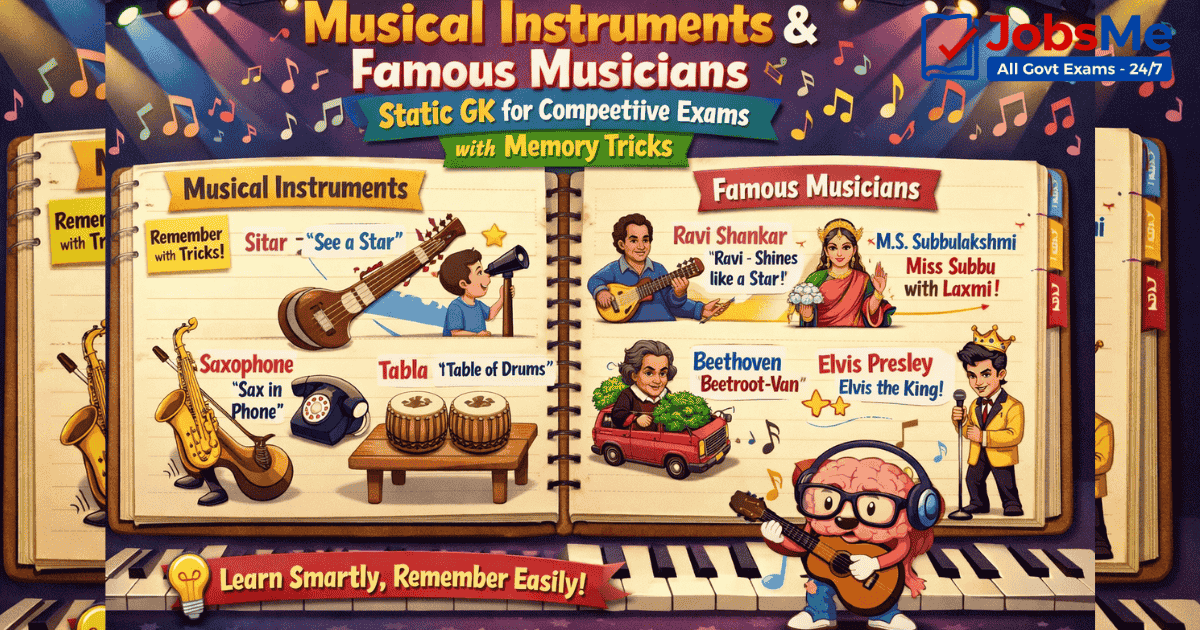
Indian Music – Classical, Folk & Fusion | Static GK for Competitive Exams with Memory Tricks
A complete Static GK guide on Indian Music covering Hindustani and Carnatic classical music, folk music state-wise, fusion forms, semiclassical genres, and modern music — with memory tricks, one-liners, and exam-ready notes for UPSC, SSC, IBPS, Railways, Defence, and all State Government exam aspirants.
Jump to section
Introduction
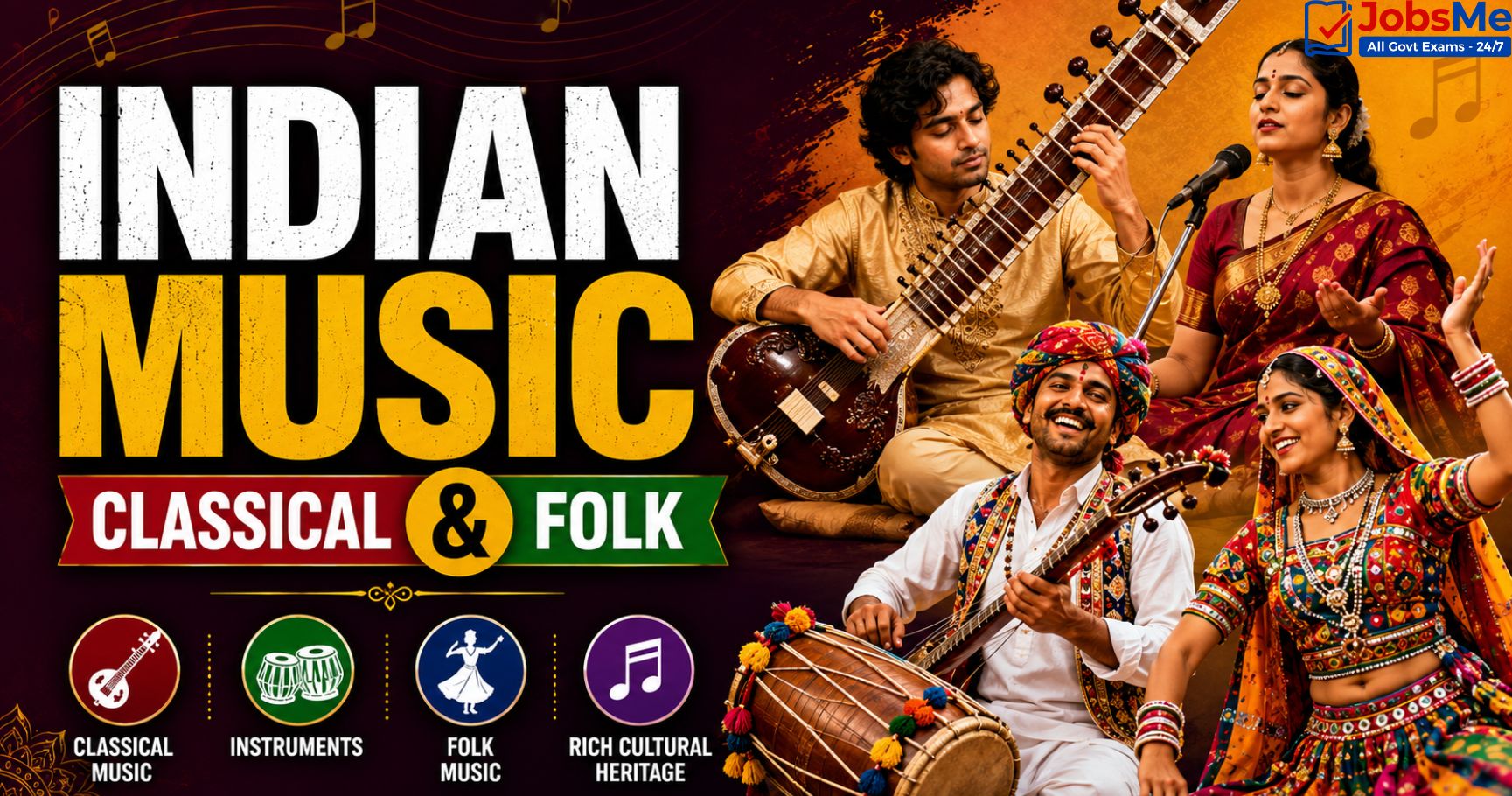
Indian music is one of the oldest and richest musical traditions in the world. It spans thousands of years, rooted in the Vedic period, and has continuously evolved to include diverse classical systems, regional folk traditions, devotional music, and modern genres. For government exam aspirants preparing for UPSC, SSC CGL, IBPS PO, RRB NTPC, PSU, Defence, Insurance, and State PCS exams, Indian Music is a recurring topic under General Awareness and Static GK.
Bharatmuni's Natyashastra is considered the earliest treatise on music in India. The Samaveda is regarded as the Veda of music, and its later portion — the Gandharva Veda — is considered the rule book of Indian classical music. Indian music mentions approximately 16,000 Ragas and Raginis.
Indian music is essentially melodic in nature — one note follows another in a continued sequence, unlike the Western harmonic tradition where sounds are superimposed on one another. It is believed that before the 13th century, Indian music was largely uniform. The divergence into Hindustani and Carnatic systems began during the Delhi Sultanate period.
For a comprehensive revision of related topics, explore Static GK Notes on Jobsme.in and sharpen your preparation with Static GK Practice Quizzes.
Basics of Indian Music
A. Swara (Notes)
Swara refers to the note, tone, and frequency in Indian music. There are 7 pure notes (Shuddha Swara):
| Abbreviation | Full Name |
|---|---|
| Sa | Sadja |
| Re | Reshabha |
| Ga | Gandharva |
| Ma | Madhyam |
| Pa | Pancham |
| Da | Dhaivata |
| Ni | Nishadh |
Shruti is the feeblest (smallest perceivable) sound unit in Indian music. There are 22 Shrutis in the Indian system of Swara.
B. Raga
A Raga is a specific combination of Swaras that creates a distinct mood or feeling. At least 5 distinct Swaras are required to form a Raga. On the basis of the number of notes used, Ragas are classified into three types:
| Type of Raga | Number of Swaras Used |
|---|---|
| Odhava Raga | 5 distinct Swaras |
| Sadhav Raga | 6 distinct Swaras |
| Sampoorna Raga | All 7 Swaras |
C. Taal (Rhythm)
Taal is the rhythmic cycle or arrangement of beats in a cyclical pattern. On the basis of the number of rhythmic cycles, Taals are classified as follows:
| Taal | Rhythmic Cycles (Beats) |
|---|---|
| Tishra | 3 |
| Chatusara | 4 |
| Khanda | 5 |
| Misra | 6 |
| Sankirtana | 7 |
Hindustani Classical Music
Hindustani Classical Music is followed in North India and all regions other than the southern states. Amir Khusrau is considered the pioneer and most influential figure in the development of Hindustani music. From the very beginning, Hindustani music followed the Time-Season-Mood theory of Raga, meaning specific Ragas are associated with specific times of day, seasons, and emotional moods.
A. Classical Hindustani Forms
1. Dhrupad
Dhrupad is the oldest classical music form in India. It emerged from the temples of Braj and Awadh. It is a sober and restrained form that demands significant effort from the lungs and vocal cords and involves a very high level of vocal frequency.
The performance sequence of Dhrupad is: Alaap → Jod → Sthayi → Antara → Sanchari → Abhaga.
- Raja Mansingh Tomar of Gwalior popularised Dhrupad.
- In the court of Akbar, the most celebrated Dhrupad singer was Tansen (originally named Ramtanu Pandey). Akbar gave him the title "Miyan" (Master of Dhrupad).
- Another famous singer in Akbar's court was Baiju Bawra.
Popular Dhrupad Gharanas:
- Dagari Gharana
- Darbhanga Gharana
- Betiah Gharana
- Vishnupur Gharana
2. Khayal
Khayal is a Persian word that means thought or imagination. Its origin is attributed to Amir Khusrau. Compared to Dhrupad, Khayal gives the singer more freedom in terms of structure and form, but the singer must emphasise the Raga at all times. Khayal is romantic in nature.
Khayal is performed in two stages:
- Bada Khayal - Slow tempo, elaborate exploration of the Raga.
- Chota Khayal - Fast tempo, more rhythmically driven.
Popular Khayal Gharanas: Kairana, Gwalior, Patiala, Jaipur, and Agra.
B. Semiclassical Hindustani Forms
| Form | Key Features |
|---|---|
| Thumri | Developed by Bhakti saints of North India. Semi-devotional and semi-romantic. Highlights love and devotion. Types: Purbi Thumri (slow tempo) and Punjabi Thumri (fast tempo). Gharanas: Banaras and Lucknow. |
| Dhamar | Performed during the festival of Holi in the Barsana, Mathura, and Vrindavan area. Highlights the love of Lord Krishna with the Gopis. |
| Tarana | Evolved in North India and was popular among the aristocratic class. Created for entertainment. Has very few meaningful words; relies heavily on rhythmic syllables. |
| Tappa | Developed by camel riders of North West India using local idioms. Noted for quick turns of phrases (rapid note movements). Later gained a higher tempo in Punjab. |
| Qawwali | Contribution of Amir Khusrau. Composed small couplets praising Allah, the Prophet, and Sufi saints. Performed during Urs festivals. Instruments: originally Daff; now Dholak, Tabla, Manjira, Harmonium. |
| Ghazal | Product of Persian influence. Mainly romantic poetry with an underlying Sufi element. Famous composers: Mirza Ghalib and Mir Taqi Mir. |
Carnatic Classical Music
Carnatic music is confined to Karnataka, Andhra Pradesh, Tamil Nadu, and Kerala. It is described as highly scientific in nature and is based on the 72 Raga system (Melakarta Raga System).
- Sangitsara of Vidyaranya is considered the forerunner of Carnatic music.
- Venkatamukhi wrote Chaturdandi Prakashika in the mid-17th century, which formed the basis of the 72 Melakarta system.
- Popularised further by Vishnu Narayan Bhatkhande in the 20th century.
Features of Carnatic Music
Carnatic music takes place in 3 stages:
- Ragam - Improvised Alapana (free exploration of the Raga without rhythmic cycle).
- Tanam - Rhythmic inter-connector between Ragam and Pallavi.
- Pallavi - Sets the melody to the Taal (rhythmic cycle).
Two versions of Carnatic compositions:
- Kriti - The song (lyrics and melody) is emphasised.
- Kritanayi - The music (instrumental aspect) is emphasised.
Famous Personalities of Carnatic Music
| Category | Names |
|---|---|
| Father (Pitamah) of Carnatic Music | Purandara Das |
| Male Trinity | Thyagaraja, Shyamasastri, Muthuswami Dikshitar |
| Female Trinity | D.K. Pattammal, M.L. Vasanthakumari, M.S. Subbulakshmi |
Folk Music of India
Folk music is the music of the common people. Unlike classical music, it has no rigid rules or principles. It is community-based, largely dance-oriented, and is transmitted orally across generations. Folk music is closely associated with life events such as births, marriages, harvests, and festivals. The earliest references can be traced to the Satapatha Brahmana and Aitareya Brahmana (1500-500 BCE), where examples of wedding songs are found.
To explore more on related cultural topics, visit Dances of India - Static GK and Folk Theatre of India.
Characteristics of Folk Music
- No fixed rules, but a specific community-based pattern must be understood to appreciate it.
- Transmitted orally from generation to generation, not through written texts.
- Closely associated with dance — most folk music is performed alongside a dance form.
- Each performance may be unique and vary from region to region.
- Repetition is a common feature; the first line is often emphasised.
- Covers a wide variety of themes: agriculture, love, birth, marriage, bravery, mythology, and daily life.
Folk Music of Uttar Pradesh
| Folk Music | Description |
|---|---|
| Rasiya Geet | Flourished in the Braj region (land of Lord Krishna's leelas). Not tied to any particular festival; woven into daily chores. Instruments: Kettle Drums, Dholak, Harmonium, Cymbals. |
| Hori | Sung during the festival of Holi. Based on the love pranks and stories of Radha-Krishna. |
| Sohar | Sung when a son is born in a family. A version of Sohar also gained currency in Muslim families of some parts of UP, showing a mingling of cultures. |
| Kajri | Sung by women during the rainy season. On the third day of the second half of the Bhadra month, women sing Kajri through the night while dancing in a semi-circle. Instruments: Sitar, Sarod, Veena, Bansuri, Santoor. |
| Alha | Heroic ballad from Bundelkhand. Narrates the deeds of warrior brothers Alha and Udal, who served Raja Parmal of Majoba. Sung in Braj, Awadhi, and Bhojpuri languages. Also connected to the Mahabharata — Alha, Udal, Malkhan, Lakhan, and Deva are seen as reincarnations of the Pandavas. |
Folk Music of Rajasthan
| Folk Music | Description |
|---|---|
| Maand | Developed in the royal courts. Unique — it is neither fully classical nor purely folk, and is recognised in classical circles. Glorifies Rajput rulers. Close to Thumri and Ghazal. The famous song "Kesariya Balam" is in Maand style. Instruments: Sarangi, Percussion. |
| Pankhida | Sung by peasants while working in the fields. Instruments: Algoza and Manjira. Literally means "lover." |
| Lotia | Sung during the Lotia festival in the Chaitra month. Women carry lotas (water vessels) filled with water, decorated with flowers, while singing this song. |
| Teej Songs | Sung by women during the Teej festival (third day of Shravan month). Themes: union of Shiva and Parvati, monsoon, greenery, peacock dance. |
| Pani Hari | About women fetching water from wells. Portrays the scarcity of water, long distances women travel, and the daily life dynamics (mother-in-law and sister-in-law relationships). Instruments: String and Percussion. |
Folk Music of Maharashtra
| Folk Music | Description |
|---|---|
| Lavani | A combination of traditional dance (Tamasha) and music, performed on Dholki beats. Traditionally sung by female artists. Originally performed to entertain soldiers. |
| Powada | Traditional ballad genre. The word Powada means "narration of a story in glorious terms." The chief narrator is known as the Shahir, who plays the Duff. Themes: heroic deeds of figures like Chhatrapati Shivaji. |
| Owi (Ovi) | Sung by women during household work. Couplets describe women's maternal home (maika) and marital home (sasural). Considered the oldest Marathi song (referenced in written poetry since the 13th century). Also found in Goa. |
Folk Music of West Bengal
| Folk Music | Description |
|---|---|
| Baul | Sung by Bauls — a group of mystic minstrels from Bengal. Bauls form a syncretic religious sect combining Hindu Bhakti and Sufi traditions. Their membership includes Vaishnava Hindus and Sufi Muslims. Had a profound influence on Rabindranath Tagore's poetry and Rabindra Sangeet. Instruments: Ektara, Khamak, Dotara. Prominent exponents: Lalon Fakir, Purno Chandra Das, Naboni Das. |
| Bhatiali | Sung by the fishing and boat-riding community of Bengal. Themes: nature and daily life. Famous singer: Nirmalendu Chowdhury. |
Folk Music of Assam
| Folk Music | Description |
|---|---|
| Bihu Songs (Bihu Geet) | The most distinctive folk songs of Assam. Associated with New Year celebrations and an ancient fertility cult. Themes: nature, love, social messages. Instruments: Dhol, Pipe, Gogona, Taal, Banhi, Toka. |
| Borgeet | Composed by Sankardeva and Madhavdeva in the 15th-16th century. Associated with the Ekasarana Dharma (Vaishnavism of Assam). |
| Zikir | Embodies the teachings of Islam. Found in the Muslim communities of Assam. |
| Jhumair | Quite famous among the tea tribes of Assam. Popular in eastern states. |
Folk Music of Jammu and Kashmir
| Folk Music | Description |
|---|---|
| Chhakri | The most popular group folk song of Kashmir. Themes: fairy tales and love stories. Instruments: Noot (earthen pot), Rabab, Sarangi, Tumbaknari. |
| Wanawan | Sung during wedding ceremonies. Considered very auspicious. |
| Bhakha | Sung post-harvest by villagers in the Jammu region. Considered the most melodic and harmonious regional music. Instruments: Harmonium. |
| Ladishah | Narrates the socio-political atmosphere of the state. Instruments: Dhukar (a crude instrument made of a metal rod with iron rings). |
Folk Music of Chhattisgarh
Pandavani is the most well-known folk form from Chhattisgarh. It is a lyrical folk ballad that narrates stories of the Pandavas from the Mahabharata, with Bhima as the central hero. It encompasses both singing (gayan) and instrument playing (vadan). The accompanying instrument is the Tambura; other instruments include Manjira, Harmonium, Dholak, and Tabla.
Pandavani has two distinct styles of narration:
- Vedamati style - The lead artist narrates the story simply, sitting on the floor throughout the performance.
- Kapalik style - Livelier; the narrator enacts the incidents and characters with full expression and movement.
Famous exponents: Teejan Bai and Ritu Verma. Pandavani is also popular in Odisha, Madhya Pradesh, and Andhra Pradesh.
Folk Music of Punjab
| Folk Music | Description |
|---|---|
| Bhangra | Dance-oriented folk music from Punjab; today a global pop genre. The female counterpart dance of Punjab is called Gidda. Instruments: Dhol, Tumbi, Dholak, Sarangi, Flute, Harmonium, Tabla. |
| Tappa | Semi-classical music depicting the plight of the lover. Inspired by folk songs of camel riders. Instruments: Tabla, Dholak, Wind instruments. |
| Jugni | Sung during Punjabi weddings. Instruments: Dholak, Cymbals, Wind instruments. |
| Dhadi | Ballads of bravery. Sung by Dhadi singers to recount acts of courage and valor. |
Folk Music of Gujarat
| Folk Music | Description |
|---|---|
| Dandiya | Dance-oriented folk music. Accompanies the Dandiya Raas (stick dance). Popular during Navratri. Instruments: Dhol, Dholak, Tabla. |
| Garba | Sung during the Garba dance. Closely associated with the worship of Goddess Amba. Instruments: Dhol, Harmonium, Drums. |
Folk Music of Tamil Nadu
| Folk Music | Description |
|---|---|
| Villu Pattu ("Bow Song") | Lead singer plays the Villu (bow) instrument while narrating. Themes are theological — emphasising the victory of good over evil. Also called the Bow Song. |
| Nattupura Padalgal | Associated with the harvesting season. Due to the dominance of Carnatic music, this form is fast disappearing. |
| Kummi Pattu | Accompanies the Kummi dance. Sung during rituals and festivals throughout Tamil Nadu. |
| Ammanaivari | Sung by women while playing the ball game Ammanai. Songs praise the Chola monarchs. |
Folk Music of Karnataka
| Folk Music | Description |
|---|---|
| Bhavageethe | Literally means "music of expression." The singer's expression is the most important element. Themes: nature, love, philosophy. Musically close to Ghazal style. Popular in both Karnataka and Maharashtra. |
| Jaanapada Geethe | Narrates the everyday life of common people. Instruments: Wind and Percussion instruments. |
| Veeragase | Performed during Dussehra processions. |
| Dollu Kunitha (Drum Dance) | Named after Dollu, a percussion instrument. Performed by the Kuruba community. |
Folk Music of Himachal Pradesh
Laman is a unique folk music form from the Kullu Valley of Himachal Pradesh. It is a conversation-style song where a group of girls sings a stanza from one hilltop and a group of boys replies from another. The interesting feature is that the two groups seldom see each other's faces — the intervening hill acts as a natural barrier, and their voices echo across the valley.
Folk Music of Manipur
| Folk Music | Description |
|---|---|
| Sana Lamok | Sung by the Maaiba (priest) during coronation ceremonies to welcome the king. Sung to evoke the spirit of Pakhangba, the presiding deity. Believed to have magical powers. |
| Songs of Lai Haraoba Festival | Lai Haraoba means "festival of gods and goddesses." Performed for the Umang-Lai (forest deity). On the last day: Ougri Hangen (song of creation) and Heijing Hirao (ritualistic song) are sung. |
| Khongjom Parba | A ballad genre narrating the Battle of Khongjom (1891) — fought between the British army and Manipuri resistance forces. A significant cultural-historical record. |
| Khubakeshei | A song accompanied entirely by clapping. No instruments used. |
Folk Music of Mizoram
| Folk Music | Description |
|---|---|
| Saikuti Zai | Composed by Saikuti, a poetess of Mizoram. Praises warriors, brave hunters, and young men aspiring to greatness. Mizo people are traditionally known as a "singing tribe." |
| Chai Hia | Songs of the Chai dance. Sung during the Chapchar Kut festival. Special occasions for singing and dancing are called "chai"; the songs are called "chai hia." |
Folk Music - State-wise Quick Reference Table
| Folk Music | State / Region | Key Theme / Notes |
|---|---|---|
| Mando | Goa | Love, tragedy, social injustice during Portuguese rule. Instruments: Guitar, Violin, Ghumot drum. |
| Banvarh | Goa | Sung during funerals. Instruments: Dhol and Shehnai. |
| Burrakatha | Andhra Pradesh | Dramatic ballad. Tambura played by main performer while narrating. |
| Kolattam (Kolannalu) | Andhra Pradesh | Dance-music combination. Similar to Dandiya stick dance. Dancers move in two circles. |
| Madiga Dappu | Andhra Pradesh | Drum-based folk form of the Madiga community. |
| Daskathia | Odisha | Ballad sung with "Kathi" (wooden clappers / Ram Tali). A form of devotional worship. |
| Bhuta Song | Kerala | Rooted in rituals to ward off evil spirits. Eerie, vigorous music and dance. |
| Sopana Sangeetham | Kerala | Originated in temples. Religious in nature. |
| Ghasiyari Geet | Garhwal, Uttarakhand | Sung by women while collecting grass for cattle. Emphasises the value of labour. |
| Basant Geet | Garhwal, Uttarakhand | Welcomes the Basant (spring) festival on Basant Panchami. Floor designs made with rice flour. |
| Jhoda | Uttarakhand | Two groups of men and women sing alternately, accompanied by dance. |
| Thadya | Uttarakhand | Initially performed in royal courts. One of the most important folk forms of the state. |
| Sukar ke Biah | Bihar (Bhojpuri) | Narrative of love between cosmological deities Shukra and Brihaspati. |
| Domkach | Jharkhand | Popular folk form. Often accompanied by dance. |
| Ja-Jin-Ja | Arunachal Pradesh | Sung during marriages. |
| Nyioga | Arunachal Pradesh | Sung at the end of the marriage ceremony. |
| Heliamleu | Nagaland | Dancing songs. |
| Hereileu | Nagaland | War songs. |
| Neuleu | Nagaland | Songs about legends and myths. |
| Hekaileu | Nagaland | Songs about oneself (personal/introspective). |
| Gha To Kito | Sikkim | Describes the natural beauty of the state. Usually accompanied by dance. |
| Lu Khangthamo | Sikkim | A thanksgiving song performed by both old and young. |
| Manganiars | North-West India (Rajasthan) | Songs of Alexander, local kings, and battles. |
| Borgeet | Assam | Composed by Sankardeva and Madhavdeva (15th-16th century). Associated with Ekasarana Dharma. |
| Lai Haraoba Ishei | Manipur | Sung by Meitei people during Lai Haraoba festival. Related to the religion Sanamahism. |
Fusion of Classical and Folk Music
Over time, classical and folk traditions blended to create new genres known broadly as Sugam Sangeet (light classical music) and devotional forms. These styles contain elements from both classical and folk traditions and are performed both in temples and in public settings.
Bhajan
The word Bhajan is derived from the Sanskrit word "bhaj" meaning "to serve." Bhajans owe their origin to the Bhakti Movement. They are a popular form of devotional singing, usually sung in groups in temples in praise of God.
- Usually based on Shanta Rasa.
- Themes: stories from Ramayana, Mahabharata, lives of Lord Rama, Lord Krishna, and Lord Shiva.
- Instruments: Jhanj, Manjira, Daphli, Dholak, Chimta.
- Famous composers: Meera Bai, Kabir, Surdas, Tulsidas, Guru Nanak, Narsi Mehta.
Kirtan
Kirtans are devotional songs usually sung by Vaishnavas, based on the love stories of Radha and Krishna. They are prevalent in Bengal.
- Transformed into song-and-dance congregations by Chaitanya Mahaprabhu (15-16th century CE), drawing inspiration from Jayadeva's Gita Govinda.
- Two types: Nama-Kirtana (constant uttering of God's name) and Lila-Kirtana (describing Radha-Krishna anecdotes).
- Instruments: Mridanga, Cymbals.
Qawwali
Qawwali is a devotional form of Sufi music. The lyrics are in praise of Allah, Prophet Mohammad, and revered Sufi saints. It is composed in a specific Raga and written in Persian, Urdu, and Hindi.
- Introduced to India from Persia around the 13th century by Sufis.
- Amir Khusrau (1254-1325) was a pioneer in the evolution of Qawwali in India.
- Originally sung to the beat of the Daff. Now accompanied by Dholak, Tabla, Manjira, and Harmonium.
- Usually sung in a group, with one or two lead singers. Performed during Urs festivals.
- Famous exponents: Nusrat Fateh Ali Khan, Aziz Mian, Sabri Brothers, Aziz Nazaan.
Shabad
Shabads are devotional songs of the Sikhs, sung in Gurdwaras on religious occasions. They are ascribed to Sikh Gurus and Bhakti saint-poets.
- Originated as a musical composition around the 17th century CE.
- Guru Nanak and his disciple Mardana are credited with the development and popularisation of Shabad.
- Three distinct styles: Raga-based Shabads, Traditional Shabads (as in the Adi Granth), and those based on lighter tunes.
- Instruments: Harmonium, Tabla, Dholak, Chimta.
- Famous singers: Singh Bandhu, D.V. Paluskar, Vinayak Rao Patvardhan.
Rabindra Sangeet
Rabindra Sangeet (also called Tagore Sangeet) consists of compositions by Nobel Laureate Rabindranath Tagore. It is a blend of classical elements and Bengali folk strains, including deep influences from Baul music.
- Over 2,000 compositions.
- Themes: devotion to God, nature, love, celebration of life, and patriotism.
- One of the most prominent emotions in Rabindra Sangeet is the spirit of patriotism.
Haveli Sangeet
Haveli Sangeet is a type of temple music popular in Rajasthan and Gujarat. It was originally sung in the temple premises and is practiced by the Pushtimarg Sampradaya community (followers of the Pushtimarg path to salvation). Today it is also performed outside temples.
Gana Sangeet
Gana Sangeet is sung in chorus and carries a social or patriotic message. It is used to express patriotic feelings and to protest against social malpractices. The most popular example is India's national song: Vande Mataram.
Other Fusion and Devotional Forms
| Form | State | Purpose / Description |
|---|---|---|
| Abhanga | Maharashtra | Devotional songs in praise of Vithoba (Vitthal). Composed and sung by Tukaram, Namdev, and other saint-poets. |
| Bhatiali | West Bengal | About nature and daily life. Sung by boat and river communities. |
| Tevaram | Tamil Nadu | Sung by the Shaivite community (Oduyars). |
| Sopana Sangeetham | Kerala | Originated in temples. Deeply religious in nature. |
Modern Music in India
Modern Indian music is a broad and dynamic category that continues to evolve. It blends Western genres such as pop, rock, jazz, and electronic music with deep roots in Indian classical and folk music.
- Rock: Indian rock incorporates elements of Indian classical music with rock. In the 1960s, global acts like The Beatles, The Rolling Stones, and The Doors were notably influenced by Indian classical music.
- Jazz: Jazz in India originated in the 1920s in Mumbai and Kolkata, where African-American jazz musicians performed. Goan musicians integrated jazz into the sounds of Hindi film music.
- Psychedelic Trance: Characterised by high-tempo riffs and layered melodies. A sub-genre of trance music.
- Pop: Indian pop music refers to music independent from Bollywood film soundtracks, and is a growing independent genre.
For daily exam preparation resources, visit Daily Current Affairs on Jobsme.in and take the Daily Current Affairs Quiz.
Mnemonics, Memory Tricks and Vivid Memory Aids
Trick 1: The 7 Swaras — "Sa Re Ga Ma Pa Dha Ni"
This is universally known. Just sing it as a musical scale: Sa - Re - Ga - Ma - Pa - Dha - Ni. Each syllable corresponds to Sadja, Reshabha, Gandharva, Madhyam, Pancham, Dhaivata, and Nishadh respectively.
Trick 2: Raga Types by Number of Notes
Remember: "ODD Students Play"
- Odhava = 5 notes
- Dee (Sadhav) = 6 notes
- Sampoorna = 7 notes (all Play)
Trick 3: Male Trinity of Carnatic Music — "Thy Shya Mut"
Thyagaraja + Shyamasastri + Muthuswami Dikshitar = "Thy Shya Mut" (sounds like "They shout"). Repeat it three times and it sticks.
Trick 4: Female Trinity of Carnatic Music — "DK ML MS"
D.K. Pattammal + M.L. Vasanthakumari + M.S. Subbulakshmi. Think of it as three initials on a music trophy: DK - ML - MS.
Trick 5: Dhrupad Gharanas — "Dad Beats Visually"
Dagari + Darbhanga + Betiah + Vishnupur = "Dad Beats Visually"
Trick 6: Khayal Gharanas — "KG PJA"
Kairana + Gwalior + Patiala + Jaipur + Agra = KG PJA. Remember as "KG (kindergarten) plus JA (junior academy)".
Trick 7: Amir Khusrau's Three Contributions — "KKT"
Khusrau gave India the musical power trio: Khayal + Kawali (Qawwali) + Tarana = KKT. Think: "Khusrau's KKT knockout."
Trick 8: Carnatic Music Stages — "RTP: Reach The Peak"
Ragam → Tanam → Pallavi = "Reach The Peak". The music builds from free exploration to rhythmic peak.
Trick 9: Pandavani Two Styles — "V sits, K acts"
Vedamati = Very still (narrator sits throughout). Kapalik = Kinetic (narrator moves and acts). The first letter tells you the behaviour.
Trick 10: Bhajan Composers — "My Kids Study Till Good Night"
Meera Bai + Kabir + Surdas + Tulsidas + Guru Nanak + Narsi Mehta = M-K-S-T-G-N = "My Kids Study Till Good Night"
Trick 11: Baul Music — The Three B's
Baul = Bengal + Bhakti + blend of Sufi — Three B's in one form. It is this unique triple blend that makes Baul globally recognised (UNESCO heritage).
Trick 12: Carnatic Pitamah — "P = P"
Purandara Das = Pitamah. Both begin with "P." Simple and unforgettable.
Trick 13: Thumri Types — "Purbi is Patient, Punjabi is Punchy"
Purbi Thumri = slow, patient tempo. Punjabi Thumri = fast, punchy tempo.
Trick 14: Sohar vs Kajri vs Hori — Birth, Rain, Holi
Think in order of life events: Sohar (birth of son) → Kajri (rainy season) → Hori (Holi festival). Three milestones, three songs, all from UP.
Trick 15: Laman — "Love Across the Hill"
Laman from Himachal Pradesh = boys and girls singing across hilltops without seeing each other. Picture two peaks, two groups, one song echoing through. Kullu Valley.
Additional Notes
Exceptions and Tricky Facts
- Maand (Rajasthan) is the only folk form recognised in classical circles — it is neither fully classical nor fully folk. This "in-between" status is a common exam question.
- Tappa appears in both Folk Music (Punjab - camel rider origin) and Semiclassical Hindustani (current form). Do not confuse the origin with its present classification.
- Owi/Ovi is found in both Maharashtra and Goa. This dual-state association is a frequent exam trap.
- Sohar is specifically sung at the birth of a son, not a daughter. A Muslim version of Sohar also exists in parts of UP — indicating cultural syncretism.
- Baul is simultaneously a religious sect and a musical tradition. Exams often ask about both dimensions.
- Borgeet was composed by Sankardeva and Madhavdeva in 15th-16th century Assam. Do not confuse this with Rabindra Sangeet, which is Tagore's work from Bengal.
- Rabindra Sangeet was deeply influenced by Baul music — a PYQ-type connection frequently tested.
- Qawwali was brought to India from Persia in the 13th century by Sufis — it is not an indigenous Indian form. However, Amir Khusrau significantly evolved it on Indian soil.
- Purandara Das is the "Pitamah" (Grandfather/Father figure) of Carnatic Music — he is NOT its founder or the founder of the system. The system itself is credited to Venkatamukhi.
- Gandharva Veda is the later portion of Samaveda and is considered the rule book of Indian music — not a separate Veda.
Frequently Confused Facts
| Confusion Point | Correct Fact |
|---|---|
| Which Veda is associated with music? | Samaveda (not Rigveda or Atharvaveda) |
| Carnatic vs Hindustani - which is more scientific? | Carnatic — based on 72 Melakarta system; described as "highly scientific" |
| Amir Khusrau vs Tansen | Khusrau = pioneer of Hindustani; origin of Khayal, Qawwali, Tarana. Tansen = most celebrated Dhrupad singer in Akbar's court. |
| Tansen's original name | Ramtanu Pandey. Akbar gave him the title "Miyan." |
| Baul's religious identity | Syncretic — both Vaishnava Hindu and Sufi Muslim members |
| Who developed Thumri? | Bhakti saints of North India (not Sufis) |
| Qawwali's geographic origin | Persia; evolved in India through Amir Khusrau |
| Shabad — when did it originate? | 17th century CE (not ancient period) |
| Bhangra's female counterpart | Gidda is the female folk dance of Punjab |
| Who wrote Chaturdandi Prakashika? | Venkatamukhi (mid-17th century) — basis of Carnatic 72 Melakarta system |
Repeating PYQ Patterns
The following question patterns have appeared repeatedly in SSC, UPSC, IBPS, and State PCS exams. Memorise these thoroughly:
- "Which Veda is associated with music?" → Samaveda
- "Who is the pioneer of Hindustani Classical Music?" → Amir Khusrau
- "What title did Akbar give to Tansen?" → Miyan
- "Which folk song is associated with the birth of a child?" → Sohar (Bihar and UP)
- "Pandavani belongs to which state?" → Chhattisgarh
- "Female Trinity of Carnatic Music" → D.K. Pattammal, M.L. Vasanthakumari, M.S. Subbulakshmi
- "Pitamah of Carnatic Music" → Purandara Das
- "Bihu songs belong to which state?" → Assam
- "Baul music is from which state?" → West Bengal
- "Kesariya Balam is in which folk style?" → Maand (Rajasthan)
- "Chaturdandi Prakashika was written by?" → Venkatamukhi
- "Qawwali was introduced to India in which century?" → 13th century
- "Khongjom Parba narrates which battle?" → Battle of Khongjom, 1891 (Manipur vs British)
- "Teejan Bai is associated with which folk music?" → Pandavani
- "Which folk song is sung during the rainy season in UP?" → Kajri
For topic-wise practice on Indian Art and Culture, use the Static GK Quiz section on Jobsme.in. For exam notifications, check Latest Govt Jobs Notifications.
One-Liners for Quick Revision
- Samaveda is the Veda of music; its later portion Gandharva Veda is the rule book of Indian music.
- Bharatmuni's Natyashastra is the earliest treatise on Indian music, mentioning approximately 16,000 Ragas and Raginis.
- Indian music has 7 Shuddha Swaras (Sa, Re, Ga, Ma, Pa, Da, Ni) and 22 Shrutis.
- A Raga needs a minimum of 5 distinct Swaras; Sampoorna Raga uses all 7.
- Hindustani and Carnatic music diverged during the Delhi Sultanate period; Amir Khusrau is the pioneer of Hindustani.
- Dhrupad is the oldest Hindustani classical form; Tansen (originally Ramtanu Pandey) was its greatest exponent in Akbar's court and was given the title "Miyan."
- Khayal means "thought/imagination" in Persian; originated with Amir Khusrau; Gharanas: Kairana, Gwalior, Patiala, Jaipur, Agra.
- Thumri is semi-devotional; types are Purbi (slow) and Punjabi (fast); Gharanas: Banaras, Lucknow.
- Dhamar is performed during Holi, depicting Krishna's leelas in the Mathura-Vrindavan region.
- Tappa was developed by camel riders of North West India and is noted for quick turns of phrases.
- Qawwali was brought from Persia in the 13th century; Amir Khusrau evolved it in India; performed during Urs.
- Ghazal is of Persian origin, romantic with Sufi undertones; Mirza Ghalib and Mir Taqi Mir are famous composers.
- Carnatic music: Sangitsara (forerunner), Venkatamukhi's Chaturdandi Prakashika (mid-17th century), 72 Melakarta Raga system.
- Carnatic music stages: Ragam → Tanam → Pallavi (RTP).
- Purandara Das is the Pitamah of Carnatic Music; Male Trinity: Thyagaraja, Shyamasastri, Muthuswami Dikshitar; Female Trinity: D.K. Pattammal, M.L. Vasanthakumari, M.S. Subbulakshmi.
- Baul music is from Bengal — a syncretic blend of Hindu Bhakti and Sufi traditions; influenced Rabindranath Tagore.
- Bihu songs from Assam are associated with New Year and an ancient fertility cult.
- Pandavani from Chhattisgarh narrates Mahabharata stories; Bhima is the hero; two styles: Vedamati (seated) and Kapalik (enacted); Teejan Bai is the most famous exponent.
- Bhangra is dance-oriented folk music from Punjab; female counterpart dance is Gidda.
- Lavani from Maharashtra is performed on Dholki beats; the associated dance form is Tamasha.
- Maand from Rajasthan was developed in royal courts and is recognised in classical circles; famous song: "Kesariya Balam."
- Chhakri is the most popular group folk song of Kashmir; Wanawan is sung at weddings.
- Khongjom Parba (Manipur) narrates the Battle of Khongjom of 1891 between British and Manipuri forces.
- Villu Pattu ("Bow Song") from Tamil Nadu emphasises the victory of good over evil.
- Bhajan is derived from "bhaj" (to serve); famous composers: Meera Bai, Kabir, Surdas, Tulsidas, Guru Nanak, Narsi Mehta.
- Kirtan was transformed into song-dance congregations by Chaitanya Mahaprabhu, inspired by Gita Govinda of Jayadeva.
- Shabad originated in the 17th century CE; Guru Nanak and Mardana are credited for its development.
- Rabindra Sangeet is a blend of classical elements and Bengali folk strains; over 2,000 compositions by Rabindranath Tagore.
- Haveli Sangeet is temple music from Rajasthan and Gujarat, practiced by the Pushtimarg Sampradaya community.
- Gana Sangeet carries social and patriotic messages; example: Vande Mataram.
- Abhanga (Maharashtra) praises Vithoba; composed by saint-poets Tukaram and Namdev.
- Jazz music in India originated in the 1920s in Mumbai and Kolkata, brought by African-American jazz musicians.
- Sohar is sung when a son is born (Bihar and UP); Kajri is sung during the rainy season (UP); Hori is sung during Holi.
- Laman (Himachal Pradesh) is a conversation song between boys and girls singing across hilltops in the Kullu Valley.
- Borgeet (Assam) was composed by Sankardeva and Madhavdeva in the 15th-16th century; associated with Ekasarana Dharma.
- Daskathia (Odisha) is a ballad form named after the instrument "Kathi" (wooden clappers / Ram Tali).
- Dollu Kunitha (Karnataka) is a drum dance performed by the Kuruba community using the Dollu percussion instrument.
- Sopana Sangeetham (Kerala) originated in temples and is deeply religious in nature.
- For the latest exam notifications and study resources, visit Jobsme.in Static GK and Banking Awareness Notes.
Free quiz • No signup required
Put this topic into practice with Indian Cultural Institutions – Static GK MCQ Quiz. It is the quickest way to reinforce what you just learned.
Frequently Asked Questions
Which Veda is associated with Indian music?
What is the difference between Hindustani and Carnatic Classical Music?
Who is called the Pitamah (Father) of Carnatic Music?
What contributions did Amir Khusrau make to Indian music?
What is Pandavani and which state is it associated with?
What is Baul music and where does it originate?
What is the difference between Bhajan, Kirtan, and Qawwali?
What is Khongjom Parba?
What is the significance of Sohar, Kajri, and Hori?
Where can I practice quiz questions on Indian Music and Static GK for exams?

About the author